• Donate
  • Our Purpose
  • Contact Us
Executive Magazine
  • ISSUES
    • Current Issue
    • Past issues
  • BUSINESS
  • ECONOMICS & POLICY
  • OPINION
  • SPECIAL REPORTS
  • EXECUTIVE TALKS
  • MOVEMENTS
    • Change the image
    • Cannes lions
    • Transparency & accountability
    • ECONOMIC ROADMAP
    • Say No to Corruption
    • The Lebanon media development initiative
    • LPSN Policy Asks
    • Advocating the preservation of deposits
  • JOIN US
    • Join our movement
    • Attend our events
    • Receive updates
    • Connect with us
  • DONATE
BusinessFinance

Great potential in need of an edge

by Thomas Schellen February 10, 2016
written by Thomas Schellen

“Why is there so much more research done on baldness than on malaria? Because rich people go bald, and they don’t die of malaria.” William H. Gates III

There were times when homegrown private banking in Lebanon looked like a short-distance runner trailing behind the field in a long-distance race. A decade ago, whenever Executive would report on the wealth management and private banking options from Beirut, representatives of foreign institutions were the natural go-to people. Local and regional directors at Merrill Lynch, BNP Paribas, Credit Suisse, UBS, HSBC and other foreign institutions provided the most insightful interviews. They also, in courting local clientele, took the business of Lebanese high net-worth families and individuals to the financial centers overseas. London, Geneva and New York stood out as the places where Lebanese private wealth accounts were managed. Sure, some local banks had knowledgeable individuals with job titles such as “head of private banking” and offices situated in unexpected corners of their respective banks’ headquarters. But mostly these people would talk about interesting ideas and projects envisioning future growth, and several of them, and their fledgling departments, were no longer to be found when Executive came around again a year or two later.

Visiting with private bankers last month, the flair was stronger on the side of the locals. From the rep office of UBS and from Credit Agricole Suisse (Liban) came understandable apologies for not being available to discuss the global scenarios at this time. The Lebanese units of Swiss banking organizations Julius Baer and UBP provided perspectives originating in their global head offices, plus valuable personal insights into regional markets. But the managers of homegrown private banking were just as interesting to listen to and had intriguing news of their own to share.

Interviewees at sector leader Audi Private and at local independent FFA Private Bank signaled calm confidence about their performance and shared their assessments of the whole range of areas of financial interest – i.e. the broad array of volatile markets and potential worry spots. Growth was clearly on the minds of Georges Abboud, global head of private banking at BLOM Bank Group, and Youssef Dib, general manager for private and investment banking at Near East Commercial Bank (NECB).

News on capacity growth

BLOM Private Bank is working on expansion of its private banking operations in Switzerland, Abboud said, full of enthusiasm. “We will definitely grow the operation in Geneva because we have a lot of demand from our clients visiting us there. We will build the advisory offering that will have a common platform between Beirut and Geneva,” he told Executive after having just returned from a visit as part of a new mandate to take care of all of the group’s private banking operations.       

With positions in the deep middle field of the Lebanese market in terms of headcount and other metrics, NECB has not been a bank in the forefront of banking activity. For the past two years, management appeared reticent to accept interview requests as the bank was working out its merger with another institution, Banque de L’Industrie et du Travail (BIT). But as Dib told Executive, the veil of the bank’s new identity – neither to be NECB nor BIT but a new brand related to the main driving force behind the institution, banker Mario Saradar – will be lifted within a few months. “2015 was an important year for Saradar Group with the official merger of the two banks. At present we are one group with two banks, NECB and BIT, and around April we will be one entity with a new name and new corporate identity,” Dib said. According to him the merged bank will have a strategy to operate as universal bank with a retail network of 20 or more branches but private banking will be one of the key business lines. “Wealth management is in the DNA of both NECB and Saradar [Group], which is highly reputed in this field,” he added.

Noting that FFA Private Bank has almost completed a decade of operating as an independent private bank (it was established as brokerage Financial Funds Advisors in 1994), and given that private banking culture appears today soundly rooted in the units backed by the country’s top two commercial banks, the new positioning of Saradar Group is a welcome addition to private banking capacity in Lebanon. However, four reputable names and growth-oriented organizations do not yet make a crowd and the Lebanese market is still a good distance away from passing important milestones that would allow the local sector to compete for all the high-powered Lebanese specialists who work the world over in asset management, funds management, private banking, etc. And while IT systems are in a process of significant enhancement at Audi Private Bank and also are being beefed up at BLOM, strengths would have to increase further before advisories here can deliver on all client needs and requests. Also the national environment, as ever, will have to become conducive to the needs of bankers and clients to allow Beirut to become a rising star in private banking.

Under those circumstances, perhaps angling for ethics can help in carving out a stronger niche. It may be counterintuitive to the popular notion that banking for the rich is akin to depriving the poor or the view that a private banker’s success requires loving money more than love itself, but business ethics and private banking are in no way mutually exclusive. If one attempts an unbiased examination of the contentious issue of wealth, one can find historic and new touch points with ethics concerning the what-in and the what-for of investing and the how of best wealth management behavior.

Three roads less traveled

In regard to the what-in, the reality of an alternative investment dimension has been demonstrated through growth of green, socially responsible, and ethical investment strategies as well as Sharia-compliant Islamic finance. Retail funds applying environmental and ethical selection criteria were no more than quirks in the financial landscape when first devised in developed European countries. But that was before the real spread of awareness of climate threats and the proliferation of investment choices. Between December 1999 and June 2014, the assets under management (AUM) in the Socially Responsible Investment (SRI) fund market across Europe grew from 11 billion euros ($12 billion) to 127 billion euros ($138.4 billion) according to a report by specialist French research firm Vigeo.

In a comparable but more recent view of the United Kingdom market, the non-profit Ethical Investment Research Service (EIRIS) of the UK, which merged with Vigeo in the beginning of 2016, said that the UK’s AUM in retail funds with ethical or green orientation grew from less than 300 million GBP ($431 million) in around 1990 to more than 15 billion GBP ($21.5 billion) in June 2015.

The Vigeo report notes that ethical AUM represent 1.7 percent of European retail AUM but that is a veritable niche and has ever-more potential for growth as attention to environmental and social issues soars, and management structures of SRI funds have been maturing and performances becoming more competitive with conventional funds.   

Similarly, the Islamic finance industry has been fed by increasing appetites for religion-compliant products. A report by the Malaysia International Financial Center (MIFC), which is affiliated with Bank Negara Malaysia, the country’s central bank, said last month that Islamic AUM stood at $60.2 billion globally in the third quarter of 2015, albeit down from $75.8 billion a year earlier. Attributing the drop to lower oil prices and some changes in regulatory environments, MIFC said that Islamic AUM are expected to grow to $77 billion by 2019, at slightly above 5 percent per annum, and added for evidence that the average growth rate of Islamic funds over the past five years was 9.6 percent per annum.

On the one hand, the growth potentials for ethical funds of Western and Islamic orientation seem worth pondering from a Lebanese perspective because the outlooks and descriptions have become less propagandistic when compared with some hyped-up conferences and reports 10 years ago. On the other hand, it seems a good rationale for Beirut as the prospective wealth management center in the middle of East and West to develop expertise in funds that have untapped marketing potentials in Western and Muslim-majority markets, and conceivably elsewhere in emerging markets.     

The ethical what-for of investing can perhaps best be approached by examining a recent fruit of philanthropy. There are 1,382 people who work at the world’s largest philanthropic organization, according to the entity’s latest factsheet. Among these people are one Melinda Ann French, married name Gates, and one William Gates III. It is widely known that the Bill and Melinda Gates Foundation has been endowed with billions of dollars by the Gates family and their collaborators, such as Warren Buffett. It has a trust endowment value of $41.3 billion (at mid 2015) and grant payments of $34.5 billion since inception, according to its factsheet.

It is in no way probable that many philanthropic organizations will quickly meet the benchmarks set by the Gates Foundation. Moreover, initiatives like the Giving Pledge, which Gates and Buffett founded in 2010 to entice their high net-worth peers toward dedicating over half of their net worth to philanthropy, are yet far from creating a sustainable tradition. But all this, including the lags behind best practices, could make advising on philanthropy a more interesting pursuit for Lebanese private banks.

There are precedents from world-leading private banks. Not only do big names operate their own foundations for giving and corporate citizenship but organizations such as Credit Suisse, UBS and Lombard have instituted philanthropy advisory services as part of their offerings for high net-worth clients. Again, the what-for of giving could be an underexplored and twice – socially and financially – profitable niche for private banking in Lebanon.     

How to be ethical?

The how of ethical private banking starts with affirmation of the best existing practice. As John Dagher, a Lebanese private banking veteran and current CEO of Julius Baer (Lebanon), put it, “Every banker and every bank should put the client as their prime focus, without any other interest.” Conflicts of interests between giving the best advice to clients and pushing for sales performance in product campaigns must be avoided and he would not agree to rewarding employees on product campaigns, said NECB’s Dib. “Understand your client and make her or him understand what he or she really wants. One thing that is important is that you have sometimes to contradict your client – if he wants to take risks that are higher than what you [see as good],” he advised on the ethics topic.

Experience of criminal behavior in top financial centers such as rate-fixing in the long-running Libor scandal and countless examples of ethical failures in banks that helped customers get away with tax crimes have taught that the implementation of ethics requires significantly more than being honest in the dealings with the client. Being their banker, it can be a serious ethical failure to prioritize clients’ financial interests over the community’s financial interest. When going as far as evading the law in the process, misguided focus on a client’s private interest over the public rule puts a banker’s personal future at risk, not to forget reputational damages and financial punishments for the bank.

To reduce financial crimes in a banking hub as much as possible, regulations and supervision are the first line of defense. The second anti-crime rampart are codes of conduct and internal controls within the bank. The third element in keeping bankers ethical is a multi-layered tradition of best practices and ethical behaviors that ideally stretches from acculturation to values in one’s family and childhood environments to training in ethical behavior during school and university studies and later on, continual education and job-training programs.

There are some elements that could be utilized to the advantage of Lebanon in quietly building capacity as a private-banking hub, especially in a regional context. “If we compare to the Gulf Cooperation Council, we definitely have more human resources for private banking. We have a strong banking sector and we have a very strong central bank, which has given a lot of power to the capital market authority as a regulator which we did not have before and which is even better for us,” said BLOM’s Abboud.

Lebanon’s central bank has, in the past, been able to keep the market’s many bankers closer to the straight and narrow than other supervisory regimes were able to do, judging from the evidence of violations in hubs like London, New York and Geneva. Incentives for a much stronger ethic are at least not inconceivable if the private banking industry here were to agree on setting up new beacons of integrity and ethical advisory services that will contribute to sustainable profitability. One way of reasoning for ethics is simple and practical: by knowing that they have more to lose from ethics violations than to gain from acts of corruption, most people will make the rational choice. The additional good news is that the managers of our private banks seem to be in agreement on the potential to make honesty a competitive edge.
February 10, 2016 0 comments
0 FacebookTwitterPinterestEmail
BusinessFinance

Crash course on markets

by Thomas Schellen February 10, 2016
written by Thomas Schellen

It was as if the in-laws had decided on New Year’s Eve that it would be fun to come for an unannounced visit. Volatility. It is part of the family experience in any investment strategy and, like the parents-in-law, volatility is never far away but the average investor feels so much more comfortable when it is out of sight. Well, in the first days of 2016, volatility was all over the place, but made itself noticed most strongly in China where the Shanghai Composite Index fell almost 12 percent from 3,540 points on December 31 to 3,125 points on January 7.

Perhaps it is no wonder, then, that an often-quoted January 8 research note by the Royal Bank of Scotland contained warnings like “history tells us that a United States downturn may be nearer than you think”, bullet-points that vacillated from thrice bearish outlooks for China, commodities and oil, to widening output gaps and predictions (almost certainly computer assisted) that automation is on its sneaky way to destroy up to half of all jobs in developed markets. “Watch out. Sell (mostly) everything” was the recommendation (emphasis original). Surveys of other economists ensued immediately showing that, although few economists agreed to the disaster scenario, many couldn’t totally dismiss it – “cataclysmic year” became the words of the hour.

Now, one lesson of the Great Recession is that any analyst or economist who could lay claim to have predicted the catastrophe became an instant celebrity. One can wager on this doomsday (DD) effect using a new economic formula where precise prediction of gloom (1), multiplied by actual cataclysmic percentage drop in world markets (X) and divided by the [accidental] number of months between the prediction and the [arbitrary] date presented in media as the actual key date of market collapse, results in the lucky DD effect number (YN). A high positive YN acts as multiplier of book sales and social-network followers, better speaking opportunities on television and YouTube and elimination of the awkwardness factor when starting conversations with “I am an economist…”. As a bonus, the risk of a negative YN appears to be negligible because the information markets tend to quickly forget erroneous predictions due to their sheer volume, even ignoring it when outlooks for, let’s say, key commodity prices turn out to be egregiously wrong by 30 percent or more.

Nonetheless, 2016 began with many interesting questions. The impact of the Federal Reserve’s December interest-rate hike, analyses showing a stealth bear market in the US, the dichotomies between monetary policies in the US and in the Eurozone, the China syndrome, the Brazilian crisis, Russia’s conundrum, capital outflows from emerging markets, the inverted oil shock and the economic troubles of oil producers in the Gulf Cooperation Council and weaknesses of their stock markets; there was much to think and talk about. What would the implications be for Lebanese investors? Keeping all the vagaries of the outlook business in mind, Executive sat down with a selection of Beirut-based private bankers and wealth management experts to learn of their views on the state of markets and advice for 2016.     

General expectations

Investors will do best if they lower their expectations, recommends Toufic Aouad, general manager at Bank Audi Private Bank. Noting that the start of 2016 appeared internationally to be “the worst in the past 84 years, since 1932,” Aouad perceives the theme of 2016 to be low growth, low inflation and high volatility, leaving no ground to anticipate high returns. “For the same risk profiles, [investors] should expect that returns will be lower. This is not very good news to share with investors but that is really the situation today,” he explains.

Neither he nor his colleagues in the Lebanese private-banking realm see the writing on the wall to be prophesizing doom. “I don’t think 2016 will be dramatic,” says Georges Abboud, global head of private banking at BLOM Bank Group. He thinks that investors will have to change their behavior in selection of equities to favor stock-pickers over investing in passive funds but believes that there is also money to be made this year.

“Some people talk of the financial meltdown, but we don’t think so,” says John Dagher, the chief executive officer of Julius Baer (Lebanon), a unit of the Swiss private bank by the same name. “We believe that it is going to be a challenging year but we also believe that central banks will continue to be a major factor in the markets and will continue to have adaptive policies. A lot of industries are under pressure, so you have to be selective and you have to diversify, but there is always somewhere in this world where you could employ some money. Interest rates are still going to be on a slow tone and the correction in prices will also reach a place from where on you could see some buoyancy,” he elaborates.

For Nadim Kabbara, who is head of research and manager of several funds at FFA Private Bank, the general outlook is for more uncertainty, also when adding in factors such as a possible exit of the United Kingdom from the European Union, the migration issues in Europe and the presidential elections in the US. “There is a lot of uncertainty and one thing that brokers are convinced about is that there will be more volatility this year. That is why we advise our clients to invest into more balanced portfolios,” he says.

Scenarios on the United States

The US markets are in many ways still not to be scoffed at, says Youssef Dib, general manager of private and investment banking at Near East Commercial Bank, part of Saradar Group. “Our view on the US is that it is still benefiting from strong fundamentals – the economy is supported by growth,” he explains. He points to positives of low unemployment and interest rates that are still low even as the Federal Reserve has embarked on their normalization at the end of 2015, to strong consumer sentiment and to corporate profits that have been sufficiently attractive on downward revised sentiments. For negatives, Dib lists the unattractively high equity valuations, the suffering of the investment sector, high corporate debt levels and the general toll that the strong US dollar is taking on corporate profits. “Overall, what we can say about the US market is that it is resilient but it is not our favorite because of the rate increases by the Fed. But the resilience of the US market is a mitigating factor against possibly adverse developments,” he tells Executive.

Pointing to the impact of the Fed’s interest rate tightening, Audi’s Aouad sees the US dollar as the probable first winner of this decision, despite the fact that the appreciation has already previously been priced in on the currency markets. Given that the Fed has started intervening rather late when compared with previous rate liftoffs, it is hard to use historic reactions in any attempt to predict market reactions this time, he notes. Audi Private Bank is selective on US markets, seeing financial companies for example as stocks that are likely to benefit directly from rate hikes. “We can say today that the US bull market is entering its last phase, where we usually witness narrow market breadth and high volatility,” he says.

In addressing the interest rate issue, Dagher also describes the approach of Julius Baer’s researchers as one of digging through historic records on interest rate hike impacts and trying to see what could happen under today’s circumstances. The bank does, however, anticipate little further movement on interest rates in the near future. Dagher says that Julius Baer expects to see no or “perhaps one more” quarterly increase in the US interest rate in 2016. (note: all interviews for this story were conducted more than a week before the January 27 announcement by the Federal Open Market Committee that it would keep the federal funds rate steady at this time). Given the hidden bears and expected end of the historic bull-run on Wall Street, he adds: “Diversification becomes very important. Although some people have been writing that diversification is not going to achieve much in this huge globalization, it still will help you when you diversify into different markets and different industries.”

Drifts in Europe

When looking over various very recent European predictions that the Eurozone might be on the verge of collapse or reading speculations that the EU is sitting on a precipice above the abyss that is about to open, it may be useful to recall that pundits with a personal interest in currency markets told Lebanese audiences of an impending euro meltdown. That was in early 2010, just after Greece in 2009 started to suffer from confidence losses because of its lying over debt levels.

Construction of similar narratives seems to be a cyclical habit in some otherwise elusive European psyche, as perhaps best exemplified by the centenary propensity for predicting the end of their civilization as the end of all worthwhile civilization. The seminal European work representative of this cultural pessimism, and counter piece to some neocon American writings, is Oswald Spengler’s “Untergang des Abendlandes”; known in English as “The Downfall of the Occident” or “The Decline of the West”, it was written just about a century ago.

But the continent’s love for self-doubt notwithstanding, Europe in 2016 does not look that bad a place for investors seeking a bit of extra diversification. “If we look at Europe, we see that stocks trade at price to equity (P/E) ratios of 12 to 13. This is below peak levels and when you look at the profit margins of European companies, they are also 20 percent off their peaks. There is space for European companies to improve their margins,” reasons Abboud. Considering that the quantitative easing (QE) program by the European Central Bank (ECB) is supposed to stay in place at least until some time in 2017, he adds: “All these factors show that there is some potential for [stock prices in] Europe to grow. I am sure if you dig in, you will find value stocks, with good dividends and good fundamentals.”

For Aouad, European stocks – amidst overall expectations that returns will not be high in 2016 – appear better positioned than those in the US to deliver high single-digit returns. “The Eurozone is recovering, you can see it by profit margins or the credit cycle. You have some tailwinds, which are the weak euro for exporters and the low oil prices,” he says. Within the European space, Bank Audi Private prefers companies that are domestically focused for being not as vulnerable as some exporters to eventual disruptive developments in emerging markets. “Among exporters, we prefer those who trade with the US as the exchange rate will be to their advantage. High-dividend domestic names in continental Europe are also to be considered. We like mainly financial and mid-class [stocks],” he explains.

In Kabbara’s perspective, it is prudent to use opposing strategies in Europe and the United States, namely to look at small cap and domestically focused companies in the US, and at exporters or companies whose input costs are in euros in Europe.

Dagher characterizes Europe as a region that retains trust of investors and will remain a very important market. Outside of market issues, he notes that points for necessary consideration in 2016 include terrorism threats, immigration controversies and matters of external relations such as the Turkish-Iranian issue. The bank’s researchers expect no big changes in the euro-US dollar currency relations, and Dagher cites indications that the currency pair will move this year in either a narrow range of 1 euro to $1.07 – $1.10 or at most shift into a wider range of $1.05 – $1.15. On the monetary side, he agrees that the ECB’s task is less easy than the Fed’s in decision-making terms. Overall he sees potentials on both sides of the Atlantic. “Valuations in European markets are perhaps a bit better than American ones; [but] this doesn’t mean that there are no US equities that you can move into after the last correction,” he says.

Dib sounds almost Europe-bullish. “The economic picture in Europe looks rather good and it is our favorite equity market. Even the euro might appreciate by yearend. If the market goes up and the euro as well, it would even be a plus-plus,” he says. From a Lebanese perspective the dollar strength results in European buying opportunities, such as apartments that look 25 percent cheaper than two years ago, but cautions that he would still avoid southern Europe and Greece as well as the UK because of it giving the impression that it is taking a course of its own.

Emerging markets and China

As to the, in comparison with developed economies, even more enigmatic markets, Dib sees no specific dangers. “The reasons why we are not positive on emerging markets are that sentiment on them is still very negative and that a lot of them have problems politically. Valuations, however, are very compelling. Valuations in emerging markets have gone down 50 percent and that puts a floor on any further downside that could happen,” he comments.

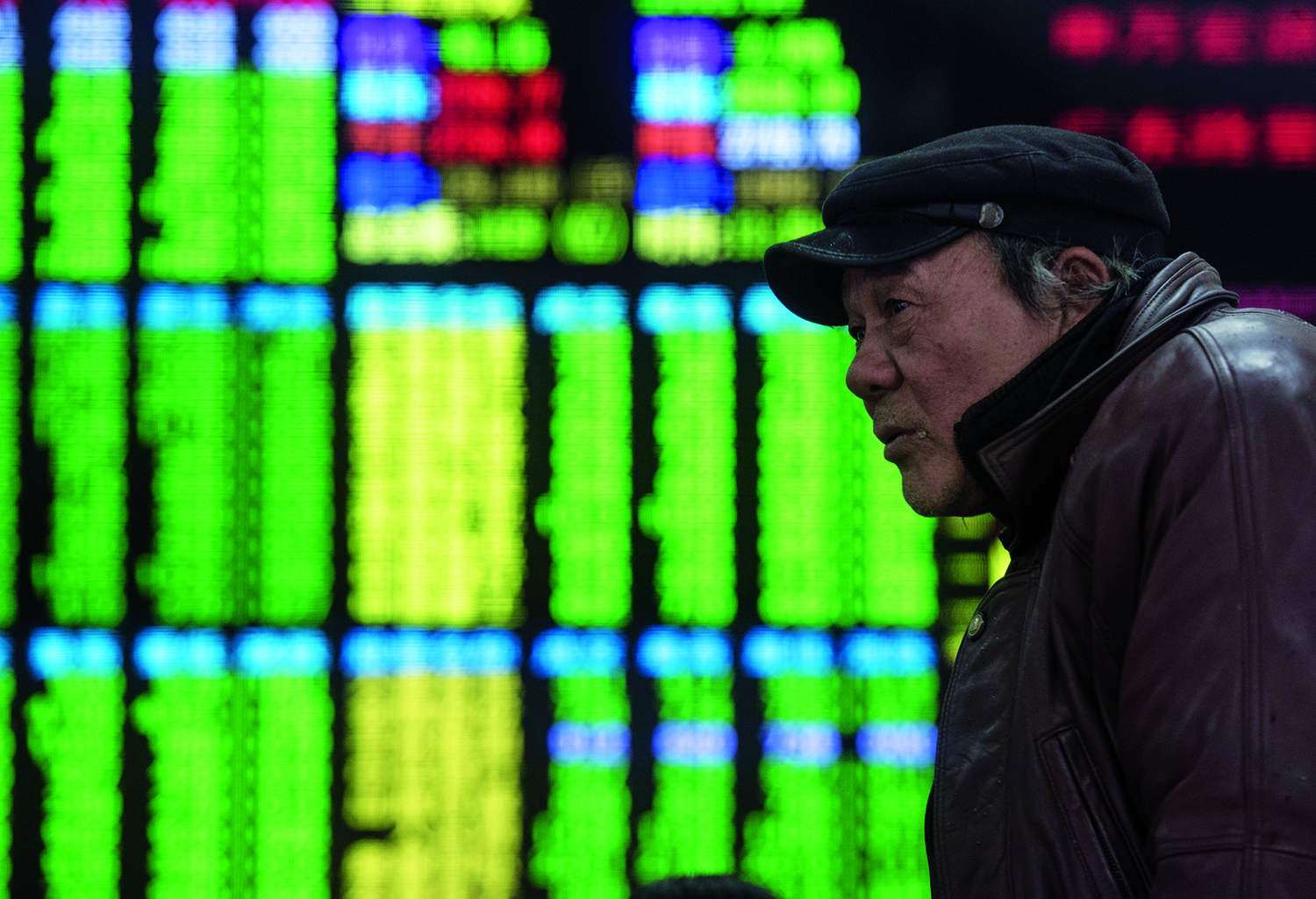
Chinese stocks got off to a really rough start in January | Johannes Eisele | AFP/Getty Image

Chinese stocks got off to a really rough start in January | Johannes Eisele | AFP/Getty

Aouad highlights that emerging market equities have been broadly the subject of severe risk-aversion by investors, which materialized in net outflows especially in the second half of 2015. “Within this asset class, country selection is very important. We are very cautious on emerging markets and when we say we are country specific, we don’t like to name countries. [However], we look more at India and Mexico rather than the rest in the spectrum of emerging markets,” he says.

China, the current top enigma within the enigma of emerging markets, remains a big uncertainty, Aouad admits. “The question is whether the Asian giant will be able to succeed in his shift to a consumer and services based economy while dealing with lower investments and huge debt burden,” he posits. While he agrees that “China is obviously the big scare” of today, Abboud offers the view that there may be mitigating factors as well as over-emphases of risk potentials when it comes to the Chinese economy in a global context. “As a whole we think the market will continue to be volatile in China, but so far we are giving credit to the Chinese government to be able to guide the soft landing,” he says. That an oversupply of analyst fears have been projected onto the country’s economy, and that the Chinese deserve to be given time to manage their challenges, appears to be a majority view among the private bankers who talked with Executive.

The GCC and oil: still the fateful pairing

Forget any notion of decoupling. The start of 2016 must have reinforced the perception that Arab markets, especially the countries of the GCC, and oil have a correlation that is as strong and fateful as ever. “For the GCC specifically, the last year was not easy and market caps in large GCC markets have certainly corrected in value since oil prices started coming down a year and a half ago. The oil price has been front and center for GCC equities but we want to remind investors that markets have been pricing in a lot of that downside in oil. P/E multiples [of companies traded on GCC stock exchanges] are today more in line with emerging markets. Also, dividend yields are quite appetizing now versus developed markets and even versus other emerging markets,” explains FFA Private Bank’s Kabbara.

Having a dedicated exposure to markets in the Middle East and North Africa (MENA), FFA Private Bank has noteworthy views on regional equities. According to Kabbara, the bank’s regional investment approach is to concentrate on companies with growing market shares and which have strong balance sheets, good management and pay dividends. “Our outlook for 2016 in MENA is cautiously optimistic and we are trying to manage the [correlation of corporate valuations with the oil price] by focusing more on countries that are diversified away from oil,” he says. Kabbara then adds: “From the macro perspective, there are no changes in why we are invested in MENA; we benefit from the demographics that you find in emerging markets but not elsewhere, from the income growth, from the young population, from governments that continue to invest in their economies and from the peg that until now links local currencies and the US dollar, which you don’t see elsewhere in emerging markets.”

Dagher, who has decades of experience working in financial markets around the Gulf, confirms that GCC economies face major changes because of the oil situation but emphasizes that the bank does little in research on the GCC and that his comments are based on his personal observations. “The mere fact of thinking about an initial public offering of Aramco means that there is a huge change in that GCC economic decision makers are looking at shifting risk of oil as the main business from the state into private hands, at least for a part of the risk,” he says. Since changes in the GCC also involve introductions of value-added taxes and removal of subsidies, or possible withdrawals from full dollar-pegs, “it is a very interesting period to see how those things will materialize,” he says.

That the magnitude of the challenge for change and adaptation of companies in Saudi Arabia and other GCC economies extends into the non-oil sector was demonstrated last month by top dairy manufacturer Almarai and food and consumer conglomerate Savola Group. The two Saudi companies were hit by the removal of energy subsidies but also, in Almarai’s case, by a government decision to phase out domestic production of alfalfa and animal forage because of high water consumption; the transition to sourcing forage abroad is going to cost it $53 million in 2016 alone, Almarai estimated in a disclosure in January. The stock lost almost 30 percent of its value in the first three weeks of January before recovering about half of the lost ground in the fourth week. Savola, which owns part of Almarai, fell even more, by about 40 percent, before coming back to a one-month loss of 18 percent on January 28.

There are clearly more things to be known about GCC equities than some far-away analyst’s notes on emerging markets can cover. As Dagher corroborates, many factors besides oil are at play in the GCC markets. “It will always be rewarding to be in the GCC markets,” he says.

Still a fateful combination | Yasser al-Zayyat | AFP/Getty

Still a fateful combination | Yasser al-Zayyat | AFP/Getty

Not for conclusions

As January drew to its close, major Arab stock indices closed the month’s last trading week on positive notes. All markets in the Gulf Cooperation Council gained a bit on January 28 but for the year to date (ytd), the region’s major bourses were all still bleeding, at ytd drops of more than 9 percent in Dubai and Abu Dhabi, around 11 percent in Kuwait and Qatar, and 14.5 and 14.9 percent in Egypt and Saudi Arabia.

In the wider world, China ended the month with investor distrust, as the Shanghai Composite Index was down 25 percent between January 1 and January 26. The Fed met expectations that it would not venture into another rate hike and adjusted its coded communication to tell markets that they should not consider upcoming decisions as foregone conclusions. The trend to issue wildly alarmist analyst notes seems to have abated to some degree but it seems that uncertainty could be even deeper than one would like to assume. The concept of economic predictability was certainly not helped when the World Bank was compelled last month to lower its forecast for 2016 crude oil prices to $37 per barrel. The astounding 28 percent downward variance from the $51 forecast issued in the previous commodities outlook in October 2015 cannot be regarded as reassurance of any person’s or any institution’s ability to give accurate predictions for the global economy in 2016.    

Doom or just volatility? Maybe the anonymous interstellar power that left us the Mayan calendar had a special sense of humor and moved the doomsday notch one leap year into the past – so that 2016 is the real 2012. Or perhaps, by way of other wholly uneconomic and unscientific but entertaining mind games, all the blood moon, harvest moon and blood-harvest moon occurrences of last September were warnings for wealth owners to repent, divest of all assets, distribute everything to the needy by [insert date of personal preference] and start rebuilding private wealth in a new cycle of global enterprise to get wealthier than ever before in the coming period of [insert lucky number] years. We will never be able to guess right.

February 10, 2016 6 comments
0 FacebookTwitterPinterestEmail
Leaders

Leader in ethics, leader in managing wealth

by Executive Editors February 10, 2016
written by Executive Editors

Absolute discretion; the strength of character that engenders trust; the emotional intelligence that enables one to gauge a client’s needs, wants and insecurities; and a keen financial mind. Such are qualities that distinguish a top private banker. These qualities, or at least their appearance, have for eight centuries opened the doors of the wealthy and given private bankers access to the money-drenched souls of the super-rich, from the doges of Venice, Belgian merchants, European royal families, American industry tycoons and third-world rulers to dot.com billionaires and post-communist oligarchs in Russia and China.

When asked about their interaction with high net-worth individuals in the current era, private bankers at the start of this year still, as they did a decade ago, talk about advising their clients on expanding and preserving their wealth, about assessing their conservative, moderate or aggressive risk appetites and, quite a bit, about asset classes and diversification of portfolios in volatile times.

Yet in important ways, private banking has changed more in the few years of this century than in the 700 years before. The three main components of this change were the redrawing of regulations, the impact of technology and the globalization of markets. Regulations moved away from selective laissez-faire regimes and from being accommodative to the private greed of the upper 20 percent, to the intense scrutiny and punishment of financial rule-breaking by banks, of complicity in money laundering and individuals’ tax evasion, of sanctions breaking and so forth. ICT systems for asset management and private banking were developed in revolutionary leaps, allowing for unprecedented sophistication of the planning, management and reporting of portfolios. In tandem with the rising data volumes, markets on every continent became richer and more accessible, giving wealth managers more options to diversify than ever before while, at the same time, engendering interconnectedness of risks with new and perhaps entirely unknowable upsides and potentially devastating downsides.

All the while, there is a growing understanding that the destruction of nature, eruption of large social conflicts and unmitigated concentration of power in the hands of self-absorbed individuals and institutions are detriments to the world’s economic future and even threaten the survival of mankind. Environmental, social and governance (ESG) considerations have risen from fears on the fringe of human debates to central concerns in the shaping of the 21st century society and economy.

Some – but certainly not all – necessary lessons have been learned in this context from the Great Recession and social upheavals of the past seven years.

Instead of capitalist orthodoxy allowing us to presume that mere pursuit of individual interest will sustain the public good, new ESG responsibilities demand attention and have begun to inform our ethical orientations and behaviors. Tying this into the behavior of private banking means to extend and enhance business ethics beyond the notion that the most successful private banker in the long term is the one who puts the client’s interest first in all things (for some options, see story on private banking ethics).

From what we can see in history and human behavior, wealth will always be more concentrated under the stewardship of the few rather than distributed into the hands of the many. Even when significant portions of wealth get redistributed via violent or peaceful ways, the concentration process will immediately restart after a revolution or, in the far superior case of voluntary distribution, carry on. Given the continuity and the considerable benefits of managing this process of growing, preserving, sharing and regrowing wealth, and acknowledging that banking is the top asset and best performer in the Lebanese economy, there is no reason why the wealth management process under observance of best ESG standards and in practice of highest business ethics should not involve Beirut as one of its strongest hubs.

As 2016 is a year that started with many questions and rising uncertainties for private bankers and all wealth management disciplines (see story on market volatility), there is one lesson from the recent past that demonstrates why ethical behavior would be a win-win for private banking institutions in Beirut. While a lot of private wealth was destroyed in 2008 and 2009, the total sum of wealth and most high net-worth family fortunes were restored by 2012 or so. But wealth managers that were exposed during the Great Recession for their unethical greed, recklessness, self-absorption and institutional malperformance, in some cases ended up in jail and in others vanished from the markets. The best time to distinguish yourself as a private bank and advertise yourself for future business is to excel in ethical behavior during a period of financial uncertainty.   

February 10, 2016 0 comments
0 FacebookTwitterPinterestEmail
Entrepreneurship

Smart money talks

by Thomas Schellen February 8, 2016
written by Thomas Schellen

It had to be one of Lebanon’s top resolutions for 2016 when Banque du Liban Governor Riad Salameh pledged at the BDL Accelerate event in December to see to the establishment of an electronic stock exchange for small and medium enterprises. “Our aim for the year 2016 is to succeed in the launching of an electronic trading platform,” Salameh said in his speech to open the event, and told Executive after his speech that the prospectus for the new exchange will be circulated in January.

The creation of the electronic exchange for Small and Medium Enterprises (SMEs) is an important proposition and one that deserves to be monitored religiously, particularly after announcements for realizing the project within 2015 came to a quiet demise – possibly because the BDL governor had vocalized the project idea last year without any regulatory groundwork having been implemented by the Capital Markets Authority. This is probably also due to a margin of severe uncertainty over the ability to institute the SME exchange under the umbrella of the Beirut Stock Exchange (BSE).

Given that the privatization of the BSE is not a likely event in the 2016 timeframe, the prospectus for the SME electronic exchange should provide a private sector path to its creation. A hint in support of that may be Salameh’s remark in the December 10 speech that participants in the electronic trading platform will be “banks, financial companies, brokers, family offices [and] professionals”. Listings will be supervised by the Capital Markets Authority, he added. The purpose of the new mart is easy enough to divine: as per the governor, it will allow startups to list and provide exit opportunities for successful companies, with creation of liquidity in service of “startups and others” as its true aim.

Another motivating force in the establishment of the electronic exchange must be the limited lifespan of the central bank’s funding flow into the startup ecosystem under the famed Circular 331 that incentivizes banks to channel investments into knowledge economy ventures at greatly reduced risk. The system’s venture capital players such as the Berytech Fund II, which used the BDL Accelerate event to announce close to $20 million in startup investments, and Middle East Venture Partners (MEVP) need exit opportunities that jibe with the seven-year timespan of Circular 331 funding of up to $400 million; a small cap exchange will open part of that realm at least in principle.

It is beyond dispute that the ratio of market capitalization to gross domestic product in Lebanon is in serious need of improvement. However, an electronic exchange with a market capitalization of a few hundred million dollars would be nowhere near enough to lift the Lebanese market cap to GDP ratio into the 50 to 100 percent range that is often considered indicative of stronger economies when compared with very low ratios associated with poor countries or with countries at less than 50 percent ratio that are considered undervalued. In this regard, the call for creation of greater liquidity in Lebanese financial markets raises the question of what other securities, besides stocks in startups, the new privately-held and privately-run market could trade and if it would be instituted with an intent to challenge the Beirut Stock Exchange.

Better market mechanisms needed for Lebanon

The attention in the BDL Accelerate event’s opening session was fully focused on Governor Salameh, documenting the awareness that most of the Lebanese entrepreneurship ecosystem’s progress in the past three years is owed to the central bank. But notwithstanding the applause with which the crowd received Salameh’s electronic exchange announcement, the main thrust at BDL Accelerate was the quest for capital; a plurality of young entrepreneurs told Executive that they had raised funds, were engaged in fundraising or were seeking to raise money in early 2016 in a variety of funding stages. By contrast, these entrepreneurs’ — and also some investment bankers’ — comments on the potential and practicality of a Lebanese SME exchange were at best enthusiastic in the vaguely affirmative way of someone who has not given a lot of thought to the matter.

More important for the project of an electronic exchange is that promises and acclamations do not compensate for absence of market fundamentals. Well regulated stock markets are noted for their macroeconomic value as they facilitate price discovery, flows of capital, and efficiency. But markets need to be supported by adequate economic incentives and, as researchers for the Organization for Economic Co-operation and Development argued in 2013, “radically different intrinsic nature[s] of markets for large cap and small cap stocks” mandate that markets for small caps should be designed differently from large cap markets. How the proposition of a small cap market can work in an environment with an anemic large cap market is, from a common sense perspective, a question that needs to be asked when deploying a small cap exchange formula in Lebanon.

Small cap ventures are notorious for their liquidity risk, meaning that investors in SME stocks may not be able to divest of shares at the time and/or price they need. It has to be asked how an electronic exchange in Lebanon could be enabled to attract market participants in sufficient numbers on both sides of the equation, namely in terms of qualified investors and of startups that can qualify as issuers of equity. This question cannot be unreasonable in a financial market that has been defined by lack of liquidity for more than 10 years. So the compounded bigger question is if a country with a fledgling capital markets authority, a history of illiquidity in its stock exchange and no recent experience with any initial public offering or much activity in secondary markets can pull off the launch and invigoration of an electronic exchange that should probably achieve more than just help startups in price discovery.

Questing for hub appeal

When compared with the marketing talk about Lebanon’s role as emerging hub, the number of genuinely international startups that presented themselves in booths provided for free to entrepreneurs at BDL Accelerate was hardly a handful, among them a UK firm that took advantage of the UK–Lebanon Tech Hub avenue to come to the Middle East. And just as BDL Accelerate did not feel like a magnet for international participants outside of some very isolated cases, global eyeballs did not seem drawn to Beirut in any approximation of the great attractiveness that local promoters talk about. In December, for example, a Huffington Post piece on dark horses in the race to attract international startups to rising tech hubs pointed not to Beirut but to Amman as one of three worth taking a closer look at. Ironically, it was posted right at the time of BDL Accelerate. Other cities in MENA that recently found mention in stories on up-and-coming startup hubs worldwide included Tunis, Cairo, Dubai and Tehran besides the familiar international contenders in Asia, Europe and Latin America.

Of greater indicator value than such — usually partisan and typically somewhat coincidental — rising ecosystem stories or promotional messages about the attractiveness of startup hubs in this or that emerging economy may be the 2015 Global Startup Ecosystem Ranking of San Francisco-based firm Startup Compass Inc. Their report, while falling quite short of evaluating hubs from all parts of the world, made several noteworthy observations on trends in what Compass described as a rapidly emerging and interconnected global startup landscape.

In an observation on the environment for exits, the report expects Silicon Valley to stay in the lead for exit values for several more years but anticipates “ultimate convergence towards an equilibrium that looks a fairly conventional 80/20 power law” in the world’s 20 largest startup ecosystems, meaning that Silicon Valley would capture between 30 and 50 percent of the annual exit pie, followed by three ecosystems that combined would also capture 30 to 50 percent, and another 16 startup ecosystems that will draw in the remaining 20 percent of the exits pie.

Just as interesting as the startup exchange for the development prospects of tech ventures is the issue of Beirut’s startup-hub appeal beyond the ranks of resident and expatriate Lebanese that comprise the ecosystem’s natural stakeholders. The idea of advocating Lebanon as an internationally attractive hub was an important premise of BDL Accelerate. However, while the event constituted a great initiative for showcasing the emerging startup ecosystem, it came dressed up with marketing messages that were far stronger than the event organization. The gaps between advertorial lore of huge local and international participation (presences of “100 speakers, 200 exhibitors and 100 startups from around the world” had been trumpeted all over the media) and the reality of attendances were visible everywhere in the Beirut Forum venue but never more so than on the second day when scheduled discussions went completely off schedule and when main-stage speakers and moderators sparred in front of a thousand empty chairs, while the more vibrant conversations were those of the people queuing for free coffee and a doughnut at the convention’s “coffee sponsor”.

February 8, 2016 0 comments
0 FacebookTwitterPinterestEmail
DrugsEconomics & Policy

Lebanon’s Captagon boom

by Jeremy Arbid February 8, 2016
written by Jeremy Arbid

The sun had not quite risen one cold January morning in east Lebanon as an army patrol set out to arrest individuals suspected for the murders of Sobhi and Nadimeh Fakhri in November 2014. What was to be a raid in Baalbek turned into a major drug bust – the army stumbled upon a Captagon producing laboratory as well as large quantities of cannabis and heroin. It was the latest in a series of seizures by the Lebanese authorities of Captagon, an illegal drug whose trade has skyrocketed in recent years and whose black market value is said to be in the hundreds of millions of dollars annually.

Business is booming and media reports insinuate that a number of players are addicted to the action – Lebanese and Syrian foot soldiers, Lebanon’s armed militias, the drug lords of Lebanon’s Bekaa Valley, the drug lords in Syria’s Qalamoun Mountains, a member of the Saudi royal family, a Bulgarian chemist flown in to cook Captagon – even a feature film has hooked the public. One Reuters report from 2014 suggested that the outflow of Captagon from Lebanon had fallen by 90 percent between 2011 to 2013. But statistics reported to the United Nations Office of Drugs and Crime (UNODC) by Lebanese authorities show a spike in seized Captagon starting in 2013. That year the Lebanese authorities as a whole seized 11.7 million Captagon pills. In the 12 months following, Lebanese Customs alone found more than double that amount. This points to a major shift in trafficking Captagon through Lebanon, if not significant local production of the drug as well. Now, a new law passed by the United States might answer who runs the Captagon show.

The region’s stimulant of choice

Captagon got its start in the 1960s as a pharmaceutical drug most commonly prescribed to treat attention deficit hyperactivity disorder (ADHD). The arrival of newer drugs that were more effective and less addictive (at treating ADHD) prompted the US government in 1981 to conclude that Captagon no longer had any medical use, leading to a ban. The World Health Organization followed suit a few years later, recommending prohibition of the drug globally. While the pill sold on the black market today carries the same name because of the pharmaceutical’s reputation, it is not the same drug (see Captagon Explained below).

Today’s street Captagon is an amphetamine-based stimulant that is said to be used both by Syrian regime forces and rebel groups fighting the country’s now five year long civil war. The pill, the Washington Post alleged, is said to make monsters out of normal men so that they can kill “with a numb, reckless abandon.” But that’s not really the case, according to addictions psychiatrist Joseph Khoury of the American University of Beirut Medical Center. Khoury, who treats patients that abuse Captagon alongside other drugs like Tramadol (a highly addictive opioid pain medication), says that Captagon keeps users alert much like a can of Redbull does. “If you want to sit at the front for days it is a valid tool – that is the purpose [to stay alert],” he says.

It neither makes users into superhumans nor does it have the psychedelic effect that the media has paraded. “If you want a guy to attack a trench and he’s on Captagon, he’ll probably be overconfident. But the idea that it makes people turn into suicide bombers is ridiculous. It’s not what explains the alteration of somebody’s personality, turning the normal caring and loving human being into a monster that can be mind-manipulated – it’s completely not true,” Khoury says. Other practitioners tend to reach the same nuanced conclusion, and a recent article in Forbes cuts straight to the point: “there is nothing especially magical about Captagon.”

Captagon Explained
What is today sold on the streets as Captagon is a mimic of the drug of the same name pharmaceutically manufactured in the 1960s and 1970s. Captagon is the brand name of fenethylline – a metabolic precursor inactive in its own right but one producing amphetamine and theophylline (a caffeine type substance) inside the user’s body. Taken orally, the body’s liver metabolizes the fenethylline tablet so that the stimulant amphetamine is absorbed into the bloodstream producing the desired effects of increased alertness and energy that improves performance of manual and intellectual tasks.

Fenethylline was found to have limited benefits for its prescribed use – treating attention deficit hyperactivity disorder – and reports on its abuse and potential for addiction as well as adverse side effects led to its prohibition by the United States Food and Drug Administration in the early 1980s. Later, in 1986, it was banned worldwide when the World Health Organization recommended it be listed as a controlled substance under international treaty – the Convention on Psychotropic Substances, of which Lebanon is a signatory. The convention calls on signatories to license the import, export, manufacture, trade and distribution of fenethylline, and to require a medical prescription for its dispensation and use. The United Nations Office on Drugs and Crime (UNODC) says it has not been legally manufactured since that recommendation came into effect.

Today’s Captagon mimics the effects of the pharmaceutical brand and carries the same name because of its similarity in appearance to the original, rather than having the same chemical composition. Because fenethylline is now a banned substance, the amphetamine needed to mimic the desired effect must be synthesized and put directly into the pill – usually as a mixture of mild amphetamines and caffeine, and sometimes other related substances, says Joseph el-Khoury, an addiction psychiatrist at the American University of Beirut Medical Center.

When Captagon mimics do contain amphetamine, one common and easy way to synthesize the amphetamine ingredient is to use a precursor called phenyl-2-propanone (phenylacetone or P2P), says UNODC’s Illicit Synthetic Drug Expert Martin Raithelhuber. “It’s a common chemical product produced at volume for many licit and industrial purposes,” Raithelhuber tells Executive. He says it is also possible to convert a related chemical to P2P and then produce amphetamine. The procedure requires only a basic understanding of chemistry and the necessary chemical equipment. “We’re not talking about very sophisticated, complicated processes. It is not complex to produce amphetamine and the result will be amphetamine sulphate which is in powder form,” Raithelhuber explains.

The same convention banning fenethylline also lists P2P as a controlled substance and its import and export requires a special permit from Lebanon’s Ministry of Public Health. Customs data available online does not list any import or export for the years 2011 – 2015, so where illicit manufacturers of Captagon source the necessary raw material they need to make amphetamine is anyone’s guess. It is most likely smuggled inside other legally imported products. Illegally handling these raw materials, according to Lebanon’s law on narcotic drugs and psychotropic substances and precursors 673/1998, carries a life sentence and a fine between 25 million – 100 million Lebanese lira ($16,600 – $66,400).

Forensic studies of seized Captagon in the mid 2000s by authorities in Jordan, Turkey, Serbia and Iraq detected amphetamine and caffeine in most pills, according to the UNODC. But, the UNODC says, some of the Captagon mimics that have been seized do not actually contain any amphetamine but only caffeine, ephedrine (an amphetamine substitute used as a stimulant) and quinine (a muscle relaxant and painkiller). Nizar Jurdi, head of the drug unit at the Lebanese Customs, told Executive that in January Customs seized some 250,000 pills because they bore the Captagon logo and were being smuggled with cannabis. But lab tests of the pills determined the Captagon mimic was a fake containing no amphetamine. The tested tablets were made up of 70 percent caffeine, 10 percent acetaminofene (also called paracetamol and found in popular brand name over-the-counter drugs such as Tylenol and Panadol for the treatment of moderate pain and fever reduction) and up to 20 percent aminofen (the generic substitute of acetaminofene).

A trafficking thoroughfare

Outside of use by combatants in various conflicts from Syria to Yemen, Captagon has regional fame as a recreational drug, and is in particularly high demand in the Gulf countries. Lebanon and Syria have traditionally been waypoints on the route of Captagon from the laboratories of Southeastern Europe and Turkey to the Gulf. But recent reports of Captagon-factory busts, as well as UNODC and Lebanese Customs’ data, not only indicate Lebanon’s continuation as a Captagon trafficking thoroughfare but also point to a rise in local production as factories are increasingly set up.

The UNODC reasoned in its 2008 World Drug Report that in the Middle East, “the growing seizure volume appears inconsistent given the small number of clandestine laboratories reported by authorities in Bulgaria [three laboratories] and Turkey [12 laboratories] in 2006.” Interpretation of factory busts and seizure reports led the UNODC to conclude that, in as early as 2006, production of Captagon began shifting from Southeastern Europe and Turkey to the region. Syria has been a source for Captagon production since at least 2006, the UNODC wrote in its 2009 World Drug Report. By 2014, a report by the International Narcotics Control Board (INCB) concluded that the breakdown of, or at least severe strain on, Syria’s government institutions created the ideal environment for the drug’s production to flourish. “The crisis situation in the Syrian Arab Republic clearly creates conditions favourable to the illicit manufacture and trafficking of tablets sold as Captagon,” INCB wrote.

But it is difficult to determine how much Captagon still originates from Syria. Officials that Executive spoke with say that while production continues there, the all-out war in the country has disrupted land routes popular for transiting the illicit drug through Jordan to the lucrative black markets in the Gulf – namely Kuwait, Saudi Arabia and the United Arab Emirates – requiring new ways to move the product and possibly shifting some Captagon production from Syria to Lebanon.

Lebanon witnessed a stark rise in the number of Captagon tablets seized by authorities in 2013 compared to previous years, according to the latest dataset compiled by the UNODC from Lebanese authorities. The statistics show that in 2013 Lebanon discovered 11.7 million tablets, having seized only 680,000 two years earlier. Data from Lebanon’s customs authority – Executive could not obtain police and army seizures by time of print – show a steeper rise in Captagon busts in 2014. That year, customs seized 25.4 million tablets at the airport and Port of Beirut. Customs valued the seizures to total $151.85 million – $6 per pill, a conservative estimate given that the street value price in the Gulf countries where the pills were destined can range anywhere between $10 to $20 per pill, a price range cited by the UNODC’s Illicit Synthetic Drug Expert Martin Raithelhuber.

Access to the Port of Beirut and Lebanon’s airport as export points has become increasingly important. “They conceal [Captagon] sometimes inside the bowels of machinery or hide it in furniture,” says head of the drug unit at Lebanese Customs, Colonel Nizar Jurdi. Recent seizures by customs at the port detail the manner in which pills were concealed – in nursery school tables, engine blocks or water cisterns. “You should not imagine that there is one container full of Captagon, that is not how it works,” Raithelhuber illustrates. “It might be one container among hundreds on a cargo ship, and in this one container there might be one large box which may not even contain the pure drug but may contain machinery, and in the cavities of the machinery is where the drug is [concealed],” he says.

Jurdi says his drug unit at the Port of Beirut inspects somewhere between 15 and 20 containers per day. The paperwork of all containers imported from Latin America, Romania and Ukraine and those exported to Arab countries are scrutinized because of those countries’ reputation as big drug producers or consumers. When a customs inspector reading the scan of one of these containers detects something unreadable or suspicious in the container, it is referred to the drugs section, says Jurdi. The goods in the shipment, the reputation of the goods’ owner and that of the import/export company, and any shared intelligence information between countries’ customs authorities are all factors that Jurdi says are taken into account when deciding whether a flagged container requires manual inspection.

In 2014 the Port of Beirut recorded 1.2 million container movements in and out of the port. The sheer scale in container volume limits the number of containers that can be X-ray scanned and an even fewer number undergo a manual search. A rough calculation indicates that less than 1 percent of all container movements at the Port of Beirut underwent manual inspection that year. According to the UNODC, in 2015 there were an estimated 750 million container movements globally and the organization says, as a very rough estimate, only 2 percent of those containers were physically inspected. “Monitoring the contents of the sheer volume of containers,” reads a recently published UNODC document, “without interrupting the flow of legitimate trade poses tremendous challenges to customs.”

“That just shows the challenge we’re facing here – [having] good intelligence on what is a suspect shipment [is very important] – we want to increase the hit rate they have with this small percentage by improving the exchange of information between [UNODC] member states,” says the UNODC’s Raithelhuber. Indeed, when Executive conducted its interview with Jurdi, a Kuwaiti customs official was present in the room, indicating that at least some level of cooperation between these two countries is real.

Less than 1 percent of containers at Beirut Port in 2014 were manually searched | Greg Demarque

Less than 1 percent of containers at Beirut Port in 2014 were manually searched | Greg Demarque

A Gulfie drug

For years recreational pill-poppers in wealthy Gulf countries have taken Captagon to get high. In these countries, says the UNODC, “it is popular among the younger, affluent population and it has also enjoyed a reputation as a sexual stimulant since the beginning of the 1980s.”

There is only anecdotal testimony that its usage is picking up in Syria and while drug-related arrests and Captagon court cases are on the rise in Lebanon, it is not a popular drug among local users. The real market for the drug remains the Gulf countries, where the street value is most attractive for distributors. Between 2011 and 2013, according to UNODC data, Saudi Arabia alone seized some 173 million tablets.

Statistics on the number of users are harder to come by. One recent article by Voice of America estimated as many as 50,000 Saudis undergo drug rehabilitation annually, but the report did not say whether that was for Captagon treatment and it did not cite any sources. In an October 2015 interview with Arabic-language publication Economic, Abdelelah Mohammed Al-Sharif, secretary general of Saudi Arabia’s National Committee for Narcotics Control, said that Captagon use was prevalent among the country’s youth and that 40 percent of the total drug-using population fell between the ages of 12 – 22, but he did not elaborate on the number of users. In any case, the amount of tablets seized suggest that the drug’s use in the Kingdom is significant.

Captagon, and amphetamines more widely, have been the Middle East’s drug of choice for the best part of the last four decades, says the UNODC’s Raithelhuber. Boredom is a driver of Captagon use in many Arab countries where alcohol is banned and access to other drugs such as cocaine is limited. There is evidence that in the past, recreational Captagon consumption was a socially accepted and established pattern. In Kuwait, for example, when pharmacies still sold the drug legally it was taken with morning tea, a visiting Kuwaiti customs official volunteered to Executive. Raithelhuber says that drug markets have a certain resiliance. “Once a drug has established itself in a user population, that’s what users know and that’s what they want to get again; not all of them are willing to experiment with other drugs,” he says.

Lebanon – production province

The figures on seizures show an explosion in the quantity of pills that are at least trafficked, but may also be locally produced. Jurdi reasons that instability caused by the war in Syria and the closure of its borders, along with the rise of seizures and laboratory busts in Lebanon, are correlational evidence of this shift.

In the last few years both the Lebanese Army and the country’s police, the Internal Security Forces (ISF), announced Captagon factory busts and arrests. The rise in incidents was enough for head of the ISF, Major-General Ibrahim Basbous, to sound the alarm at an October 2015 Captagon-focused drug conference held in Beirut. Though Basbous did say that Lebanon’s security forces had made progress in the fight to stem the drug, he appealed to the delegates to “contribute to rooting out the operations of smuggling Captagon tablets.” Lebanon needs all the help it can get.

Security forces – the ISF, Army and customs – have dismantled and arrested criminal groups manufacturing or trafficking Captagon, but lack of government clarity on the number of Captagon-factory busts and arrests does obscure the current extent of production. The amount of Captagon that Lebanon has seized does, however, imply that production volume is large, though an estimation is impossible. “We don’t have that indicator for synthetic drugs because it’s a footloose industry. Laboratories can be anywhere – in a basement, an empty industrial factory – they don’t have to be very big to produce several tons per year,” the UNODC’s Raithelhuber says. An April 2015 report by the European Council concluded that shutting down Captagon production capacity in Lebanon requires more specialized security personnel, equipment and logistical support (e.g. intelligence) and that without these Lebanon is challenged to curb production and trafficking.

Hezbollah’s ‘kingpin’?

Armed military groups are said to use the Captagon trade as a source of revenue to rival the state’s control in parts of the country – and fingers point to Hezbollah. A January article in the Arabic language Sawt al Jabal is the most recent to allege Hezbollah’s role in trafficking Captagon – it reiterated the insinuation that the brother of Hezbollah MP Hussein al-Moussawi, Sheikh Hashem al-Moussawi, is a major Captagon manufacturer and smuggler in Lebanon’s Bekaa Valley. Back in 2012, Lebanese television channel MTV ran a documentary following the ISF as it raided Hezbollah-funded Islamic schools it said were directly connected to Moussawi. A subsequent article by Al Akhbar stated that Lebanese authorities were not able to apprehend the sheikh. Another sheikh identified only by his first name and last initial, Abbas N., said during a police interrogation that “there is a religious edict allowing [Captagon] usage because it is a stimulant and not a drug,” Al Akhbar reported.

A 2012 article in online publication Middle East Transparent alleged that the religious edict was issued by Moussawi. It sanctioned the manufacturing and trafficking of Captagon as long as followers of Wilayat al-Faqih (Guardianship of the Jurist, an Iranian interpretation of Shia doctrine) did not consume the drug. The journalist of that article alleged that revenues from trafficking ignited an internal power struggle at the highest level of party leadership – Hezbollah’s Bekaa Valley faction was gaining influence that threatened Hezbollah’s southern-dominated top brass. The factional infighting, the article alleged, gave Lebanon’s anti-drug officials the green light to raid Bekaa Valley’s Hezbollah-linked Captagon factories under the presumed outcome that the raids would weaken that faction’s influence within the party to the advantage of the other. Executive could not independently verify this claim.

The validity of the power struggle claim is questionable but it may have helped to attract unwanted attention. Research published in May 2015 by George Washington University in the United States paraphrased testimony from an anonymous US Drug Enforcement Agency (DEA) agent stationed in the Middle East. The DEA agent told the researchers that “the top of the pyramid in the global Captagon trade has been since the 1980s and remains the same core group of Lebanese gangsters based in the Bekaa Valley.” The research points to the Captagon trade as sanctioned by Hezbollah and says that there is increasing evidence that the party is directly involved. “All available indicators point to Hezbollah with Iranian backing as most involved in Captagon production as an officially sanctioned fundraising strategy,” the research concludes.

Following the money would provide conclusive evidence as to who runs the Captagon show, but that is no simple task. There is very little information available on the flow of cash from Captagon trafficking, although all officials that Executive spoke with agreed the drug’s illicit trade is in the hundreds of millions of dollars annually. It is not easy to trace the money because it often remains as cash that does not flow through the traditional banking system, and there is no global framework for coordinating the tracking and seizure of drug money.

The Hezbollah International Financing Prevention Act of 2015 signed into US law in December may change that. Section 201 of the law calls for a report on narcotics trafficking by Hezbollah – Congress will be briefed on Hezbollah’s narcotics trafficking, the procedures for listing the party under the United States Foreign Narcotics Kingpin Designation Act as well as government efforts to combat Hezbollah’s narcotics trafficking activity. The Kingpin Act grants the Treasury Department’s Office of Foreign Assets Control (OFAC) the authority to block individuals and entities from the US financial system and prohibits any transactions between designees and US companies and individuals. Previously the Kingpin Act was invoked in 2014 to designate the Medellín, Colombia-based criminal organization La Oficina de Envigado (La Oficina), the enforcement and collection arm of deceased-leader Pablo Escobar’s Medellín Cartel. In October 2015 OFAC used it to designate Hezbollah-affiliated individuals and organizations.

Already listed as a terrorist organization by the United States, the application of the Kingpin Act as part of the new law will broaden OFAC’s mandate to sanction Hezbollah for any alleged role it has in narcotics trafficking – though OFAC does not publish justification for its designations. Completion of the narcotics report is expected in the first quarter of 2016 and the law requires its publication. A month later Congress will be briefed. By the middle of the year, America believes it may be able to offer an answer as to the actual size of Captagon production and the nerve center of its trafficking.

February 8, 2016 2 comments
0 FacebookTwitterPinterestEmail
Opinion

Worse than weapons

by Yasser Akkaoui February 8, 2016
written by Yasser Akkaoui

The war years in Lebanon were particularly ugly near the end. I was 16 years old when the bottom fell out from under the lira, and the currency collapse changed everything. People lost their jobs. Wealth vanished. Desperation reigned. We were used to being terrorized by bombs, bullets and ever-accurate mortar shells. Financial terrorism proved even worse.

Crooks preyed on distressed and vulnerable people who, even if they might have known better, still fell for their scams. Fear that your family would starve or be pushed onto the street, however, did not inspire the best decisions. Criminality was everywhere. Certain unscrupulous types were approving loans they knew would fail to get their hands on land or property at obscenely low prices. It was a morality-free zone.

Last December, seeing an advertisement designed to dupe people who lack a social safety net brought back some of my worst memories. We’ve been living through an economic disaster the past few years, and all signs point to distress. Even our drug trade is flourishing again. I fear for what we’re becoming. I don’t want to live in a country of outlaws, isolated from the global economy. I want a country where honest hard work and entrepreneurial risk taking are respected and rewarded.

Executive has spent more than 16 years advocating for ways our government officials can make Lebanon better for all. We must remember, however, that building a prosperous country requires individual initiative and individual responsibility. Our focus in 2016 on business ethics includes a series of warnings we all must heed. We take a look at the many opportunities that adherence to international best practices can provide.

This month we report how Beirut should position itself as a hub for private banking with an ethical investment focus. Money can be made honestly, and we mustn’t forget that. We have been sailing back into the morality-free zone. It’s time to reverse course.

February 8, 2016 0 comments
0 FacebookTwitterPinterestEmail
Fashion

Creative Space Beirut

by Lynn Soubra February 5, 2016
written by Lynn Soubra

I open the door on the first floor of an old pink building located among the cement foliage of Mar Mikhael and step inside what looks like a mad scientist’s mind. Trash bins overflowing with scrunched up papers, magazines tossed on the floor, racks of handmade clothes scattered here and there along with scissors, rulers, pens, glue sticks and more. The white walls accentuate the vibrant colors in the room and transform it into a colorful box of crayons set against January’s gloomy weather. This is Creative Space Beirut (CSB), where the mind knows no boundaries.

CSBCSB is a free fashion design school that welcomes skilled individuals from all corners of Lebanon. In 2011, Sarah Hermez, a fashion design graduate from Parsons New York, co-founded the institution with her former instructor Lebanese-American designer Caroline Shlala-Simonelli. Hermez moved to Beirut with a mission to ease the financial strains that prevent Lebanese youth from receiving an education in creative fields. “What we’re creating is a bridge for our students to cross in order to get into this competitive sector,” says Karina Goulordava, responsible for the institution’s fundraising. “We have all this talent in Lebanon that doesn’t get the chance to show itself because of the ways things are run in this country,” she explains, adding,  “Education should be a right for everybody.”

CSBAccording to Sarah Hunaidi, CSB’s communication director, CSB relies heavily on the community’s participation in its vision. As of now four students are sponsored by three donors who pay for their education throughout the three-year program. “They believe in what we do,” says Goulordava.

CSBCSB’s main source of income is sponsors but the school also relies on its Ready to Wear line, designed in-house and showcased twice a year at different venues and events around Beirut, to become more self-sustainable with time. “All proceeds from the sales go back to the school,” says Goulordava. CSB also holds fundraising parties, workshops and exhibitions. Events like these help expose students to challenges and opportunities in the fashion industry and allow them to showcase their one-of-a-kind pieces, win competitions and possibly get recruited by professional Lebanese designers. “It is not only about free education, but about access to the design world that’s very hard to get into if you do not have the financial means,” she explains.


CSBTo be selected, applicants submit a portfolio of their creations and sit for an interview, and priority is granted to those who cannot afford the high fees of private schools. Unlike most higher-education institutions in Lebanon, CSB admits
up to four students per year, and while many design schools begin their programs with theory, CSB’s 11 current students get to play with fabric on the first day. They are mentored by volunteering professional designers, photographers and other experts while the school keeps a watchful eye on student progress through regular assessment. CSB recently adopted a “buddy-system” through which senior students partner with junior classmates to help guide them through different techniques. “Most of the students have a lot of experience and knowledge; it doesn’t have to be an instructor [who teaches the course],” explains Goulordava. Students with strong knowledge in design-related methods are also invited to teach and share their expertise with the class. The seamless student-teacher relationship results in a coherent exchange of knowledge and talent, which helps the students get a well-rounded understanding of the fashion design process.

CSBCompared to traditional education systems, CSB has an unconventional way in delivering its program, which relieves unnecessary pressure and focuses more on helping the students grow into artists. “There’s no grading system because what’s the point of grades?” questions Hunaidi. “It’s not like it’s our place only and then they have to leave, it really feels like it’s their space,” she adds. “Sometimes if I drive by at 11 at night, the lights would still be on.”

CSBAfter our talk I walk around the workshop between rows of different designs, patterns and colors, discovering a hub where creativity takes a life of its own. Students are absorbed in their world of imagination as I take a peek at their work and speak to a couple of them. Ahmad, a 22-year-old who studied Interior Architecture at the Lebanese University, showed me his sketches and collages of androgynous women and men, explaining his desire to eradicate predetermined judgement in our society. 26-year-old Noor’s collection stems from a lucky mishap, when she accidentally placed fabrics too close to a heater. When she saw how the texture of the material changed, she had a lightbulb moment and decided to use the heater as a tool to create a bubble-like esthetic, mimicking the moon’s surface.
With creative minds and skilled hands, the students focus on their personal projects but work together towards the same goal: breaking social boundaries. “Our students are very aware of why we are doing this, so they should take that social responsibility out into the world with them,” says Goulordava.

Lebanon’s only free university does not have a fashion design program and CSB is filling that niche. Whereas people jump at the opportunity to invest in business and technology, creative fields seem to take a back seat. This prevents talent from showing itself and making a mark on Lebanon’s social and cultural scene. People’s wealth should not be determined by materialistic possession but should surpass them to encompass the richness of their minds. It’s about time we pay attention to Lebanon’s youth instead of focusing on making our wallets fatter. We might just be surprised at what talent is hidden right under our noses, if only we would allow it to prosper.

February 5, 2016 1 comment
0 FacebookTwitterPinterestEmail
Fashion

Creative Space Beirut

by Lynn Soubra February 5, 2016
written by Lynn Soubra

I open the door on the first floor of an old pink building located among the cement foliage of Mar Mikhael and step inside what looks like a mad scientist’s mind. Trash bins overflowing with scrunched up papers, magazines tossed on the floor, racks of handmade clothes scattered here and there along with scissors, rulers, pens, glue sticks and more. The white walls accentuate the vibrant colors in the room and transform it into a colorful box of crayons set against January’s gloomy weather. This is Creative Space Beirut (CSB), where the mind knows no boundaries.

CSBCSB is a free fashion design school that welcomes skilled individuals from all corners of Lebanon. In 2011, Sarah Hermez, a fashion design graduate from Parsons New York, co-founded the institution with her former instructor Lebanese-American designer Caroline Shlala-Simonelli. Hermez moved to Beirut with a mission to ease the financial strains that prevent Lebanese youth from receiving an education in creative fields. “What we’re creating is a bridge for our students to cross in order to get into this competitive sector,” says Karina Goulordava, responsible for the institution’s fundraising. “We have all this talent in Lebanon that doesn’t get the chance to show itself because of the ways things are run in this country,” she explains, adding,  “Education should be a right for everybody.”

CSBAccording to Sarah Hunaidi, CSB’s communication director, CSB relies heavily on the community’s participation in its vision. As of now four students are sponsored by three donors who pay for their education throughout the three-year program. “They believe in what we do,” says Goulordava.

CSBCSB’s main source of income is sponsors but the school also relies on its Ready to Wear line, designed in-house and showcased twice a year at different venues and events around Beirut, to become more self-sustainable with time. “All proceeds from the sales go back to the school,” says Goulordava. CSB also holds fundraising parties, workshops and exhibitions. Events like these help expose students to challenges and opportunities in the fashion industry and allow them to showcase their one-of-a-kind pieces, win competitions and possibly get recruited by professional Lebanese designers. “It is not only about free education, but about access to the design world that’s very hard to get into if you do not have the financial means,” she explains.


CSBTo be selected, applicants submit a portfolio of their creations and sit for an interview, and priority is granted to those who cannot afford the high fees of private schools. Unlike most higher-education institutions in Lebanon, CSB admits
up to four students per year, and while many design schools begin their programs with theory, CSB’s 11 current students get to play with fabric on the first day. They are mentored by volunteering professional designers, photographers and other experts while the school keeps a watchful eye on student progress through regular assessment. CSB recently adopted a “buddy-system” through which senior students partner with junior classmates to help guide them through different techniques. “Most of the students have a lot of experience and knowledge; it doesn’t have to be an instructor [who teaches the course],” explains Goulordava. Students with strong knowledge in design-related methods are also invited to teach and share their expertise with the class. The seamless student-teacher relationship results in a coherent exchange of knowledge and talent, which helps the students get a well-rounded understanding of the fashion design process.

CSBCompared to traditional education systems, CSB has an unconventional way in delivering its program, which relieves unnecessary pressure and focuses more on helping the students grow into artists. “There’s no grading system because what’s the point of grades?” questions Hunaidi. “It’s not like it’s our place only and then they have to leave, it really feels like it’s their space,” she adds. “Sometimes if I drive by at 11 at night, the lights would still be on.”

CSBAfter our talk I walk around the workshop between rows of different designs, patterns and colors, discovering a hub where creativity takes a life of its own. Students are absorbed in their world of imagination as I take a peek at their work and speak to a couple of them. Ahmad, a 22-year-old who studied Interior Architecture at the Lebanese University, showed me his sketches and collages of androgynous women and men, explaining his desire to eradicate predetermined judgement in our society. 26-year-old Noor’s collection stems from a lucky mishap, when she accidentally placed fabrics too close to a heater. When she saw how the texture of the material changed, she had a lightbulb moment and decided to use the heater as a tool to create a bubble-like esthetic, mimicking the moon’s surface.

With creative minds and skilled hands, the students focus on their personal projects but work together towards the same goal: breaking social boundaries. “Our students are very aware of why we are doing this, so they should take that social responsibility out into the world with them,” says Goulordava.

Lebanon’s only free university does not have a fashion design program and CSB is filling that niche. Whereas people jump at the opportunity to invest in business and technology, creative fields seem to take a back seat. This prevents talent from showing itself and making a mark on Lebanon’s social and cultural scene. People’s wealth should not be determined by materialistic possession but should surpass them to encompass the richness of their minds. It’s about time we pay attention to Lebanon’s youth instead of focusing on making our wallets fatter. We might just be surprised at what talent is hidden right under our noses, if only we would allow it to prosper.

February 5, 2016 1 comment
0 FacebookTwitterPinterestEmail
Leaders

The ABCs of the 123s

by Executive Editors February 5, 2016
written by Executive Editors

Finance is a complicated topic to understand. The jargon and math don’t help. Top employees of Lebanese lending institutions have admitted to Executive that even some bankers cannot define an annual percentage rate (APR). Look it up on Wikipedia, and you’ll no doubt be researching more new terms (such as nominal APR and effective APR) before you finish reading the first sentence. Financial literacy is not a global strong-suit. Surveys from 2011 conducted by researchers with the non-profit, US-based National Bureau of Economic Research asked residents of Germany, Italy, Japan, the Netherlands, New Zealand, Russia, Sweden and the United States three short questions designed to assess respondents’ ability to calculate interest rates, understand inflation and understand risk diversification. Only in Germany did more than 50 percent of those surveyed answer all three questions correct. In all eight countries, at least 10 percent of respondents got all three wrong.

Financial literacy is becoming a hot topic internationally, according to the Organization for Economic Co-operation and Development. The OECD explains that this stems, in part, from a global “concern about the potential impact of shrinking public and private welfare systems, shifting demographics, including the ageing of the population in many countries, and the increased sophistication and expansion of financial services.” In other words, people around the world are likely to be increasingly responsible for taking care of themselves financially rather than being able to rely on state-organized savings or pension schemes. In response, the OECD also reports that “as of 2014, more than 50 countries at different income levels are well advanced in the design or implementation of a national strategy for financial education, and many other countries are considering developing one.” While Executive was unable to find financial literacy statistics for Lebanon, it is safe to assume we would not score higher than the majority of other countries. What we know, however, is that this country has no effective pension system, and citizens are basically left to fend for themselves when it comes to having a secure financial future. We were shocked to see advertisements featuring an elderly man taking out a loan with his house as collateral. In fact, this ad inspired this month’s investigation into loan sharking in Lebanon. We we saw that advertisement, We didn’t see a man securing his family’s financial future. We saw an attempt to dupe the vulnerable. We saw a population in need of protection. In this regard, we must once again tip our hat to Central Bank Governor Riad Salameh. Banque du Liban (BDL), our central bank, recently passed much needed regulation to limit the potential bite of loan sharks (see Shark hunt), but there is still a lot more work to be done to educate and protect the population.

In the United Kingdom, there exists a company called Lending Stream. It offers so-called “payday loans” – short-term, high-interest credit many borrowers cannot repay on time, which can rather quickly bury them in unsustainable debt. Quite prominently on the company’s homepage is the following note of caution: “Warning: Late payment can cause you serious money problems. For help, go to moneyadviceservice.org.uk.” Money Advice Service describes itself as  “an independent service, set up by government” with a mandate to “help people manage their money.” Their offerings are diverse, and their financial advice is clearly aimed at helping people who understand nothing about finance get a grip on the basics. Lebanon needs something like this. While it may be too much to ask the government to follow the exact model, the Ministry of Economy and Trade could quite easily include information like this (do’s and don’t’s of borrowing, understanding interest rates and how to calculate them, identifying and mitigating risks, etc.) on the consumer protection section of its website.

Given that government is not the only stakeholder in citizens’ economic well being, the impetus to act should not be expected to come from elected and appointed officials alone. Civil society, business and economic associations, and even banks and financial institutions themselves can easily step up and help financially educate the public. We already have one example of a local ad company and a local bank partnering to produce 30-second financial literacy spots (see Q&A with George Jabbour). We need much more of this. And as an increasing number of local corporations seek ways to deploy capital on do-good initiatives under the banner of corporate social responsibility, here is a perfect place to start spending. For banks in particular, increasing financial literacy can actually translate into more business opportunities. Research out of China from 2013 shows that people increase the amount they deposit into retirement savings accounts the more they understand interest compounding (which means that interest earned is added to the principal after a certain time period – yearly, for example – thus generating the account holder more money the longer said money is kept in the account. See, increasing financial literacy can be that simple). The central bank can even help incentivize private-sector efforts to increase financial literacy by awarding the corporations doing the best job each year. Companies love affirmations of how excellent they are.

Stopping at financial literacy is not enough. We also need all relevant stakeholders to understand that they must never exploit financial illiteracy. Again, BDL has done commendable work in this regard – twice passing decisions demanding that banks, financial institutions and now even loan sharks fully explain products and services to customers. These are excellent developments, but we need more players to understand their ethical obligation not to mislead people into making poor financial decisions. The head of Lebanon’s Advertising Association says he’s keen to develop an industry code of ethics. This is a must, and it requires buy-in from not only the agencies producing ads, but the media outlets that run them and the intermediaries in between.

To build a prosperous future, we have to understand how to get there without being duped into bankruptcy along the way.

February 5, 2016 0 comments
0 FacebookTwitterPinterestEmail
Economics & Policy

Toward ethical lending

by Matt Nash February 5, 2016
written by Matt Nash

On the list of what separates humans from our primitive ancestors, one activity usually gets neglected: lending with interest. Finance seems embedded in our DNA. We have debt records that date back more than 4,000 years. As the historian Niall Ferguson put it in his book, “The Ascent of Money: A Financial History of the World,” these ancient ledgers serve as “reminders that when human beings first began to produce written records of their activities, they did so not to write history, poetry or philosophy, but to do business.” Not surprisingly, debates about interest rates are nearly as old. Religious authorities, philosophers and even state officials have, at one point in the past, advocated a ban on interest altogether. Islam still considers interest sinful.

Questioning interest, however, is as much an ethical debate as a financial one. Does a person with more resources have an obligation to help – free of charge – a person with fewer resources for that poorer person’s benefit? For the non-Sharia compliant, the answer humanity has settled on seems to be: the person with more deserves some kind of compensation for his or her assistance, with some limitation. After all, loan recipients use what they borrow to better their own lives (either by increasing their own wealth with the loan or acquiring a possession they did not have the means to buy on their own), so why shouldn’t the lender benefit too?

As noted, however, humanity seems to have generally agreed that lenders have an obligation to limit how much they benefit from the arrangement. Many jurisdictions today ban excessively high interest, commonly referred to as usury. Lebanon has no such ban (nor do its legal codes put a limit on what interest rates lenders can charge), but Banque du Liban (BDL), Lebanon’s central bank, has devised rules to keep consumers from being buried in debt by placing limits on how much of their monthly household income can be spent repaying a lender. In the end, the effect is arguably the same.

A premium for the poor

The exact rate of interest charged on a loan does not seem to be what distinguishes an ethical lender from an unethical one. Taking advantage of the vulnerable or financially illiterate and misleading people are the real distinguishing marks of an unethical lender. For example, microfinance is currently the darling of the development community. Microfinance institutions (MFIs) lend small amounts to poor borrowers who typically invest the funds into some modest business venture. The idea is to help the poor create more wealth for themselves. Microloans come in ticket sizes far smaller than most commercial banks would ever consider (hundreds or a few thousands of dollars) and thus they come at a premium. Though the rates are higher than a bank would charge, microfinance is considered by most an ethical practice.

More important than specific rates, therefore, is just how well a borrower understands what he or she is getting into. The Great Recession might never have happened if duping poor people into buying homes they could not afford had not become such a rampant practice in the United States.

One of the biggest risks MFIs face, according to the three Executive interviewed for this report, is over-indebtedness. If MFIs do not have effective tools to communicate or a centralized list of clients and their outstanding debts, borrowers could take out several loans from different institutions, eventually finding themselves with more debt than they can afford. MFIs are hoping a new association, officially launched in mid-2015, can help mitigate this risk (known as cross lending).

Protecting borrowers from themselves

Poor decision-making on the borrower’s behalf – rather than unethical lender behavior – is not only a risk faced by micro-borrowers. People using otherwise legal services like payday loans or car title loans often get in over their heads, and governments in the UK and the US have legislated protections for people who use these services, such as legislation regarding debt restructuring and personal bankruptcy. One of the prime tools these governments are using as a protective measure is more information. The thinking goes that if a borrower fully understands the risk of certain types of loans, he or she will seek funds elsewhere. Lebanon’s central bank has also recently demanded lenders provide potential clients clear and easy-to-understand information as a consumer protection measure. For a lender-borrower relationship to be both ethical and mutually beneficial, both parties need to have agreed to all terms with a full understanding of what they mean. Further, if the borrower is coming at a moment of vulnerability, a lender has a moral — if not always a legal — obligation to make sure not to take advantage of the borrower. Until humanity agrees on an ethical paradigm to govern lending, this seems like the best we can hope for to ensure credit does more good than harm.

February 5, 2016 0 comments
0 FacebookTwitterPinterestEmail
  • 1
  • …
  • 131
  • 132
  • 133
  • 134
  • 135
  • …
  • 685

Latest Cover

About us

Since its first edition emerged on the newsstands in 1999, Executive Magazine has been dedicated to providing its readers with the most up-to-date local and regional business news. Executive is a monthly business magazine that offers readers in-depth analyses on the Lebanese world of commerce, covering all the major sectors – from banking, finance, and insurance to technology, tourism, hospitality, media, and retail.

  • Donate
  • Our Purpose
  • Contact Us

Sign up for our newsletter

[contact-form-7 id=”27812″ title=”FooterSubscription”]

  • Facebook
  • Twitter
  • Instagram
  • Linkedin
  • Youtube
Executive Magazine
  • ISSUES
    • Current Issue
    • Past issues
  • BUSINESS
  • ECONOMICS & POLICY
  • OPINION
  • SPECIAL REPORTS
  • EXECUTIVE TALKS
  • MOVEMENTS
    • Change the image
    • Cannes lions
    • Transparency & accountability
    • ECONOMIC ROADMAP
    • Say No to Corruption
    • The Lebanon media development initiative
    • LPSN Policy Asks
    • Advocating the preservation of deposits
  • JOIN US
    • Join our movement
    • Attend our events
    • Receive updates
    • Connect with us
  • DONATE