• Donate
  • Our Purpose
  • Contact Us
Executive Magazine
  • ISSUES
    • Current Issue
    • Past issues
  • BUSINESS
  • ECONOMICS & POLICY
  • OPINION
  • SPECIAL REPORTS
  • EXECUTIVE TALKS
  • MOVEMENTS
    • Change the image
    • Cannes lions
    • Transparency & accountability
    • ECONOMIC ROADMAP
    • Say No to Corruption
    • The Lebanon media development initiative
    • LPSN Policy Asks
    • Advocating the preservation of deposits
  • JOIN US
    • Join our movement
    • Attend our events
    • Receive updates
    • Connect with us
  • DONATE
EntrepreneurshipEntrepreneurship in Lebanon

The brains of the operation

by Executive Editors January 22, 2016
written by Executive Editors

This company is part of Executive’s Top 20 for 2015. Read more stories from our entrepreneurship in Lebanon section, for the latest analysis on the country’s ecosystem.

TickleMyBrain

Industry: Recruitment

Product: Resume and presentation services

Product launch: 2012

Established: 2012

Employees: 4

Founder: Tara Nehme

Tara Nehme, the Lebanese-Canadian founder of TickleMyBrain (TMB), first noticed that people’s resumes needed assistance when a friend asked her to check their CV at the last moment before applying for a job in Dubai. What started as a small career advice blog in 2012 has evolved into an online platform dedicated to improving the presentation of users’ credentials. TMB offers services for improving documents (such as resumes and various applications) uploaded to their website for a minimal fee of $99 for the basic package, and $5,000 for a business plan.

Nehme identified that many candidates suffered at the application stage of careers due to poor presentation of otherwise good credentials. Akin to coaching for a pitch to an investor, TMB offers guidance to clients wishing to give the best first impression possible, without deceiving potential employers by carefully monitoring the content management of a portfolio. TMB’s main business is selling the overhaul of resumes and cover letters, but they offer other services as well to meet premium writing requests of clients. Until now, the business has operated through a freelance writing team.

Their business model matches freelance writers with clients who need editing and language services, at a 30:70 revenue split to TMB and the writers respectively, the latter of whom are heavily vetted by the business. Their future model centers around scaling the business to include a ‘tiered system’, offering express services with a fast turnaround alongside the current TMB system, as Nehme often has urgent requests. The value proposition of this would be the speed of writing turnaround, which is how they wish to scale globally.

The project is currently self-funded, and Nehme took a $15,000 loan and offered stakes to other employees within the company, including her chief designer and chief technological officer, with the majority stake resting with Nehme. The operations are based in Beirut, with freelance writers worldwide, and they review the services by incorporating a feedback mechanism from both writers and customers. Most of her employees, bar seven freelance writers, are Lebanese and TMB have recently opened offices in the Beirut Digital District as operations are based in Lebanon.

The company became profitable seven months into its foundation, with 15,000 sign ups to the website, and more than 3,000 paid users. TMB’s biggest growth is within the business plan offering, with more than $100,000 in total sales in the last year. Their target market includes any professional with a need for overhauling the presentation of their credentials. In terms of scalability, Nehme believes that their future lies with an express service, which will be rolled out in February 2016 and marketed globally. TMB’s value to the Lebanese economy is their ability to improve the chances of employment for their customers, and the opportunities offered to their own employees at what is essentially a tech-based startup. Nehme explains that their corporate social responsibility services go beyond a resume refurbishment, and regularly holds workshops and lectures on credential presentation. “I care very much about the Lebanese, and I care that they get the same chances as everyone else. What we’re offering is the chance to compete in a very tough world,” says Nehme, who hopes that TMB’s impact will come full cycle and see individuals who benefited from their services feed back into the Lebanese economy.

 

January 22, 2016 0 comments
0 FacebookTwitterPinterestEmail
EntrepreneurshipEntrepreneurship in Lebanon

Building blocks

by Executive Editors January 22, 2016
written by Executive Editors

This company is part of Executive’s Top 20 for 2015. Read more stories from our entrepreneurship in Lebanon section, for the latest analysis on the country’s ecosystem.

Urbacraft

Industry: Consumer and retail

Product: Construction toy and educational kit

Product launch: 2014

Established: 2014

Employees: 1

Founders: Sabine de Maussion and Ayssar Arida

Sabine de Maussion and Ayssar Arida developed urbacraft in 2014 after identifying a gap in the toy industry for locally appropriate toys. Their main product is a hybrid “customizable building set” which allows individuals of all ages to form buildings out of modular plastic pieces – ‘urbs’ – and other printable materials and elements – ‘kits’ – such as a cardboard façade, which can be added and ‘hacked’ (e.g. ‘colored in’) by the user. Unlike other composite toy creators, urbacraft’s philosophy is rooted in open source construction, and allows the user to add parts they designed themselves. Their product for the recently opened Sursock Museum store includes a card façade with the building’s recognizable windows. Pieces are compatible with other toys, and parts or self-designed elements can be printed using either a normal or 3D printer. The company functions as a hybrid software-production company, since individuals who use the product can upload designs of façades or other parts to the urbacraft community, which in turn can be downloaded by other users and ranked in popularity.

In terms of local business, urbacraft aims to have small regional distribution centers for the plastic parts and encourage local economies by having children from the age of eight upwards print downloaded plans in local printing offices. This vision ties in with their aim to reduce their carbon footprint by not manufacturing in China, and figuring out distribution channels to those without access to a 3D printer, thus enabling localized manufacturing. In terms of expansion, Arida is keen to recruit Lebanese talent and hopes for a team of around 40 to 50 people within the first four years. “Two of our main needs for jobs are designers and product managers. Beirut is a fantastic place for both and the economics of Beirut makes it much easier and cheaper than to hire elsewhere. We will be tapping into the design, architecture and creativity that is already there – an extraordinary resource,” he says. The company also aims to continue running operations from its main offices in Beirut for the foreseeable future, hiring for sales and social media.

urbacraft has identified that the world’s largest consumers of toys over the next few years will come from emerging markets, and in particular the construction toy market has seen 35 percent year-on-year demand growth. While children are the main target market, Arida stresses the importance of such a model for other parties. “We’ve seen so much interest from adults like architects needing to prototype buildings or corporations using them for workshops for building design,” he says. Professionals and corporations are a secondary target market for urbacraft, along with educational institutions where the startup wants to expand sales into open-ended learning systems as educational toys.

Going forward, urbacraft is looking to raise between $500,000 and $1 million in seed funding over the next year, and is pitching to investors interested in consumer goods. It is currently the only non-American company enrolled in the XRC Labs accelerator in New York, which is a joint program between the Kurt Salmon global management and strategy consulting firm and the Parsons School of Design, also based in New York. The accelerator has taken a 6 percent equity slice for an undisclosed investment and provided services, and urbacraft has already been through Phase 1 of the UK Lebanon Tech Hub acceleration program.

January 22, 2016 0 comments
0 FacebookTwitterPinterestEmail
EntrepreneurshipEntrepreneurship in Lebanon

Some assembly required

by Executive Editors January 22, 2016
written by Executive Editors

This company is part of Executive’s Top 20 for 2015. Read more stories from our entrepreneurship in Lebanon section, for the latest analysis on the country’s ecosystem.

Modeo

Industry: Furniture and design

Product: Modular assembly furniture

Product launch: 2016

Established: 2015

Employees: 2

Founders: Emile Arayes and Aline Gemayel

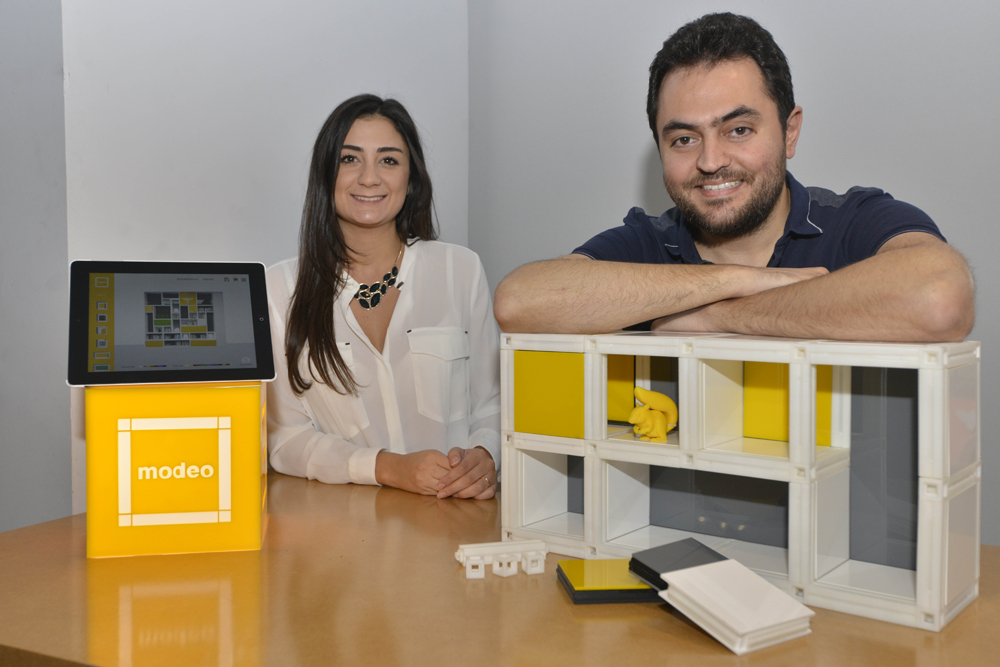
Modeo is a young startup launched in February 2015 which caters to individuals who wish to try their hand at furniture design. Formed by two working architects, Emile Arayes and Aline Gemayel, who were frustrated by the lack of low-budget  assembly furniture, Modeo allows users to build custom plastic furniture through a mobile app interface, and uses geometric “interlocking modular parts” to assemble a range of pieces. The design can be viewed in a virtual interface before ordering, with sizing and color options, as either a 2D designed image or a 3D projection. The pieces are then delivered to the user’s door, and assembled in a similar IKEA-style flat-pack method. Having come second in the Bader Startup Challenge in May 2015, the company is now enrolled in the Speed@BDD acceleration program and developing its business plan and strategy, as well as improving the design of its final product.

Arayes and Gemayel are currently recruiting a business strategy partner who will monitor the manufacturing and distribution of the Modeo system and furniture product. They have guidelines to be environmentally friendly, and are constructing lightweight furniture pieces which can be reused and reassembled post initial construction. Their target is the mid-to-low end range market of furniture users, and they are using low-cost recyclable plastic material through the ‘lean startup model’ – iterating design of the product and improving prototypes through the needs of early customers.

Dealing with mobile apps, storage and distribution means that the company will need to recruit local talent, along with using local 3D printers to demonstrate the concept to investors. Plans for mass manufacturing are not yet finalized, but local 3D printing is helping Modeo to improve their model before they move to plastic injection models formed from aluminium molds.

Though their business plan is still going through stages of development, they stress that main sales will come through their app, and do not intend to host their furniture in showrooms, but only in exhibitions as a marketing ploy. Moneyback guarantees are also in place in their business strategy, should their furniture not satisfy individuals, which overcomes the initial ‘trust’ barrier. Their target client base are those who would use similar assembled furniture lines, such as IKEA which comes from outside of the region, yet they stress that their advantage over such manufacturers and unique selling point is the ability to both assemble and disassemble pieces easily, enabling users to reuse and repack the furniture when moving. Their projections estimate a sale of 16,000 average-size units in the first year of operations, generating roughly $1 million in revenue.

January 22, 2016 0 comments
0 FacebookTwitterPinterestEmail
EntrepreneurshipEntrepreneurship in Lebanon

School of code

by Executive Editors January 22, 2016
written by Executive Editors

This company is part of Executive’s Top 20 for 2015. Read more stories from our entrepreneurship in Lebanon section, for the latest analysis on the country’s ecosystem.

Teens Who Code

Industry: Education

Product: Coding classes

Product launch: 2014

Established: 2014

Employees: Recruitment on project basis

Founders: Nour Atrissi and Ziad Alameh

Teens Who Code is the brainchild of co-founders Nour Atrissi and Ziad Alameh, who met in AltCity and decided to form a startup in October 2014 dedicated to teaching young adults how to computer program in different languages in 2014. Aimed at improving computer literacy amongst teenagers, Teens Who Code offers courses and private sessions to individuals in a number of different areas, from web development and Raspberry Pi classes, to android and iOS development. Their reasoning for targeting the youth is that programming skills are, like a language, often absorbed faster by a younger mind and can subsequently shape future career paths. Their board of advisors also boasts familiar faces, such as David Munir Nabti, CEO of AltCity, and Nicolas Sehnaoui, former minister of telecommunications.

Their business model is currently centered around developing curriculum for bootcamps – 10 week programs which Atrissi explains are in direct response to market demand – which will be rolled out in February, and which she feels enable students to improve in the most efficient manner. In addition, next year they will start targeting schools and offering after school classes in addition to separate bootcamps. A pull factor included on their website is the offer of a free hour-long coding session for new sign-ups with Alameh. Several of their graduates go on to receive job offers, and Atrissi explains that the AUB undergraduate who manages the TEDxAUB website graduated from their program. Teens Who Code has been self-financed over the past year, and has collaborated with AltCity to use their office space when offering large classes. Teens Who Code will seek external funding over the course of 2016 in a bid to expand across local and regional markets, while approaching schools to advertise and advocate their project in an educational setting. Having physical teachers on the ground encourages and pressurizes students to complete their programs, which gives Teens Who Code a competitive edge over massive open online courses (MOOCs) run by educational giants like Coursera, which have a four percent completion rate compared to Teens Who Code’s 90 percent completion rate. Aside from online platforms, Atrissi stresses that there are no competitors who specifically teach coding to teenagers in Lebanon.

Atrissi and Alameh are looking to recruit coding teachers for their different courses, which retail at $250 for a two month bi-weekly iOS development course and set a limit of 10-12 students per class. While there are no limitations on previous experience, Teens Who Code try to filter students into classes according to their coding history. As  the model for her startup is scalable to the entire region; offering licences of the curriculum and content to other cities within the Arab world is her current expansion plan, which she claims avoids the costs of having their own physical facilities and tutors. Teens Who Code also identifies quality control as a key element of their expansion plan, with key deliverables for each student within their courses. Although Atrissi does not reveal exact financial details, the project is currently self-funded and equity is equally split between her and Alameh. Immediate future plans will be concentrated in Lebanon before they seek external investment of $50,000 to roll the model out to the wider region. 


January 22, 2016 0 comments
0 FacebookTwitterPinterestEmail
EntrepreneurshipEntrepreneurship in Lebanon

The air that we breathe

by Executive Editors January 22, 2016
written by Executive Editors

This company is part of Executive’s Top 20 for 2015. Read more stories from our entrepreneurship in Lebanon section, for the latest analysis on the country’s ecosystem.

Sensio AIR

Industry: Health care and ICT

Product: Allergen and particle tracker

Product launch: January 2016

Established: 2015

Employees: 6

Founders: Cyrille Najjar and Eve Tamraz

Sensio AIR is the creation of Cyrille Najjar and neuroscientist Eve Tamraz, who founded the White Lab in early 2015 and have recently relocated to London with the second phase of the UK Lebanon Tech Hub acceleration program. Their product centers around a piece of hardware which detects “allergens like pollen, acarids and mold as well as harmful gasses” as quoted by the company, and feeds data on the quality of the air back to an app on a mobile device for analysis and notification. The patent for their device is filed in both the UK and Lebanon, which they have identified as key parts to their main sales market. Their idea was borne out of the fact that both cofounders suffered from allergies, but had limited ability to continuously monitor the quality of the air.

The device is similar to a smoke detector in installation and appearance and allows for quantitative and qualitative analysis of the quality of the air, especially that within the home. Sensio AIR has eyed Europe as a first main market in light of continuous reform to EU air quality directives, with the European Commission quoting air pollution as one of their “main environmental policy concerns since 1970”. Sensio AIR has identified 21 million people with respiratory problems in the UK alone, based on a 2010 report from Mintel, a global market research and insight firm, along with 12 million who are allergic to their own homes. The device therefore “detects everything that is in the air,” claims Najjar, who explains that it can observe particles down to a minimum of a micrometer, and often identify what the particle is. The smart allergen monitor has piqued interest among professionals and has already won two competitions: the Harvard Startup Pitch Competition in Boston and the Instituto de Empreza International Venture Day in Paris. Beta testing has been launched and electronics production is based in the UK, and Tamraz and Najjar claim that their product is more sensitive due to the accuracy of their hardware than any other detector on the market today. There are two versions, a bespoke and a business-to-business model. Their main unique selling point is that the device detects more than one presence within the air (e.g. both pollen and carbon monoxide), unlike a single feature device like a carbon monoxide detector. It also does not operate purely on ‘threshold technology’; detectors which will only sound an alarm when a certain level of a pathogen or toxic fume is reached. The Sensio AIR monitors the content and levels continuously and sends data to the user.

Najjar and Tamraz, along with their other two colleagues, eye selling 5,000 units in London, 1,000 in Paris and 200 in Beirut as a starter, and the company breaks even after the selling of 2,200 units, with Najjar confident that they will begin making profit after one year of sales. They will offer a variety of packages to accompany the units; an enterprise solution where the device is bought and a monthly fee is paid, a corporate 3G package, and a personal package which includes a one-off payment and installment of a wifi device for $299. Little boosters can also be installed in a separate room for small additional costs. The data on the units will be analyzed, and allergic homeowners can use the data in a health care perspective. Tamraz estimates that this will corroborate outbreaks with specific detected allergens, thus allowing for a diagnosis based on the principles of deduction rather than, for example, a test which pricks the skin with a needle containing a small amount of the allergen. They will launch the product during allergy season in March 2016, with the back end development based in Lebanon and the main sales market in London, though they hope to eventually have equal sales and demand here and eye the MENA region as a strong expansion plan because of frequent sandstorms. In commenting on the efficacy of their device, Najjar explains the testing they did on the quality of the air in Lebanon in summer 2015; “You don’t want to know, the results were so bad. We need a strainer, not a detector. We need to strain the air with a filter.”


January 22, 2016 1 comment
0 FacebookTwitterPinterestEmail
EntrepreneurshipEntrepreneurship in Lebanon

Guarding against fraud

by Executive Editors January 22, 2016
written by Executive Editors

This company is part of Executive’s Top 20 for 2015. Read more stories from our entrepreneurship in Lebanon section, for the latest analysis on the country’s ecosystem.

ReAble

Industry: Health care and ICT

Product: ReAble wallet mobile app

Product launch: 2015

Established: 2015

Employees: 3

Founders: Paul Saifi and Emile Sawaya

When Emile Sawaya’s younger brother was diagnosed with autism seven years ago, he became aware that the market offered very limited technological tools for independence for those with cognitive difficulties. Fast forward to 2015, Sawaya and his blind co-founder, Paul Saifi, felt that the market was worthy of exploration and wanted to develop tools which would give individuals, such as Sawaya’s brother, the ability to gain some independence from caregivers. They identified a gap in the market, which offered only expensive technological tools catering for a Western market.

Their main product is the ‘ReAble wallet’ that focuses on money management and financial transactions for people with autism and eventually for a broader range of people with special needs. Sawaya’s main motivation is that many people with autism have difficulties with the concept of understanding value and the premise of value exchange, especially with monetary difference that is owed to them after a transaction. The ‘wallet’ is an app which can be loaded onto any Android smartphone, and works through optical character recognition (OCR). It allows the user to register the bills they have in their possession, and subsequently scan receipts into the app, which can register the time, date and value of purchases. The app then informs the user of the correct change they should receive and affords them budgeting capabilities throughout a time period. The caregiver has a corresponding app with push notifications informing them of the user’s transactions. This bridges the gap between a concerned caregiver and an individual with autism, while simultaneously offering them a degree of freedom and independence. A prototype of the application, which works on Android, is scheduled to be unveiled at the Banque du Liban Accelerate conference in December 2015.

The application was designed with therapists – here in Lebanon and in Canada, the United Arab Emirates and the United States – so that the application (in terms of color, buttons and interfaces) was appealing without being distracting to those with autism. There are current plans to incorporate an element of artificial intelligence to identify the financial habits of users, and deduce whether they are harmful (e.g. overspending). ReAble is currently working with two institutions in Canada and two in Lebanon, Assafina and CARE, Consultant Advocacy for Remedial Education.

To monetize the product, the business model will be based on a subscription plan and allow the user to buy the application for $5 per month, an estimate at the end of 2015. This subscription plan can be rolled out to care centers, which would need extra tools to manage the app, from a dashboard package to enterprise, services and maintenance. Their target market is teenagers and adults who have mid-to-high functioning autism, and Sawaya says this is a market of 35 million based on WHO statistics worldwide and not limited to the MENA region.

Initial tests would support the enthusiasm Sawaya has for this project. Within 48 hours of launching applications, they received interest from 100 beta testers, who Sawaya explains are individuals with vested interest in the product, and are working to extend the project to remote therapy access through an online platform hub for people with disabilities, and roll the product out to iOS and Windows Mobile platforms. With their intentions to stay headquartered in Lebanon, they are currently looking to recruit a programmer in the country and wish to gather as much technological talent as possible, coupled, eventually, with their own in-house therapists.


January 22, 2016 0 comments
0 FacebookTwitterPinterestEmail
EntrepreneurshipEntrepreneurship in Lebanon

The design challenge

by Executive Editors January 22, 2016
written by Executive Editors

This company is part of Executive’s Top 20 for 2015. Read more stories from our entrepreneurship in Lebanon section, for the latest analysis on the country’s ecosystem.

Moodfit

Industry: Interior design and ICT

Product: Interior design website

Product launch: 2015

Established: 2014

Employees: No fixed employees; 14 freelancers

Founders: Tarek Jaroudi, Mohamed Sabouneh and Ghassan Abi Fadel

In 2014 Tarek Jaroudi, Mohamed Sabouneh and Ghassan Abi Fadel, students in the American University of Beirut’s (AUB) MBA program, were frustrated with the lack of easy communication between interior designers and potential clients, and came together to form Moodfit. Having conducted extensive research with suppliers, designers and clients, the final product is an online interior design program which enables a user to transform a space with the help of top interior designers, and removes the need for the continuous on-the-ground presence of an interior designer; the only physical interaction is done with local home decoration suppliers. Through an interface the customer uploads photos of a to-be-decorated space, as well as the dimensions of the area, and subsequently receives three to five ‘mood boards’ (suggestions) from competing interior designers, the vast majority of which are Lebanese. There is no obligation to pay if the user dislikes the mood boards from designers, but if the user chooses to proceed they select a mood board and pay $300 per room to receive the basic package of services from the relevant designer (furniture plan and shopping lists). Target markets for the basic packages can be mid-income range individuals within the Middle East and North Africa (MENA) region, but Moodfit are looking to expand to a more expensive ‘premium’ service which they would retail.

The website was launched in September 2015, and now the team has seven ongoing and 30 pipeline projects from all over the MENA region, despite only launching social media advertisements in Lebanon. The company has raised much of its funds through grants and competitions, and was the winner of the $15,000 first prize at the Darwazah Innovation Competition. Now Moodfit is looking for seed funding of around $300,000 to cover its first year of expenses, and enable them to hire their own developers and remove the need for continuous outsourcing. This is needed for its new platform, a more complete version of its current website, which it hopes will go live early 2016 – very much adhering to the lean startup model. Future expansion plans also include an app, unhindered by low internet speeds as Jaroudi explains the upload/download process is similar to that of the photo app Instagram. Moodfit’s revenue model is 20 percent commission of the user fee, and large scale referral fees from local furniture suppliers and manufacturers. Its projection for 2016 is a rate of four projects per month in the first month, growing at a rate of 15 percent, which it is already outgrowing due to positive exposure. This would allow them to break even in their third year and become profitable in their fifth.

Moodfit’s model is scalable, because it starts ‘lean’, and thus can be easily modified to fit all manner of customers, and appeals to the modern day crowd source mentality, which they utilize by connecting people to interior designers rather than placing them on a continuous payroll. The fully functioning automated version of the startup will be tried and tested in Lebanon and can be easily rolled out across the entire region. In terms of local job creation and social impact, Moodfit wishes to use the seed funding to expand and create a local sales and computer development team, and argues that its platform creates value by facilitating interior designers’ access to markets, thereby ensuring work, while simultaneously offering users the ability to use designers at affordable prices, without expending unnecessary resources.

January 22, 2016 0 comments
0 FacebookTwitterPinterestEmail
EntrepreneurshipEntrepreneurship in Lebanon

Sky’s the limit

by Executive Editors January 22, 2016
written by Executive Editors

This company is part of Executive’s Top 20 for 2015. Read more stories from our entrepreneurship in Lebanon section, for the latest analysis on the country’s ecosystem.

Next Automated Robots (NAR)

Industry: Robotics and drone technology

Product: QuadroFighter drone

Product launch: 2016

Established: 2015

Employees: 2

Founders: Charlie Khoury and Nicolas Zaatar

The drone industry is growing and is fast becoming an indispensible part of a large range of consumer services. Analysts are predicting the sky as the limit for the industry over the next few years, with 2014 seeing drone startups raising $107 million worldwide, surpassed in June 2015 with $172 million, according to data from CB Insights, a venture capital and angel investment database centered in New York. With Amazon’s ‘Prime Air’ drone-based delivery system currently in development, and local street festivals such as Car Free day in Mar Mikhael on November 22 filmed by flying drones, drone usage is on the rise.

What started as a final year university project at the Lebanese American University in Byblos in August 2014 has evolved into Next Automated Robots (NAR), a startup in Speed’s acceleration program that is working to produce a fully-autonomous 24/7 drone called “QuadroFighter”. The aim of the drone is to detect wildfires at an early stage, and target markets are governments and private NGOs, or individuals cultivating wide areas of land. The drone alerts the user through desktop or mobile applications, without piloting, and relays the coordinates of the wildfire. The user interface is being developed by NAR and a demo is scheduled for presentation to investors in mid January 2016.

While the company is still very much in the early stages, and is prioritizing the research and development into flight times, the co-founders point to the wide array of practical applicationof the project. They argue that NAR can evolve beyond detection of wildfires. “As soon as we have the platform we can shift [drone usage] to any other thing that can be beneficial to society,” explains co-founder Charlie Khoury, “[for example] industries like oil and gas and agricultural industries,” where inspections can be carried out by drones. Revenues and operating costs are still under discussion within the acceleration program, as NAR is currently heavily focussed on research and development.

Their only hesitation is the availability of parts, with no company supplying motors, controllers and batteries within Lebanon, thereby pushing NAR to source these components from outside the country. They are, however, keen to ensure their operating base remains within the country, and have expressed interest in opening a regional office to source parts. Khoury emphasizes that this technology is new to Lebanon, and within the market in the country there is enormous potential for NAR to grow, both nationally and regionally. Additionally, while their early detection of wildfires can have a positive environmental impact, NAR’s social impact can be seen through their potential recruitment – upon expansion – of local engineers and designers. As four respective engineers who graduated in classes that saw many of their peers move outside of Lebanon for employment, NAR is keen to emphasize how a new industry can incentivize young engineers to stay working in Lebanon through offering exciting opportunities in a fresh industry. Their focus, to integrate drones into everyday life, is the main persuasion tactic they will use on demo day to investors when they seek future funding.

January 22, 2016 0 comments
0 FacebookTwitterPinterestEmail
EntrepreneurshipEntrepreneurship in Lebanon

I am the passenger

by Executive Editors January 22, 2016
written by Executive Editors

This company is part of Executive’s Top 20 for 2015. Read more stories from our entrepreneurship in Lebanon section, for the latest analysis on the country’s ecosystem.

Carpolo

Industry: Technology and transport

Product: Ridesharing app

Product launch: 2016

Established: 2015

Employees: 2

Founders: Mohamad Nabaa and Ralph Khairallah

Carpolo was started by Ralph Khairallah, a business planning instructor with previous startup experience, and Mohamad Nabaa, a recent graduate in computer science from the Beirut Arab University, in mid 2015. It’s an app dedicated to carpooling and lift sharing for university students in Lebanon. Similar to the European website BlaBlaCar, which offers shared rides to passengers from drivers between cities, Carpolo aims to reduce carbon emissions and congestion through car-sharing in the metropolitan area, and is due to be piloted at AUB. “Commuting is a huge problem; Beirut is a cemetery as there is no parking and the traffic is deafening,” says Nabaa. He explains that while their starting market focuses on students, an ideal expansion would be to encourage commuters from wide metropolitan areas to use car-sharing facilities. The startup is currently enrolled in the Speed@BDD accelerator and has benefited from the $25,000 cash injection.

Since parking and commuting to campus is problematic, and there is no reliable public transportation in Beirut, Khairallah and Nabaa feel that traffic issues can only be solved by optimising the use of unoccupied car seats. This, they argue, is an obvious solution, as many students and commuters follow the same routes on similar schedules. Their app has three main marketed features aside from carpooling: live streaming (in real time) of voyages to and from campus, institutionally verified profiles (hence the start with universities) and a point exchange system to overcome the social awkwardness of exchanging money with peers and friends, which Nabaa and Khairallah say is culturally difficult in Lebanon. The point exchange works by deducting five points from the passenger and giving three points to the driver per ride, where Carpolo absorbs the extra two points so a 40 percent deficit is maintained in the system. The users then have the option to purchase extra points through their mobile provider. Carpolo has been granted access to Touch’s directory of billing to facilitate payment, with a future estimate price of $1 for 10 points, although monetization of the product will come later as the app will be rolled with free points initially to encourage and expand their user base. Carpolo currently has an agreement with Touch, and expansion plans include extending to other operators and universities across Lebanon. Greater usage of the app is rewarded with benefits through a loyalty scheme, where students who carpool frequently ascend through levels and have the option to redeem points with their operator for mobile perks.

The environmental and social impact is relatively clear, reducing emissions through the promotion of shared rides. Since they estimate that only 33 percent of AUB students own cars (which totals to nearly 3,000 people) they have been conservative about future revenue projections. The worst-case scenario estimate is $4,000 per month from 300 carpools in total from AUB. This includes the 70:30 future revenue split agreement they have with Touch, although plans have not yet been finalized. The product was scheduled to undergo beta testing at the end of November 2015, with the app due to be launched in Spring 2016.

January 22, 2016 1 comment
0 FacebookTwitterPinterestEmail
EntrepreneurshipEntrepreneurship in Lebanon

Go figure

by Executive Editors January 22, 2016
written by Executive Editors

This company is part of Executive’s Top 20 for 2015. Read more stories from our entrepreneurship in Lebanon section, for the latest analysis on the country’s ecosystem.

Figurit

Industry: Media and information extraction

Product: Figurit dashboard

Product launch: 2016

Established: 2015

Employees: None

Founders: Haramoun Hamieh and Ahmad Sharif

Haramoun Hamieh, a digital content manager with five years experience at Al-Hayat newspaper, and Ahmad Sharif, a senior information management consultant at Layout International, came together to form Figurit after their apparent frustrations with the workflow process within the journalism sector. They have developed an “intelligent data-driven dashboard”, as described by Hamieh, to provide journalists with information and analytics in trending stories.

Founded in 2015, the content discovery concept offers more than just an alert to current trends. Figurit’s unique selling point is their ability to offer in-depth analysis of the news, rather than simple traffic analytics, and present information which is grouped into one electronic resource. Their dashboard is key in reducing the time spent in content discovery, often by wire services that are ultimately outsourced, and to improve results through accurate visualization with a dashboard of visualized scientific analysis of big data. For example, a google search on the ‘Greek crisis’ will yield a list of links that are identified through inclusion of those keywords. Figurit, however, aims to go one step further by collating a large amount of information into a digestible and selectable package which includes historical analysis of trends, competitor coverage and a key to the main actors within a story, with other metrics like sentiment analysis, coverage scope and geo-mapping of events. The technology behind the dashboard extracts data from news sources, and algorithms analyse the content. The algorithms can harness the power of natural language processing (NLP) – a field of artificial intelligence – that has real-world applications in discourse analysis and automatic summarization. They can also be programmed to identify parody or erroneous news sources and will be included in the Figurit dashboard to, for example, notify the user when an actor is first mentioned in relevance to a trending story (e.g. Nicolas Sarkozy in the Greek crisis). Figurit has direct appeal to any individual involved in investigative journalism, with a wider appeal to all news and content production companies. For scalability and applicability, the technology also has the ability to forecast trends and notify individuals of breaks to patterns within content analysis.

The intention is to start with English websites and later expand the dashboard to incorporate other languages. The initial target market is digital news startups, for which the co-founders have developed their minimal viable product (MVP), and have used a cash injection of $25,000 from AltCity’s bootcamp, which they are currently enrolled in. Their current business model will generate revenue from direct sales of subscriptions to freelancers, at an estimate of $150 per month for two users, and a larger publisher package to newsrooms, which extends to five users and includes historical data for $300. Their expectations of total revenue are built on a target set for the 36 month mark. At this time they would hope to see 300 paying subscriptions per month that they calculate will bring in recurring monthly revenue of $60,000, with estimated operating costs at 30 percent of revenue, minimized due to the cloud-based nature of the dashboard. Hamieh cites future investments as a key boost to their development, and will appeal for a maximum of $200,000 from external investors at a pitching event sponsored by Banque du Liban, Lebanon’s central bank, scheduled for December 18, 2015.


January 22, 2016 0 comments
0 FacebookTwitterPinterestEmail
  • 1
  • …
  • 133
  • 134
  • 135
  • 136
  • 137
  • …
  • 685

Latest Cover

About us

Since its first edition emerged on the newsstands in 1999, Executive Magazine has been dedicated to providing its readers with the most up-to-date local and regional business news. Executive is a monthly business magazine that offers readers in-depth analyses on the Lebanese world of commerce, covering all the major sectors – from banking, finance, and insurance to technology, tourism, hospitality, media, and retail.

  • Donate
  • Our Purpose
  • Contact Us

Sign up for our newsletter

[contact-form-7 id=”27812″ title=”FooterSubscription”]

  • Facebook
  • Twitter
  • Instagram
  • Linkedin
  • Youtube
Executive Magazine
  • ISSUES
    • Current Issue
    • Past issues
  • BUSINESS
  • ECONOMICS & POLICY
  • OPINION
  • SPECIAL REPORTS
  • EXECUTIVE TALKS
  • MOVEMENTS
    • Change the image
    • Cannes lions
    • Transparency & accountability
    • ECONOMIC ROADMAP
    • Say No to Corruption
    • The Lebanon media development initiative
    • LPSN Policy Asks
    • Advocating the preservation of deposits
  • JOIN US
    • Join our movement
    • Attend our events
    • Receive updates
    • Connect with us
  • DONATE