• Donate
  • Our Purpose
  • Contact Us
Executive Magazine
  • ISSUES
    • Current Issue
    • Past issues
  • BUSINESS
  • ECONOMICS & POLICY
  • OPINION
  • SPECIAL REPORTS
  • EXECUTIVE TALKS
  • MOVEMENTS
    • Change the image
    • Cannes lions
    • Transparency & accountability
    • ECONOMIC ROADMAP
    • Say No to Corruption
    • The Lebanon media development initiative
    • LPSN Policy Asks
    • Advocating the preservation of deposits
  • JOIN US
    • Join our movement
    • Attend our events
    • Receive updates
    • Connect with us
  • DONATE
Comment

Reclaiming Beirut’s shared spaces

by Mona Fawaz August 14, 2014
written by Mona Fawaz

[pullquote]Do you wonder why an iconic national symbol such as the Pigeon Rocks in Raouche and its natural surroundings can be forever transformed through the decisions of private developers?[/pullquote]

Have you ever asked yourself why property prices are so high in Lebanon? Why Beirut homes are prohibitively expensive for at least 90 percent of the city’s daily users who cannot dream of ever claiming an address in its quarters? Have you wondered why Barcelona, Marseille, Nice or Limassol display miles of public beaches accessible to all dwellers and visitors while in Beirut, the last 100 meters of so-called public beach is privately held and, in fact, currently under negotiation for the municipality to purchase, we are told, at a meager $18 million or so? Do you wonder why an iconic national symbol such as the Pigeon Rocks in Raouche and its natural surroundings can be forever transformed through the decisions of private developers? Do you buy the idea that the laws of supply and demand are regulated by some supernatural hand that sets the price of a built square meter of land in Beirut at several thousand dollars? Indeed, could that be why the residents of Lebanon’s cities and countryside find it increasingly impossible to secure not only shelter, but also recreational areas and communal spaces? Are they just bought out by other, more deserving actors? No, they surely are not.

In these few lines, two frameworks will be developed to think through these questions and derive strategies from each to move beyond the current crisis: first, market prices are highly determined by regulatory and social institutions and second, public claims should extend far beyond what is earmarked as ‘public’ property.

Determining price

Like any other good exchanged on the market, the price of land — and housing — is highly determined by the legal and social frameworks in which exchanges occur.

In order to understand why property prices have risen as they have over the past decades, we have to look first at the regulatory and institutional frameworks in which these exchanges occur. A quick review of the taxation systems and incentives that organize property transactions indicates that while efforts were deployed to facilitate property exchanges in the 1990s through the digitization of the land registry, very little was done to curtail the widespread speculative practices that dominate the real estate sector.

[pullquote]Very little was done to curtail the widespread speculative practices that dominate the real estate sector[/pullquote]

On the contrary, a whole set of policies and administrative practices allows developers and speculators to evade taxes. These taxes are set well below international benchmarks, preventing the profits reaped by the real estate development sector from benefiting the community at large.

To take one simple example, a developer whose project overlooks the Horsh Beirut park or the seafront may charge his clients a hefty premium for this view, but they are not cumbered by any charges for these public amenities. The developer has also no requirement to produce affordable housing or any shared or communal facilities when they build in the city, as they are required to do elsewhere. In sum, a developer is encouraged to target the most lucrative segments of the market, allowing for narrow individual profit maximizing strategies to guide building investments in the city.

We also have to recognize that supply and demand curves are socially constructed, which means that they are derived from particular social and economic choices made by social agents. Recent market studies indicate that real estate demand stems from Lebanese expatriates and other well heeled buyers looking for long-term secure investments in the country. Despite the flagrant need to balance this demand for placing capital, at least partially, with the more immediate needs of those who look for shelter, no policy is taken to curtail the long-term speculative intentions of investors. To the contrary, an entire advertising industry supplements their financial interests with constructed ‘private’ ideas of ‘exclusion’, ‘luxury’ and ‘safe living’ that are consistently pegged to highly segregated housing models. In sum, developments that drive prices up are desirable for the city.

Given that land is not just another commodity — not only because its supply is naturally limited but also because it holds a special social value due to its role as shelter — the framework organizing its exchange is expected to reflect this special nature. Here too policies have lagged behind. While developers in many US cities, for example, are required to secure a percentage of affordable housing in every building development they produce and frequently negotiate the right to build in exchange for the provision of public amenities such as playgrounds and community pools, no such provision is even considered in Lebanon. Despite the urgency of the housing crisis and the dearth of communal amenities throughout the country — with Beirut meeting only one tenth of the World Health Organization minimum required open areas per capita — neither the municipality nor other public planning agencies have revised the regulatory framework to meet social needs.

These trends are, however, reversible. It was only after the second world war that northern European countries socialized the profit reaped by land development. These countries have heavily taxed all land developments and building rights and reinvested their profits in public amenities in ways that have made their cities routinely recognized as the most livable around the globe. And if Europe is too high a benchmark, we may instead look in the direction of Brazil, where revised forms of property taxation, introduced in 1991 through the City Statute, have socialized the meaning of land and ushered in the possibility of reversing decades of speculative building developments through the introduction of progressive taxation systems. Now studied in planning schools around the globe and emulated in other national contexts, the Brazilian City Statute shows that property taxation is not only desirable, but also necessary for building more inclusive cities. Those interested in more affordable housing and better public spaces should be looking in the direction of public regulators rather than relying on mere incentives for developers. 

Hence, the fact that land prices are so prohibitively expensive as to rule out the possibility of both affordable housing and public spaces is the result of specific, clearly identified and reversible policies. To change them would require the type of political will sustained by social mobilizations of the type witnessed in Brazil throughout the 1980s. While we may not be there yet, a growing number of civic organizations are working in this direction and we may have to look toward them, rather than toward corrupt political classes, to achieve change.

Rethinking public vs. private

This, however, is not enough. We also need to restore the value of the ‘shared’ in our cities. To own land is not to disembed it from its socio-spatial context and decide alone on its development.

[pullquote]To own land is not to disembed it from its socio-spatial context and decide alone on its development[/pullquote]

A common explanation for the absence of playgrounds, parks and other shared facilities — as much as for the deterioration of our built and natural heritage — is that most properties in Beirut are ‘privately held.’ Given that land is very expensive, it is prohibitive for public authorities to expropriate areas for the development of parks and other shared amenities.

To counter this point, a critique of the too easily accepted conception of private property as full dominion is needed. This is deeply rooted in the revival of 18th century liberal thought, mostly associated with John Locke or William Blackstone who at the time advocated for an understanding of the natural and built environment as necessarily propertied. This conception depicts urban and natural landscape as the sum of individually claimed parcels each labeled as ‘private’ or ‘public,’ the latter reporting to the authority of the state. Numerous critics — starting with Marx and Proudhon in the 18th century, but since then with a whole body of literature in contemporary critical legal theory and geography — have decried this reductive understanding of the landscape, most importantly because urban space simply cannot be reduced to a collection of individual claims. Indeed, there are numerous other ways of making claims over space and many other forms in which people have historically owned land.

Through this representation, however, it becomes possible to clearly delineate each land parcel, to define its boundaries and associate it with a recognizable claimant or owner who has the prerogative to include others or exclude them from the property or dispose of it as he wishes. As a result, the city can be understood as an amalgamation of propertied parcels, each with a clear claimant — and most of them private. Also, when a property is labeled as ‘private,’ the derived common sense of this representation is that it is the sole concern of its private owner to decide what to do with the land and the public has no influence about its uses and functions.

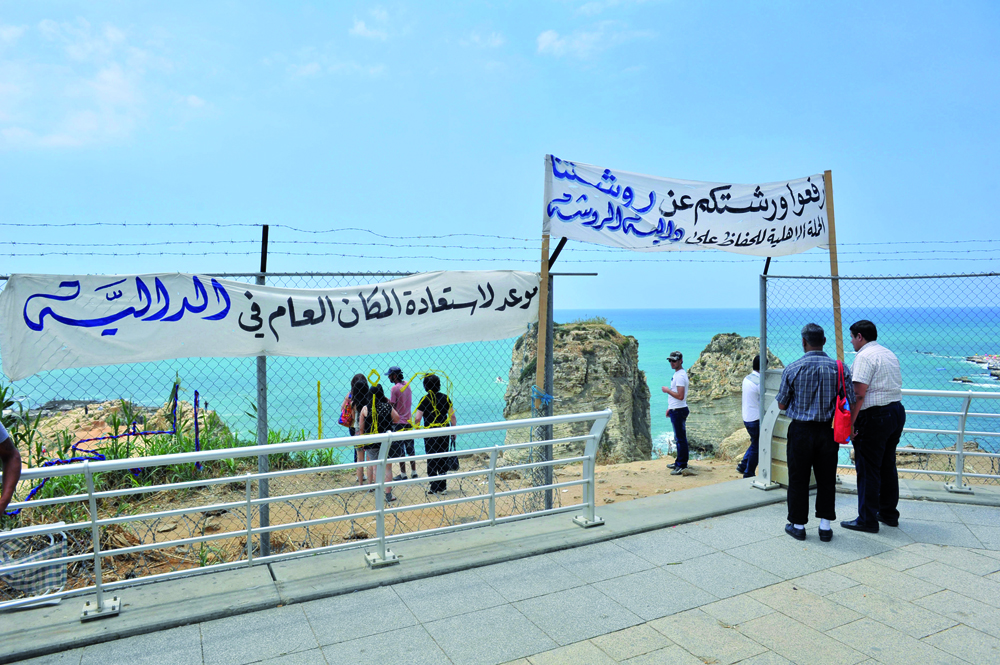
So normalized is this understanding of property in Lebanon that it has become common sense for most city dwellers to think that if a piece of land is privately held, others have nothing to do with it. Thus, responding to my outrage at the fence that recently closed off Dalieh, a large seafront area of Raouche, an acquaintance shrugged her shoulders, stating that this property is privately held and its owners have paid the market price. A clear slippage occurs here: because the property is privately held, it is assumed that the property holder can exclude others from its use and the owner can build it as he wishes.

[pullquote]The individual title holder is constrained in his enjoyment of property by the rights of the community[/pullquote]

This assumption doesn’t stand the test of reality. Indeed, although it may have been privately held (at least since the French mandate abolished communal property rights, musha‘, in Arabic) the seafront of Beirut has in practice been a shared recreational space for over a century. This is sanctioned in scores of legal texts that had enshrined the role of Beirut’s seafront as public or shared recreational space, however its property is tagged.

Starting with the first property records established under Ottoman rule and extending through the French mandate as well as jurisdictions later adopted by Lebanese authorities, a public right is recognized to the city’s seafront, one that secures visual and physical access for city residents to the sea and largely forbids building in these areas. In other words, a public right is upheld over these properties, one that recognizes that the individual title holder is constrained in his enjoyment of property by the rights of the community. The community also holds a claim over this property — even if it doesn’t legally hold a property title.

The community first

This may be difficult to grasp with a background of supremacy of private property, particularly as several more recent regulations have begun to erode the legal basis of this claim. These are in fact the same forms of claims that we, as urban planners and designers, use in order to dictate land uses in the master plans we adopt to organize cities, improve their livability and protect waterways and natural landscapes. Such restrictions are also widely used to protect heritage buildings in order to preserve the community’s identity and pass it on to future generations — even if the building is privately held.

In all these forms of land use and planning restrictions, we recognize the entitlement of the community over the individual property holder and maintain that a just balance has to be struck between those who want to enjoy the land they have bought and the price incurred by the community due to their enjoyment. These rights are clearly enshrined in planning tools that provide the regulator with numerous strategies to protect the public.

[pullquote]Beirut’s current conditions, its prohibitive prices and the dearth of public amenities, are neither inevitable nor irreversible[/pullquote]

In short, whether privately owned or not, many city spaces have been used as shared spaces for decades, and all city spaces are subject to restrictions imposed by the community as a basic prerequisite to protect the city’s livability. A wide array of planning tools — such as master plan regulations, building regulations and preservation measures — have enshrined this right and maintained it for decades. To accept the full dominion of private owners over any land is a dangerously reductive proposal that risks taking us back to the days when only private landholders were eligible to voice vision and concerns. Surely our understanding of democracy and the right to the city have evolved — and we need to extend them in our conception of who owns the city and who can claim it, live in it and speak about it.

Beirut’s current conditions, its prohibitive prices and the dearth of public amenities, are neither inevitable nor irreversible. To change the tides, it is imperative to reconsider the way we have conceived of property and the property market, and move toward one which prioritizes the rights of the collective over those of individual property holders.

August 14, 2014 0 comments
0 FacebookTwitterPinterestEmail
Comment

Israel’s new best friend

by Peter Speetjens August 13, 2014
written by Peter Speetjens

Ties between Israel and India are likely to strengthen following the recent landslide electoral victory of the Indian People’s Party (BJP). The Hindu nationalists obtained an absolute majority in parliament and saw their poster boy, 64 year old Narendra Modi, being sworn in as the country’s 15th Prime Minister.

His Israeli counterpart Prime Minister Benjamin Netanyahu on May 16 was among the first foreign leaders to congratulate Modi, whom the New York based International Business Times defined as “Israel’s best friend in South Asia.”

This is a remarkable turn of events, given the fact that relations between India and Israel have long been a troublesome affair. Much to the chagrin of the early Zionists, India’s founding father Mahatma Gandhi never supported the creation of a Jewish state.

“The cry for a national home for the Jews does not make much appeal to me,” he wrote in 1938. “The sanction for it is sought in the Bible, but the Palestine of Biblical conception is not a geographical tract… It is wrong and inhuman to impose the Jews on the Arabs.”

Furthermore, Gandhi strongly believed in secularism, which naturally did not sit well with the conception of Israel as a “Jewish” homeland. Ironically, Gandhi was killed for his secular views by a Hindu nationalist six months after the foundation of India on August 15, 1947.

For decades, however, his views on Israel would continue to dominate Delhi’s foreign policy. India only recognized Israel in 1992 and ever since, hot on the heels of the BJP’s gradual rise to power, relations have flourished.

The love affair between Zionists and Hindu nationalists should not come as a surprise. First of all, they share a similar ideology. Based on a glorifying and rather selective reading of India’s past, the “Hindutva” movement, with the BJP as its political arm, sees the country first and foremost as the national home of the Hindus.

Ideally, the BJP would like to change “India” to “Hindustan,” mirroring the name of its next door neighbor and archenemy Pakistan. Emphasizing India’s Hindu-ness, the BJP sees the country’s minorities, especially its some 140 million Muslims, as “foreign elements” and second-rate citizens, while Modi and his cohorts have often praised Israel as a bulwark in the global war against Islamic terrorism.

“The entire world acknowledges that Israel has effectively and ruthlessly countered terror in the Middle East,” read a BJP statement issued during Ariel Sharon’s visit to India in 2003. “Since India and Israel are both fighting a war against terrorism, therefore, we should learn a lesson or two from them.”

Since the establishment of diplomatic ties, bilateral trade between India and Israel has grown significantly from some $200 million in 1992 (mainly diamonds) to nearly $4.4 billion in 2013, when India became Israel’s 10th largest trading partner. Worth some $2.5 billion, diamonds and precious stones are still the bulk of today’s trade. Other Israeli exports include chemicals, minerals and, last but not least, arms.

Israel is one of the world’s biggest arms exporters, while India is one its biggest importers. According to the Israeli Defense Ministry, the country’s defense exports in 2012 amounted to $7 billion, some $1 to 1.5 billion of which headed to India. And there is much, much more to come, for the BJP aims to spend billions on a complete overhaul and modernization of the Indian armed forces, transforming India from an arms importer into an arms manufacturer.

Currently, foreign companies that invest 26 percent or more in Indian defense projects must commit to the establishment of joint manufacturing ventures in India. Yet, this has often proved an obstacle for foreign investors. India now intends to liberalize the market by, for example, raising the threshold from 26 to 49 percent.

When it comes to opening up markets, Modi is no doubt the man for the job. The son of a humble tea seller is a stern believer in capitalism. Under his 14-year rule as Chief Minister, the State of Gujarat embraced an all-out neoliberal agenda. With tax breaks and other incentives, large corporations were persuaded to establish themselves in India’s most western state.

The moral of this story? Modi is good for Hindus and good for big business, and as such could be the best news Israel has had for quite some time.

August 13, 2014 9 comments
0 FacebookTwitterPinterestEmail
ArtisanshipThe Buzz

In photos: Fashioning jewelry

by Nabila Rahhal & Greg Demarque August 13, 2014
written by Nabila Rahhal & Greg Demarque

Established in 1964, Yeprem is named after its founder Yeprem Chakardemian and is now run by his children, two of whom are the jewelry house’s designers. Yeprem is known for its use of celebrity endorsements to market its luxury designs.

Yeprem not only designs the jewelry but also has its own atelier, housed in the company headquarters in Bourj Hammoud. Most of their artisans have been working with them from the beginning but, when needed, recruitment for new craftspeople is done through contacts with the local Bourj Hammoud clubs and Armenian newspapers.

An artisan closely inspects each diamond with a magnifier to assess its quality before using it for jewelry
Using a high-powered microscope, the artisan sets the diamond stones using a thin needle
Precision and a steady hand are needed for this delicate task
Once gold has been added to the bracelet and the diamonds have been set, the final details, such as the clasp, are worked with a plier
The diamonds are polished once the piece is completed
The work dirties the artisan’s hands but the finished piece is spotless
August 13, 2014 0 comments
0 FacebookTwitterPinterestEmail
Leaders

Protect the past, plan for the future

by Executive Editors August 12, 2014
written by Executive Editors

The World Cup is arguably the most viewed sporting spectacle and social event worldwide. So when Jennifer Lopez opened this year’s games dressed by Lebanese designer Charbel Zoe and accessorized by Lebanese jeweler Yeprem, it proved that Lebanon’s luxury designers compete at the pinnacle of their professions.

Even before that, the likes of Elie Saab and Zuhair Murad were offering their own evidence that Lebanon could dress the stars at major red carpet events, blockbuster films and high fashion photoshoots.

The Lebanese do not just have a flair for luxury products, they also have a special knack for creating them — both at the level of the designers who dream up novel creations, and at the level of the skilled artisans who have honed their craft across centuries. Moreover, we know that these products can be globally successful thanks to the proofs of concept embodied in the likes of Elie Saab, Charbel Zoe and Yeprem.

This, however, engenders two main questions: what can be done to boost the country’s name as a luxury producing country, and can this help protect traditional artisans, many of whom are giving up their craft?

The answer to the former can be summed up in one word: support. And conveniently, this makes the answer to the latter a resounding yes. In Executive’s special report on artisans and luxury (see “Crafting luxury“), several Lebanese designers with experience producing collections abroad say it is both more efficient and less costly to produce in Lebanon. Working with Lebanese craftspeople, they say, has more of a familial feeling as opposed to working with impersonal factories. All designers interviewed agree that Lebanon has a substantial pool of traditional artisans which could be further developed into producing at the luxury level.

This bodes well for Lebanese artisans, who have been leaving their professions in droves due to low wages. In a globalized world, craftspeople simply cannot compete with mass produced items from abroad. Meanwhile, the markets for ‘fair trade’ and ‘traditional’ goods are limited. The only sustainable option for Lebanese crafts is to go upmarket.

One of the major impediments for Lebanese crafts entering the luxury market is that their quality is often not up to the necessary standard. This is probably because there has been no significant demand on them to produce at that level but also because, since artisans usually learn their skills through family mentorship, they are often not exposed to the latest techniques and machinery in their craft.

But this can be fixed. Having designers work with these craftspeople to set quality control standards and consistently demand quality would be one way to nurture a luxury mentality while injecting new blood — both economically and literally — into Lebanon’s crafts sector.

Another step would be to practically develop artisans’ skills by establishing vocational schools and degree programs focusing on single crafts or teaching skills as part of university design programs, such as in the case of the Elie Saab School of Fashion Design, which offers a course in pattern cutting.

The creative industry, be it the craftspeople or the designers, also needs to form an association through which collaborations would be easier to organize. Such a group, similar to what the private winemakers of Lebanon did by setting up the Union Vinicole du Liban (UVL) in 1997, would also go a long way toward creating a support system for artisans, giving value to their work and globally promoting Lebanon as a luxury producing country.

Once Lebanese artisans have the tools to produce items at the luxury level, a national branding and marketing effort will be needed to promote Lebanon as a luxury producing country. Here authorities must first extend support to designers exporting their products by providing them with reduced taxes on imports needed for their business but not available in Lebanon.

The government’s main step of support, though, would be financing a country pavilion at international trade exhibitions to promote Lebanon as a luxury producing country. In the world of design, such exhibitions remain the primary way that international buyers are introduced to the latest a country is producing in their field, and as such would have the most significant impact on the way Lebanon is perceived.

In the absence of a government willing to do so, it would be up to an association of creatives to come up with and finance such a national campaign, much in the same way the UVL self-financed the “Day of Lebanese Wine” in the United Kingdom, where member wineries exhibited their goods under the umbrella brand of Lebanon.

The past few years have not been kind to sales of luxury products within Lebanon. Visitors — and shoppers — have been few since 2012. Several local luxury manufacturers offer their products at lower prices in their boutiques in Beirut than at their high end sales points abroad, yet the ratio of local to international sales has still been shifting toward the latter.

This is a wakeup call — Lebanon can and should unleash the enormous promise of its creativity. It is time to focus on our proven potential and make luxury a priority of coordinated development and public sector support. Doing so will not only help the economy and bolster innovation, it will protect the cultural endowment passed down through the centuries. And, not to forget, give Jennifer Lopez something to wear at the next international event.

August 12, 2014 0 comments
0 FacebookTwitterPinterestEmail
ArtisanshipBusiness

Modernizing tradition

by Nabila Rahhal August 12, 2014
written by Nabila Rahhal

Nada Debs is famed for her luxury line of furniture and home accessories which blends the minimalist and modern design styles of Japan and the West with traditional Middle Eastern craftsmanship.

This successful combination did not come easy for Debs, who views her career path as the culmination of her quest to mix the many cultures she was exposed to in her life. It was also a personal challenge to herself to prove that a thing of beauty could come out of this region.

A move back to Beirut

[pullquote]“I decided to change the stereotype the West had about us … I wanted to show them a side of the Arab world that is really positive”[/pullquote]

Debs was brought up in Japan, studied interior architecture at the Rhode Island School for Design in the United States and worked first at an architectural firm in the US before opening her own design company in London. In 1999, personal circumstances brought her back to Beirut. In her life outside of Lebanon, Debs encountered the negative perceptions and stereotypes surrounding people from the Middle East and had internalized those sentiments herself. This is why a move to Lebanon was not something she would have chosen.

In Beirut, Debs questioned her own stereotypes of the country and says she found the reality here positively surprising: “I decided to change the stereotype the West had about us through functional objects like furniture. I wanted to show them a side of the Arab world that is really positive,” she says. 

Debs then approached several furniture boutiques in Lebanon asking them if they would carry a line by a Lebanese designer but they refused, reasoning that their customers prefer to pay thousands of dollars for imported furniture rather than buying something local. “It became a challenge for me to see if I could make furniture in this country and sell it,” she says, musing over the lack of confidence the Lebanese have in their local productions and their admiration of European products, adding this was also the case in Japan.

Displaying designs at home

[pullquote]”I had to choose something unique which cannot be copied, and this is where I started considering doing something with crafts in a modern way”[/pullquote]

Debs first began making contemporary furniture such as the ‘floating stool’ — a clear plastic ottoman with the bright fabric cushion placed almost in the middle, giving it the appearance of floating within the stool. After some experimenting, as it was the first time she was designing from her own imagination and with no reference, she created a series of these stools, and buyers began lining up.

However, when people asked her for the ottomans’ price, she realized that she wouldn’t be able to be competitive in this line of design. To cover costs and make profits, Debs realized she’d have to charge a high price that could not compete with cheaper, similar designs made in China.

“This is why I had to choose something unique which cannot be copied, and this is where I started considering doing something with crafts in a modern way,” says Debs. She explains that since she was working with craft — which by definition is artisanal and takes time to be of good quality — she decided to price her pieces high and go into luxury furniture design.

On a trip to Syria shortly before 2004, Debs met with craftsmen who work with mother of pearl inlay designs for furniture. She decided to use their traditional designs in a modern and minimalist way that would highlight their beauty while also being functional.

So in 2004 Debs began a modest business collecting the mother of pearl inlay pieces from Syria and manufacturing them in Lebanon, displaying the finished pieces of furniture in her home. Four years on, with a thriving furniture production operation becoming too big for her home, Debs decided to open a design studio in Saifi Village. “At the time, I thought it would be a design studio but it quickly and organically grew into a retail store where I was designing, manufacturing and selling my own brand of furniture,” she says.

From the beginning, Debs took part in shows in London, New York and Paris, because, according to her, it would give her luxury designs more credibility in the eyes of Lebanese clients. “Had I just produced and sold here, I wouldn’t be where I am now,” says Debs.

Today, 65 percent of Debs’ sales come from exporting while only 35 percent come from the local market, a figure she blames on the bad economy, the dwindling number of tourists from the Gulf region and the slow footfall in Saifi Village as compared to the Beirut Souks or ABC.

Outsourcing craftsmanship

[pullquote]“The ease, accessibility and loyalty of craftsmen to us here in Lebanon are much better”[/pullquote]

When she first started, Debs had her own atelier of 25 artisans but today, upon the advice of her newly hired chief of operations, she is outsourcing craftsmanship to a specialized workshop. “Outsourcing ensures that each person takes responsibility for their part. Because of the situation we are in, sometimes we don’t have a lot of work and outsourcing means we don’t have to pay a monthly salary when we don’t need to,” she says. This change will allow her to focus only on designing and selling.

Comparing America and Europe to Lebanon, Debs sees that craftsmanship is more expensive in the West and also more bureaucratic. For instance, if she had wanted to fix a little mistake in a piece of furniture when she was in London, it would have been a long procedure of shipping and paperwork, whereas in Lebanon, this could be done within the day. “The ease, accessibility and loyalty of craftsmen to us here in Lebanon are much better,” she explains.

An advantage furniture makers abroad have over their Lebanese counterparts is that they learn furniture making in design schools while in Lebanon the craft is typically learned through apprenticeship. The main challenge is that artisans do not have the proper training when it comes to using modern technologies and techniques.

To help furniture makers acquire these skills, Debs hopes to establish a furniture making and design school in Lebanon where students would learn to ply their craft. “Designing is not enough when you don’t have production, and a lot of time you design based on how things are made. So if you are a furniture maker, it will really help you design,” she says.

For the time being, Debs is considering getting foreign expertise to help the furniture makers she works with develop their skills and learn new techniques. She believes this is something that should be done on the national level to support the country’s craftspeople in modernizing their skills and help Lebanon compete as a luxury producing country. “We need quality control according to the standards of luxury, and this is why we need to bring international expertise to identify these standards and elevate the benchmark of our craftsmanship,” says Debs.

When it comes to luxury designers, Debs feels that despite having a handful of well known designers, Lebanon is still not at the international level but is getting there. She feels that the authorities could extend their support in promoting Lebanon as a luxury design hub and exposing the designers’ work to the world through booking national stands in international trade shows. She gives the examples of Egypt and Japan, both of which wanted to encourage manufacturing and design in their countries, and took national pavilions in international trade shows, with stands for individual designers. “Lebanon has no money to do this. I had to take care of myself as do many other luxury designers in the country, but we are all managing,” she says.

August 12, 2014 0 comments
0 FacebookTwitterPinterestEmail
Finance

Canal dreams

by Thomas Schellen August 11, 2014
written by Thomas Schellen

Appearances of a lazy summer month with underlying continued positive sentiment played out in the Middle East and North Africa during the 32nd week of the year, the first full week of trading after the end of Ramadan and Eid al-Fitr. The Saudi and the Egyptian bourses each pushed higher quite nicely, based on future-minded political decisions. Both benchmark indices in the United Arab Emirates fell, but did so with moderation when compared with the wilder fluctuations of June and July.

Index performance, week 32

Apart from the UAE, the Gulf Cooperation Council bourses all achieved gains, juxtaposed in a minor way with small drops in the Levant and a mixed picture in the smaller North African markets. On weekly terms, seven benchmark indices moved up and five dropped. Overall, relaxed volumes around the region conveyed the impression that many market participants have opted to take a break from arduous tasks such as poring over second quarter corporate results and the latest regulatory announcements.

In the balance of the two preceding weeks trading had been sparse, as people were preoccupied with the end of the fasting month and with holiday observances of varying length. Under these circumstances, index trajectories in week 32 remained largely consistent with weeks 30 and 31; eight of the twelve MENA markets in Executive’s purview recorded index gains in the period since July 20.

The general’s prosperity

The Egyptian Exchange, whose EGX 30 index was sniffing multi-year record territory right after the holiday, was first buoyed by demand for banking and real estate stocks. From market regulators, trading activity was also emboldened as the bourse reinstituted a discovery, or premarket, session and other daily trading rules which had been under suspension since January 2011.

According to a press statement, EGX Chairman Mohammad Omran “stated that the recent stability helped us to cancel a number of precautionary measures adopted after the revolution of 2011,” and that the situation in Egypt has “returned to normal.”

According to analysts, the week’s main booster of moods was a move by Egyptian President Abdel Fattah al-Sisi who announced that Egypt’s ambitious Suez Canal Corridor Development Project was finally commencing with a $4 billion project expanding transshipment capacity.

The project, which is also supposed to entail the creation of new seaports and a logistics and industrial mega-zone alongside the canal, is a reiteration of a project that was first conceived under former president Hosni Mubarak in the late 1990s and that was tendered amidst controversies by the government of Mohammed Morsi in May 2013.

According to media citing Sisi, the project this time around will be spearheaded by the Egyptian military with a mandate to dig the new waterway within one year, down from three, and will be financed entirely by the Egyptian people via a stock issuance program for a company that has yet to be established.

Shortly after the new president’s new gift was announced, which came just over one year after the military ousted his predecessor Morsi, an Egyptian court ordered the dissolution of Morsi’s Freedom and Justice Party. The political party, an affiliate of the Muslim Brotherhood, had existed for little over three years.

Amid these various news developments, the EGX 30 stayed its course to new peaks and closed week 32 well above 9,000 points — for the first time since the 2008 global crisis. For comparison, the index was moving in the upper tiers of the 6,000 point range at the onset of the 2011 Tahrir Square protests that forced out Mubarak.

Sweet regulations

Across the Red Sea in Saudi Arabia, the political boost to the stock market was of a more tangible type, in the sense that foreign institutional investors can now look forward to direct market participation in Tadawul. As per an announcement of the Saudi Arabia’s Capital Market Authority from late July, the CMA has started preparing the framework to enable “qualified foreign financial institutions” to invest in listed shares starting in the first half of 2015.

Until now, foreign institutional investors only could own Saudi shares via swap arrangements using local intermediaries. While the direct access is still a while away and, judging by the very measured and gradual implementation of changes that the kingdom has been practicing, will be phased in carefully, quick movers seem to have jumped onto buying into large cap stocks, such as globally active petrochem firm Sabic, that would be best positioned to attract international share investors.  Sabic’s stock, which rarely makes headlines for rapid price moves, leapt some 12 percent higher to six year highs within the first two Tadawul sessions after the Saudi cabinet’s decision in favor of direct access became known.

The TASI, similarly to the Egyptian benchmark, closed week 32 with the highest readings since the global financial crisis.

In a similar regulatory move, authorities in Qatar increased foreign ownership ceilings for companies listed on the Qatar Exchange. According to a report in The Peninsula newspaper, Law No. 9 of 2014 was issued to the effect that foreign shareholdings in listed companies can in the future almost double, to a ceiling of 49 percent. Aiming to attract heightened liquidity to the QE, the new law also provides that non-Qatari GCC nationals will no longer be considered foreigners in terms of share ownership.

This governmental enthusiasm for more liquidity notwithstanding, the Qatari market’s tight culture and not-too-perfect diversification even in comparison with its big Saudi neighbor, and not to mention the two markets’ divergent histories in decision processes, all suggest that the liquidity journeys in Doha and Riyadh will continue to be distinct from each other for years to come. Meanwhile, on the ground it appeared that Qatari investors started the month of August with a measure of new share buying appetite after booking some profits toward the end of Ramadan.

For the UAE markets, the tumultuous last two months suggest that some cooling off in friendly climates could be the best distraction for investors and stock market professionals in Abu Dhabi and Dubai. Low market volumes and very gradual share transactions involving market shaker Arabtec and its former chief executive, as happened in the past two weeks, sound just right in this context — and this even more so as there are plenty of new opportunities for secondary and primary market excitement looming just around the corner.

The $2.45 billion initial public offering of Emaar Malls Group, set to be the DFM’s biggest new stock impulse in seven years, is presumed to happen in September, according to a story in Abu Dhabi’s news smithy The National.

Marka, a new and yet-to-prove-itself stock with high-flying plans to feed Gulf consumers new fashion and food solutions, will make its trading debut on the DFM also next month. Meanwhile DAMAC, the luxurious developer, posted an offer to its GDR holders on the London Stock Exchange under which they can exchange their GDRs for ordinary shares, “conditional upon the admission of the DAMAC Shares to trading on the Dubai Financial Market.” The offer is valid until September 2.

And not to end here, news was leaked last week that even Meraas, the real estate company mandated by Dubai’s rulers to help drive the emirate’s latest super-mega projects such as Mohammed Bin Rashid City, has contacted banks in search of IPO advisory.

With this barrage of stimuli targeting the glands of investors it seems that only exciting times are on the program for UAE securities markets in the last third of 2014. The fact that a mandatory IPO by Zain Bahrain will finally be implemented in Manama this September, as the first flotation on Bourse Bahrain since 2010, only serves to demonstrate that excitement could also be knocking on the doors of the region’s sleepier exchanges.

August 11, 2014 0 comments
0 FacebookTwitterPinterestEmail
ArtisanshipBusiness

Flooring the competition

by Nabila Rahhal August 11, 2014
written by Nabila Rahhal

When you walk into any Lebanese home built between the early 1880s and the 1940s, the first thing you are likely to notice are the intricately designed and colorful terrazzo handmade tiles underneath your feet. In a time before carpets were fashionable, these cement tiles were the chic way to give a home a unique identity and some color.

Gradually, with the introduction of the more fashionable marble or granite tiles, and the machinery to mass produce them, the time consuming terrazzo style of tile making began fading into oblivion, taking with it the tile fitters and their tile laying skills. That was until 15 years ago, when Edgard Chaya found his great-grandfather’s tile laying tools. He began experimenting with them which eventually led to the formation of BlattChaya, a local company that produces luxury handcrafted colored terrazzo tiles for a global market.

Chaya recounts how he spent his career as a money exchange officer, starting his own offices — Chaya for Money Exchange ­— and helping develop the Syndicate for Money Exchangers, which he still honorarily heads. After a prosperous career in this field, and approaching retirement age, Chaya chose to sell his business when his children — Karim, a designer and the cofounder of Acid design and production firm; Maxime, the acclaimed Lebanese adventurer; and Caline — did not express any interest in following in his footsteps.

A few years into his retirement, and growing “tired from resting” as Chaya puts it, he found his great-grandfather’s tile making tools from the 1800s when the family had a thriving tile production business in Lebanon. “It took me four years to make my first tile exactly the way my great-grandfather made it. I was determined to succeed in this enterprise and thank God I did,” says Chaya, emphasizing that his business started as an interesting challenge for him and remains a pleasure to run.

An international success

Today, BlattChaya has profited from the rising international appreciation of handmade artisanal products and all things authentic. BlattChaya tiles not only adorn the floors of several Lebanese enterprises — Tawlet restaurant, Maison Rabih Kayrouz and Momo at the Souks to name a few — and private villas, they have been used by members of the Qatari royal family including the emir’s sister as well as restaurant and hotel owners in the Gulf. The tiles are also being sold to interior architects in New York, Boston, Geneva and Vienna.

Chaya says the Victoria and Albert Museum in London has also ordered his tiles for their newest extension as has a national museum in Saint Petersburg. “We have truly become an international name which surprises even me,” he says.

The reason Chaya is surprised by his international success is that BlattChaya has no offices outside Beirut and relies on word of mouth and their comprehensive website for marketing. “People visit our website, discover us and place their orders,” says Chaya, explaining that the website even has a simulator that allows the users to create their own patterns for the tiles and step by step illustrations of the tile laying process. 

BlattChaya has 20 orders a week during its busiest time. The company informs customers that there is a two month waiting period before their order can be processed, due to orders already in progress. Because each tile is individually made by hand, with some tiles taking 20 minutes apiece, it is a long process and tiles are admittedly sold at a high price: “I sell each [set of] five tiles for $200,” says Chaya, pointing to a 20 by 20 centimeter black and white tile with a swirly pattern being pressed by the tile layer.

Chaya’s 12 employees, whom he prefers to call artisans as he feels the word better describes their precise and delicate work, have been with him since he started the company. “I have trained them to produce tiles my way, which is very different than in the market,” he says. Each artisan produces an average of 30 tiles per day but Chaya is satisfied with this production rate. He has also declined an offer to expand his production to Jeddah, where the potential investor wanted to mass produce the tiles using the latest Italian machinery, because “it wouldn’t be BlattChaya anymore.”

Quality over quantity

Besides being handmade and time consuming to produce, Chaya believes what distinguishes his tiles and makes them a luxury product is the emphasis on quality. “People sometimes take tiles similar to ours from the abandoned old houses, but back then they couldn’t achieve the quality we do today as the tiles were much thinner and their backside would show through when laid and washed,” he explains, adding that his tiles are six to eight millimeters thick — instead of two millimeters, as is the case with many older tiles — and so retain their color even when washed many times.

BlattChaya tiles are made with 100 percent all natural coloring pigments and are regularly submitted for deterioration tests at a laboratory at the American University of Beirut to maintain quality control. Finally, BlattChaya’s terrazzo tiles are certified according to British Standard 4131:1973, based on tests of hardness, thickness, water resistance and abrasion. 

Though some have tried to replicate BlattChaya’s colors and style, Chaya believes people keep coming back to them because others cannot match their quality, which comes with a hefty price tag. “BlattChaya is not a financial investment; it is foremost a hobby for me. This is why people do not copy me: it does not make as much money as mass produced tiles and it takes a lot more time to produce, so it is not commercially viable,” says Chaya.

According to Chaya, for his company to be a profitable financial investment, he would need to sell it but retain creative and quality control for himself or his son Karim. “The company has grown larger than planned, and if someone comes to me and suggests that I sell it for a couple of million dollars, I might go for it. But the way I am doing it now, I like it, even though I know it is not profitable,” says Chaya, adding that, to date, no such offer has been made.

Chaya believes it is his passion for what he does and his insistence on high quality that leave both him and his customers happy. These have allowed him to reach this level of success and would allow Lebanon to become a luxury producing country, if copied. “The designer has to think of the quality and making himself a name before the profit margin,” he says admitting that it is difficult to find people with such characteristics.

His ideas of quality are strongly related to Lebanon’s heritage and traditions — when products were handmade and artisans took pride in creating a beautiful object. “I like to move toward the past not toward the plastic and today’s mass production. There is no quality anymore because quality is expensive and producers have their expenses to uphold,” concludes Chaya.

August 11, 2014 0 comments
0 FacebookTwitterPinterestEmail
ArtisanshipBusiness

King of diamonds

by Nabila Rahhal August 11, 2014
written by Nabila Rahhal

“Lebanese jewelers’ Achilles’ heel is their lack of creativity and originality,” explains Selim Mouzannar, a leading Lebanese jewelry designer, when asked about the main challenges local designers face.

Throughout his career, Mouzannar has challenged this weakness, becoming internationally recognized for his designs, under his own name.

Mouzannar comes from a long line of well established jewelers, whose store was the cornerstone of the Jeweler’s Souk in downtown Beirut back in the 1950s. Though he grew up amid the jewelry making business and was exposed to it at an early age, Mouzannar did not intend to become a jeweler.

“I ended up doing it because I realized that I had a base in it and I know the business well,” says Mouzannar, explaining how, despite this familial background, he derives satisfaction from having created a name for himself as a jeweler in Lebanon, away from the family business.

After having studied and worked in the jewelry industry in various countries such as France, Thailand and Saudi Arabia, Mouzannar returned to Beirut 17 years ago to start his own workshop and opened his flagship store in Ashrafieh shortly after. He enjoyed success in Beirut due to his original designs which gave what Mouzannar describes as a “fun twist” to the traditional and vintage Ottoman inspired designs, which had a hint of “sadness.”

The road to international success

It was during the 2006 July war that Mouzannar decided to ensure his brand’s sustainability by expanding his business internationally. He attended his first luxury trade show in Paris. Today, Mouzannar has seven international points of sale in five cities — Kuwait, Dubai, Istanbul, New York and Paris. He says his market is almost equally divided between local and international sales. “Any luxury brand that does not have recognition in its local area cannot be exported. The company needs to have roots,” explains Mouzannar.

Mouzannar has been featured in The New York Times, and Le Figaro and counts Gwyneth Paltrow and Rihanna among his clients, with no barter or cash incentive involved.

But such success did not come without hard work, giving all elements of his company — from the creative department to the finance or marketing department and from the craftsmanship to the suppliers ­­— equal attention. “You have to work as a team and listen to the people in your company. If you don’t do so, if you don’t have all your elements in place, you will not succeed as a luxury brand,” says Mouzannar. 

At his first exhibition in Paris, Mouzannar explains he had to overcome two preconceived notions that Parisian buyers had about Lebanese produced jewelry. The first was the stereotype of Lebanese people as dishonest in their business dealings and the second was the quality of the jewelry and its originality. 

“I had a double battle there, but I was very patient and went to many exhibitions to learn what people like,” he explains.

While Mouzannar admits that there is good jewelry craftsmanship in Lebanon, he believes most work falls short from being called luxury. He does not blame the country’s artisans’ skills for this. Indeed, he explains that producing high quality jewelry is time consuming and therefore an investment not many jewelers are willing to make for economic reasons. This in turn creates low demand for the luxury quality which leads to unpracticed craftspeople producing jewelry for the masses, despite it being Lebanon’s number one export.

Away from nostalgia

Mouzannar dismisses the idea that the artisans of previous generations were more skilled than those of today, calling this “pure nostalgia,” and citing technological advancements which have made stone laying and jewelry cutting skills better than before.

Mouzannar has his own atelier, or workshop — something he says only 5 percent of Lebanese jewelers have, usually outsourcing their designs — which gives him the advantage of maintaining control over quality and the disadvantage of a heftier price tag.

The 50 craftsmen working with Mouzannar were selected for their basic skills in jewelry making, which they either picked up by trial and error or by observation, but which Mouzannar honed and molded to suit his vision of work.

The other main problem facing Lebanese jewelers, according to Mouzannar, is their lack of originality and their tendency to copy the major design houses or even each other in their designs. While their craftsmanship may be very good, such imitation will never lead to a brand or name strong enough to be internationally recognized — much as producers of Hermès knock-offs will never be known, or replace Hermès as a luxury brand.

Hope in the new generation of jewelers

Jewelers in Lebanon are usually family businesses, explains Mouzannar, and while the forefathers and founders may be hardworking, they usually have a traditional and conservative approach to jewelry making, preferring to imitate the big names instead of investing in innovative designs. “They choose the easy way and don’t want to invest in the creative process which takes time and requires a lot of mental work before production,” says Mouzannar.

Technical and vocational schools that would teach all aspects of jewelry making in a modern and creative way would help develop this industry in Lebanon, believes Mouzannar. This is far off, though, in that it is in nobody’s agenda and even the Syndicate of Expert Goldsmiths and Jewelers in Lebanon is full of bright ideas which do not get implemented, he says.

The hope for Lebanon to have its own luxury jewelry making industry lies in the young independent designers of today who are developing their own identity and are good at communicating it both in the local and global markets. Still, the ultimate recognition, Mouzannar believes, will have to come from the luxury continent, Europe — and namely its luxury capital, Paris — once enough high quality innovative Lebanese designers have made their name there, only thanks to their own efforts.

August 11, 2014 0 comments
0 FacebookTwitterPinterestEmail
Business

Taking the streets of Beirut

by Livia Murray August 8, 2014
written by Livia Murray

With few exceptions, when strolling down the sidewalks of Beirut, one would typically encounter more parked cars than fellow strollers. Whether this is due to the desirability of moving around in air conditioning to cope with the heat of the summer or just an attachment to rolling in style, most Beirutis prefer their cars as a primary means of transportation — from the large intimidating tank-like Land Rover LRX to the smaller, sensible Kia Picanto that can fit into the most impossibly tight parking spots.

This heavy culture of cars — globally a symbol of status and coming of age — suggests that public transportation, taxi or chauffeur services are not as quintessential a way of getting around in Beirut as, for instance, the yellow taxicab is in New York. But in an apparent move to defy these odds, two taxi booking applications are launching in Beirut this summer: San Francisco based international giant Uber, which has been disrupting the industry in every sense of the word and causing massive taxi driver protests in Europe, as well as its lesser known Middle Eastern twin Careem, based in the United Arab Emirates and operating regionally. But will either company realistically be able to cause a similar disruption in Beirut?

Both are still in their testing phase in Lebanon. Careem was the first to try the Lebanese market at the end of June, followed quickly by its older sibling Uber which launched in Beirut on July 11. Both companies are backed with ammunition for expansion in the Middle East. Careem, which launched in 2012, boasts of $1.7 million in equity financing from venture capital fund STC Ventures, as well as undisclosed investments from its two cofounders Mudassir Sheikha and Karl Magnus Olsson. While they are currently raising a second round of funding, Careem’s much more established twin Uber, born in 2009, has been valued at just over $18 billion.

The two apps work essentially in the same way: acting like an old school taxi central that links riders to rides, the business model is not so much new as it is a sign of the technologization of traditional industries. The user can place an order for a taxi through the app, pinpoint their exact location on a map and where they are going, and receive information about the cab. Partnering with local cab and chauffeur services, neither company owns a fleet of its own.

Early adopters

There was certainly some visible potential for the apps before the move. According to Sebastian Wakim, Uber’s Beirut general manager, the company noticed a number of people opening the Uber app in Beirut even before they had moved in. He explains this as coming from many of their clients in the GCC market who travel to Beirut, checking to see if they could use Uber at home. Careem’s Sheikha witnessed a similar demand. “One of the main reasons we launched in Beirut was because a lot of the customers we serve in our existing markets had been requesting Beirut,” he says.

Both companies for the moment have only launched their business class segment or executive category, which is perhaps a good match for their first users, many of whom are likely traveling on business. They are of course hoping to target other market segments, partly through the eventual launch of an economy category. For now they are happy with the test phase, and claim that they have also seen new customers registering for the service.

But will the apps go viral, or will they remain a tool for a select few, enthusiastically dubbed ‘early adopters’? Though there is certainly a demand for these apps in some market segments, Lebanon remains small, with around 5–6 million people if we count the recent inflow of Syrians, and has an even smaller affluent market. Thus the question remains as to whether the companies’ expansions will be worth it.

From a cost/benefit perspective, the answer is likely yes. Despite the small market size, there are very few upfront costs associated with expansion to Beirut. Neither company disclosed the exact investments, but their costs of rolling out in Beirut stem from three sources, none of which are capital intensive: hiring staff to head the operation, installing technology in the fleet and marketing costs.

Careem’s managing director claims that marketing, which will eventually take over as a leading cost, plays less of a role at the moment. Meanwhile, Uber has already had two ‘influencers’, none other than MTV host Pierre Rabat and season two winner of “Dancing with the Stars” Daniella Rahme to use their app in high-profile stunts. According to Wakim, Uber’s marketing efforts have been mostly in partnerships to promote the app with these influencers, events and venues.

Whether or not the apps catch on massively, the move to Beirut is likely justified for both companies. Profit-wise, Careem takes a 15–20 percent commission on the rides while Uber takes 20 percent. The cost of cabs for both companies’ executive segments is comparable, with Careem at $1 per kilometer with a minimum of $8, according to Sheikha, and with Uber’s pricing made up of three components which are added up: a base fee of $2.40, a per kilometer fee of $0.65 and a per minute fee of $0.16, with a minimum on any ride of $6, according to Wakim.

Competition

One can only speculate on the relationship these two companies have in the Middle East. While Careem ambivalently said they were competing quite well against Uber in Dubai, Uber shirked the topic, saying only that competition was a good thing. “We welcome competition,” says Wakim.

In any case, Careem’s presence in the Middle East doesn’t seem to interfere with Uber’s good old fashioned plans of world domination. While Careem claims that it wants to be a regional transport provider, Uber wants to be everywhere. Careem has 50,000 users spread between Dubai, Abu Dhabi, Riyadh, Doha, Jeddah, Dammam and Manama, with Beirut being their 8th city in the Middle East, and their numbers of trips per week in the tens of thousands, according to Sheikha. Uber is in more than 140 metropolitan areas worldwide, though as a later entrant to the Middle East market their number of trips per week is in the thousands, according to Wakim, which is decent traction considering they only first arrived in Dubai last September. In the Middle East the company operates in Dubai, Abu Dhabi, Doha, Riyadh and Jeddah.

Though the two apps are similar, Careem has launched several features adapted specifically for the Middle East, according to Sheikha. The first is payment with cash. Though cumbersome — involving a driver coming to pick up the cash and then crediting the user’s account — this may open the app up to a market that either doesn’t own a credit card or that doesn’t feel safe using it, an important obstacle to credit card use in the Middle East.

Another feature is mapping technology. “The Middle East is not properly marked,” says Sheikha, and he explains that Careem has adopted a landmark based navigation that recognizes important places and maps directions from there to a customer’s location, slowly building up a repertoire of locales that don’t exist on Google Maps. Uber, however, claims that they have so far not had any trouble with maps that are currently available, with Wakim saying the “current app works well in Beirut.” When asked about the specificities of the market, Wakim claims that it’s “pretty much a product that works anywhere,” with their adaptation being mostly language based since some drivers prefer to access the app in Arabic.

Whether the advantage will be with Uber’s internationally recognized brand or with Careem’s app built specifically for the Middle East, the competition is on.

August 8, 2014 0 comments
0 FacebookTwitterPinterestEmail
ArtisanshipBusiness

Luxury from behind bars

by Nabila Rahhal August 8, 2014
written by Nabila Rahhal

While doing research for her master’s thesis on women and prostitution at Saint Joseph University in 2000, Sarah Beydoun probably never thought she would end up being the creative director and founder of Sarah’s Bag — a high end handmade brand of handbags and fashion accessories. The business currently employs 200 underprivileged women, has its own boutique in Gemmayze and 22 global points of sale.

It all started in 2000 when, upon the advice of Dar Al Amal — an NGO she was working with for her thesis at the time — Beydoun got a permit to work with women in the Baabda prison on a social project to empower them through income earning.

The beginnings 

Beydoun started working with four women in prison, two of whom were Mexican and were already skilled in embroidery. She trained and paid them in exchange for embroidery handwork. Starting with bracelets, which Beydoun says did not look good, they quickly moved into handbags, an accessory item which was in the fashion spotlight because Fendi’s colorful Baguettes had just hit the Lebanese market.

“I started with the first canvas that I beaded myself and it was a ‘eureka’ moment for me. For two months I couldn’t sleep as I had all my ideas pouring in. I really felt I had found my calling: I wanted to do something that was creative and I wanted to help society,” recounts Beydoun.

The project took off quickly and, in just three months, four women became 20 with all the handwork pieces completed by them in prison and taken to a specialized handbag artisan to be assembled. Beydoun reinvested the money she made from customers’ orders to buy all the needed supplies, thus sustaining her business.

After two years, with Beydoun receiving more orders and having to meet deadlines, she had to move most of the business out of prison. She started recruiting the girls who had finished their prison terms whom she had trained and had a good working relation with.

With time, the two-step production business Beydoun put in place — handwork embroidery pieces made by the women that then were turned into handbags by the craftsmen — has evolved and Beydoun now produces a winter and summer collection, with an occasional capsule collection in her Beirut boutique.

The way it works 

Beydoun devised a system whereby the women working with her are divided into groups, based on the craft they are specialized in (such as embroidery, crochet or beading). Each group is usually headed by a woman who was previously in prison and has worked with Beydoun from the beginning.

The group leaders pass by the offices in Gemmayze at scheduled times, pick up the sketches and divide them among themselves and the women in their group to produce the pieces at their homes. Once completed, they deliver them to the office and get paid per piece.

The group leaders are also responsible for ensuring the pieces delivered are up to the standard of quality and for deciding on the percentage of income each group member receives, with guidance from Beydoun and her financial team. This business formula does not provide the job security and social benefits of regular employment to the working women, but enables them to make money from home and is a viable alternative to other rural jobs, according to Beydoun.

Once the handwork is delivered to the office, Beydoun takes them to one of the eight ateliers across Beirut which are specialized in making handmade handbags. Beydoun prefers to work with craftspeople instead of manufacturers as it allows her to be more creative, and to customize the details of the bag, such as the zipper or the inner lining. “It’s more artisanal that way and better because they take special care of what they are producing, which in turn helps me in quality control,” explains Beydoun. To date, she outsources handbag making as she believes it allows her more time to focus on her forte, creativity.

Such a grouping and division of labor, explains Beydoun, ensures her brand remains protected from replication at any step of the process.

Prison break 

This growth into a full-fledged business was not part of the initial plan of making bags in prison and selling them. However, as Beydoun explains, this growth was necessary to be able to produce collections of high quality bags. “The women who were working with me were an inspiration as they would approach me with different traditional crafts and I would find a way to modernize and turn them into handbags,” says Beydoun.

Even though, at most, 50 of the 200 women employed by Beydoun are in prison, she always reminds her team of the company’s social responsibility in working for the empowerment of underprivileged women by providing them with opportunities to generate income. Today, Beydoun does not use the embroidery pieces produced in prison due to quality concerns. However, she continues to pay the women in order to encourage, train and invest in them.

The combined tales of handmade luxury and social empowerment of underprivileged women, including a reference to prostitution, feature prominently in the marketing narrative. “There is an increased appreciation for these handmade crafts in the fast paced life of today,” says Beydoun.

Global expansion

The first few years for Sarah’s Bag were mainly in Lebanon, with expansion limited to annual exhibitions in a few cities in the region. After nine years, however, Beydoun was curious to see how far she could take her brand. She decided to expand her business globally and went to her first international trade show exhibition in Tranoï, Paris.

Beydoun recalls that the first show did not go well as she was inexperienced in managing her brand in these types of exhibitions and also unsure of how the international market works. “But I learned my lesson; I learned to select my items, how to do a catalogue … And the next time I went, it got better and it still gets better every year,” she says.

Today, 70 percent of items from Sarah’s Bag are sold abroad, with the rest sold locally. Beydoun says this division occurred only in the last year and a half, when the situation in Lebanon worsened. Before that, she enjoyed an even division of sales. The local sales, says Beydoun, were driven by tourists from the Gulf who saw in her bags a special cultural memento of Lebanon.

Quality and aesthetics

International exposure made Beydoun realize that her handbags’ most vital selling points are their aesthetics and quality level, not solely the story of how they are made. “I always had in mind that we should sell the bags regardless of who produces them: the story is not going to sell the product, it will back it up,” says Beydoun, adding that some women own her bags without knowing the background story.

To ensure quality standards are met, Beydoun has several control stops at different steps in the handbag-making process. Prior to beginning their work, Beydoun asks both the women and the artisans to sign a document committing to abide by several quality specifications.

This quality control document has the advantage of helping those involved in production shift their mentality toward the upscale market, a feat Beydoun considers one of the challenges in her work. “They know how to do it, but we need to consistently remind them that we are a luxury brand selling in Europe, and this is why they demand this much attention to detail,” says Beydoun.

As for aesthetics, Beydoun says her team tries to be tuned in to fashion trends so women buy the bags. “People are not interested in traditional crafts unless you package them in a very modern way and make them trendy,” she says.

The future for Sarah’s Bag

Beydoun speaks enthusiastically about the future of her company, saying she first wants to sustain the growth achieved this year and, ultimately, aims to have a series of boutiques outside of Lebanon. “Through these boutiques, I will not be limited to what the buyers select from the collection for their boutiques and will have more control by displaying my whole collection,” she explains, adding that this way consumers will have more of a choice from her wider collection, instead of being limited to what the boutique owners select.

For now, Beydoun’s eye is on a shop in Dubai, due to its proximity and her connections there. She will explore the possibility of working with the locals there to revive certain crafts, using a similar model to the one she used in Lebanon.

Local luxury market

Beydoun has faith in Lebanon and its designers but says the country as a whole needs more promotion of and confidence in brands that are “made in Lebanon.” Beydoun recalls how when she first started her business, few would carry handbags made in Lebanon but that quickly changed as she built her brand.

Today, says Beydoun, many fashionable Lebanese women proudly wear locally made designs, and she points to accessories made by such designers which she wears with pride.

Local designers, Beydoun believes, should also have confidence in the country’s artisans. They should continue producing luxury goods in Lebanon instead of shifting their production abroad when they become successful. “We have a lot of talented craftsmen here and this should not go to waste. Our traditional crafts should not die,” she says.

August 8, 2014 0 comments
0 FacebookTwitterPinterestEmail
  • 1
  • …
  • 186
  • 187
  • 188
  • 189
  • 190
  • …
  • 686

Latest Cover

About us

Since its first edition emerged on the newsstands in 1999, Executive Magazine has been dedicated to providing its readers with the most up-to-date local and regional business news. Executive is a monthly business magazine that offers readers in-depth analyses on the Lebanese world of commerce, covering all the major sectors – from banking, finance, and insurance to technology, tourism, hospitality, media, and retail.

  • Donate
  • Our Purpose
  • Contact Us

Sign up for our newsletter

[contact-form-7 id=”27812″ title=”FooterSubscription”]

  • Facebook
  • Twitter
  • Instagram
  • Linkedin
  • Youtube
Executive Magazine
  • ISSUES
    • Current Issue
    • Past issues
  • BUSINESS
  • ECONOMICS & POLICY
  • OPINION
  • SPECIAL REPORTS
  • EXECUTIVE TALKS
  • MOVEMENTS
    • Change the image
    • Cannes lions
    • Transparency & accountability
    • ECONOMIC ROADMAP
    • Say No to Corruption
    • The Lebanon media development initiative
    • LPSN Policy Asks
    • Advocating the preservation of deposits
  • JOIN US
    • Join our movement
    • Attend our events
    • Receive updates
    • Connect with us
  • DONATE