• Donate
  • Our Purpose
  • Contact Us
Executive Magazine
  • ISSUES
    • Current Issue
    • Past issues
  • BUSINESS
  • ECONOMICS & POLICY
  • OPINION
  • SPECIAL REPORTS
  • EXECUTIVE TALKS
  • MOVEMENTS
    • Change the image
    • Cannes lions
    • Transparency & accountability
    • ECONOMIC ROADMAP
    • Say No to Corruption
    • The Lebanon media development initiative
    • LPSN Policy Asks
    • Advocating the preservation of deposits
  • JOIN US
    • Join our movement
    • Attend our events
    • Receive updates
    • Connect with us
  • DONATE
Insurance

Covered in stormy weather

by Thomas Schellen December 25, 2013
written by Thomas Schellen

Considering the consistency with which the Lebanese insurance market has contributed to GDP — 3 percent has been the magic number for many years — it would have been remarkable to achieve considerable growth in 2013 against the stream of an economy that has been under a lot of pressure.

     The year 2012 and the first nine months of 2013 were not disappointing, according to the research of insurance sector results by the Association of Insurance Companies in Lebanon (ACAL). Gross premiums exceeded $1 billion in the first nine months of 2013, up 10 percent from the same period in 2012 when total gross premiums for the year reached $1.3 billion.

But the association’s report for the third quarter of 2013 also shows only a 2 percent increase in the number of issued policies for the year. This is a small improvement on zero growth in the number of contracts achieved in the first half of 2013, shown in ACAL’s previous quarterly report. Overall however, the low growth rate in policy issuance is a concern.

New business is scarce and sales efforts have been concentrated in keeping clients and convincing them not to shrink their coverage blankets in a time of pressure, says Issam Hitti, the president of the Lebanese Insurance Brokers Syndicate (LIBS). “The insurance sector and the brokerage sector overall is focusing on the renewal business because we know very well that looking for new business is like wasting time,” he says. “Trying to get business away from a colleague is not new business. With the renewal business we have to take care of the decrease in the purchasing power of our clients so we have to negotiate with them as if we were selling them new business.”

insuring the ailing

The concern over insurers maintaining stable client numbers is also on the mind of Walid Hallassou, general manager of GlobeMed Lebanon, a third-party administrator (TPA) company that is the market leader in the management of health insurance payments on behalf of insurance companies.

As health insurance policy holders have faced rising premium costs and rate jumps as clients age, Hallassou is concerned that private insurance will have to be innovative in scaling and customizing policy options to the needs of financially squeezed clientele. “We are really counting on the creativity of the private sector insurers to maintain the rate of 10 percent of clients who rely on private sector insurance. This number has not been growing but we are scared that it is going to decrease,” says Hallassou.

 Health or medical insurance is the first line of general insurance business in terms of total premiums. It overtook motor insurance as the top revenue generator in 2011 and in 2012 accounted for $362.2 million or 27.5 percent of total premiums, behind life insurance with 29.3 percent of the market share. In preliminary figures for 2013 until September, medical insurance contributed $322 million or 30 percent of total sector premiums, representing a year-on-year revenue growth of 12 percent. However, the cost of medical claims to insurers rose by 18 percent in the same period in addition to which medical claims represented more than $4 out of every $10 that insurers payed out.

 “We are all aware that the increase [in total sector premiums] has been most of all in the medical insurance line and this is not due to new business but due to the increase of premiums [in addition] to the increase of hospitalization costs,”  says Hitti.

In order to lower the cost increases of healthcare and the resultant burden on the insured and the insurers in the long term, GlobeMed initiated a program focused on disease management, wellness and prevention in the fourth quarter of 2013 with plans to expand in 2014. According to Hallassou, cost reduction via conventional measures has its limits and the way forward is a shift into prevention even though bottom line-focused investors in healthcare do not easily see the benefits.

“We need to start helping people screen and understand their diseases better, and understand how they can live with their diseases in a manner that does not [lead to] complications. We have collaborations with clinics in Lebanon that are going to be the platform for the launch of such programs. In the short term, these programs have an impact on customer service more than on the financials but in the end it will be both,” Hallassou says.   

Motor insurance constitutes the second biggest sub-sector in the insurance market. It represents slightly less than a quarter of premiums in 2012 and the first nine months of 2013 and well over a quarter of settled claims. Part of the problem is the structural malaise of the compulsory third-party liability (TPL) scheme which over the past decade has been beset with implementation problems, including a lack in exchange of data on accidents among insurers and persistent underselling of TPL policies by some providers at prices that made it impossible to properly satisfy claims.

on the road again

The damage caused to the reputation of the insurance sector from settlement disputes and media programs reporting on cases has caused a major headache for the insurance association in 2013. But an even larger headache would be the expansion of the compulsory TPL to cover material damages, where the frequency of claims and the risk of fraud are much higher than under the current system which only covers bodily injuries.

This expansion — stipulated in a new Lebanese traffic law ratified this year ­— is impending. However, caretaker Minister of Economy and Trade Nicolas Nahas and Walid Genadry, head of the Insurance Control Commission (ICC) reassured ACAL and insurance companies at a top-level meeting in November that the mandatory cover of material damages will only be implemented after all kinks in the compulsory system have been ironed out.

A third concern in motor insurance is stuttering premium growth in 2012 and the first nine months of 2013, combined with anemic development in the issuing of policies, which fell a reported 7 percent for the first three quarters of 2013 from merely 1 percent growth in the same period in 2012.

The underperformance of motor policy sales and lower policy values results from a sluggish economy that could feed the insurance sector with further difficulties in 2014 if overall GDP growth remains feeble for another year.

Regional political crises and the Syrian conflict in particular detrimentally impacted the motor insurance sector in 2012. The effects grew more intense and varied in 2013.

The rising numbers of vehicles that enter Lebanon from Syria and circulate in the country, often without insurance cover, leads to more accidents involving uninsured parties. While the impact on claims have been manageable in 2013, the situation puts operational and financial stresses on the system in which local insurance companies handle cases involving foreign vehicles or those lacking the compulsory cover. ACAL Secretary General Jamil Harb has sought the collaboration of the ministry of interior to set up control points where the inflow of cars can be checked for proper TPL coverage.

The impact of the Syrian crisis differs when it comes to medical insurance. According to GlobeMed’s Hallassou, the volume of regular claims has increased significantly in 2013, contributing to a 15 to 20 percent business increase in managed services for the year. This growth stems from the fact that Syrian patients can use their domestic health insurance cards issued by the company’s Syrian unit in Lebanon, with the bill being settled by their insurance provider in Syria.

signs of the times

A second impact and exponential growth factor for claims handling lies in a recent contract under which GlobeMed was assigned by the UNHCR, the UN refugee agency, to manage the health care provision to registered Syrian refugees in Lebanese care facilities, based on payments for these services by the UN and international donor countries. With currently more than 800,000 registered refugees, the management of these treatment needs represents both a good business and a humanitarian support opportunity for the company, says Hallassou. 

In other insurance lines where one would easily expect demand increases because of regional security issues — such as terrorism, riot, or kidnap and ransom insurance — local intermediaries did not register a noticeable uptrend. However LIBS’ Hitti points out that demand for such insurance would usually be concentrated with international corporations and organizations which do not buy their covers here.

Elsewhere, basic fire insurance packages for companies are among the best-performing products in terms of demand growth, with a 12 percent year-on-year increase of premiums to $81.5 million in the first three quarters of 2013. This growth was helped by a decree from the Ministry of Industry by which industrial establishments are required to present a fire policy for receiving or renewing their operating licenses.

In other areas, especially in the need for professional liability insurance — ranging from hospitality ventures to real estate agents — the absence of government-mandated liability insurance means that the Lebanese economy and its stakeholders have to contend with unregulated risk factors and face a lack of incentives to increase professionalism. Civil liability insurance policies contributed less than 1 percent to national premiums in 2012, for example. Due to the government’s inaction in the legislating of mandatory liability covers, LIBS has taken the initiative to design a cover for insurance brokers which will be introduced from the start of next year for its members, says Hitti.

This is of course also a reminder that Lebanon’s draft law for a new and better insurance system has been languishing for nearly 10 years. The draft law, brimming with articles intended to advance the quality of regulation, supervision, solvency, provision and efficacy of insurance in Lebanon, has been left to gather dust in    parliamentary limbo.

In order to move the law forward, insurers and the ICC urgently need to develop a joint perspective and lobby with parliament and the minister of economy and trade in the next cabinet.

December 25, 2013 0 comments
0 FacebookTwitterPinterestEmail
Automotive

Samir Homsi

by Paul Cochrane December 25, 2013
written by Paul Cochrane

Executive met with Samir Homsi, president of the Automobile Importers Association (AIA), to discuss how dealers are surviving in the current economic climate and the overall downward shift in the market, with 90 percent of registered cars compact vehicles at prices of around $11,000.

  • Do you think the A and B categories (compact and small cars) will dominate the market from now on, as is the case in Europe and Japan?

Definitely. We are seeing these segments grow more and more, particularly A. The country needs low cost cars with friendly fuel consumption. It reflects the economic situation.

  • So the car market is now very much a volume game?

There is a race between brands that is causing dealers to sacrifice profit for volume. That is a definite statement. Volume is going back and losing momentum, and if the crisis persists, we will see monthly losses.

  • Are European, Japanese and American brands likely to make inroads and remain competitive through more segment offerings?

In the C category volumes are low and it is a very crowded segment. I believe today the dealers are not making good margins, certainly not as much as people believe. Margins are even lower than 7 percent. But manufacturers are investing more in the A segment, which just a few years ago was not a crowded segment. People have started accepting the baby cars, whereas before they were overlooked [in favor of] used cars. Behavior has changed.

  • So dealers are surviving through after-sales?

After-sales facilities, such as repairs, labor and parts should cover 75-80 percent of fixed expenses. Once you learn how to tackle this, you are a successful dealer. The rest, the 25-30 percent, will come from car sales. So the dealer should count on offering excellent service in order to keep customers and repairing customers, and cover the fixed expenses. A good dealer can then survive. If it doesn’t perform well in after sales then it will go down the drain. Otherwise the dealer has to sell a lot of B category cars, which are not as available in the market.

  • With three brands — Kia, Hyundai and Nissan — accounting for some 60 percent of total sales, how is this affecting the overall market? Could we see some brands eventually disappear from the market?

The Lebanese dealers are resilient and they will not give up. If you look at the history of automobile markets, the leaders change. A long time ago it used to be Fiat and Renault, then Peugeot, and then came the turn of Nissan, and now it is the time of the Koreans, with Hyundai and Kia. You don’t know when the manufacturer will introduce a new A segment car at an unbeatable price and great fuel economy. It will then change the whole market specifications.

  • Chinese brands are moving in and adding further pressure to the market. What do you make of established dealerships moving into Chinese brands? A forward-looking strategy?

They have presented their credentials and got dealerships from China. Why are they interested? For the A segment. Everybody is after the A segment car. If anybody makes an A segment at a cheap price, people will buy it as that is where the volume is. Take out the [A segment] Chevrolet Spark, and my sales [at IMPEX] would go down, as it is 60 percent of sales. What is selling Chinese cars is the brands associated with the dealers, as people trust the dealers.

  • Luxury cars accounted for 2 percent of sales this year. Do you foresee an uptick in years to come?

If the economy is better, and we get out of this crisis, it will pick up. But for the masses, they will have to dream about them, as they can’t buy luxury cars anymore. Banks won’t give them credit, so it is simple, it comes down to dollars. And given the crisis under way, people don’t want to risk being indebted to a bank for a car that could be blown up in front of them.

  • Do you think we’re likely to see a return to the 2008 benchmark of over 35,000 units sold a year?

No. We have large inventories, we are competing with each other, it is a small market, and we are playing the volume game while marketing and advertising like crazy to get rid of inventories. We all make offers, and I think it is the best time to buy a car, as it is cheap and [there are] many offers. I think we will end the year on a sad note, with declining sales if the situation persists.

December 25, 2013 0 comments
0 FacebookTwitterPinterestEmail
Automotive

Wild for wheelies

by Paul Cochrane December 25, 2013
written by Paul Cochrane

With over 1.3 million registered cars, plus thousands of unregistered vehicles as well as a significant number of Syrian cars, Lebanon’s roads are seriously congested, especially in Beirut. With no major developments planned, public transport is not going to cure this ill, nor is there likely to be any impetus for bicycle lanes to be put in place for people to huff and puff around the city carbon free. The solution for many has increasingly been scooters and motorbikes.

Yet despite the rising sales — estimated at around 500 a year — increased motorbike use is being hindered by the lack of implementation of a proposed traffic law that would enhance safety on the country’s notoriously anarchic roads, and secondly, by the fact bank loans for motorbikes are not as competitive as those for cars.

“For the near future there are no magical expectations, but the sector will grow slowly but surely, and we are getting more interest from people due to fuel prices, traffic and convenience,” says Negib Debs at Rymco Younes, dealership for Kawasaki and, as of September, Peugeot. “I think what is needed is for the older generation to understand that for younger people it is OK to have bikes, as the first barrier to owning a bike is often the family.”

But if the older generation tend to view bikers as reckless speedsters, they’re not alone. It is a view commonly held among the public in general, and it has to do with safety levels on the country’s roads. Dealerships such as ANB Holding, which sells KTM, Vespa, Aprilia, Moto Guzzi and Bajaj motorbikes, are improving road safety by offering courses and giving away helmets with bike purchases, while also working on setting up an importers association — the Lebanese Association of Motorcycle Agents — to have more sway at the government level.

CHANGING MINDS

“As the state doesn’t require it, we are offering courses like Advanced Riding Techniques. As a result, we’ve reduced accidents drastically,” says Nicholas Boukhater, CO-CEO of ANB Holding. “Mentalities are changing, and people are more excited about bikes.”

An issue for dealers is that imports of used bikes are not regulated — which would be required under the new traffic law — while used scooters are so cheap that riders often do not register them and if seized by the police, just buy another one.

“You can buy a scooter for $50, but that means your notion of transport is the wrong one. It starts from there. If the buying capability is upped to $1,000 via a bank loan, no matter how limited the income, you want to preserve the bike and not have it confiscated or break it. That’s when you care about your bike and how you ride. But the government is doing everything against us and for the benefit of the importers of used bikes,” says Marwan Tarraf, managing director of Bikers Inc, the dealership of Harley Davidson.

To get more people on motorbikes instead of in cars the traffic law needs to be passed, but with that unlikely anytime soon, one option to bolster sales and better regulate the sector is through bank financing for bikes. However, banks have not been as willing to lend at preferential rates as in the car sector, where rates can be as low as 1 percent through dealerships, and average around 3 percent from banks.

RISKY BUSINESS

“We still don’t have proper financing for bikes like [we do with]cars. Banks want a higher percentage as they say it is risky, but that can be covered by insurance. We are still pending a breakthrough,” says Debs. “Banks want around 6.5 percent and insurance is expensive. We faced this problem with the Peugeot bikes, which sell for $2,000 but the insurance premium is $600.”

Dealers such as Tarraf’s Bikers Inc have a more competitive arrangement: the “Harley loan” with Bank Audi at 5 percent interest, but that is attributable to the American bikes retailing at high prices — starting from $10,750 for the Sportster and all the way up to $60,000 — way above the purchasing power of the average commuter. “The whole banking system is not familiar with bikes and sees them as a risk,” says Tarraf. “Our plan is to decrease interest over the next four years.”

Nonetheless, sales of high-end bikes are holding up. Tarraf sold 105 bikes in 2010, 135 in 2011, 128 in 2012, and 135 new and 60 used this year, with the bestsellers the Sportster at 30 percent of sales and the Touring at 24 percent. Through a World Bank loan, Tarraf also supplied 100 Harleys to the Beirut police.

BMW motorbike sales have also surged. “We started selling motorbikes three years ago, and sold 15 the first year. This year we sold 55. The trend for bikes is up and demand is growing even though there’s a crisis. Next year we hope to sell 65 bikes,” says Nagy Heneine, general manager of Bassoul-Heneine.

Yet it is not just high-end bikes that are selling well. Sales of Peugeot have done well since being introduced this summer, while ANB recently acquired the import license for Indian-made Bajaj, with the aim of tapping into the sizable market for low cost bikes with good reliability.

“The Bajaj starts at $880 for a 150cc engine, and is the only bike at this price with a two year warranty,” says Boukhater. “With the testing playground India, which has excellent engineers and bad roads, the Bajaj is much better than Chinese brands.”

The potential is certainly there for motorbikes to become a more common sight on the roads, but as with car sales, much is dependent on the economic and security situation, which has so far played havoc with Harley Davidson’s plans to host one of six global events in Lebanon, which would be a boon for the motorbike sector overall.

“We had plans to host the Harley Davidson Middle East event in 2012, which is sponsored by the company. We had booked Ramlat El Baida [beach in Beirut] for four days and had bands coming from Europe. It would’ve been a motorcyclist’s heaven,” says Tarraf. “We threw a press conference with the Tourism Ministry, and expected to attract 45,000 people, but three days later the US issued safety warnings and the event was postponed to 2013, and now to 2014. We still want to do it but it’s not the right time.”

December 25, 2013 0 comments
0 FacebookTwitterPinterestEmail
The Buzz

Business briefing: 19 Dec 2013

by Executive Staff December 19, 2013
written by Executive Staff

Economics and Policy

Lebanon has decided to allow Ikea to offer flat-pack housing for refugees, after initially rejecting the idea.

More from Time


Egypt's ousted President Mohammed Morsi is to stand trial on charges including conspiring with foreign organisations to commit terrorist acts.

More from the BBC


Torture and summary executions are rife in secret prisons in Syria run by the Islamic State in Iraq and the Levant, Amnesty International has said.

More from the BBC


Companies and Business

Ibrahim Dabdoub, one of the longest-serving bank executives in the world, will retire from National Bank of Kuwait next year after leading the Gulf Arab state’s largest commercial lender for three decades.

More from Reuters


India's Larsen & Toubro has won a $473m contract to build substations in Qatar as the Gulf state looks to increase capacity amid a construction boom.

More from Arabian Business


Bank of London and The Middle East expects Islamic bond issuance to pick up in the Gulf next year as companies refinance maturing debt in a strong economic climate.

More from Reuters

December 19, 2013 0 comments
0 FacebookTwitterPinterestEmail
Society

Nicolas Chammas

by Nabila Rahhal December 19, 2013
written by Nabila Rahhal

Executive sat with Nicolas Chammas, head of the Beirut Traders Association (BTA), to discuss the performance of the trade sector this year and what can be done to support it through these tough times. 

How would you describe the trade sector in the year 2013?

2013 was an extrapolation from 2012 and even more catastrophic in some ways. I even referred to September 2013 [as the United States discussed airstrikes on Syria] as Black September, a throwback to the civil war years and the Black September then. It was then that, for the first time in forty years, the employers association took the decision to strike for the day and though we were practically shooting ourselves in the foot, the situation was that drastic and it forced us to take to the streets and demand that a government be formed.

In terms of the BTA FransaBank retail index we had an across the board double digit decline of 15 percent for the third quarter of 2013 as compared to the same period in 2012.

Were some trade segments worse affected than others?

In trade, you have three segments, the first of which is the staples segment, which is the essentials that never stop because people have to eat, drink and dress. This sector was barely positive despite the fact that we had a continuous flow of refugees, all of whom consume. But the issue is that they get donations from abroad and products in kind or get goods from Syria. 

The second sector is luxury goods. This was severely hit in part because Lebanese purchasing power decreased and expats were not returning home as frequently, but the biggest blow to it was that visitors from the Gulf Cooperation Council (GCC) countries continued to avoid Lebanon. GCC tourists account for 45 percent of tax refunds on duty free purchases, with Saudi Arabia making up to 25 percent of those, so their absence had a big impact on this segment and other nationalities do not at all make up for this lack.

The third segment is durable goods such as furniture, appliances and cars. This sector also reported drops except for the automotive section which saw an increase in numbers of units sold but a decrease in dollar value, as more and more consumers shifted toward smaller and cheaper cars.

As far as the traders are concerned, we got hit at the top of the line, on the turnover across all segments. We have the volume effect because we are selling fewer goods and the price effect because we are selling the products at a discounted price. We found ourselves giving discounts and sales for almost 52 weeks of the year when previously we had two sale seasons which lasted a maximum of six weeks throughout the year. This is a loss for us, but we sometimes have no choice as we need to clear our inventories due to the seasonality effect and to keep up with the trends.

What would you say is the major problem for the trade sector today?

The lack of growth. The 15 percent drop in the BTA Fransabank retail index is huge (Q3 2012 to Q3 2013) when you know that trade represents one third of the gross domestic product formation in Lebanon. So when the trade sector sneezes, the economy catches flu and my bet is that the overall growth rate of the economy will not exceed 0 percent this year.

In Lebanon, we have two economies: the financial economy, meaning the banking system (and the monetary policy) which is doing well with good indicators however you look ­— the strength of the Lebanese pound, the reserves of the Central Bank and the liquidity and profitability of the banking sector.

When you look at the real economy, which is composed of the productive sectors such as industry, services, and trade, this is where we are suffering. So it is basically a tale of two economies; one economy is doing well and the other is doing terrible. But, eventually, the financial economy will be infected by whatever happens in the real economy and they are already starting to feel the pain and are taking more provisions.

What can be done to salvage this situation and support the trade sector in Lebanon?

What we need is stability.  We need the ban on travel for GCC nationals to be lifted and we definitely need their involvement and clear engagement in Lebanon again. We need the return of confidence from not only the Lebanese consumers but also the Lebanese and foreign investors.

What we mainly need, to say the least, is the formation of a competent cabinet which can restore the trust in the Lebanese economy. This is a necessary but not sufficient condition as we also need some restoration of security conditions as well as the sovereignty and dignity of the state. How can one invest in this country if there is no rule of law?

As for the merchants’ sector specifically, we ask to be aligned with the other sectors as far as some incentives are concerned. For instance, we have not benefitted at all from subsidized loans which went pouring into other sectors such as industry, agriculture and IT. True we are a traditional sector, but we have been bleeding money for the past year and desperately need to restructure our debt and decrease the service of this debt (the outstanding debt of this commercial sector is around $10 billion and the debt service is six or seven billion dollars without taxes).

This is why we are in a shouting mode whenever people speak of the new salary grid which will cost the economy around LL2,000 billion ($1.33 billion). It will break the neck of the treasury and the national economy as it will impose on us unbearable fiscal pressure. We understand they have been waiting for 17 years for this revalorization of their salary but is it wise to time it in the worst possible year for the economy?

What is the Beirut Traders Association doing to support the traders of Lebanon?

On the macroeconomic front, we work to try and stop such crazy initiatives as the new salary scale grid.

We work on the sectors front to give the indexes, which are based on real sales figures, giving us the ability to know exactly what is happening. We are currently in the process of producing an investment index with Bank Med, which is a forward-looking indicator of the jobs and opportunities of tomorrow. You can say we are getting our toolbox in shape to be able to present more scientific arguments.

We also worked with BLOM Bank to produce the Beirut Traders Association Shopping Card which is proving to be a success as we barely started and already we have 500 retailers on board. Our objective is to have thousands of cardholders, which will give advantage to the traders because of the number of cardholders and because they are part of a network and will get a commission on all sales that are done through these cards. The consumer will get incentives in terms of exclusive discounts and they will get the possibility of credit through BLOM Bank.

Through this card we are trying to encourage the smaller and medium-sized retailers by bringing them some extra business. 

We try to be useful to our members through practical initiatives such as the credit card as well as more theoretical positions such as the indexes. I think we are doing the best out of a terrible situation.

What are your expectations for the year 2014?

The pessimistic scenario is if the same geopolitical circumstances of 2013 prevail in 2014, the decline will go on, creating a much more difficult situation as our capacity to endure is being tested every single day and financially speaking we are already using our strategic reserves, so it will become tougher.

If the situation remains as is, we will be at a stable standstill. 

If, in the Geneva processes, there is some sort of breakthrough regarding Syria, then Lebanon will benefit immediately because the Lebanese economy is very fragile but at the same time it is very resilient; you push the reset button and there we go again. In that case, I will be optimistic about the future of the economy in Lebanon.

December 19, 2013 0 comments
0 FacebookTwitterPinterestEmail
Society

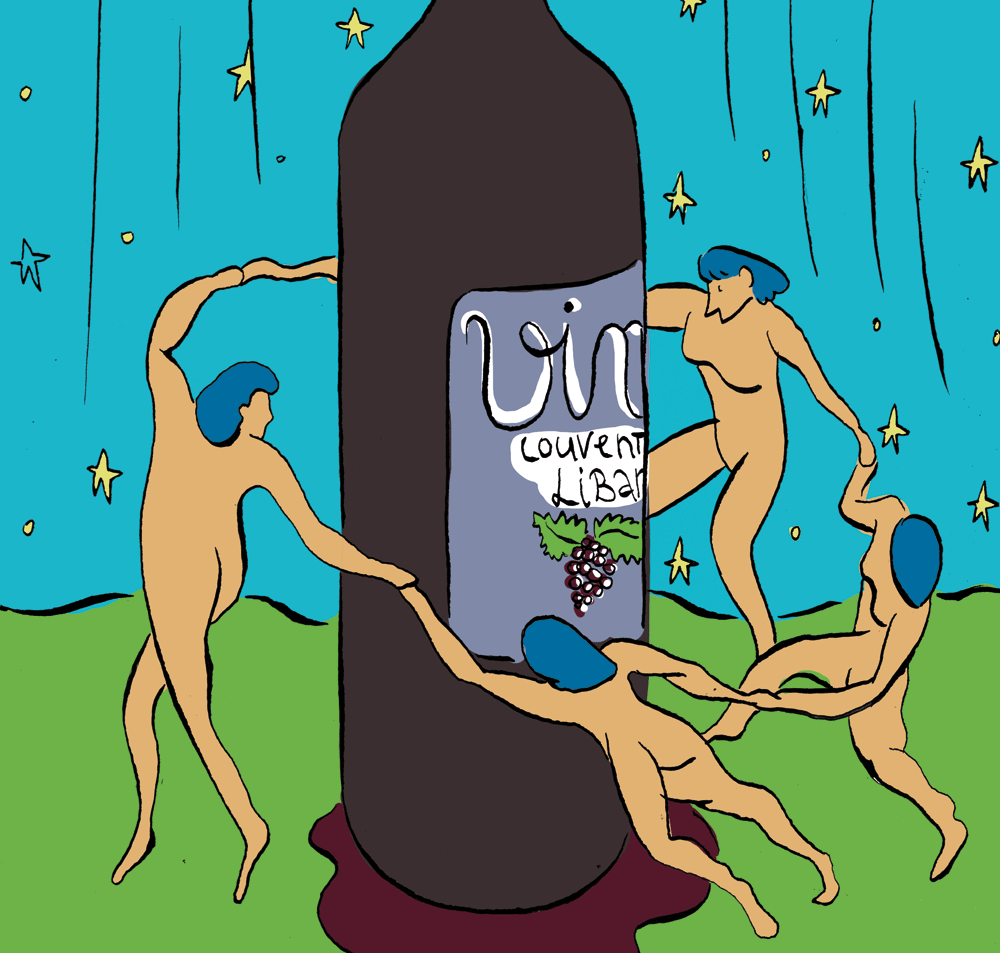
Grapes of worth

by Nabila Rahhal December 19, 2013
written by Nabila Rahhal

"Wine is a way of living; it is your vines, your terroir… You are, first of all a farmer,” says Ramzi Ghosn, co-owner and winemaker at Massaya, one of Lebanon’s leading boutique wineries. Indeed, for most Lebanese wine producers, their work is first and foremost a passion that has also spread the Lebanese wine gospel both at home and abroad.
The industry has also witnessed new steps toward regulation. This year saw the official creation of the National Wine Institute, a public-private body that will eventually control all areas of the sector. There is still much work to be done but the Lebanese wine producers Executive spoke to are confident they are on the right track.

Lebanon has a rich wine history, dating back to 7,000 BC according to modern scholars. The Phoenicians began exporting wine across the Mediterranean where it developed a reputation for quality, which continued until Lebanon became part of the Ottoman Empire and wine production was forbidden except for religious purposes.

The Jesuits, at what is now Château Ksara, produced the first modern Lebanese wines in the mid 19th century, but with the end of World War I and the arrival of the French a previously unprecedented demand for wine arose. This led to a genuine wine culture that was sustained until the onset of the civil war in 1975, when production was brought to a virtual standstill.
At the end of the war, there were only four functioning wineries: Châteaux Musar, Ksara, Kefraya and Vin Nakad. They joined the International Organization of Wine and Vine (OIV) and officially resurrected the Union Vinicole du Liban (UVL), today Lebanon’s most effective wine lobby.

The sector really began to move in the mid-1990s when a slew of new producers, such as Massaya, Heritage, Clos (now Château) St Thomas, Domaine Wardy and a newly invigorated Domaine des Tourelles appeared on the scene. They were followed soon after by Châteaux Khoury and Ka, Ixsir, and Karam to name but a few. 

Today, there are around 43 wineries in Lebanon, producing a total of 8 million bottles a year, according to figures from the UVL. Hady Kahale, general manager at Ixsir, says the wine production sector supports 3,000 to 4,000 families. Lebanese wine is exported mainly to the United Kingdom, France, Dubai, Germany, Sweden and the United States and has penetrated markets as far off as China and Japan.  

A mechanism for progress

“Things are going well for the wine sector but with progress, you need to have a mechanism in place to regulate this sector and market the country,” says Michael Karam, author of  “Wines of Lebanon”.

This year finally saw the public sector — through the ministries of agriculture, industry and economy — wake up to the idea of winemaking as a productive sector of the Lebanese economy. “Wine production has become such a dynamic sector that the public sector had to acknowledge what is going on and answer a need,” says Kahale.

In June 2013, an official Lebanese delegation led by the director general of the Ministry of Agriculture Louis Lahoud, attended the OIV conference for the first time — an event they plan to attend next year as well. The ministry, with the guidance of the UVL, also held a “Day of Lebanese Wines” in Hotel George V in Paris and will be hosting a similar event in Berlin next year. The OIV chairman was officially invited to Lebanon this year.

But perhaps the most significant ministerial activity was the approval of the creation of the National Wine Institute (NWI), a public-private initiative that will eventually play the role of tailoring rules and regulations regarding Lebanese wine production, as well as allowing for fundraising and NGO support, explains Faouzi Issa, co-owner and winemaker at Domaine des Tourelles.

In explaining how the institute came to be, Serge Hochar, president and general director of Château Musar and current head of the NWI, recalls that in the late 1990s the three major wineries of the time, Châteaux Ksara, Kefraya and Musar, asked for the passing of a law to create a national wine institute to help them in their exports (by giving credibility to Lebanese wine).  

“In 2000 we got the law which asked for the creation of a regulating wine institute. The law was officially recognized this January 2013 and the institute was approved this May,” says Hochar. Though the NWI is not yet functioning, its creation is a positive step in the development of the sector.

Current head  of the UVL — and also CEO and chairman of Château Ksara — Zafer Chaoui says, “The approach of the Ministry of Agriculture is far more positive now and they are very interested in our sector, but this government has a restricted budget and we sincerely hope this commitment will remain unchanged when there is a government with full power. We then hope to receive this support with a budget as we need to help the smaller producers attend exhibitions worldwide, which is what other countries do.”

Though the winemakers interviewed have learned to rely on themselves and each other for financial support, they see government support as adding weight to their industry and believe it will have a positive impact, especially on the international market, if sustained.  

Brewing domestic interest

Fueled by the growing number of local wineries and wine retailers in the country, along with a rising global trend, wine appreciation among Lebanese has increased, and greater focus has been put on comparisons, production and tasting explains Paul Choueiry, manager of the restaurant and wine bar Les Caves de Taillevent in Beirut.

“Healthy competition among wine producers has improved production as a whole and that, coupled with individual marketing efforts and local wine festivals, has indeed piqued the interest of Lebanese consumers,” says UVL’s Chaoui.

Château Ksara has been the dominant force in creating greater consumer awareness. With a production of nearly 3 million bottles (modest by global standards but representing 35 percent of Lebanon’s production) and with a range of 14 wines, it has made a significant impact both at home and abroad.

“Since the 1990s the Chateau Ksara management has invested heavily every year to guarantee our quality is never compromised,” says George Sara, the winery’s chief commercial officer. “We use state-of-the-art equipment, regularly plant new vines and ensure that our vineyard management is second to none. We may be the oldest and most successful Lebanese producer but due to the competition we must always be at the top of our game.”

Lebanese consume almost two bottles per capita annually, according to statistics from the UVL — a number which Massaya’s Ghosn believes is very low and a result of several factors including the Lebanese preference for hard liquor with their meals, the competition arak provides and the previously limited number of wineries.

Still, Ghosn and the wine producers interviewed feel this number is increasing steadily and while Châteaux Ksara and Kefraya dominate the local market, according to Nayef Kassatly of Château Ka, greater exposure to different varieties of wine will create a more level playing field as consumers develop a more attuned taste.

“Locally, consumers go for the big names and it will take time for the more recent wineries to catch up. We wine producers should educate the consumer so communications, press releases and wine tours are very important,” says Kassatly. “The emphasis is on quality and everyone is doing better: the grapes are better, wine is better. So yes we can have more regulations but the best referee is the consumer and the consumer today recognizes good taste,” adds Kahale.

“Some have this idea that Lebanese wine is substandard but that’s not true,” says Karam “we can compete pound for pound with the best in the world in terms of quality — especially at the entry level.” 

Still, Lebanon has to go up against imported wines which are perceived by many consumers as better. Chaoui explains that, after an agreement with the European Union, customs on European wine were reduced, which increased the quantity of imported wine to 1,200,000 bottles a year, 12 percent of Lebanon’s local consumption.

Indeed one of the recurrent complaints voiced by wine producers interviewed was how some restaurants in Lebanon exclude Lebanese wine from their menu. “While you cannot prevent the consumer from choosing foreign wines in the supermarket, we have a problem with the on-trade, namely restaurants, in that some only have foreign wine in their menus. This perception should change and the government should impose on restaurants to have at least four local wines of their choice on their menu. We should be proud of our country’s products,” says Issa.

Other local market challenges cited were those common to all sectors of the economy this year, including the dwindling number of tourists, the deteriorating infrastructure, the decreased local purchasing power and the increased price of land.

Drip for drip

The relatively limited Lebanese market can only take one so far, and Lebanese winemakers have long carried the name of their country abroad through their wine. Château Musar began during the civil war. “I was not looking for Lebanese consumers; I was looking for knowledgeable wine consumers and I positioned my wine as a fine wine. Other wineries benefited from this. Today, Lebanese wine is positioned as a good high level wine which is important,” says Hochar.

The reputation of Lebanese wine abroad is in large part due to the efforts of the UVL and although Lebanon’s production remains low when compared to other wine producing countries, UVL members hope their capacity vis-a-vis European producers will increase and are enthusiastically planning for further events, now that there is government support. “We are a small drop in the sea of wine production but we have huge possibilities worldwide and every one of us is trying to find our niches. No doubt the world is huge, our wine is good and it is not difficult to sell the part of this quantity which goes into export all over the world,” says Chaoui.

Issa explains that internationally, the UVL works together on generic campaigns to promote “Wines of Lebanon”, citing a campaign in the United Kingdom as an example, where their combined efforts with the UK-based Coco PR to execute a generic campaign included events, roadshows, participation in the London Wine Fair and media trips to Lebanon’s wineries. All this has created a positive vibe for Lebanese wine, which has translated into better distributors and increased sales, with the UK being the number one market in terms of value for Lebanese wine today.

“We are working for Lebanon, and in the end it will benefit all of us. After this equal visibility and campaign… it becomes up to each winery to distinguish itself through its quality and history,” says Issa. 

In the international market, regulations and a good image become important because wineries get only one or two chances to attract a consumer to Lebanese wine and if that consumer should happen to try a lesser quality Lebanese wine, it is unlikely he will become a fan, explains Kahale.

France is among the three main markets for Lebanese wine, due to the prevalence of Lebanese restaurants there, according to Chaoui. Some wineries, such as Ixsir, focused first on the international market in France before creating a separate marketing strategy to penetrate the Lebanese restaurants; still others put their efforts into different markets.  “[Being considered] ethnic [foreign] is not an insult because people like to discover such categories but you cannot only be ethnic, you have to be in the real world as well,” says Kahale.
Chaoui summarizes other difficulties facing Lebanese wine on the international scene: “The global economic crisis of 2008 affected us all because the average citizen’s purchasing power has gone lower and people won’t consider drinking wine their top priority in times of crisis.

Also, there is an overproduction due to the crisis and prices are getting lower so competition is getting fiercer as compared to a period of economic boom,” adding that Lebanon lost a major export market in Syria this year due to the continuation of the crisis there.

Pressing on

A final challenge the Lebanese wine industry faces is the neccesity to compete on quality and not price internationally, because of its smaller production numbers.

Karam recommends that Lebanese wineries promote certain grapes — such as the indigenous white Obeideh and the red Cinsault which, although French in origin, has been around for over 150 years — to come up with wines with a Lebanese identity that would be a welcome change for the international consumer. “We could have a Lebanese signature wine,” says Karam.

The year 2014 promises to be an active one for Lebanese wineries with Ixsir launching a restaurant on their winery’s premises, Massaya creating a new winery in Fakra and the opening of Lebanon’s first wine museum by the Saade family, owners of Château Marsyas and Domaine Bargylus in Syria.

Most wineries will likely continue to sustain growth, however Ghosn expects that some of the older wineries may consolidate or scale down and he does not believe the sector will witness the same growth it did for the past five years.

Whatever the future holds for Lebanese wines, the path they have carved is smooth and wide and it seems wine will continue to be known as one of Lebanon’s more interesting exports.

December 19, 2013 0 comments
0 FacebookTwitterPinterestEmail
Economics & Policy

A big market for small cars

by Paul Cochrane December 19, 2013
written by Paul Cochrane

For consumers, 2013 may go down as one of the best years to have bought a car, with dealerships touting offers galore, from free registration and buy-back schemes, to $300 fuel vouchers and extended warranties. But for dealers, the market is so competitive that margins are exceedingly tight, profit is limited, and sales staff are scrambling for every potential buyer. 

Difficult though the market may be, it has not descended to the level of Dubai in the wake of the 2008 crisis, when some dealers were offering deals of buy one car, get a second half price. The Lebanese car sector has not stooped to such supermarket retailer style discounts. But aggressive advertising and deals are indicative of the overall state of the car sector, which has become dominated in the past few years by the A category — compact cars — that account for some 90 percent of all new car sales in 2013, while the luxury segment accounts for just 2 percent.

As of the end of October, 29,198 new cars were registered, up just 2.2 percent on the same month in 2012. Overall, the total number of registered new and imported used cars has dropped 7 percent in the first 10 months of the year compared to 2012, according to the Automobile Importers Association (AIA).

“The best months for sales are usually June, July and August, but they were almost the worst months of this year,” says Nagy Heneine, general manager of Bassoul-Heneine, dealer for BMW, Renault, Alfa Romeo, Mini and Dacia. Indeed, the number of registered cars dropped by 26 percent in August, while September figures dropped 17 percent compared to the year before. The lack of tourists also caused car rental companies to refrain from upgrading fleets, further impacting sales.

“Before the summer season we used to have those dates locked in logistically and have the inventory to cater to rentals, but that is no longer the case,” says Farid Homsi, general manager of IMPEX, distributor for Chevrolet, GM, Cadillac and Isuzu.

But while figures are not rosy for the sector overall, sales are likely to reach the 30,000 mark by year-end — not a bad result considering the current depressed economic environment and ongoing political instability. The figure is significantly above the 19,100 vehicles sold in 2004, although behind the benchmark figure set in 2008, of 35,400 units, which largely continued until the recent economic slowdown as the conflict in Syria started to spill over into Lebanon. 

“Back in 2009 and 2010, the economy was growing and there was optimism. Unfortunately due to the war in Syria those golden years have ended, slowly but surely. It is now a very difficult market and we need to find ways to sell cars that we didn’t have four years ago,” says Heneine.

What has kept sales buoyant are compact cars with price tags of around $11,000, making the market a volume game, as well as heavy marketing. “Everyone is making big concessions. Margins are very tight, and that is why there’s sales,” says Homsi. “Margins are low or break-even for more expensive cars, as even consumers in that segment are more demanding. Otherwise people postpone buying, whereas small cars are more of a necessity for daily use.”

got the mettle

Sales of compact cars aside, dealers are somewhat surprised that sales are holding up given the lack of consumer confidence. But this can be attributed to the state of crisis seemingly becoming the norm. 

“I feel the Lebanese are getting blasé. Five to 10 years ago when there was a bombing, the country would stop for a month. Two years ago, it would grind to a halt for a week. Now it is a few days and back to normal. People have become accustomed to the situation, and that’s why they are still buying,” says Negib Debs, in charge of Infiniti at Rymco, which also has the dealership for Nissan and GMC.  

Debs’ position is backed up by sales of Infiniti, which were up 80 percent on last year’s figures. Other higher-end Japanese cars have also had strong sales, with Lexus, Subaru, Honda, and Mazda reporting double digit growth, and Mitsubishi roaring back into the market to seventh in the rankings through aggressive marketing and a compact model, up 157.58 percent.

Yet while the bottom has clearly not fallen out of the market, it is the mid- to high-priced brands selling A and B segment cars — compact and small size — that have suffered the most in the Japanese, European and American segments. Overall sales of the European brands, which take just under 20 percent of the market, were down 1.73 percent, with Opel, Renault, Seat, Citroen and Alfa Romeo all down in the double digits. American brands, which have 5.49 percent of the market, are down 13.4 percent. Although Chrysler and Ford have had a good year, up 128.57 percent and 92 percent respectively, sales of Jeep, GMC and Dodge            are down. 

Such an imbalance between brands can be put down to new models coming on the market. “Some brands have been more active due to new models, and the yen depreciating has helped Japanese brands catch up, to have a kind of come back. But there’s definitely more competition and that’s why new models help a lot, as customers like new products,”           says Homsi.

BMW, a long time favorite brand among the Lebanese, saw sales drop 38 percent this year, but is banking on a new stable of models to bolster sales next year. “For us, 2013 was a transition year for BMW in terms of models, but 2014 will be a year of BMW, as [we are] launching new models,” says Heneine.

Among the Japanese brands, which account for 27 percent of the market, it is Nissan and Suzuki that have had the weakest sales, down 14 percent and 0.35 percent respectively. For Nissan, this is due to the brand having no A segment car, a new version of its small model, the Micra, and a less competitive exchange rate on the yen for much of the year. The Japanese giant had long been a top seller alongside competitor Toyota until five years ago, when they were both knocked off the top two spots by the Korean brands with their cost competitive cars, which now have 45 percent of the market. Kia has 26 percent and Hyundai 19.7 percent, while Nissan trails with 15.71 percent. 

The struggle to keep customers

As a result of the Koreans’ rise and Nissan still keeping a relative edge, these three brands have 61.41 percent of the market, reflective of the downward shift in car size due to lower purchasing power and high fuel costs. Indeed, for Chevrolet, 60 percent of its sales come from its compact car, the Spark, and the remainder in the B and C categories. As a result, Mazda is having to go the extra mile to emphasize quality over price.

“What we see is that people have a monthly budget of between $200 to $300 to pay for a car. With such a budget, cars produced in Korea and China have an 80 percent market share. What did we do in response? As Mazda are produced in Japan, we don’t have that monthly budget — it is $400 instead — so we increased sales by emphasizing the better quality of the cars,” says Anthony Boukhater, CEO manager of ANB Holding. The dealership, like others, has also invested in a new showroom and after-sales facility, added a further eight showrooms to its dealer network, and is using innovative marketing techniques. “We are putting adverts live on TV four times a day on four channels. Not 30 seconds, but 7 to 8 minutes [in total],” says Boukhater.

With so much choice on the market, and dealerships chasing after a limited number of buyers, after-sales and customer care have become important parts of a dealership offering.“The big challenge is to ‘loyalize the customer’ as Lebanese customers are very volatile,” says Heneine.

While the Korean brands made inroads and volumes in the compact segments, helped by a move away from used cars to new due to better fuel efficiency and bank loans, the market leaders are also making headway in the less cost-sensitive segments, adding to the competition. “Before, Hyundai sales were focused in the B segment, but now we are selling C. The Tucson is the number one 4×4, which is something we never achieved before, so each year a notch on the belt,” says Rachid Rasamny, sales and marketing manager at Century Motor Company, distributor of Hyundai. 

Aware of market dynamics, Hyundai has expanded its physical presence around the country to ensure it retains its position as the second best selling car in the country. “Since 2009, we’ve doubled the number of showrooms, to 24, to get in areas where there’s no other car company and there’s a market,” says Rasamny.

way of the Chinese

Reflective of the turn away from used cars to new is the fact that veteran car dealer Chidiac Motors entered the dealership business with Chinese brands JAC and DFSK. “Before launching we did our research and felt that an invasion of Chinese cars over the next decade will happen, as it did for the Japanese in the 1980s, and the Koreans now,” says Daniel Chidiac, CEO of Chidiac Motors. “It has not been easy to enter the market but we’re doing well, with sales up 58 percent on last year.” 

Chidiac is not alone in believing in the potential of Chinese brands, with other dealers also acquiring importation rights, with Rymco (which holds Nissan) gaining a 50 percent stake in Chery, NATCO (Kia) launching BYD in the market this year, and in June 2012, Rasamny Automotive Industries (Hyundai) launching Geely. 

Indeed, Chinese brands had the biggest gains among all brands in 2013, up 75 percent on 2012. But, at 616 units, Chinese brands only account for 2 percent of the market, although up from 1 percent last year. 

The Chinese brands are likely to gain ground in years to come, with Geely utilizing the technology of Sweden’s Volvo, which it acquired in 2010, and JAC touting its 5-star safety rating and international design. “The passenger cars are designed by the same company as Ferrari, electrical systems by Bosch, and the engines by Mitsubishi,” says Chidiac.

Limited Luxury

Luxury sales have not done so well this past year, although there are certain exceptions, such as Land Rover, Volvo, Cadillac and Mercedes, whose sales rose 3.7 percent, and is now the ninth top brand in the country. But luxury and C segment sales are limited due to sheer demographics. As Executive reported earlier in the year, based on Credit Suisse’s Global Wealth Databook 2013, median wealth per capita is just $6,076, while 48 percent of privately-held wealth is in the hands of some 8,900 Lebanese, just 0.3 percent of the population. Such statistics are mirrored in the fact that just two Lamborghinis, one Aston Martin, two Rolls Royces and 18 Maseratis sold this year.

“The very rich can afford anything, but the middle class is no longer a big segment,” says Heneine. “Nevertheless, we sold 25 BMW 6 Series Grand Coupe and some 7 Series. So, not a downsize overall, but smaller cars are the bestsellers. Look at the mix, the best selling is the 3 Series — always the volume seller — at 25 percent of sales.”

The loss of wealthy Gulf Arabs who vacationed or lived in the country, due to governmental travel warnings, has been a further hit for sales and, in particular, after-sales. “We’ve had zero cars from the Gulf [into the garage]. We would fix them here otherwise. When there’s no Gulf Arabs or visitors, it affects the whole business,” says Michel Trad, general manager of Saad & Trad, dealer of Jaguar, Bentley, Lamborghini, Fiat and Abarth. “I built a Lamborghini showroom, but in the end, I need customers. Should I build a Fiat showroom to satisfy the manufacturers? We are not         Monte Carlo.”

As Samir Homsi, president of the AIA, pointed out, dealers are dependent on manufacturers bringing out smaller engines and models that reflect market demand. “By mid-next year hopefully the Q50 Infiniti will have a V4 engine. It is a problem, the lack of a V4, and other brands are feeling that too, such as Audi and Mercedes,” says Debs.

Saad & Trad are awaiting the new “mini” Jaguar, while Infiniti has high hopes for its new small model.  “People are still worried about image, so they drive a small car with image, a [Fiat 500] Abarth not a [Kia] Picanto,” adds Debs.

Some dealers, however, appear resistant to the changing dynamics of the market, downplaying the rise of the Koreans and the Chinese, as well as the downward shift in spending and vehicle size. But in the years ahead, as congestion increases, fuel costs remain high and with economic forecasts far from bright, those that adapt to this turbulent market will be able to stay, maybe not in the fast lane, but certainly on the highway. 

“The market has shifted from large cars to small, and dealers should take that shift into consideration and change inventory orders and marketing strategies,” says Rasamny. “Look at Europe, demand is for the small segment, and they shifted. India has always been about small cars. We’re similar to those markets, and I don’t see   that changing.”

December 19, 2013 0 comments
0 FacebookTwitterPinterestEmail
Banking & Finance

Jean Riachi – Q&A

by Executive Editors December 18, 2013
written by Executive Editors

Jean Riachi is the chairman and CEO of FFA Private Bank, Lebanon’s largest investment bank. Riachi sits down with Executive to talk economic outlook, investment opportunities for the bank, and strategies going forward.

What is your opinion of the macroeconomic situation — what’s influencing it and what are the biggest challenges for the country in 2013?

I think 2013 was the year where the regression of Lebanon was revealed and really felt, while probably it started in 2011. It might not be very clear when you look at the macroeconomic figures because they don’t show a big decrease in activity, but we really do feel that, and I’m talking not about recession, but about regression, because the country has entered into a phase of not only much slower growth but also a lot of sluggishness, a lot of bad mood. Now in terms of the banking sector, it has not translated yet into bad figures in terms of loan portfolios…but I think that it will show in the coming years.

In terms of pure investment banking activities, we were very much frustrated by this year because we had a number — not a big one — but a number of merger and acquisition (M&A) deals that were on the right track, where we had started this trend of talking to family businesses — some wanted to restructure, others wanted to sell, others wanted to expand by buying. We had a number of mandates that were going very well, for very interesting deals, that did not go through…We had in numerous cases people sitting together, so the matchmaking was done. Negotiations started on very good grounds, but with time passing you had buyers seeing their figures going down month after month. [They were] worrying about what will happen on the other side, and at the end [you had] both sides deciding to withdraw from doing any deal, because the buyer was worried of doing a deal at the wrong moment at the wrong price, and the sellers were worried about being forced to lower their expectations while everybody says this [situation] is cyclical and things could come back.

So yes, it was a very frustrating year in terms of investment banking/M&A activity. Now we have had a few successful stories in raising capital for companies, but interestingly nothing where the core business was in Lebanon. So [the way] for people like us to survive is to use Beirut as a base but to do deals or invest in markets that are outside markets.

When you say outside markets, is it more industry destinations or more geographic destinations? Let’s say, looking more at Africa, or looking more at Europe, or looking more at certain specific industries where you see growth in the medium-to-long term?

We are not dogmatic. I mean any interesting deal is something we are going to work on. Depends on what business line you’re talking about; we have capital market activities, brokerage, we have asset management activities, and we have real estate and finally we have investment banking activities. Since maybe 2007 there have been no more capital markets. At the time, the breakdown was maybe 30 percent in Lebanon and 70 percent outside Lebanon, I mean dealing on markets outside Lebanon. Today it’s 95 percent outside Lebanon and that started earlier. We cannot say that our brokerage activities were affected. Actually they grew a little bit in 2013. If you look at asset management, as well. All our investments — investments we do for our clients — all the assets we manage for our clients are outside Lebanon.

Looking forward to 2014, when you meet with your board of directors and you want to put together a strategy for 2014, how do these meetings look?

You know, when you are an investment bank and you have your home market, especially when you are a leader in your market, which is our case, this is where you can do best. Now we have to take things as they are and say, ok, we don’t have a local market. Our domestic market is frozen, so let us try to build on what we have to grow our operations.
It’s important to remember that people still have money, I mean, there is a lot of cash in the hands of the Lebanese, and they are looking for investment opportunities. So our role is to try to find, to source, to study, to evaluate, to do due diligence on opportunities, and if they don’t exist in Lebanon, we’ll go and get them outside Lebanon.

December 18, 2013 0 comments
0 FacebookTwitterPinterestEmail
Banking & Finance

‘2014 will be the toughest yet for banks’

by Executive Editors December 18, 2013
written by Executive Editors

François Bassil is the chairman and general manager of Byblos Bank and head of the Association of Banks in Lebanon. Bassil sits down with Executive to talk about the bank’s performance in dire economic times and the bank’s strategy for next year.

How do you gauge the performance of the bank in 2013?

In 2013, it wasn’t bad. It was an acceptable year up until now, at least up until last month [October]. We made a [positive step with] the bank’s balance sheet up 8 percent, and deposits increased 7 percent the first nine months of the year. There was a small decrease of profits of 6 percent. We took a lot of provisions because of the situation in Syria. In general, all Lebanese banks worked hard this year but their profits were stagnant. And credits to the private sector increased by 5 percent.

Next year will be difficult because unfortunately there is the security problem in Lebanon, there is the political problem, there is the rift within the political class, which is not able to agree to form a government. The administration is crumbling…banks are not on an isolated island. They will be affected by the economic sector which is on the brink of…well up until now it hasn’t collapsed. There are just difficulties in certain sectors, in tourism which has been affected the most. Up until now banks are not calling upon their dues, neither from the hotels nor the restaurants. They are instead rescheduling debts. This can last one year, two years, but not any longer.

What strategy do you have for 2014 in such an environment?

There is a new development now with the accord between Iran and the international community. That will likely have a positive effect on the whole region. Will it have a direct and immediate impact on Lebanon? That’s a question mark, it all depends. If it has a direct effect and leads to the formation of a new effective government inspired by the Baabda declaration, I think it will be a positive step for the country. Otherwise, we are in the course of establishing the budget and perspectives of the three next years. In any case we have already taken measures to activate our activities abroad.

Of course if Syria’s health improves, we have a lot to do in Syria and it will improve the situation in Lebanon. Everything depends on what is going to happen in Syria. These improvements do not enter our outlook for next year’s budget, for our plan in 2014. Instead we continue to take provisions, and [know we will]stagnate in Syria. We are managing a crisis in Syria.

We are developing our activities in Iraq. There are ways to develop despite certain precarious regions like Baghdad. In Baghdad we don’t have a lot of activity. We have a presence there; we have to be there. We were one of the first banks there. And we have operations in Basra and Erbil that are working well. In 2014 we are going to open in another city in the region of Kurdistan. In Iraq, I am optimistic that we are going to double our numbers.

In [the Democratic Republic of the] Congo (DRC), we bought a bank that belonged to Lebanese. They kept 33 percent, and we bought 66 percent. It is beginning to be profitable [after] three years. The first year we had some losses, but the next year we had small profits, this year was good. And next year I think it will be much better because we have developed relationships with local and foreign companies established in the DRC.

And we are becoming more and more active in Africa, especially in the Congo. We have a team that travels in Africa, looking for business, and we are going to count on our foreign relations for 2014. Of course, if things budge in Lebanon for the better, we are here.
Besides that, the problem for Lebanon is whether the state can continue to pay its personnel.

Is this a real danger?

It’s a real danger because banks do not want to continue to finance the deficit of the state. If you have a client that is gradually going out, and taking no measures to improve his situation, to continue to finance him, to help him, without any effort on his part…he is a big client to the banks. He is continuing to squander the money that he is receiving, and making no effort. Besides this, his revenues are diminishing because his business is diminishing. In the business community, there is a decrease of productive activities, of the taxes paid by individuals, of the taxes paid by businesses. Next year, they will decrease much more.

December 18, 2013 0 comments
0 FacebookTwitterPinterestEmail
Banking & Finance

Hadi Naffi — Q&A

by Executive Editors December 18, 2013
written by Executive Editors

Hadi Naffi is the executive general manager of Banque Misr Liban (BML). Naffi sits with Executive to talk about strategies for a small bank to remain competitive in the Lebanese market, and the impact of turmoil in Egypt.

Tell us about the performance of the bank in 2013.

Our deposits increased by over 12 percent in the first 10 months of the year. Our advances to the private sector, the credits to the clientele increased 16-17 percent. The situation is healthy, the situation is good for now. We are making profits but we are not making as big profits as we could have expected in a flourishing economic situation, that’s all. The times are tough, we are fighting, we are working hard, but our numbers are good. We have witnessed a serious development of our bank.

In Lebanon there are five large banks that alone dominate 60-65 percent of the market. When you think that in total there are 49 banks in Lebanon, of which 10 control up to 85 percent of the market, the others have to fight for the remaining 15 percent of the market.
When we arrived [on the scene] in 1929 BML did not even represent 0.5 percent of the market. Today, despite its growth, we only represent around 1.1 percent of the market. That’s nothing.

Have the developments in Egypt had a negative impact on your bank?

None. None because it is Egypt that invests in Lebanon, we don’t invest anything in Egypt. We are completely autonomous, and the flow of investments [means it] is the Banque Misr in Egypt that invests in the capital of Banque Misr Liban. The BML doesn’t invest anything in Egypt, doesn’t give credits to Egypt.

What were your largest investments in 2013?

We have made many investments that are not apparent, we have invested in technology, in the sense that we are updating our IT platform.

We also invested in the workflow of operations within the bank to ensure a higher quality of service to the clientele.

Today we are in very tough competition between banks. The only thing — the only value added thing — that one bank can have over another is to offer a more sophisticated service which responds better to the needs of the clients. The more sophisticated it is the better equipped we are to participate in an active competition.

Small banks, when they are dynamic — such as the Credit Bank led by Tarek Khalife — the reason they are dynamic is because they want to attract capital which will allow them to take a bigger share of the market. To what extent does BML have this option?

Dynamic banks, such as Tarek Khalife’s…they see big. They have reason to see big. They tell themselves, ‘by staying dynamic I will be able to show that [others] have an interest in joining me.’ This is normal. The only difference between Tarek Khalife and BML is the following: Over there it’s under the control of the family of Tarek. Here it’s under the control of an Egyptian financial institution. The decisions within Tarek’s bank will be made more easily.

So would the idea of augmenting capital and having a more aggressive strategy work?

It exists, but I will explain one thing. When I arrived here at the end of 2007, the capital was LL27 billion — a little less than $20 million. In 2009, I asked for an increase in capital. We brought it to LL100 billion. Today, we don’t [increase capital] because we don’t need it. We know that the Basel II and Basel III calls for capital adequacy ratio of liquidity coverage rate and all of that and we have completely conformed. Certainly we will need to increase the capital when there is an increase in activity, but this will come with time.

Today the Banque Misr in Egypt is subject to compliance with regulators there. To what extent, on a regulatory level, do you have to accommodate?

Today, we are living in an environment of globalization, a world of globalization. All regulators, worldwide, in the emerging countries and in the developing countries, are referring to the recommendations of Basel committees. Basel II and Basel III have [put forward] many recommendations, some very complicated. But in all cases, all regulators are applying them, though in different ways. But at the end of the day it’s the same regulation everywhere. This problem is not raised [for our bank] at any time because actually [we all follow] the same regulations. It’s all based on the Basel committee.

December 18, 2013 0 comments
0 FacebookTwitterPinterestEmail
  • 1
  • …
  • 220
  • 221
  • 222
  • 223
  • 224
  • …
  • 695

Latest Cover

About us

Since its first edition emerged on the newsstands in 1999, Executive Magazine has been dedicated to providing its readers with the most up-to-date local and regional business news. Executive is a monthly business magazine that offers readers in-depth analyses on the Lebanese world of commerce, covering all the major sectors – from banking, finance, and insurance to technology, tourism, hospitality, media, and retail.

  • Donate
  • Our Purpose
  • Contact Us

Sign up for our newsletter

    • Facebook
    • Twitter
    • Instagram
    • Linkedin
    • Youtube
    Executive Magazine
    • ISSUES
      • Current Issue
      • Past issues
    • BUSINESS
    • ECONOMICS & POLICY
    • OPINION
    • SPECIAL REPORTS
    • EXECUTIVE TALKS
    • MOVEMENTS
      • Change the image
      • Cannes lions
      • Transparency & accountability
      • ECONOMIC ROADMAP
      • Say No to Corruption
      • The Lebanon media development initiative
      • LPSN Policy Asks
      • Advocating the preservation of deposits
    • JOIN US
      • Join our movement
      • Attend our events
      • Receive updates
      • Connect with us
    • DONATE