• Donate
  • Our Purpose
  • Contact Us
Executive Magazine
  • ISSUES
    • Current Issue
    • Past issues
  • BUSINESS
  • ECONOMICS & POLICY
  • OPINION
  • SPECIAL REPORTS
  • EXECUTIVE TALKS
  • MOVEMENTS
    • Change the image
    • Cannes lions
    • Transparency & accountability
    • ECONOMIC ROADMAP
    • Say No to Corruption
    • The Lebanon media development initiative
    • LPSN Policy Asks
    • Advocating the preservation of deposits
  • JOIN US
    • Join our movement
    • Attend our events
    • Receive updates
    • Connect with us
  • DONATE
Uncategorized

Routes out of crisis

by Executive Editors October 25, 2013
written by Executive Editors

Business is “flourishing.” It’s a rarely heard sentiment in Lebanon today given the war in neighboring Syria and unease at home. Despite these challenges, Mourad Aoun, Chief Executive Operator of logistics group Net Holding, claims his businesses are doing even better — far better — than they were last year. “For the express industry, it’s flourishing. … If we go to the shipping side, it’s been even better,” he says.

Aoun’s counterintuitive assessment is one of the bright spots in an otherwise moribund economy.  And data from the Customs Higher Council supports the claim: from January to May 2013 — the most recent available public data — total import values were off just a fraction of a percent from the same period a year prior, while exports were up more than 7 percent. These modest changes, however, mask big movements in how the logistics sector is operating, and where companies are making and losing money.

Veering off the road

Before the Syrian uprising erupted in March 2011, trucks were the cheapest way to transport goods between Lebanon and the Gulf. But as the crisis escalated, drivers and their cargo came under greater threat, pushing costs higher. Then in March of this year, Jordan closed its northern border — effectively ending ground transport as a viable option.

“When the border closed, we were obligated to take our cargo by sea,” explains Nour Ghandour, operations manager at Gifco, a Lebanese offshore logistics company. But, she says, taking cargo by sea “is more expensive and profitable. …We took advantage of this.” Gifco’s book shipping business has now shifted entirely from ground to sea transport. “In logistics, when one door closes, another opens,” she says.

Net Holding has witnessed a similar shift. “We’ve seen tremendous growth in ocean export. It’s been unusual,” says Aoun. There are two reasons for this. First, “people do not want to risk losing their cargo,” he explains. But more important is the uncertain transit time for the few truckers still willing to transit Syria and able, whether legally or illegally, to get through the borders. “The trip can take you 10 days … or 20 days to be in Saudi Arabia, whereas usually it would take four days.” For exporters who need to fill orders on time, this is unacceptable.

Net Holding and Gifco’s shift to sea traffic is part of a wider trend. Shipments of 20-foot-equivalent unit (TEU) containers averaged 56,103 per month from January through March of this year. In the five months since the Syrian–Jordanian border closed, TEU shipments have averaged 68,954 per month. This amounts to a 22.9 percent increase — larger than seasonal increases in 2011 and 2012 at 18.0 and 21.7 percent, respectively. The increased traffic has led to congestion at the port as it completes a project to expand capacity by some 60 percent. This expansion is due to be completed in November.

But while shipping through the port may work for goods that don’t need to be delivered quickly, it won’t suffice for time-sensitive orders. Before the border closing, Net Holding’s subsidiary TNT had an express trucking service that operated on a time-definite basis. TNT now ships these time-sensitive products by air. Since the trucking service was premium, the air alternative is only slightly more expensive, explains Aoun. “Instead of having a problem and saying, ‘Ah, we don’t have service,’ we created an economy product that is a very viable product … and clients are using it to substitute for the trucking service.”

Global giant DHL’s air business has similarly seen an uptick. When the border closed, business that had gone to the company’s truck delivery service was channeled into its air and sea options. However, DHL Express country manager John Chedid says, the new air traffic “didn’t suit our timetable … so about a month ago we started using our own plane. … This is one of the benefits of using a company like DHL.” The new DHL-owned plane service allows the company far greater flexibility. “We’re able to control capacity; we’re able to control scheduling; we’re able to control what’s on it, what’s not on it; therefore we’re able to control price,” says Chedid.

Even typically cheap goods that would be uncompetitive if expensively shipped by air must occasionally be flown to meet orders. Gifco’s Ghandour claims the company has handled several such shipments of vegetables, which would go bad if shipped by sea.

The Syrian connection

Trade between Lebanon and the Gulf is not the only route affected by the Syrian crisis. Syria’s own economy — while tailspinning — must still export and import goods. With civil war raging, it is not always possible to get goods out through the ports in Latakia and Tartus, or through the airports.

As a result, says Ghandour, “We’re serving as a gate to Syria. …We are moving cargo via sea [to Lebanon] and [and then via] land to Syria.” For exports, Gifco has forged partnerships with Syrian companies who used to ship through Latakia and Tartus. “Syria has so many things they export … so when they had a problem with the ports, their only option was Beirut,” Ghandour explains, adding that since many Syrians left to work in the Gulf, Gifco has handled more shipments of personal items such as cars through Lebanon.

This service has proved lucrative due to the risk involved on the Syrian side of the border. According to Ghandour, freight charges have doubled since the uprising began. On top of that, she explains that while insurance used to be an option, “Now it’s a must.” This is good for companies like Gifco that offer insurance plans — premiums have “doubled or more to risky areas,” she says.

Such business, however, is shunned by Net Holding. Conceding the opportunities missed by not entering the market, Aoun takes a more cautious approach. The group’s subsidiary SkyNet — a local franchisee of the global SkyNet brand — maintains a presence in the country, but “what we’re moving into Syria is only documents and things that cannot be in breach of compliance issues” such as US sanctions. This strategy accommodates three of Net Holding’s goals: to provide global services and demonstrate the company’s commitment to clients currently living under harsh conditions, while maintaining the company’s ties to American businesses.

Bottom lines

Net Holding’s cautious strategy in the Syrian market has not hurt its financials. Instead, it has seen a dramatic increase in cash flow. Revenues for its express businesses have increased approximately 35 percent over the past year according to Aoun.

But the larger and more lucrative volumes of sea and air traffic do not always make up for the steep decline in trucking services. Gifco’s Ghandour estimates the company’s overall volume of shipments has decreased by 40 percent over the past year and a half. “We used to get two to three containers per month,” from some clients, but “now we’re getting one,” she explains. And increased revenues from sea and air transport have not made up for the loss. Ghandour estimates the company’s revenues are down from pre-crisis levels, but only slightly.

The shifts in the market hit small companies much more heavily. Global Freight and Logistics, a firm started in 2008 specializing in wood and furniture shipments, had to stop land service to the Gulf late last year due to the deteriorating security situation. Its owner and CEO Nagy Feghali explains that while prices have gone up — a typical land shipment from Saudi Arabia costing $1,800 now ships by sea for $4,000 — volumes have decreased even more.

A greater concern, though, is clients’ ability to pay. “We used to get our payments after one month” post-delivery, says Feghali. “Now everyone’s asking for three months, or even four. For one client in Tripoli, it’s been eight months.” While larger businesses only deliver paid orders, Global Freight allows clients to pay as they’re able — usually as they sell the product they’ve ordered.

Despite this, Feghali’s business model does offer an added measure of resilience. “My clients are my friends. Only maybe 30 percent [strict] business relationships, but they become friends,” he says, adding that “they will stay with you. …They don’t even ask about the rate.” Accommodating their financial difficulties thus becomes part of Feghali’s service.

Contingencies …

or opportunities

Amid a deteriorating security situation at home, a ceaseless civil war next door, a potential western attack and sky-high regional tensions, each company Executive spoke with was concerned — enough to have contingency plans — but not overly worried.

Net Holding’s Aoun and DHL’s Chedid both emphasize their companies’ long histories in Lebanon. Net Holding is celebrating its 20th anniversary this year. Aside from temporary disruptions, DHL has continuously operated in the country since 1979, according to Chedid.

When the airport became inaccessible during the 2006 war, DHL Express moved operations to its center in Jal al-Dib, using the land route to Jordan to send and receive shipments, says Chedid. That wouldn’t be a possibility under the current situation. “If the airport is closed, we may have to consider a ferry to Cyprus, which is something we did during [Lebanon’s] civil war,” he says. But failing an airport closure, DHL appears to be moving in the opposite direction — namely, its new weekly flights to Beirut.

For his part, Aoun doesn’t entertain any notion of shutting operations. “We’re not a local company; we’re a Levant-based company. We cannot just stop.” Pointing to SkyNet’s office in Syria, he adds, “If we’re still operating in Syria, I don’t see why we would stop operating in Lebanon.”

If the situation worsens, Aoun says Net Holding has alternate operations centers ready. “We have a war operation type of scenario where we decentralize everything. …This is what we did in 2006; people were working either from home or from a secure location,”    he explains.

But Aoun acknowledges the business opportunity afforded by crisis. “War for us is an opportunity to tell our clients we’re here and we’re solid, because the economy cannot stop. People need to eat …cargo needs to move.” The sentiment is echoed by Gifco’s Ghandour, who succinctly notes, “As logistics people, don’t worry about us.”

Global Freight’s Feghali isn’t worried that his clients, most of whom are friends, will abandon him. This applies even if he’s forced to temporarily shut down operations. While he’s concerned about the immediate situation, he’s resolutely positive about a rebound once security gets better: “Once the situation finishes the work is going to be booming.” He’s even planning an expansion into Syria.

October 25, 2013 0 comments
0 FacebookTwitterPinterestEmail
Society

The necessity of decadence

by Nabila Rahhal October 25, 2013
written by Nabila Rahhal

At a time when most 5-star hotels in Lebanon are reporting record low occupancies, Achour Holding has invested $25 million into transforming the Royal Plaza Hotel in Raouche into Lancaster Plaza, a 5-star hotel, marking the company’s third venture into hotel ownership and management under the Lancaster Hotels and Suites name. 

Two years ago, company chairman Wissam Achour acquired what was then the Royal Plaza Hotel from the Chehab family and began the process of completely renovating and upgrading the property. Achour is not new to the hospitality business and has two 4-star hotels — the Lancaster Hotel and the Lancaster Suites, both also in Raouche — which he bought from previous owners and rebranded and renovated in the same manner as the Lancaster Plaza. The Lancaster Group, a division of Achour Holding, owns and operates the hotels.

The breakdown

Set to begin welcoming guests this month, Lancaster Plaza is the group’s most ambitious hotel project to date and has 151 units of different dimensions — 14 of which are suites — all with a sea view.  The property also boasts two grand ballrooms, three meeting rooms, a piano bar, a rooftop bar, a shisha lounge, two restaurants — one a steak house, the other serving Lebanese cuisine “with a twist” — and a spa and health club with the biggest indoor pool in Lebanon. The food and beverage outlets are fully owned and managed by Achour Holding.

Lancaster Plaza’s operations manager Fadi Musharafieh says no detail has been overlooked to make sure it lives up to its 5-star status and that everything, from the fully interactive smart TV — which allows you, among other features, to order room service or handle your bill online — to the limousine pick-up at the airport is designed with luxury in mind.

Room rates at Lancaster Plaza start at $250 per night for the 30 square meter Pleasant rooms, designed with businessmen in mind. That compares with a starting price of between $310 and $340 at the capital’s other 5-star hotels, such as the Four Seasons, Le Gray or Movenpick. The Noble suite, the hotel’s largest suite which comes with its own fireplace and a jacuzzi in the bathroom, will be priced at no less than $5,000 per night, according to Musharafieh. He explains that they cannot go lower with their room rates as a 5-star hotel requires a large staff — Lancaster Plaza alone will have 220 employees while their two other hotels combined have 100 employees. “The Lancaster Group has one mission and vision, but those who are paying for a 5-star hotel experience need to feel the difference and this all costs money,” he says.

Lancaster Plaza hopes to attract the same high-end clientele of other 5-star hotels in the country and is targeting tourists from the Gulf as they believe the political situation in Lebanon, which is currently limiting the flow of such tourists, will improve in the near future.

Musharafieh says they are probably the only hotel operators in Lebanon who conduct their work as if the political situation in the country is stable.  “This strategy is working for us. Lebanon has always had these political problems and if we want to stop [because of] them, then we will achieve nothing and will also be behind when the situation improves. Now, when the situation gets better and the tourists return, we will be ready for them,” he says. According to Musharafieh, Lancaster Plaza will be returning a minimum of 10 percent of the investment each year, provided the situation in the country improves.

The benefits of experience

Lancaster Group’s confidence in the country is probably spurred by the success of their 4-star operations. While Lancaster Hotel mainly attracts individual and corporate travelers for short stays in Lebanon, Lancaster Suites is designed for longer term stays and has a kitchenette in each room. Both these properties are performing well and had full occupancy during the two Eid holiday weeks this summer, according to Musharafieh, who adds that both properties are currently operating at 75 to 85 percent occupancy. Musharafieh admits, however, that room rates are the lowest they have been in a while: “We actually have never seen rates in the Eid period as low as they were this year,” he says. Today, room rates are a maximum of $130 for Lancaster Hotel per night, and $160 for Lancaster Suites.

The properties’ high occupancy numbers are mainly due to the influx of Syrian families who stay long term in the Lancaster Suites and receive special rates, and also Iraqi, Syrian, and some Turkish tourists who still enjoy visiting Lebanon and prefer a 4-star hotel.

Lancaster Group has managed to stand out from the competition by offering guests cost effective deals —also to be offered at Lancaster Plaza — that Musharafieh says people are keen on in these tough economic times. “Our added value is that we have companies that complement our work such as, for example, Rima Rent a Car which allows us to offer free rides,” explains Musharafieh. In addition to airport pick up and return, Lancaster Group also offers its guests complimentary rides in Beirut and access to Jana Beach Resort in Damour.

“When potential guests compare the room rates of hotels in Lebanon, they see that with us they are paying the same price as others, but they are getting more benefits and staying at fully and newly renovated hotels,” explains Musharafieh. 

Achour Holding is clearly not holding back when it comes to investing in the hospitality sector in Lebanon. Musharafieh speaks of three venues opening in the new Achour building in Verdun area in the next few months: a cafe, Ward El Sham, an Italian restaurant called Caprese and a children’s entertainment center. Also in the pipeline is Eden Rock, a 69,000 square meters summer resort in Ramlet El Bayda scheduled to open in five years’ time.

October 25, 2013 0 comments
0 FacebookTwitterPinterestEmail
The Buzz

Business briefing: 25 Oct 2013

by Executive Staff October 25, 2013
written by Executive Staff

Economics and Policy

Iraq plans to sell bonds for the first time since 2006 as surging oil revenue pushes borrowing costs lower even as sectarian violence in the troubled nation escalates.

More from Bloomberg


European governments have taken preliminary steps to reimpose sanctions on Iran’s main cargo-shipping line, potentially complicating a new diplomatic push to settle the dispute over Tehran’s nuclear program.

More from Reuters


Companies and Business
 
France's market regulator has slapped a record $19 million fine on a Lebanese trader LVMH for insider trading surrounding the 2008 buyout of logistics company Geodis by France's national rail firm, SNCF.
 
More from AFP
 
 
The state-run Kafalat Corp., which provides subsidized loans to small and medium enterprises through Lebanese banks, is expected to see a slight drop in its profits at the end of the year due to fall in the value and volume of loans
 
More from The Daily Star
 

Cleaners discovered 280 gold bars worth $1.9m inside a toilet after landing on a flyDubai flight from the emirate to Bangladesh.

More from Arabian Business


October 25, 2013 0 comments
0 FacebookTwitterPinterestEmail
The Buzz

Business briefing: 24 Oct 2013

by Executive Staff October 24, 2013
written by Executive Staff

Economics and Policy

Egypt is not interested in importing gas via pipeline from Israel and instead is focusing on a plan to import liquefied natural gas, a top state executive said Wednesday.

More from Reuters


Kuwait is trying to persuade Saudi Arabia to take up the UN Security Council seat that Riyadh has spurned in protest at the world body's failure to end the war in Syria, a senior Kuwaiti official said on Wednesday.

More from Reuters

 
Companies and Business

Qatar National Bank, the largest listed lender in the Gulf Arab world, said it raised $1.5 billion from a two-part bond sale, underscoring investor demand for debt offerings from top-tier names in the region.

More from Reuters


The minimum capital requirement for insurance companies in Lebanon should be raised to at least $10 million to improve the efficiency of the sector and encourage consolidations among firms, the president of the Lebanese Insurance Association has said.

More from The Daily Star


Wataniya, Kuwait's No.2 telecom operator, reported a slight drop in third-quarter profit on Thursday, missing analysts' estimates.

More from Reuters


October 24, 2013 0 comments
0 FacebookTwitterPinterestEmail
Economics & PolicyIndustry 2013

‘Industrialists have given up on the government’ – Sarraf

by Joe Dyke October 23, 2013
written by Joe Dyke

Jacques Sarraf is something of a godfather in Lebanese industry. The former head of the Lebanese Association of Industrialists runs Malia Group, which has 1,608 staff across the region — around a third of them in Lebanon. Executive sat down with him to discuss how the sector is developing.


How would you assess the mood of Lebanese industrialists right now?

The problem is what is happening in our environment. Today we are suffering a lot from what is happening in Syria because Lebanon is connected to Syria and all our exports, whether to Iraq or the Gulf [go through Syria]. When Syria has a high risk with the transport this is the first big problem we are encountering.

But if we look at different sectors within the environment of Lebanon, industry is still on the safe side. I would say that despite all that is happening in our environment, still we are surviving. 


What advice would you give to companies looking to stay afloat?

There are no tips on that, no magic formula. Frankly speaking each [company] knows how to survive in a critical situation. We are in pharmaceuticals, which can survive. We are in the water industry; the water industry isn’t suffering at all.  But on the cosmetics we have to find more export markets, diversify our markets.


Do you have an estimate for the amount you lost in Syria?

All our investment in Syria was completely destroyed. It is in Qaboon — an area that is no man’s land between the two factions there. This year is better than last year because [when] the Syria problem began in 2011 it was very surprising for us. 2012 we got the big losses, in 2013 we are acquainted to it, we know how to survive. And at the same time Syrian industry is 80 percent destroyed and now you have 20 million to feed — they have to eat, they need everything.


Have you been able to increase exports to Syria?

[Last month] the [Syrian] minister of economy again put import licenses, [meaning] any product officially entering the Syrian market has to have a license. The licenses are only for the first priority [goods] — for pharmaceutical products it is easy to get an import license, food it is easier than others, but cosmetics are not a priority for them. [In the future] if we are doing something I would say we may do it illegally and non-transparent. Because it has to go there illegally, any product that doesn’t have an import license cannot enter Syria.


Right now your products are going in legally?

It used to be legally but now we have to find ways and means with our partner or distributor in Syria to get licensing to let the goods go inside.


The general perception is that the government has failed to support industrialists in recent years. Is that a fair representation?

In my mind, I tell my industrialist friends ‘forget about the government…’ It is not the case of whether [there is a government] or not, [industry] is not their priority.  In 2005 we succeeded with Omar Karami’s government to get a 50 percent reduction on tax for exports. We are now in 2013 but still [it hasn’t been implemented]. Today we have three ministers [who have come] from the private sector, supporting us, helping us — they didn’t succeed. Why? Because the government doesn’t have the priority to support the industry and the economy as a whole. They are always happy to let the private sector do it themselves. When they need the money they go to the private sector to finance their budget. Now if we said “we are not going. We will not finance you until you solve our problem” — they would do it.


An increasing number of Lebanese industrialists are changing strategy to have their logistics hub in Lebanon but to start outsourcing industrial production and targeting other markets. What is your strategy?

This is what is happening for us. We use Lebanon as a hub, all the service company is in Lebanon — banking, financing, human talent, whatever it is — but investments are in the region. Iraq today is still the area where we feel we have big possibilities.


How would you assess the impact of the initial stimulus package organized by Central Bank governor Riad Salameh?

It was very positive. Salameh knows what he is doing and we assess it very positively.

October 23, 2013 0 comments
0 FacebookTwitterPinterestEmail
Society

Creative endeavour

by Maya Sioufi October 23, 2013
written by Maya Sioufi

Walking through the buoyant Beirut Art Fair on its opening night last month, one could understand why the city has been featured as one of 12 worldwide to watch for contemporary art according to a new book published by Phaidon Press, titled “Art Cities of the future: 21st-century Avant Gardes”. Lebanese artistic talent has even caught the attention of renowned British art collector Charles Saatchi, the backer of Britain’s richest living artist Damien Hirst. Saatchi has amassed work from Lebanese arists including Hussein Madi and Zena Assi in his Middle Eastern art collection. Many were put up for online auction last month. Facing mighty neighbors such as Dubai and Doha, which have significant financial muscle and a keen interest in promoting their image as ‘art savvy’ destinations, Lebanon’s artistic talent is still taking a back row seat on the international art scene. But the country’s gallerists are not sitting idle.

Keeping up appearances

The fourth edition of the Beirut Art Fair, held at the Beirut International Exhibition and Leisure center (BIEL), was a busy affair.  Gallerists and collectors mingled with curators, artists and passers by. The backdrop was trendy, with Momo at the Souks’ Blow Up installation, a lounge in the center of the fair, playing hip music. The opening night drew in 7,500 visitors with total attendance standing at 18,000 — up from 11,000 last year — a surprisingly strong figure given current circumstances. Similarly, sales from the 46 galleries present at the fair totaled $2.6 million —up from $2.15 million last year — according to the organizers.

Most gallerists Executive spoke to had not been expecting such a large turnout. Aida Cherfan, a newcomer to the fair this year and one of Lebanon’s best-established gallerists, opened her first art space near Antelias in 2000. Cherfan refused to participate in the previous fairs, partly because they took place in July “when most people are busy or away” and partly because of restriction on art from outside the Middle East, North Africa and South Asia regions, meaning she could not bring along the international artists she represents. “This year they changed it, they said 60 percent Middle Eastern artists,” she says.

With 13 years of experience in the art market and notable artists on her roster including Madi, sometimes referred to as the ‘Oriental Picasso’, Cherfan says that her gallery is performing in line with previous years. When asked if she is worried about the country’s economic crisis, she says “It can’t be worse than [during the war in] 2006 when we couldn’t see the light at the end of the tunnel”.

The performance of Lebanon’s galleries is difficult to know as most galleries, which take between 25 to 50 percent of total art sales, refuse to share their figures. Gallerists need their clients to be economically confident in order for them to reach into their pockets to purchase a piece of art — whether it is a coup de coeur, a short term investment or a strong belief in the potential of the artist.  The most established names, however, still manage to flourish even in distressed times.

Established galleries holding up

Mark Hachem, a Lebanese gallerist based in Paris, established his downtown Beirut gallery three years ago. Since then, its sales have grown at a faster rate than in his New York or Paris galleries, with revenues in the past year north of 200 percent. “It is the fastest growing project I have ever entertained,” says Hachem, who opened his Paris gallery in 1996 before branching out to the Big Apple in 2006.

Initially focusing on kinetic art that depends on motion for its effect, Hachem’s interest for art from the region was triggered after the opening of his New York gallery. “The contemporary expression became more interesting and genuine,” he says. “There is an economic renaissance in the region pushing private Middle Eastern collectors to start developing their own collections. Historically, most collectors are patriotic and that’s what you see here too,” he adds.

Hachem has been participating in the Beirut Art Fair for the last three years. “I would never consider not participating, as it’s a way to resist and show that with culture we can do more than anything else,” he says.  Hachem’s optimism comes off the back of an exhibition held in September in Beirut exhibiting the work of French sculptor Polles. Forty percent of the work on display sold in the first two days. “It was an amazing success and I was really surprised as we are living in a tough moment now” says Hachem. Two days after the fair, the gallery opened an exhibition for seven Syrian artists to a packed audience. 

Another gallery performing well despite the economic crisis is the well-rooted Agial Art gallery, which has been operating from Beirut’s Hamra district for the past 23 years. The ongoing “Belt” exhibition of Lebanese artist Mohammad Said Baalbaki was 70 percent sold on opening night. “That’s because I’ve been around for 20 years, people trust me; in my first five years it was hard,” says Saleh Barakat, owner of the gallery. Upon opening in 1990 the Agial gallery presented art from throughout the Middle East but shifted its focus in 2005 to exhibit exclusively the work of Lebanese artists.

A painting by Lebanese artist Hussein Madi


The Janine Rubeiz gallery in Raouche follws a similar business model. Nadine Begdache, daughter of the late Janine Rubeiz, says that it’s becoming harder and harder for the gallery to sustain itself. “There are years and months when we have to make sacrifices. Gallerists are a bit crazy like the artists. They have messages and we have messages too,” she says.
Begdache is an established name in the Lebanese art scene. In her office, surrounded by numerous books and art pieces, she shares her frustration with the current crop of Lebanese collectors, without whose investment homegrown art will be unable to flourish. “The Lebanese collector, the old one, collected by pleasure, taste and education. When we bought [prominent Lebanese artist] Chafic Abboud in the 50s, we didn’t think he’d have extraordinary prices in 2013, we bought to help because we appreciated his pieces. Today the collector, the young one, invests in known names at high prices because it’s safe. It blocks a lot of artists, the emerging and the already emerged [from getting financial support],” she says. But not all young collectors are looking to acquire renowned names.

Facing big players like Agial and Janine Rubeiz, Lea Sednaoui’s Running Horse contemporary art gallery, located in the industrial Qarantina zone, has fought hard to establish a name for itself since its 2009 opening. To stand out, Sednaoui chose to represent emerging artists — both from Lebanon and abroad — targeting a younger clientele, with more affordable prices reaching up to a maximum of $10,000. One of her artists, 33 year-old Alfred Tarazi, has featured in an exhibition at the Austrian Krinzinger gallery that represents controversial performance and installation artist Chris Burden. Last year was a record year for the gallery, however in 2013 sales are down 30 percent. “People don’t want to spend as much anymore” she says.

Going international to stay afloat

Many gallerists in Lebanon have had to represent more than just local talent to remain in business. Throughout her career dealing contemporary art, Cherfan has featured international as well as Lebanese artists. “I felt the gallery couldn’t function with only Lebanese art,” she says. Naila Kettaneh-Kunigk’s Tanit gallery, which has exhibit spaces in both Mar Mkhayel and Munich, represents 55 artists of whom 15 are Lebanese. Tanit represents several world renowned artists such as the late American artists Sol LeWitt and Donald Judd. LeWitt also features among gallery Sfeir Semler’s roster of 34 artists, seven of whom are Lebanese. The gallery also owns exhibition spaces in both Beirut and Munich.

But some galleries such as Agial and Janine Rubeiz continue to focus exclusively on local talent, representing some of the most established names in the Lebanese art pantheon: from the late Shafik Abboud to Huguette Caland — daughter of Lebanon’s first president Bechara al-Khoury ­— to pieces by Lebanon’s first abstract artist Saloua Rouada Choucair. Barakat is proud of his Lebanese heritage and disagrees that Lebanese art is not up to international standards. “Look at Saloua Rouada Choucair: she is sharing headlines with Roy Liechtenstein at the Tate Modern. She was a blockbuster this year,” he says.


A sculpture by Kamel Hawa in downtown Beirut


Lebanon at the Venice Bienniale

Gondolas on the Venetian canals have been packed with more than just sightseers this year as curators, artists and collectors have flocked to the city for its 55th Bienniale, a celebration of arts held in Venice every two years. This year, for the second time in the Bienniale’s history, the Lebanese flag has been planted on one of Venice’s tiny islands. Barakat, along with Sandra Dagher — currently co-director of Beirut Art Center — curated Lebanon’s first pavilion at the Venice Bienniale in 2007, bringing along five artists with the support of Lebanese foundations and corporate donors. This year, artist Akram Zaatari is representing Lebanon. His piece, a video entitled “Letter to a Refusing Pilot”, concerns an Israeli pilot who objected to bombing a school in Zaatari’s hometown of Saida in 1982. 

Unlike in Britain, where the British Council manages the country’s national pavilion, or in the United States where the Department of State selects a public gallery to manage its pavilion, in the case of Lebanon a private non-governmental organization called the Association for the Promotion and Exhibition of the Arts in Lebanon (APEAL) was behind this year’s initiative. This year’s Bienniale was the third time APEAL has brought Lebanese artists to an international audience, having organized collective exhibitions in Washington DC in 2011 and London in 2012.

The apathy of the public sector

When it comes to supporting the arts in Lebanon through the purchase of Lebanese artists’ works, again, public sector efforts are negligible. Long gone are the days when the Ministry of Culture selected top quality pieces for its collection, which features some of Lebanon’s most prominent names such as Khalil Saleeby, Bibi Zogbe and Said Akl. “The Ministry of Education and of Tourism had a buying committee that went around galleries and bought paintings; that’s how the collection of the government was built,” says Begdache, who regards Michel Edde as the only former minister of culture that had a strong interest in supporting the arts.

Stepping into the public sector’s shoes when it comes to funding and acquiring art pieces are private donors and foundations such as the Mikati Foundation, the Philippe Jabre Assocation, Foundation Saradar and Marwan Assaf. The banking sector is also not averse to the occasional dalliance in the market: Bank Audi has a wide collection of Lebanese and international works, while BankMed and Banque Libano Francaise support the Beirut Art Fair and the Beirut Art Center respectively. “Art is also social visibility and it indicates where the person or organization stands with regards to their evolution,” says Pascal Odille, art critic and artistic director at the Beirut Art Fair.

With no national museum displaying Lebanon’s contemporary art, the private sector has had to fill the cultural gap to increase public access to both national and international art. The Beirut Art Center (BAC), which opened in 2009, and the Beirut Exhibition Center (BEC), which opened last year, are examples of spaces exposing contemporary art. While BEC’s mission is to promote art from Lebanon and the region through regular exhibitions, BAC is increasing the country’s artistic exposure by bringing international art to its space. Another example of a private initiative taking the lead is the Modern and Contemporary Art Museum (MACAM) opened by Lebanese art critic Cesar Nammour in a large compound factory in Jbeil.

The lure of the Gulf

With auction house Christie’s choosing Dubai as its Middle East base and competitor Sotheby’s opting for Doha, collectors and their deep pocket capital have been flowing into neighboring cities in search of the latest names capturing the zeitgeist. “We are now on a wave, it’s unbelievable what’s happening in the region,” says Hachem as he describes how his clients in the United States have been increasingly interested in art from the region, particularly Syrian art. Dubai’s artsy reputation has suffered in recent years due to the financial crisis the city has experienced — Christie’s latest auction for modern and contemporary Arab, Turkish and Iranian art held in April brought in just over $6 million, down $8 million from 2011.

Doha, on the other hand is faring better ­— Sotheby’s successfully raked in $15 million this year in its second auction in the city, during which international as well as Middle Eastern artists’ work was exhibited.  While Beirut currently has no auction houses Odille strikes an optimistic note: “It will come,” he says.

But will it? Lebanon’s well-established gallerists aren’t so sure. “The platform is gone and for a long time to Dubai: they have the stability and the money” says Barakat. Even the younger generation is not optimistic. “We don’t see the end of the tunnel, it’s been years and years, from the days of our fathers and grandfathers” says Sednaoui.

Lebanon’s fatigued financial muscle has not allowed its homegrown creative talent to reach its full potential, curtailing the arts and culture from developing and contributing to the growth of the country’s tired economy. While the private sector — from gallerists to private individual sponsors and donors to associations — fights hard to establish international and local recognition for the country’s artists, the country still has a lot of artistic potential to explore. To support the development of the country’s art and culture and help it gain deserved recognition, it’s up to the Lebanese private sector to discover, enjoy and continue making efforts to promote the abundant local artistic talent.

October 23, 2013 0 comments
0 FacebookTwitterPinterestEmail
The Buzz

Business briefing: 23 Oct 2013

by Executive Staff October 23, 2013
written by Executive Staff

Economics and Policy

Saudi Arabia’s unprecedented rejection of a U.N. Security Council place has pushed the world body into uncharted territory, but fellow Gulf nation Kuwait is emerging as an early front-runner to fill the seat.

More from Reuters


Saudi Arabia's intelligence chief has said the kingdom will make a "major shift" in dealings with the United States in protest at its perceived inaction over the Syria war and its overtures to Iran.

More from Reuters


Egypt hopes that political tensions with natural gas giant Qatar will not undermine efforts to secure supplies from the Gulf state, but sees Algeria and Yemen as other options.

More from Reuters


Companies and Business

Iraqi Kurdistan’s largest oil and gas investor has filed the first major legal case against its regional government over $1 billion in owed payments and production rights, just as the autonomous region looks to become a major energy exporter.

More from Reuters


Phase one of Dubai's $3.3bn Mohammed Bin Rashid Solar Park has opened as part of a push to diversify energy supplies in the UAE.

More from Arabian Business


A $140 million investment has turned Beirut Port into one of the largest container handlers in the East Mediterranean amid growing demand for transshipment goods from war-torn Syria.

More from The Daily Star


October 23, 2013 0 comments
0 FacebookTwitterPinterestEmail
Economics & PolicyIndustry 2013

Neemat Frem: ‘Lebanon’s first industrial park is nearly ready’

by Joe Dyke October 22, 2013
written by Joe Dyke

Neemat Frem is the president of the Association of Lebanese Industrialists and chief executive officer at INDEVCO Group. He spoke to Executive about a forthcoming industrial park, optimism for 2014 and why he has given up on the government.


What advice would you have for Lebanese industrialists that are struggling at the moment?

To help themselves first of all — not to expect anything from anybody. We have learned the hard way with the situation today — when we see the public sector in complete paralysis, when we see one organization after another collapsing and going into a coma. I can describe the phenomena we are living in as a multiple organ failure in the public administration. Being in such an environment the industrialists have decided to count on themselves, and start special initiatives between each other to see how they can help each other.


What kind of initiatives?

First of all we have started to put direct business-to-business contacts between industrialists in Lebanon and importers in England and Greece. We are taking from the portfolio in Lebanon [the goods and services] which we think are exportable and [which have] reached a level of manufacturing excellence that will allow them to be exported easily. We are opening these routes to markets.

Also, two years ago we started working very hard to build an industrial park with the highest international standards. [Initially it was] with the public sector and the government but again we found out that we can’t count on anybody — this is why now we have resorted to our own initiatives to form a private company. Instead of having developments for real estate or touristic resorts, we are going to build an industrial resort. We are moving quickly in that direction and hopefully in the coming three to four months we are going to launch an industrial park.


Could you give me more details on the size and location?

At this stage I prefer not to talk about it before it is completed. We can just say that it will be about 500,000 [square] meters, we will leave the land to industrialists, prices will be very affordable and we will build the right infrastructure for industry.


Are you expecting any tax breaks?

Again, I go back to my former answer [about not expecting anything from the government].


How much more expensive is exporting goods than it was three years ago?

Land exports are getting really exorbitant because of insurance. This is why today sea exports are what is supporting our exports. We didn’t experience major growth in expenses first of all because the sea lines have worked very hard to be competitive and because we have a slight increase [in exports] to our primary destinations in Saudi and the UAE. Iraq as a destination and Jordan as a destination are two countries that are landlocked — we have witnessed a major [negative] surge, but they do not constitute the bulk of our exports. The only countries where we are suffering a net loss in competitiveness are Jordan and Iraq.


The Central Bank’s Evolution of opinions shows industrialists are less pessimistic this year than last. Are you sensing a new optimism?

[Industrialists] discounted last year. There is a window of opportunity today in a sense that we didn’t have a major collapse. Last year everybody said it was a matter of weeks or months before we had a major political collapse in Lebanon or major civil unrest or conflict. Because this did not happen it has given a lot of hope that we might be able to pass the situation with less damage than expected. On the economic front the private sector was able to somehow mitigate a lot of the problems and has tried to take advantage of what is happening in Syria somehow. 


So industry has been able to survive the crisis?

Not only survive; develop and thrive. We have proven this time that the industrial sector in Lebanon is the shock-absorbing sector of the economy. When you have a major crisis this sector is more resilient than others. Can you believe that we are growing? Our industrial export is growing, our output is growing, our investment is growing. This is all coming from the fact that the Syrian industrial expansion was really competing heavily with the industrial sector in Lebanon due to competitiveness and their ability to operate illegally in Lebanon and having a lot of tax breaks because of that.


In effect you have lost some competition?

Yes

October 22, 2013 0 comments
0 FacebookTwitterPinterestEmail
The Buzz

Business briefing: 22 Oct 2013

by Executive Staff October 22, 2013
written by Executive Staff

Economics and Policy

Cairo will begin repaying the more than $6 billion it owes to foreign oil firms within two months, the chairman of state-run Egyptian General Petroleum Company has said.

More from Reuters


Lebanon's Caretaker Prime Minister Najib Mikati cannot call for a Cabinet session to discuss oil and gas licensing without political consensus and such a meeting remains unconstitutional, the caretaker Economy and Trade Minister Nicholas Nahas has said.

More from The Daily Star


Gulf states will continue to fail in their quests to diversify because they insist on controlling their economies, a Qatari sheikh and former economy minister has claimed.

More from Arabian Business

Companies and Business

Etihad Airways is close to placing an order that could kick off a $50 billion jet-buying spree from the Gulf as the region’s carriers flex their muscles in an industry hit by weak margins and high fuel prices.

More from Reuters


The consortium managing the only producing natural gas field in Iraq's autonomous Kurdistan region is taking the Kurdistan Regional Government (KRG) to court, alleging overdue payments that are likely to total over $2 billion.

More from Iraq Oil Report


A Saudi-based investment firm is planning to launch a first-of-its-kind private equity fund in the Middle East that will solely focus on investment in the fast-growing education sector in the Gulf Arab region.

More from Reuters


A new $2.9 billion terminal at Abu Dhabi’s international airport will be operational in July 2017, aiming to double passenger capacity.

More from Reuters


October 22, 2013 0 comments
0 FacebookTwitterPinterestEmail
Business

Cultivating a fortune

by Nabila Rahhal October 22, 2013
written by Nabila Rahhal

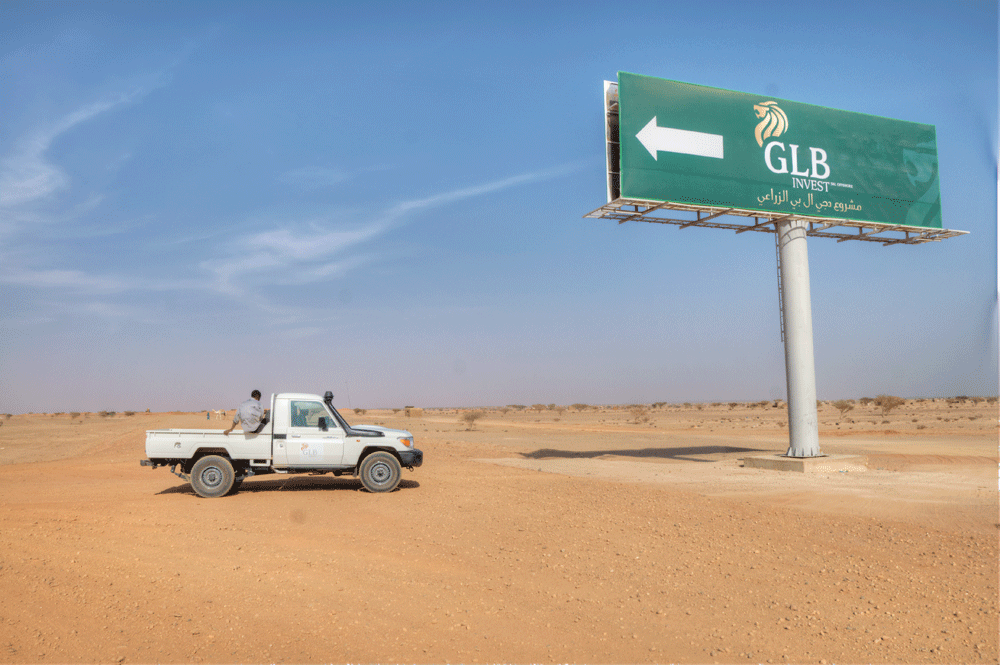
GLB Invest (GLB), a Lebanese offshore company based in Sudan, is developing an $800 million alfalfa production project in Sudan with plans to primarily export the crop to Saudi Arabia. $200 million has been invested by Firas Badra, president of FB Holding, which owns GLB. 

This alfalfa plant is GLB’s first venture into agricultural production. Their business so far has focused primarily on agricultural trading through Golden Grain, their grain trading company, and FB Negoce, which trades in sugar, rice and fast moving consumer goods in Lebanon and the wider Middle East region. Badra admits that he lacks experience in agricultural production but says he has hired experts from France and Spain to run the project’s operations and ensure quality. 

“The queen of forage”

Alfalfa is known as the “queen of forage” and is either dried as hay or mixed with other crops for feeding dairy cattle. Its main advantages include a high yield per hectare and a high nutritional value, which maximizes cattle’s milk production. Financially, alfalfa is considered a cash crop since it can be harvested every 35 days. GLB’s Sudan Project plans to start making profit within the second year of the project initiation. One drawback of alfalfa farming is the sheer volume of water required to cultivate the plant. Irrigated alfalfa is the single largest agricultural water user in California with as much as 40 inches of seasonal water neccesary to maintain healthy growth. Hence Saudi Arabia is encouraging its agricultural and dairy companies to import their forage needs. 

While America currently dominates the market in alfalfa production, a 2012 report by the United States Department of Agriculture indicates that alfalfa production in the US, in terms of area and production, is the lowest it has been since 1957. Debates have ensued on whether to discontinue its production. 

Dwindling American production has has created an opportunity for others to fill the supply void. Badra has an eye on the Saudi market but says GLB is open to exporting to China, Japan and the United Arab Emirates as well, all markets with a considerable dairy industry.

In 2011, GLB acquired 87,200 hectares of land in Sudan under a 99-year renewable lease and secured the water rights for 900 million cubic meters per annum in deals signed with the Sudanese government. Aside from its favorable climate and its proximity to the major areas of export, Badra says Sudan was chosen for the project because of a lack of local competition. To date multinationals have avoided operating in Sudan as it is classified a “high risk” country and subject to US sanctions. In spite of this Badra remains confident, “We know the market and how to deal with it; we know the people there and have good relations with the government so we have all the support we need from it.”

Recouping the investment

GLB’s Sudan Project is spread over five phases of land development, seeding and harvesting with the final goal of producing 750,000 tons of alfalfa annually by 2019.  According to Badra work on the project is progressing as planned, with the first harvest scheduled for January 2014 currently on target. 

Badra says that more than half the $800 million to be invested in the project will be generated from the project itself. Once the project completes its second phase, scheduled for October 2014, it will yield a minimum additional capacity of 210,000 tons of alfalfa per annum and will begin to finance itself with the majority of profits generated being reinvested in the project. FB Holding’s $200 million share has already been invested in the first phase of the project. “Financing was a difficulty as European banks, US banks and some Arab banks don’t finance in Sudan because of the sanctions so that’s why the project started as 100 percent equity,” says Badra. 

The second phase requires an investment of $140 million and GLB is in the process of convincing banks and would-be investors to back the project. Badra says they already got approval from Islamic banks as well as development and African banks. As most of the profits will be reinvested in to the next phase of the project, Badra says investors can expect an initial return on investment between 40 to 45 percent within two years of their investment. Though the central bank places restrictions on repatriating dollars from Sudan, Badra says “we have our ways to manage that”. 

Alfalfa won’t be the only crop planted by GLB in Sudan, as they also plan to plant sunflower seeds when it is time to rotate the crop in three years. The sunflower seeds will be used to make oil to be sold locally in Sudan and exported further afield. 

Though Badra is aware of several new alfalfa production projects coming up in Sudan over the next few years, he says the demand generated by Saudi Arabia alone will create more than “enough room for everyone.”

October 22, 2013 0 comments
0 FacebookTwitterPinterestEmail
  • 1
  • …
  • 229
  • 230
  • 231
  • 232
  • 233
  • …
  • 695

Latest Cover

About us

Since its first edition emerged on the newsstands in 1999, Executive Magazine has been dedicated to providing its readers with the most up-to-date local and regional business news. Executive is a monthly business magazine that offers readers in-depth analyses on the Lebanese world of commerce, covering all the major sectors – from banking, finance, and insurance to technology, tourism, hospitality, media, and retail.

  • Donate
  • Our Purpose
  • Contact Us

Sign up for our newsletter

    • Facebook
    • Twitter
    • Instagram
    • Linkedin
    • Youtube
    Executive Magazine
    • ISSUES
      • Current Issue
      • Past issues
    • BUSINESS
    • ECONOMICS & POLICY
    • OPINION
    • SPECIAL REPORTS
    • EXECUTIVE TALKS
    • MOVEMENTS
      • Change the image
      • Cannes lions
      • Transparency & accountability
      • ECONOMIC ROADMAP
      • Say No to Corruption
      • The Lebanon media development initiative
      • LPSN Policy Asks
      • Advocating the preservation of deposits
    • JOIN US
      • Join our movement
      • Attend our events
      • Receive updates
      • Connect with us
    • DONATE