• Donate
  • Our Purpose
  • Contact Us
Executive Magazine
  • ISSUES
    • Current Issue
    • Past issues
  • BUSINESS
  • ECONOMICS & POLICY
  • OPINION
  • SPECIAL REPORTS
  • EXECUTIVE TALKS
  • MOVEMENTS
    • Change the image
    • Cannes lions
    • Transparency & accountability
    • ECONOMIC ROADMAP
    • Say No to Corruption
    • The Lebanon media development initiative
    • LPSN Policy Asks
    • Advocating the preservation of deposits
  • JOIN US
    • Join our movement
    • Attend our events
    • Receive updates
    • Connect with us
  • DONATE
Comment

The fading of Syrian humanity

by Lama Fakih November 5, 2013
written by Lama Fakih

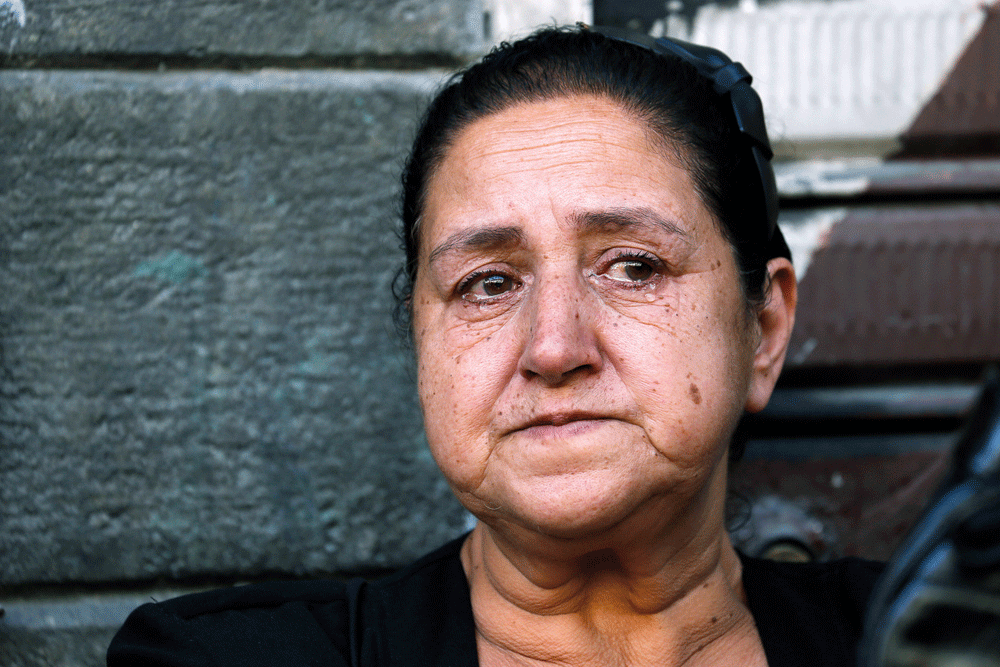
In September, as I stood looking out across a valley in the Latakia countryside, I could hear mortar fire in the distance. There it was, the town of Salma, just kilometers in front of me. I had last visited the rebel-controlled town in December 2012. Then, as now, Syrian government forces were bombarding it by land and air. The government has conducted indiscriminate strikes there, hitting both the rebel fighters who operate in and control the town and the few remaining residents who by choice or for a lack of options have stayed on.

In December, I documented what appeared to be deliberate attacks by the government on the only hospital there. Helicopters had repeatedly dropped improvised aerial bombs in the vicinity of the hospital, finally destroying it on October 5, 2012. Even then the town was in ruins. I could only quickly pass through to survey the damage before night fell and the expected artillery shells began to drop.

The strikes on Salma were continuing in early September. But this time, I was in Barouda, at a Syrian government military position in an Alawite village just kilometers away from Salma, and from which some rebel fighters accuse the government of attacking the town.  From the Barouda military position a government military intelligence officer pointed out the opposition stronghold in the distance. We were standing behind a barricade of sandbags and weapon shipping crates. His enemy was there in Salma. If they could, they would hit us, he said. For fear of snipers I ran to the position and back, through exposed terrain, then back to the village.

I was back in Latakia to document for Human Rights Watch yet another series of war crimes in this war with no end in sight. This time, I was looking at a different set of attackers, documenting an attack on August 4 by rebel fighters led by five groups — Ahrar al-Sham, the Islamic State of Iraq and Sham, Jabhat al-Nusra, Jaish al-Muhajireen wal-Ansar, and Suquor al-Izz. The attackers killed at least 190 civilians and seized over 200 hostages — the vast majority women and children — during the first day of a two-week military offensive, before government forces pushed them back to Salma. At the time of writing the hostages have not been freed.

This is the gravest set of abuses we have documented by rebel fighters; so grave, systematic, and premeditated that they may amount to crimes against humanity. But this is not the first time Human Rights Watch has documented likely crimes against humanity in this conflict. We have long believed that some government abuses also meet this terrible threshold. It was also not the first time family members told me about their relatives being gunned down, their throats slit, their lives shattered. Different attackers, but the victims are much the same.

While the number of sectarian attacks increase in this war, the Sunni, Alawite, Shia, Christian, Kurd, and Druze civilians across the country who have been targeted or are victims of indiscriminate attacks speak with one voice. They describe arbitrary detention, hostage-taking, the agony of not knowing, living with permanent injuries, and picking up the pieces of their shattered lives as refugees, as displaced persons. They want the abuses to stop and the abusers punished. They also comment on us — the nongovernmental groups, the journalists, and other governments — at times seeing us as indifferent to their suffering.

In Latakia, one Sunni man demanded of me: “Who will compensate me for my businesses and buildings that have been destroyed?” One Alawite man detailed the names of over 10 family members who were hostages: “Will you help us see them released?” Another spoke about the execution of his father and his wife. 

With the end of the conflict nowhere in sight, as the faltering Geneva II peace negotiation discussions seem to reflect, we all know that more can be done to stop abuses by all sides: states should halt arms sales and military assistance to the government and to rebel groups that commit widespread or systematic abuses; they should adopt targeted sanctions on commanders on all sides implicated in the most serious abuses; and the United Nations Security Council should promote accountability by all parties by referring the situation to the International Criminal Court. Victims on all sides of the conflict deserve at least this much.

Lama Fakih is the Syria and Lebanon researcher at Human Rights Watch.


November 5, 2013 0 comments
0 FacebookTwitterPinterestEmail
The Buzz

Business briefing: 5 Nov 2013

by Executive Staff November 5, 2013
written by Executive Staff

Economics and Policy

Egypt returned a $500 million deposit to Qatar at the start of November after Qatar refused to renew it upon its maturity.

More from Reuters


The United Nations estimates that around 9.3 million people in Syria, or about 40 percent of the population, need humanitarian assistance due to the country's 2-1/2-year civil war.

More from Reuters


Iraq will hold a general election on April 30 after lawmakers agreed on polling regulations.

More from AFP


Several thousand illegal workers were arrested in Saudi Arabia on the first day of raids following a six-month amnesty.

More from Arabian Business


Companies and Business
 
Vivendi has agreed terms to sell its 53 percent stake in Maroc Telecom to the UAE's Etisalat for €4.2bn ($5.67bn), the latest step in the French conglomerate's attempts to become more media-focused.
 
More from Reuters


November 5, 2013 0 comments
0 FacebookTwitterPinterestEmail
Editorial

A need for debate

by Yasser Akkaoui November 1, 2013
written by Yasser Akkaoui

During an informal chat with one of Lebanon’s most senior politicians last month, I was told to stop being so pessimistic. The deal between the Russians and the Americans over Syria and the region would allow more breathing space for Lebanon, the politician assured me, and so the economy would start to boom again in just a few months.

While I wanted to believe him, it felt like yet more evidence that the world our political class lives in is totally divorced from our own. While those of us in the private sector face squeezed budgets and declining revenues, it feels that they — with their fixed salaries and clientelistic networks — are oblivious to our suffering.

Later in the month I got a clue as to how this sad state of affairs developed when I attended a debate where a government minister and private sector leaders discussed growth in challenging times. I was excited: here was a rare chance to quiz a cabinet minister on his plans to support the private sector, to grill a representative of the government on why it has done so little to support businesses both big and small.
But there was nothing. The few journalists in the room asked a couple of tough questions, but the businessmen’s anger was noticeable by its absence. Some of Lebanon’s most fierce negotiators turned into fawning, submissive sycophants, praising the minister’s hard work and commitment to his cause. The minister likely went away thinking he was popular with the private sector, but behind closed doors most were bemoaning him.

Why? The easy answer, and one which is at least partially true, is that they are afraid. The government controls the contracts that the private sector relies on; an angry minister can easily make sure a project never sees the light of day. Why stick your neck out when no one else is willing to do so?

It’s time to change the culture of undue deference toward public sector leadership. The private sector is the engine of Lebanon’s economy, the creator of meaningful jobs and wealth. We need not feel subservient to those in public office — most of whom have brought us little but corruption and destitution. Excessive deference reduces our public debate. If government officials are never truly told what we think of them in a constructive manner, how can we expect any better?

We should also be more proud of our achievements. For this reason this month Executive again celebrates Lebanon’s entrepreneurs, those who have chosen to be brave and go it alone. With precious little government support, Lebanon’s businesses are its future.

November 1, 2013 0 comments
0 FacebookTwitterPinterestEmail
The Buzz

Business briefing: 1 Nov 2013

by Executive Staff November 1, 2013
written by Executive Staff

Economics and Policy

Intent on supplying his government with arms, oil and food, Syrian President Bashar Assad has turned to Russian banks to access world markets, and the lenders could open more doors to him, despite a risk of isolation from the U.S. banking system.

More from Reuters


Lebanon’s impoverished class will suffer the most from the long-running Syrian crisis, the World Bank has said.

More from The Daily Star


Iraq’s northern Kurdistan region plans to build a second new oil export pipeline to Turkey within the next two years as it ramps up output independently of Baghdad.

More from Reuters


Morocco has secured a $895m loan from German state-owned bank KFW to part-finance two solar power plants totalling 300 megawatts worth an estimated €1.7bn.

More from Reuters


Companies and Business

The National Bank of Abu Dhabi has said its nine-month net profit surged 13.8 per cent as the bank maintained its solid balance sheet and strong capital position.

More from Khaleej Times


Kuwait's Gulf Bank posted a 2.4 percent rise in net profit in the third quarter.

More from Reuters

November 1, 2013 0 comments
0 FacebookTwitterPinterestEmail
The Buzz

Business briefing: 31 Oct 2013

by Executive Staff October 31, 2013
written by Executive Staff

Economics and Policy

Lebanon's caretaker Finance Minister Mohammad Safadi has warned that growth was unlikely to exceed 1.5 percent in 2013 – and it could flatline next year.

More from The Daily Star


China is moving further into Iraq, increasing its investments in the country's oil.

More from Reuters


Oman plans to launch construction of the first part of a $15 billion rail network in the fourth quarter of 2014.

More from Reuters


Companies and Business

The Christie’s auction in Dubai has recorded the highest price ever price paid for a painting by a female artist from the region, when Fahr El Nissa Zeid’s ‘Break of the Atom and Vegetal Life’ sold for $2,741,000.

More from Arabian Business


The Jumeirah Group, a luxury hotel chain and a member of Dubai Holding, announced today that it has raised a $1.4 billion unsecured syndicated loan for further expansion.

More from Gulf Business


Saudi Arabia’s bourse broke a three-session losing streak Wednesday after two of its top telecoms operators posted estimate-beatings earnings and lifted sentiment, while Egyptian shares rallied in mixed regional markets.

More from Reuters
October 31, 2013 0 comments
0 FacebookTwitterPinterestEmail
The Buzz

Business briefing: 29 Oct 2013

by Executive Staff October 29, 2013
written by Executive Staff

Economics and Policy

The London-based Institute of International Finance has revised downward its projection for Lebanon’s 2013 GDP growth from 1.1 percent to 0.7 percent, a further indication that many international agencies do not share the government’s forecast of 2 percent.

More from The Daily Star


Libya’s efforts to end a three-month stranglehold on its oil industry were dealt a significant blow when exports dropped to 20 percent of capacity following new protests at the weekend at major western fields and ports.

More from Reuters


A Syrian state agency reissued two tenders Monday, seeking quantities of rice and sugar it has repeatedly tried and failed to obtain since June.

More from Reuters


Companies and Business

Saudi Arabia’s Kingdom Holding, the investment firm of billionaire Prince Alwaleed bin Talal, has posted a one per cent rise in third-quarter net profit.

More from Reuters


First Gulf Bank, the second-largest lender by market value in the United Arab Emirates, has posted a 13 per cent rise in third-quarter net profit on higher operating income.

More from Reuters


Lebanon's BLOM Bank’s third-quarter profits rose by 4.8 percent to $262.7 million, while Byblos Bank’s net income in the same period fell by 7 percent to $113.6 million.

More from The Daily Star


Etisalat, the Gulf’s No.1 telecom operator, has reported an 18 per cent drop in third-quarter profit.

More from Reuters


October 29, 2013 0 comments
0 FacebookTwitterPinterestEmail
Society

A classy indulgence

by Nabila Rahhal October 29, 2013
written by Nabila Rahhal

Gilt may seem an odd choice of name for a venture launched in one of Beirut’s least-golden periods of recent history, but Marwan Keyrouz is confident his first solo venture will shine in a lackluster market.

“If you create the right atmosphere and if everything is well studied, from scratch to the final concept, then people will keep coming back to the venue,” says Keyrouz, the owner of the cosmopolitan restaurant and bar which has attracted a steady stream of clients both during the day and in the evening since its opening in March 2013. 

Indeed, part of what sets Gilt apart is its ability to appeal to both lunch clientele and dinner and drinks clientele. Keyrouz explains that the secret to creating such a venue lies in the right layout and design, in the concept’s image and in communication with clientele.

Keyrouz is not a newcomer to the hospitality business and was a shareholder in both Monot Street’s Element Club and in Fly, the bar on the Virgin Megastore rooftop in downtown Beirut. In 2008, after his main partner and friend Sami Farhat moved to Dubai, Keyrouz opted to stay and use the experience and expertise he had gathered in his years in the business in Lebanon to venture solo. Gilt is the first of such solo venues by Keyrouz, and one for which he has only one silent investor.

Gilt is located on the edge of Saifi Village, in downtown Beirut, in one of the few buildings in the area that is equipped to handle kitchen requirements and which also houses the wine concept restaurant Burgundy. Its position means Gilt is ideally situated to attract the business lunch crowd from the offices nearby as well as the bar hoppers and night-time diners who are looking for a change from the nearby Gemayzeh and Uruguay Street.  Careful consideration went into choosing Gilt’s location. Keyrouz chose Beirut as the hub of the hospitality business in Lebanon and then looked for a venue with easy access to a parking lot — a crucial element in attracting lunch clients who usually have a limited time period. Additional prerequisites included the existence of three facades so the venue could be well lit and a five meter clearing so guests could “breathe”. Designed by the architect Issam Barhouch, who also worked on Element, Gilt’s interior facilitates a smooth transition between day and night.

With a seating capacity of 77, the entrance leads to a classy yet casual bar area which opens up to an intimately laid out dining space with sturdy wood tables and big glass windows overlooking the alleyways of Saifi. The French oak used in the wall paneling is light enough to give off a fresh look during the day, whilst additionally complementing the dim lighting used at night, to conjure a cozy and chic vibe.

Gilt gives off the atmosphere of both a restaurant and a bar where one can enjoy a good meal while listening to inoffensive music and socializing with friends in a relaxed atmosphere. The staff are friendly and informative without being overly assertive and the music is laid-back during the day and more upbeat at night. The menu features a diverse range of cuisine “with a twist” and was designed by chef Maroun Chedid, a regular on the MTV morning shows, and is implemented by Chef Toni Ziadeh, working under Chedid’s supervision. The beef carpaccio is a medley of zesty and sweet flavors and is not to be missed, nor is the delicious spinach ravioli with walnuts. 

With an average bill of $65 for two including drinks, Gilt’s clientele range between 35 to 60, appreciate nice design, good food and service, and have a keen eye for detail, according to Keyrouz. The restaurant has an average turnover of a 100 customers on a busy day and Keyrouz hopes to return his $1.25 million investment within two years, taking into account the ups and downs of the country.

Though Keyrouz is pleased with his venue’s success, he is still seeking to fill the 4 pm to 8 pm period which is usually rather calm as, contrary to the European “after work drinks” culture, the Lebanese tend to go out later in the night. To achieve this, he is trying to attract foreigners more inclined to an early evening cocktail and also the 60 and above clientele who tend to enjoy an early dinner. “These people are neglected though they still like to go out and spend money,” says Keyrouz explaining that the only outlets in Lebanon that are active at 7 pm are diners or burger joints.

Keyrouz plans to take Gilt abroad to Europe where he believes New York style restaurant/bar concepts are lacking and would fare well. As for Lebanon, should the political situation stabilize, Keyrouz has a few ideas in mind, including a Chinese or Mexican restaurant or a nightclub.

Keyrouz seems to have a knack for creating concepts that have a timeless appeal and only time will tell whether future venues will have that same charm.

October 29, 2013 0 comments
0 FacebookTwitterPinterestEmail
The Buzz

Business briefing: 28 Oct 2013

by Executive Staff October 28, 2013
written by Executive Staff

Economics and Policy

Lebanese caretaker Energy Minister Gebran Bassil said new estimates for nearly half of Lebanese waters suggested the country’s reserves of natural gas and oil might be larger than previously thought.

More from Reuters


Egypt's closure of tunnels used to smuggle goods into the Gaza strip has caused monthly losses of $230 million to its economy.

More from AFP


Algeria's energy minister says a new oil field containing an estimated 1.3 billion barrels has been discovered.

More from Associated Press


Stability in the Gulf monarchies is essential for Egypt's security, Prime Minister Hazem Beblawi has said, a day after the United Arab Emirates pledged Cairo an extra $3.9 billion in aid.

More from AFP


Companies and Business

Dubai developer Emaar has launched an ambitious $3bn master community project in Erbil, the capital of Iraqi Kurdistan.

More from Arabian Business


Jordanian lender Arab Bank Group's nine-month net profit rose 15.4 percent to $559 million.

More from Reuters


Mobile telecommunications group Zain wants to expand in North Africa by taking controlling stakes in companies or winning management contracts in the region, the Kuwaiti group's chief executive said.

More from Reuters

October 28, 2013 0 comments
0 FacebookTwitterPinterestEmail
Hospitality & Retail

An ode to civil turmoil

by Executive Editors October 25, 2013
written by Executive Editors

The presence of Syrian artists in Beirut is far from new, due to the city’s international connections, and the higher prices artworks fetch. “Syrian artists have always been part of the Lebanese art scene for as long as I can remember,” gallery owner Joanna Seikaly says.

However, currently more work by Syrian artists is being showcased in Beirut than ever before, as Damascene gallerists and artists have shut up shop and relocated to avoid war in their homeland. Seikaly has featured five Syrian artists over the past year.

Of all the Syrian creatives now in Beirut, it is visual artists who have found their place in the city’s art galleries and on the stage of international culture, as well as its open and internationally recognized cultural scene, which affords creative minds more opportunities and liberties than elsewhere in the Arab world. 

Syrian art has long been held in high regard by collectors and galleries in the region and further afield. Prompted by his connections to the Syrian art world, coupled with a shortage of space for the art he had acquired over the last 20 years, collector Antoine Haddad opened Artlab in late 2012. For the first nine months, the gallery only featured Syrian artists. “Syrian artists have given the local art scene a boost,” he says.

According to the sculptor Mustafa Ali, Syrian art has become more open. The volume and focus of the artistic output since the uprising, itself marked and driven by a widespread use of creative media, has indeed fundamentally changed. Before the uprising, art that consistently challenged the regime, such as the cartoons of now-exiled Ali Ferzat, were the exception rather than the rule. But the mold is changing.

In late 2012 Houmam al-Sayed expressed his rejection of violence against children in his “From Damascus to Beirut” exhibition at the Mark Hachem Gallery in Minet el-Hosn. Tackling injustice, confronting the status quo and condemning violence on a wider scale are adding new dimensions to Syrian art in an unequivocal manner.

Focusing on work with the war raging close by can be painful and challenging. “You’re thinking about people, how they live, how they take this. You feel guilty,” says Fadi al-Hamwi, who painted a large portrait of a friend who had been arrested. “It’s not a quiet situation in which we find ourselves.”

“Before things got messy, before they started to use guns and threaten us, my only way to express my opinion freely was through my art,” Heba al-Akkad says. “[Now] it is my duty to talk about it [the war] in my art.”

Akkad’s show of mixed media work, “Things are still the same,” shown at Galerie Tanit this summer, is a powerful message of hopes dashed. Her colorful yet macabre, naïve yet highly symbolic and evocative body of work turns out to be an obituary to a still-born infant: the revolution. Some of Akkad’s recent work was produced during a month’s stay at Raghad Martini’s Artist Residence in Aley (ARA), a creative hub established to help Syrian artists connect with local galleries and collectors.

On the terrace of his home studio, painter, videographer and installation artist Hamwi points to works similarly influenced by current events in Syria. For a 2012 installation  in Damascus titled “4am”,  Hamwi painted the walls of the 5x5m gallery room black, put grass on the ground and placed his bed in it, with bricks aligned to look like a mattress. “People would enter my dream. I was not telling a story but putting you in a situation,” he says.

Symbols of hardship

This year, Hamwi painted dinosaurs, each wearing a gas mask while holding a single flower, and human skulls and machine guns in X-ray vision. “A Bone In The Head”, the first in the ‘transparent’ series, features a pistol inside a brain, as the artist tries to get inside the heads of killers and tormentors.

“This is the change that came to my work when I was in Syria. How do they think when they shoot a human being? When they cut a body part? Many people are prepared to do these kinds of things,” he says.

Akkad gave birth to her first child in Lebanon last year. Already pregnant, and with her husband facing the draft, leaving Damascus became inevitable. Her 10-month-old son has no birth certificate, a consequence of her husband’s refusal to join the Syrian army.

Without papers to prove her son’s identity, Akkad used her art to provide him with one: “Black & Yellow and vice versa” is dominated by a large male head at the center symbolizing her son. It also bears witness to friends and family she has lost, featuring in one corner a beautiful sketch of a woman sitting cross-legged, drawn by her teenage brother. Akkad recently found out that he’d been killed in tragic circumstances.

With her husband studying, Akkad became the sole breadwinner. Syrian artists can make up to three times what they would in Damascus for their work, in line with prices for other goods, but they have to contend with much higher living expenses and renew their visas every six months. Though she has sold art in both Lebanon and Jordan, Akkad has also been forced to take on low paid casual work.

While some Syrian artists struggle to get by in Lebanon, others are making the city work for them. 

Artist and musician Samer Saem el-Dahr lives and works with Waraq, an artists’ collective located in a traditional house painted bright yellow and turquoise in Ras el-Nabaa.

Last year, he contributed to a collective exhibition and managed to sell two paintings. He subsequently approached Seikaly who encouraged him to put together his first solo exhibition: “This is not politics!” — which included 26 new expressionist paintings — was held in early 2013.

The 23-year old artist left Aleppo in September 2012. “The plan was to stay here for one month but then things got worse,” he says. “I’m comfortable here now, because I’m producing a lot. For now Lebanon is good for me, for another couple of months. There is the stress though of what’s coming up next, what if Lebanon doesn’t want us? Where will we go? All over the world, we’re not wanted.”

“For sure I feel homesick,” says Hamwi, who left much of his art behind. “I left the old memories as well. All the small details, my whole life — it’s there.”

Nostalgia infuses some of the personal projects the artists undertake, notably Hamwi’s painting of the logo of Derby — a Syrian chips brand — which created a buzz on his Facebook page, or Dahr’s Hello Psychaleppo, an electronic-classical Arabic music collaboration with Lebanese music producer Nabil Saliba.

visions of home

Dahr’s career took off in Beirut but he sees his future in Syria. “I will be going back to the country, [but now] it’s a war zone. There will be nothing. Then there will be a lot. We’re the youth. If it’s not us, nobody will do it.”  For Mustafa Ali, who was born in 1956 in Latakia, relocating to Beirut was fairly easy. Dividing his time between Paris, Damascus, and Beirut where he took an apartment in early 2013, he is among those who still regularly enter Syria, but has sent his small children to school in Paris.  Working primarily as a wood and metal sculptor, based in Damascus since 1974, he has exhibited widely and received prestigious commissions, notably from the Institut du Monde Arabe in Paris.

While he has moved work to Dubai, Paris and Beirut, Ali still has his main studio and most of his art in Damascus; his large sculptures are simply too heavy to be moved. His cellphone is filled with images of his work, of openings or events at his Damascus gallery that used to attract a thousand people. Besides his gallery in the old city, he has three workshops; the largest in Al Ghouta, which he has been told has been partially destroyed.

Though better connected in Beirut than younger Syrian artists, Ali heads to Damascus to work. Dahr on the other hand, consciously refrains from drawing inspiration from his surroundings. “That way I’m not dependent on it or on being in Syria.”

“I don’t like to take advantage of what’s happening,” Dahr says. He refers to a sketch he did of the artist Youssef Abdelke who was held captive for a month between July and August 2013. “For this one I did it…He came twice to my studio; I’ve known him since I was very young. When I heard he was arrested, to spread the word, in favor to someone I know personally, I did this sketch.”  Syrian artists are aware that their work has now become fashionable and generates considerable media interest, a fact that is not without its complications. “People want to buy the story,” Hamwi commented. “We have the story. We’re now the ‘world victims’. This is very clear to us. Some artists play into that, but it shows. To do archiving of this era you need to be super sane and stay objective.”

Syria Contemporary Art Fair will take place at Artheum from 2 to 9 October 2013. The exhibition will be featuring over 45 contemporary, established and emerging artists from Syria, covering a variety of styles and techniques.

October 25, 2013 0 comments
0 FacebookTwitterPinterestEmail
Banking & Finance

Engineering exclusivity

by Joe Dyke October 25, 2013
written by Joe Dyke

Lebanon may be a small country, but never let it be said that its dreamers don’t think big. Should it score the investment to become a reality, entrepreneur Ralph Debbas’ $3.4 million Lykan Hypersport is set to become the Arab world’s first supercar.

The basic facts of the car are incredible — twin turbo-charging engine reaching 7,100 revs per minute, 0-100 kilometers per hour (KpH) in 2.8 seconds and a maximum speed of 395 KpH. It also looks beautiful and is, as supercars tend to be, exorbitantly expensive — at $3.4 million dollars each, Debbas’ W Motors are planning to make only seven, with the designers dubbing it “the most exclusive car in the world.”

Supercars are a naturally niche market — targeting not merely the world’s 1 percent but the 0.01 percent — and breaking into that market is a daunting challenge, especially with competitors including Ferrari, Lamborghini and Porsche.

But it appears that Debbas and partner Sari el-Khalil are getting there. With the backing of FFA Private Bank, last month they launched a search for $6 million in investments to finalize the first version of the car, due to be launched at the Dubai Motor Show in early November.

While the Lykan may initially seem a strange project for FFA to be involved in, it is part of an increasingly varied portfolio of deals: the bank was recently involved in the financing of the Hollywood blockbuster Two Guns. The bank’s head of investment banking, Julien Khabbaz, said their involvement, though their first foray into the world of supercars, was based on solid financial decisions. “It is a great opportunity for investors, with an estimated internal rate of return of between 31 and 43 percent.”

While half of the investments by private customers are exchanged for equity, the other half are secured debt guaranteed by Debbas’ Lebanese real estate, so risks are also slightly lower than other investment opportunities. Investors will also have priority return over founders through annual reimbursement of the debt.

Khabbaz is confident that the company’s growth targets will be met: “The estimated returns are based on the first seven cars [being] sold in two years but my assumption is it will be faster than that [and yield better returns].” He added that the highest-end luxury market has been less affected by the current global economic climate as billionaires continue to spend.

all revved up

       Potential investors must have deep pockets, however, with a minimum spend of $100,000. Khabbaz said he was not sure how many investors would be needed to make up the $6 million, as one or two may invest over a million dollars each.

As Executive went to print, FFA had raised 75 percent of the $6 million needed, with expectations that the rest would be received within a week. The money will raise W Motors enough capital to launch the first version of the car later this year. The next challenge will be to convince the world’s richest that their product is this year’s must-have play thing.

To do this they will need to develop a brand, something they are in the process of doing. Pitching itself as the first ‘Arab supercar’, Debbas is cleverly trying to tap into pan-Arab sentiments while creating a product so good that billionaires globally will want it too. The car is set to play a major part in the forthcoming seventh movie in the Fast and the Furious franchise, with much of the film based in the United Arab Emirates.

So while many of the car’s features may seem a little gaudy (diamonds and rubies in the lights, for example), they may play well in the Gulf where bling is most definitely still in. And behind the not one but two holograms that the Lykan features is the potential for an incredible car, with Austrian firm Magna Steyr responsible for the interior and exterior design and Germany’s RUF Automobile developing the chassis and engine.

With only seven cars to sell, the difference between the venture’s success and failure will be incredibly fine — with the initial reaction of those lucky (and rich) enough to test it at the end of 2013 likely to determine whether it is a hit or a miss. Success will lead to a ‘more affordable’ and only slightly less exclusive sister car, with 25 of the $1.5 million Supersport version planned. For those looking at investing in the firm, it represents a risky opportunity, but a potentially lucrative one.

October 25, 2013 0 comments
0 FacebookTwitterPinterestEmail
  • 1
  • …
  • 228
  • 229
  • 230
  • 231
  • 232
  • …
  • 695

Latest Cover

About us

Since its first edition emerged on the newsstands in 1999, Executive Magazine has been dedicated to providing its readers with the most up-to-date local and regional business news. Executive is a monthly business magazine that offers readers in-depth analyses on the Lebanese world of commerce, covering all the major sectors – from banking, finance, and insurance to technology, tourism, hospitality, media, and retail.

  • Donate
  • Our Purpose
  • Contact Us

Sign up for our newsletter

    • Facebook
    • Twitter
    • Instagram
    • Linkedin
    • Youtube
    Executive Magazine
    • ISSUES
      • Current Issue
      • Past issues
    • BUSINESS
    • ECONOMICS & POLICY
    • OPINION
    • SPECIAL REPORTS
    • EXECUTIVE TALKS
    • MOVEMENTS
      • Change the image
      • Cannes lions
      • Transparency & accountability
      • ECONOMIC ROADMAP
      • Say No to Corruption
      • The Lebanon media development initiative
      • LPSN Policy Asks
      • Advocating the preservation of deposits
    • JOIN US
      • Join our movement
      • Attend our events
      • Receive updates
      • Connect with us
    • DONATE