• Donate
  • Our Purpose
  • Contact Us
Executive Magazine
  • ISSUES
    • Current Issue
    • Past issues
  • BUSINESS
  • ECONOMICS & POLICY
  • OPINION
  • SPECIAL REPORTS
  • EXECUTIVE TALKS
  • MOVEMENTS
    • Change the image
    • Cannes lions
    • Transparency & accountability
    • ECONOMIC ROADMAP
    • Say No to Corruption
    • The Lebanon media development initiative
    • LPSN Policy Asks
    • Advocating the preservation of deposits
  • JOIN US
    • Join our movement
    • Attend our events
    • Receive updates
    • Connect with us
  • DONATE
The Buzz

Business briefing: 4 Sept 2013

by Executive Staff September 4, 2013
written by Executive Staff

Economics and Policy

Numerous Lebanese private institutions announced Tuesday their intention to join Wednesday’s first private sector-led general strike in years.

More from The Daily Star


Saudi Arabia’s annual economic growth rose to 2.7 per cent in the second quarter after a weaker six months as non-oil expansion remained robust while a decline in the oil sector eased.

More from Reuters


U.S. President Barack Obama won the backing of key figures in the U.S. Congress, including Republicans, in his call for limited U.S. strikes on Syria to punish President Bashar al-Assad for his alleged use of chemical weapons against civilians.

More from Reuters


Companies and Business
 

The Turkish electricity barge Orhan Bey has successfully connected to the Jiyyeh power plant in Lebanon and started supplying energy.

More from The Daily Star


The growth in net profits of the 13 largest banks in Lebanon fell to 1.3 percent in the first half of 2013 from 7.7 percent in the same period of last year.

More from The Daily Star


Egypt’s El Sewedy Electric, the Arab world’s biggest listed cable maker, said on Tuesday second quarter net income surged 159 per cent year-on-year as wire and cable revenue rose.

More from Reuters


September 4, 2013 0 comments
0 FacebookTwitterPinterestEmail
Economics & Policy

A show of support

by Nathalie Rosa Bucher September 4, 2013
written by Nathalie Rosa Bucher

Contingency plans, cancellations, and reduced audiences. This is what Lebanon’s summer festivals had to cope with this year in the context of a bleak socio-political and security situation. Although the 2013 summer festival season has been marred by many rippling effects of the war in Syria, the event season also saw many memorable and well-attended performances by local and international artists.

The security situation has affected tourism, and where locals go — or won’t go. Lebanon’s grande dame of festivals, the Baalbek International Festival, which dates back to 1956, has been the hardest hit, due to its location in the Bekaa valley, which has been hit by rockets fired from Syria on several ocassions.

Baalbek’s stages are majestic. The biggest names in opera, jazz, dance, theater, Arab and classical music have graced the stages around the Bacchus and Jupiter temples over the years; others have vied for it. Of late, however, many Lebanese are avoiding the Bekaa altogether due to safety precautions. Baalbek festival organizers decided to move the event to La Magnanerie in Sad El Baouchrieh, just outside of Beirut. Of the line-up, which initially consisted of six performances, half remained after the opening act American soprano Renée Fleming cancelled her concert due to security concerns, Lebanese singer Assi El Hellani postponed his to 2014 and British legend Marianne Faithfull injured herself a week before she was due to perform, effectively delaying the starting date of the festival by a month.

Baalbek’s press attaché Zeina Sfeir explains the festival’s target audiences: “We try as much as we can to attract all ages and audiences, and to satisfy all tastes, from the jazz lovers, to classical music, popular singers, as well as ballet and dance.” Dolly Shaiban, a member of the Zouk Mikael International Festival says that the festival’s target audience consists of the widest possible cross section of society starting from 20 year olds. Zouk achieves this with fairly priced tickets.

The Pet Shop boys put on quite a show in Byblos


Generally speaking, having realized that younger audiences too possess financial clout, local festivals have, with significant success, started to cater for these audiences. Lebanese band Mashrou Leila gave a hugely successful performance inside the Bacchus Temple last year, and this year Beiteddine featured the China National Acrobatic Troupe Splendid Circus, which catered for a family audience. The program in Byblos, which is regularly the most eclectic, ranging from flamenco to metal, was very popular with younger revellers this year, with American singer-songwriter Lana del Rey breaking audience records.

“We didn’t reach the target of 50,000 but sold 40,000 tickets this year, which is a really good figure,” Abdallah Almachnouk from Buzz Productions, the artistic directors and producers of the Byblos International Festival, says. “Lana del Rey drew a crowd of 7,000, the biggest we have ever had; Greek composer and multi-instrumentalist Yanni and German rockstars The Scorpions performed two nights respectively and we sold 10,000 tickets over the two nights. We had a couple of really good shows!”

Audience numbers have declined but haven’t exactly plummeted, thanks to loyal local customers. “In our opinion, this is due to the regional situation,” Shaiban says. “Local Lebanese audiences have not wavered in their support. This can be seen in the number of people still coming for the first time to Zouk. We know this from the random interviews we conduct before and after each of the concerts each year.”

Hala Chahine, director of the Beiteddine Art Festival, a non-profit organization, says 25,000 to 30,000 people attended this year, a 30 percent increase from 2012, although there were more performances this year. They also saw a 20 percent increase in local attendees with a 30 percent drop in Arab tourists and Lebanese expatriates. In previous years the festival, famous not only for its diversity but also for commissioning original productions and artistic collaborations, has attracted up to 51,000 spectators. The Baalbek Festival sees around 20,000 spectators every year, says Sfeir. Figures for this year are expected to be lower, given venue change and performer cancellations.

The Lebanese keep partying nomatter what the situation


Last year, according to Shaiban, Zouk drew 5,500 spectators, down from 6,000 in 2011 and 6,500 in 2010. This year the three of the four scheduled concerts that took place attracted 5,000 people. Young up and coming crossover jazz star Jonathan Batiste and his Stay Human Band from the United States, who shared the bill with festival returnee Monica Yunus, drew a mixed-age crowd to Zouk’s Roman-style amphitheater. Batiste, a maverick musician and entertainer, managed to get the crowd on their feet.

Yet shrinking box office figures are significant, as all festivals are heavily dependent on ticket sales for revenue in addition to sponsors’ support and government subsidies. When coupled with delays in the delivery of the Ministry of Tourism (MoT) subsidy, operations could be heading for trouble.

Key to surviving these turbulent times are corporate sponsors. These are most often banks but also local businesses that have committed themselves on a long-term basis to the festivals, as well as generous private individuals. All festivals contacted confirmed having solid and long-term relationships with their sponsors, and some such as Baalbek have secured new ones this year.

“The [overall] budget varies between $2.4 million and 3.5 million and it is financed 55 percent through ticket sales, 28 percent partners and sponsors and 17 percent governmental aid,” Beiteddine Festival’s Chahine says.  In the case of Byblos, Almachnouk says that ideally the festival would be looking at a budget that would be evenly split between sponsors, ticketing and subsidies. “That’s how it works in France. But here we are faced with a breakdown that looks like this: 50 percent ticketing, 30 percent sponsors and 20 percent subsidies [by the MoT]. The challenge with regards to the subsidies is that these are most of the time paid out one year later, which leads to a minute profit margin.”

American band One Republic got in touch with their Lebanese sides


Local festivals collaborate with the MoT and the Ministry of Culture respectively, especially when it comes to advertising and attracting visitors from abroad. Even this year festivals haven’t given up on the foreign audience, with both Zouk and Beiteddine confirming that they actively targeted Lebanese and non-Lebanese audiences.

“We have a very diverse audience and we take a different approach with regards to advertising for every audience,” Byblos’s Almachnouk says. “For the younger audiences in particular, we go through Facebook.” This year, Baalbek focused on a social media strategy. “Social media helps in reaching the youth that we wish to attract to attend the festival,” Sfeir.

At the time of going to press, Byblos Festival’s Facebook page had over 12,000 likes, Beiteddine just under 7,000 and Baalbek 6,500. All festivals have registered a drop in their advertising budget with the advent of social media coupled with a shift from traditional media — print, radio, TV — to online platforms and social media.

The economic impact of festivals on their local communities are also significant. “Around $2 million dollars are injected yearly into the local economy covering different sectors,” Beiteddine’s Chahine says. “Furthermore there are Lebanese artists’ fees, hotels, airlines, freight, local transport, restaurants, stage and tiers rentals, sound and light systems, insurance etcetera.”

“It is thanks to the local businesses that support the festival that it is able to continue year after year,” Shaiban says of Zouk. Chahine underlines that local businesses benefit significantly from yearly festival activities, which bring in regular business opportunities.

Back for more

Retaining artists and even booking venues has become more challenging, but festival directors have been resilient. Unlike Zouk, Beiteddine and Baalbek, Byblos encountered challenges when it approached artists with requests to book them. “Frankly, we weren’t expecting it to be that hard,” Almachnouk admits. “We had a crazy time convincing them but we did in the end manage to get some of the biggest names to Lebanon,” referring to Lana Del Rey, who arrived in July on the day of a bombing in south Beirut.

Shaiban says that he uses “personal connections” to approach artists. “There is a trust factor that has been established over the years and that then plays a big part in their decision to come or not,” he says. However security concerns still can trump personal ties, as happened with French artist Pascal Obispo’s decision to cancel his show.

Some festivals re-invite artists: Monica Yunus performed in Zouk this summer for the second year running. Jazz diva Dee Dee Bridgewater brought Ramsey Lewis along to Beiteddine, where she had wowed audiences in 1997 and The Scorpions came back by popular demand, after having sold out in Byblos two years ago.

“Every year it gets harder,” Almachnouk says. “We need to choose artists that are relevant to Lebanese audiences and that are not too expensive. We have so many constraints locally and regionally; we don’t know how to approach people. And next year we’ll have to take into account the World Cup — if Brazil plays Germany, people won’t come to Byblos even if Coldplay is performing!”

In light of an extreme shortage of public spaces, especially in Beirut, festivals can fulfill a crucial role as social equalizers and meeting places. Many of the concerts held across the summer transport audiences to a different place through their perfomers, providing a much-needed breathing space.

September 4, 2013 0 comments
0 FacebookTwitterPinterestEmail
The Buzz

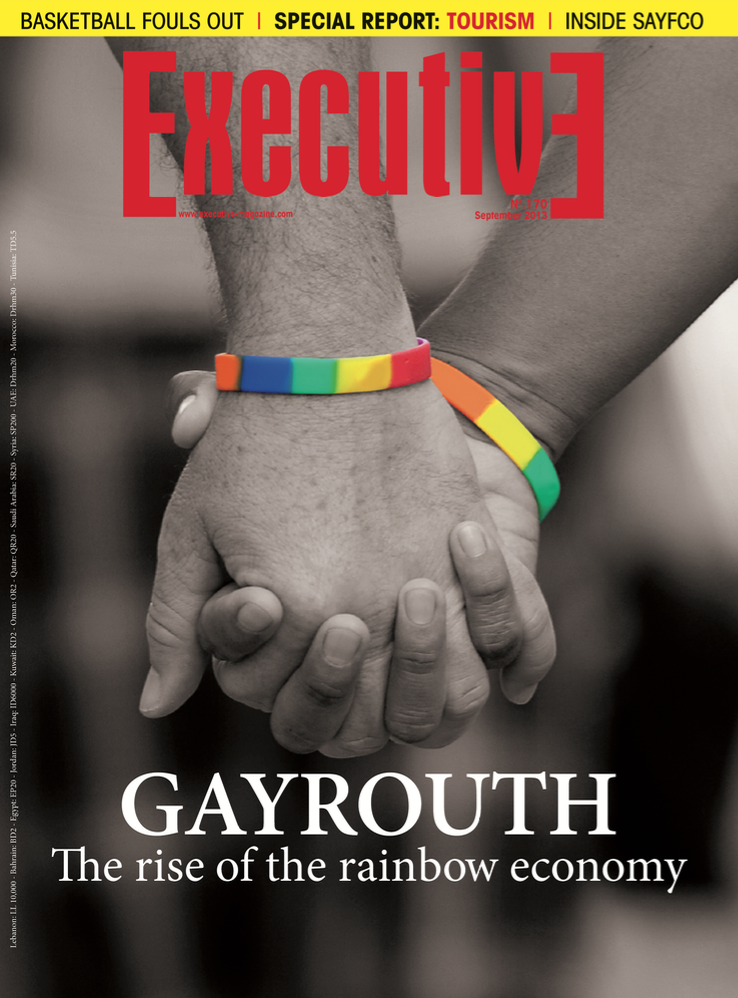
The rainbow economy

by Maya Sioufi September 4, 2013
written by Maya Sioufi

Homosexuality is not a mental disorder. In an unprecedented statement in July of this year, the Lebanese Psychiatric Society (LPS) became the first of its kind in the Arab region to declare that gay people are not mentally ill and do not require treatment. This was welcome news in the Lebanese homosexual community which has been more rapidly coming out of the closet in the past decade and battling for their rights. The statement came shortly after Pope Francis declared that, “if a person is gay and seeks God and has good will, who am I to judge?” That statement sent shockwaves throughout the worldwide gay community, which has celebrated recent progress in rights in some countries, but is still fighting rampant abuses in others. 

Lebanon’s lesbian, gay, bisexual and transgender (LGBT) community has reasons to cheer and some to boo. Beirut has a reputation of being a gay friendly city in comparison to other Middle Eastern capitals such as in Saudi Arabia and Iran where execution of homosexuals is not uncommon. The capital’s tolerance toward homosexuality has allowed an increased gay presence across industries, countless gay tourists to flow into the country and has seen numerous businesses — from department stores to bars and clubs — striving to attract the burgeoning gay community. Yet all this is against a legal backdrop that presents a less than rosy human rights picture — especially among the more vulnerable socioeconomic classes. 


The booming gay scene

It’s Saturday night and Bardo, a gay friendly bar in Beirut’s Hamra area, is packed. A friend of mine shows me a conversation he just started on Scruff, a gay dating application which allows users to share their location. The guy he is messaging is not too far away and after exchanging two or three messages, he seems keen to meet up. “The Lebanese gay community is booming,” my friend says. “It’s the  ‘in’ thing now and it’s really easy to hook up.”

Related articles: Homosexuality is not an illness, Lebanese scientists decide

A lack of tolerance — Lebanon still largely unaccepting of homosexuality

Scruff is not the only dating app geared towards the gay community. The more popular Grindr, which has more than 6 million users worldwide told Executive that it has 8,636 average active monthly users in Lebanon. Manjam, the social network and dating platform for gay men in the Middle East, has around 17,000 users in Lebanon and 137,000 in the region. 

These figures significantly understate the number of LGBT people in Lebanon. No surveys on homosexuality in the Lebanese population have been conducted. Using the commonly cited (and widely contested) 10 percent figure, based on the studies of sexologist Alfred Kinsey conducted in the US in the 1940s and 1950s, would imply that there are around 400,000 gay people in Lebanon. The percentage of the population that is ‘out’ varies tremendously by region depending on its social values. The Gay European Travel Association (GETA) included Lebanon and Israel in its recent study of gay European tourism because of the thriving gay communities in these countries and when estimating the number of openly gay people in a country’s population, it applies the conservative 1 percent figure used for Central Europe to Lebanon implying that 40,000 Lebanese would identify themselves as gay in the country.  While this figure is disputable, one fact that is irrefutable is the increase in visibility and empowerment among Lebanon’s gay community, giving confidence to the younger generation to declare their sexual orientation. 


Hamed Sinno, the openly gay Mashrou Leila singer, with a rainbow flag at Byblos in 2010

Growing in confidence

Hamed Sinno, the lead singer of Lebanese alternative rock band Mashrou’ Leila, is openly gay. He has written a love song in Arabic, “Shim El Yasmine” about homosexual love. At the Byblos International Festival in July 2010, he grabbed the LGBT rainbow flag from a fan in the crowd and tied it to his microphone on stage in front of 3,500 people. “Right in front of me, there was a crowd of about 100 LGBT kids and there was this kid, 18 at most, and he was waving the rainbow flag and his friends were doing the same thing with signs on gay rights. It is touching to see a bunch of 18-year-olds doing that in my country,” says Sinno over coffee in Hamra. He comes from a very conservative family but they eventually came round. Not everyone has though and Sinno receives constant online attacks for his sexual orientation. “I don’t take it seriously. I just ignore it. I’m not going to stop being gay or making music,” he says. 

It’s voices like his that give strength to the youth and the band’s success has been remarkable, with over 100,000 followers on Facebook, concerts held in the Middle East, Europe and Canada and a third album — which is being financed via crowdfunding — on the way. 

Sinno and his band are not the only ones breaking taboos and calling for a much needed change. The percentage of the Lebanese society that accepts homosexuality remains at a dismal 18 percent according to Pew Research. While it is higher than in other Arab countries such as Jordan and Egypt where the rate stands at a perturbing 3 percent, the figure remains unchanged since 2007. 

In this relatively conservative society, many gays prefer to keep their sexual orientation hush hush but it is widely whispered within the community. Just ask any gay Beiruti. From famous fashion designers, to TV anchors, to advertising executives, to bankers and many political figures, the Lebanese gay community is more visible across the board. 


Chasing the gay customer

The increase in visibility has caught the attention of business owners looking to cater and profit from the thriving community. Referred to as DINK — double income, no kids — the gay community is widely assumed to have higher freedom to spend and to travel; in the United States, gays earn an average annual income of $61,500 versus the national average of $50,000 according to a December 2012 survey by financial firm Prudential. GETA estimated in October 2012 that expenditure on tourism from gays in Lebanon amounts to $83 million annually. Department store Aishti launched a campaign in 2004 with the tagline “Vote for Tolerance” featuring men and women standing closely side by side in bright colors; gay men Executive spoke to felt the campaign alluded to the rainbow flag and was catered towards them.

And then there are the parties. Event organizer PC Party host several hip, gay friendly parties a year, advertised by word of mouth, in different locations — from Solea V to the Saint Georges Yacht Club to the Estral Cinema in Hamra — and with themes — Paparazzi and Celebrities, Tres de Mayo, PC in Wonderland. With a LL50,000 ($33) cover, the parties attract up to 1,200 people according to the party's management. Gay friendly bars and clubs from Bardo in Hamra to Posh in Burj Hammoud to Gemmayze’s Life and Obladi — referenced in gay travel guides and blogs — also attract a gay crowd.

Aishti's 2004 campaign seemed to appeal for tolerance of homosexuality

Bardo, established in November 2006, caters to a mid to high-end gay crowd and racks in annual revenues exceeding $600,000. With different DJs mixing tunes every night, manager Joseph Aoun says he wants Bardo to be a melting pot of a tolerant and progressive society. “We do concerts, support cultural events such as the BIPOD [Beirut International Platform of Dance] festival and sponsor movies. We want to reflect the creative in our community and not the sexual. [Being] gay is not just about sex,” he says. And the gay friendly bar has never had to bribe policemen. “Our location helps a bit. You have corrupt policemen that enter without an order just to get money. Here it’s a security area for [Druze leader] Walid Jumblatt so they need permission from his guards,” says Aoun. As for the bar’s competitors, Aoun says that it is the straight bars in Beirut as “all the high-end places take into consideration the wealthy gay community. And [they] want good food, drinks and vibe and who cares if it’s a gay bar?” he adds.  

In recent years, some of the hippest parties such as Decks on the Beach and CU NXT SAT, which are held weekly during the summer at Beirut’s Sporting beach club, as well as the renowned parties hosted by organizers Cotton Candy, have attracted a diverse range of partygoers, gay and straight alike.


Worth a trip

Beirut’s pink reputation has lured international gay tourists as well. Travel agency LebTour has been serving gay clientele since 2004; but not from Arab countries. “Arabs are more interested in food and other stuff that I don’t provide, you understand my point,” says founder Bertho Makso. 

One year after its formation, LebTour became Lebanon's representative of the Florida-based International Gay & Lesbian Travel Association (IGLTA), the world’s leading travel network for gays. “They asked me to deal with all Arab countries, with a focus on Lebanon,” says Makso who has featured in prominent media outlets such as the Wall Street Journal and the New York Times. “I don’t advertise, I rely on these interviews,” he adds. 

Beirut has been featured in various media as a destination for gay travelers

After the 2006 war with Israel, business dried up in Lebanon so Makso decided to start covering Syria. “That was something,” he says. He would spend a week a month in Lebanon and the rest in Syria. Arriving on the Syrian border with a bus of 35 gay men, “they asked me where our wives were. I said in another bus; it’s obvious, they know [we were gay]” he says. Makso received up to 700 gay tourists annually from Europe and the United States in 2009 and 2010 prior to the Syrian crisis. Many would come with the July 2009 NYT article featuring Makso and entitled “Beirut, the Provincetown of the Middle East”; Provincetown is a town in the US state of Massachusetts, renowned as a vacation destination for gays.  

“Now business is dead, just like after the war with Israel in 2006” he says. When he is not busy on tours, Makso edits international gay travel guides such as the well-known German guide Spartacus established in 1970. 

When it comes to international gay travel guides, Lebanon has made its mark. A quick Google search comes up with several guides for gay tourists looking to visit Beirut. Canada-based gay travel agency OUT Adventures offers a $1,749 package for a one-week trip to Lebanon; the only other Arab countries covered are Jordan and Morocco. French gay magazine Tetu featured an in depth travel guide on Beirut in 2011. And the NYT article on Beirut’s gay scene also included a travel guide. 


Battling with Israel for pink dollars

When it comes to attracting gay tourists from the West, Lebanon has tough competition from neighboring Israel, a country that has legalized same-sex activity and recognizes same-sex marriages performed abroad. It seems ironic that a country famed for violating human rights is promoting its capital as a defender of gay rights. 

Hosting an annual gay parade attracting 100,000 people, Tel Aviv has positioned itself firmly as a gay destination and in 2009, the city's tourism association invited IGLTA there to promote gay travel. With GETA forecasting that European gay tourists spend $65 billion on travel annually and Americans spend $64 billion, drawing in some of those pink dollars would give a boost to the economy. The city’s municipality allocates around $100,000 annually — a third of its marketing budget — to promote its gay image. It expects to attract 50,000 gay tourists this year and double that figure next year. 

Following the IGLTA conference in Tel Aviv, Makso was furious. “To react and show them that Tel Aviv is not the human rights friendly destination, the next year in 2010 we decided to promote Beirut,” he says. Contrary to their standard procedures requiring an official invitation, IGLTA held their annual conference at the Bella Riva Hotel in Beirut in October of 2010 following an invitation by Makso. He is not satisfied though. Lacking the support that Tel Aviv receives from its officials, this opportunity “was not used in the proper way” to promote LGBT tourism in Lebanon, he says. 


Legal progress

While homosexuality is not explicitly illegal in Lebanon, Article 534 of the penal code declares “any sexual intercourse contrary to the order of nature is punishable by up to one year in prison.” This law was copied and pasted from the French law when Lebanon adopted its constitution in 1943. Far from just decriminalizing homosexuality, France has since passed a bill approving same sex marriage this year. 

The statement by LPS in July came on the back of mistreatment of LGBT people in the past year and shortly after New York-based lobbyist group Human Rights Watch (HRW) published a report bringing to light the abuses by the Internal Security Forces, Lebanon’s police force, of vulnerable groups including LGBT people. 

In July of last year, 36 gay men were arrested in Bourj Hammoud’s Cinema and subjected to anal ‘egg tests’ — so called for the egg-shaped implements used to try and determine homosexuality — violating both the United Nations’ Convention Against Torture and the International Covenant on Civil and Political Rights which Lebanon has ratified. “The population that goes to this cinema is the lower class that don’t find space in other LGBT spaces and parties that are becoming too expensive for them and this is why the police went too; its always the poor, lower social economic classes that are persecuted” says Ahmad Saleh, board member of Beirut-based LGBT advocacy group Helem. 

In April of this year, the gay friendly nightclub Ghost in Dekwaneh was raided and four people were arrested and ordered to undress at the municipality, with their pictures later leaked online. “We made them take off their clothes… Is it a woman or a man? It turned out to be a half-woman and half-man and I do not accept this in Dekwaneh,” mayor Antoine Chakhtoura said on national television. But LGBT partygoers have been going to Ghost for a while, with gay guides in Lebanon often featuring the bar under the nightlife section. Here again, Saleh says, it was the lower end of society that was persecuted and in this case, those arrested were all Syrians on low income.

With a growing number of gay rights activists, bloggers and supporters, these incidents are creating massive fallouts and forcing change. Following the Cinema Plaza incident, gay rights activists were outraged and lobbied the Ministry of Justice to ban the anal tests. Saleh points out that the ‘egg test’ is not even scientifically reliable. “Some people are penetrated and some penetrate in sex,” he says. 

Lebanese non-governmental organization the Legal Agenda launched a campaign to end the anal examinations and it seems to have worked. “Helem’s work has also contributed to the repealing of the so-called anal tests” says Stine Horn, the deputy head of mission of the Norwegian embassy in Lebanon, which has donated substantially to Helem since 2011. In August 2012, the Lebanese Doctors’ Syndicate issued a directive calling for an end to these examinations. The Lebanese Ministry of Justice soon followed with a statement urging the country’s public prosecutor to ban the tests. While this has yet to be implemented, it is a positive step. After the Ghost incident, “the support the media gave us was impressive; even politicians and the police had to take a step back” says George Azzi, one of Helem’s founders. In fact, soon after Minister of Interior Marwan Charbel stated that Lebanon is against liwat, a highly offensive term equivalent to faggot, and questioning whether married French gay couples should be allowed to enter the country, his press office issued a clarification on Facebook saying that he was only stating that gay marriage is allowed in France but forbidden in Lebanon. “Homophobia and transphobia are widely spread within the Lebanese society. However, the degree of homophobia is not the way it was a few years ago. There has been some progress in people’s attitudes towards the LGBT community” says Horn.


Gay activism 

With the advent of the internet in the late 1990s, Lebanon’s gay community began finding refuge online. On the Gaylebanon.com platform created in 1998, they were able to meet people and share their experiences without revealing their identity. As their interactions increased, an underground group, ClubFree, was formed in 2000 and restricted to trusted gay people. With the rise in visibility came an increase in confidence within the community to come out and speak up. ClubFree turned into a formal organization in 2004 with the formation of advocacy group Helem. Still not officially recognized by the government, Helem aims to abolish Article 534 and raise awareness of HIV. 

Helem calls for the abolishment of Article 534, which criminalizes "unnatural sexual acts" and is used to target homosexuals

In the decade since its establishment, Helem has raised funds through private donations and grants from organizations such as the Ford Foundation and foreign embassies including Norway’s have been supporting the advocacy group, donating $305,000 since 2011. By building a strong network of allies on the ground, Helem fights to curtail discrimination against the gay community. It has worked with its allies to change the wording used by the media and over time, the use of the word methli has become more popular and replaced more pejorative terms such as monharif and loutte. “Helem has been successful in raising awareness of discrimination of LGBT people, spreading information on the needs of the community and in providing essential support at an individual level through their community center,” says the Norwegian embassy’s Horn. 

While local media has progressed, there still remains room for improvement. Actors with ‘camp’ characteristics, such as MTV Lebanon’s Wajdi and Majdi, are still featured in television shows for comedic purposes.

From a legal standpoint, gay rights activists have welcomed positive improvements. While they have not been able to repeal Article 534, the use of the law to arrest gay people has been put in check somewhat. As HRW points out in its report, police have tightened the basis on which they make arrests under the law. “Earlier if someone suspected his neighbor to be gay, the police would investigate and charge. Now they need hard evidence to charge with 534” says Saleh. Figures on the number of people arrested based on this law are not available; Helem knows of about 15 cases a year but “of course not all get reported as people are afraid to say they are charged with 534, it’s taboo” adds Saleh. As the article does not define what “nature” is when it comes to sexual intercourse, it leaves significant room for interpretation by judges. In 2007, Mounir Suleiman, a judge in Batroun, ordered a halt to the criminal investigation of two men suspected of engaging in sex based on his interpretation that law 534 did not apply to homosexual acts.


Raising HIV awareness

Another goal that Helem has set itself is to raise HIV awareness among the gay community and help in treating those affected. While lesbians have an extremely low risk of contracting the disease, gay men are considered an at-risk group. In 2007, the advocacy group set up a clinic to provide free HIV testing and voluntary counseling; it started collaborating with the Ministry of Health in 2005 on the awareness initiative. The ministry’s logo featured on Helem brochures despite the non-official recognition of the organization. “We considered it an official recognition from the state,” says Saleh. 

There are 3,600 people living with HIV/AIDS in Lebanon, both gay and straight; a figure that is understated given that many don’t report the disease because of the stigma and many others don’t get tested. As Helem eventually saw the need to provide its sexual health services to all Lebanese and not just gay people, Marsa, a sexual health center in Hamra, was established in February 2011 offering free testing for HIV amongst its numerous sexual health services. Last year, the center conducted 800 free HIV tests up from 500 in the first year of operation and 300 medical consultations up from 150 a year earlier. “We noticed recently a rise in the number of people with HIV between the age of 18 and 24” says Diana Abou Abbas, manager of the center. She believes this rise is due to an increase in sexual activity combined with a lack of sexual education in schools.

One person trying to educate the Lebanese population at large about HIV is Lebanese jewelry designer Moe Khadra. Having lived most of his life outside of Lebanon, Khadra was shocked by the degree of ignorance in the country when it came to the virus. “Some banks still ask you to get tested for HIV before you get employed,” he says. So in September of last year, he decided to establish ColoRED, a concept that aims on supporting and raising funds for organizations that fight HIV. It was launched during a charity event at Beirut’s SkyBar as “we need[ed] something hip and trendy that would attract celebrities and public figures” he says. And Khadra performed an HIV test in front of the 750 people that attended the event to show how easy it is to get tested. The $16,000 raised was donated to Marsa. Khadra hopes to raise a larger amount at another event this year that has not been scheduled yet; the funds will also be donated to an association that fights the spread of the virus among the Lebanese population. 


It starts at home

Gay men and women have been coming out of the closet in Lebanon for a while now. Their increasing visibility and activism has forced the legal system to be more lenient, the medical system to acknowledge that they are not ill and businesses to cater to their needs. But while a small faction of the Lebanese population seems to be more acceptant of homosexuality, homophobia is still widely present and many gays still live in fear, are discriminated against, threatened and mistreated. The incidents of the past year reflect the fact that Lebanese society remains fundamentally homophobic. In a modern society, judging people based on their sexual orientation is anachronistic. But a change in attitude and mentality towards homosexuality will not happen overnight. Abolishing Article 534 and ending police mistreatment of gay people is not realistically going to happen anytime soon, especially in a country with no government. 

A wider acceptance of homosexuality within society can put pressure on the political and legal systems to curtail these abuses. This starts at home, in equal acceptance and love for gay children, empowering them to stand up for themselves, and encouraging tolerance. Homosexuality should not be a taboo. Starting with families, the embracing and normalizing of homosexuality in society at large would guarantee that the individuals behind sickening incidents of abuses would have no one left to please.

September 4, 2013 1 comment
0 FacebookTwitterPinterestEmail
The Buzz

Business briefing: 3 Sept 2013

by Executive Staff September 3, 2013
written by Executive Staff

Economics and Policy

Syria has canceled an urgent tender to buy sugar two weeks after scrapping a bid to purchase wheat in the latest signs that President Bashar Assad’s government is losing its ability to buy food as civil war destroys its harvests.

More from Reuters


An attack by assailants on a container ship in the Suez Canal has heightened risks for merchant shipping using the vital waterway, with further threats considered likely as political turmoil continues in Egypt.

More from Reuters


Lebanese banks will close their businesses Wednesday in solidarity with the Economic Committees, a body that represents private sector groups, to demand the immediate formation of a Cabinet.

More from The Daily Star


Despite this action, the governor of Lebanon's Central Bank has reiterated his belief that the country's banking system is immune from the impact of the Syria crisis.
 
More from The Daily Star


Companies and Business

Qatar’s sovereign wealth fund, one of the world’s most aggressive investors, is hiring senior bankers and industry executives to lessen the fund’s reliance on Europe and diversify its investment portfolio.

More from Reuters


Elsewhere, Bahrain sovereign fund Mumtalakat has had signed a $250 million loan to help refinance part of a larger five-year facility.

More from Reuters


Dubai International Financial Centre (DIFC) registered 67 new companies in the first half of the year, bringing the total number of active registered firms in the centre to 979, an increase of seven per cent from year-end 2012.

More from Gulf Business


September 3, 2013 0 comments
0 FacebookTwitterPinterestEmail
Finance

The Arab supercar steers closer

by Joe Dyke September 3, 2013
written by Joe Dyke

When this magazine initially discussed the world’s ‘first Arab supercar’ nearly a year ago it is fair to say that the idea was a long way from fruition. Lebanese entrepreneur Ralph Debbas had big plans for his company W Motors and its $3.4 million Lycan cars, but they seemed remarkably like pipe dreams. Not so anymore.

The basic facts of the car remain incredible – twin turbo-charging engine reaching 7,100 revs per minute, 0-100 kilometers per hour (KpH) in 2.8 seconds and a maximum speed of 395 KpH. It also looks beautiful and is, as supercars tend to be, exorbitantly expensive and exclusive – at $3.4 million dollars each, they are only planning to make seven, with the designers dubbing it “the most exclusive car in the world.”

But supercars are a niche market – targeting not the world’s 1 percent but the 0.01 percent – and breaking into that market is a daunting challenge, especially with competitors including Ferrari, Lamborghini and Porsche.

It appears that Debbas and partner Sari el-Khalil are getting there. With the backing of FFA Private Bank, they today launched a search for $6 million in investments to finalize the first version of the car, due to be launched at the Dubai Motor Show in early November.

While it may initially seem a strange project for FFA to be involved in, it is part of an increasingly varied portfolio of deals: the bank recently was involved in the financing of the Hollywood blockbuster Two Guns. The bank’s Head of Investment Banking Julien Khabbaz said their involvement, though their first in the world of supercars, was based on solid financial decisions. “It is a great opportunity for investors, with estimated Internal Rate of Return of between 31 and 43 percent,” he said.

While half of investments by private customers are exchanged for equity, the other half are secured debt guaranteed by Debbas’ Lebanese real estate, so risks are also slightly lower than other investment opportunities. Investors will also have priority return over founders through annual reimbursement of the debt.

Khabbaz is confident that the company’s growth targets will be met: “The estimated returns are based on the first seven cars [being] sold in two years but my assumption is it will be faster than that [and yield better returns].” He added that the highest-end luxury was less affected by the current economic global climate as billionaires continue to spend. 

Potential investors must have deep pockets, however, with a minimum spend of $100,000. Khabbaz said he was not sure how many investors would be needed to make up the $6 million, as one or two may invest over a million dollars each.

It is highly possible that, with the backing of the prominent FFA, W Motors will find enough investors to get the $6 million needed to launch the first version of the car later this year. The next challenge will be to convince the world’s richest that theirs is this year’s must-have play thing.

To do this they will need to develop a brand, something they are in the process of developing. Pitching itself as the first Arab supercar, Debbas is cleverly trying to tap into pan-Arab sentiments whilst creating a product so good that billionaires globally will want it too. The car is set to appear as a major part of the forthcoming seventh movie in the Fast and the Furious franchise, with much of the film based in the United Arab Emirates.

So while many of the cars features may seem a little gaudy (diamonds and rubies in the lights, really?), they may play well in the Gulf where bling is most definitely still in. And behind the not one but two holograms is the potential for an incredible car, with Austrian firm Magna Steyr responsible for the interior and exterior design and Germany’s RUF Automobile developing the chassis and engine.

With only seven cars to sell, the difference between success and failure is likely to be incredibly fine – with the initial reaction of those lucky (and rich) enough to test it at the end of the year likely to determine whether it is a hit or a miss. Success will lead to a ‘more affordable’ but slightly less exclusive sister car – with 25 of the $1.5 million Supersport version planned. For those looking at investing in the firm, it represents a risky opportunity but a potentially lucrative one.


September 3, 2013 0 comments
0 FacebookTwitterPinterestEmail
The Buzz

Business briefing: 2 Sept 2013

by Executive Staff September 2, 2013
written by Executive Staff

Economics and Policy

US President Barack Obama has delayed an imminent military strike against Syria to seek approval from the US Congress.

More from Reuters

Egypt's state prosecutor says he has referred ousted President Mohammed Morsi for trial on charges of inciting the murder of protesters.

More from the BBC


Yemen's transport minister has called on Middle Eastern companies to participate in a $500 million tender next month that would revamp the country's airport infrastructure and improve services and operations management.

More from The National

Companies and Business

HSBC will stop offering wealth management products in Lebanon, Bahrain and Jordan as the British lender continues to exit small or insufficiently profitable operations globally as part of a strategic review, the bank said.

More from The Daily Star


General Motors said it expected the automobile industry in the Middle East to show growth that is sustainable, but at a slower rate than in the last few years, hurt by uncertainty and political crisis in markets such as Egypt and Syria.

More from Reuters


Saudi Arabia's No.3 telecom operator Zain Saudi has appointed industry veteran Hassan Kabbani as chief executive with immediate effect.

More from Reuters


The US military has not renewed its contract to buy jet fuel from Emirates National Oil Company (ENOC) in the United Arab Emirates (UAE) because other suppliers made cheaper bids, the US Department of Defence said.

More from Reuters


Etihad Airways expects a $600m investment in Jet Airways to be cleared by Indian authorities imminently.

More from Reuters


September 2, 2013 0 comments
0 FacebookTwitterPinterestEmail
Editorial

Fading into darkness

by Yasser Akkaoui September 1, 2013
written by Yasser Akkaoui

We have strived to build a better Lebanon. Month after month, we have highlighted the failings of the state and trumpeted the successes the Lebanese have had, both at home and abroad.

Slowly but surely after the end of the 15-year civil war in 1990, the country and its ingenious people have moved forward. There were the good times; summers of plenty, when tourism and trade grew and it looked as though we were leaving our troubles behind us. There were also the tough times. We endured the lack of governance, the war with Israel, the rampant corruption, and the spree of assassinations. But through it all we still believed that things would get better.

Now that hope is fading. Sunny skies have given way to darker clouds, as the threat of war again knocks on the country’s door. But this time it is not a foreign enemy bringing death to our doors but Lebanese again turning on themselves.

Last month three bombs struck Lebanon — one in the Beirut suburb of Rweiss and two targeting mosques in Tripoli during Friday prayers — with around 80 people killed. While we do not know the culprits, and many have pointed to outside forces, the deaths are a result of the failure to inoculate Lebanon from the winds battering the region. We have allowed ourselves to become part of the crisis next door.

Some of Lebanon’s brightest are already planning to leave. Those that remain have a feeling of inertia — there is little that we can do as civil society and journalists to stop the tolls of war.

For those of us that have stayed here, the echoes of the 1980s are resonating. In those dark days, we turned in on ourselves. The café, the place of worship and the friendly gathering all become poisoned with a looming suspicion that death lies around the corner.

Without the security that comes from a legitimate government and a strong military, dark times lie ahead.

September 1, 2013 0 comments
0 FacebookTwitterPinterestEmail
Business

Can you make money out of Lebanese e-Commerce?

by Livia Murray August 30, 2013
written by Livia Murray

Natasawak in Arabic means “we shop,” explain Imad Karam and Rami Audi, co-founders of the Lebanon-based online shopping platform of the same name. Their challenge is to push Lebanon’s shopping trends online.

Lebanon’s e-commerce market is hardly mature. According to a recent Ipsos poll of the 1,700,000 internet users in the country, less than 1 percent make purchases online. Compare this with the United Arab Emirates – where that figure is over 7 percent – and it is clear Lebanon’s market is still in its infancy. Moreover the country’s regulatory framework makes for me challenges.

“Let me be honest with you – Lebanon is not the best country to operate an e-commerce website from typically because you have high customs, and you have high delivery fees, and you have certain obstacles that are not present in the UAE,” says Karam.

This did not stop them from launching Natasawak in Lebanon in January this year and the men claim that, despite the hurdles, it has been a valuable learning experience. “You learn a lot trying to solve those problems,” says Audi, “and that’s why we think that starting a business in Lebanon, even though it might be difficult, gives lots of insights… and makes you ready to go and open it in another country.”

Natasawak brings together three different shopping platforms in one website. Unlike their competitors, who either use a model of online boutiques or flash sales, Natasawak has incorporated both of these alongside of a local designer section. The flash sales section offers certain items at a discounted price for a short amount of time. The online boutique section permits any store to open an online shop for free. Finally, the local designer stores features hand-made items from designers in Lebanon. Natasawak currently features eight to 10 new flash sales a week, 17 permanent boutique stores and 10 local designer stores.

This diversification has apparently had some success. Though they haven't computed the percentage yet, Karam estimates that 25 percent of people who bought from them on a flash sales offer came back and bought from another section of their website. “This decision was really a very successful strategy for us,” says Audi, “and also there was lots of added value in terms of providing something, in terms of being a one-spot shop, let’s say, for lots of people.”

According to Karam and Audi, they have made $25,000 in sales over the past seven months, which comprised of 200 different orders from 120 different users. They said that Natasawak brought in two to three sales a day in the month of August. Though they did not wish to share the exact margin of profit they made, they said they made an average of 25 to 50 percent cut of the sales thanks to agreements with the suppliers who are trying to liquidate their stock.

Like many startups in their early stages, the company is not yet profitable. They received a first round of funding of 75,000 from a Lebanese-American angel investor, which helped them launch the website and secure the operations of the company for one year. This included hiring staff, online advertising and closing agreements with Aramex, the company handling deliveries for the countries of the Gulf Cooperation Council.

Before breaking even, they are already looking at further rounds of funding in order to facilitate geographical expansion, particularly into the Gulf region where online retail is more established. “We’re looking at raising half a million dollars in order to take the business to the next level. We want to implant or establish an operation in the GCCs, mainly in the UAE in order to expand, first of all, our coverage, to improve our prices, and to improve our margins,” said Karam. “Expansion is our next natural evolution,” added Audi.

The dangers of competition loom, however. If Natasawak were to move into the UAE, their competitors would include the regional giants Souq.com, Cobone and MarkaVIP. How they would mark themselves out from the crowd remains a potential challenge.

Nataswak is the pair's second business venture together after co-founding the online advertising company Clouds Media. Since the launch they have acquired two other partners – who remain unnamed – as advisers. The first works in the luxury goods industry, and the second – the most recent addition – works for one of their competitors and has recently opened a branch of his e-commerce website in Dubai. They have one full-time employee who handles operations, as well as a driver who handles deliveries within Lebanon on a scooter.

For the creators of Natasawak, the most important factor determining expansion was controlling the costs of operations. “Once we felt that we can control costs, that’s where we felt that we can make it in other markets. Cause, you know, we can sell a lot. However if you sell a lot and you have a lot of costs you might stay negative. And you might stay negative for many years,” says Audi. They anticipate the site will be profitable within a year.

August 30, 2013 2 comments
0 FacebookTwitterPinterestEmail
The Buzz

Business briefing: 30 Aug 2013

by Executive Staff August 30, 2013
written by Executive Staff

Economics and Policy

Total deposits at Lebanese banks grew 5 percent in the first half of the year, head of the Association of Banks in Lebanon Francois Bassil said on Thursday.

More from The Daily Star


Strong growth in the U.S. economy and signs of a delay in expected Western military strikes on Syria lifted equities worldwide on Thursday.

More from Reuters


Kuwait and Saudi Arabia have shelved their project to develop the Dorra offshore gas field after disagreeing over how to share the gas back on land.

More from Reuters


Despite this dispute, Saudi Arabia is set to pump 10.5 million barrels a day of crude in the third quarter, a million bpd increment over the second quarter and its highest quarterly level of production ever.

More from Reuters


Companies and Business

Al Jazeera's new American TV network attracted poor audience figures for its first full week, according to Variety magazine.

More from Arabian Business


Around 50 entrepreneurs in Beirut took part in an intensive training session hosted this week by the Amman-based accelerator Oasis 500.

More from The Daily Star


In the UAE, meanwhile, while start-ups are benefiting from a more positive economic environment in Dubai, getting financing to grow their businesses remains an obstacle.

More from The National


August 30, 2013 0 comments
0 FacebookTwitterPinterestEmail
Economics & Policy

Bassil – ‘Minor’ delay to oil and gas bids possible

by Joe Dyke August 30, 2013
written by Joe Dyke

Lebanon’s energy minister has provided the clearest hint yet that he expects a delay to the bidding process for the country’s offshore oil and gas, ahead of a Monday deadline.

In an interview with Executive, Minister of Energy and Water Gebran Bassil said that a “minor” delay was possible as the country’s political situation was preventing the signing of key decrees.

In order to continue with the process, Lebanon’s caretaker cabinet must meet before Monday to sign two laws regarding the oil and gas sector. One of these confirms the terms of agreement between the government and international oil companies, while the other formally demarcates the offshore blocks that companies can bid on.

Related articles: Oil and gas should fuel negotiations

The beginner's guide to Lebanon's oil and gas

These decrees were supposed to be agreed in July, but the fall of the government in March has led to a political stalemate, with the country’s oil and gas prospects being the victim.

Bassil said that he was still hopeful that the laws would be passed, but that there was a possibility that an extension would be necessary. “We have to recognize that the government resigned and that there was no new government until now,” he said. “This could be a reason for a delay that I would describe, if it happens, [as] minor. It can happen in any bidding round to have a minor delay or extension. What matters is not to have it major.”

Asked to speculate on the potential length of the delay, the minister declined. However, industry insiders have suggested that the bidding would be opened for at least a month longer, with the potential for it to be extended for a number of months. If the process were delayed, it would be the first time that Bassil has failed to hit his self-made targets.

Bassil denied, however, that it was now too late for a deal ahead of Monday’s deadline, saying that the laws were ready to be signed immediately if the caretaker Prime Minister Najib Mikati and President Michel Sleiman agreed on it. “It can happen in two minutes by convening the Council of Ministers (cabinet) – the decrees are there, they [have been] ready a few months, we have the approval of the Shura (Council). It is a two-minute meeting, we say ok and we move on.”

Bassil said the situation was all the more urgent as Lebanon’s neighbors Israel and Cyprus have continued to improve their relations with regard to offshore oil and gas. Earlier this month the two countries and Greece signed a deal to cooperate over energy policy. This followed a memorandum of understanding between Larnaca and Tel Aviv to establish a liquified natural gas plant in Cyprus which both countries would use.

Asked if he was concerned that any delays to the bidding process would mean Lebanon falling further behind its neighbors, Bassil said: “If it is long enough yes. If it is long enough, let's say we will stay for a few more years doing nothing, yes. This is the aim of Israel, to delay us. So the big question for our politicians is do they want to help Israel by giving Israel more time?”


The interview will appear in full as part of a report on oil and gas in Executive's October edition

August 30, 2013 0 comments
0 FacebookTwitterPinterestEmail
  • 1
  • …
  • 237
  • 238
  • 239
  • 240
  • 241
  • …
  • 695

Latest Cover

About us

Since its first edition emerged on the newsstands in 1999, Executive Magazine has been dedicated to providing its readers with the most up-to-date local and regional business news. Executive is a monthly business magazine that offers readers in-depth analyses on the Lebanese world of commerce, covering all the major sectors – from banking, finance, and insurance to technology, tourism, hospitality, media, and retail.

  • Donate
  • Our Purpose
  • Contact Us

Sign up for our newsletter

    • Facebook
    • Twitter
    • Instagram
    • Linkedin
    • Youtube
    Executive Magazine
    • ISSUES
      • Current Issue
      • Past issues
    • BUSINESS
    • ECONOMICS & POLICY
    • OPINION
    • SPECIAL REPORTS
    • EXECUTIVE TALKS
    • MOVEMENTS
      • Change the image
      • Cannes lions
      • Transparency & accountability
      • ECONOMIC ROADMAP
      • Say No to Corruption
      • The Lebanon media development initiative
      • LPSN Policy Asks
      • Advocating the preservation of deposits
    • JOIN US
      • Join our movement
      • Attend our events
      • Receive updates
      • Connect with us
    • DONATE