• Donate
  • Our Purpose
  • Contact Us
Executive Magazine
  • ISSUES
    • Current Issue
    • Past issues
  • BUSINESS
  • ECONOMICS & POLICY
  • OPINION
  • SPECIAL REPORTS
  • EXECUTIVE TALKS
  • MOVEMENTS
    • Change the image
    • Cannes lions
    • Transparency & accountability
    • ECONOMIC ROADMAP
    • Say No to Corruption
    • The Lebanon media development initiative
    • LPSN Policy Asks
    • Advocating the preservation of deposits
  • JOIN US
    • Join our movement
    • Attend our events
    • Receive updates
    • Connect with us
  • DONATE
Economics & Policy

Leveling the playing field

by Nicole Purin September 18, 2013
written by Nicole Purin

Economic development and betterment are at the forefront of countries’ goals on a global scale. Governments’ desire to create stability within countries allow them to explore different archetypes. Some have argued that the level of a country’s progression and economic development is measurable by the level of advancement of women in society. Such advancement is inextricably linked to a society’s evolution and has produced great result on all levels — the developments of families, communities and countries — the systemic core.

The Council of Europe’s Secretary General Thorbjorn Jagland, a Norwegian politician, has described women’s role in society as the “strongest transformative force in the world today”, a view held by many politicians. Gender equality is imperative to ensure economic opportunity and development. One of the key objectives is the creation of gender equality in employment. It is believed that this will have great implications for the world’s economy as a whole — for the better. Swedish Prime Minister Frederik Reinfeldt said in his address at the 66th meeting of the United Nations General Assembly  in 2011 that “equality between men and women in employment would boost American GDP [gross domestic product] by as much as 9 percent, the euro zone by 13 percent and Japanese GDP by 16 percent.” 

These statistics are significant and they evidence a political theme that has been trending for the last few years. Some have referred to this movement as “an investment for the future generations”. Statistics have demonstrated that the greater women’s role is in society, the greater the improvements in the public good and reduction in corruption. Yet the question remains how accurate is this elevation in practice and whether governments and legislative bodies are truly supporting this new social structure at the very core.

Pillars of equality

It is undeniable that the European Union position on gender equality is advanced. The European Commission’s policies have been prioritized through several action plans and strategies such as economic independence, equality in decision making, dignity and integrity to name a few. From a legislative perspective, the Treaty of Rome (1957) describes gender equality as a fundamental pillar of the EU and various directives namely.

Legislation has been very important in women’s empowerment but it is not the only significant factor. The increase in the women’s workforce has been a catalyst and promoter of a remarkable societal transformation, which has worked hand in hand with economic growth. Recognition of the increase of the number of women in the workforce has encouraged the public and private sectors to develop retention strategies as well as maximization on progression within the relevant organization. Maternity and parenting policies have become key elements in the outlook of companies to ensure a balanced approach between working mothers and the work environment.

Specifically, the issue of diversity at the board level has been a point of discussion among politicians, shareholders and regulators. Legislative proposals to augment the participation of women at senior level, especially at board level, have been introduced and have turned into reality in countries such as Norway, France, Belgium, Spain, Italy and Iceland.

Diversity at board level has been a widely debated topic and there are diverging views on how to achieve this most effectively. Supporters believe that companies should be forced to introduce quotas of women’s representation on boards throughout the European Union and specifically in the United Kingdom. Countries such as Norway and France have implemented this approach successfully and can be viewed as model countries. 

Yet opponents argue that quotas are counterproductive as they focus on ‘filling numbers’ rather than on a qualitative approach. They argue that the focus should be on how women should create value via merit, and business leaders should drive the diversity approach through affirmative action. Another fundamental question is whether greater women’s representation at board level does increase “performance”. The statistical data is currently being compiled but it does appear that “at the global level, larger companies are found to have more women on their boards, probably due to their high visibility and consequently outside pressure for greater diversity”, according to the Lord Davies Progress Report, a UK government backed report that set a target for a minimum of 25 percent female board representation in FTSE-100 companies by 2015.

Overall, a lot of impetus has been made at EU level on gender equality. The debate of greater diversity at the board level is emphasizing the challenges that are still being faced and how a better gender balance can be achieved at all organizational levels. 

Transition in progress

One of the most influential business women in the Gulf Cooperation Council, Raja al-Gurg, based in Dubai, UAE, has upon the author’s request summarized the position of women in the Gulf as follows: “Women across the GCC have been making rapid strides in the political, social, economic and business domains over the last few decades, thanks mainly to the increasing focus on women empowerment by the governments and organizations in the region. We are fortunate to have several illustrious women in the GCC who have demonstrated remarkable leadership qualities. They have shown that opportunities for leadership in every sphere are growing across the region and can be capitalized on by women with enough motivation, dedication and vision. We should follow the lead of admirable people and avoid setting limits to what we can dream and achieve.“ 

Dubai, in particular, is being very active in promoting Arab women’s leadership and progress. The appointment of women ministers such as Sheikha Lubna al-Qasimi, the United Arab Emirates’ first female minister, and Reem al-Hashimy, minister of state in the UAE Cabinet since 2008, are renowned examples of the achievements of Emirati women. 

The progress cited in Gurg’s powerful statement also extends to the public administration and corporate realm. In a similar fashion to Europe, Sheikh Mohammed bin Rashid, ruler of Dubai and vice president of the UAE made it mandatory for government agencies and corporations to include women at board level across the country. This was a landmark decision and a first of its kind in the Arab world. Such a legislative measure has consolidated the position of Emirati women and is encouraging their substantial contribution to the economy. 

The rise of women in the UAE professional environment has been incremental and should serve as a  model for the region as a whole. The female literacy rate in the UAE is 91 percent and female labor force participation is 43 percent. Of those working as ministers in the UAE, 17 percent are women. In short, UAE women have become a force to be reckoned with. 

Other countries in the GCC are moving in their own ways to empower women. Notably, Saudi King Abdullah Bin Abdul Aziz Al Saud appointed 30 women to the Majlis Shura, the kingdom’s consultative council. This is a revolutionary step signaling recognition of the importance of women in Saudi society and evidencing the desire for change. This decision is also clearly linked to the country’s drive to transform Saudi Arabia into a world class economy. This jump cannot be achieved unless the full potential of the Saudi women’s work force is recognized and even more reforms are introduced. 

In the past 80 years, the role of women has undergone a radical transformation. “If women and girls everywhere were treated as equal to men in rights, dignity, and opportunity, we would see political and economic progress everywhere,” as Hillary Clinton said in her farewell speech as the Secretary of State of the United States earlier this year. She added that “promoting equal rights for women and girls around the world is not only a moral issue but an economic issue and a security issue.”While gender equality is largely in its infant stages across the GCC and elsewhere,  the progress of women in these past decades has arguably become unstoppable. 


Nicole Purin is senior legal counsel at Standard Chartered Bank in the UAE. The views in the article represent those of the author, not of Standard Chartered.

September 18, 2013 0 comments
2 FacebookTwitterPinterestEmail
The Buzz

Business briefing: 18 Sept 2013

by Executive Staff September 18, 2013
written by Executive Staff

Economics and Policy

Lebanon’s budget deficit in the first six months of this year continued to rise amid falling revenues and increasing expenditures, the Finance Ministry has announced.

More from The Daily Star


Islamic trade finance, a tiny part of global banking business, is starting to attract interest among big Western banks because of rapid growth of trade involving wealthy Gulf economies.

More from Reuters


Companies and Business
 

Two years of double-digit declines in tourism and persistently weaker domestic demand are pushing operators of several international food and beverage franchises to downsize their operations and reconsider store portfolios in Lebanon.

More from The Daily Star


Just Falafel, the United Arab Emirates fast-food chain planning 720 new outlets in 19 nations, is weighing the sale of a 25 percent stake in an initial public offering, two people with knowledge of the matter said.

More from Bloomberg


French energy firm Alstom announced that it has won a contract worth around $227 million in Saudi Arabia to supply steam turbine generators for the Shuqaiq power plant.

More from Gulf Business


Dubai real estate firm SKAI Holdings has recorded sales worth $653m since the launch of its $1bn Viceroy Dubai Palm Jumeirah project in May.

More from Arabian Business

September 18, 2013 0 comments
0 FacebookTwitterPinterestEmail
Economics & Policy

Reeling them in

by George Atalla & George Atalla September 17, 2013
written by George Atalla & George Atalla

In recent years, tourist arrivals to Gulf Cooperation Council (GCC) countries have increased from 23.5 million in 2006 to 29.7 million in 2011, representing a an average annual growth rate of around 5 percent. The Gulf region, as well as the Middle East overall, are clearly part of a global trend that has made tourism as important to the world economy as the automotive sector. But governments in the GCC have to do much more if their countries are to participate extensively in the global growth of hospitality and benefit from the 70 percent increase in global tourist arrivals over the next 20 years that is predicted by the sector’s main international organizations, the UN World Tourism Organization (UNWTO)  and the World Travel and Tourism Council (WTTC). If accurate, that will mean a whopping 1.8 billion global tourists a year.

While the six GCC states have considerable tourism potential, none has made tourism a national priority. As a result, the direct contributions of tourism to gross domestic product in Kuwait, Qatar, Oman and Saudi Arabia range from 4.5 to 7 percent, while countries such as Spain and Hong Kong achieve 15.2 and 18.5 percent contributions according to WTTC and Euromonitor. Until they invest in tourism strategies and better plan their hospitality offerings, GCC countries cannot fully benefit from a sector that accounts for 9.3 percent of world output.

Enhancing the experience

Three factors currently prevent the GCC tourism sector from reaching its full potential: a subpar mix of tourism products, insufficiently developed sector enablers and systems that discourage tourism.

First, most GCC states have a below-average assortment of tourism products because of limited variety, undifferentiated product quality and sporadic marketing. Examples of the narrow range of offerings include Saudi Arabia’s focus on religious tourism, Bahrain and Qatar’s stress on business offerings and Oman’s concentration on beaches. 

In terms of quality, the GCC could obtain globally recognized quality certifications. Only the United Arab Emirates has beaches with “Blue Flag” certifications, a mark of water safety and good environmental practices. Similarly, there are too few attractions designated as UNESCO World Heritage sites despite the region’s considerable historical endowment. GCC countries also tend to market and promote their tourism products unsystematically. They participate infrequently in international tourism fairs and do not take advantage of digital promotion channels.

Second, most GCC countries have not fully developed the enablers that support and boost the sector. For example, they lack a long-term strategic plan for tourism and do not consistently develop human capital for the sector. The governments do not invest substantial amounts into tourism and there is not enough done to encourage private sector investment.

Third, there are systems that discourage tourism. These include stringent visa requirements and environmental sustainability standards that are lower than they should be. An area where change is happening in this regard is public transportation. Although it is underdeveloped, the region is undertaking significant investments in rail and metro systems worth around $70 billion.

This analysis applies primarily to the GCC states with nascent tourism sectors but not fully to the UAE and specifically Dubai, which embarked on planning, building and marketing its tourism sector years ago and consequently is one step ahead when compared to other GCC states or fellow Emirates. 

The GCC’s tourism sector also has six competitive advantages. First, GCC countries are in generally strong economic health, allowing them to invest in tourism products. Second, the region has ample airport capacity to handle large volumes of visitors, with convenient connections to countries that are major generators of tourists. Third, GCC states have great appeal as business tourism destinations given their infrastructure for meetings and conventions. Fourth, the region’s cultural amenities are improving, with ancient sites being restored and important new museums in Kuwait and Qatar promoting the contemporary arts. Fifth, the GCC has good weather for a significant part of the year when top tourism markets for beach leisure activities are in low demand. This  allows the GCC  to be a “sun and beach” destination when competing markets are off-season. Sixth, the GCC’s reputation for safety and stability can attract security conscious travelers.

To build on these advantages, GCC states have to treat tourism as a multilayered ecosystem. Understanding the sector in this way allows them to address shortcomings in the ecosystem through three sequential steps that yield a national tourism sector strategy.

The first step is to define the ecosystem. Its major components are tourism products and services, attractions such as beaches and culture; sector enablers that build up the sector, such as marketing and promotion; and system enablers, such as infrastructure, safety and security which influence tourists’ perceptions of a country.

Building their tourism ecosystem requires GCC countries to understand what tourism products and services they offer at present and then concentrate on a few core product areas. That requires them to define and take inventory of all offerings including those related to culture, sun and beach, nature, sports, lodging and food. GCC countries also have to examine sector enablers. 

These typically fall into five categories: planning, promotion, marketing, human capital development, and research and statistics. Generally, a central tourism planning entity (CTPE) oversees these activities with a mandate to  diversify tourism offerings and increase tourism-related investments. 

Finally, countries must examine their system enablers — such as infrastructure, health and safety — to see where more attention is needed.

The second step is to choose a strategic position and value proposition. This involves selecting the main sources of tourists, which are preferably large and close. Countries then need to narrow the potential sources of tourists by segment, such as business or budget travelers, families or retirees, which has implications for the average spend of these tourists and the anticipated growth in their numbers. This allows GCC countries to decide which products to prioritize, bearing in mind whether the product is inherently in demand, is ready to be offered, and can compete.

GCC countries will benefit from focusing initially on a clear and well-articulated value proposition that differentiates them from competing destinations. For instance, GCC countries may offer their tourism products to the broader Arab market; they may become business and conference hubs, or adventure holiday destinations. Lacking the maturity of established tourist destinations, we recommend that countries refrain from hasty pursuit of multiple value propositions. 

Offering one product, such as beaches for anybody to sit on, is different than having a value proposition. An example for a focused value proposition would be culture holidays for high net-worth visitors from Europe, where a CTPE has identified an activity, a geographic source of tourists and a segment of that source market, and where supporting parts of the ecosystem are put in place. 

As opposed to multiple propositions that would scatter efforts and prevent GCC countries from developing a well-defined brand, we see the best practice in focusing on a clear value proposition formulated around few products but with a variety of quality offerings. 

The third step is to set up an appropriate institutional framework. This allows the CTPE, which is at the heart of the framework, to obtain the maximum impact from tourism initiatives and integrate tourism into the national development program. The CTPE is typically responsible for setting policy and drafting and enforcing regulations. In some countries, the CTPE develops and executes projects.

By developing a tourism strategy, GCC countries can help in diversifying their economies, increase the skills of their workforce and create jobs in complementary sectors such as retail and construction.

September 17, 2013 0 comments
0 FacebookTwitterPinterestEmail
The Buzz

Business briefing: 17 Sept 2013

by Executive Staff September 17, 2013
written by Executive Staff

Economics and Policy

Lebanon’s central bank plans a further boost next year to an economy hit by war in neighboring Syria and domestic turmoil, but the package will be smaller than this year’s $1.46 billion, its governor said Monday.

More from Reuters


Lebanon's Caretaker Prime Minister Najib Mikati signed a decree Monday to authorize the advance payment of $800 million to pay the salaries of public sector employees.

More from The Daily Star


Oman's plans for a national railway project will be fast-tracked and completed in a single phase instead of three as proposed earlier.

More from Arabian Business


Iraq’s oil exports were cut sharply by a pipeline leak and work at southern ports, industry sources said, raising concern among buyers of prolonged outages despite Iraqi assurances.

More from Reuters


Companies and Business

Dubai real estate developer DAMAC Properties has handed Saudi Binladin Group a $96m to construct a luxury housing project in Riyadh.

More from Arabian Business


Barclays has been branded reckless by a British watchdog for failing to disclose payments of $511 million in advisory fees to Qatari investors who helped bail it out during the financial crisis.

More from Reuters

September 17, 2013 0 comments
0 FacebookTwitterPinterestEmail
The Buzz

Business briefing: 16 Sept 2013

by Executive Staff September 16, 2013
written by Executive Staff

Economics and Policy

Regional markets rose sharply on news of a US-Russia deal over Syria.

More from Arabian Business


Attacks across Iraq took more than 46 lives on Sunday and 25 on Satruday.

More from Iraq Oil Report


60 percent of Lebanese say their savings accounts are smaller than they were a year ago.

More from the Daily Star


Companies and Business

Real estate giant Solidere is projected to make $52 million in profits in 2013.

More from the Daily Star


Zain Iraq expects wealthy individuals to be the main buyers in its IPO.

More from Gulf Business


Saudi Prince Alwaleed bin Talal says he will not sell his shares in Twitter when the company makes its upcoming IPO.

More from Arabian Business

September 16, 2013 0 comments
0 FacebookTwitterPinterestEmail
The Buzz

Fouling out

by Peter Speetjens September 16, 2013
written by Peter Speetjens

Sport can heal and unify a nation, as shown by Lebanese basketball club Sagesse (Hekmeh) in the late 1990s. Their green and white colors waved across the country when the club was crowned Asian Club Champion for the first (and second) time in Lebanon’s history. But sport can also have the exact opposite effect, and such is the case for Lebanese basketball today. 

Rattled by feuds and infighting, the 2012-2013 season was halted several times and eventually ended without a winner, and on July 18 the International Basketball Federation (FIBA) suspended the Lebanese Basketball Federation (LBF) from international competition. Consequently, the national basketball team — already in Manila — was not allowed to take part in the FIBA Asian Championships. Replaced by Iraq’s national side, the Lebanese flew back to Beirut on July 21, not having made a single basket. 

Rodrigue Akl, the national team’s point guard and captain of Sagesse, was on his way to morning practice when he heard the news. “I passed by the doctor’s room, which is always the players’ hangout on international trips,” says the 25-year-old star. “The manager was there. He told me, though his face said it all, really. We were all very sad and angry, yet the biggest shock had come earlier, in Taiwan, when FIBA had first warned the LBF.”

The national team left Beirut on July 4 to play the Taiwan William Jones Cup in preparation for the all-important Asian Championship. Three-time finalist Lebanon was not a favorite for the Asian title, but there was a lot at stake. A top three spot meant qualification for the 2014 FIBA World Championship in Spain. 

“We had a very good chance of qualifying,” says Akl. “Iran was the favorite for the Asian title [and won], but countries like China and Jordan didn’t have such a strong team this year, while we had [former NBA player] Loren Woods.”

“I was at the 2010 World Championship,” saysAkl. “But I was the youngest on the team, so I only played for one and a half minutes. Today, I’m one of the senior players and I had high hopes to play a major role this time. But, well, ‘they’ killed my dream.”

Champville vs. Amchit 

To understand who ‘they’ are and the reason for the LBF’s suspension, we must go back to last May, to the league’s quarterfinal playoff games between Champville and Amchit, two of the main protagonists in this tragic tale. Based in Dick El Mehdi in Metn, Champville was Lebanon’s reigning champion. The money trail behind both teams evidence the role that politics have played beyond the sidelines.

Most of Champville’s annual budget of $1.7 million stems from four main investors, Wadih al Absi, Elias Bou Saab, Jozef Hgoussoub and Ghassan Rizk, each investing $300,000. “Four different people, yet all with the same political color,” laughed Champville board member and press attaché Jad Deaibess. The orange on Champville’s jerseys reflects the color of the Free Patriotic Movement’s (FPM) flag.

The game planThere are some 400 to 500 basketball teams in Lebanon. Most of them are quite small and play on an amateur level. There are ten professional outfits that compete in LBF or BankMed League. They have a combined budget of over $11 million. Less than the budget is generated through the sales of tickets, advertisement and broadcasting rights. One of the main grievances between Lebanon’s professional teams, their sponsors and the LBF is that the latter is largely run by representatives of the amateur clubs.

Basketball is so far the only sport in Lebanon to be broadcast live on prime time television. The rights to the 2012- 2013 season were sold for $350,000, which is evenly divided over the clubs, after the LBF takes its cut. The latter moreover takes a cut on ticket sales, while every club member pays a federation membership fee. Finally, the LBF receives an annual contribution from the Ministry of Youth and Sports, which this year amounted to some $300,000, as the Lebanese national team was set to play the FIBA Asian Championship.

The main part of the clubs’ budgets stems from individual sponsors and political parties. As basketball is broadcast live, many politicians perceive it as an excellent platform for exposure. Basketball is arguably the only Lebanese sport in which an athlete is able to make a decent living, and more. Average salaries amount to some $3,000 to $4,000 a month, while the league’s top players may earn up to $20,000 a month. According to Robert Paoli, who played basketball on a national level before the game entered the professional era, the LBF League cannot be considered healthy. “All professional clubs depend on an external financial source for their survival, while there is no tangible return on investment,” he says. “That makes them vulnerable.” Take what happened to Zahle-based club Anibal. Backed by Wadih al Absi, the team in the 2011-2012 season ended as runners-up in the league, while it won the Lebanese Cup. Following a disagreement with the club’s management, Absi withdrew his money for the 2012-2013 season and took star player Rodrigue Akl with him to Sagesse. Anibal promptly ended last in the league and were relegated.

Absi is a reoccurring name in Lebanese basketball. He is the owner of the First Lebanese and First Kuwaiti construction firms that, among other projects, helped build the $750 million American embassy complex in Baghdad. Two years ago, Absi sponsored Anibal Zahleh, which promptly finished second in the season and won the Lebanese and Asian Cups.

In the 2011-2012 season, however, Absi withdrew from Anibal and put his money into Champville. In the 2012-2013 season, Absi not only bankrolled Champville but also Sagesse with almost $1 million, until the Lebanese Forces took over in early 2013. In addition, Absi also paid part of the annual budget of Beijeh and Antranik, and even coughed up the national team’s budget to travel to the Philippines. Absi was not available to comment on the reasons for his generosity, but it is widely believed among those with whom Executive spoke to be related to the planned (but postponed) 2013 parliamentary elections, with either Absi or a close ally of his expected to run.

While Champville, presided over by Jad Kahwaji, the son of the Lebanese Armed Forces commander Jean Kahwaji, is linked to the FPM, newly promoted Amchit is closely connected to President Michel Sleiman, whose son acts as the club’s honorary president. Its annual budget of an estimated $1.3 million is provided by a group of local businessmen and, reportedly, one Gulf investor. As every Lebanese person knows, the FPM’s founding father, Michel Aoun, and Sleiman can hardly be called best friends.

26 seconds

On May 5, Champville won the third playoff game and led the best-of-five series by 2 to 1. Hence, Amchit had to win the upcoming fourth match to stay in the race. It was scheduled for the next day, May 6, at 10:30 pm. Two hours before the match, however, Interior Minister Marwan Charbel, who is linked to President Michel Sleiman, asked LBF President Robert Abdallah to postpone the game due to “security issues.” 

“It is strange there could be any security issues, as Champville supporters were not allowed to enter the Amchit stadium,” says Jihad Salameh. Salameh is not a LBF board member, yet as Secretary General of the Mont LaSalle Sports Club he is regarded as one of the main power brokers in Lebanese basketball and sports in general. Salameh also heads the FPM’s Youth and Sports program.

“I don’t know what security concerns the minister referred to,” says Dany Hakim, Amchit’s director of basketball. “You should ask him.” The 32-year-old is one of the sponsors behind Amchit, the club he has supported since childhood. He was also an LBF board member, but resigned earlier this year following the alleged embezzlement of $131,250 by LBF President Robert Abu Abdallah. The latter denied the accusations and appointed an auditor.

“I did send the LBF an official protest regarding the third game, as it ended in a brawl, while the Champville supporters used abusive language,” says Hakim who, prior to the playoffs, had requested the LBF, in vain, to appoint international referees. “The LBF board should have had a meeting and responded to my protest, but never did.” 

With 26 seconds to go in the third game and Champville leading by five points, there was indeed some agitation between the players and staff during the third playoff, while the crowd chanted. Yet, looking at the images, it is clear nothing major happened. It was a matter of words, not fists, and as such not an unusual scene in basketball anywhere in the world. Interestingly, Hakim himself appeared to be one of the most agitated people on court. 

Many insiders believe Charbel acted on “special request” from Sleiman when he called the LBF to postpone the fourth game. It is thought that Amchit aimed to buy time to prepare for their must-win game. Some even whisper Amchit aimed to play the game only after Champville returned from playing in the West-Asian club championship (WABA Cup) which took place from May 11 till May 18 in Iraq. 

Unfair game

Following the minister’s interference on May 6, the LBF postponed the game until May 7 at 4:45 pm. “We arrived early afternoon, but the Amchit stadium was closed,” says Champville’s Jad Deaibess. “The game was then again postponed till 10 pm. We waited in the bus for about two hours, surrounded by Amchit fans, but the stadium remained closed.”

“The LBF had told us the fourth game would be played on May 7, but not at what time,” Hakim says. “On May 7, they only told us at 1:00 pm that we had to play at 4:45 pm, but we could not prepare the team on such short notice! We suggested [we] play on May 8. Instead the LBF postponed it till 10 pm that same evening, yet failed to inform us in a proper manner. They should have called, faxed or emailed us. Instead, we were told by [Lebanese Broadcasting Corporation]. So, we decided not to play.”

Conforming to the rules, the LBF handed Amchit a 20-0 loss for failing to appear. Consequently, Champville won the series 3-1 and, following its win in the WABA Cup on May 18, went on to play the semifinals against Sporting. However, Amchit had not yet given up the fight just yet. It sued the LBF over the 20-0 loss, arguing the club had not been properly informed.

“Amchit had a point,” says sports journalist Tony Khalil. “On May 7, there had been a meeting with all parties involved at the Ministry of Interior, including LBF President Robert Abdallah. There it was decided that the game would be played on May 8. Later that day, however, the LBF changed its mind and failed to properly inform Amchit.”

“One main problem of Lebanese basketball is that the federation is run by absolute amateurs,” he continued. “Another one is that, because of the politics involved, everything is polarized and no one is willing to compromise. It’s a sad story.”

Against the clock 

Following a judicial decision to temporarily freeze the semifinal series between Champville and Sporting, which then stood at 1-1, the LBF on May 30 announced the league would be halted until the court’s final decision. “The situation is very dangerous with all the interference, which could lead to the banning of Lebanon from international competitions,” said LBF President Abdallah at a press conference. “While we were trying to find a way to finish the league quickly, the situation has now become critical for the national team in their bid to qualify for the fourth time to the World Championship.”

On June 6, the court decided in Amchit’s favor. As the club had not been properly informed, it said, not only should the disputed fourth game between Champville and Amchit be played again, but so should the two semifinal matches that had already been played between Champville and Sporting. The LBF appealed.

The national team returns from Manila following their disqualificationThe national team returns from Manila following their disqualification (Photo: Daily Star)


Although Amchit reportedly offered Champville a win without playing so that the league could run its course, the LBF on June 16 sent a complaint to FIBA. Some people have asked themselves why did the LBF turn to FIBA? They include Hakim and national team coach Ghassan Sarkis. 

“Couldn’t they have waited until August 12 [the end of the Asian Championship] to address the issue with FIBA?” Sarkis says upon his return from the Philippines. “It wasn’t innocent at all to raise the issue, and although the clubs [Amchit and Mouttahed] made a huge mistake by filing a lawsuit… it wasn’t the first time in our sports history. I’m deeply sorry because we have lost a golden chance to qualify [for the FIBA World Championship.]”

Perhaps the LBF, who couldn’t be reached for a reaction, wanted to play hardball and finish the issue once and for all. On June 28, FIBA replied. It offered the LBF a one-week grace period and demanded that all court cases be withdrawn and its decisions annulled, while also stipulating that all professional clubs sign a memorandum of understanding (MoU) aimed at establishing an appeal commission within the LBF to avoid future court cases. 

“We refused to sign the MoU,” says Hakim. “We don’t have a problem with Champville. We have a problem with the LBF. If we trusted them, we would have signed. Now we told them: ‘first show us an appeals court, then we’ll sign.”

Four clubs (Amchit, Byblos, Sporting and Mouttahed) refused to sign the MoU. They are the same four clubs that contested the LBF elections, which were overwhelmingly won in November 2012 by FPM-backed candidates. It is not a coincidence either that all these clubs are supported by political powers opposed to the FPM. 

One week after the FIBA deadline passed, a Lebanese appeals court decided the Amchit case in favor of the LBF. Yet this was not enough for FIBA. It seems FIBA wanted to end the lawsuitphenomenon once and for all. It gave the Lebanese clubs one last chance to sign the proposed MoU within 24 hours, yet to no avail. 

The FIBA’s final letter, dated July 18, emphasized the LBF’s suspension had not been taken lightly. “It was indeed approved by the FIBA Central Board due to events of the utmost gravity whereby one club has been able, with external political support, to disrupt entirely the smooth running of the Lebanese National Championship. It has also been able to obtain a decision by a state civil court cancelling technical and sporting decisions taken by your federation…Your federation was not and still is not properly armed to face political interferences and solve sporting disputes within its own structures.”

“We suspended the LBF, because we cannot accept political interference in sports,” says FIBA Secretary General Hagop Khajirian. “That’s not just the case for basketball, but for all sports. We had previously heard about political interference, mainly by Lebanon’s minister of interior, but the reason to suspend the LBF was the court case. A sports federation needs to be strictly autonomous. Decisions can be questioned at an appeals commission within the federation and, ultimately, at the Court of Arbitration for Sport in Lausanne. We trust the LBF to change its statute, which should happen in early September. As soon as that is done, we are ready to lift the suspension.”

“Every revolution is for the better,” says Hakim with a wry smile. “Of course, it is sad for the national team, but now we have the chance to create a proper appeal commission and a truly professional league. In the end, the national team will profit from that too.” 

It remains to be seen if the national players share his optimism. Sure, an appeal commission will be an improvement for a smoothly running league. And normally, it should not be too hard to find three or five wise heads, who can cut the knot in case of conflict. But this is Lebanon. Appointing those arbiters could very well become the next arena for yet another endless fight over sect and political color. 

“You often hear older people in Lebanon complain about the country, but I always stayed positive,” says Rodrigue Akl. “But, I must say, this time I was hugely disappointed and I actually looked into playing elsewhere — Brazil maybe, as I have a Brazilian passport. But, well, for now I have a four-year contract with Sagesse, so I’m not going anywhere. Let’s just hope the problem gets fixed and serves as a lesson so that it will not happen again.”

September 16, 2013 1 comment
0 FacebookTwitterPinterestEmail
The Buzz

Business briefing: 13 Sept 2013

by Executive Staff September 13, 2013
written by Executive Staff

Economics and Policy

The Gulf Arab state of Kuwait will deposit $2 billion in aid in Egypt’s central bank next week, the Egyptian central bank governor has said.

More from Reuters


An extension by Lebanon of a key deadline for its first oil and gas licensing round may be a setback but will not end the plans, experts have said.

More from The Daily Star


Lebanon’s merchants and traders are contemplating not paying the value added tax in November in order to press politicians to speed up the formation of a Cabinet.

More from The Daily Star


Palestinians are in a precarious economic position and may struggle to keep financing their budgets over time, the International Monetary Fund has warned.

More from Associated Press


Companies and Strategies

Major Saudi construction firm Abdullah A. M. Al-Khodari Sons Co expects the impact on its bottom line of a government levy on foreign workers to last a few more quarters.

More from Reuters


Lebanese banks have assured the US ambassador to Lebanon David Hale they were strengthening measures to combat all forms of money laundering, terrorist funding and tax evasion.

More from The Daily Star


September 13, 2013 0 comments
0 FacebookTwitterPinterestEmail
Economics & PolicyTourism 2013

It’s no day at the beach

by Thomas Schellen September 12, 2013
written by Thomas Schellen

It has been no magical mystery tour for Lebanon’s hospitality sector this summer. In advance of the year’s main vacation season, optimistic voices such as Phoenicia Hotel owner Mazen Salha had dared to hope for good tidings, political blessings and the enthusiastic return of Saudi guests after Ramadan observances. Instead, the resounding summary in August was as ominous as can be: coffin nails.

Uttered by caretaker Tourism Minister Fady Abboud to describe the impact on tourism of the abduction of two Turkish pilots in Beirut, the phrase all too soon had reason to resurface. Whether foreign or domestic, any incident of terrorism was the last thing that Lebanon’s tourism sector wanted to see but as hate not fate had it, terrorist attacks against civilians struck Shiite quarters near Beirut on August 15. A week later, twin bombings that targeted worshippers in Tripoli constituted the vilest single act of shedding civilian blood in the country since the 1996 Grapes of Wrath bombing of a United Nations shelter in Qana.

No wonder that Pierre Achkar, head of the hotel owners’ association, feels that this is a time when he could do “nothing” to improve the situation of a hotel sector with income in the year to date described as less than half of the peak tourism year of 2010.

The magnitude of the revenue contraction jibes with the trends reported by the Ministry of Tourism. According to its latest data the first seven months of 2013 saw around 750,000 visitor arrivals, down by 43 percent when compared with the same period in 2010 and 13.5 percent lower than between January and July of last year.

According to Achkar, hotels outside of Beirut have a few positive occupancy surges generated by Syrian and Iraqi customers while hotels in the capital benefit from the basic visitor volume that the city draws at all times for business or leisure. During the Eid al Fitr holidays in early August, some luxury hotels in Beirut filled to capacity but stays were shorter and room rentals were overall closer to 75 percent than to full occupancy.

The occupancies at the same luxury hotels dropped back to around 30 percent at the end of August and the reservations outlook for September was no better, said industry sources on condition of anonymity because they were not authorized to disclose the information at the time.

Other factors

As other fluctuation factors may have come into play, the drop in rates cannot wholly be attributed to last month’s security incidents and bombings. But conventional wisdom and professional data universally see a strong correlation between security and visitor flows; it would be foolhardy to expect anything other than further waning of visitor inflows in September and sector debility that may well last through to the religious holiday season of Eid Al Adha in mid-October.

Lebanon is not alone in the Middle East in suffering from tourism impairments this year. Egypt, where tourism is one of two hard currency providers along with Suez Canal receipts, is looking at a vanished summer resulting from the recent military coup overthrowing Mohammad Morsi and the violent clashes that followed. Some alternative destinations, such as Abu Dhabi, anticipate seeing above-average visitor numbers in October amid the expected extension of security risks in the Levant, but all this is of no comfort to the Lebanese hospitality industry. 

With so few customers, why not have a nap?


The developments of the past eight months make it highly unlikely that Lebanon will perform according to predictions for year-on-year growth of 1.8 percent to $4.2 billion in direct tourism receipts and of 2.3 percent to $11.4 billion in combined direct and indirect receipts. But even if it is overstated, this forecast for 2013 by the World Travel and Tourism Council (WTTC) signifies the importance to the national economy of what the WTTC calls the tourism industry and tourism economy.

Tourism industry under this definition entails all direct contributions of travel and tourism to gross domestic product, which in the WTTC assessment amounted to $4.1 billion in 2012, representing 9.3 percent of Lebanon’s GDP. The multiplier of direct tourism receipts into the fluffy tourism economy, adding all indirect and induced economic effects to the direct results, is usually a factor of two to three. This means that by WTTC reckoning, Lebanon has a 24.5 percent “total” contribution of tourism to the economy and is among very few countries at the high end of tourism contributions to GDP along with island nations such as the Seychelles, Cape Verde and Barbados.

Such numbers cannot be accepted blindly, commented Garrick Aird, a tourism consultant and entrepreneur based in Beirut.  “I don’t believe most of the numbers. The contribution of tourism to GDP is not reliable. It is a best guess,” he said, using the example that a Lebanese expatriate on a home visit will often already bank some of his income in Lebanon and thus will be spending money that is already in the country, meaning that it is an error to just multiply visitor numbers by average spend to reach a view on the contribution of tourism to the economy.  

Recent explosions in Beirut have further damaged tourism


Whether the WTTC assumptions about the Lebanese tourism industry and tourism economy hold true or not, the hospitality industry is vital to society here beyond the various avenues in which visitor numbers and their expenditures can be extrapolated into GDP contributions. Plus, given the probabilities for new expansion of hostilities in Syria and further spillovers into Lebanon, lamenting further about how bad tourism in 2013 has been would be pointless.

Coping mechanisms

Executive therefore ventured to search for hospitality cases that work and for strategies by which tourism businesses and entrepreneurs cope with the situation. Venturing into the nooks and crannies of the Lebanese rural landscape, we found how entrepreneurial operators are creating success stories in boutique hotels and inns, achieving practically complete occupancies in the niche of small, quality-minded hospitality ventures.

Combining innovativeness with coping strategies, restaurant operators this year are capitalizing on their nature loving patrons to enjoy the outdoors. Summer venues have seen a renaissance and have allowed operators to divert traffic from their conventional “winter venues” — bars, pubs, and restaurants. Together with the resilient festival scene, these hospitality offerings and attractions all have in common that they address the domestic tourism market.

Banking on the local market was also the coping strategy employed by Ziad Kamel, hospitality operator and chief executive of The Alleyway Group. After growing his company together with business partner Patrick Cochrane, Kamel ventured into a restaurant focused on the segment of high-spending tourists.      

Assuming that there could be no better place to start such an operation “than a luxury marina that is surrounded by thousands of luxury hotel rooms, which at the time were always at 90 percent occupancy,” The Alleyway Group invested $1 million into Amarres, a French eatery in the Zaitunay Bay development in the Beirut hotel district. Opening at the start of 2012, the venue initially performed according to expectations but then was hit heavily in May of the same year by advisories which Arab countries issued against travel to Lebanon.   

Bittersweet investments

Hanging on for another 12 months, Kamel decided to close the restaurant and write off $1.5 million in investment and operating losses. The coping strategy was the expansion of the group’s other French restaurant brand, Couqley, into a second location. It was a “bittersweet moment” to shut down one venue and open another at almost the same time in May of this year, Kamel said, but it was a strategic decision to cut losses in a location that is dependent on tourism and that is in a situation of no demand without prospect to be resolved in the short or medium term.

Instead of throwing good money after bad in the Zaitunay Bay locale, Kamel allocated about $1.15 million in total for investing into the second Couqley and toward redeveloping two pub concepts in Beirut’s Gemmayzeh quarter, plus some innovations.  This is all based on the resilience of the domestic market, he said. “We target Lebanese who work and live in Lebanon. These Lebanese don’t stop going out when the situation deteriorates — when there is an incident, business goes down only on the day or the following day but then it resumes.”  In the wider context of the restaurant sector, Kamel, who is also the treasurer of the restaurant owners’ association, characterized the current time as a struggle for survival by three out of four venues. This, however, is a result not only of the dearth of foreign visitors.

Strong years of economic growth and good tourism in the second half of the past decade resulted in many restaurant investments and bar openings which  today are not sustainable, especially if they target tourists.  However, the sector is also fundamentally plagued by absence of standards and infrequent enforcement of regulations, he admitted, attracting countless operators who anticipate glamour and quick profits but have zero appetite to collaborate with or seek consulting help from the Syndicate of Restaurants, Cafes, Night Clubs and Pastries. Among the restaurants, Kamel sees “many losers and few winners”.

Those best positioned to survive are the operators that offer good value for money and have their own identity, ideally one developed over considerable time. “Generally the establishments that have been around for generations with top-of-mind awareness seem to be weathering the storm.”

Deeply embedded into the Lebanese hospitality sector’s struggle for survival appears to be the disorganization of the tourism industry. For Aird, the dominant impairment today is not the absence of Gulf visitors per se but the fact that access to Lebanon has not been developed because of the complacency of sector players.

Inherent contradictions

“If, rather than assuming that the flow of revenues is going to carry on forever, the market had been correctly diversified over the years that would have been good, I think this situation wouldn’t have occurred,” he said, citing airline structures whereby business travelers from Europe are discouraged from flying to Beirut and companies like his own will not bring clients to Beirut in the summer because available seat capacity is taken up by long-haul Lebanese expatriate travelers who in economic terms do not represent the average spend on hotels, restaurants etcetera that a business traveler represents.  

There is an inner contradiction in the Lebanese tourism industry whereby the national openness to visitors clashes with long-standing deficiencies in the structure of the hospitality sector and the factors that determine success or failure of tourism.

For example, the World Economic Forum’s rankings on competitiveness in travel and tourism show Lebanon as the globally leading country, number one, for affinity to tourism in 2013. This is a measure of the attitude of a country’s population to visitors and the size of tourism in national GDP, among other points. 

At the same time, Lebanon was among the worst-ranked countries when it came to environmental legislation and preserving nature as a tourism resource. It also ranked far below its station in the quality of tourism policies and regulations, ground transport infrastructure and security. According to the WEF study, the most competitive countries in tourism are not at all the cheapest countries. All global insights and studies on tourism today point to the importance of developing the sector strategically to be able to compete in a future where the contribution of tourism to global GDP will be only going up further.       

The Lebanese affinity for tourism has potential that points outside of Lebanon’s borders, in many different ways. Kamel is an example of an entrepreneur who is now preparing to transplant his restaurant concept to other markets in the region. Aird on the other hand has leveraged his company’s expertise in tourism consulting into the creation of a hotel feasibility software package that was developed in Beirut and is serviced from there. The product, called Xiscope, was launched last March and surpassed first-year sales targets within four months of operations.  

Coping strategies and methods to successfully leverage the tourism potential of the Lebanese into growth businesses may be found in many niches and often these opportunities seem to lead beyond Lebanon’s borders. That provides a strong note of well-warranted optimism at a time when the road to a flourishing tourism market and industry in Lebanon is long and winding.  

September 12, 2013 0 comments
0 FacebookTwitterPinterestEmail
The Buzz

Business briefing: 12 Sept 2013

by Executive Staff September 12, 2013
written by Executive Staff

Economics and Policy

Sheltering in a bomb-proof safe room in a heavily fortified office in Baghdad is the new reality for a senior Western oil executive who runs one of Iraq’s oil field mega-projects.

More from Reuters


Dozens of Lebanese firms are moving their operations abroad, the head of the Beirut Chamber of Commerce has said.

More from The Daily Star


The United States said on Wednesday it saw "troubling developments" in Iran's nuclear programme and called on the country's new president to take concrete steps soon to ease concerns about Tehran's aims.

More from Reuters


Companies and Business

US hotelier Marriott International is close to the sale of three hotels to an institutional buyer, the operator’s CEO said, with an Abu Dhabi government fund the most likely buyer.

More from Arabian Business


Abu Dhabi plans to invest $5 billion in Russian infrastructure in a venture to be set up with the country's state-backed private equity fund.

More from Reuters


Commercial banks in the United Arab Emirates (UAE) are expected to report net profit growth of about 20 per cent in 2013, higher than that posted last year.

More from Reuters

September 12, 2013 0 comments
0 FacebookTwitterPinterestEmail
Business

Beefing up a classic

by Nabila Rahhal September 11, 2013
written by Nabila Rahhal

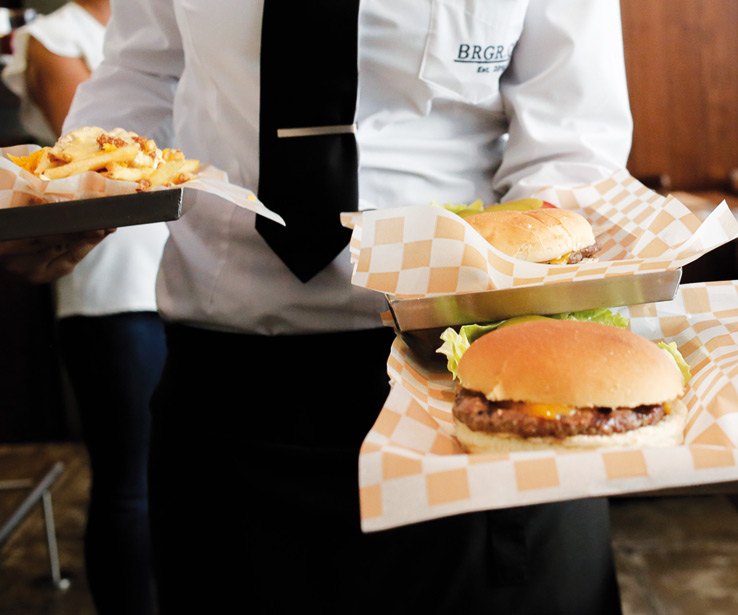
“We are not just a counter hamburger restaurant. We are a gourmet hamburger restaurant. That’s our niche.” With these words, Nadim Hammoud, chief executive of Par Contre, the founding company of Brgr. Co, summarizes the philosophy behind a burger joint that has been one of the country’s most successful since its 2010 launch in Ashrafieh.

Three years on, Brgr. Co now has two venues in Lebanon — the first in Ashrafieh was an investment of $500,000 and the second in downtown cost Par Contre $750,000 — one in London and a catering line that is busy all summer long. Revenues have tripled, says Hammoud, and are now close to $2 million. Par Contre has no plans to slow down and is expanding Brgr. Co locally and internationally, as well as branching into different culinary concepts, such as the soon to be launched Pzza Co, a $700,000 Italian restaurant concept that will turn its oven on in the Beirut Souks in October. Par Contre will also be launching their new 400 square meter (sqm) central kitchen in the area over their downtown venue, into which they invested $600,000.

Burgers are not new to Lebanon and many have childhood memories of the country’s first national burger joints which opened in the 1970s and 1980s, including Winners or Juicy Burger. In the 1990s came the advent of fast food, with Burger King and McDonalds setting up shop in Lebanon.

Such burger joints, and the success they met, established the foundations for future burger ventures in Lebanon. Starting in 2010, more than five ‘burger only’ diners opened up within a two year framework. Riding that burger wave was Brgr. Co. According to Hammoud, people are becoming more conscious of what they eat and are demanding traceability — to be able to track their meals back to a clean and safe source — and better quality food, something he says Brgr. Co is able to provide in a meal not commonly associated with refined dining.

The company’s Dowtown Beirut branch is proving a success


Brgr. Co’s emphasis on quality is also illustrated by their collaborators: Hussein Hadid, a well-known Lebanese private chef with 20 years of culinary experience in New York and 15 in Lebanon developing his own catering line and kitchen, is one of the partners in Par Contre and the creator of Brgr. Co’s signature burgers. “Hussein’s name is a seal of quality for our venues,” says Hammoud.

Other key figures that Brgr. Co has worked with include the architect behind their warm and classic décor, Gregory Gatserelia, an interior designer who has worked on Nikki Beach resorts around the world, as well as Cocteau and Balthus restaurants in Lebanon, and Maya Karanouh’s branding agency TAGbrands. “This is Brgr Co: all of the elements we use are quality and we are putting them all to work on the hamburger business. Probably, we’re the first globally to put this much emphasis and effort on a hamburger business and given it this much quality, elevating it like this.”

Quality does not come cheap, however. According to Hammoud the average bill at Brgr. Co is $20, which he says is “very affordable.” The bill can easily grow however, beyond the basic options, and online user reviews place the average cost for a burger and fries at no less than $30, which they generally agree is a little overpriced, despite it being a good burger.

The company imports its meat from Australia


When it comes to quality, Hammoud explains that Brgr. Co’s patty options are three different cuts of Australian Black Angus beef, generally accepted as the best beef on the market. They are offered in 8 ounce, 6 ounce, and 4 ounce sizes, the latter, which costs LL11,500 ($7.70), being the most in line with prices elsewhere on the burger market in Lebanon. “People will give you the same price [for the 4 oz burger] but not with Black Angus beef which we have. So, if you look at value you are getting, you are getting better quality at the same price,” rationalizes Hammoud.

If one goes for the 8 oz or 6 oz cuts, or tries one of Hadid’s signature burgers and adds appetizers, and extras such as fries or coleslaw, the cost begins to rise steeply, but

Hammoud maintains that their prices are reasonable for what they offer. “On some burgers we have very low margins as we are trying to respect the title of being a hamburger place, but at the end of the day when you come here and taste our burgers, you feel the quality and this costs money,” says Hammoud, explaining that while lower margins may not be financially sound, they hope to hook customers and thereby increase their visits.

With an average turnover of 400 to 500 customers per day on a weekend and 250 covers on a regular day in their Beirut Souks venue, Brgr. Co seems to be doing well despite the price tag.

Selling ice to the eskimos

Brgr. Co will be launching three new venues in Lebanon within the next three years, with one of them set to open in ABC Verdun upon its launch in the year 2015, according to Hammoud. Internationally, Brgr. Co London’s Soho branch — which opened as a franchise in December 2012 and seats 55 — is performing solidly, with around 300 to 400 covers per day. “Our London venue is as big as Ashrafieh’s but performing as well as Solidere’s, as the volume of people in London is different from Beirut,” says Hammoud, adding that the response for Brgr. Co London has been positive and that sales are growing. He is looking forward to their Chelsea branch which will be opening soon and will seat 100. Hammoud attributes their success in London to the high quality provided in everything from the décor, to the waiting staff’s crisp white uniforms, to the meat which comes from the Buckler Estate in Scotland. Brgr. Co London follows the typical franchise model of territory fees and a percentage of net revenues and is in strict coordination with Par Contre, which provides all recipes and implementation training according to set manuals.

Brgr. Co also has plans to open in Manhattan, New York, “the land of hamburgers” says Hammoud. While he realizes that New York is going to be a big challenge for them, Hammoud believes that, judging by the performance in London, chef Hadid has the ability to take Brgr. Co there. Hammoud explains that the New York expansion will be a franchise fully funded and owned by one of Par Contre’s board members in Beirut who will be funding all of the company’s growth in the United States.

This westward expansion is unusual for a Lebanese restaurateur and Hammoud sees it as adding value to their brand through perceived success in cosmopolitan cities that already have a thriving and competitive market for gourmet burgers. However, their next move might see Brgr. Co coming back to the Middle East. One of Par Contre’s partners is seriously contemplating an expansion in Dubai, a more natural “next step” for restaurants expanding from Lebanon.

“Par Contre is funded and overseen by a board of directors or partners who have the means and the power to see the company grow and go global,” Hammoud says. The board is made up of Hammoud, Hadid and three silent partners. Par Contre follows a ‘sweat equity’ model in which each of the partners owns 20 percent of the company but only the three silent partners invest capital in it — Hammoud and Hadid’s contribution is their hard work and ‘sweat’. Par Contre invested $3.5 million total, with $1.5 million coming from a subsidized loan from the central bank.

Par Contre, and its main business Brgr. Co, are still laying the foundations for success and heavily investing in their growth, explains Hammoud when asked about the return on investment which he says will be slow and not before the next five years. “It takes time to build quality and that is why the board is being patient. They are not looking for the quick buck,” says Hammoud. 


Correction: A previous version of this article erroneously referred to sweat equity as “Swot equity”. The text has been changed to properly identify Par Contre’s business ownership model and more clearly explain the concept of sweat equity.

September 11, 2013 0 comments
0 FacebookTwitterPinterestEmail
  • 1
  • …
  • 235
  • 236
  • 237
  • 238
  • 239
  • …
  • 695

Latest Cover

About us

Since its first edition emerged on the newsstands in 1999, Executive Magazine has been dedicated to providing its readers with the most up-to-date local and regional business news. Executive is a monthly business magazine that offers readers in-depth analyses on the Lebanese world of commerce, covering all the major sectors – from banking, finance, and insurance to technology, tourism, hospitality, media, and retail.

  • Donate
  • Our Purpose
  • Contact Us

Sign up for our newsletter

    • Facebook
    • Twitter
    • Instagram
    • Linkedin
    • Youtube
    Executive Magazine
    • ISSUES
      • Current Issue
      • Past issues
    • BUSINESS
    • ECONOMICS & POLICY
    • OPINION
    • SPECIAL REPORTS
    • EXECUTIVE TALKS
    • MOVEMENTS
      • Change the image
      • Cannes lions
      • Transparency & accountability
      • ECONOMIC ROADMAP
      • Say No to Corruption
      • The Lebanon media development initiative
      • LPSN Policy Asks
      • Advocating the preservation of deposits
    • JOIN US
      • Join our movement
      • Attend our events
      • Receive updates
      • Connect with us
    • DONATE