• Donate
  • Our Purpose
  • Contact Us
Executive Magazine
  • ISSUES
    • Current Issue
    • Past issues
  • BUSINESS
  • ECONOMICS & POLICY
  • OPINION
  • SPECIAL REPORTS
  • EXECUTIVE TALKS
  • MOVEMENTS
    • Change the image
    • Cannes lions
    • Transparency & accountability
    • ECONOMIC ROADMAP
    • Say No to Corruption
    • The Lebanon media development initiative
    • LPSN Policy Asks
    • Advocating the preservation of deposits
  • JOIN US
    • Join our movement
    • Attend our events
    • Receive updates
    • Connect with us
  • DONATE
The Buzz

Business briefing: 11 Sept 2013

by Executive Staff September 11, 2013
written by Executive Staff

Economics and Policy

Agricultural exports increased 5.4 percent in the first half of the year compared to the same period of last year, but remain lower than levels reached before the Syrian war, a report from the Lebanese Farmers' Association has said.


More from Reuters
 

Middle East shares jumped Tuesday, with Dubai soaring 8.5 percent, on hopes that a U.S.-led military strike on Syria might be averted.

More from Reuters


Proposals by football regulator body FIFA to move the 2022 World Cup tournament to a winter date is likely to land Qatar with a large compensation bill from sponsors and football clubs.

More from Arabian Business

 
Companies and Business

Employees in the UAE are in line for an average salary increase of five per cent in 2014, the second successive year the average pay rise in the emirates has dropped by 0.1 per cent.

More from Gulf Business


First Gulf Bank, the United Arab Emirates' third largest bank, is cutting about 300 jobs, equivalent to nearly 10 percent of its workforce.

More from Reuters


Labourers taking short-cuts are to blame for the majority of injuries on construction sites, a top executive at Arabtec, one of the largest builders in the Gulf, has said.

More from Arabian Business


September 11, 2013 0 comments
0 FacebookTwitterPinterestEmail
Comment

Statistically unsound

by Joe Dyke September 10, 2013
written by Joe Dyke

Friends of mine recently visited Lebanon for the second time, roughly a year since their first trip. Over the course of their weeklong stay they commented on how much more expensive things had become, especially in Beirut. “Everything costs about 10 to 15 percent more,” one said after a particularly overpriced dinner in one of the city’s less enjoyable restaurants. 

In economic terms this type of mental accounting is, of course, gibberish. We had not been to the same tourist sites or eaten at the same restaurants and more importantly they had not recorded how much they spent a year previously. Using personal perception as evidence that prices are going up is perhaps the worst kind of do-it-yourself economics. Unfortunately, in Lebanon the lack of reliable statistics leaves few realistic alternatives.

This has become particularly apparent after the Central Administration of Statistics (CAS) announced late last month what sounded like a huge drop in the annual inflation rate. Based on the consumer price index (CPI), year-on-year inflation fell from 8.8 percent in June to 2 percent in July.

Contrary to common perception of ever-rising prices, could inflation have fallen by more than three quarters? Obviously not.  This huge reported drop was not due to a sudden, huge decline in rates of demand or any lowering of consumer prices but because of poor statistical methodology.

Related article: How bad data inflated Lebanon’s inflation statistics

Without going into technicalities, until June 2012 changes in the cost of housing had not been included in the official inflation statistics for three years. All of that increase over three years was then added at once — with the housing index component of CPI skyrocketing. As such, inflation soared — jumping from a little over 2 percent to over 8 percent. Therefore, as inflation is reported year-on-year, for the past year the country’s official inflation figure has been artificially high. Now it has fallen back to 2 percent but housing has again not been adjusted — so we can still have little confidence in the numbers. Estimating Lebanon’s actual inflation rate remains guesswork.

The fact that an economic indicator as key as inflation could be so badly calculated is a particularly egregious example of a much wider problem — Lebanon’s statistical base is desperately poor. Look at basically any of the key economic indices — from gross domestic product, to unemployment, to industrial production — and the data is potentially unreliable, at least in some parts. This makes measuring the impact of economic and political change on Lebanon’s society a near impossible task.

Take the Syrian crisis: the government has produced virtually no concrete data as to the impact of the vast Syrian refugee influx on Lebanon. As a result, the gap has been filled by various organizations, often with widely disparate results. In June, for example, the United Nations Economic and Social Commission for Western Asia (ESCWA) estimated that the amount that had entered Lebanon’s banking system from Syrian nationals fleeing the crisis at around $11 billion. Makram Sader, head of the General Association of Banks, reacted angrily, putting the figure at closer to $1 billion. The $11 billion would be equal to around 25 percent of Lebanon’s GDP, while $1 billion represents about 2 percent. The difference between these estimates is so vast that it seems prohibitive to use either figure with confidence.

This impact on the country’s governance is clear. Without numbers, good policymaking is all but impossible. Designing the best fiscal and monetary strategy to get Lebanon growing again in the coming years will be a difficult task but trying to do that with no reliable evidence on any topic is pointless.

Ambiguity creates friction as well. The fact that everything is unreliable enables all sides to make the case that they are getting a hard deal. Without established and widely agreed upon data provided by a genuinely independent body, politicians can claim that their particular constituency is economically underrepresented or that the state favors one party over the other.

CAS could still be that body. In the absence of holistic change CAS may represent the best hope for improving the country’s statistics. The body is flawed, as evidenced by the inflation debacle, but it is also crippled by limited funding and political interference. These are not insurmountable problems —  the funding needed is relatively small, even for a deeply indebted country, and the positive impact could be significant.

In these increasingly fractious times for Lebanon, it may seem strange to be talking about statistics. But if and when the situation does calm down, one way to help unify the country is economic growth. To do that, we need data.

Joe Dyke is Executive’s online editor

Note: This article originally attributed the $11 billion figure to the World Bank, not ESCWA.

September 10, 2013 0 comments
0 FacebookTwitterPinterestEmail
The Buzz

Business briefing: 10 Sept 2013

by Executive Staff September 10, 2013
written by Executive Staff

Economics and Policy

Most Gulf bourses resumed declines Monday as the U.S. Congress prepared to debate on whether or not to approve a military strike on Syria.

More from Reuters


British energy giant BP has said it had discovered a "significant" amount of gas in the East Nile Delta after drilling the deepest ever well in the region.

More from AFP


Egyptian troops and tanks backed by helicopter gunships swept through villages in the northern Sinai Peninsula, in a continuing attack on alleged militants.

More from Associated Press

 
Elsewhere in Egypt, Qatar has agreed to convert a $2 billion deposit with Egypt’s central bank into bonds within a week.
 
More from Reuters
 
 
Companies and Business
 
House prices around the world rose 2.4 percent in the second quarter of 2013, with Dubai storming ahead and leading the pack with a 5 percent quarterly increase a surge of 21.7 percent year-on-year in the last twelve months.
 
More from Arabian Business
 
 
Lebanon’s telecoms revenues – a key income for the cash-strapped government – have seen a moderate decline this year amid a slowing economy and customers shifting away from text and calls to free messaging and Voice over Internet Protocol applications.

More from The Daily Star


The European Union has granted Lebanon the right to export 50,000 tons of potatoes, reversing a decadelong export prohibition, the Agriculture Ministry has said.

More from The Daily Star


September 10, 2013 0 comments
0 FacebookTwitterPinterestEmail
The Buzz

Business briefing: 9 Sept 2013

by Executive Staff September 9, 2013
written by Executive Staff

Economics and Policy

In a setback for Western efforts to tighten sanctions against Iran, a top EU court has thrown out penalties imposed on several Iranian businesses for their alleged ties to the country’s disputed nuclear program.

More from Associated Press


The World Bank is looking into establishing a Multi Donor Trust Fund to support Lebanon after its government requested a swift assessment of the social and economic impact of the Syrian conflict on the country.

More from The Daily Star

Children born to a Saudi mother and foreign father will be able to more easily claim Saudi citizenship under a proposed change to the citizenship law.

More from Arabian Business


Companies and Business

The online retail industry in the UAE is expected to be worth US$1 billion by 2020 as more shoppers swap the mall for the web.

More from The National


Egyptian telecoms tycoon Naguib Sawiris said he was still interested in taking a stake in Telecom Italia but might be discouraged if the Italian government was opposed.

More from Reuters


September 9, 2013 0 comments
0 FacebookTwitterPinterestEmail
Real Estate

The foundations of success

by Thomas Schellen September 9, 2013
written by Thomas Schellen

Chahe Yerevanian, the chairman and chief executive of real estate company Sayfco Holding, is clearly comfortable in his capitalist boots. He has no reason not to be, since he owns 50 percent of a company that by his own estimate is worth about $350 million and has accrued $40 million in net profits over the past three years. That profit is equal to or higher than what the entire company was worth when he and his brothers transformed Ara Yerevanian & Sons, the family business established by their late father, into Sayfco not even 10 years ago.


Related article: Q&A with Chahe Yerevanian


In the manner of a modern, corporate governance-oriented businessman, Yerevanian has no qualms disclosing his corporate pay to Executive — $40,000 per month versus an average employee pay of $3,000 — and explaining in generous strokes with the valuation brush that the company’s $350 million comprises assets — lands, the head office building, and cash and equivalent — of about $200 million together with $100 million plus in secured revenue streams from development fees. 

The key to Sayfco’s rapid growth over the past three years has been its fee structure. Until 2010, Sayfco had success as a developer with the foresight to pursue projects that anticipated the shift in demand to affordable, small to medium-sized apartments on the outskirts of Beirut. The company was a conventional developer during these “old days”, Yerevanian says, buying land, designing a project, financing it with a mixture of own equity and debt, marketing and delivering the units and pocketing the profit. 

From 2010, however, things took a radical turn. Yerevanian had picked up on the fact that he could sell his corporate expertise to landowners as a fee-based services package under a far more scalable business model whereby Sayfco provides development and marketing services while landowners retain the project ownership and the risk. “This has helped us grow exponentially,” Yerevanian says. “With our own money, we wouldn’t have been able to grow this fast. Secondly, it has limited our risks because we are purely service providers. It has helped to create what Sayfco is today.” 

The foundations for the new model were provided by the reputation the company had built in the Lebanese market and by its strong promotional and sales track record, which was fueled by apt use of Facebook and online advertising.  

The company applied the services formula in the execution of 11 of its 14 projects from the start of 2010 through the summer of 2013, a period during which Sayfco sold 3,109 units in total. Of these, 500 or fewer were units which the company developed conventionally as project owner. Yerevanian tells Executive that he expects to boost his portfolio cycle from these 14 projects to 50 projects in the next couple of years. The vast majority of these upcoming developments will also not be owned by Sayfco. 

Factory model

As Yerevanian admits, the Sayfco of 2013 has become “a pure service provider” but he also likes to describe the business model as that of a “real estate factory” because of its streamlined processes. 

Crystal Towers offers residential apartments and offices in Antelias


The way in which their “factory” generates profits is akin to revenue structuring by a funds management company. When signing Sayfco as their project developer, the landowner agrees to pay 8 percent of sales value over the project cycle. This comprises a basic development fee of 5 percent, calculated from the total projected sales value of the project, plus another 3 percent fee on sales. 

This 5 percent basic fee is split into two equal tranches of which only the first is paid in cash by the landowner. The second half of the fee is collected by Sayfco from the down payments put up by buyers who sign for units in the first wave of marketing.

Fees keep flowing into Sayfco’s coffers during the three to four year cycle of project execution and also after completion. The company takes 3 percent from the installments paid by buyers when each installment is made and it earns a success bonus after the final delivery of the project. 

This success fee is a hefty 30 percent on all amounts in sales revenue that exceed the project’s sales target which the landowner and Sayfco agree upon when signing their initial contract. “If total sales at $2,500 per square meter were $100 million and we were able to bring in $120 million, 30 percent of those added $20 million is ours,” Yerevanian explains.

Sayfco’s services entail project research and market studies, a concept and basic design for the development, detailed architectural designs and permit files, securing of all permits and official requirements, advertising, online marketing and sales management, and collection of payments and handling of relations with buyers until final delivery of their units. 

Not included in the basic package is the construction management. Sayfco offers this option for a 12 percent fee on construction value. 

Strong, but not invulnerable

Besides requiring little in capital outlay, the beauty of the model’s scalability affords Sayfco advantages such as extensive use of its marketing and project planning skills and efficiency gains from the pricing power that the developer holds vis-à-vis its own suppliers such as architectural firms for whom Sayfco is an attractive client. 

While the company does not have the same operating profit margins as a conventional developer, the larger numbers more than make up for this. Theoretically, taking a project with $100 million sales value and construction cost of $40 million, a full execution package with fees of 8 percent (of sales value) for development and marketing and 12 percent (of construction cost) for construction management will generate $12.8 million. Success bonuses for revenue coming in above agreed targets can boost the total to an even more capitalist-heartwarming $19 million if the project sales clock up 20 percent over target. 

As a percentage of total revenue in a highly successful development, this means Sayfco accrues an operating income that can reach up to between 14 and 16 percent of total sales. According to Yerevanian, the price tag of Sayfco’s services amounts to about half of the 8 percent basic fee. This means not only that profit runs at about 4 percent of total sales value but also that Sayfco reaches the breakeven point for its participation rather early in the project cycle, as the first tranche of the 5 percent basic fee is to be paid by the landowner at contract signature and the second tranche comes in shortly after marketing launch, which is well before the start of construction.

The model appears, however, to be just as vulnerable as any property development scheme to the common cyclicality in the real estate business; periods of slow demand can conceivably translate into pressure on margins when Sayfco’s high outlays during the early project phases cannot be covered fully from down payments. Profit also could take a hit when adverse market trends keep the final sales revenue close to the initial price targets. This would impair or cut off the flow of success fees, which by all indications supply a very significant boost to net results. 

Smart marketing

So far, Yerevanian has navigated the recently sluggish streams of real estate demand in Lebanon very well. “In the past few months we have been selling 500 units a month. That is amazing,” he says. An example for the sales splurge was the 450-unit Les Roches project of chalets in Kfardebian, of which Yerevanian recorded 320 buyer reservations within less than a month. The marketing for the leisure units consisted of online promotions — a smart pre-launch campaign on Facebook where Sayfco is a global leader in the real estate sector by number of followers — combined with price psychology, enticing buyers with a low first down payment of $10,000 to reserve their unit.  

“The down payment is extremely important. We have proven this with our many projects,” Yerevanian says, explaining that people are much more likely to sign up for a down payment of $50,000 that is staggered into five installments. “I am still getting my $50,000 but in a six-month period, whereas not many people will come in the other scenario when I say I want $50,000 as down payment.”  

Possibly due to the heavy emphasis on promotions via social networking, Sayfco reached many local and expatriate Lebanese buyers in the age group of 25 to 39. Despite the low entry point to sign up for a unit and the less-established profiles of younger buyer groups, Yerevanian claims that legal defaults on purchase contracts were nil because the strong demand for the units so far always enabled the company to find another person to step into the contract if an original buyer had to pull out.    

On to Beirut

A focus on low initial payments and unit prices that are attractive when compared with unit prices of larger apartments in the same area is also how Yerevanian plans to tackle the luxury market in Beirut — his next major move into new projects, which he says will be announced very soon.  

Another important agenda point is the plan to transform the company again, possibly by partnering with a large Lebanese bank, whereby it could be shaped into a fund-like venture that buys land and develops it on behalf of financial investors such as high net-worth clients of the participating bank. “There are so many potentials that are not just talk, but have potentials for real people and banks to come in. That is why you will very soon see Sayfco managing 50 projects per cycle,” Yerevanian promises.  

This will release the company from the constraint that the current base of client landowners numbers just about seven, who all approached Sayfco on their own, without the company having an acquisition strategy for this client group. On the other hand, upscaling the venture from 14 to 50 and diversifying, as Yerevanian intends, the activity into projects in every part of Lebanon, will be another challenge entirely.  

September 9, 2013 0 comments
0 FacebookTwitterPinterestEmail
Real Estate

‘Without infrastructure, real estate is nothing’

by Thomas Schellen September 9, 2013
written by Thomas Schellen

Sayfco CEO Chahe Yerevanian runs among the country's most successful real estate firms. Executive sat with him to discuss the company's long-term strategy, Syrian refugees and the government's role in the Lebanese real estate sector.


You have told us that your company has achieved development of 14 projects in a three-year cycle that started in 2010. What is your growth expectation in the next three years?

I think the slope is going to be extremely steep and I forecast that we will have 50 projects in a cycle in the next three years, because we already have many in the pipeline and many close to the pipeline. So I can foresee 50 projects increasing from 14.


Your projects have been concentrated in the Metn region. What is your strategy of geographic expansion?

The next step is to go to Beirut; our strategy is to come up very soon with signature projects of [small] luxury units in areas such as Ashrafieh, Bliss Street and Verdun. I can even tell you that top local banks have approached us with ideas to be their real estate development arm.  


Related article: Sayfco's foundations for success


Overall, projects are getting bigger and bigger in Lebanon. What kind of a role do you and your peers in the development sector play toward improvement of urban environments, infrastructure and planning?

Not enough. We haven’t done anything and much more can be done. I have plans to create a consortium of big developers to lobby for these issues. If not, perhaps I should become a minister and do it myself.


So what is the biggest need for the government to address in relation to the property sector? 

The government should do its utmost in the next five years to re-plan at least the main infrastructure arteries to get the blood of the economy flowing. I hope they will wake up and especially in my industry, real estate, I can say that the only important thing for the government to do is infrastructure. 


Doesn’t there have to be urban planning too?

Definitely but infrastructure is the priority; if you give me infrastructure, then you can give me urban planning and so on. If there is no infrastructure, there is nothing. Start with infrastructure.


In interviewing developers and intermediaries I heard of no joint initiatives or even ideas from private sector developers on how to help the state in housing predicaments such as the Syrian refugee crisis. Why is that and what role should the private sector play in addressing national problems on housing?

The Lebanese mentality is patriotic only in words. For my part at least I am proud to be Lebanese and I believe I am patriotic. I had the chance to go to other countries and work as a developer but I chose to continue investing here in these difficult times of war and explosions. We created this brand from a family company that ten years ago was not even selling 50 units a year to a company that sells 500 units a month. That is what I call a success made in Lebanon. 


What does your company promise to landowners as average internal rate of return (IRR)?

The median rate of return of the 14 projects so far is 52 percent annualized IRR. That was achieved as average of the 14 projects between 2010 and now. 


Is that the return that the landowner achieves on his investment? 

No, that is on the project. As the landowner measures the investment into the project, he will say that it brought 52 percent IRR but not as return on [cash] investment. His return on investment is on average four to five times cash — if he invested $10 million, he is making $50 million. 


This of course raises the question if this kind of investment gain is moral.

Is there such thing as a moral corporate gain? It is a big debate. 


When states tax corporate gains, the intention is to make society more equitable and that at least makes the system sound more moral.

And that is why it was important that the Council of Ministers [Lebanon’s Cabinet] proposed to tax the banking sector and the real estate sector within the basket of tax increases sent to Parliament. I am among those people who are not at all against this but what I say is that much has to be done first. Clean up the corruption, stop paying retired general managers and stop paying employees that do not exist, and privatize the electricity. There is so much to do to run the country in a proper manner. Tax me but before you tax me, first clean up [the administration]. 


And you are ready to help with cleaning all that up?

I am definitely ready.

September 9, 2013 1 comment
0 FacebookTwitterPinterestEmail
The Buzz

Business briefing: 6 Sept 2013

by Executive Staff September 6, 2013
written by Executive Staff

Economics and Policy

The European Commission is extending 22 million euros ($29 million) of additional funding to Lebanon.

More from The Daily Star


Gulf Arab shares dropped Thursday, sustaining losses for a second week in a row, as a possible U.S. military strike against Syria moved closer.

More from Reuters


Qatar’s central bank plans to issue QAR3 billion ($824 million) worth of local currency government bonds next week.

More from Reuters


Companies and Business

The Lebanese government will seek more than $5.5 million in compensation from the Turkish operator of two power barges contracted by Lebanon.

More from The Daily Star


The UAE plans to invest $25 billion in its railway infrastructure, accounting for 10 per cent of the entire MENA region’s investment in the sector.

More from Gulf Business


Dubai developer Emaar has announced that it is entering the world of Formula One through a two-year sponsorship deal with the Lotus F1 motor-racing team.

More from Arabian Business


September 6, 2013 0 comments
0 FacebookTwitterPinterestEmail
Comment

The rational irrationality of Middle East peace talks

by Ahmed Moor September 5, 2013
written by Ahmed Moor

It may be easy to overlook, but the Palestinians and Israelis are allegedly negotiating over the future of Palestine once again. To be more precise, the Palestinian regime in the West Bank is reported to be meeting with the Israeli leadership over the future of the West Bank, which represents only one fifth of Palestinians.

The so-called negotiations have been conducted in a highly secretive manner, and only after much-publicized wrangling to bring both sides to the table. United States Secretary of State John Kerry inexplicably put an enormous amount of weight into the resumption of talks, and still the parties yielded only to talks about the possibility of talks. Even then the Israelis announced plans to deepen the apartheid in East Jerusalem and the West Bank by building several thousand housing units in new and existing settlements, all of which are illegal under international law.

Kerry, for his part, took the news stoically. He encouraged the Palestinians to avoid reacting and for the most part they proved accommodating. Mahmoud Abbas embraced the role the Americans asked him to play and met with Israeli parliamentarians on August 22, when he allegedly expressed unhappiness “at the slow pace of negotiations”.

That the Palestinians and Israelis will achieve an agreement on two states is a losing proposition — and it has been all along. The Madrid Conference established the basis for the accommodation in 1991 when it was proposed that land occupied by the Israelis could be ceded to the Palestinians in return for a complete end to the conflict. In reality, the parties to the conference, which was co-sponsored by the United States and the Soviet Union, failed to understand the objectives of the leadership in Israel: the maximum amount of land with the fewest number of Palestinians on it. Indeed the Oslo years, which began in 1993, witnessed the most rapid expansion of settlements since 1948. Palestinians were aggressively cantonized — that is, ethnically cleansed from the rural to the urban centers of the West Bank — even as Jerusalem was Judaized.

Today, Palestine is a series of noncontiguous cantons, separated by Israeli-only roads and apartheid Jewish-only colonies in the West Bank. More than one in six people living in the Occupied Territories is a Jewish Israeli, while one in every four living in Israel is not Jewish. In other words, the unscrambling and partition required by a two-state outcome is far from imaginable. So why do the parties negotiate? And why has Mahmoud Abbas, the illegitimate governor of the cities of the West Bank — his elected term in office ended in 2009 —  agreed to preside over a demilitarized entity policed by US soldiers? For the Palestinians part of the answer is that the ‘process’ is the only persistent validation of Abbas’s rule. The absence of a deal of any kind would have meant that the leadership of the PA policed and repressed Palestinians in the West Bank for very little, if nothing at all. But it’s also the case that the Palestinians who negotiate do so in an inertial, unenthusiastic manner — Abbas’s meetings with members of the Knesset notwithstanding — for the maintenance of the PA regime.

Related articles: Vizualizing Palestine, seeing the future

Jordan's economy could benefit from Palestinian confederation

For 20 years the Oslo process has created a vast patronage network that relies on donor money. The absence of a political process may undermine international donor largesse and that outcome may have disastrous consequences for the personal incomes of many members of the ruling elite and many thousands of civil servants.

In other words, the negotiations process is about legitimizing the existence of the PA and about the continuation of European donor aid. That the Palestinians do not believe in the talks is indicated by Abbas’s latest utterly unrealistic claim to members of the Knesset that a deal could include American police in the West Bank. He is merely playing for support and time.

Israelis rely on the surface-level observance of negotiations in order to relieve international pressure as they continue to annex the West Bank and East Jerusalem. Negotiations do not obscure the settlement process, but they do provide an argument for changing the subject — that ‘peace’ is being pursued. So long as that’s the case, Europeans feel relieved from their considerable responsibilities to begin sanctioning apartheid, a costly endeavor in any case.

For those reasons one arrives at a bizarre juncture where the rational behavior for both parties is to negotiate over a partition that everyone knows will never materialize. And there’s no reason to think that the basis for their rationality will change.


Ahmed Moor is a Palestinian-American writer and co-founder and CEO of Liwwa.com, which provides support to Middle Eastern small businesses

September 5, 2013 0 comments
0 FacebookTwitterPinterestEmail
The Buzz

Business briefing: 5 Sept 2013

by Executive Staff September 5, 2013
written by Executive Staff

Economics and Policy

Lebanon's Energy and Water Minister Gebran Bassil has announced that the date to submit bids to explore for gas has been extended from Nov. 4 to Dec. 10 after the Cabinet missed a deadline to pass two important decrees to demarcate the gas blocks.

More from The Daily Star


Egypt is prepared to repay within days $2 billion that Qatar deposited with Egypt’s central bank in May if talks to convert the funds into bonds do not succeed.

More from Reuters


Companies and Business

Iraq has pre-qualified 12 companies and joint ventures to build an $18-billion export pipeline to Jordan, the Oil Ministy has said.

More from Reuters


Stock markets in the UAE and other Gulf countries continued to plunge on fears of an imminent attack on Syria.

More from Khaleej Times


Saudi Arabian retailer Fawaz Abdulaziz Alhokair plans to open nearly 250 stores at home and abroad this financial year, a top executive said, as the kingdom’s booming retail sector provides a platform to expand into new markets.

More from Reuters

September 5, 2013 0 comments
0 FacebookTwitterPinterestEmail
CommentCoronavirus Closeup

Battening down the hatches

by Nicholas Blanford September 4, 2013
written by Nicholas Blanford

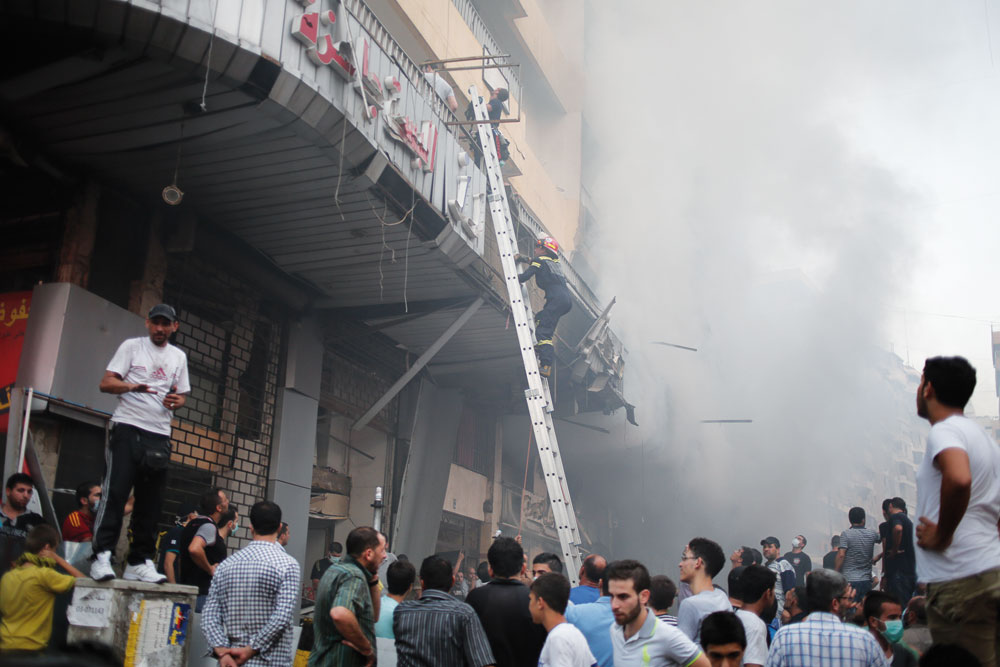
After the car bomb attack last month in southern Beirut which left 30 people dead and hundreds injured, Hezbollah now finds itself in a position similar to its enemies in Israel and the West in the post-September 11, 2001 era — trying to maintain security without causing too much disruption to people’s lives.

Hezbollah men wearing rubber surgical gloves can be found manning checkpoints at the entrances to Dahiyeh — Beirut’s southern suburbs — searching all vehicles entering the area. Hoods are popped open, trunks are inspected and doors patted to see if they sound hollow or potentially packed with explosives. The process is thorough. Not only are the cars searched but in some cases the license plates are read and cross-checked against lists of suspect vehicles. At night, armed Hezbollah men man checkpoints and patrol the streets with bomb-sniffing dogs.

Smaller access points into Dahiyeh have been closed off which is likely to increase the traffic congestion at the larger entrances. The security restrictions are having an impact on business in the southern suburbs. Residents say that many families have travelled to their hometowns or villages in the south and the Bekaa Valley. Outsiders are avoiding the area and residents are choosing to limit their movements as much as possible. Despite the procedures, stopping another attack is all but impossible, a grim fact to which Hezbollah members admit. Indeed, once a suicide bomber or car bomb is en route to its target it is more a matter of luck if it can be intercepted before detonation. With security having tightened in Dahiyeh, Hezbollah’s enemies may choose more vulnerable locations such as Nabatiyeh, Tyre, Bint Jbeil or Baalbek. The most effective way Hezbollah can halt future attacks is through diligent intelligence work. Hezbollah has powerful intelligence capabilities and works closely with the army’s military intelligence bureau. Other security agencies, including the Information Branch of the Internal Security Forces — once considered suspect by Hezbollah — also appear to be working hard to roll up militant cells. The attacks against Hezbollah and Shia areas are seen as retaliation for the Shiite party’s military intervention in Syria on behalf of the regime of Syrian President Bashar al-Assad. Hezbollah has deployed thousands of its battle-hardened fighters as well as new recruits to serve 30-day tours in some of the most bitterly contested fronts in the Syrian war, including Damascus, Deraa province in the south, the central western city of Homs and Aleppo province in the north, according to sources close to the group.

Related article: The EU’s pointless Hezbollah blacklisting

It remains to be seen for how long the local residents will tolerate the security restrictions. For now, residents accept that the inconvenience is the price that must be paid to prevent further devastating attacks in the area, especially as the threat remains high and in light of looming events that draw crowds. 

In November, Shias will mark the holy month of Muharram, which includes daily gatherings culminating in the Ashura ceremony, a public commemoration of the death of Imam Hussein, the grandson of the Prophet Mohammed, who was killed in Karbala in Iraq in 680 AD. In 2004, Sunni jihadist suicide bombers killed at least 178 Shias gathered for Ashura ceremonies in Karbala and Baghdad.

Hezbollah justifies its military presence in Syria as necessary to prevent the Assad regime falling and being replaced with a radical takfiri successor which could destabilize Lebanon. The party’s support base generally subscribes to this rationale for the time being, especially in the wake of the Rweiss bombing, roadside bomb attacks in the Bekaa, cross-border rocket fire from Syria and frequent blood-curdling threats from extremist groups in Syria. However, it remains to be seen for how long that tolerance will prevail given that there is no end in sight to the Syrian conflict and the security situation in Lebanon will surely worsen in the weeks and months ahead. Some supporters may begin to question the wisdom of Hezbollah’s intervention in Syria and the backlash it is having on Lebanon. 

On the other hand, as the rift between Lebanon’s Shia and Sunni communities continues to widen, the support base may well seek refuge in the sectarian trench, thankful for Hezbollah as a powerful protector rather than blaming it as the cause of their woes.


Nicholas Blanford is the Beirut-based correspondent for The Christian Science Monitor and The Times of London

September 4, 2013 0 comments
0 FacebookTwitterPinterestEmail
  • 1
  • …
  • 236
  • 237
  • 238
  • 239
  • 240
  • …
  • 695

Latest Cover

About us

Since its first edition emerged on the newsstands in 1999, Executive Magazine has been dedicated to providing its readers with the most up-to-date local and regional business news. Executive is a monthly business magazine that offers readers in-depth analyses on the Lebanese world of commerce, covering all the major sectors – from banking, finance, and insurance to technology, tourism, hospitality, media, and retail.

  • Donate
  • Our Purpose
  • Contact Us

Sign up for our newsletter

    • Facebook
    • Twitter
    • Instagram
    • Linkedin
    • Youtube
    Executive Magazine
    • ISSUES
      • Current Issue
      • Past issues
    • BUSINESS
    • ECONOMICS & POLICY
    • OPINION
    • SPECIAL REPORTS
    • EXECUTIVE TALKS
    • MOVEMENTS
      • Change the image
      • Cannes lions
      • Transparency & accountability
      • ECONOMIC ROADMAP
      • Say No to Corruption
      • The Lebanon media development initiative
      • LPSN Policy Asks
      • Advocating the preservation of deposits
    • JOIN US
      • Join our movement
      • Attend our events
      • Receive updates
      • Connect with us
    • DONATE