• Donate
  • Our Purpose
  • Contact Us
Executive Magazine
  • ISSUES
    • Current Issue
    • Past issues
  • BUSINESS
  • ECONOMICS & POLICY
  • OPINION
  • SPECIAL REPORTS
  • EXECUTIVE TALKS
  • MOVEMENTS
    • Change the image
    • Cannes lions
    • Transparency & accountability
    • ECONOMIC ROADMAP
    • Say No to Corruption
    • The Lebanon media development initiative
    • LPSN Policy Asks
    • Advocating the preservation of deposits
  • JOIN US
    • Join our movement
    • Attend our events
    • Receive updates
    • Connect with us
  • DONATE
The Buzz

Business briefing: 26 June 2013

by Executive Staff June 26, 2013
written by Executive Staff

Economics and Policy

Power rationing in Lebanon is due to continue until at least Friday due to ongoing maintenance work, the state-run energy company has said.

More from The Daily Star


Central Bank governor Riad Salameh has said that Lebanon successfully raised LL700 billion ($466.6 million) from the sale of eight- and 10-year Treasury bills.

More from The Daily Star


Kuwait needs a Disney Land-type attraction to improve tourism, a leading businessman has said.

More from Arabian Business


The Lebanese stock exchange and markets remain immune to the effects of the U.S. decision to end its quantitative easing program in 2014, bankers and economists believe.

More from The Daily Star


Companies and Business
 
HSBC Holdings is considering selling its majority stake in Dar Es Salaam Investment Bank BDSI.ISX, which has made it the main international lender in Iraq.
 
More from Reuters


Arab Bank PLC, facing lawsuits over allegations that it aided Middle Eastern terrorists, said it asked the U.S. Supreme Court to stop a federal judge from imposing sanctions it claims may cause it to lose at a trial.

More from Bloomberg


Dubai Holding’s telecoms unit has hired Credit Suisse as a financial adviser to sell its 35 per cent stake in state-owned Tunisie Telecom, three banking sources aware of the matter said.

More from Reuters

June 26, 2013 0 comments
0 FacebookTwitterPinterestEmail
Comment

Don’t write John Kerry off yet

by Riad Al-Khouri June 26, 2013
written by Riad Al-Khouri

As continued troubles roil the Middle East, the need for action to stabilize the region economically becomes more urgent. Since 2011, in much of the Arab world a lack of stability has created a vicious circle of weaker economies and political unrest that is becoming tougher to handle through normal policy measures.

Of course, many problems in Arab economies are internal, due either to local political conflict or mismanagement. Yet, the regional situation has a major impact: despite home-grown elements of the Arab Spring in many states, the Palestinian-Israeli dispute remains a major obstacle to regional stability and prosperity. Real peace between Arabs and Israelis could help the countries around Israel to end costly and destabilizing confrontation, allowing the private sector and civil society to flourish. In the case of Lebanon and Syria, the advantages of a genuine, just peace with the Israelis would be dramatic, but Egypt and Jordan (those countries that already have treaties with Israel) could also benefit enormously from expanded relations with the Jewish state that are based on justice and sustainability.

Seeming to sense this potential, US Secretary of State John Kerry has kept a busy schedule of shuttle diplomacy, making four Middle East trips in less than five months on the job. “So much of what we aspire to achieve and what we need to do globally, what we need to do in the Maghreb and South Asia, South Central Asia, throughout the Gulf, all of this is tied to what can or doesn’t happen with respect to Israel-Palestine,” Secretary Kerry said during his Senate confirmation hearing in January.

On June 27-29, as part of his fifth visit to the region, he will meet with Jordanian, Israeli, and Palestinian officials on advancing Middle East peace. While there is much cynicism about his plans, perhaps a little optimism couldn’t go amiss.

A key component of his strategy has been to re-introduce the Arab Peace Initiative (API) as a starting point for a comprehensive regional solution to the conflict with Israel. Promulgated at the 2002 summit of the Arab League, the declaration called on Israel to complete withdrawal from the occupied Arab territories to the pre-1967 war line, attain a just solution to the problem of Palestinian refugees, and accept an independent and sovereign state of Palestine in the West Bank and Gaza Strip – with East Jerusalem as the capital.

In return, the Arab states committed to regarding the conflict with Israel as having ended and signing a peace agreement with the Jewish state to normalize relations. The API was unanimously re-affirmed at the 2007 Arab League summit at which all 22 members except Libya were present, with Ismail Haniyeh of Hamas abstaining. In 2009, then-Senator Kerry called the API the basis for Arab countries to play a more active peacemaking role and paint a clearer picture than ever of the rewards peace would bring. That indication of the stability and prosperity the region could enjoy through peace has become even more relevant in light of recent economic retrogression in the Arab world.

In early April of this year, the US informed the Palestinians that a new approach to peace negotiations would be on the basis of the API with the 1967 lines modified through mutual agreement. Later that same month, the Arab League agreed to support limited land swaps as part of a peace deal based on the two-state solution of the API.

Amid present turmoil in the Middle East, it is significant that Arab leaders remain publicly committed to the API, which is itself consistent with an overwhelming international consensus. On the Israeli side, Yaakov Peri, Israel's science and technology minister and former head of the Shin Bet security agency, last week endorsed the API, the strongest statement by an official of Israel in favor of the Arab initiative since its relaunch in April. Peri sits on a small committee of senior Cabinet members that is briefed on peace efforts, and his comments appeared timed to support Secretary Kerry's moves to mediate resumption of talks between the two sides.

Would the API solve all the problems of the region? Clearly not. But an easing of tension on the Palestinian-Israeli front would help the Middle East become more stable. Of course, there is little optimism that a breakthrough is coming in the coming weeks, but Kerry’s seemingly strong commitment to the plan – and relentless visits to the region – could help push both sides slightly closer to a deal.


Riad al Khouri, a Jordanian economist who lives in the region, is principal of DEA Inc, Washington DC

June 26, 2013 0 comments
0 FacebookTwitterPinterestEmail
Economics & Policy

Alfa and Touch: Who is innovating?

by Stephanie Naddaf June 26, 2013
written by Stephanie Naddaf

Taking a 50 percent hit in sales of a top product is never easy. But if you’re a government who uses those profits to service your debt, it can be disastrous. Such is the case with mobile text messaging in Lebanon, which has lost around half its volume over the past two years. When you consider that “the money [mobile operators] earn all goes to the government, it…goes into settling the debt of the government of Lebanon” – as mobile operator Touch’s Chief Commercial Officer Nadim Khater bluntly puts it – such a drop in revenues is bad for the entire country. No wonder Touch and Alfa, Lebanon’s only mobile telecoms operators (both of which are government-owned) are desperate for new products and fresh revenue streams.

The actual innovation is being done by Orascom and Zain, the private companies contracted to manage Alfa and Touch – officially Mobile Interim Companies 1 and 2 – respectively. Both of these companies have a list of objectives that should be met within their contracts with the government. The more objectives met, the greater the profits for both the government and the mobile operators. The flip side is that when revenues are down, both the government and privately contracted operators suffer – making innovation a high priority for all involved.

The curse of technology

For both Alfa and Touch the changes in consumer trends present both threats and opportunities. As the popularity of smartphones increases, subscriptions to mobile plans that include internet access have been booming. In September 2011, only 144,000 Touch customers had a data subscription; today that number is 881,000, up by a factor of six. This data boom is also due to the decrease in prices for internet services, causing more people to switch over to a data plan.

But among the downsides of internet for the phone companies (and upside for consumers) are apps such as Viber and Whatsapp that allow free or significantly cheaper SMS and voice services. The cumulative effect has been a sharp decline in revenues in recent years. According to Touch’s Khater, “SMS revenue has gone down 52 percent from last year and voice by 5 percent… What we see is the rise of data, the ‘data boom.’”

Related article: Mobile phone prices across the Arab world

The company has moved quickly into providing internet, with revenues from data services “growing by nearly 75 percent during the period of February to May 2012 and [February to May] 2013,” Khater said. But despite the scale of this boom, it doesn’t quite make up for lost SMS revenues, which he said are “almost being covered.” “It’s almost a balancing act between the losses in voice and SMS and what we are making in data,” he said, declining to give more specific financial figures.

Alfa Chairman and Chief Executive Officer Marwan Hayek said his company has seen a comparable drop in SMS use. But despite the losses, he said, “with our innovative…plans, we managed to secure [increased] revenues.” He declined to give any specific numbers backing his claim.

The challenge of 4G

As the number of data subscriptions grows, so does the demand for higher internet speeds and data consumption. Last month, both operators rolled out 4G-LTE in a bid to bring the latest-and-greatest mobile data technology to Lebanon.

“Almost half of our customer base is on a data plan, and this number is only growing…so we had to make sure that our data is up to standard and we are keeping up with the latest technologies, especially when it comes to dimensioning and capacity,” Khater explained. There are, however, huge engineering issues involved in data technology, he warns, thus explaining why many customers have reported slow speeds. “Some engineers say it takes 18 months to really optimize and dimension a data network right.”

And Khater admits the 4G-LTE network isn’t yet at full capacity, but currently “limited to dongles and routers and tablets. It’s not available on mobile phones yet because having it on a mobile phone requires more engineering work.”

Yet Hayek remains optimistic, explaining how deployment of 4G is ongoing “to further expand the network coverage to major cities gradually until the end of the year.” It is expected that by end of 2013, “300 4G-LTE sites will be installed covering around 40 percent of the population and representing 25 percent of the network infrastructure,” he said.

Capturing the student market

But faster speeds don’t necessarily mean more revenue. Thus both companies have been pursuing strategies to bridge the gap between lost SMS revenues and money from new data plans. With the mobile market already partly saturated, one of these strategies is to focus on the one steady source of new customers: youth.

Both mobile operators provide plans designed for younger people. Targeted directly towards students, Alfa’s U-Chat plan aims to tap into the market. “We have a message and data driven plan (U-Chat9) for low-budget students, and message and data driven for high-end students (U-Chat17),” Hayek said. The U-Chat17 line provides university students 1000 MB, 1000 SMS and five hours of talk monthly for only $17.

Touch provides a similar plan, Web & Talk, which allows up to 60 minutes to random numbers, one hour to a preferred number, 300 MBs, and 300 SMS monthly, all for $14. “We felt that the youth segment is really keen on having data,” stated Khater.

Both companies stress that these offers are proving successful. Khater states that “during the first week [after launching], 200,000 customers subscribed to the Web & Talk plan.” Alfa said their U-Chat plan also attracted a large amount of customers, but declined to share exact figures.

App-lying themselves

But perhaps the most interesting areas which both Alfa and Touch have pushed into may seem a strange field for mobile operators: app stores. Alfa launched its store in November, while Touch introduced its own earlier this month. However, both of these stores have been launched in beta, meaning there is still some testing to be done before they are fully functional. “We are not making a big fuss about it yet just to make sure everything is running just before we make a big announcement,” said Khater. This will also allow the app stores a chance to get more developers and more applications available on each of the stores. Currently there are just a handful of apps on the Alfa store – including Alfa’s very own mobile services app. On the Touch App Store, there is only the recently launched music app Anghami

But for Touch, the app store is just the beginning. On June 19, the company announced its collaboration with Anghami in order to allow for in-app purchases. This allows customers to purchase music directly and charge it to their phone bill. Khater explains how “developers and agencies wishing to use Touch as a payment channel for their apps will be subject to a revenue share agreement.” For example, if a consumer was to purchase a song through the Anghami application on the Touch App Store, then the money will be taken from the customer’s Touch account and the revenues split between the app developer and Touch. The exact percentage, however, will depend on the contract between Touch and the developer.

“We feel this is very fresh, it’s very innovative, it’s very new. It gives the developers and the start-ups a way to monetize whatever they have built on mobile apps,” explains Khater. Touch’s app store also provides what is called backend-as-a-service, provided by mobile and web developer Apstrata. This allows developers of applications to access cloud storage and simpler usage of tools such as identity management, push notifications and social media integration.

Touch’s in-app payments and backend-as-a-service innovations are far beyond anything Alfa currently offers. However, when asked about the direction Alfa is heading in terms of future innovative projects, Hayek simply responded “data.” The company has yet to reveal anything more specific.

Reinventing the phone company

Touch’s move into apps and Alfa’s yet-to-be-disclosed data products are in their early stages, but they speak volumes about the future of the sector in Lebanon. Assuming an increase in internet speeds, smartphones will eventually eliminate the need to make almost any traditional voice calls or messages – meaning revenue from these sources will drop further, leaving data plans as the only ‘traditional’ revenue source. The move into app stores and services other than simple data subscription shows that Touch – and Alfa to a lesser degree – aren’t banking on just being wireless internet companies in the future. It remains to be seen whether such self-reinvention will be successful, but one can be sure economists at the Ministry of Finance are watching closely.

June 26, 2013 0 comments
0 FacebookTwitterPinterestEmail
Editorial

The wild card in play

by Yasser Akkaoui June 25, 2013
written by Yasser Akkaoui

The darkness over Damascus was lit up like a light bulb early last month, the entire city illuminated in orange for five seconds in the middle of the night. All reports said these were the biggest explosions yet in the more than two-year conflict. And where did these missiles that struck the military base on the edge of the city come from? Israel.

It had slipped the minds of many that the region’s most powerful military was also watching; the beast, however, has only stirred.

While massive international interests are at play in Syria, the proximity of Israel, the strength of the Israeli army, and Israel’s sway over American and Western foreign policy means that there is perhaps no power so able to quickly and radically redefine the parameters of the Syrian conflict. When Russia said last month that it would send S-300 anti-aircraft missiles to Syria, the Israeli Army responded that it would destroy any such shipment. No one should doubt that they would follow through with this threat.

Let’s be clear: Israeli policy makers do not care about the lives of Syrians or the destruction of their country. They care about preserving “Israeli security”. For a long time, Syria’s Assad family was Israel’s perfect enemy. While the Syrian army posed little threat against the far-more-sophisticated Israeli war machine, the Assads oversaw a police state powerful enough to prevent local paramilitary groups from forming and launching attacks from the Golan Heights — from the point of self-interest, the Assads knew what the Israeli response would be.

Thus today, from an Israeli perspective, one has to wonder what sort of future Syria is preferred. One run by the radical and unpredictable Salafist factions now hijacking the Syrian opposition in the name of jihad, or one under the grip of a tyrannical regime bent on crushing internal dissent and ruthlessly looking out for its own self interest? With many cards in their hand yet to be played, the Israelis may yet flush out a neighbor they love to hate.

June 25, 2013 0 comments
0 FacebookTwitterPinterestEmail
Banking & Finance

Investment ideas

by Maya Sioufi June 25, 2013
written by Maya Sioufi

Up, up and away we go. Stocks continue their rally this month, but economic fundamentals are showing weakness across the board. France is sliding back into recession and China’s industrial output is disappointing. This month, Executive sits again with Elie Khoury, chairman of Berytus Capital, and Nour Eldeen al-Hammoury, chief market strategist at Amana Capital, for their take on the markets.

Elie Khoury

Last time we spoke to Khoury, in November 2012 he was conservatively bullish on equities in the United States and recommended investing in Pfizer (up 15 percent since his recommendation as Executive went print), Kraft (up 19 percent), Microsoft (up 35 percent), Intel (up 10 percent) and Qualcomm (up 14 percent). The overall gain in the Standard & Poor’s 500 index over the same period was 18 percent. 

> Still bullish? He remains bullish on equity markets overall, and especially US markets. With the inflation rate at 1 percent, below the Federal Reserve’s target of 2 percent, Khoury does not foresee the cessation of quantitative easing — when central banks inject money into the economy by buying up government securities — any time soon.

> Time to start investing in Europe? One can start selectively investing in Europe now, as it is cheap, according to Khoury. He would recommend the non-cyclical sectors such as the food industry and the pharmaceutical sector, as they are safer plays.

> Concerns in these markets? Khoury stresses that the market, spurred by cheap credit, has gone a bit ahead of itself and he remains concerned about the high US unemployment rate — currently at 7.6 percent — and European debt issues. However, he stresses that he is taking a more positive approach toward the markets today and would look to build position on                   any correction.

> Invest in gold?  He would advise a net position of 3 to 7 percent of one’s total investable portfolio in this asset class and he says he believes the secular bull market on gold is taking a major hit. “I think in the short term the best days [for gold] are behind us and not in front of us,” he says.

> Top recommendations? In the consumer sector, he still likes Kraft and also recommends investing in Kellogg’s and Coca-Cola. In the pharmaceutical sector, he highlights biopharmaceutical company Amgen and an animal health business Zoetis, a Pfizer subsidiary that listed in February of this year. For the technology sector, he prefers Apple and Samsung.

Nour Eldeen

al-Hammoury

When Executive sat with Hammoury in November 2012, he was concerned about market fundamentals. Still, he recommended investing in the S&P Index (up 18 percent since his recommendation), Apple (down over 20 percent) and Facebook (up 28 percent).

> Still concerned with the fundamentals? He is less convinced about a further upswing in the US markets, given that the current levels fail to reflect the performance of the economy. “Equities across the board don’t reflect economic fundamentals, and they should not be at these levels at all,” he says.

> Main concerns? The Federal Reserve’s ballooning balance sheet at $3.3 trillion is Hammoury’s biggest worry. He expects quantitative easing to continue at least until the middle or end of the third quarter as central banks worldwide eventually lose control of inflation rates, forcing them to stop easing and start raising rates fast. He is also concerned about the worsening sovereign debt situation in Europe. “[Politicians] spent more than three years trying to solve Greece [which carries over] 400 billion euros of debt, and they did not even solve it that much. So how much time will it take to solve Italy, with more than 2 trillion euros of debt?” he asks.

> Top investment tips? Hammoury’s top recommendation is to invest in commodities such as silver and gold, which he recommends buying through exchange-traded funds. He also likes Asian currencies and would continue to sell the Japanese yen against a basket of currencies such as the sterling, the dollar and the euro. As for equities, he would stay clear of this asset class for now, and his only equity tip would be to buy Apple and diversify it by buying some Samsung stock as well.

June 25, 2013 0 comments
0 FacebookTwitterPinterestEmail
Special Report

Lending Hope

by Sam Tarling June 25, 2013
written by Sam Tarling

To follow a microfinance loan officer around for a day is somewhat akin to taking a ride with Robin Hood, albeit one that operates well within the law. It seems the officer knows almost everyone, and everyone knows him. “I’m famous around here!” exclaims Ismael Jaouni, a loan officer for non-profit microfinance institution (MFI) Al Majmoua as he shows Executive around the working class streets in the Beirut suburb of Jnah.

Despite usually carrying higher interest rates than commercial bank loans, it’s no wonder that microfinance loans are popular. They don’t require collateral, they offer smaller sums than most bankers keep in their wallets and they are convenient, especially for clients in remote locations.

“It’s easy because when I have to repay, I don’t have to go to the bank. It’s like the bank paid me a visit,” said sculptor and artist Elias Khalife. After a lightning strike destroyed his business premises, he got a loan in just a few days and was soon back up and running. The loan officer he contacted at MFI Vitas was a friend of his wife’s.

While product promotion is almost exclusively based on word of mouth and personal relations between loan officers and the communities they serve, microloans seem to be making an impact on the grassroots of Lebanon’s economy.

More than $14 million in loans have been given out over the last four years alone through the USAID-funded Lebanese Investment in Microfinance (LIM) program, according to Joanna Naccouzi, communications and coordination manager at the International Executive Service Corps, which facilitates funding and development for MFIs. This, she claims, has saved over 11,000 jobs, especially in rural areas. It’s empowering less-enfranchised segments of society too, as some 42 percent of the program’s 8,000 loans were granted to women and 41 percent of them to clients between the ages of 18 and 35. And LIM’s efforts make up just a fraction of the nationwide cumulative portfolio of some $120 million to $150 million [see page 26].

Beekeeper

Estephan Badawy, a former Middle East Airlines pilot, started producing honey 13 years ago on the hillsides of the village of Lehfed in Lebanon.

Badawy took a $30,000 Kafalat loan to start his project and recently took a $5,000 USAID-financed microloan from Association d’Entraide Professionnelle (AEP) to buy and fill 40 more hives, bringing his total to 280.

Although he only sells to friends and family, Badawy is confident he’ll find a home for the extra 400 kilograms his hives should yield once they reach full capacity. “Pure honey is like when a man has a beautiful daughter at home; he’s not worried about when she’ll get married,” said Badawy.

His investment should increase his production from 1,600 kg to 2,000 kg per year.Badawy sells his product for around $23 per kilogram and expects to pay off the loan in two and a half years. He is paying annual interest of 10 percent.

Chef

When an industrial accident nearly blinded Jihad Saadeh, he was forced to close his successful car repair business. Saadeh had 12 employees on his payroll, and his children were enrolled at the American University of Beirut.

To provide for his family, Saadeh opened a small restaurant in Lehfed with his wife Raymonda. His four children help out in the summer, and every year he expands the premises.

Today, Saadeh’s labour of love can seat some 700 diners. He recently took a $5,000 USAID-financed microloan from AEP in order to buy a new generator to supply sufficient electricity to cater for a full house. Saadeh said with just a few large events he could repay the debt.

However, Saadeh is a reluctant microborrower: he was persuaded to take the loan by his children but remains wary of debt, an attitude one industry insider said was common among the older generation.

“I don’t like to have a debt,” he said. “If something happens to me today, I don’t want my children to be indebted.”

Sculptor

Sculptor and artist Elias Khalife took a $15,000 USAID-funded microloan from Vitas after his atelier in Ehmej, Lebanon was destroyed in a lighting strike. 

Three weeks after the fire, the charred remains are still visible as Khalife works beside a hastily erected structure. Khalife was able to get back up and running quickly, after receiving the money in just 15 days.

“If I hadn’t been able to take out the loan, I would have had to sell some land and would have been unable to fill my monthly orders,” said Khalife, who is the sole producer of statues for the nearby St. Charbel monastery.

Khalife said that despite good access to finance, small rural businesses such as his struggled to find outlets for their products.

Baker

Lucia Saab has been running a humble mana’ish bakery in Chekaa since 2000. She took a $2,000 USAID-funded microloan from Al Majmoua two years ago to expand the premises, create a seating area, and to rebrand her business as Gusto, a full fledged cafe, that she runs with her son, Chalita.

“There’s no other way I could have expanded,” said Lucia, adding that taking a microfinance loan was “a simple procedure. It’s easier than going to the bank, all you need is a guarantor.”

Dekanjia

Majida Moqdad, a mother of three and grandmother of seven, used to clean houses. She desperately wanted to leave her job and set up her own business, but unable to find a source of capital to get started, her project seemed doomed from the start.

“When I was trying to open the shop, I felt suicidal. Then someone told me about Al Majmoua. I called them; Ismael [a loan officer] came here and he helped me,” she said.

In 2010, Moqdad took a microloan of $1,000 to equip and stock her shop. Since then, she’s taken a second loan to pay for a heart operation for her father and a third loan to increase her stock. As each was repaid as scheduled, her interest rates for subsequent loans dropped from 1.5 percent of the principal per month to 1.4 percent and then 1.3 percent.

Saleswoman

Clothing-store owner Layla Jouni was Al Majmoua’s first client in the Jnah area of Beirut, taking her first loan of $1,000 11 years ago.

“When I took the first loan, I bought stock for my shop. Each time I take a loan, I make my stock bigger and bigger,” said Jouni, who said she appreciates the independence these loans have given her. “I didn’t need to get help from anyone,” she said.

Jouni has also borrowed from Al Majmoua to fix up her house and is planning to take out a loan to finance a Hajj pilgrimage next year.

Shopkeeper

Hayat Kheir Imriri recently took a microloan of $800 dollars to buy stock for her store in the Sabra Palestinian refugee camp. The loan was taken from Al Majmoua. She is shown here holding a receipt of repayment.

Mechanic

Mechanic Jihad Rashid has taken six microloans from Al Majmoua over the last 6 years in order to pay for his children’s education.

This has allowed Rashid to pay the school fees annually; if he paid monthly, he says, the school would charge him three times more interest than that offered by Majmoua, which began at 1.5 percent of the principal per month. Due to successful repayments Rashid now pays a lower monthly rate of 1.3 percent.

June 25, 2013 0 comments
0 FacebookTwitterPinterestEmail
The Buzz

Business briefing: 25 June 2013

by Executive Staff June 25, 2013
written by Executive Staff

Economics and Policy

Qatar's emir Sheikh Hamad bin Khalifa al-Thani confirmed on Tuesday he was transferring power to his son, Crown Prince Sheikh Tamim, taking the rare step for a Gulf Arab ruler of voluntarily ceding power to try to ensure a smooth succesion.

More from Reuters


The cost of doing business in Saudi Arabia for multinational companies could be cut as much as half by the kingdom's weekend change, an economist has estimated.

More from The National


Regional bourses fell Monday as renewed selling pressure on global shares sparked a profit-taking spree.

More from Reuters


Companies and Business
 

Profits of Lebanese banks operating in Syria in the first three months of 2013 fell by 98.2 percent to $640,000 from $49.8 million in the same period of 2012.

More from The Daily Star


Technology giant Lenovo is aiming to be among the Middle East’s top three smartphone vendors by market share within three years.

More from Arabian Business


Taiwan's largest listed property developer Farglory has become the first overseas developer to break ground on Abu Dhabi's Al Maryah island, whose master planner is Mubadala Real Estate.

More from The National


June 25, 2013 0 comments
0 FacebookTwitterPinterestEmail
Society

Lebanon’s answer to eBay?

by Executive Staff June 25, 2013
written by Executive Staff

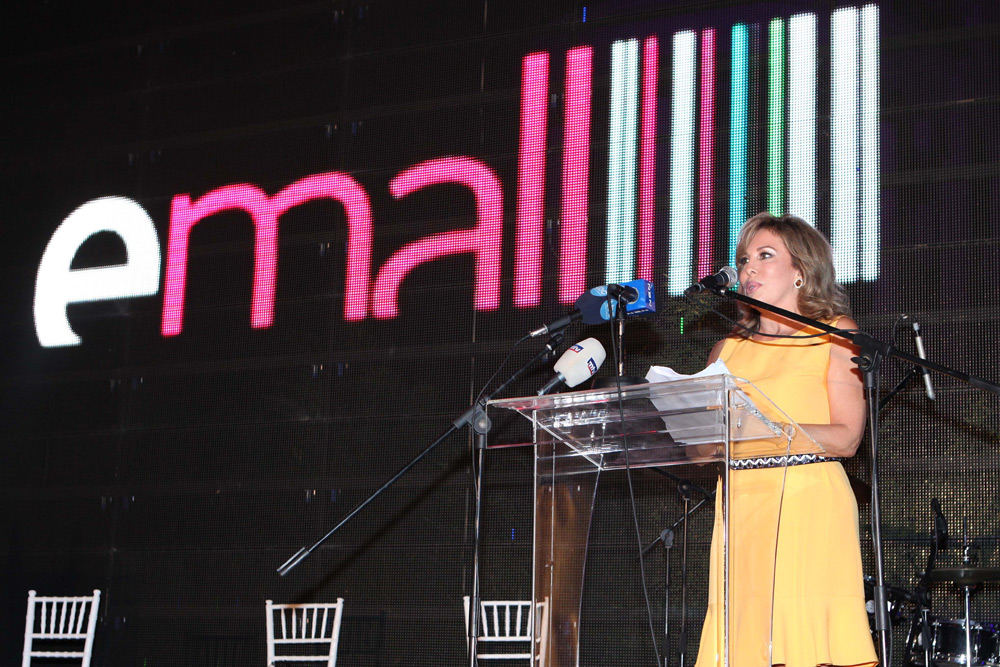
The eBay of Lebanon – that’s what Samir Hanna, CEO of Bank Audi, called their new innovative online shopping platform eMall. Launched on Sunday night at a glitzy cocktail reception held on Bab Idriss Street in downtown Beirut (blocked from public use for the occasion) the event was well-attended – with over 200 attendees including senior bank managers, company directors and media figures – despite the ongoing clashes in the southern city of Saida.

With a violinist and a pianist in the background, Randa Bdeir, head of electronic banking and card services at the bank and the driving force behind the initiative, presented the platform. eMall allows merchants registered with Bank Audi to sell their products online and have the items delivered to consumers’ households by shipping provider Aramex. So far over 90 stores have signed up, including those selling designer items, food and beverage, and electronics.

In Lebanon e-Commerce is in its infancy, with a recent poll putting the percentage of people regularly shopping online at less than one percent. As such Bank Audi are seeking to capitalize on a burgeoning market.

Audi’s profits are to be derived from the stores rather than the customers. eMall charges a 3 percent rate on products sold through its site, in addition to a set up fee and a monthly maintenance fee which vary on the category of microsite chosen. For the consumers, anyone can buy products from the platform but Bank Audi’s clients will have access to special deals and discounts. As such, expect the bank to bite into other local banks’ market share.

eMall also provides shoppers with additional features such as ordering items from the United States shipped to their homes in Lebanon and donating to non-governmental organizations such as the Red Cross and the United Nations Development Program. The US service seeks to bypass the problem many Lebanese face as their cards are not accepted by American firms through a partnership with the website MyUS.com.

To launch the new eMall site, an indoor space on the corner of the banks’ headquarters is presenting a simulation of the site – on laptops, iPads and iPhones – and of other payment technologies, for a period of one week. The highlight of Sunday’s event was the mind-blowing 3D display, which brought to life Bank Audi’s main headquarters.

June 25, 2013 0 comments
0 FacebookTwitterPinterestEmail
Comment

Precious little solace

by Joe Dyke June 25, 2013
written by Joe Dyke

Even as Eric Le Borgne, lead economist at the World Bank, presented the body’s latest report on the Lebanese economy yesterday, he knew facts on the ground were already making it out of date. In the southern city of Saida, at least 17 Lebanese army soldiers had been killed by forces loyal to the fundamentalist Sheikh Ahmed al-Assir while sporadic clashes have been reported in recent days in southern Beirut, Tripoli and the eastern Bekaa region.

In these circumstances, Borgne appeared hesitant to back one key part of the body’s findings. The report, optimistically titled “Growing tensions in a resilient economy”, predicted GDP growth at 2.3 percent in 2013, up from 1.4 percent in 2012. But Borgne knew the Bank would almost certainly downgrade this figure later in the year as it was on an optimistic assessment of the country’s political trends. He said the prediction was made earlier in the year on the “assumption there would be elections for June and increased security in the second half” [of the year]. “Clearly this isn’t true,” he added. A slight understatement, perhaps.

The report makes depressing reading for all but the most blindly optimistic. In essence it describes a perfect storm of factors undermining the economy. Apart from the dubious GDP prediction, most major economic trends are going the wrong way, including, but not limited to, expenditures, consumer confidence and spending, the fiscal deficit, gross public debt and inflation.

In fact, the only thing keeping the economy afloat is increased government spending. The central government posted a fiscal balance deficit of 9.4 percent of GDP in 2012, up by 3.7 percentage points on 2011. This was partly due to slightly declining revenues, but more to increased spending – largely on servicing the losses of the deeply indebted and inefficient Electricite du Liban and paying higher wages due to a public sector pay rise.

Indeed, Borgne went as far as to say that it was only government spending preventing growth dropping below zero. “Were it not for the expansion of fiscal policy, the country would have been in a recession,” he said. But this spending, he pointed out, was deeply unsustainable due to the country’s spiraling debt, with the country’s debt to GDP ratio predicted to arrest its recent decline and grow again.

The primary causes are well known to anyone in the country – Syria and the subsequent deteriorating security trends. The Bank’s figures show that trade has been severely hit as transit routes have been disrupted, tourism has been devastated – with hotel occupancy rates falling to their lowest figure since 2007 – while inflation is being pushed upwards.

The refugee crisis is also undermining unskilled laborers – both Lebanese and other nationalities. There are now nearly half a million Syrian refugees fleeing the country’s civil war registered in Lebanon, with over one million estimated to be living in the country. While Syrians have long formed much of Lebanon’s unskilled workforce, the increased numbers searching for any work they can get are creating “significant downward pressure on wages in the short-term,” the report said. “The comparative advantage of these Syrian activities in terms of prices disfavors local businesses and workers, thereby creating potential tension with local hosting communities,” it added.

A lack of options

Depressingly lacking from the 45-page paper, however, are any realistic policy proposals for dealing with the country’s woes. The Bank is emphatic in its criticism of the status quo, but its few suggestions for growth were roundly lambasted by Lebanon’s most senior economists in the debate that followed Borgne’s talk.

While the wise heads of the economy each took turns to suggest their own proposals, the depressing fact remains that the time for economic policy-making may already be passing. 1,000 well-meaning policy papers cannot prevent Assir’s men from further destroying confidence.

Until the security and political situation improves, economists can do little to help the country grow. Hezbollah and other groups’ increasing involvement in Syria, the crisis in Saida, the cancelled elections – all are increasingly drawing the country into a spiral it is hard to get out of. For policy-makers right now, the best they can hope for is to slow the decline.

After the event, Executive asked Borgne to make a prediction how much they would reduce their GDP prediction by. He politely declined, but said it would be above zero due to ongoing government spending. Precious little solace for a weary nation.

June 25, 2013 0 comments
0 FacebookTwitterPinterestEmail
Banking 2013: Looking for better horizonsFinance

New banks on the block

by Maya Sioufi June 24, 2013
written by Maya Sioufi

Political turbulence and economic uncertainty have not stopped new banks from opening their doors in Lebanon. For this month’s special report on the banking sector, Executive spoke to the general managers of four debutante institutions — Cedrus Invest, LiBank, Lucid Investment and Optimum Invest — with an aim to assess their performance, strategies, goals and concerns.

The founders of Cedrus and LiBank described Lebanon as the optimal location for their clients and their operations. “We decided [to set up] in Lebanon because of our Lebanese and Arab client base, the banking sector’s good reputation and conservative regulator, the lighter cost structure relative to London and Geneva and because it is convenient to have a base in Lebanon,” says Raed Khoury, co-general manager of Cedrus.

Lucid Investment and Optimum Invest are not exactly new — they were established nearly ten years ago — but a management overhaul at each encouraged Banque du Liban, Lebanon’s central bank, to upgrade their licenses to match their diversified portfolios of services.

The four banks profiled share a focus on private equity (PE). Whether pursuing opportunities in London, like LiBank and Cedrus; in Ghana, like Optimum Invest; in Lebanon, like Lucid Investment or in the Middle East, these bankers are rolling up their sleeves to find promising companies for their investors’ capital.

The banks are betting on PE opportunities to provide them with an edge in the aggressive world of finance. “Large investment banks are not interested in small [PE] projects in Africa, so there is scope for our size of companies,” says Albert Letayf, chief executive of Optimum Invest.

Corporate strategy, management and financial advice will all feature in the banks’ menus of products. They offer consulting services for business strategy, capital fundraising through equity or debt, financial management and the implementation of corporate governance frameworks.

As offerings vary from one institution to another, the types of clients that the banks target differ, too. Cedrus and Optimum Invest cater to the private banking needs of high net worth individuals in Lebanon and the Middle East. LiBank will look more widely, from the region to Brazil and Asia.

Lucid Investment’s target clientele is Lebanese companies. “Our main focus is on investment banking as there is high demand for this and [corporations] are highly underserved in Lebanon,” says Wael Zein, CEO of Lucid.

While it is still too early to judge their performance after a year or less in operation, one promising sign is that the banks seem to have taken into serious consideration the importance of solid corporate governance standards, such as the establishment of boards of directors that include independent members.

The main concern for these new banks remains the political instability in Lebanon, forcing them to look abroad to hedge themselves. LiBank is considering opening an office in London to cater to its expatriate Lebanese clients. Cedrus, too, has an operational presence in the city, where it is developing a real estate investment opportunity for its clients. Optimum is focusing on private equity deals in Africa, and Lucid Investment aims to develop a roster of clients that includes Middle Eastern corporations headquartered outside Lebanon.“We are managing our business on a day-to-day basis, and that is very difficult for a bank. We have to follow our clients and make sure [that] if they are doubtful about Lebanon and the banking sector, we can render the services they are expecting in connection with Lebanon from outside Lebanon,” says Tony Ghorayeb, chairman of LiBank.

Meet the banks in-depth below


1.  Cedrus Invest Bank

Armed with a lucrative address book after 15 years of working at Barclays in Dubai, Raed Khoury and Fadi Osseili returned home to Beirut to set up Cedrus Invest Bank, which began operations in February 2012.

With the majority of their clients from the Middle East, the bankers voted for Beirut to be their base. Besides the fact that it is home, the country’s solid banking sector, conservative regulator and lighter cost structure — compared to heavier cost structures in major financial centers such as London and Geneva — tipped the balance in favor of Lebanon’s capital.

Khoury and Osseili, who together own 8 percent of the bank, invited clients whose wealth they had managed for years to own a stake of the new financial institution. More than 25 shareholders took up the opportunity to invest in the bank — 75 percent from Lebanon and the remainder from Saudi Arabia — and open an account with the new Beirut-based private bank. Cedrus currently has $400 million in assets under management.

With 25 employees, Cedrus Invest is offering wealth management for the affluent with a minimum deposit requirement of $1 million, as well as family office and corporate advisory services for companies with at least $15 million in assets. The wide scope of services brought about $2.4 million of profits last year, the firm’s first year of operation.

With 11 family offices in its roster of clients, this business accounts for 30 percent of the bank’s overall profits. Having focused on the financial wealth of companies last year, the Lebanese bankers have expanded family office services in 2013 by adding corporate governance offerings such as succession planning and board nominations. The bank itself has two independent board members —  Ghazi Youssef, an economist and member of parliament, and Assaad Razzouk, a clean energy entrepreneur — on its board of directors.

To stand out among local competition, Cedrus is offering its clients regional private equity (PE) opportunities through direct investments in companies and not through funds. With an average investment of $30 million per company, the bank is currently offering its clients two opportunities in this area: a healthcare company in Saudi Arabia and an industrial company in the United Arab Emirates. It is also considering PE opportunities in Lebanon for smaller sized deals of up to $10 million.

Beyond the region, Cedrus and a Lebanese family office are in final negotiations to acquire a real estate development project in Belgravia, a prime location in London, for $90 million. Cedrus will own 25 percent of the development in London and the Lebanese family, whose name wasn’t disclosed, will own 75.

The aim is to transform the development into serviced apartments with a target internal rate of return north of 18 percent. Cedrus intends to offer this investment opportunity to its clients as soon as it guarantees the loan for the development from credit-wary banks, an exasperating task in a downturn.
Looking ahead, Cedrus anticipates growth across its line of businesses and expects to generate profits of $5 million in three years. The main challenge will be to maintain a steadily positive income, despite the lack of stability in Lebanon and the region. “Our clients are from the region so we would like to see stability; we need the Arabs to come to Lebanon and the Lebanese expatriates to come too,” says Khoury.


2. Levant Invest Bank

What do the Harris School of Public Policy, the Levant Business Union, Brazil and Hong Kong have in common? Levant Invest Bank (LiBank), the newest financial institution to set up
in Lebanon. Having opened its doors in January 2013 in Beirut, LiBank aspires to be the boutique investment bank of choice for the diaspora of the Levant region.

With $30 million of paid-in capital, LiBank plans to become a profitable but low-key advisory investment bank, something akin to the Lazard Bank of the Middle East. Set up by Tony Ghorayeb, who is also the co-chairman of the Dean International Council at the University of Chicago’s Harris School  of Public Policy, and his colleague Salim Chaar, the idea for the establishment of this financial institution came out  of the Levant Business Union ­­— an association of which Ghorayeb is the secretary general.

Between Ghorayeb and Chaar,  their previous experience working in Latin America and in Asia respectively reflects the aims they hold to establish a global clientele. When he worked in Brazil, Ghorayeb developed and maintained solid relationships with the Lebanese diaspora of South America.  Chaar was on the other side of the globe, serving as the head of Indosuez in Hong Kong and Singapore for over 12 years.

Ghorayeb’s Latin American connection extends from LiBank’s client base to its shareholder structure.  A group of Lebanese Brazilian businessmen including David el-Etter, founder of Nicoboco, one of most successful producers of sportswear in Latin America, and Jamal Fatah, the agent of electronics company Olympus in Brazil, together own 12.5 percent of the bank.

LiBank’s diverse shareholder base also features the Qatari group Al Salam International, which own 15 percent, a Saudi Syrian group with a 10 percent stake, a Syrian Turkish group holding 5 percent ownership and the Lebanese real estate brokers Care Group, owned by Victor Najarian, with a 10 percent stake. Ghorayeb and Chaar own 20 percent of the bank together.

By the end of next year, the founders plan to have $50 million to $100 million of assets under management. Their ultimate objective is to provide their clients with specific projects to invest in. That’s where Ghorayeb’s son Kayssar comes in. With a background in banking in London and management consultancy in Chicago, he is developing the private equity side of the bank and is currently working on several regional deals over $50 million in size.

Their other main area of focus is on services for family offices, and they intend to open a branch in London to cater to this market. LiBank is also geared to offer their clients a palette of corporate governance services, an issue the bank has taken seriously by electing three independent directors to their board: Patrick Zurstrassen, former chief executive of Indosuez, Graham Wisner, a lawyer at American law firm Patton Boggs, and Andre Bandali, the Central Bank-appointed interim chairman of the now liquidated Al Madina Bank. 

With 17 employees on board, the founders are hoping to be profitable by the end of this year. In the immediate term, they are researching private equity opportunities on a project-by-project basis to provide their clients with the highest returns. But they are concerned that new regulations — from the increase in capital requirements to the additional scrutiny of banks — may place a costly burden on the nascent bank, especially during a time of regional and domestic uncertainty.

Whether it will develop its platform in Beirut or elsewhere, LiBank aims to become the investment banker for the growing Middle Eastern diaspora.


<
3. Lucid Investment

After operating for eight years under the name Addima as a corporate finance, strategy and management-consulting firm with offices in Beirut, London and Riyadh, a change in ownership of the firm compelled the company to become a financial institution under the new name Lucid Investment. Becoming the bank of choice for corporate Lebanon is what this newly restructured financial institution aims to accomplish.

The founders of the new financial institution, Samir Taleb, Wael El Zein and Kamel Abdallah together own the vast majority of the firm, which was granted its financial institution license from the central bank in 2011 and kicked off operations in 2012. While the last two founders were also behind Addima, Taleb joined from Optimum Invest where he owned a minority stake. Trained as a civil engineer, Taleb worked in the family business at Dar Al Handassah as well as in investment banking in a private family holding.

The remaining three shareholders joined last year and are of Lebanese origin: Wael Sinioura, a former senior banker at Arab Bank and son of former prime minister Fouad Sinioura, Joseph Raad, former banker at Credit Libanais, and Habib Jaafar, a Nigeria-based businessman.

With an initial paid-in capital of $5 million, the objective of the founders is to increase the capital of Lucid to $20 million by the end of the year by gradually taking on new shareholders and upgrading the license to an investment bank.

The firm’s main focus is advise Lebanese companies and regional firms, from startups to well-established businesses. Its services include assisting companies with their capital needs and advising about potential merger and acquisition targets. Lucid will maintain some of Addima’s prior offerings as well, such as strategy consulting and corporate finance services. Its roster of clients features Lebanese companies such as the food chain Kabab-ji and Internet service provider Terranet.

As the owners of the companies they serve could also happen to be high net-worth individuals, Lucid is catering to their personal wealth management needs. It has set up a capital markets division, but it stresses that private banking is not its area of focus for revenue.

Their core activity remains corporate advisory. And when a company they are advising needs capital, the firm seeks external investors. Currently they are working on two Lebanon-based private equity deals. It has structured a $25 million fund that acquired 70 percent of a Lebanon-based hospitality business with worldwide operations. The second equity deal that the firm is working on is for a Lebanon-based conglomerate valued at around $150 million and looking to raise $25 million.

With 15 employees on board and a 2013 revenue target of $2 million, Lucid Investment aims to be profitable by the end of this year, its second year in operation. For future growth, it is focusing on providing corporate advisory and investment banking services to medium-sized corporations in Lebanon and the region, especially to companies owned by the Lebanese diaspora. “Financing the company with equity means opening your books to someone new, and this was a major issue in the past. Now we are starting to feel that [families and corporations] are more open to having partners with them,” says Wael El Zein, chief executive of Lucid Investment.
4. Optimum Invest

Optimum Invest has been around since 2004, so why does it feature among the new financial houses on the block? Because it was only at the end of last year that it officially became a financial institution, after Banque du Liban, Lebanon’s central bank, upgraded its license. Along with the new status came a new shareholder base, a new management and a new strategy.

The main business of Optimum Invest used to be fixed-income brokerage for banks in Lebanon and the Middle East. With a majority stake owned by Antoine Salame and two Lebanese partners, the financial institution wanted to diversify its services. That’s when Albert Letayf came in. With a background in private banking at Saradar and Banque Libano-Francaise, among others, he bought out one partner ­— Samir Taleb, who went on to found Lucid Invest — and is now the chief executive of Optimum Invest.

With a paid-in capital of $5 million, Optimum expanded its services and grew its revenues by 20 percent in 2012. Its most prominent achievement was establishing a fixed-income fund that invests in Lebanese Eurobonds in partnership with Beirut-based Arab Reinsurance Company. The fund is entirely seeded by local insurance companies. Launched in January 2012, the Caerus Lebanon Debt Fund has raised $20 million and generated a net return of 6.65 percent in its first year of operation ­— better than the Blom Bond Index, a tracker of Lebanese Eurobonds, that ended the year down 1.7 percent.

With 17 employees on board, Optimum’s ultimate objective is to offer its clients hand-picked investment opportunities. In partnership with Los Angeles-based real estate investment firm Colony Capital, headed by Lebanese-American businessman Tom Barrack, Optimum set up a $10 million feeder fund that offered an opportunity for its clients to invest in real estate in the United States.

But it’s in Africa where the founders have placed their biggest bets on future growth. Investing part of their own money to align with the interests of their investors, Optimum is eying the world’s second most populous continent for lucrative returns with current projects including a real estate fund and an education fund that aims to establish universities, both in Ghana. “[Ghana] is more politically stable and one of the less corrupt countries in sub-Saharan Africa,” says Letayf. Optimum is also looking to launch a power fund in Africa but would not disclose more.

The company’s offerings include corporate advisory services as well as wealth management services, but it is the asset management arm, with its private equity (PE) offerings, that will be its main focus.

“In Lebanon, we signed the Foreign Account Tax Compliance Act (more commonly known as FATCA) so there is no more banking secrecy with the US. We are in a world where everything that is opaque and muddy will disappear,” says Letayf as he explains his preference for PE opportunities over private banking business.

To comply with the trend towards transparency and accountability, Optimum has set up a board of directors with one independent member: Pierre Gaspard, advisor to the chairman of Saradar Group. There are plans to elect a second independent board member, but a deadline is yet to be set.

As Optimum works to establish itself as a boutique, asset-management investment bank for the Middle East and Europe, it’s toward the world’s poorest continent that the firm is seeking the most lucrative returns to offer to its investors.

June 24, 2013 0 comments
0 FacebookTwitterPinterestEmail
  • 1
  • …
  • 250
  • 251
  • 252
  • 253
  • 254
  • …
  • 698

Latest Cover

About us

Since its first edition emerged on the newsstands in 1999, Executive Magazine has been dedicated to providing its readers with the most up-to-date local and regional business news. Executive is a monthly business magazine that offers readers in-depth analyses on the Lebanese world of commerce, covering all the major sectors – from banking, finance, and insurance to technology, tourism, hospitality, media, and retail.

  • Donate
  • Our Purpose
  • Contact Us

Sign up for our newsletter

    • Facebook
    • Twitter
    • Instagram
    • Linkedin
    • Youtube
    Executive Magazine
    • ISSUES
      • Current Issue
      • Past issues
    • BUSINESS
    • ECONOMICS & POLICY
    • OPINION
    • SPECIAL REPORTS
    • EXECUTIVE TALKS
    • MOVEMENTS
      • Change the image
      • Cannes lions
      • Transparency & accountability
      • ECONOMIC ROADMAP
      • Say No to Corruption
      • The Lebanon media development initiative
      • LPSN Policy Asks
      • Advocating the preservation of deposits
    • JOIN US
      • Join our movement
      • Attend our events
      • Receive updates
      • Connect with us
    • DONATE