• Donate
  • Our Purpose
  • Contact Us
Executive Magazine
  • ISSUES
    • Current Issue
    • Past issues
  • BUSINESS
  • ECONOMICS & POLICY
  • OPINION
  • SPECIAL REPORTS
  • EXECUTIVE TALKS
  • MOVEMENTS
    • Change the image
    • Cannes lions
    • Transparency & accountability
    • ECONOMIC ROADMAP
    • Say No to Corruption
    • The Lebanon media development initiative
    • LPSN Policy Asks
    • Advocating the preservation of deposits
  • JOIN US
    • Join our movement
    • Attend our events
    • Receive updates
    • Connect with us
  • DONATE
The Buzz

Business briefing: 21 June 2013

by Executive Staff June 21, 2013
written by Executive Staff

Economics and Policy

High Syrian demand for Lebanese manufactured goods caused industrial exports to surge by 6.3 percent in the first three months of 2013.

More from The Daily Star


Syrians are increasingly abandoning their own currency in favor of the security of the dollar.

More from Reuters


At least 18 Lebanese citizens have been expelled from Qatar after the Gulf Cooperation Council pledged to act against members of Lebanon's Shiite Hizbollah movement.

More from AFP
 

Rami Hamdallah has resigned as Palestinian Authority prime minister, just two weeks after taking the post.

More from The National


Companies and Business

BP has agreed a price for any gas produced from Oman’s Khazzan project as part of a commercial framework agreement with the government.

More from Reuters
 
 
Blackberry has launched a smartphone and store in Dubai as it battles to regain market share from rivals Apple and Samsung.

More from The National

June 21, 2013 0 comments
0 FacebookTwitterPinterestEmail
Banking 2013: Looking for better horizonsFinance

The art of banking

by Maya Sioufi June 20, 2013
written by Maya Sioufi

As Raymond Audi, chairman of Bank Audi, Lebanon’s largest bank, walked me through the four floors of their headquarters in Downtown Beirut, I would have thought I was in a major contemporary art gallery were it not for the bankers conducting their daily activities.
Banks across the world are building art collections and multi-million dollar pieces adorn the walls of the largest bank offices. Germany’s Deutsche Bank, which started its art collection in 1979, features the world’s largest corporate art collection. Its New York offices even have a different art theme for each floor. Picture working in that environment.

Related article: Bank Audi’s chairman on his love affair with art

Swiss bank UBS’ art collection features a painting by American pop artist Roy Lichtenstein, with a similar one sold at Christies for over $4 million in November 2011. How better to impress clients than to have a piece by Lichtenstein hanging in the meeting room? The bank has a five-year partnership started in April 2012 with New York’s Guggenheim museum to identify and support a network of art, artists and curators from South and Southeast Asia, Latin America, and the Middle East and North Africa.

Lebanese deck the halls

Similar to the décor of JP Morgan’s Wall Street offices, the entrance of Bank Audi’s main headquarters hosts a six-meter tower sculpture by French artist Jean Dubuffet. At auction in Christie’s in November 2011, a two-meter sculpture by Dubuffet fetched $1.2 million.
From French artists such as Dubuffet, Bernar Venet and Francois Rouan to Lebanese artists such as Paul Wakim, Jean Marc Nahhas and Shafiq Abboud, Bank Audi has a wide collection of modern and contemporary art in its Beirut headquarters with some valued at exorbitant prices.

Many pieces of contemporary art are owned by Lebanese banks


In its Swiss offices, the bank holds a collection of old masters’ paintings from renowned artists of the 16th century, such as Lucas Cranach the Elder, and the 17th century, such as Jan Van Goyen. Villa Audi, the bank’s art space in Beirut, hosts its collection of mosaic art, the bank’s first purchase of art pieces which started prior to the Lebanese civil war. The estimate of the entire art collection was not disclosed.

Bank Audi is not the only Lebanese bank building an art collection. Focusing primarily on Lebanese art, BankMed started developing its collection in 1995 and its modern art pieces are hung on the walls of its branches throughout Lebanon.

While the bank started its collection by acquiring a piece by a French artist, its focus is on Lebanese art, which now accounts for about 80 percent of its collection. The bank owns the largest private collection of the renowned late artist Paul Guiragossian.

“When we started investing in Guiragossian, we wanted to stop the pieces from leaving the country as a lot of people were buying his pieces and at that time, [the banks] were the only ones able to afford keeping the national heritage in the country,” says Diala Choucair, head of communication at BankMed who did not disclose the estimate of the bank’s art collection. Choucair, who takes charge of all matters related to art for the bank, is now keeping an eye out for pieces to embellish the bank’s new headquarters that will be completed in two years.

Beyond an art collection

Involvement with the art world goes beyond merely acquiring a piece for a corporate art collection. Some banks are turning sections of their premises into art spaces. Since 2011, Byblos Bank has held six exhibits in its headquarters in Beirut for Lebanese artists Chucrallah Fattouh, Charbel Samuel Aoun, Rawya Zantout, Hrair, Krikor Nourikian and Dory Younes.
Falling under the bank’s corporate social responsibility (CSR) practices, the bank does not charge a fee for the sale of pieces during the exhibits. “We are now thinking of art as part of our CSR to help Lebanese emerging artists at different levels of maturity in their work. If promoting them means helping by buying a piece we will do it,” says Nada Tawil, head of communications at Byblos Bank. A piece by Aoun adorns the walls of the office of Semaan Bassil, vice chairman of the board and general manager of the bank.

A Jean Marc Nahhas sketch on an office wall in Bank Audi’s headquarters


Byblos Bank is not the only bank hosting exhibits in its offices. FFA Private Bank turns its first floor into an art space twice a year. With art consultant Nada Boulos el-Assaad on board since 2009, FFA provides local artists with a platform to display their pieces and, similar to Byblos Bank, does not take a fee for the sale of art pieces.

To support Lebanese art, FFA acquires a piece from each exhibition it hosts. Its collection now includes paintings by Marwan Sahmarani and Oussama Baalbaki, a photograph by Joe Kesrouani and a sculpture by May Rishani. “FFA invests primarily in Lebanese art but is open to works from the region. The main focus has been on semi-established artists but the focus is changing to emerging talents,” says Reem Moukarzel, FFA’s marketing and communication manager.

Behind the Beirut Art Fair

Extending sponsorship of art outside their offices, banks have backed the Beirut Art Fair since its debut in 2010. With over $2 million in sales and 11,000 visitors last year, organizers of the art fair are expecting sales of $3 million and 13,000 visitors at the fair in September. BankMed, the fair’s largest sponsor, has supported the event from the beginning. “It is a national effort more than a sponsorship,” says Choucair as she explains how the bank first decided to sponsor the fair in 2010.

In partnership with the organizers of the Beirut Art Fair, Byblos Bank sponsored a photography competition for Lebanese photographers last year. The winner of the competition, 25-year-old Dory Younes, hosted a solo exhibit in the bank’s headquarters in April 2013. The competition will take place this year as well, with the winner to be granted a solo exhibition in 2014.

Byblos Bank plans to focus on photography going forward as it develops its understanding of the art world. “You can’t be the blind leading the blind. We want to build credentials for people to start thinking about us [as art experts] so we decided to partner with the Beirut Art Fair so they teach us and we decided to help young photographers,” adds Tawil.

Cutting edge partnerships

Up until this year, the involvement of the banking sector with art involved corporate art collections, hosting art exhibits or sponsoring events. However, in May, the AUB Byblos Bank Art Gallery opened on the university’s campus to expose students to cutting-edge art.
The gallery, which is sponsored by Byblos Bank,  will host exhibitions for foreign and local artists with the first exhibition entitled “Art in Labor: Skill, De-skilling, Re-skilling,” running until July 27, 2013. The non-commercial gallery will host art “that can make you stop and think,” says Tawil.

A shoe by Lawrence Abu Hamdan and a long tube by NY-based Gregory Sholette are displayed in the art gallery at AUB.

Banks’ courtship with the art world is taking on different shapes and forms. As these activities help brush the image of the banks, they also aim to promote Lebanese artists. Given the lack of national museums and government funding for local talent, this support is welcome news for Lebanon’s growing and buzzing art scene.

June 20, 2013 0 comments
0 FacebookTwitterPinterestEmail
Banking 2013: Looking for better horizonsSociety

Raymond Audi

by Maya Sioufi June 20, 2013
written by Maya Sioufi

Standing six meters tall, French artist Jean Dubuffet’s blue, red, white and black sculpture decorates the entrance of the Beirut headquarters of Bank Audi, Lebanon’s largest bank. It is one among many modern pieces that adorn the head office. Old masters’ paintings also feature in Bank Audi’s corporate art collection on display in their offices in Switzerland. The bank’s mosaic pieces are placed at Villa Audi, the bank’s art space. For this month’s special report, Executive visited Raymond Audi, the bank’s chairman and a Lebanese art patron, for an insight on the bank’s art collection.

Walking into the Bab Idriss headquarters, one cannot but notice the impressive tower sculpture of Dubuffet. Why did you choose to acquire this piece 12 years ago for the entrance of the headquarters?

When we had to find a sculpture piece for the entrance, I wanted to have a sculpture by French artist Bernar Venet, but my son, who is my art mentor, suggested to have a more colorful piece. We went to the Dubuffet foundation because we knew the person responsible for the art collection of [French automaker] Renault. It was very expensive and it is one of our most valuable pieces. I told Venet that we will switch him to another place in the bank and his piece is now placed at the Wadi Abou Jmiel entrance of the bank. He promised me that he will offer to Lebanon one big piece, like when the French artist Arman offered a piece [Hope for Peace] to the Lebanese army [in 1995]. I’m still expecting one day he will come and offer a piece for the town.

Raymond Audi takes pride in the bank’s art collection


When did Bank Audi first start its art collection?

Before the [Lebanese Civil War started in 1975], I was collecting mosaics and I bought piece after piece from several places to decorate the walls of our branches. After buying a bank in Switzerland and spending time there after the war, we discovered that it was a good opportunity to start collecting Flemish and Spanish art because of the tax benefits on art investments. So we collected about 13 valuable pieces from renowned artists such as Pieter Brueghel (the younger) and Lucas Cranach (the elder) that are in our Swiss offices. As I started moving in and out of Lebanon, I started supporting Lebanese artists and buying some beautiful pieces from artists such as Paul Wakim and Jean Marc Nahhas.

How do you go about acquiring a piece of art?

I hate to go to the launching of art exhibitions at galleries because you are surrounded by lots of people and the gallery owners want you to buy immediately. That’s why I don’t go. I go suddenly when I am free and without saying who I am. If I find something nice, I buy. I don’t have art advisors [except for my] son, [who] knows a lot about art, especially modern art.


Related article: The Art of Banking


Who is your favorite artist?

For me, Paul Wakim is one of the best, and he is a fantastic guy. I knew him from his early days when he was painting with cats all around him.
With time, I discovered he does not deserve to be helped. I helped him raise the value of what he is doing in such a way that he should at least help me in developing our art collection. Anytime I ask for a good piece, he prices it highly, and he is becoming greedy. I am not happy about him, but for me, he is one of the best.

What are your thoughts on the Lebanese art market today?

We don’t have a national museum that collects pieces of art and gives them a proper reference. The galleries, which are the main art dealers, are over-inflating the prices on pieces that are of bad quality. They are not differentiating between the good and bad quality pieces.

Do you acquire art for investment purposes? To sell them for profit?

It is becoming more and more of an investment, and the value of our art collection [which remains undisclosed] is very high. But the choice of the piece depends on its quality more than on its value. Some good painters are not paid what they deserve, and some are very well paid for what they don’t deserve. This is the current art situation, and I pay very close attention to it.

With art pieces fetching exorbitant prices, some industry experts are saying art valuation is a bubble that will eventually pop. Do you agree?

We feel that art is becoming a kind of haven for [some] investors because they don’t know what to do with their money, especially for the ones that are asked questions like, ‘From where did you get your money, how did you make it’ and so on. They don’t like to answer these questions, so they prefer to invest in art.

Some large investment banks are offering their private banking clients an opportunity to invest in funds dedicated to art. Is this something that Bank Audi would consider?

No.

Would you consider opening a gallery?

We don’t want to be a seller or merchant of art. We have in Villa Audi a display ground where we feature a retrospective of artists that passed away, for them to be better known after their death. I would like to create a museum for mosaics at Villa Audi, but unfortunately archeology in Lebanon is a major problem. Authorities consider any collector as a smuggler. Any new minister that wanted to help was dismissed. Villa Audi is not officially a museum, but in fact it is a museum.

June 20, 2013 0 comments
0 FacebookTwitterPinterestEmail
Business

Bringing detox to Beirut

by Maya Sioufi June 20, 2013
written by Maya Sioufi

Company: Qi Juices

Country: Lebanon

Industry: Food and Beverage

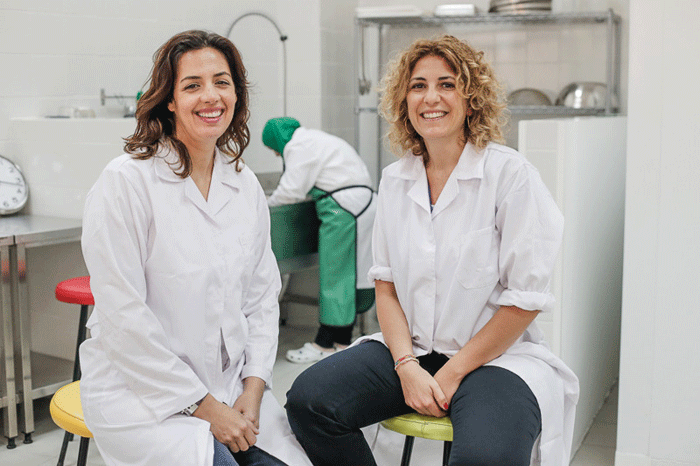
Founders: Leila Fakih Nashabe and Hana Alireza

Established in: 2012

Number of employees: 7

Revenues last year: Expected revenues of $100,000 in 2013

Capital raised: Kafalat loan of $114,000


Beyonce, Oprah and Gwyneth Paltrow have all done detox diets to shed a few pounds and feel healthier before the summer. Now the hugely popular American concept has landed in Beirut.

The idea is simple — a liquid-only diet for three days. That’s what the founders of Qi Juices, Leila Fakih Nashabe and Hana Alireza, recommend to make you feel healthier
It is not cheap, mind you. For $65 a day, you get six juices made of homegrown fruits and vegetables. The cleansing program is an extreme diet plan that claims to remove the toxins from your body. From a Red Magic juice with beetroot and ginger to a Green Dream juice with spinach and parsley, the three-day cleansing program — which can be extended to five days or cut to just one — requires a dedicated will to detox, perhaps encouraged by overindulgence at the dinner table or a few extra summer nights out. Detoxers often lose between one and three kilos but the two women stress that it is not about losing weight but being healthy.

Launched in March of this year out of a kitchen — or ‘Qitchen’ as the founders like to call it — in the heart of Achrafieh, the idea was initially sparked by a trip to California when Alireza went on a juice cleanse program for three days in Los Angeles. After finishing the detox she felt more energetic, so she decided to bring the idea to Lebanon, rich in agricultural produce.

She initially partnered with her old friend Nashabe in December 2011 but they found funding hard to come by. Eventually they succeeded in obtaining a $114,000 loan from the government-subsidized loan program Kafalat and have started producing their products this year. “It took over a year; Kafalat was skeptical about the idea,” says Nashabe. The founders themselves funded the remaining cost of the project, putting in $86,000 to reach their $200,000 target.

Carrot and apple juice, anyone?


At $10.8 a bottle, the Qitchen has a maximum capacity to produce up to 400 bottles a day and the founders expect to generate between $100,000 and $120,000 in their first year in operation.  With a three-day shelf life, the founders are selling the juices directly to clients on order and have recently signed with organic food store New Earth. Other organic stores are also showing interest in buying their products.

As for the taste of these healthy juices, customers will be pleasantly surprised by the often odd-sounding juices, some of which contain spinach, parsley, beetroots or event fennel and romaine lettuce. Colorado-based nutritionist Natasha Henry advises the founders on the mix of the products to maximize the nutritional benefits. Henry established New Paradigm Healing, a clinic that claims to provide natural therapies for the physical and spiritual well-being.

While the detox diet is hot in America with several Hollywood celebrities behind the hype, there is still little scientific evidence backing its claimed benefits — from removing toxins to losing weight. The debate among nutritionists is fierce. What is not in doubt — as we were so often told in our youth — is that eating fruits and vegetables adds a significant source of vitamins to our daily diet. So while the cleansing program may be of debatable value, the vitamin-rich homegrown fruits and vegetables packed in one small bottle of juice can’t hurt — except your wallet.

June 20, 2013 0 comments
0 FacebookTwitterPinterestEmail
The Buzz

Business briefing: 20 June 2013

by Executive Staff June 20, 2013
written by Executive Staff

Economics and Policy

Most Lebanese bankers have apparently coalesced around the candidacy of François Bassil as head of the Association of Banks in Lebanon, ahead of the group’s July 5 election.

More from The Daily Star


Revenues at Beirut Port grew 26 percent in the first five months of the year, with the port benefiting from the Syria crisis.

More from The Daily Star


The Cypriot Cabinet approved on Wednesday plans to sign for a deal with a US-Israeli partnership to build a liquefied natural gas plant on the island to exploit untapped energy riches.

More from AFP


The Syrian central bank sold $8 million to local banks Wednesday at 175 pounds to the dollar, despite the official rate remaining at 99.91 pounds to the dollar.

More from The Daily Star


Companies and Business

Dubai’s Roads & Transport Authority (RTA) has announced that the company building the $196m Rashid Hospital Tunnels project has completed construction and is putting the finishing touches to the tunnels, which are set to open on June 30.

More from Arabian Business

June 20, 2013 0 comments
0 FacebookTwitterPinterestEmail
Comment

Tied fortunes

by Jihad Yazigi June 19, 2013
written by Jihad Yazigi

Syria’s ongoing destruction has impacted the Lebanese economy in various ways, but its eventual reconstruction could bring rich opportunities to its smaller neighbor.
The first two years of the Syrian conflict have seen a massive influx of refugees who have added to the large, existing Syrian workforce. According to Lebanese government estimates, more than 1 million Syrians resided in the country at the beginning of 2013 (both refugees and non-refugees) — the equivalent of a staggering 25 percent of the Lebanese population — while estimates from the United Nations High Commissioner for Refugees have documented 486,000 refugees as of May 22, both registered and waiting to be registered.

This flow has had, and will continue to have, a significant impact on the weak Lebanese state and its physical infrastructure. The number of Syrian children that will require schooling in Lebanese state institutions in September 2013 is expected to rise significantly, with some analysts forecasting their enrollment to be on par with the current number of Lebanese pupils. The water and electricity networks will not be spared, particularly during the summer, while traffic congestion is already on the increase.

Negative effects have also been felt by Lebanese businesses. The conflict in Syria has frightened off tourists and dipped confidence in the economy. Demand from Lebanese households has declined and so has investment, according to Banque du Liban, Lebanon’s central bank. The conflict has also significantly increased the cost to insure and transport exports to Lebanon’s traditional trade partners, such as Iraq and the Gulf. Meanwhile, Lebanese investors in Syria, particularly those in the financial services industry, have taken major losses.

This is not, however, the full picture. In the summer of 2012, the expansion of violence to Syria’s two largest cities, Damascus and Aleppo, drove thousands of urban dwellers from the Syrian middle class and business community to Lebanon. This led to a surge in demand for rented housing across the country and to a rise in consumption. The presence of Syrian patrons at restaurants in Beirut’s Hamra district and beyond is ample proof of that. Investment is still lagging, though by the spring of 2013 an increasing number of Syrian investors were reportedly starting to establish offices or set up shop in and around Beirut.

More relevant to the longer term, however, is the effect of the war and of the Syrian economy’s disintegration on the often-complicated relations between Lebanon and Syria

Already, the decline in Syria’s economic output has improved Lebanon’s trade balance with its eastern neighbor. According to Lebanese customs, Lebanese exports stood at $296 million in the first four months of 2013 — more than the total of 2012, which reached $294 million. While this is partly due to transit trade of energy products to the sanctions-hit Syrian government, there is also evidence that this is the consequence of a massive decline in Syria’s output, especially in the farming sector, creating intense demand for essential goods and commodities from abroad. This represents a reversal of a historic trend; Syria’s more competitive agricultural products used to regularly flood Lebanese markets.

Even if the conflict were to end today, the Syrian economy would need years before it recovers. Replacing destroyed infrastructure and housing alone is expected to cost tens of billions of dollars. The UN’s Economic and Social Commission for Western Asia forecasts, for instance, that when reconstruction begins, demand for cement in Syria will be at some 30 million tons per annum, or three times the level of demand prior to the conflict — a rise in demand that will benefit the Lebanese building materials industry.

After a decade during which Lebanese financial sector capital and know-how benefited from Syria’s economic liberalization, it’s now likely that the country’s smaller industrial and agricultural sectors will find strong new opportunities in post-conflict Syria.

It is still too early to make a comprehensive assessment of the impact of the war on bilateral relations, but there is little doubt that Lebanese investors, across all business sectors, are going to be major beneficiaries of Syria’s reconstruction effort. This will be a strong incentive for solid ties between the two countries, but whether politicians have a grasp of the importance of nurturing these ties is, obviously, a different story.


Jihad Yazigi is editor-in-chief of The Syria Report

June 19, 2013 0 comments
0 FacebookTwitterPinterestEmail
Banking 2013: Looking for better horizonsFinance

Credit crunched

by Marwan Mikhael June 19, 2013
written by Marwan Mikhael

Loans have divided societies throughout history, between people who consider them a beneficial product that allows customers to purchase goods they need now and pay for later in the future, and others like Thomas Jefferson who believe “that the principle of spending money to be paid by posterity, under the name of funding, is but swindling futurity on a large scale.”

The latter category seems to be off base since banking credits expanded prodigiously in the past 50 years and banking activity in general generated remarkable profits for shareholders. This was driven in part by significant improvements in banking investment opportunities, with return on equity ranging between 20 and 25 percent for the financial industry as a whole up until the financial crisis in 2008.

The boom years…

Banking activity in Lebanon flourished after the end of the civil war, and it again took off in the period following the July 2006 Israeli war on Lebanon. Throughout, the growth of the sector’s activity was accompanied by a surge in lending. While loans to gross domestic product (GDP) remain within international standards — hovering at around 100 percent — with average interest rates on loans close to 7.2 percent through 2012, the surge in loans is posing a burden on consumers.

Credit to the private sector increased two and a half times in the past six years until the end of 2012. While loans to all sectors of the economy surged, the most prominent increase was for individual loans, which recorded more than a 250 percent jump during the same period to stand at around $13 billion at the end of 2012. The boom in real estate activity and prices in the past six years was the major contributor to this increase, driven by support from Banque du Liban, Lebanon’s central bank, and the Public Corporation for Housing. Housing loans went up from $1.2 billion at the end of 2006 to more than $7 billion by the end of 2012 and loans to the construction sector followed, jumping from $3 billion to more than $8 billion in the same period.

The sum of this real estate-related lending activity shows strong growth during the past six years, from $5 billion, or 27 percent of total loans, in 2006 to $19 billion, or 42 percent of total loans in 2012.

As for the other sectors of the economy, loans have doubled during the same period. Credit to the trade and services sector, the largest constituent at 35 percent of outstanding loans, increased by 105 percent in the last six years to reach $17 billion. Loans for manufacturing moved from $2.5 billion in 2006 to $5 billion in 2012, and those to the agricultural sector more than doubled, albeit from a low base, from $219 million to $455 million.

A welcome piece of news that has accompanied the lending surge is the drop in non-performing loans (NPLs), loans that are close to default. The NPL ratio to total loans decreased from 12.2 percent at the end of 2006 to 3.5 percent at the end of 2012.

…go bust

But banking loans to the private sector are expected to grow at a slower rate through 2013 and 2014. Economic activity has slowed as real GDP logged just one percent growth in 2012 and is projected to grow between 1 and 2 percent this year and 3 percent in 2014.
Hence the opportunities for growth of the banking sector in the domestic market will be limited. Banks will have to look, as some of them are already doing, at growth options in the region or other parts of the world. With a continuous slowdown in the growth of deposits, fulfilling the demand for loans by both the private and public sectors is challenging, and it seems likely that the private sector will be crowded out in favor of the public one.
In this context, returning to the high economic growth rates and a positive balance of payments is crucial. And this will not be feasible without a stable political and security situation, accompanied by structural reforms and infrastructure investments through public-private partnerships so as not to overburden government finances.

In the words of French artist Eugene Delacroix: “If one considered life as a simple loan, one would perhaps be less exacting. We possess actually nothing; everything goes through us.” From this perspective, adding a few other loans to life could actually be a good thing, for they may help us in improving our living standard as long as we have the capacity to pay them back.

June 19, 2013 0 comments
0 FacebookTwitterPinterestEmail
The Buzz

Business briefing: 19 June 2013

by Executive Staff June 19, 2013
written by Executive Staff

Economics and Policy

Syria is to  draw on a $1 billion credit line from Iran in order to stabilize the pound after it plummeted to a record low against the dollar this week

More from The Daily Star


All of Lebanon’s 10 demarcated offshore blocks were nominated as areas of interest by oil and gas firms participating in the initial licensing round, the Energy Minister said.

More from The Daily Star


A lawyer for a son of ousted dictator Muammar Qaddafi has accused Libyan authorities of showing a "blatant disregard" for the International Criminal Court by announcing they will put Saif Al Islam Qaddafi on trial in August.

More from Associated Press

 
Companies and Business
 
Foreign direct investment into the Arab world rose by nearly 10 per cent in 2012 led by Saudi Arabia and the UAE.
 
More from Khaleej Times
 

Bkam.com, the Middle East's first price comparison website, has launched a UAE portal after receiving funding from an investment company behind Souq.com and Cobone.com.

More from The National

The French oil major Total has widened its operations in the Kurdish region of Iraq by becoming the operator of a concession in the autonomous area.

More from The National


The Qatar Exchange is to introduce trading of government bonds issued by the central bank on June 20, as part of measures to deepen the Gulf state’s debt market and diversify investment tools for banks and other institutions.

More from Reuters


Kuwait mobile operator Zain will make acquisitions and partnerships in computer-based industries this year to exploit rising demand for data and help offset falling conventional call and text income, its chief executive has said.

More from Reuters


June 19, 2013 0 comments
0 FacebookTwitterPinterestEmail
Economics & Policy

Making the best of a bottom dollar

by Philip Issa June 18, 2013
written by Philip Issa

Want to take out a loan to open a small workshop in your village? Without owning a piece of land that could be used as collateral, banks would pass on that; they’d also decline the $200 loan request for a woman who wanted to invest in a sewing machine as the starting point for a small business and economic self-sufficiency.

Despite Lebanon’s high bank saturation, the poor here have long lacked access to financial services. Only six years ago, the International Finance Corporation found that  Lebanon’s microfinance sector comprised just 11 providers, with a total outstanding loan portfolio of      $33 million. 

Related article: Every little helps

Photogallery: The people benefitting from microloans

Microfinance is considered an entry point for those in the lowest income brackets to penetrate the formal economy. Al Majmoua, the largest Lebanese microfinance institution (MFI) according to publicly available data, offers group loans — making up 26 percent of their clientele — to women in which the borrowers mutually guarantee each other. 

The practice serves as a screening mechanism, as borrowers will naturally exclude non-trustworthy partners. Importantly, it eliminates the need for collateral.

Vitas, the second-largest Lebanese MFI, told Executive that a third of its portfolio was lent to micro-entrepreneurs in the retail sector, followed by 24 percent in the services sector. Less than 9 percent of its loans were for personal use.

The Association for the Development of Rural Capacities (ADR) reported that 79 percent of its outstanding loans were for business, with the remaining 21 percent personal.

Today, the number of providers has passed 20 and the publicly available audited loan portfolios of five of the top MFIs have a combined worth of $62 million. Officials at major MFIs told Executive that they estimate the total cumulative portfolio of all providers at between $120 million and $150 million.

The proliferation of local providers is creating a financial industry that serves people on the margins of the national economy. These clients stand to gain much from the sector’s growth. But a lot will depend on whether MFIs can remain faithful to the social mission of microfinance: to help poor clients smooth their incomes, mitigate financial risk and invest in their futures.

An Opaque Expansion

If industry estimates are correct, then the size of the microfinance sector has quintupled since 2007, as measured by total outstanding loan portfolio. But verifiable data is hard to come by.

Five institutions (see chart) publish audited data on the MIX Market, a non-profit microfinance data site founded and sponsored by a World Bank research center. Three of these institutions — Al Majmoua, Emkan and Vitas — are operationally self-sufficient, meaning they are able to cover all of their expenses from revenues. These three still accept grants and loans from local and international organizations, but they do not depend on them. 

Operational sustainability is complementary to the social mission of microfinance. An MFI that operates below the threshold of sustainability relies on subsidized funding, indicating that it may be making overly risky loans that fail to pay off — casting doubt on the efficiency of such lending.

However, there is no requirement to list on MIX Market and there is no central registry of Lebanese MFIs. Thus, the exact number of microcredit providers is unknown, as is their financial viability. 

Industry executives agree that the largest provider of microloans in Lebanon is one such unlisted institution: Al Qard Al Hassan (AQAH). As a non-profit, it is registered with the Ministry of the Interior, but it does not have to follow the lending regulations incumbent upon financial institutions registered with Banque du Liban (BDL), Lebanon’s central bank. 

According to AQAH’s website, the organization disbursed $208 million in loans in 2012 alone, but the figure does not subtract repayments; the outstanding portfolio is therefore assumed to be smaller. 

That a microlender of such a scale can operate in such opacity highlights the need for data disclosure and sector-wide cooperation. Unusual among MFIs, AQAH will sometimes require physical collateral, such as jewelry, gold or a deed to make a loan. The organization has not submitted to operational audits that would verify that such practices do not overburden financially-illiterate borrowers. 

Lacking financial history, stable income, collateral and access to financial guidance, microborrowers are particularly vulnerable to unscrupulous lending practices. MFIs often guard themselves against such accusations by submitting to social performance audits conducted by internationally-recognized microfinance organizations, such as Planet Rating and Kiva.

These audits not only gauge transparency and client-protection practices; they also recognize social accomplishments, such as lending to women-owned enterprises or non-lending services, and employing women at all management and staff levels. Principally, the audits seek evidence that an MFI’s services measurably improve the welfare of its clients’ families.

Planet Rating and Kiva have evaluated only two MFIs in Lebanon to date: Vitas and Al Majmoua. Planet Rating, in 2010, found that both institutions demonstrated a “clear commitment to social goals”. It added that Al Majmoua was likely to achieve a positive social impact, but Vitas was yet to measure its impact and refine   its practices.

The USAID-funded Lebanon Investment in Microfinance (LIM) program requires social performance data from its partners and conducts field audits of its own. Although the audit results are not public, the program’s director Mohammed el-Zrein told Executive that LIM has not found evidence of questionable practices among its partners (ADR, Al Majmoua, Vitas, Emkan, Cooperative for Lebanese Development, AEP, EDF and Makhzoumi).

Not all Lebanese MFIs have received social performance ratings. Some, such as Ibdaa, which began its operations in July 2012, do not have enough data available for an audit. Others simply may not have a business or regulatory interest in acceding to a public audit. There are no BDL or government requirements to publicly disclose data that can be used to protect micro-borrowers against unsavory lending practices. 


Cross-lending roulette

The proliferation of unregulated microcredit in Lebanon has led to serious concerns about cross-lending, wherein clients borrow from multiple institutions without disclosing their level of indebtedness to each. “This should be a red alert,” said Ali Hejazi, microfinance operations manager    for ADR.

Some information on over-burdened debtors can be obtained from the Central Office of Credit Risk at BDL, but access to this data is reserved to registered financial institutions. Najib Choucair, head of the Banking Department at BDL, told Executive that Parliament will have to amend the Code of Money and Credit by law in order to allow non-profit MFIs access. 

In the meantime, MFIs are doing what they can to reduce default risks in an information-poor environment. Vitas and Al Majmoua told Executive that their loan officers check with officers of other institutions to see whether they share clients, but this practice is informal and undocumented.

Financing microfinance

 “Usually, we [MFIs] are supposed to be dealing in a non-profit manner,” said Hejazi. Indeed, there is a pervading expectation that microcredit providers do not make money off of the backs of the poor — to do otherwise would seem contrary to the social mission. 

But Lebanese MFIs are moving towards registering as for-profit, financial institutions. Partly, this is to access BDL’s Central Office of Credit Risk. There are cost motivations,        as well.

Vitas — formerly Ameen — pioneered the MFI financial institution model in Lebanon. The organization, established in 1999, shed its non-profit status in 2003 and registered as a financial institution in 2007. It is now the second-largest MFI in Lebanon, serving 15,500 borrowers. Emkan, which also began operations as a non-profit, followed suit in 2011. Its lending portfolio is spread across 5,493 clients.

Ibdaa started as a non-bank financial institution registered with BDL. Its managers had decided from the start not to pursue a non-profit status, Chief Executive Bachar Kouwatly told Executive. 

By registering as a financial institution, Ibdaa can demonstrate regulatory compliance and attract otherwise hesitant, profit-minded investors to upscale its operations. 

“Being a financial institution gives you certain credibility with third parties, investors, donors and even clients,” said Dalia Farouki, deputy general manager of Vitas. 

Al Majmoua confirmed to Executive that it, too, is considering registration, but in a deliberative manner. “We are concerned about mission drift,” said Executive Director  Youssef Fawaz. “Our average loan amount is lower than our competitors. We go more down market. [Financial institutions] may focus on a segment that is slightly more profitable.”

Farouki, however, is convinced that Vitas’ status as a financial institution is fully compatible with its commitment to poverty reduction.

“True, we are a financial institution, but we have a social mission as well,” she said. “We’ve never lost sight of our mission.”

Tangled regulations

“We believe there is room for microfinance in the country, and some people can benefit from it,” BDL’s Choucair told Executive. “But it is not a very large sector, and we do not believe there is much money to be made from it,” he said, adding that BDL is not very concerned about the ramifications of a cross-lending bubble among micro-borrowers.

Even so, BDL last year revised its Basic Circular 93 to cheapen the cost of commercial lending to MFIs in the interest of expanding credit access. Under Circular 93, bank loans to MFIs do not need to be offset by a BDL reserve deposit. In fact, the loan can be made directly from the bank’s BDL deposit account, cheapening the cost of the capital and therefore allowing lower interest rates for repayment.

ADR has been able to obtain capital at 4 to 5 percent interest through its partnerships with Bank Audi and BLC Bank, according to ADR President Youssef el-Khalil.

 Khalil, who is also the director of BDL’s Financial Operations Department, credits the regulation for reducing the costs of ADR’s borrowing. He said that his position at BDL had no impact on the regulator’s decision to allow Bank Audi and BLC to lend to ADR from reserves.

But while ADR has been able to obtain low-cost, Lebanese commercial bank investment for its operations, Ibdaa and Al Majmoua complained that they have not.

“There is a reserve exemption, but it is not [specifically] for MSE [micro- and small- enterprise] lending. It is for unserved markets. Banks saw micro as overly risky, and most lending went to housing,” said Ibdaa’s Kouwatly. 

“We went through a road show; we knocked on the doors of many banks,” said Fawaz. “The [commercial banking] sector is simply not interested, in spite of our [portfolio-at-risk] rate.” Those banks that did consider lending to Al Majmoua, according to Fawaz, offered interest rates between 9 and 11 percent, more burdensome than rates the institution can obtain from abroad.

Moreover, BDL regulations effectively prohibit MFIs from accepting deposits, severely constraining the sector’s ability to offer other services. Only banks in Lebanon may accept deposits, not non-profits, nor non-bank financial institutions.

“That’s why we initially wanted to [register as] a bank — we wanted to bring something new to the industry,” Kouwatly said of Ibdaa. He did not comment on why Ibdaa’s application for a banking license fell short, but industry executives agree that the reserve requirements are too onerous for microbanking.

Regulatory and operational restraints and cost barriers on funding should be expected to stay with the microfinance industry for the foreseeable future. 

Nevertheless, facing the pressing financial needs of Lebanon’s poor, Lebanon’s MFIs are showing promising signs of evolution. The USAID-funded LIM program expects to establish the first ever Lebanese microfinance network this year. 

LIM’s Zrein, the program director, said, “The network will provide a unified voice for the sector, lobby for the sector and promote the sector.”

But even more important than speaking with one voice — which will not be an easy task in the mosaic of Lebanese communal identities — is the need for this maturing industry    to innovate. 

To date, the Lebanese microfinance sector offers lending services and business development support, but little else. “What the poor need are a vast array of services, not the least of which are savings, insurance and financial education,” said Al Majmoua’s Fawaz.

June 18, 2013 0 comments
0 FacebookTwitterPinterestEmail
Comment

Every little bit helps

by Philip Issa June 18, 2013
written by Philip Issa

Every day in the Philippines, select clients of CARD Bank receive a visit from their savings officers who collect as little as half a dollar from each and deposit it in their clients’ bank accounts. The micro-savings initiative, which CARD runs in partnership with the Grameen Foundation, helps people develop financial discipline. Mariner Apdo, a fishmonger, told Grameen, “If I have money at my house, it’s easy to spend it. Yet, if it’s in my savings account, I’m able to save it.”

People like Mariner live in Lebanon. An estimated 63 percent of Lebanese adults do not have a bank account, according to the World Bank, and this in itself makes it a challenge for them to save. And insurance experts say there is a vast lack of awareness on ways in which the poor can access insurance for financial protection against disasters and disability.

Related articles: Microfinance rising in Lebanon

Photogallery: The people benefitting from microloans

For the past two decades, Lebanon’s microfinance institutions (MFIs) have fixed their ambitions on expanding credit access to the country’s poor. By expanding horizontally into micro-savings and micro-insurance, Lebanese MFIs will take a major step toward realizing their social mission to provide the poor with the financial tools necessary to achieve economic stability and growth.

Elsewhere in the world, poor households depend on savings and insurance to finance their livelihoods, according to a comprehensive review published by the World Bank’s microfinance policy and research center, CGAP. “[Poor households] use credit and savings to pay school fees, they save to invest in business, and they use health and crop insurance, when available, to stave off risk.”

Although the Lebanese regulatory environment makes it difficult for MFIs to offer low-balance accounts and micro-insurance, the task is not impossible. MFIs can partner with commercial banks to provide savings services to their clients. They need only look to Vitas, an MFI serving 15,468 clients. 

Vitas has negotiated an agreement with one of its partnering banks to allow its clients to open savings accounts with a minimum deposit of $50. Because Vitas is a financial institution, its clients build credit histories logged at Banque du Liban (BDL), Lebanon’s central bank, Central Office of Credit Risk, facilitating their transition to the formal banking sector.

 The ability to facilitate this transition should be reason enough for other MFIs to rush to BDL to register as financial institutions. Al Qard Al Hassan and Al Majmoua, the country’s two largest MFIs, are both non-profits and cannot access the Central Office of Credit Risk. It is a disservice to their clients, who currently cannot build credit histories off of their legitimate lending and repayment activity.

The Vitas model needs improvement, however. Vitas says that it encourages its clients to open savings accounts, but their scheme is promoted through word-of-mouth alone. More aggressive marketing would yield a better uptake and better social outcomes. 

In Malawi, a controlled experiment found that farmers who were offered savings accounts with commitment devices — accounts from which they could not withdraw until a pre-selected date, such as immediately before the planting season — changed their investment and expenditure patterns, and the value of their croup output increased by 22 percent. 

If such yield improvements can be attained in the Lebanese agricultural sector, banks and investors will surely notice. This is an opportunity for MFIs to show to the commercial sector that it is not only moral to adopt a social mission, but profitable as well. Farmers and financiers both will win.

Insurance should also be considered a vital component of an overarching microfinance strategy. Youssef el-Khalil, president of the Association for the Development of Rural Capacities (ADR), told Executive that his institution is working to roll out its own micro-insurance product. Khalil said such services could be extended through partnerships with commercial institutions, thus circumventing restrictive regulations on MFIs.

Other MFIs would do well to follow ADR’s example, or to look to the new memorandum of understanding between AXA, the global insurance giant, and Grameen-Jameel, a Dubai-based microfinance joint venture with stakeholders in nine Arab countries, including Al Majmoua in Lebanon. The memorandum, signed seven months ago, proposes to sell micro-insurance through Grameen-Jameel’s network in the Middle East.

Lebanese MFIs should not wait for regulations to change to offer innovative services to their clients. The microfinance and commercial sectors can partner to provide savings and insurance products tailored for the country’s financially marginalized population — an opportunity that is both cost-effective and ethical.


Philip Issa is a former fellow at Kiva, a non-profit organization that connects leaders to MFIs worldwide

June 18, 2013 0 comments
0 FacebookTwitterPinterestEmail
  • 1
  • …
  • 252
  • 253
  • 254
  • 255
  • 256
  • …
  • 707

Latest Cover

About us

Since its first edition emerged on the newsstands in 1999, Executive Magazine has been dedicated to providing its readers with the most up-to-date local and regional business news. Executive is a monthly business magazine that offers readers in-depth analyses on the Lebanese world of commerce, covering all the major sectors – from banking, finance, and insurance to technology, tourism, hospitality, media, and retail.

  • Donate
  • Our Purpose
  • Contact Us

Sign up for our newsletter

    • Facebook
    • Twitter
    • Instagram
    • Linkedin
    • Youtube
    Executive Magazine
    • ISSUES
      • Current Issue
      • Past issues
    • BUSINESS
    • ECONOMICS & POLICY
    • OPINION
    • SPECIAL REPORTS
    • EXECUTIVE TALKS
    • MOVEMENTS
      • Change the image
      • Cannes lions
      • Transparency & accountability
      • ECONOMIC ROADMAP
      • Say No to Corruption
      • The Lebanon media development initiative
      • LPSN Policy Asks
      • Advocating the preservation of deposits
    • JOIN US
      • Join our movement
      • Attend our events
      • Receive updates
      • Connect with us
    • DONATE