• Donate
  • Our Purpose
  • Contact Us
Executive Magazine
  • ISSUES
    • Current Issue
    • Past issues
  • BUSINESS
  • ECONOMICS & POLICY
  • OPINION
  • SPECIAL REPORTS
  • EXECUTIVE TALKS
  • MOVEMENTS
    • Change the image
    • Cannes lions
    • Transparency & accountability
    • ECONOMIC ROADMAP
    • Say No to Corruption
    • The Lebanon media development initiative
    • LPSN Policy Asks
    • Advocating the preservation of deposits
  • JOIN US
    • Join our movement
    • Attend our events
    • Receive updates
    • Connect with us
  • DONATE
Finance

Q&A: Mastercard’s Basel el-Tell

by Maya Sioufi November 1, 2012
written by Maya Sioufi

Today’s smartphones increasingly resemble “mini laptops”, allowing users on-the-go access to the Internet. They are about to get more useful and addictive, becoming wallets as well, allowing users to pay with their mobile phones. Google Wallet, launched in 2011, is an example of a system allowing users to tap their phones for payments. It is still early days and the adoption of phone payments is still nascent. In the Middle East, cash transactions remain the primary means of payment but Basel el-Tell, Levant regional manager  of MasterCard Worldwide, is calling for the region to increase its adoption of electronic payments. While in Beirut, he sat with Executive to discuss the technological changes in electronic payments and their implementation in the Middle East and Lebanon.

Have you witnessed a change in consumer patterns during the Arab revolutions?

While there is a tendency to save, there has not been a shift in spending habits and overall spending is still growing across the region. Point-of-sale transactions are up 32 percent in the first half of 2012 relative to the same period last year. Some countries have been affected by a reduction in tourism but overall spending in the region is still steady.

One year on from MasterCard and Visa’s ban on all Syrian issued cards, how have you been affected by this ban and how many cards were impacted?

We don’t issue figures on cards in Syria but everything was halted: debit cards, credit cards etc. The United States placed sanctions on Syria and we don’t see [our ban] changing unless there is a change in regime.

What percentage of Middle East consumers holds a credit or debit card?

In the region, electronic payment methods account for less than 10 percent of total payments as cash and checks still account for more than 90 percent of payments. In Europe and in North America, electronic payments reach 20 percent; cash and checks still dominate. This is one of our drivers: we want to see a world beyond cash. Our competition is cash and checks. Cash is very expensive as it costs between 1 and 1.5 percent on average of a country’s gross domestic product to print cash, transport it and secure it. We are working with governments to replace cash and checks with electronic payments.

For instance, in Egypt we are working with the Ministry of Finance on a program enabling the payment of employees’ wages by payroll cards. In the United Arab Emirates, we are working with the Ministry of Labor on a wage protection system whereby all migrant workers are paid electronically. This will allow the government to make sure that people are paid on time. In Lebanon, we are working on several projects with local partners. We have made inroads but we don’t have anything to declare today. We see momentum and we think we will shortly see projects where government payments start taking place electronically.

With the ‘Gauss’ virus attacking Lebanese banks recently, what is MasterCard doing to help alleviate consumer concerns regarding electronic payments?

We are aware of this issue and we are working with our technology and security teams to monitor the situation as it evolves, to prevent any impact to our business and our cardholders. We recommend that consumers continue to be diligent when it comes to protecting their personal financial information when they are online. It’s important to take steps such as making sure your virus protection software is current and features the latest updates. Also, consumers should refrain from clicking on links in emails that come from unknown sources for their own protection.

Near field communication (NFC) is gaining more and more traction among mobile phone developers recently, and  it was a disappointment for Apple fans when the new iPhone 5 did not offer this technology. Tell me a bit about it and why it is so important.

Imagine you are walking around in New York City and you want to eat a pizza. You go on Google maps and it shows you the closest pizza place. You can then book a table, order your pizza online and you can pay while you walk to the pizza place. It saves time and it is very secure. In 15 to 20 years, plastic will disappear in most of the world. Currently, many issuers are using NFC technology and we are working on it in the region too.

With the region still behind in adopting plastic but with mobile penetration on the rise, can we go straight to mobile payment and jump plastic?

Mobile penetration in the region shows this is the way forward but we need the infrastructure to make sure the mobile partners are ready. Some telecommunications operators in the region are not able to execute such technology. In Qatar, we launched a Qatar Telecommunication and Qatar National Bank solution so Qataris can walk into a Pizza Hut and pay with their phones. At the beginning, people will be hesitant but the learning curve will take place. We know that the Lebanese culture is one of entrepreneurship, innovation and early adoption of technology. We think PayPass (MasterCard’s “Tap and Go” cards) will be a hit.

How does PayPass work and how successful has it been in the region?

PayPass cards are made up of a radio chip that resides in the card and when it ‘sees’ a contactless reader, it starts communicating. It is designed for low value payments and does not require a signature or a PIN. If the value exceeds the limit put forth by the bank, you need to input the PIN. In the future, you will just tap your phone and not the card. It has been adopted in 41 countries in the world and four in the region: the UAE, Qatar, Egypt and Lebanon.

How many banks in Lebanon offer this technology?

Two banks in Lebanon offer PayPass: Fransabank launched it in 2006 and Bank Audi [launched September 30]. It has been mostly used by Fransabank’s international travelers and some local clients.

How many readers are available in Lebanon for this technology?

There are around 300 PayPass readers in Lebanon currently but we will see many more in the future. There is currently an aggressive marketing plan with retailers and ABC Group, one of the biggest retailers with seven outlets and two big malls, is deploying readers. Bank Audi, which is deploying the readers for ABC, will be installing 2,000 readers in the next 12 months and another 3,000 readers after that.

When do you think Lebanon will be “tapping and going”?

Some banks are still offering magnetic strips and some are moving to chip now. Remember ‘zip-zap’ payments? It used to be zip-zap then magnetic then chip then contactless (such as PayPass) and then NFC. There is a learning curve. Less than 10 percent of the current available readers are Bluetooth GPRS enabled machines, the ones that move to you, and that is because they cost three times more than the regular readers (a Bluetooth reader costs $500 to $1200 vs. $150 to $300 for a regular reader). The acquirer — the MasterCard or Visa licensed financial institution — pays for the reader and often charges the retailer a fee for using it, with an average 2 percent of sales on machine paid to the acquirer.

What does the future of electronic payments look like?

Everything will be on your phone in the end. Your life is on it. It is becoming a big part of our lives.

November 1, 2012 0 comments
0 FacebookTwitterPinterestEmail
Society

Book review: Superman is an Arab

by Faisal al-Yafai November 1, 2012
written by Faisal al-Yafai

As cultural editor of An Nahar, Joumana Haddad has long been a presence in the vibrant media landscape of Lebanon. But until recently, she was better known outside of the country for her poetry than her journalism. That changed two years ago, after the publication of ‘I Killed Scheherazade’, a furious tirade about the state of women in Lebanon, the Arab world and elsewhere. It was widely praised, particularly in liberal circles and in the West, a fact that provided Haddad’s critics with ammunition.

‘Superman Is An Arab’ is the follow-up to that book, less a sequel than the continuation of a conversation about what Haddad thinks is wrong in the battle of the sexes.

Haddad turns her attention to men in this book, decrying the ‘Superman’ of the title, a man whose “muscles are just a facade for his insecurities”, who “confuses manhood with machismo, faith with fanaticism, ethics with stale tradition, love with possession and strength with despotism.”

There are, she argues, many of these men “in my dear old Arab region” and happily lists them. It is a long list. “The father, the brother, the boyfriend, the husband, the priest, the sheikh, the politician. In short, the guy next door.” Haddad contrasts these Supermen with the Clark Kents, men who are “timid, clumsy, honest, sweet and mild-mannered. In short, genuine.” Lebanon and the Arab world, she writes, need more Clark Kents.

Despite the title, Haddad isn’t specifically taking aim at Arab men, but men in general. It is clear, however, that she feels especially angry about the treatment of women by men in her own country, Lebanon.

Haddad has said before she feels her country hates her, but she exhibits genuine care for Lebanese. She is just furious at their treatment.

And her fury has many targets. Haddad is outraged by what she sees as sectarianism pervading daily Lebanese life, from the assignation of a child’s religion at birth, to the lack of civil marriage in the country, to the division of political spoils. She fumes at the emphasis on women’s virginity, which she writes leads the bodies of women to be religiously regulated, even mutilated, to be “buried under burqas” and murdered for the sake of “honor”.

Even the social freedom of Lebanon, the “illuminating exception” of the country in the region, provokes her. This freedom is illusory, a glaze of liberty in a conservative country, always compared to places with much less freedom, like Saudi Arabia.

Yet Haddad reserves most of her anger not for individuals, but institutions. She writes sympathetically of women, whom she feels have been victimized and, on occasion, have participated in their own victimization.

Interspersed with the book’s polemical essays are amusing, telling biographical sketches. Haddad is reflective in her writing and recognizes that she has too, on occasion, participated in unhealthy relationships — she speaks of men she has loved who were wrong for her from the start.

But ultimately Haddad is arguing for the freedom of individuals from the bonds that restrict them. She is scornful of marriage. It is a “disastrous invention”, she writes, a patriarchal institution that promotes male superiority over women.

Haddad’s latest work will delight those who enjoyed ‘Scheherazade’; her anger is clearly undimmed and she ranges widely in her exploration of this new territory. The criticism of her critics will remain the same; those who find her shrill, or argue she is perpetuating Western notions of liberation, will find little here to change their minds.

One can disagree with what Haddad says and even the way in which she says it. But it is difficult to argue that Lebanon’s Germaine Greer — still angry, still vibrant, still worth reading in this tirade against manufactured men of steel — does not for the people she writes about.


Faisal al-Yafai is an award-winning journalist and essayist. His book about feminism in the modern Middle East is forthcoming from I.B. Tauris, London

November 1, 2012 0 comments
0 FacebookTwitterPinterestEmail
Finance

MENA stock tips, November 2012

by Maya Sioufi November 1, 2012
written by Maya Sioufi

Markets appeared to be on the downward slope of the rollercoaster last month. After rallying following monetary easing measures in the United States and in Europe in September, markets have headed back down as companies report their third-quarter earnings, with some corporates guiding the market lower. Executive sat with Abdulla al-Hosani, general manager of Emirates NBD Securities, the brokerage arm of Emirates NBD, and Nadim Kabbara, head of research at FFA Private Bank for investment recommendations. 


Abdulla Al Hosani

In which markets would you buy?

Hosani would invest in three regions: South America, for its significant growth and increasing population, the Far East (mainly China), which he says is still booming, and the Gulf Cooperation Council (GCC), where Hosani is seeing investor demand coming back. For more developed markets, he prefers to wait for now. Hosani is mostly concerned about the unresolved European issues.   

Key concerns with these markets?

"Accountability of management” says Hosani. “Management makes a wrong decision and then they take their bonus and leave.” He would also like to see stricter investment banking and auditor regulation. 

Favorite asset classes?

Hosani favors fixed income, equities and property in the three regions mentioned above. For property, he would also consider “one of the big cities such as London, New York or Paris if there were unique opportunities.” As for sectors, Hosani prefers exposure to more defensive sectors, mainly the telecommunication sectors across the three regions.

Thoughts on Middle East equities?

His preference would be for markets in Saudi Arabia, the United Arab Emirates, Qatar and Egypt. He likes Saudi Arabia, Qatar and the UAE for their stability and growth potential. In Egypt he sees strong demand from investors following the uprising. He would also recommend investing in Libya and Tunisia. 

Top investment ideas?

Hosani believes that “the Middle East would be one of the best areas to invest in if the ‘Arab Spring’ settles, especially Syria.” He would break down his investment in the Middle East as follows: 45 percent in equities, 25 percent in real estate and another 30 percent in fixed income. 


Nadim Kabbara

Time to buy on third-quarter result weakness?

Kabbara would be selective in what he is buying. He believes that the US’ quantitative easing measures limited the downside of the markets but “it won’t take us forward.” Kabbara is focusing on quality US companies at good valuations and would stay away from Europe as “it is still challenging for now.” He favors betting on increased spending from US consumers, choosing discretionary sectors such as apparel manufacturers and food and beverage. 

Kabbara is also waiting to invest in cyclical companies, with a preference for industrial companies such as Caterpillar and Cummins, and technology companies such as Intel. He also likes the US healthcare sector as the baby boomers are retiring and “are going to need more medication.”

Concerned about the upcoming US fiscal cliff (the massive legally-mandated tax increases and spending cuts coming into effect in 2013 if no budget-balancing deal is found)?

“Extremely concerned” says Kabbara. He does not know what US politicians will do and would not be surprised if “they look to do things at the eleventh hour” just like they did with the increase in the debt ceiling last year. “It is a very big headache for the markets,” he adds. 

Thoughts on Europe?

Kabbara believes that expectations have risen in Europe following the bond-buying program announced by the European Central Bank in September, and would not invest unless there are selective opportunities. He wants to see “less talking and more doing from Europe’s politicians”. 

Thoughts on MENA equities?

Kabbara believes that MENA equities present good opportunities with some companies “trading at very attractive prices to free cash flow with generous dividend yields.”  He would avoid countries in the region that are oil importers or that have a lot of political risk, mainly Kuwait, Lebanon, Syria, Bahrain and Egypt. He favors Saudi Arabia, which is looking to use its revenues to boost non-oil sectors. He also recommends investing in Qatar, Oman and the UAE. 

Top investment ideas?

His top picks are Spirit Airlines, a US-based regional ultra-discount airline company, and Etihad Etisalat, a Saudi-based telecommunications company that he considers an “attractive way to play Saudi consumer spending with a nice growth profile and cash-flow generation capacity.” 

November 1, 2012 0 comments
0 FacebookTwitterPinterestEmail
Last Word

Smiling through our pain

by Sami Halabi November 1, 2012
written by Sami Halabi

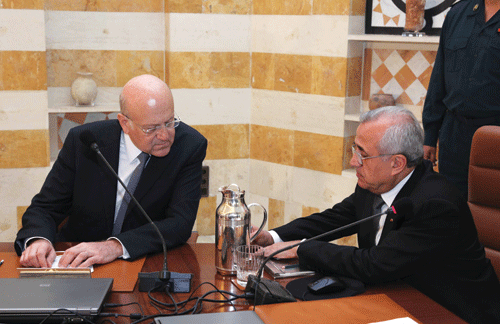
An economy that can serve the interests of all our people requires confidence. The necessary conditions for that economic confidence are both security and straight talk from those who are entrusted to protect our nation’s growth. That is why it is so damaging that no one called out the president or the prime minister for inflating Lebanon’s economic progress to the public and international community last month.

According to our Prime Minister Najib Mikati’s office, “estimated results” for last year’s economic growth have come to 5 percent and growth in the first quarter of this year increased by “leaps and bounds”. If that makes you think that one of his speechwriters has a substance abuse problem, you are not alone. No one — from the international financial institutions, to local academics, or even the humble journalists who monitor our economy — thinks growth last year exceeded 1.5 percent, not to mention those who believe the economy has been contracting since the third quarter of 2011.

Not to be outdone, at a United Nations conference last month President Michel Sleiman heralded the achievements of the agricultural sector, claiming it now makes up 6.5 percent of the economy while it had previously made up 5 percent. Of course, he neglected to mention that value added in the sector fell in 2010. There are no national accounts for 2011 and certainly not for 2012.

The relatively productive agriculture minister, Hussein Hajj Hassan, who flanked the president at the conference last month also trumpeted his ministry’s development platform for the sector, issued in 2009. A paper was issued in 2009 that contains a laundry list of issues facing the sector, followed by bullet points and badly drawn Microsoft Word Tables stuffed with the keywords governments love to use: “enhance” this, “develop” that, “reduce costs”, “create jobs”. Naturally, the only real targets in the document are those aimed at increasing staff (read: patronage) within the ministry. Since then none of the laws he proposed have passed parliament and the strategy ends next year anyway.

Instead of trumpeting overly rosy figures and touting their outstanding visions, perhaps some more humility would befit a political class that has not managed to have a census in more than 80 years, or even knows what the country’s gross domestic product, employment or inflation rates really are. The statistical, administrative and monitoring frameworks needed to accurately calculate these things are still some way off. In the meantime, there are real indicators that can be monitored in a much easier fashion to appraise the government.
Take, for instance, another half-nation of around five million hard-nosed people with limited government ability to make decisions: Scotland. In a surprisingly successful effort to reform government, the Scots have come up with a system that, on the surface, reads very much like the agriculture ministry’s ‘strategy’. Their ‘National Performance Framework’ starts with a purpose (basically ‘increasing sustainable economic growth’), drills down into five purposes of equally loose language: ‘safer & stronger’, ‘healthier’, ‘smarter’, ‘greener’, ‘wealthier & fairer’. Each category then has indicators (such as improved levels of educational attainment) and measurement criteria (such as gaps in student performance between Scotland and countries from the Organization for Economic Cooperation and Development), with progress reports posted online and updated regularly. The government doesn’t meet all of its targets, in fact they maintain the status quo much of the time, but people believe them when they succeed and listen to them when they explain why they fail. This approach to governance was a contributing factor to ruling Scottish National Party winning an outright majority in 2011 in an electoral system that was designed not to allow that to happen.

Lebanese politicians should take heed: honesty and transparency in governance builds confidence — from international institutions and partners, from the business community, and from those who are supposed to be paramount in all this, the Lebanese. When our economy is suffering, smiling to us and telling us everything is fine will not make it easier to pay rent or get a decent job. Rather, what is needed is an honest appraisal of where things are failing and what is lacking — at least then we will know where to begin to fix things.

Sami Halabi is a Masters of Public Policy candidate at the University of Edinburgh and former managing editor of Executive


November 1, 2012 0 comments
0 FacebookTwitterPinterestEmail
Society

Presidential beyond words

by Line Tabet, Zeina Loutfi & Ramsay G. Najjar November 1, 2012
written by Line Tabet, Zeina Loutfi & Ramsay G. Najjar

“Obama’s weaknesses on full display in debate”; “Obama admits debate performance a flop”; “In debate style and body language, Romney trumps Obama”.

These have been the sort of remarks making headlines since the first of the three United States presidential debates in the run-up to the vote between Democratic incumbent, President Barack Obama, and Republican candidate Governor Mitt Romney. As expected, the debate has been extensively analyzed in the hopes of predicting who might become the next American president. What was especially striking about the media coverage this time was the excessive attention given to the candidates’ physical language, across both serious and comedic media, which seems to have played a major role in their proclamation of the first debate’s winner.

While the analysis of body language might seem trivial to many, becoming the preferred subject of comedy and spoof shows, some studies have shown that only 7 percent of communication is conveyed through actual words, whereas 93 percent is nonverbal communication. The most telling and over-used example of this is the first American televised presidential debate: The 1960 Richard Nixon versus John F. Kennedy debate. It has become a popular reference that Nixon, the accomplished politician, failed to impress in the face of a young and novice candidate, mainly because he refused to wear makeup.  

Whether the above percentages are accurate or whether we agree or not with the analysis of the Nixon debate, one cannot discount the importance of body language in a public or media setting, whereby posture, facial expressions, hand gestures, voice and dress code have become key components to be taken into account, alongside messaging and content. Trying to predict the winner of the American elections through body language is no doubt a fortune telling assignment. However, given that the whole world is closely watching this event, and that all eyes are riveted on American media screens, we cannot but stop and examine the presidential and vice-presidential debates to illustrate the basics of body language and extract key takeaways, as well as some ‘Dos’ and ‘Don’ts’. Furthermore, keeping in mind that the victor of the elections may well be known by the time you read this article, it is worthwhile exploring whether all this hype about the two candidates’ nonverbal performance had any real value.

Posture: the manifestation of confidence

The reason some viewers may have confused Obama’s first presidential debate with that of a daily press briefing is because of his perceived “defeatist” attitude and posture. His body language communicated stress and anxiety: leaning on one foot, tilting his head to the side and slouching his shoulders. He came across as unsure of himself, lacking energy and outright bored. On the other hand, Romney seemed calm, projecting passion and motivation, whereby his overall posture was straight and upright, conveying confidence and poise, all of which translated into positive energy.  

Facial Expressions: telling it all at a glance

A month prior to election day with polls providing all kinds of forecasts as to voter intentions, candidates need to speak to voters and rally them, be they supporters or opponents, and especially the undecided ones they are trying to win over. Therein lies the importance of appearing to address each and every one of them. And what better way to do so than establishing eye contact so as to give every viewer the impression of being spoken to directly. Both Romney and current Vice President Joe Biden played this card successfully, as they stared straight at the camera to address voters, conveying both candor and caring. 

On the other hand, Obama’s genuine smile, one that has become his trademark over the years, looked dull and faded because of the negative energy he exuded. He was often seen pursing his lips, especially when listening to Romney’s arguments. This brings us to one of the main challenges that face incumbents during such debates: to avoid appearing condescending and patronizing or looking at their opponents with disdain and arrogance. A challenge both men failed to meet. 

Hand gestures: adding punch through motion

The art of hand gestures may seem like a secondary element of body language, one that comes naturally and spontaneously. However, it can strongly affect the image of any politician or public figure, either by making them appear tense or agitated or by adding emphasis and impact to their messages. Indeed, those with overly animated hand gestures often distract viewers, as their attention is drawn to the hand rather than the content and messages. As such, the “Golden Rule” when it comes to hand gestures is to avoid excessiveness. When it came to persuading voters with gestures, Romney outdid Obama in the first debate. Indeed, they were in sync with his speech, reaching out to his audience, creating a feeling of openness, and ultimately making some messages more memorable to the audience.

Voice: conveying impactful messages through delivery 

Recent award-winning movies, including The Iron Lady and The King’s Speech, have shown the importance of voice in conveying leadership: Margaret Thatcher in the midst of vocal training, working on the pitch of her voice to project power and authority, and the lessons of King George VI with his speech therapist to cope with his stammer. These have become iconic scenes that support the claim that voice can accentuate leadership attributes and is an effective means to influence and impact the audience. During election time, the debate’s objectives are to inspire people and mobilize them to vote. Hence the importance of one’s voice, as it transforms lexis into impactful messages and memorable sound bites through the appropriate use of pitch, tone, volume, rate and articulation. Varying the tone of voice allows one to convey dynamism and enthusiasm, which are key to emphasizing pivotal ideas.

Whereas Romney was confident in delivering his messages, speaking eloquently and clearly, Obama had a slower delivery, resorting to verbal fillers, and making long pauses. This did not play to his favor, despite succeeding in projecting empathy and compassion when he softened his tone of voice to mention his grandmother in the context of social security and his fight for the American middle class.

Dress code: the clothes that make the man

Red is typically the color of the power tie, a memo that Romney received and understood, with his dark red striped tie popping on screen during the debate, compared to Obama’s royal blue tie which blended in with the purple background and reinforced his sense of fatigue. The specific choice of color is of course not the point here; what is important to remember is that speakers must always choose attire that accentuates their presence and aura. This example confirms that dress code goes beyond style and can actually influence the image of a public figure, clearly helping to make a strong and positive impact.

Everything comes 

in pairs 

Jon Stewart dedicated an episode of his satirical show, “The Daily Show” to the exaggerated hype given to the candidates’ body language after the first debate, with some media going to extremes by counting the number of blinks for each candidate. However, this definitely subsided following the second debate, with the focus shifting toward content, arguments and promises made by each.

With the parliamentary elections in Lebanon, Jordan, Qatar and Egypt “theoretically” around the corner, potential candidates can stand to learn a lot from the US elections’ experience when it comes to polishing their body language in the hope of possibly compensating for the huge gap in their rhetoric, which remains sorely lacking. When it comes to media performance, and as the saying “everything comes in pairs” goes, it boils down to content and physical language, two ingredients that need to complement each other in order to ensure a successful recipe.

November 1, 2012 0 comments
0 FacebookTwitterPinterestEmail
Society

Szechuan in style

by Nabila Rahhal November 1, 2012
written by Nabila Rahhal

Driving down the highway from Antelias into downtown Beirut, one cannot but notice several huge billboards advertising the latest Asian cuisine restaurant, Chenbao — the Chinese word for castle. Curiosity aroused, Executive decided to pay a visit.

Chenbao is the newest conception of the Kazzami group, which brought us the high-end sushi restaurant Osaka and is planning for the opening of the Italian garden restaurant Villagio on Kantari Street, Beirut. Since Chenbao is also promoted as luxurious dining, expectations were high. Situated on the main road in Saifi Village II, with glass panels allowing diners to see the streets outside and be seen themselves by passersby, glamor is projected before you take your first step inside. 

At the entrance, Executive’s party of two is greeted by an Asian hostess wearing a Chinese-style dress, who escorts us to our table and offers us the traditional wet and warm hand towels. The restaurant’s glossy granite flooring and black and gold trimming gives off a subtly luxurious vibe, though the excessive use of dark wood finishing on the walls, perhaps meant to accentuate the Asian feel, lends a somber and somewhat heavy feel to the place. The tables and chairs are placed at such angles so as to allow enough privacy for the diners’ conversations while at the same time allowing them to see most everyone in the spacious setting. The dark wood tables themselves are artfully set with little flowers on the chopsticks holders and upholstered, cream-white chairs prove comfortable for the meal. (An interesting feature of Chenbao, showing particular sensitivity on the owner’s part, is the electric sliding chair attached to the stairs leading to the bathroom — a facility for the disabled, the elderly and those too full to walk down the stairs.)
Menus are provided minutes after we’re seated by another Asian waitress who remains attentive throughout the dining experience, refilling water glasses and removing empty plates almost as soon as the last bite is taken.

sweet and sour
Prepared by the experienced Malaysian chef Eddie Chua, the menu offers traditional Chinese fare, from Szechuan-flavored stir fried meats to rice and noodles, as well as Thai fusion dishes. Matching the high-end image of the restaurant are the prices. A single serving of vegetable noodles costs $11, appetizers are between $20 and $25, and main dishes are as much as $40 if one orders seafood. Upon the waitress’s recommendation, we ordered the wasabi prawns as appetizers, the chicken cashew nuts with vegetables noodles for the main course and finished up with jasmine flavored macaroons — totalling $85 for two, drinks excluded. The artistically arranged dishes of generous portions arrive in perfect sequence, one after the other — the wasabi prawns drizzled in cream sauce offered a unique, harmonious blend between the spicy and sweet adjuncts to the shellfish; the chicken a light and pleasant, if somewhat uninspired, main dish in terms of Chinese cuisine, while the jasmine macaroons were the highlight of the meal, a bouquet of the sweet and the bitter to wrap up the flavor experience.

Having arrived at 9 pm, new customers were still coming in two hours later when we left, keeping the place half full at all times. The clientèle were mainly young professionals, between the ages of 30 and 40, who, according to those who sat around us, were also prompted by the billboard advertisements. 

In the months to come, the tables at Chenbao will likely continue to be filled with inquisitive patrons out to see what all the fuss is about, and while they will certainly not be disappointed by the ambiance and the service, some dishes will have to find a stronger identity to pull their weight in an establishment banking its reputation on high-end and original cuisine.
 

November 1, 2012 0 comments
0 FacebookTwitterPinterestEmail
Comment

Battle of the drones

by Nicholas Blanford November 1, 2012
written by Nicholas Blanford

The unmanned aerial vehicle (UAV), or drone, Hezbollah dispatched to fly over southern Israel in October carried a couple of messages.

First, it was intended to remind Lebanon and Israel that Hezbollah’s main focus remains the confrontation with the Jewish state and not the conflict in Syria. The drone’s flight occurred amid increased reports of Hezbollah’s alleged assistance to the regime of President Bashar al-Assad, including sending fighters to Syria to fight the rebel Free Syrian Army (FSA) and train the regular Syrian army in urban warfare. This assistance would contradict the Lebanese government’s policy of disassociation with the war in Syria, though Hezbollah is not the only Lebanese faction operating there — several hundred Sunni Lebanese have reportedly joined the FSA and there are logistical support networks for the Syrian rebels in parts of the northern Bekaa and Akkar regions of Lebanon.

Still, amid such controversy, Hezbollah appears to have decided to switch attention away from Syria and redirect it toward Israel. It worked, at least in the sense that the drone captured headlines for a few days.

The drone’s flight over southern Israel was also a demonstration of Hezbollah’s evolving technical capabilities. It flew a drone for the first time in Israeli airspace in November 2004. That drone, an Iranian Ababil-T, was launched near Naqoura, crossed undetected into Israel and reached near Haifa during its 18-minute flight before returning to Lebanon. The Israelis never spotted it.

Hezbollah sent a second drone over Israel six months later; it also used them in the 2006 war with one drone shot down off the Israeli coast and another off the Tyre peninsula.

However, the drone that ploughed the skies above southern Israel was far more sophisticated than the Ababil-T, which lacks the range to reach the Negev desert from Lebanon — if indeed that was the origin of the UAV. Although Sayyed Hassan Nasrallah, Hezbollah’s secretary-general, admitted that his group was responsible for the flight and Hezbollah-affiliated Al Manar broadcast graphics indicating part of the flight path, the incident remains dogged by uncertainty. Nasrallah said that the drone was launched from Lebanon but did not pinpoint the precise location. The United Nations Interim Force in Lebanon (UNIFIL) said it did not detect the drone, neither on its ground radars in south Lebanon nor on the shipboard radars of the Maritime Task Force, the naval component of the peacekeeping force. That suggests that the drone was small enough or flying low enough to avoid detection. Alternatively, it never flew from Lebanon in the first place.

The guidance system remains unknown as well. Drones are usually controlled by one of two means: either by an operator using radio or satellite signals to directly steer the UAV on its course or by installing a preprogrammed flight plan. The UAV, if launched from Lebanon, was operating beyond the range of radio control, suggesting it was following an autonomous preprogrammed flight plan or it was being guided by satellite signals. If the latter, that would suggest a whole new level of technological advancement for Hezbollah and Iran.

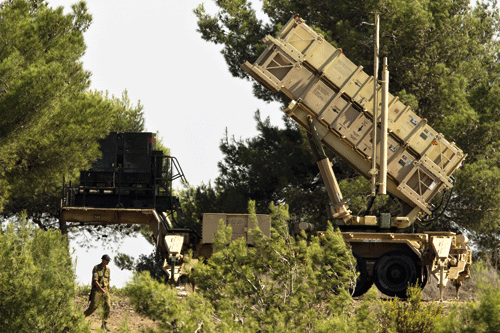
The Israelis said that they picked up the drone when it was still flying over the Mediterranean but decided to tail it until it crossed over empty terrain before shooting it down. Iran and Hezbollah claimed that the drone in fact slipped into Israeli airspace undetected, thus proving the inadequacy of Israel’s air defense systems. As usual, it is difficult to be certain which version is correct. If Israel really detected the drone over the sea and chose to follow it, that would be a first. Usually, Israel shoots down unauthorized aircraft.

It has been speculated, however, that the Israelis attempted to interfere electronically with the UAV to bring it down safely so that it could be examined. Hezbollah is believed to have done something similar a year ago when an Israeli drone mysteriously vanished over south Lebanon after UNIFIL radars saw it floating to the ground. The Israelis appear to have been not so lucky as their Hezbollah foes. When the Israeli cyber interception failed, the drone was shot down so that at least the debris could be salvaged for inspection.

The unusual incident goes to show that even though the Lebanon-Israel border has remained relatively calm for more than six years, the conflict between Hezbollah and the Jewish state continues to rage on the technological front of cyber-warfare and signals intelligence.


Nicholas Blanford  is the Beirut-based correspondent for The Christian Science Monitor and The Times of London

 
November 1, 2012 0 comments
0 FacebookTwitterPinterestEmail
Comment

Tweeted into shame

by Paul Cochrane November 1, 2012
written by Paul Cochrane

Social media’s role in bringing about progressive change is a hot topic in the Middle East as much as, if not more than, elsewhere given the ongoing debate about its use in the Arab uprisings. On a collective level it is hard to gauge due to the multitude of factors that contribute to people taking to the streets —  mass demonstrations can and of course have happened without any social media — but when it comes to smaller, localized events social media’s power is clear. The online exposure last month of a Middle East Airlines (MEA) employee’s racist remarks toward Asian passengers is a clear case, and one that other companies should take heed of if they don’t want their name or brand dragged through the mud. 

In early October, passengers were waiting in Rafiq Hariri International Airport at a departure gate for a flight to Dubai, including a group of Nepalese women, when a MEA employee got on the public announcement system and said, “Filipino people, stop talking.” The woman told the “Filipinos” to stop talking twice more, giggling as she did so and goaded on by a male colleague. 

The incident outraged fellow passenger Abed Shaheen, who tried unsuccessfully to make a complaint. In the past Shaheen might have told just family, friends and colleagues about the incident, and his complaints would have had minimal if any effect. In our new world of social media, Shaheen wrote about the experience on Facebook and Twitter. The story was quickly shared and within three days 1,600 people had signed a petition on change.org, calling for “MEA to apologize publicly for their staff’s behavior.” 

The media promptly picked up the story as well, initially in Lebanon and then abroad. Under fire, MEA eventually came out to say they had launched an investigation, and the employee was first “disciplined,” then reportedly fired.

While justice has arguably been done, and a strong message sent to MEA staff to think before they speak, MEA’s reputation has been negatively impacted. A scroll through the 200 plus comments following the airline’s apology on its Facebook page shows a great deal of animosity toward MEA: “service sucks,”  “airline crew impolite” and, more worryingly for the carrier in these difficult financial times, is the number of people that wrote they would “vote with their feet” by no longer flying with MEA. Judging from the comments, many Lebanese opt for MEA out of solidarity with the nation’s carrier, despite its invariably higher ticket price. But patriotism only goes so far, and this incident will no doubt lose the airline old as well as potentially new passengers. 

MEA, and subsidiary MEAG that runs the airport, say they have gone beyond “damage control” mode and made effective changes that can be immediately seen; this includes mandating that staff be trained to treat everyone equally and respectfully, as paying customers. Numerous times on flights to the Gulf and East Africa, acquaintances and I have seen African and Asian passengers seated together at the back of the plane away from passengers despite numerous seats being available. This happens too often to be coincidence and the check-in staff, by designating seats in this way, creates segregation. Such a policy is racist, and even more insulting when it occurs on the national airline of the segregated passengers, such as Ethiopian Airlines. This has to change.

Then there is the small boxy room that domestic workers are forced to wait in upon arrival at Beirut airport until their new employers come to collect them, rather than being met like everybody else in the arrivals lounge. It is reminiscent of a prison with inmates awaiting bail. For many of these women, it is the first time out of their country; they are unsure, scared perhaps about what’s next, and they should be treated in a more dignified manner. Both MEA and the airport are, after all, people’s first impressions of the country, no matter where a passenger is from, and customer service should reflect that. 

Ultimately, MEA has now put itself under the spotlight of social media, and activists will be on the lookout for further misdemeanors. It is a useful lesson for MEA to change its policies and better manage employee behavior, as well as for other companies to realize the power of social media to hold them to account.


Paul Cochrane is the Middle East correspondent for International News Services


November 1, 2012 0 comments
0 FacebookTwitterPinterestEmail
Comment

An offer they can’t refuse

by Farea al-Muslimi November 1, 2012
written by Farea al-Muslimi


In gangster movies, a classic scene is for a mafia boss to greet someone warmly with his right hand, then wink to one of his bodyguards on the side and say “kill him”. Minus the cinematography, this is how many Yemenis perceive the international community’s role in the transition of their country today. 

Earlier this year, Yemenis generally welcomed the role of the international community — via the Gulf Cooperation Council (GCC) sponsored deal that saw former President Ali Abdullah Saleh exit power and thereby avert an imminent civil war — because they thought it paralleled their national interest. Since then, however, the realization has come for many that the international community’s commitment to Yemen’s interests, unity, democratic development and prosperity does not extend beyond press releases; rather, foreign powers now seem to be paralyzing progress and hijacking Yemen’s nation building. 

Publicly, Western countries, the GCC and others have voiced much hope — as have Yemenis — in the country’s National Dialogue conference, which is meant to bring together representatives from all of Yemen’s various groups and factions to come up with a road map for the country’s future. To this end the international community has provided political and technical support, mainly through United Nations agencies, to prepare for the conference (previously scheduled for mid-November, but now postponed to a later date). However, other actions (and inactions) by foreign powers are at the same time sabotaging this attempt at national reconciliation.  

Powerful local stakeholders — including former President Saleh himself, the influential Ahmar tribe, and others — remain able to hinder the country’s transition in order to preserve their own power, and while the United Nations Security Council (UNSC) has threatened them with sanctions, none have been forthcoming. In fact, member countries of the UNSC continue to actively deal with these sorts of local players. The GCC-sponsored agreement this year also succeeded, in large part, because it went out of its way to address the concerns of powerful local players, rather than the concerns of average Yemenis; this had the effect of empowering these divisive groups with local clout that they will be able to exercise at the upcoming national dialogue. 

One of the Yemeni revolution’s core goals was the restructuring of the military, which became a key article in the GCC deal. The United States has taken a lead role in this task, but in such a way that the Yemeni military is looking more like an extension of the US army in Yemen. This is both because of an intense American public relations campaign, as well as the Yemeni military’s facilitation of un-manned American drone strikes and US and British special operations in parts of Yemen under the guise of ‘counter-terrorism’. 

Whatever the military justification, American drone strikes have killed hundreds of civilians and injured many more. Yemen’s new president, Abdu Rabbu Mansour Hadi, rather than condemn the strikes has in fact endorsed them, marring his legitimacy amongst Yemenis and making him look like an American puppet. That he reports to the ‘international community’ that brought him to power, rather than his citizenry, is a definite problem. Hadi remains, however, generally favored among the population relative to possible alternatives; his presidency, along with the appointment of Morocco’s Jamal Benomar, a former human rights campaigner, as UN envoy to Yemen, constitute the most positive initiatives of the international community to date.  

US support for the “Public Committees”, or civilian militias, in South Yemen, is also dangerously shortsighted. While America’s aim is to enlist local help in the battle against Al Qaeda in the Arabian Peninsula, supporting powerful non-state actors and armies implicitly undermines the state, especially in South Yemen where there is a fervent secessionist movement that will turn that same support against the central government. 

South Yemen is also now a battleground in a wider geopolitical struggle. The frequency of sectarian clashes — mainly between Houthi groups and the Islah (or Muslim Brotherhood) — have been on the upswing as Iran and Saudi Arabia escalate their proxy war through local tribal and political groups, each offering cash, support and media backing.

With all this foreign money flowing in, one has to wonder why humanitarian aid organizations in Yemen are still suffering a funding crisis, reporting that cumulatively they have less than 50 percent of the cash they need to run their operations; this leaves, among other things, 10 million Yemenis going to bed hungry every night.

There is little wonder why then, when the international community comes with its hand extended, Yemen braces for the wink. 


Farea al-Muslimi is a Yemeni activist and writer for Almasdar

November 1, 2012 0 comments
0 FacebookTwitterPinterestEmail
The Buzz

Morning briefing: 31 Oct 2012

by Executive Staff October 31, 2012
written by Executive Staff

Economics

The prime minister of the United Arab Emirates has announced approval of a 2013 federal budget that is heavy on social spending but without the deficits of the last two years.

More from Arabian Business


The Egyptian government has decided to allow residents of Sinai to own their land in the peninsula, state media has reported. According to Prime Minister Hisham Qandil, applicants need to prove they do not have a second nationality, and confirm that both their parents are Egyptian.

More from AME Info


Iran banned the export of around 50 basic goods, its media said on Tuesday, as the country takes steps to preserve supplies of essential items in the face of tightening Western sanctions. The Islamic Republic is under intense financial pressure from US and European trade restrictions imposed over its disputed nuclear programme.

More from Reuters


Egypt has unveiled plans to set up two industrial zones in Algeria and Ethiopia, in an effort to boost economic ties with African countries. The Ethiopian government said it would grant Egypt one million square meters of land on which to establish an industrial zone.

More from AME Info


Lebanese state electricity company Electricite du Liban has warned against the increasing phenomenon of cable theft, saying in the long run it would affect power rationing in areas where it is on the rise.

More from The Daily Star


Companies

Passenger traffic at Dubai International Airport climbed 12.8 per cent from a year earlier in September, as a larger flow of European travellers offset a drop in traffic on some Middle Eastern routes due to turmoil in countries such as Syria.

More from Gulf Business


Starbucks Coffee has launched a bilingual website for the Middle East and North Africa.

More from AME Info


District cooling firm Tabreed, part-owned by Abu Dhabi state fund Mubadala, reported a 35 percent rise in quarterly net profit on Wednesday, helped by growth in its core chilled water business and lower financing costs.

More from Arabian Business


October 31, 2012 0 comments
0 FacebookTwitterPinterestEmail
  • 1
  • …
  • 304
  • 305
  • 306
  • 307
  • 308
  • …
  • 686

Latest Cover

About us

Since its first edition emerged on the newsstands in 1999, Executive Magazine has been dedicated to providing its readers with the most up-to-date local and regional business news. Executive is a monthly business magazine that offers readers in-depth analyses on the Lebanese world of commerce, covering all the major sectors – from banking, finance, and insurance to technology, tourism, hospitality, media, and retail.

  • Donate
  • Our Purpose
  • Contact Us

Sign up for our newsletter

    • Facebook
    • Twitter
    • Instagram
    • Linkedin
    • Youtube
    Executive Magazine
    • ISSUES
      • Current Issue
      • Past issues
    • BUSINESS
    • ECONOMICS & POLICY
    • OPINION
    • SPECIAL REPORTS
    • EXECUTIVE TALKS
    • MOVEMENTS
      • Change the image
      • Cannes lions
      • Transparency & accountability
      • ECONOMIC ROADMAP
      • Say No to Corruption
      • The Lebanon media development initiative
      • LPSN Policy Asks
      • Advocating the preservation of deposits
    • JOIN US
      • Join our movement
      • Attend our events
      • Receive updates
      • Connect with us
    • DONATE