• Donate
  • Our Purpose
  • Contact Us
Executive Magazine
  • ISSUES
    • Current Issue
    • Past issues
  • BUSINESS
  • ECONOMICS & POLICY
  • OPINION
  • SPECIAL REPORTS
  • EXECUTIVE TALKS
  • MOVEMENTS
    • Change the image
    • Cannes lions
    • Transparency & accountability
    • ECONOMIC ROADMAP
    • Say No to Corruption
    • The Lebanon media development initiative
    • LPSN Policy Asks
    • Advocating the preservation of deposits
  • JOIN US
    • Join our movement
    • Attend our events
    • Receive updates
    • Connect with us
  • DONATE
Society

Presidential beyond words

by Line Tabet, Zeina Loutfi & Ramsay G. Najjar November 1, 2012
written by Line Tabet, Zeina Loutfi & Ramsay G. Najjar

“Obama’s weaknesses on full display in debate”; “Obama admits debate performance a flop”; “In debate style and body language, Romney trumps Obama”.

These have been the sort of remarks making headlines since the first of the three United States presidential debates in the run-up to the vote between Democratic incumbent, President Barack Obama, and Republican candidate Governor Mitt Romney. As expected, the debate has been extensively analyzed in the hopes of predicting who might become the next American president. What was especially striking about the media coverage this time was the excessive attention given to the candidates’ physical language, across both serious and comedic media, which seems to have played a major role in their proclamation of the first debate’s winner.

While the analysis of body language might seem trivial to many, becoming the preferred subject of comedy and spoof shows, some studies have shown that only 7 percent of communication is conveyed through actual words, whereas 93 percent is nonverbal communication. The most telling and over-used example of this is the first American televised presidential debate: The 1960 Richard Nixon versus John F. Kennedy debate. It has become a popular reference that Nixon, the accomplished politician, failed to impress in the face of a young and novice candidate, mainly because he refused to wear makeup.  

Whether the above percentages are accurate or whether we agree or not with the analysis of the Nixon debate, one cannot discount the importance of body language in a public or media setting, whereby posture, facial expressions, hand gestures, voice and dress code have become key components to be taken into account, alongside messaging and content. Trying to predict the winner of the American elections through body language is no doubt a fortune telling assignment. However, given that the whole world is closely watching this event, and that all eyes are riveted on American media screens, we cannot but stop and examine the presidential and vice-presidential debates to illustrate the basics of body language and extract key takeaways, as well as some ‘Dos’ and ‘Don’ts’. Furthermore, keeping in mind that the victor of the elections may well be known by the time you read this article, it is worthwhile exploring whether all this hype about the two candidates’ nonverbal performance had any real value.

Posture: the manifestation of confidence

The reason some viewers may have confused Obama’s first presidential debate with that of a daily press briefing is because of his perceived “defeatist” attitude and posture. His body language communicated stress and anxiety: leaning on one foot, tilting his head to the side and slouching his shoulders. He came across as unsure of himself, lacking energy and outright bored. On the other hand, Romney seemed calm, projecting passion and motivation, whereby his overall posture was straight and upright, conveying confidence and poise, all of which translated into positive energy.  

Facial Expressions: telling it all at a glance

A month prior to election day with polls providing all kinds of forecasts as to voter intentions, candidates need to speak to voters and rally them, be they supporters or opponents, and especially the undecided ones they are trying to win over. Therein lies the importance of appearing to address each and every one of them. And what better way to do so than establishing eye contact so as to give every viewer the impression of being spoken to directly. Both Romney and current Vice President Joe Biden played this card successfully, as they stared straight at the camera to address voters, conveying both candor and caring. 

On the other hand, Obama’s genuine smile, one that has become his trademark over the years, looked dull and faded because of the negative energy he exuded. He was often seen pursing his lips, especially when listening to Romney’s arguments. This brings us to one of the main challenges that face incumbents during such debates: to avoid appearing condescending and patronizing or looking at their opponents with disdain and arrogance. A challenge both men failed to meet. 

Hand gestures: adding punch through motion

The art of hand gestures may seem like a secondary element of body language, one that comes naturally and spontaneously. However, it can strongly affect the image of any politician or public figure, either by making them appear tense or agitated or by adding emphasis and impact to their messages. Indeed, those with overly animated hand gestures often distract viewers, as their attention is drawn to the hand rather than the content and messages. As such, the “Golden Rule” when it comes to hand gestures is to avoid excessiveness. When it came to persuading voters with gestures, Romney outdid Obama in the first debate. Indeed, they were in sync with his speech, reaching out to his audience, creating a feeling of openness, and ultimately making some messages more memorable to the audience.

Voice: conveying impactful messages through delivery 

Recent award-winning movies, including The Iron Lady and The King’s Speech, have shown the importance of voice in conveying leadership: Margaret Thatcher in the midst of vocal training, working on the pitch of her voice to project power and authority, and the lessons of King George VI with his speech therapist to cope with his stammer. These have become iconic scenes that support the claim that voice can accentuate leadership attributes and is an effective means to influence and impact the audience. During election time, the debate’s objectives are to inspire people and mobilize them to vote. Hence the importance of one’s voice, as it transforms lexis into impactful messages and memorable sound bites through the appropriate use of pitch, tone, volume, rate and articulation. Varying the tone of voice allows one to convey dynamism and enthusiasm, which are key to emphasizing pivotal ideas.

Whereas Romney was confident in delivering his messages, speaking eloquently and clearly, Obama had a slower delivery, resorting to verbal fillers, and making long pauses. This did not play to his favor, despite succeeding in projecting empathy and compassion when he softened his tone of voice to mention his grandmother in the context of social security and his fight for the American middle class.

Dress code: the clothes that make the man

Red is typically the color of the power tie, a memo that Romney received and understood, with his dark red striped tie popping on screen during the debate, compared to Obama’s royal blue tie which blended in with the purple background and reinforced his sense of fatigue. The specific choice of color is of course not the point here; what is important to remember is that speakers must always choose attire that accentuates their presence and aura. This example confirms that dress code goes beyond style and can actually influence the image of a public figure, clearly helping to make a strong and positive impact.

Everything comes 

in pairs 

Jon Stewart dedicated an episode of his satirical show, “The Daily Show” to the exaggerated hype given to the candidates’ body language after the first debate, with some media going to extremes by counting the number of blinks for each candidate. However, this definitely subsided following the second debate, with the focus shifting toward content, arguments and promises made by each.

With the parliamentary elections in Lebanon, Jordan, Qatar and Egypt “theoretically” around the corner, potential candidates can stand to learn a lot from the US elections’ experience when it comes to polishing their body language in the hope of possibly compensating for the huge gap in their rhetoric, which remains sorely lacking. When it comes to media performance, and as the saying “everything comes in pairs” goes, it boils down to content and physical language, two ingredients that need to complement each other in order to ensure a successful recipe.

November 1, 2012 0 comments
0 FacebookTwitterPinterestEmail
Society

Szechuan in style

by Nabila Rahhal November 1, 2012
written by Nabila Rahhal

Driving down the highway from Antelias into downtown Beirut, one cannot but notice several huge billboards advertising the latest Asian cuisine restaurant, Chenbao — the Chinese word for castle. Curiosity aroused, Executive decided to pay a visit.

Chenbao is the newest conception of the Kazzami group, which brought us the high-end sushi restaurant Osaka and is planning for the opening of the Italian garden restaurant Villagio on Kantari Street, Beirut. Since Chenbao is also promoted as luxurious dining, expectations were high. Situated on the main road in Saifi Village II, with glass panels allowing diners to see the streets outside and be seen themselves by passersby, glamor is projected before you take your first step inside. 

At the entrance, Executive’s party of two is greeted by an Asian hostess wearing a Chinese-style dress, who escorts us to our table and offers us the traditional wet and warm hand towels. The restaurant’s glossy granite flooring and black and gold trimming gives off a subtly luxurious vibe, though the excessive use of dark wood finishing on the walls, perhaps meant to accentuate the Asian feel, lends a somber and somewhat heavy feel to the place. The tables and chairs are placed at such angles so as to allow enough privacy for the diners’ conversations while at the same time allowing them to see most everyone in the spacious setting. The dark wood tables themselves are artfully set with little flowers on the chopsticks holders and upholstered, cream-white chairs prove comfortable for the meal. (An interesting feature of Chenbao, showing particular sensitivity on the owner’s part, is the electric sliding chair attached to the stairs leading to the bathroom — a facility for the disabled, the elderly and those too full to walk down the stairs.)
Menus are provided minutes after we’re seated by another Asian waitress who remains attentive throughout the dining experience, refilling water glasses and removing empty plates almost as soon as the last bite is taken.

sweet and sour
Prepared by the experienced Malaysian chef Eddie Chua, the menu offers traditional Chinese fare, from Szechuan-flavored stir fried meats to rice and noodles, as well as Thai fusion dishes. Matching the high-end image of the restaurant are the prices. A single serving of vegetable noodles costs $11, appetizers are between $20 and $25, and main dishes are as much as $40 if one orders seafood. Upon the waitress’s recommendation, we ordered the wasabi prawns as appetizers, the chicken cashew nuts with vegetables noodles for the main course and finished up with jasmine flavored macaroons — totalling $85 for two, drinks excluded. The artistically arranged dishes of generous portions arrive in perfect sequence, one after the other — the wasabi prawns drizzled in cream sauce offered a unique, harmonious blend between the spicy and sweet adjuncts to the shellfish; the chicken a light and pleasant, if somewhat uninspired, main dish in terms of Chinese cuisine, while the jasmine macaroons were the highlight of the meal, a bouquet of the sweet and the bitter to wrap up the flavor experience.

Having arrived at 9 pm, new customers were still coming in two hours later when we left, keeping the place half full at all times. The clientèle were mainly young professionals, between the ages of 30 and 40, who, according to those who sat around us, were also prompted by the billboard advertisements. 

In the months to come, the tables at Chenbao will likely continue to be filled with inquisitive patrons out to see what all the fuss is about, and while they will certainly not be disappointed by the ambiance and the service, some dishes will have to find a stronger identity to pull their weight in an establishment banking its reputation on high-end and original cuisine.
 

November 1, 2012 0 comments
0 FacebookTwitterPinterestEmail
Comment

Battle of the drones

by Nicholas Blanford November 1, 2012
written by Nicholas Blanford

The unmanned aerial vehicle (UAV), or drone, Hezbollah dispatched to fly over southern Israel in October carried a couple of messages.

First, it was intended to remind Lebanon and Israel that Hezbollah’s main focus remains the confrontation with the Jewish state and not the conflict in Syria. The drone’s flight occurred amid increased reports of Hezbollah’s alleged assistance to the regime of President Bashar al-Assad, including sending fighters to Syria to fight the rebel Free Syrian Army (FSA) and train the regular Syrian army in urban warfare. This assistance would contradict the Lebanese government’s policy of disassociation with the war in Syria, though Hezbollah is not the only Lebanese faction operating there — several hundred Sunni Lebanese have reportedly joined the FSA and there are logistical support networks for the Syrian rebels in parts of the northern Bekaa and Akkar regions of Lebanon.

Still, amid such controversy, Hezbollah appears to have decided to switch attention away from Syria and redirect it toward Israel. It worked, at least in the sense that the drone captured headlines for a few days.

The drone’s flight over southern Israel was also a demonstration of Hezbollah’s evolving technical capabilities. It flew a drone for the first time in Israeli airspace in November 2004. That drone, an Iranian Ababil-T, was launched near Naqoura, crossed undetected into Israel and reached near Haifa during its 18-minute flight before returning to Lebanon. The Israelis never spotted it.

Hezbollah sent a second drone over Israel six months later; it also used them in the 2006 war with one drone shot down off the Israeli coast and another off the Tyre peninsula.

However, the drone that ploughed the skies above southern Israel was far more sophisticated than the Ababil-T, which lacks the range to reach the Negev desert from Lebanon — if indeed that was the origin of the UAV. Although Sayyed Hassan Nasrallah, Hezbollah’s secretary-general, admitted that his group was responsible for the flight and Hezbollah-affiliated Al Manar broadcast graphics indicating part of the flight path, the incident remains dogged by uncertainty. Nasrallah said that the drone was launched from Lebanon but did not pinpoint the precise location. The United Nations Interim Force in Lebanon (UNIFIL) said it did not detect the drone, neither on its ground radars in south Lebanon nor on the shipboard radars of the Maritime Task Force, the naval component of the peacekeeping force. That suggests that the drone was small enough or flying low enough to avoid detection. Alternatively, it never flew from Lebanon in the first place.

The guidance system remains unknown as well. Drones are usually controlled by one of two means: either by an operator using radio or satellite signals to directly steer the UAV on its course or by installing a preprogrammed flight plan. The UAV, if launched from Lebanon, was operating beyond the range of radio control, suggesting it was following an autonomous preprogrammed flight plan or it was being guided by satellite signals. If the latter, that would suggest a whole new level of technological advancement for Hezbollah and Iran.

The Israelis said that they picked up the drone when it was still flying over the Mediterranean but decided to tail it until it crossed over empty terrain before shooting it down. Iran and Hezbollah claimed that the drone in fact slipped into Israeli airspace undetected, thus proving the inadequacy of Israel’s air defense systems. As usual, it is difficult to be certain which version is correct. If Israel really detected the drone over the sea and chose to follow it, that would be a first. Usually, Israel shoots down unauthorized aircraft.

It has been speculated, however, that the Israelis attempted to interfere electronically with the UAV to bring it down safely so that it could be examined. Hezbollah is believed to have done something similar a year ago when an Israeli drone mysteriously vanished over south Lebanon after UNIFIL radars saw it floating to the ground. The Israelis appear to have been not so lucky as their Hezbollah foes. When the Israeli cyber interception failed, the drone was shot down so that at least the debris could be salvaged for inspection.

The unusual incident goes to show that even though the Lebanon-Israel border has remained relatively calm for more than six years, the conflict between Hezbollah and the Jewish state continues to rage on the technological front of cyber-warfare and signals intelligence.


Nicholas Blanford  is the Beirut-based correspondent for The Christian Science Monitor and The Times of London

 
November 1, 2012 0 comments
0 FacebookTwitterPinterestEmail
The Buzz

Morning briefing: 31 Oct 2012

by Executive Staff October 31, 2012
written by Executive Staff

Economics

The prime minister of the United Arab Emirates has announced approval of a 2013 federal budget that is heavy on social spending but without the deficits of the last two years.

More from Arabian Business


The Egyptian government has decided to allow residents of Sinai to own their land in the peninsula, state media has reported. According to Prime Minister Hisham Qandil, applicants need to prove they do not have a second nationality, and confirm that both their parents are Egyptian.

More from AME Info


Iran banned the export of around 50 basic goods, its media said on Tuesday, as the country takes steps to preserve supplies of essential items in the face of tightening Western sanctions. The Islamic Republic is under intense financial pressure from US and European trade restrictions imposed over its disputed nuclear programme.

More from Reuters


Egypt has unveiled plans to set up two industrial zones in Algeria and Ethiopia, in an effort to boost economic ties with African countries. The Ethiopian government said it would grant Egypt one million square meters of land on which to establish an industrial zone.

More from AME Info


Lebanese state electricity company Electricite du Liban has warned against the increasing phenomenon of cable theft, saying in the long run it would affect power rationing in areas where it is on the rise.

More from The Daily Star


Companies

Passenger traffic at Dubai International Airport climbed 12.8 per cent from a year earlier in September, as a larger flow of European travellers offset a drop in traffic on some Middle Eastern routes due to turmoil in countries such as Syria.

More from Gulf Business


Starbucks Coffee has launched a bilingual website for the Middle East and North Africa.

More from AME Info


District cooling firm Tabreed, part-owned by Abu Dhabi state fund Mubadala, reported a 35 percent rise in quarterly net profit on Wednesday, helped by growth in its core chilled water business and lower financing costs.

More from Arabian Business


October 31, 2012 0 comments
0 FacebookTwitterPinterestEmail
The Buzz

Morning briefing: 30 Oct 2012

by Executive Staff October 30, 2012
written by Executive Staff

Economics

Gold edged down on Tuesday, heading for its biggest monthly loss since May, after disappointing corporate earnings prompted investors to sell holdings to cover losses in other markets, which have been hurt by global economic uncertainty.

More from Arabian Business


Construction labor costs in Saudi Arabia are the highest in the GCC, a new research report has said. Labor costs in the Kingdom are on average 18 per cent higher than in the UAE, and 51 per cent greater than in Qatar, says the Q3 construction costs report by MEED.

More from Gulf Business


Most Arab oil exporting countries in the Gulf should plan to reduce growth in government spending to make their budgets more sustainable, as their combined surplus could turn into a deficit around 2017, the International Monetary Fund said on Monday.

More from Gulf Business


Fitch Ratings put Kuwait on warning that a further escalation of political protests there could put its AA sovereign credit rating under pressure for a downgrade despite the nation’s strong balance sheet.

More from The Daily Star


Companies

Big data will drive $28bn of worldwide IT spending in 2012, according to global technology giant Gartner, Inc. In 2013, the company forecast that big data would drive $34bn of IT spending.

More from AME Info


A consortium of Turkish, Saudi and Bahraini businessmen have received the necessary approval to proceed with a multimillion dollar marina development on the Muharraq coastline.

More from AME Info


Bank of Sharjah has released its financial results for the January to September period showing a one per cent rise in net profit on last year.

More from Gulf Business


Politics

Two Iranian warships docked in Sudan on Monday, Iran's official IRNA news agency reported, less than a week after Khartoum accused Israel of attacking an arms factory in the Sudanese capital.

More from Arabian Business

October 30, 2012 0 comments
0 FacebookTwitterPinterestEmail
The Buzz

Morning briefing: 29 Oct 2012

by Executive Staff October 29, 2012
written by Executive Staff

Economics

Oil slipped on Monday, with Brent near $109 a barrel, as refineries along the US East Coast lowered run rates ahead of approaching Hurricane Sandy, reducing crude use in the world’s largest oil consumer.

More from Gulf Business


Egyptian President Mohammed Morsi's next step on the road to salvaging the country's struggling economy will be to cut energy costs with a nationwide curfew for restaurants and shops.

More from The National


Iran's exports of condensates amounted to more than $1 billion in the last month, a customs official was quoted as saying on Saturday, softening the blow of Western sanctions on its crude oil sales.

More from The Daily Star


Iraq's National Investment Commission has said foreign investment in the country is set to drop slightly to $35bn this year, as potential investors, including its Gulf neighbours, hesitate in the face of the continuing regional tensions and political insecurity.

More from AME Info


According to a report by the Qatar Statistics Authority (QSA), unemployment in the country has dropped by 22.8% over the past 10 years, but the gender gap in terms of average wages increased considerably. 

More from AME Info


Companies

Moorfields Eye Hospital Dubai, (Moorfields) the first overseas branch of the world renowned Moorfields London eye hospital, has announced the appointment of Mr Mariano Gonzalez as its new Managing Director. .

More from AME Info


Dubai-based entertainment venue Global Village announced that it has welcomed over 600,000 visitors since opening on October 21.

More from Gulf Business


UAE-based telelcommunications giant Etisalat has said it expects a shakeout in the sector to throw up takeover opportunities in the next 18 months and wants to be ready.

More from AME Info


The number of Twitter users in Bahrain grew by 39% in the last six months, as companies seek to exploit the web to attract more business, according to the Social Media Club in the country.

More from AME Info


Politics

The Federal National Council said the European Parliament should have given the UAE an opportunity to explain its view on human rights issues "instead of listening to biased reports that contain many baseless allegations and inaccurate information about the real situation in the UAE", the state news agency Wam reported.

More from The National


October 29, 2012 0 comments
0 FacebookTwitterPinterestEmail
The Buzz

Morning briefing: 26 Oct 2012

by Executive Staff October 26, 2012
written by Executive Staff

Economics

Brent crude oil rose above $108 per barrel on Thursday, consolidating after seven days of falls as better-than-expected data suggested the world economy was recovering, but analysts said the overall outlook for oil prices was bearish.

More from Arabian Business


Olympics spending fuelled Britain’s strongest quarterly growth in five years, springboarding the country out of recession in the third quarter, data showed on Thursday

It provided some rare relief for a government accused of favouring austerity over growth, and may make another stimulus injection of cash from the central bank less likely.

More from Khaleej Times


The smoking ban, weak tourism season and the tense situation in Lebanon are prompting some restaurants to either close down or lay off most of their staff to cut growing losses, owners of eateries and hotels said Thursday.

More from The Daily Star


Bank of Beirut's unaudited net profits in the first nine months of this year rose by 3.42 percent to reach $78.67 million.

More from The Daily Star


The world's spare oil production capacity outside of Iran rose in last two months as gasoline demand waned in the United States and oil use for power generation fell in the Middle East, the US government said in a bimonthly report.

More from Arabian Business
 

Politics

Sudan has said it intends to complain to the UN over an explosion at an arms factory that it claims was caused by an Israeli air strike.

Sudan's UN envoy Daffa-Alla Elhag Ali Osman said Israel had violated Sudanese air space three times in recent years.

More from the BBC

Saudi Arabia has expelled three people working at Syria's consulate in Jeddah, a new sign of ill feeling between the countries as Riyadh backs rebels fighting President Bashar al-Assad's government in Damascus.

More from Arabian Business

October 26, 2012 0 comments
0 FacebookTwitterPinterestEmail
The Buzz

Syria: Mapping the exodus

by Benjamin Redd October 25, 2012
written by Benjamin Redd

The United Nations began registering Syrian refugees in South Lebanon on Wednesday for the first time since the beginning of the Syrian conflict last year.

The UN High Commissioner for Refugees (UNHCR), the UN’s refugee agency, registered nearly 100 people on its first day at the new site in Ghaziye, just south of Sidon, with an additional 1,700 having approached the body for registration. But those numbers pale into insignificance when compared with the 13,000 Syrians estimated to be in the area.

Click here or on the map below to explore our interactive infographic mapping UNHCR registered refugees across Lebanon, Turkey, Jordan and Iraq. The graph will be updated regularly in the coming months.

The new branch comes as the increasingly bitter civil war is continuing to force thousands of Syrians to flee their homes. There are now more than 70,000 registered with UNHCR’s Lebanon branch, (as well as another 30,000 waiting to register), while, as our infographic shows, refugees are flooding Syria’s other neighbors as well. Approximately 100,000 have entered Jordan and Iraq, and another 100,000 are currently in Turkey.

At least 300,000 people have fled the country, a number that has grown rapidly since the beginning of the year, when there were fewer than 20,000 Syrian refugees outside the country. The increase has been the most pronounced in the past three months, with more than 150,000 leaving.

In many ways the launch of the south Lebanon branch illustrates how wide scale the Syrian refugee crisis has become. From last year, when the first Syrian refugees starting entering Lebanon, predominantly in the northern region, the UNHCR’s registration services for Syrians were based in the north, but have since gradually moved south following the spread of refugees across the country.

“There was a need to begin formal registration in the south to gauge the accurate number of people, and expand the operation to assist people more systematically,” said UNHCR Lebanon’s Dana Sleiman.

“We started our program in the north, where [the] first refugees started to cross,” she added. “Later on, more refugees started to cross to east Lebanon, and then we established the presence there, and similarly now, we know of the presence of people in the south. That’s why we’ve established the permanent presence there.”

You can follow Executive Magazine on Facebook and Twitter

October 25, 2012 0 comments
0 FacebookTwitterPinterestEmail
The Buzz

Morning briefing: 25 Oct 2012

by Executive Staff October 25, 2012
written by Executive Staff

Economics

The outlook for Lebanon’s banking system remains negative, Moody’s Investors Service said in a new Banking System Outlook published Wednesday.

It added that the main drivers of the outlook are the expectations of weak economic growth and business sentiment in both 2012 and 2013. This weakness is blamed on escalating political unrest and an acceleration in the formation of problem loans related to lending in the domestic market and in countries undergoing political transition or economic slowdown. Declining net profitability, primarily resulting from higher provisioning needs and subdued fee-generation, was also cited.

“The operating environment for banks will remain challenging over the 12-18 month outlook period due to weak growth, the poor performance of sectors key to banks’ asset quality and the factious domestic politics,” the report said.

More from The Daily Star


An official document clarifying ultimate responsibility for new debt issuance by Abu Dhabi's government-related entities aims to eliminate any risk of a Dubai-style debt crisis in the emirate.

The document introduces centralised mechanisms to manage debt and restraints on borrowing by quasi-sovereign bodies. But it does not change the level of state support available to Abu Dhabi's key development vehicles, bankers and analysts said.

The document, dated August 7 and delivered to state-owned entities by the Executive Council, which assists the ruler of Abu Dhabi, says the government will only be responsible for debt formally guaranteed by the council or Abu Dhabi law if the borrower is unable to meet its obligations.

More from Arabian Business


Kuwait said on Wednesday that Iraq will complete payment of a $500 million settlement of an airline dispute between the two nations by the middle of next year.

A royal decree ratifying the settlement signed by Kuwait Emir Sheikh Sabah al-Ahmad Al-Sabah states that Baghdad will pay $200 million in the first six months of 2013.

The remaining $300 million will be deposited in a special bank account and transferred to state-owned Kuwait Airways Corp.

The decree said the deal between the two neighbours' airlines was signed in Kuwait City in July and officially ends a 22-year old dispute which began after Iraqi troops invaded Kuwait in 1990.

More from The Daily Star


Iran's intelligence chief says up to 50 people have been arrested in connection with the decline in the value of the national currency and the chaos that followed the slide.

Heidar Moslehi says those detained have been accused of cooperating with the country's enemies to create currency "disruptions" and economic instability. He spoke after a Cabinet meeting Wednesday.

Iran's rial has lost nearly 40 percent of its value against the U.S. dollar this month. The rate Wednesday – about 31,500 rials to the dollar – was a bit better than the record low of 35,500 rials to the dollar earlier this month.

More from The Telegraph


Politics

The government of Syrian President Bashar al-Assad has indicated to Russia that it will accept UN-Arab League peace envoy Lakhdar Brahimi's proposal for a Muslim holiday ceasefire in Syria, Moscow's UN envoy said on Wednesday.

"We have had indications that they (Syria's government) are accepting the proposal of Mr. Brahimi," Ambassador Vitaly Churkin told reporters after a closed-door meeting of the 15-nation Security Council during which Brahimi briefed council members via video link from Egypt.

Brahimi told council members that a final announcement Of a ceasefire with rebels was expected Thursday. Churkin seemed to confirm remarks Brahimi made earlier on Wednesday in Cairo, when he said the government had indicated its acceptance of the proposed truce.

More from Reuters


Palestinian rebels held fire overnight on Thursday and Israel refrained from air strikes as an informal truce brokered by Egypt appeared to take hold following two days of violence along the Israel-Gaza border.

Palestinians had launched dozens of rockets into Israel over the preceding two days and Israel conducted a number of air raids on the coastal enclave, raising fears of a prolonged, bloody confrontation between the two sides.

An Israeli military spokeswoman said the last known rocket was fired from Gaza on Wednesday at 8.00 p.m. (2 p.m. EDT).

More from Reuters


And finally…

Many in the Middle East believe Barack Obama failed to deliver on promises of a new US approach in the region but still prefer him to presidential rival Mitt Romney, who they see as too close to Israel and too keen to project US military might.

Whoever wins the Nov. 6 election faces a knot of regional issues that will not be easy to unravel. World powers are split over the Syria conflict, a row about Iran’s nuclear ambitions rumbles on and Palestinian-Israeli peacemaking is going nowhere.

Compounding the challenge, the Middle East is a region where perceptions of fading US influence have been hardened by Arab uprisings that have toppled dictators who were longtime U.S. allies, bringing Islamists in their place.

More from Gulf Business

October 25, 2012 0 comments
0 FacebookTwitterPinterestEmail
The Buzz

Beyond the assassination

by Joe Dyke October 24, 2012
written by Joe Dyke

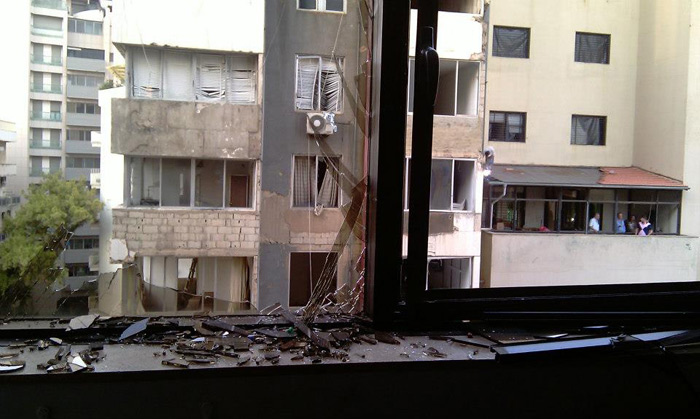
Shortly before 3pm last Friday afternoon the sun was getting in Eli Abujawdeh’s eyes. After ignoring it for a few minutes, he surrendered to irritation and stood up to close the blinds, a decision that could well have saved his life. Returning to his desk, he shuffled some papers and carried on working before an almighty blast threw him onto the floor.

“The whole glass of the window shattered and I was only a few feet away. Because the blind was closed I was ok, but if it had been a few minutes earlier I could have been really badly injured,” he said.

Takreem Initiatives, the company for which Abujawdeh is the marketing executive, is based in the Asco Center, an 11-storey building only 100 meters from the epicenter of the car bomb that ripped through Ashrafieh, killing Lebanese intelligence chief Wissam al-Hassan. Casualty reports initially stated eight civilians had also been killed (though this number has since been revised down), while more than 100 were wounded.

The primary tragedy is of course for those who have lost loved ones: houses ruined, lives destroyed. But while the area is predominantly residential, it is also home to several small to medium-sized businesses that have spent the days since the blast reassessing their futures.

Business blow away

Takreem, which runs annual awards celebrating excellence in Arab businesses, has 16 staff in its offices, all of whom luckily escaped with only minor injuries. But the damage done to the company financially is huge. “Simply in terms of assets, there were not less than 20 computers, at least 9 laptops, 3 photocopiers, scanners, LCD screens etc. Our main server that operates everything has also been damaged,” Abujawdeh said, estimating the loses at a minimum of $50,000.

“But the damage that has been caused is not only material, it is psychological. I don’t know how much employees are willing to go back to those offices — it is not easy for you to go back to a place where you nearly died,” he added.

Further away from the bombsite, the damage is less severe but still threatens to undermine viability. Hicham Sbat, who owns a small hairdressers one street away from the bomb, said he would struggle to pay the repair bills without support.

“There were three customers in the shop and then there was a very loud crash and the air conditioning unit fell from the ceiling. The customers just ran out and left – one still had shampoo in her hair,” he said. “The air conditioning is broken, the door is as well. The whole thing will cost about $1,000,” he added.

Lebanese politicians of all colors have rushed to their soapboxes to offer cast-iron guarantees that those who have lost their homes and businesses will be given compensation to cover their loses. Indeed Telecommunications Minister Nicolas Sehnaoui has even promised the relief commission will start paying out this week. But the Lebanese know that promises of government support do not necessarily translate into action.

Antoine Eid, chairman of the Ashrafieh Merchants Association, estimates that the total cost of rebuilding the area to be more than $5 million, but he is not confident the money will be paid.

“If you go back in time to the first three or four (car bomb assassinations) that happened back in 2005 and 2006, the major part of those hit by these explosions were compensated. Maybe not all of them, and maybe not everything they claimed, but it was widely covered. But the last experience we had — when the building collapsed in Geitawi (in January 2012) — until now people have still not been compensated,” he said.

“What I am fearing now is that the political problems that were aroused by the explosion are much bigger than the voices of the people who want to be compensated. You have a bigger problem, there are clashes, so I am not sure we are the top priority of the government right now.”

In decline

Perhaps unsurprisingly, all the businesses open in the area that Executive spoke to described the days since the explosion as eerily quiet. The proprietor of No Name, a local clothes store whose windows were blown out, said that she had seen no customers in two days. In total, Eid estimates the explosion directly affected more than 100 businesses, with a handful such as Takreem being completely destroyed.

But there are also potential ramifications for the rest of Ashrafieh’s 1,800 businesses. Barber Sbat said he had already been struggling to make ends meet before the explosion, as there has been a general trend less money flowing around the area.

Eid highlights the 2008 crisis in the Gulf, the Arab Spring and the Syrian civil war as key factors that have helped undermine local businesses, particularly retail, and accuses the government of exacerbating this situation with populist policies such as the wage hike in the private sector.

“Even if you go to Downtown Beirut you can see many shops closing, and in Ashrafieh the situation is as bad,” he says. “The cost of doing business in Lebanon compared to activity is way too high for any business to sustain. This is why people are closing to limit their losses.”

The fear is that in an economy that has already suffered from a drop in tourism, the bomb could push local businesses closer to the edge. But, while Eid admits the possibility, he is hopeful that the resoluteness of the Lebanese may well pull people through.

“We have a quality in Lebanon, which is also a curse, we forget quickly. I think in 10 days life will come back again but it is not necessarily such a good thing as we won’t have learnt the lessons,” he adds.

October 24, 2012 0 comments
0 FacebookTwitterPinterestEmail
  • 1
  • …
  • 306
  • 307
  • 308
  • 309
  • 310
  • …
  • 707

Latest Cover

About us

Since its first edition emerged on the newsstands in 1999, Executive Magazine has been dedicated to providing its readers with the most up-to-date local and regional business news. Executive is a monthly business magazine that offers readers in-depth analyses on the Lebanese world of commerce, covering all the major sectors – from banking, finance, and insurance to technology, tourism, hospitality, media, and retail.

  • Donate
  • Our Purpose
  • Contact Us

Sign up for our newsletter

    • Facebook
    • Twitter
    • Instagram
    • Linkedin
    • Youtube
    Executive Magazine
    • ISSUES
      • Current Issue
      • Past issues
    • BUSINESS
    • ECONOMICS & POLICY
    • OPINION
    • SPECIAL REPORTS
    • EXECUTIVE TALKS
    • MOVEMENTS
      • Change the image
      • Cannes lions
      • Transparency & accountability
      • ECONOMIC ROADMAP
      • Say No to Corruption
      • The Lebanon media development initiative
      • LPSN Policy Asks
      • Advocating the preservation of deposits
    • JOIN US
      • Join our movement
      • Attend our events
      • Receive updates
      • Connect with us
    • DONATE