• Donate
  • Our Purpose
  • Contact Us
Executive Magazine
  • ISSUES
    • Current Issue
    • Past issues
  • BUSINESS
  • ECONOMICS & POLICY
  • OPINION
  • SPECIAL REPORTS
  • EXECUTIVE TALKS
  • MOVEMENTS
    • Change the image
    • Cannes lions
    • Transparency & accountability
    • ECONOMIC ROADMAP
    • Say No to Corruption
    • The Lebanon media development initiative
    • LPSN Policy Asks
    • Advocating the preservation of deposits
  • JOIN US
    • Join our movement
    • Attend our events
    • Receive updates
    • Connect with us
  • DONATE
Finance

Your social insecurity

by Maya Sioufi September 1, 2012
written by Maya Sioufi

For paying nearly a quarter of each employee’s monthly salary into the National Social Security Fund (NSSF), one would think that private sector businessmen would be ensuring a nice retirement package and healthcare coverage for those working for them. Why then is it so common for retiree savings to run out at 68, and for hospitals to threaten to deny them services? This Executive investigation dives into the inner workings of Lebanon’s social insecurity.

The money pit

The NSSF, Lebanon’s largest insurance provider, more commonly known as the daman, manages $4.7 billion in private sector contributions and offers coverage for approximately 30 percent of the Lebanese population. Other than end-of-service indemnities, the daman also offers healthcare coverage and family allowance payments.

To deliver these services — or attempt to deliver these services — the law stipulates that the NSSF should receive an amount equal to 23.5 percent of every employee’s monthly salary. This cash is then allocated to the NSSF’s three dedicated funds and entirely invested in Lebanese currency through treasury bills and deposits with local commercial banks. Employers carry the lion’s share of the burden, paying 21.5 percent and employees contribute the remaining 2 percent.

Under the umbrella of the Ministry of Labor, the NSSF is a “black hole” says Nassib Ghobril, chief economist of Byblos bank. Of the three funds run by the NSSF, two have been racking up deficits for the last 10 years. The family allowance fund reported an accumulated deficit of $252 million as of the end of last year.

Employers pay cash equal to 6 percent of each employee’s monthly salary into this fund, up to a salary cap of LL1.5 million ($995), meaning for higher salaries the fund payment is fixed at $60. This stash of money pays $40 to each married employee if the spouse is unemployed and $22 for each child until the age of 18, up to a maximum of five children. This means that if an employee is married with an unemployed spouse and just one child, he receives more from the family allowance fund than his employer pays into it.

“This allows for corruption,” says Ibrahim Muhanna, founder of the actuarial firm i.e. Muhanna. “Let’s say you are my sister and you have three children. I can put you down as an employee; tax and contributions to the funds are paid and you get the benefits for the children.”

The healthcare fund, also known as the ‘sickness and maternity fund’, also runs a deficit that stood at $239 million at the end of last year. The employer contributes to this fund an amount equal to 7 percent of each employee’s monthly salary, with contributions also capped at a salary level of LL1.5 million. Unlike the other two funds, the employee also contributes by paying 2 percent of his monthly salary, up to a cap of LL30,000 ($20).

What the fund does is reimburse employees for 90 percent of their hospitalization costs and 80 percent of medication and examination expenses, though payment delays often exceed several months and involve navigating long queues and a quagmire of bureaucracy.

The catch for healthcare providers is that NSSF also sets the rate private hospitals can charge patients using their coverage for certain services — rates that can remain unchanged for decades. This year private hospitals in Lebanon began threatening to stop taking NSSF patients unless the rate for an overnight hospital stay was raised from $20 to $60, citing the burden of mounting medical costs. In response, the NSSF administration has asked the government to raise the salary cap on contributions to the healthcare fund to LL2.5 million ($1660) — or a maximum payment of LL175,000 ($116). Economic associations in Lebanon, however, have publicly opposed raising the cap, based on fears that this would pass the burden onto the employers in a time when the country’s economic growth is contracting.

Daman deficits!

Given that the contributions to the healthcare and family allowance funds are capped to a fixed salary, they fail to take into account the rising cost of living, the increase in medical costs and the rise in wages. With the cost of healthcare equipment and pharmaceuticals on the rise — the 2012 Towers Watson Global Medical Trends Survey estimated global medical costs would jump 10 percent this year after increasing 10 percent in the past three years — and contributions into the healthcare fund stable, the deficit continues to plunge ever deeper into the red.

“The contributions do not have an automatic adjustment mechanism like in the West — for instance, having the ceiling at three times the average salary so the ceiling grows along with the increase in the average salary,” says Muhanna. “In Lebanon, if you want to change the figures, you need the Parliament to change the law.”

The deficits on these two funds started piling up after the contributions rates were slashed in 2001 under the leadership of former Prime Minister Rafik Hariri, with the aim of reducing labor costs. While the contribution rate to the EOSI remained unchanged, the family allowance fund rate was cut from 15 percent of an employee’s salary to 6 percent, and the sickness and maternity fund rate was cut from 15 percent to 9 percent, amounting to a 40 percent cut in contributions to social security. Mohamad Karaki, director general of the NSSF, blames these rate cuts on the deficits incurred by the two funds and wants to see them increased by at least a few percentage points.

Ghobril disagrees, saying that evasion from NSSF registration is very common. “Just like there are people who evade taxes and you don’t fight tax evasion by raising rates — it will scare away more companies from registering,” he says.

Jihad Rizkallah, lawyer at El Meouchi law firm, says it is “a frequent problem” and common practice in Lebanon for employers to declare lower salaries for their employees in order to decrease their NSSF contributions. “But the employee has the right to claim all amount due; this is of public order,” he says.  “Even if the employer and the employee agree on not registering with the NSSF, the employee can change his mind and his rights are preserved. The employer needs to pay up.”

While Karaki states that more controllers have been hired in the past year — from some 40 to now 100 staff — to stop evasion from contributions to the NSSF, the impact on the figures are yet to be seen.

Abundant insecurity

The only fund that is running a surplus is the end-of-service-indemnity (EOSI) fund catering to retirees [see story page 50]. With an accumulated surplus standing at $5.2 billion as of the end of 2011, the other two funds borrow from the EOSI to stop their bleeding. The lucrative nature of this fund might well be the reason some politicians have said they want to spin it off from the NSSF and have it privatized, which is delaying the discussions in Parliament on implementing reforms to social security, according to Karaki.

The daman’s mission is to provide private sector workers with society’s basic needs from healthcare to family assistance to catering for retirement. With private hospitals threatening to stop coverage, petty family allowances and with savings left depleted within a few years of retirement, it would seem that the nation’s social security fund actually contributes to a feeling of insecurity more than anything else.

September 1, 2012 0 comments
0 FacebookTwitterPinterestEmail
Last Word

Can the cabinet

by Sami Halabi September 1, 2012
written by Sami Halabi

Imagine how Lebanese parliamentarians feel when they are sworn in for the first time. Their hearts must flutter with joy as they take the oath they will likely not keep. After all, who would refuse to be inducted into a club that allows one to get away with doing practically nothing, get paid for it, with benefits, and do so for the rest of one’s life (and in some cases one’s children)?

With no way to appraise the performance, or even the voting record of members of Parliament, the public has little means of knowing what the people they elect are doing. As a result, legislators have the prerogative to fit themselves into one of three categories: those that choose to be active members of this supposed pillar of Lebanon’s government, easily identifiable by the committees they head; a second group simply speaks to the press about anything and everything other than what they theoretically should be doing, producing legislation to fit the times and circumstances. And there is a third group that do not bother turning up for committee meetings or even the general assembly, unless they are called upon to make up the numbers against a vote of no confidence. This final group has the privilege of hosting the so-called zaims (or sectarian leaders) of Lebanon’s broken assembly.

On top of it all stands Speaker Nabih Berri who, for almost 22 years, has used the pedestal of Parliament as the starting point to spread his influence and patronage throughout the institution and, as a result, the state apparatus. One need look no further than the last crisis over Électricité du Liban’s contract workers to see how his power can enter into people’s homes through their light bulbs and the rotting food in the fridge.

And yet people are still bedazzled by how Parliament writes and passes laws that have little to no bearing on reality, while also failing to pass those that do. The laws needed either simply don’t get passed (such as the national budget), get watered down so as to become inapplicable (such as a law protecting women against domestic violence), have no place in a globalized economy (such as the laws regulating electronic transactions) or get shoved in a drawer until Berri feels like bringing them to the floor (like a food safety law or a new traffic law). And even when laws do get passed (such as a law allowing maritime oil and gas exploration, or those concerning telecoms, electricity and water), their implementation is bequeathed to a fractious cabinet and its ministers who run the country like they are playing a perpetual game of musical chairs.

Herein lies the crux of the problem. Because the executive branch is appointed through sectarian horse-trading between eight major parties that can barely agree on anything, it becomes the body of government which is the most prone to collapse and the least able to make decisions. In turn, this has also allowed Parliament to become flippant about drafting laws, writing them up as generalities and relying on cabinet to issue the infamous implementation decrees. Thus, entrusting this non-elected body with the power to apply or not to apply the law results in an arbitrary legal bottleneck to enforcement and drafting of legislation, not to mention the preclusion of citizens from the decision-making process.

So why do we need a cabinet? The short and evident answer is that we don’t. A move to a presidential system that reforms the executive into an administrative body of technocrats would serve the interests of the country infinitely better than it does today. It would even maintain the sectarian “balance” some backward members of society seem intent on keeping through Parliament and the constitutionally mandated senate that has never been formed. But perhaps the most important result of such a move would be that it places accountability back where it should be in a democracy, with those the people elected.


SAMI HALABI is a Masters of Public Policy candidate at the University of Edinburgh and former managing editor of Executive

September 1, 2012 0 comments
0 FacebookTwitterPinterestEmail
Finance

The retirement pain

by Maya Sioufi September 1, 2012
written by Maya Sioufi

When planning retirement in Lebanon, a key question one needs to ask is “Do I have enough money in my savings account for my old age?” And if not, then “do my children have enough money to pay for my old age?” If answers to both questions are a “no”, then you can still opt for renting a taxi license upon retirement to secure a source of income for the grey haired years.

Lebanon does not provide a public pension scheme — meaning regular payments upon retirement and for the rest of one’s life — to the private sector, guaranteeing instead an end-of-service indemnity (EOSI) paying retirees a lump sum at the age of 64, or earlier if demanded, with reduced benefits for those with less than 20 years labor under their belts. The amount paid is linked to the last monthly salary and the number of years toiled; if one enters the labor at age 21 and exits at 64 while remaining with the same employer throughout — a not too frequent path — then a maximum of 55 months salary is handed over at retirement. That’s equivalent to roughly four and half years spending at the same constant rate, after which the capital is depleted.

Currently the National Social Security Fund (NSSF), Lebanon’s public provider of social security for the private sector, requires from employers a monthly contribution equal to 21.5 percent of each employee’s monthly salary. Of this, 8.5 percent goes to the EOSI fund, which had tallied a surplus of $5.2 billion as of the end of last year. After taking 0.5 percent for administration expenses, the Daman — as the NSSF is commonly called — then keeps in its coffers 8 percent set aside for workers’ old age.

To work out the end of service indemnity, a complex formula needs to be applied to the last monthly salary. If requested upon retirement at the age of 64, an employee’s final salary is multiplied by 20 for the first 20 years toiled then by 1.5 times the remaining years in labor. If requested prior to completing 20 years of work, a punitive rate is then applied (see box).

What it means

Assume an employee named Karim starts work at the age of 24 with a starting salary of $1,000, receives a 5 percent raise annually until retiring at age 64; his last monthly salary would be $6,700 (see graph). The NSSF would then have to pay him a lump sum of $325,000 upon retirement. The total contributions by the employer to the Daman, however, stand at only $116,000, with the remaining $209,000* the responsibility of the employer to cough up. (Ouch.)

Now let’s theoretically assume that instead of contributing the 8 percent to the NSSF, the employer adopts a retirement savings plan with a local insurer for Karim and guarantees that he will pay him the same amount as the Daman upon retirement. Reinvested at a conservative 4.5 percent rate  (a typical rate at which a conservative local  insurance firm would reinvest today) the plan would dish out $260,000 instead of just the $116,000 raked up in the drawers of the NSSF. This means that the employer would have to top up the EOSI payment by just $65,000 upon retirement to guarantee the employee the same indemnity as the NSSF. That’s a difference of $145,000 and that’s just for one employee.

With slightly more than 50,000 private companies registered at the Daman employing an average of 8 employees per company, employers would be saving a mind boggling $58 billion based on these simplistic assumptions. That is if this calculation was always applicable, however, which it is not.

It gets a bit more complicated if one requests the EOSI payment before retirement. Let’s assume that after working for 15 years, Karim quits his job and requests his indemnity. He would then receive $17,000, whereas the total contributions by his employer to the NSSF would have reached $23,000, leaving the Daman with a tidy $6,000 in its coffers. So for the first 20 years of work during which the punitive rates are applied, the employer will not be requested to contribute additional cash when an employee quits, but will be fattening the NSSF’s wallet instead.

Once 20 years of labor are completed, the formula to calculate the lump sum payments becomes much more lucrative for the employee and punitive for the employer, as the reduced rates are no longer applied and the NSSF pays back more than the accumulated contributions. In Karim’s case, at the age of 45, his indemnity payment jumps by $17,000 in one year. Thus, employers might be happy to see their workers quit before the 20 years are completed.

Also, when the reduced rates are applied, the private insurance retirement plan generates higher returns, implying that had the employee gone for private insurance instead of the Daman — which he legally is not allowed to do — he would have secured a higher indemnity for the first 20 years of labor. It would also mean that had the employer invested the 8 percent with private insurance instead of the NSSF — which he is also legally prohibited from — and had he paid back to the employee the amount the Daman pays, he would have made money: up to $25,000 in Karim’s case for two decades work.

A flawed system

This simplistic case aims to reflect the inefficiencies of the EOSIs provided by the Daman from both the employers’ and employees’ perspective.

Retirement of Lebanese citizens is exclusively funded by corporate Lebanon as neither the employee nor the government participates in the EOSI. And it is not just a tax rate of 21.5 percent of employees’ monthly salary, as there is the additional stack of cash that employers have to cough up as a one-time payment if their workers are loyal for several decades.

As for employees in the private sector, if Karim relied solely on Lebanon’s public sector for social security he would find himself penniless within a couple of years of retirement, after which he would have to either reenter the labor force or beg for money for the rest of his life.

The punitive indemnity rate explained

If an employee works between one and five years, his end-of-service indemnity (EOSI) payment from the National Social Security Fund (NSSF) will be 50 percent of his last salary times the number of years he worked. If this employee worked between 6 and 10 years, his EOSI for the first five years will be calculated the same; the number of years he works more than five will then be multiplied by 65 percent times his last monthly salary. The rate between 11 and 15 years of work is 75 percent of the employee’s last monthly salary, and between 16 and 20 years it is 85 percent.

*Correction 23.10.2012: the figure is an overstatement as the employer is not held accountable for the half months benefit for every year of contribution beyond 20 years.

September 1, 2012 0 comments
0 FacebookTwitterPinterestEmail
Editorial

Business in brutal times

by Yasser Akkaoui September 1, 2012
written by Yasser Akkaoui

Among the less discussed symptoms of the collapsing Syrian state is the realigned trade balance with Lebanon. Before, everything from gasoline to eggs was sourced cheaply in Syria and sold lucratively in Lebanon, an equation amounting to a multi-billion-dollar trade deficit for Lebanon. Today, the balance of payments is much more even. In Syria, shortages and hobbled transportation networks are fuelling inflation and reversing the flow of goods.

Another reason goods are moving the other way is the collapsing Syrian economic model. Subsidies, along with price and currency controls, have effectively vanished in much of the country as Syria is whipped from a centralized, state-controlled economy to a vicious, smuggling-based, no-holds-barred chaos form of ‘free’ market capitalism.

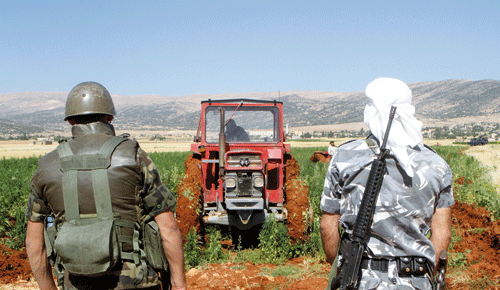
Indeed, the centralized state authority is evaporating en masse, with the Kurds in the east asserting more autonomy, and sectarian fiefdoms forming where once there were mixed neighbors under one government. This is far from unique to Syria — look at the Bekaa tribes uniting last month to violently fend off Lebanese security forces’ efforts at cannabis eradication. Iraq has long been divided into a Kurdish north, Sunni west and Shia south and in Jordan the atmosphere is far more charged with tribal sentiments than any time in recent history.

This general trend toward state fragmentation seems only to be accelerating, and is perhaps a natural historical consequence of the contours of these countries being defined by colonialist powers — powers that, more or less, took a ruler to a map and drew lines on it without the least regard for local demographics, precedents or relationships. As the strongmen who held this patchwork together are deposed, the fabric is unraveling and the interim period before a new one can be woven together will likely be turbulent. 

For business and commerce, this means adapting to a new paradigm, and unfortunately Syria may be the harbinger of where the region is headed — the predatory, ruthless economics of war. 

September 1, 2012 0 comments
0 FacebookTwitterPinterestEmail
Finance

Q&A – Mohamad Karaki

by Maya Sioufi September 1, 2012
written by Maya Sioufi

The National Social Security Fund (NSSF) is Lebanon’s main social security program and the country’s largest insurance provider, covering approximately 30 percent of the population. Famed for its endless queues, appalling delayed payments and highly underdeveloped services — requests for this interview were required to be sent by fax machine — ‘daman’, as it is commonly known in Lebanon, provides healthcare, family allowance and end-of-service indemnity (EOSI) to 1.3 million Lebanese citizens. To discuss the issues faced by the daman, Executive sat with Mohamad Karaki, the NSSF’s director general.

E  On my way to meet with you, I heard a man on the radio complaining that the NSSF was closed at 10:30 am today and he could not get his payment….

That cannot be true. Employees of the NSSF have the same working hours as government employees [8:00 am to 2:00 pm]. But you know, it is Ramadan now and today it is Friday so they might leave earlier for Friday prayers.

E  A government draft bill called for reforming the NSSF back in 2004 and it has not been signed yet. What is delaying the implementation of this law?

From a practical point of view, we can agree over two to three sessions on the key points in the draft law and in a month it would be over. The bigger issue, however, and the one which is taking a political dimension, is whether the EOSI fund gets spun off and managed by an independent company with a separate management or whether it remains under the umbrella of the NSSF. This is the issue that keeps on delaying the implementation of the new law. Many people in the government, for no economic or practical reason, want to have an independent company running the EOSI fund. I disagree. Their arguments are that the NSSF has issues and can’t manage itself. If the government can’t improve the NSSF then where will it find the right people to run this independent company? Also, it would be duplicating jobs.

E  Why do they want to put the EOSI into a separate company? Because it is the only fund among the three funds of the NSSF that is not in a deficit?

Many people are saying that is the reason they want their hands on the funds of EOSI. I am just saying EOSI needs to be in its natural place, which is within the NSSF.

E  As of the end of last year, the sickness & maternity fund and the family allowance fund reported an accumulated deficit of $239 million and $252 million respectively. What needs to be done to stop these deficits from increasing?

Unfortunately in 2001, the contributions to the NSSF were brought down by 40 percent in one go [contributions to the NSSF were reduced from 38.5 percent to 23.5 percent by lowering the contributions to the family allowance fund from 15 percent to 6 percent and to the sickness and maternity fund from 15 percent to 9 percent]. The only solution is to increase the contributions or the ceiling of the contributions.

E  But how much would you want to see the contributions increased? 

I am not asking for an increase to 2001 levels but a few percentage points. The raise in the minimum wage this year will bring in new revenues for the NSSF and then we will see how much contributions need to be increased.

E  How are the funds of the NSSF invested and is there a way of raising the returns?

The funds of the NSSF stand at $5 billion as of the end of 2011; 70 percent of the funds are invested in treasury bills and the remaining 30 percent are placed in deposits with local commercial banks. As the sickness and maternity and family allowance funds are in deficit, the funds being invested now are from the EOSI fund. There is a committee charged with preparing how to invest these funds. There is no article in the current law allowing diversification, even within currencies. There was no political agreement in the 11 years I have been running the NSSF to diversify in other currencies, as we have to invest everything in Lebanese pounds. With the current law being discussed in parliament, it should open the possibility to invest in other currencies.

We are proposing several investment options both domestically and abroad. The [government officials] are trying to limit the options and are suggesting equities in Lebanese and foreign listed companies and investments in Lebanon’s real estate sector. We wanted to go further and have equities in all companies in Lebanon [and not just the listed ones]. Investing in other currencies is the least we can expect as the NSSF pays all contributions in Lebanese pounds but medical costs are in foreign currencies.

E  I hear that evasion of contributions is common in Lebanon. What are you doing to better control evasion from the contributions and alleviate the deficits of the funds?

We have controllers who check evasion from contributions. Now we have 100 controllers, whereas a year and a half ago we had just 30 to 40 controllers, so there will be better controlling going forward. One of the main issues that the NSSF faces is the lack of human resources. We should have 2051 employees and we have 1112 so we are working at 50 percent capacity.

E  What is the 2051 figure based on?

When the organization was founded, the law stated that the NSSF should have 2051 employees so we have 939 missing employees. The NSSF used to have its independence when it came to hiring of employees, until 2004 when the hiring process was put under the Civil Service Council. Now every time we need to hire employees, we need the approval of the government that will ask the council to conduct exams and this is delaying our hiring process. We have recently received approval for the hiring of employees and exams are starting in a month.

E  Isn’t the lack of electronic services also one of the main issues of the NSSF?

Now we have 35 offices with 1,000 PCs linked online throughout the country. So from a technological point of view, we are among the most up-to-date companies in Lebanon.

E  But you don’t offer any services online and you don’t even have an NSSF domain email?

Let me explain. The first step was to train our employees and explain PCs to them. The second step and the most important one is to link hospitals, doctors, pharmacies and all providers of services electronically to the NSSF and start electronic services. I am happy to tell you that the administration recently approved putting in place a department dedicated to electronically linking all services with the NSSF. We will start by linking pharmacies then move on to hospitals and doctors. We hope that by the end of the year we would have started to provide electronic services and that by the end of 2013, we will be providing services such as online registration and providing certificates on employee headcounts online. We also have a new website which we are working on internally and it will be made public within five to six months, allowing people to enjoy services online.

E  How about the board of directors that has expired in 2006?

There are no elections yet planned for the board and the current board members are still here and different committees meet on Tuesdays and Thursdays. We need new blood in the organization but unfortunately the current problems in the country are not allowing for elections.

E  Do you think the government should provide a private pension plan with tax incentives?

In my opinion, what is missing in Lebanon is an unemployment fund so that if the citizen finds himself without a job, he does not end up on the street without an income. If the NSSF is given the human resources necessary and with the required improvements in place, it can provide all social services to the country. These plans need approval by the government and I am waiting for their approval. I want to improve the NSSF to provide better services to the population. The biggest problem for now is the lack of human resources.

September 1, 2012 0 comments
0 FacebookTwitterPinterestEmail
Feature

Lebanese in Kurdistan

by Joe Dyke September 1, 2012
written by Joe Dyke

As you wait for your bags at the airport in Erbil, the capital of the northern region of Iraq, a large sign reads “Welcome to Kurdistan”. But the sponsor’s name plastered below is not the Kurdish Regional Government or a local firm, but Lebanon’s own Byblos Bank.

In the decade since the invasion of Iraq, no region has grown as much as the semi-autonomous Kurdish region. And the province has paved the way into the Iraqi market for many Lebanese, with more than 6,000 currently working there according to the Lebanon-Kurdistan Friendship Association. The Kurdistan Board of Investment estimates there is more than $760 million in Lebanese capital invested in the region, the second largest of any Arab country behind only Kuwait.

Banking on business

In the banking sector Byblos itself first opened a branch in Erbil in 2007 and now has expanded beyond Kurdistan to establish branches in Baghdad and Basra, while the Intercontinental Bank of Lebanon and Bank of Beirut and the Arab Countries (BBAC) are also well established.

These success stories are leading other banks to take the plunge, with Credit Libanais, Banque Libano-Francaise (BLF) and BankMed all heading to Erbil in the next year. Maurice Iskandar, head of the International Division at BLF, believes it is the perfect time to invest.

“We consider the Iraqi market as a vast and growing one… Iraq remains a primary destination for Lebanese exports and investments, having been for many years the most important export destination for Lebanese products,” he said. “It is in many ways a strategic location and a natural market for our expansion.”

Yet there are issues over the potential growth of the industry in Kurdistan — the region is already home to 14 state-owned banks and 30 private ones, while personal banking remains in its infancy. In this climate, new investors may find it difficult to develop a decent market share.

BankMed, which is unusually due to open branches both in Erbil and Baghdad simultaneously rather than using the former as a springboard for the latter, said they were hoping their strong position in neighboring Turkey, where their affiliate T-Bank has 27 branches, will help differentiate them from their rivals. “Our presence in Turkey, in particular, is a definite plus for our customers in Iraq given the significant trade flow between the two countries,” a spokesperson for BankMed said.

Too many fish in the pond?

While banking is undoubtedly still growing, there are other areas where the relatively small market may already have become overpopulated. Toufic Tasso was among the first to realize the potential for top quality private higher education in Kurdistan. The Lebanese-French University was eventually established in 2007, the first private institution of its kind in Erbil.

Yet five years on and the university is still to turn a profit, while Tasso, the university’s president, admits that the market has become heavily competitive. Ten rival private universities have set up, while the regional government has continued to subsidize growing public universities. The 800 students being taught per year is below capacity by almost 200.

“I would say for the time being (the market) is definitely saturated,” Tasso said. “It is not necessarily saturated in terms of quality offer, but it’s not a market that is now in dire need for new universities.”

He points out that the culture of private education, so prevalent elsewhere in the Middle East, is not dominant in Kurdistan, highlighting tuition fees as an example. “It’s a totally different market than, let’s say, the Lebanese and Emirati models where people are used to private education in most cases — they know that they have to pay a price and that is adjustable with time.”

“Here we have lots of trouble changing the tuition fees every year to adjust for inflation. For them, when they start those are the fees whether it’s a two year program or a four year program, whether inflation is weighing on their costs or improving their revenues.”

Servicing up services

It may be that services, an area where the Lebanese have traditionally excelled, offers the best opportunity for new investors to the market. Erbil itself is barren of much of the luxuries that are so prevalent both in Beirut and the Gulf, as economist Riad Khouri pointed out. “If we were in Erbil and we wanted a nice Lebanese lunch, there is no nice restaurant. Let’s say we wanted to go and buy a certain book or DVD, the shops don’t exist. If you want to go to a club in the evening, they are not there,” he said.

The regional government certainly plans for this to change, aiming to increase tourism exponentially in the coming years. Some 1.7 million tourists visited the Kurdistan region in 2011, the majority of whom were from other parts of Iraq. The regional government hopes this figure will rise as high as 2.5 million, necessitating growth in the hotel market.

Erbil’s Rotana Hotel became the city’s first 5-star hotel when it opened in 2010, with much of the capital behind the project Lebanese. The development, which cost $55 million, was the result of a partnership between the Lebanese group Malia and the Italian company DIVA. Malia chief Jacques Sarraf has targeted the Kurdish market heavily, holding several major assets, of which the Rotana is the most prized.

Thomas Touma, the hotel’s Lebanese manager, said the hotel had benefited from its pioneer status. “We have been profitable since we opened, the profit has grown month by month, but we started with a profit,” he said, declining to give more detailed financial numbers. “We are seeing double digit increase on occupancy rate due to increased demand and short supply,” he added.

Touma admits that the market is going to get a lot tougher in the coming years as “five or six” 5-star hotels, none of which are Lebanese-owned, are due to open. However, he is hopeful that instead of undermining Rotana’s profits, the rivals will help spur the market.

“There is a new five star hotel open next to us — they opened and we did not see any drop in our occupancy or restaurant returns,” said Touma. “This is due to the fact that demand is increasing on a daily basis.” The statistics seem to suggest he may be right, with the Kurdistan region’s investment board announcing in July that tourism in the first six months of the year was up 75 percent on the same period in 2011.

The Rotana’s success appears to be pushing others into the market. In July, Lebanese real estate company Zardman announced the launch of a 200,000 square meter project in Erbil, which will include 269 luxury apartments, a medical center, a hotel and high-end shopping and entertainment centers (slated for completion in 2015).

Looking ahead

Yet, there is one issue that continues to dog the region, and that is consistent allegations of corruption. There is a widespread perception that the duopoly of the two main political parties — the Kurdish Democratic Party (KDP) and the Patriotic Union of Kurdistan (PUK) — has organized the system to make it work for them. Diplomatic cables released by WikiLeaks showed that the United States believed corruption in the Kurdistan region was “pervasive”, and could hinder foreign investment in the oil-rich area. While few people were willing to talk on the record about the issue, Touma hinted that bureaucracy can slow down a project significantly. “Being a new country under development there are still a lot of procedures, a lot of laws that have not been communicated well,” he said. But Lebanese-French University’s Tasso denies that the only way to succeed in the region is through greasing palms.

Investing in Kurdistan is undoubtedly a great opportunity for Lebanese businesspeople, yet there are pitfalls to be wary of. And while the service sector is undoubtedly in its infancy and the potential for growth is there, whether Kurdistan has enough attractions to become the regional business and tourism hub the government wants it to be remains to be seen.

September 1, 2012 0 comments
0 FacebookTwitterPinterestEmail
Feature

Parking against the machine

by Nabila Rahhal September 1, 2012
written by Nabila Rahhal

How many times have you come back to your parked car to find a red surcharge ticket welcoming your overdue return? Hopefully you paid the LL10,000 ($6.6) charge within the 10-day time limit, lest it increase incrementally to a $26 fine and then $66, which you will inevitably have to pay when your car goes through the annual Motor Vehicle Inspection, or “Mecanique” as it is known. Behind those parking meters is a private company working alongside the public sector and there are substantial funds involved, and perhaps this is the reason behind their efficiency.

The beige parking ticket you get from the Ministry of Interior for parking in an illegal spot is a different story. If you forget about this ticket, the ambiguous method of collection will not soon hold you to account. And, human nature being what it is, we tend to abide by the rules when we know there is no escaping the consequences, and break them when we know we can get away with it.

Solving the parking problem

According to Rachid Ashkar, council member of the Municipality of Beirut, the decision to install parking meters as one of the solutions to the parking problem in the city was taken by the Municipality of Beirut, in collaboration with the World Bank, which loaned the funds for the project, back in 2000. In 2002, the Council for Development and Research (CDR) took on the role of consultant for the municipality and began the bidding process for an operator for the parking meters. Chafik Sinno’s Duncan-Nead won the bid for Greater Beirut and in 2004, he signed the agreement with the CDR and the Traffic Management Office (an autonomous entity under the Ministry of Interior, currently headed by Farjallah Srour). Finally, in 2009, the first parking meters were installed in Beirut.

“Four years into their installation, and with 643 parking meters in operation in Greater Beirut for 4,500 designated parking spots, phase one is complete,” says Ashkar. “We are now entering phase two, which includes installing 125 new meters, still in commercial areas and including the Corniche.”

According to Ashkar, the Corniche, due to its public appeal, will follow a different formula that will include having free parking on the weekends. Phase two will also include the introduction of different payment options through credit cards and through Short Message Services (SMS).

Pay and park all day

To ensure availability of space, the maximum parking time is set at two hours, but for those who park all day to go to work or university, there is the option of the $6.6 surcharge. “The $6.6 surcharge is not a penalty, or a punishment, it is an option to park all day against a certain fee,” says Ashkar. “This surcharge ticket can be used in different parking spots during the same day without paying a fee again. This service spares you from the valet and from the many parking charges you encounter on a typical day. To obtain this surcharge ticket, simply leave your car without paying the charge.” He adds that phase two of their project will include a media campaign promoting this surcharge ticket as people are unaware that it is not a fine. Part of this campaign, according to Ashkar, is to change the surcharge ticket’s color from the negative red to a neutral blue, and to add an explanatory sentence outlining that one can park all day anywhere using this ticket.

Fines and penalties come into play when the surcharge fees are not paid in the assigned time period. “Since everything is computerized, it is very easy to keep track of each and every misdemeanor. All outstanding charges are sent to the Mecanique Department and one pays them along with the car inspection fees,” says Ashkar. As soon as a surcharge ticket is issued and the controller takes the picture using his hand-held computer, an automatic notification is sent to the Traffic Management Office’s system and then the ticket’s charge is automatically increased if not paid in time and is finally sent to the Mecanique.

Who’s collecting?

With an average of 116 coupons sold per designated parking space per month, and with 4,500 surcharge tickets issued per month per machine in Hamra alone, it is no surprise that the total revenue from the parking meters in Greater Beirut is $60,000 per month. The obvious question which comes to mind is: where does all that money go?

“The parking meter charges are collected by Duncan-Nead and given to the Traffic Management Office, which is the operator of traffic lights and parking meters in Lebanon,” says Ashkar. “The office uses the money generated from parking meters installed in Greater Beirut for the maintenance of those machines, and also for the maintenance of traffic lights which don’t bring any revenues of their own, but use those of the parking meters.”

“After the maintenance is done and needed spare parts are bought by the Traffic Management [Department], the rest of the money goes to the treasury of the respective municipalities, which should use it to increase the capacity of the parking meter system in their area,” adds Ashkar. He is quick to point out that Duncan-Nead is merely the manager of the parking meters in Greater Beirut, and has a contract upon which it receives a monthly income from the Traffic Management Office in return for its services regardless of the meters’ output. “This fee is based upon the number machines it is operating and the number of employees it has on them and does not come out of the meters’ revenues,” says Ashkar.

Automation without wasta

Ashkar believes that the secret behind the success of this system lies in it being automated. “It has been proven that once there is no personal access to cancel or interfere in any operations, machines don’t have wasta (personal favors),” he says, and wonders why the Ministry of Interior does not equip police officers with a computerized system for the illegal parking spots. He acknowledges that traffic police officers have 10 kilometers under their supervision while the parking meter controller has only 400 meters, and so it is very difficult for the police officer to maintain control.

The antiquated system

Colonel Joseph Moussallam, head of the Media and Communications Department at the Ministry of Interior, agrees that the ministry is understaffed. He says ministry employees issue 250,000 beige tickets annually for illegal parking, and a high percentage of them are unpaid. “Just sorting the tickets out at the ministry takes time since the process is a manual one,” says Moussallam. “The purpose of the ‘no-parking’ spots is to reduce traffic jams, and in parking illegally one is effectively closing down a lane meant for drivers.”

Once a parking fine is issued, one has a period of 10 days to pay it, though it stays in the Ministry of Interior’s Traffic Management Office for a month before it is moved to the judiciary court.

“The judiciary court receives thousands of tickets per month, and because it also has no computerized system, it takes months and even years before a court decision is issued, and by that time the verdict could be for the ticket to double or triple in monetary amount,” he says.

Moussallam believes that in order for fines to be effective, they must be implemented promptly, otherwise people forget about them. As examples, he cites changes of address, and sometimes of country of residence, as reasons why people don’t hear about their parking tickets for years after they receive them.

“Judges have up to four years to issue a verdict before the ticket becomes absolute, but a lot can happen in the citizen’s life during that time,” says Moussallam.

Some people recount receiving tickets for cars they had already sold or having to pay exuberant amounts for tickets they don’t recall receiving. Others boast about years of not paying parking tickets and never hearing about them again.  The longer one waits to pay the beige tickets, the higher the fine usually gets and it seems the main beneficiary from the increased fines is the judiciary court.

“If a ticket is paid on time, 20 percent of the amount goes to the security forces, 20 percent to the municipalities’ treasury and 60 percent to the Ministry of Finance. However, if payment is late and it goes to the judiciary court, then 55 percent of the charges, including the late penalty, go to the judges’ treasury and the remaining 45 percent is distributed among the aforementioned factions,” says Moussallam.

Yet he is optimistic about the future, mainly because of the new traffic laws which are now in the process of being decreed. “The new laws will be modernized, especially the ones involving the radars for the speeding tickets,” says Moussallam. “We will also be sterner with higher fines, and increasing the scale on penalties for not paying on time. For example, the charge for illegal parking is going to increase to $33.” The system will remain un-automated however, as the budget cannot accommodate the expense.

Man vs Machine

In this battle of man against machine, it is clear that the machine is the winner. The Ministry of Interior and the judiciary court need to have an automated system for their parking tickets, similar to the parking meters’ system, or risk being drowned in paper work — that is, if they are still able to find a spot to park their car and make it to the office.

September 1, 2012 0 comments
0 FacebookTwitterPinterestEmail
Comment

Aleppo out of work

by Jihad Yazigi September 1, 2012
written by Jihad Yazigi

It took almost a full year before Aleppo, Syria’s second largest city by population, became an active part of the popular uprising that began engulfing the country in March 2011; but when it did, events very quickly took a violent turn. This summer has seen thousands killed in armed clashes and bombings, more than 200,000 inhabitants are estimated to have fled the city and several districts are being levelled under daily bombardment. ‘Normal life’ is at an almost total standstill throughout the metropolis.

Aleppo is also Syria’s manufacturing hub, and according to the head of the Aleppo Chamber of Industry, Fares Shihabi, by mid-August all the plants located in the industrial area of Sheikh Najjar, a large complex located outside the city’s boundaries, had stopped production because of the rising insecurity. Factories could not be protected and employees feared going to their workplace, while the supply of inputs and the distribution of finished products became almost impossible — that equals more than 600 factories and 40,000 workers in the industrial city that are estimated to be out of work. Should the violence last it is likely that shortages of all kinds of products will occur across the country. Already, medical supplies are threatened and the World Health Organization has warned of drugs shortages — with some 20 companies producing a wide range of medicines, Aleppo is a major center for pharmaceutical production in Syria.

Until the recent rise in violence, Aleppo had managed to escape some of the worst economic consequences of the uprising. Its manufacturers, in particular, benefitted from a number of favorable circumstances. The suspension of the free trade area with Turkey, which was decided after Syria’s northern neighbor imposed sanctions last December, and the increase in customs tariffs decided by the government earlier this year, helped reduce competition in the local market. Likewise, depreciation of the Syrian pound, which has lost some 50 percent of its value compared to the United States dollar in the last year and a half, temporarily spurred increased exports to neighboring Iraq.

Though it has fallen well behind Damascus in terms of overall wealth, Aleppo had long been Syria’s economic capital. Its gradual decline began in the early 1920s when the demarcation of the country’s borders cut its links with its Turkish hinterland, followed by the nationalizations of the late 1950s and early 1960s that stripped the Syrian bourgeoisie, then mainly based in Aleppo, of its land and other assets.

However, it was only in the early 1970s that the balance tipped clearly in favor of Damascus with the increasing centralization of the Syrian state and the growing state capitalism imposed by then President Hafez al-Assad. From then on, the closer investors were to the center of power in Damascus, the luckier they were in winning large government contracts, which represented a large source of revenues and profits for both them and the middlemen/bureaucrats that helped them conclude the deals.

It is therefore no surprise that in the late 1970s, when protests demanding more political freedoms and democratic change began across the country, Aleppo rose — only to see its protest movement and that of neighboring Hama ferociously crushed by the government — while Damascus watched. Only when two decades later Bashar al-Assad reached power and began a policy of economic and trade liberalization, did the city regain some of its lost wealth. The improvement of ties with neighboring Turkey, in particular, helped boost trade, tourism and investment. After decades of marginalization, Aleppo saw its businesses thrive again and sought stability, calm and order. This was not, however, to last, and the city, as most other parts of the country, is now engulfed in an uprising that is unlikely to end anytime soon.

The profound economic, social and political changes likely to emerge from the revolution will force a redefinition of the country’s economic model and the role of the state, of the links between the center and the periphery and of the balance between trade and production. Whether Aleppo will lose again from these changes, as it has with most other dramatic turns of the last century, or whether it will adapt successfully to the situation as it evolves, remains to be seen.


JIHAD YAZIGI is editor-in-chief of The Syria Report

September 1, 2012 0 comments
0 FacebookTwitterPinterestEmail
Finance

Q&A – Christos Papadopoulos

by Maya Sioufi September 1, 2012
written by Maya Sioufi

Continuing with their investigations of banks involved with Iran, United States authorities went after Standard Chartered Bank (SCB) last month, accusing the British bank of helping Iranian banks and corporates hide around 60,000 transactions worth at least $250 billion between 2001 and 2010. To settle these accusations and avoid seeing its New York license revoked, SCB agreed to pay a $340 million penalty. Prior to this scandal, with Asia as its core market, SCB had recorded its 10th straight year of record profits, standing at $3.95 billion as of the end of June 2012, up 9 percent year-on-year. The bank also announced plans to add as many as 1,500 jobs in the second half of the year. To shed light on the bank’s performance in the Middle East and North Africa region, Executive sat with Christos Papadopoulos, SCB’s head of MENA and Pakistan.

E  Standard Chartered has agreed to pay $340 million to settle the American accusations of working with Iran. Is this the price to pay to resolve a public relations headache and avoid seeing the New York license revoked?

We are continuing to have discussions with a number of other regulators in the US and it would be inappropriate for me to comment on when the discussions will be completed. We have an agreement to settle with the New York regulator. 

E  With respect to clients from the MENA region, have some of your clients stopped doing business with Standard Chartered? How has this issue affected your business?

Our clients in the MENA region have been very supportive and it is business as usual.  We remain open for business. Given the sensitivity of the issue, I cannot comment further.

E  Have we seen the worst in Europe yet?

I definitely think it is not over. I believe Greece will go out of [the euro] with a possibility that this will happen by the year’s end. When that happens, we will go through a significantly stressed situation, a bit like when Lehman Brothers went under. The hope is that by then the European Union would have the firepower to contain the contagion from Greece. I don’t expect more bailouts for Spain, Cyprus, etcetera, beyond what we have already had.

E  How has the turmoil in the MENA region affected demand for banking services?

The turmoil has affected the appetite for credit, but we have seen counterbalance in the significant stimulus provided by the governments such as in Saudi Arabia and Qatar. As banking services are correlated to economic activity, we went through a phase of subdued activity and we are still in that phase as there is no clarity. In the medium term, I am very optimistic; some classes of assets appear to be gaining more momentum, like Islamic banking, and I expect [this momentum] to accelerate in the medium term in markets such as Egypt.

E  Why Egypt?

We couldn’t do Islamic banking in Egypt before. Now with the Muslim Brotherhood in power, we expect a regulatory framework that allows for Islamic banking and we expect the population would want to buy [Islamic banking products]. We are increasingly developing solutions to offer the whole stream of products, both conventional and Islamic.

E  Where do you see the highest opportunity for growth for the banking sector in the region?

Saudi Arabia, Egypt and Iraq are the markets of tomorrow as they are enjoying a lot of economic activity. But I also see a strong opportunity in Lebanon where we want to focus on non-resident clients. Lebanon has a massive diaspora in markets like Africa and the Gulf and this becomes a much bigger proposition.

E  Which of the following will see the most significant growth in the coming years: retail banking, private banking or investment banking?

The retail banking business will reflect the demographics and in this region, as the youth come into employment, there will be an appetite for consumer products and therefore consumer banking — so we see a big opportunity in this space. We also see a big opportunity in private banking because there are big wallets in the Middle East. As for investment banking, the need will always be there but in the medium term, I expect consumer and private banking to gain more momentum.

E  With increased scrutiny on Swiss private banks, do you sense that big wallets in the Middle East will increasingly look for bankers in the region as opposed to developed economies?

The coverage was always done both in the Organization for Economic Co-operation and Development (OECD) countries and in the [MENA] region with bankers flying in and out. The main issue is where the assets are booked: Switzerland vs. Singapore vs. Dubai. As the OECD region becomes hostile to some of the clients, they are looking for solutions in different locations. In my view, it is increasingly in Dubai and Singapore, which is why we are seeing many private banks moving and rebalancing their resources into the Middle East. Bankers are booking their clients’ assets in the Middle East. A private bank client books his assets where he feels comfortable.

E  Once the dust settles, do you expect other banks to come back to the region?

It is a mixed picture. On one hand, European banks are pulling out from the region. They are reducing their assets not just in the Middle East and Asia but also in the US. On the other hand, American and Japanese banks are looking for growth opportunities. We have seen Japanese banks as big buyers of European banks’ Middle Eastern assets. It shows appetite [for assets in the region].

September 1, 2012 0 comments
0 FacebookTwitterPinterestEmail
Finance

Executive Insight – A fund for the future

by Ibrahim Muhanna September 1, 2012
written by Ibrahim Muhanna

“Pending the institution of an old-age insurance scheme, an end-of-service indemnity (EOSI) Fund shall be set up.” So begins article 49 of the 1963 Social Security Law. Run by Lebanon’s National Social Security Fund (NSSF), the public provider of insurance for the private sector, the EOSI still pays retirees a lump-sum payment upon retirement but its conversion into a pension — with regular payments during retirement guaranteeing social security for old age — has not yet seen the light of day.

With developed countries and even developing countries establishing functional old-age pension schemes, Lebanon’s lack of reforms is alarming. Over the past four decades, several draft bills were put forth to the Lebanese Parliament aiming to reform the current retirement system and adopt a pension scheme, yet none have passed. The majority of the proposed reforms aimed to address the numerous drawbacks of the EOSI system, such as the large one-time payment as opposed to much smaller regular monthly payments, the lack of social security coverage for the self-employed and workers of the informal sector and the low employer contribution to the EOSI fund, which currently stands at 8 percent of the employee’s monthly salary.

Two paths through retirement

When designing any social security scheme, there are essentially two polarized approaches. The first is to define the benefits of the scheme — such as the payments during retirement — and subsequently determine the cost of those benefits, paid in the form of contributions by the employer, the employee and the government. These are known as defined benefit (DB) schemes. The second is to set the contributions to be paid by the participants of the scheme, which ultimately determine the level of benefits at the point of retirement. These are known as defined contribution (DC) schemes. Recent history has seen hybrid plans that combine both DC and DB schemes.

Back in 2004, the World Bank initiated a project supported by former Prime Minister Rafiq Hariri to implement a DC pension scheme.  The cabinet voted in favor of it, but it was shelved after Hariri’s 2005 assassination and has since been collecting dust.

The folder is now being discussed again and amendments are being considered, following the 2008 financial crisis that significantly hit DC schemes. As pension funds witnessed their asset values dwindle, their benefits, which are not guaranteed, plummeted.

The proposal

Parliament is currently considering either implementing the 2004 law with some caveats or implementing a proposal crafted by my actuary services firm calling for the establishment of two major funds at the NSSF to care for old age: ‘Fund A’, providing old-age pension coverage that would replace the EOSI and a new fund, ‘Fund B’, providing health care coverage for retirees.

Fund A combines the characteristics of a DC and a DB scheme by setting a level of financing to be paid to the NSSF by employers and employees. The employer contributes 12.5 percent and the employee contributes 4 percent of the employee’s monthly salary. The fund also guarantees a one percent accrual rate for every year of contribution as a minimum level of benefits for retirees, which ensures a decent standard of living. The design of Fund A aims to facilitate the NSSF’s work by linking the level of minimum benefits, contributions and the ceiling on contributable salaries to the average wage of covered employees.

It is worth noting that currently, the EOSI contribution is applied based on the full salary. In the current law, contributions to the health indemnity and the family allowance fund are capped to a percentage of a fixed salary that does not take into account rising wages.

Fund A would also accommodate a gradual expansion of coverage to all informal sector employees and employers, as well as self-employed persons who currently do not benefit from NSSF coverage.

The introduction of Fund B aims to provide healthcare to those most in need of it in our society: the elderly.

It calls on the government, employers and employees to contribute 2.5 percent, 0.5 percent and 0.4 percent, respectively, of the employee’s monthly salary. It also calls on the retirees to pitch in, through their pension, by providing 0.6 percent of their last monthly salary.

This proposal, currently being discussed in Parliament, aims to alleviate the burden on the Lebanese through a just social protection scheme.

September 1, 2012 0 comments
0 FacebookTwitterPinterestEmail
  • 1
  • …
  • 318
  • 319
  • 320
  • 321
  • 322
  • …
  • 686

Latest Cover

About us

Since its first edition emerged on the newsstands in 1999, Executive Magazine has been dedicated to providing its readers with the most up-to-date local and regional business news. Executive is a monthly business magazine that offers readers in-depth analyses on the Lebanese world of commerce, covering all the major sectors – from banking, finance, and insurance to technology, tourism, hospitality, media, and retail.

  • Donate
  • Our Purpose
  • Contact Us

Sign up for our newsletter

    • Facebook
    • Twitter
    • Instagram
    • Linkedin
    • Youtube
    Executive Magazine
    • ISSUES
      • Current Issue
      • Past issues
    • BUSINESS
    • ECONOMICS & POLICY
    • OPINION
    • SPECIAL REPORTS
    • EXECUTIVE TALKS
    • MOVEMENTS
      • Change the image
      • Cannes lions
      • Transparency & accountability
      • ECONOMIC ROADMAP
      • Say No to Corruption
      • The Lebanon media development initiative
      • LPSN Policy Asks
      • Advocating the preservation of deposits
    • JOIN US
      • Join our movement
      • Attend our events
      • Receive updates
      • Connect with us
    • DONATE