• Donate
  • Our Purpose
  • Contact Us
Executive Magazine
  • ISSUES
    • Current Issue
    • Past issues
  • BUSINESS
  • ECONOMICS & POLICY
  • OPINION
  • SPECIAL REPORTS
  • EXECUTIVE TALKS
  • MOVEMENTS
    • Change the image
    • Cannes lions
    • Transparency & accountability
    • ECONOMIC ROADMAP
    • Say No to Corruption
    • The Lebanon media development initiative
    • LPSN Policy Asks
    • Advocating the preservation of deposits
  • JOIN US
    • Join our movement
    • Attend our events
    • Receive updates
    • Connect with us
  • DONATE
Society

Still horsing around

by Ellen Hardy April 3, 2012
written by Ellen Hardy

On Easter Monday, the Hippodrome hosts a new horse race, one a little different from all the others. Just six or seven horses will run that day, and to the untrained eye, the beasts stampeding around the track may look much the same as all the others billeted in the Hippodrome’s stables. But whereas the regular runners set their owners back in the region of $8,000 to $10,000, those running on Easter Monday can be worth around $50,000 – possibly much more. 

The difference is that their bloodlines are DNA accredited by the World Arabian Horse Organization (WAHO), a British-based society that controls the stud books for purebred Arabian horses all over the world. The Easter race in Beirut for WAHO horses is the first of its kind in Lebanon, opening a new chapter for investors in high-class equines, and throwing the precarious situation of their heartland, the Hippodrome, into sharp relief.

Arabian steeds are desert horses, a breed perhaps as much as 4,500 years old, favored by the ancient Egyptians and the Bedouin in battle. A Bedouin myth describes Allah creating the Arabian horse from the south wind, saying: “I create thee, Oh Arabian. To thy forelock, I bind Victory in battle. / On thy back, I set a rich spoil / And a Treasure in thy loins. / I establish thee as one of the Glories of the Earth. / I give thee flight without wings.” 

This is the sort of story that gives aficionados of the breed their passionate emotional investment in their charges. Known for their speed, agility and physical beauty, Arabian horses have high-set tails, large eyes and the famous ‘dished’ faces. When the automobile replaced horses for transport in Lebanon at the beginning of the nineteenth century, it was this breed that stayed on in local programs for racing and beauty pageants. Farms such as that of Future Movement Member of Parliament Nabil de Freige, whose father was a founding member of WAHO in 1967, still breed them today, though as objects of personal passion rather than in expectation of any great profit. 

“I was born between their legs,” says de Freige. “In Lebanon, you have some experienced guys — my father was one of them — who could tell you [from the horse’s] action, his character, his way of running, his muscles, even his ears, his eyes, the largeness of his muzzle, if it’s really an Arabian horse. And me also, I can see.” 

Breeding trouble

But despite this long lineage of professional breeders, in recent history the fortune of Arabians in Lebanon has been fraught. During the chaos of the civil war, illegally imported horses and unscrupulous breeders contaminated bloodlines with thoroughbred blood to produce faster horses. Post-war, de Freige and others were able to build up a collection of horses they considered purebred. Problems came when submitting this collection to WAHO for consideration. The WAHO Arabian horse definition is “one which appears in any pure-bred Arabian Stud Book or Register listed by WAHO as acceptable.” And though Lebanese “oral pedigrees” and blood tests may satisfy local experts of an animal’s heritage, WAHO DNA testing is very strict, even if the horse’s physical appearance would put off traditional experts. Nabil Nasrallah, director of the Society for the Protection and Improvement of the Arabian Horse (SPARCA), describes Lebanon as an “orphan” from WAHO.

So there exists today two classes of race horse in Lebanon: around 1,700 that are accepted by the local stud book, with its relatively low financial worth, and the few WAHO horses that the organization considers acceptable by their DNA testing criteria — originally one stallion and 24 mares, their numbers have now grown to around 200. In contrast to the local horses, the WAHO horses have a high international market value for sale and competition. Despite the bloodline travails, the nucleus is there to build a profitable industry. Much of the work of improving Lebanese stock is made easier by the legal loophole that allows artificial insemination for WAHO horses, unique in equine breeding programmes. Rather than investing in a breeding stallion for a hundred thousand dollars, frozen semen from a WAHO stallion can be flown in at a cost of $500–$50,000 per dose, depending on the lineage of the stallion. 

But although interest is on the rise, to date there has been little real competition and investment in Lebanon: most foals are sold on to Dubai at around one year old, to take advantage of their superior training facilities, and potential for hundreds of thousands of dollars in prize money. The question is whether enough Lebanese investors can be attracted to make such schemes part of a cohesive network of breeding, training, trade and racing in Lebanon.

Passion not profits

The business of breeding and owning horses in Lebanon is not, traditionally, for those seeking profits, though around 7,000 families are said to depend on horses for their livelihood. 

“Having horses is a hobby and a passion but it also costs lots of money. Nobody can really earn money with this,” warns de Freige. 

For local horses, as well as the costs of acquiring the animal, they cost around $6,000 per year each, or $500 a month at the Hippodrome, to feed, train and maintain for racing. Training starts a year later in Arabian foals than it does with thoroughbred racehorses, and though Arabians bred exclusively for showing as beauty horses can be kept and trained privately, facilities and expertise in Lebanon are far from professional. Race winnings at the Hippodrome are never more than about $2,000, which is all that SPARCA, which runs the Hippodrome for the Municipality of Beirut, can afford from its income. These revenues are generated by the betting volume of around $250,000 per year and has remained relatively static since roughly 1996. 

Though one or two horses might make money, they have no international value and as a general rule private stables will operate at a loss.

For WAHO horses the picture is currently similar, though the stakes are much higher; WAHO horses can be worth five to 10 times as much as their local counterparts, and their breeding and prize money potential is much greater. But there are two elements that could change this picture: attracting increased investment to produce a thriving WAHO program, and investment in the Hippodrome to increase its capacity for horses and facilities for race-goers.

Hi Ho Hippodrome

The first WAHO race is a step in this direction, as are the WAHO beauty pageants that have been held in the Bekaa for the last two years and are due again this summer. According to Youssef Chahine, a WAHO horse owner and advisor to the Minister for Youth and Sports, they attract around 1,000 spectators and offer prize money up to $5,000 drawn from local sponsors, suggesting that there is a growing potential for the animals bred as show horses rather than for racing. But “it’s very expensive to compete with the best horses in the world in Dubai,” with their desert race runs and air-conditioned stables, he points out. Still, all experts Executive spoke to agreed that now is a good time to consider investing in WAHO horses in Lebanon.

But for both de Freige and Nasrallah, what is really holding back the future of horse racing in Lebanon is the state of the Hippodrome. A treasured element of Beirut’s heritage, the structure was almost completely demolished by the Israeli army in 1982 and today cannot support the crowds for the number and size of events needed to make the enterprise turn a profit. 

“We need an infrastructure,” says Nasrallah. “If you go in the middle of the racetrack you need toilets, you need walking areas, you need a lot of things we cannot afford to do today.” The Hippodrome currently does not cover its costs from the 15 percent of betting volume it receives annually. They have some financial reserves, says Nasrallah, but “we are coming into trouble very soon.” $15 million, he estimates, would do the job, and give the industry a shot at regenerating itself, with more facilities and stables on site and opening part of the Hippodrome’s park to the public. But although the municipality gains five percent of the betting volume, there are currently no moves to boost the Hippodrome in this way. 

“They don’t know what they have,” concludes Nasrallah. “The race track is not only betting and getting money out of betting, it’s a whole generating wheel of workmanship, from the breeders to the jockeys to the lads to everybody… to bring the people to do something positive, it’s very, very difficult if it’s not in their direct interest.”
April 3, 2012 0 comments
0 FacebookTwitterPinterestEmail
Finance

The man with your books

by Joe Dyke April 3, 2012
written by Joe Dyke

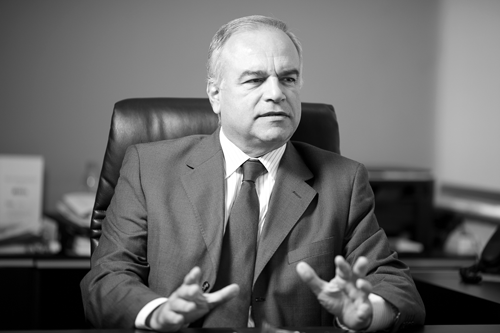
When Abdul Hafiz Mansour says 2011 was an “active” year, he leaves the impression that an off-the-record interview would yield a coarser word choice. As the “Secretary” of the Bank du Liban’s Special Investigation Committee (SIC), Mansour has the task of rebuilding confidence in the Lebanese banking sector’s ability to deal with money laundering, following the Lebanese Canadian Bank (LCB) crisis in early 2011. Along the way he has faced constant pressure from American authorities, including new legislation that could undermine Lebanon’s banking secrecy, and a slow-moving Lebanese legislature that has stalled implementation of laws conforming to international banking standards.

He believes the LCB crisis that began in February 2011 when the United States Department of the Treasury labeled LCB as ‘non-compliant’ is  finally over. 

But Executive notes that critics have raised concerns about the process by which many of LCB’s assets were acquired by Societe Generale de Banque au Liban (SGBL), with a number of ‘suspect’ accounts being allowed to remain.

Mansour defends the plan for the accounts as “well defined” and promises the Lebanese central bank is watching them closely. “Those accounts [that SGBL] did not take, we know where they were transferred eventually and we follow those accounts just like the banks that acquired them… there is nothing wrong with those accounts,” he says, but declines to discuss specific accounts. 

Loads of laundry

In 2010, the SIC only dealt with 254 investigations. When it was setup in 2001, the SIC published the actual dollar figures involved in reported cases and the sums that were frozen: $5.2 million out of a total $18.8 million. Since then it has stopped publishing these figures, thus reducing transparency and the ability to gauge the SIC’s productivity. Mansour says that because these figures represent a “moving target” during an investigation, reporting amounts is a frivolous exercise. 

Mansour admits that due to unusual circumstances last year the number of cases the SIC dealt with may be higher. But that figure is likely to grow exponentially once new rules are implemented.

Exchanging blows

Following the LCB scandal, the SIC took aim at currency exchange with a series of new measures, including higher capital thresholds. Mansour concedes that this will mean much stronger regulation on an industry of 400 businesses without any significant new allocation of resources — a seemingly daunting task, especially outside of Beirut. Yet he insists the SIC is prepared to take on this role.

“Lebanon is very well equipped, the SIC is very well staffed. I don’t like to name and cite other countries but certain countries with populations and banking sectors much bigger than Lebanon… don’t have as big an FIU [Financial Investigation Unit],” he says. Lebanon’s SIC has a staff of around 40, while Russia has some 600 and Saudi Arabia having roughly 110.

Last month Executive revealed that adapting to the US FATCA declarations on tax evasion could require a change to Lebanese banking secrecy laws, with Law 318 that created the SIC having to be amended to include tax evasion as a money laundering crime. The government and the central bank have yet to confirm this, but Mansour admitted it would be necessary to remain compliant.

These changes could threaten remittances, which are more than a fifth of gross domestic product, but Mansour disagrees, pointing out that the same fears were raised when the SIC was created in 2001, yet the financial sector continued to grow.

“It will be recommended that tax evasion would be a predicate offense…under the umbrella of anti-money laundering laws. So if you committed tax evasion all the monies that [are] involved in it will be considered as falling under the anti-money laundering rules,” he says, adding that corruption and politicians’ accounts will also be covered.

April 3, 2012 0 comments
0 FacebookTwitterPinterestEmail
Society

Complications amass

by Michael Karam April 3, 2012
written by Michael Karam

The message from Baselworld 2012, the watch and jewelry industry’s annual conference in the Swiss town of Basel, was that business is back on track after a few wobbly years. In 2011, Switzerland exported a record $21 billion in watch sales (nearly 30 million units), a 19 percent increase over 2010  due to growth in the Asian and  Middle Eastern markets. China led the charge, overtaking the United States as the nation with the biggest demand for luxury watches. Overall growth projections for 2012 are 7 percent, up from 2011’s 5 percent.

Lebanese importers attended Basel and were not disappointed. “Brands seem to keep surprising us each year by developing more and more complications,” declared Mher Atamian, managing director of Ets. Hagop Atamian, using the industry term for features beyond the normal display of time. “There is just no end to the imagination and development of high-end complicated pieces that will keep the watch aficionados interested.”

According to Simone Tamer, marketing manager at the Tamer Group, the models at this year’s show were defined by quality, technology and price. “The main engine working behind the scenes of these developments are the research and development as well as the design departments,” she said. “Every company is seeking to become partially independent in creating their own movements from their old suppliers.”  

There is also good news for female consumers. “In Basel we noticed a development in the women’s segment, where we saw wider ranges of female products in the collections, especially in brands like Breitling,” explained Tamer. “Today’s woman wants a man’s watch so brands are expanding their women’s collection to incorporate a masculine aspect in both design and mechanism.”

 The watches that caused a buzz during March included the Tudor Heritage Black Bay Diver. Tudor is a brand that has long lived in the shadow of its parent company Rolex, but seems to becoming a high-end name on its own. Many of the previous models looked too similar to their Rolex cousins, but recent designs have been very refreshing, especially the Heritage Chrono, which many believe is destined for iconic status. The Heritage Black Bay Diver, with its stunning cherry red bezel and the achingly elegant snowflake hour hand, sits up there with the Breitling Superocean Heritage, also modern with a design nod to a previous age.

Zenith is another brand that hides its light under a bushel. It is known among watch aficionados for making the El Primero, the most famous chronograph movement ever made. This year, Zenith unveiled the Big Date Special, a pared down, understated aviator chronograph, which is sure to enhance the brand’s status even further.

Another impressive watch was Omega Speedmaster professional. With a manual wind mechanism and a Hesalite Plexiglas glass (so as not to shatter in space), Omega has introduced a limited edition model that resembles the Speedmaster pre-Professional worn in space in 1962 by Walter Shirr.

Elsewhere, TAG Heuer showed off its limited edition Carrera to celebrate the 80th birthday of Honorary President Jack Heuer, while IWC unveiled the Big Pilot’s Watch Muhammad Ali Edition with fantastic red lume in honor of the great man’s trademark gloves, a watch auctioned for the Celebrity Fight Night charity on March 24. 

For those who love a bit of bling, Swiss watchmaker Hublot showed off the most expensive watch at this year’s fair. With a price tag of $5 million, the ‘watch’ was inlaid with more than 1,200 diamonds, including six weighing more than 3 carats. Call me a purist but I’d take the Tudor Black Bay Diver any day.

April 3, 2012 0 comments
0 FacebookTwitterPinterestEmail
Business

Q&A Ghassan Hasbani

by Thomas Schellen April 3, 2012
written by Thomas Schellen

The Saudi Telecommunications Company (STC) currently leads the expansion of telecommunications operators from the Middle East. It also is a main player in the development of regional content offerings both as distributor of content and as 71-percent owner of Intigral, a company focused on the mobile applications and content space. Executive caught up with Ghassan Hasbani, the chief executive of STC International, at the ArabNet Entrepreneurship Summit in Beirut and asked him about the group’s strategies.     

What role do mobile applications play in the STC strategy?

Mobile applications are now at the heart of most of our activities in the region and globally. For mobile applications to be widely spread and available we need to make sure that we do not play a direct role as telecom operators but allow a maximum level of creativity by encouraging the environment for application developers. Our strategy stems from the fact that the people that will make up the economy from now on over the next 30 years are people who were born after 1990. Those people live of applications and a connected world.

When I asked a Lebanese developer of mobile apps what question he has for the international CEO of STC, his question was, 'How can I make more money off them?’

Of course. The answer is simple. It depends what they are developing. If they are a startup they can make money by submitting their business plan to our venture capital [fund] so that we can co-invest with them. If they want to be a supplier, we have an application store where they can upload their applications and share revenues, or we have a company that deals with contents and applications and they can direct their developments towards the needs of that company. This company knows the market very well and interacts with us quite closely on our customer base. They can help the developer in developing the right things or modify their applications to suit the demand in the market, and make more money. These are the three channels we have.

Some people in the industry told Executive that only very few apps control attention while most have trouble to find market share and be profitable. As host of a very large customer base, your company presumably could decide which applications get visibility and which developers will fail to do so. How does STC approach this?

You need to strike a balance between a democratized service and a central command and control enforced distribution. If you have too much interference in enforcing distribution you move more into a socialist type of environment as opposed to a democratized type. In a true democratized environment applications are running based on their attractiveness to the consumer. If you create a randomized accessibility to searches rather than a prioritized accessibility to searches, then the smart applications and the popular applications will end up winning. Our policy is to provide an equal opportunity across the board. Saying democratization of access means that the developer has to be very smart in describing the applications that they are putting in the app store or online. It is about the ability of the developer to market their applications with the right key words, and the right targeting. This is what I call a true democracy.

Today you are described as being one of the top 20 operators worldwide and largest in the Arab markets. When another regional telecommunications operator went into an expansion spree some years ago with a declared aim to become one of the world’s top ten networks, STC was reported to announce similar aspirations to rise to being a top ten operator. Are you still pursuing this type of goal?

We are not saying that we want to be among the top ten telecommunications operators in the world. We want to be an operator – and we are effectively where we want to be – and continue being an operator that contributes to the economy and the society where we invest a higher value than we extract from it. That doesn’t mean we are making losses and we are not actually squeezing every penny out of the market. This is a business discussion. What we are saying is that for every dollar extracted from a specific market we contribute in value to that economy and society much more than one dollar. We believe effectively that for every $700 invested through our infrastructure development investments, a job must be created somewhere in that society whether inside or outside of telecoms.

Is this a benchmark you have devised?

No, this is the World Economic Forum’s benchmark. It was an OECD study on the Mediterranean countries published by the World Economic Forum. I am looking at this as a benchmark. If beyond this, we are looking at the relations to our shareholders, it is not our objective to be in the top ten for the sake of being there. Our objective is to be large enough to create synergies, to create economies of scale, to be able to serve our customers with the best possible prices and the best possible offerings. The objective is to remain profitable from our international investments, to diversify our base, and create enough scale to give us the economies that we are looking for.

On the side of profitability you said here at ArabNet that STC last year generated $100 million in Saudi Arabia in direct billings related to mobile application and content services. Is it correct that a lot of that revenue is created in profit sharing between STC and content developers?

Yes.

I also understand that a lot of content demanded by your customers has specific cultural relevance in Saudi Arabia, such as information of Hajj rites. Where do you see your position between commerce and cultural obligations?

Part of our strategy is always to be culturally sensitive to the market we operate in while preserving our values and our beliefs and our value system. In fact, there is huge demand for content that is Arabized and tailored to the culture that we operate in. That doesn’t mean it contradicts with profit making. For example, among the most popular contents and applications we have are religious contents. That content serves the requirements of the market, is culturally an extremely valuable content, and at the same time provides the right profits for the developer and for the producers and for us as distributors.

If you agree that mobile applications are at the drivers of future growth in the telecommunications industry, one will expect this to be the center of competition. In the past, we have seen for example the previous browser wars. Will the next wars be those of app stores, do you expect a commercial war between the STC store and the Android App market or Apple’s App store?

I don’t see this emerging into a full-fledged war because there is always going to be demand for global type of applications and contents that are useful to everyone. I think what we can do is differentiate on relevance. There could be market specific applications and activities that we can do that complement global international applications. This is what we would encourage developers to focus on and this would also allow those developers to differentiate themselves from the masses of developers in India, in Europe, in China, the US and all over the world.

But there is also the financial element. You are not part of the revenue stream if the app is sold to your customer via the Apple or Android markets.

Let me put it this way: how much is that revenue worth? It is a small portion and that revenue will not exceed ten to 15 percent of the total revenue base. This industry has been there for 150 years and it has been making the bulk of its revenues from connectivity services. I am not just saying connectivity infrastructure but access and capacity.

So you see your role also for the future to be providing access more than building a community and provide content?

I am not saying no but the dominant part of our revenues will still come from selling capacity, access, and quality of service. By being smart carriers we bring value to the industry and continue to build value for the next 150 years because somebody has to create that part of the industry. If we try to pretend that we will turn our business model into applications and contents and go and compete with every developer in the world, which means we will have to develop our own content, it doesn’t make sense because we don’t have the mass.

If someone were to try to convince you to scale up in other ways and add non-telecom capacities by for example buying a bank or buying a handset maker, what would you say?

That would be the biggest mistake because if you buy a bank, you limit yourself to the license of that bank.  If you buy a handset player, you limit yourself to the creativity of that one player. Trying to do other people’s business is wrong. Equally, if Google is trying to become a telecoms operator, it is also wrong. They will fail.

As STC has a growing international profile and has recently been invited to join the International Telecommunications Union’s Broadband Commission, what do you see as your role and contribution in shaping the global broadband culture and its social and socioeconomic performance?

Our position is to turn what today is broadband into the narrow band of the future. [We also aim] to create a differentiated quality of service approach, which is based on the experience of consumers and on the value they extract from it and are willing to pay for as well. This maintains value across the telecommunications industry and enhances the ability of the top players to use the broadband infrastructure effectively and it creates a system by which everyone can happily live for the next 20, 30 years until the next big thing comes up.

What can your specific experience as operator in Saudi Arabia as a market with extremely high mobile phone penetration and at the same time vastly different income groups tell you about the priorities for the development of mobile communications in the coming few years in developing and emerging markets?

Our experience is summarized in one word, competition. Whenever you have fair competition in a market regulated by a transparent, fair and independent regulator with a clear government strategy to enhance and build the ICT sector, knowing full well that this sector will build the entire economy, this is where you get a system that caters to everyone and enhances penetration, provides affordability to everyone, and creates a momentum in the economy and society.  

Is STC planning to grow into any new areas?

We always look for opportunities.

Are there still opportunities for expansion of telecommunications through new licenses or acquisitions?

There are always opportunities and the price is a function of the value to the operator. If it is something you can extract value from, adjacent to a market you have, the synergies, why not? You can pay for it the proper value. It is always based on the right calculations. We always look for opportunities that complement our portfolio and at the same time, on a standalone basis, make a business case. 


April 3, 2012 0 comments
0 FacebookTwitterPinterestEmail
Society

The Tobacco Keeper

by Ellen Hardy April 3, 2012
written by Ellen Hardy

How do you tell the story of modern Iraq? For novelist, film producer and war correspondent Ali Bader, it’s not enough to recount the terrible cycles of violence that have made his country unrecognizable. His fictional account of Iraq in “The Tobacco Keeper” — first published in Arabic in 2008 as “Hareth al-Tabgh” and newly out in English from Bloomsbury Qatar — is filtered through an identity that is as complex and multivalent as history itself. As an idea, it intrigues, but as a finished book, it becomes mired in its own ambition.

The unnamed journalist narrator takes us through 80 years of Iraqi history, with diversions through Israel, Moscow, Iran and Syria. An ambitious and wide-ranging setting for a political tale of the Middle East, Bader’s novel is also an intensely personal and artistic one. Its central character, a musician, reflects after a performance for Saddam Hussein: “There has always been an ego that watched me and made fun of everything I did. Don’t those great politicians possess a similar ego that watches them and makes fun of their acting and role-playing?”

This existential angst — for the artist, and for Iraq itself — underpins the unfolding plot, and with good reason: the musician character turns out to have lived three different identities during his life, all filtered through the political convulsions of Iraq. Born Yousef Sami Saleh in 1926, a middle class Iraqi Jew exiled to Tel Aviv in 1952, he witnesses what, for him, was the key event in the collapse of Iraqi values: the 1941 Farhoud incident, involving a series of violent and murderous attacks against Iraq’s Jews, events Bader describes as “a real turning point in the history of this society, being the first attack of its kind against its own citizens, and opening the door to civil conflict. Although historians have devoted little attention to it and have done nothing to address our collective amnesia, we can safely say that all the subsequent civil strife in Baghdad may be traced back to what happened on that fateful day.”

At moments like these, there is a real sense of atmosphere in the book, and of a fresh analytical perspective that brings internal Iraqi struggles to the forefront of history, but the narrative never settles for one answer. In closing, the narrator muses, “How could we define the identity of the enemy? Sectarianism? Imperialism? Foreign Intervention? Was it the desperate defense of private wealth, the class system, international law, or the conflicts of the governments? How could one label what was happening?”

The character Yousef Sami Saleh avoids labels as thoroughly as his home country. With a forged passport, he escapes Tel Aviv to Moscow and then Iran, returning to Iraq as the Shia Haidar Salman in 1958 after the fall of the monarchy, only to be deported again in 1980 as Iraqis with Iranian affiliations lose their citizenship in the shadow of the Iran-Iraq war. In 1981 Salman changes his identity a third and final time, for that of Kamal Medhat. This was the Sunni character that brought him back to Baghdad for the third and final time — a Baghdad that would, in 2006, claim him — an 80-year-old man kidnapped and murdered by an unnamed armed group. With a characteristic sense of tragedy, the narrator declares, “He thought that identities spelled the end of the world.”

The book is a worthy choice for translation by Bloomsbury Qatar — it was long listed for the Arab Booker Prize, and Bader himself is well known and respected in Arab literary circles. But despite some poignant moments, its overall execution is frustrating. Bader’s often dry, repetitive prose and paper-thin characterizations seem to have suffered from both indifferent translation and uncritical editing, resulting in a text which, while fascinating in set-up, will neither convert new readers to Arab literature in translation nor thrill those already on the lookout for titles previously unavailable in English. The title of the book comes from a poem, “Tobacco Shop” by the Portuguese poet Fernando Pessoa, whose three narrators — the author’s heteronyms — correspond to Saleh’s three lived identities. Again, a fascinating possibility, but the repetitive musing on this connection drags the book down further. At a time when the appetite for voices from the Arab world has never been greater, this is a missed opportunity.

April 3, 2012 0 comments
0 FacebookTwitterPinterestEmail
Comment

An unnecessary tragedy

by Nadim Houry April 3, 2012
written by Nadim Houry

Alem Dechasa-Desisa’s death at age 33 would have probably gone unnoticed — like that of so many other migrants — if not for a widely circulated video showing her being physically assaulted by a man, later identified as labor recruiter Ali Mahfouz, at the gates of the Ethiopian consulate 20 days prior. Dechasa-Desisa had come from Ethiopia to Lebanon in December 2011 to work as a domestic worker. She committed suicide on March 14. Caught on film, the abuse of Dechasa-Desisa triggered a public outcry that pushed the prosecutor to charge Mahfouz on March 22 with contributing to and causing her suicide. 

The abuse of Dechasa-Desisa was outrageous and its perpetrator must be held accountable. But the issue here is not just the criminal behavior of a recruiter, but the entire system of recruiting and regulating migrant domestic workers. Dechasa-Desisa’s death was entirely foreseeable and could have been prevented had the Lebanese authorities granted domestic workers their most basic rights.   For years now, human rights groups have been raising the alarm over the high suicide rate among domestic workers in Lebanon. A 2008 Human Rights Watch study concluded that domestic workers were dying at an average rate of one a week, mostly from suicides and failed escape attempts from buildings. KAFA, a Lebanese women’s rights group, compiled information about nine deaths for the single month of August 2010. This year, The Guardian newspaper reported on the death of Lila Aacharya, a Nepalese woman who arrived to Lebanon in late 2011 and died on January 29, her body found dangling from a balcony window near Beirut. A few days later, Paltishi Hendor, an Ethiopian domestic worker, was found dead after she hung herself at her employer’s house in Keserwan. The situation has gotten so bad that three years ago an ambassador from one of the ‘labor sending’ countries told me that he was no longer running an embassy but a funeral parlor. 

Suggestions that these women were simply unstable are unfounded. Interviews with embassy officials, and friends of domestic workers who committed suicide, suggest that the main factors in these deaths are isolation caused by forced confinement, excessive work demands, employer abuse and financial stress. Dechasa-Desisa’s overriding worry, according to a social worker from the Caritas Lebanon Migrant Center who visited her at the psychiatric hospital a few days prior to her death, was her ability to feed her two children in Ethiopia and repay the debt she had incurred to travel to Lebanon. 

Faced with overwhelming evidence of a broken system that regularly drives migrants to despair, the Lebanese authorities’ lack of an effective response amounts to negligence. Under pressure from rights groups and countries that started barring their nationals from coming to Lebanon, the authorities introduced a compulsory standard employment contract for domestic workers in January 2009. But the contract provides weak protections, is only available in Arabic — a language most workers cannot read — and is rarely enforced. Most importantly, the authorities took no measures to grant these workers the right to move freely during their time off, which would help end the isolation they often endure.  

If Lebanon wants to end the high suicide rates among migrant domestics, it must fundamentally revisit the current kafala (sponsorship) system that grants employers so much control over domestic workers’ lives. As one ILO representative told the media, the kafala system creates “a total dependency of the worker on the employer for her food, sleeping, health, everything. Total dependency creates total vulnerability and opens the door wide to exploitation.”

Lebanon needs to catch up with international standards by ending this dependency and ensuring that workers can — as a matter of law — leave the household during their time off. Visa regulations must be amended to allow them to live on their own if that is the arrangement they prefer. And finally Lebanon must reexamine the role of private recruitment agencies whose business is to make money by finding and selling cheap labor to Lebanese families. At a minimum, the authorities need to ensure that all agencies are licensed through a rigorous inspection process and monitored regularly. Better still, they should explore an alternative recruitment process that reduces the role of intermediaries.

Short of that, Dechasa-Desisa’s tragic end will be far from the last. 

April 3, 2012 0 comments
0 FacebookTwitterPinterestEmail
Society

Lonely in Luxury

by Yasser Akkaoui April 3, 2012
written by Yasser Akkaoui

Dipping my head to walk onto an Air France flight at Beirut’s Rafiq Hariri International Airport last month, I suddenly found myself sitting next to some familiar faces. To one side of me I found former telecommunications minister Marwan Hamadeh. In the next row, I saw Bank Audi general manager Marc Audi, who was sitting next to Azmi Mikati, nephew to the Prime Minister, and in the last row sat Progressive Socialist Party leader Walid Joumblatt and his wife Noura. 

Now, I was not overly surprised to find myself in such an assembly, as Paris, more than any other city, is our Lebanese home away from home. We may do business in the Gulf — and nearly everywhere else on the planet — but for savoir vivre, we return to the Seine. What did surprise me was that I fly business class and when I had stepped on board I had glanced to my left and saw that “La Premiere,” the first class, was empty. Should not all these members of the Lebanese uber-elite be sitting in first class instead of hobnobbing in Affaires?    

Curious to find about the first-class Air France service between France and Lebanon, I arranged a press trip with our friends at the airline. Three days later, after I had concluded my business and filled my inner reservoirs with cultural and culinary delights, I stepped out of the front door of my Paris home to find a car from the airline ready to drive me to Charles De Gaulle.

What I arrived to was anything but the clunky Paris hub I was used to. I was recieved in what looks more like a hotel than a terminal. There was no counter to wait at, only a dazzling attendant assinged to you (and only you) wearing the finest bleu, blanc est rouge. The exchange with this lovely French damme is anything but the usual drab airline chitchat, and you barely notice as she takes your documents only to bring them back promptly and whisk you through customs to a dedicated elevator bringing you to the La Premiere Lounge. There, surrounded by a fine art exhibition and served the best French cusine by Alain Ducasse’s own staff I began to understand why, after the fall of the Concord, Le Premiere has become Air France’s alternative offering to the world’s well-heeled. After relaxing in the spa, it was time to board and my personable attendant drove me (in a  French car of course) to the plane. 

I was the last passenger to board, welcomed and escorted to the vestibule of my seat by a flight attendant who was yet another dazzling lady. But the four hours back to Beirut in La Premiere was enough time for me to return to the question: why on earth were the Lebanese elite I saw three days prior flying business class instead of in noble first?

First I thought it was a matter of image. Bankers, even the top brass at the largest banks, may be sensitive to the public perception that demands austerity in harsh economic times. But nobles and princely ‘zaims’ surely do not have to consider those business image factors, so I thought of other reasons. While sitting lonesome in the first-class cabin, I thought maybe isolation is not a Lebanese thing. Lebanese boys  like to show off, but in La Premiere, as you are last-on and first-off, nobody ever sees you, so how can you show off if nobody walks by? 

In the end, I think I figured it out. Every crown has its jewel, and for those gems no price is too high for those who want what no one else has. But while no other airline offers such daily first-class service from Beirut to Europe, and clearly there are enough high-net-worth Lebanese to fill eight, or even 16 seats, do they have the will, or find the worth, in spending $1,000 an hour for the privilege? 

I may have rubbed shoulders with absolute luxury and the finest culture (albeit in splendid isolation), so if I am invited again, or if high demand for business class in the summer narrows the price gap considerably, I will gladly consider La Premiere. But when, as this spring, the return flight on first will mean shelling out about $5,000 after adding taxes, when a business class seat will set me back $2,000 or less, I think I would rather use Affaires and rub shoulders with neighbors.

April 3, 2012 0 comments
0 FacebookTwitterPinterestEmail
Comment

Hezbollah softer on Syria?

by Nicholas Blanford April 3, 2012
written by Nicholas Blanford

Is Hezbollah beginning to dampen its enthusiasm for the regime of Syrian President Bashar al-Assad? The answer is probably no, but that question is being asked in diplomatic circles after indications that Hezbollah has toned down some of its rhetoric on the Syria crisis lately.

Most notably, in a speech in the middle of March, Secretary General Sayyed Hassan Nasrallah declined to repeat accusations that the upheaval in Syria is the work of the West and allied Arab states to weaken a cornerstone of the anti-Israel ‘Axis of Resistance’, the pan-regional alliance that brings together Iran, Syria, Hezbollah, elements in Iraq and some Palestinian groups. Instead, he opted for a more conciliatory tone, stressing that only a political solution could end the bloodshed.

“Since day one, we have called on the Syrians to avoid carrying arms and adopt a political solution… It has been one year since the crisis began and no tangible results have been achieved,” he said. “There is only a political solution in Syria. That is [for both sides to] lay down arms simultaneously within an agreed-upon mechanism, in order to embark upon a clear political solution.”

Referring to a silent plurality in Syria that does not necessarily support the Assad regime but fears an alternative, Nasrallah said, “There are people who want reforms and not a civil war or partition. They want to continue [to resist Israel] and be loyal to Palestine. We are with them.”

When the revolt in Syria erupted a year ago, it posed a serious dilemma for Hezbollah, as well as Iran. Syria is a critical ally of Iran and Hezbollah, the geo-strategic lynchpin connecting the two that serves as a conduit for the flow of arms and provides strategic depth for the Resistance. The loss of Syria threatens the integrity of the alliance. However, offering unvarnished support for the Assad regime risked worsening already strained relations with the region’s Sunnis. Hezbollah has always championed intra-Muslim unity, believing that the schism between Shias and Sunnis distracts from the more pressing goal of confronting Israel. But the hostility of Syrian Sunnis towards Hezbollah has steadily grown over the past year as the uprising has taken on a more sectarian tone.

In dozens of interviews with Syrian refugees, activists and Free Syrian Army fighters, accusations have been leveled against Hezbollah for helping the Syrian government forces stamp out the rebellion. Some claim to have seen men “dressed in black with beards” kept separate from Syrian security forces. Others insist that the suspected Hezbollah men were speaking with Lebanese accents. Yet little concrete evidence has emerged that Hezbollah is fighting alongside Syrian troops to crush the protests.

In the early stages of the uprisings in Tunisia, Egypt, Bahrain and Libya, Hezbollah sided with the rebels. Indeed, Hezbollah officials could barely disguise their glee at the sight of Hosni Mubarak, former Egyptian president and arch critic of Hezbollah, carried into court on a stretcher after his downfall. But when the Arab Spring came to Syria, Hezbollah changed its tune, opening the party up to charges of hypocrisy. Hezbollah, however, makes no apology for its seemingly contradictory stance toward Syria. The argument runs that Syria is deserving of Hezbollah’s support because of its rejectionist stance toward Israel and its support for the Resistance, unlike all the other countries subject to the Arab Spring revolts, which were allies of the West.

Nevertheless, Nasrallah must surely rue the lost opportunity that was available early in the crisis when the Syrian regime could have staunched the protests by embarking upon a genuine reform program, which would have left the regime in place but addressed some of the demands of the protestors. There is an argument, of course, that the Syrian regime cannot implement meaningful reforms without fatally weakening its hold on power.

Either way, Hezbollah has little choice for now but to follow Iran’s lead and continue backing the Syrian regime in the hope that it can eventually prevail. If the Assad regime collapses it will upset the strategic alignments across the region. In the — admittedly unlikely — event of a smooth transition to a Sunni-dominated regime in Damascus that realigns closer to Saudi Arabia and Turkey, Iraq could emerge as the new regional fault line between Iran and the Gulf states. That would leave Hezbollah still domestically strong, but regionally isolated on the shores of the Mediterranean with its Iranian patron on the other side of the Middle East.

April 3, 2012 0 comments
0 FacebookTwitterPinterestEmail
Comment

Mainstreaming extremism

by Spencer Osberg & Ali Sayed-Ali April 3, 2012
written by Spencer Osberg & Ali Sayed-Ali

Last month a new player was born into the world of sectarian politics in Lebanon. Sheikh Ahmad al-Assir, the Imam of Bilal Bin Rabah Mosque in the southern city of Sidon, was for the first time given a national audience, his speech to a rally of some 2,000 Salafist Sunni Muslims in Downtown Beirut on March 5 broadcast across the spectrum of Lebanese satellite TV stations, his words printed in newspapers and websites affiliated with all the country’s sectarian power centers. Overnight, Sheikh Assir became the face of the Salafist movement in Lebanon.

Until last month, the strongest association most Lebanese had with the word ‘Salafi’ was the siege of Nahr Al Bared in 2007, when a group of heavily armed, mostly-foreign Sunni extremists waged a four-month war with the Lebanese army at the Palestinian refugee camp near Tripoli, leaving many hundreds dead and wounded, tens of thousands displaced and the camp leveled. Until last month ‘Salafi’ was synonymous with a vein of religious fanaticism most Lebanese find abhorrent.  

Not unaware of this, Sheikh Assir clearly made moves to legitimize and rebrand the Salafist movement and move it closer to the mainstream. Opening the rally before Assir took the stage was Fadel Shaker — the pop-culture icon most had previously associated more with Lebanon’s glitzy, Champagne-guzzling nightclubs than a literalist Sunni interpretation of the Quran — who crooned an Islamic anthem to bless the ceremonies. Then came Assir’s conciliatory words to the country’s Christians, emphasizing their essential place in a religiously plural Lebanon. He repeated this sentiment the following week in an interview on the nation’s most popular talk show “Kalam Ennas”, on the Christian-affiliated LBC channel. While on air he shrewdly went as far as he probably could to distance himself personally from the extremist label while not alienating his followers when he said that he is, in fact, not a Salafi at all, but at the same time to be a Salafi “is not a crime.”

During this interview, despite saying, “I am not a politician,” Assir made his political ambitions clear: he intends to replace Saad Hariri as the leader of the Sunni sect in Lebanon. That’s ambitious, as Assir’s movement is still small relative to other political parties in the country, with a support base focused mainly around Sidon and Tripoli, but it has gained momentum in recent years. 

Following Hezbollah-led fighters’ effective takeover of much of Beirut in May 2008, many Sunnis were left feeling humiliated and abandoned by their traditional leaders. The enduring absence of Hariri from the Lebanese political scene and the financial troubles battering his business empire have left much of the Sunni populace increasingly adrift for leadership — an opening Assir seeks to exploit.

Assir is also emboldened by the regional gains of the Salafi movement within the context of the Arab uprisings, with Salafi parties making public shows of force at the ballot boxes in Egypt and Tunisia, and the Syrian uprising increasingly becoming a regional rallying cry for Sunni liberation.

There is a fundamental incongruence, however, in trying to take an extremist ideology into the mainstream, and the more Assir’s movement is in the spotlight of scrutiny, the more these inherent contradictions will surface.   

While the rally in downtown Beirut was ostensibly a show of support for the Syrian uprising, the Salafi character of the demonstration played perfectly into the warnings of the Syrian regime that there is actually a sectarian conflict being waged by religious extremists. 

While there will also undoubtedly be a Salafi showing on the next ballot for parliamentary elections in 2013, can a group that explicitly believes non-Sunnis to be ‘infidels’ reconcile this with responsibility to govern fairly over a population as religiously diverse as Lebanon’s?

Perhaps the contradictions are no better embodied than by the man who opened for Assir at the rally, Fadel Shaker. Despite having sung his way out of a youth of poverty and being invited to open the rally precisely because of his famous vocal cords, Shaker said afterward in an interview on MTV’s “Inta Hurr” talk show that — in line with fundamentalist Islamic teachings — he considers singing a sin and was going to retire. He’d decided to postpone his professional exit, however, to use his immoral abilities to support the Syrian revolution — and introduce the nation to its newest religious icon.  

April 3, 2012 0 comments
0 FacebookTwitterPinterestEmail
Finance

Fixed income’s online shine

by Henri Chaoul March 27, 2012
written by Henri Chaoul

Over the course of the last decade, electronics have transformed the global markets: virtually all the world’s exchanges are electronic. Access to liquidity and the ability to execute in nanoseconds is routine. The electronic revolution in securities issues has led to greater efficiency, liquidity, price discovery, quicker execution, and productivity for all players: broker-dealers, institutions, and individual investors.

Notably absent from participation in this transformation has been the fixed income market, but that is changing. Driven by regulation, technology, and the need to compete, fixed income markets are catching up – if not soon to surpassing – the electronic capability seen in equities and purely fixed income asset classes.

The regulatory requirements mandated both in the Basel and Dodd-Frank regimes that lay out rules for the financial industry necessitate greater connectivity, transparency and access among fixed income players. Owing to regulation, upcoming trends will include a move from proprietary to agency-based execution, where an individual or a firm is authorized to executive on behalf of the principal, and a further tightening of spreads – all of which harbor well for a centralized connected solution.

In addition, from the competitive standpoint, the previous advantages reaped from bond market opacity are disappearing, meaning that the market is moving to become more efficient. Internet-based technology unavailable only a decade ago enables this efficiency, transparency, and connectivity. And, precisely because the bond markets are delayed entrants into technology, the technologies that are available and which are being deployed are already the most advanced.

Bonds behind the curve

One of the reasons the bond market has lagged behind is a resulting structural issues related to trading. Part of the problem resides in the sheer size of the market and the number of instruments available. In equities, a company has one stock available for trading. In the bond market, a company has different issues, released at different times, under different terms. This creates an illiquid market that is, by definition, ‘hard to trade’. Sourcing liquidity is not only difficult but has to be solicited and, until recently, the only way to find the other side of a trade was to make a number of bilateral phone calls.

Secondly, the way bonds are traded are simply not as easily understood by investors as equities and foreign currencies. But as investors increasingly see a need to diversify (evidenced by the decline in volumes in the equity markets), especially in light of today’s global market uncertainty, bonds become a “must have” in any portfolio. In addition, investors who are now holding large amounts of cash are trying to figure out what to do with it. One answer is bonds. For example, Americans invested $131 billion into taxable bond mutual funds through November 2011, with a concomitant net outflow of $115 billion from stock mutual funds.

What’s more, banks are no longer the sole liquidity providers, which has traditionally been the case. The result is a more liquid and competitive market. The buy side is getting bigger and trader intent will matter less in such an environment. What now matters is the desire to access liquidity and to execute.

The variables and trends in today’s environment call for a more sophisticated approach and technology meets this need, facilitates it, and drives it. The critical gap of the lack of a centralized, connected, and transparent market for interested parties worldwide to meet and transact is now being met. Such a centralized approach will generate maximum liquidity in one place without displacing current relationships but, rather, expanding on them and making them more efficient in time, access to liquidity, prices, and execution. People will not be displaced, but phones will be.

Delivering a centralized platform via technology to traders worldwide, regardless of type or motivation, will connect local market players to the entire universe of instruments available for trading. Local investors in Beirut, Riyadh or Dubai will be able to access any instrument, anywhere. And investors outside local markets will be able to transact in local issues. Interested parties will meet, regardless of time, location, or language.

Demographic issues are also pushing the equation. In the United States, the baby boomers are nearing retirement and are moving into bonds. In European securities, the desire for certainty mandates a move to more predictable asset classes. Younger traders, used to a world of Facebook and EBay, simply work through computers and mobile devices rather than phones, and will demand equivalency in their professional environment. The transformation is upon us.


HENRI CHAOUL is general manager of the Lebanon-based Master Capital Group

March 27, 2012 0 comments
0 FacebookTwitterPinterestEmail
  • 1
  • …
  • 337
  • 338
  • 339
  • 340
  • 341
  • …
  • 686

Latest Cover

About us

Since its first edition emerged on the newsstands in 1999, Executive Magazine has been dedicated to providing its readers with the most up-to-date local and regional business news. Executive is a monthly business magazine that offers readers in-depth analyses on the Lebanese world of commerce, covering all the major sectors – from banking, finance, and insurance to technology, tourism, hospitality, media, and retail.

  • Donate
  • Our Purpose
  • Contact Us

Sign up for our newsletter

    • Facebook
    • Twitter
    • Instagram
    • Linkedin
    • Youtube
    Executive Magazine
    • ISSUES
      • Current Issue
      • Past issues
    • BUSINESS
    • ECONOMICS & POLICY
    • OPINION
    • SPECIAL REPORTS
    • EXECUTIVE TALKS
    • MOVEMENTS
      • Change the image
      • Cannes lions
      • Transparency & accountability
      • ECONOMIC ROADMAP
      • Say No to Corruption
      • The Lebanon media development initiative
      • LPSN Policy Asks
      • Advocating the preservation of deposits
    • JOIN US
      • Join our movement
      • Attend our events
      • Receive updates
      • Connect with us
    • DONATE