• Donate
  • Our Purpose
  • Contact Us
Executive Magazine
  • ISSUES
    • Current Issue
    • Past issues
  • BUSINESS
  • ECONOMICS & POLICY
  • OPINION
  • SPECIAL REPORTS
  • EXECUTIVE TALKS
  • MOVEMENTS
    • Change the image
    • Cannes lions
    • Transparency & accountability
    • ECONOMIC ROADMAP
    • Say No to Corruption
    • The Lebanon media development initiative
    • LPSN Policy Asks
    • Advocating the preservation of deposits
  • JOIN US
    • Join our movement
    • Attend our events
    • Receive updates
    • Connect with us
  • DONATE
Brand VoiceBusinessTechnology

Dedicated to SMBs, Microsoft launches Dynamics 365 Business central in Lebanon

by Microsoft July 19, 2021
written by Microsoft

Microsoft is dedicated to enabling digitalisation across the Middle East and Africa. With digital transformation now a necessity, small and medium-sized businesses are seeking cost-effective, streamlined systems that will make their transition seamless. Addressing this need, Microsoft’s cloud-based business management solution, Dynamics 365 Business Central, will launch in Kenya, Nigeria, Tunisia, Morocco, Algeria, and Lebanon starting July 2021.

“Dynamics 365 Business Central helps small and medium-sized businesses (SMBs) connect their financials, sales, service, and operations to streamline business processes and improve customer interactions,” explains Maher Al-Khaiyat, regional business applications director for Microsoft MEA Emerging Markets. “Multiple, disconnected systems are now easily combined under one secure, centralised application.”

Using Dynamics 365 Business Central, efficiency is boosted through automated tasks and workflows — all from within familiar Office tools like Outlook, Word, and Excel. “What businesses get,” adds Al-Khaiyat, “is an end-to-end view of their operations, with built-in intelligence when and where they need it.”

The application is easy to tailor and extend to meet unique business or industry-specific needs. By putting flexibility at the core of your business, Dynamics 365 Business Central enables you to start quickly, grow at your own pace, and adapt in real time, making it the ideal solution for SMBs. 

SMBs account for over 90 percent of all businesses in Kenya, Nigeria, Tunisia, Morocco, Algeria, and Lebanon, where Dynamics 365 Business Central will launch. SMBs across these markets will be empowered to accelerate the digital transformation of their own business processes using this innovative all-in-one solution.

Connecting all aspects of your business

SMBs can bring people, processes, and data together to manage their business end-to-end, instead of juggling standalone systems that disrupt business flow. With previously disconnected systems now brought together, tasks like connecting workflows across sales and accounting to automatically track cash flow are made effortless.

Dynamics 365 Business Central is easy to integrate with applications like payroll, banking apps, or custom Application Programming Interfaces (APIs), with the same consistent and secure experience across devices, from laptops to phones, no matter where teams are accessing the application from. 

Full Office 365 integration means teams can use familiar tools to work together and connect with colleagues and customers, whether creating professional-looking business documents in Microsoft Word templates, or exporting and updating data in Microsoft Excel. 

Helping you work smarter, not harder

A centralised, unified overview of your business offered by Dynamics 365 Business Central helps business owners and leaders make smarter, more streamlined decisions that improve productivity. 

Thanks to easy to create dashboards and built-in analytics, leaders can proactively inform and guide employees, manage budgets, and monitor progress with real-time data on available resources. As a real-time online application, all data stays up to date, making it simple to spot trends, prevent issues, and deliver great customer experiences. 

Tracking ongoing sales performance is simple, enabling teams to leverage actionable insights to focus on customers that have the greatest potential for long-term growth. 

A tech solution that grows with the business

Dynamics 365 Business Central is easy to install, getting the business up and running quickly. Start with what the business needs and grow at your own pace to run the entire business in the cloud. What businesses get is easy set-up, management, and scalability. 

Each business has unique needs, which Dynamics 365 Business Central caters for by easily integrating add-on applications and industry-specific solutions. Importing data from other solutions using data migration wizards and assisted set-up is simple. Plus, with a user-friendly drag-and-drop interface, it’s simple to rearrange fields, rename groups, and reposition elements to create workspaces for specific roles. 

SMBs can deploy Dynamics 365 Business Central in the cloud, on-premise, or with a hybrid approach; no matter the requirements for data residency, compliance, or security, companies can run their business wherever and however needed. A universal, mobile-enabled user experience means users have the same powerful, intuitive experience across deployments and devices.

Today’s all-in-one solution for tomorrow’s business growth

The business management solution that growing SMBs need is one that is secure, centralised, easy to adopt, and capable of integration with other line-of business systems. They need a cloud-based solution that is flexible and adaptable enough to handle increased inventory and transactions as the business grows. 

“Microsoft’s unique ability to deliver the depth of integrated business applications necessary, alongside fully integrated analytics, productivity, and IoT solutions at cloud efficiency, and scale, drives the success of its Dynamics 365 Business Central solution,” explains Al-Khaiyat. “This is the all-in-one solution to meet every SMB’s business-management needs.”
July 19, 2021 0 comments
0 FacebookTwitterPinterestEmail
2018 BudgetEconomics & PolicyManufacturingSpecial Report

What they crave

by Walid Slaiby July 6, 2021
written by Walid Slaiby

Following the roundtable discussion on Manufacturing, we quizz the chief executive officers of two high-profile companies that are adding value to the real economy of Lebanon: cloud infrastructure component maker Multilane in high-tech manufacturing, and paints producer Sipes International, a stalwart player in the chemicals sector. With all the infrastructure shortcomings of Lebanon, fulfillment of one practical want would set these industrialists’ minds onto steeper growth: the implementation of dedicated manufacturing zones or “special economic zones” (SEZs) as building blocks of a real-economy industrial ecosystem.

Chief executive officer of Multilane, Fadi Daou, sums up how he perceives the fundamental problem of manufacturing in Lebanon. “All the existing laws in our system center around a consumer industry and none of them focus on the export sector,” he says.

Like approximately 90 percent of systemic industrial manufacturing problems, this battle over the creation of industrial zones or SEZs is nothing new but all the more enmeshed in sticky interests. According to a World Bank report from 2018, Lebanon has had a program for establishing industrial zones “for several decades” and a strategy for such zones was developed in 1995 by the Investment and Development Authority for Lebanon (IDAL). More recent by comparison was that some five years ago, a program for SEZ master-plans and pilot zones was heaved onto the political table as result of a collaboration between UNIDO and the Ministry of Industry. This occurred after several years during which the topic of industrial zones in context of the Syrian refugee crisis had been shouted by UNIDO from the country’s development rooftops. Back in 2009, the Lebanese Parliament started to discuss the establishment of a SEZ in Tripoli which was enacted as a law but until now has never seen the light of day. A certain plot of land allotted for the creation of this zone and the appointment of its chairman are all that has been done in this direction so far.

Daou comments that “the Tripoli SEZ was founded as a quasi government organization and it won’t be able to operate as an independent free market industry sector.”

Daou stresses the need for a private sector-driven SEZ to operate outside the local jurisdiction, saying: “We need to create an echo system or a legal setup that will allow a competitive operation of multinational companies in Lebanon which have been able to operate in the SEZs of Dubai, Vietnam, Tunisia, Malaysia and Thailand.” He tells Executive: “SEZs will help us export products rather than export people and will become the foundation for creating jobs.”

Wajih Bizri, president of Sipes Group, echoes Daou’s views by saying “the best lobby we can do as businessmen and as industrialists is to put an effort to create the SEZs which should be completely independent from anything related to the government bureaucracy.”

He continues, “There is a need to have multi SEZs in different areas geographically and demographically to be available for different sectors.” According to him, future SEZs will serve as a hub for IT export and for exportable services, adding that “On top of that we can open hubs for small and medium size businesses in these zones and let them develop.”

“If we succeed in that then we can talk about developing the five sectors we talked about at the roundtable especially IT, Intelligence, other industrial sectors and even service sectors,” Bizri says. He moreover suggests merging some of the industries discussed at the roundtable or having a common export bureau for these industries.

While he considers lobbying with the current public sector a waste of time unless it is restructured according to the International Monetary Fund (IMF) demands, he advocates for bringing in European experts who can assist industrialists and show them the way to export to Europe, especially with the devaluation of the Lebanese pound and the drop in salaries in Lebanon.      

Lebanese brand

When asked about how important the brand of Lebanon is to his enterprise, Daou says, “For me as a manufacturer it is not very critical. In our sector our end customers don’t necessarily care where the product is coming from. They care that the supplier, us in this case, is not at risk of delivering a high-quality cost-competitive model on time.”

While being committed to these standards, Daou’s high-tech manufacturing venture could build a Lebanese brand, a brand which, according to him, “has been damaged because Lebanon is viewed as a country of risk.” For some other industries, namely fashion or food products, Lebanese branding could be relevant “for sympathy purchasing,” he says.

Daou adds, “The brand of Lebanon can best be improved by us being able to create a more competitive environment in which we can meet the delivery needs of our customers. I believe what we really need to do is to mitigate the risk by removing the financial risk to our market segment to be able to freely transact in the banking sector as we would in any other country and we need to eliminate the historical barriers that have existed in our sector and have prevented us from growing or creating or helping or enabling other companies in our sector to grow in this country.”        

For Bizri, the brand of Lebanon has suffered a lot in the past three to four years. However, he says, “It is still an important brand in the agro industries where it has an advantage. Other than agro industries, the brand of Lebanon does not have an added value in the present circumstances because of the lack of transparency linked to Lebanon and its government.” 

“To best improve the brand of Lebanon, it is a must to have a transparent government. And we have to start moving forward with the IMF. Besides, we need to have political stability which will eventually lead to some economic stability. You cannot put all your efforts on branding something which cannot be branded,” Bizri concludes.  

Synergies

Regarding the creation of synergies with the other industries that were discussed at the roundtable series, Daou says, “I don’t necessarily see from my industry a relevant collaboration with an agro or fashion or hospitality industry which is completely unrelated in terms of their needs. However there are common principles for operating any business in that there needs to be a synergy, for example the most critical thing is the banking sector. Today, we are underwriting the banking sector and it is not as effective and efficient as it used to be. Another area could be rendering the labor laws to be more compatible with the free market economy.”

He emphasizes that access to finance is not what is holding him back but cautions that the current system is not viable for the creation of new industries, adding that the formation of an ecosystem will achieve more than subsidizing the sector. However, the banking sector needs to be stabilized by creating mergers. “There is a need for creating a hybrid model system, a crypto currency for that matter. Any way that will let us be able to transact with our people and to receive money from abroad without being charged a huge amount of money,” he says.

For Bizri, Lebanese industries face daunting but surmountable barriers of finance. “Accessing finance today is very difficult with all the question marks about the Lebanese economy. But it is not an impossible mission. We need to concentrate and depend somehow on the Lebanese diaspora by offering them interesting investment opportunities,” he says. 

This, however, relates to a bigger challenge that exceeds private sector bargaining. “It is a very difficult mission today to access the money markets and convince them to invest in Lebanon before the government does something very transparent with the IMF,” he adds.

Survival and growth

Some segments of the manufacturing industry that managed to survive the financial and economic crisis in the country so far are considered a hub for future growth.

“I strongly believe that our industry segment can be a cornerstone for the creation of tens of thousands of jobs in the country,” Daou enthuses, citing the success of Multilane in reaching as clients top-shelf names in the knowledge economy and purveyors of global cloud services. “In this sector, manufacturing is becoming competitive and the labor costs in Lebanon have become more competitive and affordable,” he says.

Mismatches of supply and demand are in favor of companies that supply quality components to cloud computing infrastructure and create new opportunities for Lebanese high-tech manufacturers with their recently improved cost structures. “What we need to do is create a demand model for these jobs in Lebanon through enabling an ecosystem,” Daou explains.

In addition to the tech industry, the agro, pharmaceutical, cleaning and personal care industries are doing very well according to Bizri. “These industries can improve their exports even with the crisis hitting Lebanon. They are working with very high capacities and their possibilities for export are very high,” he says.

Export opportunities nonetheless do not automatically solve challenges that have arisen in the past year of domestic distress for Lebanese manufacturers. “My field [of paints manufacture] is down since it is related to construction which is on hold in Lebanon nowadays. So we are facing real problems like not having demand for any construction material,” Bizri explains.

Plan B, sort of

Industrial companies that survive the current crisis are considering a plan B in case things become worse.

“We have survived because in our business we don’t depend on local consumption. Our market focuses primarily on exports. We are getting fresh dollars and we are able to grow but the risk is the country risk,” Daou says. This perception of Lebanon is a measurable impediment and will not just disappear tomorrow. “In the global economic and banking sectors Lebanon is seen as a risk country. Our company, which is growing at a 25 percent rate per year, has mitigated the country risks by having operations in different parts of the world like the Far East, Silicon Valley, Munich, and Dubai,” he explains.

The litany of potential disruptions is familiar. Daou cites airport closures, the inability to buy diesel for the company’s generators, the loss of all governmental electricity supplies, the cutting off of internet access, and the blockage of the company’s imported raw materials or banks’ ability of receiving fresh dollar transfers from Multilane’s foreign customers as obvious risks. But if the company’s ability to supply its customers from its plant in Lebanon were to be paralyzed by any of those potential impediments, it would adapt – just not from Lebanon.

“We have plans that enable us to click the switch and start operating and manufacturing completely from places outside Lebanon so the supply to our customers will keep flowing,” Daou says, adding the sobering view that transacting out of Lebanon is becoming increasingly difficult even for agile manufacturers with strong exports.

For companies that don’t have overseas operations like Bizri’s company, the situation is still more complicated. “We are trying as much as possible to reduce our overheads and to diversify into different businesses like anything related to chemical industries. Besides, we are trying the possibilities of export today,” the industrialist explains. His Plan B is survival of the core, preservation of manufacturing capacity even if hardships strangle the sector further. Bizri says, “In case the situation gets worse, we have to reduce further our overheads and to reduce our working period from six days per week to three days.”

July 6, 2021 0 comments
1 FacebookTwitterPinterestEmail
Economics & PolicyManufacturingSpecial Report

Damn the torpedoes and full speed ahead

by Thomas Schellen July 5, 2021
written by Thomas Schellen

Initiating the deliberations on the real economy stalwart sectors of manufacturing industry and the food-processing and agro-industrial enterprises, Yasser Akkaoui, Executive Magazine’s editor-in-chief, outlines the session’s structural design as one that combines a first part of qualifying and quantifying the size and economic impact of industrial manufacturing in Lebanon with participants’ proposals for solutions and builds towards an action plan for development of manufacturing as industry and for individual enterprises. “De-risking industries and manufacturing today is not an easy task especially when we’re doing this in the absence of any government,” he acknowledges the roundtable’s challenge.

As a preamble, Thomas Schellen, Executive Magazine’s editor-at-large, cites two quotes, the first from a paper by the Trade and Investment Facilitation initiative that is affiliated with the United States Agency for International Development (USAID), emphasizing that “manufacturing is in position to push creativity by developing innovative products.” From the Executive Magazine’s brief on manufacturing, the moderator further paraphrases a quote saying that development of manufacturing industries is crucial for growing employment, growing productivity, fixed capital formation, and for improving exports and overall GDP of Lebanon. “In this spirit I invite you to give us your views if manufacturing is the glass which is half full or the glass that is almost empty but has a lot of room to be filled,” he says.

Paul Abi Nasr, board member in the Association of Lebanese Industrialists (ALI), and CEO of an industrial company: cites well-known challenges of past 15 years including bad infrastructure and deficient legal framework but adds that a special challenge for manufacturers was the subsidization of imports by way of the dollar peg. “When you subsidize your imports it makes it much harder for your local manufacturing to pick up,” he explains.  Many weaker players are forced to withdraw from the market and only a few champions of manufacturing who could by innovation to make up for the additional cost created by subsidization of imports, by the lack of ecosystem, and the lack of infrastructure.

Manufacturing has a very high multiplier effect in terms of jobs, adds financial expert Maya Dada, by creating direct jobs in the sector but also indirect jobs that support the sector and induced jobs from the growth and value added that manufacturing contributes to the economy the economic model in Lebanon. This makes it very important to enhance the manufacturing industry, she emphasizes: “[we have to] think how we can improve and focus on the sector, recreate, redesign, and support it in all ways possible.”

Opportunities or not?

Adding that he experiences economic realities from the diverse sides of being a private equity manager, investor, shareholder as well as board member of several Lebanese banks, Romen Mathieu zooms in on the role of finance. “Industries need funding in order to grow, and the question of finance in Lebanon today its dual,” he says, highlighting that the presence of lollars and dollars which manufacturers need both translates into local and external funding requirements. Although political barriers stand against the inflow of foreign investments until there is a political solution in the country, some 70 billion lollars could be deployed as investments into manufacturing industries, notwithstanding current discounts on lollar values, and used for purposes such as paying down old debt or purchasing local manufacturing inputs. “Bankers are looking to [keep] this money and depositors want to take it out of banks. So I think the best thing today is to focus on finding solutions on how to remove part or all of these billions,” he says. 

Different stakeholders in the manufacturing industry, including associations, are in agreement on many needs, such as creating new export promotion channels but are not engaged in active collaborations, explains Halim Choueiry, who has been involved with USAID’s Trade and Investment Financing (TIF) project research. “What really struck me is that there is no collaboration between the people. Everyone is in his own cocoon. They all come up with great ideas but they don’t fully divide those efforts, in order to really come up with something that really can work,” he says. This means that vast knowledge of long-standing problems and prudent solutions exists in the industry circles but the open question remains on who will carry those solutions onward, Choueiri points out.  

Investing lollars into industrial projects would be prudent, Nada Rizkallah, vice president of the board of bank Credit Libanais, concurs with Mathieu in returning to the finance problem. Investor participation in financially distressed small and medium enterprises could bring win-win solutions for investors and SMEs but will require “more governance, [and] more transparency,” she points out. Getting manufacturing industries of all sizes better prepared for environmental, social and governance (ESG) requirements by investors and international financial institutions such as the International Finance Corporation (IFC) and the European Bank for Reconstruction and Development (EBRD) would be a good start even before an eventual political solution in form of a trustworthy government will come into play, she says.

As discussions continue to circle around the access to finance issue, Dada affirms that lollars can be activated for some needs of the manufacturing industry but that those industrial enterprises will still be in want of fresh investments. “Financing is a big challenge these days, but I look at it as an opportunity to explore other options, other channels,” she says in reference to alternatives to bank lending.

Following her remarks, Wissam Ghorra, manager at the Cedar Oxygen ESG Fund says that the young fund is indeed addressing many of the issues that had been under discussion at the roundtable until this moment. “So today, I’m happy to say that we have a partial solution, let’s be accurate, it’s a partial solution for Lebanese industrialists sourcing fresh funds facilities,” in the financing pillar of Cedar Oxygen, he says, in addition to which the fund is engaged with the organization of the first virtual fair of Lebanese industry in Europe, in partnership with the ALI and Investment Development Authority of Lebanon (IDAL).

Economic policy expert Rayane Dandache takes the discussion onto the territory of job creation and productivity by noting how manufacturing industry had on one hand been resilient in the many long years in which the past Lebanese rentier economic approaches had been detrimental and littered with public sector mistakes, but how this industry on the other hand has missed out on so many opportunities. The current opportunity to focus on according to Dandache is the temporary comparative advantage created by the depreciation of the Lebanese currency. “I want to hear from industrialists how they see us benefiting from this small window of opportunity,” she says.

Tech industrialist Fadi Daou responds to the question of missed or underused manufacturing opportunities by outlining his experience as a maker and exporter of ICT cloud infrastructure products that have next to local market at all. “We have survived the challenges and are still producing and exporting high-tech equipment that is designed in Lebanon. On a weekly basis, we ship four to five thousand high-tech items to China, Japan, US, and Europe,” he says.

Emphasizing that while one can build a business case for such a company in Lebanon as he did and succeed in with dedication and determination on an interesting personal journey as entrepreneur, access to finance and investment issues that manufacturers need to think about, relate fundamentally to the question if they are building products for the local economy or the global economy. If one aims to produce for the size-wise very limited local economy, one cannot be very innovative or build what can be considered an industry and scale production, Daou says, but if one wants to be innovative on industry level, an addressable global market is needed. Finance, according to him, is not the issue as much as the need to identify and build an industry that can address global markets and is suited to Lebanese knowledge-based economy and educated workforce.

“I believe what is happening globally today is a great opportunity, for building up the [Lebanese] industrial sector, especially with high-tech companies, and impacting the market,” Daou says but cautions that he sees the biggest problem standing against this industrial expansionism in “the system that we are in,” namely a system of corruption and weak laws. Thus the real opportunity for Lebanese industry according to him thus is to create a model that can operate outside the local jurisdiction, attract many international companies, and focus on multinational companies in high-value industry.

Dire financial straits 

Wajih Bizri, industrialist in the chemical sector and head of the International Chamber of Commerce for Lebanon, in turn emphasizes the role of existing manufacturers and the many problems that they face. According to him, the majority of the manufacturers are facing problems and the need is to bring them together under one umbrella rather than having weak manufacturers with limited capacities.

“All manufacturers are facing basically financial problems. If they stay fragmented the way they are today, you will find most of them shutting down within a few years. Instead of waiting to see this happen, one of the ideas is to bring them [together], which is not easy, with the Lebanese mentality where everyone wants to be the president,” he notes. 

For Lebanese SMEs which have been starting to export and participate in international markets, his experience has shown that they encounter difficulties when receiving follow-up orders, says Dani Elias, a manufacturing consultant specialized in SMEs. “When the second order comes, they have an issue in understanding and evaluating their capacity. So it’s not only about opening in your market; it’s about sustaining the levels of operation and managing them,” Elias says.

He concurs with the views saying that clustering, better or perhaps joint capacity utilization, and changes of ego mentalities are key needs of Lebanese manufacturers today, including SMEs. “It’s now the time for Lebanese industries to work together to sustain, build the system and deliver a more productive management system and product so that we can sustain our export markets,” he says. 

In conclusion of the first round of deliberations, Nabil Makari, sections editor at Executive Magazine, offers his recapitulation and comments on what was said. In his tracking of arguments, the dominant issue in the discussion was the contradiction between manufacturing opportunities that are specific to the economic realities in Lebanon and the full absence of public sector reform.

Focus on development

In response to Akkaoui’s request for naming solutions, Mathieu emphasizes that in the environment of absent will for funding from foreign investors and after divesting of expectations for a quick government formation, private sector industries need to rely entirely on their own powers for resolving problems. “Let us find solutions; we can solve this among [ourselves],” he enthuses.

Specifically he proposes to return banking to an investment banking business model, saying this could be done very quickly. Doing this smartly would over time transform Lebanese banking dollars to real dollars with benefits for all involved. Expecting it to be difficult and time intensive to unite diverse industries under an institutional umbrella of mutual interests as proposed in the first part of the RT discussion, he suggest to prioritize a fast creation of private sector export agency. SMEs being hard pressed by cost of sending own marketing experts overseas, Mathieu says such an entity should serve both solely export-oriented Lebanese manufacturers and locally focused industries with small export ambitions.

The discussion, turning to the question which manufacturing industries are best for development, and what measures have been suggested by the ALI, Abi Nasr reiterates that the dollar peg was subsidizing cost for manufacturers who relied on imported inputs. He reminisces on his participation in numerous export promotion initiatives and says that export propositions have become stronger since the effectual end of the dollar peg but juxtaposes this recent advantage with longer time needs for unlocking specific export markets after many years when most Lebanese companies were not present there. 

While agreeing that private actors can do many things together as they understand those needs, Abi Nasr also sees large needs that cannot be met by private sector initiatives, first among them creation of currency stability. He adds that lollar funding was seen as an option in 2020 but as the manufacturing sector was slow to act and not ready for it then, he currently does not see lollar funding as viable solution of investment needs in manufacturing. Maya Dada, who concurs with Abi Nasr that the use of lollar is not a universally strong value proposition for all manufacturing enterprises, tells manufacturer to look at sustainability and generally adopt a long view of seeking to compete internationally not on labor costs but on “quality and uniqueness and sophistication.”

Sharing images from a report and recommendations with his peers, TIF’s Choueiry says that a large need and solution for the manufacturing sector exists in the creation of research laboratories and centers. Countries that are leaders in product development show significant allocations to research, something that is missing in Lebanon. 

Basing herself on observation of customs data, finance and ESG expert Nada Rizkallah points out large trade imbalances in areas such as prepared foodstuffs and live animals. These negative balances should be addressed by development of synergies between manufacturing and agricultural producers, as well as focuses on collaborations between manufacturing branches such as packaging and industrial manufacturing. Acknowledging that there has been loss of trust in the banking sector, she notes that with all the need to restructure banking and implement a full reform of the economy on all levels, in the end banks – which have provided much financing to industry before the current crisis – “have to retake their roles.”

According to Rayane Dandache the current search for solutions in manufacturing industry will prudently focus on quick wins but also prepare the stage for long-term gains. “We need to focus on the firms or the industries that were able to stay resilient despite all the crises, because the lessons learned from those industries are going to help us look into medium term and long term plans,” she argues.

Seeing that the Lebanese economic model of the past 30 years has not been conducive for fixed capital formation, the exact best path to the future will have to comply with the basic economic equation of achieving growth by ways of investments but will also be requisite of a government that can secure an enabling environment of a strong legal and regulatory framework, in addition to an agreement with the International Monetary Fund. In this regard, the government is not the only blameworthy party, she adds: “Talking bluntly, not only the government is corrupt; Lebanese people are corrupt as well. I’m not talking about everyone but about the majority, whether we like it or not.

Needs of manufacturing development mentioned in closing remarks of participants included adoption of lean manufacturing principles for improving competitiveness and productivity, preparing draft laws for addressing ESG priorities, and activation of research partnerships between industry and academia. In a concluding comment, Georges Frenn of USAID, complimented participants for their dynamic engagement with the roundtable, saying: “There is a great need to work together and this is exactly what we are trying to facilitate.” 

July 5, 2021 0 comments
2 FacebookTwitterPinterestEmail
EconomyOpinionSpecial Report

A crash course to avoid the crash

by Nada Rizkallah July 2, 2021
written by Nada Rizkallah

Given the enormous investments needed to bring the Lebanese industry towards sustainable, low-carbon development, the financial sector will have to play a major role in allocating affordable and cheap funding to sustainable investments that shall contribute to the green transformation, while discontinuing any funding provided to activities that harm the environment. Indeed, awareness has been rising among central banks and regulators that the financial system has to take into consideration the environmental challenges and climate risks facing the real economy. In fact, the central banks play an important role as guardians of the financial and macroeconomic stability, as climate change and environmental damages may have direct consequences on price stability and levels of inflation.

This included the central of bank of Lebanon (BDL) which developed a set of industrial and sustainable energy subsidized funds granted through the Lebanese banking sector, to deal with this challenge in practice, prior to the unstructured sovereign default announced by the resigned government and the severe financial crisis still heavily weighing on all the Lebanese economic sectors. In this respect, the Lebanese banks provided long-term subsidized financing at low interest rates that were only eligible for disbursement, subject to sustainability assessments performed by accredited institutions and were monitored by both the banks and the regulators. This contributed earlier in the acceleration of the awareness and implementation of sustainable measures, to enable the funded industrialists to apply further enhancement of their sustainability policies and adopted measures.

No ESG, no money

As a matter of fact, Lebanon suffers from one of the highest negative environmental, social and governance (ESG) scores, reflecting its severe exposure to environmental risks, extremely high social risk and weak governance measures.

The United Nations Development Programme (UNDP) estimates total solid and chemical waste arising from industry to be around 326,000 tons per year (Source: UNDP report), with most of it generated in Mount Lebanon and the Greater Beirut areas. Many environmental issues like the chronic waste management crisis and the absence of any recycling measures, as well as water, air and noise pollution can be resolved if strict ESG measures are adequately implemented, by imposing on the government and companies to take due actions to enable them secure any future funding or equity investments.

In order to engage and implement strict ESG policies, a serious and trustworthy government has to be formed engaging action for the immediate execution of the long awaited political and economic reforms, including reinitiating the negotiations with the International Monetary Fund (IMF), in order to re-establish trust in the country and resume the path to financial stability that can revive economic activity and future investments in the country. The promised financial pledges from a number of foreign donors will bring economic aid to Lebanon. However the multi-development banks (MDBs) and other donors, such as the World Bank, International Finance Corporation (IFC), European Bank for Reconstruction and Development (EBRD), Agence Française de Développement, etc. are only expected to offer financing that would be fully integrated to support reforms including sound environmental management, which would reflect the importance provided by them for supporting the environmental agenda in Lebanon. Nonetheless, this will not be enough to solve all the country’s problems, unless the authorities apply the necessary reforms and prioritize ESG factors as part of their full economic and financial recovery plan.

In parallel, joint initiatives by the Ministry of Environment, the Ministry of Finance and the BDL have to be closely incepted with the donors, in coordination with the Lebanese Industrial Association (LIA) to join efforts, with clear objectives to reduce the industrial pollution in targeted industrial companies. The Ministry of Environment will have to strengthen its monitoring and enforcement capabilities for all financial sectors to follow suit. In fact, they jointly need to set up several prerequisite mechanisms for financing the abatement of the industrial pollution within the industry sector and to provide the necessary technical assistance for ensuring the ESG implementation and the sustainability of these interventions. The banking sector will also have to resume its active lending role in the economy, by implementing transparent ESG policies in its lending criteria, otherwise it will not be capable of raising new direct cheap financing from MDBs. In fact, for previous loans granted by MDBs, local banks were required to implement strict social and environmental management systems (SEMS), consisting of assessing the environmental and social risks and opportunities arising from any borrowers’ business activities, prior to granting or renewing any related facilities, that were regularly monitored by the donors.

Raising the issue

The major issues and difficulties anticipated and previously faced are the weak participation and awareness of the industries in the implementation of pollution abatement measures which may affect achieving the set targets and the additional efforts that may be required to align the technical reports completed by the industries to meet ESG requirements.

While Lebanon is still suffering from the regional political constraints and the continuous delays in the formation of a decent trustworthy government, it would be still recommended that the LIA initiate immediately more active and focused collaborations among industrialists to create and implement enhanced sustainability awareness, including practical measures and collaborations to improve the ESG implementation and proceed with the needed lobbying with some credible deputies to promulgate or at least prepare the needed regulations. In parallel, this would pave the way to pre-secure in due time the terms and conditions required to raise cheap financing and enhance their performance capacity, to meet the growing ESG and competition needs. The benefits could be immediately witnessed with potential cheaper production costs, higher exports raising fresh funds liquidity, obtaining fresh funds financing (such as through Cedar Oxygen), while awaiting political stability and reforms.

In fact, it would be a good initiative for the industrial sector to provide special attention and focus on how integrated supply chains opportunities may be initiated among stakeholders, in order to adopt local alternative resources to save on the import of raw materials and save on paying very high sums in foreign currencies. For instance, manufacturing industries of plastic packaging, nylon bags, water pipes and tanks, cartons, etc. that are importing most of their raw materials could eventually coordinate with the recycling industries and other concerned parties, to recycle existing plastic and paper waste in Lebanon to be used as part of their raw materials. This would have several benefit edges including the reduction of the cost of acquiring raw materials, cheaper and more competitive products that can be exported, thus attracting fresh funds and actively contributing to the ESG implementation, while maintaining a stable supply chain and contributing to lowering pressure on the Lebanese pound and inflation. This will eventually have spill-over effects that would benefit end-consumers and all the local economy.

Finally it would be worth highlighting that the absence of standardized data about business practices relating to social and environmental concerns is a key barrier limiting the flow of socially responsible investments, especially in the MENA region. Another challenge lies in educating all relevant stakeholders about the importance of ESG standards in investment and lending decisions by training existing resources, communicating with clients and ensuring continuous board and management engagement. Some basic methods that could be used to create more public awareness are: regular roundtables among all stakeholders, lectures, seminars, TV spots and programs, fairs, cleaning campaigns and press releases. NGOs, academic universities and institutions could also contribute to sponsor initiatives, organize seminars and environmental fairs to combat pollution. The visual media and programs also play an important role in exposing the environmental problems with scientific documents broadcasted to introduce different pollution problems objectively.

July 2, 2021 0 comments
0 FacebookTwitterPinterestEmail
OpinionpolicySpecial Report

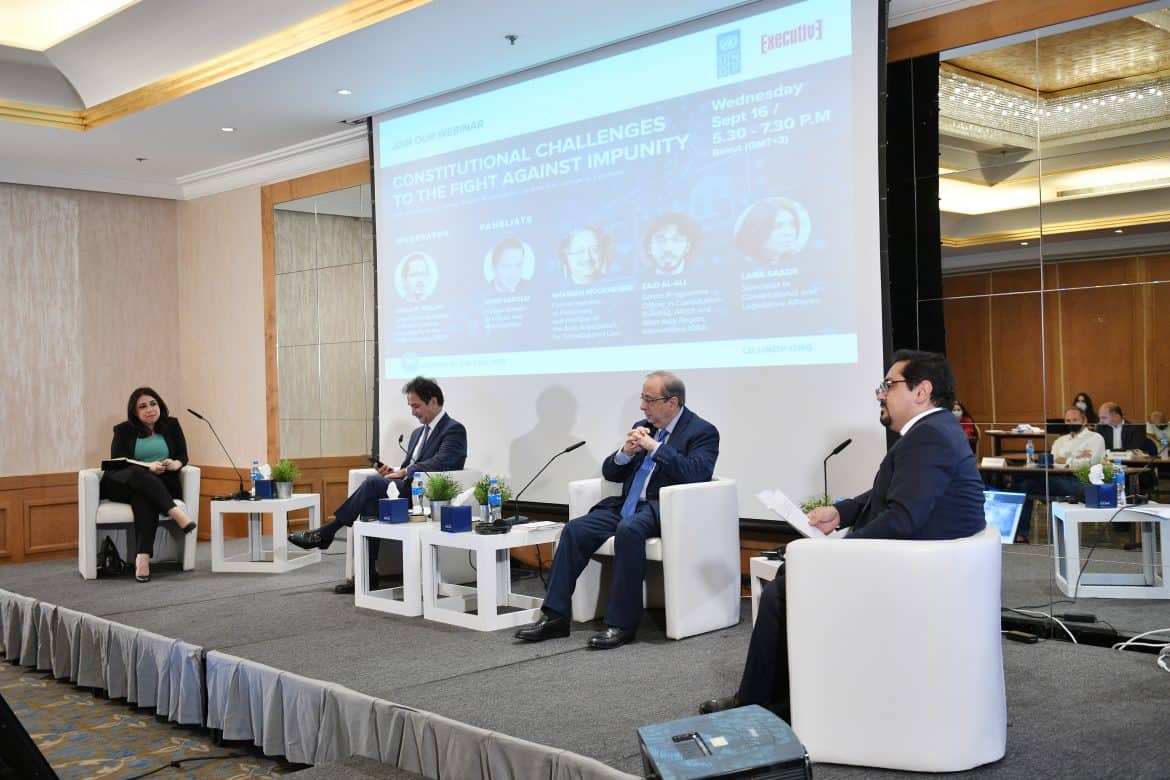
Constitutional challenges and the fight against impunity

by Ghassan Moukheiber July 1, 2021
written by Ghassan Moukheiber

Accountability is a fundamental tool for fighting corruption effectively, the formula for success being to make the cost of corruption, through holding the concerned individuals to account, much greater than its benefits to them.

However, the sad reality in Lebanon is the continued wide prevalence of impunity, particularly in the cases of grand corruption, which signals that corruption is systemic, in the sense that it is not accidental, but a tool for the real operation of the political system as a confessional-based multiple oligarchy controlling citizens and the state’s public goods, redistributed to political clients through acts of corruption.

Corrupt acts in such a system, are not only limited to criminal offenses, petty or grand, (such as bribery, misappropriation of public funds or illicit enrichment), but extends to practices, many of which are based on laws or decrees (thus the adjective often used of “legalized corruption”), involving the abuse of public office for the personal gain of political clients, such as the provision of services and the allocation of public goods, including public offices, public land and public contracts.

This article assesses whether or not the provisions, interpretations and practice of the constitution, cause, promote or facilitate this systemic state of corruption and impunity. It also suggests some follow-up actions.

The constitution, interpretations, practices and culture

When evaluating the constitution, we do not limit ourselves to its operative texts alone, but extend our review to the full “constitutional bloc”, which includes its preamble and a number of fundamental laws mentioned in the constitution, such as the electoral law, the by-laws of Parliament and government, the laws governing the Judiciary, the constitutional Council, the Higher Council for the trial of presidents and ministers and the Court of Audit.

Also,  we include in our evaluation political practice, which departs many times from the intent of the text and the constitutional principles. These practices, called “silent constitutional amendments”, result from various mis-interpretations, practices (or the lack thereof) and loopholes in the laws, not accidental, but meant to exist.

Constitutional principles and tools for oversight and accountability

The general discourse about ending impunity through constitutional means, usually emphasizes the important role that should be played by an independent judiciary. However, this fails to highlight other constitutional oversight and accountability means that are: popular, parliamentary and financial.

Distorted expressions of popular sovereignty

The constitution solemnly states that the People is the source of all powers/branches of government. However, reality distorts such supremacy and turns it upside down.

Distorted and rigged elections: Free, fair and regular elections, that should constitute the ultimate popular tool of accountability, have been regularly distorted to the advantage of the ruling oligarchic leaders that have succeeded in controlling the electoral results. Not only are the choice of districts and electoral system themselves tampered with, but there are other ways and means for controlling the results, such as ineffective tools to manage the elections, ineffective controls of campaign finances and media and pressure on voters.

Clientelism: Citizens who should be free and equal in the exercise of their political role, are captured by leaders as clients through sophisticated practices of corruption and confessionalism, such as in the apportionment and redistribution of public goods and services among political and confessional clients (e.g. public offices, land and contracts).

Emergence of popular empowerment: Direct oversight and accountability by the people, which was amplified by modern social media, is a novel and potent tool, which has been most effectively exercised since the October 17, 2020 and the massive popular demonstrations, as well as the parallel rise in effectiveness of the new civil society organizations and political grassroots movements. The direct action of citizen is putting an unprecedented pressure on the politicians, seeking more accountability and the pursuit of an effective fight against corruption.

Distorted separation of powers

The constitution solemnly declares in its preamble that “the [political] system is based on the principle of separation of powers, their balance and cooperation”. This indeed constitutes the foundation of the effectiveness of oversight and accountability. However, in reality, the practice developed the hegemony of leaders over the constitutional institutions (particularly through extra-institutional mechanisms such as the “Troika” and the “Dialogue Table”), and the preeminence of the executive over a weak parliamentary oversight and a weak judicial independence.

Weak parliamentary oversight: this is highlighted in a confusion between the offices of members of Parliament and ministers, especially in the context of the prevalent practice of the so-called National Unity Governments; rare meetings of the Plenary of Parliament for oversight sessions (an average of 21 meetings for questions in over 19 years); ineffective mechanisms of oversight and accountability provided for in the by-laws; oversight confined to committees that do not hold public meetings and do not report back to Parliament; the inability to form any parliamentary investigation committee; and inappropriate transparency of the parliamentary activities, particularly the absent use of the electronic voting system and of any  TV coverage of the legislative process.

Weak judicial independence and effectiveness: this is related to the lack of independence of the Judiciary as a third branch of government as provided by the Constitution; the inability to approve a pending bill meant to develop its independence, effectiveness and integrity; a similar inability to develop administrative court (the Council of State); the appointment of administrative judges in consultative positions within ministries; the need to reform the Constitutional Council, who in addition to its many institutional shortcomings (including its inability to accept requests for constitutional interpretation, as originally provided by the Taef Accords), is rarely used by the political system for the constitutional review of laws.

Immunity of public officials

The constitution solemnly declares the principle of equality of all citizens before the law. However, many forms and mechanisms for immunities specifically favor civil servants and public officials.

In reality, immunities have become the stronghold of political impunity, further reinforced by the abusive practice of confessionalism. The most striking example of institutional immunities, is the protection afforded to the president of the republic and ministers, who can only be tried before a special political jurisdiction, the High Council for the trial of presidents and ministers. The procedural law applicable to this jurisdiction makes it almost impossible to operate. A small window of improvement was opened by the most recent amendments of the illicit enrichment laws, which has now allowed the trial of ministers on that count before common courts.

Ineffective financial oversight

The historic rationale for the very existence of Parliaments originally was the exercise of the “Power of the Purse”, that should be the most potent tool for the financial legislation of taxes and the budget as provided by the constitution.

However, the practice has limited such power, if not made it totally ineffective. For more than 10 years, Parliament did not vote a budget; for more than 50 years, it did not vote a properly audited final state accounts (e.g. the State’s balance sheet) and since 2005 there were none produced. Parliament always invented drafting means to circumvent such obligation, required prior to the vote of any budget, a practice considered unconstitutional by the Constitutional Council. In addition to the above, parliament has few tools for the effective exercise of its own financial oversight, other than the finance committee, such as an independent budget office, as best practiced by many other parliaments.

Last but not least, the role of the Court of Audit mentioned in the constitution, has also been ineffective, particularly to oversee the budget and public financial expenditures.

Recommended actions

It appears from the above, that a distorted constitutional practice has weakened the proper functioning of the oversight and accountability mechanisms, to the extent that the political system has become similar to a “basket that doesn’t hold water”, a mere façade of laws and institutions, void of their much needed effectiveness. This signals, not only a lack of will to fight corruption effectively, but also, and much to the opposite, a concerted will to maintain the systemic corruption and curtail the effectiveness of any effort for accountability, oversight and transparency. Thus the state is not “failed,” but “captured.”

This will can be reversed by appropriate actions. A few bills were submitted to parliament to address some of the issues raised in this article, e.g. reinforcing the oversight functions of parliament, improving the means for holding ministers to account, limiting political immunities, improving the independence and effectiveness of the High Court of Justice, judiciary, court of audit and other oversight bodies.

Also, the government has recently completed the “National Anti-Corruption Strategy”, which includes many actions directed at preventing and fighting corruption (including reforming the Judiciary and the Court of Audit), but falls short of addressing many of the constitutional issues discussed in this article, which must be addressed appropriately, through further scholarship and dialogue, in preparation for the development of a special strategy and action plan to correct the many distortions of the constitutional tools of accountability.

Most of these efforts would probably not require modifications of the constitution itself, but filling the gaps of the fundamental laws forming the bloc of constitutionality and changing many of the legal misinterpretations and decades of improper practices..

Ghassan Moukheiber is a lawyer and former member of parliament

Disclaimer: The analysis, views and policy recommendations of this article do not necessarily reflect the views of the United Nations, including UNDP, or its Member States. The article is an independent piece commissioned by UNDP as a build up to the “Constitutional Challenges and the Fight Against Impunity” webinar organized in partnership with Executive Magazine.

July 1, 2021 0 comments
0 FacebookTwitterPinterestEmail
MediaOpinion

The end of the li(n)e

by Alexis Baghdadi June 30, 2021
written by Alexis Baghdadi

In May 2021, clashes in Palestine took their habitual toll of innocent human lives. After a “ceasefire” agreement was reached with both sides unsurprisingly claiming victory, some establishments responded with smears, character assassination, and legal attacks on human rights campaigns. For wary observers, this amounted to a “same [expletive] different day” situation, except that what most of them failed to predict this time, and still struggle to comprehend, are the new “nuances” in public debates. The repeated use of terms like #apartheid, #settler-colonialism, and #ethniccleansing prompted many to ask “Has Israel’s ‘narrative control’ collapsed?”

While the usual suspect lineup of commentators and self-anointed experts continue their debate ad nauseam about right or wrong narratives, the real issue should highlight the momentous change in the way people are consuming information and questioning narratives. This discussion goes beyond conversations about the mainstream press’s hard editorial lines and catering to special interest groups versus idealized citizen or activist journalism, sometimes referred to as the fifth estate. It forces a reevaluation of the core role and responsibility of media institutions, outlining a true evolution.

Fakes and Breaks

Notwithstanding the tragic loss of lives, the issue extends beyond geographical borders to the way and the reason why information is relayed and consumed. As far back as we know, the purpose of information, from reindeer bone carvings to the first newspaper in the 17th century down to its online descendants, is to document events. It follows that the holder of the pen, so to speak, controls the narrative; a reindeer’s equivalent of a podcast would tell a totally different story about a very one-sided and bloody speciesist conflict. Social media platforms are only the latest iteration of such vehicles of information, distinguished from their peers only in that more people than ever can adopt these tools and use them to articulate and disseminate information.

Thanks to this new tool, narratives previously kept in check have gained prominence, but the resulting information overload has polarized media institutions and tainted the alternative space as a bog of biased and misinformed micro-discourses, leading to distrust of the media in general. En vogue discussions involve an arena where the “mainstream media” and the so-called fifth estate vie for relevance and survival by earning income, likes, and followers to establish themselves as opinion makers, shapers or influencers – just as Roman gladiators hoped for the “thumbs up,” a symbol of approval we still use in modern emoticons. One could endlessly rhetoricate about ethics in the many declinations of journalism as independent, investigative, analytical, citizen, activist, social, solutions-based, etc., with no clear outcome other than its self-promotion. A simple look at the institutionalized media outlets in Lebanon, and the mushrooming “independent” platforms, shows how these have become slaves to their labels and made themselves easy targets for condemnation and commendation, interchangeably. Nor is the unfortunate term “fake news,” vulgarized by populist politicians, limited to one era or form of dissemination. “Disinformation,” more accurately, has existed since the cognitive revolution was responsible for making us human by essentially giving us the ability to “tell the thing that isn’t there,” bluntly: the ability to lie.

No more tall tales

The idea of any type of narrative is losing its viability, a demise harried by the tableau of a battle between “fake” and “real” news, good and evil, promoted by many institutions, including the media themselves. But this reductionism does not hold up against thousands of voices and nuances. One can conjure up an image of humanoid figures in an M. C. Escher landscape, each upholding their own narrow perspective. The one entity with some advantage here is the implied external viewer who can at least see the whole picture. Like these figures, media institutions and consumers are often unable to shift perspectives. Their own limitations of identity and purpose restrict even their format; they may borrow each other’s tools and channels, but only in form, not delivery. This poses hurdles in the proper flow of information and negates any narrative.

One exit strategy from this rigged playing field is for media institutions to graduate from players into coaches. Amid the current Babel-like conversation, absolute objectivity and a dominant narrative remain more than ever elusive ideals. But educating people about how to navigate these subjects is within reach. The media have a golden opportunity to reposition themselves as educators about ethical and responsible use and consumption of information. Internationally, AFP’s Fact Check platform stands out as one example. In Lebanon, organizations like SMEX and SKEYES are also experimenting with this but unfortunately lack the wider reach of media outlets because they position themselves as activists. On the other hand, media institutions like An Nahar and even the National News Agency operate fact-checking services, yet these are widely perceived as polarized and lack credibility. What is needed is a strategic plan to develop a truly comprehensive approach combining competencies from each of academia, civil society, mass media, and social media to deep-dive into the proper usage of media channels while also appealing to the lambda social media users and content creators. Such a dream team can actively contribute to building a more constructive public discourse and eventually engage policymakers in higher stakes: upholding and improving existing media freedoms and ethics we risk losing otherwise.

June 30, 2021 0 comments
2 FacebookTwitterPinterestEmail
ICT infrastructureQ&ASpecial Report

Renaissance people of ICT

by Nabil Makari June 30, 2021
written by Nabil Makari

In light of the economic crisis affecting Lebanon, and with the country’s talented workforce leaving the country, resulting in a brain drain, Executive sat down with Wissam Youssef, chief executive officer at CME, a multinational technology consulting firm based in Beirut, to discuss the Information and Communication Technology (ICT) sector, the possible new business model for the technology sector, and the role-models that Lebanon could develop. This Q&A follows the Technology and Knowledge Economy roundtable held on March 31, 2021, and the preparation of Executive Magazine’s action plan for reinforcing this and other sectors.

During our roundtable, you mentioned that due to the brain drain and the lack of economies of scale it is necessary to focus on premium outsourcing services. Could you expand on what types of services are needed?

Let’s start with a little brief on the outsourcing landscape in general. Usually you have two different levels of outsourcing needs. The first level is outsourcing for low-cost resources, which is typical for South America, Asia, and Eastern Europe. It’s more about focusing on obtaining low-cost mass scale resources, and they are available in countries like India, China, Vietnam, the Philippines, and others. This is a good market. However, in Lebanon we don’t have the scale to serve a similar market, we don’t have a massive workforce, the whole ICT (Information and Communications Technology) sector is currently employing around 10,000, even less, skilled resources. So to serve this market it’s going to be really tough on the Lebanese ecosystem. That’s why I don’t think it’s necessarily our main advantage, although today we are competitive on the cost side, but not necessarily on the availability of resources. That’s why I prefer to stay away from similar markets, unless there is a special opportunity of course. So this is where it comes to the low-cost layer of the outsourcing market. Then you have the more advanced layer, more focused on the added value, the technology added value, this is when outsourcing occurs not just for low cost but also for availability of skilled resources, and this is when companies look for skilled resources. This is happening all over the world because of the lack of skilled resources. It’s not just about low cost but also about skills and efficiency in terms of cost, the balance between quality and cost. This is where Lebanon has a real opportunity because we have skilled resources. This is not about mass, this is not about serving a need of 10,000 or maybe 1,000 resources, this is not the main target for premium services, it is more about filling a gap for a specific innovation product, innovative product or a niche company. This is where I think Lebanon has a real opportunity.

During our roundtable, CME was hailed as a success story. Can you tell us what CME is about? And also do you think that others could replicate this business model in Lebanon?

Let me give a little briefing of what we do and how we started. I think it is relevant and could be a case study for any new business. We are a technology company; we provide services, including outsourcing, but also products we develop, solutions, in different industries. We serve more than ten different industries, from Telecom, retail, healthcare, digital wallets, market research, insurance etc. It is really diversified, and we have a pretty diversified portfolio of technologies because of our scale. We have been serving customers throughout the past 17 years. We deliver for the whole supply chain system for Subway, everything that starts from the point of sale all the way to inventory management, procurement, operations, sales, compliance etc. Our solutions are deployed in more than 35,000 locations for Subway specifically, and other branches of course, all designed and engineered from Beirut. We also have a support team, 24/7, serving customers all over the world. We also worked with PayPal in the past; we developed for them the next generation mobile payment system that they currently use to compete with Apple Pay and Google for digital wallets. Thomson Reuters was also one of our customers, we supported them in deploying large billing systems for law firms, and we also served Allen & Overy (one of the biggest law firms in the world), White and Case and other big names in the law industry. This is the type of products and services for customers that we served in the past years.

One of the main capabilities that we have now is all-around diversification in terms of industries and technologies. We are also what we call the end-to-end solution provider, because we are not only software vendors, we are also hardware vendors, we design and manufacture hardware. It is not just about the software itself, and this is really unique because when I talk about hardware, it is not about large-scale hardware manufacturing, it is more about the Internet Of Things (IOT), smart devices. This is all engineered here in Lebanon. We are talking about product design, mechanical design, electronic design, and certification [such as the] Federal Communications Commission (FCC), all we can imagine. It is all engineered in Lebanon, prototyped and manufactured in China, and sold mainly to the US market. So this is the model that we have now. I think the main standpoints of CME today are first diversification, and second the track record that we have because it helps us acquire additional customers. The third one is what I call the end-to-end engineering services which is hardware and software, which is pretty unique and is similar to the model that Apple has actually. And the fourth one is about the resources, because all IT knowledge is about the resources. This is what is really unique about Lebanese talent; it’s multidisciplinary aspects and mindsets. This is a true differentiator, and this is why we are able to succeed in the premium services as well. And the real case study is around this point, because [we have] a tangible example of this. If we go to India or to the Philippines or China, usually we find someone who is really good; you can definitely find smart people and good developers, but they are more focused on a specific technology or industry. They do not really know how to make the link between the domain expertise and the technology, so it’s not just about technology or about writing code. Let’s say you are developing an insurance software, it’s pretty complicated, the insurance industry is not a straightforward industry, so if you deal with a developer focused on coding, then you need someone else who is going to do the analysis for him, to make the business case. Another resource, a third one, is going to test his work, so you end up hiring three instead of one. Whereas in Lebanon thanks to the academic background we have, [which is] one of the advantages we have, we are multitasking, multidisciplinary, so when faced with a challenge we really have the package, the background, to deal with this and to really play three roles in one: analysis, development and quality assurance. This is exactly what I call premium services: when you deal with someone who is really professional. If you go today and ask a developer to send you a username and password of a production system, one of the options is that he sends everything in one mail, and this is not professional. You will get the information but it is not really professional. A professional developer would have everything stored in a secure location and would send you a link that requires your authentication. This is exactly what I think Lebanon is capable of.

Do you believe the Lebanese ICT sector’s credibility has been reviewed downwards? If yes, do you think it can come back again?

There are different problems for the sector’s credibility. The Lebanese brand in particular. The first part is related to the government itself, and the way the country is run. When a high-level ranking officer in the government, minister or general director, goes on public media and claims that we [will not be able to provide] Internet by end of January, and this video reaches our customers in the US or the Arab countries, what do you think they will think about this? They will think their business is at big risk. They have huge operations that rely on the Lebanese talents in Lebanon. [That same day] one of the customers received a video on WhatsApp saying that Lebanon will “go dark” at the end of January. Imagine a company is going bankrupt in the next three months […] do you think the CEO will go on the news and say the company is going bankrupt in three months? Or [will he do] his best to make sure that everything will be managed properly to avoid the chaotic environment? This is really hurting us, and the same happened with electricity as well. I had to cover for our risks, to find solutions to provide our customers with plans B, C and D. Murex are offering to relocate their team to Cyprus, I read an article about it in the Commerce du Levant a few weeks ago. They are doing this because of the noise; financially it makes zero sense because we can operate here.

The second part, and it is also not contributing to build a real plan for Lebanon, is coming from the private sector, because whenever we are successful we go outside of Lebanon, and we claim success from a country outside of Lebanon. And this is not helping. I think we really need to convince the private sector that companies can go wherever they want, have offices anywhere. We are present in all continents, but we always take pride in our presence in Lebanon, we are not trying to hide it at all, this is our identity and we want to create a brand for the Lebanese ICT [industry], and I’m not blaming them, but we need to fight a little bit and create this brand.

How do you see the ICT sector in Lebanon building synergies with other industries?

I think there is a huge opportunity here. It’s a great question. I’m going to specify a set of industries that are really on the edge, and the mix between these industries and technology will create a huge advantage [money-wise].

The first one is healthcare. We have the best doctors, until now. The ICT [industry] might help them to stay in Lebanon, because most of the ICT companies pay in fresh dollars, because they sell outside Lebanon. One of the solutions we are developing now is a healthcare or wellbeing practice application. Soon we will be hiring doctors, just to give you the scope of this. […] If we really want to compete in innovative products, healthcare is a great resource for the ICT sector in Lebanon to create this edge.

Then you have the education sector. We also have really strong academic institutions in Lebanon, {like] the American University of Beirut (AUB), Université Saint Joseph (USJ), the Lebanese University, with hundreds of years of experience. We partnered with USJ to build an education system, an information management system for the students, and it’s going to be a partnership between CME and USJ. The ownership of the property is for CME but USJ has royalties in this. This is also going to add value to our offering. When we develop software for an institution like USJ, you really know it is going to be a Class A product, because it is one of the top universities not just in Lebanon. Theirs are actually the same needs as universities in France and Canada.

I just gave you two examples but there are many others like supply-chain, insurance, banking.

You mentioned bench lining during the roundtable? Can you elaborate on it from a policy view? Are you still hiring? How?

I talked about the bench lineup, that is similar to that of sport teams, the bench support for the football team. One of the main challenges in our industry, the outsourcing industry, [is the] speed of mobilization. Whenever you have a customer, the first question is the cost, and then how much time you need to staff the team. Is it a week? Immediate? Three months? If it’s three months I am not interested because other vendors can furnish the same service in a shorter time. So it’s not just about quality and cost but also availability and mobilization. This is something we struggled with in the past. Again, because of the lack of economies of scale in Lebanon, we don’t have a massive workforce. To mitigate this risk, we decided to develop the bench lineup: resources that are hired but are not necessarily assigned to production or an existing customer. There are what I call “overstaffed resources” without them being really aware of course, so they don’t really feel the difference between someone who is on the bench and someone who is really on production. So when you do that, you have an availability of resources to engage immediately with your customers. So it’s adding up to our real edge now on top of what we have now in terms of cost advantages and quality advantage. Thus is the main advantage of having a bench lineup, and the reason we couldn’t do it before is the cost. Due to the currency devaluation and all that is happening in Lebanon, we are much better on cost so we are able to have an overstaffed team to a certain extent of course.

Globally speaking, do you see a role model for the sector in Lebanon for the moment? You said the Silicon Valley model would not work. Do you only see premium outsourcing as a role model for now?

You mentioned a key word here, “for the moment.” You know, if you really want to be successful in this field, you have to have a step-by-step approach, and not an aggressive one. I really like Circular 331 [announced by the Lebanese central bank in August 2014] as an initiative of course; I have a lot of comments on the way it was executed. But 331 was more into building a “Silicon Valley,” and right now we don’t have funds, and people are not interested in bringing funds into the country. So if you really want the Silicon Valley model you need funds, because it’s all about investing in startups. And all of the startups are living on funding, so this is not possible in Lebanon today, it is impossible I would say […] The only chance today is to focus on services, the real added value, the premium services, even if we need to go into the low cost let’s do it. If there is an opportunity we will do it. We need to create jobs. People want work. This is the real economy we need to build now. If we start now promoting the professional services business for the ICT sector, then with time the same model that happened with CME will happen with others. Whenever we gain domain expertise, whether from insurance industries, banking or others, we are going to develop our own solutions, and not just be limited by what we provide to customers. When you do that you have a chance to become a Silicon Valley. Maybe in five or ten years.

Thank you for having been part of our roundtable discussions. How do you evaluate the idea of Executive’s action plan? What would you like to see in it?

I think, the more we talk about this, it’s better. As an ecosystem. One of the main challenges in our ecosystem is we don’t really have an umbrella where all the ICT companies, the key players of this industry, are collaborating or communicating. Because we always look at each other as competitors, which is fine, this is the nature of the business. But for the benefit of the country it is necessary to have similar gatherings to brainstorm, throw ideas, even if there is no tangible outcome but it is good to keep the discussions open. Most of the points were discussed three years ago with Adel Afiouni (former minister of technology), with the Investment Development Authority of Lebanon (IDAL), exactly the same model. We did not do anything but I don’t blame anyone. At least if we maintain this communication, if we don’t give up, we will give hope for others to start. I know that many will give up, but these roundtables, especially if we capitalize on them, regardless of the agenda, regardless of the outlook, if we capitalize on them and send positive stories to the Lebanese people, to the Lebanese youth, the upcoming engineers, to give them a little bit of hope, that’s it. I don’t blame anyone for leaving Lebanon, immigrating, but today it’s being promoted as the only solution, which is not true, at least for the software engineers and the technology sector. We need the other side of the equation, that’s it.

June 30, 2021 0 comments
0 FacebookTwitterPinterestEmail
ICT infrastructureSpecial Report

Getting cozy

by Thomas Schellen June 29, 2021
written by Thomas Schellen

There are occasions where it is hard to walk a mile in another person’s shoes in order to understand and not judge them – simply because the shoes of the other are standing under a very distant bed. Outsourcing is a scenario for which this observation has been fitting. For a unionized worker in the US state of Georgia (not that there would be high shares of unionized workers there – a political candidate would statistically have to shake 15 employees’ hands before meeting one union member) the concept of outsourcing might easily convey an existential threat of job loss that means economic despair and social bleakness for her and her children. For a young knowledge worker in the Transcaucasian country by the same name (but with roughly 7 percent in nominal GDP when compared to the US state), the concept of outsourcing by contrast might flag a personal economic hope to score an outsourced job. She or he would enjoy the opportunity of capturing a slightly larger slice of the global income pie.

In this context of globalized competition for jobs among legally and socially very differently positioned and physically dissociated labor markets, outsourcing in the late industrial and information age has acquired an ambiguous flair depending on how and from where one looked at it. From the Lebanese perspective the idea to attract outsourced ICT services jobs such as call centers, which was theorized at some points in the reconstruction and development era around the turn of the millennium as natural opportunity for multilingual Lebanese providers, was hampered by the disadvantageous cost and unreliable access to required communication infrastructures. Another barrier against applying the outsourcing model locally was the in comparison with Asian outsourcing destinations noncompetitive cost of Lebanese human capital in the dollar-pegged country. 

But things are very different now. Outsourcing, once a practice of manufacturers which notoriously externalized not only parts of their supply chain to low-cost industrial locations but also their social obligations, has become services-oriented. Business process outsourcing (BPO) is something that the economy-hugging folks at Investopedia neutrally describe as “a method of subcontracting various business-related operations to third-party vendors.”

The evolution of outsourcing

Advanced from early-globalization era manufacturing practices, the application of BPO in services industries has become diversified. It furthermore appears to be in the process of emancipating itself from the seesaw of inconclusive zero-sum economic logic, by which the job gained in one new manufacturing location is the job lost in an established center of industry.

Instead of just a job being replaced by just another job – at best a questionable temporary gain in the age of rising AI and automation – the emerging paradigm of outsourcing could become a new non-zero-sum employment play as a huge range of digitally interconnected, complex jobs are globally realigned on a socially aware global playing field.

This implies that outsourcing is maturing into well-regulated and strategic digital outsourcing, a globalized application of the fundamental economic behavior of relying on division of labor for improvement of productivity. This incarnation of outsourcing comes with the promise and necessity of compliance with both productivity optimization objectives and high ESG standards, and lately also involves strategies of inclusiveness and social justice for disadvantaged groups.

Naming digital outsourcing as a specific opportunity in the context of new tech entrepreneurial and knowledge enterprise developments at the focus of the fifth roundtable organized this March by Executive Magazine in partnership with the United States Agency for International Development, it was prudent for Executive to investigate if the economic play of digital outsourcing is demonstrating a specific potential for Lebanon in context of the national convergence of economic need of underemployed or unemployed professionals, a current if temporary comparative edge owed to the depreciation of the Lebanese lira, and an ongoing trend of proactively tapping into the diaspora and their wider economic networks for creation of economic opportunities for remote professional work from Lebanon. 

A practical example that is currently seeking to prove this proposition of creating a digital outsourcing destination identity in Lebanon is the Lebanon Outsourcing Initiative (LOI) by the platform Bridge. Outsource. Transform. (B.O.T.). Launched this year by its young parent B.O.T. – a startup company of 2018 vintage that saw very strong revenue growth in the crisis year of 2020 but has yet to write profits – LOI is a directory of outsourcing services that Lebanese providers of such services – individual freelancers and small enterprises – can enroll in, says Charbel Karam, development and marketing manager at B.O.T.

“We took some of our expertise in outsourcing and put it into the Lebanon Outsourcing Initiative. We knew that the need existed for companies and freelancers in Lebanon to acquire clients from abroad. [We] also knew that we could access the Lebanese diaspora across the world. So we created an action plan for Lebanese diaspora to engage with service providers and freelancers in Lebanon,” he tells Executive, emphasizing that the reason why B.O.T. launched this initiative at the beginning of January 2021 was “to give back” to the community in Lebanon.

Marianne Bitar Karam, managing director of B.O.T., describes the LOI directory as a campaign that evolved from a marketing idea for the company into a wider effort of trying to attract attention to SMEs that provide services – which differ from B.O.T.’s portfolio – under the common theme of Lebanon as outsourcing destination. The company, which is supported by social enterprise builder Alfanar and the Lebanese International Financial Executives (LIFE) network, took the initiative of developing the website and starting to populate it with names of services providers after setting up a publicity campaign anchored on a video that features actress Zeina Makki.

“We consider it as a directory of services. Client companies who want to use a service that B.O.T. does not provide, can find [this service] from the website. We do this out of empathy with the Lebanese economy and did not want to do it by ourselves,” Bitar Karam says. According to her the initiative for the time being is a standalone marketing activity of social enterprise B.O.T and not incorporated as a separate enterprise, which means that there is no vetting of providers or broking of services of the listed providers by B.O.T. All due diligence and negotiation over provision of services is done directly between the directory-listed Lebanese provider and the client who seeks the service, she confirms. 

Good samaritans

The website of B.O.T. and the services directory by LOI share their base domain (https://letsbot.io/ and https://loi.letsbot.io/home) but the list of categories in the directory goes significantly beyond the seven digital service categories offered by B.O.T., with the latter extending from AI training data and data management to transcriptions and market research.

There is no financial fee or revenue sharing between B.O.T. and entrants in the LOI directory, says Charbel Karam. LOI is an activity that does not generate any income and the intention is to keep it this way. “Today this is an activity by B.O.T. As we develop further into future, we might change its legal status into something more incorporated and get the conversation going. In the future it might become transactional, or ad-base or free and subsidized and funded by organizations. We don’t know but we definitely hope that it continues to be free of charge,” he says.

The funding journey of B.O.T. since 2018 entailed financing support by UNICEF, which has now ended, and current funding commitments by Alfanar that entail technical assistance and also have allowed the enterprise to set its sights on expanding into Jordan.

Current projections for reaching a breakeven point should be discussed at the end of this year, adds Bitar Karam, who hopes that success in this year will demonstrate that B.O.T. can access markets and attract international clients. “Today our priority is to prove that our model is scalable abroad,” she says but after achieving such milestones the company would seek to attract investors in the following two years of 2022 and 2023.

With B.O.T. still in its early stages, its ability to prove the value proposition of Lebanon as digital outsourcing destination has still to be tested in the new economic realities of a changed global labor environment but Michelle Mouracade, the Lebanon country director of Alfanar, never tires of advocating for this proposition. She points out that B.O.T. saw a 230 percent revenue increase between 2019 and 2020 and asserts firmly, “We believe that Lebanon can become an outsourcing hub.”

Growing numbers and propositions 

In Bitar Karam’s and Charbel Karam’s view, the proposition will, however, require governmental support “on all levels” from revision of taxation schemes for freelancers that agree to formalize their activity and adoption of a tax formula that is suited for the building of social enterprises to infrastructure improvements and support of outsourcing initiatives by the Ministry of Foreign Affairs and Lebanese embassies.

On the upside of the aspiration of elevating the country to an outsourcing destination, the social enterprise angle of the Lebanon Outsourcing Initiative could contribute to attracting currently untapped investments from the growing global pool of impact investment funds that prioritize ventures which aim to provide economic opportunities for marginalized groups and disadvantaged communities, and measure the impacts they have in this regard, adds Mouracade, who also addressed this topic as participant in the Executive- United States Agency for International Development (USAID) roundtable on tech entrepreneurship and knowledge enterprises.  

As noted at the tech roundtable but also at preceding roundtables, the past year’s indications of the increased job engagement with the diaspora and remote work angles cannot be expected to last. The tremendous labor cost advantage under the depreciated local currency scenarios of lira and lollar is already being eroded by demands of creative workers to be compensated in hard currency for their remote services. Outsourced labor to Lebanon will have to adjust its remuneration demands upwards in predictable alignment with the real exchange value of the work done here.

The remote working propositions of outsourcing will (as will every proposition of long-distance employment contracts from Lebanon) more importantly need to be embedded in a social arrangement of long-term safety of such work and satisfactory social insurance, which is a tall but inescapable order for the next global social contract and stabilization of Lebanese life. By today’s visibility, the aspiration for creating the outsourcing destination Lebanon appears to open an attractive but temporary window of opportunity that calls for initiatives to urgently commence and anticipate growing impacts. “The more we have private initiatives [in ICT and tech entrepreneurship] and the more we work together, the more we can change the image of Lebanon and get support from the government,” says Bitar Karam. 

June 29, 2021 0 comments
0 FacebookTwitterPinterestEmail
ICT infrastructureOverviewSpecial Report

We can rebuild it, we have the brains – but for how long?

by Nabil Makari June 28, 2021
written by Nabil Makari

According to the United States Agency for International Development (USAID) Trade and Investment Facilitation (TIF) project report, related to the Information and Communications Technology (ICT) sector in Lebanon, around 500 companies are active in the technology sector in Lebanon, among them 300 ICT companies and 200 startups, with the ICT workforce being estimated at between 15,000 and 18,000 persons. The report mentions that “Lebanese ICT companies are highly export-oriented.” However, these numbers have likely been affected by the economic crisis.

The first problem, which was expanded on, was the lack of finance for technological companies in Lebanon. Nassib Chalhoub, partner at Credly Advisors, mentions that, “In terms of startups and the ecosystem, we are currently witnessing a significant downturn.” For him, after the “significant crowding out effect” due to high interest rates in banks on depositors’ accounts, the ecosystem in Lebanon is currently struggling, and many companies are migrating to regional hubs, to the United Arab Emirates in particular. Fares Kobeissy, chairman and chief executive officer at Bluering, mentions the fact that many companies are leaving Lebanon, and that the biggest challenge, in his view, is “still how to access capital and financing,” not only in the form of equity but also from banks. Summing up, for Kobeissy, the two biggest challenges are the access to finance and helping companies reach new markets. This was also confirmed by Gabriel Deek, president at ISOC, in his belief that Circular 331 of the Central Bank of Lebanon (BDL), which guaranteed partially banks’ investments in startups, was a good idea but “could have been much, much better.” In addition, for Deek, one of the main issues is to access capital. With regards to the same circular, Jihad Bitar, general manager at SmartESA, comments: “the good side of 331 is that it changed the culture,” but on the negative size “it brought some laziness ad a habit of not being very professional and of overspending money to a lot of the ecosystem.” For Bitar, with regards to startup financing, the main issue is at the seed stage land pre-seed where, according to him, it is extremely difficult to access capital: “You are going to get lollars, not dollars, if you move to angels.” For Bitar, the moment that Kafalat stopped giving grants was the moment “this started to slowly kill the ecosystem.”

For Bassel Aoun, program manager at Kafalat, “access to finance is a common major point,” and that venture capital funds are, like most businesses, suffering from lack of access to capital. For him, startups and funds, emboldened by Circular 331, are currently moving to other ecosystems, believing they can capitalize on their know-how and launch second funds in the region. According to him, historical players on the venture capital scene in Lebanon have managed to raise new funds but outside of Lebanon, due to their track record in the industry: “This is the situation today. Access to finance is a problem on the level of the startup and it is a problem on the level of intermediate players, people that bring the money into the ecosystem.” In addition, according to Aoun, the investment tools needed for the financial advisors (for example safe agreements and convertible notes) are not available due to Lebanon’s lagging legal infrastructure. This mention of the legal framework was echoed by Karl Naim, managing director at StartechEUS, for whom the legal framework is “completely inexistent in Lebanon” for the tech industry. According to him, Circular 331 “unfortunately did not help the Lebanese startups at the time.” Due to this lag in legal infrastructure, it would be very hard to compete with other ecosystems in the region, taking into account seed or series A funding in the UAE, funding is reaching between $5 million and $10 million, compared to hundreds of thousands three years ago. Nicolas Rouhanna, of IM Capital, confirmed this view by adding that venture capital (VC) and 331 funds are currently moving to Dubai, and that the lack of financing would hinder growth for companies.

The second issue mentioned by the guests of the roundtable has been the lack of support in accessing new markets. For Chalhoub, we are witnessing a migration and value deterioration for successful Lebanese companies, as most of them “established prototypes and validated their concepts” in Lebanese market and therefore still suffer from the local risk, while these companies are, for some, exportable, and others not. For him, there is a temporary decline in the local tech and entrepreneurship ecosystem, which would require access to finance in order to regain its previous strengths. For Kobeissy, Lebanon lacks institutions whose entire purpose is to help local companies access new markets, and this lack of export promotion is, in his opinion, a big deficiency. For Gaby Deek, this lack of access to markets is more important than lack of finance, and for Bitar one of the main impediments to this growth in Lebanon is a lack of talents and soft skills. Bitar, on the other hand, sees the crisis as an opportunity as “only the professional and serious people will continue” their activities in Lebanon, which would rout out those he deems as “not very serious.” Echoing Chalhoub and Kobeissy’s opinions, Michelle Mouracade, country director at Alfanar, laments this lack of technical assistance to entrepreneurs, deeming that such support tis given only in accelerator programs but lamenting that they are not, in her opinion, getting help at the business plan level and their cash flow projections.

This need to access new markets nevertheless, requires talents, which are leaving due to a brain drain. For Deek, though the human capital is present, “we are not competitive in terms of education as we should be,” and he adds that imperfect education in ICT is why “access to talent is a problem and an issue for startups.” This is echoed by Naim, for whom, though the Lebanese speak three languages, which he deems important, when it comes to “real skills today, digital skills, digital marketing, software development,” he sees Lebanese universities as uncompetitive in comparison to their counterparts in Dubai or in developed markets.

A first solution proposed by the roundtable participants is to focus, with regards to the technology and knowledge sectors in Lebanon, on premium outsourcing. This was first mentioned by Mouracade, deeming that Lebanon could be an outsourcing destination for the digital sector. For Wissam Youssef, CEO at CME Offshore, there are three models for the Information and Communications Sector (ICT): the Silicon valley model, which he deems impossible in Lebanon due to the current situation, the mass outsourcing, which he deems difficult due to the fact the Lebanon lacks economies of scale, and the premium outsourcing model.

A general opinion, shared by most panelists and first mentioned by Gabriel Deek, is the need for self-reliance and not to count on the Lebanese State to implement reforms: “Never rely on the government, never rely on the public sector.” For Rouhana, the Lebanese crisis cannot be solved by the technology sector, but stakeholders can work towards fixing and solving the SME and startup crises.

One measure to solve the access to finance, according to Mouracade, is “to encourage businesses in Lebanon to have a social impact, measure it and communicate on it,” as according to studies she mentions, consumers are more likely to spend on a product or service from a social enterprise versus a product or service from a regular enterprise. Mouracade, cited the example of BOT, an outsourcing social enterprise that Alfanar supports. In 2020, their income grew by 230 percent because of their focus on outsourcing digital services and because of a pool of 2000 freelancers on their platform: “this is a social impact because many young people will not have other opportunities if it weren’t for BOT.” According to her, such organizations, which have a social impact and are focused on supporting youth in the digital sector, are also strengthening the social impact sector of Lebanon and this could attract potential investors, adding the global market for impact investing is worth $715 billion, according to the Global Impact Investing Network. For her: “If a company is providing vulnerable communities and SMEs and MSMEs with access to affordable products and services, there is a huge potential as well. In her opinion, this would also help relieve the brain drain as it would attract potential talents and entrepreneurs if they believe their work would have a social impact.”

Amine Goraieb, consultant at Alfanar, mentioned that he would like to “encourage all companies in Lebanon that think that they have a genuine social impact.” This would, according to him, help mobilize the diaspora and to support local companies having a social impact “by either introducing them to people or by delegating some of its activities to Lebanon.” Indeed, for Gohrayeb, the first question is for those who are vulnerable communities that still have access to technology: how can they access services that are otherwise difficult to access? According to him: “Lebanon is a poor country and getting poorer by the day, and affordability is a key barrier to technology.”

Another solution mentioned is the need to leverage the Lebanese diaspora for better market access. For Youssef, it is necessary to build on the “emotional connection” between the Lebanese diaspora and the Lebanese community living in Lebanon, since Lebanon has what he deems to be “success stories” in order to “build on those success stories and then approach the Lebanese diaspora with a model that creates jobs in the Lebanese market.” In addition, due to lower cost of operations, he recommended cuing candidates “without having real concrete projects” as this would release these companies doing outsourcing from a turnover problem due to a brain drain. For Nassif Shalhoub, this need to reach the diaspora is important, citing quasi government bodies and others, such as the World Lebanese Cultural Union, to enable connectivity between members of the diaspora, thanks to an application called diaspora ID, which connects all the “national councils and continental councils and connections of the Lebanese diaspora in the world.”

Nassif Shalhoub, with regards to access to capital, has also highlighted what he sees as a need to change the local mentality: “We have been raised over the past 6,000 years on being traders, and traders are greedy.” For him, valuations made by Lebanese owners in the ICT sector are too high and well above market benchmarks in the rest of the world, and this needs to change. “Why seek immediate relief? Why do you want to be Elon Musk without going through Elon Musk’s journey?” Highlighting the fact that Lebanon is already a risky environment, he recommended building more deferred options for investors to come invest in Lebanon. For Bassel Aoun, access to markets requires access to finance, and this could be done by working on brand name, including working on impact investing.

For George Frenn, from USAID Lebanon, access to market requires first to stabilize, then to “explore and find niches of growth, particularity on exports, and support them on enterprise level and sector level.”

Thomas Schellen resumes what he sees as the potential for the solutions expressed during this roundtable, with regards to the potential of impact funding, cultural union, and the Lebanese entrepreneurial spirit. The roundtable then moved to final words with participants, with Goraieb encouraging all companies in Lebanon to think that they have a genuine social impact, in order to help mobilize the diaspora, as the MENA region is catching up on social impacting with the rest of the world. Rouhanna, on his part, hints that IM Capital is working on funds for startups, growth stage companies that have a potential to scale and weather the crisis. Kobeissy mentioned his wish to see the tech community collaborate more. Elie Abou Saad also proposes to use the platform v-expo for an event to enable all tech companies who export their services.

The final note belongs to Yasser Akkaoui who believes that in entrepreneurship, the value is “in the ideas, and so that the ideas continue to flow, we need to create for them an enabling environment.” 

June 28, 2021 0 comments
1 FacebookTwitterPinterestEmail
EnvironmentOpinionSpecial Report

Could social enterprises lead Lebanon’s economic recovery?

by Michelle Mouracade June 25, 2021
written by Michelle Mouracade

Lebanon continues to sink into its worst economic and financial crisis since the end of the civil war, witnessing soaring poverty, double-digit unemployment and unprecedented social hardship. Meanwhile, the ongoing political stalemate further undermines Lebanon’s ability to implement desperately-needed reform and receive any kind of financial assistance. In such dire circumstances, the ability to attract foreign investment is clearly a challenge.

There is, however, a significant and untapped opportunity to attract what is known as impact investment. In addition to seeking a financial return, the objective of impact investors is to support social enterprises, companies that generate a social and/or environmental impact that is measurable and scalable. In recent years, institutional donors have increasingly recognized the untapped potential of social entrepreneurs as new actors seeking sustainable market-driven solutions to old problems. But support remains limited to short-term funding for start-ups, with a lack of longitudinal follow-up to ensure successful implementation. As a result, both growth-stage social enterprises and those graduating from accelerators are left struggling to survive with scarce resources. This is the funding gap that impact investors have their eyes on.

With the deteriorating socio-economic situation and the need to create economic opportunities with impact, there has never been a better time for Lebanon to be a magnet for such impact investments, tapping into a global market valued by the Global Impact Investing Network at around $715 billion.

Historically, one of the main factors hindering the growth of impact investment in Lebanon has been the small pipeline of investment-ready social enterprises. The fact that social enterprises can only register as either regular companies or non-profits is also confusing and misleading. Although there are clear advantages for social enterprise to have a separate legal entity – including to benefit from tailor-made tax incentives – this has not prevented established social enterprises such as Fair Trade Lebanon, Souk El Tayeb, BOT and FabricAID, from operating as such and attracting impact investors.

Regardless of the legal entity under which it’s registered, three main criteria have to be met for a company to qualify as a social enterprise. First, the company needs to be solving a social, cultural or environmental problem by applying private sector business principles (i.e. selling market-based products and services). Second, its impact should be measurable, scalable and clearly mentioned in the company’s bylaws. Finally, it should reinvest the majority of its profit into the growth of the business.

So is the pipeline of social enterprises in Lebanon small or are we simply not classifying and supporting “businesses with impact” the right way? We strongly believe it is the latter, if we support “businesses with impact” in better modelling, measuring, scaling and communicating their impact, they could be classified as social enterprises and easily attract impact investors.

This is the mission of impact-focused accelerator programs and venture philanthropy organisations that provide social enterprises with grant funding, training, management support and access to markets. However, there are very few ecosystem players whose mission is to support social enterprises in Lebanon – Makesense, Fondation Diane and Alfanar are the only ones who are entirely focused on this sector. Moreover, as social enterprises grow, their funding needs can no longer be covered by grants, and can only be matched by impact investments.

Such impact investments also offer great opportunities for competitive financial return. The average realized gross returns of private equity impact funds in emerging markets in 2020 ranged between 11 percent and 18 percent.

Today, there is a real opportunity to strengthen the impact sector in Lebanon and attract impact investors and their fresh funds, while helping solve ever-growing social challenges. This will take time, but if ecosystem players come together – including social entrepreneurs, the diaspora, angel investors, institutional donors and foundations – the stage could be set for one of the most attractive impact investment markets in the MENA region, while supporting vulnerable communities in a more sustainable manner.

As Nobel Laureate economist Muhammad Yunus recently said, “When you hit the darkest part, you come up with the brightest ideas.” In doing so, we need to “throw away the old thinking and be outrageously bold” to reshape society post COVID-19.

Impact investment can significantly contribute to saving Lebanon’s socio-economic fabric. There has never been a better time to do this, by supporting social enterprises, paving the way for impact investment to be the norm, and building the foundations for a more equitable Lebanon that provides for its people.

June 25, 2021 0 comments
1 FacebookTwitterPinterestEmail
  • 1
  • …
  • 31
  • 32
  • 33
  • 34
  • 35
  • …
  • 689

Latest Cover

About us

Since its first edition emerged on the newsstands in 1999, Executive Magazine has been dedicated to providing its readers with the most up-to-date local and regional business news. Executive is a monthly business magazine that offers readers in-depth analyses on the Lebanese world of commerce, covering all the major sectors – from banking, finance, and insurance to technology, tourism, hospitality, media, and retail.

  • Donate
  • Our Purpose
  • Contact Us

Sign up for our newsletter

    • Facebook
    • Twitter
    • Instagram
    • Linkedin
    • Youtube
    Executive Magazine
    • ISSUES
      • Current Issue
      • Past issues
    • BUSINESS
    • ECONOMICS & POLICY
    • OPINION
    • SPECIAL REPORTS
    • EXECUTIVE TALKS
    • MOVEMENTS
      • Change the image
      • Cannes lions
      • Transparency & accountability
      • ECONOMIC ROADMAP
      • Say No to Corruption
      • The Lebanon media development initiative
      • LPSN Policy Asks
      • Advocating the preservation of deposits
    • JOIN US
      • Join our movement
      • Attend our events
      • Receive updates
      • Connect with us
    • DONATE