• Donate
  • Our Purpose
  • Contact Us
Executive Magazine
  • ISSUES
    • Current Issue
    • Past issues
  • BUSINESS
  • ECONOMICS & POLICY
  • OPINION
  • SPECIAL REPORTS
  • EXECUTIVE TALKS
  • MOVEMENTS
    • Change the image
    • Cannes lions
    • Transparency & accountability
    • ECONOMIC ROADMAP
    • Say No to Corruption
    • The Lebanon media development initiative
    • LPSN Policy Asks
    • Advocating the preservation of deposits
  • JOIN US
    • Join our movement
    • Attend our events
    • Receive updates
    • Connect with us
  • DONATE
Comment

Banking on diplomacy

by Paul Cochrane December 3, 2011
written by Paul Cochrane

It has been a difficult year for the Lebanese banking sector. While deposits are only marginally down on 2010, Arab uprisings have affected banks’ regional operations and the Lebanese economy is feeling the ongoing global financial crisis. But by and large, these are the sorts of issues Lebanese bankers are used to handling; risk management is a hardwired Lebanese specialty. What has presented unusual concern this year is the black cloud lingering over the sector following the listing in February of Lebanese Canadian Bank (LCB) by the United States Department of the Treasury as a “financial institution of prime money laundering concern.”

The designation left LCB’s reputation in tatters and, after a limited run on the bank, shareholders opted for LCB to merge with Société Générale de Banque au Liban (SGBL) rather than to appeal the charges. For the banking sector, the LCB designation was a well-aimed kick to the nether regions. Banks are still “paranoid” 10 months later, a senior member of Banque du Liban (BDL), Lebanon’s central bank, recently told me.

The concern is that other banks could find themselves in the US Treasury’s sights — a worry compounded by the apparent political motivation of Washington’s decision, as LCB was accused of laundering money on behalf of Hezbollah, the steward of the current Lebanese government and designated as a terrorist organization by the US. The US decision looked on the surface to be a warning to the banking sector — and Lebanon generally — to play ball. Not helping the sense of paranoia is the failure to release results of the investigation into any wrong-doing on the part of LCB by either Washington or BDL.

There was an upside from a regulatory point of view, however, to the taking down of LCB. Due diligence has suddenly taken on special importance, compliance officers’ voices are better heard in the board rooms and those in need of screening software to detect suspicious transactions have quickly placed orders.  Rumors of further LCB-style designations have persisted, while additional pressure has been heaped on Lebanon following multiple rounds of US and European Union sanctions on Syria in response to Damascus’ crackdown on protestors. For the sanctions to have bite, Lebanon cannot be a financial conduit for the Syrian regime; Lebanon is not required to abide by US and EU sanctions — only United Nations resolutions are binding — but it has pledged to cooperate.

With around 60 percent of Lebanese banks’ deposits in American dollars, and the lira pegged to the greenback, Lebanon, as the BDL source put it, is effectively part of the US financial system — Beirut must respect US decisions whether it likes them or not. Indeed, Beirut’s compliance on this matter is so crucial that it was the first item on the agenda in talks between Prime Minister Najib Mikati and US Secretary of State Hillary Clinton in September. In November, Daniel Glaser, the Treasury Department’s assistant secretary, visited Beirut to push the issue further. Yet while bilateral meetings were underway in late September, another black cloud loomed on the horizon. A second bank — which shall go unnamed — was suspected of money laundering, according to sources in the financial sector and within BDL, although officially BDL would neither confirm nor deny this.

Yet what seems to have happened behind the scenes is an arrangement whereby in exchange for Lebanese cooperation on Syria there would be “no more LCB surprises,” as the BDL source put it. Beirut is in a form of “partnership” with Washington, and BDL is under pressure to deliver by making sure no money laundering or terrorist financing (by American definitions at least) is occurring within the banking sector. If another bank is in the firing line, the US may point its finger, and BDL will investigate rather than merely getting a day’s warning from Washington — as happened with LCB.

Some may call it a Faustian pact, and it goes against the grain of supposed transparency in the financial sector that is being pushed worldwide, but as a diplomatic move it suits both Washington and Beirut nicely, for the time being at least. Lebanese banks are right to be paranoid and to keep in line with US regulations in order to avoid the devastating blow to the sector’s credibility that an LCB redux would mean.

Paul Cochrane is the Middle East correspondent for the International News Services, and a regular contributor to Money Laundering Bullettin

December 3, 2011 0 comments
0 FacebookTwitterPinterestEmail
Economics & Policy

Sun goes down on a destination

by Executive Staff December 3, 2011
written by Executive Staff

While 2011 may yet prove to be a good year for democratic ambitions in the Arab world, it was most certainly not a good one for tourism in Lebanon.

Put bluntly, it was “the worst year in 20 years for the Lebanese tourism industry,” according to Paul Ariss,  president of the Syndicate of Owners of Restaurants, Cafes, Night Clubs and Pastries in Lebanon.

Following three years of consecutive growth, the number of foreign arrivals dropped by 24 percent in the first nine months of 2011, while across the board, room occupancy rates plummeted by 15 percent.

Regional turmoil, especially in Syria, is regarded as the main factor affecting the figures but internal political bickering at the beginning of the year and the negative travel advice issued by many Western embassies also had an effect.

That cold spring wind

As the Arab uprisings lit up one regional capital after another, it gradually became clear during 2011 that Lebanon was not to break the tourist arrival record again.

According to the Ministry of Tourism (MoT), 1,276,100 foreign visitors entered the country in the first nine months of 2011, compared to nearly 1.7 million during the same period in 2010. In 2010, Lebanon set an all-time high of nearly 2.2 million tourist arrivals, contributing an estimated $8 billion to Lebanon’s gross domestic product.

The fairy tale was not to be repeated in 2011. Even if the last three months of the year were to attract the exact same number of arrivals as in 2010, the total number of tourists would not exceed 1.7 million, a decrease of 22 percent. In reality, the end-of-year result is likely to be worse, as until October every single month of 2011 recorded a decline.

Traffic in July was particularly affected, with a decrease of no less than 39.3 percent on 2010’s figures; summer months are traditionally Lebanon’s high season.

As in 2010, most tourists in 2011 came from the Arab world, followed by visitors from Europe and Asia. According to the MoT, some 430,000 Arabs flocked to Lebanon during the first nine months of 2011, compared to 710,000 during the same period in 2010, down 39.4 percent.

Around 374,000 Europeans arrived by October, a smaller relative decrease of just 10 percent. By October, 206,000 people from non-Arab parts of Asia had entered Lebanon, a decrease of some 28 percent.

Industry professionals agree on the causes of the downturn. “The Arab crisis, especially in Syria, reflected badly on the Lebanese tourism sector,” said Pierre Achkar, head of the Association of Hotel Owners in Lebanon (AHOL). “A lot of Arab tourists, especially Jordanians and Arab families from the Gulf, come by car. With the political situation in Syria, that was virtually impossible.”

A closer look at tourist arrivals reveals that only 99,000 Jordanians entered Lebanon in the first nine months of 2011, compared to 217,000 by October 2010, a decrease of over 50 percent. During the same period, some 84,300 Saudis, 46,000 Kuwaitis and 22,600 Emiratis visited the country, a decline of 46 percent, 41 percent and 37 percent, respectively.

The vast majority of Asians visiting Lebanon in 2010, some 65 percent, were Iranians. By October 2011 only 119,000 had entered the country, a decline of 37 percent. This too was largely due to the regional situation, as many Iranians visit Lebanon by bus following a pilgrimage along the many Shia religious sites in neighboring Syria. Interestingly, the number of Iraqis and Turks visiting Lebanon remained more or less the same, while African visitors were the sole group to show an increase, up 16 percent to some 44,100 by October 1.

Ariss of the restaraunt owners’ syndicate also pointed to regional turmoil for the decline, yet blamed domestic factors too. “The absence of a government during the first four months of the year and the accusation issued by the Special Tribunal for Lebanon also played a role. What’s more, we had Ramadan in August and people generally travel less during Ramadan,” he said.

Falling revenues

As a consequence of the drop in tourist arrivals, Ariss said the overall turnover of Lebanese restaurants in 2011 will decline by some 30 to 40 percent. While there are no reliable figures available, he estimated there are more than 6,000 restaurants of all types in Lebanon, 70 percent of which operate all year round. They employ more than 50,000 persons on a permanent basis and up to 70,000 at peak times. Ninety percent of employees, Ariss claimed, are Lebanese.

The Association of Car Importers in Lebanon estimated that car rentals in 2011 were some 40 percent down. Many retailers, particularly in the heart of Beirut, had a rough year as well. “We cannot complain,” said Frank Luca, owner of souvenir and artisan store Orient 499. “Of course we had a reduction in sales, but I have many friends in retail, and they had a year much worse than me. Overall, we still had a good year, with fewer visitors buying more. Some 50 percent of our clientele are foreigners, half of whom are Arabs, while the other half are Lebanese.”

“The whole market has been affected by the regional situation and the Beirut Souks are no exception,” said Joseph Asseily, chairman of the Beirut Hospitality Company (BHC), a Solidere subsidiary founded in 2010 with the aim of bringing Downtown Beirut to life by establishing restaurants, cafes and hotels. So far it has opened Momo, Café M, Relais Foch and STAY, while L’Atelier is set to open next year. “What 2012 will bring is anyone’s guess, but we are determined to make Beirut the food capital of the Middle East.”

“Ramadan cut the 2011 summer in half, but that was calculated,” said Suzan Bou Dargham director of public relations at the Four Seasons Hotel in Beirut. “We expected 2011 to be at least as good as 2010, but with the political situation in the region constantly changing, we had to have a plan B.” She declined to give specific figures regarding turnover or occupancy rates.

AHOL’s Achkar estimated that, as a result of lower occupancy rates, hotel revenues in 2011 have declined by some 38 percent. According to the MoT, the average room occupancy rate for five-star hotels in Beirut during the first six months of 2011 amounted to 48 percent, compared to 63 percent in 2010, while the average bed occupancy rate was 52 percent, down from 74 percent.

The average room occupancy rate for four-star hotels in Beirut decreased from 62 to 50 percent. Outside the capital, average occupancy rates across the board hovered between 20 and 40 percent.

In its most recent survey of the Middle East hotel sector, Ernst & Young concluded that despite a decrease of 15 percent year-on-year, the average room rate at Beirut hotels amounted to $222 in the first 9 months of 2011, which made the capital’s hotels the seventh most expensive in the region. The regional average amounted to $183.30.

Hotels

According to Achkar, there are some 400 hotels with a total of 21,000 rooms in Lebanon, employing some 18,000 people, with another 3,000 rooms under construction.

“In 1975, Lebanon had around 475 hotels, yet the average size in those days was much smaller. For example, here in Broumana alone there were 36 hotels, yet most had an average size of only 14 to 18 rooms. Today there are 7 hotels. Over the years, the trend has been to grow bigger and bigger, and today a hotel with 300 rooms is no exception.”

Among the more noteworthy planned newcomers on Lebanon’s hotel scene is the Grand Hyatt, Beirut. Scheduled to include 351 rooms, it is expected to be the biggest hotel on Lebanese soil after the Phoenicia InterContinental.

The Kempinski chain also has plans for two five-star outlets in Lebanon. Set to open in 2012, the Kempinski Hotel Beirut is a resort hotel located at what once was the famous Summerland Hotel. The hotel is in the final stages of construction and will have 151 rooms and 56 luxury apartments, as well as a marina with up to 60 berths. Between Aley and Bhamdoun, the German hotel chain is currently constructing Al Abadiyah Hills, which is set to open in 2013 featuring 74 rooms, 12 villas and 181 apartments.

Ending up, but slopes ahead

Tourism in Lebanon picked up slightly toward the end of 2011. The Eid Al Adha holiday in early November saw hotels and restaurants fill up across Beirut, while according to Achkar, meetings, incentives, conferences and exhibitions (MICE) tourism showed an increase. “It sounds ironic, but Lebanon in 2011 was one of the most stable countries in the region,” he said. “Beirut and Dubai proved popular destinations for business meetings and conferences. Let’s hope that trend will continue next year.”

That said, “The political turmoil in the region prevented many Arabs from choosing Lebanon as their final destination,” said the restaraunt owners’ syndicate’s Ariss. “2012 is going to be worse, as the causes of the crisis prevail and Syria will remain politically instable. In addition, the raise in wages, not only the minimum ones, will have disastrous consequences on the tourism industry. Companies have started lay-offs. Expansion plans have been halted. New investments are being postponed. Many restaurants in 2012 will shut down or change owners.”

“Political stability in the region, and especially Syria, will be essential for a full recovery of the Lebanese tourism sector in 2012,” said Achkar. “In addition, it does not help that Lebanon is still haunted by the negative image created by the international media, which seems to only report on negative events. This does not really affect Arab tourists and Lebanese expats, but it does make potential Western visitors think twice.”

With the aim of countering Lebanon’s negative image abroad and attracting more western tourists, the cash-strapped Ministry of Tourism in 2010 proposed to introduce a LL 5,000 airport tax to be used exclusively for promotional activities, yet the proposal never made it through parliament.

“If I look at the stands of neighboring countries, such as Syria, Jordan and Egypt, I honestly feel ashamed to participate at tourism fairs,” said Lebanon’s Minister of Tourism Fadi Abboud. “At such events we look like the poor cousin. Tourism represents 22 percent of our GDP and we should invest in it. Yet you cannot create an industry if you do not promote it.”

More visitors from Europe would surely help diminish Lebanon’s over-dependency on Arab tourism. “It would be great if Lebanon in the near future could attract more tourists from the US and Europe,” said Bou Dargham of the Four Seasons. “But how do you do that in the short term? Today, when you type in Beirut or Lebanon, Trip Advisor shows you in red letters: ‘Travel Alert: Safety and Security Concerns.’”

Following the kidnapping of seven Lithuanian cyclists in the Bekaa Valley and attacks on United Nations Interim Force in Lebanon (UNIFIL) troops, the British and French embassies warned their citizens to avoid or be cautious when traveling to the south or east of the country. Following alleged incursions by the Syrian army into Lebanon, the British embassy in October advised against “all but essential travel to within 5 kilometers of the Syrian border,” while it “continued to advise against all travel to Palestinian refugee camps and against all but essential travel to the Bekaa Valley and south of the Litani [River].”

The French Embassy furthermore warned against the danger of kidnapping in the Bekaa Valley, potential attacks of French UNIFIL troops in Saida and further south and called on travelers to avoid certain suburbs of Beirut and Tripoli. Seeing the events which occurred in Lebanon in 2011, such specific and carefully worded warnings do not seem unreasonable.

The same cannot be said about the travel advisory issued by the US State Department, as it urges “all US citizens to avoid all travel to Lebanon due to current safety and security concerns.” The statement edges on the hysterical, warning, among other things, that “public demonstrations occur frequently with little warning and have the potential to become violent” and “family or neighborhood disputes often escalate quickly and can lead to gunfire or other violence with little or no warning.”

This is almost ironic coming from a country enamored with firearms and that boasts an annual homicide rate twice as high as that of Lebanon. Issued on April 4, 2011, following the fall of the pro-American Hariri government and with negotiations over a new cabinet in full swing, some people claim the travel ban to be politically motivated. The US travel warning is particularly harmful, as the red alert on the popular site TripAdviser is directly linked to it.

“In 2011, we had hoped to attract an increasing number of Western expats living in the Gulf, yet the opposite happened,” said Achkar, who despite everything remained positive about things to come. “We’ve seen much worse. We’ve had the 2006 war, an 18-month blockade of downtown Beirut and months without a government or president. But we’ve always overcome. And we will overcome again.”

December 3, 2011 0 comments
0 FacebookTwitterPinterestEmail
Economics & Policy

Castles made of sand

by Executive Staff December 3, 2011
written by Executive Staff

When future generations of Lebanese look back on 2011, they may remember it as a year when the economy, having driven up the growth graph since the 2006 war, simply ran out of road at the top and headed off a cliff into recession.

How far the economy has fallen and how much further it may dive is a question that will have no certain answers anytime soon. As Executive went to print 2010’s national accounts — the primary method used to calculate the size and relative growth of an economy — had not yet been released by the government, much less those for three first quarters of 2011. 

“Every growth estimate is nothing more than a guestimate,” says Jad Chaaban, acting president of the Lebanese Economics Association. As such, in October the International Monetary Fund guesstimated that this year growth had fallen to 1.5 percent from 7.5 percent in 2010. What makes the outlook even more somber is that it was the second time this year the fund had revised growth downwards; previous to April the growth estimate was still hovering between 2.5 and 4 percent, depending on which international organization you chose to cite. By November the fund went even further.

“After four years of strong growth, Lebanon’s economy has lost momentum reflecting domestic political uncertainty and regional unrest,” said an IMF press release marking the end of their annual appraisal visit to Lebanon. “Latest indicators are pointing to some pick-up in activity, and the economy could grow at 1 to 2 percent in 2011, markedly below an average of 8 percent per year during 2007-10.”

Of course the government itself did no better in calculating growth. The previous finance minister’s budget proposal — which like all other budget proposals since 2004 have not made it past Parliament’s sticky gates — estimated growth at 5 percent.

“You are not walking into a certain environment… If the problem gets worse in Syria all of our exports will go down and we could even have the counter effect, with refugees coming into the country and a huge consumption problem,” said Chaaban. “With this uncertainty that is present today, you can’t just have one scenario. It’s more honest as an exercise to do different scenarios. I’ve never seen anyone give you a real plan for something with one scenario, unless they want to sell you the plan.”

This precipitous fall in economic activity was not only a byproduct of the country’s failing infrastructure or lack of official employment, inflation or economic policies. At the start of 2011 Lebanon got a new year’s shock as the cabinet collapsed over the issue of trying ‘false witnesses’ for misleading the Special Tribunal for Lebanon, set-up to investigate the assassination of former Prime Minster Rafiq Hariri and 22 others in a 2005 explosion. Since then, the issue has largely been ignored, but its repercussions are still being felt.
Almost immediately the readers of Lebanon’s economic crystal balls saw the dark clouds approaching. By the end of the year there was still little consensus over what the ultimate effect was. While the IMF posited a figure of 0.8 percent growth for the first six months of 2011, Finance Minister Mohamad Safadi joined the guessing game in October when he announced that the same period saw no growth and projected a 4 percent outlook for the second half.

“Neither the zero growth for the first half of the year nor the 4 percent for the second are precise or accurate,” says Elie Yachoui, dean of the School of Business Administration and Economics at Lebanon’s Notre Dame University, who agrees that all the indicators suggest that the gross domestic product (GDP) growth for this year will not exceed 2 percent. In an exclusive interview with Executive Safadi explained that the 4 percent projection was based on a “best-case scenario” playing out next year.

“This year [2011] clearly we wasted opportunities from the start, with changes taking place in the Arab world and the collapse of the  government,” said Nassib Ghobril, head of economic research and analysis at Byblos Bank. “If we had a government in place we could have been able to benefit and be on the radar, just like we did in 2008 and 2009 from the global financial crisis. All of this was before Syria. Once that started it affected confidence even more.”

Two months after the government collapsed the situation in Syria erupted, with widespread protests engulfing the nation, which constitutes Lebanon’s only open land border. The effects of the crisis on the economy were palpable, especially over the summer months when many tourists would usually arrive over land. Official figures show a 25 percent yearly contraction in visitors by the end of September — falling to 1.28 million compared to 2010’s year-on-year figure of 1.69 million. The turmoil in Syria was still ongoing as Executive went to print, a fact that Riad Salameh, governor of Banque du Liban (BDL, Lebanon’s central bank, finally admitted last month has hammered Lebanon’s economy.
“Since Lebanon’s economy is so closely intertwined with that of neighboring Syria, the unrest across the border has taken a huge toll on the Lebanese economy,” he said in a television interview in November.

As the terra firma shook under Lebanon’s economy, the structural indicators also gave in. For the first time in many years Lebanon’s balance of payments, a relative measure of money coming in and out of the economy, turned from a surplus to a deficit. A detailed breakdown had not been released by the time Executive went to press (something that used to happen during the days of the surplus) but consolidated figures show that by end-September the deficit had reached $302 million dollars, a far cry from the $186 million surplus posted in September 2010.

In the past the positive balance of payments was heralded as one of the shining beacons of Lebanon’s economic indicators because it overshadowed the balance of trade (the difference between the monetary value of exports and imports in an economy), which subjects Lebanon to a host of economic ailments. All throughout the year the balance of trade was setting record lows, and by the end of September 2011 had reached a five-year nadir of $11.18 billion — constituting a 10 percent increase in the trade deficit on 2010.

That is not withstanding the level of remittances entering the country, which, as Executive went to print, had not yet been released by BDL or the World Bank. Some 45 percent of households have at least one person abroad sending home money, according to research conducted by economist Robert Kasparian, who heads the compilation of Lebanon’s National Accounts.

Last year remittances reached a level of around $8.2 billion, although that figure includes some dubious additions such as payment of salaries from abroad.
“Our economy is more an external economy than an internal economy,” says Notre Dame’s Yachoui. “The remittances of Lebanese workers amount to $8 billion or $9 billion; it’s as if we were exporting such an amount. As long as the global economy is recovering I don’t expect any new crisis in terms of Lebanese employment aboard… unless a new international crisis erupts.” As Executive went to print, the Greek and Italian sovereign debt crises were looming apocalyptically over global markets. 

Pressure on the lira

As the rate of growth in the country’s economy nosedived, its currency has felt a downward drag, though, as has been the case since December 1997, the BDL maintained the exchange rate of the lira to the US dollar at 1507.5 through tapping its $30.6 billion war chest of foreign currency reserves. (By the end of September the total foreign assets of the BDL totaled some $32.2 billion, of which $16.2 billion was in gold.)

In the absence of an operational currency exchange market that could be used to value the Lebanese lira, the main indicator of currency pressure is the deposit dollarization rate, which rose during the first three quarters from 63.2 percent to 66.6 percent.

Adding to the weight on the lira and rattling the banking sector earlier this year was the debacle involving the United States Treasury Department and Lebanese Canadian Bank, when the treasury proposed banning US financial institutions from opening or maintaining certain accounts at the bank, in effect forbidding it from using the US dollar. At a time when government was at a standstill, this had reverberating effects on economic confidence due to the suggestion (still unproven) that the bank was working with Hezbollah — which the US has labeled as a terrorist organization — setting off speculation over possible banking sanctions. There are still widespread reports of investigations being carried out by the US treasury into a list of banks, although Lebanese authorities have refuted these. “We have no problems and no issues at all with the American treasury,” insisted Finance Minister Mohamad Safadi when questioned by Executive about his meetings with US officials.  

“The dollarization rate is still high but there is no panic or rush to the dollar,” said Ghobril. “There was obviously in the first half of the year, especially during the first few months, but now that is not the case; it’s a stable market. As long as there is no outflow from deposits the [currency] situation will remain stable.” Commercial bank deposits stood at $115.7 billion after the first nine months of 2011, a 6 percent growth year-to-date and a 9.4 percent growth relative to the first nine months of last year.

Feeling the inflation

While exports fell during the first three months of the year, they experienced a relative turn-around over the next two quarters and managed to stay in the black. However, imports have been rising; even in a period of assumed recession when consumption usually falls, the value of imports rose 9 percent year-on-year in the first three quarters.

While on the surface this figure may not seem too much of a worry, it has to be taken into account that Lebanese consumption of imports increased far less than the price they paid for those imports. Fuel prices averaged $113 per barrel in the first nine months of 2011, compared to $77 per barrel in the respective period of 2010, causing fuel imports — which constituted 18.3 percent of all imports by end-September — to rise by 5 percent in value. “Excluding this item, imports that have increased in value are mainly those that are highly affected by the volatility of international prices,” an October trade report issued by the finance ministry said.

Thus, the problem of import inflation is intensifying. Official figures, which are widely discredited by economists, put the third quarter year-on-year consumer price index (CPI), the major indicator of inflation, at 4.8 percent, while the governor of the central bank estimated it will hit 6 percent by year’s end on the back of rising commodity costs.

There is currently no concrete indication of how much this inflation is due to higher import prices and how much is homegrown. According to a World Bank report issued in May regarding 2010, “imported inflation in Lebanon has a strong impact on the CPI because imports amount to… 50 percent of domestic consumption.”

Still, Chaaban, whose organization is carrying out a study to quantify the sources of inflation, deems that the common estimate thrown around — that import inflation constitutes around 70 percent of inflation — is inaccurate. He estimates the figure somewhere between 50 and 60 percent because of the prevalence of what is commonly referred to as “the cartels.”

“If you look at the structure now — what we call the syndicate of this, or the syndicate of that — it’s basically cartels of this or cartels of that,” said Finance Minister Safadi.

At the crux of the matter is the long-standing issue of exclusive agencies, basically monopolies, enjoyed by importers who can sell a given brand in the country. This is compounded by a lack of legal controls on price fixing and other non-competitive practices such as import bans on certain sectors. Politicians, rich families or religious establishments, whose constituents are usually the same people wearing different hats, often own and control these companies.
“The 500 to 600 families that run the country need to admit to themselves that in order to keep the country running they must open up and partner with new companies and open up their capital,” said Chaaban.

A quick fix would be to pass and implement a comprehensive competition law, something that has been drafted and proposed for years but never made it through parliament. Given the make-up of the Lebanese economy and political circles that may not be such a surprise. “With regards to exclusive agents, you have companies that market thousands and thousands of items and the politicians have connections and interests with the oligarchs,” said Yachoui.
Another concern regarding inflationary pressures in the last quarter of the year was a demand put forth in October by the country’s main labor union to increase the minimum wage. The issue was debated widely in the press and in cabinet until the latter decided to impose an increase on the eve of a general strike. Rather embarrassingly for the cabinet, a later decision by the Shura council, Lebanon’s highest court, threw out the measure shortly afterward because it was deemed contrary to labor law. As Executive went to print negotiations between the labor minister and the unions were ongoing and it was not clear when and if a new minimum wage measure would be passed.

A tool to help possibly ease inflationary pressure would be to de-peg the currency from the US dollar and instead peg it to a basket of currencies of countries where Lebanon sources its imports, such as a mixture of the Chinese yuan, the euro and the dollar. This would allow the exchange rate to ease some of the pressure on prices. The country’s main import currency is the euro with Italy, France, Germany, the Netherlands and Spain constituting 28 percent of all imports from 2006 to Q3 2011, followed by China and the United States with 8 percent, respectively. However, such a move would go against the longstanding policy of the central bank to annul the local currency market in the interests of “currency stability.”

“The banking sector has resistance to venturing into complex schemes even if they would probably be beneficial for us as a country,” said Chaaban in relation to such a proposal.

Add or subtract value?

Another further upward pressure on prices is expected to come in the form of an increased value added tax (VAT), as proposed in the 2012 provisional budget. Yet the budget, as well as its associated revenues, is based on growth, which is anything but assured. Minister Safadi told Executive that all items, including VAT, where up for discussion as long as the end result did not increase the proposed deficit figure of $4.14 billion, an 11.4 percent increase on the 2011 budget, which never reached a vote in Parliament.

In theory, the constitution states that the budget needs to be passed by the end of January at the latest. But if it is not, at least according to minister Safadi, “it’s not a catastrophe.” Lebanon has not managed to propose and pass a budget since 2004 and this year looks no more certain, with a host of new taxes on the banking and real estate sectors set to be debated by many of the very same proprietors of these institutions in both cabinet and Parliament.

What is perhaps nearing catastrophe in Lebanon is the state of its infrastructure, with its insufficient water supply and decrepit transmission network, almost nonexistent wastewater treatment, daily power outages, crumbling roads and insubstantial public transportation system. To amend this, vital infrastructure projects such as power plants and water storage facilities, among others, need to be built. The problem is that, with a widening deficit and a debt-to-GDP ratio of some 140 percent (depending on whose GDP figure you use) financing these projects from the government coffers has become nearly impossible, even if a budget is passed. The electricity sector is projected to need some $6.5 billion in investment and water some $8 billion, just in capital expenditure, according to the Ministry of Energy and Water.

“Very simply, our treasury is no longer able to solve any problem related to any public service — that’s it,” says Yachoui. “We are left with only one solution which is a very ‘light privatization’ where we sign investment and management contracts in all the public service sectors with the private sector without selling any of our public services.”

And that is precisely what has been proposed through a draft public-private partnership law that has been through several drafts, with the reasons for its delayed passing unbeknownst to many, including the finance minister.

Gloom on the horizon

The economy looks set to suffer in the year ahead as harbingers of a precipitous slide have been calling out ever more vociferously. The Beirut Stock Exchange, for instance, lost around 20 percent of its value in the first nine and a half months of 2011. A new listing of the national carrier was put on hold indefinitely by the central bank, which owns the airline, and a new capital markets law passed this summer is still to be implemented.

Unemployment is ostensibly on the rise. Few give credence to the official numbers, which have not been updated since 2007, when the figure was put at 9.2 percent. But, according to a leaked presentation about an unfinished project being conducted by the World Bank, unemployment rates amongst men and women are 10 and 18 percent, respectively, which, when added to those working in the informal sector, make up “close to half the labor force.”

Among the few silver linings is an expected increase in telecom penetration due to broadband infrastructure upgrades. The World Bank estimates that every 10 percent increase in broadband penetration accelerates economic growth by 1.3 percent.

“Any analysis of this sector gives you a stand-alone impact: it gives you the potential but not the real growth after impact,” says Chaaban. “If there are more jobs and profits from this sector and then there is inflationary pressure the net effect is zero.”

The telecom sector cannot save the economy on its own, however, and it should be taken into account that the new infrastructure will be owned and operated by the government, and thus it could quash already limited private sector participation.

What’s more, as Executive went to print Prime Minister Najib Mikati had announced on a popular TV show that he would resign if funding for the special tribunal for Lebanon was not provided in some fashion by the end of the month.  If that occured it would result in the same scenario that caused the economy to plummet in 2011; the lack of a cabinet. This time, however, it will be more than just internal strains that the economy will have to bear.

“We are still subject to the problems in Syria and what happened in the first part of the year, from which we still haven’t recovered, so the outlook is tied to that,” says Ghobril. “As for the sources of growth, frankly, I can’t see them.”

December 3, 2011 0 comments
0 FacebookTwitterPinterestEmail
Comment

Nothing left to offer

by Sami Halabi December 3, 2011
written by Sami Halabi

Arabs across the Middle East and North Africa took action for social, political and economic change in 2011; the Lebanese, meanwhile, largely stood silently by as their country continued to revel in sectarianism and a sham ‘democracy’. No more can we claim to be more enlightened or forward thinking than our Arab brethren. What has been made clear over the past year is Lebanon’s rot: from its politics, to its economics, its food and even its collective psychology.

The Lebanese should take a lesson in empowerment from the rest of the region; the longer our situation persists, the more backward we are shown to be. If we continue to avoid the needed fundamental structural change, the socioeconomic situation will only deteriorate, putting us at risk of our society snapping — as it has many times before — resulting in sectarian violence.

But toppling the people at the top is not the answer. At the start of the year, the Hariri government came down and by the middle, Mikati’s had emerged. Yet little changed on the ground.

When Hezbollah and its backers pulled out of the cabinet, causing the Hariri government to crumble, the main reason was that Hezbollah could not tolerate being part of a government headed by a man who would accept it being targeted by the Special Tribunal for Lebanon (STL). The manner in which the excuse given for bringing down the government — the controversy over the so-called ‘false witnesses’ issue — was duly swept under the rug by the new government is yet another example of how internal political squabbling produces few results other than personal political gain.

 When the Mikati government emerged in June, it was a by-product of both Syrian pressure to have a government in place that could support it as it came under fire for its brutal crackdown on dissent, and Saudi consent for a prime minister that would protect their interests by playing it down the middle.

What these two instances show is that despite people across the region taking to the streets chanting “Al shaab yurid isqat al nizam” — the people want the fall of the regime (or system) — we are still unable to break the cycle of internal stagnation brought on by external influences. What has kept us in our current state is the self-fulfilling mantra that the people alone cannot change the basic realities of life in Lebanon because there are larger tribes outside the country that manipulate our chieftains. We, their subjects, render ourselves helpless and apathetic because we believe any action taken toward change will ultimately fail. This proved to be true this year, when disorganization and internal bickering caused a youth movement that called for secular change to fall apart from the inside.

But, as the external factors began to change in 2011 — most notably on the Syrian front — a unique opportunity to change how the country is run presented itself. During a year when our economic growth has been erased because of failing infrastructure and a region in turmoil, our socioeconomic sectarian system entrenched by the threat of ‘fitna’ — sectarian discord — is proving unable to protect those it claims it does.

In the absence of societal progress and productive economic growth there is little left for sectarian chiefs to dole out to their subjects. Emigration is proving less of an option as the world deals with the global reality of fewer jobs and less pay. Thus, the support mechanism is, in effect, running low on fuel.

The debacle over raising the minimum wage, which erupted in October, is the best example of this. Once the chieftains realized that simply dishing out more cash to their subjects would bring on further, unsustainable demands due to increasing inflation and unemployment, they backtracked and their impotence became apparent.

When the people realize that the problem is the monopolistic structure of the economy, they will also realize that the solutions necessitate changing the economic nizam. This will undoubtedly play itself out in other areas, from the elections to the water supply, as 2012 progresses. To maintain their system, the chieftains will try to use a weapon they know how to wield best to maintain their power: fear. If it does not work, the only other option for them is fitna, because structural change will result in their own self-destruction.

It is up to the rest of us to decide whether we will continue to be duped by the old ways, or turn on our chieftains and hold them to account.

Sami Halabi is Executive's economics and policy editor

December 3, 2011 0 comments
0 FacebookTwitterPinterestEmail
Real Estate

Golden shores

by Executive Staff December 3, 2011
written by Executive Staff

While 2010 saw the launching of five development megaprojects, all in downtown Beirut, this year saw a more modest track of real estate announcements.

The biggest by far was the Waterfront City project, a joint venture between Joseph Khoury Holding and the United Arab Emirates’ Majid Al Futtaim Properties, which will encompass 5,000 residential units along with a Carrefour shopping mall and entertainment complex at the Dbayeh marina.  In July, Walid Bejjani, a member of the board at Waterfront City, told Executive that while investment in the first phase is around $200 million, the overall expenditure will exceed $2 billion.

In June, Solidere and London’s Stow group (the developers behind downtown’s first high-rise, Marina Towers) announced they had joined forces to create Zaitunay Bay, which will see Beirut’s marina lined with 22 shops and restaurants, all leading to a membership-only yacht club with 53 serviced residences. Prices will float at above $22,000 per square meter (sqm), the highest in the city. At the launching ceremony, Beirut Waterfront District Chairman Farouk Kamal told Executive that the budget had ballooned to more than $200 million.

From downtown to out-of-town

Solidere, the only listed real estate company in Lebanon, has around 1.27 million sqm of built-up area either under construction, awaiting permits or ‘under study’, out of a total portfolio of nearly 3 million sqm in downtown.

Elsewhere in downtown Beirut, the first mega-residential village announced it would offer 20 small-size studios, ranging from 65 sqm to 160 sqm, within one of the 22 buildings in the District//S community, due to high demand for small, fully-serviced and furnished units within the capital.

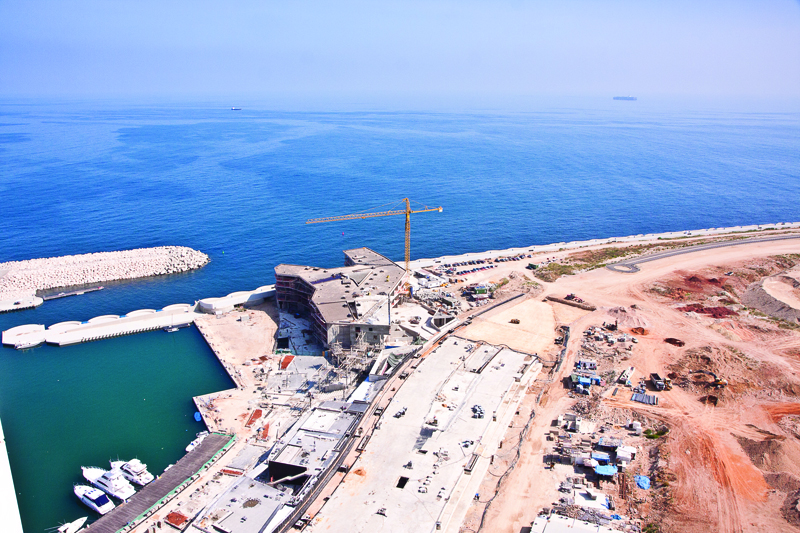
Summerland Village, the 73-unit residential section of the upcoming Summerland Hotel and Resort Kempinski, will also offer serviced apartments, introducing the concept of branded apartments to Beirut.

While branded and serviced apartments are marketed as pied-à-terre for non-residents, experts believe there is growing Lebanese demand for gated communities on the outskirts of Beirut. Seven Invest real estate developers plan to create a carefully picked community of 30 villas in their new project, The ONE, in Ain Saade, located 7 kilometers from downtown Beirut, with each villa ranging from 550 sqm to 650 sqm and including its own garden and swimming pool.

The firm’s architectural team is collaborating with fashion designer Zuhair Murad to give each villa a unique design flair, a new concept in Lebanon. With proper infrastructure already present, the group’s director Fawaz Sawaf says it will offer an alternative to those who originally planned to buy a house in the city center. “It’s the same price as a 300 sqm apartment in Beirut but you get the gardens, clean air and the larger villa with a pool,” he says.

Problems

Aside from a lack of proper infrastructure and project delays due largely to outdated and cumbersome bureaucratic procedures for obtaining permits and licenses, the main problem for developers remains the cost of land in the capital.

“Price per built-up area is dictating the increase in the price of apartments, and with the end users becoming price sensitive, developers are now having to study the market well and need to have the best combination of unit size and the best prices,” says Mireille Korab Abi Nasr, head of sales and marketing at FFA Real Estate.

Office towers developments will be more affected by price sensitivity of prime plots as they generally require a larger area of land.

A planned deal for Capstone Investment Group in downtown failed when the landowner changed his mind on one strategic parcel, forcing the developer to negotiate on another two parcels. According to developers such as Capstone’s Chief Executive Officer Ziad Maalouf, the issue is that landowners have inflated expectations regarding valuations despite the new realities in the market. While Lebanon was possibly underpriced up until a year ago, Maalouf says he believes the prices are now growing too fast.

Buyers’ concerns

Homebuyers have become extremely price-sensitive in recent months and are making increasingly high demands before putting their money on the table. “Everybody wants more for what they are paying,” says FFA Real Estate’s Nasr. Buyers are reasonably becoming more concerned about project specs, the right finishing and having their apartments by the date promised, since there is more competition in the market and it has become easier to compare projects, especially if they are within the same district.

But it isn’t just buyers that are price-sensitive. Though many experts believe the proposed 3 percent tax on real estate capital gains, included within the Ministry of Finance’s budget proposal submitted in October, will not pass in the near future, the government’s effort to raise revenues has sent an unpleasant ripple through the industry. It would primarily affect speculators rather than end-users, however, as investors have made exorbitant profits since property prices started escalating in 2005.

Though it will force both buyer and seller to declare the true price of a property when they register it, something usually not practiced to avoid paying higher taxes, some developers say it will just increase the asking prices of high-end projects.

Looking ahead

Uncertainty is the most repeated word among industry experts. As such, developers who are not building in prime areas, or who owe money to banks to pay off loans, might drive prices down in an effort to sell quickly.

In the last two years, “non-professional developers” in the market have been continuously blamed for offering low-quality stock or selling at prices that disturb fair market price, but there seems to be a consensus this year that fewer projects have been launched by such groups of investors.


Sidebar: Building environmental awareness

While Greenstone is widely credited as the first developer in Lebanon to implement green construction and get certification from the Leadership in Energy and Environmental Design (LEED), it appears the concept is catching on. Developers both in and outside of the capital are looking at long-term cost saving, though many industry players complain that the term “green” is mainly used as a marketing concept and not all developers make the investment they should in these initiatives. Still, London-based green-building consultancy firm, G, has partnered with 45 buildings in Lebanon to help them attain LEED certification. Nader Nakib, chief executive officer of G, told Executive in September that investing in green technology makes sense because of government subsidies. Jouzour Loubnan, an environmental non-governmental organization that has partnered with developers such as Estates and Har Properties, hopes around 35,000 trees will have been planted by the end of this year, having launched a new program whereby for every square meter built and sold, one square meter of new forest area will be planted.

December 3, 2011 0 comments
0 FacebookTwitterPinterestEmail
Comment

Yemen turns a page

by Farea al-Muslimi December 3, 2011
written by Farea al-Muslimi

In ancient times, what is now Yemen was given the name Arabia Felix — or “Happy Arabia” — by the Romans. But in modern times, it has enjoyed such a description in title only. In recent decades, Yemen has become known as one of the poorest countries in the world: the homeland of extremists, racked by conflict under the 33-year dictatorial rule of President Ali Abdullah Saleh.

When the Arab uprisings began, Yemenis saw a new chance to continue their struggle toward a more democratic state. For years, Yemenis have been politically active in the streets, from the political campaigns of the Joint Meeting Parties (JMP) during the presidential elections in 2006 to the southern movement rallies in 2007.  But as other Arab rulers felt the spring wind in their windows, Saleh tried to temper it by announcing a dose of reforms right off the bat. Some were entirely unrealistic — like announcing 65,000 new jobs for Yemeni youth in one night. After the Yemeni Parliament began the year by passing new legislation allowing Saleh to run for the presidency ad infinitum, Saleh announced his three famous “No’s” a month later: no presidency forever, no running for elections again and no inherited presidency, meaning that his son, who was being groomed for succession, and who is the leader of the Republican Guard, will not succeed his father. 

Saleh’s concessions failed to appease those itching for immediate change, however, and February 3 witnessed the first massive demonstrations. Taking place in more than 17 governates, the protests organized by the JMP called for political and economic reforms and a fair distribution of wealth. Up until this point, demands for Saleh to step down had not been made. The JMP called an end to the demonstrations but groups of young people remained in Sanaa’s squares demanding Saleh’s departure. These unknown youth were the catalyst of Yemen’s continuous uprisings for the next nine months.

The point of no return came on March 18, when the security forces’ snipers opened fire on protesters, killing more than 50 and injuring hundreds. The first massacre of its kind in Yemen was a turning point for the uprisings; a wave of resignations by senior military and government officials ensued. The First Armored Division of the military, a powerful segment of the army, declared their support of the uprisings, thus providing their influence on the side of the protesters, but also complicating future agreements.  With the tide seemingly having turned, most thought Saleh was in his last days, if not hours, in power. However, due to an international cardiopulmonary resuscitation, especially at the hand of Saudi Arabia, eight months passed without a transition of power. No sanctions were imposed on the regime and, at the beginning of June when Saleh was injured after his presidential mosque was bombed, the Saudis provided three-month sanctuary to the embattled dictator before his eventual return.

Each day of delay was to the detriment of regular Yemenis; with limited electricity and skyrocketing prices, the humanitarian situation became catastrophic. Violence broke out in many governates, including clashes between government forces and tribal leaders in the capital and escalating violence between government forces and extremists in the Abyan governate. With the situation deteriorating drastically, the international community slowly ratcheted up pressure. Even if Saleh was “the man” when it came to fighting Al Qaeda, it was clear his brand of “stability” was no longer sustainable.

On October 21, the United Nations Security Council passed a resolution urging Saleh to sign a power transfer deal proposed earlier by the Gulf Cooperation Council. One month later, on November 23, given one final ultimatum by the Security Council, Saleh signed the plan whereby he will remain honorary president but will delegate his powers to his deputy, Abd-Rabbu Mansour al-Hadi. Under the plan, the latter will work to form a new government with the opposition, with elections intended within three months.

Such a signing was received by the majority as a victory and a new page in the history of Yemen, though the reality is that in Yemeni politics, signatures are much easier to put on paper than they are to abide by. However, it seems that, after a full nine-month term, change of some sort has been born out of Yemen’s uprisings. But as the Arab uprisings have made clear, the fall of a dictator is only the start of a revolution.

Farea al-Muslimi is a Yemeni activist and writer for Almasdar

December 3, 2011 0 comments
0 FacebookTwitterPinterestEmail
Banking & Finance

Investment guide MENA stock tips

by Executive Editors November 25, 2011
written by Executive Editors

Despite the release of third-quarter corporate earnings last month, the markets remained fixated on macroeconomic news coming out of Europe. With the European sovereign debt crisis still unresolved, the markets remained jittery with investors sitting on the sidelines. For recommendations on where to invest in such volatile markets,

Executive spoke to Georges Abboud, head of private banking at BLOM Bank, Nadim Kabbara, head of research at FFA Private Bank and Haitham Arabi, chief executive of Gulfmena Investments.

Georges Abboud

Bullish or bearish?

According to Abboud, most fund managers are sitting on a lot of cash at the moment as, at least in Europe and the United States, markets seem to be heading back into recession. “You can start building some positions now but you need to be careful,” says Abboud. He recommends investing in companies with solid cash flows, as Warren Buffett did when his investment vehicle, Berkshire Hathaway, acquired Burlington Northern Santa Fe in November 2009. “Buffett is intelligent, he saw what was coming, so he bought a company with secure cash flows for the long term.”

Favorite asset classes?

“Now is not the easiest time to ask me where to put my money,” admits Abboud, though he still recommends investing in companies with high dividend yields, low price-to-earnings (P/E) ratios and a vision for growth for the next five years. He believes that the high rates on deposits in Lebanon allow him to buy time and identify stocks to invest in. He would not invest in gold as it has “no transparency, we don’t know what we are buying, we don’t know who the market players are, we don’t know what the leverage is and the speculators are everywhere.”

Thoughts on the Middle East and North Africa, Lebanon and top picks?

Abboud would invest in the MENA region as well as the Lebanese market. His two favorite countries are Saudi Arabia, which has deep pockets and is diversifying away from oil through large infrastructure projects, and Qatar, which has strong development prospects, abundant gas and solid dividend yields. His top pick in the MENA region is Orascom Telecom, but he warns that it is a risky trade. Being a telecommunications company, it is defensive but it carries political risk. As for Lebanon, he does not believe Solidere is expensive but as there is no visibility within the current environment he prefers the local banks, which are cheap, diversified in terms of activities and offer solid dividend yields.

Other interesting ideas outside the MENA region?

 1) Indian government bonds —current yield is around 8 to 9 percent with potential currency appreciation, as he expects India to continue enjoying solid gross domestic product growth. 2) General Motors — recently unseated Toyota as the world’s number one automaker, maybe the most compelling turnaround story in this sector. 3) Eurotunnel Group — operator of the Channel Tunnel between Britain and France. It is now profitable (started paying dividends two years ago) and should benefit from a significant cash flow boost through 2014.

Nadim Kabbara

Bullish or bearish?

 Kabbara is cautious but optimistic. He is concerned by the recent reports coming out of the US, Europe and Asia which show that the global economy is slowing. He is also concerned that we have not yet seen companies materially increase their revenues.

Favorite asset classes?

Kabbara highlights the disconnect between dividend yields on equities and coupons on 10-year treasuries. He believes that “Once we move out of this fear situation, there will be a return to fundamentals,” and investors will start buying equities again. He recommends owning stocks in defensive sectors — such as telecommunication, utilities and staples — but says “If you think we are going to go back into recession, then invest in fixed income and hold cash instead.”

Thoughts on the MENA, Lebanon and top picks?

 According to Kabbara, MENA markets are moving in the right direction but one must be careful when looking at individual names, “as there remains a lack of corporate governance, transparency and regulatory apparatus.” He likes Saudi Arabia, Qatar and the United Arab Emirates. For Saudi Arabia, it is because of increasing investment in the social framework of the country. As for Qatar and the UAE, they are sheltered from the regional turmoil, are increasing infrastructure spending and might be upgraded to MSCI emerging market status from their current frontier-market ranking. Mobily, telecom operator in Saudi Arabia, and Industries Qatar, producer of petrochemicals, steel and fertilizers, are Kabbara’s top picks in the MENA. BLOM Bank is his top pick in Lebanon due to what he calls their risk averse culture, solid operating metrics and capacity for growth. He would remain cautious this year as local banks have, prudently so, put growth projects on hold due to the turmoil in some parts of the MENA.

Top pick globally?

Barrick Gold, the world’s largest gold producer, as Kabbara believes investors have not paid enough attention to gold miners as compared to the physical (gold).

Haitham Arabi

Bullish or bearish?

Arabi is slightly bearish in the short term as “the European crisis is not entirely over and the Eurozone’s GDP is around 27 percent of the world economy, the numbers in the US are looking anaemic and we keep hearing that China’s figures are exaggerated, and that we might see a hard landing. All of which clearly indicate a slowing global economy.” Arabi, however, recommends being selective and gradually building positions on valuation grounds.

Thoughts on the MENA and top picks?

Arabi is cautiously optimistic about the region as, “from a markets perspective, Middle Eastern equity markets have stronger embedded fundamentals.” However, he is concerned that the global macro-environment will impact investor sentiment in the MENA markets. He believes that “in general, it’s time for stock picking, with a 6 to 12-month horizon before markets start to perform again.” Arabi likes Saudi Arabia and Qatar, which are in an expansionary fiscal policy mode. On Saudi Arabia, he adds, “it has around $21 trillion of oil reserves and its total debt to GDP ratio is only about 10 percent while some countries now have debt to GDP ratios in the region of 160 percent to 170 percent, so if anything Saudi is a great hedge for investors if they can read its fundamentals.” As for stock picks, Arabi likes Saudi Basic Industries Corporation as he believes “it is way undervalued”, trading at a P/E ratio of 8.5 times earnings for the first time in several years compared to a usual ratio of 18. It is one of his largest holdings. He also recommends the banking sector in Saudi Arabia and Qatar. In Saudi Arabia, he recommends Rajhi Bank, Riyadh Bank and Saudi British Bank. In Qatar, he likes Qatar National Bank, Commercial Bank of Qatar and Doha Bank.

November 25, 2011 0 comments
0 FacebookTwitterPinterestEmail
Economics & Policy

For your information

by Executive Editors November 25, 2011
written by Executive Editors

Syria stutters

As Syria comes under further strain as a result of the ongoing uprising and government crackdown, a series of announcements last month reflected the effects on the country’s economy. In an interview with Bloomberg in late October, Adib Mayaleh, the governor of Syria’s central bank, said the country had spent $3 billion of a $5 billion emergency fund since the start of the uprising in March in order to defend its currency from devaluation and to finance trade. The fund’s existence was revealed in August when Mayaleh announced that $2 billion had already been spent. Mayaleh also noted that foreign currency reserves held by the central bank amount to around $18 billion.  European Union sanctions on oil imports from Syria are scheduled to start this month and are expected to deprive the government of an essential foreign currency source, accounting for 25 percent of total annual revenue. Last month Mayaleh also hinted the country may transition away from the euro towards the Russian ruble if the EU bans the country from dealing in their currency. “In the near future we will agree on parameters for switching to close cooperation with Russian banks and using the ruble for international settlements,” he told Bloomberg.  This year Syria’s economy is expected to contract by 2 percent, according to the International Monetary Fund. Other predictions are even worse for the Levantine state, with the Institute of International Finance positing a 3 percent decline. Syria’s finance minister announced in September the country was expecting gross domestic product growth to slow to around 1 percent this year from 5.5 percent in 2010. [See Dithering in Damascus]

Draft budget released

Last month Lebanon’s finance ministry proposed its draft budget for the year 2012, in accordance with the constitutional deadline for doing so. The budget proposed a series of new taxes including an increase in value added tax (VAT) from 10 percent to 12 percent, while removing VAT refunds on a series of fixed assets used to perform activities such as educational services, activities of non-profit organizations and manufacturing of books, newspapers and magazines. Last month Neemat Frem, president of the Association of Lebanese Industrialists, told Executive that industries have not been receiving their refunds from the VAT administration for over 18 months. “They are borrowing from the private sector without asking us, by force,” he said. The increase in VAT is expected to rake in around $262 million in 2012, according to the draft budget. However, last month Finance Minister Mohamad Safadi told a local radio station that the revenues from the VAT increase would  total $364 million. A 3 percent tax on sales of real estate was also proposed in anticipation of a tax on real estate profits by 2013. The budget also proposed raising the tax on gasoline by LL2,000 ($1.32) per jerry can (1 jerry can = 20 liters) after it was reduced by LL5,000 ($3.25) earlier this year. The budget also proposes a tax on the thorny issue of illegal privately owned maritime properties built on public land, without specifying the amount. The budget predicted real gross domestic product growth in 2012 at 4 percent with inflation expected to hit 5 percent. The total deficit was estimated to reach $4.1 billion, or 29.7 percent of total expenditure. Total debt servicing was estimated to come in at $3.86 billion, an increase of around $24 million on 2010. Other items proposed included exemptions from some fees for non-polluting vehicles and reducing late fines imposed on municipal fees by 70 percent for years prior to 2009. The budget did not account for the increase in minimum wage, decided upon by the cabinet last month, which Safadi stated would cost the government at least $700 million. The budget will have to be approved by cabinet and then sent to parliament to be debated before it is passed into law. Lebanon has been without a budget since 2005.

Lebanon gets thumbs up and down

A series of global economic rankings released last month provided a mixed outlook for Lebanon’s relative position in the region and globally. The World Bank/International Finance Corporation’s “Doing Business Report 2012”, released last month, ranked Lebanon in 104th place amongst the 183 countries surveyed, a drop of one place in the global rankings. The report is compiled according to a composite index of 10 sub-indices including availability of electricity, registering property, paying taxes and enforcing contracts, all of which are major problem areas in Lebanon. The country fared worse than the previous year in terms of getting credit, protecting investors and starting a business. Resolving insolvency was deemed to take around four years and 22 percent of a debtor’s total estate value on average, compared to 3.5 years and 14 percent in the region respectively.  Balancing this grim assessment was the right-wing Fraser Institute, based in Canada, which measures competitiveness and government intervention in global economies and praised Lebanon’s economic freedom, ranking the country second amongst 16 countries in the region last year, the same position as in 2009. The index measures five broad factors of economic freedom and 18 variables.

FDI down

Lebanon is experiencing a downturn in foreign direct investment (FDI) and will continue to do so for the rest of this year, in line with the regional situation brought on by this year’s uprisings across the Middle East. According to the Kuwait-based Arab Investment and Export Credit Guarantee Corporation (AIECGC), total FDI in Lebanon will fall by 39.5 percent this year, from $5 billion in 2010 to $3 billion. Thirteen of the 21 Arab countries will experience a downturn this year, according to the organization, with the Arab world tipped to experience an FDI contraction of 17 percent in 2011 to $55.1 billion. Countries which have recently experienced uprisings were particularly affected by FDI contraction, with Egypt expected to see a 92 percent slide to just $500 million this year. Tunisia is expected to receive 21 percent less FDI year-on-year in 2011, Syria’s figure will fall by 65 percent and Libya’s is expected to see an 87 percent plummet. A total of seven Arab countries were tipped to see growth in FDI, including Saudi Arabia with $29 billion (up from $28 billion in 2010) and Iraq, which should see investment inflows of $3.5 billion this year according to the AIECGC. 

3G prices and legal problems

Last month Telecommunications Minister Nicolas Sehnaoui revealed the pricing structure for Third Generation telecommunication services (3G), tipped to be launched in February. Users will be charged $19 dollars by the ministry for every 500 megabits (Mb) of data they use over the service. Mobile operator Alfa also released their pricing scheme for the service last month saying that the service will be introduced in the ”coming few months”.  The ministry is still embroiled in a court case at the Shura council, Lebanon’s highest court, with the private data service provider Cedarcom over licenses to operate the service. The council ordered the ministry to halt execution of the 3G project on September 15 for one month pending the submission of a request for information by the court. Sources close to the proceedings told Executive that the government had submitted the requested documents, which stated that the mobile operators do not need a license because they are government-owned. When it came to pricing the service, which for public companies would require a cabinet decision, the sources said the ministry intended to treat the mobile operators as commercial entities able to set their own prices.

Hunt again for energy

The cabinet seemed intent to restart on the road to hydrocarbon wealth last month as it prepared for a proposed bidding round at the start of 2012. Last month the cabinet authorized the launch of a tender process to survey onshore hydrocarbon prospects. It also recommended a new draft law to regulate onshore oil and gas exploration similar to the one passed in August covering offshore exploration. The energy ministry also revealed that it has launched a tender process to reassess the seven existing onshore wells drilled between the 1930s and 1960s.

November 25, 2011 0 comments
0 FacebookTwitterPinterestEmail
Real estate

For your information

by Executive Editors November 25, 2011
written by Executive Editors

Property sales taxed

The Lebanese government intends to introduce a 3 percent capital gains tax on real estate sales. The proposals come as part of the Ministry of Finance’s efforts to raise government revenues and increase next year’s expenditure by 13 percent, as revealed in the draft budget on October 4. In an interview in mid October, Finance Minister Mohammad Safadi said that the real estate tax, in principle, is acceptable as long as it is below 15 percent. In June 2010, under former Minister of Finance Raya al-Hassan, a draft budget proposed a hike on property registration fees from 5 percent to 7 percent on real estate valued over $500,000 as an alternative to a tax on real estate sales. It was not implemented before the collapse of the government in January 2011.

10 new levels of luxury

A Saudi Arabian firm, Al Shegrey Group KAS Investment, has opened the doors to its newly completed boutique hotel in the Beirut Central District, according to the group’s October 3 press release. Le Dix Hotel, named after the 10 suites which each occupy their own floor, was built at a cost of $25 million, and includes luxury amenities such as private butler service and limousine transport to and from the airport. Arguably built at the highest cost per room key for a hotel in Lebanon, the large suites include two or three bedrooms, kitchen and balcony with an unblocked sea view. Chief Operating Officer of the firm’s hospitality division, Abdulkader A. Hankir said in the press release,”We invite presidents, ministers, ambassadors and businessmen from all over the world to visit Le Dix and have a look at one of the most luxurious hotels in the Arabic region.”

Summerland’s back

The Summerland Village – Residential Apartments was launched October 20, as part of the mixed-use Summerland Hotel & Resorts Kempinski development in Ramlet al Baida, Beirut. Kempinski is the hotel operator, while the developer is London-based Sanbar Development Corporation, the architects are Samir Khairallah & Partners, and the main contractor is Gruppo Rizzani de Eccher. Set to open its doors in spring of 2013, Summerland Hotel will encompass 22,000 square meters of private land with 5000 square meters of private beach, a village composed of 73 residential apartments and a 60-boat-capacity marina. The original Summerland Hotel, which closed in 2001, was created by Société Générale d’Entreprises Touristiques SAL in 1967.

Saudi, king of construction in 2011

Saudi Arabia is dominating the Middle East and North Africa (MENA) construction market this year, having amassed $17 billion worth of new contracts in the first nine months of the year, a 152 percent increase from the same period last year, according to a Bank of America Merrill Lynch Emerging Markets report released October 20. The United Arab Emirates, meanwhile, experienced the steepest fall in new contracts for the same period, down 55 percent compared to the same period last year. For the whole MENA new contracts are up 19 percent year-on-year, but third quarter results were disappointing as contract awards were down 18 percent to $17.2 billion for the quarter. The report pointed out that major UAE construction firms like Drake & Scull International and Arabtec had succeeded in diversifying away from UAE markets, but that Arabtec’s “construction margins are weakening due to low contribution from high-margin projects reaching the end of their cycle and mobilization delays.”

Hilton to manage Habtoor

Al Habtoor Group, the Dubai-based construction giant, announced on October 17 that Hilton Worldwide will take over the management of the group’s two hotels in Lebanon.  The handover of the running of the Habtoor Grand and the Metropolitan Palace will be completed in early 2012. Although a Hilton Hotel in Beirut Central District has been ready for visitors for more than a year it is awaiting the necessary permits to open.  The deals between Hilton’s chief executive officer Christopher Nassetta and Habtoor’s chairman and founder Khalaf al-Habtoor were signed at a media conference in Dubai, where they also revealed that Habtoor’s upcoming 324-room hotel on Palm Jumeirah would be run by Hilton under their luxury Waldorf Astoria brand when complete in 2013. It will be the second Waldorf in the United Arab Emirates after the Ras Al Khaimah property is complete in 2012. Habtoor’s remaining four hotels in Dubai will remain under in-house management, but both speakers said they hope to conclude more contracts together in the future. “We have experience in running our own hotels and we did a great job ourselves, but now we thought it is the right time to hand over this new project to the people who are professional, who have more experience than us, who can provide worldwide experience and also to promote our property,” said Khalaf al-Habtoor.

Cement industry’s slower build

Cement deliveries in Lebanon reached 3.7 million tons in the first eight months of 2011, showing a 4.8 percent increase compared to the same period last year, according to Lebanon’s central bank. However, this growth is more modest than the 5.5 percent growth during that period in 2010, and the whopping 20.5 percent growth in that period of 2009. In August, cement deliveries reached 451,000 tons, indicating a year-on-year growth of 6.2 percent, according to Bank Audi. As for the major players in the local industry, Holcim Liban declared net profits of $19.9 million in the first half of 2011 versus $18 million for the first half of 2010, according to a Byblos Bank report. Net sales were at $97.1 million for the first half of 2011 compared with $92.7 million for the first half of 2010. Société Libanaise des Ciments Blancs recorded net profits amounting to $1.4 million for the first six months of 2011 versus $1.5 million in the first half of 2010. Sales revenues were $6.9 million in the first half of 2011 compared to $7.5 million for the same period in 2010. These figures indicate that after a slightly slower start this year compared to 2010 the rate on construction is finally picking up to its 2010 autumnal levels.

November 25, 2011 0 comments
0 FacebookTwitterPinterestEmail
Banking & Finance

Lebanese capital markets

by Executive Editors November 25, 2011
written by Executive Editors

BLOM Stock Index (BSI)

Weighted effective yield of Eurobonds

Equity update

The shivering political situation in the Arab region, the gloomy economic situation in Lebanon and fears of another global recession weighed negatively on investors’ appetites for equities. This was reflected by the relatively low daily average volume of 150,811 shares valued at $1.02 million during the four-week period between September 16 and October 14, as opposed to an average 182,811 shares worth $1.72 million traded daily during the preceding four-week period. The BLOM Stock Index (BSI) hovered between a lower threshold of 1,205 points and a higher band of 1,244 points, before closing at 1,220 points on Friday, October 14, its lowest close since June 2009. The BSI closed around 2 percent lower than on September 16, and 17.3 percent lower than its value on December 30, 2010. 

On the regional front, the BSI outperformed the Morgan Stanley Emerging Market Index (MSCI), which lost 3.5 percent, during the four-week period, to settle at 930 points after distressing economic developments in  Europe at the end of September. As for the S&P Pan Arab Composite LargeMidCap Index, it fell by 1.2 percent to 106 points.  

Banking stocks captured the bulk of trade between September 16 and October 14, representing 63 percent of the total value traded. BLOM Bank stocks retreated during the period, as its Global Depository Receipts (GDR) lost 3.9 percent to hit $7.85 and its listed stock declined by 4.7 percent to settle at $7.80. However, BLOM Preferred 2011 added 0.1 percent, to settle at $10.12. Bank Audi listed stock dropped 3.55 percent to $5.98, while its GDR reversed the trend, adding 0.15 percent to reach $6.83. Both Audi and BLOM common stocks touched their lowest values since their respective stock splits in May and October 2010. It is worth noting that Bank Audi listed an additional 1 million GDRs on the Beirut Stock Exchange that were converted from Audi listed stocks as of September. Byblos and BEMO common stocks decreased a respective 1.2 percent and 3.9 percent to $1.63 and $2.47, whereas Bank of Beirut common stock gained 1.2 percent to hit $19.50.

In the real estate sector, Solidere A and B edged below their support level of $15, losing 1.3 percent and 2.6 percent to stand at $14.95 and $14.9 respectively, their lowest level in more than two years.

In the industrial sector, cement manufacturer Holcim Liban added 1.7 percent to reach $16.99 after revealing an 11 percent year-on-year growth in profits. Ciment Blanc Class B hit $3.25, its highest level since March 1998.

Eurobond bulletin

The Lebanese Eurobond market saw some selloffs on profit taking from foreign investors during the last two weeks of September, in order to cover some of their losses incurred in emerging markets. The BLOM Bond Index slipped 0.15 percent to 111.07 points. The portfolio weighted yield remained almost unchanged at 4.77 percent, whereas the spread against the US benchmark yield widened 16 basis points (bps) to 388bps as investors rushed for fixed income instruments. Lebanon’s credit default swap (CDS) for five years — a proxy for a country’s risk of default — reached 402-432bps compared to 395-425bps on September 16. Comparatively, in regional markets, Dubai and Saudi Arabia CDSs were quoted at 453-464bps and 111-118bps respectively.

November 25, 2011 0 comments
0 FacebookTwitterPinterestEmail
  • 1
  • …
  • 357
  • 358
  • 359
  • 360
  • 361
  • …
  • 707

Latest Cover

About us

Since its first edition emerged on the newsstands in 1999, Executive Magazine has been dedicated to providing its readers with the most up-to-date local and regional business news. Executive is a monthly business magazine that offers readers in-depth analyses on the Lebanese world of commerce, covering all the major sectors – from banking, finance, and insurance to technology, tourism, hospitality, media, and retail.

  • Donate
  • Our Purpose
  • Contact Us

Sign up for our newsletter

    • Facebook
    • Twitter
    • Instagram
    • Linkedin
    • Youtube
    Executive Magazine
    • ISSUES
      • Current Issue
      • Past issues
    • BUSINESS
    • ECONOMICS & POLICY
    • OPINION
    • SPECIAL REPORTS
    • EXECUTIVE TALKS
    • MOVEMENTS
      • Change the image
      • Cannes lions
      • Transparency & accountability
      • ECONOMIC ROADMAP
      • Say No to Corruption
      • The Lebanon media development initiative
      • LPSN Policy Asks
      • Advocating the preservation of deposits
    • JOIN US
      • Join our movement
      • Attend our events
      • Receive updates
      • Connect with us
    • DONATE