• Donate
  • Our Purpose
  • Contact Us
Executive Magazine
  • ISSUES
    • Current Issue
    • Past issues
  • BUSINESS
  • ECONOMICS & POLICY
  • OPINION
  • SPECIAL REPORTS
  • EXECUTIVE TALKS
  • MOVEMENTS
    • Change the image
    • Cannes lions
    • Transparency & accountability
    • ECONOMIC ROADMAP
    • Say No to Corruption
    • The Lebanon media development initiative
    • LPSN Policy Asks
    • Advocating the preservation of deposits
  • JOIN US
    • Join our movement
    • Attend our events
    • Receive updates
    • Connect with us
  • DONATE
Comment

Follow the money

by Peter Grimsditch October 3, 2011
written by Peter Grimsditch

It is a headline writer’s dream: “Ambassador expelled”; “Trade with Israel suspended”; “Prime Minister to visit Gaza”; “Turkish navy to patrol eastern Mediterranean”. The reality is much less Hollywood.

The Israeli ambassador to Turkey was not in the country anyway, conveniently and with “foresight” avoiding the embarrassment of television cameras capturing him skulking away. The trade suspension was rapidly qualified as government-to-government — a fraction of the $3 billion plus annual total. The Turkish navy is unlikely to provide the Israelis with another opportunity to demonstrate their military prowess with a 1967 Liberty-style attack. And Prime Minister Recep Tayyip Erdogan’s Gaza trip was always politically unrealistic, however much he personally may have wanted to go.

More significant than any of this is that private sector commercial relations between the two countries is growing, not declining. Never let rhetoric interfere with the sacred duty of making money. Even as Economy Minister Zafer Caglayan was solemnly declaring that trade ties with Israel were being downgraded to second secretary level, he was truthfully admitting that “there has not been much change in bilateral trade relations yet”. In short, if you want to know what is really going on in this world, follow the money. Verbal and political warfare between the two countries began with Erdogan’s walkout at the 2009 World Economic Forum in Davos and came to a head following the Israeli slaughter in May 2010 of eight Turks and an American of Turkish origin aboard an aid flotilla. Now check out the cash flow since then.

In the first half of this year, Israeli exports to Turkey shot up by 39 percent to $950 million. Trade in the opposite direction rose by 16 percent, to just more than $1 billion, and by the end of the year the two-way volume is expected to surpass $4 billion. Of course, there are sound reasons — on both sides — for wanting to maintain the exchanges.

Turkey has been suffering from the economic malaise in Europe, the main market for its exports, and suffered financial body blows from the uprisings in Libya and Syria. For its part, Israel was hurt by economic turmoil in the United States, its main customer.

Erdogan and Caglayan have both said Turkey’s quarrel is with the Israeli government, not individuals or businesses. Israeli Premier Benjamin Netanyahu was exporting his own complementary statement. The political crisis “is not our choice”, he said. “We respect the Turkish people and their heritage.” Not to mention their money. And their cheap holiday resorts.

The number of Israeli visitors to Turkey fell through the floor last year, dropping by around two thirds to 109,600. Tourists are not made of the same stern stuff as business people, and some Israelis took delight in flaunting figures to the northwest and pointing out how much they were hurting the Turkish tourist industry. That Turkey’s overall tourism numbers went up anyway, even given the missing Israelis, was not included in the gloating. Regardless, the Israelis are coming back. Perhaps encouraged by a favorable exchange rate as much as the facilities, the July and August figures rocketed from around 94,000 in 2010 to 166,000 this year, according to the Israeli Airports Authority. Tourism and trade operate on different dynamics of course. Tourist numbers can drop suddenly and build up again fairly quickly. Trade relations are established over a much longer period, and equally take a good while to wind down. Economic relations between Egypt and Israel had developed a rising momentum when Netanyahu became Israeli prime minister for the first time. It took just more than a year of his hardline policies before there were visible signs of decline.

In the longer term — and short of Middle East peace — Turkey is more important to Israel than the other way around. Erdogan’s relentless drive to enhance his country’s influence and strength took him to Egypt last month, where he forecast a rise in mutual trade to $10 billion over the next few years, as well as to Libya to restore the large and lucrative Turkish contracts that the revolution put in abeyance. Then there is always the US. Francisco Sanchez, the undersecretary of state for trade and commerce, said in Ankara last month the US aimed to triple trade with Turkey over the next five to six years. That would make it worth $45 billion, dwarfing the figure with Israel. And, after all, why deal with the monkey when you can trade with the organ grinder?

PETER GRIMSDITCH is Executive’s
Turkey correspondent
 

October 3, 2011 0 comments
0 FacebookTwitterPinterestEmail
Comment

Deference versus diversity in the Gulf

by Paul Cochrane October 3, 2011
written by Paul Cochrane

Gulf Cooperation Council (GCC) countries have long struggled with implementing nationalization employment policies (NEPs) to bring more GCC citizens into the workplace, offset reliance on expatriate labor and diversify their oil-dependent economies. The track record has been mixed — fairly good at getting citizens into the government sector but pretty hopeless at the private sector level.

In the United Arab Emirates and Saudi Arabia, nationals account for around 80 percent of the public sector workforce, in Kuwait around 90 percent and in Qatar 94 percent, although some of these statistics are questionable. In 2009 for instance, Sheikh Mohammed bin-Rashid, vice presidentof the UAE, admitted that Emiratization levels “did not exceed 54 percent in ministries and 25 percent in federal authorities.”

In the private sector, Emiratis account for less than 1 percent of the workforce of the UAE, in Kuwait and Qatar around 5 percent and in Saudi Arabia 13.3 percent, according to government statistics.

While NEPs have been in place for decades, most GCC governments appear to be working hard to ensure such policies do not succeed outside the public sector. The most effective way they have done so is by raising public sector salaries to ridiculous levels. Last year, the UAE gave federal government employees a 70 percent wage increase. In September, Qatar announced it would raise government employees’ wages by 60 percent and give military officers a 120 percent salary, pension and benefits hike. What incentive does this give to young Emiratis and Qataris to become, say, entrepreneurs or scientists when a cushy job for life can be had with the government?

Instead such moves create greater dependency on the state, a useful weapon to defuse political opposition and give the impression of greater distribution of oil wealth among nationals. Yet such ruler-subject dependency is not sustainable. It is creating divisiveness between nationals and expatriates, causing social malaise and stifling the potential of the Gulf people.

Such policies also throw into question the motivation behind spending billions of dollars on educational facilities and programs if citizens’ only incentive to study is to get into the public sector. Take Qatar’s Vision 2030 and the National Development Strategy 2011-2016, which mapped out the development of both a knowledge-based and free economy. One of the lofty aims of the multi-billion dollar, state-endowed Qatar Foundation is to make these plans a reality, but this is dependent on young Qataris entering the private sector and not opting to join the military and civil service instead. (Women, on the other hand, account for 77 percent of Qatar University’s student body, which bodes well for the future.)

So how is diversification going to occur and nationalization targets be met against such seemingly great odds? Is the answer to give passports to foreign professionals and experts, as has happened with 11 players on the Qatar national football team? (When I asked one Qatari if his countrymen were proud of their team after Qatar won the bid to host the 2022 World Cup, he replied: “What team?”)

While the UAE and Qatar are scoring own goals against their private sector NEPs, Saudi Arabia is taking its Saudi-ization policy more seriously, introducing this year the Nitaqat plan to find employment for 1.12 million Saudis by 2014. But through its complex quota categories — 205 of them in all — even the labor ministry has admitted that up to 40 percent of private companies will fail to employ enough Saudis and could “cease to exist.”

There appears to be no easy way of encouraging NEPs in the private sector, either beset by onerous requirements or countered by the government placating subjects through high-paying state jobs. A balance needs to be found. The hard truth, though, is that the GCC countries need to accept that introducing viable NEPs that put the private sector ahead or on par with the public sector as an attractive employment option for nationals will eventually bring about a different relationship between the state and the people. It would mean greater governmental accountability; a step that could be viewed by the rulers as one too far. But the status quo cannot continue forever, as major socio-political problems inevitably crash the party. Leaders of certain other Arab countries have recently learnt this the hard way.

PAUL COCHRANE is the Middle East
correspondent for International News Services


October 3, 2011 0 comments
0 FacebookTwitterPinterestEmail
Comment

Nuclear negotiations from fusion to fission

by Gareth Smith October 3, 2011
written by Gareth Smith

In the fall of 2004 I went twice to the Supreme Council for National Security in Tehran for long interviews with Hossein Mousavian, a senior negotiator in talks with Britain, France and Germany over Iran’s nuclear program. The transcripts make sharp reading seven years later, for two reasons. Firstly, leading Iranian diplomats or security officials no longer seem to give such access.

Secondly, the interviews recall a diplomatic process during which Iran suspended uranium enrichment as a “goodwill gesture” to help talks with Western powers. The Iranian negotiators were led by Hassan Rouhani, a pragmatic if dour cleric who, as a colleague told me, “understands we’ve suffered too long from ideologies, and that Iran should instead pursue its national interest.”

A whiff of compromise hung in the air. A European diplomat said the Mousavian interviews offered “real insight into the mind of the Iranian negotiators” and another insisted Europe would at some stage relax its demand for Iran to cease enrichment for good.

One point Mousavian made to me was that the Iranians felt domestic pressure from critics of the talks. Hossein Shariatmadari, editor of Kayhan newspaper, argued that Iran should leave the Nuclear Non-Proliferation Treaty (NPT). Ali Larijani, now parliamentary speaker, quipped Iran would be swapping “candy for a pearl” if it took economic aid in return for ending enrichment.

Some Europeans scoffed at the idea the Iranian negotiators were under pressure. One diplomat, who happened to be close to Washington, said this was a tactic cooked up by the Iranian team.

And yet, there were indications, going back to the 2003 offer of a “grand bargain”, that Iran’s leaders were ready for a deal in which they would accept, for a set period, limits on enrichment as well as intrusive inspections by the United Nation’s International Atomic Energy Agency (IAEA).

Such a compromise would give, Iran suggested, the “objective guarantees” the Europeans wanted of Iran’s peaceful intentions while recognizing its right to enrich as an NPT signatory.

Times have changed. Following his 2005 presidential election win, Mahmoud Ahmadinejad raised the nuclear program from state policy into a popular campaign. Enrichment was resumed and expanded, and sanctions have been strengthened. Barack Obama won the United States 2008 election promising “engagement” but, restrained by the US right and Israel, this has amounted to a few cursory meetings.

The latest IAEA report, out in September, finds Iran now has 4,534 kilograms of uranium enriched to around 5 percent (low-enriched uranium,or LEU) and 70.8 kg enriched to 20 percent.

That is far more than Iran had in 2004. It is also more than it had last year when it agreed with Turkey and Brazil to export the bulk of its LEU in return for 20 percent-enriched uranium, which is used for medical treatment, especially of cancer patients. Yet the US torpedoed theTurkey-Brazil deal, and Iran began enriching to 20 percent itself.

And so the show moves on. In August, Fereydun Abbasi-Davani, head of the Atomic Energy Organization, said Iran would no longer consider a fuel swap.

Iran is edging nearer to being able to enrich to 95 percent for a bomb, if it should choose to do so. Yet, the issue is political and not technical: any country that can enrich uranium can make a weapon. As Mousavian said in 2004, “Iran already has the capability… we have the minds.”

This summer Mousavian, now at Princeton University, published a wide-ranging piece, ‘Rules for Successful Engagement with Iran’, examining the state of diplomacy on the New Atlanticist blog. He suggested the Obama administration had continued the Bush policy of “ratcheting up pressure through new sanctions, hinting at a readiness to take military action and supporting covert sabotage of Iran’s nuclear program.” Threats and sanctions, he wrote, limited Iranian officials’ room for maneuver, just as Ahmadinejad’s rhetoric had “increased tremendously the political cost to American politicians of being seen as soft on Iran”.

Mousavian conceded engagement was “risky” for both camps and required “bravery and wisdom in Washington and Tehran”. But, the alternative he wrote was “the same escalation of the confrontation”. He seemed far from optimistic.

GARETH SMYTH has reported from around the Middle East for almost two decades and was formerly the Financial Times correspondent in Tehran

October 3, 2011 0 comments
0 FacebookTwitterPinterestEmail
Comment

Commemoration and conformity

by Peter Speetjens October 3, 2011
written by Peter Speetjens

Perhaps, if on another planet, one may have missed the 10-year anniversary of the day when September 11 became “9/11”. Virtually every self-respecting media outlet in the world dedicated time and space to the terrorist attack which, among other things, saw two planes torpedo New York’s Twin Towers. Television channels repeated the explosion again and again last month. Newspapers created special supplements and magazines filled entire issues with stories of the victims, their families, firemen, witnesses and just about anyone remotely connected to the dreadful event. For people not anywhere near the scene when it happened, no problem, there was always the “where were you when” question. The American media in particular went overboard, which is to some extent understandable, given the event took place on American soil. Worldwide, 9/11 also resonated, as it unfolded live on TV for a global audience of hundreds of millions — one reason the late German composer Karlheinz Stockhausen defined 9/11 as “the greatest work of art… ever”.

Still, while the West likes to pat itself on the back for its intrepid free press, the conformity of its coverage was striking. It was, by and large, an emotional affair with few critical questions asked. Only a heartless fool would not feel for the nearly 3,000 victims and their families, or take exception to a moment of silence. But do we need to watch and read the same thing in English, French, Arabic and God knows how many languages? What is more, is the wave of media attention justifiable, considering the millions of people who were killed over the course of history, yet for whom no tears are shed and no flags are waved? Why is there no global wave of compassion for the victims of “the other 9/11” in 1973? On that day, General Augusto Pinochet took power in Chile, with US blessing. Many more than 3,000 people were killed on that 9/11, while some 20,000 were to be shown their graves in the months following and a million forced into exile. Why does the rest of the world not commemorate the 800,000 Tutsis killed in Rwanda during the 100 days of horror, or the 2.5 million people killed by the Khmer Rouge in Cambodia? The book of mass atrocities has many chapters, with much of human history written in blood.

Commemoration, however, is not just about compassion. The ritual in memory of the martyr is also a means to close the ranks and stand as one. It is about reconfirming the collective identity, an act particularly welcome in the US, a country that seems to grow more divided by the day as it goes through one of the worst economic spells in its history.

On such a solemn moment of unity, it is not befitting to raise critical questions. Doing so is to step out of line and out of the group; one essentially declares oneself an outcast. That is what happened to New York Times (NYT) columnist Paul Krugman. In a welcome variation to the general mode of tear jerking, he wrote in a piece called “The Years of Shame” that “fake heroes like Bernie Kerik, Rudy Giuliani, and, yes, George W. Bush raced to cash in on the horror… [while] the attack was used to justify an unrelated war the neocons wanted to fight, for all the wrong reasons. How many of our professional pundits took the easy way out, turning a blind eye to the corruption and lending their support to the hijacking of the atrocity?”

Conservative America crucified Krugman. Former Defense Secretary Donald Rumsfeld, one of the Iraq War’s main architects, tweeted: “After reading Krugman’s repugnant piece on 9/11, I canceled my subscription to the NYT.” Waging a war on false grounds was not the only consequence of 9/11. What about Guantanamo Bay, the Patriot Act and the rendition of terrorism suspects to countries like Egypt, Jordan and Syria? In the name of the victims of 9/11, are these not the questions that should be asked? The media’s, and society’s, widespread abdication from its responsibility to address these controversial issues is no show of reverence for those who were killed, quite the opposite; it dehumanizes them, reducing them to objects fit only to be mourned, rather than remembered as living, feeling, thinking individuals — many of whom, had they survived, may well be asking these questions themselves. 

PETER SPEETJENS is a
Beirut-based journalist

October 3, 2011 0 comments
0 FacebookTwitterPinterestEmail
Finance

Beirut Stock Exchange: Ringing the changes

by Maya Sioufi October 3, 2011
written by Maya Sioufi

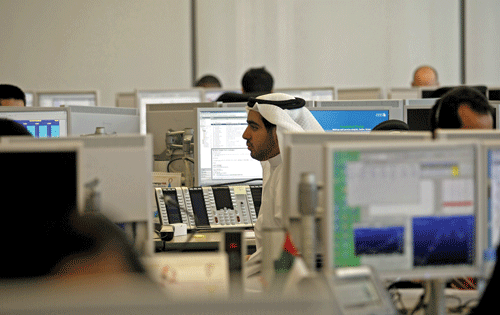
The Beirut Stock Exchange (BSE) could be considered among the sick children of Middle Eastern bourses. With a tiny market capitalization of $11 billion and an average daily volume of trades of $2 million, it is eclipsed in the shadows of the big boys in the Gulf such as Saudi Arabia, Qatar and Abu Dhabi, with market capitalizations of $324 billion, $122 billion and $67 billion respectively. Admittedly, the BSE, even in the best circumstances, is unlikely to rival the top regional markets, but few would disagree that its full potential has hardly been tapped.

For years, the BSE has been effectively orphaned by the Lebanese government. The Ministry of Finance has left the BSE chairman’s seat vacant for more than two years; the seats of three other board members — two resigned and one deceased — collect dust as well.

In an apparent effort to begin ameliorating the situation, on August 4 the Lebanese parliament approved the capital market and insider trading law, which will provide Lebanon with an independent authority to oversee the exchange and protect investors.

“This law is a quantum leap”, said Riad Salameh, governor of Banque du Liban (BDL), Lebanon’s central bank as it would attract “substantial” investment in Lebanese companies. “It will also allow companies to raise their capital and expand their business without borrowing money”, he added.

The new capital market law does lay out the blueprint for significant changes to the BSE, which, if implemented, could go a long way in helping inject new life into the bourse; however, the timeline and quality of implementation is as yet uncertain, and many feel that reforms need to go beyond the scope of what the law proposes.

What the law entails

Up until now the BSE has been both an exchange and its own regulator, simultaneously — meaning independent oversight has been utterly absent. 

“The role of an exchange should be to bring buyers and sellers together and not to be a regulator, and so the role of the BSE [has been] a failure,” said Jean Riachi, chairman of FFA Private Bank.

The long-awaited capital market law, which had idled on the shelf since it was first introduced in the Lebanese Parliament five years ago, calls for the establishment of an independent regulatory body called the “The National Council for Financial Markets in Lebanon” — headed by the governor of BDL and consisting of seven members, with five drawn from the private sector.  The law also requires theBSE to be privatized but it does not state how this should be done. The Arab Federation of Exchanges (AFE) has suggested privatizing the exchange by selling part of it to brokers with an equal distribution of shares amongst them, granting veto power to the government to protect investor interests and selling a specified amount to the public with a limit of 5 percent ownership per shareholder.

Ziad Abou Jamra, deputy general manager at Fidus, believes the law would “serve as a milestone in enhancing the overall performance of the BSE.”  The problem, however, is: “You never know when it will be implemented, as with any law in Lebanon,” said Fadi Khalaf, secretary general of the AFE and former head of the BSE.

The lack of liquidity

Investors had regularly complained that the BSE simply lacked the liquidity to make it attractive — even before popular uprisings swept through the Middle East and North Africa this year. Since the regional unrest began, the volumes have only become thinner, while the BSE also lost $2 billion in market cap between January and September.

According to a senior private banker the Lebanese equity market is cheap and offers attractive dividend yields but the illiquidity could leave the exchange dormant and unattractive. Georges Khoury, general manager of Libano-Française Finance and head of private banking at Banque Libano-Française, similarly argues that Lebanese equities are cheap but the thin volumes and Lebanon’s inherent political instability scare away investment in the BSE.

The scant listings on Lebanon’s exchange contribute to the lack of liquidity. There are currently 11 companies with securities listed on the BSE, of which three (Solidere, Bank Audi and BLOM Bank) account for almost 75 percent of the exchange’s market capitalization. There is little diversification among sectors either, as the exchange consists of six banks, two industrial companies, one real estate company, one automotive company and one fund. Though Lebanon has a relatively small economy, Khalaf says there are some 50 companies sizeable enough to raise equity on the exchange, but which avoid doing so.

Khalaf said, however, that the new law should be a catalyst for greater liquidity in the capital markets, given that the head for both the central bank and the capital market regulator is the same person; he explained that the central bank governor is the most influential person in Lebanon’s banking sector and can encourage the sector to inject liquidity into the capital markets and motivate companies to list.

Other challenges the BSE faces, however, go beyond the scope of the new law and may yet leave the exchange hobbled.

Entrepreneurs and family affairs

Several factors contribute to the limited options on the BSE menu, among them being that the majority of Lebanese companies are family-owned enterprises (FOEs) and prefer not to have foreign investors own a stake in their company. It is also a transparency issue. Listing implies corporate taxes and transparency; according to Khalaf, companies in Lebanon often keep “several books” and thus prefer not to list.

Khaled Zeidan, general manager at MedSecurities, a BankMed subsidiary, said the mentality of family businesses in Lebanon needs to change in order for the businesses to survive. As new generations rise up through a company, the distribution of its capital becomes more and more diffuse.

“You need to institutionalize or it is over for everyone,”said Zeidan.

According to Ammar Bakheet, head of asset management at Audi, FOEs need to be educated about the long-term benefits of listing; in order to expand, at some point they will need to access the equity markets and go beyond bank financing.

A viable BSE would also help venture capitalists, who on the one hand seek out entrepreneurial start-ups to invest in, and on the other hand need to exit these investments; in developed economies, listing on equity markets is a lucrative exit strategy. Take Berytech for example: this Lebanese business incubator created a fund in 2008 with $6 million of capital to invest in start-ups. With a lifespan of seven years, the fund has not yet exited any of its investments, and as Nicolas Rouhana, managing director at Berytech, explains, the exit strategies for investments is one of their main challenges. He says the fund’s current exit strategies include the company being acquired by the entrepreneurs themselves, by larger funds or by multinationals looking to buy the technology or the product. The BSE is not considered a viable option. 

The banks vs. the bourse?

Long seen as the backbone of the Lebanese economy, the country’s banking sector is 10 times the size of the capital market. This has lead to mixed opinions regarding the banks’ impact on the market’s development. AFE’s Khalaf believes that the banking sector and the capital markets are in competition, as it is in the banks’ interest to provide loans to companies: loans generate more income for banks than advising companies on listing on the exchange.

A study undertaken in May 2010 by the French consulting firm Arche and sponsored by the French Ministry of Finance noted that banks in Lebanon are acting more as credit issuers and less as market intermediaries, given that “their operating income is heavily geared toward interest income.” The study also stressed that “capital markets will never develop without strong and active intermediaries.” Arche experts recommended that the BDL push investment banks to act more as intermediaries with the use of incentives or penalties.

A financial expert disagreed, saying she believes that in the long run the whole financial system, including banks, would benefit from strong capital markets, as the extra liquidity would go through the system. A stronger capital market would also require more activity from the advising arm of the bank. BLF’s Khoury concurred, saying the strength of the banking sector is not the main issue affecting the development of the exchange. He stressed that the main roadblocks were the lack of liquidity and the lack of diversification of the bourse.

Beyond the law

It is clear that the new capital market law, in and of itself, will not make the BSE an exchange ripe for hungry investors; policymakers will need to do more.

Saeb el-Zein, managing partner at Spinnaker Middle East and board member of the BSE, recommended the privatization and listing on the exchange of the various telecommunication, electricity and water companies owned by the government, a suggestion that AFE’s Khalaf strongly adheres to aswell. Zein also suggested encouraging the development of private pension funds — supported via various tax incentives — that would commit to investing in local capital markets and obliging the social security fund to invest up to 20 percent of its assets in Lebanese stocks.

Khalaf said he suggested to Lebanon’s Ministry of Finance a tax exemption of a limited number of years for companies that list, but the ministry turned down his proposal as it reduces revenues. Zeidan suggested that incentives ought to be given to local banks that buy securities on the BSE in order to increase institutional participation in the exchange.

Jacques Sarraf, chairman of Malia Group conglomerate, recommended creating a system to encourage small companies to merge, which will create larger companies better suited for listing on the exchange.

Khalaf, however, warned against relying too heavily on incentives to boost the exchange. He points out that when Egypt introduced tax exemptions on the profits of listed companies, the number of listed companies increased significantly but there was little trading. Owners would list a stake to benefit from the tax exemption but they would not trade; listed companies on the Egyptian exchange went from 627 in 1991 to 1,070 by the end of June 2001, but the majority of the trading was concentrated in 30 companies.

Investors are also concerned about the lack of transparency, which is crucial in building confidence in an exchange. Stock exchanges usually encourage good corporate governance by issuing listing and disclosure standards and by monitoring compliance with these standards, but this is not applied in Lebanon.

According to Badri Meouchi, executive director at the Lebanese Transparency Association, the BSE does not have corporate governance guidelines; it only has requirements for listing.

In order for proper corporate governance to be implemented, several articles in the Lebanese code of commerce need to be amended, such as separating the role of general manager from chairman, protecting minority shareholders rights (such as allowing them to elect board members) and not requiring board members to have shares in the company.

The BSE’s ills have not gone unnoticed, and the government’s passage of the new capital market law could provide some useful medicine. However, much remains to be done before the bourse is given a clear bill of health and given the chance to reach its full potential.

October 3, 2011 0 comments
0 FacebookTwitterPinterestEmail
Finance

Fadi Khalaf – Arab Federation of Exchanges

by Maya Sioufi October 3, 2011
written by Maya Sioufi

Lebanon’s capital market is entering a new era, at least in legislative terms, with parliament’s approval of the long awaited capital market law in August 2011. In a next step, an independent regulatory authority with oversight of the Beirut Stock Exchange (BSE) is to be created and headed by the central bank governor, the indomitable Riad Salameh. Fadi Khalaf, secretary general of the Union of Arab Stock Exchanges and former BSE chairman, talks to Executive about the new law, imbalances in Lebanon’s financial markets and the BSE’s new prospects and challenges.

The BSE has not had a president since you left in August 2009. Do you know of any plans to have a new president?

I am not aware of any plans regarding the election of the next president. This is government politics. There are over 50 vacant positions in the Lebanese government and this is just one of them. It is the government’s decision to find a new president. When I left in August 2009, I never thought that we would be in September 2011 and still without a president, but some posts in Lebanon stay vacant for three to four years.

What are the most important issues that the BSE faces?

We don’t have enough companies listed. Most of the companies in Lebanon are family owned and they avoid listing because they don’t want foreign investors to own a stake in their company. Listing implies fiscal taxes and transparency, and in Lebanon, companies have several books. If companies list and don’t disclose their entire income, their stock price will be hit. If they disclose their income, then they have to pay taxes. So some companies will avoid listing.

There is also a lack of liquidity. The BSE is not a priority for the government. It has always been secondary. The government wants to encourage the BSE but it needs the liquidity to cover the government expenses and the government deficit. If there remains excess liquidity, then it will see if it will be directed to the exchange. If the banking sector needs liquidity, then the government needs to keep it there. Many exchanges in the world have enjoyed a strong boost due to the privatization of state owned enterprises, which also gives incentive for other companies to list. We have not had this in Lebanon. Take the privatization of the telecom sector for instance, if a strategic investor wants to pay a good price and not be listed, the government accepts. So the BSE was never a priority.

Do banks encourage companies to list?

Capital markets and the banking sector are usually complementary but [in Lebanon] they are in competition. Investors put their money either in a bank or in the capital markets. When companies need funds, they either take it as debt from banks or equity from capital markets. Since the banking sector is 10 times the size of the capital markets, it has a much stronger influence and it will not encourage companies to list since it is not in their interest.

For example, I had once convinced a very large Lebanese company to list on the exchange and sent them the necessary [documents]. Two to three months later, the CEO tells me that his banker, who is also a shareholder in the company, advised him against listing and provided him with a loan to cover his financing despite the fact that his bank has a brokerage firm and its duty is to convince companies to list.

How about the fees that banks would receive from advising companies to list on an exchange?

Banks earn more fees by providing companies with loans as it provides them with regular payments of interest, whereas listing on the exchange only generates a one off fee. When a company’s debt to capital ratio reaches a certain limit, then the banks might advise them on considering the capital markets. The exchange is just a tool. It is living on the crumbs of the banking sector.

Will there be more interest in the stock exchange following the capital markets law signed in August?

Yes there will be more interest. The governor of the central bank will head the capital markets authority and he has the most influence in the banking sector. This is a good step for the exchange. He can direct the banking sector to inject liquidity into the capital markets. He can also influence the banking sector into encouraging companies to list. In the exceptional case of Lebanon, the banking sector’s market capitalization is around $120 billion whereas the exchange is a mere $11 billion so if the banking sector is not convinced, the only other way to boost the exchange is through privatization of the telecom industry and it does not look like that will happen anytime soon.

When do you think the law will be implemented?

I am not sure if it will be implemented by the end of the year. No one knows how long it will take in Lebanon.

How about the initiative to privatize the stock exchange?

It gives the exchange independence from politics. The private sector is the driving force in Lebanon. Privatizing the exchange will give it a boost but it is not the key factor; if companies are not convinced of listing, privatizing… it is not going to change anything.

One issue that needs to be addressed regarding privatization is how to implement it. The law says the stock exchange should be privatized but it doesn’t say how. It says that after the formation of the capital markets authority, the exchange has one year to have the legislation in place to become a [registered] company as opposed to a public institution and one year after that to be become private.

What initiative could be put in place to increase liquidity? Would it help for example to provide incentives to local banks to buy stocks on the BSE?

What is the point of going to the supermarket with plenty of money in your pocket if there is not much on the shelf for you to buy?

How about incentivizing companies to list? Should the government encourage mergers?

When I was head of the BSE, we did a study on the Lebanese market and we found that there were 50 companies sizeable enough to list on the exchange and they were not listing. Mergers mean putting family businesses together. It is a problem on a whole different level. It could help but it is not enough. Besides, we shouldn’t want the exchange to live on incentives only.

What can the Beirut Stock Exchange do to improve?

It cannot do much… The evolution of the exchange has already taken place in the past ten years with the implementation of measures such as an increase in the type of instruments that can list (stocks, bonds, preferred shares, GDRs,  etcetera) ,a move from fixed pricing to continuous pricing, a reduction of the taxes on dividends and an update of the trading system. All these steps helped increase the volume of shares traded from $200,000 per day in 2000 to 8 to 10 million dollars per day today.

The exchange has done what it can do. The rest remains in the hands of the other players of the Lebanese economy. Unfortunately, the correct step they are taking with the capital markets law is happening during a time when the biggest Arab bourses are complaining of low volumes, so the timing is not great, but at least the exchange will be ready for the next wave of investment in the Middle East.


October 3, 2011 0 comments
0 FacebookTwitterPinterestEmail
Finance

Q&A with Jean Riachi, chairman at FFA Private Bank

by Executive Staff September 26, 2011
written by Executive Staff

FFA’s Jean Riachi gives high-net worth investors tips on how to get the best out of their private bank

September 26, 2011 0 comments
0 FacebookTwitterPinterestEmail
Consumer Society

Ian Gorsuch

by Executive Editors September 18, 2011
written by Executive Editors

It the Beirut launch of McLaren Automotive’s long awaited high performance car, the MP4-12C, Executive spoke with Ian Gorsuch, McLaren’s regional director for the Middle East and Africa.

A totally bespoke car, the 12C has a lightweight carbon fiber chassis structure and a 3.8-liter, V8 twin-turbo engine producing around 600 brake horse power (bhp), able to reach 0-100 kilometers per hour (km/hr) in just 3.3 seconds.

  • The MP4-12C has been a long time coming, with production of the iconic McLaren F1 ending in 1998 and the world’s best selling luxury supercar, the Mercedes-Benz SLR McLaren, in 2009. Why did it take so long?

We had a long gestation period. Over the last three years there’s been a lot of speculation about what we were doing, especially as we had no new car on the road. And because it is our first car (in such volume), there has been a lot of discussion. Perhaps we revealed too much information too early, and we should have been more circumspect in releasing information as it created such a seemingly long waiting time. But although it seems like a long time to launch, it is on time.

  • How much did McLaren invest in developing the MP4-12C?

More than $1.3 billion has been invested in the project since 2005. Around 30,000 hours were spent in simulation development, and 100,000 kilometers of prototype testing was carried out, from the Arctic to the Middle East. We could have done testing in Death Valley in the United States, where the temperatures are the highest on earth, but we thought it better to do the testing in the humidity and dust of the Gulf.

  • Will there be other MP4-12C models?

We will also be launching the MP4-12C GT3 racecar. It is not like the Porsche GT3, which can be driven on the roads; it is purely a racecar. There has been a lot of interest from race teams, and we will initially start in Europe.

  • A new trend appears to be for supercar manufacturers to downsize and improve carbon emissions. Is this the case for the MP4-12C?

The car has the lowest carbon emissions in its segment, better per horsepower than a Toyota Prius. We built in performance criteria, not just 0-100 kilometers, but also ergonomics and CO2 [carbon dioxide] levels. We are a technology-led company.

  • How else does the car differ from others in the same segment?

The problem for many people is that they have to choose a luxury vehicle for a certain job. [They need] good suspension to make driving in traffic comfortable, or a performance car for high speed, which needs rigidity and good engagement with the road. Rarely can you enjoy the two together. With the MP4-12C’s unique suspension you can feel everything on the road, high speed on bends and you are able to cruise around in town, much like the comfort of a BMW M-Series. It can be driven every day, not just for a burn out on the weekend.

  • The F1 famously had a gold covered engine. Does the MP4-12C?

No, we didn’t need it for the MP4, perhaps due to the engine size. It was only on the F1, and for heat insulation on the engine bay.

  • How many MP4s are to be produced?

About 1,000 a year. There are already around 20 on the roads in Britain. Once we get up to full production and offer different models, it will be 4,500 worldwide.

  • How many do you expect to sell in the Middle East?

We will sell around 100, so 10 percent of global sales. The order bank is more than that, but the constraint is the production capacity. The biggest market is the United States.

  • What’s the price tag?

In Dubai, AED900,000 to AED 1,000,000 [$245,000 to $272,271].

  • Are customers old clients?

There are only 106 F1s in the world at the moment, so if we sold to F1 customers it would not be a viable business. We don’t advertise, so the key is through the media and our reputation.

  • Could the financial crisis affect sales?

At our level there are a limited number of cars so we are reasonably secure. And this is indicative worldwide. Before the crisis, if someone was worth $100 million, they are now worth, say, $70 million. This has not affected their lifestyle but it has affected their purchasing psyche. It’s not value for money, but people don’t just want a badge, they want intrinsic qualities behind the badge. This is an advantage we have.

  • Can you tell us about the main investors in McLaren Automotive?

Peter Lim, a Singapore investor, has joined us along with our chairman Ron Dennis. Other investors are the TAG Group, headed by [Saudi businessman] Mansour Ojjeh, and Mumtalakat Holding Co., the Bahraini sovereign wealth fund (with 50 percent). So we now have European, Middle Eastern and Asian investors, bringing new money, equity and experience to the board. We are perhaps the best funded car company in the world.

  • What is your regional presence in the Middle East?

We have six new showrooms; a 400 square meter showroom in Dubai, which is to open in November, and in Abu Dhabi, Jeddah, Doha, Bahrain and Kuwait. And we have eight service points, including Beirut, as a lot of Gulf nationals bring their cars to Lebanon in the summer and need the confidence that their car can be looked after.

Asia is the next step, with Osaka, Singapore and Hong Kong. We will be opening 35 new showrooms in 19 countries. It has been very exciting but [there has been] a lot of pressure, as no luxury brand has done in such a short time span a global launch with showrooms for just one car. We have had to train technicians at our facility in Woking, England, create unique dealer ordering portals and sign dealership contracts.

  • Is McLaren facing problems with the gray market?

The gray market is a problem for every luxury manufacturer, and it is costing the second buyer a lot of money. I heard of one car sold on Ebay, worth $280,000, that was offered online for $411,000. It was sold to a trader for $445,000.

  • When it was launched in 1993, the McLaren F1 was the world’s fastest production road car with a top speed of 386 kilometers per hour. British actor Rowan Atkinson, known for his role as Mr. Bean, crashed his F1 in early August in England. Have you any news?

Atkinson is fine and his car is being repaired. The press undervalued the car at $3.2 million. It is actually worth $5.76 million as there are only a few in existence worldwide.

“People don’t just want a badge, they want intrinsic qualities behind the badge. This is an advantage we have”

September 18, 2011 0 comments
0 FacebookTwitterPinterestEmail
Economics & Policy

For your information

by Executive Editors September 18, 2011
written by Executive Editors

Huff, and puff, and blow ,your smoke out

Non-smokers will be breathing a breath of fresh air after a new anti-smoking law was passed by Lebanon’s parliament last month. The law, which has been in the pipeline since 2004, was slow to come to fruition but was spurred on recently by both civil society and the press. It prohibits smoking in certain indoor and outdoor locations including bars, restaurants, schools, hospitals, public and private offices and on public transportation. It also bans any form of tobacco advertising, including promotion and sponsorship. In addition, the law increases the size of the required health warnings on cigarette packages to 40 percent of the surface area of a pack. Hotels were granted some leeway by being permitted to allow smoking in 20 percent of their rooms. Penalties to be introduced range from a fine of $663 to $1,990 for establishments that are caught allowing smoking indoors, as well as a fine of $66.3 for individuals caught smoking in public spaces. Implementation is to take place gradually over the next year, allowing establishments and businesses to recalibrate their activities accordingly.  “A long road ahead to achieve effective implementation awaits us,” said a statement released last month by the health ministry’s National Tobacco Control Program unit. “The previous partial law passed in 1996 was very weakly implemented; it is necessary to prevent the tobacco industry and its allies from once again standing in the way of effective implementation.”

Enough energy to bring ,down a cabinet

Cracks in the cabinet began to emerge last month when a bill proposed by MP and Free Patriotic Movement leader Michel Aoun to borrow $1.18 billion to fund electricity projects from 2011 to 2014 was not passed from the cabinet to parliament. Aoun threatened to pull his ministers out of the cabinet if the bill was not passed, and as Executive went to print a deal had not yet been hammered out. The project proposes to produce 700 megawatts of electricity at a cost of $850.4 million using combined cycle gas turbines, as well as $247 million on transportation of power, $38.5 million on distribution and $40 million for consulting. According to the energy minister, the additional 700 megawatts could decrease average power rationing around the country by up to seven hours per day. If the power was only partially distributed to curb rationing by an average of 4 hours and repairs on the rest of the aging infrastructure were completed, estimated savings of $460 million per year for the treasury could be achieved and individual households could save $730 million to $1.3 billion on expenditures for private generator companies, said Energy Minister Gebran Bassil.

Assuming a deficit fall

The finance ministry seemed to shift the goal posts in the latest release of public finances last month, which stated that the total fiscal deficit had fallen 4.8 percent in the first half of the year. According to their figures, the 2011 deficit through June came in at $908.7 million. Government expenditure was put at $5.63 billion, a rise of 7.3 percent on the same period in 2010, while revenues were believed to have risen to $4.77 billion, a 9.8 percent rise. The smaller deficit figure, however, factors in revenues estimated by the telecom ministry totaling $704 million over the first six months of 2011, even though this sum has not yet been transferred to the treasury. The government’s largest expenditure item, debt servicing, shrank slightly during the first six months of this year to $1.9 billion, a fall of 0.5 percent year-on-year, constituting 33.8 percent of total expenditures. Interest payments on domestic debt made up $1.2 billion of that total in the first half of this year, with the primary surplus — the government’s income statement without debt servicing — at $1.13 billion, fractionally different than in 2010.

Welcome news on the web

The price of legal Internet in Lebanon looks set to fall after the adoption of a ministerial decree last month by the cabinet. The decree, which was proposed by the telecom ministry, details a new breakdown of prices and bandwidth caps for different categories of Internet speeds. The changes will take effect one month from the projected publication in the official gazette on August 29. The price list was not yet made public but was leaked to the pro-opposition Al Mustaqbal newspaper and confirmed as accurate by several telecom experts. The changes will see the slowest available residential Internet package rise in capacity — from 128 kilobits per second (kbps) with a bandwidth cap of 2 gigabits (GB) per month to 1 megabit (mbps) per second with a cap of 4 GB — while falling in price, from $23.21 to $15.90. The highest available residential package will rise from 2.3 mbps with an 8 GB cap to 8 mbps with a 30 GB cap, while decreasing in price from $199.00 to $114.09. The telecom ministry also announced that the 3G mobile Internet service will have a test-run on some 4,000 clients by mid-September, with the service available to the general public by the end of the year.

Business feeling blue

The feeling amongst the top hirers in the country is that business has been stagnant in 2011 but may well emerge from the doldrums come next year, according to a new survey conducted by the job site Bayt.com. Bayt’s latest Consumer Confidence Index (CCI) stated that 45 percent of Lebanese respondents believe that business has been stagnant this year while only 13 percent think things are going well, with the remaining 36 percent offering a neutral response. Nonetheless, 34 percent of respondents think that next year things will improve, while around half that percentage believes things are heading south in a year’s time. The June CCI index itself decreased year-on-year by 19.7 percent to 98.3 points. Asked whether salaries make up for the increasing cost of living in Lebanon, 71 percent said that they did not.

Buttressing the maritime border

The issue of the location of Lebanon’s maritime border has finally been resolved, at least as far as the Lebanese government is concerned. Last month, Lebanon’s parliament passed a law demarcating the country’s maritime border with Cyprus and “Occupied Palestine” for the first time. The law sets out Lebanon’s Exclusive Economic Zone from which it can extract what many expect to be hydrocarbon resources present under the seabed. The move comes after Israel submitted its own proposal regarding maritime borders, in which it drew its boundary according to a previous agreement between Tel Aviv and Nicosia that adopted “Point 1” as the boundary for Israel’s proposed border with Lebanon, which starts in Ras Naqoura and ends 133 kilometers off the coast at an angle of 291 degrees. Lebanon also signed an agreement with Cyprus adopting Point 1 but never ratified it in parliament. The new law proposes “Point 23” as the ending point, which is around 17 kilometers southwest of Point 1 and corresponds to Israel’s existing northernmost contract blocs, areas where oil and gas companies can come to explore and extract hydrocarbon resources. The differences have resulted in a disputed area of some 854 square kilometers and have fueled fears of potential conflict over the area. Israel has already found large deposits of gas in its northern fields and is in the process of extracting them, while Lebanon has not yet had its first bidding round or set out contract blocs. The agreements signed with Nicosia by both Israel and Lebanon (which never ratified the agreement in Parliament) each allow for an adjustment of Point 1. Last month, the foreign ministry requested to the United Nations Secretary General that the UN step in as arbitrator to resolve the issue.

September 18, 2011 0 comments
0 FacebookTwitterPinterestEmail
Real estate

For your information

by Executive Editors September 18, 2011
written by Executive Editors

Solidere’s ups and downs

Solidere, Lebanon’s largest firm by market capitalization, will be distributing $147 million in dividends to shareholders, as approved at the Ordinary General Assembly held by the real estate company on August 1. Of this, $61 million will be paid out in cash, while the majority, $86 million, will be distributed as shares. This comes after a 19 percent drop in sales through the first half of 2011, with share prices hitting a two-year low of $15.85 in the last week of August. At the same time, Citi Investment Research & Analysis, a division of Citigroup Global Markets, valued Solidere’s target price per share at $31 in August, though it said the company’s shares were “high risk”.  They also warned that they may not be able to reach the target price, due to concerns that those planning to build on plots already purchased from Solidere may have trouble securing financing and making payments, given the economic slowdown and tightening of credit in the region. The company currently owns a land bank of 1.9 million square meters, valued at about $7.5 billion based on current market prices.  In an August 18 press release, Solidere unveiled their plans for Zeitouneh Square, a public garden behind the Starco building in Beirut Central District, with the company’s master plan stipulating the allocation of 50 percent of the total land area to public spaces and gardens. It plans to complete four other public squares in the near future as part of this overall plan.

Increased construction of the humble abode

While the number of construction permits increased 21.8 percent year-on-year in the first half of 2011, to 9,728, according to figures from the Order of Engineers in Beirut and Tripoli, the actual construction area authorized by permits increased by just 5 percent to 8.77 million square meters (sqm). These numbers indicate that developers are increasingly interested in smaller plots, possibly to deliver buildings with small-sized apartments (less than 250 sqm) to accommodate demand, according to a recent report by real estate advisory RAMCO. Supply indicators in Lebanon have been low through the first half of 2011. Unlike during the first half of 2010 and 2009, when cement deliveries increased 9.2 and 19.8 percent, respectively, deliveries rose just 2.9 percent in the first half of this year, in parallel with the slow progression of construction activity. Tons of cement delivered reached 2,662,000, according to figures from Banque Du Liban, Lebanon’s central bank, and in June cement deliveries increased 18.3 percent year-on-year, putting an end to a downward trend seen earlier in 2011.

Rising up amid an uprising

In an August 2 company statement, Dubai-based mall developer Majid Al Futtaim (MAF) Properties said it had started foundation work the week before on its $1 billion mixed-use project in Syria, its first in the country, which will cover 1.5 million square meters in the Yaafour district west of Damascus. The news is surprising given the uprising against President Bashar al-Assad, which has engulfed Syria and hobbled its economy since March. The first phase of the Khams Shamat project, slated for completion by 2014, will include hotels, residences, offices and commercial space. Peter Walichnowski, chief executive officer of MAF, said that the foundation work is “in preparation for the buildings’ development and the completion of works related to roads, electricity, water, sanitation and public services.” MAF has three other major projects underway in Lebanon, Egypt and the UAE.

Israel’s cynical use of housing crisis

Israel’s Ministry of Interior gave final approval on August 11 to the construction of 1,600 new units in the East Jerusalem settlement of Ramat Shlomo in the occupied West Bank, with an impending approval of 2,700 additional units. Israeli officials claimed the move came in response to protests over soaring real estate prices in Jerusalem, a claim that anti-settlement group Peace Now called a “cynical use” of the housing crisis, according to The New York Times. The settlements were initially proposed in March 2010 during a visit by US Vice President Joe Biden, an apparently deliberate affront to the Obama administration’s calls for a permanent cessation to settlement building. On August 4, 900 new homes were approved in Har Homa, a settlement just north of Bethlehem, also in the West Bank.  European Union foreign policy chief Catherine Ashton condemned the settlement approvals, telling Agence France-Presse, “The European Union has repeatedly urged the government of Israel to immediately end all settlement activities in the West Bank, including in East Jerusalem. All settlement activities are illegal under international law.” The area is a point of contention between the Palestinian Authority, which views East Jerusalem as the capital of any future Palestinian state, and the Israeli government, which has insisted on a unified Jerusalem as its capital in the event of a two-state solution. It was originally annexed from Jordan after the 1967 war.

Getting real on land prices     

The last quarter was the worst in the past five years for the real estate industry in Lebanon, according to property advisory firm RAMCO’s second-quarter report, citing limited land sales and especially slow sales in the luxury segment of the residential market, where the price per square meter (sqm) is $5,000 or above. The report called the continually rising price of land “worrying”, and said that realistic selling prices would not justify the cost of the plots to land buyers, thus concluding that landowners will eventually re-align their expectations with market realities and lower their prices. Demand mostly exists for smaller apartments, under 250 sqm, at prices ranging between $500,000 and $800,000 each; two projects with a built-up area of nearly 10,000 sqm each “were almost entirely sold out in a very short period of time” because they offered small-sized apartments at a fair market price. In the commercial sector, the report said that Grade A, purpose-built offices are undersupplied in Beirut and are mostly concentrated in the Beirut Central District (BCD). Estimated Rental Values (ERV) in BCD are $325 to $375 per sqm per year in the Park Avenue area, and $275 to $325 per sqm per year in the Beirut Souks area. Other business areas like Tabaris offer some high-end office buildings with ERV between $250 and $275 per sqm per year. It also noted that Verdun and Clemenceau have ERVs of $250 to $275 and $225 to $250 per sqm per year, respectively.

Bringing life to the Dead Sea

On July 28, the Jordanian government, along with the Jordanian Development Zones Company (JDZ), announced a 25-year development plan to create a touristic and commercial area within 12 zones along the northern coast of the Dead Sea. The chief executive officer of JDZ, Taha Zboun, said that the project was openly looking for both local and foreign investors (small and medium sized) to undertake development on the 59 plots up for sale, while also claiming it would create jobs for thousands of locals. Though the vision for the corniche boulevard is to create a string of hotels, malls and restaurants within the touristic zone, the project will also focus on boosting infrastructure, including an investment of $250.5 million in a desalination station. American development firm, Sasaki Associates, has been appointed to lead the consortium for master planning purposes.

$4.08 billion backlog for UAE construction giant

The UAE’s biggest construction company by market value, Arabtec, has posted a 67 percent drop in first-half net profits — hitting just less than $27 million — following a 74 percent drop in second-quarter profit as multiple project delays took their toll on the balance sheet, reported the company in a statement on August 7. Chet Riley, an analyst at Dubai’s Nomura Bank, told Gulf News in an August 8 article that payment transfers from profits also took a toll; “around 35 per cent of Arabtec’s actual profit in the second quarter was actually paid out to minority interests… We are finding revenues are slightly lower across the board due to delays in starting up new projects.” Its current backlog of projects stands at $4.08 billion, of which a third comprises a 5,000-home project to be built in a joint venture with the Saudi Bin Laden Group in Saudi Arabia. On August 17, the builder announced it had won a $76.2 million construction contract from Nakheel to build 523 homes in Dubai’s Jumeirah Village Circle, to be completed by the end of 2012.

September 18, 2011 0 comments
0 FacebookTwitterPinterestEmail
  • 1
  • …
  • 363
  • 364
  • 365
  • 366
  • 367
  • …
  • 707

Latest Cover

About us

Since its first edition emerged on the newsstands in 1999, Executive Magazine has been dedicated to providing its readers with the most up-to-date local and regional business news. Executive is a monthly business magazine that offers readers in-depth analyses on the Lebanese world of commerce, covering all the major sectors – from banking, finance, and insurance to technology, tourism, hospitality, media, and retail.

  • Donate
  • Our Purpose
  • Contact Us

Sign up for our newsletter

    • Facebook
    • Twitter
    • Instagram
    • Linkedin
    • Youtube
    Executive Magazine
    • ISSUES
      • Current Issue
      • Past issues
    • BUSINESS
    • ECONOMICS & POLICY
    • OPINION
    • SPECIAL REPORTS
    • EXECUTIVE TALKS
    • MOVEMENTS
      • Change the image
      • Cannes lions
      • Transparency & accountability
      • ECONOMIC ROADMAP
      • Say No to Corruption
      • The Lebanon media development initiative
      • LPSN Policy Asks
      • Advocating the preservation of deposits
    • JOIN US
      • Join our movement
      • Attend our events
      • Receive updates
      • Connect with us
    • DONATE