• Donate
  • Our Purpose
  • Contact Us
Executive Magazine
  • ISSUES
    • Current Issue
    • Past issues
  • BUSINESS
  • ECONOMICS & POLICY
  • OPINION
  • SPECIAL REPORTS
  • EXECUTIVE TALKS
  • MOVEMENTS
    • Change the image
    • Cannes lions
    • Transparency & accountability
    • ECONOMIC ROADMAP
    • Say No to Corruption
    • The Lebanon media development initiative
    • LPSN Policy Asks
    • Advocating the preservation of deposits
  • JOIN US
    • Join our movement
    • Attend our events
    • Receive updates
    • Connect with us
  • DONATE
Banking & Finance

Leaning back to Lending

by Executive Editors June 4, 2011
written by Executive Editors

United Arab Emirates banks are nearing a new paradigm where a quality customer is king and a strong cash position is a necessary burden. The first few months of 2011 saw banks consolidate their liquidity positions and pursue new lending opportunities, especially within retail and small business banking, signaling a heat up in what many expect will be a fierce competition for winning the business and loyalty of a limited group of good-quality consumers.

“I see ample liquidity in the banking system at present,” said Rick Crossman, head of personal financial services for UAE at HSBC.

“What we are seeing is [a] potential increase in lending competition, with supply more available and chasing a relatively small number of borrowers,” confirmed Daniel Cowan, Middle East and North Africa banks analyst at Morgan Stanley.

Supported by the early signs of a pickup in economic activity and by the UAE’s relative political stability, banks saw their deposits leap 14.3 percent at the end of March 2011 from a year ago and achieved an annualized growth rate of 23 percent in the first quarter. The rise in deposits, coupled with restoration of balance sheets through write-downs at most banks, brought down the loans-to-deposits (LTD) ratio to less than 100 percent in March for the first time since 2007.

Although it is difficult to estimate the exact value of deposit inflows resulting from the emergence of the UAE as a safe haven in the Middle East, bankers expect the funds to remain within the country’s banking system at least until confidence returns to revolt-stricken countries.

“It is hard to forecast exactly what will happen, but conventional wisdom tells us that it is probably going to take approximately a year and a half before there is enough confidence and stability to see a real reversal in terms of capital flows, so we expect the rise in deposits to be sticky for the medium term,” said Crossman. Until then, deposits at UAE banks are expected to continue to grow strongly, buoyed by high oil prices, with Cowan projecting growth in the range of 5 to 10 percent in 2011 across the sector.

“I certainly believe that banks have an appetite to lend, though I don’t think it would be prudent to return to pre-crisis levels”

Too much cash

Some experts even believe that deposits are slowly becoming more of an accounting liability given meager expectations for loan growth, and may not be as welcome anymore, at least not at current rates. “There is no more competition for deposits. On the contrary, banks are now able to turn away deposits because we have reached the situation of excess liquidity,” said Rasmala’s MENA banking analyst, Raj Madha.

But others argue that the sector is not yet well capitalized. Varun Sridhar, senior banking consultant at Value Partners said, “There is marginal liquidity improvement, but banks are still ready to pay 4 percent for deposits, implying that they are not so liquid.”

Regardless of whether the sector is already well capitalized, or will be later in the year, strong deposit flows mean banks are looking for channels to deploy those funds. “I certainly believe that banks have an appetite to lend, though I don’t think it would be prudent to return to pre-crisis levels. At HSBC we are lending to a broad section of customers, in line with the rest of the market,” said Crossman.

Despite the inclination of banks to offer more credit, limited loan growth so far reflects their continued sense of cautiousness amid a still fragile economic recovery. Loans and advances fell in five of the 12 months through March 2011, although they managed to inch up 2.6 percent year-on-year.

While banks in general are being selective with loans, quality demand, especially in the virtually dormant private sector, is yet to gain momentum. “For a meaningful increase in revenue, we will need to see the fragile recovery in the private sector actually pick up, even though some banks can continue to enjoy business from the government-related sector,” said Cowan.

To counter the weakness in corporate lending, banks are going after the few bright spots within retail, especially mortgage, cards and some personal finance. Growth in mortgage credit has been fairly strong, with the latest data available showing a year-on-year increase of 14 percent in the total value of mortgage loans through the end of January 2011.

Part of the increase is driven by more favorable lending packages by banks, but consumers may also be taking advantage of the decline in property prices in the past two years. In addition, mortgage loans still benefit from a low penetration rate in the UAE, unlike auto and personal loans, which are common.

However, recent central bank regulations forcing a cut in fees, capping retail loans at 20 times the borrower’s salary, and limiting the repayment period to 4 years, could potentially dampen growth in the retail segment, which generates an estimated 30-40 percent of the sector’s revenues. Industry experts do not deny the potential negative impact, but they believe the effects should be minimal given more stringent internal policies at most banks.

“I think recent central bank regulations potentially have some impact on fees and might put some slight pressure on margins, but I think the regulation matched most of the banks’ internal policies anyway so the impact may not be as bad as had originally been feared,” said Cowan.

In addition to specific types of retail lending, the banking industry in Dubai is benefiting from a resurgence in global trade, shoring up non-interest income on the back of increased trade finance activity. Indeed, while government lending has been relatively weak following a major uptick in 2009, infrastructure projects are filling some of the vacuum by directly supporting the trade finance segment.

As Cowan explained, “every time a project is bid, you need some kind of trade finance.” Foreign contractors who are awarded projects typically secure their funding in the domestic market, a backdoor channel for government to support lending growth.

UAE bank indicators in 2010

Source: Company Reports

UAE bank indicators in Quarter 1, 2011

Source: Company Reports

Large UAE banks are not only benefiting from public projects within the emirates, but also stand to profit from lending opportunities in major infrastructure projects at their under-banked, cash-rich neighbor, Saudi Arabia.

Focus has also intensified on the thriving small and medium-sized enterprises (SME) banking segment at a time when larger corporate clients are grappling with liquidity issues. In particular, National Bank of Abu Dhabi (NBAD), Abu Dhabi Commercial Bank (ADCB), Mashreq and HSBC have been prominent in promoting SME banking services, which can potentially support cheaper growth in deposits through cash management services, but also fee income through trade finance.

Despite the availability of lending opportunities in several segments, banks are choosing to err on the liquidity side as concerns surround the current and future corporate restructuring environment. In particular, the takeover by the Dubai government of Dubai Bank in May confirmed what many had expected in terms of uncertainty surrounding several large government-backed entities.

“I think banks are worried about corporate defaults because now you see Dubai Bank folding up and you really don’t know which other government entities will ask their bank for restructuring some medium-term loans,” said Sridhar.

And the concern is not limited to Dubai-backed companies. “I think there are going concerns about Abu Dhabi as well, with rents falling consistently over some time, and we’re seeing some of the Abu Dhabi-based conglomerates with exposure to retail having some cash flow issues,” said Ansari.

In line with Abu Dhabi concerns, NBAD reported an 80 percent YoY increase in specific loan provisions to AED365 million [$99.4 million] in the first quarter of 2011, driving down net profit 10 percent for the period and putting in doubt some claims that Abu Dhabi-based banks would be immune from further provisioning.

Loans and deposits at UAE banks* ($billions)

Source: Central Bank of the UAE

*End of month,  loans are net of provisions

Personal loans to UAE residents† ($billions)

Source: Central Bank of the UAE

†End of month, net of provisions for bad and doubtful debts, suspensed interest and general provisions

And according to Sridhar, more provisioning is yet to come: “Many banks have investments in Libya, Syria, Egypt, Yemen and Bahrain, but we haven’t seen yet in the first or second quarter any write-downs on investments. By the end of the year, we should start seeing some amount of write-downs at large companies with operations [in these countries] and therefore the loans linked to those companies.”

On the bright side, successful restructuring efforts at Dubai World (DW) have injected a heavy dosage of confidence into banks and investors alike. During the first few months of 2011, local equities showed enviable resilience after the UAE’s political stability was confirmed. This was reflected also in the country’s five-year Credit Default Swap (CDS), where the cost to insure against the government’s default on its debt reached a two-year low.

In parallel, Bloomberg data showed companies quickly and successfully rode the wave of investor confidence, raising $7.35 billion in bonds in 2011 through the middle of May, more than tripling the amount raised in the same period of 2010.

As a result of the political and asset price stability, assuming the fragile economic uptick doesn’t reverse, the consensus among industry experts points to a decline in the sector’s provision charges in 2011. “DW was by far the largest [provision charge], and you might see a couple of other names come through but they won’t be anywhere near comparable to DW. I think we have seen the worst,” confirmed Ansari.  

The absence of bad surprises in the real estate sector is also a pre-requisite for lower provisions in 2011. Although analysts believe the real estate sector will continue to be a drag, they view it as a declining negative. Indeed, with less immigration and more expected supply, the sector appears to have some more red ink to draw in terms of property values, but not necessarily in the short-term.

Instead, the issue of commercial occupancy is increasingly on the radar, as a lot of groups, especially the high net worth group, have exposure in that segment. According to Madha, “the issue has moved from the declining asset prices to the particular focus of where those additional cash flow difficulties will be and specifically in the commercial property market.”

Still, relative to 2010, which included large provisions for Saudi Arabia’s Saad and Ghosaibi, in addition to DW, net profits in 2011 are poised to rebound on lower provisioning charges. “Profitability will recover from 2010 levels, but the major support will come from falling provision costs, not volumes which will likely be slow because the consumer is still constrained,” said Ansari.

“We’re seeing some of the Abu Dhabi-based conglomerates with exposure to retail having some cash flow issues”

Abu Dhabi Banks Favored

Although the recovery in profitability in 2011 is expected to include most banks, structural differences between Dubai and Abu Dhabi are seen favoring the latter, especially as a result of faster loan growth. Abu Dhabi’s government controls almost 90 percent of the country’s oil reserves and is secured by one of the world’s largest sovereign wealth funds, Abu Dhabi Investment Authority, with an estimated $625 billion in assets under management.

On the other hand, Dubai has limited resources to support an expansionary fiscal policy, and continues to grapple with debt restructuring at several of its large holdings. Still, according to Ansari, “If you look at trade finance, which is where Dubai has positioned itself as a leader in the growing transport and logistics sector… Dubai will do better than Abu Dhabi.”

General provisions versus specific provisions for NPLs ($billions)

Source: Central Bank of the UAE

Growth in real estate mortgage loans to UAE residents (year-on-year)

Source: Central Bank of the UAE

Bank earnings in 2010 support the trend that most analysts and investors expect — a divergence in performance between Abu Dhabi banks benefiting from oil wealth and a strong economy, and Dubai-based banks hung over from the emirate’s debt restructuring and weak real estate sector.

Abu Dhabi’s five largest banks all reported solid growth across a multitude of financial metrics during the year, including assets, deposits, loans and earnings per share, while profits at Dubai’s biggest trio fell significantly, with loans plummeting 8 and 14 percent at Emirates NBD and Mashreq respectively. The trend continued into the first quarter of 2011 but with weaker loan growth at Abu Dhabi banks than in 2010 compared to a slower decline in credit at their Dubai-based peers.

“Most Dubai banks contracted their loan books last year, so this year we are looking at smaller declines, but growth remains centered in Abu Dhabi [which] will therefore grow at a slightly faster pace,” said Ansari, who expects loan growth in 2011 to be between 6 and 8 percent.

Another positive for Dubai-based banks is the recent pick-up in Initial Public Offerings (IPOs). By May 20, three IPOs had been closed in UAE in 2011, raising a total of $271 million, compared to absent activity during the whole year 2010, according to Zawya. “The IPO market is starting to come back, so some banks that have in the past couple of years not had any IPOs would have some additional fee income, especially some of the [Dubai International Financial Center] banks which are very good book runners,” said Sridhar.

If the growth story for UAE banks is rightfully not compelling yet for investors, a look at valuations should be tempting enough, with analysts generally favoring Abu Dhabi-based banks and Emirates NBD.

“Stocks are trading at or near book value, so the story for UAE banks is centered on valuations. As investor confidence and asset quality begin to improve, we will see a rebound in multiples,” said Ansari, who is recommending First Gulf Bank (FGB), ADCB, and Emirates NBD to his clients.

According to analysts monitoring UAE banking stocks, there is upside potential to the market’s revenue expectations at ADCB following three years of restructuring. In the case of FGB, the lender is seen as supported by a strong retail business in the short term while strong links to business are expected to serve as an advantage once the recovery is underway.

In addition, NBAD is favored by nine out of 10 surveyed analysts with a consensus price target of AED13.63 [$3.70], an upside potential of 24 percent over its May 19 closing price; Abu Dhabi Islamic Bank is recommended by the four analysts who follow the stock.

In effect, banks in Dubai and Abu Dhabi expect to have a good showing in bottom lines on lower provisions in 2011, barring a significant unexpected deterioration in property prices or commercial occupancy rates. Operationally, with corporate loans still posing impairment risk to the country’s largest banks, the focus has shifted to the development of the retail (especially mortgage) and fee-based businesses, as well as SME banking. Furthermore, continued political stability, high oil prices, strengthening signals of an economic recovery and the thorough cleansing of balance sheets in the past two years place the banking sector on the doorsteps of a new spring and a new cycle.

“If you look at trade finance… Dubai will do better than Abu Dhabi”

June 4, 2011 0 comments
0 FacebookTwitterPinterestEmail
Banking BuoyancySpecial Report

When Caution kills the crops

by Executive Editors June 4, 2011
written by Executive Editors

Akl el-Helou’s farm has grown beyond his wildest expectations. Just outside of Jbeil in Hosrayel, it is a far cry from how it looked in 1989 when it was ravaged by the Civil War. Helou did not have much to his name after he lost over $80,000 in equipment and contracts with Gulf countries but he had an idea: broccoli. He obtained a $34,609 loan from Kafalat, a government subsidized loan program, in 2005, and used it to rent additional land at high altitude, in Laqlouq, for summer production, as well as set up greenhouses. According to Helou, since obtaining the loan his profits have increased by 40 percent. But stories like Helou’s may be fewer this year as Kafalat lending has taken a southerly turn.

Today, Lebanon is mired in an ongoing political crisis; the situation is reflected in the country’s economy as well as in Kafalat. “It’s a wait-and-see attitude of some banks in respect to the political situation,” said Freddie Baz, chief financial officer at Bank Audi. 

This certainly seems to be the case, according to recent figures published by Kafalat.

Loans to small and medium-size enterprises (SMEs) under Kafalat’s guarantees fell to $41.9 million in the first quarter of 2011, down 9.5 percent from $46.3 million at the same point a year before. The total loan guarantees totaled 301 year-to-March in comparison with 392 during the same quarter in 2010. The average loan size, however, reached $139,183 compared to $118,173 in the first quarter of 2010. 

While Mount Lebanon received 44 percent of the guarantees, the South and Nabatieh follow with 21 percent. The North received 16.3 percent, the Bekaa 12.3 percent and Beirut 6.6 percent.

The industrial sector accounted for 40 percent of total guarantees, agriculture 37.2 percent, tourism 19.3 percent, specialized technologies 2.3 percent and handicrafts 1.3 percent. 

Kafalat loan guarantees had increased by 42 percent in 2010, said Khater Abi Habib, Kafalat’s chairman, in an interview with Executive in March 2011. “Economic and political conditions affect the market, and they affect us,” he said, but declined to offer an explanation for this year’s drop. With the current political stalemate and the economy slowing, SMEs’ situations are vulnerable.

“When it comes to investment, people are cautious,” said Walid Raphael, general manager of Banque Libano-Francaise, adding that investors require visibility in terms of economic and political development. According to Saad Azhari, chairman and general manager of BLOM Bank, people are not encouraged to start new businesses in an environment without growth. As many industry voices have noted, Lebanon’s economy is threatened by both internal and regional instability.

For new, innovative companies to emerge, strong and diversified funding must be available; with new public sector initiatives on hold until at least a new government is formed, this will only be done through the commitment of private funds. As May came to an end, the lack of risk appetite in the market likely had much to do with the lull in Kafalat lending, offering perhaps the most simplistic demonstration of how political stagnation can cripple a country’s productivity.

What is Kafalat?

Kafalat is a private financial company owned by the National Institute for the Guarantee of Deposits and by about 40 Lebanese banks. Kafalat loans receive a subsidized interest rate and are financed by the Lebanese Treasury and administered by the central bank. The program aims to support young entrepreneurs, helping SMEs to receive loans from commercial banks, by providing them with loan guarantees. The candidates are required to submit a feasibility study and business plan for their project, which has to fall within the industry, agriculture, tourism, crafts and technology sectors.

June 4, 2011 0 comments
0 FacebookTwitterPinterestEmail
Banking BuoyancySpecial Report

Cost of Unrest

by Executive Editors June 4, 2011
written by Executive Editors

Out of the 14 private banks doing business in Syria, Lebanese banks comprise a third, with five helping to spearhead the establishment of this sector over the past decade. Those Lebanese banks operating next door are: Bank Audi Syria (BASY), Byblos Bank Syria (BBS), Bank of Syria and Overseas (BSO), Banque Bemo Saudi Fransi (BBSF), and Fransabank Syria (FSBS). Lebanese banks have been amongst the highest earners in the Syrian financial market, leading the sector in asset rankings since its inception. Since protests broke out in Syria, however, the double-digit year-on-year growth seen by the above banks has been curbed.

The initial reaction of the market was a withdrawal of assets by individuals and foreign businesses alike, to the extent that for a few days in early April there was a limit set on permitted withdrawals. Nonetheless, the financial market is stabilizing with the efforts of the Central Bank of Syria and some private sector businessmen connected to the regime, who have been compensating for the liquidity withdrawn from the market by foreign investors.

Chairman of the Union of Arab Banks, Adnan Yousif, said to the Syrian Arab News Agency  in mid-April that the monitory conditions in Syria, along with the banks, were faring well, noting that major withdrawals had halted. He added that the financial market was not affected by the past few weeks of protests and that banks had confirmed their assets had not been affected.

Yousif said, “We saw some withdrawals from banks in Syrian pounds, which were later changed to dollars, yet this was a small [amount] that does not exceed 8 percent [of total consolidated assets].” He added that an injection of liquidity into the market by the Central Bank of Syria had mitigated the drop in the Syrian pound, which began the year at 46.8 to the United States dollar and stood at 47.5 as of May 25. Nonetheless, first quarter figures make Youssef’s comments appear selectively optimistic, showing that the financial sector was indeed affected, exemplified by a drop in the assets of the leading private banks — all Lebanese.

BBSF, the leading bank by assets, witnessed assets shrink over the last quarter of 2010 by 7.7 percent, from $2.44 billion to $2.25 billion, while BASY, the second leading bank in asset rankings suffered the most, with an 8.5 percent drop, from nearly $2 billion to $1.82 billion.

BSO, the third bank in rankings, which had earned a number of countrywide and regional awards in 2010, suffered a milder drop of 4 percent, from $1.96 billion to $1.88 billion.

It is notable that BBS, contrary to other banks, exhibited a 4.5 percent increase in assets, from $0.91 billion to $0.95 billion; bank sources wishing to remain anonymous alleged this was due to the personal consequence of one of the Syrian investors who has a substantial share in the bank. 

Yet, this does not reflect the current day-to-day reality of the Lebanese banks, or private banks in general, operating in Syria. The protests gained momentum after March 25, only a week before these first quarter figures were released, so the full effect of the unrest was not reflected; second quarter results, however, will be much more telling of the damage done, and the direction of the Damascus Stock Exchange (DSE) is likely a good harbinger of what is to come.

The DSE weighted index suffered a 19 percent drop over the last three months, from 1721 to 1394 points, despite intervention and the halting of trade for several days. The shares of Lebanese banks suffered as well, with BBSF dropping 33.5 percent, BASY down 20 percent, BSO down 17 percent, and BBS dropping 14 percent, trading of its shares having been suspended from mid-March until early May. Conversely, FSBS shares increased by 83 percent, only because it was recently listed on the market, which automatically made it a viable investment in the eyes of the market, as nearly all newly enlisted bank shares are.

Damage to banks’ books will not be limited to direct business losses but will also stem from indirect effects rippling through the economy. The Organization for Economic Co-operation and Development downgraded Syria’s country risk rating from 6 to 7 in late March, making investors even more hesitant about the prospects of doing business in the country. Further, the tourism and travel economy in Syria, accounting for 12 percent of Syria’s GDP and employing 792,000 people, has also taken a major hit [see story page 50].

The Syrian regime is taking some steps to try to stabilize the financial market, from increasing interest rates, to allowing foreign currency accounts and decreasing the compulsory reserves private banks are required to keep in the Central Bank. In addition, the issuance of Law 29 in February allows companies to buy their own shares on the DSE.

But with no resolution to the protests in sight, the fragile economy of the country is bound to hit new lows. The newly found financial sector, a less than a decade old private banking sector and a two-year old stock market are bound to suffer. And with the Lebanese banks already well established and leading the market, there is no clear exit-strategy.

Assets

Source: Damascus Securities Exchange

Share prices

Source: Damascus Securities Exchange
June 4, 2011 0 comments
0 FacebookTwitterPinterestEmail
Banking & Finance

Adventures In Banking

by Executive Editors June 4, 2011
written by Executive Editors

For years, Lebanese bankers were buoyant when talking about the potential for expansion throughout the Middle East and North Africa (MENA) region. But even the best risk assessment teams couldn’t have predicted the ‘Arab Spring’, nor could they have anticipated it coinciding with Lebanon’s political vacuum. Now, caught between domestic stalemate and regional instability, Lebanon’s big banks are putting the brakes on their foreign conquests and talking conservatism and contingency planning. And while they may claim they still firmly believe in the MENA region’s fundamentals, many of the Lebanese alpha and beta banks are ogling new territories. Be it to diffuse the risk or make money off of it, Lebanese banks’ future expansion plans are as bold as they are chancy.

Risky business

In the first quarter of 2011, ratings and economic growth forecasts for troubled MENA countries crumbled. According to Merrill Lynch, Egypt’s real gross domestic product contracted by 7 percent in the first three months of the year. Meanwhile, EFG Hermes forecast non-performing loans (NPL) at Egyptian banks to rise 150 basis points in 2011. The numbers were anything but comforting to other international banks and institutions who have poured resources and investments into the country; Lebanese banks are no exception.

For Bank Audi, which operates in Egypt through its subsidiaries — the online brokerage firm Arabeya Online and commercial and retail business Bank Audi Egypt — the stakes are high.

“We have assets in the range of $3 billion in Egypt, which is a very important presence,” says Freddie Baz, chief financial officer at Bank Audi, adding that the bank had to quickly react through immediate contingency plans when protests began in Cairo. “We froze all our development expenses and delayed all our new branches, and we adopted a conservative strategy in assets dollarization in order to safeguard the quality of our assets and to consolidate our customer franchise,” he adds.

For Saad Azhari, chairman and general manager at BLOM Bank, the pain in Egypt was felt, but short-lived. “There are some delays that we have seen in Egypt, [such as] in the beginning of the year in retail lending because the bank was closed for a while,” he says.

And while Egypt seems to be on the path toward economic and political reform, this offered little relief as Syria’s recent debacle hit even closer to home with Lebanon’s alpha banks [see story page 74]. In early May 2011, the Institute of International Finance downgraded Syria’s sovereign, political and overall country risk amid a deteriorating political and security situation in the country. It also expected its economy to contract by 3 percent in 2011. As the Syrian scene unfolds, banks are wary of the outcome.

“It’s a natural market for Lebanon and it’s a natural market for us. [Now] We’re in a grey area. We don’t know exactly what will happen,” says Walid Raphael, general manager at Banque Libano-Française (BLF). 

For Baz, the deterioration in Syria is too fast and too recent to assess damages. “The country is facing political challenges and this will have a [negative effect] on the economy. We have applied the same contingency plan for Syria that we did in Egypt,” he adds.

François Bassil, general manager at Byblos Bank, admits there is a price to pay for operating in an unstable region. “We have insurance for all the investment we are doing in all these countries. It costs a lot but we have to do it,” he says. Byblos Bank is sure to keep a close eye on the situation in Syria where it operates extensively through 11 branches, and so will other alphas; both Fransabank and BLF offer full-fledged banking services in four branches in Syria, two of which are outside Damascus.

There to stay

When asked about planning for the unforeseen in countries like Syria and Egypt, Raphael considers Lebanon to have thoroughly acquainted its banks with risk. “We have experience in Lebanon and whatever happens in Syria, it should not be very different from what we have experienced in Lebanon,” he says. BLF has been slated to open a fifth branch in Syria this year, and not without reason. Much to the delight of international investors, in July 2010 the Syrian government issued presidential decree 56, which raised the ceiling of foreign ownership in local commercial banks with capital over $200 million from 49 percent to 60 percent.

For BLOM’s Azhari, the bank’s strategy for becoming a full-service bank in the region means staying in Syria, even when it hurts. “Our plan is to be there indefinitely… The strategy did not change, but maybe the pace [will be slower],” he explains, adding that the convenience of similar languages and cultures in the Arab world helps greatly in acquiring market share. 

Where others see challenge, Baz says he sees opportunity, and more importantly, profitability. “I believe that the empirical link between more democracy and freedom and better economic governance efficiency is being implemented in Egypt.”

A success, he says, that would translate into a more efficient economy, more foreign direct investment and higher GDP growth, all of which would benefit the banking industry. For the shorter term, however, Baz looks to Audi’s Egyptian corporate loan portfolio. In early February 2011, the bank decided to accrue a major part of corporate pretax earnings as collective provisions, part of a preemptive effort to weather the storm in the country. These accruals, a sort of delayed gratification, would automatically boost Audi’s 2011 income statement. “Hopefully at year end a major part of those collective provisions will get back to our income statement and account for net earnings,” says Baz.

In the long run, Lebanon’s alpha banks seem unanimously set on having a more balanced breakdown of assets and earnings between Lebanon and abroad. “We have a target of 50 percent [share] of profits and lending outside Lebanon,” says Bassil.

Likewise, Bank Audi aims at serious expansion in Lebanon’s neighboring region. Since 2005, and up until the first quarter of 2011, Audi had upped its MENA share of total earnings from 1 percent to 12 percent, and share of total loans to customers from 3 percent to 30.7 percent; the bank is aiming at a split between domestic and foreign earnings and assets of 60:40. 

As for Byblos’ Bassil, the current situation in the Arab region calls for shifting focus toward other markets. Stressing the need to continue consolidation in Lebanon through branches and acquisitions, he also sees the money in unchartered territories. “For the time being, Europe and Sudan are most profitable,” he says. Byblos Bank could also benefit from its presence in the Democratic Republic of the Congo, as the International Monetary Fund forecasts a 6.5 percent economic growth for the country in 2011.

Eyes on Iraq 

After Syria and Egypt destroyed the traditional notion of the safe bet, a country that once appeared to be an untamed frontier and a risky investment has banks salivating for its untapped potential: Iraq.

“There is a potential risk. [But] do you accept the risk or not?” asks BLF’s Raphael when asked about the bank’s decision to open in Baghdad by year’s end. Byblos Bank made the first move when it opened its Erbil branch in Iraq in 2007, and another one in Baghdad three years later. While the decision was bold, talks of Iraq becoming the next business hub had plenty of foreign investment pouring in to the country, including those of Lebanese banks.

Both International Bank of Lebanon and Bank of Beirut and the Arab Countries banks have branched out to Erbil, while Bank of Beirut has one representative office in Baghdad. The race to Iraq was on after the Iraqi government’s efforts to attract foreign banks through 10-year tax-free status and guarantees of privatization. Of course, the country offers less than favorable conditions for running businesses smoothly, but aside from Iraq’s evident security risk, banks and financial institutions in particular face a somewhat nationalized, loosely regulated banking sector and a public that doesn’t trust it. Up until 2003, operations such as international transfers and opening foreign currency letters of credit were off limits for banks in Iraq.

But Chawki Badr, head of international expansion at BBAC, says he believes that there is money to be made from the mayhem in Mesopotamia, as opportunities lie in the country’s dire need for investments away from oil, and into reconstruction and infrastructure.

“Iraq’s economy is 95 percent dependent on oil. There is quite the potential to develop other sectors, especially the banking sector,” says Badr, adding that to date, government banks account for 85 percent of the overall balance of deposits of banks operating in Iraq.

As for expansion elsewhere, Badr says that the quick pace of change in the MENA region calls for a wait-and-see mood, at least for now. “In the short run, the unrest will be costly in terms of cash inflows, production and investment. But in the long run, the tide will turn if the region successfully transitions towards developing institutional structures, regulating governance and promoting freedom,” he adds — a recipe for success in more than just banking.

June 4, 2011 0 comments
0 FacebookTwitterPinterestEmail
Banking & Finance

A good foot forward

by Executive Editors June 4, 2011
written by Executive Editors

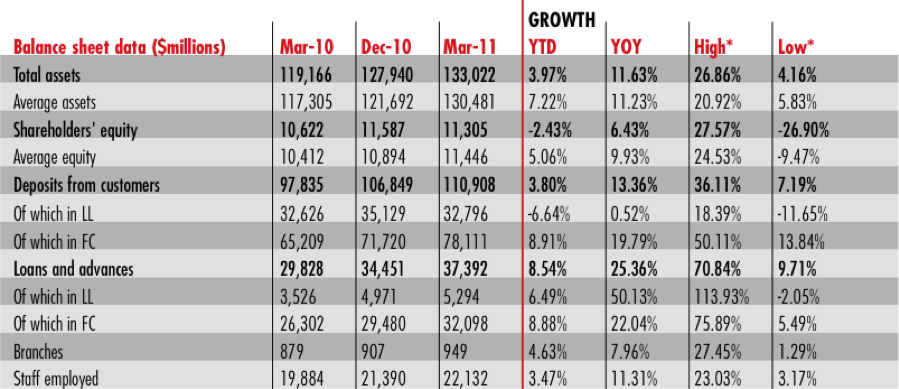
Lebanese banks have shown resilient results amid the relatively tough operating environment that characterized the first quarter of 2011. The ‘Alpha Report’ — a detailed performance synopsis of the top 12 Lebanese banks, issued by Bankdata Financial Services — showed that total assets grew by almost 4 percent over the quarter and 11.6 percent year-on-year (YoY). In parallel, customer deposits grew 3.8 percent over the quarter and 13.4 percent YoY, representing a sustained healthy performance although at a lower pace than had been registered over the past couple of years. Evidently, given the market pressures at the beginning of the year, the rise was almost fully accounted for by foreign currency components.

The most significant development of the quarter rests in the 8.5 percent growth in loans over the quarter and 25.4 percent YoY. This bears witness to the continuing lending activity of Lebanese banks benefiting from strong liquidity levels, in addition to the success of the central bank’s initiatives encouraging lending in Lebanese lira (LL). The latter grew twice as much YoY as loans in foreign currencies, at 50.1 percent and 22 percent respectively. Consequently, loans to deposits rose to a record high of 33.7 percent. Loans to deposits in LL continued their ascending path to reach 16.1 percent in March 2011, while loans to deposits in foreign currencies registered 41.1 percent.

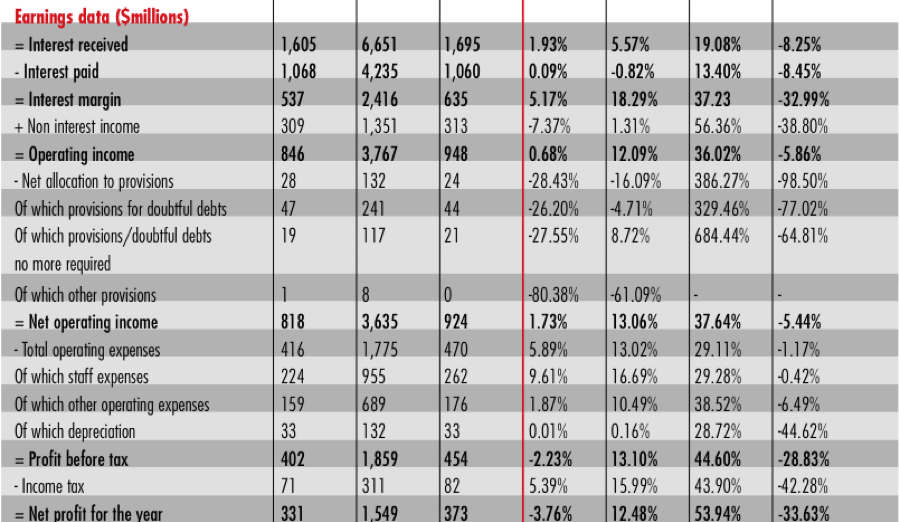
The rise in bank lending contributed to the improvement of bank spreads by 12 basis points YoY, despite a slight drop of 4 basis points compared to year-end 2010. In fact, banks’ interest margin reported a rise of 18.3 percent YoY driven by both volume and price effects. In parallel, net allocations to provisions decreased by 16.1 percent YoY. The outcome was a sustained improvement in banks’ net operating income (13.1 percent YoY). The mild growth in non-interest income (1.3 percent) reflects the slowing economic conditions, as non-interest income is a reflection of aggregate spending in the economy.

Alpha banks pursued their firm cost control policies in the first quarter, restricting the rise in total operating expenses to 13 percent YoY and aiming at flat growth in this item in full-year 2011. Meanwhile, cost to income rose to 49.6 percent, similar to the ratio of December 2009, and up from its record low of 47.1 percent at year-end 2010. This rise was triggered by 42 new branch openings over the quarter, and a corollary rise in the number of staff by 742 employees since the beginning of the year.

As a result, banks’ net profits grew by 12.5 percent YoY, in line with the growth registered in their activity base. Consequently, both net return on average assets and on average equity were stable YoY (1.14 percent and 12.41 percent respectively).

It is worth noting that the first of the year is generally a slower quarter and as such, the performance confirms the capacity of Lebanese banks to manage the adverse impact of decreasing foreign and local interest rates and a troubled political and economic context. The positive results of Lebanese banks despite tough operating conditions bears witness to a new episode of resilience of Lebanon’s banking sector.

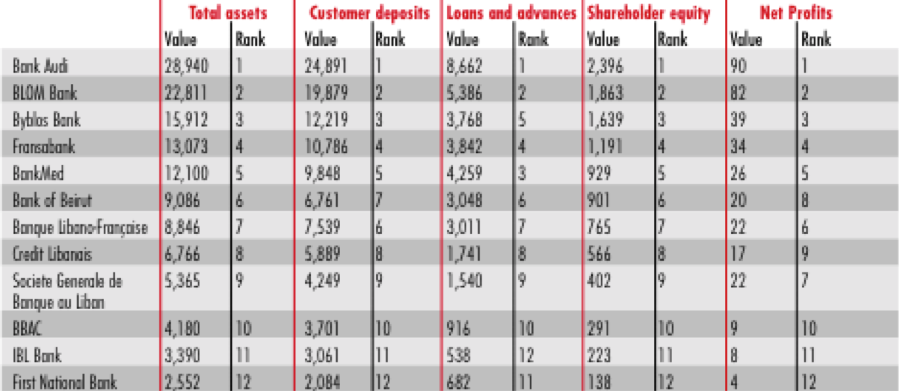
The ranking of alpha banks by assets, deposits, equity, loans and net profits in March 2011 showed that Bank Audi ranked first in all criteria followed by BLOM Bank, while Byblos Bank ranked third.

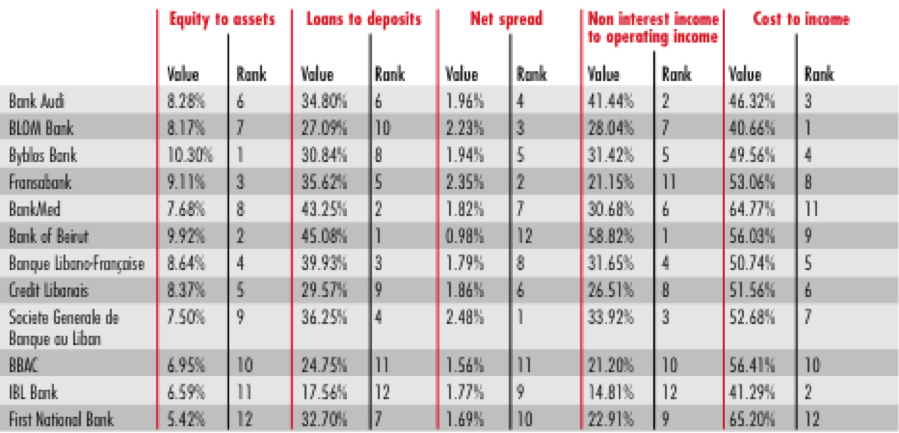
Finally, the ranking of alpha banks as per major financial ratios reveals that Byblos Bank ranked first in terms of capitalization (equity to assets ratio), while Bank of Beirut ranked first in terms of loans to deposits ratio and Société Générale de Banque au Liban (SGBL) ranked first in terms of net spread.

With respect to the ranking by non-interest income to operating income ratio, Bank of Beirut ranked first, whereas BLOM Bank ranked first in terms of efficiency (cost to income ratio). The following pages show the ranking of the 12 alpha banks according to major financial aggregates and financial ratios as of March 2011.

Consolidated balance sheet of Alpha group

*Refers to the superlative performing banks from within the group

Alpha banks ranking by aggregates as of March 2011 ($millions)*

*The Alpha group of 13 banks with deposits above $2 billion was recently reduced to 12 banks further to the upcoming merger/acquisition of Lebanese Canadian Bank by Société Générale de Banque au Liban (SGBL).

June 4, 2011 0 comments
0 FacebookTwitterPinterestEmail
Banking BuoyancySpecial Report

Saving the economy Selectively

by Executive Editors June 4, 2011
written by Executive Editors

Since the end of the civil war, Lebanon has developed a relationship between its economy and banking sector that resembles an old beat-up truck carrying a heavy load on a road to nowhere. The banks keep the truck (in this case the economy) running with the money they pump into the gas tank. In return, the driver (the government) agrees to take on a heavier load of debt as he drives the economy aimlessly toward a destination of which even he is not really sure. Whenever the truck slows down everyone gets worried that it has finally given out and the price of gas to keep it going will be too high for the driver to pay. When that happens the mechanic, in this case the central bank, comes along and makes an arrangement with the government and with the banks so that the fuel can be afforded. So far the arrangement has kept the truck running. But the further the truck travels, the more beaten-up it becomes, and the less it delivers to its owner, the people.

“The system is not creating jobs,” says Jad Chaaban, acting president of the Lebanese Economics Association (LEA) and assistant professor of economics at the American University of Beirut, in relating the banking sector’s contribution to GDP. “Its creating consumption but this is not sustainable because there are no jobs and the incomes to finance it. It’s just creating a debt cycle.”

An economy of consumers

At the end of the first quarter, Lebanon’s commercial banks held $30.9 billion in loans to the private sector and $28.2 billion in loans to the government, according to Banque du Liban, Lebanon’s central bank.

Since gross domestic product is comprised of several components, it can be calculated either by looking at expenditure (the sum of consumption, investment, government spending and net trade) or various income approaches. But because Lebanon’s lack of accurate or timely GDP statistics on many of the elements needed to compute output using the income approach is useless as a basis for analysis. The only way to make an assessment of how banks contribute to the economy is to consider how the money they pour into the country affects the elements of the national accounts — the numbers that come together to make up national output or GDP — using the expenditure approach.

Lebanon calculates national output by adding consumption, gross fixed capital and changes in inventory (in other words gross net investment), and exports, then subtracts imports from that figure. Looking at the last available national accounts from 2009, consumption accounts for $32.45 billion, equal to 92 percent of total GDP at nominal prices that year. Gross net investment, by comparison, totaled $11.98 billion, equivalent to just 34 percent of nominal GDP.

Effectively, that means Lebanon’s economy is heavily dependent on how much it can consume.

Consumption requires income, which comes primarily from wages, as well as remittances, which came in at $8.2 billion last year, according to the World Bank.

Official employment figures are scant and widely believed to be inaccurate; figures on wages are pretty much non-existent, but one does need a job to have a wage. In this regard the banks do not contribute as much as is popularly thought; the Association of Banks in Lebanon puts the number of employees in the banking sector at 27,268 in 2009, the latest figure available. Total wages and allowances during that year came to $732 million, or just 2 percent of nominal GDP during the year.  Indirectly, however the banks’ private sector loan portfolio supports different sectors that spur some consumption and investment.

“We play a major role. Lending for the economy is like blood for life,” says Freddie Baz, chief financial officer and group strategy director at Bank Audi.

The latest available figures from the central bank for how loans are split up in the financial sector date to the end of 2010 and were released in May; total loans to the private sector from the financial sector were $38.7 billion, up from $31.56 billion a year earlier. Of that figure, 77.68 percent of the total number of borrowers had taken out individual loans.

The LEA’s Chaaban explains that the predisposition toward consumption is a matter of a glass being “half full or empty” — Lebanon needs consumer spending to spur confidence but at the same time the banks have become “almost partners in setting up fiscal policy,” and have an interest in seeing consumption in the economy maintained. According to Baz and other bankers Executive has spoken with, loans go to the economy according to its structure. At present, the economy is not just heavily tilted toward consumption but also consumption of imports as well as goods and services produced by specific sectors.

“[Banks] play a major role. Lending for the economy is like blood for life”

You are what you fund

Economies are defined by their primary, secondary or tertiary activities. Primary activities are those that produce raw materials and basic foods whereas secondary materials use the former to produce finished products. These first two activities are commonly agreed to be characteristics of classical productive sectors. Tertiary activities are those associated with the services sector and in developed economies account for the overwhelming majority of jobs. 

According to the 2009 national account, the proportion of loans given to what economists label as “productive sectors” is scant at best. Agriculture and livestock made up 4.8 percent of output ($1.7 billion at nominal prices) that year, constituting a 6.9 percent real contraction, while industry made up only 6.4 percent of output ($2.6 billion at nominal prices), also falling 4.2 percent in real terms. The only secondary productive sector that saw an increase in output was construction, making up 13 percent of output ($4.7 billion at nominal prices) constituting a real expansion of value-added by 10 percent. 

Assuming that the economy is relatively similar a year later, the first discrepancy with regard to the allocation of loans to sectors according to their output is obviously the loans to the government to finance the public debt, which currently stands at more than 130 percent of GDP. Government expenditure constituted 9 percent of output in 2009 ($3.16 billion at nominal prices), an expansion of 8.5 percent on the year previous.

More is not spent on much-needed public services and infrastructure for several reasons, including the government’s inability to pass a budget for the past six years, the large fiscal burden for civil service employee salaries, and predominately because the government has to pay its interest on the public debt, which is majority-held by the same local banks that dole out the loans.

One also notices that loans to construction constitute 16 percent of total credits to the economy ($6.3 billion), which is roughly the same as output. If one considers all the elements of the real estate industry together (construction, real estate rents and housing loans) the figure rises to 35 percent of total loans ($13.6 billion). This, however, could be an oversimplification of the sectoral risk the real estate sector poses — especially given the recent decline in retail prices — because a housing loan is backed by a real asset, requires a significant down payment by the buyer and the amount of refinancing on retail property is ostensibly nothing compared to that seen in US when the housing crisis triggered the global financial crisis in 2008.

“The process of building is development but the process of selling is different,” says Marwan Iskandar, economist and chairman of Banque de Crédit National.

Even so, walk by any construction site in Lebanon and one will notice that the majority of workers are not Lebanese. Stroll into any real estate broker’s office, however, and the opposite is true. Since most construction workers are paid off the books and breakdown figures for real estate jobs are not published, it is difficult to gauge how many jobs are being created for locals and what the net income effect on the economy is for the sector that can go to construction.

The only indicator is the national accounts, which showed the output of the construction services sector to be some $398 million at nominal prices in 2009, below 10 percent of nominal construction output for that year. Ergo, the net effect on job creation, and thus local wages and the economy, is presumably much less than in a country that employs local labor in that sector.

Those who are quick to accuse the banking sector of not creating jobs often point to their contribution to the tertiary sector. “Does a large farm produce as much as two expert doctors?” responds Iskandar rhetorically to the idea. “Jobs, maybe more so. But if you are concerned about the national income you have to weigh these things. Is it really a good thing to employ many people who produce a little, or a few people who produce a lot and then allow you to invest because their savings go into facilitates? This is debatable.”

“You don’t decide if its sustainable and neither do I. History will always tell if it is sustainable or not”

Make up the breakdown

But even so, here the loan breakdown formula propounded by banks doesn’t make much sense: total contribution of market services and trade at nominal prices in 2009 was $20.6 billion constituting 59 percent of the total. If transport and communications are added to this figure it becomes $23.3 billion or 66 percent of the economy. Loans to “trade and services” at the end of 2010 came to almost $14 billion, or 36 percent of the total. Adding financial intermediation and “others” — which includes health, social work, defense, public administration and regional organizations — that figure increases to just 48 percent.

The difference between the bankers’ formula relating to loans and output can be explained by the loans that go to individuals. In total at the end of last year $9.1 billion went to individual loans (including housing loans at $4.5 billion) making up some 24 percent of the total. This allows for further consumption that is not predicated on actual labor and output. “The banks also give interest on deposits, mostly to consumers, which also inflates the GDP,” says Chaaban. 

How productive that money is for the economy also depends on how it is spent. “If you buy cars and homes then, yes, you are contributing. But if one takes out a personal loan just to have a good time then not really,” says Nassib Ghobril, head of economic research and analysis at Byblos Bank. 

What is certain, however, is that the loan portfolio of banks is heavily skewed toward consumption. This inherently creates a problem for output because when import prices rise — as is the case presently because of rising commodity prices — GDP suffers as people’s ability to consume decreases but their dues to the banks stay the same.

Moving away from such a model will require concerted public policy and regulation to steer the economy toward a model that can produce locally and shield the economy from external shocks.

“Today in Lebanon, increasing the job component of growth can only be possible by shifting our growth model from internal demand as a major driver to external demand,” says Baz. “If the Lebanese economy is a tertiary activities economy and a services industry economy, it is not up to us to make miracles and shift it overnight to a manufacturing economy… It’s like a tanker — when you want to change the direction it takes time.” 

How long it will take, if that is even the intention of Lebanon’s so-called economic policy makers, is as unclear as the still non-existent government’s policy of job creation. In the meantime, the banks will likely continue to contribute to the economy in the same way they have since the end of the civil war. As for the Lebanese, it also seems they will have to wait and see if the system is maintained or, perhaps at their own accord, it eventually crumbles.

“You don’t decide if its sustainable and neither do I,” says Baz. “History will always tell if it is sustainable or not.”

June 4, 2011 0 comments
0 FacebookTwitterPinterestEmail
Banking & Finance

For your information

by Executive Editors June 4, 2011
written by Executive Editors

Government pockets Dubai Bank

The Dubai government last month took full control of Dubai Bank, an Islamic lender that was 70 percent owned by the emirate’s Dubai Holding and 30 percent owned by real estate developer Emaar Properties. The bank’s latest annual report showed a loss of $79 million in 2009 after nearly tripling its impairment losses to $148 million from exposure to Dubai Holding and the real estate sector.  “The intervention is designed to ensure that Dubai Bank’s business continues uninterrupted while options for the bank’s future, whether to be run on a stand-alone basis or potentially merged with another bank in which the government has ownership, are being assessed,” a Dubai government statement said. The government’s plans for the bank, which include a capital injection that will effectively dilute both shareholders, dispelled fears among investors nervous about a potential bank failure and sent positive shockwaves across markets. According to industry sources, the bank may need “a couple hundreds of millions of dollars” to clean up the balance sheet before potentially being sold to a large bank with government stakes, with Emirates NBD pitted as a leading potential buyer.

Palestine’s first corporate bond

Last month the investment firm Palestinian Development and Investment Company (PADICO) became the first Palestinian company to successfully raise capital through the issuance of corporate bonds. The five-year bonds, estimated at $70 million, have already been oversubscribed after receiving orders from investors amounting to $90 million. The bonds will have an annual fixed interest rate of 5 percent for the first 30 months, and a variable interest linked to the United States dollar London Interbank Offered Rate afterwards, within a range of 5 to 6.5 percent. The proceeds of the transaction will be used for a new $300 million power plant, as well as for a tourism center near Jericho in the West Bank, where PADICO operates and is currently headquartered. According to statements by Palestinian Prime Minister Salam Fayyad, the Palestinian Authority (PA) plans to sell bonds itself, after encouraging private companies to do so. The PA might be issuing bonds sooner than expected, as Israel suspended its transfer of tax revenues to the authority in early May, following the reconciliation agreement between the Palestinian factions Fatah and Hamas.

Lebanon’s golden reserves

Lebanon ranks 18th worldwide and 2nd in the Middle East and North Africa region in terms of the value of its gold reserves, according to the latest report published by the World Gold Council (WGC). Lebanon’s total gold reserves stood at 286.8 tons, some 29 percent of the central bank’s total reserves. The country came in second in the MENA region after Saudi Arabia, which ranked 16th worldwide, with gold reserves of 322.9 tons, though accounting for only 3 percent of its total reserves. Worldwide, the United States topped the list with official gold holdings of 8,133 tons, followed by Germany, the International Monetary Fund, Italy and France. The report mentioned that gold sustained its upturn during the first quarter of 2011 but at a slower pace of 2.4 percent quarterly rise, compared to an average quarterly increase of 6.2 percent over the past two years. According to the WGC’s report, the demand for gold and silver has been fueled by investors’ concerns about inflation in the US after the Federal Reserve’s decision to maintain low interest rate levels, as well as the high inflationary environment in China and India, political turmoil in the Middle East and the effects of Japan’s earthquake.

Lebanese bankers talk Basel III

In a recent conference at the Ecole Superieure des Affaires (ESA), titled “Basel III — Immunity requirements”, Riad Salameh, governor of Banque du Liban, Lebanon’s central bank, stated that the Lebanese banking sector is prepared to implement the Basel III pillars and is adopting the appropriate measures. The latest upgrades to the Basel accords include measures to limit counter-party credit risk, to tighten definitions of common equity and to introduce a leverage ratio, in an attempt to restore investors’ confidence in the global financial sector, Salameh said. Talking about the banking sector’s solvency ratio — or its ability to meet long-term obligation — which currently stands at around 7 percent, Salameh stressed the need to raise the ratio to about 10 percent within the next four years to meet Basel III standards. He also said that the central bank intends to increase the banking sector’s provisioning ratio to 2 percent, urging Lebanese banks to limit their dividend distribution to 25 percent of their net profits. Meanwhile, Joseph Torbey, president of the Association of Banks in Lebanon, said that the importance of the latest Basel accords lies in their ability to shield banks from shocks and to lead to further coordination between Lebanon’s banking sector and surveillance authorities.

US, EU freeze Assad’s assets

Following an intense crackdown on anti-government protesters in Syria, the Obama administration froze the assets of Syrian President Bashar al-Assad and six other officials, including Vice President Faruq al-Shara, Prime Minister Adel Safar, Interior Minister Mohamad Ibrahim al-Shaar and Defense Minister Ali Habib Mahmud. In a statement made on May 18, the Treasury Department announced that it would freeze any property, or interests in property, in the United States which belongs to Assad and the other targeted Syrian officials, while also strongly condemning the Syrian government’s use of violence against its people. On May 23, the European Union followed suit, agreeing to impose sanctions on Assad and approximately “a dozen other senior members of the government”, according to British daily the Guardian. Meanwhile, Switzerland also announced on May 19 sanctions on 13 Syrian officials, including implementing a travel ban and freezing any assets the officials have in Swiss banks. Switzerland had already blocked assets of Libya’s Muammar al-Qadhafi and his entourage, as well as those of ousted Tunisian and Egyptian leaders.

Raw ratings for Tunisia’s largest bank

Capital Intelligence (CI), an international credit agency, assigned a negative outlook to the financial strength and foreign currency ratings of Société Tunisienne de Banque (STB), Tunisia’s largest bank with $4.8 billion in assets, citing political uncertainty and the bank’s poor asset quality and insufficient capital. The credit agency said that profitability has shown some signs of improvement at the majority government-owned bank, but risk of increased provisioning charges continues to impact net profit. “STB’s profitability, as is the case with the Tunisian banking sector, could come under pressure in 2011 on the back of possible asset quality deterioration and limited asset expansion. STB’s position may be more vulnerable due to its market position and government ownership,” said CI.

Aid rolls in for Egypt

Promises of financial assistance poured in for Egypt in May with Saudi Arabia pledging $4 billion in grants, long-term loans, and deposits, Egypt’s MENA news agency quoted Field Marshal Hussein Tantawi, the country’s current ruler as saying. In a televised speech, US president Barrack Obama also pledged $1 billion in debt relief to support Egypt’s transition to democracy, and guaranteed another $1 billion loan for new projects and job creation. Egypt was quick to accept the loan guarantee and said it plans to raise the money through a 5-year Eurobond offering this year. In addition, the country is nearing an agreement with the World Bank for a $2.2 billion soft loan and has requested up to $12 billion from the International Monetary Fund to support the country’s ambitious $38 billion development plan.

June 4, 2011 0 comments
0 FacebookTwitterPinterestEmail
Special Feature

From the farm to the arm

by Adam Pletts June 4, 2011
written by Adam Pletts

As the needle pierces Reza Etesamifard’s skin in central London, the heroin entering his blood stream is on the final stage of a journey that most likely originated in Afghanistan. The drug in his veins has traveled more than 6,000 kilometers across battlefields, mountain ranges, deserts, rivers and seas, changing hands dozens of times. Along the way it has crossed at least 10 borders, eluding customs and law enforcement agencies at every stage.

Only moments after Reza removes the syringe, the heroin starts to kick in and he begins to scratch his face irritably, a common symptom among heroin users. As chance would have it, Reza is a refugee from Iran, one of the many countries that the heroin he uses most likely passed through en route to Britain. Unlike the vast majority of the United Kingdom’s users, his path to addiction began by smoking opium when still in Iran.

Reza would be the first to attest to how addictive heroin is and confesses that he will do anything to get his next fix and avoid the withdrawal pains, which he describes as being like “ants crawling around your skeleton.”

Although the 10 British pounds [$16.20] that he pays for 0.2 grams of heroin on a daily basis may not seem like much, he is just one of more than 11 million heroin addicts across the world whose combined payments make the heroin trade a $55 billion industry. Though highly profitable to some, the trade is lethal to others, with the United Nations Office on Drugs and Crime (UNODC) estimating that as many as 100,000 people die from the use of Afghan opiates every year. Some one million people worldwide are involved in heroin trafficking alone, while as many as three million Afghans play some part in the cultivation of poppy plants that yield the raw opium from which heroin is made.

One of those poppy farmers is Wali Jon, who supplements subsistence farming with cash from poppy crops in order to help support his wife and four children. Wali is from south Helmand Province, which alone produces half of Afghanistan’s opium. If prices are similar to last year he expects to make about $250 from two acres of poppy (8,093 square meters), which he hopes will yield four kilograms (kg) of opium. Like many other farmers in the region he is fearful that the authorities will destroy his crop; when asked what he would do if they did, he to Executive, “If somebody takes away your water on a hot day, what do you do?”

Reza and Wali are both tied to opiates — one through addiction and the other through his livelihood — but the similarities end there. Reza spends roughly as much on heroin every fortnight as Wali hopes to make from his whole crop in a year, despite the fact that Wali will produce enough opium in that year to supply Reza with heroin for eight years (given that it takes seven kg of opium to produce one kg of heroin). In short, Reza pays for each hit approximately 200 times what Wali was paid to produce its raw ingredients (based on last year’s prices).

As with any commodity, prices go up and down at both ends but no matter how high they rise, the Afghan farmers only ever see a tiny proportion of the whole profit.

Reza pays for each hit approximately 200 times what Wali was paid to produce its raw ingredients

The many roads from Afghanistan

So how does Wali’s opium reach Reza as heroin? Who actually makes the profits and how did Afghanistan become the world’s leading heroin producer? Although the heroin trade is illegal, the answers lie in conventional economics that link supply to demand and more importantly, reward to risk.

Unlike most other illegal recreational drugs, which are by and large produced and consumed within the same region, the vast majority of opium production is restricted to only three areas on Earth: Afghanistan, South East Asia (mainly Myanmar) and Latin America (Mexico and Columbia). Since 2005, Afghanistan has controlled some 90 percent of the global total, at about 8,000 tons of raw opium per-year. It also accounts for 85 percent of the world’s heroin, most of which is processed here or in neighboring Pakistan and Iran.

The net result of this concentration of production is a worldwide narcotics trafficking network emanating from Afghanistan, the likes of which can only be rivaled, in both the reach and value, by Colombian cocaine trafficking. Afghan production single-handedly supplies heroin to Western Europe and Russia, by far the world’s two biggest markets, which together make up 47 percent of global heroin demand, and although Myanmar and Latin America are the major suppliers for China and the United States, respectively, small proportions of Afghan heroin also feed these markets.

By the very nature of illicit drug trafficking there is no way of saying with certainty how heroin has been smuggled from one place to another. The routes are fluid and change frequently, with traffickers taking advantage of loopholes as they appear. There are, however, established flows that have been identified by law enforcement agencies and bodies such as the UNODC and the European Monitoring Center for Drugs and Drug Assistance (EMCDDA).

Essentially heroin and opium take one of three routes out of Afghanistan; either the “Northern Route” through central Asia and into Russia, the “Southern Route” through Pakistan, or the “Balkan Route” via Iran and then onwards through Turkey and the Balkans to Western Europe. Much of the drugs that transit through Pakistan subsequently also pass onto the Balkan Route.

The UNODC estimates that some 25 percent of all Afghan heroin (95 tons) leaves via the Northern Route, 40 percent (150 tons) via Pakistan and around 35 percent (130 tons) via Iran. From the combined Iranian and Pakistani routes around 37 percent of Afghanistan’s total heroin production continues onto Europe via the Balkan Route (see map page 37).

The vast majority of the 95 tons of heroin that leaves via the Northern Route is consumed within Russia, while the Southern Route’s supply satisfies Pakistan’s demand (19 tons) and that of other destinations, including Iran (35 tons), South East Asia (25 tons), Africa (20 tons) and the United Arab Emirates (11 tons), the

latter of which is almost exclusively for onward shipment, mostly to China and South Africa. Of the Balkan Route heroin, after accounting for seizures and consumption in the countries en route, some 88 tons make it to the high-value sales in Europe, where four countries alone are thought to account for more than half the market, namely the UK (19 tons), Italy (18 tons), France (10 tons) and Germany (7 tons).

The Balkan Route carries the largest volume the greatest distance and to the highest value market. Heroin was smuggled along the Balkan Route well before Afghanistan became the chief producer, during the period when it originated from Pakistan and Burma.

Laurent Lamiel, an analyst at the EMCDDA, described the route as “the illegal version of the silk road.”

“Heroin was travelling on [the Balkan Route] even when the Iron Curtain was in place, which shows how strong this route is and how developed, protected and historical the networks are,” he said.

Afghan production single-handedly supplies heroin to Western Europe and Russia, by far the world’s two biggest markets

1. In the backstreets of west Kabul, two addicts ‘chase the dragon’ under a scarf used to trap heroin vapors

2. In order to get their next hit, many of Kabul’s addicts make what little they can by begging

3. An impromptu musical performance by one of the patients at a residential heroin

rehabilitation clinic in Kabul

4. A patient in withdrawal at a residential heroin rehabilitation clinic in Kabul

5. Members of the Afghan National Army in Khost province, eastern Afghanistan, who made no secret of the fact they were high, probably having smoked hashish. Opium and hashish use are a significant problem within the Afghan security forces, compounding the fight against illegal drugs

Control of the routes

“The thing that is very important to understand is that the big players on the Balkan Route are Turkish criminals and traffickers,” Lamiel explained. “[They] are able to concentrate a large amount of heroin produced in Afghanistan into their hands and act as wholesalers to the British market as well as other European markets.” The UK’s Serious Organized Crime Agency (SOCA) backs this assertion, believing that some 140 Turkish networks control the heroin supply to Europe.

That Turkish criminal groups have taken dominance over other criminal organizations along the route is hardly surprising, not only because the route traverses some 1,600 kilometers of Turkish territory but also because Turkey controls the Bosphorus Straits, the most direct access point to Europe from South Asia without having to pass north of the Caspian and Black Seas. Turkey also shares a long land border with Iran, where heroin can be bought at prices similar to those in Afghanistan, and there are extended communities of Turks in London and elsewhere in Europe, particularly Germany, who can facilitate connections and legitimize travel. In a similar way, Pakistani groups that smuggle direct from Pakistan to the UK, by air or sea, exploit their connections within the UK and their close proximity to the Afghan market, cutting out middlemen to maximize profits on a route where they can buy at around $3,000 per kg and sell at $30,000 per kg; that route only accounts for small volumes of traffic, however, at most some five tons between ships and flights from Pakistan to the UK or the Netherlands.

Although Turkish and Pakistani groups largely control the Balkan and direct air and sea routes, respectively, individuals and groups from many other countries are also involved, as the arrest figures for heroin traffickers attest. In the Netherlands, for example, which could be considered the end point of the Balkan Route and is a key hub for onwards shipment to various European countries including the UK, Dutch citizens account for 20 percent of arrests, followed by Nigerians (19 percent), Turkish (16 percent), British (5 percent), Brazilians (5 percent) and Americans (5 percent). 

Similarly, at several points along the route ethnic groups that straddle national borders, or have large diaspora populations, facilitate trafficking, examples being Kurds along the Iran-Turkey border, Aziris along the Iran-Azerbaijan border across which a sub-route branches north from Iran into Russia or Europe, and Albanians who are particularly visible in the trade in Greece, Italy and Switzerland.

Afghanistan has a near monopoly on global opium and heroin production yet makes far from the lion’s share of revenues

The economics of the trade

Even though Afghanistan has a near monopoly on global opium and heroin production, the economics of the trade conspire such that the country makes far from the lion’s share of revenues. At retail prices the total world opiate value is approximately $65 billion — $55 billion for heroin and $10 billion for opium. The market with the highest value, Western Europe, accounts for approximately $20 billion of the global total, followed by the Russian federation ($13 billion), China ($9 billion) and the US ($8 billion). At best Afghanistan makes a small fraction of the profits. In 2009 the combined total paid to Afghan farmers was an estimated $400 million. When opium trafficking and opium processing into heroin are factored in, the value of the opium/heroin industry to the Afghan economy was some $2.4 billion, which is roughly 3.5 percent of the global market value. Antonio Maria Costa, the executive director of the UNODC, quoted Afghan President Hamid Karzai as telling him: “We take 3 percent of the revenue and 100 percent of the blame.”

Nonetheless, to a poor country like Afghanistan this revenue is still substantial. To put it in context, recent projections for Afghan government expenditure this year estimate it at $4.5 billion, of which the government can only raise $1.9 billion itself, the remainder being provided by international donors. Afghan heroin revenues are one-seventh the size of the nation’s licit gross domestic product, which according to the International Monetary Fund was $16.6 billion in 2010, although even this figure is inflated by international donor money, with an estimated $5 billion in annual aid fuelling the economy.

In general, the further away from Afghanistan, the higher the potential profits from heroin. Along the Balkan route, the wholesale heroin price varies from just $2,400 per kg in Afghanistan, to $11,000 per kg at the approximate mid-point in Turkey, to $30,000 per kg in the UK (see map page 37). Part of the explanation for this is that, in broad terms, the route travels up two gradients: firstly from less developed to more developed countries, where higher prices can be charged, and secondly from an area of abundance to one of relative scarcity. There is also the fact that the further the heroin travels, the more hands it passes through and the more costs are incurred, which must be recouped in the eventual sale price.

“Although the UK is the highest value market in Europe, with some of the highest street prices for heroin anywhere in the world, there is more money flowing into Afghanistan from opiates consumed in Iran than there is from the UK,” explained a SOCA financial specialist who requested only to be identified as ‘Richard’ due to the sensitive nature of his work. To understand this, one must break down the price and look at where the revenues from street sales go.

At approximately $30,000 per kg the UK’s wholesale heroin price is below the European average of $36,000 per kg. This perhaps reflects the fact that, barring Russia, the UK has the single highest consumption in Europe and the pull of the market pushes the price down even after factoring in the risk to dealers, which is considerable given that the UK makes among the highest number of seizures in Europe. However, the street value of about $80 per gram is above the European weighted average of $77 per gram, so that UK dealers are in a privileged position of buying at lower-than-average prices and selling at above-average prices.

The majority of the street value stays in the UK, with criminals making $50,000 for every kg of heroin sales, albeit most of these sales at street level will be in very small quantities, typically of 0.2 grams. Most of the wholesale import price of the heroin has to be paid down the chain of traffickers to pay costs incurred on the way, with any significant profits being retained well before Afghanistan by the controlling criminal groups.

This model is widely applicable to the high-value European markets, meaning the largest revenues from heroin sales are retained within the countries of final sale, even if they may be distributed between large numbers of dealers. Richard makes the point that, “When you go back to the cultivators and the processors in Afghanistan the price has nothing to do with the destination market, so they’re getting as much for each jirib [approximately 2,000 square meters] of land that they’ve cultivated whether the opium is smoked in Pakistan or the UK.”

Like so many things in life it’s a question of who you know.

“In reality if [Afghan traders] could get [heroin] to the UK themselves they would,” Richard said. “They’re entrepreneurs to a degree, but they can only sell it to the people they know who will buy it from them and they tend to be across the first border in Iran or Pakistan.”

The UK is the highest value market in Europe, with some of the highest street prices for heroin anywhere in the world

Mechanisms of trade in Afghanistan

It is widely understood that the majority of Afghan opium farmers make very modest profits and are simply trying to make a living. In fact, many are stuck in an economic trap not dissimilar to that of coffee plantation laborers in various parts of the world who, after working hard in the fields, only receive a fraction of the profits that up-market Western coffee shops reap. The difference is that poppy crops are illegal and there will likely never be a “fair heroin trade” campaign. To this end the UNODC, together with most organizations, do not generally consider that the line of criminality has been crossed until the opium or heroin reaches the hands of substantial traders. Nonetheless, Afghan farmers stand the risk of having their crops eradicated by the Afghan National Security Forces (ANSF) and are often suspected of having links with the Taliban who, although not necessarily in control of the opium trade, do facilitate and profit from it.

Often Afghan farmers have turned to opium as a last resort in areas where the government provides very few services or even basic security. In such places, the Taliban or other anti-government elements can be an attractive source of support, especially in relation to poppy cultivation. At a grass roots level they provide poppy seeds and small loans to farmers to prepare for the harvest, as well as organizing collection of the opium. It’s in the Taliban’s interest to do so because the farmers in turn pay a tax on their opium, known as ushr, direct to the Taliban, which is usually levied at 10 percent.

Further down the chain, the Taliban are more closely involved with traders and lab processors, who pay for protection, facilitation and, where necessary, logistical assistance in heroin processing, storage and packaging. They also charge a zakat tax on traders, generally set at 2.5 percent. Wherever they can, the Taliban levy these taxes on all goods, but with illegal crops they generally take payment in kind, knowing they can get higher prices beyond Afghanistan’s borders. However, contrary to what is often portrayed, the model is more one of the Taliban taking advantage of pre-existing trade than their having direct control of it.

The Taliban are known to apply pressure on farmers to grow opium but their decisions to do so are affected by a broad range of factors. Although it is true that opium usually fetches higher prices than alternative cash crops, other practical considerations must be taken into account. In the first place, with other crops farmers would have to get their produce to market by their own means, which can be difficult given the state of infrastructure in Helmand, or indeed most locations in Afghanistan. Secondly, raw opium acts as a form of currency, which is particularly important in under-developed rural areas where no banking facilities exist.

Some sort of transferable savings are especially valued during times of war and uncertainty, as Jean Luc Lemahieu, the UNODC’s representative in Afghanistan, explained: “Many people have been displaced, but if they are able to take their raw opium with them and their opium seeds, they have an income which will stay good for 10 years. Try to do the same with pomegranates, which only keep well for three weeks, after which they’re rotten in your pockets.”

To give some idea of the increase in earnings that opium can bring to farmers, according to the UNODC the average income of non-opium growing farmers in 2006 was $2,370, while that of opium growing farmers was $5,055. That said, the reality on the ground in Helmand and other poppy producing locations changes radically from one place to another. According to Richard of SOCA, “It’s very much a moveable feast. Village by village, prices change [and] intentions change, as does the role of authority and whether the local tribal leader or key person is sympathetic to the government or the Taliban.”

Raw opium acts as a form of currency in under-developed rural areas where no banking facilities exist

Price fluctuations and their causes

This year the average raw opium price in Afghanistan is estimated to be much higher than last — some $280 per kg compared to just $80 per kg in 2010. A very small portion of this rise can be attributed to successful eradication, which reduces supply and hence pushes up prices. However, there are two much more significant factors in the price increase: the first being that widespread disease triggered a blight in the crops last year and tightened supply, second and more importantly, is speculation.

“The military operations mean that a lot of farmers are very uncertain about their future prospects and so they start to stockpile opium because in times of war it’s one of the best commodities to have,” said Lemahieu, pointing out the similarities to the classic economic model of the ‘Dutch tulips’.

Essentially the opium farmers are asking the same questions that any Afghan observer asks: “Is the troop surge going to work?” The farmer, however, must think beyond this to ask: “If the surge does work, will I be able to plant opium in the future and should I stockpile some of what I have?”

As Lemahieu notes, “It’s Wall Street all over again — except in Helmand and Kandahar — and these are not high paid bonuses for bank executives, these are poor farmers thinking ahead and saying ‘in this uncertainty, I’m not selling. I want to sit on it and see what happens to the price’.” The recent price rises are substantial enough so as to have provided many farmers who had previously abandoned poppy crops with the extra incentive to renew cultivation. The UNODC estimates that of the 20 provinces (from a total of 34) in Afghanistan that were for all intents and

purposes ‘opium free’ by 2010, thanks to eradication efforts, at least four will see renewed cultivation in 2011.

Generally speaking, as the volume of opium production has increased over the years, from just 1,000 tons in 1980 to a peak of 9,000 tons in 2007, prices have decreased, but previous large price fluctuations at the supply side are not unheard of. Following the Taliban’s ban on opium cultivation in early 2001 prices rose from less than $50 per kg in July 2000 to nearly $700 per kg in August 2001. The ban was strictly enforced, making it probably the quickest and most effective, albeit short lived, drugs eradication program in history. The Taliban partly put the ban in place to appease Western governments in the hope that they would recognize the regime, not then aware that the move would be rendered redundant by the events of September 2001, which led to Western military intervention, the removal of the Taliban regime and a resumption of opium production.

Although the supply side prices may be prone to fluctuations given shortages in production, this is no different from any other commodity. The farm gate price of opium, however, is so low compared to the eventual market prices of the heroin that these fluctuations have negligible effect on heroin markets in distant locations, where the bulk of the price is driven by high risks to the dealers, combined with covering the costs of transport. Furthermore, the local mid-level traders take up some of the slack in the market, as Lemahieu explained: “[They] act as a price cushion in between the demand and the production so that some of their inflated profits from the past have gone down over the last months because they are paying for the extra cost on the production side while higher prices are not really reflected in the consumer side.”

Afghan production of opium has become so high that if it were all converted into heroin it would outstrip global demand three times over. From what has become such a strong and steady supply, European prices have gradually dropped, with the average heroin wholesale price falling from $100,000 per kg in 1990 to just $36,000 per kg in 2011. It suits the wholesale suppliers — in other words the larger organizing criminal groups — to keep the prices steady.

“They’re no different to other commodity brokers, which is essentially what they are, in terms of the ways they absorb price fluctuations and try to manipulate the market and the supply,” said Steve Coates, deputy director of SOCA.

Afghan production of opium has become so great that if it were all converted into heroin it would outstrip global demand three times over

Becoming the sultan of smack

It is only since the early 1990s that Afghanistan became the world’s dominant opium and heroin supplier (see figure page 36) and, effectively, the current war in Afghanistan has only consolidated its position. There had always been some opium production in Afghanistan but it wasn’t until the Soviet war through the 1980s that it became a major supplier. Previously, Pakistan had been the world leader in opium and heroin production, but as the Afghan mujahedin who were fighting the Russians began to use opium to fund their resistance, Afghanistan’s annual production started to increase.

As weapons were smuggled into Afghanistan, largely by Pakistan’s Inter Services Intelligence (ISI) and partly funded by the American Central Intelligence Agency (CIA), opium would be brought back and refined to heroin in Pakistan. In the early 1990s Pakistan clamped down on its production, virtually ending Pakistani poppy cultivation, but elements within the ISI continued to turn a blind eye to Afghan opium traders using the preexisting routes and processing infrastructure within Pakistan.

Following the Soviet withdrawal in 1989, a fierce civil war was fought between different Afghan factions, all of whom used opium revenues to some extent to fund their war effort. The Taliban, who had conquered all but the furthest northern reaches of Afghanistan by 2001, were no different in their use of opium as fuel for war, a fact that continues to this day.

What has changed is that opium production has roughly doubled since 2005 and has become increasingly concentrated in Afghanistan’s embattled southern areas, while it was not until the last decade that the majority of heroin began to be processed inside Afghanistan.

“If the government provided any services or alternatives, I wouldn’t grow poppy”

An end in sight

The extent to which the Taliban profit from the opium and heroin trade is often misunderstood. Of the $2.4 billion value of the opiates trade that is retained in Afghanistan, the UNODC estimates the Taliban’s total share would be around $125 million, with other less conservative estimates suggesting it to be as high as $400 million. Even the higher figure gives the Taliban only a 0.6 percent share of the total revenue generated from foreign sales of Afghan opiates. As a portion of Afghanistan’s share of the global spoils, it is only 17 percent. Nonetheless, in a country where entry-level police salaries are less than $100 per month, this allows the Taliban to compete with, and often out pay, state security forces’ salaries.

Successfully ending the opium trade would cut off a significant source of insurgent funding, but eradication is a double-edged sword that can sometimes act to alienate Afghan farmers, pushing them closer to the insurgents. In the past this has led US forces to back away from tackling the drugs problem, which they haven’t considered part of their main mission. Thanks to a change of policy in recent years, a slow decline in cultivation is beginning to take place.

“The real change [regarding opium] came about two years ago when the US military decided to go after the drugs, which they had not been doing for nine years,” said journalist and Afghanistan expert Ahmed Rashid. “If [former US Secretary of Defense Donald] Rumsfeld had not had that policy for so many years there wouldn’t have been such an awful situation.”

This year was the first that the US marines had a permanent presence in Marjah, previously one of the centers of the opium trade in Helmand. Although the farmers had been warned that eradication would go ahead many still planted poppy. As the harvest period approached, government tractors began to plow up the fields with marines providing security. Usually the harvest is the last quiet period before the Taliban’s yearly spring offensive begins, but this year in Marjah hostilities got off to an early start. No sooner had the tractors been sent into the fields than the drivers found themselves under fire from angry locals, some of whom had just crossed the line from farmer to insurgent. In a classic Catch-22, the eradication that is necessary to end the insurgency has also fueled it.

Until stability returns to Afghanistan it will continue supplying the world with the deadly by-product of its wars. It is estimated that there are more than 10,000 deaths per year from heroin overdoses in NATO countries, more than four times the total number of NATO troops that have been killed in Afghanistan since hostilities began in 2001. As Rashid sees it, “You cannot eradicate drugs until the war comes to an end. That’s the bottom line. When that happens, you can talk about a nationwide policy but you can’t really effectively tackle the problem until the war is over.”

The problem, however, is not simply to defeat the insurgents but to extend the government’s reach throughout Afghanistan. In many parts of Southern Helmand the first real evidence that the farmers had seen of any government action was the eradication of their precious poppy crops, before alternatives were put in place or any significant services provided. As Wali Jon, the poppy farmer, insists, “If the government provided any services or alternatives, I wouldn’t grow poppy.”

That certainly doesn’t seem like a reality in the near future and in the distant streets of London, Reza Etesamifard, has little concern that supply will dry up. As he strolls comfortably around his adopted city he points out the many locations where it’s easy to score heroin, from Soho back alleys to upper class suburbs. 

“In every part of London there are dealers; it’s an epidemic and nobody is dealing with it,” he said. “Plenty of users hold onto a job — its only the ones who have lost everything that you notice.”

Reza is frank about his addiction; he knows he’s lost everything. Although young, bright and energetic, he is homeless, penniless and without a friend he can trust, willingly confiding that the addicts he spends his time with would put heroin before their friendship, no matter the cost. The only thing forming any structure to his life is the acquisition of his next pain-staving, euphoria-delivering fix.

June 4, 2011 0 comments
0 FacebookTwitterPinterestEmail
Feature

A sad state of affairs

by Executive Editors June 4, 2011
written by Executive Editors

It’s a balmy September Friday evening in Damascus. Even at the tail end of the summer tourism season, visitors stream through the Old City souks. Bars, some only recently opened or newly renovated, are packed and crowds have gathered to enjoy weekly live music performances at parks across the city.

Fast-forward seven months and violence and unrest in the country has left Syria’s highly-touted tourism venues empty and the industry in tatters.

Having earned a place on the New York Times Top 10 destinations list in 2010, Syria had invested heavily in tourism promotion to bridge other domestic funding and investment shortfalls. Even in January, as unrest gripped regional neighbors Egypt and Tunisia, Syrian Tourism Minister Saadallah Agha al-Qalaa told reporters an additional 83 hotels would be built in 2011; the move was encouraged by optimistic reports from the ministry of a 40 percent rise in tourist numbers in 2010, from 6.09 million to 8.5 million, which the ministry said generated more than $8 billion in revenue, accounted for 12 percent of gross domestic product, and supplied nearly 800,000 jobs — some 11 percent of the total workforce. 

Sources told Executive last year of plans to improve the capacity of the Old City in preparation for an anticipated increase from 18,000 visitors to 30,000 each week — in other words as many visitors as there are residents living in the ancient walled city.

But by March, as protests spread across the country and the death toll at the hands of Syrian security forces grew, the picture looked ever more bleak. Tourists have become a rare sight, even in Damascus, which was still relatively unscathed as of the end of May, with embassies from Australia, United States, Canada, the United Kingdom and throughout Europe issuing travel advisories against all but essential travel to Syria.

While Syria’s tourism industry had been growing, the unrest will only compound pre-existing shortcomings it had already been struggling with; the World Economic Forum Travel and Tourism Competitiveness Report 2011, released in March, saw Syria slide in terms of tourism sector competitiveness rankings, from 85th out of 139 countries two years ago, to 105th, with the data for the report collected before the outbreak of the ‘Arab Spring’.

Work on a number of new hotels had already stalled, with only one large-scale hotel opening in the last five years as a result of a lack of financing or bureaucratic delays, according to economic news website The Syria Report in March; that one opening was the $130 million Yasmeen Rotana in Damascus, opened by Bena Properties, a subsidiary of Cham Holdings whose shareholders include Rami Makhlouf, cousin to Syrian President Bashar al-Assad and currently on the United States sanctions list.

Dreams of summer blown away

Damascus favorites, including the Four Seasons Hotel, are reporting low occupancy rates at the beginning of what had been a highly anticipated summer season.

“It is business as usual for us, but yes, occupancy is low,” said the head of the hotel’s communications, Naram Omran. “We have a few tourists who still enjoy walking the Old City and visiting the sites,” she said, adding that while the hotel’s biggest market was from the Middle East, the downturn in international guests was largely attributed to the issue of travel warnings. Others were more pessimistic.

Blaming international “propaganda” against Syria, Antoune Mezannar, owner and manager of Beit Mamlouka and Dar Mamlouka — two highly popular boutique hotels in Damascus — said: “The travel warnings and negative press have been have been a disaster for us.”

“We used to be fully booked from March through May — now we do not have one room taken.”

 With no tourists to cater for, Mezannar has been forced to lay off staff. “I have had to cut staff to reduce my expenses,” he said adding he planned to meet with the tourism ministry this month to address the crisis, with other hotel owners.

 Elsewhere, travel agents report falls of up to 40 percent on bookings to Syria. Fadi Saflo, owner and manager of Syria-based tourism agency, Shamra Travel and Tourism, said the fall had been significant. “There are definitely many more cancellations than last year,” he said.

Saflo said these affected both group bookings and individuals, from Europe and the Gulf, adding that many were choosing Turkey or Asia as an alternative destination. Still, he said he remained optimistic that the industry would bounce back.

The tourism blight also seems to be spreading to neighboring countries, with travel agents and economists saying the unrest was affecting tourism in Lebanon, as well as Jordan and Egypt, as most international visitors choose regional tours. “We are seeing a lot of those people cancel altogether,” said one agent on condition of anonymity, citing commercial interests.

Economist Louis Hobeika told Executive that the tourism sector, which accounts for between 8 and 10 percent of Lebanon’s economy, would be impacted as a direct result of unrest in neighboring countries. Already the number of visitors to Lebanon in the first three months is down 13 percent on last year.

“It is very rare that people come just to see Lebanon. They like to travel around the region,” he said. “We are closely intertwined with Syria’s economy.”

Hobeika added that the number of tourists crossing the border now is “practically nil.”

On the streets of Damascus, businesses are starting to feel the pinch. Once busy bars are empty, with many closing on Fridays, as customers are reluctant to venture on to the streets during days when protests are likely. Moreover, the lucrative Arabic student client base, flush with cash and free time, has dropped off, as foreign universities and language schools close their exchange programs and evacuate students. 

“The mood is very strange. Business is definitely down and there are not a lot of tourists coming anymore because most of them have left,” said one bar owner in Damascus, who did not wish to be named. “It’s mostly just locals but they don’t spend as much.”

Prices at bars and restaurants have risen by between 15 and 50 percent in some cases, as businesses try to make ends meet.

“I had to raise the prices, because the tourists aren’t coming,” said another bar manager. “But now people are buying their alcohol and food to eat at home; they are not coming to the bars or the streets.”  Another textiles retailer based in the Old City said: “Tourists are my whole livelihood… I am considering changing my business.”

“The mood is very strange. Business is definitely down and there are not a lot of tourists coming anymore because most of them have left”

June 4, 2011 0 comments
0 FacebookTwitterPinterestEmail
Society

Q&A – Larry Prein

by Thomas Schellen June 4, 2011
written by Thomas Schellen


Ford Motor Company, the grandparent of affordable Americanautomobiles, has just reaped first-quarter profits of $2.6 billion [AED 9.55billion], putting them on pace for a record year. The group’s resurgence andrecent success in the United States and international markets has beenattributed by the global media to a focus on fuel efficiency and smaller cars.Executive spoke to Ford Middle East Managing Director Larry Prein to see whatdrives regional car markets. 

E  In the firstquarter of 2011, many manufacturers reported strong growth in car sales in theUnited Arab Emirates. Which factors and market segments have driven thisgrowth?

At least for Ford, our growth has been driven essentially bynew products entering into different segments. Ford has been known for verygood SUVs [sport utility vehicles] and very good large cars. We also have seensome excellent growth with smaller cars. [Our growth] has been driven by theintroduction of new products that catch people’s attention and also byrepositioning some of our existing products.

E  What can youtell us about the impact of new products on the development of your customerbase? Do you track new customers versus repeat customers?

We try to. It depends on how good our dealerships’information is. What we are seeing is that the new products attract a higherpercentage of new customers into the showrooms. They like the styling, thetechnology [and] the value that the vehicles offer. It ties in with what we areseeing in the US and Europe as far as purchase motivation.

E  Any specialdemand profiles in the local market?

Although we do testing for the Middle East and some specialengineering for the region, a lot of customer tastes are pretty similarthroughout the world. One thing we are trying to do is to commonize [sic]nameplates around the world. A [Ford] Focus that looks different in the USversus Europe versus South America versus Asia is going away. [It is about]having one vehicle designed for the world that we can market to the world anddevelop one advertising campaign and get better efficiencies.

E  When was theconvergence point at which Ford moved into this unified global approach?

It was when Alan Mulally came in [as president and chiefexecutive officer] about four years ago. He had a global view, coming fromBoeing. There was a lot of talk at the time about people merging and doingjoint ventures and having everything together. I remember him saying that thebiggest thing Ford had to do was to merge with itself and get efficiencies ofproduct development and purchasing by having global platforms; instead ofengineering a vehicle four times, engineer it once.

E  In the luxurysegment, the group has the Lincoln brand, which appears not to have the kind ofstrength in this region that it used to have in the US. How is the brand doingtoday for you?

The US is working on how to bring Lincoln to really premiumstature. Right now, it is probably at some place between the premium and themass market in the Gulf Cooperation Council. We have some new products out thatare doing very well but it is still a small volume for us. We haven’t got thatbreakthrough product in Lincoln yet.

E  Does theabsence of what is perceived as a full premium brand in your product portfolioimpact your position negatively in the GCC?

No. The UAE is a bit of an anomaly. It has a very highluxury segmentation; probably close to 20 percent of the industry is in premiumcars. But in Saudi Arabia [the premium segment] is 3 or 4 percent. Kuwait issomewhere in the middle, probably 8 or 10 percent. To do [the luxury market]right, you have to have a heritage. Mercedes, BMW, Range Rover and some of theothers have their place in the market but we still have the 90 percent [toaddress]. The mass market is where you have people still looking for the bestvalue for their money and the best vehicle that fits their personality andtheir needs.

E  How do youraudiences here in the GCC respond to automotive trends that are very muchemphasized globally, such as hybrid and green?

It varies by market. In Saudi Arabia, petrol is 50 cents pergallon, whereas it is more expensive in the UAE. Incomes are higher here, so Ithink people are more aware of green and doing the right thing. We arelaunching our eco-boost engines that get 20 percent better fuel economy thantraditional engines and have much cleaner emissions, and we are taking a lot of[other] steps in that direction… We are doing some testing [on hybrids] butwe are not really sure if customers are ready to pay the premium at the massmarket level.

E  How aboutinfrastructure for hybrids?

The infrastructure isn’t the biggest deal, at least on thevehicles that have gas and battery power. Once you get to cars that run solelyon battery power, the infrastructure becomes more of an issue.

E  How much isthe overall investment required per vehicle to make a car fit for the high heatand humidity environments of the Middle East?

The real trick there is building it into the base program.We have a couple of engineering people based here and a lot of people come fromdifferent product programs around the world to test. When findings are made onwhat the norms should be for this area, they get built into the productprograms globally. So, there is a lot of learning and if the new norms are setas part of the base program, this is what you have to achieve. It is much morecost efficient, and we are getting much better at that. If the vehicles arealready developed and you have to try and go back and fix it afterwards it getsmuch more expensive.

E  When it comesto product and efficiency for this market, how close to your ideal are you?

You can always improve. We have a very good process and havebeen doing it for several years. Before, it was more hit or miss — fixingthings after they get here — let’s say 20 years ago. We have been gettingbetter and it has really picked up in the last five years with the push forglobal platforms and more commonality between markets.

E  What is yourUAE marketshare?

In the UAE last year we finished at around a little over 5percent, based on the numbers that we look at. We take MEAC [Middle EastAutomotive Council] data and then have some assumptions for re-exports. It’shard to tell because there are no definitive government records one way or theother. It is the best guess that we can come up with.

E  Do you seepolitical risk and security risk hitting you any time soon?

My region includes Afghanistan and Iraq as well as the restof the Middle East, so we always have some of those risks present. We don’thave Egypt but North Africa has an impact on everybody, just from a customerconfidence viewpoint. We just have to play it out and manage the risk the bestwe can.

E  Can you sayhow much you have invested in the past five years in your Middle East presence?

Our dealers have invested, I would say, hundreds of millionsof dollars, all told, but I don’t have an exact number. It is a very significantamount. They see the business opportunity as our new vehicles have come out andcustomer acceptance has been strong. That gives them more confidence to investin new facilities, in people and processes.

E  Do you expectUAE automotive sales to reach a double-digit increase in 2011 versus thepre-crisis year of 2008?

No. If we could get all the vehicles we wanted, we might beable to do it, but we can’t. We are in competition with all the other marketsto get production. We see our sales growing here significantly versus last yearbut we probably will not reach 2008-type numbers [until 2012] if we can get theinventory next year.


June 4, 2011 0 comments
0 FacebookTwitterPinterestEmail
  • 1
  • …
  • 376
  • 377
  • 378
  • 379
  • 380
  • …
  • 707

Latest Cover

About us

Since its first edition emerged on the newsstands in 1999, Executive Magazine has been dedicated to providing its readers with the most up-to-date local and regional business news. Executive is a monthly business magazine that offers readers in-depth analyses on the Lebanese world of commerce, covering all the major sectors – from banking, finance, and insurance to technology, tourism, hospitality, media, and retail.

  • Donate
  • Our Purpose
  • Contact Us

Sign up for our newsletter

    • Facebook
    • Twitter
    • Instagram
    • Linkedin
    • Youtube
    Executive Magazine
    • ISSUES
      • Current Issue
      • Past issues
    • BUSINESS
    • ECONOMICS & POLICY
    • OPINION
    • SPECIAL REPORTS
    • EXECUTIVE TALKS
    • MOVEMENTS
      • Change the image
      • Cannes lions
      • Transparency & accountability
      • ECONOMIC ROADMAP
      • Say No to Corruption
      • The Lebanon media development initiative
      • LPSN Policy Asks
      • Advocating the preservation of deposits
    • JOIN US
      • Join our movement
      • Attend our events
      • Receive updates
      • Connect with us
    • DONATE