• Donate
  • Our Purpose
  • Contact Us
Executive Magazine
  • ISSUES
    • Current Issue
    • Past issues
  • BUSINESS
  • ECONOMICS & POLICY
  • OPINION
  • SPECIAL REPORTS
  • EXECUTIVE TALKS
  • MOVEMENTS
    • Change the image
    • Cannes lions
    • Transparency & accountability
    • ECONOMIC ROADMAP
    • Say No to Corruption
    • The Lebanon media development initiative
    • LPSN Policy Asks
    • Advocating the preservation of deposits
  • JOIN US
    • Join our movement
    • Attend our events
    • Receive updates
    • Connect with us
  • DONATE
Comment

Saudi Arabia’s oily ambiguity

by Paul Cochrane March 3, 2011
written by Paul Cochrane


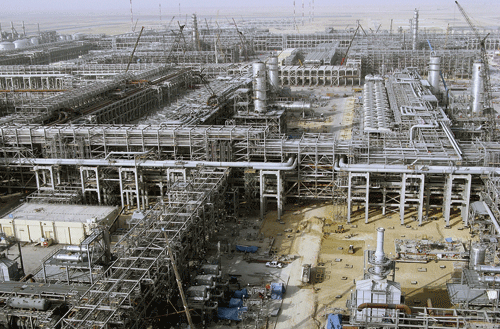
While the cache of diplomatic cables recently released by WikiLeaks may have caused a number of international stirs, the majority have been largely ignored, causing little political, diplomatic or economic fallout. The revelations in early February that Saudi Arabia overstated crude oil reserves by up to 40 percent falls in the latter category, generating little more than newswire buzz. But should that have been the case?

With Saudi Arabia a top oil producer, the cable could have sparked a reaction on the world markets, driving the price of oil even higher and causing havoc with future oil supply projections. The kingdom itself would have had its position as the de-facto head of the Organization of the Petroleum Exporting Countries (OPEC) challenged, and its sovereign risk ratings would have been battered, given the country’s overwhelming dependency on hydro carbons to balance the books.

But there was no reaction on the markets, nor was there a flurry of stories in the press querying Saudi Arabia’s oil reserves and reigniting the debate about “peak oil.” The only reaction from the Saudi side was by the man who told United States diplomats in 2007 that the reserves were overstated. Sadad al-Husseini, a former vice president and head of exploration at Aramco, Saudi Arabia’s oil monopoly, said he had been “misrepresented” by the diplomats and the press and “did not question in any manner the reported reserves of Saudi Aramco.”

Major economic publications also dismissed the revelations: Petroleum Intelligence Weekly, considered “the bible” of the energy industry, called the cables a “false alarm” while a Wall Street Journal (WSJ) blog downplayed concerns because of Husseini’s apparent volte-face.

So is the cable just an example of US diplomats playing a game of what the WSJ referred to as “Chinese whispers?” Or was Husseini pressured into denying his original statements, meaning Aramco really has fiddled with the figures? It is, of course, hard to know, and that is the crux of the problem. Even if the contents of the cables are false, Aramco has not been transparent with its figures since the company was nationalized. According to a former Aramco employee, only the company’s nine-member executive committee is privy to the actual figures, despite the need of departments to have access to such information to carry out research, implement long-term plans and so on.

Like Aramco employees, the world is expected to believe what the company tells us, as they have always delivered enough oil to the market; but should we, in the same way the world took at face value the kingdom’s stated gold reserve until the Saudi Arabian Monetary Agency revealed last year it had 180 tons more than it originally accounted for? After all, Aramco is still peddling the lie that it is the world’s largest producer of oil. Exporter yes, producer no. In fact, Russia became the world’s biggest producer in 2009, according to the BP Statistical Review of World Energy 2010, with an average output of 10 million barrels per day (bpd), or 12.9 percent of total production worldwide, whereas Saudi produces 9.7 million bpd.

A primary reason the cable didn’t result in a media frenzy was that the revelations were nothing particularly new. Many oil experts have queried Aramco’s figures before, noting in particular that 90 percent of all the oil that Saudi Arabia has ever produced has come from seven giant fields that are now maturing, three of which are more than 50 years old.

In the case of these US embassy cables, the debate centers around Husseini questioning Aramco figures that put Saudi Arabia’s reserves at716 billion barrels, of which 51 percent are recoverable. It is the recovery figures that are the questionable part, as the global recovery average is some 30percent, which suggests Aramco is being overly optimistic about what it will be able to extract. The real estimates need to be revealed. If Aramco’s numbers do come up short, the ramifications on the world economy of a Saudi oil shock would be devastating. Perhaps the best solution would be for the world to start moving more quickly toward alternative fuels rather than relying on debatable recovery estimates.

PAUL COCHRANE is the Middle East correspondent for International News Services


March 3, 2011 0 comments
0 FacebookTwitterPinterestEmail
Comment

Changing of the guard

by Jonathan Wright March 3, 2011
written by Jonathan Wright

After the euphoria of Egypt’s revolution comes the more tedious work, and the devil is in the details. Egyptian society hovers between the yearning for stability through cobbling together the surviving fragments ofthe state and the urge to eliminate the remnants of a dilapidated autocracy riddled with corruption, brutality and incompetence.

The military council that took over from President Hosni Mubarak on February 11 stands firmly in the middle and is disputing both sides of the argument. It is appealing for people to set aside their professional and personal grievances and go back to work, while promising that it will uphold the demands of the revolution and root out corruption.

The council’s latest proposed cabinet shuffle reflects its ambiguous stance: Prime Minister Ahmed Shafik, a former air force officer and one of Mubarak’s younger protégés, will stay, as will Foreign Minister Ahmed Aboul Gheit, one of Mubarak’s most loyal defenders and a diehard opponent of the revolution until defeat was inevitable. Others have not been so lucky: threeformer ministers are in detention for questioning, along with Ahmed Ezz, the steel magnate and ruling party official who oversaw the rigged parliamentary elections of 2010.

Even Hosni Mubarak is in limbo, surrounded by old retainers in comfortable retirement in the Red Sea resort of Sharm El Sheikh — an ominous reminder to some revolutionaries that their work is unfinished. Egypt’s most venerable wise man, journalist Mohamed Hassanein Heikal, says his presence in Sharm El Sheikh is a threat to the revolution.

The committee assigned to redraft the constitution, in whose hands lies the future of the Arab world’s most populous nation, also straddles the divide: Will it merely rescind the most authoritarian constitutional amendments or propose a radical overhaul to give Egypt a system of government fit to last into the 21st century? The military council says it is in a hurryto cede power to elected civilians but the most Egyptians can expect for now is a constitutional provision requiring the next elected government to make the long-term changes.

In the meantime, ambitious Egyptians are launching into the brave new world of political pluralism, forming parties and organizing in a way that was unimaginable during Mubarak’s police state and the reign of his National Democratic Party. After 15 years of fruitlessly seeking recognition under Mubarak, the Wasat Party won it through the courts eight days after Mubarak’s fall. With its recognition of Egypt’s Islamic heritage and its commitment to equality for all citizens in a civil society, Wasat has an ideology that could strike a chord with Egyptian voters in free and fair elections.

In the south of the country, reinvigorated members of the old Gama’a Al Islamiya, which waged war on the state in the 1990s, are meeting openly to plan for a future as a peaceful political party. The Muslim Brotherhood, the largest and best-organized political force in the country, has taken steps in the same direction. The young secular liberals who launched the revolution on January 25 are also jockeying for position in a new environmentof competing political ideologies, despite their distrust of hierarchy and their inexperience in conventional campaigning.

Above the fray looms the military council, inscrutable as the Sphinx, combining the sternness and the benevolence of a patriarch. While foreigners fret over the army’s allegedly vast vested interests in the status quo, especially its network of privilege and patronage, Egyptians tend to give the military the benefit of the doubt, trusting their promises to withdraw from the scene in six months when their task is complete. In the interim, the military may be an effective deterrent to any excess, especially on the law-and-order front.

With the world watching, speculation is rife as to what the revolution will bring about. Will Egypt’s next leaders, like Hosni Mubarak, cooperate with Israel and the United States against Hamas, Iran and their other regional enemies? Will they reconsider the neoliberal economic policies that brought Egypt high growth but a widening gap between rich and poor? Most important of all, what role will Egypt play in what could well be a constellation of newly democratic Arab governments seeking, in their relations with the United States and Europe, a third way between submission and confrontation?

Jonathan Wright is managing editor of Arab Media and Society


March 3, 2011 0 comments
0 FacebookTwitterPinterestEmail
Finance

Riad Salameh speaks to Executive

by Emma Cosgrove March 2, 2011
written by Emma Cosgrove

With praise from international media raining in for his steadiness at Lebanon’s financial helm, Executive sat down with Central Bank Governor Riad Salameh to discuss the current and future state of Lebanese Banks.

E  As a foil to the rest of the world, Lebanese banks have actually struggled to find profitable uses for their excess liquidity, especially in local currency. Do you believe that the banks have enough tools to keep this liquidity from becoming a burden?

Well, as you know, the amounts that came to the banking sector after the collapse of Lehman [Brothers], and between September 2008 and July 2009, were very large amounts compared to the size of deposits already existing in the banking sector. Plus they were mostly converted into Lebanese pounds. It is normal that the banking sector can’t find immediate use for such amounts when they total around $16 billion. The credit market in Lebanon usually increases by $2 billion to $3 billion a year.

So the central bank issued 5-year certificates of deposit (CDs) in Lebanese pounds in order to mop up some of that liquidity, and the

Ministry of Finance also issued more treasury bills in Lebanese pounds than needed, in order to keep discipline, prevent bubbles, speculation and inflation. And this money will be gradually used again in the economy in Lebanon.

Therefore, we have to face the positive aspect of not having been touched by the crisis and embrace the confidence in our system, and we thought that it was an opportunity for Lebanon to receive and keep all these funds, as there will be a need for them in the future, whether to finance the public sector or the private sector.

E  Why did the central bank stop issuing five-year CDs?

We have issued circulars to enhance credit in Lebanese pounds and we have given incentives to lend for housing without placing price ceilings, so you can now see the banks competing to lend money at rates that are around 5 percent for medium-term [loans].

We have also given incentives for the financing of new projects, not only those covered by the previous circulars, which means that any project besides industry, tourism, agriculture, or technology that is launched between now and June 2010, and we’re going to extend it until June 2011, will be able to be funded with low rates of interest. We have also launched student loans and  environmental loans using those same incentives.

Given this package, we thought that we had to leave some liquidity in the hands of the banks in order to motivate them to lend according to these circulars. As we look forward, we can have good growth in 2010 if the credit activity is maintained and intelligently directed. So, the markets started to find a certain equilibrium despite the fact that we stopped these CDs.

We still had conversions from dollars to Lebanese pounds. We still had a balance of payments that showed a positive balance of $6 billion by the end of October, which is a record for any year in Lebanon for the first 10 months. Therefore, we thought that we can now afford now some gradual decrease in rates.

Nonetheless, if we see that our management of the liquidity in the market requires us to reenter by selling CDs, we will do that, and we have announced that we might come back with 7-year and 10-year maturities.

The idea is to acquaint the market with longer maturities in Lebanese pound denominated papers, and that the government later on can also issue bonds for 7-year and 10-year maturities in Lebanese pounds.

By extending the maturities on debt we will have less pressure on the refinancing of that debt on a yearly basis, and that will help maintain a more acceptable structure of interest rates.

E  As interest rates decline, do you expect the dollarization of deposits to remain around 66 percent?

We think the market is keeping that ratio. This is one of the equilibriums that we are starting to see. And today we have approximately $27 billion in liquid foreign currency on our balance sheet at the central bank, which is also a historical high. This means that out of the capital inflows coming to the country, 66 percent remain in dollars, while the rest are converted to Lebanese pounds. We find that it’s up to the market to define the equilibrium, but I believe we have seen the markets at this level for the past three or four months.

E  Both the prime minister and the finance minister have stated that they are keen to implement Paris III initiatives that include raising taxes on interest earned in local banks from 5 to 7 percent. Do you think this will actually happen in this government’s term?

The tax on the interest on deposits is not, I think, a priority for the time being, especially in that this tax was envisaged before the international crisis. And even though it is presented as a law to be voted, there is an understanding that this cannot be implemented before we have stability in the banking sector worldwide and in the region.

The tax approach is also not the priority, as I understand, because the priority is going to be given to more growth in the economy and to fix activities that are creating large deficits for the government, like Electricite du Liban.

Anyway, the government is presently discussing the economic program that they want to present to the Parliament or at least a declaration on that, and we will wait to see what will be approved. But I know that growth is the priority and for that, everything is going to be done to facilitate growth.

E  You’ve been successful in swapping the short-term debt for long-term debt with more maturity. How do you see Lebanon coming out of its debt situation?

Our priorities really are to reduce the yearly deficit because the present stock of debt that is in the market is perfectly sustainable, due to the high liquidity that we have and also to the increased confidence in the financials of the country. As you can see, the credit default swap that is quoted internationally for Lebanon for the past five years has declined to reach 2.3 percent, at certain times it was at 7 and even at 10 percent. So there is demand on the Lebanese paper, and interest rates in the secondary market have substantially decreased.

The future expectations of inflation are going to diminish the real value of that debt, which is stated today at around $48 billion. And the present value or the real value of that debt will look less important in the next four or five years, as the purchasing power of currency is going to be depleted worldwide. So what the market requires are signals showing that the deficit is declining, and for that purpose we hope that the originators of this big deficit be addressed in the reform program of the government. The most important sector to reform is the energy sector in general and electricity in particular.

We have to wait for the government declaration in order to see if the program of privatization is going to be implemented fully or partially and in what ways.

E  In light of the likelihood of the dollar decreasing in value, is the central bank changing the ratio of its foreign currency reserves?

No. We have the same ratios because we intervene in US dollars, so by departing too much from our structure of reserve in the dollar, we will incur risks on the Forex markets, dollar vis-à-vis euro or sterling or yen, which is not good for a central bank.

We cannot be speculators on the exchange markets, but we have created a model that preserves the real values of our reserves and don’t forget; the central bank, on its balance sheet, has a large stock of gold that represents around 30 percent of that balance sheet today. So the country is well hedged against any future development in terms of inflation internationally or a weaker dollar if this trend continues.

E  Is the devaluation of the dollar going to help us get to a higher balance of payments now that our exports are going to be more attractive?

You know, the dollar is decreasing in value against all of the currencies and most economic activity, whether in terms of production or services, is dollarized. This gives a competitive advantage to the country. And we have seen that in the correlation between the growth in the economy in Lebanon and the decline in value of the dollar. Of course we are talking about the economy in general. We are not talking about savings and the purchasing power of savings but this is an issue that concerns the people, the owners of capital, not the central bank. At the central bank, we have a diversified portfolio in terms of currency. We have a large stock of gold. But our transactions will remain related to the US dollar as long as the markets are dealing in that currency. If the markets change to another currency, then we will change as well.

E  To what extent are banks in Lebanon compliant with Basel II?

They are fully compliant to the criteria of Basel II; the solvency ratio in the country is around 12 percent. As you know, most banks worldwide are struggling to get to 8 percent, which is the norm. And this 12 percent is by applying all the criteria of Basel II. We are also working on the governance issue and on the risk and transparency issues along with the banks. We issued circulars in that regard and we have created, at the central bank, a unit for good governance that is going to work in the field to make sure that good governance is implemented, and we will start by a strict analysis of the composition of the board of directors and their prerogatives in the bank’s management.

The group is within the central bank so effectively it will give its recommendation to the governor. The governor will present it to the central board and there will be a decision that has enforcing powers. This is a follow-up activity, nonetheless there is also the banking control commission that is empowered and has the teams that are in the field working to see how our circulars are being implemented in the banking sector.

E  The sentiment at the Union of Arab Banks conference in November was that Basel II is insufficient to prevent a crisis like we are seeing right now from happening again. Do you agree with that?

The crisis happened after Basel II had been approved, so Basel II is not enough to prevent a crisis. Here, we added to Basel II the liquidity factor that did not exist before. So in Lebanon, the banks have to constitute a liquidity of 30 percent on their balance sheets, 15 percent as a reserve requirement with the central bank and 15 percent on their own books. The fact that we have low leverage and high liquidity has helped the sector refrain from going into adventurous credit, and Basel II is more on the capital side than on the liquidity side. So it has to be developed more. Anyway, Basel II is just guidance because the major countries did not even implement it, like the United States or India. There is no better protection for a bank than its management because they know what is really happening in the bank, and for a banking sector, the local central bank should be aware and prudent, to moderate leveraging in the sector.


March 2, 2011 0 comments
0 FacebookTwitterPinterestEmail
Finance

Embracing evolution

by Peter Daou March 1, 2011
written by Peter Daou

In an economy such as the United Arab Emirates, where the government has significant stakes in several of the largest banks, it is hard to isolate successes and attribute them fairly. Still, the success of UAE banks at surviving what have been trying times earns them at least part of the financial accolades of the emirates in 2010; the orderly restructuring of nearly $25 billion of debt was a major achievement on the part of the UAE banking sector and September’s announcement that all 90 of Dubai World’s (DW) creditors had agreed to a restructuring agreement sent positive waves across financial markets. 

“Common sense prevailed, and it was therefore an achievement to get all the banks to agree to the restructuring terms, which reflects the pragmatic structure of the agreement,” says Jeremy Parrish, chief executive officer of Standard Chartered UAE. Emirati banks also withstood exposure to a still-ailing real estate sector and what Parrish describes as “very tight liquidity” in 2010.

Return to liquidity

After the DW debt rescheduling, liquidity was scarce for Dubai’s banks. But in the second half of 2010, banks and sovereign authorities were able to tap into international capital markets. Dubai’s Department of Finance raised $1.25 billion in 5-year and 10-year bonds in September. Emirates NBD raised $221 million in August through securities backed by auto loans, a first in the Middle East, and then followed through in November by raising $410 million in 5-year multi-currency notes. At the same time, banks have actively sought out solutions and new strategies to mitigate the dismal financial and credit conditions.

 EFG Hermes banking analyst Murad Ansari points out that UAE banks, namely in Dubai, offered competitive returns on deposits and organized road shows to raise deposits.

This national increase resulted in an improvement in the loans-to-deposits (LTD) ratio, which slipped into positive territory again at the end of October and is another indicator bankers view as an achievement in a country that has historically been highly leveraged.

Michael Tomalin, CEO of National Bank of Abu Dhabi (NBAD) attributes the decline in the LTD ratio to proceeds from corporate bond issuances and to the attractiveness of interest rates on dirham deposits, especially given the fixed exchange-rate regime.  Tomalin adds that “some of the banks in the country — not NBAD, but other banks in the region — have been quite aggressive at going out into international markets and raising institutional deposits through programs offering relatively high rates of interest in dollars.”

Banks have been actively adopting strategies to align themselves to a new operating environment. Many are focusing on growth sectors such as trade finance, tourism and project finance for infrastructure. Standard Chartered is targeting small and medium-sized enterprises to mitigate exposure to large real estate developers, while Emirates National Bank of Dubai and NBAD are also focusing on their fee-based business.

“We are a local bank that has connections and access, can guide, help and advise on how best to structure a project and so on,” says Tomalin.  “Our international lending activities are directed to advance our client who wants to invest abroad, or an overseas client who wants to sell something, so we support him in that sale.” Tomalin adds that while interest income relative to fee-based income is currently at a ratio of 70:30, he would like to see it at 60:40.

Taking on the big boys

The local banks’ new strategies mean pitting themselves against international banks who have historically dominated the lucrative fee-based businesses such as investment banking and corporate finance. Tomalin admits that local banks have to be smart and realistic in that regard.

“We have to ask ourselves, if we want to compete with Goldman Sachs, Barclay’s or Deutsche Bank, etc, how are we effectively going to compete with these people? They are huge, we are a little bank,” says Tomalin. “Our point of differentiation is that we are a bank in the Arab world. We are here in Abu Dhabi. That makes us different.”

Emirates interbank offered rates

At the same time, expanding deposit bases may prove to be expensive, especially when many banks are rushing to cut their LTD ratio and add more lending capacity. According to Tomalin, “some banks… have been paying very high rates of interest for deposits to get their ratios sorted out. We haven’t been paying this sort of interest [at NBAD] but other banks have.”

Nonetheless, banks may be able to attract deposits through other means than interest rates. Sanjoy Sen, Citibank’s Middle East Consumer Bank Head, believes that customers are increasingly sensitive to the reputation, brand name, financial stability and strength of their bank. “Banks that are in a comfortable liquidity position will not necessarily need to pay high rates for mobilizing retail deposits,” says Sen.

In parallel, fears of rising competition for deposits between international and local banks appear unfounded. “There is an increase in competition between banks but it is a level playing field and all players have equal opportunities to get a ‘share of the wallet,’” says Sen. Parrish adds that “there has always been a healthy competition between international and local banks, but we do not see any shift in the paradigm.”  

On the other hand, the sought-after deposits have already begun to affect profitability. Banks usually seek to attract retail deposits first because they are cheaper compared to their corporate counterparts, which are more interest rate sensitive. But retail deposits are notoriously harder to attract, and given the pressing need to raise long-term debt in order to finance maturing obligations and increase lending, some banks have been aggressive, at the expense of their operating margins.

What make matters even more complicated are speculative capital inflows. Although hedge funds are happy to park their money in high-interest dirham deposits, banks are all too familiar with the 2008 scenario and will not lend against hot money, thus creating an added cost.

As a result, and despite discernible improvements in the ability of UAE banks to counter credit and economic crises, the list of concerns continues to cloud what many bankers view as the emirates’ strong fundamentals.

Tight liquidity is a major concern at banks looking to refinance and lend. Widening credit default swap spreads and expectations of a stable emirates interbank offered rate spread do not support an increase in liquidity. There seems to be a general consensus among bankers and analysts that a continued orderly restructuring and refinancing of large corporates without massive and surprising provisions will go a long way in re-establishing confidence in financial markets and especially banks.

Analysts are carefully tracking developments in asset quality, especially at Dubai banks whose non-performing loan ratios are among the highest in the country, given their tilt toward the embattled real estate sector. Still, the shift to the resilient sectors of the economy such as tourism, trade finance and government, should improve overall asset quality at UAE banks.

 However, fear of additional provisioning and general weakness across some of the largest sectors in the economy, especially in Dubai, may shift the focus of banks more toward stabilizing their balance sheet and liquidity ratios than toward taking on additional risk, unless on a highly selective basis.

At the same time, a 98 percent national LTD ratio, which goes even higher by the central bank’s loans to stable deposits, does not provide much leeway for banks to grow their loan books in 2011. But there is room for measured growth, according to Parrish, who says: “The drop in the LTD ratio is not a signal for the flood gates to open, but we will see a measured increase in loans after what so far has been a flat growth in the last 18 months.”

The general mood of investors and analysts covering UAE banks remains largely skeptical, with several exceptions in the banks and some economic sectors. Nevertheless, the rush of positive news, including airport and port traffic in the second half of 2010, has boosted confidence at the business and consumer levels, generating strong support for the belief that today’s concerns, such as asset quality deterioration and profitability, may form the achievements of 2011.

March 1, 2011 0 comments
0 FacebookTwitterPinterestEmail
Banking & Finance

Regional equity markets

by Executive Editors February 28, 2011
written by Executive Editors

Beirut SE  

Current year high: 1,180.99    Current year low: 939.02

>  Review period: Closed Jan 26 at 1,024.00 Points                  Period Change: 5.3%
The Beirut Stock Exchange had a positive entry into 2011 and the MSCI Lebanon index rose to a 6-month high on January 11. Volatility appeared as the nation and BSE were exposed to the newest twist in the power bickering of Lebanese politics. During the Jan 12 to 26 period, shares of real estate firm Solidere fluctuated between $18 and $20. Bankers affirmed there was no flight of money. In terms of the BSE’s reaction, the uproar over a new PM on the Jan 25 “day of rage” was but a tantrum.

Amman SE  

Current year high: 2,648.36                Current year low: 2,223.30

> Review period: Closed Jan 26 at 2,424.62 Points                  Period Change: 1.2%

The first significant uptrend in several months for the Amman Stock Exchange benchmark index — 125 points, or 5.3% between Dec 19, 2010 and Jan 17, 2011 — fizzled out with the eruption of political protest in Tunisia. The index dropped 2.2% in the following week but there was nary an immolation of Jordanian stock prices by the Jan 26 close. Industrial stocks were involved in driving the market higher and the industrial index was the best performer in the review period, closing Jan 26 up 3.85% on the month. The banking sector index lagged slightly behind the benchmark.

Abu Dhabi SM   Current year high: 2,931.67                Current year low: 2,471.70

> Review period: Closed Jan 26 at 2,668.66 Points               Period Change: -1.9%

Amid broadly negative sentiment affecting most sectors on the Abu Dhabi Securities Exchange, real estate and construction were the sectors that dragged the benchmark index even lower. The industrial index was the upward outlier. The newsmaker among listed companies was developer Aldar, which embarked on a long expected restructuring, including placement of a $760 million convertible bond, a $2.9 billion impairment charge, and a $3 billion transfer of infrastructure assets. The stock subsequently slumped to its lowest quotations ever, beneath the AED 2 mark ($0.54).

Dubai FM   Current year high: 1,880.62                Current year low: 1,461.80

> Review period: Closed Jan 26 at 1,627.97 Points               Period Change: -0.2%

Index movements on the Dubai Financial Market lacked clear direction at the start of 2011. Among sector indices, telecommunications and transportation closed the review period on positive notes banking, investment, real estate and insurance sector indices were bearish. Down 12.1% year-to-date at Jan 26 close, the utilities sector was the DFM’s underperformer. District cooling firm Tabreed fell 9% and Emaar Properties gave up 3.4%. Gainers included telecoms operator Du, up 9.4%, contractor Drake and Skull, up 7.7%, and multi-sector investment company Dubai Investments, up 5.4%.

Kuwait SE   Current year high: 7,575.00                Current year low: 6,319.70

> Review period: Closed Jan 26 at 6976 Points                     Period Change: 0.3%

Movement on the Kuwait Stock Exchange in January stayed loyal to the same point range that had been the theme of the last quarter in 2010, dallying in the 6,900s and not breaking into 7,000 territory but not softening to 6,800 either. Except for the banking sector, which outperformed the benchmark index performance by six percentage points, the domestic sub-indices remained range bound. The index for non-Kuwaiti share values slipped 4.8% during the review period.

Saudi Arabia SE  

Current year high: 6,929.40                Current year low: 5,760.33

> Review period: Closed Jan 26 at 6,697.80 Points   Period Change: 1.2%

Based on a 360-point gain in December, the TASI ascended to an eight-month high on Jan 16 before profit taking in the latter part of the review period curtailed its January gains. Industrial investment was the top gaining sector index at 7.6%. Transport and agriculture stocks saw sector index drops of 4% and 3.8%. At the top, supermarket retailer Othaim climbed 16.5%. Heavy-weight Sabic retreated from a 28-month high after 27% year-on-year improved Q4 profits that narrowly undercut forecasts.

Muscat SM  

Current year high: 7,027.32                Current year low: 6,058.11

> Review period: Closed Jan 26 at 6,943.10 Points   Period Change: 2.8%

Enjoying five closes above 7,000 points, the Muscat Securities Market’s H2, 2010 rally with a cherry on top lasted until January 17, a day that apparently nudged investors across the GCC to think about profit taking. All three sector indices on the Omani bourse closed the review period higher, with the services and insurance index showing the best gains at 9%. Banking and industrial indices added 2.8% and 1.7%, respectively. Incompatible liquids were a happy, if most likely not interconnected, theme as Maha Oil and National Mineral Water each gained more than 18%.

Bahrain SE  

Current year high: 1,605.98                Current year low: 1,361.19

> Review period: Closed Jan 26 at 1,460.67 Points   Period Change: 2.0%

The benchmark index of the BSE recorded notable gains near the end of the review period, propelling the market to the number three spot in the GCC, after Qatar and Oman. Sector indices for investment, services and industry moved north; banking, insurance and hotels headed south. At the extreme points of individual share price movements, Ahli United Bank advanced 12.7%. Bahrain Islamic Bank, announcing Q4 losses, fell 23.3%. The bourse listed a $530 million Bahraini sovereign bond on Jan 20, expanding the number of listed bonds and sukuk to 12.

Doha SM   Current year high: 9,242.63                Current year low: 6,558.45

> Review period: Closed Jan 26 at 9020.24 Points    Period Change: 3.9%

True to the form of recent months, the Qatari market was again the Gulf’s best gainer in January 2011. But even on the World Cup-delighted QSE, where economic prospects were buoyed last month through government reconfirmations of immense infrastructure investment intentions, days of profit taking emerged in mid-January. First, however, the QSE benchmark rallied to highs unseen since the maelstrom of the 2008 crisis. All sectors followed the benchmark trend of rise and retreat. Only banking, up 4.7% by Jan 26, closed the review period higher than the general index.

Tunis SE   Current year high: 5,681.39                Current year low: 4,534.88

> Review period: Closed Jan 26 at 4,552.80 Points   Period Change: -12.7%

From sideways trading in December, the Tunis Stock Exchange crashed in January, losing 665 points in only one week of trading to Jan 14 before the TSE shuttered its gates and remained closed for the remainder of the review period to avoid being fully submerged in political chaos and panic selling. Prices dropped for nearly all stocks that were traded during the period, without indication of any sector or industry being at the center of selling. The upheaval set the TSE back to index levels last seen in January 2010 with a wholly indeterminate outlook.   

Casablanca SE  

Current year high: 13,397.47              Current year low: 10,846.39

> Review period: Closed Jan 26 at 13,183.91 Points             Period Change: 4.4%

The MASI index started 2011 with a 740-point rise to a new historic market peak on Jan 12. This turned into a 3% slide in the wake of the unexpected crisis in Tunisia but investor sentiment stabilized toward the end of the review period; the Moroccan bourse was the period’s best performer in North Africa. Market cap leader Maroc Telecom climbed 6%. Ennakl Automobiles, the Tunisian car distributor cross-listed in Tunis and Casablanca, dropped only slightly on the CSE but bled much more on the TSE.

Egypt CASE  

Current year high: 7,603.04                Current year low: 5,647.00

> Review period: Closed Jan 26 at 6310.44 Points    Period Change: -11.64%

Crash and bang but no boom was the tenor on the Egyptian Exchange, whose indices were driven down sharply during the morning of Jan 26 after violent demonstrations the day before stoked investor fears of national political instability. The benchmark EGX 30 index dropped 6% that day but the wider EGX 70 and EGX 100 indices fell about 10% each. Banking, financial, and real estate sector indices were all heavily involved in the January drops as were food and leisure.

February 28, 2011 0 comments
0 FacebookTwitterPinterestEmail
Feature

Hard Numbers

by Executive Editors February 21, 2011
written by Executive Editors

In a much publicized and internationally heralded move in August 2010, the Lebanese government passed “right to work” legislation for the country’s Palestinian refugee population. For those who thought that this would usher in a new era for the refugees and alleviate the poverty of the Palestinian community, nearing its 62nd year in exile in Lebanon, the unfortunate reality is that little has changed.

While Lebanon’s economy has made gains in recent years (recent incidents notwithstanding), it is glaringly apparent that little, if any of this has reached what remains one of the country’s most disenfranchised communities. Lebanon’s 12 official Palestinian refugee camps are still mired in destitution: in south Beirut’s Shatila Camp sewage runs through the alleys, secondary school drop-outs and unemployed men in their 20s idle in the market and only a minority of homes have access to natural sunlight.

While clearly visible to the eye, the poverty that dominates the economic situation of Lebanon’s Palestinian refugees — estimated  by various organizations at anywhere between 260,000 and 400,000 — has been largely difficult to quantify due to a shortage of reliable data. In late December, the American University of Beirut (AUB) released a report called “Socio-Economic Survey of Palestinian Refugees in Lebanon,” commissioned by the United Nations Relief and Works Agency (UNRWA) and funded by the European Commission, which claims to be the most comprehensive survey of the population in the past decade. The last major benchmark study on the subject was carried out by the Norwegian foundation FAFO, using data collected in 1999.

The AUB report offers a rare statistical quantification of the socio-economic realities and hardships of Palestinians in Lebanon.

Dire poverty

The survey found that 66.4 percent of Palestinians in Lebanon live under the poverty line of  spending $6 per day – deemed enough money to cover basic food and non-food items. Of these, 6.6 percent fell under the extreme poverty line, spending less than $2.17 per day, enough to cover food items alone.

Unlike previous surveys, the AUB report measured spending rather than income as a measure of poverty, which authors of the report argue is more accurate. From these statistics, the study estimates that approximately 160,000 Palestinian refugees live in poverty.

Inside the refugee camps — which are often isolated from urban areas and job opportunities — three out of four residents live below the poverty line, compared to one in two Palestinians who live in gatherings outside of the official camps. Remaining Palestinians not living below the poverty line are by no means affluent: the report mentions that no individual surveyed reported a monthly expenditure of more than $600.

The average monthly expenditure was revealed to be $170; those living in informal gatherings spent an average of $200 per month while those living in camps spent only $150. Little change then, from data collected in 1999 by FAFO, which found that 44 percent of Palestinian refugees in Lebanon made less than $2,400 per year, or $200 per month.

No jobs to go around

The most obvious contributing factor to the poverty facing Palestinian refugees in Lebanon is that most of them do not have jobs. The AUB report shows that only 37 percent of the working age (15 to 64 years old) Palestinian refugee population is employed. The study’s authors assert that widespread discrimination on the part of many Lebanese employers makes finding jobs difficult.

“If a secretary [applies for a job] with a CV that says Shatila Camp [under] residence, they will not employ her,” says Sari Hanafi, an associate professor at AUB and one of the contributors to the report.

Of Palestinians who do have jobs, very few have contracts — prerequisites for obtaining elusive work permits that give the employee legal standing and rights. This leads many Palestinians to work illegally, exposing them to labor abuses.

“Those who are interested in employing Palestinians are exploiters,” says Hanafi. “A few days ago I found three Palestinians working with a construction company. I got the details and found  they work without work permits and they work for half the price that their Lebanese colleagues can get from this company.”

Legal issues remain the largest issue facing Palestinians who want to work, and so far the lauded “right to work” legislation of August 2010 has done little to help the employment situation facing Palestinians.

“[It had] zero impact. I am not exaggerating,” says Hanafi.

As evidence, Hanafi points to the fact that, in the past six months, the Lebanese Ministry of Labor has granted only three work permits to Palestinians. In 2009, 99 permits were issued to Palestinians. Foreign workers from other countries — primarily domestic workers from Asia and Africa, along with non-Lebanese Arabs — were issued a total of nearly 150,000 permits in 2009.

“The Ministry of Labor is supposed to take some implementing measures. Those measures have not been taken yet,” says Salvatore Lombardo, director of UNRWA in Lebanon, adding that the country’s current political crisis is “likely to delay even further the implementation measures.”

With the stagnation of the process, Hanafi says, “the main factor [contributing to unemployment] is really related to the lack of a legal framework allowing Palestinians to get jobs in the private sector.”

Rather than a step toward more equal rights, the report says “the amended law constitutes an institutionalization of discrimination.”

While in theory it would make it easier for Palestinians to obtain work permits, the law did little to help Palestinian professionals trying to enter liberal professions, many of which are syndicated and reserved for Lebanese nations. For unskilled jobs, permits are not as helpful as it might seem, given the reluctance of employers to issue Palestinians contracts and thereby give up the current low labor costs and freedom from worker protection regulations. 

The fear of tawtin — the naturalization of Palestinians — upsetting Lebanon’s delicate sectarian balance has made many Lebanese hesitant toward granting further rights to Palestinians. In a narrow Lebanese job market already saturated by low-wage workers from other Arab countries and further afield, some fear that additional working rights would worsen the situation for Lebanese job seekers.

“A very important conclusion of the study is that [Palestinian refugees] do not represent a threat to Lebanese nationals in terms of job searches,” says Lombardo, taking into account that Palestinians primarily compete with non-Lebanese Arabs and other unskilled foreign laborers for jobs. The sheer number of Palestinians in Lebanon would put the community in a position to be a strong positive economic force in the country, if only they were better integrated into the economy through proper employment.

School’s out forever

The inability to keep students in school is a driving factor behind the undereducated Palestinian workforce. While elementary and preparatory schools that Palestinian children go to enjoy high attendance numbers, enrollment rates crash to 51 percent for secondary school. However, this is an improvement from FAFO’s 2006 study, which found that 74 percent of the Palestinian labor force in Lebanon had less than a secondary education.

Post-graduate opportunities are bleak throughout the Palestinian community: “When these kids see their older brother unemployed after a few years in private university, they have no incentive to go to school,” says AUB’s Hanafi.

For Lebanon’s Palestinians, the path to a brighter economic picture is largely out of their own hands. Their high levels of unemployment and poverty will likely continue as long as there are no serious efforts to integrate the refugees into their host country’s economy. With the country’s politicians currently handling their own problems, it could be some time before a helping hand is given to the Palestinians.

February 21, 2011 0 comments
0 FacebookTwitterPinterestEmail
Editorial

Willfully ignorant of the imminent

by Yasser Akkaoui February 21, 2011
written by Yasser Akkaoui

In the first month of 2011 a storm of popular rage swept across the Arab world. Protests from Morocco to Yemen have brought millions out into the streets to demonstrate against the once-feared powers that be, toppling one long-time titan of autocracy in Tunisia and leaving another clinging to power in Egypt as January ends.

One must remember that Tunisia and Egypt were the North African darlings of international investors looking for high returns in developing markets. Both had been regarded as stable macroeconomic environments right up until their collapse, with proven track records of strong growth and stellar potential. Who could have foreseen these revolts?

Economists and the like have a nice term for an event of such radical departure from the expected: a ‘black swan’ – a freak of nature, unforeseeable, unavoidable and of devastating consequence.

But were the events of the last month really so unexpected? We have known for years that wealth has failed to trickle down in Egypt and Tunisia, that corruption is rampant, that education has failed to match the needs of the economy and that brutal police repression has stymied legitimate protest.

The soaring Tunisian stock exchange led business and political leaders to assume the social economy was also thriving, and that Egypt’s long years of political stability and growing middle class were signs that all was well on the banks of the Nile.

Perhaps it is human nature for greed to settle us softly into irresponsible complacency, where we take for granted the status quo will remain and we blind ourselves from the fires growing around us. Perhaps, then, many ‘black swans’ are not unforeseeable at all –– rather, we ignore obvious threats because wanton disregard seems to make sense when profits are easy. But then the crash comes, and again we claim we’ve been wronged by wicked fate.

In the cases of Tunisia and Egypt, we were simply focused on the wrong indicators. Gross domestic product growth and stock market performance do not tell the health of a nation; to assess the stability of any society you must assess the level of satisfaction of its people.

In the future, analysts will have to revise the indicators they use to assess a country’s risk and investment potential if they want to avoid looking like the archetypal jilted lover, always claiming they never saw it coming.

February 21, 2011 0 comments
0 FacebookTwitterPinterestEmail
Economics & Policy

Accession in Atrophy

by Executive Editors February 21, 2011
written by Executive Editors

Arab attitudes toward the World Trade Organization (WTO) are mixed: at one extreme is Libyan leader Muammar al-Qaddafi, who opened the latest Africa-European Union summit at the end of November by branding the WTO, and other international trade organizations,  as “terrorists.” “We call for the elimination of the WTO, because it does not serve our interests,” Qaddafi said. “It wants us to open our borders to foreign goods to kill our industries.”

Though most of the region does not share this point of view, there is a palpable indifference to the organization throughout. The Arab world is greatly underrepresented in the WTO, with only 12 out of 22 Arab League members having joined, a much weaker representation than in other regions.

Interest in the WTO among Arab states is growing, however: from the initial nine that were founding members of the WTO, three have acceded in the years following while eight more are currently in the process of doing so. The accession of Arab countries has tended to take longer than that of states in most other parts of the world. Jordan’s accession, which came in 2000, took around six years, longer than its peers who joined in 1999 or 2000. Saudi Arabia, which acceded in 2005, took more than 12 years to negotiate membership, having started under the WTO’s predecessor, the General Agreement on Tariffs and Trade (GATT). As for Arab countries now seeking to join the WTO, they tend to resemble the Saudis more than the Omanis, who took just five years.

Syria should do a Turkey

Syria, the latest to begin negotiations, is a good example of the difficulties faced by some states in the Middle East and North Africa region; it was forced to wait for a full nine years before its application to join was even acknowledged. The start of Syria’s accession process a few months ago was good news for those seeking more liberalization, as moves to join the WTO have already prompted discussions of sorely needed Syrian domestic policy reform.

With 14 percent of Syrians living in poverty and 20 percent unemployment, the country’s Deputy Prime Minister for Economic Affairs Abdullah Dardari acknowledged in late 2010 that the “challenges facing us are formidable.” Syrian economist Nabil Sukkar concurred in January when he stressed to Executive the need to meet the endlessly growing demand for jobs, calling the task “enormous.”

So is WTO membership an effective tool to help solve Syrian economic problems?

Whatever the details of the recipe for reform, which include changes in the foreign trade regime, most observers agree that “business as usual” is not an option. Paul Salem, director of the Carnegie Middle East Center in Beirut, said recently that the Syrians should follow the example of Turkey, now on its way to becoming an economic power, but which 30 years ago “resembled [the] Syria of today.” Turkey’s blossoming was partly achieved through massive exports to new markets, due in large part to its WTO membership and to bilateral trade deals, which in turn interacted positively with economic reform and restructuring at home.

A tall ladder to climb

However, for Syria and other Arab countries, finally joining the WTO may take some time and involve much effort. Ever since the organization was officially launched in 1995 as the successor to GATT, the average accession process has lengthened over time. The average since the WTO was founded is 8.5 years, but that number has steadily risen since the first batch of entrants in the late 1990s, which typically required only two years.

Such delays are not purely political. Lebanon’s accession, which was initiated over a decade ago, is hampered by problems related to intellectual property rights (IPR) and other economic issues, more than a decade after the country applied for membership. Granted, such a delay for Beirut has much to do with its political situation, as it does in Syria, although officially the only issues on the table relate to economics. 

The danger now in Syria or in other Arab states is that those who oppose opening up to global markets could plead the existence of political obstacles, in an effort to derail economic change and delay WTO accession. To help counter this mentality, more training and technical assistance could be sought, as has happened in Jordan, Yemen and other Arab states, to enhance trade-analytical capabilities.

In this vein, Syria could also use accession negotiations as leverage for more aid from state donors. For example, if the United States or EU grumble that Syria’s IPR situation leaves something to be desired, Damascus could counter with a demand for technical assistance from the West for training and public information campaigns.

Faced with the daunting process of accession, the countries of the region should seek all the foreign technical assistance they can get, as well as learn from the experience of other Arab states that have already joined or are in the process of doing so. Tamam el-Ghul, a former Jordanian WTO negotiator and ex-minister, recently described the admission process as “complex,” requiring extensive technical expertise.

Accession also calls for a change in public attitudes, but the media in this respect have not been helpful, with many economic journalists still unfamiliar with the WTO and incapable of enlightening people about trade. In this regard, a linguistic dilemma arises: Arabic is not an official WTO language, as it is at the United Nations and many other international organizations. That is not a merely superficial problem, as adopting Arabic as a working language could have far-reaching positive implications. The buzz at WTO headquarters in Geneva suggests that the issue could start to be taken more seriously from 2012, as more Arab members join the organization. One WTO official, speaking off the record, told Executive: “For Arabic to become an official language, financial backing from rich Arab states would be needed.” Translation is already a huge expense at the WTO, but it is clear that Colonel Qaddafi and other WTO naysayers could profit from more clarity in understanding the benefits of accession.

February 21, 2011 0 comments
0 FacebookTwitterPinterestEmail
Economics & Policy

For your information

by Executive Editors February 21, 2011
written by Executive Editors

Telecom bidding concludes

The Ministry of Telecommunications has announced that it has concluded the bidding round for the second installment of the ministry’s project to build Lebanon’s modern Internet infrastructure. The ministry awarded the contract to the Swedish company Ericsson, in part because its bid of $6.3 million was the lowest price of the five competing companies. The project specifications cover the supply and installation of DWDM multiplexers, equipment that allows signals to pass along fiber optic cables. Bids by Tellabs and UTL were thrown out because their “administrative files were not complete” and ZTE was disqualified because it did not meet the ministry’s technical specifications. The project has been criticized in the past by United Nations International Telecommunications Union experts for being overpriced and badly structured.

GDP forecast drops with cabinet demise

The longer it takes, the worse it will get. That was the sentiment of most international financial institutions that commented on the collapse of Lebanon’s cabinet last month. JP Morgan slashed its Gross Domestic Product estimate for Lebanon in 2011 following the collapse of the cabinet, as did the International Institute of Finance, with each lowering their forecasts to 4 percent and the former expecting political negotiations to last several months. Before the cabinet dissolved, GDP calculations from the United Nations Economic and Social Commission of Western Asia were set at 5.6 percent, down from 6.7 percent in 2010. Credit Suisse expected the crisis to affect the country’s creditworthiness but anticipated that it would be contained by Lebanon’s strong financial standing. EFG Hermes noted that because the cabinet was in a state of paralysis anyhow, its downfall did not represent a short-term risk to the economy but, down the line, risks were likely to increase. Barclays Capital noted that the cabinet’s downfall meant that the much-needed reforms and expenditures associated with the 2011 budget would be delayed and could put pressure on interest rates and the government’s borrowing costs. It estimated that the finance ministry would need to roll over some $3.4 billion in foreign currency debt at these new rates but also noted one ‘silver lining;’ the lack of budget expenditures would keep the fiscal deficit in check. 

A moderately free economy

Lebanon’s economy is “moderately free.” At least, that was the reading of the United States’ right-wing think-tank Heritage Foundation, which posted its global Index of Economic Freedom last month in collaboration with The Wall Street Journal. Lebanon was ranked 83rd out of 183 countries in terms of its economy’s freedom and eighth among 17 countries in the Middle East that were surveyed. The term “moderately free” was an upgrade from the 2010 index reading that classified the country as being “mostly unfree.” The index evaluated 52 independent economic variables and 10 broad factors to come up with its results. Lebanon ranked one notch below Greece.

A water plan for another government

Before his resignation from cabinet last month, then-Minister of Energy and Water Gebran Bassil unveiled the long-awaited plan to reform the country’s water infrastructure. The plan seeks to provide citizens with a flow of 1.8 billion cubic meters (BCM) by 2035, which would cover the current deficit, the minister claimed. According to Bassil, during a dry year water demand can outstrip the annual supply of 1.2 BCM by some 283 million cubic meters (MCM). If measures are not taken the average annual deficit is expected to rise to 600 MCM by 2035, he warned. The total investments needed to realize the plan were set at $7.7 billion, with an additional $2.2 billion in expenditures over the next 10 years. Noting that $1.6 billion has already been pledged, the minister expects the rest to come from a combination of sources that include the government budget, the private sector and international organizations. The plan would increase Lebanon’s storage capacity to approximately 670 MCM from the current 235 MCM. It also seeks to increase the amount of treated wastewater that can be reused from the current 6 percent to 80 percent by 2015 and 95 percent by 2022. The current practice of one-time annual fees charged to consumers would be phased out by increasing the percentage of users with water counters to 25 percent by next year and 75 percent by 2015, with the rate of bill collection to increase to 60 percent from the current 47 percent, and up to 80 percent by 2015. The minister also revealed that only a third of the 4,050 employees required to fill the organizational structures of regional water establishments are currently employed.

Energy round up

Transfers of funds to Electricite du Liban dropped significantly during the first 11 months of last year, but may soon see another rise with the cabinet’s collapse. The latest figures from the finance ministry released last month showed a 22 percent drop in transfers to $1.06 billion. The fall was attributed to the relatively low price of fuel oil imported from the Kuwait Petroleum Company and the Algeria’s Sonatrach — the Lebanese government’s only two suppliers — compared to 2009, as well as a 27 percent drop in the quantity of imports. That import drop is the result of fuel oil being substituted by Egyptian natural gas, the delivery of which to the Deir Ammar plant via a pipeline from Syria began in November 2009.  According to the finance ministry, supply was halted on November 5 of last year even though the previous cabinet approved the December payment. EDL has yet to make the disbarment, the ministry stated, and the cabinet will need to approve future payments to Egypt in order for Lebanon to continue receiving natural gas. The lack of a cabinet decision to improve the Lebanese energy sector’s fiscal situation precedes the current political crisis, as the previous cabinet failed to ratify a credit line on a concessional loan to help Lebanon cover its energy expenditures, as agreed upon with the Arab League’s Arab Monetary Fund (AMF) in December 2008. Last month the AMF extended a $45 million concessional loan to the government with a rate of LIBOR plus 1 percent. Meanwhile, last month the energy ministry also unveiled its national energy efficiency strategy that seeks to reduce the country’s energy expenditure by 1 percent every year for the next five years and plans to make good on the promise Lebanon made at the Copenhagen climate conference last year to produce 12 percent of its power output through renewable sources by 2020.

Tourism passes two million

For the first time in Lebanon’s history, the number of tourists arriving in the country over a period of one year has surpassed two million. According to the Ministry of Tourism, the number of visitors during 2010 reached 2.17 million, a 17.12 percent increase from 2009. The numbers were bolstered by a high number of arrivals during the holiday season in December, reaching nearly 900,000 tourists, a 14 percent increase on the previous year. Of total visitors, other Arab nationalities topped the list with some 895,000 (41.27 percent), followed by Europeans (25.35 percent), Asians (17.23 percent) and tourists from the Americas (11.47 percent).

FDI levels off

Foreign direct investment in Lebanon (FDI) saw a slight contraction last year, a possible indication that the economic ceiling has been reached. The total amount of FDI estimated by the World Bank for 2010 was $4.65 billion, a decline of 3.2 percent on 2009 ($4.8 billion) but still more than 2008 ($4.33 billion). The downward trend is consistent with the fall of FDI throughout the region, which contracted by 12 percent in 2010 compared to the previous year, hitting $28.4 billion. Lebanon still accounted for the highest estimated ratio of FDI to gross domestic product in the Middle East and North Africa at 11.9 percent (down from 13.7 percent in 2009) and ranked second in total investment, behind Egypt’s $6.5 billion. FDI to the country accounted for 16.4 percent of all investment in the MENA region, up from 15 percent in 2009. The bank also estimated Lebanon’s current account deficit at 23.6 percent of GDP in 2010, compared to a surplus of 0.3 percent for the MENA region. The World Bank calculated GDP growth at 8 percent in 2010, putting Lebanon even with Yemen as the fastest-growing MENA economy among a total of nine low and middle-income countries in the region.

February 21, 2011 0 comments
0 FacebookTwitterPinterestEmail
Real estate

For your information

by Executive Editors February 21, 2011
written by Executive Editors

Large price tag, small apartment

In a study comparing the 2010 prices of 120-square-meter apartments across 92 cities, Beirut came in highest in the Arab world, and 33rd overall. That’s a steep rise from 52nd place in 2009. As a study on property investment, the Global Property guide looked at high-end apartments in selected areas of the world’s cities that are available for resale. The study collected prices of apartments in Ashrafieh, Verdun, Ramlet El Baida and the downtown district, among others. The study placed Beirut and Tel Aviv at the top of the Middle East and North Africa region for their price-to-rent ratio, or the number of years required for rent paid to equal the property’s sales price. Up from 24 years in 2009, it now takes and average of 30 years.

Squatters’ scuffle

Albert Abela, a Lebanese man living in London and chairman of Abela Group, most famous for its worldwide catering services, successfully evicted a group of 30 European squatters from his £10 million ($15.9 million) mansion in Highgate, London on January 17, according to British daily The London Evening Standard. Abela, who has not lived in the house “for a long time” according to one neighbor, commissioned a private company who used 22 officers to remove the squatters after obtaining a court order on the morning of the eviction. The last squatter to leave, 21-year-old Jason Ruddick, revealed that he had traveled 1,500 miles specifically to live in the 10-bedroom mansion, staying there since Boxing Day. In a bizarre confrontation with bailiffs, he discussed the group’s plans to squat in another abandoned home. A neighbor said, “I can’t understand how someone could let a property that expensive just sit empty… if people need a home I don’t mind all that much.”

Political upheaval shakes share prices

The resignation of 11 ministers and collapse of the government on January 12 sent investors on the Beirut Stock Exchange scrambling, with the bourses’ largest publicly traded company and Lebanon’s biggest construction company, Solidere, seeing its “A” shares tumble 8.2 percent to $18.73 and “B” shares slide 6.7 percent to $18.72, according to data from Bloomberg. The shares slipped further as tension in the country mounted over the next week. Following Parliament’s election of the new Prime Minister Najib Mikati and the cessation of demonstrations around the country by supporters of the former Prime Minister Saad Hariri, share prices rebounded, with Solidere “A” shares closing at $19.96 and “B” shares at “20.02” as of going to print. 

New stars for Starwood

It’s going to be a busy five years for Starwood Hotels & Resorts. The group, which operates 50 hotels throughout the region, plans to open another 25 hotels in the Middle East by 2015, making the area its prime focus after North America. Ten will be in the United Arab Emirates, which is already home to 20 Starwood hotels. The New York-based operator said that the president, chief executive officer, chief financial officer and other executives are currently touring the Middle East and will sign five deals this month to open new hotels. Currently on the agenda are new hotels in Muscat, Amman and the emirates of Sharjah and Ajman. The UAE construction firm Al Habtoor group, which owns four hotels in Dubai and two in Lebanon, said in a January 17 press release that its CEO, Mohamad al-Habtoor, held meetings with the top leadership of Starwood Hotels & Resorts. Despite the fact that his company is still waiting on payments of around $1.1 billion for projects that have been complete, the chairman of Al Habtoor Group has plans to build the largest hotel in the UAE, which will have approximately 2,000 rooms.

Eco education expansion

Abu Dhabi’s Masdar Institute of Science and Technology has selected Arabian Construction Company (ACC) to take up the second phase of construction on its campus expansion plan, which means the Lebanese firm will be in charge of building student dorms, labs and conference areas for a price of $204 million. Company director Hamed Mikati told Gulf News on January 9 that Aldar Properties, based in Abu Dhabi, will manage the project, which would take about a year and half to complete and will enlarge the campus size by 35 percent by adding 82,000 square meters. He said, “We are taking sustainable building practices and the reduction of embodied carbon into account and look forward to being a part of the future of green construction.”

Failed bid to buy out the occupiers

Palestinian-American businessman Bashar Masri was beaten by Israeli supermarket tycoon Rami Levy in a bid to buy out a bankrupt Israeli real estate company Digal Investments & Holding, which is building a housing project in East Jerusalem. Masri offered $36 million to buy all shares in Digal and half the shares in another company that is building a hotel on the plot. Masri had said he wanted to sell the more than 300 units to Palestinians.  Levy told Israel National News TV that the opportunity to take over the project was an attractive one, both from a financial and ideological perspective, with 90 homes already built and 300 more planned. “There is no reason why Jews should not live there,” Levy said. Digal completed nearly a quarter of the 400 residences, which they planned to sell only to Jews, but later ran into debt problems when slow sales ensued. Masri told the Los Angeles Times in a January 12 article that the sale “sends the wrong message that if you are of Arab background you will be treated differently from someone with an Israeli background. It is not good for your business if you claim to be a free-market economy.”

Jeweled property

The Boghossian Foundation, founded by the Armenian family of the same name, has opened the Villa Empain in Brussels to art aficionados. The previously run-down villa has been refurnished with textiles and art for gallery showings. Opened in November and running until February, the exhibition shows off a range of Ottoman relics. Jewelers Jean and Albert Boghossian, who fled Beirut during the civil war in the 1970s and are now based in Geneva and Antwerp, purchased the property in 2006 as a new headquarters for their foundation before opening it to the public in April of 2010. Global Post describes the family as having “rescued” the villa, which had fallen into disrepair and was once used as a Nazi headquarters.

Five-star Kurdistan

Beirut-based Malia group, partnering with Italian company DIVA, opened the Erbil Rotana Hotel, the first five-star hotel in the Iraqi region of Kurdistan in late December, according to Byblos Bank’s January report. The hotel, built at a cost of around $55 million, sits on 20,000 square meters of land and offers 201 guest rooms. Founded in Lebanon in 1936, Malia Group now operates in Syria, Iraq, Jordan, Egypt and some parts of Europe. They had been active in the Kurdistan construction industry before starting work on the hotel, which had been scheduled to open in 2009.

February 21, 2011 0 comments
0 FacebookTwitterPinterestEmail
  • 1
  • …
  • 390
  • 391
  • 392
  • 393
  • 394
  • …
  • 696

Latest Cover

About us

Since its first edition emerged on the newsstands in 1999, Executive Magazine has been dedicated to providing its readers with the most up-to-date local and regional business news. Executive is a monthly business magazine that offers readers in-depth analyses on the Lebanese world of commerce, covering all the major sectors – from banking, finance, and insurance to technology, tourism, hospitality, media, and retail.

  • Donate
  • Our Purpose
  • Contact Us

Sign up for our newsletter

    • Facebook
    • Twitter
    • Instagram
    • Linkedin
    • Youtube
    Executive Magazine
    • ISSUES
      • Current Issue
      • Past issues
    • BUSINESS
    • ECONOMICS & POLICY
    • OPINION
    • SPECIAL REPORTS
    • EXECUTIVE TALKS
    • MOVEMENTS
      • Change the image
      • Cannes lions
      • Transparency & accountability
      • ECONOMIC ROADMAP
      • Say No to Corruption
      • The Lebanon media development initiative
      • LPSN Policy Asks
      • Advocating the preservation of deposits
    • JOIN US
      • Join our movement
      • Attend our events
      • Receive updates
      • Connect with us
    • DONATE