• Donate
  • Our Purpose
  • Contact Us
Executive Magazine
  • ISSUES
    • Current Issue
    • Past issues
  • BUSINESS
  • ECONOMICS & POLICY
  • OPINION
  • SPECIAL REPORTS
  • EXECUTIVE TALKS
  • MOVEMENTS
    • Change the image
    • Cannes lions
    • Transparency & accountability
    • ECONOMIC ROADMAP
    • Say No to Corruption
    • The Lebanon media development initiative
    • LPSN Policy Asks
    • Advocating the preservation of deposits
  • JOIN US
    • Join our movement
    • Attend our events
    • Receive updates
    • Connect with us
  • DONATE
Comment

Protests in Yemen? Business as usual

by Noah Browning February 3, 2011
written by Noah Browning


A basalt statue in Sana’a’s military museum stands as a testament to a bygone era. Two figures stand locked arm-in-arm, a traditional sword-wielding Yemeni tribesman and a Kalashnikov-toting soldier. They represent the hard-fought war in defense of Yemen’s republican revolution, in which thousands of Egyptian soldiers came to the aid of embattled tribal allies in the South Arabian nation. Nasser’s Egypt once inspired the whole Arab world to shake off ancient monarchies and colonial occupiers but the Egyptian regime today, ideologically bankrupt and under unrelenting assault from its own people, is unrecognizable in that picture of ascendant strength.

Many now wonder whether the uprising in Cairo’s streets foreshadows a new regional upheaval, especially in Egypt’s old ward, Yemen, after as many as 16,000 citizens and activists gathered in Sana’a on January 27 to express their indignation with the country’s ruling party and President Ali Abdullah Saleh.

But for those hoping for a Tunis-style ‘Jasmine Revolution’ or Egyptian uprising, the signs are not good.

Egypt’s 1952 officer revolt ushered in an era of relative prosperity and national purpose, out of which grew a strong middle class and a professional army with a monopoly on the legitimate use of force.

Its 1962 analogue in Yemen produced more mixed results. Decades of civil war, presidential assassinations and national division have defined its troubled modern history. Recurrent crisis only served to exacerbate divisions of class, ethnicity, religion and tribe, engrained deeply in Yemeni society, and in all of these political upheavals the omnipresent weapons of Yemen, which outnumber people by a ratio of four to one, always intervened.

To the extent that political expression exists at all, it traditionally proceeds along these tired lines. This is just as true for Yemen’s 32-year reigning President Saleh as it is for his rivals, great and small, in the opposition.

Sheikh Hamid al-Ahmar, scion of the country’s most powerful tribal confederation, is also heir to a hopelessly corrupt empire of telecommunications outlets, banks, insurance companies and business conglomerates. He is also, not coincidentally, a major figure in the Islamist Islah opposition party and coordinates much of his political clout through a network of clients.

Despite his own checkered background, Ahmar still managed to accuse the president recently of “appropriating the natural resources of a generation and using the government facilities and monopolies to stay in power indefinitely.” He continued: “I callon massive protests to oust this government, which is the most corrupt in the history of Yemen.” The statement, notably, was distributed through Ahmar’s own private TV channel.

A less known political rival is Tawakul Kerman, head of “Women Journalists Without Chains” and a noted human rights defender and Islah party member. Her defiant rhetoric and out spoken speeches in recent protests tapped into heartfelt popular sentiment in the country, which suffers widely from unemployment, high food prices and illiteracy.

“The country is a failing state. We protestors are trying to rescue it. The current situation is so bleak, but Tunisia reassures people of their own power,” she declared, only days before her dramatic arrest by plain-clothes police officers.

Whereas in Egypt and Tunisia popular anger has spearheaded the uprisings, political manifestations in Yemen have depended heavily on party membership, significant funding and even perhaps a degree of foreign backing. One example of this is Tawakul herself. She is the scion of a wealthy family and the daughter of a former minister. The operations of her NGO, and her own substantial compensation, are heavily funded by the State Department’s “Middle East Partnership Initiative,” according to colleagues in international and feminist NGOs. Tawakul was also pictured next to a beaming Hillary Clinton during the latter’s brief visit to Sana’a last month; few of the demonstrators in Egypt or Tunisia had such friends in high places.

After a morning of massive competing demonstrations between the ruling party and opposition groups on the27th, Sana’a quickly returned to normal as the two sides tentatively agreed to renew their dialogue. As calls for democratic freedom echo throughout the region, the outcome of mass protests remains bound to the demographic and political makeup of each country. In Yemen, these indicators don’t leave much room for hope. 

 NOAH BROWNING is deputy editor of National Yemen


February 3, 2011 0 comments
0 FacebookTwitterPinterestEmail
Comment

A farewell to subsidies

by Gareth Smith February 3, 2011
written by Gareth Smith


It was probably just fallings now that eased air pollution in Tehran last month, but the improvement might also be a sign of early success in the government’s efforts to reduce gasoline consumption by removing costly subsidies of fuel, along with electricity and even bread. President Mahmoud Ahmadinejad has skill fully used widening United States-led sanctions — which have impeded Iran’s gasoline imports — to win popular acceptance of the need to phase out subsidies of energy and other everyday items, estimated to cost $100 billion annually. Previous governments have tended to shy away from economic reform, fearing that Iranians regard cheap fuel as a birthright.

Figures from Shana, the oil ministry news agency, put average daily consumption of gasoline at 55.4 million liters in the week ending January 7, a 12 percent drop from the week before a new pricing system was introduced on December 19.

President Ahmadinejad called December’s move the “biggest surgery” in Iran’s economy for 50 years and said he plans to phase out all subsidies by 2013, the end of his presidential term. The subsidies, in place since the Iranian Revolution, have encouraged over-consumption and contributed to budget deficits, and their removal has been encouraged by the International Monetary Fund as a move towards liberalization.

The government is maintaining a range of price controls and has threatened to arrest merchants going beyond prescribed levels, while also stockpiling rice, cooking oil and detergents. With 80 percent of goods moved by road, higher prices for fuel could easily boost inflation. The hikes are steep. Before December 19, motorists paid the equivalent of 10 cents a liter for a monthly quota of 60liters of gasoline and 40 cents per liter for any more. As of December 19, the60-liter quota is 40 cents per liter and any petrol above the quota is 70cents. The price of diesel jumped from 6 cents to $1.32 per gallon, although truck-drivers are temporarily allowed to buy a monthly tank of fuel at the old rate. The price of flour for bread has increased 40-fold, although the cost of a loaf has been pegged at 30 cents, up from 10 cents. Consumers have not as yet received utility bills, but many Iranians are already wearing a sweater rather than turning up their gas fire. While some boost to inflation is inevitable, the government has leeway as the current level of 10.1 percent for the Iranian month ending on December 21 is well down from nearly 30 percent in late 2008and 25 percent in late 2009.

The likely fiscal benefits are further good news for Ahmadinejad; calculations in the Iranian media suggest the president is aiming to save $15 billion to $20 billion before the end of the Iranian year in March. Parliament has mandated the distribution of these savings, with 50 percent in targeted payments to individuals, 30 percent in grants to industry and 20 percent to be retained by the government. These direct payments to individuals and industry are intended to ease the burden of the higher prices. Despite the scheme being delayed until the final three months of the year, the president has already allocated $84 per eligible individual and promised another $84 before March. With 60 million people eligible for payments, according to the government, this would amount to $10billion for the current year.

It will take time for new patterns of consumption to emerge, but already there are indications that the higher costs are impacting overall usage. Initial figures for four petroleum products — diesel, petrol, fuel oil, and kerosene — from December 19 to 27suggested an overall drop of 38 percent, but there were marked variations among different kinds of goods, with fuel oil and kerosene consumption increasing with the cold weather in January. Gasoline imports are down to around 100,000tons per month, just 20 percent of last year’s levels. They were falling even before December’s price hikes, following a shift in production at petrochemicals facilities to gasoline. 

President Ahmadinejad, then, has many reasons to be cheerful. “I sincerely thank the entire nation and kiss everyone’s hands,” he told a rally in Alborz province. “I proudly declare to the whole world that Iranians have achieved the most beautiful sympathy, trust and understanding in their cooperation with this law.”

 GARETH SMYTH is the former Tehran correspondent for the Financial Times


February 3, 2011 0 comments
0 FacebookTwitterPinterestEmail
Comment

Fairweather friends

by Paul Cochrane February 3, 2011
written by Paul Cochrane

As the wheels slowly felloff yet another ‘national unity’ government last month, Lebanon’s politicalclass apparently had enough time to re-hash some old ideas and present them aslegislation. But of all the bad ideas that Lebanese politicians have come upwith to preserve the “diversity” of the country, the most recent draft lawproposed by Labor Minister Butros Harb is likely the most regressive anddivisive.

Harb’s proposal to ban thesale of land between individuals from different religions for a period of 15years is nothing new and stems back as far as the 1860s, when Lebanon’s first“civil war” erupted. But supposing that the minister has read the constitution,he would know all too well that his proposal contravenes the principles ofequality among the Lebanese, the right to private property, a free economy, andthe fact that “there is no segregation of the people on the basis of any typeof belonging, and no fragmentation, partition, or colonization.”

Then again, governmentregularly makes a habit of ignoring the constitution, from its obligation tohold timely sessions of parliament to that of passing a national budget, soperhaps we should regard Harb’s proposal as par for the course. At a time whenthe issue of Christians in the Middle East is particularly loaded, Harb mayhave used the opportunity to promote himself as the torchbearer of age-oldChristian paranoia over being engulfed by the wider Muslim, and in this caseShia, population.

February 3, 2011 0 comments
0 FacebookTwitterPinterestEmail
Comment

The Egyptian intifada

by Jonathan Wright February 3, 2011
written by Jonathan Wright


If one week is a long time in politics, one month can bring a generation’s worth of change. The sudden and unexpected collapse of authoritarian rule in Tunisia has breathed new hope into opponents of Egyptian President Hosni Mubarak, who have struggled for years to muster mass support for their democratic agenda. Now hundreds of thousands of Egyptians have risen up alongside them, challenging the conventional wisdom that autocrats in the Arab world have mastered the dark arts of political survival more successfully than anywhere else around the globe. One way or the other, the Middle East will never be the same again.

Egypt and Tunisia had much in common — high youth unemployment, brutal repression by police, economic growth that never trickled down and stagnant political systems centered around crony-capitalist ruling parties.

The Tunisian opposition that helped drive Ben Ali into exile on January 14 has made great progress toward ensuring that the old guard of the ruling Constitutional Democratic Rally (RCD) party cannot salvage many of the privileges it enjoyed for the past 23 years. In Egypt, as Executive went to press, the battle for the future was still raging, and the latest developments are strong indications that the old guard of the regime will cling to power with some tenacity, possibly at the cost of much more blood of young Egyptians determined to make a clean break with the past.

For the moment, Egyptian President Hosni Mubarak, 82 years old and in power for three decades, has sacrificed his own son’s presidential ambitions and a prime minister, Ahmed Nazif, with an enviable record as an economic manager, in an attempt to fend off a challenge from the streets that by January 30 looked close to triumph. In only four days, overt opposition to Mubarak, once the preserve of a few marginal politicians, Internet activists and the cowed Islamists of the Muslim Brotherhood, has flourished into a mass movement with no clear leadership, little coordination and a simple agenda: to “overthrow the regime.” When tens of thousands of Egyptians flooded across the Nile bridges into central Cairo at sunset on Friday 28, routing one of the world’s largest police forces dedicated to suppressing protests, it looked like Mubarak was on the run. The headquarters of the ruling National Democratic Party was in flames and many jubilant Egyptians were welcoming the arrival of the army as their savior.

But Mubarak, slow and stubborn, but still wily, had more tricks up his sleeve. For the first time in his long reign he appointed a vice president in the person of security adviser and intelligence chief General Omar Suleiman, a man whose public statements have been as rare as Cairo rain. Then he named an old air force associate, former Civilian Aviation Minister Ahmed Shafik, as prime minister, jettisoning technocrat Nazif and his team of liberal economists. Suleiman’s appointment is another nail in the coffin for any plans for his deeply unpopular son Gamal to take over the reins of power.

It was a classic defensive tactic, akin to a circling of the wagons as the enemy advanced. With the army in the streets to reassure ordinary Egyptians who hated and despised the police force, Mubarak was surrounding himself with old military colleagues who would think twice about advising him that it was time to follow Ben Ali into ignominious exile. He has not yet pacified the street, and opposition politicians have dismissed the appointments as too little too late, just like the last-minute concessions with which the Tunisian president tried to save his skin.

For the moment the army is fraternizing on the streets with thousands of protesters telling Mubarak to go. The future of Egypt, and possibly the whole Middle East, now depends on the dynamics of that fragile and shallow alliance between the army and the people. It seems unlikely that the protesters will just give up without violence. When that time comes, will the army stand by the people or by Mubarak?
A successful revolution in Egypt, coupled with that in Tunisia, could be a beacon of light for the Arab world with massive implications for international geopolitics. But an army-backed repression would be a throwback to the dark days of the 1950s, the womb that gave birth to the current autocratic regimes.

JONATHAN WRIGHT is managing editor of Arab Media and Society

February 3, 2011 0 comments
0 FacebookTwitterPinterestEmail
Comment

Harb’s divisive idea of ’diversity’

by Sami Halabi February 3, 2011
written by Sami Halabi


As the wheels slowly fell off yet another ‘national unity’ government last month, Lebanon’s political class apparently had enough time to re-hash some old ideas and present them as legislation. But of all the bad ideas that Lebanese politicians have come up with to preserve the “diversity” of the country, the most recent draft law proposed by Labor Minister Butros Harb is likely the most regressive and divisive.

Harb’s proposal to ban the sale of land between individuals from different religions for a period of 15years is nothing new and stems back as far as the 1860s, when Lebanon’s first“ civil war” erupted. But supposing that the minister has read the constitution, he would know all too well that his proposal contravenes the principles of equality among the Lebanese, the right to private property, a free economy, and the fact that “there is no segregation of the people on the basis of any type of belonging, and no fragmentation, partition, or colonization.”

Then again, government regularly makes a habit of ignoring the constitution, from its obligation to hold timely sessions of parliament to that of passing a national budget, so perhaps we should regard Harb’s proposal as par for the course. At a time when the issue of Christians in the Middle East is particularly loaded, Harb may have used the opportunity to promote himself as the torchbearer of age-old Christian paranoia over being engulfed by the wider Muslim, and in this case Shia, population.

One reason for the draft law stems from allegations that parties such as Hezbollah are behind real estate purchases in “Christian” areas. If that is the problem, however, Harb could have used his legislative ingenuity to propose measures to lift banking secrecy on the accounts of public officials and their relatives and increase the transparency of financial transactions by political parties. That, however, might not go over well with his colleagues in government, who use banking secrecy to circumvent campaign finance laws to help buy their way into office.

A more relevant move for Harb in his capacity as labor minister would be to propose a measure to stamp out sectarian discrimination in the workplace.

Unfortunately, it makes more political sense to stoke sectarian fears and claim to be defending your own than to stick your neck out and actually propose something that takes aim at the institution of Lebanese sectarianism. For starters, if the intention of any law is to protect a particular sect then it is by definition discriminatory and will only serve to increase divisions rather than do away with them. The idea that people from sects that did not traditionally reside in places like Keserwan or Batroun now want to buy property there should not be thought of as particularly grotesque, unless one truly believes that each sect should have its own ghetto and Lebanon is nothing more than a collection of Bantustans.

If Harb truly fears for his community, then he should have used his position as both a member of Parliament and a minister to dismantle the institution of sectarianism by insisting that the cabinet form the constitutionally mandated committee to abolish the practice in society, and that legal structures of a secular state are voted on by parliament. True to form, neither Harb nor any of his colleagues has yet been brave enough to seriously propose either, preferring instead to use such suggestions as a political bargaining tool, happy that they can collect their pay checks and kickbacks based, effectively, on their own sect.

The mantra of co existence between sects cannot just be a pretty phrase that we blindly recite to foreigners before rejecting citizens from “our” areas because they pray on Friday or Sunday. The fact that the country is already staunchly segregated is not something to be proud of, nor a condition to be supported through legislation. 

For all their faults, the Constitution and the Taif Accord lay out the framework that intends to eventually abolish the stain of sectarianism. The Lebanese, including Harb, should not forget that the people and their government are not bound by any other social contract. So the next time a minister or MP would like to propose legislation to protect their community from the “dominance” of other sects, they would do well to start with that in mind and leave the sectarian laws where they belong: as things of the past. 


 SAMI HALABI is deputy editor of EXECUTIVE Magazine


February 3, 2011 0 comments
0 FacebookTwitterPinterestEmail
Comment

Reluctant rise of the Resistance

by Nicholas Blanford February 3, 2011
written by Nicholas Blanford

Once head of the opposition, Hezbollah may be the predominant force in the Lebanese government by the time you read this column. Such a government will certainly set Lebanon at odds with the international community, especially over the fate of the international tribunal investigating the assassination of former Prime Minister Rafiq Hariri. Paradoxically, while Hezbollah is the strongest political and military force in the country, it has never actively sought to take control of the state — at least not in the conventional sense of being elected into power and forming a government.

That is because Hezbollah’s focus lies elsewhere — specifically in ensuring the retention of its formidable armed wing to confront Israel. Since its founding in the early 1980s, Hezbollah has gradually moved deeper into Lebanon’s political milieu. But each step was taken only when evolving political circumstances threatened the party’s resistance priority. When Hezbollah burst upon the scene, Lebanon was mired in civil war, Israel was occupying the southern half of the country and there was little or no state control. This was the era of suicide bombings against Western targets, kidnappings of foreigners and hijacked airliners. The idealistic Islamic revolutionaries vowed to overturn the Lebanese political system with its sectarian checks and balances, nepotistic feudal leaders and corrupt patronage networks.

But the end of the civil war in 1990 and the dawn of ‘Pax Syriana’ in Lebanon necessitated a change of attitude and conduct, if not ideology and agenda. Hezbollah embraced parliamentary politics, despite its earlier public disavowal of the political system, winning seats in the 1992 election and performing credibly as an opposition to the governments of Rafiq Hariri. It had no desire to join the government, content with its parliamentary toehold where it could generally remain aloof from the sordid bargaining and compromises inherent in Lebanese politics.

Damascus rewarded Hezbollah’s pragmatism through the preservation of its resistance priority. These were Hezbollah’s “golden years,” in which it waged an increasingly successful campaign against the Israeli occupation of South Lebanon and enjoyed broad approval across Lebanese society. Syria’s political umbrella, the Israeli occupation of the Shebaa Farms and continued detention of Lebanese prisoners ensured that Hezbollah did not have to immerse itself deeper into the Lebanese political morass to protect its weapons after Israel’s withdrawal in 2000.

But in 2005, following Hariri’s assassination and Syrian disengagement from Lebanon, Hezbollah found itself hemmed in once more. It allied with one-time rival Amal, reached out to the Christian supporters of Michel Aoun and entered government for the first time, taking a previously unwanted step to better defend its resistance priority. Hezbollah’s weapons became the single most divisive issue in Lebanon, roughly splitting the country in two. Hezbollah even chose to expose its popular standing to significant risks to defend its weapons: the 18-month sit-in in downtown Beirut that began in the fall of 2006 ended with armed clashes against Sunnis and Druze in May 2008.

The emergence of the Hariri tribunal and accusations that Hezbollah had a hand in Hariri’s assassination is the latest iteration in the broad domestic, regional and international campaign to neutralize the organization. The prospect of the tribunal indicting Hezbollah members for killing a Sunni Lebanese leader threatens to severely discredit the Shia group’s image as a champion of anti-Israel resistance in the eyes of Arabs and Muslims, forcing Hezbollah into damage control.

The best it can hope for is to sever all links between the tribunal and Lebanon and besmirch the judicial process as a political ploy of the West and Israel. But the refusal of the previous Prime Minister Saad Hariri to disavow the tribunal investigating his father’s killing compelled Hezbollah to bring down the government, opening up the prospect of a new cabinet filled solely by the present opposition.

“The Resistance is not interested in obtaining seats in the government but rather its main concern is to protect [Lebanon’s] dignity and defend Lebanon against [American] conspiracies,” Hezbollah official Sheikh Nabil Qawq said prior to the parliamentary vote to nominate a new prime minister.

Attaining power in government is usually the ultimate goal of a political party, but in Hezbollah’s case it may prove something of a poisoned chalice from which the organization was reluctantly compelled to drink.

NICHOLAS BLANFORD is the Beirut-based correspondent for

The Christian Science Monitor and The Times of London


February 3, 2011 0 comments
0 FacebookTwitterPinterestEmail
Comment

Mikati’s STL mire could solve itself

by Paul Salem February 3, 2011
written by Paul Salem

Prime minister designate Najib Mikati has been called on before to navigate difficult transitions.  In his first posting as prime minister between April and July of 2005, he presided over the transition from the Syrian-dominated era to the elections of 2005 that brought in a Western-backed anti-Syrian March 14 majority; today he is presiding over a reverse transition back to a pro-Syrian March 8majority.

Before, he presided over the aftermath of former Prime Minister Rafiq Hariri’s assassination; today he is asked to manage the repercussions of its international investigation. Earlier, he stepped in to ease explosive Lebanese-Syrian tensions; now he is being asked to defuse Sunni-Shia hostility. Indeed, the challenges facing Mikati are daunting, but in the few days since his nomination he has renewed hopes that perhaps a stable and peaceful way forward is possible.

The key variable in his success or failure is the stance of Saudi Arabia. Riyadh suffered a blow in May 2008 when Hizbullah defeated its allies in Beirut and it suffered a further blow when Syria and the Lebanese opposition refused to give it and Saad Hariri’s government any concessions in exchange for Hariri breaking with the tribunal. The final blows were the opposition’s bringing down of Hariri’s government and Walid Jumblatt’s change of allegiance to grant March 8 a majority in parliament. This new majority could remain until the next parliamentary elections in 2013, and possibly beyond. 

Saudi Arabia now faces a stark choice: it can acknowledge the new unfavourable status quo and work with Mikati to moderate March 8policies from within the new government; or it can stonewall the new government and exclusively support the new Hariri-led opposition. In all likelihood, it will do a bit of both.


Saudi Arabia is aware that the opposition’s insistence that Lebanon distance itself from the tribunal will have to be satisfied sooner rather than later. It might be more convenient to them for Mikati to grant that concession rather than his predecessor, as that will not seriously discredit the tribunal in regional and international opinion and will allow Hariri to keep waving the tribunal’s flag. 

Riyadh could work with Mikati to bolster the Sunni presence in the new government and to provide some counterbalance to Hezbollah and other March 8 forces, while continuing to support Hariri and the March 14 opposition. In that context, the Mikati government might be short-lived; once it distances the Lebanese state from the tribunal, its main function would have been served. After that, it might give way to a return to a national unity government including both March 8 and March 14. 

Once Lebanon officially breaks with the tribunal, Hezbollah itself might be interested in bringing March 14 back into government — and even into the prime minister’s office — because it is aware that a government over which it has too much obvious dominance exposes it to intense risk from Israel and the United States. Syria would also be interested in rebuilding relations with the Sunni community in Lebanon and the region after the issue of the tribunal has caused so much tension. Any new government faces serious social, economic and political challenges, and Mikati is trying to assemble a varied team to deal with them. Throughout the government’s tenure, however, the Hariri-led opposition will probably keep the pressure up, claiming that the government is unrepresentative and unconstitutional. 

Even with Mikati’s best efforts, Sunni-Shia relations will remain tense. In this context, the real risk facing the country is not the formation of the government but the impact of the indictments, if and when they are made public. At that point, the country’s fate might be decided. If the indictments point to high officials in Hezbollah and are backed up with convincing evidence, the country might descend toward serious sectarian strife; alternatively, if the indictments point to low or unconnected operatives and/or appear based on flimsy or circumstantial evidence, the country could put this chapter behind it and rebuild stability and power sharing. 

In either case, Najib Mikati has a very challenging time ahead of him.


PAUL SALEM is the director of the Carnegie Middle East Center in Beirut


February 3, 2011 0 comments
0 FacebookTwitterPinterestEmail
Comment

A dictatorship defaults

by Daniel Williams February 3, 2011
written by Daniel Williams


Among the Middle East’s authoritarian leaders, there’s a mantra: economic development takes precedence over civil freedoms and human rights. Things such as free speech, assembly, association and competitive elections — these will only lead to instability, which will damage the people’s principal concern, namely their wallets. Human rights just get in the way.

Tunisia was a poster child for such thinking. Growth stood between 5 and 6 percent in recent years, homeownership stood at 80 percent according to government statistics, and the poverty rate was about 2.5 percent. The latest World Economic Forum Global Competitiveness report ranks Tunisia 31st, far ahead of most of its Arab neighbors. The country presented itself as a successful Western-looking nation, minus the liberties, of course. Those would come later, maybe.

The long rule of Zineel-Abidine Ben Ali supposedly proved that aforementioned mantra that stability comes not from democracy, but from prosperity. Never mind the niggling detail that this domestic tranquility was anchored in repression, the beating of dissidents, torture and fake elections.

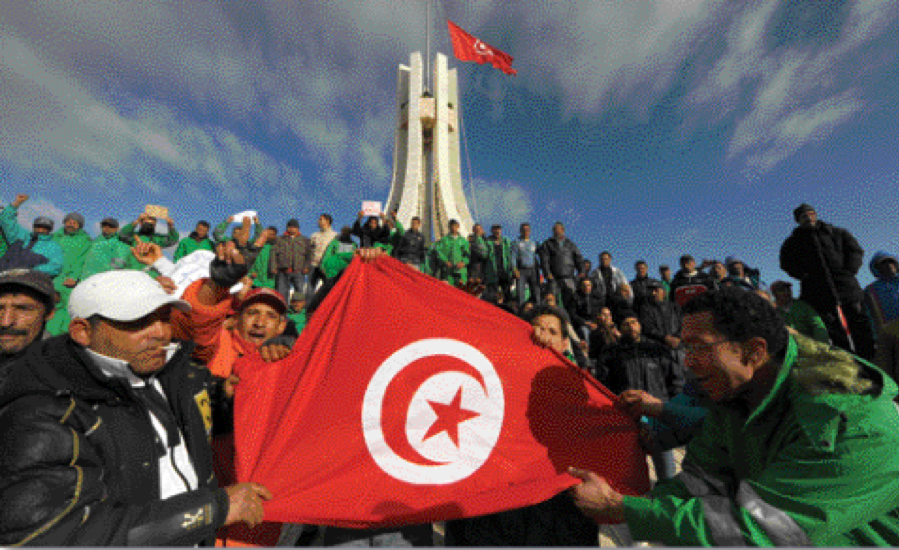
Yet it all collapsed with startling speed, with the failure of “trickle-down economics” to produce jobs sparking the unrest. A young college graduate, underemployed as a fruit vendor, set himself on fire and ignited a national revolt. It was not just his economic frustration that led him to this fateful act: He was humiliated by the police, who unceremoniously shut down his business. To say that the riots stemmed only from a disconnect between growth and job creation would underestimate the hunger for freedoms, especially as security forces began to fire on protesters, wounding and killing many.

Ask the crowds still demonstrating in Tunis. They want rights, too. On January 13, Ben Ali tried a last-ditch appeal to calm protesters by pledging to leave office in three years and to lift censorship. Too little, far too late. He left for exile the next day.

After his exit, crowds gathered daily — met with violence from the police, tear gas and beatings — to reject the interim cabinet, which is dominated by leftovers from the previous government. Veteran human rights activist Moncef Marzouki arrived at the Tunis airport from exile in Paris and called the interim government a “masquerade.”Supporters and bystanders called for freedom.

Is there a lesson here for the region’s other Arab leaders? They too follow the same economy-first dogma. Take Egypt, for example. Last November, the finance minister, Youssef Boutros Ghali, wrote in the Washington Post that what “matters most to ordinary Egyptians is their standard of living.” He went on to boast of Egypt’s independent media and Internet freedom in what he called a “healthy political space.” A few days later, Egypt’s parliamentary elections turned farcical as opposition candidates were thrown off ballots, election monitors — even those from participating parties — were barred from polling places and police disrupted campaign rallies. As of this writing, thousands of protestors were still in the streets of Cairo, calling for an end to the regime.

Algeria, statistically booming from natural gas sales to Europe and beyond, has been beset by strikes and self-immolations, while a series of copycat immolations from Morocco and Saudi Arabia are becoming a potent symbol of hopelessness. Wikileaks is credited widely with opening Tunisian eyes to the corruption central to the people’s frustration. A 2008 cable from the US embassy in Tunis detailed the lucrative wheeling and dealing of Ben Ali’s extended “family.” But it’s not as if Tunisians weren’t already aware of corruption. I’ve had taxi tours of Tunis in which embittered drivers pointed out lands and projects controlled by relatives of Ben Ali. In Cairo and Damascus it is much the same: pals of the powers-that-be dominate the development landscape. In these countries, citizens have no conduit for their complaints, much less ways to persuade anyone to crack down. The impunity that allows rampant human rights abuses also shields despots from scrutiny of their business dealings.

Tunisia’s saga shows there is a limit to the growth-without-freedom model. Prosperity statistics don’t erase the degradation of arbitrary rule. Freedoms may not do away with the frustrations of a country’s youth, but they at least would offer a channel for influence. Getting rid of Ben Ali is not enough; full respect for speech, association and participation in political life, as well as economic rights, is what is needed.

DANIEL WILLIAMS is a senior emergencies researcher for Human Rights Watch


February 3, 2011 0 comments
0 FacebookTwitterPinterestEmail
Society

Beware of small states

by Dean Sharp February 3, 2011
written by Dean Sharp


Lebanon is in crisis mode, again, and as usual it is not only a Lebanese concern. Crisis and foreign intervention go hand in hand in this small, fought-over state. This time around, it is Syria and Saudi Arabia who have added their names to the long list of failed intermediaries. Their foreign interventions, as well as those of Israel, France, the United States and Iran, have regularly ranged from ineffective to catastrophic.

The diplomatic excesses and Machiavellian schemes of foreign states in Lebanon have left a depressing legacy in the country that has been deftly examined by veteran British journalist David Hirst in his latest book ‘Beware of Small States: Lebanon, battleground of the Middle East.’  The book takes its title from  Russian anarchist Mikhail Bakunin, who warned that while smaller states are often the victims of larger ones, they are also a source of danger for regional powers — a fitting warning here in Lebanon, the ‘Achilles’ heel’ of many of the region’s power brokers. 

Hirst gives a fascinating account of how Lebanon has twisted and turned in the regional headwinds. A principal point of discussion is the incongruous relationship between Lebanon and the nascent state of Israel. Initially, the newly arrived merchant Zionists to the Levant were welcomed with open arms in Beirut. “The [Lebanese] government even produced a tourist manual in Hebrew, whose preface proclaimed that, ‘Anyone who wants to lengthen his days, taste paradise and feel the world to come should spend some time in Lebanon.’”

Many would say that the future state of Israel took this tourist manual too literally, with its 1982 invasion and two-decade occupation of South Lebanon. Indeed, as Hirst points out, “from 1973 till this day [Lebanon] has … furnished the only militarily active front in the Arab-Israel struggle,” with the exception of occupied Palestine.  Israel itself is another example of the “small state” phenomena, as is emphasized throughout the book. However, as Hirst shows, its creation was “…a vastly more arbitrary example of late imperial arrogance, geopolitical caprice and perniciously misguided philanthropy than Lebanon’s.” Hirst articulates how the lessons have not been learnt, noting that the needs and fundamental demands of the Palestinian population are ignored in the Israeli project. Misguided philanthropy has also cost the US government countless billions each year in government aid alone. While often a diplomatic and military battleground, Lebanon has also been an ideological front for many of the seminal movements of the past century in the region. Whether it was anti-Ottoman independence, resistance to Israeli occupation, pan-Arabism, sectarianism or Islamism, Hirst asserts that Lebanon has been the unwieldy axis on which the region turns.

 When Arab nationalism began its rise, Lebanon was a key player. It was one of the founders of the Arab League and where, Hirst argues, “Nasserism reached its high-water mark.” Lebanon would also take on with equal fervor the revolutionary spirit of the 1979 Iranian revolution from which sprung the makings of today’s Hezbollah. Though a detailed and well-researched account of Lebanese and regional history, there is one glaring omission: David Hirst himself. A British journalist who has lived in Beirut for the past 50 years, Hirst likely has much to contribute about the familiar aspects of life in Lebanon. In contrast to Robert Fisk, who is often criticized for his improbable propensity to be “at the scene” at every major event that has hit Lebanon, if not the region, Hirst seems nowhere, leaving a sense of detachment from the country itself.

For better or for worse, regional and international powers have not shared this hesitancy to project themselves onto the Lebanese landscape, continually lured into the morass of Bakunin’s small-state curse. 


February 3, 2011 0 comments
0 FacebookTwitterPinterestEmail
Society

The ‘Butterfly Effect’

by Thomas Schellen February 2, 2011
written by Thomas Schellen

In one example of the damage to Japan
</p>
									            </div>
        </div>

		            <div class=

February 2, 2011 0 comments
0 FacebookTwitterPinterestEmail
  • 1
  • …
  • 392
  • 393
  • 394
  • 395
  • 396
  • …
  • 686

Latest Cover

About us

Since its first edition emerged on the newsstands in 1999, Executive Magazine has been dedicated to providing its readers with the most up-to-date local and regional business news. Executive is a monthly business magazine that offers readers in-depth analyses on the Lebanese world of commerce, covering all the major sectors – from banking, finance, and insurance to technology, tourism, hospitality, media, and retail.

  • Donate
  • Our Purpose
  • Contact Us

Sign up for our newsletter

    • Facebook
    • Twitter
    • Instagram
    • Linkedin
    • Youtube
    Executive Magazine
    • ISSUES
      • Current Issue
      • Past issues
    • BUSINESS
    • ECONOMICS & POLICY
    • OPINION
    • SPECIAL REPORTS
    • EXECUTIVE TALKS
    • MOVEMENTS
      • Change the image
      • Cannes lions
      • Transparency & accountability
      • ECONOMIC ROADMAP
      • Say No to Corruption
      • The Lebanon media development initiative
      • LPSN Policy Asks
      • Advocating the preservation of deposits
    • JOIN US
      • Join our movement
      • Attend our events
      • Receive updates
      • Connect with us
    • DONATE