• Donate
  • Our Purpose
  • Contact Us
Executive Magazine
  • ISSUES
    • Current Issue
    • Past issues
  • BUSINESS
  • ECONOMICS & POLICY
  • OPINION
  • SPECIAL REPORTS
  • EXECUTIVE TALKS
  • MOVEMENTS
    • Change the image
    • Cannes lions
    • Transparency & accountability
    • ECONOMIC ROADMAP
    • Say No to Corruption
    • The Lebanon media development initiative
    • LPSN Policy Asks
    • Advocating the preservation of deposits
  • JOIN US
    • Join our movement
    • Attend our events
    • Receive updates
    • Connect with us
  • DONATE
Finance

Lurching forward

by Emma Cosgrove April 1, 2010
written by Emma Cosgrove

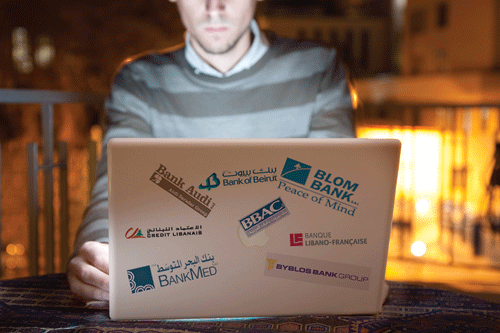
With the financial crisis winding down, hiring is set to cautiously resume in the region’s banks. Executive spoke with Panos Manolopoulos, vice president for the Middle East at Stanton Chase, an executive search and compensation consultancy, to find out what financial jobseekers can expect to see in 2010.

 E  Did the banking sector see the trimming down of personnel as much as other sectors?

There were a lot of losses in most parts of the banking sector. The mortgage losses were the centerpiece of the crisis and of course that led to many layoffs and, in turn, restructuring. So all the players took a hit and no one can claim to have been unscratched. JP Morgan, HSBC, Goldman Sachs, Bank of America; everyone has felt it.

There has been a trimming down of personnel as much as other sectors and in some cases even more. But things are getting back to normal a little bit right now, because we are seeing some light at the end of the tunnel. Some financial institutions are again searching for talented people, but they are very cautious right now. They don’t want to revisit the nasty experience that they had in 2009.

E  How has compensation in the banking industry changed since the financial crisis?

In terms of base salaries for top performing senior managers it has not changed much. Of course, finding the right [chief executive officer], [chief financial officer] or head of capital markets is not an easy task. And the list of competent people who can deliver is short. So the top jobs continue to post top salaries. Where do we see changes? It is in bonuses and payouts, which are not being paid by many organizations this year. Some housing allowances dropped approximately 40 percent, or in some extreme cases they have been completely cut from the budget. There are some clients that are much more reluctant to [hire internationally], as they feel that the talent in the local pool is far more accessible to them.

This is a trend that we see growing over the coming years. Generally speaking, this ‘Emiratization,’ or general nationalization of human resources is the trend. And of course at the forefront is the banking sector.

E  Which countries in the region have the highest paid bankers and is there any explanation as to why?

Generally Saudi is booming and everyone is trying to get a piece of the pie. I think that the bankers with key relationships in the region will simply be doing better than their peers and make the most money.

In a very simplistic approach I would say that Saudi, being the least regulated market in terms of salary levels, and at the same time having big opportunities is the reason for some bankers there making good money.

E  How much does compensation differ from bank to bank in the region? What is the reason behind these differences?

Unfortunately, compensation differs tremendously from bank to bank and the main reason is that it isn’t a mature market. During the boom, banks could not find enough staff to manage their gold, so they hired people who could grow into the roles to which they were assigned. This created internal inequity, because all of a sudden you had someone with eight years of experience earning the same as someone with three years of experience. The banking market is fragmented and I think it will take some time for there to be some regulation.

E  Does compensation at the state-owned banks hold up to private institutions?

[State-owned banks] are sometimes forced to be competitive when it comes to top executive jobs. Other times, with middle management jobs, they use the argument of being state-owned with some sort of rules about salary levels in order to negotiate, and because of that sometimes they are losing some good candidates. [Compensation at state-owned institutions] is lower.

E  Are there any other trends that you expect to play major roles in 2010?

There will always be a fight to attract talented people, because it’s a hosting region. That will always continue to happen. But at the same time gradually over the years we will be seeing more and more locals occupying top jobs and climbing up the ladder.

E  Are Lebanese bankers still in demand around the region or is this trend shifting as well?

[Yes, but] not because of their technical skills — we have found very strong bankers from multiple nationalities — but I think it is because of their overall package. And it is not a phenomenon particular to the banking sector, it is in all sectors. Why are Lebanese at the top of the list of the most wanted executives in general? It is because they have this combination of the Middle East experience with European, Western experience.

They speak three languages and have Arab culture    but at the same time have Western culture. And the last, which I think is the most important, is that they have some entrepreneurial spirit, unlike the overall perception of the rest of the countries including the Levant neighbors.

The Lebanese can start a business and they are a lot better in business development. I wouldn’t say that they are better bankers in the sense that they are more technically equipped, but I think the whole package that they are carrying  makes them look more attractive.

E  What is the role of nepotism in hiring in the banking sector? Does this hurt the actual human talent of the bank?

Absolutely. We are beginning to see a trend of family conglomerates getting rid of nepotism, but it’s something that will not happen overnight. In most of the cases what we see is that there is good willingness, but when it comes to crises or decision-making processes, it is always an implication; meaning that the involvement of nepotism is higher than expected.

Sometimes the processes are not very transparent, because at the end of the day, the last word is the major shareholder or the family member that is the leader of the group. I think that the social structure of this region is influencing this and it will remain so for many years to come. It will be very difficult to get rid of it.

We are working outside the financial sector with a number of family conglomerates and we see that there is a willingness to get rid of [nepotism], but at the end of the day, it is part of the culture. It will not happen overnight or even over a generation.

It also varies across the region. It is a lot less in Lebanon. It’s a lot more in Saudi, in Oman and in Qatar.

April 1, 2010 0 comments
0 FacebookTwitterPinterestEmail
Real Estate

Out with the old

by Nada Nohra April 1, 2010
written by Nada Nohra

In the late 1940’s after World War II, to avoid tenants from being thrown out of their homes and exacerbating the economic and social distress of the time, the Lebanese government issued an exceptional law stating that all rental contracts would be extended until a new law is issued in that regard; and, until 1992, all those new laws only extended the old one.

This meant owners could only repossess their properties under two circumstances: for family needs or demolition, while paying a compensation fee of 25 to 50 percent of the value of the property, the exact amount determined either between the two parties or by the courts.  In 1992, two laws were issued distinguishing between contracts made before 1992 and the ones made after: Law 160/62 extended the former rental law and applies to contracts made before 1992. The second law (159/62) applies to contracts made after 1992, and stipulates that rental agreements should be signed for at least three years, unless otherwise agreed upon. The 160/62 law was also extended many times, most recently this past February.

The problem

When the Lebanese lira began to devaluate in late 1980’s, old rental rates was not allowed to rise in line with inflation and thus the money collected by owners was negligible. Even though the 160/62 law in 1992 included an increase in rents, they were still well below market value and owners were not allowed to implement any further increases.

Georges Rabahiye, president of the Owners’ Association, which has been active since 1988, said some rents total only $120 a year. Consequently, owners are demanding to cancel the old contracts so rents can align with the true market value, while also giving tenants a three-year window to vacate. Although owners have been promised a new law for a number of years, it has not yet been issued.

“Every one or two years they draft a law and fool the owners,” said Rabahiye. “We can no longer accept tenants with this low rent.”

On the other hand, Marie Nassif Debs, the president of the Tenant’s Association, said that most of the old-rate tenants belong to the lower-income bracket and older age groups, and thus they are concerned about the impact canceling the contracts may have. The increasing rents, especially in Beirut and its suburbs, and the absence of a housing plan to accommodate low-income tenants will create a housing problem for many families, said Debs.

“There is a substantial number of tenants who, if they are [forced to vacate], will not be able to rent new apartments,” she said. “We are not against freeing the contracts but it should be done, taking into consideration the social and economic situation of the tenants.”

Under the old law, it is not easy for an owner to repossess his property. Nader Obeid, partner at the law firm Alem and Associates, explains that if the two parties don’t agree and they go to court, these cases could take years to resolve.

“We have a judicial system which is not known for its high speed,” he said, adding that, “These cases are not considered as priority and they could take a year, two or three, or could end quickly depending on the speed of the courts…it is unpredictable.”

The new law

The Parliamentary Administration and Justice Commission has come a long way in drafting the new law, but sources from the commission said that there are still two major points being discussed. The first is the time frame within which the old contracts should be canceled — arguments thus far generally place this between four and seven years. The second point is compensation for tenants upon vacating. The commission is still deciding whether to implement a fixed percentage on the value of the property or if the compensation should vary depending on the time in which the tenant vacates.

The commission is also planning to increase rents gradually, so that at the end of the seven years, they will reflect market rates.  

Rabahiye said that owners should completely refuse to pay any compensation. He argued that owners should be the ones compensated since they suffered huge losses due to decades of low rents.

“Compensation usually goes to the damaged. Therefore it should be given to the owner and not the tenant and it should be retroactive,” he said.

None of the parties know what the new law will actually include; they simply lobby the commission hoping their demands will be heard.

“The commission has met with both parties, taken their demands into consideration and now is trying to reach a common ground,” said a source from the Admissions and Justice Commission, which is responsible for drafting the new law. “The municipality law might delay the rental law for a while…but I still think it should be done by the end of 2010.” If the law is not issued, the old law will again be extended.

The lease to own ‘solution’

In 2006, a ‘lease to own’ law was introduced, to be implemented by the Public Corporation for Housing (PCH). It included giving incentives to developers to build low-income housing, which tenants can either buy, or rent with the possibility of later purchasing. The PCH found that, under the law, buyers would pay some $80 to $120 per month for 40 years without a down payment. The implementation decree of this law has yet to be issued, however, and therefore it cannot be applied.

Debs from the Tenants’ Association expressed hope that this scheme would be part of the solution for old tenants, allowing them to buy affordable houses. She said that the compensation given by the owners would serve as a first payment to the PCH, which would thereafter be paid in small installments. Debs doubted, however, whether the implementation decree would ever be delivered.

Abdallah Haidar, president of the PCH, explained that the corporation first introduced the project for new university graduates and was not meant for long-standing tenants. He added that the older tenants would not meet the loan’s age requirements.  “Even if we change the law and gave loans to this age bracket, what assurance could be given to us to ensure that the loans will be paid?” asked Haidar. The loans cannot be given without life insurance, which will be costly for the elderly.

One solution often heard is for the loan to be signed in the name of the tenant’s children, but, “The law says that a citizen can only benefit from the loan once in their lifetime, so if children take the loan they won’t be able to buy a house for themselves later on,” said Haidar.

He added that although the PCH is already accepting some 6,600 loan applications each year, it is not organizationally or financially ready to manage the new scheme.

Number of properties in Lebanon rented before 1992, by region

Waiting for a solution

While tenants worry about canceling the old contracts in the absence of a housing plan, owners are eager to reclaim their properties; between the two stands the Adminstration and Justice Commission, trying to find a solution. All parties Executive spoke to said the government must ensure the tenants ability to find adequate housing.

However, with the PCH unable to handle the burden, the property market witnessing skyrocketing prices and no housing plan in the pipeline, the some 140,000 tenants who would be affected by the new rental law will surely not be relishing the day their contracts are finally canceled.   

April 1, 2010 0 comments
0 FacebookTwitterPinterestEmail
Comment

The region’s rising risk

by Paul Cochrane April 1, 2010
written by Paul Cochrane

Getting labeled as a high risk country for firms to operate in, or receiving a low financial rating by an agency, is like a movie getting slapped with a XXX rating instead of the General Release investors had hoped for — meaning the mainstream conservatives are going to stay well away.  Recently, ratings agency Moody`s downgraded seven state-linked firms in Abu Dhabi by a notch or more due to “no explicit formal” government guarantee to support the companies, and is considering downgrading four United Arab Emirates banks.

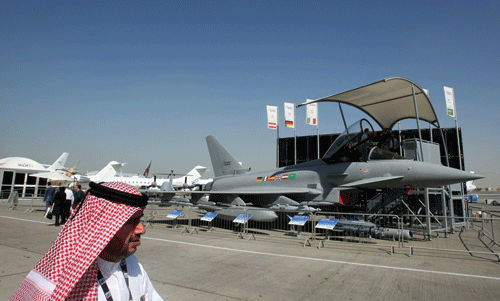
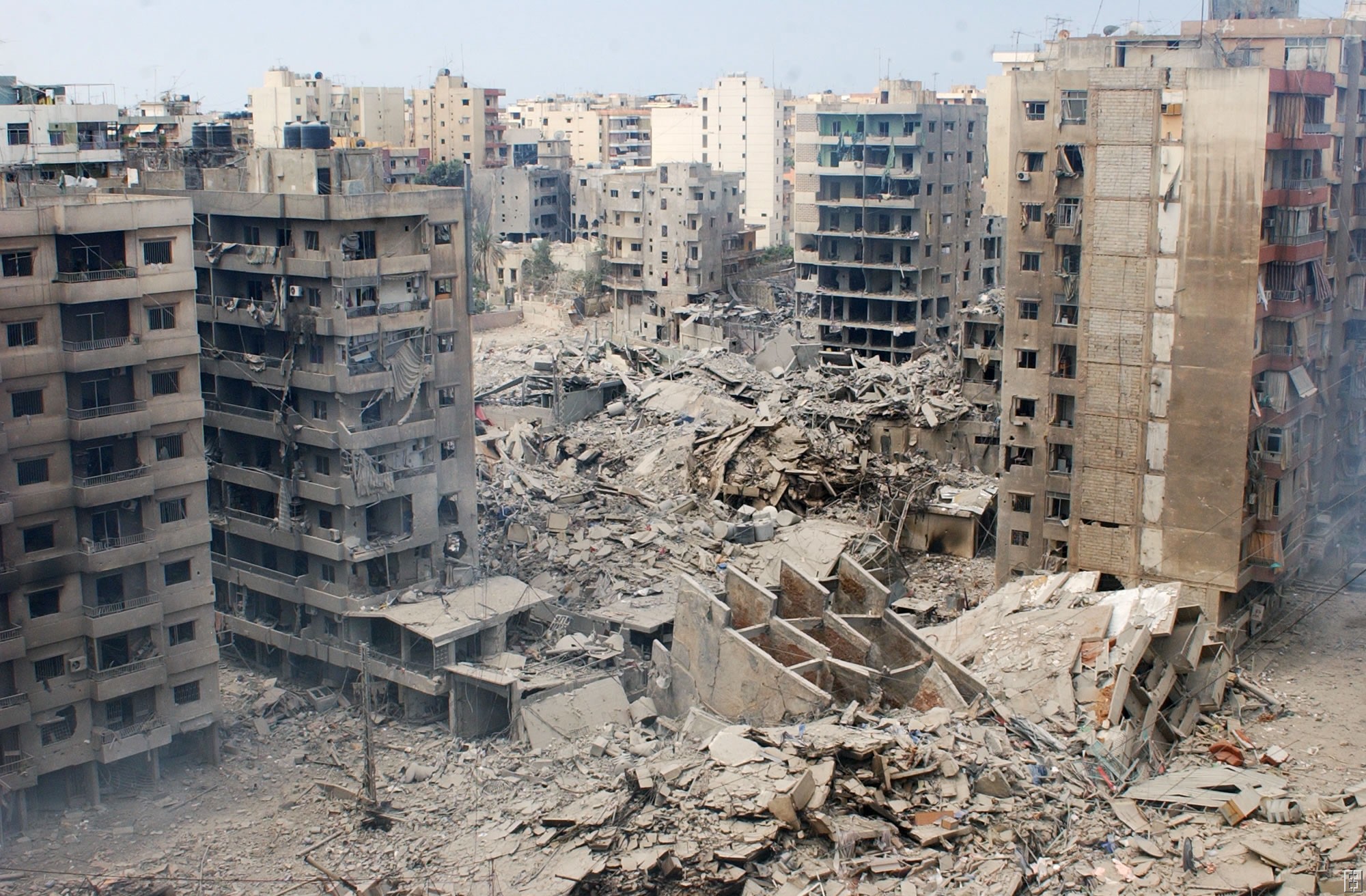
This comes as predominantly Western financial analysts are mulling not only higher risk ratings for Middle Eastern and North African (MENA) countries, but the region at large. The recent situation in Yemen, ongoing insurgency in Iraq and Israel’s sabre-ratting on Lebanon’s border are all causes for concern, as is as the potential for widespread conflict if the situation between Iran and the United States/Israel deteriorates into actual war.

On top of this, US regulatory watchdog, the Treasury Department’s Financial Crimes Enforcement Network (FinCen), is widening its offensive on the global financial system, from the now well-established anti-money laundering and counter terrorist financing regulations all banks operating with the US have to comply with, to a heightened focus on corruption – the Foreign Corrupt Practices Act (FCPA). This onslaught by Washington and US-based ratings agencies is making life hard for Middle Eastern financial institutions and foreign firms that work in the region, and in particular for raising capital in an already tight lending environment. But while the UAE is being a touch sensitive about the downgrades — after all, British and American banks received lower ratings following the financial crisis and resultant government bailouts — the regulatory side is decidedly political.

Since the creation of the US Patriot Act in 2001, doing business with the “wrong sort” has been taken increasingly seriously. Early last year, British bank Lloyds TSB was slapped with a $400 million fine by a New York court for illegally transferring funds on behalf of clients in Iran and Sudan, both of which are under US sanctions.

The lesson to be learned is clear: if you do business with the likes of Iran, don’t get caught, and if you do get caught, make sure you are making enough profit to pay the fines. Lloyds TSB was slapped on the wrist financially — eventually agreeing to pay $350 million — but the bank was not blacklisted by the US. It is hard to imagine a Middle Eastern bank, caught playing the same game, would be let off as easily. 

As for the FCPA, FinCen going after firms using bribes to get deals in the MENA region would open a Pandora’s Box given the rampant and endemic nature of corruption here, as a cursory glance at Transparency International’s Corruption Index shows.  British aerospace firm BAE felt this when it was investigated in London for greasing palms in Saudi Arabia to secure multi-billion dollar contracts. While cracking down on corruption is laudable, the case of BAE, like Lloyds, is a relative exception to the rule; corruption is blatantly practiced by Western firms, domestically and internationally.

 In any case, a greater focus on corruption and a higher collective risk level for the MENA would not necessarily dampen business or financial confidence; if that was the case, many firms and multinationals would have given the region the cold shoulder long ago. There is, after all, the maxim that big risks equal big rewards. Then there is the classic of “getting around” the rules and the regulations. On the regulatory level, institutions use tactics such as acquiring stakes — silently or not — in local banks and firms to operate in riskier markets. What such international firms need to watch out for is how far down the money trail US regulators may want to go. But unlike in the movies, financial institutions cannot edit or re-write the script where politics is involved; risks have to be faced head on, and it will no doubt come down to who you know.

 PAUL COCHRANE is the Middle East  correspondent for International News Services and writes for Money Laundering Bulletin

April 1, 2010 0 comments
0 FacebookTwitterPinterestEmail
Finance

Sprinting from the storm

by Natacha Tannous April 1, 2010
written by Natacha Tannous

Sprinting from the storm - First quarter results mask challenges around the bend

Once a hurricane passes, those left in its wake assess the damage, pick up the pieces and look ahead to how best to get on with life. The first quarter of 2010 was akin to such a moment for the six biggest United Arab Emirate banks, unbattening their hatches as the financial storms of 2009 slowly abated in the distance.

Ostensibly, exposure to poorly performing sectors and bad loans generally did not prevent Emirati banks from posting attractive numbers on first quarter financial statements.

But one must sift through the statistics to be sure whether faults in the findings have not been masked by opaque disclosures of asset quality and a recent UAE central bank circular to reduce provisioning.

The headline of the first quarter

Most UAE banks posted better-than-expected results, leading to improvements in ratings and paving the way for an upward trend in 2010 estimates.

According to profit and loss (P&L) statements, quarter-over-quarter (QoQ) improvements in first quarter net income stemmed from higher operating profits coupled with lower credit costs, which had peaked in the fourth quarter of 2009.

Net Income and balance sheet size of Dubai
</p>
									            </div>
        </div>

		            <div class=

April 1, 2010 0 comments
0 FacebookTwitterPinterestEmail
Business

Going your own way

by Carla Haibi April 1, 2010
written by Carla Haibi

After 18 years of partnership, the agency formally known as Saatchi & Saatchi Levant has split from the Saatchi & Saatchi worldwide network to become M&C Saatchi Middle East and North Africa, under Eli Khoury’s strategic leadership. Through this new partnership with M&C Saatchi, Khoury, chief executive officer of Quantum Group, is adopting a business model that may be a harbinger of a new way to conquer the market: one client at a time, one ad at a time.

Khoury says his drive for growth and continuous learning force him to challenge his status quo with every coming decade. After launching Quantum Group and its components in consultancy, content and communications in 2000, the advent of 2010 was a catalyst for Khoury to reassess his company’s standing and the way it provides services.

Companies need to design strategies in line with new trends in tools and technology if they want to stay on top of the communications game. The inability of big networks to keep pace with the shifting momentum of the industry fueled Khoury’s decision to split from Saatchi & Saatchi. “If you want to offer a client  something in communications, you have to walk in knowing what is happening online, offline and everywhere else,” he said. In a transforming industry, Khoury advocated a thorough mastery of the new trends in communication and how to apply them to any agency or network’s core strategies.

“It’s not only about bringing the cyber age into communication,” he said. “You have to really understand it. It has to be part of your first thinking.”

When Khoury first partnered with Saatchi & Saatchi network, as Saatchi & Saatchi Levant, it was still with the brothers Maurice and Charles, who founded the firm in 1970. The brothers later split from the network to start M&C Saatchi in 1995. In the mean time, Saatchi & Saatchi turned into a global network owned by Publicis Group. But then the network’s advertising spirit lost its essence, said Khoury.

Splitting from the pack

With half of the region managed by Saatchi & Saatchi and the Levant area managed by Eli Khoury, under the Quantum Group, the network was much less concerned with the small Middle East market than it was with the larger and more lucrative emerging markets of Brazil, Russia, India and China. After careful examination, Khoury could no longer see the relevance of being bound to a global network.

“Their agenda for the Middle East was something that we could not find our way through,” he said, noting that the agenda was not just about the future plans and strategies, but also about the clients they cater to, as well as allocation of their competencies and talents.

Diverging agendas with the Saatchi & Saatchi network was not the only problem though. The impact of the economic downturn on the mega group trickled down to the regional agencies and then to the clients, due to budget restrictions and lack of investment opportunities. The disagreement was also rooted in the disparity between how the Saatchi & Saatchi network wanted to do business, how it could adapt to the change in the industry, and Khoury’s vision and aspirations. Saatchi & Saatchi worldwide, a network operating in many countries, had an inefficient formula that, according to Khoury, was outdated in today’s changing industry.

While he agreed that larger networks provide a presence worldwide, this presence does not always deliver as it should.

“That big network name doesn’t give you added value,” said Khoury. “The myth of a network agency doing better because it belongs to an enormous machine doesn’t exist.”

In reality, the network’s operating costs were high, its resources, core competencies and talents diluted, and the investment opportunities were limited as a result of the economic downturn. Consequently, agencies in the Middle East were penalized by budget restrictions and their relationships with clients were jeopardized.

“If you look at networks that are owned by mega groups, [they] cannot invest as we speak, [even] if they have an important client they need to cater to,” Khoury explained. “Somebody who lives in a far off land is taking decisions on behalf of the region, whereby [that] region might have its own specific needs, its own specific hunger and investment requirements.” 

Another issue was that business coming from the network was limited.

“Some 95 percent of our revenue and of our work is from our agency’s clients, which did not come from the network,” said Khoury.

The network was also squeezing the already limited resources to maximize services for minimum fees, while the revenues and operating costs remained the same. As a result, the network was not accommodating clients properly, and neither could Saatchi & Saatchi Levant, given the nature of the agreement with Saatchi & Saatchi worldwide network.

Additionally, having a fully operating agency in almost every market is no longer optimal, as it erodes both revenues and talents.

“The thickness of your talents working together is nuclear,” said Khoury. “It is like any good paste, you dilute it too much [and] it becomes watery.”

On the other hand, through the strategic partnership with M&C Saatchi, an agency that also has a multinational presence, Khoury claims he is acquiring more flexibility in terms of his core strategies, resource and competency allocation and, more importantly, decreasing operating costs.

A fresh start

Along with a new name and partnership, comes a new business model. With M&C Saatchi, Khoury sees it as more efficient and effective to behave like a consulting group, with a back office — which he calls the “lighthouse” — being the main hub of competencies in Lebanon, and a front office of consultants and talents, acquired as necessary.

Such a centralized business model with an expansion strategy helps his company make use of economies of scale to provide a better service for the client, at a lower cost. It also offers flexibility to service choice clients and concentrate on lucrative markets, while still having the freedom of getting in and out.

The focus will not be on increasing market share or on going after market advertising expenditure, but rather on following target clients.

“We will be driven by the client not the market,” said Khoury.

Similar to supply-chain management, the new business model relies on building a competitive and competent infrastructure and leveraging the logistics, all in synchrony with demand. Hence, new acquisitions, if any, will be to diversify the services, and supply new competencies to the clients.

Completing the Saatchi circle

Quantum Group’s communication services are now referred to as M&C Saatchi MENA, with a minority stake going to M&C Saatchi. The MENA agency also features Brand Central, Fusion Digital and Vertical Media, regional brands that offer expertise for offline and online communications and brand building tasks, servicing clients with a wider range of interests.

Geographically, there will be no more limitations as to which clients Quantum with M&C Saatchi can access, in the Near East, Middle East, North Africa, and beyond if need be. Without the restrictions set by alliances with mega-networks, Khoury can also cater to any client anywhere without worrying about having an office in that specific location, with the specific competencies that will deliver a quality service.

“If our client is a multinational and wants us to be in five different countries, we will be in five different countries at the same time,” he said.

Having established a firm regional standing in media and communications, Khoury endeavors to thrive on continuous growth and push industry standards higher every decade. The value of his group has been its propensity to push the red lines, acting unconventionally while addressing the effects of new media on the industry, and incorporating new tools into core strategies that better serve the client.

In spite of the current industry changes, Khoury believes that when delivering a message, the principles will always be the same. The template, through which that message is delivered, however, is in flux.

In the process of globalization and the extension of the worldwide network, Khoury felt advertising work lost its zest.

“It’s becoming so mechanical that it is not even interesting anymore,” he said.

With little added value from the global network, the split was a natural progression, with the criteria for choosing the best new partner for Quantum tied to increasing their coverage and the thirst for learning new skills. 

“We are aiming at a competency relationship rather than just a network membership,” he said. Nostalgic for the 1980s and 1990s, and the era of “true-spirited advertising”, Khoury saw in M&C Saatchi a shared passion. Just like in most industries, enthusiasm and dedication were most likely to be found in smaller agencies where creative people still thrive on making ads, rather than expanding.

“M&C Saatchi is an independent network, but it’s not a machine. It’s about Soho, it’s about Charlotte Street. We did our lengthy turn to go back to Saatchi, from Saatchi & Saatchi to M&C Saatchi. Basically, you can call us Saatchi. This is where it all started, and, it seems, where it had to end, or to start again.”

April 1, 2010 0 comments
0 FacebookTwitterPinterestEmail
Real Estate

Hilton on ice

by Rayya Salem April 1, 2010
written by Rayya Salem

Lucas William, tapped to be the director of operations at the Hilton Beirut, is not talking about the elephant in the room. Indeed, most of the affiliated parties are keeping mum about the eight-storey, 158-room hotel in Minet a-Hosn that stands ready but is suspiciously closed. The hotel’s awkward silence in the midst of a buzzing touristic hotspot has lead many a curious mind to speculate what went wrong.

Davis Langdon Lebanon (DLL), the hotel owner’s representative during the construction phase, which ended in January of 2007, abruptly left the Hilton party when its contract was up. A spokesperson from the group declined to comment, instead referring queries to the “sole owner,” Nadhmi Auchi, chairman of General Mediterranean Holdings (GMH) — an expansive holding conglomerate made up of 120 companies in 28 countries, with more than 11,000 employees and assets worth over $4 billion. However, the Iraqi-born businessman — most well known in Lebanon for his Dbayeh landmark, Le Royal Hotel, and its Watergate theme park – also shied away from an interview with Executive after originally accepting the proposal in early July. However, Nizar Younes — the original owner of the central district land behind Beirut Souks and president and founder of Butec engineering firm, which constructed the Hilton — and the commissioned architect, Younes’ daughter, Hala Younes of Atelier d’Etudes techniques et d’Architecture Beyrouth (AETA), responded to interview requests regarding the five-star hotel’s nearly three-year delay and the tangle of legal disputes.

In 2005, Nizar says Auchi was brought in as a partner in a holding company Nizar had started, called Sharikat Al Ikarat Wal Abniat (SIWA), which owned the Hilton property in full. As construction of the $70 million hotel project neared the halfway point, Nizar says he needed extra capital. He and his brother Issam retained a 49 percent share of SIWA (29 percent and 20 percent respectively), and sold 51 percent to Auchi, making him the majority stakeholder.

Auchi heralded his new stake in SIWA in GMH’s 2005 chairman’s statement, which read: “Through subsidiaries we own controlling interest in the Beirut Hilton, located in the center of the city, which is in the final stages of construction and is expected to be ready by the end of 2006.”

Nizar claims that Auchi has the master key and is leaving the Hilton locked up until he can purge the Hilton’s management, obtain full ownership and have his Le Royal team manage the hotel instead.

On July 12, the International Court of Arbitration in Paris, under the International Chamber of Commerce, ruled that Auchi must pay compensatory damages for delaying the hotel’s opening, “which was estimated by the court for the whole period to be… around $40 million dollars,” said Nizar.

In 2007 Nizar says he sold Auchi his 29 percent share, but has yet to be paid in full, with this dispute now the subject of a pending legal battle in Lebanon in the Jdeideh Court of Arbitration.

Issam Younes has held on to his 20 percent share, despite several takeover attempts by Auchi.  AETA’s Hala Younes says that her firm’s role in the project has dragged on for roughly 10 years, starting from the original contract signed with Hilton in 2000, to court arbitration in Lebanon with Auchi over lack of payment. AETA finally received full payment in 2009. 

Hala claims that the GMH chairman was in agreement with the original layout for interior design, but later didn’t pay in full, claiming that the result deviated too much from the original agreement. 

Refuting the rumors

Among the more persistent rumors regarding why the Hilton has remained closed is that it failed to meet Hilton’s construction standards. However, on Feb 21, 2007, Hilton International headquarters sent a letter of approval to the architect’s Verdun office, confirming that the hotel’s physical structure, surfaced in acid-etched glass to protect it from the sea climate and featuring custom-made interior design, was up to par. According to Hala Younes, Solidere signed the occupation permit in January 2008, verifying that the building meets legal standards. The hotel still doesn’t have a legal permit to operate, however, as SIWA has not signed it.

If, or when, the new Hilton Beirut does open, the Lebanese can be thankful that its delay was down to simple, old fashioned business wrangling, rather than an omen of imminent war like its ill-fated predecessor; the original Hilton was due to open one day before the start of the Lebanese Civil War in 1975.  

April 1, 2010 0 comments
0 FacebookTwitterPinterestEmail
Economics & Policy

Regional equity markets

by Executive Editors March 27, 2010
written by Executive Editors

Beirut SE  (One month)

Current year high: 1,200.49    Current year low: 705.56

>  Review period: Closed: Feb19 – 1,099.12  Period change: 2.7%

BLOM Bank and developer Solidere’s two share classes drove the index gains, with improvements of 5.9%, 4% and 5%, respectively. On the downside of index movement, banks BEMO and BLC gave up 12.2% and 9.6%. Banks BLOM and Byblos reported full-year 2009 results to have improved 16.5% and 20% from 2008. Bank of Beirut posted a 15% profit improvement. Egyptian analyst house HC tipped BLOM and Byblos as buy opportunities and saw Bank Audi as a solid hold.

Amman SE  (One month)

Current year high: 2,968.77    Current year low: 2,396.28

> Review period: Closed: Feb 21 – 2,446.71 Period change: -3.1% 

ASE traders might be hoping to strike solid desert rock and gain footing for a rebound. On Feb 18, the index fell to 2423.80; its lowest reading in over five years, according to local media. This was compounded by an even steeper fall toward the end of the month. No sector ended the review period with growth; insurance was best, at .025% percent down. Industry and services dropped 3.7% and 3.4%, respectively. Gainers came from the smaller stocks. Of the five firms with market cap of more than $1 billion, the strongest were Jordan Telecom and lender HBTF with gains of 0.9% and 0.3%.

Abu Dhabi SM  (One month)

Current year high: 3,239.74    Current year low: 2,311.11

> Review period: Closed: Feb 21 – 2,754.68 Period change: 4.6%

With the media birds of prey circling over Dubai, the ADX weathered more winds of challenge, but recorded a black zero in performance when compared with the last session in 2009. Adding 8.4% and 7.7%, the consumer goods and telecoms indices led the advancers, while the real estate index, down 2.5%, was the single losing sector. Etisalat, the only ADX firm with more than $10 billion in market cap, climbed 7.7%, and Abu Dhabi Commercial Bank, up 24.3%, was the big cap stock with the best performance. It was a bad month for driving instructors: Emirates Driving Co plunged 18.7%.

Dubai FM  (One month)

Current year high: 2,373.37    Current year low: 1,490.02

> Review period: Closed: Feb 21 – 1,623.93 Period change: 2.1%

Another dismal month for the region’s most troubled performer for the year to date, down by 10% in 2010. Volatility topped 23% and the P/E ratio was a mere 9.15x. Real estate and utilities sub-indices ended the period lower. With the exception of a high-flying materials index, transport and banking were the cheeriest sectors. Negative news got the most press and a new oil find, trumpeted out as good news for the emirate, was met with skepticism. It seems the vultures with trust issues outnumber the noble falcons circling the Burj Khalifa. 

Kuwait SE  (One month)

Current year high: 8,371.10    Current year low: 6,391.50

> Review period: Closed: Feb 21 – 7,418.90 Period change: 5.6%

February’s trading supplied almost all of the KSE’s gains since the start of 2010. Real estate was flat. Insurance was the only sector to dip into the red during the review period. Up by over 9% each, food and banking indices represented the sectors that flavored the month positively. KSE heavy Zain Group said farewell to its visionary CEO, Saad al-Barrak, then announced a very profitable sales plan for its African assets. The latter move fueled a 44.4% share price gain for the stock in the review period.

Saudi Arabia SE  (One month)

Current year high: 6,568.47    Current year low: 4,130.01

> Review period: Closed: Feb 21 – 6,479.15 Period change: 3.6%

The Tadawul index of the SSE closed the review period up 5.8% on 12 months ago. The upside outlier was agriculture, at plus 5.3%. The investment sector fared worst at -1.2%. Weqaya Takaful, a firm that started trading last June, dropped 22%. Kingdom Holding was the top advancer, appreciating 55.6%. Insurance debutants, Buruj Cooperative and Gulf General, put in shooting star performances gaining 258% and 150%, respectively, when compared with their February trading starts.

Muscat SM  (One month)

Current year high: 6,798.17    Current year low: 4,575.99

> Review period: Closed: Feb 21 – 6,798.17 Period change: 4.1%

While not in the least likely to be a psychologically significant barrier, the Feb 21 close marked a new 12-month high for the MSM and the benchmark index’s strongest reading since November 2008. The MSM is the best performing GCC stock exchange for the year to date; its gain of 6.74% put it almost one percentage point ahead of the Saudi Stock Exchange The industrial index was the MSM’s lead performer in February, whereas the banking index trailed the general index for most of the period, closing about half a percentage point below the benchmark.

Bahrain SE  (One month)

Current year high: 1,681.28    Current year low: 1,413.28

> Review period: Close: Feb 21 – 1,513.45   Period change: 2.4%

Not a traditional contender in the Winter Olympics, the BSE seemed to try for some downhill-uphill action around the first week of the Vancouver Games before regaining a solid percent of index values. Of sector indices, insurance, banking, and services outperformed the general index last month; investments stalled and industry tanked. Top gainer of the period was Bahrain Kuwait Insurance, up 20%. Arab Banking Co. dived 23.2% in the review period. Gulf Finance House, the Sharia-compliant financial firm, reported a 2009 net loss of $728 million, mostly from non-cash provisions.

Doha SM  (One month)

Current year high: 7,624.45    Current year low: 4,230.19

> Review period: Closed: Feb 21 – 6,950.58  Period change: 5.98%

February saw redemption from the fall of January for the QSE index but still a drop of -0.1%, year to date. All sector indices were positive in February, with banking and industry gaining 7% and 6%, respectively. Services and insurance trailed slightly with gains of 3.3% and 3%, respectively. Market cap leader Ezdan Real Estate edged up just under 1% and Industries Qatar climbed 4.9%. Market watchers expect Qatar will be a good bet going forward, in anticipation of solid economic growth. 

Tunis SE  (One month)

Current year high: 4,743.05    Current year low: 3,059.18

> Review period: Closed: Feb 19 – 4,681.53 Period change: 0.8% 

Compared with December and January’s relentless ascent, the Tunindex checked its pace in February but remained the region’s best climber. The exchange’s three top gaining companies this month made for an eclectic manufacturing mix — Electrostar, an assembler and distributor of household electric and electronic goods, rose 24.7%; tire maker STIP advanced 21.7%. Third in the group with 21.1% was cement maker Ciments de Bizerte, which, until Feb 3, had been on a prolonged slide from its trading debut last October.

Casablanca SE  (One month)

Current year high: 11,729.86  Current year low: 9,99.756

> Review period: Closed: Feb 19 – 11,053.55           Period change: 1.1% 

Market cap leader Maroc Telecom traded sideways during the review period, ending on a slight downward bias. Leading bank Attijariwafa maintained an overall positive trajectory, climbing 5.2%. The exchange’s price to earnings reached 18.6x, making it the most expensive equities market among the Middle East and North African markets tracked on these pages. The Damascus Stock Exchange, which celebrates its first birthday in March and is not currently part of this markets roundup, reported a still higher P/E ratio of 21.2x.

Egypt CASE  (One month)

Current year high: 7,249.55    Current year low: 3,517.33

> Review period: Closed: Feb 21 – 6,708.45 Period change: -0.7% 

Egypt sees itself soaring with 2010 economic growth well above 5%, but the EGX 30 fell into a glide in the second part of February. EGX volatility of 22.2% was higher than other bourses in the region. The top double-digit gains were mainly seen by manufacturers, including chemicals and steel producers. Telecom Egypt and Orascom Telecom Holding, the bourse’s number two and three by market cap ended the period 6.8% and 8.1% higher, respectively. Top dog Orascom Construction Industries lost 6.2%.   

March 27, 2010 0 comments
0 FacebookTwitterPinterestEmail
Economics & Policy

Telecoms Trapped in inertia

by Executive Editors March 27, 2010
written by Executive Editors

Shame is a word used to describe the painful feeling arising from the consciousness of something dishonorable, improper or ridiculous. All of which seem to apply to Lebanon’s telecommunications sector — once the beacon of Middle Eastern telecommunications.

To get an idea of how far Lebanese telecommunications has fallen, a small case study can be considered. In January 1995, Lebanon was at the forefront of the regional telecom industry, with some 512,000 mobile subscribers and 612,000 land-line subscribers. At this time the United Arab Emirates had just introduced mobile telephony and had 737,000 fixed service subscribers, according to the International Telecommunications Union (ITU), the United Nations agency for telecommunications which works with governments and the private sector to promote best market practices. Last month, Etisalat, the UAE state-owned mobile telecom company announced that it had reached 100 million subscribers across the 18 countries in which it operates. Lebanon has just reached around 2.4 million subscribers, around half of the population. Fixed line penetration totaled only 750,000 in March 2009 according to the World Bank.

Riad Bahsoun, telecom expert at the ITU, said Lebanon might reach 100 percent market penetration in second-generation mobile telephony in 2014. That is just four years before the end of Global System for Mobile’s (GSM) generation lifecycle, the measure by which a technology can exist as relevant in a market. In other words, it will take Lebanon another four years to fully adopt what is, even now, relatively obsolete technology, and even that limited progress is nowhere near certain.

Bahsoun, previously identified by the media  as a contender for telecom minister, estimates that because best practices have not been followed in Lebanon since 1994, some 12,000 potential jobs have been lost and between $10 billion to $12 billion in revenue squandered. Last year Etisalat made $8.4 billion in revenues and reached a mobile penetration rate of over 200 percent in the UAE alone.

“We lost money, we lost chances, we lost jobs and we lost our dignity,” said Bahsoun.

According to the finance ministry, $1.36 billion was transferred to the treasury from the telecom sector’s surplus last year

What now?

Whatever the opportunities lost, one thing is for sure: the wholly government-owned and controlled sector has been making a pretty penny off its current pricing structure, which by far exceeds prices offered in neighboring countries.

According to Lebanon’s finance ministry, $1.36 billion was transferred to the national treasury from the telecom sector’s surplus last year, which exceeds the figure of $1.27 in revenues announced to the press by the telecom minister Charbel Nahas in February. The prices of bandwidth in Lebanon are also amongst the highest in the world, with one megabit per second (Mbps) of dedicated bandwidth costing consumers and businesses $1,350 per Mbps per month.

“If an Internet Service Provider (ISP) is located in Kuwait, Qatar, Bahrain, the UAE or Saudi Arabia, the cost [of dedicated bandwidth] is $100 per Mbps per month,” said George Jaber, director of business development and partnerships in the Middle East North Africa at TATA communications.

But it is not just government ownership that impedes the telecommunications sector from achieving rates of growth similar to neighboring countries. All decisions related to pricing and revenue sharing are decided upon by the 30 member Cabinet, comprising Lebanon’s fractious political elements, while the sector’s governance structure has facilitated political interference, allowed the public sector to maintain its grapple-hold, and made decision making a long and tiresome affair.

Thus, it’s little surprise that Abdulmenaim Youssef, the head of Lebanon’s incumbent public operator, Ogero, also heads the Directorate of Operations and Maintenance at the Ministry of Telecommunications (MOT), whose job it is to oversee Ogero’s operations. Youssef has held both positions for half a decade and cannot be removed from either without a cabinet decision.

The current Telecom Minister, Charbel Nahas, was handpicked by the opposition leader Michel Aoun in a long, drawn-out battle that held up the cabinet’s formation for five months. No one from the ministry, including both director generals and the minister, responded to

Executive’s repeated requests to comment.

“Ogero has the capacity today to offer more than two megabits per second. [They could offer] up to 4 Mbps, but they cannot do it because they do not have the tariff structure,” said Gaby Deek, president of the Professional Computer Association of Lebanon (PCA), a non-profit ICT association. The tariff structure cannot be put in place until agreed by the cabinet.

The issue becomes even more egregious when one considers that “half of government revenue from telecom last year was taxes,” according to Deek, who is also a member of the Lebanese Broadband Stakeholders Group, a local lobby group that pushes for broadband in Lebanon. Nahas has repeatedly stated that he seeks to separate commercial activities from taxes in the sector, but ultimately it is not his decision alone.

Change price, change structure

The only recent respite for the sector came in February 2009 when the cabinet decreased longstanding tariffs on mobile communications to levels that are still well outside of regional norms.

A recent World Bank report found that “these price reductions combined with MOT investments into mobile networks, together with the new management fee structure (which creates incentives to expand the subscriber base) have resulted in renewed marketing efforts by the managers of the two mobile service providers, a shift from pre-paid to post-paid subscribers, and recent increases in mobile penetration, yet there was no improvement in the quality of service to the consumers who are still suffering poor quality of service.”

The report also stated that a 10 percent increase in broadband penetration would result in gross domestic product growth between 1.2 percent and 1.5 percent “on a recurring basis.” 

The “new management fee structure” the World Bank refers to was an agreement between the Lebanese government and the country’s two mobile operators, Alfa and mtc touch, who currently manage the mobile networks. The yearly one-time renewable contracts had accorded Alfa $6.75 per subscriber and mtc $6.66 per subscriber, in tandem with an aggressive expansion plan implemented by the operators and the ministry. As Executive went to print, the expansion was still underway and a second phase “is being discussed with the MOT to increase capacity up to 1.7 million customers,” for each operator, said Claude Bassil, general manager of mtc touch. 

The MOT implemented a revenue sharing agreement with the operators for a period of six months, starting February 1, whereby each firm receives a monthly fee of $2.5 million plus 8.5 percent of revenues generated by the networks. The contracts can be renewed twice for a period of three months at a time.

“Since it is a revenue sharing model, the more revenues the MOT gets, the more revenues mtc touch gets,” said Bassil. “It is, however, more challenging than the previous model because then there was latent demand which we were capturing. But now we have to maximize revenues and increase ARPU [average revenue per user], which has never been easy anywhere in the world.”

Bassil’s company has repeatedly stated that it seeks to acquire a mobile license to own and operate their network, but this has not come to pass and Lebanon’s finance minister has stated to the media that privatization would not occur this year and was only a possibility in 2011.

“Until the privatization process is activated, we will do our best to continue managing MIC2 [the official name of mtc’s network],” said Bassil, who claims his company constitutes 57 percent of the mobile market. “Like any reasonable contract, the current management agreement allows for any party to request an adjustment or a review of certain conditions in case of major changes.”

Even though both mobile operators have expressed their continuing “commitment” to the Lebanese market, one can only wonder how long the operators will have the appetite to stay in a market while not being able to own their operations and set their own prices.

A new plan, sort of…

On the surface, not all the news coming out of the sector is disheartening. In late January, Minister Nahas presented a plan to raise the legal bandwidth in Lebanon from 2 Gigabits per second (Gbps) to 120 Gbps, a dramatic increase of Internet capacity in Lebanon. Lebanon’s total bandwidth is unknown due to the presence of grey and black market participants that make up “40 to 60 percent of the market,” according to Habib Torbey, head of the Lebanese Telecommunications Association (LTA). 

All of this will come at a cost. Nahas has stated that he and the finance ministry have agreed to spend $166 million on the expansion plan and include the figure in the next budget, which has yet to be approved by the Cabinet or by Parliament. Lebanon is also expecting to finally connect itself to the International Middle East Western Europe 3 (IMEWE3) network by May, according to the minster. A submarine cable extending from Tripoli to Alexandria, Egypt, would link Lebanon to the network and effectively allow the country to stop relying on Cyprus for an international Internet connection via the CADMOS cable.

Despite media reports stating that Lebanon’s bandwidth will increase to 30 Gbps upon connection, documents obtained by Executive show that the actual capacity of the cable is 300 Gbps upon connection and can increase to 3,840 Gbps. An official from one of the companies investing in the cable, who spoke on condition of anonymity, said that Ogero had invested some $45 million in the cable. The official also said that because Lebanon will only be connected via one of the three fiber pairs — a subdivision of a fiber optic cable — the initial capacity Lebanon will have access to is 120 Gbps, which can be upgraded later to 1.2 terabits per second.

Many in the country are welcoming the addition to Lebanon’s infrastructure, yet it is still “not enough to meet current demand, especially if we intend to have real broadband,” said Mahassen Ajam, commissioner of Lebanon’s Telecommunications Regulatory Authority (TRA).

The finance ministry could not confirm, however, either the cost of the expansion plan or that it did indeed include the IMEWE3 connection, as a spokesperson at the ministry said Ogero is given a lump sum each year to spend at its discretion. Moreover, several experts have contested the proposed timeframe for connecting Lebanon to the cable on technical grounds. 

Despite repeated requests to the press office at the telecom ministry for details on the expansion plan, none were forthcoming.

“They haven’t given us a single detail [either] which shows you that something is not right,” said Torbey who is also president of GlobalCom Data Services, which owns Inconet Data Management (IDM), one of Lebanon’s largest ISPs. “If we are not up to speed with the details, then that means that there is not much in terms of details.”

According to the PCA’s Deek, the expansion plan is comprised of 23 projects. Contacted directly by Executive, Imad Maatouk, a department head at the general directorate of construction and equipment at the telecom ministry, would not confirm how many projects comprised the expansion plan, but stated that the ministry was still “studying” the plan. Maatouk also explained that the ministry was still in the process of issuing the tender book and added that “the minister is an economist, so surely his budgeting will be based on things that are very clear.”

Nonetheless, the lack of information has led some to cry foul.

“Because of the inaccuracy of the design it plans to use, the telecom ministry will spend a minimum of $166 million on this project, while it can build a more advanced network for a maximum of $40 million,” said Bahsoun, who is also a member of the International Telecom Council of Lebanon (ITCL), a group of Lebanese nationals in the diaspora who are high-level telecom executives and lobby for best practices.

The cost of the project is also much higher than the $64 million scheme proposed by the last Telecom Minister, Gebran Bassil, in March 2009.

Youssef — the head of Ogero and the MOT’s directorate of operations and maintenance — and Minister Bassil (Michel Aoun’s Son-in-law) were at loggerheads over implementation of the $64 million project.

An intelligence briefing document from the office of the former telecom minister, dated August 27, 2009, obtained by Executive, states: “The project is opposed…by Dr. Youssef, but this everyone knows [sic].” The document also states that, “The managers who are in charge of implementation, Naji Andraos and Aurore Feghali are apparently deliberately delaying the implementation for political reasons.”

Notably, the $64 million plan did not include details regarding the technology, or cost, of the “access layer,” the final crucial link between the telecom infrastructure and the user. Similarly, the structure of the access layer in the current $166 million plan had yet to be finalized, according to Maatouk.

Regardless of what form the access layer will take, the gap in proposed spending is still significant and unexplained. “It makes a big different because up to three-fourths of the cost of the initial $64 million of what was being proposed was related to digging; now it is $166 million and no one knows why,” said Bahsoun.

He explained that in 2002 the ITU presented the Telecom Ministry with an national backbone plan that did not apply the traditional method of creating several “rings” on the national and metropolitan levels, but instead went from the customer to existing infrastructure while allowing a redundancy buffer to ensure continuous service.

“This is what specialists call the cost of ignorance and this explains the large gap between the two budgets for the same project,” said Bahsoun. “As we all know, ignorance indeed is very costly.”

Without proper information, no one knows for sure when Lebanon’s telecom troubles will start to clear. The only thing that is certain is that the longer the current situation persists, the more opportunities the country misses.

“You cannot imagine after the crash of Dubai, how many companies contacted us to evaluate the possibility of switching their headquarters to Beirut,” said Torbey. “The single obstacle that prevented them from doing so was the poor performance and high prices of telecom connections.”

Total bandwidth is unknown due to the presence of grey & black market participants that make up “40 to 60 percent of the market”

March 27, 2010 0 comments
0 FacebookTwitterPinterestEmail
Economics & Policy

For your information

by Executive Editors March 27, 2010
written by Executive Editors

The cost of Lebanon’s short ciruits

Electricity shortages in Lebanon cause the economy to lose a total of $5.75 billion every year, according to energy minister Gebran Bassil. The minister also announced that lower fuel oil prices meant the total losses of Lebanon’s state-owned electricity provider, Electricité du Liban (EDL), fell to $1 billion last year, from $1.86 billion in 2008. The minister said that EDL currently employs only 1,930 of the 3,097 full time staff it needs to operate effectively, and is losing 120 to 150 people yearly because of the legal retirement age. Government officials have stated that the average age of an EDL employee stands at around 58 years. Bassil also bemoaned the amount of investment made in the sector by the current and previous governments.“We have only invested $1.5 billion in the electricity sector over the past 18 years while many Arab countries spend this amount every year to upgrade their power stations,” he said, according to press reports. A recent International Monetary Fund working paper has stated that if electricity constraints were reduced to the world average, Lebanon’s economy would grow by 1 percent.

Central bank sitting on a mountain of gold

The World Gold Council (WGC), the global private information association for gold, has stated that Lebanon has the highest reserves of gold in all the Middle East and North Africa. At the end of 2009, Lebanon was registered as having $9.2 billion of gold reserves, making it the world’s 15th largest holder of gold. Lebanon’s reserves also made up 1.1 percent of the world’s total gold reserves at the end of last year, according to the WGC. Banque du Liban, Lebanon’s central bank, uses the gold reserves as a security against unexpected financial fluctuations and as an instrument to stave off any depreciation of the Lebanese lira. The Lebanese government has the official right to liquidate the gold, but most observers agree that the current policy of not selling the gold will continue. The gold reserves at the end of 2009 were equal to around 18 percent of the public debt, according to the finance ministry’s debt estimate, and some 28 percent of gross domestic product at the end of September 2009, as per the WGC.

Poland-Israel arms deal

Israel’s Rafael Advanced Defense Systems has inked a deal with Poland’s Bumar Group to provide manpower and resources for Israeli weapons manufacturing. The deal, said to be worth some $400 million, will result in the joint production of Spike missiles for drones and helicopter gunships. According to Poland’s defense minister Bogdan Klich, the Polish military will also acquire eight Aerostar Unmanned Aerial Vehicles (UAVs) from Israel’s Aeronautics for around $32 million. The UAV, or drone, has long been a key tool in the military arsenals of both the United States and Israel and is used extensively in Afghanistan, Pakistan and during the 2008/2009 Israeli attack on the Gaza strip. During the period between 1995 and 2009 more than 200 military activities, including joint training and information exchanges, were conducted between the Polish and Israeli armed forces, according to the Polish defense ministry cited in the French language monthly Le Monde Diplomatique.

Syria’s stable economic outlook

The impact of the global economic downturn on the Syrian economy has been “relatively limited,” according to a report released last month by the International Monetary Fund. “Overall real gross domestic product growth is estimated to have decelerated in 2009 by 1 percentage point to about 4 percent. This reflected a slight increase in oil production and a decline in non-oil real growth by 1.5 percentage points to about 4.5 percent over the course of the year. Lower growth in manufacturing, construction and services was partially offset by a moderate recovery in agriculture,” the report stated. Unemployment was seen to have risen to 11 percent in 2009, according to the IMF, after hovering around 8 to 10 percent over the past four years. Conversely, inflation registered at just 2.5 percent in 2009, on the back of falling commodity prices, after reaching levels of around 14 percent in 2008, according to the IMF’s analysis. The fund also estimated that the fiscal deficit widened by 2.5 percent of gross domestic product to 5.5 percent, but that this “was appropriate to mitigate the impact of the global crisis,” cautioning that “fiscal consolidation is necessary going forward.”

Lebanon B.O.P. $7.9 billion in 2009

According to figures released last month by the Banque du Liban, Lebanon’s central bank, the country achieved its highest ever balance of payments (BOP) surplus in 2009, boosted by several economic factors.

Lebanon registered a total BOP surplus of $7.9 billion last year. This was more than double the amount registered in 2008 as capital inflows reached $20.66 billion over the course of 2009 — an increase of 26.6 percent relative to 2008 — according to Bank Audi. Non-resident deposits in Lebanese banks hit $5.1 billion according to Audi, while remittances dropped marginally from $7.18 billion in 2008 to $7 billion in 2009, as per World Bank estimates. The relatively high BOP surplus is also a result of an increase in the net foreign assets of the central bank, reaching $8.69 billion in 2009, offsetting a decline of $794 million in net foreign assets held by banks and financial institutions over the covered period. The balance of trade deficit had reached $11.8 billion in the first 11 months of 2009, according to the Association of Banks in Lebanon.

Lebanon hungry for US goods

A report from the United States Department of Commerce released in February said that Lebanon has a favorable climate for investment, but that bureaucracy and political instability still present barriers. In its Country Commercial Guide for Lebanon, the commerce department noted that Lebanon was the 64th largest market for US exports in 2009, up four spots from 2008, and that in the first nine months of 2009 Lebanon imported $1.1 billion in US goods. The most imported US goods in Lebanon last year were vehicles ($521 million), mineral fuel and oil ($99 million) and machinery ($79 million), as well as electrical appliances and cereals ($26 million each). The report also predicted that the US share of the Lebanese auto market reached 16 percent in 2009. It noted that Lebanon has one of the best educational systems in the region, citing the number of students enrolled in universities inside and outside of the country. Information and communication technology pharmaceuticals, and insurance were identified as having the best business prospects by the US department.

News Corp buys into Rotana

A high-profile deal between Rupert Murdoc’s media conglomerate News Corp and Saudi billionaire Prince Alwaleed bin Talal was signed in late February. The deal will see News Corp, which already includes media giants such as The Wall Street Journal and the right-wing American news channel Fox News, acquire a 9.1 percent stake in Rotana Media Group for $70 million. The deal carries an option for News Corp to increase its share to 18.2 percent in the 18 months after the deal. Rotana already distributes Fox’s channels to the Arab world and has some of the most popular Arab pop stars on its books. Alwaleed’s investments, in particular his stake in Citigroup, took a battering during the financial crisis. Nonetheless, through Kingdom Holding (KH), Alwaleed already owns a 5.7 percent stake in News Corp, according to a statement KH made last year.

March 27, 2010 0 comments
0 FacebookTwitterPinterestEmail
Real estate

A time-line of towering prices

by Karim Makarem March 27, 2010
written by Karim Makarem

Recent real estate reports issued by both Lebanese and foreign publications have given, what we at Ramco consider, inaccurate data concerning residential property prices in Beirut. We therefore feel it is our responsibility to correct this misinformation with accurate data of our own on the evolution of prices of new apartments since 2005. In summary, our research department has found that over the last five years, prices have increased some 120 percent on the lower end and, on average, 150 percent at the higher end of price ranges.

Other major developments can be measured along the following timeline:

2005 & 2006

Despite the degradation of the political and security situation in the country, which saw numerous assassinations and a major war in the summer of 2006, the real estate market in Lebanon showed remarkable resilience. While demand may have seesawed during this time as a result of these events, the number of development projects increased, as did prices, which rose by about 20 percent each year.

2007

This period witnessed the most dynamic time for the market, partly spurred by a burgeoning demand from expatriate Lebanese. The price of construction during the period also increased. In conclusion, prices shot up some 30 to 40 percent. The value of a square meter surpassed, for the first time, the symbolic ceiling of $2,000 on the first floor in Clemenceau, Furn el-Hayek and Koreytem. Downtown stock was being sold at no less than $3,500 per square meter.

2008 & 2009

Within the context of a global economic crisis, the market in Beirut seemed mostly unaffected. The market witnessed a relative stability in prices after continued increases since 2005, compared to other regional capitals that at this time witnessed drops of as much as 50 percent in value. In Beirut, developers stood fast and did not succumb to panic, which saw prices rise by 10 percent to 20 percent in the first half of 2008 and remained stable throughout the rest of the year. At the start of 2009 prices rose again by 10 percent.

2010 (year to mid-February)

Since the end of 2009, the market has seen renewed activity. New stock prices have risen by 5 to 10 percent. The primary reason for this is the increase in the price of the buildable area. The result is that the up-market areas of Beirut no longer list anything at less than $3,000 to $3,500 per square meter.

The gap between these prices and that of the prices of stock in downtown has never been so small. Developers seem to have no qualms about asking for $5,000 per square meter in Verdun, Sursock and Georges Haimary Street. Although the luxury stock made up of large areas is proving difficult to shift, product that is tailored more to actual demand, such as apartments of 150 to 250 square meters, are witnessing a continued increase in prices.

Beirut property prices,February 2010

Karim Makarem is director at Ramco real estate advisors.

March 27, 2010 0 comments
0 FacebookTwitterPinterestEmail
  • 1
  • …
  • 425
  • 426
  • 427
  • 428
  • 429
  • …
  • 686

Latest Cover

About us

Since its first edition emerged on the newsstands in 1999, Executive Magazine has been dedicated to providing its readers with the most up-to-date local and regional business news. Executive is a monthly business magazine that offers readers in-depth analyses on the Lebanese world of commerce, covering all the major sectors – from banking, finance, and insurance to technology, tourism, hospitality, media, and retail.

  • Donate
  • Our Purpose
  • Contact Us

Sign up for our newsletter

    • Facebook
    • Twitter
    • Instagram
    • Linkedin
    • Youtube
    Executive Magazine
    • ISSUES
      • Current Issue
      • Past issues
    • BUSINESS
    • ECONOMICS & POLICY
    • OPINION
    • SPECIAL REPORTS
    • EXECUTIVE TALKS
    • MOVEMENTS
      • Change the image
      • Cannes lions
      • Transparency & accountability
      • ECONOMIC ROADMAP
      • Say No to Corruption
      • The Lebanon media development initiative
      • LPSN Policy Asks
      • Advocating the preservation of deposits
    • JOIN US
      • Join our movement
      • Attend our events
      • Receive updates
      • Connect with us
    • DONATE