• Donate
  • Our Purpose
  • Contact Us
Executive Magazine
  • ISSUES
    • Current Issue
    • Past issues
  • BUSINESS
  • ECONOMICS & POLICY
  • OPINION
  • SPECIAL REPORTS
  • EXECUTIVE TALKS
  • MOVEMENTS
    • Change the image
    • Cannes lions
    • Transparency & accountability
    • ECONOMIC ROADMAP
    • Say No to Corruption
    • The Lebanon media development initiative
    • LPSN Policy Asks
    • Advocating the preservation of deposits
  • JOIN US
    • Join our movement
    • Attend our events
    • Receive updates
    • Connect with us
  • DONATE
Lebanon

Acres Development – Georges Kamal (Q&A)

by Executive Staff June 3, 2009
written by Executive Staff

Georges Kamal is the CEO of Acres Development, a subsidiary of the retail company Azadea. Earlier this year, Acres launched its first property — Le Mall Sin el Fil — and they currently have plans to launch two more: Le Mall Saida (at the end of the year), and Le Mall Dbayeh (at the end of 2010). Executive sat down with Mr. Kamal recently to talk about the branding of Le Mall, and why, despite the economic crisis, he believes this is a good time to launch shopping malls in Lebanon.

E  Tell me about the new Le Mall at Habtoor City.
Don’t say Habtoor, please.

E  Ah, I see. So Le Mall is in the location of the old Habtoor Le Boulevard Mall, at the Habtoor Grand Hotel, in Sin el Fil, but it’s an entirely new mall?
Right. The idea was to re-launch this mall. The original building was achieved in 2005, by Habtoor. It’s part of their hotel. But they didn’t succeed.

E  Why not?
You can attribute it to the circumstances in Lebanon, the political uncertainty which Lebanon was suffering for a couple of years, because of the [former Prime Minister Rafiq] Hariri assassination.

E  And your company, Acres Development, took over this failed mall and re-launched it as Le Mall. Why?
The commercial deal was fantastic. Because when there is a failure somewhere, the owner tells you, “Please take it and make something successful out of it,” and the conditions were extremely pleasant and profitable for us. We leased it from Habtoor for 20 years.
Also we believed a lot in the area, Sin el Fil.

E  That’s pretty brave, launching three malls in the middle of an economic crisis. You must be pretty confident.
This is important, because it’s directly related to our strategy. What we are testing today, are seeing today, is that Lebanon is crossing the crisis without any loss, any harm. Why? We think that in the previous three to four years Lebanon didn’t pick up as much as the other countries abroad picked up, it didn’t profit from the growth in the region because of the political situation here. That’s why today, you don’t feel like you’re going down, because you didn’t go up. The moral of this is that Lebanon is still attractive to the Arabs in the region and to Lebanese living abroad. We’re always trying to monitor, month by month, what’s happening in Lebanon, and we are always surprised in a positive way. So we are extremely confident in this country.
We’re seeing right now an increase in our sales by 20 percent.

E  Why do you think that is, other than the relative stability of Lebanon lately?
What we’ve done to Le Mall is a series of actions. First, the architecture and the design of the old building was extremely heavily, a lot of concrete, not a lot of light, not a lot of style. What we’ve done is to make it lighter, a modern style, catchy. We changed 50-60% of the structure.
Our second action was to build a very strong mix of brands inside. Because what brings people to Le Mall, or any mall, is really the brands there. Azadaya, the mother company of Acres, has in its portfolio a lot of big brands: Zara, Massimo Dutti, Paul and Bear, a lot of these brands. And we completed the Azadaya brands with some from the other big groups, like Retail Group [La Senza, La Cenza Girl, Aldo, Nine West] and Bestseller [Vero Moda, Jace & Jones.]
And in order to complement the shopping area with some food and beverage, we brought with us the leaders in the Lebanese market — Roadster, Lina’s, Dunkin’ Donuts, Burger King, Columbus Café, Julia’s.

E  Finally, there is the communication, the campaign.
The famous IAmMyself.Me campaign. You could hardly leave your house without seeing that.
That was the idea — it was a crazy idea to promote something very solid in Gemmayze, but today it is the talk of the town. What you try to do is build Le Mall as a brand. We went in a very aggressive campaign, very catchy one, and very young very trendy.

E  What about the other branches — the future branches in Saida and Dbayeh?
We’re full in Saida, all the shops, and in Dbayeh I can’t even open the leasing right now, because I have 100 shops, and the waiting list is 500 long!

E  Is there one that you like the best?
Dbayeh. It’s a more interesting one because it will be bigger, it will be on the highway, it’s very well located, and you have cinemas, entertainment, and we have many more anchor tenants than Sin el Fil or Saida, because they are smaller malls. In Sin el Fil and Saida, you have about 12,000 square meters of gross leasable area. In Dbayeh you have double this.

E  Plus, you get to build the Dbayeh and Saida malls from scratch, unlike Sin el Fil. What’s there in those cities now?
In Dbayeh there is nothing. In Saida there will be another mall facing us that they are building now. We will finish at the same time, and both of us will create synergy for the whole area. From there, you have Saida, Tyre, Jezzine, the mountains around there — now there is nothing. We are going there and taking the risk, we’ll be the first, and that’s what you’re doing, trying to be a leader in all markets.

E  How did you get into this business?
I’m a civil engineer, and I worked a lot in France in real estate development. Then I came back to Lebanon… and then I moved to this company.

E  I assume you are a big fan of malls.
No! It’s by accident. I used to build offices, I used to build apartments, it’s all real estate development. Malls are not hard if you have a structured mind and you have the logic for the whole process. Selling malls is like selling glasses, or popcorn. It’s just a product.

E  I noticed that in one of your sketches for the future malls there seems to be a giant Aquarium, which reminds me of a mall in Dubai. Is that what you’re going for? Do you have ‘Gulfie’ aspirations?
The final product — a virtual aquarium, not a real one — won’t be like that. It’s smaller. At the beginning it was like this but it was extremely costly, so we decreased the cost of it. Dubai is Dubai. When you start to do a project in Dubai, it doesn’t matter if it is profitable, it just has to make an impact.

E  So no plans for an indoor ski slope?
In Saida mall? Ha. No. How we will succeed is with the mixed brand in the mall.
Our vision is to be a leader in Lebanon in commercial development, and try to compete on the regional level. So for now, let’s be humble. But in 10 to 15 years? What you want to do is make Acres into something big, a Lebanese company, with a well known trademark in the region.
Right now we’re moving in the right direction.

June 3, 2009 0 comments
0 FacebookTwitterPinterestEmail
Lebanon

Real estate – The house made of brick

by Executive Staff June 3, 2009
written by Executive Staff

The region’s real estate markets have seen better times. Jordan’s property prices continue to plummet. Dubai’s real estate bubble has burst. The rest of the Gulf Cooperation Council hasn’t fared much better. In Lebanon, prospective buyers waited for prices to follow suit; figuring the past year’s decrease in construction cost and the lower demand from Lebanese expatriates would bring prices down. But Lebanon’s real estate has had a very different experience from its regional colleagues since last fall’s crash began.

Real estate prices in Lebanon are not going up — but they’re not going down. Demand from expatriates has slowed, but prices have not taken a plunge mainly due to strong local demand and scarcity of land and properties. Still, some prices have decreased 10 to 20 percent because developers who had the luxury of inflating prices due to high demand are being forced to return to the original, fair market value of properties.

Demand leveling out
Local demand for Lebanese real estate has not decreased, since the Lebanese economy, as a whole, has not been severely affected by the financial crisis. The banking sector is still performing well and making loans available. Companies operating in Lebanon are not shutting down or sacking employees, leaving the local demand for properties intact.
What is triggering a concern is the demand from Lebanese expatriates, who represent the largest portion of the market and dominate the mid-range and high-end segments. There is an ongoing debate about how hard the crisis has hit expatriates, and how that will affect the real estate sector.
“Definitely we are seeing the impact,” adds Hani Haddad, managing director of A&H Construction and Development, of his firm’s performance over the last few months. “The demand was much lower. But it is starting to pick up again,” he says.
A&H specializes in high-end properties, whose clientele is comprised mainly of Lebanese expatriates. Haddad says one of the reasons for the lower demand was that people stopped buying. They assumed prices would go down, as in other countries in the region.
“They waited and prices didn’t go down. So maybe now they are starting to change their mind,” he says.
Some say that demand in Lebanon has not been impacted at all, while others say expatriates have started to return with no money to buy a house, consequently lowering the demand for properties in Lebanon.
Coldwell Banker President Elie Harb says that there is no evidence that demand has gone down.
“It is a normal cycle,” he says. “Every year, we see these months have the lowest activity.”
Harb says expatriates who drive Lebanon’s real estate market are highly educated managers and professionals with high incomes. He says it is doubtful large swaths of these professionals would lose their jobs, and is optimistic the real estate market will recover soon.
Christian Baz of Baz Real Estate disagrees.
“All market segments will be affected,” says Baz. “People are coming back broke. They either bought their house already, or are broke and will live with their parents.”
Those who are still buying are currently enjoying the luxury of making an unhurried choice, at least compared to how the Lebanese market was a year ago. Stable prices mean buyers have more time to compare properties, without having to worry about prices going up the next day, or another buyer aquiring the property.
“Properties are not selling as quickly as they used to,” says Karim Makarem, director at RAMCO. “While not so long ago, if you saw a property, the next day it could be sold. Now it is not sitting, but you might have a few days, a week or two before you make an offer.”
Sandro Saade, co-general manager at Greenstone, says prospective buyers are now “pickier.”
“[The consumer] is asking questions, and making sure that the product that is delivered is of better quality and is reflected in the price being asked,” says Saade.

A fair price?
Many factors play a role in determining Lebanon’s property prices, the most important being the availibility of land, construction materials, profits and demand. When the market was peaking, all these indicators were heading upwards. Land became scarcer and construction material more expensive. People rushed to buy properties for fear of further price increases. Some developers jacked up prices, confident consumers would buy out of necessity.
“People have overpaid… because they were either mislead, or they refused to get advice and they went with their gut feeling,” says Makarem. This created a vicious circle where prices rose and buyers rushed to make purchases, which then caused prices to rise again.
Developers who took advantage of the rush are the ones who are now being forced to rollback inflated prices. The lower cost of construction material and dwindiling demand has left them with no other option.
“Certain developers have reduced their asking prices by up to 20 percent,” Makarem says. “But their asking prices were overpriced to start with.”
He adds that there is a huge risk in doing so, because when the market slows down, buyers will know the price increase was unjustified and it will hurt the developer’s reputation.
Other developers who set their prices according to ‘reasonable’ parameters are not finding it necessary to decrease their prices. They did not use the increase in construction material costs as an excuse to inflate prices. And now they say the decrease in the cost of construction material is not substantial enough to trigger a price decrease.
“The cost of construction has not lowered substantially, as people think,” says Karim Saade, the other co-general manager at Greenstone. Saade says this is one of the reasons why Greenstone and other reputable developers are maintaining their current prices. Haddad from A&H concurs.
“We stick to our prices, we don’t lower them and we don’t increase them,” he says.
Even if conventional wisdom says the cost of construction material has decreased and prices should go down, land remains very expensive. In densely packed Beirut, finding a plot to build on has become more difficult, and developers are now including the high cost of land in their cost structure, making apartments expensive.
“There is no land anymore [in Beirut]. And if there is, they are asking for ridiculous prices,” says Haddad.
Makarem says the city’s spatial limits may drive prices up in the boom times, but generally the limited supply helps contribute to the stability of Beirut’s real estate market.
“As long as that is the case, I don’t see any reason why the prices of end products should collapse,” he says.

Money to give
Most Lebanese buyers rely on financing to purchase property. With a healthy banking sector, Lebanon has not been hit by a lack of liquidity, and buyers can acquire home loans or mortgages provided by banks in partnership with the Public Corporation for Housing.
“Conditions are still the same,” says Antoine Chamoun, general manager of Bank of Beirut Invest. “The flow of people is still the same, and I may say even more than before.”
But the situation has changed for expatriates. The crisis has put a lot of expat’s jobs at risk, and Bank of Beirut, and other banks, are increasing the level of scrutiny on the financial status of applicants, the stability of their jobs and other sources of income.
“We are looking more at the source and the stability of the income. We are also seeing if the employer is affected or not,” says Chamoun.
He says the heightened scrutiny and generally bleak economic conditions outside Lebanon has caused expatriate applications to decrease.
The credit situation for developers is better. Developers in Lebanon, compared to their regional colleagues, are not over-leveraged and they continue to apply for loans. A bank not only provides project financing depending on developer’s financial situation, but also on the specific project. The bank studies market activity in the area, the expected sales and other factors.
“We are receiving a lot of applications from developers for project financing — the number [of applications] has not changed,” says Chamoun.

Developers sitting pretty
Most developers are in a good position in Lebanon due to having sold a majority of their projects. Consequently, they have not been forced to sell at a discount as demand has slowed, which has kept prices stable.
“We started the sales process in September 2008, and have sold so far 35 percent of the project, which is a very good result. So we are quite confident” says Greenstone’s Saade.
Developers have not changed their operating strategies. They did not feel the need to. On the contrary, they are still planning ahead and looking for new projects and future investments. Currently there are 300 new construction projects in Beirut, according to Makarem, totaling some 1.6 million square meters of built up area.
A new trend that is coming to the market is the construction of smaller, cheaper units because the financial crisis might lower the budget of some people looking for more affordable units to rent or buy. Brokers are advising developers to focus on the mid-range market, and several developers are considering the change.
“The true demand is to build a house of 150-160 square meters with three bedrooms, and having the price below $200,000, so that 90 percent of the local market can buy” says Harb from Coldwell Banker.
Haddad says that his firm, A&H, might consider building smaller units, but it is still a dilemma because in the high-end segment the target market is usually families who are used to big spaces. Still, they might consider it for their next project. “Our budget is $1.5 million. Maybe you can go smaller, take it down to $500,000,” adds Haddad.

Awaiting the summer
Real Estate professionals are optimistic about the summer. Most believe that if elections go well, the real estate market in Lebanon will bloom again, since it will represent a safe haven for those who still have money and are willing to invest.
“I think in the summer you might find a lot people looking to buy,” says Makarem. “If ever [people] needed evidence that no matter what happens, the [real estate]sector in Lebanon is extremely secure, they have it.”

June 3, 2009 0 comments
0 FacebookTwitterPinterestEmail
Lebanon

Rest & recreation – Clubs find summer’s groove

by Executive Staff June 3, 2009
written by Executive Staff

With the Mediterranean a few feet away, and a table groaning with plates of grilled prawns, it’s hard to picture Oceana beach club as a scene of any duress. Life here among the bronzed and beautiful is good. But in 2006, as owner Nicolas Sawan says, the first Israeli bombs to hit the Dammour area were just a few hundred meters away.

“They hit the bridge where we had the Oceana sign,” he says.
Beyond the human carnage and destruction wrought by the July war, Lebanon’s tourist heavy economy also took a blow. The initial overall economic cost was estimated at $2.8 billion and the year, which had begun with a record flow of tourists, saw an 85 percent drop from the previous August, according to Tourism Ministry statistics. The owners of Lebanon’s beach clubs, who had been preparing for a bumper season, were hit particularly hard. Sawan, for example, claims he invested $200,000 on an advertising and marketing campaign that year.
Although the conflict lasted almost exactly the length of Lebanon’s high tourist season — from mid-July to mid-August — Oceana reopened after the bombs stopped falling, just to prove a point: Lebanon doesn’t give up that easily. But the experience left Sawan and other beach club owners with a little less spring in their step, even as this year the Tourism Ministry is once again recording significant year-on-year increases of visitors, up 53 percent in the first quarter.
Ziad Abdo, Oceana’s general manager, said the club would not be investing nearly as much — perhaps half the original amount — in its marketing campaign as they had in 2006. While Oceana still runs radio advertisements, they are playing it a bit cooler, hoping instead to bring in new clients through other means.

A pool of one’s own
For example, they have carved out creative new transport strategies, including an exclusive deal with the Intercontinental Phoenicia Hotel, which will provide a free shuttle service to and from Oceana for its guests. They’re also planning to offer arrival via sea; visitors can leave from the Marina at Dbayeh and take a boat directly to Oceana. Thanks to these innovations, they’re expecting a 30 percent increase from last year’s 62,000 entries.
Gilbert Khoury, owner of Bamboo Bay beach club in Jiyeh, also had to make some hard choices in the wake of the war.
“Because of the 2006 war we had a huge amount of losses, around half a million dollars,” he says. Once bitten, he is now twice shy: after the war, and against the background of continuing conflict and instability that has plagued Lebanon, he abandoned plans to develop a resort and hotel complex on an adjacent property.
“Because of the problems from 2005 to 2008, we decided not to develop a hotel-resort complex as we’d initially planned. It was too risky to invest this much money,” says Khoury.
Instead, he reinvested almost $500,000 in an upgrade and expansion of Bamboo Bay, in order to reposition the club as “one of the most Class A and A plus” projects on Lebanon’s coast, as he puts it. To that end, he’s enlarged the total area of the club from 12,000 to

19,000 square meters, adding 14 private “terraces,” or bungalows, along the beach, and six terraces with private dip pools. Each terrace has its own changing area, shower and restroom. There’s also a “mega-terrace,” which has a larger dip pool, solarium and private bar, as well as a butler service.
“It’s like a micro-beach resort that you can rent privately for the day,” Khoury says.
On top of this substantial investment in infrastructure, Khoury has made what he considers an even more important investment, in human resources.

Select clientele
“Last year, we had a big crisis in hiring qualified staff, because a lot of people left to work abroad. This year, it’s the opposite. Because of the work crisis in the Middle East, we’ve been able to hire a lot of qualified staff from the Gulf,” Khoury says.
“People are willing to come back to Lebanon and work, and that’s what we’re most excited about. It’s not only a restructuring of the physical aspect, but also a deep managerial restructuring. Our staff is very motivated, very qualified, and it’s going to make a big difference in the quality of service this year,” he adds.
Despite increasing the size of the club by more than 50 percent, Khoury plans to limit the number of clients he lets in to 800, maintaining a high area-to-client ratio that will set Bamboo Bay apart. In a tiny, nosy country like Lebanon, what greater luxury is there than a little extra room to breathe? 
At Lazy B, they’ve also placed a premium on space, capping admission at 500 visitors and, as Karima Hawa, wife of owner Georges Boustani, points out, leaving around a third of their land untouched and unused.
“We left it just the way it was,” she says.
Daisy Boustani, Georges’ mother and the club’s designer, has re-done the bar and replaced the furniture for this year. But she’s not expecting anything out of the ordinary.
“We’re just working for the people who are used to coming here,” she says.

June 3, 2009 0 comments
0 FacebookTwitterPinterestEmail
Lebanon

Investment – Business building blocks

by Executive Staff June 3, 2009
written by Executive Staff

Last month, the Lebanese Building Block Equity Fund announced its first investment in a technology firm. The $1 million in funding — which can be increased to $2.4 million — went to Luceor SAS, an internet deployment company based in France, but founded in 2005 by a group of Lebanese expatriates.

“The Building Block Investment will allow Luceor to market beyond its current French and European territories further to the east, into the Gulf Cooperation Council and the Levant as well as to the west, mainly to North America,” said fund manager Nagy Rizk. “It will permit it to compete on the global level [and] expand at a faster pace.”
The expansion of Luceor will take place through Luceor Technology Services SAL (LTS), a company incorporated in Lebanon and tasked with offering services, including maintenance, testing, integration and ultimately research and development for the Luceor applications.
According to its 36 month development plan, LTS will be creating up to 25 qualified technical jobs in the first 18 months of its deployment plan. The company is already tapping into a pool of specialized engineers that will be repatriated to Lebanon.
The Building Block Fund is part of initiative by the non-governmental organization Bader, which provides small and medium-enterprises (SMEs) with business development opportunities and promotes entrepreneurship. It is a closed ended fund registered in Luxemburg, specializing in Lebanese and Lebanese related SMEs in the technology, services and traditional industries.
Founded in 2006, the fund is designed to help existing businesses that need financing for development. It also takes interest in early development projects, when they meet the criteria set for this fund.
“These criteria facilitate project selection: each proposal has to be built on a proven business model or technology and has to generate a visible stream of revenues,” said Rizk. “Besides providing companies with capital influx, the company also offers technical, management and legal direction.”
Rizk said the fund provides entrepreneurs with the opportunities to speak with professionals who can advise them on a variety of business topics such as strategy, accounting systems and team building.
Contrary to traditional financial institutions, which provide companies with credit facilities, the Building Block Fund, which is mainly focused on existing SMEs, grows through equity, and has managed to raise more than $16 million.

The cash-out
“Investments in the Building Block Equity Fund aim at generating revenue for fund owners with a projected return between 20 to 30 percent. The fund intends to buy into attractive businesses, which are selected and managed following a five step process: identification of opportunities, building a case for investment, investing, creating value and monitoring the company before exiting,” Rizk said. “This practical and effective business model will be applied to other companies as well, with two already in the pipeline, one technology company and another food processing venture.”
Fund ownership is only temporary, as shares are to be sold after a certain time period (up to five years), as soon as the venture achieves sufficient growth and becomes attractive enough for future sale.
On average, Building Block’s typical investment varies between  $300,000 to $2.4 million, with about 20 percent of the fund’s resources allocated to early development projects.
Today, Bader is translating a simple reality that has been capitalized on in the west: Lebanese companies cannot be built solely on debt; with equity, investors will be injecting funds and will share a company’s risk. 

June 3, 2009 0 comments
0 FacebookTwitterPinterestEmail
Finance

BLOM Bank – Saad Azhari

by Executive Staff June 3, 2009
written by Executive Staff

E Marwan Iskandar recently said that it is not realistic to think that Lebanon has not been affected by the global financial crisis, especially considering the public debt; what’s your take on this?

Lebanon proved to be one of the least affected countries in the world because we had, after the election of the president, positive momentum coming from that election that really was more important than the international financial crisis. But definitely, if we didn’t have the global financial crisis it would have been even better. We cannot say we were not affected. We’re seeing right now that the country is witnessing good growth; all the figures on tourism, retail sales, car sales, are much better than last year. I agree with Iskandar when he says we have been affected, but at the same time maybe the statement is not complete, because it’s not saying that we were the least affected. The most important element is political stability and security.

E How will the upcoming parliamentary elections in June affect the banking sector?
There’s always a problem of uncertainty. So for people wanting to make major investments, they don’t want to do it before the period of uncertainty.
 
E Some believe that by lending the government money, Lebanese banks are perpetuating the country’s debt problem. How  much longer can the banks carry Lebanon’s debt?
The banks are important holders of the government debt. But I have to say that the size of the debt compared to the balance sheet of the banks is much smaller. The balance sheets of the banks are growing much faster than the growth of the debt. Also, the equity base of the banks has grown a lot. We always apply pressure on the government to resolve their debt problem and the size of the debt. We believe it’s a major problem, and we don’t think that there’s an imminent short-term pressure that needs to be applied because of the high liquidity that is available. But it is a problem that needs to be resolved. Hopefully the adjustment will happen sooner rather than later.

E Due to the slower pace of lending to the private sector compared to public sector lending, many feel that banks in Lebanon should increase their lending and are pressuring the central bank to lower the interest rates in order to stimulate investment in the private sector. What is your take on this?
Effectively, if you look at the lending to the private and public sector it’s about the same size; they’re equal. There’s no problem lending to the private sector because it is well diversified. There are so many banks in Lebanon that are eager and competing to give more loans. The real ratio of lending to the private sector is among the highest in relation to GDP. We are lending at more than 80 percent compared to GDP, which is a very high level even compared to western nations. It’s not a problem due to the lack of lending; it’s a problem of the lack of opportunities to lend.

E What will happen to foreign remittances into Lebanese banks this year? Will they beat last year’s record of over $6 billion?
The confidence is there and it seems to be it will be a very strong year compared to last year. Until now, it looks like growth will be higher than last year.

E Seeing how Lebanese banks are heavily exposed to government paper and thus largely dependent on government debt, is geographic expansion the solution to reduce dependency and strengthen the sector overall?
Right now Lebanese banks have 220 branches outside of Lebanon — that’s huge. We and other banks have been expanding outside of Lebanon. By next month we will be present in 12 countries.

E If you were to prepare a list of requests for the new government, what would it entail?
They already know of the reforms that are needed. We would like them to apply the reforms to the public institutions, privatization, solving the electricity problem and so on. They know what they have to do. I want them to do what this government and previous governments promised to do but haven’t done because of the [political] situation.

June 3, 2009 0 comments
0 FacebookTwitterPinterestEmail
Lebanon

Election – The ballots bought

by Sami Halabi June 3, 2009
written by Sami Halabi

Lebanon’s June 7 parliamentary elections are expected to be a close affair, pitting the March 14 coalition against the opposition parties of Michel Aoun’s Free Patriotic Movement, Hezbollah and Amal. The elections are unprecedented in many respects, not least of which is the introduction of a new electoral law.
Lebanon’s new electoral law is unique in the region, addressing core issues such as media objectivity during the elections and campaign finance. The reforms are a step towards adopting legislation that would bring Lebanon’s elections in line with international standards. But the current legislation is “diluted by significant loopholes,” said Madeline Albright, the former United States Secretary of State, when she touched down in Beirut to head a delegation to monitor elections from the National Democratic Institute (NDI).
The loopholes are many, but certain reforms that did not exist prior to this year’s elections have been adopted. Not least of which is Lebanon’s newly formed Constitutional Council that can adjudicate contraventions of the electoral law. 

Spending caps skirted
In theory, the new election law stipulates that an “electoral campaign account” must be established for each candidate and “all electoral contributions and expenses shall be exclusively made through this account during the period of the electoral campaign.”
The law restricts each candidate to a campaign spending limit, including pay-in-kind expenses, of approximately $100,000, plus a variable of around $2.66 per registered voter in an electoral district, which is measured by the Ministry of Interior’s list of registered voters. But the actual number of eligible voters in a district is impossible to calculate because Lebanon has not conducted a census since 1932. 
“Candidates are required to do all their spending from their electoral account, but they can make transactions from their personal accounts or their family’s accounts and no one can know,” said Lynne Ghossein, the campaign finance project manager at the Lebanese Transparency Association (LTA). 
One possible solution to this skirting of the law would be to monitor candidate’s personal accounts or those of their families. But this provision is not included in the new electoral law. 
“I gave my opinion while discussing the draft electoral law and I said very openly that we cannot limit banking secrecy to the campaign account,” said Lebanon’s Interior Minister Ziad Baroud at a press conference for the Supervisory Commission on the Election Campaign (SCEC). Baroud is responsible for insuring the SCEC fulfills its mission of implementing the new electoral law.
Lebanon is one of the only countries in the world that maintains a policy of banking secrecy on personal accounts. Banking secrecy can only be lifted by the Special Investigation Committee (SIC) of the Lebanese Central Bank.
“We have not lifted banking secrecy on any candidate’s accounts nor received any request to do so,” said Hisham Hamzeh, director of the audit and investigation unit at the SIC.
Hamzeh explains that banking secrecy is only lifted in order to investigate suspected “terrorist” activity, as well arms and narcotics trafficking and money laundering. Even if candidates are found to have violated the campaign spending clauses of the electoral law, the public would not find out about it until after the elections, when many of the candidates will have already assumed office.
“The only thing that can happen is when the election is over someone does the inventory and campaign auditing for a candidate. [Then] they can see that there is more money spent than what was in the [electoral campaign] account,” said Nadine Farghal, legal counsel and coordinator at the Lebanese Civil Campaign for Electoral Reform (CCER). “This way they can see that [the candidate] has used another account.”  
Violations of campaign financing regulations are to be submitted to Lebanon’s Constitutional Council, whose formation has been delayed for years. On May 19, a group of 55 Lebanese civil society organizations and eight universities sent a formal letter to President Michel Sleiman demanding the creation of the Constitutional Council.
On May 26 — less than two weeks before the election — Lebanon’s cabinet finally appointed its half of the council’s membership (five out of the 10 seats). The council is Lebanon’s highest judicial body that can rule on the constitutionality of the elections and is seen as an essential judicial organ providing an alternative to violent conflict over electoral contentions.
In addition to being prevented from tracking the personal accounts of candidates, the SCEC can only begin to monitor campaign accounts from the point when candidates officially submit their eligibility, a period that ran from March 2 to April 7. Hence, supposing that candidates do follow the letter of the law and only use their campaign accounts to fund their campaigns, there is still no adequate mechanism in the law to account for the total amount spent on a campaign, which began well before the submission period.
“The monitoring time is [too] short and we didn’t get the time we wanted,” Baroud said.
Yara Nassar, executive director of the Lebanese Association for Democratic Elections, said that long before the monitoring period began, candidates used their own accounts or that of their party. She said the lack of an official commission to report violations in the run-up to the election period is another significant shortcoming of the new law.
“This is the first time the SCEC is here,” she said. “They haven’t been around for four or five years and this is part of the problem.”

Foreign influence 
In theory, Lebanon’s new electoral law specifically prohibits candidates “from accepting or receiving, whether directly or indirectly, contributions or aids from foreign states or from a non-Lebanese natural or legal person.”
But without oversight on candidates’ personal accounts, there is technically little to stop candidates from ignoring the law and accepting the support of foreign entities willing to dish out cash to support their interests.
“Candidates can receive money in other accounts then transfer it to their electoral account,” said Gaelle Kibranian, programs director at the LTA. “We cannot know where this money is coming from.”
Lebanon’s role as a battleground for regional and international players makes it a prime candidate for illegal money entering the country to support one side of the political divide more than another.
“Can you say that Hezbollah doesn’t take money from Iran or Saad Hariri doesn’t take money from Saudi or [Michel] Aoun from Qatar,” added one legal expert who spoke on condition of anonymity. “It’s all around the media and no one is investigating it.”
The practice of accepting foreign money has become so commonplace in affecting the course of Lebanese politics that many politicians have heralded it as a necessary element to achieving their political aims. Ahmad el-Assad, a candidate running for the Shiite seat in the Marjayoun electoral district and founder of the Lebanese Option Gathering (LOG), said he has “no problem” with accepting financial help from Saudi Arabia or the US “because if we don’t do that things don’t move forward.” However, he denied receiving any funding for his campaign from foreign sources.
His organization aims to provide an alternative to Hezbollah’s influence over Shiites in the south of Lebanon. Assad accused Hezbollah and its allies of intimidating the residents of Lebanon’s south and of receiving “tens of millions of dollars” from Iran. Hezbollah declined to comment on Assad’s accusations.  

Vote buying
International and local election watchdogs say the biggest obstacle to preventing vote buying is the balloting system in Lebanon. Ballots can be printed or written out on any piece of paper and parties usually hand out their pre-printed “list” before a voter enters a polling station.  
A party can hand out a variety of ballots, with candidates listed in any order and any font. This in turn allows political parties to trace the ballot back to a particular voter or bloc of voters. 
Despite repeated calls by civil society and some government figures like Minister Baroud, the proposed introduction of standardized, pre-printed and government distributed ballots at the polls was not included in the 2008 Election Law, due to opposition from parties on both sides of the political spectrum.   
“We know that the buying happens at the ballot because it is just a piece of paper and they [candidates and parties] put signs on it and pay for the votes afterwards,” the LTA’s Kibranian said. 
She said each party has representatives at the polling station during vote counting who, in turn, monitor the number of votes cast for each candidate or list of candidates.  CCER’s Farghal said the markings are usually simple alterations in the lists of candidates, such as having the “second name in italics or the third name in a different font.”
Election observers agree that most of the ballot rigging happens at the ‘family level,’ whereby large families in electoral districts agree to arrange for their family members to cast votes for a certain candidate or list of candidates. Once the ballots are counted, each family then receives cash or pay in-kind services according to the number of counted votes. 
“We have witnessed representatives of the candidates marking each name when they count the votes,” said Nassar of LADE.  “They see the ballots they need to mark and then they mark their own register.”
But it’s not just families that take part in vote buying corruption. An anonymous source working with one of the major Christian opposition parties in Lebanon said his party  recruited through an “electoral pyramid scheme,” whereby the amount of money ‘recruiters’ make increases with the number of people they ‘recruit.’ The source has agreed to vote for the party in question and act as a representative at the polling booth. 
“All they wanted was a photocopy of my ID,” the source said. “If you have a car they need your driver’s license and you can get more [money] because they ask you to transport people.”
The source said he was receiving $100 for his vote and $100 to man the polling station come June 7.
Candidates and parties are also looking to bring votes back to Lebanon from abroad, and with it the voters, because current legislation does not allow Lebanese citizens to vote outside the country.
An anonymous source in Dubai with links to a prominent Sunni party said the electoral pyramid scheme that applies to local vote buying is also being put to use abroad. The source said that parties are giving voters abroad, especially those from tightly contested districts, either airline ticket vouchers or sending them tickets directly. 
While this is not technically an illegal practice, the electoral law specifically states that transportation costs must be deducted from a candidate’s electoral campaign account.
“If you can prove that the candidates themselves are paying for people to fly in from abroad to come and vote for them, then it can be counted as campaign spending,” said Farghal.
As for the foreign staff in charge of recruiting voters, the payment of their salaries will not pose much of a problem in circumventing the law.
“If I am a candidate and I have a lawyer, even if he is not a very smart one, I will find a way to make it seem like these people [foreign staff] are volunteering to get me more votes abroad,” added Farghal.
The current law allows for volunteers to provide services for free which are not counted as campaign expenditures.

Pay-in-kind and your vote is mine
Apart from candidates merely paying people in cash to further their campaign, many parties and candidates are blatantly disregarding the illegality of pay-in-kind services to further their campaigns.
In May the March 14-affiliated Kataeb party advertised on its website that it had distributed free medicine and healthcare in a “special for the campaign.”
El-Assad’s campaign also “distributed health cards that were conditional upon voter choices,” according to a report issued by LADE. El-Assad admited to this violation but says that it pales in comparison to Hezbollah’s violations. Hezbollah declined to comment.

The media’s bark
The new electoral law aims to restrict Lebanon’s sectarian media landscape from unbalanced reporting on the elections. Given that each major media outlet in Lebanon belongs to one political party or another, this is turning out to be an uphill battle for the SCEC.
“Our media landscape is controlled by people who are running in the elections and obviously they will use their media outlets for their own purposes,” said Roula Mikhael, executive director of the Maharat Foundation, a local NGO that is monitoring the media during the elections.
The SCEC’s first report in early May identified 293 media violations of just one article of the electoral law committed over 14 days, from April 14 to April 28. The report covers several categories of contraventions across different types of media that include libel, slander, defamation and broadcasting that triggers sectarian tensions.
The first report contained no specifics as to who committed which media violation because of what head of the SCEC Ghassan Abu Alwan, called “a period of forgiveness.” Minister Baroud added that “we should not consider that it is impossible for the media to follow the law.”
The media organizations however seem to be above the law as they enjoy widespread support among large swaths of the Lebanese public because of their political and religious affiliations. Nassar of LADE explained that the issue of addressing what the media are allowed to do is “something that the authorities in Lebanon are afraid to tackle or take action against,” because “even if the court says you are right, you are well documented and you have everything you need to do this, public opinion could sway against you.”

Piles of posters
The new law also lays out the explicit terms for displaying political posters by which each municipality must assign spaces for display.
But given Lebanon’s municipal elections are scheduled to be held next year, municipalities have a lot to consider if they are to take down illegal posters of a candidate who could represent them in government after June 7.
“Municipalities are usually politicized so they will not, in most cases, forbid people from hanging posters of a certain figure,” said Tony Mikhael, lawyer and legal expert at Maharat. But since the beginning of May, reports have surfaced that the law is being applied in some areas of Lebanon, but “if you go outside of Beirut you see the chaos when it comes to hanging pictures,” said Mikhael.
This practice has greatly impeded any monitoring body’s ability to track campaign expenditures on campaign posters. The SCEC has declared that the cost of any promotional material that even alludes to a candidate or their party will be counted against their campaign account. On the ground, however, there are always ways around such rules.
“You cannot forbid people from placing posters on private property,” Tony Mikhael said. “If you put a picture on the roof or balcony of a building, the municipality can do nothing.”

Abusing public office
Public officials have been accused by various monitors and NGOs of abusing their public offices to promote their campaigns. One of these is the telecommunications Minister Gebran Bassil who recently sent out a voice recording to mobile phone subscribers advertising Lebanon’s recent deduction in phone tariffs.
The message started out by saying “This is not a lie, but the truth” mentioning the minister’s name, but not that of his ministry, which prompted a flurry of accusations. His office said that he recorded the message on April 1, before he submitted his candidacy. Gebran’s office said “technical reasons” caused some subscribers to receive the message later.
Even Parliamentary Speaker Nabih Berri, an opposition leader, has been criticized by LADE for promoting himself and his electoral list by giving speeches at the opening of public events.
Ali Hamdan, a senior adviser to Berri, said that the SCEC has approved of all of the speaker’s speeches, and in turn accused LADE of being biased.
“The US is supporting this NGO so how can they be neutral,” said Hamdan. “They are not neutral anymore and [hence] they should be phased out.” LADE declined to respond to the allegation.
The mudslinging will most likely continue well into and past the elections. But with the legal body to prosecute violations in place, the law now has some teeth. And, with some key reforms advocated by civil society already enacted, there is a sense that the ball has at least started rolling on the path to a democratic process that is in line with international standards.

June 3, 2009 0 comments
0 FacebookTwitterPinterestEmail
Finance

Bank Audi – Freddie C. Baz

by Executive Staff June 3, 2009
written by Executive Staff

E Economist Marwan Iskandar recently said that it is not realistic to think that Lebanon has not been affected by the global financial crisis, especially considering the public debt; what’s your take on this?

Our customer deposits represented almost 90 percent of our funding base. Boring banking, boring banks. Lack of sophistication based in commercial banking is why Lebanese banks have been insulated from the crisis.
What Iskandar is saying is true in marginal terms, not absolute terms. The International Monetary Fund has forecasted real gross domestic product growth for 2009 between 3 and 4 percent. Global GDP will witness a negative growth of negative 1.5 percent. This drop in our growth rates translates into some of the burdens felt by the global financial crisis, but it’s a mix of positive and negative contributions, with a net contribution still positive, but at 3 percent, not at 8.5 percent. At this point of the year, it is too early to confirm what Iskandar is saying or not.

E Some believe that by lending the government money, Lebanese banks are perpetuating the country’s debt problem. How much longer can the banks carry Lebanon’s debt?
It’s a political statement, it’s not an objective or professional statement. Nobody imposed the subscription to any public paper on the banks. At the end of the day, the government has to pay salaries to the public servants, so if there is no income, you either borrow or you sell assets. This easy borrowing has made the politicians’ lives easier in not feeling the need to reach a consensus on financial reforms. Easy borrowing has provided an exit.
If you evaluate all pubic assets, and you allocate a very conservative value to each of those assets, you will reach a bottom line which is much bigger than the outstanding debt. So the Lebanese government is not in a situation of technical bankruptcy, whereby their asset value is lower than their outstanding debt. Their asset value is still higher than their debt. The issue is more one of cash flows than of net asset value.

E Due to the slower pace of lending to the private sector compared to public sector lending, many feel that banks in Lebanon should increase their lending and are pressuring the central bank to lower the interest rates in order to stimulate investment in the private sector. What is your take on this?
At the end of the day, figures talk. The consolidated exposure of Lebanese banks to the domestic private sector in terms of lending is almost 100 percent of GDP. The benchmark worldwide is 60 percent. It’s a false problem that has been created by politicians. We are at 85 or 90 percent lending to the private sector. When you have such a high level of exposure in Lebanese banking, you shouldn’t even dare to mention that we are under-lending to the private sector.
If you go into the breakdown of the overall portfolio by size of companies and how much we are lending to big corporates, with respect to middle size corporations and small to medium [sized] enterprises (SMEs), there is a [higher] concentration in the bigger corporations. That is because of the contribution of those important borrowers to the GDP of Lebanon. If 80 percent of my portfolio is concentrated on tier 1 companies, it’s because the top 100 companies in Lebanon contribute up to 80 percent of the GDP formation in Lebanon.
I agree that we should give more loans to SMEs in order to increase their contribution to the economy of Lebanon, but it’s a matter of governance much more than one of size. SMEs are mostly family profiled or not legally organized. The responsibility is not at the level of the banks, because those companies have not developed into well organized companies eligible for bank loans.

E Do you expect to see mergers and acquisitions in the Lebanese banking sector?
On the regional scene, there is a place for one or two mega Lebanese institutions [to merge]. This is something that frustrates me a little bit because this should have been encouraged by the central bank. It will definitely happen. Among the top 10 banks in Lebanon we have to see two or three mega-mergers. What we have witnessed so far are lobsters eating shrimps; what we need in Lebanon is lobsters marrying each other.

June 3, 2009 0 comments
0 FacebookTwitterPinterestEmail
Comment

The frontier of Iraqi investment

by Ranj Alaaldin June 3, 2009
written by Ranj Alaaldin

At the Invest Iraq conference, held last month in London, a flood of investment projects and opportunities were presented by the Iraqi government to more than 250 foreign investors from British and international companies. The high-profile delegation from Iraq included Prime Minister Nouri al-Maliki, Deputy Prime Minister Barham Salih and officials from Iraq’s various ministries and provincial investment commissions.

This was going to be an all-out team effort because Iraq, quite simply, needs foreign investment and expertise. The country needs a colossal $400 billion worth of infrastructure to meet the basic needs of its population. It needs power plants to generate electricity (electricity rationing still occurs in the country); it needs water systems, new hospitals, schools, transport networks and more than 3.5 million residential units within the next 10 years at a rate of 350,000 per year. The list continues to include agricultural and food production needs.
Falling oil prices mean Iraq is unable to independently fund its reconstruction and is looking to the private sector for funds. It exports a mere 1.8 million barrels per day (bpd), far below potential for a country that has a 119 billion barrel oil reserve (the third largest in the world) and which expects to get 86 percent of its revenue from oil in the coming year. Its desperate need for funds was highlighted by its recent reversal over Kurdish oil exports, now permitted through the country’s national pipeline and into international markets. Oil from the TaqTaq and Tawke oil fields in the Kurdish north should bring in a revenue stream of $5 million per day (at $50 per barrel) from what initially will be exports of 100,00 bpd in June, but which could rise to 250,000 bpd down the line.
At the London conference, Iraq’s oil minister Hussein al Shahristani said the oil industry needs an estimated $50 billion over the next five years to repair and upgrade the oil industry, still suffering from decades of war, sanctions and financial neglect. Still yet to be passed, however, is an oil law that provides for revenue sharing from the production and exploration of Iraq’s oil. Until heated disagreements between Baghdad and Erbil are resolved and the law is passed, foreign investment and expertise will stay away.
But it is not just the oil law that keeps foreign investors away. Corruption is rampant and, as it stands, a foreign investor can take man, machine and money to Iraq only to be prohibited from purchasing land, although the government is attempting to change this. At the London conference investors expressed concern at what they feel is an ambiguous regulatory and legal framework that fails to guarantee, in clear terms, how they will be protected. Foreign investors, for example, can transfer abroad any profit incurred during the course of business, pursuant to Article 11(1) of the Investment Law 2006; however, banks do not open accounts in the name of foreigners and the Companies House does not register shares to foreigners. Of greater concern still is that government agencies and ministries do not always act in accordance with the same law that investors are required to.
The aforementioned obstacles are arguably transitional, and expected in a nascent democratic state recovering from totalitarian rule. The Iraqi government’s 500 different investment projects across the various sectors means serious opportunities exist to stake a claim in the country’s future. More than $10 billion worth of British and international investment deals are currently on the table, and investors from the region and the Gulf states have already stepped into the market.
Moreover, Iraq’s banking sector is dramatically improving. The Trade Bank of Iraq has increased its assets to $10 billion from $2.8 billion in 2006. Iraq needs a stable banking sector if the economy is to reach maximum potential: the country now has six state-owned retail banks and more than 30 private banks, including international bank HSBC. But only 2.7 million Iraqis have bank accounts and persuading Iraqis to trust the banks and part with cash will be the hard task.
It would be premature to maintain that investors should flock to Iraq without hesitation; in addition to the aforementioned issues, security, although improved, is still a matter for consideration. Baghdad has the necessary vision, as illustrated by its decision to contract Lebanese consultants Khatib & Alami to draw up a construction masterplan for the city. The next step is to place greater emphasis on a three-pronged attack that dispels uncertainty not just over Iraq’s economic and investment needs, but also its political and security needs, all interwoven and interdependent on each other.

Ranj Alaaldin is a Ph.D. candidate at the London School of Economics focusing on post-invasion Iraq

June 3, 2009 0 comments
0 FacebookTwitterPinterestEmail
Finance

Lebanon – Insulated, not impervious

by Executive Staff June 3, 2009
written by Executive Staff

“Boring banking,” said Freddie Baz, “is why Lebanese banks have been insulated from the crisis.”

Baz, the group chief executive and strategy director at Lebanon’s biggest bank, Bank Audi, said the “lack of sophistication” in commercial banking was the key factor protecting the Lebanese banking sector from the financial turmoil plaguing the rest of the world.
Other factors have been the conservative policies set by Banque du Liban (BDL) — Lebanon’s central bank — and traditional, prudent strategies used by domestic banks. Last year the average profit for the top five banks topped 20 percent. Those record breaking profits are in the past, but early 2009 numbers seem to indicate Lebanon’s banks are doing just fine: Bank Audi, BLOM Bank and Byblos Bank — the three largest in Lebanon — posted total profits of $149 million in the first quarter of 2009, a 13 percent gain on the same quarter last year, according to a BLOM Bank report.
Still, Lebanon has not been immune to the financial crisis, said Francois-Pascale de Maricort, chief executive officer of HSBC Lebanon.
“It’s quite obvious that Lebanon has been affected by the global markets,” he said. “If you look at the growth rates, Lebanon recorded a very high rate of 8 percent last year. This year we forecast growth to be between 3 to 4 percent.”
But at least it’s still growing, unlike Lebanon’s regional brethren.  To deal with the slowdown, banks have maintained the status quo, using the same strategies to try to mimic last year’s success. But while Lebanese commercial banks have been insulated from the global turmoil and remain resilient, they are not isolated, nor immune.
As a natural repercussion from the global circumstances, profitability among banks is expected to slow year-on-year, but still achieve positive results. Foreign remittances from Lebanese expatriates working abroad may also decline. It is important to note, however, that confidence in Lebanese banks remains high.
“So far in Lebanon we have been quite protected, we haven’t seen a decrease in remittances; the real estate market is doing quite well,” said de Maricort.

Banque du conservatism
The BDL prohibited Lebanese banks from purchasing sub-prime products and derivatives in the West and built up its foreign reserves to $13 billion, which acted as a preventive measure to guarantee the Lebanese lira’s stability. The central bank ordered banks to have a minimum of 30 percent of their total assets in cash and also set rigid loan level ceilings for real estate projects.
In November 2008, central bank Governor Riad Salameh announced the combined assets of Lebanon’s banks totaled more than $100 billion — four times the country’s gross domestic product. Bankers agree that BDL and domestic banks take pride in shying away from complex investments and structured products that they do not understand. Although criticized by some bankers at first, the policy turned out to be prudent and beneficial, given the events of the last eight months.
Most recently, the central bank has been working on freeing Lebanese banks from mandatory reserves for projects financed in Lebanese lira between 2009 and mid-2010, excluding real estate projects and consumer loans. This move would cause Lebanese lira interest rates to fall by 2.25 percent, thus lowering the cost of borrowing in local currency to a favorable 7 percent.
EFG-Hermes research believes that the “central bank is seeking to lower interest rates indirectly to preserve high interest rates on deposits, which are vital in ensuring capital inflows at a time when other inflows, including remittances, are expectd to decline.”
Clearly, higher interest rates on deposits in local currency will entice and encourage depositors to place more capital in domestic banks. Dollarization of accounts dropped from 77 percent in March 2008, to 67.7 percent by March 2009, a four-year low, as mass capital inflows streamed into the local banks after the infamous fallout of Lehman Brothers in September 2008, in order to benefit from divergent interest rates between the Lebanese lira and the US dollar.
The central bank’s strategy seems to be working well, as deposits in Lebanese lira have risen nearly 10 percent from the end of 2008 and by almost 62 percent year-on-year. Deposits in foreign currencies increased by a mere 0.7 percent since the end of 2008, and only 2.9 percent year-on-year.
After the fallout of Lehman Brothers, the somewhat unexpected influx of liquidity allowed Lebanon to bask in balance of payment surpluses of $1.4 billion in the first quarter of this year, as opposed to a $200 million deficit in the first quarter of 2008. This plan is in line with other BDL steps aimed at increasing lending in Lebanese lira, hence giving the central bank an even larger role in stimulating the economy and reducing risk potentials.
The role of the central bank is a contentious subject among banking experts and executives.
Economist Marwan Iskandar said BDL has “done a good job of making banks and individuals avoid very large [losses],” but that the “central bank has become the biggest private bank in Lebanon.”
“This is not its role,” he said.
For example, Iskandar said it is atypical for a central bank to own shares of a casino — BDL currently owns 42 percent of Intra Investment Company, which owns Casino du Liban — or own a national airliner, in this case Middle East Airlines.
Yet, the argument against such statements is that the central bank saved these entities from demise when no one else could, and that privatization will eventually happen. Iskandar said he does not want to see the central bank go ahead with plans to amplify its role.
“In recent months, the central bank has received a truly inflated image and they need to settle on the basics,” he said. “With the governor, [the four new deputy governors] should concentrate on trimming the role of BDL, not expanding it further; it has expanded beyond principles of real guidance for a free economy.”
Most experts are less harsh on the central bank, as over the years it has established a very positive relationship with local banks.
Laila Sadek, associate director in the financial institutions group at Fitch Ratings in London, said the relationship between BDL and Lebanese banks is “mutually supportive.”
Saad Azhari, chairman and general manager of BLOM Bank, echoed this perspective.
“We have an excellent dialogue,” he said. “There is a lot of trust between the banks and the central bank, which has proved to be very important in critical times such as 2005 and 2006.”
Unfortunately, one thing the central bank cannot protect the sector from is political instability.

Red, white and green
Infamously known for its volatile social and political environment, Lebanon made a comeback after the Doha Accords in May 2008. With the scheduled June 7 parliamentary elections, the question of confidence in the Lebanese economy arises.
Salim G. Sfeir, chairman and general manager of Bank of Beirut, said the biggest threat to the banking sector is “any disruption in the country’s political stability.”
“There is no financial soundness in the presence of political shakiness,” Sfeir said.
“There is always a problem of uncertainty,” said Azhari. “So for people wanting to make major investments in Lebanon, they won’t want to do so before the period of uncertainty passes.”
HSBC’s de Maricort said that so long as the situation remained relatively peaceful, the country’s economy and banks wouldn’t take any major hits.
“So far things are going well, we haven’t seen specific tensions,” de Maricort said. “Investors may delay some projects or investors wait until after the elections.”
Even with the regular political instability, it seems Lebanese confidence both inside and outside Lebanon has not waned.
Foreign remittances by expatriates were the best confirmation that Lebanese abroad viewed local banks as safe havens, totaling $6 billion by the end of 2008. The Economist Intelligence Unit (EIU) believes that the elections will bring political uncertainty, which could have a negative impact on the flow of foreign remittances.
As the country remains highly dependent on remittances, Salameh and others have forecasted a worst case scenario of a 10 to 30 percent drop in remittances by the end of the year. Bankers in the country claim otherwise, though the second quarter is yet to be closed and no numbers can validate such forecasts just yet.
“It’s just speculation,” said Walid Raphaël, deputy general manager of Banque Libano-Française (BLF). “A reduction in remittances has not materialized, but we have not seen any figures.”
With the undeniable regional and global recession, it seems inevitable — and a natural consequence from the ripple effect of the crisis — that remittances will decline to some extent. This is not to say that the Lebanese diaspora will not continue to send money back home, just that their capital will not be as plentiful as before.

The perils of public debt
One of the chief problems the Lebanese economy faces is the size of its national debt. Currently, the net public debt stands at $47.8 billion, constituting an increase of 1.8 percent from the end of 2008 and a 10.7 percent rise from the end of March 2008. As of March 2009, commercial banks account for 56 percent of the total debt, while BDL holds 21 percent of the debt.
The government borrows from the local banks in the form of treasury bills and Eurobonds. Bank of Beirut’s Sfeir explained that domestic banks’ “aggregate subscription in Lebanese treasury bills and Eurobonds exceeds 30 percent of their deposits base.”
With interest rates ranging between 8 and 11 percent (depending on the maturity date), it is favorable for the government to continue borrowing from the domestic banking sector rather than foreign entities.
According to Sadek of Fitch Ratings, the loan relationship between the government and local banks is beneficial for both sides.
“It’s a very lucrative business, but on the whole banks would be happy to reduce their exposure to the sovereign if that were possible.”
With the government’s worrisome finances negatively affecting Lebanese banks’ international credit ratings, domestic banks would, unquestionably, like to see the debt reduced.
Nassib Ghobril, head of economic research and analysis at Byblos Bank, agreed, saying the “last thing” banks want is for public debt to increase. The government’s debt is already estimated to increase by $4 billion this year. Ghobril said banks would prefer to redeploy their liquidity elsewhere.
“[The] bloated public sector is an obstacle to economic growth in the country overall,” he said. “The government has to reduce its structural, fiscal deficit and the public debt by doing reforms, improving the investment climate and the business environment, which would help raise the rating of the country.”
Georges Abou Jaoude, chairman and general manager of the Lebanese Canadian Bank, said banks are treating the Lebanese government with kid gloves.
“We are making life easier for the politicians. We should put many more conditions when we lend [to] the government,” Abou Jaoude said.
On top of properly addressing the public debt, there are many benefits to the government conducting financial reforms.
“The Lebanese economy has a huge potential and we need politicians to help raise this potential, but this will only happen through new reforms,” said Raphaël of BLF.
Similarly, Ghobril urged politicians to get their house in order.
“Whoever wins [the election] and whatever the formation of the cabinet, they need to realize the urgency of putting financial and economic issues as top priorities, and letting political decisions be taken to serve these priorities,” Ghobril said. “This is long overdue, because politics trump economy and finance.”
BLOM Bank’s Azhari would like to see the new government accomplish what the present administration and its predecessors have been unable to do. He said privatizing Electricité du Liban, the mobile networks and MEA would be a good start. Also, the structure of the public debt should be improved, in order to boost the economy’s potential and increase bank capitalization. The good news is that even with the turbulent circumstances in the global markets, Lebanese banks continue to enjoy high levels of liquidity.
According to Sfeir, the Lebanese banks’ robust balance sheet liquidity is one of the highest in the world.

Cash is king
Although liquidity is abundant in the banking sector, the structure of this cash has changed since May 2008. This modification is due to the large conversion of US dollars to Lebanese lira after the Doha Accords, when depositors gained confidence in the Lebanese currency.
And while the structure of the liquidity has changed, it has undoubtedly been altered to the benefit of the Lebanese economy as confidence in the local currency continues to rise. HSBC’s de Maricort said no matter what its form, liquidity is a key ingredient to a successful banking sector and economy.
“For all banks one of the top issues is to make sure we keep a high level of liquidity, because we’re in a very volatile global environment,” he said.

Rule of many, by the few
The number of banks in Lebanon has left top bankers anticipating a serious consolidation in the near future. Lebanon boasts 52 commercial banks and could easily cut this figure in half, while still being able to cater well to its population at home and abroad. Byblos Bank’s Ghobril said Lebanon must get down to 20 banks. Iskandar describes the banking sector as “oligopolistic,” as the top 10 banks account for 90 percent of the total balance sheet of all domestic banks in Lebanon.
De Maricort said he would not be surprised if mergers and acquisitions take place in the near future.
“It would make a lot of sense to consolidate, due to the over-banked nature of the banking sector.”
Frustrated with the central bank for not encouraging consolidation in the sector, Bank Audi’s Baz said he would like to see two or three mega-mergers within the top 10 banks. Although a number of mergers have taken place, they’ve been anything but momentous.
“What we have witnessed so far is lobsters eating shrimps,” Baz said. “What we need in Lebanon is lobsters marrying each other.”
According to Baz, the big banks “swallowing” medium and small banks are “not real consolidation.”
Raphaël, of BLF, highlighted the fierce competition that exists between local banks.
“The Lebanese are getting the benefits of this competition through unbelievable rates for their deposits and their credits,” said Raphaël. “Mergers and acquisitions are something that banks need to be larger, stronger and play a major role in the regional and global scene.”
Even with the current international circumstances, regional expansion is seen as a key for Lebanese banks to widen their presence and capitalization. Abou Jaoude of Lebanese Canadian Bank considered expansion as “a necessity” for domestic banks.

Conclusion
Lebanese banks will soon begin to see the inevitable slow down in economic growth in the coming months. Economic growth is set to slow in 2009, while consumer spending looks set to dip, with the volume of imports declining by 9.1 percent in just the first quarter of 2009, perhaps marking the beginning of a slowdown in domestic consumption.
Georges Saghbini, deputy general manager of SGBL, said that due to the anticipated slowdown in the real economy, banks will feel “a slower dynamic and a shortfall in transfers, thus a slowdown in consumption as well.”
The factors effecting the country’s growth are mainly political uncertainty, economic contraction of Western markets and the sluggish growth rates in the Gulf. These elements are also likely to have an implicit impact on foreign remittances and Lebanon’s tourism, real estate, construction and financial sectors, according to the EIU.
But the potential for damage is cushioned by the Lebanese banks conservative management and the central bank’s policies. With the high levels of liquidity, little exposure to real estate lending, robust deposit bases and strong support from the central bank, Lebanese banks are well positioned to weather the global economic storm.

June 3, 2009 0 comments
0 FacebookTwitterPinterestEmail
Comment

Kuwait the unforgiving

by Paul Cochrane June 3, 2009
written by Paul Cochrane

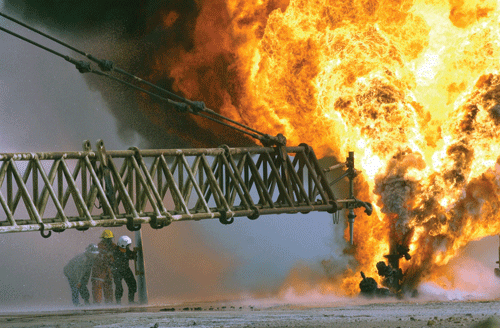
It’s been 19 years since Saddam Hussein’s army invaded Kuwait, and six years since the United States led the invasion that overthrew the dictator, but Kuwait is still demanding reparations from the Iraqi people.

According to Kuwaiti officials, Iraq still owes $25 billion in war reparations, in addition to some $16 billion in loans that funded Iraq’s eight year war with Iran. At the same time, Iraq is considering a request for $7 billion in loans from the International Monetary Fund as it struggles to pay for reconstruction. Oil revenues have plunged from $7 billion in June 2008, to just over $2 billion in May.
Given the beleaguered state of Iraq, and all it has been through, it is high time that these reparations and debts are confined to the dustbin of history, finally closing the chapter on the Saddam Hussein era.
It is outrageous that a country that is among the richest in the world, with a per capita income of $41,000, is forcing Iraqis, with a capita income of just under $4,000, to pay for Saddam Hussein’s actions.
Kuwait was, after all, no innocent bystander in the Iran-Iraq war, or a hapless victim of the 1990 invasion. It helped fund the war and was happy to have Iraq do all the dirty work to contain and weaken the fledgling Islamic Republic. Kuwait had goaded Iraq from the outset of the end of the war, allegedly violating OPEC agreements by increasing oil production pumped from the disputed Rumaila oilfield, which is partly in Kuwait but mostly in Iraq.
The increased production caused oil prices to tumble. Iraq accused Kuwait of waging “economic warfare” and violating Iraqi sovereignty. Baghdad estimated the loss in revenue cost Iraq’s treasury an estimated $4 billion per year, which the regime said it needed for reconstruction. After a 16-month standoff, Saddam made his fateful mistake and invaded his southern neighbor. The Iraqis have been paying economically ever since.
After the end of US-led war to expel the Iraqis from Kuwait, the United Nations Compensation Commission (UNCC) was created to assess and payout claims, with Kuwait claiming $386 billion in damages. Individuals and businesses from 100 countries also filed claims. Multinational corporations have received vast sums, not for war damage, but for “profit loss” and “lost potential earnings.” As of April, according to the UNCC website, Iraq has paid out $27 billion to the commission.
But as Kuwait reminded Baghdad, there is still a further $25.5 billion to pay. And then there are the other debts Hussein accrued with numerous nations around the world. However, following lobbying from the US after its occupation of Iraq, and pressure from organizations such as Jubilee Iraq, many countries have waived Iraq’s debts, most recently the United Arab Emirates writing off $7 billion.
Kuwait should follow suit. The 1990 invasion was a decision of a dictator, not the Iraqi people. Furthermore, history has numerous precedents of debts being written off that were made by an individual — the leader — not the country itself. And most famously, of course, reparations have been shown to have negative consequences, particularly if one recalls the outcome of the Versailles Treaty in 1919 that forced Germany to pay out billions, yet resulted in hyperinflation and acted as a catalyst for the rise of National Socialism. We all know where that led.
But while such an outcome is exceedingly improbable in Iraq, paying out reparations means there is less money for reconstruction. It is also disingenuous on Kuwait’s part to divert such funds away from Iraq, as an unstable and poor neighbor is not to Kuwait’s benefit, or anyone else for that matter.
To date, Iraq has received $125 billion in reconstruction aid, according to the US Government’s Special Inspector General for Iraq Reconstruction. Hundreds of billions of dollars more are needed. Oil revenues are expected to help in this regard, but with low oil prices and billions needed to upgrade energy infrastructure, Iraq is still years away from being able to allocate oil revenues to pay off debts when it needs money for reconstruction. Either debts are frozen until Iraq has ample revenues, or written off completely by Kuwait. This is what Iraq has asked for.
Equally, the whole reparations deal reeks. There have been innumerable wars and invasions since World War II and the victorious Allies rightly realized that reparations from Germany and Japan were a bad idea. Few, if any countries, have received compensation since then for being on the receiving end of aggression. The US has certainly never paid out reparations for the numerous wars and conflicts it has been involved in, while Israel has never paid a cent for the damage it has caused to the Arab economies, left to foot the bill from decades of Israeli aggression.
While Kuwait has not acted militarily, the Gulf state’s demands are not healthy for Iraq, for its border with its neighbor, or for the region. Kuwait’s requests should end and allow a more prosperous Iraq to develop.

PAUL COCHRANE is the  Middle East correspondent for International News Services

June 3, 2009 0 comments
0 FacebookTwitterPinterestEmail
  • 1
  • …
  • 466
  • 467
  • 468
  • 469
  • 470
  • …
  • 685

Latest Cover

About us

Since its first edition emerged on the newsstands in 1999, Executive Magazine has been dedicated to providing its readers with the most up-to-date local and regional business news. Executive is a monthly business magazine that offers readers in-depth analyses on the Lebanese world of commerce, covering all the major sectors – from banking, finance, and insurance to technology, tourism, hospitality, media, and retail.

  • Donate
  • Our Purpose
  • Contact Us

Sign up for our newsletter

[contact-form-7 id=”27812″ title=”FooterSubscription”]

  • Facebook
  • Twitter
  • Instagram
  • Linkedin
  • Youtube
Executive Magazine
  • ISSUES
    • Current Issue
    • Past issues
  • BUSINESS
  • ECONOMICS & POLICY
  • OPINION
  • SPECIAL REPORTS
  • EXECUTIVE TALKS
  • MOVEMENTS
    • Change the image
    • Cannes lions
    • Transparency & accountability
    • ECONOMIC ROADMAP
    • Say No to Corruption
    • The Lebanon media development initiative
    • LPSN Policy Asks
    • Advocating the preservation of deposits
  • JOIN US
    • Join our movement
    • Attend our events
    • Receive updates
    • Connect with us
  • DONATE