• Donate
  • Our Purpose
  • Contact Us
Executive Magazine
  • ISSUES
    • Current Issue
    • Past issues
  • BUSINESS
  • ECONOMICS & POLICY
  • OPINION
  • SPECIAL REPORTS
  • EXECUTIVE TALKS
  • MOVEMENTS
    • Change the image
    • Cannes lions
    • Transparency & accountability
    • ECONOMIC ROADMAP
    • Say No to Corruption
    • The Lebanon media development initiative
    • LPSN Policy Asks
    • Advocating the preservation of deposits
  • JOIN US
    • Join our movement
    • Attend our events
    • Receive updates
    • Connect with us
  • DONATE
Office ArchitectureSpecial Section

Horizontal flexibility

by Executive Staff January 24, 2008
written by Executive Staff

The MENA region is currently experiencing a boom in office construction, as every country in the region lacks the prime grade office space that is so sought after by large companies. In Dubai alone, according to Colliers International, there is currently 4 million square meters of office space under construction. The office, and the way the office is thought about, is transforming just as fast as it is being constructed. The computerization of offices, from the internet to wireless, is completely restructuring the layout of the office. This has resulted in the fundamentals of good office design today meaning that much of the current stock of offices in the MENA region are unsuitable and even the current stock under construction may soon become dated for design savvy clients. Santa Raymond, a leading interior design consultant and co-author of “Tomorrow’s Office — Creating effective and human interior’s,” explained, “If you look at offices in the Middle East there will be a boss who sits at the top of the room in an open plan or in his own office, with everyone else in rows in front of him. There is a very hierarchical situation.” It is this office hierarchy that is changing out of all recognition, with the onset of computerization, in cutting edge office design. “In the brightest offices they are now saying that offices must not reflect your seniority or your pay package but the layout of the office must reflect your task.” Firms have realized that to be as innovative and efficient as possible they have to rid the office of the traditional hierarchical layout and keep things as horizontal as possible.

Open plans and flexibility

A horizontal layout not only allows a more efficient design with regards to employee’s tasks but it also means that the office can be subject to change and is given – what has become the new buzz word in office design – “flexibility”. The ability to change the layout of the office itself with relative ease is increasingly important for many offices. Flexibility translates into offices being designed open plan, with boards as partitions, and structurally to have as few columns as possible. Tarek Sinno, of Nabil Gholam Architecture and Planning (NGAP), told Executive, “the layout of the office with the greatest efficiency is the one with open space where people would come and go … You now don’t have an office but an open space.” Flexibility in time, with the introduction of such concepts as flex-time, has meant that staff can log into work from home, through the internet, or work in cafes and even different countries. Office staff are not tied to their desks as they used to be and office design has responded to this transformation in work practices through flexible and horizontally designed offices. “You go into offices and they are empty 75% of the time, so why have a desk when you are out most of the time?” Raymond rhetorically asked. Sharing desks or ‘hot desking’ is the latest way in achieving office efficiency, in which staff can book a desk before they come into the office, with their belongings in individual trays. “In the brightest offices, such as Bloomberg, they have big open spaces and the CEO has his desk on the floor, he has a meeting room that anyone can use when he is not there. But he does not have his own office,” said Raymond.

With the space that has been created by reducing the number of desks, small meeting rooms and single person concentration rooms have been created. As the open plan office gets rid of any possibility of privacy these small rooms around the perimeter of the office solve this dilemma. Also, with the death of the individual office, rooms for private meetings are essential. Small ‘concentration rooms’ are now essential in open planned offices, designed so people are able to make private phone calls or read quietly. Lounges in offices are also becoming increasing important where employees can just relax with a few colleagues. According to Raymond, “The ambience of the office is very important, as staff are now getting fussier.” Other issues of central importance in satisfying design conscious staff involve ensuring that the light levels are correct, having good furniture, art and plants, and also to ensure that the air quality is good. Getting the right ambience also entails providing the right services. Companies now offer services to their staff such as gyms, daycare, and dry cleaning. Big firms are seeing great benefits in investing in their cafeterias, as staff are then less likely to go out of the office and staff are also happier as they maximize their time off.

As to whether the move to flexible and horizontal offices is permeating the Middle East, Mohammed Arayssi, an architect at Batimat Architects, told Executive, “What has changed the most for us is the way the spaces are partitioned, giving much more control to the people inside with curtains or blinds, using different ways to filter between spaces. Rather than actual differences in the distribution of people in the office, the manager still has 12-16 square meters. The real democratic open spaces [have not arrived] and I don’t think it will come.” However, Arayssi stated that you can see the more open and horizontal trend in office furniture. “The type of actual furniture they design, you see a trend done in that orientation, for example, you have one long table with small partitions that you can remove very easily, if you want to work for a few hours you come in, move the partition and use the space and then move out.” With international companies increasingly occupying much of the office space being constructed, at least in the Gulf, the shift to horizontal offices will no doubt occur eventually. Just as elements of horizontal design have crept into offices in the Middle East, the pressure to attract a highly skilled staff, which is always at a premium, will no doubt force companies to have horizontal layouts. Especially, as various companies compete among each other to have to the most attractive, prestigious and cutting-edge offices.

Iconism

One other way companies have achieved prestige is to create ‘iconic’ buildings. Tarek Sinno explained that “companies are keen to design their buildings so it is not just another office bloc. There is the trend of the high-rise that we now see in the Gulf, a symbol of presence, a symbol of power.” The desire to build the tallest tower in the Gulf is creating intense competition and three towers — Burj Mubarak al-Kabir in Kuwait, Al-Burj in Dubai and Burj Dubai — are all jostling to become the tallest building in the world. The Burj Mubarak al-Kabir in Kuwait is currently poised to win the much sought after title, reaching a structural height of 1,001 meters. Elie Harb, head of Real Estate Magazine, told Executive that “there is a lot of excitement about building the new Mubarak towers, there will not be a problem in filling that space, as people will want to be part of that scene.”

Dubai, in particular, has seen a spate of so-called ‘iconic’ buildings rise across its horizon. The drive to have ‘iconic’ architecture in Dubai and the Emirates has been very profitable, for Iraqi born and AUB educated architect, Zaha Hadid, who is currently designing two new office buildings in Dubai, the Signature Towers and the Opus. These office blocs are just two among many projects being designed by Hadid in the Emirates. The Opus office tower, a $470 million project, is another attempt by the architect, in her post-modernist repertoire, to re-think the office bloc. The project is comprised of separate towers that are strung together to give the appearance of a solid cube that seems to hover off the ground with a, “distinctive void in the middle [of the building].” The Opus ensures that the offices have a high level of ambience and areas for relaxation, executive dining, exercise, and “nap shell” rooms all designed into the office space, so “occupiers need not leave the office.” The Signature Towers, also planned to be built in the Business Bay Development in Dubai, are three towers that intertwine with each other and are designed to share ‘pragmatic’ elements and to rotate to maximize the views towards the creek. The towers, unusually for the general trend of the region, mix offices with residential space.  

Offices of Glass and Steel

Both of Zaha Hadid’s office bloc’s use glass and steel as the main construction material, in what is a firmly entrenched trend in the construction of office space in the MENA region. The reason for this, according to Tarek Sinno, is because “glass and steel is sexy, trendy and contemporary. Glass gives you this image of modernity.” However, using glass on a mass scale in the Middle East causes many problems, especially in the Gulf. To solve the problem of letting too much sun in you have to put in double or triple layers of glass and it also means that the air conditioning is on all the time. Despite these draw backs, the sex appeal of glass and steel buildings remains strong. The rising cost of steel and glass caused by the demand in China and the slump of the dollar, as most of the glass is imported from Europe, has meant that developers are beginning to think of alternatives but when building tall the dominance of glass and steel is inevitable. “Glass will always be a part of architecture but I hope that it will not stay as just an aesthetic material as it is now,” Arayssi said. There is a search for methods to use glass and steel in a more environmentally friendly and cost effective way. He sees a future in which glass will be used in a smarter way, outlining that, “Now what is happening is that there is a cross-over between technology and construction materials. You have materials that are working for the building, so it is not something that is very passive.” Innovations constantly occur in the way materials are being used, especially with glass, to make the use of the material more energy efficient and even generate energy. The major obstacle in using these innovative materials is that they are expensive and untested, so a push is needed to encourage developers to use these ‘smarter’ more efficient materials.

‘Greener’ materials

In October 2007, the ruler of Dubai, Shaykh Mohammed bin Rashid al-Maktoum, issued a resolution mandating that all new buildings built in Dubai must meet certain standards regarding energy efficiency, water conservation, the usage of renewable material and recycled products. This has reportedly caused some companies to go back to the drawing board and re-think the way they are constructing their buildings. Another ‘green’ push that the Emirates are attempting is through the creation of a rating system — styled on the Green Building Council in the US — Leadership in Energy and Environmental Design (LEED). Atkins Architects, designer of the ‘iconic’ Burj al-Arab in Dubai, has been involved in the creation of LEED rating system and is leading the way in the construction of ‘green’ buildings in the Emirates. Dalia Ajrami, a senior architect at Atkins, extolled to Executive the ‘green’ virtues of their latest projects in the Middle East. “The Bahrain World Trade Centre is the first commercial building to harness wind power for energy and the DIFC Lighthouse tower is set to be the first commercial tower in Dubai to reduce its total energy consumption by up to 65%.” The DIFC Lighthouse tower, to be located in the Dubai International Finance Centre (DIFC), will be a single use office tower, with 64 floors of prime office space, with the top 120 meters of the tower having three horizontal-axis wind turbines to harness the northwest wind for energy use. Although glass and steel are still the primary construction materials this new project is leading the way in showing how those materials can be made to work with the building. Its glass exterior will have an integrated photovoltaic mesh that harnesses the sun’s energy and provides shade to the façade. This will subsequently reduce the solar glare, which will in turn cut the building’s cooling requirements. As for the future of ‘green’ buildings, Ajrami thinks Dubai will be a leader in the shift to sustainable buildings, but problems remain in the production of locally manufactured building materials. Raymond, however, does not hold the optimism that Ajrami displays and sees Dubai as an “embarrassment”, because most of the buildings being constructed will not last more that 20 years, which of course is anything but sustainable. “In construction there is the idea of embedded energy, which means trying to demolish as little as possible. That is why Dubai is so terrible.”

The Importance of Good Office Design

It is the lack of thought put into the office that has been the main ailment which much of the Gulf has suffered from in the design of the interior and exterior of office buildings. This lack of thought being put into an office space has been the consequence of the pace and speculative nature in which office developments have been constructed in the region.

There is a chance for the second wave of office building projects currently underway in the region to break the prevailing mode, and to move to a more progressive method of office design and construction. “The relationship between how well your company performs and what your building is like, is strong,” says Raymond, “Executives need to engage, good design has a monetary value in performance now, if the building is energy efficient it costs less to run and well designed buildings keep their value.”


January 24, 2008 0 comments
0 FacebookTwitterPinterestEmail
By Invitation

The doctor and the pharmacist

by Ramsay G. Najjar January 24, 2008
written by Ramsay G. Najjar

The other day I was faced with a dilemma. I had a terrible cold, but I wasn’t sure whether I should merely ask my pharmacist for advice or go to the doctor. I decided to start by visiting the pharmacy, and I ended up leaving with a big bag of decongestants, Paracetamol and vitamins.

After a few days, I started to feel better, while knowing that it could have simply been my allergies. In retrospect, I could have saved myself a lot of unnecessary pill-popping had I gone straight to my doctor for a proper diagnosis and the right prescription.

My dilemma can easily be compared to the one faced today by organizations in the Middle East when communicating with their stakeholders. Just as I referred to my pharmacist, most companies are used to referring to advertising agencies for advice, and when the agencies’ campaigns fail to deliver the desired results in terms of their bottom line or stakeholders’ reactions, they merely decrease their advertising spending and declare the advertising business in the region ineffective. Yet, it is paramount to point out that the problem certainly does not lie in advertising, without which the client would undoubtedly miss out on significant opportunities to build a brand and fulfill key goals. The real problem is efficiency and effectiveness in communication — choosing the right messages that answers the proper diagnosis.

In order to understand the communication scene in our part of the world today, it is best to take a look at the evolution of communication in the West. Only a few decades ago, reference to “communication” was reserved to the realm of telephony and telecommunications, whereas advertising was limited to commercial publicity and promotion. Soon the lines began to blur, in which we consume what is essentially one type of content coming at us in different forms, through different channels, with no clear categorization of the “serious” versus the “commercial”.

A big brand name like Coca-Cola, for example, began in the late 1800s by promoting its carbonated soft drink’s “secret formula” and continued to focus on the drink’s original taste throughout the 20th century. As Coke’s clout grew into an international symbol of American lifestyle. Coca-Cola’s image and brand equity became dependent on a variety of factors, including its public relations, social responsibility as well as its marketing and advertising.

The “ad agencies” that were purely dedicated to advertising and serving their clients under one roof as a one-stop-shop of communication solutions realized the evolving communication needs of consumers and the public were becoming more mature and demanding. They began to set up standalone units that are specialized in a specific discipline of communication and can thus offer specific solutions in advertising, public relations, corporate social responsibility, corporate identity, media planning and buying, and later online and digital media.

In the Middle East, big communication agencies originally entered the immature market at the time with their eyes fixed solely on the “cash cows” of advertising and marketing communication, selling “communication cures” over the counter without any prescription.

This approach has had its downside despite the original ‘boom’. With agencies prescribing and selling the medication, companies in the region soon became wary of the obvious conflict of interest. Balancing out this conflict meant always negotiating hard and pushing for reductions in the proposed advertising spending budgets. This has lead to a losing situation, with the client not getting the desired communication results and the overall sector seeing low per capita advertising spending.

In such a situation, we are in dire need of a fresh perspective that can tackle organizations’ communication issues and benefit both the client and the industry. This perspective is provided by the extra pillar that the West has long since added: the strategic communication consultancy. Going back to our analogy, the consultancy, like the doctor, has the objective perspective, free of any conflict of interest, which allows it to properly diagnose the situation and recommend just the right amount and type of medication needed to effectively address it and fulfill the client’s goals. The addition of this pillar makes the triangular relationship between the client, consultancy and advertising or other communication suppliers a winning one, whereby the clients’ objectives are met, meaning only that they will come back again and again, to both doctor and pharmacy, leading ultimately to catalyzing the ad sector in the region.

Furthermore, strategic communication consultancies treat communication holistically. This does not mean that they merely view public relations, marketing communication and advertising as connected but rather that they look at all communication messages and channels as part of a larger strategy to interface with external and internal stakeholders and achieve a set of defined objectives.

Since corporations and the public sector today have their image under the microscope and many organizations have faced demise because of a tarnished reputation, strategic communication consultancies offer advice that can build an organization’s image and immunize it by helping build a “trust bank” with its stakeholders to draw on during crisis.

By brining together the added value of these complementary elements to the organization’s communication, a synergistic effect is created — one that is in the service of the client’s interest, leading to a win-win situation for all.

Ramsay G. Najjar, Chairman S2C

January 24, 2008 0 comments
0 FacebookTwitterPinterestEmail
By Invitation

The road to riches

by Imad Ghandour January 24, 2008
written by Imad Ghandour

Dear very successful executive,

You have been working so hard lately, making sure that your company is heading in the right direction, meeting and exceeding your targets, and making sure you distribute healthy dividends to shareholders.

You are probably getting a good base salary, a healthy annual bonus, and some sort of profit sharing. After all, the shareholders want their interests to be aligned with yours as you are a critical pillar for the success of the company. As you are a star in your industry, the shareholders do not want to lose you to the competitors.

But something still seems not right. Are you getting your fair share of the profits? Can you do better financially? Can you grow the business more aggressively? Why can’t the shareholders re-invest the profits instead of taking dividends? Why not get a financial institution to back an aggressive expansion and acquisition plan?

Management buyouts are becoming more common globally and regionally. With a backing of a private equity fund with deep pockets, you may buy your company from your shareholders. You can then go about your ambitious plans with the backing of a shareholder that can speak your language and share your vision. Both of you have their interest aligned and focused on making your company as profitable as possible as quickly as possible. And PE funds don’t lack the ambition: they probably want to triple or quadruple the size of the company over the next few years.

If your shareholders don’t want to sell, how about locating, in your industry, another company to acquire. I am sure you can manage that company as successfully as yours. And the private equity funds will still be interested to partner with you in what they call “management buy-ins”.

Four Seasons, Aramex, Boots-Alliance, Kinder Morgan and others were bought out by their respective management with the backing of private equity funds. The respective CEOs grow their business more aggressively with the backing of the private equity fund, realizing excellent returns for the fund and for them.

But be prepared to put some money where your mouth is, as strategy presentations and business plans alone will not work. The private equity fund will only back those that are willing to risk their own fortunes to make their dream come true.

And be prepared for early retirement after a few years of hard work. The PE firm (and you) will only make money by selling the firm. You will then be rich, but most likely unemployed.

Aramex was taken private by its CEO in 2002 with the backing of a regional private equity firm. In 2005, it was re-listed on Dubai Financial Market tripling the investment for the private equity backer. The CEO and his management team bought 25% of the company and more than quadrupled their money at exit, and they remained on the helm of the company after listing.

Kinder Morgan was bought by a group led by its CEO in 2006, and the CEO automatically made more than $1.8 billion, increasing his stake from 18% to 31% of $15.2 billion company without paying a cent. This was not highway robbery. The deal was done with the consent of Kinder Morgan happy shareholders! Shareholders got the price they want — which was 27% above market price — and the CEO got the company.

Some fresh ideas for a momentous new year’s resolution?

May 2008 be prosperous on all of us.

Imad Ghandour is head of Strategy & Research, Gulf Capital and Board Member of the Gulf Venture Capital Association.

January 24, 2008 0 comments
0 FacebookTwitterPinterestEmail
By Invitation

The old curse of sectarianism

by Octavia Nasr January 24, 2008
written by Octavia Nasr

I was 14 at the time. Lebanon’s civil war was in full force. One afternoon the shells began raining down on our neighborhood in Beirut. We ran from school screaming. Out of breath, my knees giving way, it seemed to take forever to reach our local shelter — a dark humid room at the back of our apartment block.

The memory of that terrifying afternoon receded — until recently. After more than a decade of relative peace and reconstruction, the bombings and assassinations have returned to Beirut. Every time I hear of a new explosion, I think of a frightened child sitting in darkness.

In 1988, I watched the last throes of Lebanon’s civil war firsthand. Now I watch from another continent, but I find those same emotions resurfacing.

The actors are like shadows from a long gone past. They are grayer perhaps — those who have avoided assassination. But the cast in Lebanon’s tragedy has changed little in two decades. Then, as now, a presidential election is the setting, and the struggle where religion and clan play the main roles threatens to set Lebanon back 20 years.

In 1988, the president’s term was coming to an end and the warring factions were unable to agree on a new candidate. Militias prevented parliament members from reaching the assembly building. Compromise was nowhere in sight. The West had abandoned Lebanon to the manipulation of its neighbors. Syria had its choice for president; Israel had its own allies — a foil for growing Muslim radicalism. The country was awash with weapons.

In his last act as president, Amin Gemayel named fellow Christian and army chief Michel Aoun as prime minister. At a stroke, he shattered the convention that a Muslim hold that position. Muslims refused to serve in the Cabinet and the country ended up with two governments. Aoun famously declared: “I am prime minister and six ministers in one.” Aoun’s “War of Liberation” against Syria turned into defeat. Then, he turned on fellow Christians of the Lebanese Forces in the “War of Elimination.” When that failed, the Syrians drove Aoun to take refuge at the French Embassy.

I came to CNN as a World Report panelist in 1990. I tried to explain Lebanon’s chaos, the bewildering array of factions and the horrors of civil war for ordinary civilians. I was offered the opportunity to stay at CNN and gratefully accepted the chance to escape the anarchy.

But almost as I left, the civil war was being laid to rest. The various factions had fought each other to a standstill; Arab governments helped negotiate a new constitutional framework overseen by Syrian influence. Peace came to Lebanon, but it would be five years before I returned.

I went back in 1995 and was stunned. I kept looking around for checkpoints manned by militants. I couldn’t believe that I could go anywhere without being harassed or kidnapped. No longer did identity — Christian, Muslim or Druze — define where Lebanese could go. People mixed freely in chic coffee shops and laughing at the same jokes. It was as if Lebanon’s divisions had been wiped away.

Downtown Beirut, once rocked by explosions was rocking to Lebanese pop music. The dusty sandbags had given way to boutiques carrying the latest fashions and deluxe hotels. Lovers had returned to the Corniche, overlooking the Mediterranean, for romantic strolls at sunset.

But the agreement that ended the civil war was more a truce than a real settlement — and was overseen by a “pax Syriana.” As anti-Syrian sentiment grew, so did political tensions. On Valentine’s Day 2005, the Corniche was once again rocked by an explosion. Former Prime Minister Rafik Hariri was killed.

The symbolism left me speechless. On the day of love, Lebanon was thrown back into its most hateful history. It had been widely expected that Hariri would run for office again and demand the withdrawal of Syrian troops. Suspicion fell on Damascus, which vehemently denied involvement. On March 14, Martyrs’ Square became a human sea of demonstrators: Muslims, Druze and Christians alike, demanding the “truth.”

But Hariri’s death also exposed the fault lines that had broken Lebanon a generation previously. Even after it withdrew its troops, Syria still had allies in Lebanon. One is Hizbullah, accused of the suicide attacks against US Marines over 20 years ago. The other is Gen. Michel Aoun; back from exile, the same person who had defied Syria in 1989, but who now made common cause with Hizbullah.

Earlier this year I visited Martyrs’ Square. The spirit of the Cedar Revolution had evaporated. The place looked like a morgue. Anti-government Hizbullah squatters had brought life there to a standstill. As I passed through, business owners stood silent in the sun and shook their heads at me in despair. I wondered if they sensed my disappointment, my pain at watching Beirut bleed again.

Lebanon’s political actors now find themselves re-enacting scenes from the final act of the civil war 19 years ago. Once again, the term of the president is at its end with no agreement on his successor.

And the question haunts me: Will the country’s brief renaissance that so amazed me in 1995 be snuffed out by the old curse of sectarian rivalries?

Octavia Nasr is CNN’s senior editor for Arab Affairs.

January 24, 2008 0 comments
0 FacebookTwitterPinterestEmail
By Invitation

A boost for insurance in the Middle East

by Peter Vayanos January 21, 2008
written by Peter Vayanos

The market has rich potential. Here is what is needed to get it going.

When one looks at financial services in the Arab World, there is one sector that stands out for its lack of development: Insurance.

While investments and loans are now commonplace across the region, insurance has yet to achieve the same level of penetration. On average, insurance premiums represent only about 1% of gross domestic product in the Middle East, versus as much as 4% in other emerging markets and 9% in more industrialized countries. The situation for life insurance is even worse.

The low penetration of insurance in the Middle East points to the magnitude of the opportunity, especially given the above-average economic growth of the region, its young population, and ongoing political changes. Those changes include the requirement, in many countries, that consumers carry auto and health insurance. Government privatization programs will also fuel the market, as formerly self-insured entities turn to the market for their needs.

But the fertile environment for an insurance boom in the Middle East and North Africa (MENA) doesn’t guarantee that it will happen. For the potential to be realized, business leaders, regulators, and policymakers must focus on five areas.

1. Establishing a comprehensive legal framework. At present, there is wide variability in the maturity of legal and regulatory frameworks that govern regional insurance markets. In fact, until recently, almost all MENA countries had outdated insurance laws and regulations. Although some countries have introduced new legislation, much still needs to be done.

Specifically, regulators in countries with under-developed legal frameworks need to upgrade these frameworks in line with international standards. Countries that don’t have a judicial authority dedicated to resolving insurance disputes should create one. The regulation of takaful — insurance compliant with sharia law — also needs to be addressed.

In countries at the early stages of implementing legal frameworks, the approach should be to set prescriptive rules and guidelines, and to require that all insurance products be approved prior to sale. As markets mature, regulators can issue guidelines, or principles, giving insurers the flexibility to bring products to market more quickly.

The end goal of a legal framework should be to regulate all participants, including insurance companies, brokers, and professionals. Among other benefits, a well-defined legal framework will attract international players.

2. Empowering a regulator. It’s not enough that there be insurance laws — there also needs to be regulators enforcing them.

All the countries in the region have an insurance regulator in place, although varied in form. In some places, the regulatory body that oversees a country’s banks or capital markets doubles as its insurance regulator. Other nations have, in effect, multiple regulators — creating needless bureaucracy. An example is Lebanon, where the Insurance Control Commission and the Directorate of Insurance Affairs at the Ministry of Economy appear to have overlapping responsibilities.

Ideally, the lines of authority of each country’s insurance regulator should be spelled out in the legal framework and so should the regulator’s independence.

As they step up their supervisory efforts, regulators should look to the guidelines set out by the International Association of Insurance Supervisors. New regulatory bodies should start with an audit-based model, which relies on data collection to ensure compliance with rules and requirements. In the medium term, though, they should shift to the risk-based model common in more mature markets.

3. Creating an environment that encourages competition. For now, the insurance industry in the region is dominated by a large number of small players with limited capital. While that is understandable given the size of the market, the preponderance of small players has limited the amount of actuarial and risk-management expertise.

Regulators need to raise the competitive bar by requiring higher capital levels and introducing minimum standards for governance and risk management. This will result is larger local companies that are better-equipped to serve customers.

4. Offering skills and training. The shortage of skills has a huge impact on the state of insurance in the region, limiting product innovation and introducing inconsistencies into critical functions like risk assessment and pricing.

Regulators and policymakers can foster skills development by setting accreditation requirements for insurance professionals. They can also organize specialized training programs through affiliations with international training providers or universities. Finally, regulators can encourage insurance companies to invest in training their staff by offering a reduction in annual regulatory fees as an incentive.

5. Implementing market-led initiatives. One last thing that will help the insurance industry thrive is the rise of programs and associations that articulate insurance benefits to consumers and attract young professionals to the field. Bahrain and Jordan both have such programs. Bahrain’s program uses a specially created cartoon character, Taamina, to raise awareness. But these two countries remain exceptions. Other Arab countries are doing little to promote the industry or to lure talented college graduates headed for jobs elsewhere in the financial services sector.

Peter Vayanos is a vice president at Booz Allen Hamilton.

January 21, 2008 0 comments
0 FacebookTwitterPinterestEmail
Comment

Cruising the Musandam

by Norbert Schiller January 21, 2008
written by Norbert Schiller

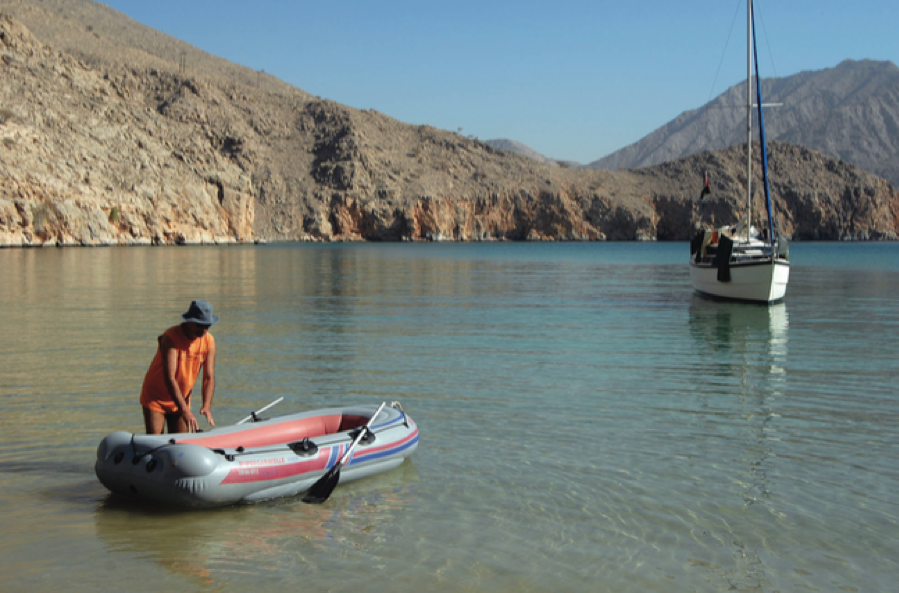
Two months ago, I was invited by friends to go on a three-day sailing cruise aboard their boat around the fjords of Musandam at the northern tip of Oman. The Musandam Peninsula acts as the gateway to the Strait of Hormuz, which leads into the Arabian Gulf. This region of Oman used to be out of bounds to foreigners, but over the last two decades the region has slowly opened up.

The scenery in this rugged and relatively untouched part of Oman is spectacular with rock formations jetting out of the sea and forming the high mountains of the interior. Because of the rocky peaks and steep terrain the peninsula is largely impassable. Almost all of the landscape is void of flora and the only animals that can be seen roaming freely are domesticated goats foraging for food. Unfortunately, the goats have found a more accessible kind of food new to this environment, garbage. This trash is often left behind by weekend tourist who charter boats to explore the hidden shores. I witnessed a goat devour a huge piece of foam plastic that was probably used for packaging.

The lack of plant and wildlife on the land is the antithesis of what lies beneath the surface of the sea. With a mask and snorkel you are privy to a whole other world as you dive below. Suddenly, there are hundreds of beautifully colored fish of all shapes and sizes surrounding you. The barren rocks we saw above the surface are transformed into a resting place for various shell fish and different types of colorful coral. It is a world in stark contrast with what can be seen above. Such is life in this pristine corner of the earth.

As Oman opens its doors to tourism, areas like Musandam are slowly being discovered and tourist development schemes are already on the drawing boards. The pace of development in the Gulf region is happening at such lightening speed that before an objection can be lodged, an entire skyline is transformed. This continues to be the case in the Emirate of Dubai and now in Qatar. Fortunately, these two emirates happen to have plenty of empty spaces to develop in areas which are not environmentally sensitive. Oman is different though. It is a country of contrasts, which enjoys an environment that changes with the terrain. Oman has 1,700 kilometers of coastline stretching along the Indian Ocean from the Yemeni border in the south to the Strait of Hormuz. In the north, the landscape is barren and mountainous. Yet in the south, which is tropical and hit by the monsoons, the land is lush green and covered with banana plantations and coconut groves. The people and their lifestyles also reflect this contrast. Like the rest of the Gulf States, Oman has its cosmopolitan modern cities with shopping complexes, high rises and five-star hotels. Alongside this developed part of the country is the traditional part where houses have kept their mud brick facades and where marketplaces are still fragrant with the smell of frankincense. Oman is still one of the few places that has been able to successfully blend modernity with tradition. But for how long can it hold out?

During our trip north, I could make out the skeletons of a few tourist projects being constructed along the coast. Fortunately, they were mainly on sandy beaches and not intrusive. The real concern is when developers go a step further and venture into the tranquil bays of the once foreboding Musandam Peninsula.

At its closest distance, the tip of Musandam Peninsula is only 38 kilometers from the Iranian coast. Between the two countries lies the volatile Strait of Hormuz, a very strategic body of water. Twenty percent of the world’s traded petroleum passes through the strait. This area is still considered militarily sensitive for Oman, but it is a far cry from the war zone it was in the 1980s and 1990s.

Two decades ago Oman’s Musandam Peninsula was largely out of bounds to all but local tribes, the military and the odd scientific explorer. In the mid-1980s, during the latter half of the Iran-Iraq war, ships that entered through the Strait of Hormuz were at risk of being attacked by Iranian gunboats. Overnight, this little stretch of water became the focus of the world’s economic superpowers. First, the Soviet Union sent warships to the region and began chartering Kuwaiti ships hoping to deter Iranian gunboats. However, this may not have been such a wise decision. Kuwait, which had one of the largest commercial maritime fleets, was a close ally of Iraq at the time and took the brunt of the Iranian attacks. Then the Americans, not to be outdone, went a step further and temporarily re-flagged all Kuwaiti-registered oil tankers with American flags. This way, the US navy was able to escort those tankers as they transited the Arabian Gulf.

By the time the Iran-Iraq war was over, Oman was well on its way to opening up the country. Musandam, though, remained closed. This was not so much the Omani government’s doing but the result of rumors, circulating among expatriates in Dubai, about mysterious tribes lurking in the mountains and waiting to attack any foreigners who dared to trespass. The source of these rumors was probably a local tale passed on from generation to generation. The government did not try to deny these stories as they served authorities when they wanted to keep out tourists from that part of the country. Unfortunately, this is no longer the case.

Norbert Schiller’s latest book Arak and Mezze: The Taste of Lebanon was published last month.

January 21, 2008 0 comments
0 FacebookTwitterPinterestEmail
Comment

The Bali road to nowhere

by Peter Speetjens January 21, 2008
written by Peter Speetjens

Rejoice. The world has a second “road map”! Judging by the bad karma given off by the original Middle East version, one would have expected the world’s political elite to avoid the term at all cost, but no. Following two weeks of intense debating and tabling, participants of over 180 countries at the December UN Conference on Climate Change (UNCCC) accepted the “Bali Roadmap.”

The Kyoto Protocol, which requires its 178 member states to cut their 1990 levels of green house gas emissions by 5%, expires in 2012. The Bali mega-conference aimed to reassurance the world’s increasingly concerned citizens about the environment.

But the Bali Roadmap nearly never saw the light of day.

At the UNCCC’s dramatic grand finale, negotiations were broken off. The Europeans suggested cutting greenhouse gas emissions by 25% to 40% by 2020, which would mean an immense incentive to boost investments in cleaner, greener technology. Yet the suggestion proved too hot to handle for countries such as the US, Canada, and Japan. Washington was especially averse to putting figures in the final text

With an embarrassing deadlock looming, the Europeans thrashed out an 11th hour compromise, which, amid tremendous pressure, forced the US into a dramatic U-turn, accepting that “deep cuts in global emissions will be required to achieve the ultimate objective (to curb climate change).”

But let’s not get ahead of ourselves. Over 10,000 ministers, state officials, experts, weathermen, Al Gore and any self-respecting environmentalist from any corner of the earth was in Bali, to stay two weeks in a five-star air-conditioned hotel to discuss the obvious. Charles Clover of The Daily Telegraph estimated that the two-week conference produced some 100,000 tons of CO2, which is about as much as Chad omits annually. The US blasts 60,000 times as much into the atmosphere and heads the world emission rankings. 

“It’s a framework that is quite weak,” admitted France’s Deputy Ecology Minister, Nathalie Kosciusko-Morizet. “The public will understand that we brought the United States into the negotiations.”

Paula Dobriansky, head of the US delegation, proved quite delighted with the world’s second roadmap. “I think we have come a long way … the US is very committed to this effort and just wants to really ensure that we all act together.”

After years of doing it alone, refusing to sign the Kyoto Protocol, Dobriansky presented the US as a modern day musketeer with a “All for one, one for all” attitude. The US argues that developing nations have to make a bigger effort. This may be a reasonable argument regarding emerging giants like China and India. However, it is quite off the mark regarding the vast majority of the world’s countries. Bolivia is facing melting glaciers and dwindling water reserves, yet it has no industry to speak off.

George Bush did not exactly appoint Dobriansky for her green fingers. In 1997, she was among the 32 founding members of the “Project for a New American Century” (PNAC), a private club for Neocon America that calls for military-backed US hegemony over the world.  These are the same people who urged President Bill Clinton to invade Iraq in 1998.

Dobriansky is not only convinced that what is good for America is good for the world, she is also a true believer in the blessings of the free market and thus opposes any regulation. Voluntary emission cuts will do, she argues. Most environmentalists would disagree and argue that the main cause for having reached the current state of over-exploitation and pollution is a lack of rules and regulations, as well as the failure of the economic model to qualify environmental issues as cost determining factors. 

The rather unsettling truth seems to be that destruction is the inevitable flipside of the mythical coin called “progress”. The UN’s 4th Global Environmental Outlook (GEO) states that 20% of the world population produces 57% of global GDP, as well as 46% of greenhouse gas emissions. 

And as global trade and GDP grow, coral reefs are dying, fish stocks are declining, deforestation continues, and some 16,000 species are threatened with extinction. It has been nearly 40 years since the Club of Rome first warned about the limits of economic growth, yet the 2007 GEO concluded: “there are no major issues for which the foreseeable trends are favorable.” Unfortunately, the Bali Roadmap to nowhere fits the picture perfectly.

Peter Speetjens is a freelance writer and analyst based in Beirut.

January 21, 2008 0 comments
0 FacebookTwitterPinterestEmail
Comment

Regional chess

by Claude Salhani January 21, 2008
written by Claude Salhani

There are two schools of thought regarding President George W. Bush’s Middle East peace extravaganza held last month on the shores of the Chesapeake Bay in Maryland, which brought together for the first time 16 Arab countries and Israel in a non-violent environment.

One group believes it was a waste of time, pure theatrics by an administration desperate to leave something more substantial for the history books than the wars in Afghanistan and Iraq. Critics of Bush’s foreign policy were quick to denounce the Annapolis antics as just a mega-photo opportunity and a publicity seeking stunt meant to take focus off the economy, a US dollar at its weakest point in decades, a hurting real estate market going south as a result of the sub-prime scandal and gas prices going through the roof.

Then there are the optimists, the president’s supporters and those who believed a miracle could be accomplish in Maryland when previous attempts have failed in the Holy Land, where miracles traditionally are given greater odds.

Bush’s intent was to jump-start the comatose peace negotiations between Palestinians and Israelis with the expectation of reaching an agreement for a two-state solution before the end of his mandate, now just a year away. For the president, it was somewhat of a shot in the dark. Palestinian and Israeli leaders walked away from the peace conference promising the US president they would “push for peace.” In political parlance that is the equivalent of saying “the check is in the mail.”

But something unexpected did come out of Annapolis. The first thing is the highly significant return of Russia to the Middle East peace negotiations. According to sources close to President Vladimir Putin, Russia was instrumental in convincing the Syrians to participate in the Annapolis meeting. Putin personally telephoned Syrian President Bashar al-Assad urging him to participate in the Annapolis conference. This was confirmed by a high-ranking European diplomat in Washington.

Syria, long shunned by the Bush administration for its policies in Iraq and Lebanon and considered by Washington to be counter-productive to peace efforts, remains a key player to any future negotiated settlement of the larger Middle East crisis.

Russia’s renewed interest in bringing about a peaceful settlement to the Arab-Israeli dispute injects a new momentum in a process that has been dragging for decades. Putin has already convened a follow-up summit in Moscow scheduled for January.

Saudi Arabia and other Arab states are suddenly eager to shift the peace talks into high gear. After decades of refusing so much as to even mention the name of Israel, there seems to be a new impetus, spearheaded by the Saudis, to get the ball rolling.

Why this sudden sense of urgency after years of procrastination? Because the Saudis, much like the Russians, have seen what sort of damage home-grown terrorists can cause to the economy.

Another result of Annapolis is a meeting of the minds of two leaders on opposing ends of the political spectrum: Russia’s Putin and King Abdullah of Saudi Arabia.

Just like Russian pressure on Damascus convinced Assad to send his deputy foreign minister to Annapolis, similarly, the Saudi king’s political clout brought a total of 16 Arab countries — including Syria — face-to-face with Israeli leaders at the conference.

What motivated those two politically opposed leaders to act in unison with the European Union, the United States and Israel? The fact that they all share a common enemy — Islamist terrorism.

Moscow and Riyadh, much like Washington, London, Paris, Madrid, Istanbul and other cities that have experienced firsthand attacks by Islamist terrorists, also agree on a fundamental focus point of the Middle East conflict. They say that until the Palestinians have their own state, the continued unrest in the Middle East will provide extremist Islamists a perfect recruiting poster for their cause.

The Russians, much like the Saudis, and indeed the United States, have seen the results of homegrown terrorism and it was not pretty. Ironically, the Islamists, contrary to what they were hoping for, ended up acting as a unifying force by bringing together the United States and Russia, two former Cold War warriors. At the same time, they succeeded in pushing the vast majority of the Arab World into the same camp with the Western-Russian alliance — and Israel — who now agree they have a new common enemy — the extremists within Islam.

Claude Salhani is editor of the Middle East Times.

January 21, 2008 0 comments
0 FacebookTwitterPinterestEmail
Comment

The year that brought globalization to the Arab World

by Riad Al-Khouri January 21, 2008
written by Riad Al-Khouri

Since the current wave of global change accelerated after the end of the Cold War, mention of globalization has tended to upset Arabs. However, 2007 could be the year that the Arab World really moved closer to the rest of the globe. Politically, this was evident in the Annapolis conference, where — under watchful American eyes — for the first time high-level representatives of Saudi Arabia and Syria sat down in public with Israeli officials, a powerful symbol of the region’s engagement with the West and its stepchild Israel. In the economic sphere, vast Arab investments were welcome in Western countries, sometimes as sizeable, controlling interests in big-name global companies. Not all deals went off without a hitch, witness the Qataris backing off over the takeover of the major British retail chain Sainsbury’s. But it will soon be forgotten, as the 2005/06 failed attempt by Dubai World Ports to invest in the US was forgotten, while Arab money poured into shaky Western stock markets. Moves in the opposite direction were also evident, as global businesses headed in greater numbers to Arab countries.

Along with these developments, the message that finally started to come across in 2007 is globalization is neither necessarily good nor bad, but it is here and it is important. The term still has negative connotations in the region, but 2007 has shown that to integrate into the world does not mean that Arab countries will have to surrender their identity.

Nevertheless, the big deal for the eastern part of the Arab region remains the Israeli-Palestinian conflict. Annapolis has not of course resolved the problem, but things may be better after that meeting than they were before. In the Maghreb on the other hand, the major issue is closer relations with Europe and it is important that French president Sarkozy chose to roll out his Mediterranean Union initiative in that corner of the Arab World. Like Annapolis to the eastern Arab countries, the launch of the idea of a Mediterranean Union does not signal that all of the Maghreb’s problems are over. However, this indication of an increased European role in the region is critical. In the East too, greater EU involvement in the peace process could help. Europeans being involved more in the Arab World means more emphasis on the bright side of globalization and this seems to have gained ground in the Arab World during 2007.

Turning from the big picture to nitty-gritty issues at the center of globalization, such as logistics, is also revealing, in terms of changes taking place within the Arab World. For example, the World Bank’s first Logistics Performance Index ranked Lebanon 98th among 150 countries worldwide and 13th among 17 Arab states. The index covers ability to track and trace shipments, timely arrival, customs procedures, logistics costs, infrastructure quality, and competence of the domestic logistics industry. Globally, Lebanon tied with Zambia and ranked behind Papua New Guinea, and was below both the global average and the Arab score. Examples of Lebanon’s performance vis-à-vis Arab states in individual sub-indices were especially grim: tying Syria and behind Yemen on the customs sub-index, below Mauritania on the infrastructure measure, behind Tunisia on logistics competence, and weaker than Egypt on tracking and tracing. To mention Lebanon’s logistics in the same breath as most of these countries would have been unthinkable a generation ago. But today, while much of the region advances and globalizes, the Lebanese wallow in instability.

However, even considering Lebanon, the past year appears to have been better for the Arab World as a whole, at least in terms of macro-economic indicators. Was the same true regarding the average person living in the region? Maybe not, so how can the benefits of growth and globalization that accrue to the rich and well-connected help the average person in 2008? The answer may be larger doses of democracy and liberalization to bring the region into better harmony with the forces of globalization. Well thought out democratic practices and properly introduced liberalization are valuable in making the best of globalization. Take as an example the recent and continuing entry of Arab countries into trade agreements. The experience of various regions, including Latin America and South and East Asia, suggests that the negotiation capacity of states seeking to join trade pacts actually increases in the presence of pressure groups. By contrast, in many cases Arab negotiators themselves monopolize, and so weaken, their own countries’ negotiation position. The challenge remains to revitalize labor unions, professional syndicates, and business associations as partners in public decision-making, to make the best of globalizing. The alternative is globalization for the rich and powerful and a doubtful future for the rest of the population.

Riad Al Khouri is visiting Scholar at the Carnegie Middle East Center and Senior Fellow at the William Davidson Institute, University of Michigan.

January 21, 2008 0 comments
0 FacebookTwitterPinterestEmail
Comment

More than blind hope

by Zaki Abushal & Priyan P. Khakhar January 21, 2008
written by Zaki Abushal & Priyan P. Khakhar

The sun reflects the facades of designer stores that flaunt Prada, Chanel and Armani. Women in Dior sipping iced lattes and chatting to friends could be absolutely anywhere in the developed world, affluent and totally at ease in their surroundings; Fifth Avenue in Manhattan, Kings Road in London, Champs Elysees in Paris or Gran Via in Madrid.

But this isn’t Europe or North America and for that matter it’s in no other part of the developed world. A little over a year ago Lebanon was at war. The bombardment suffered at the hands of Israel’s military wasn’t the country’s first taste of war in recent memory, but it did knock a burgeoning economy off its feet.

Leading local bank, Audi-Saradar, recently issued a report on the country’s economic conditions, summing up its plight with cold-hearted brevity when it described 2007 as a ‘lost year.’ A sentiment echoed by Prime Minister Seniora, who was just as pessimistic in a speech soon after the conflict where he said “Israel’s military offensive against Hizbullah caused billions of dollars in direct damage to Lebanon’s economy, sending the country from recovery into recession.” On the ground however, there are signs of prosperity, social transformation and a positive attitude.

Any country that’s endured such a history would be forgiven an extended mourning period. But Lebanon shook off the lugubrious shroud left by a 15 year civil war, and a subsequent boom-bust cycle stretching from 1992 to 2005, to quickly get on with the job of rebuilding the country.

Such is the Middle East’s faith in the long term prosperity of Lebanon that investors are never far from its shores. Lebanon is “a small country that has a large Diaspora strongly tied to it and regularly investing back in it, and a rich Arab community unwilling to give up on it,” according to the Bank Audi report.

Whether investors’ faith has more to do with the country’s strong bank secrecy laws is up for debate, but there’s no getting away from the fact that Lebanon’s inward foreign direct investment (FDI) has suddenly skyrocketed. In 2000 the country received close to $5 billion in FDI, up from a meager $53 million 10 years earlier. But that was just the beginning because in 2005 FDI inflows leapt to $15.5 billion. And with the wheels truly in motion, there was no stopping Lebanon’s FDI train as inflows reached $18.3 billion in 2006.

Probably to those living in the country, 2006 will resonate as the year when conflict returned to their shores. But it’s unlikely the people of Lebanon will see 2007 as lost. Even now industries within the country enjoy disproportionate growth and the outlook remains strong. “Once the political situation is cleared the real estate sector can easily witness a boom again,” said the Bank Audi report. It’s not only the real estate industry that shows promise, so too does the banking sector. In fact, they’ve drawn praise from international and supranational institutions, most notably the IMF. The organization was clearly impressed with Lebanon’s handling of the war from an economic point of view as it pointed out in its most recent consultancy paper issued in November. “Financial pressures associated with the conflict were managed effectively owing to the banking system’s strong liquidity position,” said the report. “As with FDI growth, one would expect trade to flounder, however, as we’ve seen FDI has flourished and trade hasn’t been hampered by the political confusion or Israeli attacks.” Also, “aggregate imports and exports increased by 8.6% over the first five months of 2007 relative to the same period in the previous year,” according to Bank Audi.

Down on the street amid the tanks and infantry, businesses remain positive. They are driven by more than just blind hope. Once the politicians stop their dithering and finally decide on a united government then capital and foreign investment will return to Lebanon. Even now, as political tension strains the will of the population, investment is clambering to find a home and there is a bottleneck in development and investment. The coffees in the local Starbuck’s and Costa Cafes keep flowing at prices on par with the West. So it seems neither bombs nor the complexities of choosing a president will discourage investment and growth in Lebanon in the long-run. The unrealized potential is merely observing the hurdles of politics to gain stronger momentum. The cedars of the nation are full of sap.

Zaki Abushal is the editor for the British Chamber of Commerce and Dr. Priyan P. Khakhar is a lecturer at the Suliman S. Olayan School of Business at the American University of Beirut.

January 21, 2008 0 comments
0 FacebookTwitterPinterestEmail
  • 1
  • …
  • 550
  • 551
  • 552
  • 553
  • 554
  • …
  • 688

Latest Cover

About us

Since its first edition emerged on the newsstands in 1999, Executive Magazine has been dedicated to providing its readers with the most up-to-date local and regional business news. Executive is a monthly business magazine that offers readers in-depth analyses on the Lebanese world of commerce, covering all the major sectors – from banking, finance, and insurance to technology, tourism, hospitality, media, and retail.

  • Donate
  • Our Purpose
  • Contact Us

Sign up for our newsletter

    • Facebook
    • Twitter
    • Instagram
    • Linkedin
    • Youtube
    Executive Magazine
    • ISSUES
      • Current Issue
      • Past issues
    • BUSINESS
    • ECONOMICS & POLICY
    • OPINION
    • SPECIAL REPORTS
    • EXECUTIVE TALKS
    • MOVEMENTS
      • Change the image
      • Cannes lions
      • Transparency & accountability
      • ECONOMIC ROADMAP
      • Say No to Corruption
      • The Lebanon media development initiative
      • LPSN Policy Asks
      • Advocating the preservation of deposits
    • JOIN US
      • Join our movement
      • Attend our events
      • Receive updates
      • Connect with us
    • DONATE