• Donate
  • Our Purpose
  • Contact Us
Executive Magazine
  • ISSUES
    • Current Issue
    • Past issues
  • BUSINESS
  • ECONOMICS & POLICY
  • OPINION
  • SPECIAL REPORTS
  • EXECUTIVE TALKS
  • MOVEMENTS
    • Change the image
    • Cannes lions
    • Transparency & accountability
    • ECONOMIC ROADMAP
    • Say No to Corruption
    • The Lebanon media development initiative
    • LPSN Policy Asks
    • Advocating the preservation of deposits
  • JOIN US
    • Join our movement
    • Attend our events
    • Receive updates
    • Connect with us
  • DONATE
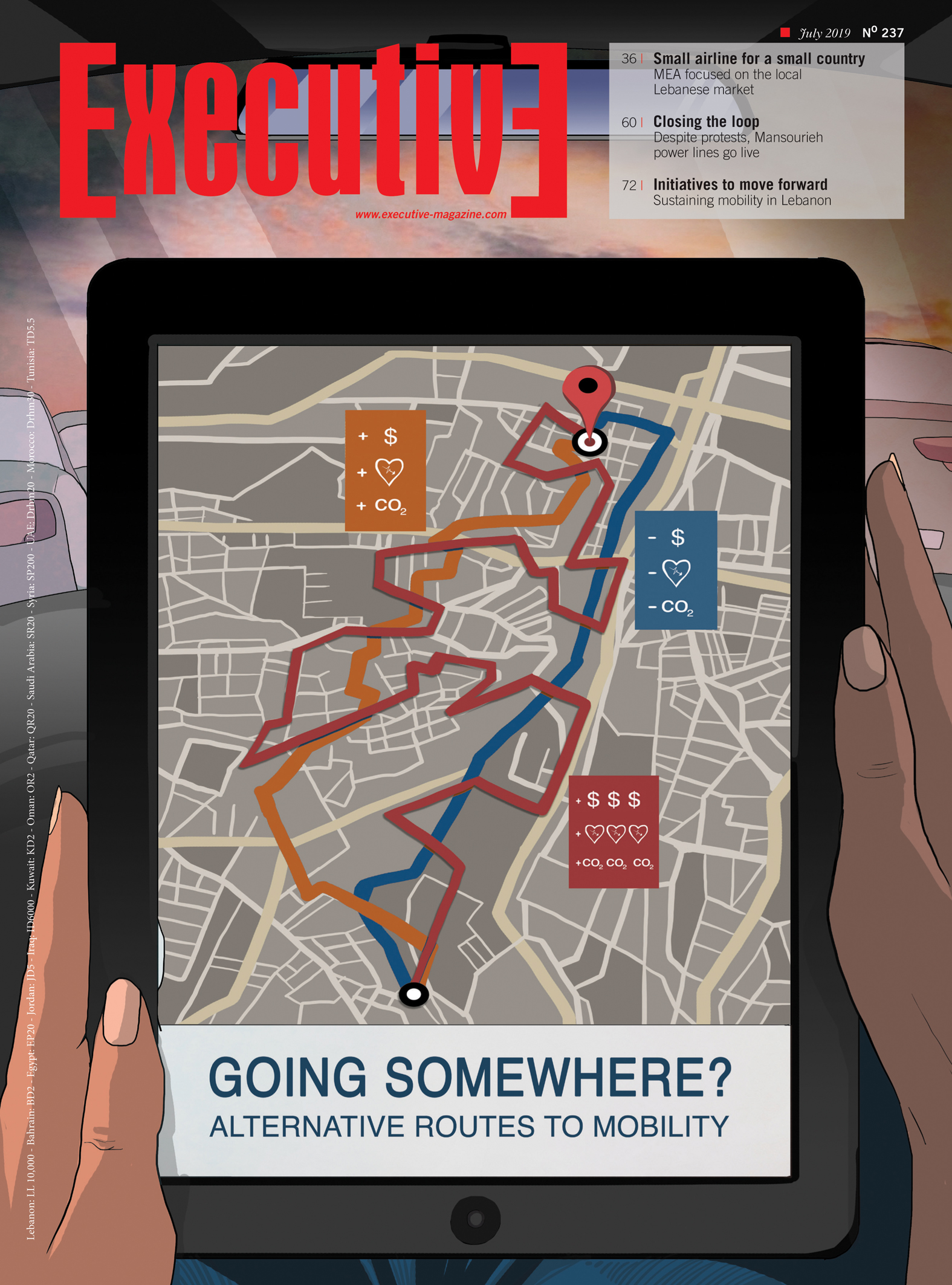
MobilityOverviewSpecial Report

The importance of Lebanon’s macro and micro mobility

by Thomas Schellen July 5, 2019
written by Thomas Schellen

“Nobody ever saw a dog make a fair and deliberate exchange of one bone for another with another dog.”

Adam Smith

Online economic literature has no ready answer to the question of whether Adam Smith had a deep personal bond with a canine, nor if he was an expert on animal behavior by the standards of the time and Scottish dog-keeping society. But one thing is certain: Smith’s interpretation of the distinctly human trait for trade as a “propensity to truck, barter, and exchange one thing for another”—which is directly juxtaposed with his dog reference in his inquiry into the wealth of nations—is an indisputable pointer to the importance of trade in the making of human economy. Some even see trade as the secret that made us human.

Regardless of the idea of what makes one human, one can easily postulate that the impulse to engage in give and take has provided fundamental patterns for people’s interaction and development of diverse forms of capitalist economies—whether in Adam Smith’s human-gain-oriented propensity or in Karl Polanyi’s social-relationships-oriented “reciprocity and redistribution.”

From the vantage point of modern Lebanese identity, however, the real roots of this Lebanese identity construct may have emerged and been shaped at the time of the country’s political formation. Trade is intrinsically linked to the history of the seafaring people in this region since some 32 or 33 centuries ago when the Phoenician era saw Levantine cities rise to world-shaping trade powers. And for about the same length of time—about three millennia—trade organized from the cities on this coast was inextricably entwined with the people’s aptitude for mobility and their adoption of practicable written communication through the Phoenician alphabet.

The narratives of Phoenician trade by ancient Greek and Roman observers strengthen the view that trade is an eternal trait—if there ever is anything human that can be called eternal. Moreover, success in trade, by this very long view, is contingent upon positive linkages to two other fundamental human traits: the desire for mobility and the ability to communicate. This desire to move and discover, entwined with the impulse to pursue actions of give and take, and augmented by the will to narrate, has preceded, transpired into, and historically driven, the development of humanity’s trade and mobility tools from the physical to the organizational.

This means on the practical front that the cargo always came before the container and preceded the vessel. It makes the case that trade existed before the first bank opened its doors and that trade indeed determined the creation of the mercantile corporation. It also puts recent issues into perspective. The story—and dream—of travel started before the rise of cart, train, car, plane, and any Elon Musk rocket project; and the commute to places of greater productivity existed before the metro, before the tram, and way, way, way before the ride hailing app.

In short, trade and travel are inseparable from what contemporary society views as progress. As long as people exist, mobility happens and trade happens. But matching the impulses to engage in trade and mobility with the optimal tools and patterns for each moment in history is the source of the narratives of failures or successes that shape history. This is evidenced from the establishment of the Silk Road over the narrative of the Dutch East India Corporation as the archetypical enterprise, to the double daily congestion that we experience commuting between our homes in Damour, Aley, or Jbeil and Jounieh to our work places in Beirut.

For the present state of Lebanon, the importance of trade and mobility extends from the country’s positioning on the trade routes between Asia and Europe that are emerging as 21st century Belt and Road iterations of the Silk Road—with all implications for the need to develop Lebanese logistics, marine shipping, and port operations—to responsible care and expansion of 20th century aviation patterns between Lebanon and its relevant but diverse travel markets in the Arab world, Africa, and Europe.

These trade issues, some of which have been getting considerable attention by the political circles in the country, will be integral for the success of the Lebanese economy—but just as crucial for the Lebanese economy, and urgently deserving attention, are the myriad aspects of urban mobility and near-term futures in digital transportation. Executive hopes you will enjoy some of our mobility stories and find them useful in working to improve Lebanon’s national and your personal productivity.

July 5, 2019 0 comments
0 FacebookTwitterPinterestEmail
LeadersMobilityOpinionSpecial Report

Transport is transforming and Lebanon must keep up

by Executive Editors July 5, 2019
written by Executive Editors

When compared to political revolutions, it has never been exactly clear what economic revolutions entail nor how long they take. But it is clear that these economic revolutions combine multiple change and adaptation processes, whether one talks of periods of fundamental economic transformation as “revolutions,” beginning with the first agricultural revolution in the fertile crescent or starts the tally with what is today labeled the first industrial revolution, originating in 18th century Britain and sweeping, virus-like, through Europe in the course of the next 100 years. Economic transformations thus might be called “revolutions” on account of their impact in changing human societies, but not because of their speed or intensity.

Economic transformations thus might be called “revolutions” on account of their impact in changing human societies, but not because of their speed or intensity.

It is also clear that while real changes were gradual, each economic revolution in the past 300 years has spread faster than the previous one. When discussing the first and second industrial revolutions, there is also the debate as to whether these industry transformations were accompanied by epochal developments in trade, transport, communication, and finance—or if transportation and communication revolutions constituted core components that shaped these economic transformations in ways that, without them, the industrial leaps, such as those that occurred in textile or steel manufacture, would have not been revolutions at all.

The intuitive expectation in the early 21st century would be that the currently unfolding digital economy revolution is inseparable from the digital communication revolution, and the digital mobility revolution, which is simultaneously unfolding in the two large realms of moving goods—through trade and transport—and of moving humans and connecting them in superior social and productivity settings.

Diversification and digitization

There are too many innovations taking place in the sphere of the digital mobility revolution to discuss the implications of each of them. To bundle these micro uprisings of tech entrepreneurs and myriad disruption-minded businesses, each of which can contribute to shaping mobility in the short and medium term, let us talk of four transition issues: technical, behavioral, economic, and regulatory mobility.

These four issues entail diversification and digitization of mobility through technical inventions, as well as behavioral implications and new patterns through shared mobility and the sharing economy on the level of individuals, families, and urban communities. They further entail enterprise-level shifts in trade and transport with productivity optimization and corollary creative-destruction impacts on regions, industries, and national economies. They finally comprise challenges to create enabling environments for mobility through prudent regulation and wise political decisions, so as to hopefully enable socially and environmentally responsible progress of digital mobility through economic activity in this crucial segment of the emerging digital society.

A very reasonable assumption, however, is that plenty of the current innovations and changes in mobility and digital life will run into technical dead ends and political roadblocks, encounter behavioral resistance, and be enmeshed with an economic mix of wins and busts. This assumption advises us to moderate our expectations about the digital mobility transition, its rapidity, and its reach. For example, the likelihood of a mobility revolution that creates a platform of “zeros”—zero emissions, zero accidents, and zero ownership—is about as great as the likelihood that a future iteration of the sharing economy will equip mankind with zero exploitation of its weaker participants, zero corruption of the stronger players, and zero conflicts between economic interests.

Even if you are as enthused about the digital mobility future, there is ample reason to expect—by all methods that people have acquired throughout history—only the tiniest of odds that digitization of our mobility would transpire into zero congestion, zero inefficiency, and zero crime in this vast human mobility realm. Thus in their sum, the chances for all afore-quoted ideological expectations of zero-ness to soon come to fruition through digital mobility are, well, zero.

It is nothing short of tragic how in the current status quo, Lebanese mobility is becoming an oxymoron.

On the other hand, an equally unwise approach—which one sadly encounters all too often in Lebanon—lies in harboring notions that the arrival of digital mobility can be mastered with wait-and-see indifference or fake economic complacency in pretending that the current business models work well enough and will never be destroyed. Indifference, careless ignorance, or even a focus on 20th century solutions for as yet undefined digital mobility challenges will not be our advantage, neither in the private nor in the public sector.

Before any other consideration on national mobility, it must be acknowledged that Lebanon is in urgent need of better—and better balanced—approaches to the challenge of transitioning into a digital mobility future than begging international partners to fund investments in hard infrastructures for transportation or even soft infrastructures of public transport. It also deserves to be pointed out—over and over, until construction of a better reality is at least attempted in concerted actions of public and private stakeholders—that it is nothing short of tragic how in the current status quo, Lebanese mobility is becoming an oxymoron.

It is an oxymoron to talk about mobility when the daily commutes of employees and entrepreneurs makes the economy lose incalculable amounts of productivity, and when the time wasted on state-related errands makes citizens lose entire workdays unnecessarily. It is also a contradiction-in-terms to discuss trade and digitization of logistics industries in Lebanon at times when stifled information flows at import gateways and disregard of transport logic continually translate into ballooning logistics costs, and when inefficient road networks in combination with unsafe delivery vehicles and substandard urban infrastructures erode the capacities for ethical and environmentally responsible, or “green,” earnings.

All this is tragic in the classical sense of how this society, by trying to address social and economic challenges through the means from the past of transport and communication, seems to steer itself into squandering an intangible historic asset that may be at least as valuable as the oft-cited assets of Lebanese entrepreneurial spirit and this society’s admirable human capital: a good mobility narrative with cultural and practical implications.

Lebanon has practically no historic identity narrative of the kind that has helped other countries to grow beyond their limits. What Lebanon seems to have much more than “natural borders” and nation-forming stories, however, is a deep history of trade entrepreneurship and maritime agility.

Moving forward

The above narrative could contribute to building a national shared identity that Lebanon lacks, along with a unifying national sense of purpose and social contract narrative with convincing mutual obligations.

The iteration of a new and convincing social contract narrative might well be of what the country is in greatest need. Lebanese society is in want of such a narrative, possibly more than it has need of savings in the financial system and perhaps even more than it needs well-organized institutions, political identification figures, and an effective fight against corruption.
This translates, on account of the search for a better narrative of what Lebanon can be, into an open-ended quest for all patriotically minded people, a quest that can be pursued at practically no economic investment cost and with no consultancy involvement: the construction of a credible narrative that weaves stories of the great historic achievements in trade and mobility by all the clans, tribes, and religious communities living in what today is known as the state of Lebanon, into a narrative of mutual obligations and common purpose for a—socially truly fair and inclusive—shared national identity.

On the practical level, Lebanon’s mobility and correlated trade problem includes not only wasteful processes in customs, under-powered aviation (in terms of infrastructure and operation), congested primary arteries, and dilapidated secondary roads in rural provinces. The problem also extends to politically-poisoned national planning overloaded with unimaginative, competing, and unrealized economic plans, to failures of achieving urban productivity improvements, and shortsighted and opportunistic decision-making on all levels from municipal to transnational infrastructure and trade.

The country needs to solve the fiefdom issues that still infest parochial institutions and obstruct national strategy development, an important example for the problem’s trade dimension being the—conceptually long-expired—temporary authority at the Port of Beirut. The government needs to focus not merely on investment calls and construction of public-private partnership models for road infrastructures but also dedicate more attention to assuaging risks of 20th century infrastructure projects. It needs to improve governance of all transportation, mobility, and communication related public institutions and state-affiliate entities, of which there are plenty, but none that stands out with first-class governance.

Executive thus calls on all stakeholders to depart from parochial thinking, abandon piecemeal approaches to long-standing mobility, trade, and transport problems, and invest in developing a much broader and more committed approach to the complex challenges of digital mobility in the context of Lebanon’s digital transition.

Lebanon today is a prisoner of its recent financial and economic past that stands on top of a 300-foot cliff; to escape from this past the country has no choice but to jump into a macroeconomic ocean of uncertainties that is moreover full of financial undercurrents, microeconomic rocks, and political risk reefs. The only sane thing is to jump, but do so with existential trust and the added confidence of having a perfect mobility program that covers all possible routes for swimming out of the danger.

July 5, 2019 0 comments
0 FacebookTwitterPinterestEmail
EditorialMobilityOpinionSpecial Report

Groundhog Day

by Yasser Akkaoui July 5, 2019
written by Yasser Akkaoui

Some repetitions have become part of our routine; it is amazing what human beings can learn to accept. We have become used to daily power cuts, as the electricity switches back and forth between state supply and generator, and to water shortages in the summer and waiting for private companies to refill the tanks. We are only reminded of the pain when we pay the overpriced double bill for bad quality services. We pay, complain, accept—then forget.

Beyond this nonchalant bourgeois attitude that chooses to throw money at the problem rather than revolt, there is one issue that is impossible to accept or ignore: the lack of mobility in this country. The congested streets and the absence of public transport impacts our daily routines, our pockets, and our health—and the problem has been growing to paralyzing levels.

Our mobility woes are rooted in our politicians’ disregard for lives and productivity. Citizens are forced to contend with destructive behaviors, poor planning, and the lack of responsibility and accountability lost between a state-owned and laissez-faire economy. We are stuck in limbo, between a state unable to provide for its citizens and an unregulated private sector feeding off the state’s dereliction of its duties.

It all boils down to one thing: our inability to decide what kind of country we want to be. Transport is one of the many state-owned industries that has disintegrated over time, as vested parties bickered on their vision for the state. The trams, trains, and buses we enjoyed in the ‘50s and ‘60s, they dismantled in the ‘70s and ‘80s and have never rebuilt.

We need to ask what is the price we are paying—the cost of being stuck in traffic every day is depriving us of the basic human right to get from point A to point B without losing our time and resources, and putting ourselves in harm’s way for hours on end. Moving 20 km in two hours is not acceptable, putting our lives in the hands of reckless Lebanese drivers each day is not acceptable, not being afforded the healthy option, an alternate mode of transport, is not acceptable.

But, of course, the repetitions persist. It is in the interest of our politicians to keep the transport sector in the shambles it is today, just as it is in their interest to keep the electricity and water sectors as they are. We suffer, while they enjoy the returns of an informal system that only benefits them.*

*Due to a technical error the last six words of this editorial were missing from the print edition of the magazine. Executive apologizes for this mistake.

July 5, 2019 0 comments
0 FacebookTwitterPinterestEmail
BankingNumbers & Figures

An analysis for 2013-2018

by Dany Baz & Thomas Schellen June 18, 2019
written by Dany Baz & Thomas Schellen

Banks included in Bankdata’s classification for alpha and beta banks with deposits respectively exceeding $2 billion and $0.5 billion are regarded by many international analysts and local banking industry observers to represent the top tiers within the Lebanese banking sector of 59 banks, comprised of 46 commercial banks and their 13 subsidiaries. 

Together, the 16 alpha and 11 beta banks are the dominant banking players in the domestic market and are the only two banking groups with foreign presence. Alpha and beta banks, according to Bankdata’s analysis, also represent 96 percent of loans issued by the banking sector over the past five years. In this period, they injected $10.8 billion into the economy as they grew their loan book from $60 billion in December 2013 to $70 billion at the end of 2018.

Analyzing the provision of loans by these banks within the five-year period under consideration, the highest growth in lending activity was registered in 2014, with an increase of $6.8 billion, or 11.4 percent in year-on-year comparison. Loan growth gradually dropped to $3.8 billion in 2015, and then stalled at $1.5 billion yearly in the following two years, 2016 and 2017; it dipped into a negative growth of -3.8 percent at the end of 2018.

Further analysis highlights that the decrease in total loans was mostly due to the drop in foreign loans over the period. The overall growth registered in 2014 was evenly distributed between domestic and foreign loans, but after an exceptionally strong growth in foreign loans at the start of the period—+22 percent in 2014, followed by a mild increase of 2.9 percent in 2015—this growth fully reversed into negative territory in 2016-2018, in a development presumably related to currency pressures in Egypt and Turkey in the past three years. Consequently, in analysis of the five-year trend of the lending activity by Lebanese banks in foreign markets, as reflected in the banks’ consolidated figures, the end-to-end picture on these loans over the period is quasi -flat, with a growth of merely $126 million.  

In parallel, the domestic loan book continued growing over the period 2013-2017, representing 99 percent of the growth in banking sector lending—and noting that the Lebanese banking sector’s loan book consists of 74 percent of domestic loans.  

Loan developments in Lebanon, owing to the policies of Banque du Liban, Lebanon’s central bank, were isolated to a major extent from foreign exchange pressure that globally affected emerging markets under the Federal Reserve’s move to a tightening of monetary policy at the end of 2015. Other factors and unconventional influences came to bear on the Lebanese lending market in the past three years, as witnessed in the domestic lending developments of Lebanese banks. Notably, negative growth in the amount of foreign currency (FC) denominated loans between 2016 and 2018—after FC loan growth in 2014 and 2015 that was in line with the overall growth of loans in those years—translated into a net increase in the domestic loans in foreign currency portfolio of $5.7 billion. This compares with a net increase of loans denominated in Lebanese lira to $5.1 billion over the analyzed period. 

In a context where dollarization of domestic loans steadily decreased from 75 percent in 2013 to 70 percent in 2017, LL-denominated loans saw double-digit growth annually until end of 2017, but contracted by the equivalent of $1 billion (-5.9 percent) in 2018.  The overall ratio of loans to deposits dropped from an average of 37.7 percent for the 2013-2017 period to 36 percent in 2018. The breakdown by currency shows that the loans to deposits ratio in LL increased from an average of 25 percent in 2013-2017 to 29.3 percent in 2018; the ratio in FC dropped from an average of 43.2 percent over the same period to 37.1 percent in 2018.

Over the past five years, alpha and beta banks in Lebanon have strengthened their provisioning against the impacts of a low-growth economic environment. These banks increased their specific provisions for non-performing loans from $1.5 billion in 2013 to $2.3 billion in 2018, a hike of $766 million. Furthermore, collective provisions were increased by nearly $500 million and reached a peak of $1.1 billion at year-end 2017. Thus banks undertook conscious efforts to shield themselves and the stakeholders in the Lebanese economy from risks that could materialize as loan takers among households and enterprises face downward pressures on their finances. 

Lebanese banking sector
The following infographics refer to alfa and beta banks

Net primary liquidity to deposits by currency
Domestic vs. foreign loans & deposits
Loans & deposits by currency
Loans to deposits ratio by currency
Number of bank branches
Number of bank employees
June 18, 2019 0 comments
0 FacebookTwitterPinterestEmail
LeadersOpinion

A potentially important step toward a new social contract

by Executive Editors June 10, 2019
written by Executive Editors

As a democracy, Lebanon has a sovereign. This sovereign—which the constitution affirms to be the people of Lebanon—has, for the longest time, appeared remarkably unconcerned over a very specific dereliction of duty by its public officials. The dereliction in question was the government’s serial failure to produce a sane, credible, and timely budget, and the sovereign indifference was the near universal quietude over the failure. Moreover, such practical irreverence of the budget’s crucial functions has festered in the Lebanese political body and government since the days of the elder Hariri until last year, when a late and astonishingly unrealistic budget was rushed through.

As a democracy, Lebanon has a sovereign. This sovereign—which the constitution affirms to be the people of Lebanon—has, for the longest time, appeared remarkably unconcerned over a very specific dereliction of duty by its public officials. The dereliction in question was the government’s serial failure to produce a sane, credible, and timely budget, and the sovereign indifference was the near universal quietude over the failure. Moreover, such practical irreverence of the budget’s crucial functions has festered in the Lebanese political body and government since the days of the elder Hariri until last year, when a late and astonishingly unrealistic budget was rushed through.

Although the Lebanese body politic has, over the years, become increasingly irate about the corruption of its many political chieftains, complaining that thieves, hoodlums, and incompetents run their polity, the same body politic did for many years not take to the streets to demand a responsible budget from its cabinet. Thus, while the politicians did not produce, the people did not insist on their acting responsibly. Small voices of the people and civil society stakeholders calling for a budget were academic, self-interested, anemic, and ineffective.

It would be a waste of energy to try and list all the reasons for this specific non-performance of state and citizens, even as the civic and public budgetary indifference were related to the country’s being overburdened with existential concerns. However, this past state of budgetary affairs is nonetheless galling in practical and philosophical terms. This is because everybody with even the most rudimentary understanding of anything resembling political economy should understand that a Lebanese state with no budget is a Phoenician trireme lost among dangerous reefs before an unknown coast.

In this sense, anybody examining the risk that a budget-less course meant for the ship of the Lebanese state and its crew of many communities, could not pretend that the perils were not mounting. Nor could one assume that nonexistent budgets would result in just a tiny and diminishing smidgeon of deficiencies—these deficiencies had to accumulate and were moreover incorrigible. You simply cannot ameliorate by one iota something that does not exist.

And yet, over the many years of a state without a budget, it would have been quite the delusion to expect any Lebanese group to have donned their yellow vests to scream in public and protest that the management of their free and independent nation was conducted by core constitutional institutions—the legislative and the executive branches of government—without diligent observation of their duty to issue and implement an annual state budget. It would have been even incomparably more utopian to ask the people to volunteer personal sacrifices for the national wellbeing.

Now, in late May 2019, the Lebanese people have been presented with a reformist budget. The first thing that must be acknowledged about the process of designing this budget is that the involved ministers and the parties they represent sent out signals of sincerity and seriousness. But it also is clear that in 2019, the chickens of years of waste and indifference have come home to roost. They did so in two forms.

On one hand, citizens concerned over the assumed loss of their entitlements rose up in protests that were often described as preemptive. Case by case, these protests may or may not have had validity as material concerns. Taken all together, the protests also may have, as some experts allege, conveyed to international observers that the new budget has real austerity teeth.

But in another perspective of these protests, which in May 2019 often looked premature more than anything else, would be to consider them as multifaceted signal that Lebanese people have learned to distrust their government in response to innumerable deceits they were subjected to by their leaders in the last 20-30 years. At the same time, however, as “preemptive strikes”—a word choice that, at least in peace-oriented thinking, smacks of morally repugnant military actions—in defense of entitlements, the hasty protests did not smell healthy against the background of the public’s previous indifference concerning the state’s ability to finance an increasingly burdensome range of entitlements. Nor did they serve to reduce concerns over the likelihood of future social conflicts that could result in economic damages of magnitudes that are in no proportion to the value of the entitlements that various social groups might be seeking to protect.

With regard to the interpretations of the budget process by international and local analysts, the budget draft and its design process were met with the degrees of skepticism that must be expected from herds of economists. As analyst perspectives are informed by the past performance of the objects or matters they study, examinations of the 2019 budget and of different scenarios of fiscal and economic developments of Lebanon in the next few years, struck the reader as anything from being tainted by disappointment of failed and insincere political promises in the past quarter century to containing heavy doses of questionable economic modeling and vulnerable assumptions.

Much remains to be done

The experts on all sides, and in all international institutional stakeholders in the Lebanese reform process, have, of course, still much to do in pouring over the figures and implications of the 2019 budget, but it would not be the wisest thing to assume that this budget and its confessed target figures on revenue enhancements, waste cutting, etc., already constitute a trustworthy treasure map that is viable for setting the Lebanese state’s fiscal course over the next three to four years. 

Whereas the recent views of experts thus vary from emphasis on the 2019 budget’s short-term importance for the state’s ability to stave off financial draining of hard currency and instill investors with new confidence, to a medium-term focus of the budget’s alleged potential to improve fiscal balance and real GDP growth, or create a turning point in the evolution of Lebanon’s debt-to-GDP ratio, such narratives are all constructs produced under conditions of uncertainty.  

The only thing that one might assume with a reasonable degree of probability is that the next budget will not be perfect. The draft and resulting 2019 budget law cannot be expected to be void of miscalculations and understated cost expectations, regardless of the number of sessions and hours of deliberations which are invested at the levels of executive (Council of Ministers) and legislative (Parliament).

But on the philosophical upside of all this, the struggle for a new budget in Lebanon can and should trigger much more than a fiscal discussion for the year 2019 with implications for the coming years and the five-year deficit reduction targets that Lebanon has made commitments to in April 2018.

As practical measure for improving the management of Lebanon’s political economy in the coming period, the budget imposes the sacrifices that people will not commit to otherwise. As such, the budget may save the state’s economic neck.

However, the budget can potentially also be an important step toward a new social contract. Devising of new social contracts is a universal challenge and issue of concern to societies around the world these days, as new contracts are needed for the age where the previous liberal democracy model—which since the mid-20th century postulated that the combination of free markets and liberal democracies to be unbeatable for the improvement of peoples’ prosperity and wellbeing—can no longer be sold as the one and only winning ideology for existence in a simultaneously fractured and digitized global community with new definitions of the wealth of societies, global progress, sustainability, and environmental and social priorities.

In the fading age of liberal democracies under American political-economic tutelage and claims to ideological leadership, social contract thinking was informed importantly by the philosophy—formulated by American thinker John Rawls almost 50 years ago—that a society of reasonable people will acknowledge the primacy of liberty as well as the reality of inequality in economic existence. But this understanding is not complete without the mandate that a social contract in such context must ascertain that unequal distribution of wealth is beneficial to the least advantaged members of society without any ambiguity. For a country, this philosophical aim is the moral mandate to structure society in such ways that unequal distribution of economic assets leaves the least-advantaged people better off than they would be under any other form of economic distribution.

It must be said that Lebanon, under its social contract with its rentier and entitlement drivers from the post-civil war years until today, has not made any progress toward implementing a society where the least-advantaged are better off. While unequal distribution was the country’s most prominent economic and social determinant for the last 25 years—arguably much more than the oft-debated consociationalism of the political system and even more than the proverbial entrepreneurial orientation of the Lebanese—the failure of this system to benefit the least-advantaged among Lebanon’s people is undeniable. Poverty rates tell the story that the opposite has been happening.

From this vantage point of seeing the 2019 budget not only as something practical that is needed for the survival of the Lebanese nation and its protection against international financial interventions that would be even costlier to the people than the new avowedly reformist and restrictive budget, the viability test will be not if the percentage targets for deficit reduction, revenue generation, and other ratios are realized with digestible margins of error. The philosophical test for the budget will be if it will improve the lives of the least advantaged and bring Lebanon closer to developing a new social contract.

Although the Lebanese body politic has, over the years, become increasingly irate about the corruption of its many political chieftains, complaining that thieves, hoodlums, and incompetents run their polity, the same body politic did for many years not take to the streets to demand a responsible budget from its cabinet. Thus, while the politicians did not produce, the people did not insist on their acting responsibly. Small voices of the people and civil society stakeholders calling for a budget were academic, self-interested, anemic, and ineffective.

It would be a waste of energy to try and list all the reasons for this specific non-performance of state and citizens, even as the civic and public budgetary indifference were related to the country’s being overburdened with existential concerns. However, this past state of budgetary affairs is nonetheless galling in practical and philosophical terms. This is because everybody with even the most rudimentary understanding of anything resembling political economy should understand that a Lebanese state with no budget is a Phoenician trireme lost among dangerous reefs before an unknown coast.

In this sense, anybody examining the risk that a budget-less course meant for the ship of the Lebanese state and its crew of many communities, could not pretend that the perils were not mounting. Nor could one assume that nonexistent budgets would result in just a tiny and diminishing smidgeon of deficiencies—these deficiencies had to accumulate and were moreover incorrigible. You simply cannot ameliorate by one iota something that does not exist.

And yet, over the many years of a state without a budget, it would have been quite the delusion to expect any Lebanese group to have donned their yellow vests to scream in public and protest that the management of their free and independent nation was conducted by core constitutional institutions—the legislative and the executive branches of government—without diligent observation of their duty to issue and implement an annual state budget. It would have been even incomparably more utopian to ask the people to volunteer personal sacrifices for the national wellbeing.
Now, in late May 2019, the Lebanese people have been presented with a reformist budget. The first thing that must be acknowledged about the process of designing this budget is that the involved ministers and the parties they represent sent out signals of sincerity and seriousness. But it also is clear that in 2019, the chickens of years of waste and indifference have come home to roost. They did so in two forms.

On one hand, citizens concerned over the assumed loss of their entitlements rose up in protests that were often described as preemptive. Case by case, these protests may or may not have had validity as material concerns. Taken all together, the protests also may have, as some experts allege, conveyed to international observers that the new budget has real austerity teeth.

But in another perspective of these protests, which in May 2019 often looked premature more than anything else, would be to consider them as multifaceted signal that Lebanese people have learned to distrust their government in response to innumerable deceits they were subjected to by their leaders in the last 20-30 years. At the same time, however, as “preemptive strikes”—a word choice that, at least in peace-oriented thinking, smacks of morally repugnant military actions—in defense of entitlements, the hasty protests did not smell healthy against the background of the public’s previous indifference concerning the state’s ability to finance an increasingly burdensome range of entitlements. Nor did they serve to reduce concerns over the likelihood of future social conflicts that could result in economic damages of magnitudes that are in no proportion to the value of the entitlements that various social groups might be seeking to protect.

With regard to the interpretations of the budget process by international and local analysts, the budget draft and its design process were met with the degrees of skepticism that must be expected from herds of economists. As analyst perspectives are informed by the past performance of the objects or matters they study, examinations of the 2019 budget and of different scenarios of fiscal and economic developments of Lebanon in the next few years, struck the reader as anything from being tainted by disappointment of failed and insincere political promises in the past quarter century to containing heavy doses of questionable economic modeling and vulnerable assumptions.

Much remains to be done

The experts on all sides, and in all international institutional stakeholders in the Lebanese reform process, have, of course, still much to do in pouring over the figures and implications of the 2019 budget, but it would not be the wisest thing to assume that this budget and its confessed target figures on revenue enhancements, waste cutting, etc., already constitute a trustworthy treasure map that is viable for setting the Lebanese state’s fiscal course over the next three to four years. 

Whereas the recent views of experts thus vary from emphasis on the 2019 budget’s short-term importance for the state’s ability to stave off financial draining of hard currency and instill investors with new confidence, to a medium-term focus of the budget’s alleged potential to improve fiscal balance and real GDP growth, or create a turning point in the evolution of Lebanon’s debt-to-GDP ratio, such narratives are all constructs produced under conditions of uncertainty.  

The only thing that one might assume with a reasonable degree of probability is that the next budget will not be perfect. The draft and resulting 2019 budget law cannot be expected to be void of miscalculations and understated cost expectations, regardless of the number of sessions and hours of deliberations which are invested at the levels of executive (Council of Ministers) and legislative (Parliament).


But on the philosophical upside of all this, the struggle for a new budget in Lebanon can and should trigger much more than a fiscal discussion for the year 2019 with implications for the coming years and the five-year deficit reduction targets that Lebanon has made commitments to in April 2018.
As practical measure for improving the management of Lebanon’s political economy in the coming period, the budget imposes the sacrifices that people will not commit to otherwise. As such, the budget may save the state’s economic neck.

However, the budget can potentially also be an important step toward a new social contract. Devising of new social contracts is a universal challenge and issue of concern to societies around the world these days, as new contracts are needed for the age where the previous liberal democracy model—which since the mid-20th century postulated that the combination of free markets and liberal democracies to be unbeatable for the improvement of peoples’ prosperity and wellbeing—can no longer be sold as the one and only winning ideology for existence in a simultaneously fractured and digitized global community with new definitions of the wealth of societies, global progress, sustainability, and environmental and social priorities.

In the fading age of liberal democracies under American political-economic tutelage and claims to ideological leadership, social contract thinking was informed importantly by the philosophy—formulated by American thinker John Rawls almost 50 years ago—that a society of reasonable people will acknowledge the primacy of liberty as well as the reality of inequality in economic existence. But this understanding is not complete without the mandate that a social contract in such context must ascertain that unequal distribution of wealth is beneficial to the least advantaged members of society without any ambiguity. For a country, this philosophical aim is the moral mandate to structure society in such ways that unequal distribution of economic assets leaves the least-advantaged people better off than they would be under any other form of economic distribution.

It must be said that Lebanon, under its social contract with its rentier and entitlement drivers from the post-civil war years until today, has not made any progress toward implementing a society where the least-advantaged are better off. While unequal distribution was the country’s most prominent economic and social determinant for the last 25 years—arguably much more than the oft-debated consociationalism of the political system and even more than the proverbial entrepreneurial orientation of the Lebanese—the failure of this system to benefit the least-advantaged among Lebanon’s people is undeniable. Poverty rates tell the story that the opposite has been happening.

From this vantage point of seeing the 2019 budget not only as something practical that is needed for the survival of the Lebanese nation and its protection against international financial interventions that would be even costlier to the people than the new avowedly reformist and restrictive budget, the viability test will be not if the percentage targets for deficit reduction, revenue generation, and other ratios are realized with digestible margins of error. The philosophical test for the budget will be if it will improve the lives of the least advantaged and bring Lebanon closer to developing a new social contract.

June 10, 2019 0 comments
0 FacebookTwitterPinterestEmail
Last wordOpinion

Press freedom in Lebanon today

by Paul Morcos June 7, 2019
written by Paul Morcos

At the time when it is essential for the press to be independent, when everyone should be investing their efforts into safeguarding the well-being of the press, instead, the world over, there are economic, religious, political, and legal pressures that are controlling the freedom of expression of journalists, media outlets, and even citizens themselves.

Freedom of the press has always been perceived as a trademark of democracy. It is protected by both local law and international convention. In the fundamental provisions of the Lebanese constitution it is stated that “Lebanon is a democratic parliamentary republic based on respect for public liberties especially the freedom of opinion,” while article 13 stipulates that “the freedom to express one’s opinion orally or in writing, the freedom of the press, the freedom of assembly, and the freedom of association shall be guaranteed within the limits established by law.” Internationally, the first principle of the declaration on media freedom in the Arab World—adopted on May 3, 2016 in Morocco—verifies freedom of expression, including media freedom, as being a fundamental human right to seek, receive, and transmit information and ideas of all kinds through any means of communication, even across frontiers.

The fundamentals of a democratic society are the rotation of power, freedom of expression, and independence; if any of these are lacking, the nation or state shall no longer be considered democratic. In Lebanon, the relationship between the media and public opinion remains ambiguous, in the sense that media freedom is juxtaposed with partisanship and hidden or open dependencies. This, unfortunately, results from most media institutions being dependent on the influence of religious communities and funding from the different political parties.

Freedom of the press in Lebanon has always been at risk; many Lebanese journalists have been assassinated for their opinions. In honor of World Press Freedom Day, celebrated on May 3 of every year, the regional office in Beirut of the United Nations Educational, Scientific and Cultural Organization, organized a conference on May 2, 2019 entitled: “Media for Democracy: Journalism and elections in times of disinformation.” During the event, it was revealed that between 2016 and 2019 around 100 summons of journalists were recorded in Lebanon. The main reason behind these summons were journalists turning to social media to publish their personal point of view on certain subjects. These numbers are shocking and increasing from one year to another. Lebanon’s press freedoms have been regressing since 2015 because of these arrests. 

Can we expect this issue to be resolved when almost every media institution is politicized? Can we safeguard the freedom of the press at a time when social media has—for better and for worse—allowed anyone to disseminate information? Can we preserve freedom of the press when laws are not being respected anymore due to a lack of authority and mal implementation? 

In civil states everyone’s rights are well preserved. The Lebanese political system allows for freedom of expression and of the media; had this been obstructed we could no longer call Lebanon democratic. It is a journalist’s job to report the news impartially and with objectivity, yet the media landscape in Lebanon—with the affiliation of media outlets to certain political forces—makes this difficult, and self-censorship has been common among journalists in the country.

Media is a major leeway for people to communicate their ideas and opinions; it is the window that exposes them to news and information. More importantly, it remains the crucial ombudsman watching over the performance of the ruling bodies. That is why it is essential to support its freedom and safeguard it. 

For us to achieve full press freedom, the government should take legislative actions through, for example, reviewing the current laws pertaining to media and information, passing new laws, enacting the laws relating to detecting corruption and the data protection act, and modernizing the penal code. This, however, will not be enough if we suffer from a lack of commitment to the ethical and professional standards required to realize full freedom of the press. 

June 7, 2019 0 comments
0 FacebookTwitterPinterestEmail
Hospitality & TourismSaudi return

Five star hoteliers preparing for forecasted boost in tourism from Saudi Arabia

by Nabila Rahhal June 7, 2019
written by Nabila Rahhal

The rising temperatures in Beirut signify a rapidly approaching summer, typically a peak tourism season in Lebanon and one that five star hoteliers in the country are eagerly anticipating. Tourism in Lebanon has been slowly getting back on its feet over the past four years—thanks to a diversification of markets that included European and South American visitors to the country—but hospitality stakeholders expect 2019 to be the best in terms of visitor numbers to Lebanon since 2010.

The reason for this unabashed optimism largely lies in the Gulf, specifically in the lifting of the travel advisory against Lebanon by Saudi Arabia in late February. Saudi nationals had been warned against travel to Lebanon for almost seven years—although the advisory was briefly lifted in 2017 only to be reinstated following Prime Minister Hariri’s retracted resignation—and over that period there was an almost consistent decrease of visitors from Saudi Arabia to Lebanon.

Lebanon’s five star hoteliers are hoping the lifting of the travel advisory means the tide has changed and GCC nationals will be flocking back to Lebanon this summer in the same volume they did pre-2012.

The reunion

Following the lifting of the travel advisory, some hotels, such as the Phoenicia Hotel, say they felt an almost immediate positive impact on their occupancy rates, according to Tracey Bolton, its cluster director of sales and marketing.

Others say the real upshot of the lifting of the travel advisory manifested a bit later in the year. “Definitely, the number of visitors from the Gulf—and specifically from KSA—has increased so far in the year,” says Gilbert Zeait, general manager of Gefinor Rotana. “The effect of the lifting of travel restrictions was felt to some extent when it first occurred in February, but we can talk of a significant impact to tourism in mid-April when there were school holidays in KSA.” Speaking for the Four Seasons, its regional vice president and general manager Ramy Sayess says 2019 has been a positive year so far, and April 2019 was the best performing month since the hotel opened in 2010.

While the holy month of Ramadan is typically a slow one for tourism from the GCC countries, early indicators—interviews for this article were conducted in mid-May—suggest that Eid el-Fitr, this year falling in the first week of June, is going to be a busy period for Lebanon’s five star hotels. Nadia Madi, director of sales and marketing at Kempinski Summerland Hotel & Resort, says the property is fully booked starting from Eid and for the remainder of June with mainly Lebanese expats, and GCC and European nationals.

Bolton says all 72 rooms in Phoenicia’s sister property, Le Vendome, are already fully booked for the Eid period, and she expects Phoenicia to be fully booked as well for the same period by the time Eid is celebrated in June. She explains that their royal and presidential suites—favored by the Saudi nationals who were visiting Lebanon before the travel advisory—are being frequently booked again. “We’ve had support from the KSA market in the past five years—we’ve been lucky that way—but it hasn’t been from the big spenders, so now the average rate is intrinsically increasing again because they have started to come back and book these big suites,” Bolton says.

Zeait says Gefinor Rotana is at 50 percent occupancy for June—already an increase when compared to the same period in 2018—but explains that GCC nationals are usually last-minute bookers, and so he expects June occupancy to increase substantially during the last week of Ramadan. Zeait also mentions that the property’s suites and two to three bedroom apartments—which are part of the hotel and serviced as regular rooms—are an advantage in attracting Saudi tourists, who tend to travel in large groups.

Will they or won’t they?

Now that the Saudis can visit Lebanon freely again, the question is: Will they want to? Hoteliers interviewed generally believe that they do. Although Saudi nationals have likely developed other preferred travel destinations during their almost seven-year absence from Lebanon, hoteliers are hoping that there is truth in the expression that absence makes the heart grow fonder. Madi says Lebanon is still viewed as the “ultimate summer destination among its neighboring countries,” while Sayess explains that, based on his conversations with Saudi nationals, “they love Lebanon, and they miss Lebanon, and so for them to be able to come back, it’s like finding their first love.”

In a more pragmatic manner, Bolton explains that many Saudi nationals visited Turkey when they were unable to come to Lebanon, and now that relations between Saudi and Turkey are strained, Lebanon can reap the benefits—especially since they had not been able to visit Lebanon for a while, so it feels like a new destination to them.

Photo by: Greg Demarque | Executive

The younger generation of Saudis—who have grown up travelling to the likes of London, Dubai, and even Istanbul—might conceivably pass on visiting Lebanon, but here again hotel operators are optimistic. “They will of course want to come to Lebanon because the feedback they hear about the country from those who have been here is always positive,” says Zeait. “I used to live in Saudi, and am talking from my personal experience. For those in their early 20s, and even if they had never visited Lebanon, they see it as a place where they can have fun.”

Put in the work

Although the perception is that Saudi nationals are eager to revisit Lebanon, the reality is that the global tourism market has become very competitive, and in order for Lebanon to grab its piece of that pie—and attract GCC and other international business—it has to put in the effort. “It needs a push from the government to market the destination Lebanon and reposition it, targeted at the countries which have not supported Lebanon as much in the recent past,” explains Bolton. “We work very closely with the Ministry of Tourism, and we go to a lot of trade shows to represent Lebanon—and all it has to offer in terms of history and culture—as a destination.”

Over the past three years, tourism stakeholders have indeed been working to promote Lebanon through a combined effort from the Ministry of Tourism and individual hospitality establishments, according to Sayess. In the then-absence of a steady GCC market, the European market was better developed by these stakeholders, as was the South American market with a focus on the Lebanese diaspora. This was achieved through a variety of efforts including participation in international trade shows marketing Lebanon as a destination and the organization of Visit Lebanon—the second edition of which took place at the end of May—a B2B trade show that invites international travel and tourism agencies and introduces them to all the tourism that could be done in Lebanon.

Today, both the European and the South American tourism markets are gradually growing, and so the expected boost from the Saudi market will serve to drive visitor numbers to Lebanon even higher. This is leading several tourism stakeholders to say that summer 2019 is likely to break tourism figures records, with Sayess saying his only wish is that the works in the airport will finish in time to accommodate the large number of expected visitors. While Eid el-Fitr is predicted to set the season off on the right foot, the belief is that Eid el-Adha (in mid-August) will be when visitor numbers will flow until the end of the summer season in mid-September, provided there are no unexpected negative surprises. Stay tuned.

June 7, 2019 0 comments
0 FacebookTwitterPinterestEmail
EntrepreneurshipFinancial technology

StartechEUS to provide funds and mentorship

by Lauren Holtmeier June 7, 2019
written by Lauren Holtmeier

Fintech—financial technology— is a buzzword in the entrepreneurship sphere and a fast-growing segment of the financial services industry globally and in the MENA region. In 2018, the fintech sector saw $36.6 billion invested worldwide, a 329 percent increase over a five-year period, according to UK-based non-profit Innovative Finance. Lebanon is no exception—in 2015 the country hosted 14 percent of the region’s fintech startups and was the fourth most-served market by fintech companies, according to the Investment Development Authority of Lebanon (IDAL). Despite this, Lebanon’s nurturing of local fintechs still seems to lag behind the global trend. Those Executive spoke with noted that with a highly skilled local labor force there is potential for launching successful fintech startups here, but entrepreneurs still face challenges, primarily in the form of regulatory hurdles.

StartechEUS, a new fintech hub, opened its doors on May 1 in Beirut Digital District (BDD) and hopes to help startups navigate these obstacles by serving as a one-stop-shop for budding fintech entrepreneurs. Founded by Alexandre Harkous, who is also StartechEUS’ managing partner, the new hub aims to provide funding, mentorship, and physical space to primarily late-seed phase fintech startups. Harkous is an experienced player in financial services, having previously founded BI-SAM Technologies S.A., a company that offers analytics software, client reporting, and data management solutions to the investment management industry. The hub is expected to occupy a 800 square meters space in BDD, though at the time of writing, this space was not yet confirmed. Like Agrytech, an accelerator that focuses on startups in the agri-food vertical, StartechEUS is a vertical-specific endeavor targeting a niche market. 

Stephanie Abi Abdullah, BDD’s program director argues that StartechEUS will be a significant contribution to BDD. “It’s good to have them close to the startups, leveraging their expertise, and building relationships with them,” she says. “Having the first fintech hub at BDD is just natural for us.” She notes that the Lebanese Economic Vision (LEV) produced by international consulting firm McKinsey positions fintech as one of the key pillars of the Lebanese startup industry, with a high potential for success. The financial services section of the LEV sets the target for the number of fintechs in Lebanon serving the global market as rising from 15 today to 45 by 2025. 

Few boots on the ground

Executive spoke with Nizar Ajeeb and Giovanni Khalil, chief technology officer and chief marketing officer at StartechEUS respectively, to discuss how StartechEUS plans to contribute to the ecosystem. They explain that the organization is comprised of three pillars: the “Finnovation Fund,” a hybrid fund of private partner funding and funding via Circular 331; the “FinHub,” which is the accelerator arm, and the “Technology Academy,” which will provide partnering entrepreneurs with training sessions and access to physical space and technology. “The main difference here is that we aren’t a silo,” Ajeeb says. “We’re not only an incubator or an accelerator, we’re all of these together.”

Khalil tells Executive in a follow up email that they expect the Circular 331 portion of the hybrid fund to equal $25 million. When asked about the size of funding raised from the private sector thus far, the duo declined to comment. They say, however, that chosen partnering startups will be eligible to receive between $50,000 and $2 million in funding, depending on which stage they are at in their life cycle. 

Asked how many startups StartechEUS would be able to support at any given time, the duo declined to give a number, but did say that each startup would be in the program between five and seven years until exit into global EU and US markets. The focus on these markets is driven by the idea of job creation for Lebanese graduates as well as increasing the foothold of international companies in Lebanon, says Karl Naïm, chief investment officer and partner at StartechEUS. Currently, StartechEUS lists one company in its portfolio, OneWealthPlace, also founded by Harkous. Ajeeb says they are conducting due diligence on two potential companies now, which, if successful, would be announced via their website. 

With just two potential companies in the pipeline and only one in their portfolio, the question remains if there are currently enough fintech startups in Lebanon—or enough in the development pipeline—to justify an endeavor of this scale. Especially considering that StartechEUS plans to focus solely on fintech companies started by Lebanese or members of the Lebanese diaspora, limiting their potential market.

Executive posed this question to Fawzi Rahal, managing director of Flat6Labs, a regional accelerator program, and his reply was blunt: “No.” Despite a growing number of fintech pitches, Rahal says that only five of Flat6Lab’s 26 startups are fintech. While this constitutes 19 percent of their portfolio—not an unimpressive portion—he says there are not enough fintechs in the rest of the country that would be suitable for StartechEUS to invest in. Most of the fintech startups that apply to Flat6Labs cannot, or should not, be validated in Lebanon, Rahal says, because either the idea is not suitable for Lebanon, or the infrastructure is not available to test and develop an idea.

Negative perceptions

Ajeeb says StartechEUS will look for graduated startups from the likes of Flat6Labs to feed into their program, and on this front Rahal seems optimistic. “For us, we see [StartechEUS] as a healthy advancement of the pipeline,” Rahal says. “Because when startups do graduate from Flat6Labs, right now the only other option for fintechs is Phoenician Funds.” Focusing on seed and early stage companies, Phoenician Funds does offer support to fintech, but it is not the VC’s sole focus. 

As far as the diaspora is concerned, attracting investment from abroad is challenging. The 2018 Arabnet report on the Lebanese Innovation Economy notes that while the diaspora is large, it has proven challenging to motivate them to invest in Lebanon. Most investors do not want to invest in such a risky environment and opt for other, less volatile markets. There is also a perception problem with Lebanese products; if there is a cheap Lebanon-based solution, it is perceived as being of lesser quality, according to Rahal. This, he says, is a perception the startup ecosystem needs to overturn by continuing to launch quality products. 

Naïm says that startups StartechEUS invests in will have Lebanese talent and presence, but will not necessarily have a Lebanese holding, meaning that IP and holding companies may be located abroad. He says this should help combat negative perceptions and will facilitate smoother international adoption and expansion, and alleviate risk that may be associated with a company in Lebanon.

Rahal also says that for a Lebanese national in the country, going through the pipeline here is a lot easier than elsewhere in the region or abroad, as there is funding available and the overhead costs are not as high. However, for non-Lebanese, he argues there is little incentive to set up shop in Lebanon because of the difficulties faced in navigating the regulatory framework—cited by 64 percent of tech startups as a main impediment in the Arabnet report. 

Currently Lebanon lacks any sort of regulatory sandbox, a testing environment used to ensure regulatory compliance and security checks for financial operations. Places like Bahrain, the UAE, Saudi Arabia, and Egypt have all introduced sandboxes linked to their central banks to encourage development in the sector, but Lebanon is still lagging.

Creating a fintech-friendly environment would require serious regulatory change from Banque du Liban (BDL), Lebanon’s central bank. Without measures from BDL, along with improvements to digital infrastructure, there is little incentive for those abroad to launch their companies here. 

To expand in the region or further a field?

Ajeeb says he is hopeful the hub will be a positive contribution to the ecosystem by providing Lebanese talent the opportunity to launch their companies here, while attracting the knowledge and expertise of the global Lebanese diaspora who may have started their companies in Europe or the US. StartechEUS has partnered with Lebanese International Finance Executives (LIFE), a worldwide membership organization of diaspora-based Lebanese financiers that has over 250 finance executives, to help gain access to this talent pool,  Khalil says. 

Attracting investors knowledgeable of EU and US markets would be an advantage for StartechEUS, which promises to provide access to these markets abroad and regulatory compliance training, such as training on the General Data Protection Regulation that exists in the EU, to their partners. 

Rahal says that Flat6Labs has taken a different approach. “We believe the first step needs to be the GCC and the MENA,” he says. It is difficult for a startup developed in Beirut to be taken to Europe, because most of the validation that must happen is easier done within the region, he says, arguing that it is easier to scale and grow a startup regionally than suddenly competing against extremely well-versed founders in Europe or in the US.

Naïm said in an email that there are successful Lebanese fintech startups abroad, like Murex that was founded in Paris. “There are no reasons why a Lebanese startup with the right idea, execution, contacts and partners, couldn’t compete globally, and StartechEUS is here to facilitate this,” Naïm says.

There are a lot of challenges that fintechs must navigate in Lebanon, especially those that seek to export their product abroad. Where perception problems and a lack of a regulatory framework will be hurdles any fintech startup StartechEUS partners with will have to leap over, Naïm seems confident that his team is prepared to help them do so. He acknowledges that the startup ecosystem in Lebanon is still in its infancy, and he agrees that as of today there are not enough fintech players in Lebanon, but says that StartechEUS’s role will be to help nurture and accelerate the vertical’s maturity through their VC funding, mentorship, and targeting of the diaspora, and added that with the backing of BDL and the banking ecosystem, pushing this initiative forward is feasible. 

June 7, 2019 0 comments
0 FacebookTwitterPinterestEmail
CommentEconomics & PolicyEntrepreneurship

Lebanon’s long-awaited 2019 budget

by Fadi A. Karaa June 7, 2019
written by Fadi A. Karaa

A sobering reality emerges in the shadow of the long-awaited 2019 budget, declared by Prime Minister Saad Hariri as the most austere in Lebanon’s history. As a stop-gap fiscal rescue package, it falls short of the transformational budget, based on a grand national vision for debt reduction and upgrading of critical infrastructure that is sorely needed at this juncture. Justifiably, the refinancing of near-term maturity Eurobonds is on hold as foreign investors ponder the absence of the promised public reforms. Similarly, the CEDRE creditors—about 8 percent of the pledged amounts are grants, with the majority of the funding in new loans—have also withheld the pledged funding on the requirement that Lebanon undertake serious public reforms.

An unnecessary ordeal

A unanimous austerity consensus across the political class was met with anxiety, disappointment, and anger by large segments of the population, particularly public sector employees, military officers, teachers, and pensioners. The budget follows unusually gloomy statements over the last 12 to 18 months by top political and community leaders regarding the financial crisis and the severe lack of liquidity. These announcements often coincided with the customary reassuring statements of Banque du Liban (BDL), Lebanon’s central bank, regarding the stability of the currency and the health of the financial sector. This dual-track discourse has generated a sense of deep financial crisis and an overall distrust of institutions, gradually amplifying a national suspense about a possible looming disaster, and the usual flight to foreign currencies. Combined with the mounting geopolitical risks, the repatriation of large numbers of previously-employed Lebanese citizens from the Gulf countries, and the continuing burden of the refugee crisis, a national ordeal of negativity has befallen consumers and producers alike. This has affected investment and spending decisions and depressed entire asset classes, such as the real estate sector.

Since much of the pressure from creditors is tied to the high 2018 budget deficit and debt-to-GDP ratio, Lebanon should defer any further debt, and instead, reduce its total debt by enacting structural, organizational, and financial deleveraging reforms on a fast-track basis. Instead of utilizing debt to rebuild infrastructure, Lebanon should reorganize the power sector into independent private utilities, with equity and debt issues to be owned by a majority of Lebanese investors. The delivery of a long-awaited reliable electricity sector should be entrusted to competitive private utilities subject to public regulation regarding rate setting. A reform of the capital markets in support of an “Invest in Lebanon” program would help reduce debt through new infusions of capital into the public and private entities, and create a new investment vehicle for future employee retirement plans.

Lebanon has made inroads in startup formation, information services, tourism, healthcare, and higher education. With potential major new revenues from energy production within the next decade or so, Lebanon now needs a long-term vision for success. It needs to chart a clear course on the enlightened socio-capitalism spectrum, both geopolitically and economically, with similarities to Switzerland, Singapore, Monaco, UAE, and others. This vision must be communicated to Lebanese citizens and international markets alike, in order to elicit the essential trust in the direction of the country, and the acceptance of the austerity measures as a means to an end: a new more vibrant Lebanese economy.

The Lebanese political leadership has elected an unusually tough stance regarding the austerity measures. To many, such cuts—while unwelcome—could be acceptable, if perceived as a worthwhile sacrifice and an investment in the future of Lebanon. The communication of such measures—which affect not only public employees and pensioners, but also investors by boosting the tax on interest income—as a national short-term sacrifice for all, is critical to their acceptance and renewed public confidence.

Lebanon is at a crossroads, but also a tipping point. It can either solve its problems through sound long-term measures, or continue to avert the short-term crisis by further mortgaging the future and increasing a future risk of default. In order to gain the trust and patience of its population, it is in sore need of a grand vision, better coupled with prudent management of its finances, and a deleveraging and modernization of the public sector, in order to lead its citizens to a period of renewed prosperity. Adding more debt to the balance sheet is by no means the highest priority.

June 7, 2019 0 comments
0 FacebookTwitterPinterestEmail
BankingSpecial Report

Reduce the gender gap in Lebanon’s finance sector to boost productivity and growth

by Zeina Zeidan June 7, 2019
written by Zeina Zeidan

Lebanon’s capital market needs a turbo boost. The Beirut Stock Exchange (BSE) has long been hobbled by the lack of companies listed, and the lack of associated opportunities. This is reflected in the BSE’s low market size—$9.2 billion—and in its performance. In 2018, the BSE was the fourth worst performing bourse in the world, down 15 percent on 2017, with overall trading down by 36 percent. The downtrend has not eased in 2019. At the end of April, the BSE’s market capitalization had shrunk to $8.8 billion. 

This needs to change. Given the current economic condition of the country—the runaway debt and the need for reforms—it is necessary to invigorate the economy by supporting and empowering our capital markets to accomplish three interlinked objectives: to direct savings into qualified enterprises, to invigorate trading of equities, and to attract liquidity.

It has been established by ample research that efficient and well-regulated capital markets are great tools for improving the national economy. This fact has been extremely well understood by Banque du Liban, Lebanon’s central bank, and thus over many years Lebanon has seen attempts to create and empower its capital markets. 

Initiatives with this aim have been present since the BSE was reopened in the mid-1990s and have entailed moves like the creation of a Capital Markets Authority in 2011 and more recently, the approval by the cabinet to transform the BSE into BSE sal. The decision to establish the BSE as joint stock company, taken in 2017, was a welcome move to many stakeholders in financial markets, such as myself, and it is also highly desirable to see efforts that would implement the partial privatization of BSE sal through the selling of shares to the private sector, an action that needs to be given a green light by the newly formed cabinet. 

The role of women

Another new initiative, which has been under preparations for several years now, is the creation of an Electronic Trading Platform (ETP). The relationship of the two entities to each other, and the question if Lebanon is best served by integrated or separately managed capital markets platforms, however, is still in need of clarification at this time.

But even as the BSE privatization and ETP projects are progressing in 2019 amidst such lingering uncertainties, much attention should also be given to another factor that could improve our capital markets. This factor is the role of diversity, and specifically the role of women in capital markets. While lost opportunity costs abound in the delays to reinvigorate the stock market, lagging behind the global development curve does have a potential upside. Discussions are underway on how best to turbo charge the capital market; it is an opportune time to tag onto the agenda the empowerment of women in the stock exchange as well as the financial sector.

Just a decade or so ago, such a notion would have been politely dismissed, if not openly laughed at in such a male-dominated ecosystem. But over the past several years, empowering women has risen higher on the agendas of global institutions such as the World Bank, the International Monetary Fund, and the United Nations, while the financial sector itself is increasingly adopting gender equality programs, evidenced in the launch of Bloomberg’s Gender-Equality Index 2018.

There are regional initiatives emerging as well, the American University of Beirut was awarded a $1.5 million federal grant by the US Department of State Middle East Partnership Initiative to create an index with the title: “The KIP Index: A Comparison of the Status of Women in the MENA Economies.” This index is concerned with creating a localized measure of women’s contributions to MENA economies through measuring recruitment, retention, and promotion of women in Arab organizations.

As a lot of attention will be paid to the privatization and development of the BSE, it is essential that the bourse reflects the global move toward greater gender equality as part of improving environmental, social, and corporate governance (ESG). This is needed not only in the financial sector, but across the board, as Lebanon’s country ranking on gender inequality reflects in many ways the underwhelming performance of the BSE. According to the World Economic Forum’s 2018 Gender Gap report, Lebanon ranked 140 out of 149 ranked countries.

Working to reduce the gender gap will not only promote equality, inclusive growth, and stability, but would have myriad macroeconomic benefits. According to the UN’s International Labour Organization, closing the gap in economic participation rates by 25 percent would have a corresponding boost in GDP (in purchasing power parity terms) by 9 percent.

While closing the gap would have a wider economic boost, more needs to be done in the financial sector and at the stock exchange. Gender equality must cover all rungs of the career ladder, especially the middle and upper rungs where there are very few women. I would know, as I am one of just a handful of women in upper management at a Lebanese financial institution. In fact, just 4.4 percent of all Lebanese firms have a female senior executive, according to a 2019 study by the International Finance Corporation, lower than the MENA average of 5.4 percent, and the world average of 19 percent.

The elevator pitch

To address this, the Lebanese League for Women in Business (LLWB) is working on a draft law to ensure a quota of 30 percent of women on boards (WOB) by 2025. It will be a challenge to ensure this is achieved in the next six years, but that is where the capital market and the financial sector itself can play a role in driving change.

It is not enough to change mindsets to get women on boards. This is where the hard sell comes in: the economic argument for gender equality. Numerous studies in recent years have highlighted the improved performance of companies and boards that have greater gender equality, but a few highlights can serve as a sort of elevator sales pitch.

Bank of America Merrill Lynch research, published on International Women’s Day this year, showed that companies with high scores on board diversity and women in management, which also have policies on diversity, had lower earnings volatility, higher returns on equity (ROE), and lower risk. In the same report, the one-year median ROE for 2010-2016 was higher for S&P 500 companies that had at least 25 percent of female representation among executives, “suggesting diversity may drive better returns.”

A 2015 Diversity Matters study by international consultancy firm McKinsey found a relationship between diversity of leadership teams and financial performance, with top quartile companies by gender diversity 15 percent more likely to have an earnings before interest and taxes above the industry median. One final point: Management diversity is of importance to female investors, with 77 percent of women in a global study cited by Bank of America Merrill Lynch stating a desire to invest in companies with a diverse management. In short, diversity is profitable.

The same can apply to the BSE. The more diverse its offerings, the more profitable it will be. And this concerns women and men alike: why capital markets are crucial for Lebanon today, what opportunities and liquidity they can generate in the country, and what are the primary triggers to activate the potential of capital markets. In March 2014, the BSE signed an agreement with Euronext, a wholly owned subsidiary of New York Stock Exchange, for the implementation of a new trading application platform that supports the expected growth in equity listing and the entry into new asset classes in the Lebanese markets.

For the ETP project we need a better understanding of which consortium would be the optimal licensee for the project, and a discussion with banks and other firms on the expertise required to ascertain that the ETP gets the right platform solution (neither too small nor outsized), technology advice, and expert staff. Other questions include market making, and the participation of banks and foreign specialist companies, such as stock market operators and technology providers.

There are also questions about how much regulation, of which sort, is ideal; how the governance of listing candidates, such as SMEs and startups, can be supported; and how governance and regulations should be optimized to enhance the size and volume of capital markets activity in Lebanon. To attract investors, it is important to tap into the very special ratio and relationship potential of diaspora investors.

Capital markets also link the present to the future, but that radical uncertainty is the secret sauce that flavors all the assumptions we have about how and in which direction the financial markets of the near future will develop.

 In brief, the most important work in capital markets in the Lebanese context today is unlocking growth potentials and job creation in private companies by bridging savings silos to entrepreneurial initiatives. We need to mitigate risks through determined political will, wise leadership, and reforms. We know this involves capital markets with a strong, agile, and responsive operator that is sensitive to markets and the regulator.

There are many challenges and risks in developing markets, but we know from our experience that the way to success is not by avoiding risk. We need to facilitate superior, regulated risk taking. All players in this endeavor—and we want to be among them together with the right partners in an operator consortium—have to continually strive to balance market forces, regulation, and society.

June 7, 2019 0 comments
0 FacebookTwitterPinterestEmail
  • 1
  • …
  • 63
  • 64
  • 65
  • 66
  • 67
  • …
  • 691

Latest Cover

About us

Since its first edition emerged on the newsstands in 1999, Executive Magazine has been dedicated to providing its readers with the most up-to-date local and regional business news. Executive is a monthly business magazine that offers readers in-depth analyses on the Lebanese world of commerce, covering all the major sectors – from banking, finance, and insurance to technology, tourism, hospitality, media, and retail.

  • Donate
  • Our Purpose
  • Contact Us

Sign up for our newsletter

    • Facebook
    • Twitter
    • Instagram
    • Linkedin
    • Youtube
    Executive Magazine
    • ISSUES
      • Current Issue
      • Past issues
    • BUSINESS
    • ECONOMICS & POLICY
    • OPINION
    • SPECIAL REPORTS
    • EXECUTIVE TALKS
    • MOVEMENTS
      • Change the image
      • Cannes lions
      • Transparency & accountability
      • ECONOMIC ROADMAP
      • Say No to Corruption
      • The Lebanon media development initiative
      • LPSN Policy Asks
      • Advocating the preservation of deposits
    • JOIN US
      • Join our movement
      • Attend our events
      • Receive updates
      • Connect with us
    • DONATE