As befits the ancient city of Berytus, Lebanon’s capital
city is a haven for antique lovers, with dozens of
antique furniture stores strewn throughout the city
and its suburbs. Whether you’ re seeking to enhance your home
with a lovely historical piece of furniture, or whether you’re
looking for an entire dining room or living room set, the best
place to start your travails is Le Voltaire, a charming boutique
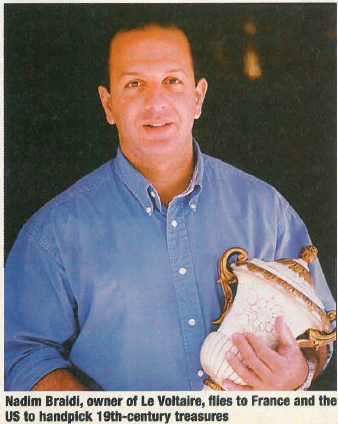
in the heart of Badaro. Owner Nadim Braidi personally flies
to Prance and the US in search of I 9th-century furniture, paintings
and artworks for his seven-year-old store.
Most items on display are from one of the following
eras: Empire, Restoration, Louis-Philippe, Charles X and
Napoleon III. Among his most prized possessions (all of
which are for sale) is a Charles X wooden cabinet from the
1830s with intricate designs and an Art Nouveau statue in
silver metal from the famed WMF German catalogue. The
cabinet costs $7,500, while the statue bears a more accessible
$1,800 price tag. Braidi claims to have some of the lowest
prices in town: “Many local antique dealers buy my merchandise
and sell it at prices 30% or 40% higher than
mine,” he says. Braidi also warns antique lovers to carefully
inspect any items they wish to buy: “There are many fake
antiques in Lebanon, many of which are made in Egypt or
Malaysia. Buyers often do not have enough experience to
tell a real item from a fake one.”
While Braidi’s store is a study in minimalism and a showcase
of carefully selected antique items, Caravanserail in Jounieh is
literally bursting at the seams with hundreds of artworks,
pieces of furniture and intriguing objects collected by owner
Georges Doche over ·the past two decades. A man who finds
beauty in even the smallest of objects, Doche says that he hasn’t
left Lebanon since 1987 and he acquires his merchandise
either from people wishing to sell their family heirlooms or from
other local dealers. The most eye-catching antique in his store
is a I 920s bar made from banana and lemon trees and decorated
with artistic carvings. This particular piece costs a whopping
$45,500, but Doche also has infinitely more affordable pieces,
such as two matching Japanese pillows in lacquer priced at $300.
Caravanserail doesn’t specialize in any particular style or era,
although Doche does admit to certain personal affinities: “I prefer
Islamic art,” he muses, “but I buy anything that strikes me.
I don’t like conventional things. I am always looking for
something different, for a fantasy!”
Doche’s exuberance provides a striking contrast to the
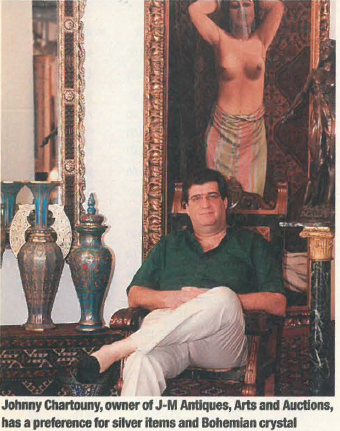
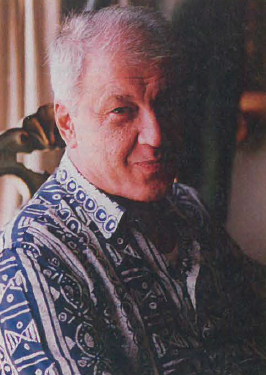
understated elegance of Johnny Chartouny, owner of J-M
Antiques, Arts and Auctions in Ashrafieh. Along with his partner
Maha Sehnaoui, Chartouny specializes in 18th- and
I 9th-century antiques, although he does profess a personal
preference for paintings, silver and Bohemian crystal. J-M
Antiques has been in operation for nine years, but Chartouny
also owns two successful
antique shops in Brazil, both of
which have been open for 25
years. With a master’s in fine
arts (and an emphasis on sterling
silver items), Chartouny is
particularly well qualified to
advise people on which items
best suit their needs.
Chartouny also organizes
Lebanon’s most prestigious
and successful antique auctions.
Held roughly four times
a year, the auctions have featured
such objects as a Louis
XVI clock, Martin Giesen’s
painting Aurore sur Anjar and a
Venetian mirror from the late
19th century. Auctions usually
take place over a five-day period,
allowing for a three-day
preview before the auction
takes place. All merchandise
is priced at about 50% its
value, and proceeds go to the owner, minus the fee taken by
J-M Auctions, which includes insurance, transportation and
advertising. According to Chartouny, auctions are particularly
interesting because they allow antique lovers to buy authentic,
historical furniture, art pieces or paintings at amazingly low
prices. “During my la~t sale, 15% of the merchandise was sold
to local antique and art dealers,” he says. ‘They marked up the
items and sold them in their own stores.” In the past, Chartouny’s
auctions have attracted people from Turkey, Jordan, Syria,
Kuwait and Saudi Arabia, with overseas purchases making up
I 0% of total sales. The next auction is scheduled for November
12-15 (see box for location). Additional auctions will take
place in March and July 2001.