• Donate
  • Our Purpose
  • Contact Us
Executive Magazine
  • ISSUES
    • Current Issue
    • Past issues
  • BUSINESS
  • ECONOMICS & POLICY
  • OPINION
  • SPECIAL REPORTS
  • EXECUTIVE TALKS
  • MOVEMENTS
    • Change the image
    • Cannes lions
    • Transparency & accountability
    • ECONOMIC ROADMAP
    • Say No to Corruption
    • The Lebanon media development initiative
    • LPSN Policy Asks
    • Advocating the preservation of deposits
  • JOIN US
    • Join our movement
    • Attend our events
    • Receive updates
    • Connect with us
  • DONATE
For your information

State assets on the block

by Sami Atallah June 27, 2000
written by Sami Atallah

The privatization law was recently passed through parliament
with a large majority. Although brief and general,
the bill is a signal to investors that the political desire for
privatization is there. The next steps are clear. For each privatization,
the government must design a strategy, draft a bill, and get
parliamentary approval.

Analysts have estimated that selling a majority of the utility sector
would generate $4 billion to $6 billion. For each $1 billion raised
from the private sector, debt to GDP is expected to fall by 6%, according to Marwan
Barakat, head of economic research at Banque Audi. The accumulated effect is
a 30% reduction in the debt, which is currently
about 136% of GDP.

The big question is whether the government
will be able to undertake privatization in
such a way that the benefits will be realized.
Will it be able to ensure that the process will not benefit the political and economic elite at
the expense of the general public? Put simply,
will the government do it right?

To be fair, some of the constraints may be
beyond the scope of the government. For a start, two events may hamper the process.
The Israeli withdrawal and the uncertainty that comes with it will
hardly convince investors to rush into Lebanon. Furthermore,
the parliamentary elections in August will definitely delay the
process and may aggravate the fiscal health of the country.
Fortunately, the impact of these two events will be limited in the
medium and long term.

The more serious challenge lies in the privatization process.
Essentially, it is how the government plans, sells, implements, and
regulates the newly privatized enterprises that will determine the
degree of success and the benefits accrued.

Three major challenges await the government. The first involves
the process of selling the assets to the private sector. There are different
options of mobilizing capital, which range from selling 100%
of the entity to a single buyer to breaking it up and selling the components.
In between lie three alternatives: selling a minority stake,
issuing shares, or a combination of both. The government’s choice
should be based on three criteria: maximizing proceeds; minimizing
the impediments, such as financial information on the companies,
economic and market factors; and minimizing the legal and logistical
complexity.

With a weak capital market and a desperate need
to raise as much revenue as possible, the government will most likely
resort to option one (or a variation thereof), which is selling a large
part of the company to a strategic investor while the state keeps a
small share. This would particularly be the case for strategic
assets such as telecommunications and electricity.

Once the option is selected, the questions mount: How will the bidding
process be handled? How do we make sure that state enterprises
will not be sold to unworthy bidders? If the last few years are any indicator,
we’re in serious trouble. The government essentially handed
contracts and concessions to friends and family with little consideration
for other factors. This point is important. Lebanon has relatively few public enterprises,
so there’s little room for mistakes.

Having said all that, privatization will hardly
reap the desired benefits unless it is complemented
by the twin pillars of a market
economy: competition and regulation. They
are the government’s two biggest and trickiest
tasks, particularly since the record of the Lebanese state — save the banking sector — in doing both or either is poor.

The risks of privatizing public enterprises
without a competition policy in place are high.
We would end up with few gains in efficiency,
prices, and services. What’s more crucial is the timing of introducing competition in the market.
In many instances, it will be essential to do that prior to privatization.
The opposite may be costly, since a privatized monopoly
will try to use its money and political influence to prevent the introduction
of competition later on. This point may be overlooked since
the government’s priority will be fixated on raising cash in the short
run, ignoring the medium- and long-term implications.

The third task awaiting the government is setting up an effective
regulatory framework. Otherwise, political interference in the operation
of the newly privatized firms may reduce large-scale investment,
hence lowering the quality of services in the medium and long
run. Is the state capable of regulating these newly privatized enterprises?
Will it have the autonomy to make independent decisions?
Will political influence be restrained? Will the decision-making
process be transparent? These and others are daunting questions for
Lebanon, where there is little regulatory tradition.

Privatization will reduce the size of the state, but require it to
become a strong one. Its role in the economy will be moved from
direct production of goods and services to supervising and regulating
entire sectors. To think that with privatization the role of the
state will have diminished or even ended is a big mistake.
June 27, 2000 0 comments
0 FacebookTwitterPinterestEmail
Editorial

In through the out door

by Executive Editors June 26, 2000
written by Executive Editors

Globalization is a buzzword in business. While companies in
most countries see it as an opportunity, many in Lebanon see
it as a necessity. With a market of about 4 million ensnared in economic
stagnation, it’s no wonder that Lebanese firms are looking
beyond their borders.

Some are relative newcomers. The need for generators has dwindled
over the years, so Jubaili has lost power. But the company
found markets in Nigeria and the UAE, which make up 70% of its revenues,
and increased its turnover as local sales dropped dramatically.

Arab Traders’ income jumped from $200,000 to $6 million
in four years, moving goods from one continent to another, with
only 15% going in-and-out of Lebanon. Knowing that Lebanon is
just a testing ground, this country’s first factoring firm, Ipso
Facto, is increasing capital that will help it to go regional this year.

This month’s cover story looks at C.A.T., a contracting company with
a history of doing business elsewhere, that is getting its second wind.
It restricts itself to project management in Lebanon, while its lucrative
construction contracts are in the Gulf and Africa. It has a desire
to do construction in Lebanon, but only when conditions have
improved. After falling from grace – revenue dropped from more than
$1 billion in the early 1980s to about $25 million in 1995 – C.A.T.
is making a comeback. Ninety percent of its $80.2 million in revenues
last year came from abroad.

On the flip side, foreign companies coming to Lebanon have not
exactly been welcomed with open arms. Three foreign investors
are tied up in disputes with the government involved in the development
of “the gateway to Lebanon,” the Beirut International
Airport. If only Lebanon could bring in as much as it lets out.

June 26, 2000 0 comments
0 FacebookTwitterPinterestEmail
Executive Living

Discovering Lebanon on foot

by Natacha Tohme June 22, 2000
written by Natacha Tohme

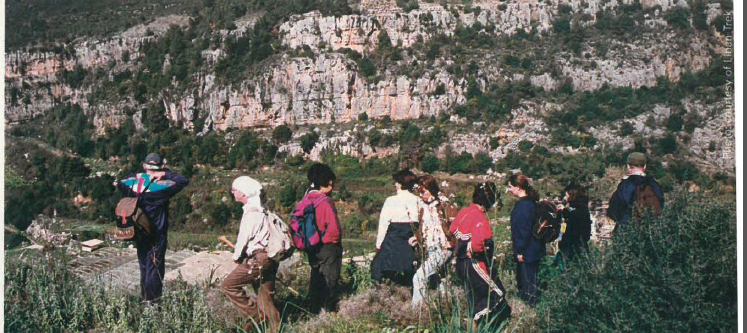
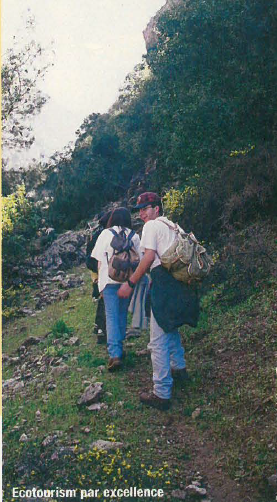
For many people, discovering Lebanon means visiting
archaeological sites and driving to remote villages to
lunch at local restaurants. That may be fine when the
grandparents are along, but for a growing number of people,
a simple trip to the mountains just doesn’t cut it. They want
more: more contact with nature, more exploring and more of the great outdoors. If
this sounds like what
you’re looking for,
now is the time to discover
trekking.

“Trekking is accessible,”
says Pierre Abi
Aoun of Wild Expeditions.

Other activities,
such as rock
climbing and rafting,
are technical and
require a certain
amount of skill, as
well as sporting
equipment. Trekking
needs no training.

“All that is needed is a
good pair of boots,”
says Michel Moufarege
of Liban Trek.

Lebanon’s mountains
and valleys
offer plenty of playgrounds for adventure. “Trekking is ecotourism par excellence,”
says Moufarege (see box). Treks often include cultural
excursions to sites where classical tours don’t go.

Besides its natural attributes, the Qadisha Valley, for example,
has a rich cultural heritage. “There are a lot of caves that
were occupied by monks and villagers during the Middle
Ages,” says Abi Aoun. “The only way to get to them is on
foot.” The Deir Es Salib cave, for example, is a site that
requires vigorous rock climbing to visit.

Trekking programs are divided according to levels of
difficulty. Liban Trek has two programs to the Horsh Ehden
nature reserves, one for beginners and one for amateurs. The
company also organizes a hike for those with an athletic aptitude
to Qornet Assawda, Lebanon’s highest peak at 3,083
meters.

Treks are led by one or more guides, who explain
the geography and history of the areas being explored.
Besides being educational, treks are socially stimulating and
a great way to meet people.

Liban Trek and Wild Expeditions provide bus transportation.
“The advantage is that we can start the hike at
point ‘A’ and finish at point ‘B’, where the bus retrieves the
group,” says Moufarege. “With cars, we would have to
make circular tours to get back to the starting point.”

If
transportation is included, costs rise to about LL 30,000 per
person. Lebanese Adventure doesn’t offer transportation,
so its treks cost about LL 15,000 per person. Prices are
determined based on the distance to destinations and on
entrance fees for reserves. Participants should bring a
simple picnic lunch, except when itineraries include lunch
at a local restaurant.

Down with five-star hotels

There’s historical Lebanon, with its Phoenician and
Roman sites. There’s leisure Lebanon, with its
beaches and ski resorts. And there’s carnal Lebanon,
with its nightlife, casinos and shopping galore. These
assets, which attracted tourists by the millions during
the country’s heyday, won’t be enough to entice a new type
of traveler that has since emerged – ecotourists.

These
modern-day adventurers are into nature trails and prefer
to explore countries while doing outdoor activities such as
trekking, cross-country skiing, caving, birdwatching and
camping.

“Ecotourism is the fastest-growing segment of
tourism,” says Felix Tohme of TLB.

Realizing this, the Ministry of Tourism recently formed a committee
to promote Lebanon as an ecotourism destination.

Some local tour operators are already trying to capitalize on
the growing demand for ecotours. TLB offers off-road
adventures that incorporate ecotourism. For example, it
offers a 16-day journey through Lebanon, Jordan and Syria.
Participants travel in 4×4 vehicles and stop to explore valleys,
mountains, deserts, towns and archaeological sites.

TLB also offers a number of nine-day package trips
through Lebanon, including a cross-country ski trip.

“Lebanon has natural assets that neighboring countries
don’t have,” says Tohme. “It’s easy to spend a couple of weeks
in the mountains.”

Some nights the participants camp out. On
other nights, they stay at mountain lodges or family homes in
remote villages. Because travelers visit out-of-the-way
places, ecotourism helps develop rural areas.

To have a successful ecotourism sector, preserving the
environment is a must. “If we don’t have a healthy and beautiful environment we can’t play a role in the ecotourism field,”
says Andre Bechara of Lebanese Adventure, which is
responsible for all outdoor activities in the Chouf nature
reserve.

“Lebanon’s nature is deteriorating fast,” says
Michel Moufarege of Liban Trek. Laws exist, but they often
aren’t enforced. For example, there’s a law that forbids bird
hunting, but it is largely ignored. Similarly, regulations exist
regarding quarrying, but the practice continues
unchecked.

“The best way to safeguard the environment
is to make big natural
reserves – protected
areas,” says Bechara.

Ecotourism requires
its own infrastructure,
including first aid facilities,
helicopters for
mountain rescues, forest
rangers, standardized
signs and up-to-date
maps.

A stable political environment
is needed to capture
more tourists. Liban
Trek was established in
1997, “on the eve of what
we thought was peace,”
says Moufarege. “We
expected more incoming
tours.” In the interim, Liban
Trek, like most companies,
concentrates on the
local market.

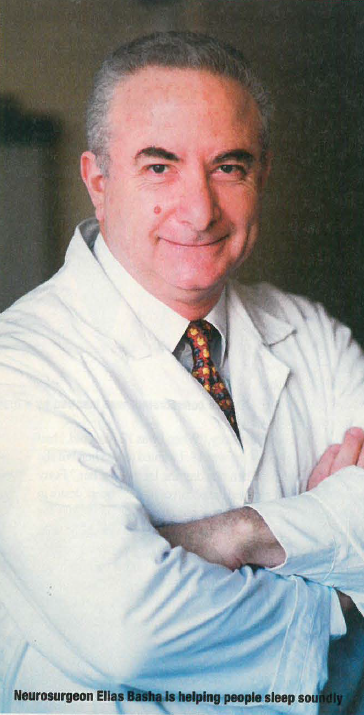
A GOOD NIGHT’S SLEEP CAN DO WONDERS
SWEET DREAMS

Are you prone to headaches or become agitated
quickly? Have you been forgetful lately or found
it hard to concentrate? According to neurosurgeon
Elias Basha, your problems may stem from a sleeping
disorder. “We sleep seven to eight hours a day – that’s
one-third of our life,” says Basha. “Therefore, sleep has an
important function.”

EEG recordings of the brain show five different types of
activity. When awake, brain activity is called alpha. When
asleep the brain registers four kinds of activity: slow waves
indicate drowsiness, spindles indicate light sleep, delta indicates
deep sleep and rapid eye movements (REM) occur when
we are dreaming.

This sleep cycle should occur five to seven times every night.
People who don’t experience these cycles have a sleeping
disorder, which can affect the quality
of their waking hours. “You can have a good state of wakefulness
or a diseased state of wakefulness,” says Basha.

Every stage of sleep has a function. For example, during
deep sleep hormones are secreted, such as growth, sex and
immunity hormones. Subsequently, light sleepers often
suffer from a deficiency of hormones. This can lead to
anything from stunted growth to frigidity, impotence and
a faulty immune system.

The most important stage of sleep is REM, because that
is when we dream. Dreams are directly related to memory,
problem-solving abilities, sexual health, intellectual faculties
and mood. A healthy amount of dreaming is 100 minutes
per night, over five to seven cycles.

“If you dream
enough, you’re fast-thinking, smart, alert, vigilant and creative,”
says Basha. “If you sleep badly, you wake up without
these faculties.” Basha even claims that proper sleep can
make a person more intelligent.

“Part of sleep is productive and part is wasteful,” says
Basha. Wasted time includes the hour it takes some people
to fall asleep, and the 15 to 30 minutes it takes others to fall
asleep after waking up in the middle of the night. According
to Basha, this can be harmful: “Dreaming is interrupted.”

Basha’s patients receive six 90-minute consultations,
each costing $50. They record their sleep patterns in a
diary. This enables Basha to determine the factors leading
to sleeping disorders. They are usually related to bad eating
habits, exercising before bedtime, smoking or drinking
coffee after 3:00 p.m. Tranquilizers are definite no-nos.
“They kill your dreams,” says Basha.

There are a number of other factors that can influence an
individual’s sleep cycle. These include whether the person
snores, talks in his or her sleep, or whether the individual suffers
from nasal obstructions. For this reason, patients spend
one night at the clinic in order to record their sleep patterns. The
cost is $750, but not all patients require a full night’s session.

“My sleep problem started when I was a kid,” says architect
Hani Choueiri, who consulted with Basha two years ago.
Recordings determined that Choueiri suffered from epilepsy
during his sleep. Choueiri used to depend on medication to fall
asleep and wake up. He gradually stopped taking the medicine
and began changing certain unhealthy habits.

“When the
quality of my sleep improved, the epilepsy went away,” he says.
“I have a better memory and in less time I am able to do more.”

Six months ago, Elie Chaaya was afflicted with a breathing
problem, which affected his sleep. He couldn’t get out of
bed easily, would wake up with a headache and his eyes
became irritated by strong odors. Recordings determined that
he had a snoring problem. Basha prescribed for Chaaya a
$1,600 breathing mask to wear when he went to bed.

“I’ll
have to use it between nine months and two years, depending
on my progress,” says Chaaya. So far,
the mask, which he has been using for a
month, has helped him sleep – and live
– better.

“I used to be irritable at work
and would get angry with clients,” says
Chaaya, who sells health equipment.
“Now I am able to deal with difficult situations
calmly.”

Basha also warns that a proper sleeping
ritual is of utmost importance. That
includes putting on pajamas just before
going to bed and using the bedroom
only for sleep and sex. That means no
phone, no television and no reading
material in the bedroom.

Top of Form

Bottom of Form

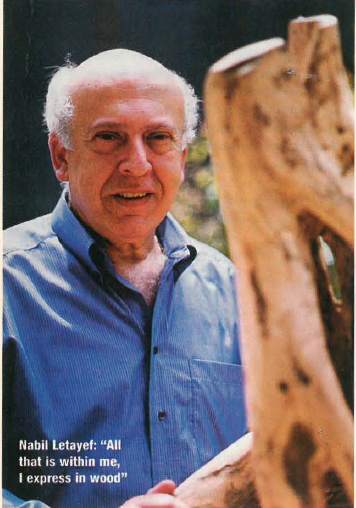
SPIRITED SCULPTURES

Nabil Letayf began sculpting when he returned to
Lebanon ten years ago. “Since then I haven’t
stopped.” Letayf is a dermatologist by profession
and sculpts as a hobby. An untrained artist whose preferred
medium is wood, the good doctor is an eccentric.
Darting around his workshop and makeshift studio, uttering
profound statements, Letayf acts like a crazed genius. “The
shape is the essence of a sculpture, but shape alone is not
enough. The meaning you give to a shape makes it alive,” he
says.

Letayf becomes passionate when talking about his sculptures
and completely absorbed when creating them. His intellect,
fervent imagination and skill with his hands merge to create
exceptional works of art.

Letayf sculpts outdoors because natural light falls on the grains
of wood in such a way that it compels forms. “I can see where
I have to work,” he says. He tackles wood “centimeter by centimeter”
or else it expands and cracks.

Letayf works with all
types of wood, but mostly pine and olive. He enjoys going into
the forest on weekends to gather fallen wood, which must first
be dried in the sun. “Sometimes the wood obliges you to wait several weeks,”
says Letayf. “That
is why I work on
several pieces at the
same time.”

What inspires
Letayf? Previous
inquiries encouraged
him to write
an explanatory
essay. Three and a
half years later he
completed a book,
Vibrations in Wood.

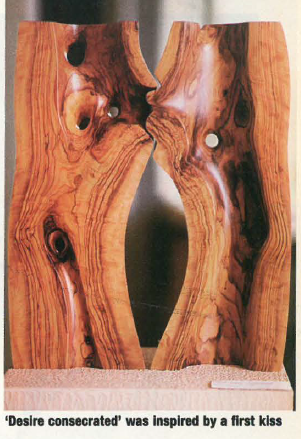
One piece, “Desire
Consecrated”, commemorates his first
kiss. Letayf recounts the story. “When I was 12 years old, I had
a beautiful neighbor – she was 18. I wanted to kiss her, but she
wouldn’t allow me. Then one day she let me kiss her.”

Forty
years later, Letayf recalled the object of his pubescent desire in
a dream, and immediately set about immortalizing the kiss she
granted him. “All that is within me I express in wood,” he says.

Not all the sculptures were inspired by personal experiences.
“The Horse of Don Quixote” pays tribute to the famous
novel by Miguel de Cervantes Saavedra. The base of the
sculpture is skillfully constructed to make it look as though the
horse is levitating. “It is not fixed because the horse is imaginary,”
he says.

Letayf has displayed his sculptures at a number of collective
shows in Beirut. But it was not until June 1999 that he held his
first one-man show. Of the 63 pieces exhibited, 14 were sold.
Since starting, he has only sold about 30 sculptures.

But he isn’t particularly fond of galleries. “Gallery owners
are not interested in art – only in selling art.” Letayf is a nonconformist.
It’s unlikely to find “please don’t touch” signs in front
of his sculptures. On the contrary, he invites people to touch the
sculptures, to feel the vibrations they emit. “Wood is something
alive,” he says. “I don’t like parting with my pieces, but I must
sell to continue.”

Letayf occasionally commissions bronze
reproductions of favorite sculptures.

Prices vary, but are mainly determined by size. “The Dermatologist
Who Lost His Hair” is a small piece
(7 cm × 11 cm × 11 cm). It is priced at $400. “Desire Consecrated”
is medium-sized (44 cm × 35 cm × 5 cm) and is priced at $1,800.
One of the larger sculptures, “Metamorphose”
(118 cm × 107 cm × 56 cm), costs $4,500.

June 22, 2000 0 comments
0 FacebookTwitterPinterestEmail
New companies

BUILDING A REPUTATION

by Natacha Tohme June 22, 2000
written by Natacha Tohme

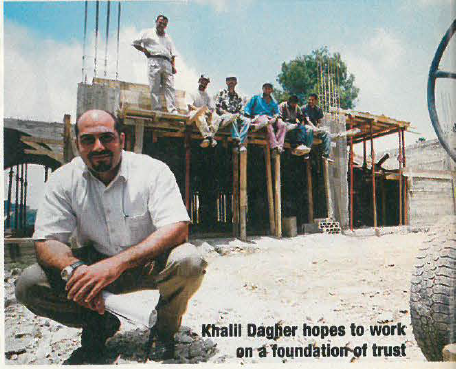
When he was young, Khalil Dagher
was inspired by entrepreneurs. He
realized his dream last December with the
establishment of Dagher Enterprises, a construction
company. About $50,000 has been
invested so far. But has Dagher’s unwavering
ambition obstructed his view of reality?
The stagnant economy generates fierce
competition and this has resulted in underbidding
to win available projects. According
to Dagher, profit margins should be about 5%
but have been reduced to ridiculously low
levels. Many contractors regularly cut corners
to reduce costs. This often involves using substandard
materials and not meeting designs.


“Nobody follows specs,” says Souheil Abou
Habib, general manager of contracting firm
Nassim A. Habib.
Dagher, who has a master’s degree in
construction project management, sees the
potential in working on “cost-plus-fee” or
“cost-plus-percentage” contracts. With
these formulas clients agree to be billed
for whatever the project costs, and the contractor
earns a fixed fee or a percentage of the value.
“I am working for
anywhere from 3% to 10%,
depending on the type of
work,” says Dagher. The system,
which is meant to allow a
higher quality of work, is a
costlier approach. But clients
might be skeptical because –
let’s face it – bills can easily be
forged.
“This system is based
on trust,” says Dagher.
Often unqualified contractors
are unable to finish jobs, leaving
project owners with the
headache – and added expense –
of hiring another firm to take over.
“I would prefer to pay extra and work with someone I
trust to get the job done,” says Abou Habib.
“But he needs to build a good track record.”
Dagher, who previously worked with
Oger-Liban and on such landmark projects
as the Grand Serail, already has a name in the
business. Many big firms hire him as a consultant,
and his company is already working
on six projects, all under the cost-plus formulas.
Five are residential villas (each costing
on average $150,000), and one is a five-story
apartment building (about $500,000).
Dagher plans to build his reputation with
cost-plus contracts, but the system will be limited
to private projects, because the government
only considers lump-sum and unit price
contracts. However, he has every intention to
venture into this sector.
“To expand you must
go for government projects,” he says.


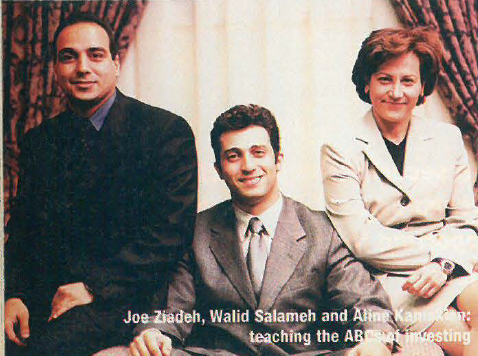
INVESTING IN STOCK

International stock markets have produced
a new breed of investors. Almost
everyone wants to get on the bandwagon,
including Walid Salameh and Joe Ziadeh.
“We were interested in trading in stocks,”
says Ziadeh. “But we couldn’t find anybody to teach us the basics.”
The void presented
a business opportunity. Marketing expert
Aline Kamakian came on board, and the
group established Business Investment
Developers (BID), which is sponsored by
Financial Funds Advisors. They began
with an initial investment of
about $50,000.


BID gives seminars on the
basics of stock trading, and so
far they have run at near-full
capacity. The four-week
seminar, made up of 12 two-hour
sessions, costs $600 per
person. BID is conducting its
third seminar.
“We have
recouped about 75% of our
investment,” says Ziadeh.
Four young finance graduates
instruct the seminars.
Each participant is given $500,000 in virtual money to practice trading.
Kamakian, who previously traded
stocks, nonetheless attended the first seminar. How has she fared with the turbulence
in the US stock markets?
“Honestly, if I didn’t take the course, I would have lost
a lot of money – $20,000 to $30,000,” she
says. “I learned how to minimize my risk –
by diversifying and doing options.”
What’s
their view on the dead Beirut Stock
Exchange (BSE)?
“We are not trading on the
BSE yet,” says Kamakian.
“In Lebanon,
stock markets are misunderstood,” says
Fadi Khalaf, chairman of the BSE, which is
organizing a campaign to educate the public
about capital markets.
BID plans to expand regionally. The company
is designing a four-day seminar to be
held throughout the Middle East. Creating an
advanced seminar is under way, as is a workshop
where people can practice trading.


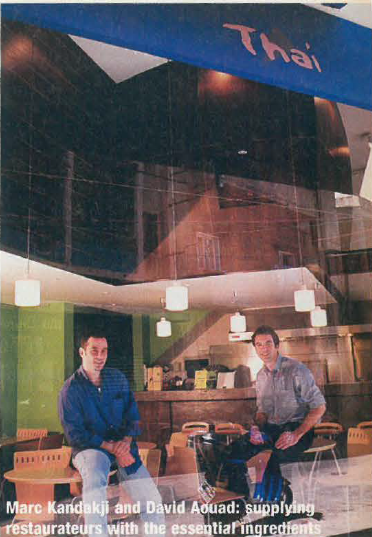
A WINNING RECIPE

David Aouad and Marc Kandakji met ten
years ago in Montreal, where both
were economics undergraduates. They
talked about starting a business together.
But Aouad pursued architecture, and
Kandakji went into hotel and restaurant
management. Reunited in Lebanon a year
ago, they resumed talks about a business
venture and came up with Fusion
Restaurant Study and Development.
Fusion develops concepts and provides
management services for investors in the
restaurant business. The elements that
make a restaurant work? “Good food, good
prices, good design and good location,”
says Aouad.


To attract investors, Aouad
and Kandakji had to prove themselves. To
do this, they opened a restaurant, Thai, last
December. “Our concept is to offer good
food at reasonable prices,” says Kandakji.
A meal at Thai costs $10 on average. Raed
Habib, co-owner of Caracas, a bar restaurant,
says restaurants such as Thai work
on profit margins of about 10% and depend
on a high turnover. Caracas, however,
operates on a lower turnover with margins
of 15% to 20%; meals cost about $25 to $40.
Affordable dining doesn’t necessarily
mean compromising on image. Aouad says
that locating the restaurant on Monot Street
– packed with trendy bars and eateries – was
a necessity. The area maximized Thai’s
exposure and put it in the same fashionable
bracket as the venues surrounding it.
The small restaurant, which only seats 20,
is always bustling with activity. “We receive
between 60 and 100 customers a day,” says
Aouad. The two would only say that they
negotiated “a good deal” for the location.
The monthly overhead, about $7,000, isn’t
high for its staff of six, says Aouad. Head chefs
demand about $2,000 a month, but with
Kandakji in charge of food preparation and
menu creation, wages are minimized.
And
because Aouad designed the restaurant, the
expense of hiring an interior designer was
eliminated. The initial investment totaled
about $60,000, which was funded with a
bank loan.
The venture seems to be paying off,
since opening sales have doubled every month.
At that pace the two would need a year
to recoup their investment.
So any future projects?
A joint venture for another Thai restaurant,
due to open soon, say the guys.


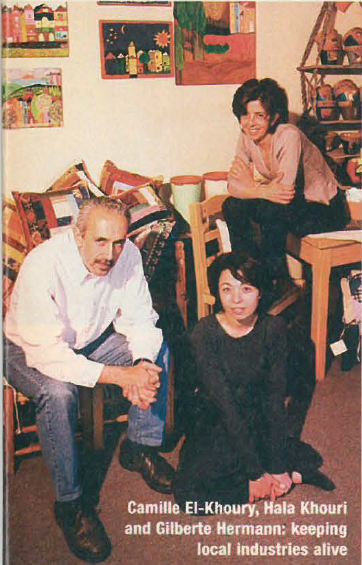
CREATIVE WORKS

Camille El-Khoury, Gilberte Hermann
and Hala Khouri are artistic types.
Last year, on an initial investment of
$15,000, they established a line of handicrafts
called Scraps & Stuff. The items
manufactured include a range of rustic furniture,
hand-painted flowerpots and fabric
articles for the home, patterned in the
patchwork design.
“The concept was to
produce things from scraps and to keep
local traditions alive,” says El-Khoury.
Scraps & Stuff produces rustic stools, which
are made in rural areas. “They are the traditional
stools made by agriculturalists from
discarded wood from pruning trees,” he
says.
His company enhances the stools to
make them marketable. Each stool retails for
$21. Scraps & Stuff also uses crude clay pots
that are locally produced. They are priced
from $9 to $33. Cushions made for the rustic
stools range from $24 to $46.
Because everything is handmade and unique,
markups are high, at about 40%.
Scraps & Stuff, like other handicraft businesses,
is affected by the slumped economy.
The store Style & Nature offers a selection
of dried flower arrangements. The owner,
Viviane Torbey, says sales are slow, but
boom on special occasions.
At Scraps &
Stuff, the pots, which are most affordably
priced, have been the fastest sellers. The
patchwork items, which are more expensive,
are slow sellers.
Since opening four months ago, sales
have been less than satisfactory. Scraps &
Stuff is displayed at Arcanes in Ashrafieh.
To help local artists, the proprietor offers the
gallery at no charge. El-Khoury believes
that commercial banks should help small
and medium-sized businesses by giving
microcredit.
A loan would enable him to
better market Scraps & Stuff.

June 22, 2000 0 comments
0 FacebookTwitterPinterestEmail
Tech Knowledge

HATCHING THE GOLDEN EGG

by Executive Contributor June 22, 2000
written by Executive Contributor

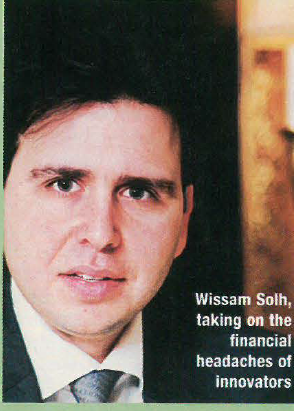
Lebanon may have its first incubator.
Netakeoff is a launching pad for
entrepreneurs who have innovative ideas
but lack the financial means and support
to realize their brainchild. The company is
dedicated to the development of Internet
and technology firms. It provides seed
capital, office facilities, business assistance,
technological know-how and other support services. “This will allow entrepreneurs
to give their full attention to
their ideas by letting us deal with the
financial headaches,” says Wissam Solh,
the firm’s CEO. “We’ve already raised
around $5 million in capital and plan to
select four to eight ideas with high
growth prospects a year.”
The company will invest no more than 10% of the incubator’s
capital per project but no less than
1%. “We invest in companies that are in
the early developmental stage, with special
focus on the Internet, B2B, B2C, e-commerce,
WAP and telecommunications
technology, software, communications
and information services,” says Solh.


The company has assembled a large network of
world-class advisors and consultants in
order to provide the best advice possible
to the incubated companies. In return
Netakeoff expects to receive an equity
stake in each incubated company. Each
selected portfolio company is treated as a
separate legal entity and is directed by its
own management team.
The company’s exit strategy is to achieve liquidity. That
can be done by listing the start-up company
on an American or European
exchange (Nasdaq, Easdaq) within two or
three years, via a private placement or
through a merger or acquisition.

HOW DO I LOVE YOU? LET ME COUNT THE WAYS…

Who can resist opening an e-mail
message with a subject line that
reads, “I LOVE YOU”? Apparently, not
many. The love bug clogged millions of
computers around the world throughout
May, infecting at least 600,000 computers
and, according to some estimates, cost
companies up to $1 billion.


“The Melissa virus was nothing compared
to this,” says Mihran Boudromian,
head of Expervision’s software and sales
department, referring to a March 1999
attack that infected more than 300,000
computers. “This was ten times quicker.”
Many large companies have already
installed antivirus software to block
transmission of the virus and most home
computer users and small businesses
seem to be coping. “We’ve had some
calls for help, but it’s not what I would call
overwhelming,” said Boudromian.
In theory, at least, the epidemic has run
its course. The major antivirus software
makers, such as Norton and McAfee,
have already released updates of their
virus signature files to detect and remove
the loveworm. But if files have been overwritten,
there remains the expensive and
time-consuming job of restoring those
files from backups, if backups exist.
If your antivirus software has an automatic
update feature, you should use it as soon as possible to download the solution.
Meanwhile, if you haven’t been infected,
the best advice is to immediately delete
any message that contains the “I LOVE
YOU” subject line. (Note the lack of a
space between the I and the L.) In any case,
do not open the attachment, which is the
only way the virus can spread.
But the seriously bad news is that computer
experts predict this may be just the
beginning, as viruses grow more frequent
and malicious. All it takes is one person
who’s moderately familiar with software
technology to come up with an enticing
subject line and send it to the right group of
people. Then it will spread like wildfire fed
by the dupe of friendship or the fool of love.


… AND THE MILES TO GO BEFORE I TRAVEL

There’s nothing quite as satisfying as
being rewarded for spending your
hard-earned money. Liban Miles
(www.libanmiles.com), keen to cash in on
shopping foibles, launched a point-card
system in November 1999, and has so far
netted some 30,000 card-toting customers.
The mechanics are straightforward
enough: Customers with a Liban Miles
card – which costs $12 per year to own –
collect points while shopping for goods
and services in about 200 participating outlets,
ranging from supermarkets to
clothes shops to travel agencies.
Miles
are accumulated at the rate of $10 per
Liban-mile and are then redeemed for
prizes such as dinners, consumer electronics
and airline tickets.
“Our target for 2002 is to have a membership
roll of 100,000 customers and
3,000 participating stores,” says Roy
Saba, the company’s general manager.
The cheapest “freebie” for 30 miles is a
six-pack of Coca-Cola (an offer that, in
strict money terms, translates as $300 spent
for $6 in soda pop). The most expensive
item, earned at 15,000 miles, is a Sony
Projection TV, valued at roughly $3,000.
According to Saba, collecting towards airline
tickets is proving popular. For instance, a
round trip to Paris, in Liban units, represents
3,600 miles. That’s the equivalent of 3,000
crates of Beaujolais Nouveau or 600 items
of Parisian lingerie – and for some, that
may be enough to whet the appetite.

June 22, 2000 0 comments
0 FacebookTwitterPinterestEmail
Tech Knowledge

WET BEHINDTHE EARS

by Carl Gebeily June 22, 2000
written by Carl Gebeily

Few would argue that the Internet
offers enormous opportunities for
organizations that want to conduct
business electronically. With such unheralded
best-selling e-stories as Amazon, it’s not
surprising that a number of web brands have
popped up in the ether like eBay, eToys and
CDNow. Or that the traditional brick and
mortars, afraid of eating their cybercompetitors’
dust, have been seeking ways to get
online in a big way without ruffling the feathers
of their existing distribution networks. In
Lebanon, though, with the exception of some
websites and internal intranets hosted by portals
like LebanonLinks and Libanis, only a
select few companies have actually integrated
and exploited the powers of the Internet
within their strategic business processes.

The number of Internet users in Lebanon
has topped 85,000, a year-on-year growth
rate of almost 42%, according to ISP estimates.
This annual count projected the
number of users would reach 100,000 by the
end of the year and exceed 200,000 by
2003. The two major drivers of consumer
demand? The Internet and e-mail.

With the number of Internet servers and
desktops growing exponentially, access to
the Web is commonplace. Internet
Facilities, a consulting firm that owes its
steroid-induced growth to the emergence of
the Net, calculates that in global terms, e-commerce
represents a monthly $25 billion
worth of goods in revenues, versus some
$30,000 for Lebanon. And given a
respectable number of users and a growing
number of companies now active on the
Net, why is Lebanon lagging so far behind
the West when it comes to shaping the
Internet and the electronic economy that’s
springing forth from it? The answer to that
question is complex and open to interpretation.
Nevertheless, it’s clear that
Lebanon has several fundamental hurdles to
clear before it can hope to assume an
important role in the new economy.

A favorite whipping boy of most is the
high communications costs that both businesses
and consumers face. This is something
almost everyone complains about, says
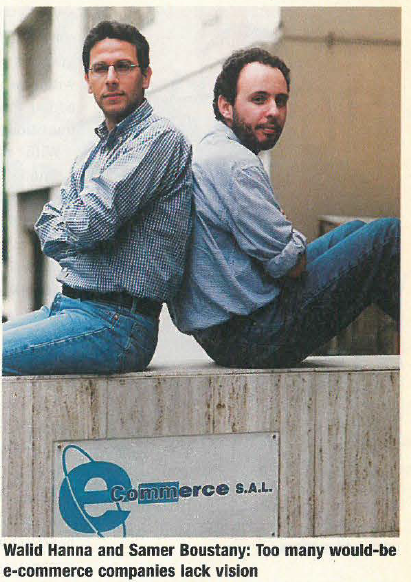
Walid Hanna, general manager of e-commerce,
which beat the competition in
Knowledge
Lebanon by registering such an aptly
named dot-com with the Beirut Chamber of
Commerce last fall. “And the more users
stay online, the more it costs. So of course
it’s a problem,” he says. “The high phone
charges certainly adversely affect e-commerce.”

Such criticism is echoed by leading
ISPs across the board. “We need a measure
of liberalization in the telecom industry,”
says Sam Lutfallah, general manager of
Inconet. “Charges for local services remain
high, which poses a serious obstacle to
Internet use among Lebanese consumers.”

An official at the Ministry of Post and
Telecommunications counters that argument:
“High connection charges are used as
an excuse. They’re not the big issue everyone
tries to make them out to be. $1.4 per hour is not
big money.” Perhaps, but like snowflakes
such charges can quickly mount up.

“When you spend some time on the
Internet, and you get a bill for $100 or $150
a month, you quickly change your ways the
next month,” says Khoury.

Still, despite the high telecom fees, e-companies
that have something special to offer are achieving a measured success.

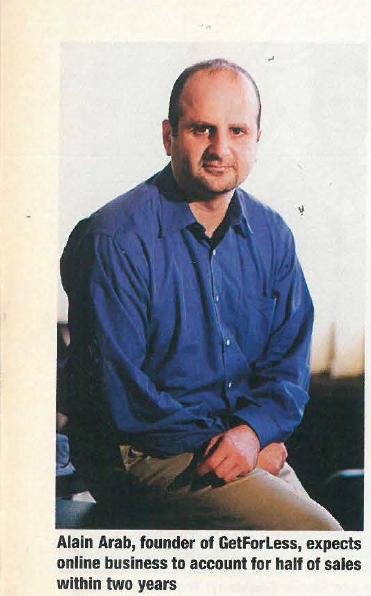
GetForLess carries 140 brands ranging
from such items as espresso machines and
cameras, to computer software, music CDs
and home gyms. It has been selling goods
online since September 1999 – a burgeoning
e-business that is currently at 10% of total revenue – and reports monthly revenues of
some $25,000.

“We expect that our online
business will grow to 50% of total sales
within two years,” says founder Alain Arab,
adding that Lebanese culture is ripe for the
transition to an e-commerce environment.

With monthly revenues of $2,000,
LebanonShop is also profiting from a budding
dot-com landscape. As much as 90%
of their sales come from abroad in a clear-cut
positioning that aims to attract
Lebanese expatriates. “All our products
have a strong Lebanese or regional element,”
says general manager, Fouad
Khabbaz. “Whether it’s books, CDs or
antiques, our clients tend to be expatriates
looking for a taste of home.”

The Internet has evolved into a global
infrastructure – capable of connecting multiple
applications and business processes –
not only within organizations, but also
between trading partners around the globe.
And while the consumer market captures the
hearts and minds of the public, the real
money is in the business-to-business (B2B)
market. Vicky Khoury, consultant at
Internet Facilities, calculates that, of the
$300 billion global e-industry in 2000, as
much as 80% is grabbed by B2B.

By 2002,
Khoury believes e-commerce will be worth
$1.3 trillion as more businesses catch on to
the benefits of harvesting the cyberfields.
That’s a lot of buying and selling going on.
“But I bet that if you asked most people what
business-to-business e-commerce means,
you’d probably get a lot of glazed eyeballs,”
says Khoury, adding that the problem
in Lebanon is mostly perceptual.

Internet
Facilities is currently helping companies –
such as Home Interactive, manufacturers of
construction materials – gain footholds in
cyberspace.

“While the consumer side of e-commerce
offers plenty of sizzle, pretty
pictures and graphics, the business-to-business
side is all about the bottom line.”

A more fundamental problem, argues
Hanna, is that too many would-be e-companies
lack vision. Some major corporations
have, he concedes, established online
networks between themselves and suppliers
to facilitate supply chain management.
But he is critical when the same corporations
refrain from moving to the next level of
integration, and allow full information
sharing between all the entities composing
the supply chain.

Compare that cautious
approach to Dell Computer, now the
biggest PC vendor in the United States and
number two in the world. Dell is rapidly
integrating the Internet into its internal and
external operations, and sees the sharing of
information as the key to a successful transition
into the new economy.

“Information
and intellectual assets are replacing physical assets,” says Hanna. “Our dot-coms need to
get into a more collaborative mode with
partners, buyers and customers.”

Dell is not
only able to optimize the delivery of goods
and services to its customers, but has also
slashed inventory to just six days’ worth.
This whole-hearted adoption of the Internet
contrasts starkly with the narrow mind-set of
too many Lebanese corporations, which
still view the Net with suspicion.

“The greatest challenge facing Lebanese
organizations today,” says Khoury, “is not
deciding if they should leverage the
Internet, but how best to leverage existing
investments in technology and infrastructure
with the cost efficiencies and flexibility of the
Net.”

While Web commerce typically refers
to the selling of products over the Web, the
broader term “Internet commerce” can be
viewed as a term that means any exchange of
business information over the Internet.
That could be business reports, purchase orders,
shipping and manufacturing information,
or bank-account updates.

Internet commerce
enables the sharing and exchange of this
business data within and beyond company
walls, across town or to the other side of the
world.

The Internet allows this exchange of
information to occur in a fraction of the
time required by traditional paper-based
processes – reaching more customers and
trading partners faster, more efficiently and
certainly more affordably, than ever before.

To fully leverage the benefits and opportunities
on the Internet for information
exchange, you must look beyond the obvious
person-to-person communications to
the underlying internal communication layers
that enable business processes.

Customers and business partners in an
enterprise will be much more likely to
embrace the concept if it is cost-effective,
readily available and automated.

“For many companies, it’s not the customer who
demands key business
data but rather business
partners, such as vendors
or suppliers, banks and
clearing houses,” says
Hanna. “These partners,
due to the very nature of
their businesses, require
timely, reliable, automated information delivery, guaranteed.”

In a global environment
where information is in such
high demand, information is
the business.

And perhaps the best model
for B2B transactions in the
near future may be eBay.
Since the Internet can provide
real-time pricing and availability
information, companies
will bid on whole lots of
goods – 1,000 DVD players
from Japan, say, or 500 crates
of champagne from France –
always opting for the best
price.

It’s almost as if a name-your-price strategy will
become de rigueur in the corporate
world.

It also benefits the
seller. Say you’re a leading
watermelon cultivator in the
Bekaa and you’re overstocked on summer watermelons.
With a global reach, you could peddle your watermelons to
countries with opposite weather patterns.

According to Khoury, there is a similar
lack of vision at play in the business-to-consumer
sector. She is down on merchants
who take a “build it, and they will come”
approach to e-commerce.

“They put their
products on the Web and hope everyone
will visit,” she chides.
“But you need to
offer interesting products you can’t easily
buy in the real world. And you need bulletin
boards, chat services and newsletters to
keep bringing customers back.”

Buying in
cyberspace also remains a stretch for many
Lebanese consumers who are more comfortable
in what is still a cash-based society.
While the use of store credit cards is on the
rise, dealing in hard cash wins out easily.

Such reluctance is only heightened, when the next-door neighbors are convinced, through the
purple prose of the press,
that cyberspace is awash
with hacker pirates looting
lists of credit card numbers
on a daily basis.

As a result, innovative
Lebanese companies are coming up with hybrid solutions that allow
customers to order online, yet pay in traditional
ways.

One such pioneer is
GetForLess. Customers can browse the electronic
catalog online, place orders and pay on
delivery by credit card or cash.

Critics of
hybrids say it’s not true e-commerce when
payment is in cash. Nevertheless, it works and
suits the current Lebanese psyche.

As other
businesses take up this approach, Lebanon
can expect to significantly boost business-to-consumer
online trade.

But is it actually possible to have too much
e-commerce? In the West, economists are
asking whether the technology boom on the
stock market has led to over-investment in the
new sectors.

If so, there could be a depressing
fall-out as the bubble, if it is one, bursts.
Here, we are far from these earthly concerns.

Dot-com commerce in Lebanon is still in its infancy;
and virtual horizons, with the promise of
enormous opportunities, appear as cloudless
as a summer sky.

As Khoury puts it, “The
greatest advantage as newcomers is that
we’re at the bottom of the league – there’s only
one way for us to go.”

At least in terms of conducting
business on the Internet, we’re still far
from having too much of a good thing.

June 22, 2000 0 comments
0 FacebookTwitterPinterestEmail
Money Matters

TAKE ANOTHER HIKE

by Peter willems June 22, 2000
written by Peter willems

On May 16 the Federal Reserve continued its
search and destroy mission to stamp out potential
inflation threats and bring the US economic
growth rate down to safe levels. But the Fed did not
advance at the same pace of raising interest rates since it
began in June 1999. After five previous increases, the federal
funds rate was jacked up 50 basis points, the highest
leap in five years, reaching 6.5%. The last time the federal
funds rate hit 6.5% was when the US economy was
climbing out of a recession in 1991.

The Fed’s move helped fuel a
continuation of volatility on
US equity markets that began
in early spring. “The markets
are focusing on macroeconomic
issues instead of earnings,”
says Jon Olesky, head
of block trading at Morgan
Stanley Dean Witter. “The
debate continues as to how
long the Fed will keep raising
interest rates. Volatility will
remain high until the next
meeting in June and may
continue to the end of the
year.” In fear of rate hikes
slowing the economy and
tech equities viewed as overvalued,
the NASDAQ composite
has fallen over 32% from its
mid-March high operating
in a deep bear market – with a
16.7% decline this year.

From its high in January,
the Dow Jones
Industrial Average
has dropped 9.4%, off
7.6% for the year.

A major concern
among investors is
when the Fed will
stop the tightening
cycle. According to
Maury Harris, chief
economist at PaineWebber, the Fed is keeping a close eye on the labor market. “We have a very
tight labor market, and wages are going up a lot,” says Harris.
“There will be another hike in June.”

Recently, unemployment fell to a 30-year low at 3.9%. In
the first quarter the employment cost index rose 1.4%, the
largest gain since the third quarter in 1989. In April average
hourly earnings went up 6 cents, a 0.4% increase, which was
more than the 0.3% rise in March. On top of those pressures,
the US trade deficit continued to grow in March, up to $30.3
billion, which shows strong consumer demand pulling in
imports. In the last six months, the annual rate of core inflation
rose to 2.5%, up from 1.9% in the previous six months.

Some hold that the end of the tightening cycle is near.
“There is no evidence of true inflation in the US economy,”
argues Bruce Steinberg, chief economist at Merrill Lynch.
“I expect interest rates to reach 6.75% to 7%, but no further.”
He says that home sales have gone down by 10% in the last
nine months, while retail sales fell 0.2% in April. The consumer
price index (CPI) was flat in April and the core CPI

-excluding food and energy prices – increased only 0.2%,
half the rise in March. The producer price index in April fell
0.3%, the first decline in 14 months.

Steinberg expects economic growth to slow from 6% over
the last three quarters to 4.5% in the second quarter and ease
into 3.5% in 2001. If the cycle ends after one of the Fed meetings
in June or August, bet on double-digit returns on equities
in the coming year as investors expect rate decreases and
earnings moving up, says Steinberg.

Volatility on NASDAQ, moving up or down by 1% to 4% in a
day, is routine. If investors can stomach the rocky ride, the end
of the tightening cycle may be worth the wait. But with the labor
market getting tighter, when it comes is debatable

June 22, 2000 0 comments
0 FacebookTwitterPinterestEmail
Money Matters

GLOBAL RESEARCHHIGHLIGHTSECONOMIC FOCUSUNITED STATES

by Executive Contributor June 22, 2000
written by Executive Contributor

• Some signs of moderation are evident in recent economic data, and
inflation remains virtually absent. That’s unlikely to stay the Federal
Reserve’s hand, however. Policymakers are concerned about the
underlying strength of the economy and the tightness of the labor market.
Those worries are likely to prompt a 25-basis-point tightening at
the June 27–28 FOMC meeting, in our judgment.

• Sharp declines in energy prices pushed the April producer price
index down by 0.3%. The core PPI edged up by 0.1% and was only
1.3% above its year-earlier level; excluding the recent pop in
tobacco prices, the year-to-year PPI was unchanged. In other words,
the report showed no inflationary pressures.


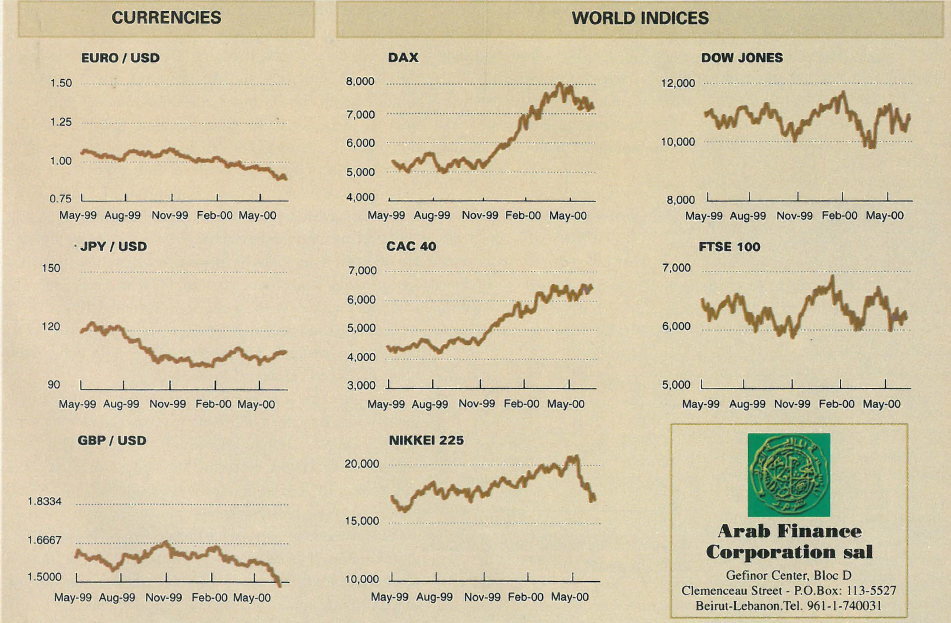
EURO

• The euro recently declined to a record low of about 89¢ against the
dollar. We continue to think that the euro will eventually strengthen,
but we have lowered our target. Without a recession in the US or a
burst of public sector reform initiatives in Europe — both of which are
unlikely to occur, in our view — the dollar will probably stay at higher
levels versus the euro than we had been expecting.

• We now think that the euro will remain below parity for much of
2000. Next year, when US and European economic growth rates are
likely to converge, the euro ought to be able to move above parity.
Our new forecast: we think that the $/euro rate will be 0.95 in three
months, 0.99 in six months, and 1.06 in 12 months; our previous forecasts
were 0.99, 1.06, and 1.10, respectively.

• In our view, two major problems plague the euro. First, the US economy
has been growing faster than the Eurozone economy by a wide margin.
Second, structural reforms in the Eurozone have not gone far enough
in the crucial areas of labor policy, regulatory policy, and pensions.
Investors’ concerns about both issues have helped to channel the flow


STRATEGY FOCUS
GLOBAL VIEW

• We have reduced our overweight of Japan in favor of Eurozone equities.
We still like Japan, but the pace of restructuring in that country
in relation to that of the Eurozone does not justify a more aggressive
stance, in our view. It’s particularly true at a time when money
growth is slowing in Japan and the Bank of Japan has let speculation
flourish about possible rate hikes later in the year. The Eurozone has
the added advantage of having a much more competitive currency than
Japan and, consequently, better growth prospects, in our view.

• Consumer spending moderation in April as overall retail sales
declined by 0.2%; excluding automobiles, retail sales were unchanged.
That was a much weaker showing than most market participants
expected. In addition, it appears that concerns about stock market
volatility and higher interest rates have started to show up in consumers’
spending patterns. We expect real consumer spending to increase at a
rate of 4.5% for the second quarter; that’s a healthy pace, but far below
the torrid first-quarter pace of 8.3%.

• Meanwhile, import prices for April declined by 1.6%, led by a drop
of 12.7% in petroleum prices; excluding that sector, import prices
edged by 0.1%. Export prices slipped by 0.1%.

Bruce Steinberg, chief economist

of capital out of Europe and into the US, to the benefit of the dollar.

• Europe’s economic growth is currently the best it has been in a
decade, with Eurozone GDP set to rise by about 3.5% in 2000. Even
so, growth this year will probably be 5.0%. That means that the
growth differential will remain very large for the time being. Next
year, however, we expect Eurozone GDP to increase by 3.2% and
US GDP to rise by 3.6%, the smallest gap in more than a decade.

• Additional pluses for the euro include the development of the
region’s capital markets, which are beginning to resemble those in the
US, and the massive corporate restructuring efforts that are under way
in Europe. Nonetheless, Europe lags the US on a number of economic
fronts. In particular, the political will to implement labor market reforms
appears to be lacking. Without more flexibility in the labor market,
trends in European productivity and economic growth will almost certainly
continue to lag those in America. That, in turn, will tend to limit
the euro’s long-term upside potential.

MICHAEL HARTNETT, SENIOR INTERNATIONAL ECONOMIST
GLOBAL ECONOMICS TEAM

• With liquidity conditions deteriorating, risk aversion rising, and a possible
slowdown in global growth prospects looming, we have moved
the emerging markets down from a small overweight to an underweight,
in our global portfolio. However, those markets appear to be better situated
to withstand a slowdown than they were the last time around.

• The recent weakness in global bond markets suggests that investors
are not convinced that monetary policy has been tightened sufficiently
to ensure price stability. We expect short-term interest rates to rise further
during the next three months. For that reason, our regional
asset allocation guidelines suggest that investors adopt above-average
cash levels.

• GDP growth expectations are still rising and inflation expectations
are under some upward pressure from cyclical forces. As a result, it
is no surprise that European central banks and the US Federal
Reserve have been tightening. The tightening, together with the
effects of higher energy costs, could begin to influence economic
growth prospects as fall approaches. The OECD leading indicator for
the G7 nations has topped out, and liquidity conditions particularly
in the US have begun to deteriorate. Moreover, the Japanese inventory-shipment
ratio, a key cyclical indicator, turned down in March.
Those developments are consistent with a peak in global industrial production
growth this summer. That, in turn, would argue for a shift
toward a more defensive portfolio. Interestingly, turning points in the
growth rate of the OECD leading indicator have tended to coincide
with major changes in sector leadership. Traditionally, when the
growth rate is declining, pharmaceutical and insurance issues have
done relatively well.

• The influence of tighter monetary policy has already manifested itself
in the form of increased risk aversion across a number of asset classes.
We expect that trend to continue as central banks tighten further. Signs
of risk aversion include the major deterioration in equity market
breadth, particularly in the NASDAQ; much wider spreads in the corporate
bond market; the underperformance of many emerging markets;
and the weakness of the Australian dollar (the currency of a country
with a large current-account deficit) against the yen (the currency
counterpart of a country with a large current-account surplus).

• One surprise, in our view, is how well the dollar has held up in the face
of the NASDAQ market’s sharp setback. The dollar’s strength indicates
that global investors are still prepared to fund the US private sector’s
financial deficit and that they still think that returns on US assets will
be better than those on European and Japanese assets. However, we
believe that the current divergence between the performance of the
NASDAQ and the dollar is unsustainable.

• If risk aversion declines and the dollar continues to strengthen, economically
sensitive stock market sectors particularly the technology
sector could start to outperform again. On the other hand, if recent
inflation concerns in the US lead to a Fed-induced period of below-trend
economic growth, our strategy would probably need to become
much more defensive.

• The global context raises two crucial questions in that regard. First,
to what extent have America’s remarkable good inflation trends been
helped, until recently, by below-trend growth in the rest of the world?
Second, what are the implications of the funding of the US private sector’s
financial deficit if investment activity starts to increase faster than
savings in Japan and Europe? The more prospective returns in Europe
and Japan improve, the more the US may struggle to fund its expansion
just when domestic capacity is significantly increased. Against
that backdrop, we continue to prefer non-US markets.

June 22, 2000 0 comments
0 FacebookTwitterPinterestEmail
Money Matters

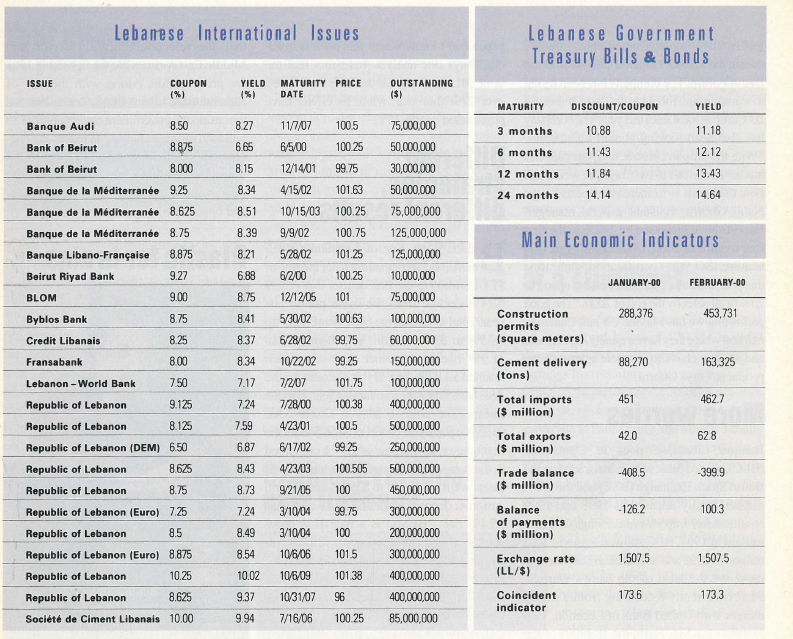
Lebanese International Issues

by Executive Contributor June 8, 2000
written by Executive Contributor
June 8, 2000 0 comments
0 FacebookTwitterPinterestEmail
Money Matters

YOUR MONEY OR YOUR LIFE

by Executive Contributor June 8, 2000
written by Executive Contributor

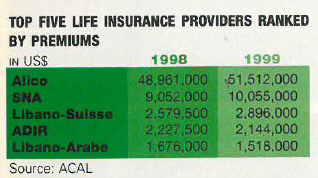
Sales of life premiums grew by just 6%
last year, from $74,778,669 to
$79,272,469, according to the Lebanese
Insurance Companies Association (ACAL).
“The slowdown in growth is more related to
life insurance policies sold as guarantees
for bank loans rather than those sold for
future security,” says Joseph Mrad, a manager
at ADIR, an insurance company catering
mostly to the insurance needs of Byblos
Bank. Over 50% of ADIR’s portfolio is
composed of life insurance policies. The
value of life premiums has dropped from
$2.227 million in 1998 to $2.144 in 1999, a
3.7% decrease. Libano Arabe, which caters
to Banque Audi, is in the same boat. Its life
portfolio has decreased by nearly 10%.
“Banks are being more careful in issuing
loans and consequently the amount of life
premiums collected by the concerned insurance
companies is affected,” says Mrad. In
contrast, firms like Alico, SNA, and
Libano-Suisse, which sell private life insurance
policies not tied to bank loans, have
each seen an increase in business.

NO-LOSE SITUATION

Banque Audi, one of Lebanon’s top
five banks, is offering customers the
opportunity to invest in international equities.
In mid-May, Audi launched “Harvest
Guaranteed” products. Returns are tied to the
performance of the three best-known international
indices: Dow Jones Euro Stoxx 50
(40%), S&P 500 (35%) and Nikkei 225
(25%). Harvest Guaranteed offers three
products. One investment guarantees
returns of 15%, with a maximum return of
between 65% and 70%. A second guarantees
a return of 9%, with a maximum return of
between 82% and 87%; and a third investment
guarantees a return on the capital
invested, with a maximum return of
between 100% and 105%.
“One of the reasons we launched Harvest
was the demand of our clients,” says Nabil
Chaya, head of treasury at Audi’s capital
market division. “It’s also to help investors
think of long-term investing, focusing on
consistent growth, instead of being speculative
and trying to make a quick buck.”
Until now, Audi has offered clients the
chance to trade only on the local market. But
in the last two years, trading volume on the
Beirut Stock Exchange and on Lebanese
GDRs has been in decline, which has been
harmful to the bank’s capital markets division.
Many investment firms, such as
Financial Funds Advisors and Fidus, as
well as the capital markets departments of a
number of banks, including Byblos Bank
and Banque du Liban et d’Outre-Mer, have
been focusing on international markets.

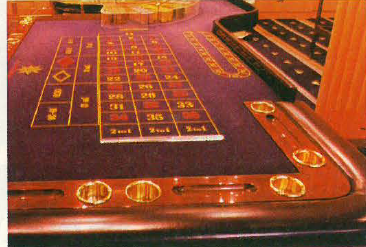
CASINO: EVERYONE
GETS FLUSHED?

The ongoing conflict between the 11
board members of the Compagnie du
Casino du Liban (CCL) and Elie Ghorayeb,
its chairman, continues. The two sides are in
disagreement over how to handle a government
demand that the casino pay back taxes
on slot machine revenues, from which nearly
40% of the $87 million earned from gaming
is generated. “Deloitte & Touche, the
casino’s auditors, estimates that the claim
can vary between $33 million and $100 million,”
says one board member. Intra
Investment Company, the state-controlled
firm that owns 51% of CCL, is expected to
take action when it elects a new president
soon. Three scenarios are possible: remove
Ghorayeb and elect a new chairman, dismiss
the entire board or a combination of both.
“Those scenarios represent a last-ditch effort
to get Ghorayeb removed and solve our
problems with the Ministry of Finance,” says
the board member. He adds that Ghorayeb has
succeeded in alienating the members, the
employees’ syndicate and the minister.


IN NEED
OF A STIMULANT

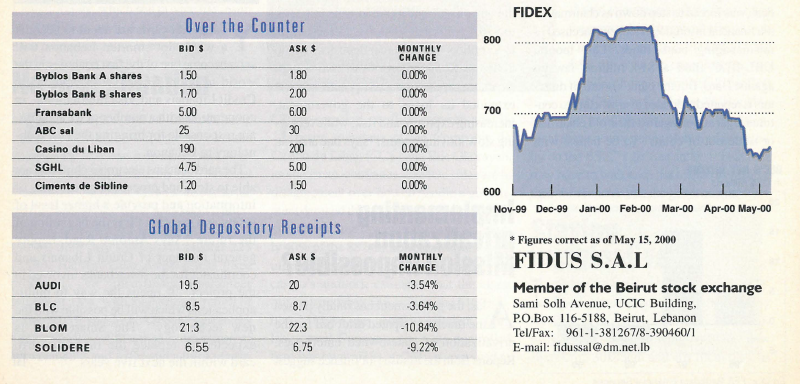
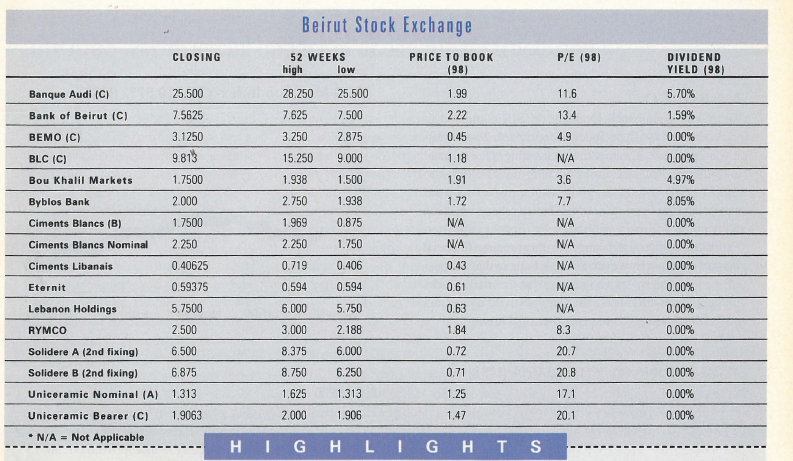
The Beirut Stock Exchange (BSE) suffered
operational losses of $70,315 in 1999
due to a slowdown in trading. A decrease in
earnings from commissions, coupled with a
failure on the part of some member companies
to pay their dues, was the root of the problem,
according to Fadi Khalaf, the market’s chairman.
Sales of BSE stocks have cratered since
1997, from $639 million to $331 million in
1998, falling to just $90 million in 1999. The
market did not start off well this year either,
with trading volume amounting to
$28 million in the first four months, in
contrast to $40 million for the same
period in 1999. There have been
reports that the BSE is trying to
encourage television stations to go
public. But there are obstacles: To list
shares, television stations have to get
the approval of the Council of Ministers.
There have also been reports that the
BSE was trying to encourage the two
mobile phone operators, LibanCell
and Cellis, to list shares. “Listing big
names such as LibanCell and Cellis could be a stimulant
to the nearly nonexistent trading activity
on the BSE,” says one analyst. That idea
may have to wait until the operators resolve
their differences with the government.


STAYING
IMAGINATIVE

Lebanese tile maker Uniceramic is celebrating
its 25th anniversary this year by
launching a new line of products. The company
was busy showing off its new
30x60cm, 30x45cm and 10x10cm tiles,
as well as a new imported brand called “Lifetile,”
during the Project Lebanon exhibition at the
Beirut Forum. The company has been trying
to compensate for what has so far been a
20% drop in local sales this year. The company
has also been looking abroad for markets.
“With the drop in construction, our capacity
has been reduced to two days per week, and
now our focus is to increase exports,” says
Nabil Ghorra, assistant general manager.
Exports have increased by 142% in the first
four months of 2000. Uniceramic expects to
acquire ISO 9000 certification some time
this year and has a goal of increasing exports to
20–25% of all sales by the end of 2000. “The good
part is that we have hit the US and Canadian
markets where they have a quality requirement
and we don’t have to compete against cheap
products,” says Ghorra.


MORE WORRIES

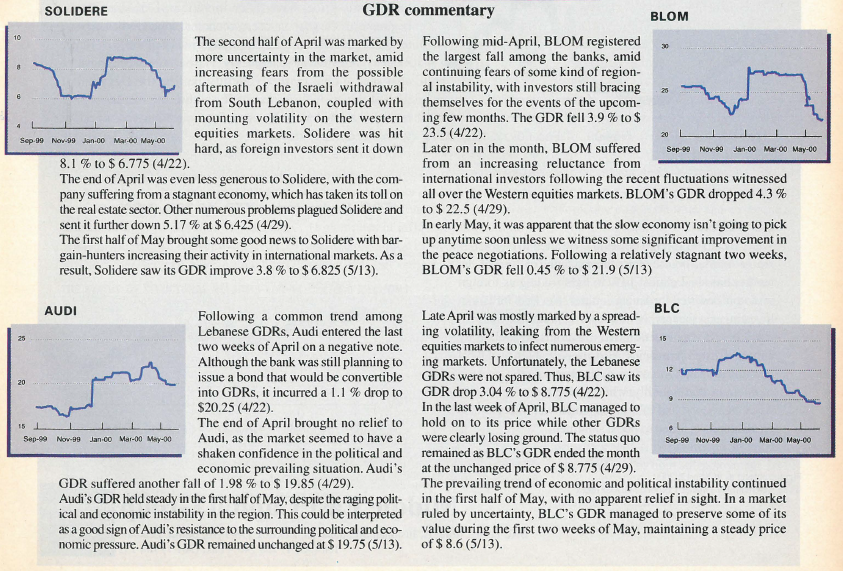
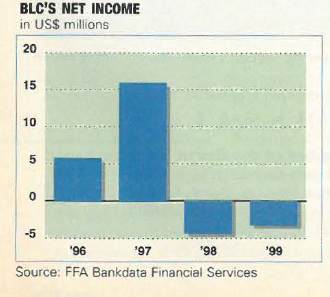
Banque Libanaise pour le Commerce
(BLC), a listed bank with shares traded on the
Beirut Stock Exchange (BSE) and the GDR
market, finally released its 1998 and 1999
results. After impressive earnings of $15.9
million in 1997, BLC showed losses of $4.3
million in 1998 and $3.2 million last year. But
these are the least of the bank’s worries.
BLC is currently recovering from a messy
merger with United Bank of Lebanon. Two
months ago, Safi Harb, the architect of the
deal, was forced to step down as chairman of
the financial institution after being accused of
mismanaging bank funds. Last month,
UBL-BLC filed a $14 million lawsuit
against Harb. But the bank’s board of directors
is reportedly divided over whether to continue
legal action against their old chairman


or settle out of court. “To be honest with you,
I don’t know where this bank is heading,”
says one analyst. Investors feel the
same. BLC’s shares on the BSE have fallen
over 27% this year, while its GDRs have
plummeted nearly 36%.


DIFFERENT
STRATEGIES,
DIFFERENT RESULTS

Byblos Bank, one of Lebanon’s top five
banks, declared unaudited net income of
$13.4 million in the first quarter this year, a
0.24% decline from the same period last
year. Total assets, on the other hand, went up
7.35% to $3.75 billion, and there was an
11.9% rise in customer deposits, which
reached $2.87 billion. Byblos’ stocks on the
BSE have fallen 20% so far this year. Banque
Européenne pour le Moyen Orient SAL
(BEMO) posted net profits of $866,546 for the
first quarter, an increase of 2.94% compared
to the same period last year. The bank’s total
assets went up 26.8% to $395.3 million and
customer deposits totaled $319.88 million, a
35.4% rise. “BEMO is a recession-proof
bank, having most of its liquidity in US dollars
and 95% of its loans also in dollars,”
says a local analyst. BEMO doesn’t rely as
much on T-bills and tries to forego high
yields for less risky investments.
Banque Libano-Francaise (BLF), on
the other hand, saw its net income fall 23%,
to $36.4 million in 1999. Assets rose 6.7%,
to $3 billion, and customer deposits went up
8.3%, to $2.54 billion. “BLF has a high
exposure to the Lebanese pound and has
extended its loans to the government,
increasing exposure and risk, while receiving
slow-moving returns,” says one analyst.

IMPLEMENTING
PRIVATIZATION:
MISSION IMPOSSIBLE?

Alas, the government has finally passed
the much anticipated draft bill for the
privatization of state-owned enterprises.
Reports from the Ministry of Finance suggest
that the telecommunication sector and
Middle East Airlines are the first candidates
for privatization. Along with the sale of
Électricité du Liban (EDL), Télé Liban and
the casino, the government could net some $5
billion in revenues, helping to reduce the government’s
ballooning debt. “I expect delays
in implementation as the bill had no clear
plan of execution and it faces serious political
opposition,” says one local analyst.


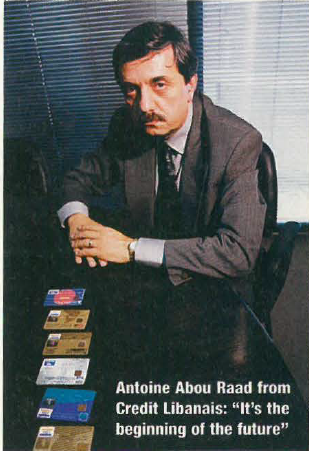
PLASTIC FOR BRAINS

Your credit cards are about to become
a whole lot smarter. Lebanon will
soon become one of the first countries in the
world to adopt Smart Card technology.
Credit Libanais and Visa International, in
cooperation with a number of local banks,
are responsible for bringing the new technology
to Lebanon.
The card contains electronic chips that are
able to store and process large amounts of
information and provide a higher level of
safety and security. “It is the beginning of
the future,” says Antoine Raad, deputy
general manager of Credit Libanais and
coordinator for the seven banks involved in
the project. “It opens the way to multi-applications
which will be possible with the
new technology.” The Smart Card is
expected to replace the magnetic-stripe
card within the next five years.

June 8, 2000 0 comments
0 FacebookTwitterPinterestEmail
  • 1
  • …
  • 687
  • 688
  • 689
  • 690
  • 691
  • …
  • 695

Latest Cover

About us

Since its first edition emerged on the newsstands in 1999, Executive Magazine has been dedicated to providing its readers with the most up-to-date local and regional business news. Executive is a monthly business magazine that offers readers in-depth analyses on the Lebanese world of commerce, covering all the major sectors – from banking, finance, and insurance to technology, tourism, hospitality, media, and retail.

  • Donate
  • Our Purpose
  • Contact Us

Sign up for our newsletter

    • Facebook
    • Twitter
    • Instagram
    • Linkedin
    • Youtube
    Executive Magazine
    • ISSUES
      • Current Issue
      • Past issues
    • BUSINESS
    • ECONOMICS & POLICY
    • OPINION
    • SPECIAL REPORTS
    • EXECUTIVE TALKS
    • MOVEMENTS
      • Change the image
      • Cannes lions
      • Transparency & accountability
      • ECONOMIC ROADMAP
      • Say No to Corruption
      • The Lebanon media development initiative
      • LPSN Policy Asks
      • Advocating the preservation of deposits
    • JOIN US
      • Join our movement
      • Attend our events
      • Receive updates
      • Connect with us
    • DONATE