• Donate
  • Our Purpose
  • Contact Us
Executive Magazine
  • ISSUES
    • Current Issue
    • Past issues
  • BUSINESS
  • ECONOMICS & POLICY
  • OPINION
  • SPECIAL REPORTS
  • EXECUTIVE TALKS
  • MOVEMENTS
    • Change the image
    • Cannes lions
    • Transparency & accountability
    • ECONOMIC ROADMAP
    • Say No to Corruption
    • The Lebanon media development initiative
    • LPSN Policy Asks
    • Advocating the preservation of deposits
  • JOIN US
    • Join our movement
    • Attend our events
    • Receive updates
    • Connect with us
  • DONATE
Money Matters

CAN’T GET NO SATISFACTION

by Peter willems June 8, 2000
written by Peter willems

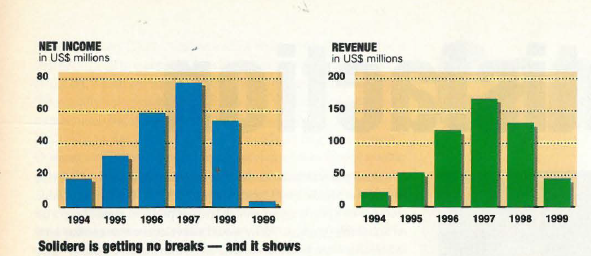
Condolences to Solidere shareholders. Profits of the real
estate company, responsible for rebuilding the Beirut
Central District (BCD) and the largest business in
Lebanon, plummeted from $54.2 million in 1998 to $3.7 million
last year. That’s a 93% free-fall! It won’t be decided until June,
but you can bet your shorts that Solidere won’t pay dividends this
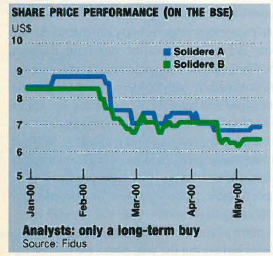
year. Share prices have more than halved since peaking in
1997. This year alone, Solidere’s A and B shares traded on the
Beirut Stock Exchange (BSE) have dropped more than 22%. Its
market cap, which takes up nearly 70% of the BSE, has shrunk from
$1.4 billion to $1.1 billion in the last 12 months. Expecting bigger
and better things in the near future? You may have to wait.
Land and real estate sales, the company’s main source of revenues,
fell 68% in 1999, from $118 million in 1998 to $37.5 million,
according to Solidere’s finance division manager Mounir
Douaidy. Sales contracts worth $79 million that were supposed to
come through last year were either cancelled or postponed.
Douaidy points to three factors contributing to Solidere’s dramatic
decline in sales: the stagnant economy, investors’ jitters about
political uncertainties and the snail’s pace of building permits.
There’s no doubt that Solidere isn’t immune to the economic slowdown
and political uncertainties. But according to Ziad Maalouf, vice
president at Middle East Capital Group (MECG), if there is economic
recovery or a peace agreement, the permit problem would keep a lid
on Solidere’s progress. “Why would a developer come and buy land
in Solidere when he knows that he’ll run into massive delays?” says
Maalouf. “Holding back permits is paralyzing Solidere 100%.”
The problem begins with the differences between the old construction
code and Solidere’s building decree 4830, which was
passed in 1994 for the purpose of rebuilding BCD, according to
Oussama Kabbani, department manager for urban management at
Solidere. “In principle you only have to pass through 4830, but it
doesn’t cover every detail,” he says. “Whenever the decree doesn’t
cover something, the municipality of Beirut goes back to the original
code. You’re using two laws that in principle should complement
each other. But when found in the grey zone, they apply the
old one and suddenly there are discrepancies.”

He claims that the
government was more flexible with 4830 under the old regime. But
things have changed under this administration. “When discrepancies
are found, nobody wants to take responsibility,” says Kabbani.
George Khouzami, head of the engineering department at the
municipality of Beirut, admits that his team is running into discrepancies
that delay the permit process but denies that the change
of government has altered the way the municipality works. “During
the previous government, we never bypassed the law,” he says. “We
followed the law then as now.”
But talk to anybody related to rebuilding downtown and they’ll tell
a different story. What motivated the powers-that-be to alter the process
is anyone’s guess. Analysts argue that there is an anti-Hariri campaign,
since he was the mover-and-shaker for Solidere while prime minister
and is a major shareholder in the company. Some at Solidere believe
that this government’s drive for law and order has forced those
working with permits to follow the rule book down to every detail.
“The government said that everybody must follow the law, so suddenly
everybody started getting scared,” says one Solidere official.
“Everybody says that it’s not their responsibility and throws the ball
in a different direction.”
Some developers and consultants that have
had a hand in the rebuilding program since the beginning have a different
theory and don’t sympathize with Solidere. “I feel sorry for the
developers that bought land and have permit problems, but not for
Solidere,” says one developer. “Solidere used to be the government,
it had power and it had a free hand in doing what it wanted to do. There
used to be pressure on the municipality. Now those at the municipality
are fed up with Solidere and are taking revenge.”
Regardless of who’s at fault, the government has stepped in to
offer a little help by passing two decrees. One was to make it easier
to get occupancy permits that were on hold because legal documents
had been destroyed during the war. Since the decree was implemented
in mid-February, only five permits have made it; 30
are pending. “Not good enough,” says one Solidere official.
The
second decree created the high council of urbanism to deal with discrepancies
found by the municipality. But according to Kabbani,
the council was given limited power. “In some cases there are five
problems, and the council can only decide on three, not the rest,”
he says. “We thought the council would get things rolling, but we
get stuck again and again.” Since the decree emerged early this year,
no construction permits have been issued — 24 are pending.
Since these decrees are merely patchwork, Solidere is anxiously
waiting for five more. One is supposed to clean up the discrepancy
mess. But there’s a problem: The council is only supposed to last
for six months, so it will expire in three. Watching how slow the
decree is moving, Solidere expects it to take one to two years to be
finalized. (It’s already been sitting at the Council for Development
and Reconstruction for over four months.) “They will probably
extend the council,” says Kabbani. “It’s better than nothing.”
Also critical are the souks. “It’s the vital part of BCD,” says
Douaidy. “It will energize the atmosphere, draw commercial life and
create traffic, which will bring in more investors.” With the souks
including 20,000m² of office space, 10,000m² of residential units and
70,000m² of retail space, not only would it bring in a new, healthy cash
flow from sales and rental income, but it could trigger a domino effect.
A decree to let Solidere develop the souks has been approved all the
way up to the last chain of command: the council of ministers.
According to Solidere, it has been waiting for the final signature for almost two
months.
The new decrees, which include dealing with the marina and property
given to government, are not only important to
Solidere. Those who have invested
in the BCD have been caught
in the crossfire.
“We are worried about how long it will take for the
decrees to be passed,” says Essam
Makarem, speaker for a group of
investors in BCD. “We’ve already
invested around $500 million in the
land, with another $1.5 billion in the
banks ready to invest; all we need is
to be sure that the other five decrees
are passed by the government.”
Is Solidere in a position to withstand
the outside forces if they continue to drag on? “Their fundamentals are
still sound,” says Maalouf. “The company is healthy in terms of financials.”
He notes that Solidere is sitting on $77 million in cash, its debt-to-equity ratio stands at an
acceptable level (22%), most of the infrastructure projects are nearly
completed and even though its net interest earnings have decreased
over the years, they’re still in the black. “And the land Solidere is sitting
on is strategic land, prime real estate, and its value can only increase
over time,” says Maalouf. “It’s a strong fundamental.”
Solidere is taking precautions to weather the storm. By downsizing
(mostly by reducing its staff by over 30%), general and administrative
expenses dropped from $16.4 million in 1998 to $14.3 million last year.
Cost cutting will mostly be felt this year, with Solidere aiming for
expenses to hit $10 million.
It has had plans to generate a new income
stream through rental income to help offset slow sales (see “Hedging
its bets,” July/August 1999). But with no substantial contracts developed
last year, its main source of rental income is still the ESCWA building —
rental revenues inched up only 0.5% ($6.9 million).
The Saifi project,
set up with an option to lease or buy, will be completed by the end
of the year and has booked 55% of space available. With Solidere’s aim
to increase its rental revenues, according to HSBC’s latest report, it will
climb steadily to reach around $19 million in 2002.

There’s also a backlog
of land and real estate sales amounting to $49 million that could
come through this year. But with the permit problem, Saifi’s results not
showing up on the books until 2001, and, most importantly, not
knowing if contracts for land and real estate will come through, it’s difficult
to predict if Solidere will show profits this year.
With economic conditions stagnant, uncertainty about the
peace issue and the permit problem dragging on, HSBC and
MECG recommend “hold” on Solidere’s shares. Some investment
firms have pulled back and stopped giving recommendations, not
knowing where the company is heading. “There are too many variables,”
says an analyst at the Merrill Lynch branch in
London. “We have to wait until things are clear before we can present
our view again.”
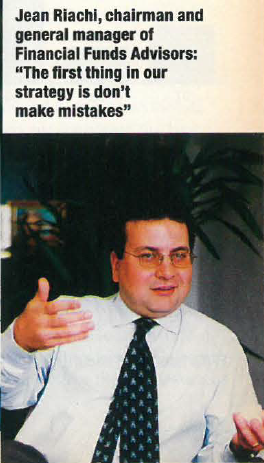
But analysts still believe that if there’s peace, Solidere’s shares will
jump. “The share prices will shoot up if there’s peace,” says Jean
Riachi, chairman and general manager at Financial Funds Advisors.
History offers some support: When peace talks were temporarily
revived a year ago, Solidere’s shares had a quick rally.
But if there is peace and the permit problem remains, the flurry would
probably lose momentum. What is needed is the government to grease
the wheels of Solidere; otherwise, it will just sit there idling
June 8, 2000 0 comments
0 FacebookTwitterPinterestEmail
Money Matters

Focused

by Peter willems & Peter willems June 7, 2000
written by Peter willems & Peter willems

The first time EXECUTIVE met Jean Riachi, chairman and general
manager of Financial Funds Advisors (FFA), was in the
summer of 1998 at the head office of Bou Khalil Markets
in Baabda. The meeting centered around Riachi and Walid El Khalil,
then the head of special projects at Banque Libanaise pour
le Commerce**’s** capital markets division, who were taking Bou
Khalil public.

Even though the private placement and moving
Lebanon’s biggest supermarket chain onto the Beirut Stock
Exchange (BSE) was a success, it was the last time Riachi was
involved in investment banking activities.

“We would like to be investment bankers, but we’re realistic,”
says Riachi. “We know that it’s not possible right now; there is no
market for this in Lebanon.”

Instead, Riachi has kept FFA focused            
strictly on brokerage activities and asset management, which has
paid off. It got its license from the central bank in 1996 and was up
and running in 1997, the year that trading on the Lebanese equity
markets was in vogue. FFA capitalized on investors’ interests:
Eighty percent of its transactions were on the local markets, and it
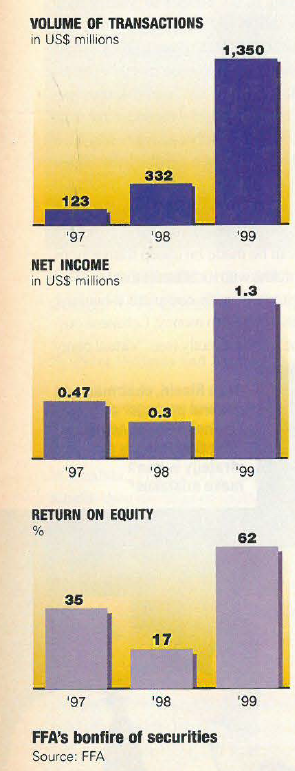
pulled in $470,000 in earnings during its first full year of operations.

But the “bull run” was short-lived. Trading volume on the BSE
dropped to $330 million in 1998 from $639 million one year earlier,
and FFA went with it. Profits sank 36% to $300,000.

The logical step? Go where the action is. That’s where Riachi and
his clients headed. Last year, over 90% of FFA’s trading deals were on
international markets, which pushed its trading volume up from $332
million to $1.4 billion. Profits climbed 333%, up to $1.3 million.

Those
who trade only on the local markets sat idling. Banque Audi’s capital
markets division, for example, watched its trade in equity on the BSE
drop from $384 million in 1997 to $39 million last year.

Avoiding full-fledged investment banking, which includes corporate
finance and advisory services, makes sense. Investment
bankers complain that family-run businesses are afraid to lose control
and are not transparent.

They also claim that local companies
are not familiar with investment banks, don’t understand how they
can benefit from such services, and are reluctant to pay fees even
once they are aware of what they can get in return.

If an investment
bank does take in a company, the chances are high that it will be
working with a wily client, according to Nicolas Photiades,
senior vice president at Thomson Financial Bank Watch, a former investment
banker. “It’s too much effort,” he scoffs. “There is not a lot
of cooperation from the client and there’s a lack of transparency,
professionalism and organization.”

Photiades argues that with the amount of time spent working with
a client to finish a deal, the returns are not worth it. “A deal that
would take you a month or two in the West would take you a year
or two here,” he says. “One of my deals took me
two years, which was for no more than $1 million in fees.
If I had done it in London, it would have
taken three months, max.”

To compound the
problem, even if companies want to work with
investment banks and go public, the BSE being in
intensive care is pushing them away.

Lebanon Invest and Middle East Capital Group,
two prominent local investment banks that started
making deals in 1995, have had difficulties facing this
unruly business community. Their solution? Move
their services into the region where more deals can
be made. “With so many problems in Lebanon, you end up
with overheads and might end up with losses,” argues Fouad
Trad, general manager at Credit Agricole Indosuez Liban. “You have
two options: go into regional business or create a regular source of
income, which is asset management and brokerage activities.”

FFA focusing on foreign markets — especially the US — was the
major catalyst in creating growth. But it is not alone. Many investment
houses have caught the wave in equities abroad.

Across town
is Fidus, which has built up a solid client base over the years: It does
at least 97% of trading on foreign markets. Société Générale
Libano-Europeenne de Banque bought a 51% stake in the investment
firm at the beginning of 1999.

“Because Société Générale is an
international name, present in the
US, European, Asian and Middle
East markets, it has added credibility
and confidence to Fidus,” says
Nabil Aoun, who sold his shares but
still runs the firm.

Fidus also benefits
from Société Générale’s client base and through technical assistance from the bank. According to
Ort, Misri & Associates, Fidus carries out at least $6 million worth
of transactions a day.

Local banks have flooded the market by setting up capital market
divisions. Byblos Bank’s brokerage arm is averaging about $5 million
a day in trading volume.

Banque d’ Affaires du Liban et d’Outre-Mer
(BALOM), a subsidiary of Banque du Liban et d’Outre-Mer, has also
been caught up in the rush, watching trading volume
jump 143% and net commissions on share trading
shoot up 135% from the first quarter of 1999 to the
same period this year.

Plus, big foreign firms are present.
Merrill Lynch, the world leader with $35 billion
in total revenues in 1999, has an active branch
in Beirut, while CCF Finance Moyen Orient
moved in a few years back.

Credit Agricole last year
doubled its trading volume, reaching around $2 billion.

“If there is peace, more big foreign institutions
will come into the market,” says Riachi. “It’s a permanent
fight to improve your people, technology and services.”

That’s exactly what FFA is trying to do. Similar to what Merrill
Lynch and Arab Finance Corporation (AFC) provide, FFA just
launched an up-to-date online account.

That gives clients access
through the Internet to their immediate portfolio summary, holdings,
statements, profits and losses, recent transactions and risk management.

FFA also has plans to set up online trading by the end of the year.
AFC has launched “online trading” but is merely passing orders from
clients to brokers to execute. FFA will take on Merrill Lynch, which
already has online trading.

Even though entering cyber trading is considered a must for the
future by many investment firms, there’s hesitation. First, firms are
uncertain about how much money can be made on cheap transactions
online.

Brokerage houses are also in line with local banks that are moving
slowly to accommodate customers with complete e-banking
services.

The general belief: When it comes to money, Lebanese customers
still want to interact with the banker directly (see “Virtual piggy
bank,” February 2000).

“Online trading will eventually come, but it
will be difficult to compete,” says Fadi Osseiran, general manager at
BALOM, which is thinking about offering online trading next year.
“Eventually you give access to clients with virtually zero income on
transactions. But if someone trades online and makes mistakes, he
can’t talk to the computer. He still needs to talk to a person.”

Osseiran anticipates customers using a portion of their money to trade
online, leaving a larger sum in the hands of asset management.

Although FFA has doubts, now might be the time. Some large US
investment firms, like Merrill Lynch, got left behind when online trading
caught on and had to scramble to catch up to retain customers. FFA’s
chief local rival, Fidus, also has plans to launch online trading this year.

Even though FFA is exploring the new world of technology, Riachi
stresses the tight control of its operations.

“When it comes to taking
on new clients, if I feel I cannot handle that many, I stop. I drop clients
that can be a problem; ‘terrorist clients’, which is risky business. We
don’t want risky business,” says Riachi.

FFA also pays close attention
to risk management. By monitoring clients’ investments, it tries to trim
down exposure to risk. “When Nasdaq crashed in April, we didn’t feel
the pain. We have clients that lost money but within an acceptable range,” says Riachi.
Other brokers felt pain with their clients.

“Some bought at the top and
believed that prices would
continue to rise,” says Tarek
El-Ahdab, vice president of
asset management at AFC.
“For some people trading on
leverage, the consequences
were very harsh.”

Brokers at
FFA didn’t have to make any
margin calls during the turbulent
times in the US markets.

Was FFA’s spectacular jump
in earnings last year a fluke?
It might be difficult to repeat,
and Riachi aims at consistent
growth.

“We’ll have growth
unless we make mistakes,”
he says. “The first thing in
our strategy is don’t make
mistakes; make sure things
are operating well before
taking the next step.”

A hint at
FFA’s results in 2000: In the
first quarter, transactions
were $450 million and earnings
came out as $450,000. If
it keeps up the pace, FFA’s
profits will increase about
38%. Not as sensational as last year, but for any investor
or broker, something to
smile about.

June 7, 2000 0 comments
0 FacebookTwitterPinterestEmail
Feature

Race Against Time

by Hadi khatib June 6, 2000
written by Hadi khatib

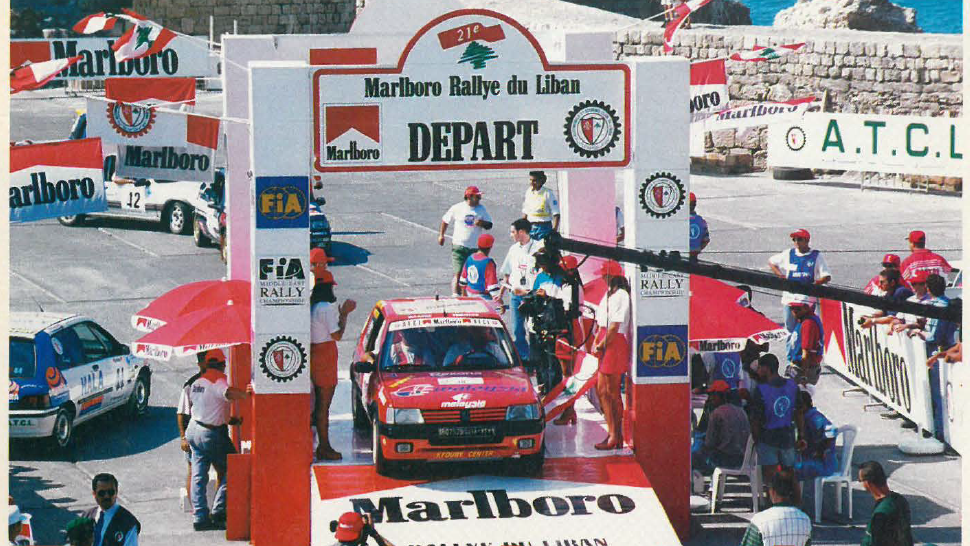
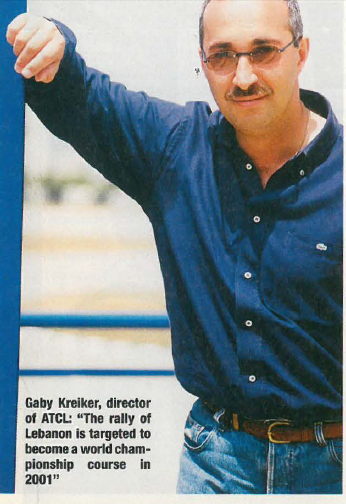
Lebanon, start your engine. “The
rally of Lebanon is targeted to
become a world championship
course in 2001,” asserts Gaby Kreiker,
director of the Automobile and Touring
Club of Lebanon (ATCL). He expects 500
foreign journalists to swarm the country to
report on the 900-km, four-day race, an
event that is expected to attract big-name
sponsors and professional drivers from
around the world.

Even more ambitious
are the plans to hold a Formula One race in
the Beirut Central District in the next few
years. Over a billion people could watch
Michael Schumacher weave his Ferrari
through the streets of Solidere on TV. The
event could attract as many as 40,000 visitors
and pump hundreds of millions of
dollars into the local economy.

Sounds like the dreams of a motor-crazed
country craving international attention. The
Lebanese have a passion for car racing, as
anyone driving to Jounieh on a Friday night
quickly discovers. But the sad reality is that
motor racing events here are crashing.

“Motor sports are one of the most expensive
sports you can do,” says Kamil Maalouly,
one of three partners who own the Motor
Club, a company involved in organizing
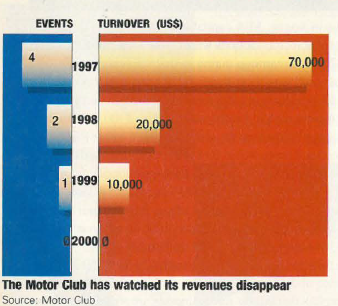
amateur rallies. In 1997, its best year,
Motor Club organized five events, including
the Amateur Cup, which attracted 350 competitors.
The event was covered by LBC,
which contributed 200–300 advertising
spots. Motor oil company IGOL was the
main sponsor, contributing $10,000, with a
number of smaller co-sponsors throwing in
another $15,000.

But in 1998, the Motor
Club organized just two events. The company
had to shift to MTV for coverage of the
Amateur Cup because LBC was no longer
willing to contribute the same number of TV
spots, and the number of participants
dropped by more than a third.

Last year, the
Amateur Cup was the only event organized
by the Motor Club. This time, the company
had to go to Future TV for sponsorship and
only 60 competitors participated. The
Motor Club did well during those three
years, earning profits of around $50,000 on
revenues of $100,000. But for 2000, lack of
demand has meant that the company is not
organizing any events.

Kreiker understands these problems well.
ATCL, a non-profit organization with 9,000
members, organizes such big-name races as
Rally of Lebanon and Rally of the Cedars, as
well as a number of smaller karting, 4×4, and
closed-circuit events.

“Between 1992 and
1994, there were no other spectator sports, and
we made money. But since 1995 we started
to go downhill, losing coverage to basketball
and other events,” he says. Rally of Lebanon
and Rally of the Cedars used to get an average
of 20 TV spots per day, one month
before the event. Today, they get just 10
spots. “This affects our sponsors and drivers,”
says Kreiker.

ATCL has to pay around $200,000
of the $600,000 budget to organize
the Rally du Liban. Marlboro foots about
$250,000 of the bill, with TV stations — such
as LBC and MTV — contributing $100,000.
Co-sponsors pay the rest.

For the Rally of the Cedars,
these days ATCL must
pay the entire $70,000 to
$100,000
needed to organize
the event. The organization
receives no contributions from
TV stations.

ATCL’s difficult situation
could change if the Rally of
Lebanon is promoted from
the Middle Eastern rally car
circuit to the world circuit, as
Kreiker says will happen.

While the Middle Eastern
circuit stops in Dubai, Abu
Dhabi, Jordan, Qatar,
Bahrain, Cyprus, and
Lebanon, the international
circuit is held at 14 different
locations around the world.
With sponsors like Michelin
helping to finance the event,
an international rally car race
could bring an estimated $10
million
of revenue into
Lebanon.

Profits generated
from the event could then be
reinvested in order to make
the Cedars Rally into a
Middle Eastern circuit event.

The payoffs of a Formula
One race would be even
greater. The idea first arose
in the mind of Khaled Altaki,
a local businessman, in 1994.
His Beirut Hariri Circuit
would have run along the
Ramlet El Baida promenade.
The idea has since been
scrapped, although Altaki
now claims to be designing a
second closed-circuit track
running in an as-yet-undisclosed
location.

But the main impetus these
days is on the idea of running
a Grand Prix through the
streets of Solidere. The Ministry
of Tourism has appointed a committee of five officials,
including Cheikh Fouad Al Khazen, the
chairman of ATCL, and Nabil Karam, a
five-time champion with ATCL, to prepare
a budget and market the event through a private
company.

Should Lebanon be awarded
the rights to organize a Formula One race,
ATCL would be given the job of managing
the race. The event would demand a year of
preparation and require an estimated budget
of $100 million. ATCL would be charged
with managing the event, gaining valuable
experience and worldwide recognition.

“Formula One will change the face of
Lebanon in the eyes of the world,” says
Karam. Hotels would be full for a week,
generating some $3 million for the government
in restaurant taxes alone. It has
been estimated that the event would generate
$100 million in profits for organizers,
which would be shared by the government,
ATCL, and the company in charge of marketing
the race.

“It will have a snowballing effect on
tourism and everyone will be positively
affected — taxis, hotels, restaurants, malls,
retailers — and it will put Lebanon on the
tourist map for the entire world,” says Fadi
Saab, board member of the national council
for tourism. Saab, also chairman of TMA,
would be involved in facilitating the transport
of racecars into and out of the country.

Sound too good to be true? It probably is.
Lebanon is competing against Egypt and
Dubai to host the event. Although Lebanon
has the best climate, Sundays off, and a casino
for gambling, Dubai has pledged to spend
close to $1 billion to organize the event and
is the leading candidate.

At the same time,
Dubai and Egypt do not have to deal with the
nasty political environment plaguing
Lebanon. “Bernie Ecclestone, the head of the
international association for Formula One organizers,
refuses to come to Lebanon under
these conditions,” says Karam, adding that
Formula One wouldn’t take place here
before regional peace is achieved.

Others feel that Lebanon is not ready to host
an event of this size. “It seems to me that it’s
too early to organize such an event. The
country doesn’t have the necessary organization
to attract the right amount of tourists and
make sure their stay is trouble-free,” says
Ghassan Matar, previously an independent
consultant for the ministry of tourism.

If Lebanon succeeds as a candidate, organizers
will have to wait until 2003 before
they can hold the event. Until then, perhaps
the slogan we should be promoting is
“Rally for peace.”

June 6, 2000 0 comments
0 FacebookTwitterPinterestEmail
Feature

Shame shame

by Kirsten Vance & Kirsten Vance June 4, 2000
written by Kirsten Vance & Kirsten Vance

You’ve heard it before, we’re sure,
that old adage everyone so likes to
repeat: Lebanon — the region’s
entrepreneurial spirit and center of free
market capitalism. It seems, however, that
somebody forgot to tell the government.

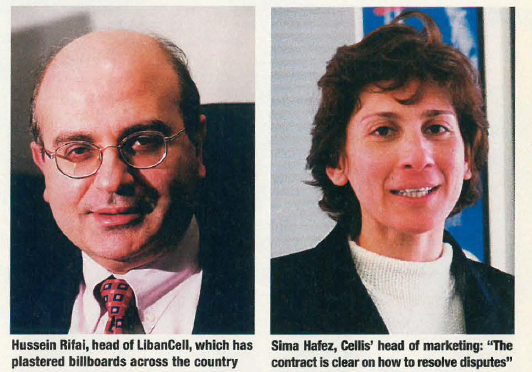
The two cellular companies, LibanCell and
Cellis, have found that out recently, with
the government threatening to cancel their
contracts if they didn’t pay up. “It’s like a
soap opera with dark forces working
behind the scenes,” says Ziad Maalouf,
vice president at Middle East Capital
Group (MECG). “This could tarnish the
image of Lebanon in the eyes of investors.”

While it’s not clear who’s right or wrong
in the heated cellular row — or even if there
is fault on both sides — many in the business
community agree with Maalouf’s assessment
and feel the matter could have been
dealt with better.

Rather than being handled discreetly
with negotiations out of the spotlight, the
brawl has been all too public and loud. “If
what the government claims is legitimate,
they should have done it quietly,” says
Nassib Ghobril, an analyst at Lebanon
Invest. “We’re not exactly in the most stable
and peaceful environment for investors
— you don’t scare foreign investors.”

Instead, the government has brandished
swords, fencing LibanCell and Cellis into a
corner with a $300 million fine each.

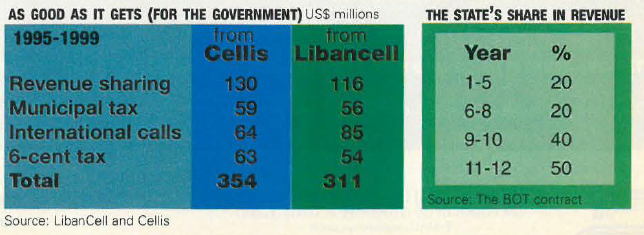
With LibanCell’s five-year profits           
through 1999 at $141 million and Cellis’ at
$124 million, the move looks like the government’s
attempt to turn the two companies
into non-profit organizations — as if making
profits was some sort of a sin.

The milking
machine had already been turned on once
before, when a six-cent tax was slapped on
each minute of talk time last June in an effort
to increase revenues to government coffers.

LibanCell, which is owned by Finland’s
Sonera and a consortium of local investors,
has a case pending in the Shura Council to
have that tax overturned. (Hussein Rifai, the
company’s chairman, declined repeated
requests for an interview, as did Issam
Naaman, the minister responsible.)

And where did that $300 million figure
come from anyway? “We don’t understand,”
says Sima Hafez, marketing director
of Cellis, which is two-thirds owned by
France Telecom and one-third owned by the
Mikati Group. “All they’ve said is ‘you’ve
done damage to the government. Pay.'”

The two companies weren’t the only ones
confused. While Naaman did list numerous
violations, there was a lack of documentation
or supporting evidence put forth.

Even
members of parliament, who approved the
cabinet’s decision to deliver the ultimatum,
were ill-equipped to give any kind of
verdict. “When we discussed the issue, we
didn’t have any documents,” says Boutros
Harb
, a lawyer and MP. “We needed the
whole file in order to discuss it properly and
make a decision.”

The cellular operators appear to have done
much better in the media wars, returning the
government’s hardball with facts and figures.
The duo churned up the PR machine
with adverts splashed all over billboards and
in newspapers, spelling out which party
pockets the largest share of phone bills paid
by customers — the cellular companies at
4.63 cents and the government at 8.43 cents
per minute.

If LibanCell and Cellis already
had the sympathy of the business community
and investors, that move swayed general
public opinion in their favor.

And there’s
more to come. Cellis compiled 1,000 binders,
enclosing copies of the contract with other
supporting documents, destined for the
desks of prominent business leaders, as well
as 5,000 smaller pamphlets. LibanCell has prepared
its own thick file to present its case.

For the cellular companies, the government
demonstrated the worst of its bad
faith when Naaman pulled a flip-flop that
would be the envy of any Olympic gymnast.
In mid-April, the minister turned 180
degrees, bringing an abrupt end to negotiations
with LibanCell and Cellis without any
prior warning.

That was just one day after the
two cellular operators claimed they had
signed an agreement in principle to turn
their build-operate-transfer contracts into
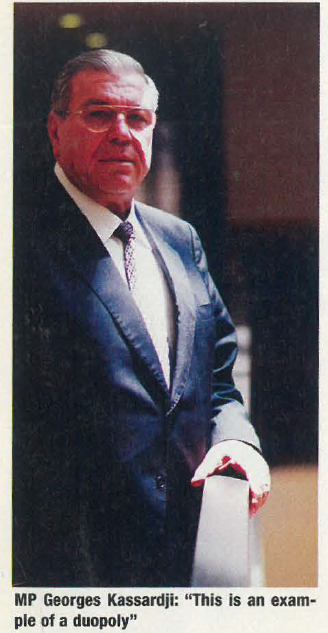
licenses by the start of 2001. The operators
offered to pay $1.2 billion, according to
Georges Kassardji, a battler on the
front lines against the cellular companies.

While EXECUTIVE did receive an unsigned
copy of the agreement, Hafez claims the
signed version is at the offices of law firm
Booz, Allen & Hamilton (BAH). However,
the firm would not comment on the matter.

So what would be the next step to resolving
the stand-off professionally? “You can’t
sign contracts with two leading international
companies, abrogate the contract, and
expect to maintain goodwill,” says Marwan
Iskander, an economist. “The government
should agree to go to arbitration.”

Those sentiments
are echoed by many analysts, business
people, and MPs alike. It is also the
preferred choice of LibanCell and Cellis.

The government does, however, have the
right to terminate (see box) the contract for
any reason it sees fit.

But outside termination, there are other procedures
stipulated in the contract. “The
contract is clear about how to resolve a dispute,”
says Hafez, listing off the steps: the
coordination committee, the appointment of
outside experts, arbitration according to the
rules set out by the International Chamber of
Commerce. “This is what we should follow,”
she says. “We should abide by this contract.”

Further, the International Finance
Corporation, which provided Cellis with a
line of credit, received a letter of guarantee
from the previous government that the termination
clause would not be used. The
World Bank organ has since warned that
such a move could damage Lebanon’s ability
to attract future foreign investment.

The threat to give the cellular companies
an early exit visa stems from 17 alleged
violations. These include not providing sufficient
geographical coverage, not allowing
government audits of their accounts, failing
to pay taxes in full, and cheating the government
on its share of revenues. LibanCell
and Cellis have denied the accusations.

The most hotly disputed allegation concerns
the number of subscribers and
whether or not the contract stipulates a
ceiling of 250,000. Two independent
lawyers consulted by EXECUTIVE interpreted
the said figure as a ceiling, and that any
expansion of the subscriber base should
take place within that limit.

According to the
cellular operators, however, BAH said
there are two possible interpretations.

When the dispute first arose following the
change of government, the companies put
a hold on new subscriptions. That created a
black market. “We asked several times for
a meeting of the coordination committee,
but it hasn’t met in over two years,” says
Hafez. “They didn’t abide by the procedures
in the contract, so we put more lines on the
market and continued our expansion.”

The
government has said it wants 50% of revenues
from the lines in excess of 250,000,
rather than the usual 20% stipulated in the
contract for years one through eight.

According to Kassardji, the expansion was
a move to control the market before a third
player could enter the fray. “This is not
a good example of privatization; it’s an
example of a duopoly,” he says, presenting
a list of unfair practices and violations.

Regardless of the outcome, this doesn’t
bode well on the eve of privatization. Now that
parliament has passed the privatization law, the
government needs to sell off state assets to
reduce its huge debt. But in the aftermath of
such a disastrously mismanaged dispute, will
there be any buyers? And if so, will they pay
as much as the government hopes to get?

June 4, 2000 0 comments
0 FacebookTwitterPinterestEmail
Feature

It’s a jungle out here

by Gareth Smith June 4, 2000
written by Gareth Smith

“Someone came and said he
wanted me to value a property
at $1,000 per m². I said I
wouldn’t, since it wasn’t worth that. He
went to a khabeer muhallaf ikary [sworn
expert on real estate], a big name, who
agreed to make the $1,000 valuation. There
are also examples where land is valued at,
say, $50 million for collateral, but when the
bank claims the land after default, it turns out
to be worth only $10 million.”

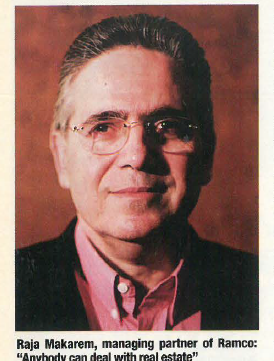
Raja Makarem — consultant and broker in
Lebanon and England for nearly 30 years —
smiles when he tells the stories, but he’s not
really laughing. In the post-war boom,
some saw mushrooming concrete as the
fruition of Lebanon’s love of free-market
entrepreneurship: anyone, it seemed, could
prosper in the unregulated real estate jungle.

In today’s landscape of unsold property,
silent building sites, and banks foreclosing,
the lack of regulation takes on a different
light. Suddenly, a new professionalism
seems to be needed, and yet professionalism
is next to impossible in a jungle.

Last year,
Georges Corm, the minister of finance, put
stagnation in real estate alongside public debt
and the balance-of-payments deficit as one
of Lebanon’s three most serious economic
problems. “If we don’t do anything about
them,” he said, “then the Lebanese should
not expect any growth in the future.”

Successful modern capitalism requires a
regulated market, and Makarem is not
alone in believing that the lack of regulation
is strangling Lebanese real estate. “The
sector is marked by several inefficiencies,
with a notable mismatch between supply
and demand,” noted an HSBC report last
summer. “Assessing the state of the market
is made difficult by a crucially lack of reliable
market information … Real estate transactions
in Lebanon are made more difficult by
heavy, time-consuming administrative formalities
and high costs. The aggregate of
local taxes, agent commissions, notary and
registration fees could be as high as 15% of
the property value.”

Living in a jungle, in other words, is
expensive. The lack of regulation — and
the consequent lack of transparency and professionalism —
pushes up prices.

“Anybody
here — a porter, a driver, a doctor — can
deal with real estate,” says Makarem.
“People buy the wrong property at the
wrong price, or they buy something without
knowing about the restrictions, like zoning.

Clients look for a quick buck and don’t
want to pay for market research. People
avoid serious brokers: they say things like
‘this guy won’t budge from his 2.5%,’ so
they go to someone who’ll take half a percent,
and there are plenty of them — of
course they might be taking a huge cut
from the vendor. In the end, all this uncertainty
can make prices 10% to 20% higher.”

There are many examples of real estate
markets regulated both by law and voluntarily
by the industry. No one can deal in real
estate in the US without a broker’s certificate,
and they are legally liable for their actions.
The UK has no restrictions on who can deal
in real estate, but there is a code of practice
laid down by two professional associations
and a strict legal framework (see box).

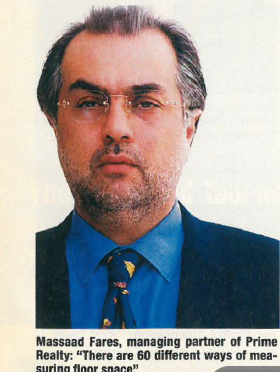
Massad Fares, managing partner of
Prime Realty, argues that Lebanon needs a
real estate agents’ act to organize the profession:
“Other sectors here are regulated. A
financial broker, for example, needs a
license and the purchaser is bound by law to
pay a commission. This could be the case also
in real estate.”

Makarem suggests that the first
step is the establishment of a professional
body: “It should require basic minimum
knowledge of anyone wanting to become a
professional in the field. It might rule out people
with certain criminal records.” Those
approved would display a sign and adhere to
a publicly available code of practice and a
general fee structure.

The initiative, says
Makarem, must come from the industry: “It
has to start with us. The ministry of finance
should then become involved in drawing
up the regulations. Everyone should be
required to pay dues to the broker, as you can
only do the serious work if someone is paying
for it. But at the same time, the broker
should be held responsible for any breach of
the code of conduct.”

The only current qualified real estate
operatives in Lebanon are the so-called
sworn experts. There are over 700 such
appraisers, registered and approved by the
ministry of justice, who work for the courts
and offer services to the public. But their
only qualification is a high school or technical
school degree, or 15 years**’** practical
experience.

The appraisers’ methods, says
Massad Fares, are old-worldly and generally
based on comparisons — what “similar”
properties have sold for — rather than yields.
This means the appraisers do not examine
the potential of property, and consequently
portfolio holders are seeking better advice.

“The banks come to people like us, who are
more up to date,” says Fares. “We then
have the khabeer muhallaf sign our report.
A foreign bank will also tend to require an
auditor to sign the evaluation.”

The appraisers are involved in a wide
variety of transactions and are called on by
courts in cases of financial conflict. But they
are not held responsible for the accuracy of
their valuations. “In the UK, anyone who
makes a valuation is liable,” says Makarem.
“To do a valuation in Britain — or the United
States — you need professional indemnity
insurance. If you give the wrong advice and
someone suffers, they have to be compensated.”

In Lebanon, the legislation concerning
valuations is old, and ignorance of the law
is widespread. After more than 20 years in
business here, Makarem cannot recall a single
example of a valuer being sued.

Nothing is more basic in real estate than
square meters. Yet in Lebanon there is no
established way of measuring buildings.
Balconies and internal walls may or may not
be included: elevators, stairs, and technical
areas are sometimes counted in residential
properties.

“All over the world, each country
has one way of measuring,” says Fares. “In
Lebanon they have 60 different ways.”

Landlords and developers generally include as
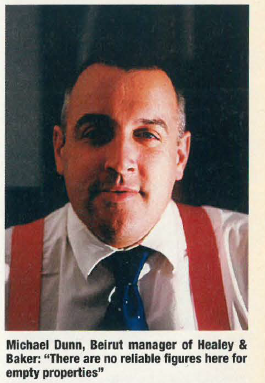
much as possible, says Michael Dunn, Beirut
manager of Healey & Baker: “The current system
of measuring gross external areas allows
vendors or landlords to ask a higher price
and to divert attention from what interests the
client — the floor area that can be used.”

With land, the more progressive brokers are
taking up the concept of BUA (built-up area,
the amount of floor space permitted on a plot
of land by building regulations), which is the
only effective way of comparing prices. Most
brokers still price plots not in BUA but in
square meters of land, even though allowable
floor space can vary in Beirut from 1.2 times
plot size in zone ten (parts of the coast) to six
times in zone one (parts of downtown).

Floor space and land prices are not the only
questionable statistics bandied around.

“People invent figures,” says Fares. “They
say, for example, that $7 billion worth of
property is idle. But if you think about it, the
banks wouldn’t lend half that amount. So the
figures need to be questioned: is a building
empty because the owner is away in the
Gulf, or is it for sale?”

Other, more optimistic,
statistics cited on empty property come
from studies carried out by the government’s
short-staffed central administration of
statistics in 1995 or 1996 and are a poor guide
to today’s market. “There are no reliable
statistics here on empty buildings,” concludes
Dunn.

As with empty properties, so with “average
prices”. Experts take the prices for specific
neighborhoods quoted in some journals with
a large pinch of salt.

The stagnation of the
market since 1996 means that there are few
actual transactions in any neighborhood from
which to derive a meaningful market price.

In
Britain, large agents like the Halifax
use actual sales figures to compile regional
house-price surveys that are regularly published
in newspapers and, more thoroughly, in
specialized magazines.

In Lebanon, many
dealers claim that sellers and buyers regularly
report falsely low figures to the land registry
in order to minimize taxes — while at the
same time, the seller may circulate a falsely
high figure to enhance the development’s
standing amid potential buyers.

Figures for rents are distorted for a different
reason. Many owners still avoid
renting because of the history of state intervention
that fixed rents way below market
prices. Regulation can be harmful as well as
helpful.

The new law in 1992 (159/92) —
allowing landlords and tenants to agree
contracts freely — was a step in the right
direction, but it did nothing to change the
market distortion of older rents. Many of
these originate from days when the
exchange rate was LL3 to the dollar.

Proposals for reform have been bogged
down in parliament for many months and
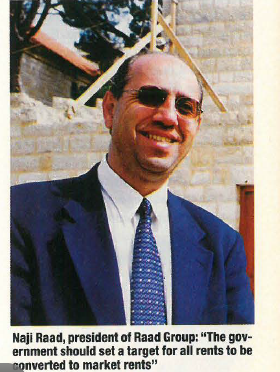
action is overdue, says Naji Raad, president
of Beit-Mery-based firm Raad Group: “The
old rents can be raised only by parliamentary
approval and then by very small percentages.
The government should set a target — five or
ten years — for all rents to be converted to
market rents. The politicians are scared of
disadvantaged people becoming homeless.
But there has to be a limit. Today, someone
paying $100 or $200 a year in rent might
have to be offered $20,000 as khlou (indemnity)
to leave. This is ridiculous. Setting a
time limit would give tenants and owners an
incentive to negotiate.”

But the tenant and landlord law is “still in
its infancy,” says Dunn, who feels the 1992
law “needs to be tried, tested and proven
before it’s fully accepted in the market.”

The
absence of law on leasing has led Solidere
to pioneer the practice in downtown,
including the first residential properties (Saifi)
and commercial property (170
Marfaa) to be leased with an option to buy.

While not providing an adequate legal
framework for a successful market, the government
does tax real estate transactions
highly. Although comparable to Egypt, the
transaction tax of 5.4% is much higher than
in the West. In England, the rate is just 1% on
properties up to £250,000 ($390,000), rising
to 3% on properties above £500,000
($790,000). In Kuwait, the tax is just 0.5%.

“It’s also 16% here for foreigners,” says
Dunn. “While 5.4% and 16% may not
sound like very high figures, if you pay $20
million for a property the tax is a lot.”

Fares believes that tax rates should be part
of a wider overhaul of the antiquated legal
structure. Many point favorably to the legal
change in the 1970s that allowed landlords to
claim service charges from tenancies, but it falls
short of its aim because of the lack of professional
management of buildings.

Without clearer and more effective regulation,
the industry is likely to struggle, even
if and when the economy and the regional situation
improve.

Meanwhile, real estate professionals
envy the banking sector, which is
successful partly because it is strongly
supervised by the central bank and the banking
control commission.

“Real estate is
every bit as important as banking,” muses
Makarem. “Or at least it could be.”

June 4, 2000 0 comments
0 FacebookTwitterPinterestEmail
For your information

Great plan,poor implementation

by Executive Editors May 26, 2000
written by Executive Editors

The Syrian-Lebanese free trade agreement was supposed to stimulate trade. Why has it failed to do that?

Lebanon’s total imports are down 25%, as are Syria’s. It’s not just a problem between Syria and Lebanon. It’s a problem relating to the economic possibilities in Lebanon and Syria. There is stagnation and recession. We also have to take into consideration the price of oil. Last year, the price was $8 or $9 a barrel. The biggest imports (50% to 60%) from Syria are oil, gas and fuel oil. The quantity is still the same, but the price has gone down. Another point, Lebanon imports about $25 million in truffles from Syria. Last year, there were no truffles, no production in Syria. At the same time, we’re still trying to resolve problems concerning the formalities of trade. We have to facilitate the formalities. We also have to find a solution to the problem with letters of credit (L/C).

You mentioned letters of credit. If a Syrian wants to import goods from Lebanon, he must pay 100% up front for an L/C. That’s not the case with other countries. What are you doing to solve this problem?

KHOURY There was a meeting between representatives of the Commercial Bank of Syria and about five or six private banks here. They decided that the first step towards a solution was to open a credit line between the Commercial Bank of Syria and the association of banks in Lebanon to facilitate the method of payment. About six banks here have this agreement and we hope that all other banks follow. But the issue is still under discussion. I hope that in four or six months, many of these problems will be solved.

This agreement makes exceptions for a number of items. Can you really call this free trade?

KHOURY This week an agreement was ratified for porcelain, reducing tariffs by 50%. With beverages, the problem is with customs duties. Other items, like marble, juice concentrate, mineral water and certain beverages such as Pepsi are kept out of the agreement. We are discussing these items. At the same time, there are about 20 industrial items that cannot be imported into Syria by the private sector. For example, Chiclets, who have a lot of factories in Syria, go through a public sector company. If the market needs it, they import it. If it doesn’t need it, they don’t import it. So we are discussing the possibilities of permitting the private sector to import these types of items from Lebanon. I think they are going to cancel this rule within a month. The private sector responds better to the market.

Agricultural products were also not included. The two sides negotiated a separate agreement in October. What was that agreement and why hasn’t it been implemented?

It calls for an immediate 50% reduction in tariffs on 22 items that are grown in both countries and a further I 0% reduction each year for the next five years. It was signed at the end of October, but not ratified. I expect it to be ratified at the end of this month.

Farmers here are worried that they will not be able to compete with Syrian produce. What do you think?

A commission from both countries was formed two months ago and is discussing how to coordinate agricultural policy, increase complementarity and specialization in regards to what both countries grow. When the plan is finished we will have an idea of what should be done in Lebanon and Syria.

Traders complain that the agreement is arbitrarily enforced at the border. One day something is allowed, the other it is not. Tariffs change on the whims of the customs agent.

KHOURY Both sides complain about this. Sometimes customs agents change the price. Sometimes you find an agent who changes the tariff code as he likes. You have a certificate of origin and you arrive at customs and they say that it’s not correct. We have a commission for Syria and Lebanon. You can sometimes complain to this commission and they will check up on the problem.

Fadi Abboud, president of the North Metn Industrialists’ Association, recently called the agreement “no more than an exercise in public relations.” Others have expressed similar feelings. What’s your response?

KHOURY I know Fadi Abboud very well. I think he believes deeply in the relationship between Syria and Lebanon. He is for a common market. He wants to promote it. That’s why he complains all the time. He is in a hurry all the time. But you cannot take everything as you see it. You have rules, you have an economic situation. You have a lot of things to take into consideration when you implement an agreement.

May 26, 2000 0 comments
0 FacebookTwitterPinterestEmail
For your information

Courting disaster

by Sami Atallah May 26, 2000
written by Sami Atallah

The government of Hoss and the first and second governments of Hariri listed judicial reform as one of their top priorities. The rest is history. I want to add my voice to those who are calling for judicial reform. Not only is an independent and well-functioning judiciary one of the prerequisites of democracy and civil liberty, but also it is a vital component of the functioning of a market economy.

A well-functioning judicial system contributes to a country’s wealth and economic growth. First, it protects property rights, the basis of a market economy: It gives the owners of firms, capital and assets the right to use, sell and generate income as they wish and prohibits the government from expropriating their assets. Secondly, it enforces contracts and resolves disputes between two parties. With a fair and efficient judiciary, firms would be able to undergo complex interactions with the confidence that a second party will not renege on the agreement. Otherwise, firms will avoid such dealings and lose investment opportunities or face the difficulties of solving conflicts outside the court. And third, it can hold the executive and legislative branches accountable for their decisions and maintain the credibility of the business environment.

The last two hurt the Lebanese economy in a way that cannot be easily measured. The judiciary’s ability to enforce contracts and resolve disputes is slow and costly. This is expected since only 359 positions for judges are actually filled out of 515. Of course, this has resulted in the accumulation of unresolved cases. The average case takes three to four years to clear compared to 100 days in France. Although the government recently appointed judges, the situation is not likely to improve due to misuse of the procedural code. The system allows the defendant to postpone a case by abusing the process of hearing and notification. Along with the snail-pace of court cases, the cost of filing lawsuit fees, fiscal stamps, and lawyer fees make for a hefty bill. So it’s no surprise that resorting to the courts is the least favorite option of firms to revolve disputes.

The costs in terms of time and money are harmful to the economy. Small firms, which comprise the majority of enterprises in Lebanon, can’t afford to go to court and avoid it completely. They deal with people they trust, which limits their economic activities to their surroundings. Even if these deals aren’t the most economical, firms are willing to pay the extra price to guarantee the fulfillment of a contract. Bank lending to the private sector is also affected. Banks are inclined to lend to firms that are trustworthy, because the court procedures are complex. This, however, may deprive emerging firms of credit. Although there are other ways to solve disputes, such as arbitration and reputation, an efficient judicial system is irreplaceable.

The ability of the judiciary to hold the executive and legislative branches accountable is also questionable. Lebanon has decent laws and decrees, albeit in need of modernization, to govern the issue of competition and anti-dumping, but it has no resources to enforce them. In some instances, its rulings are ignored or subject to political pressure. The judiciary has often reported abuse by government officials of the public procurement process; however, nothing has been done about the problem. Its lack of power to check government action is problematic, especially if privatization is to be realized. Otherwise, the privatization process may become the pie that everyone tries to snatch. It is high time to bring the judicial reform file off the shelf. The call for an independent judiciary is needed more than ever.

May 26, 2000 0 comments
0 FacebookTwitterPinterestEmail
For your information

When will the tax man cometh?

by Executive Contributor May 26, 2000
written by Executive Contributor

The government has increased taxes, but better collection is what’s needed.

As the government struggles to find new sources of income, many have called on the government for serious action. Georges Corm, the finance minister, chose to raise taxes as the primary way to meet the short-term goals of increasing revenues. But the Lebanese government’s track record on collection has been less than admirable. Instead it relies on customs duties, which are easy to collect and account for close to half of total revenues. The five-year plan calls for tax revenues at 16.8% of GDP in 1999, rising to 20.3% in 2003. But the problem lies in Corm’s approach: His main weapon to try to reach his 1999 figure has revolved largely around tax increases. Indeed, last year’s controversial budget increased the upper limit of income tax from 10% to 15%, doubled dividend taxes from 5% to I 0% and raised taxes on a number of products and services.

Corm’s reasons for the tax hikes? To achieve social justice and improve public revenues. Both goals are commendable and needed. But his definition of social justice is dated. Social justice would be better served by forcing tax evaders to pay their dues and penalizing them for delays. The theory of redistribution of wealth through taxation has been tried and tested throughout the world and has been unequivocally discredited by its utter failure to meet the three basic principles of taxation: productivity, equity and elasticity. Today, the worldwide trend is towards reducing taxes to stimulate the economy, increase disposable income and encourage investments.

The tax hikes have also hurt the competitiveness of the Lebanese economy. The evasion rate reaches 60% of income tax dues, according to Banque Audi estimates. Given the narrow tax base, it was not unexpected that the results backfired and the economy moved from economic slowdown in 1998 into a full-blown recession, depriving the government of much needed revenues.

What’s more, Corm seems bent on a touchy-feely approach of collection, repeating his desire to establish a “new relationship” with taxpayers. It’s still unclear what that means, but he shed light on his approach when he simply “reminded” tax delinquents recently that their 1999 taxes were overdue. This approach can hardly improve tax collection in Lebanon, or anywhere else in the world for that matter. That’s exactly what the US and other governments have long realized.

So what needs to be done? Create a tax collecting body similar to the US Internal Revenue Service (IRS). Indeed, conservative projections have shown that with adequate tax collection and fighting tax evasion, the government could easily treble its revenues from corporate and income tax.

The IRS collects income tax and enforces tax laws, administering a tax system based on voluntary cooperation. The taxpayer fills out a tax return, stating income and the amount of tax owed and then sends the money to the IRS. How can such a voluntary tax system work? Theoretically it shouldn’t since nobody likes to pay taxes, but it’s the powers of the IRS that makes this voluntary system function. The IRS has extraordinary powers to collect and to enforce the tax code. Unlike other US law-enforcement officers, IRS agents have a free hand to peer into and lay claim to bank accounts, pursue debt and to decide whether individuals must forsake their home, all without going through the courts. And, unlike other civil cases, when the IRS sues a citizen the burden of proof is on the taxpayer. As a result, the IRS receives more than 180 million voluntary tax returns annually and has a staff of 86,000 to audit them. In comparison, the FBI, the federal agency in charge of fighting crime, employs about I 0,000 persons.

These powers were mostly held in check by congressional oversight and the IRS’ own rigid code of ethics. But since the 1970s, a legal loophole has allowed the agency to shield itself from many inquiries into its activities and top IRS managers were rarely held accountable for how they achieved their goals. This has resulted in serious abuses. In sensational testimonies in front of the US Senate in 1997, a woman testified to a 17-year battle with the IRS during which the agency mistook her husband for another taxpayer. A Delaware man testified that he had paid the IRS $50,000 he did not owe, out of fear of financial ruin if he fought its false accusations. Other taxpayers told of IRS agents who wrongly seized bank accounts, fabricated evidence and refused to acknowledge payment. As a result, the US Congress approved unanimously an IRS reform package.

An empowered Lebanese Internal Revenue Service would collect taxes from all, indiscriminately lifting the cover from those avoiding payment. An embryonic structure exists for such an agency. Fouad Siniora, former minister of state and financial affairs, started the process of rebuilding the tax department by attracting well-qualified assessors and auditors, simplifying and automating operations, retraining staff and moving towards computerization. Corm is following in Siniora’s footsteps and plans to increase the number of tax collectors. But the idea of having direct ministry staff collect taxes has become increasingly obsolete as most advanced countries have an autonomous tax collecting body.

The long-term goal should be to form a Lebanese IRS as an independent governmental agency whose functioning is immune from political interference or change in leadership, and to grant it similar powers to those of the IRS. In the meantime the military should be employed to help collect taxes in the short-term until a system is in place. This practice has been prevalent in Russia, where tax evasion is notorious.

The solution to the tax problem is simple: Lebanon needs its own IRS that strikes terror in the hearts and minds of tax evaders but without the military tactics of the Russian government or the abuses of the American IRS and its lack of accountability. When the Lebanese reach the point of paraphrasing a popular American saying, “the only two things guaranteed in life are death and taxes,” everyone would know that a Lebanese IRS is born, and that social justice and public revenue growth are possible without tax hikes.

May 26, 2000 0 comments
0 FacebookTwitterPinterestEmail
For your information

Crash Landing

by Robert Tuttle May 26, 2000
written by Robert Tuttle

It was one more of those grand schemes of Rafik Hariri’s era, designed to resurrect Lebanon’s glory days. Like Solidere and the construction of an Arab highway to Damascus, a new Beirut International Airport (BIA), was going to welcome visitors to the commercial and cultural capital of the Middle East. Today, Solidere is struggling, plans for an Arab highway are on hold, and the BIA has turned into a major headache. The new $400-million facility, touted to be one of the world’s most modern airports, is slated for completion this month. But that’s two years behind schedule, and already the facility has three strikes against it.

Strike one. Hoctief-Consolidated Contractors Company, the German-Lebanese joint-venture hired in 1994 to build the new airport, is locked in an arbitration dispute with the Council of Development and Reconstruction at the International Court of Arbitration in Paris. The conflict centers on $200 million in cost overruns that the company says arose from delays in construction and alterations made in the design of the facility. The arbitration case has been ongoing for two years in a relatively low-key manner. That is, until last month, when the government was accused of intervening in the process by preventing Joseph Takla, Lebanon’s representative, from attending a hearing. Takla eventually resigned and a replacement has yet to be appointed. Meanwhile, a number of local lawyers have suggested that the case be settled in Beirut, an option Hoctief rejects. “It was to take place in Paris during the initial arbitration. Both sides agreed,” said a spokesman for Hoctief.

Strike two. Mohammed Abdul Mohsen Al-Khorafi & Sons, the company building the $24 million airport car park, claims to have suffered a 50% reduction in revenues because the police have allowed illegal parking along the sidewalk in front of the airport. Khorafi won the 15-year build operate and transfer contract in 1997.

Phase one was completed in 1999 with 800 parking spaces. The second phase will increase the number of spaces to 2350 and is scheduled for completion by next year. Complaints to the Lebanese authorities haven’t yielded any results, says Khorafi. Fayssal Mikdashi, director general of civil aviation at the ministry of transport, claims that during peak times the police can do little to stop the infractions because there are too many cars. There have also been complaints that the rates are too high. “If rates were a bit lower, nobody would park outside,” he says. Users are charged LL4,500 for the first hour and LL6,000 for two hours.

Strike three. Just who will run a new 6000 m² duty-free zone when it opens this month, is still in question. Phoenicia Aer Rianta Company (PAC), a Lebanese-Irish joint venture, won a 15-year concession to operate the facility in 1996 on a $38 million bid, $20 million of which has already been paid. Last year, prime minister Salim Hoss, referring to a decision by the government’s committee for consultation and litigation, suddenly declared that the contract wasn’t legal. He said that a concession could be granted for four years only. The statement prompted protests from PAC, which still claims that it was not formally notified of the decision. Since then Najib Mikati, minister of transport, and Hoss have said that the government was reviewing the contract. But its status remains vague. Mikdashi says the contract is still valid, “unless we hear otherwise.”

But the government, if it wants to honor the deal, will have to make legal what was not. That will require approval from parliament. The ministry of transport prepared a draft law that would do just that, but it’s not clear whether it will be presented to parliament.

What do these problems have in common, other than the airport? Each involves a foreign company that has invested substantial amounts of money and is in conflict with the government. “It would do good to explain why all these projects have been going through this, and clarify the situation,” says Nassib Ghobril, an analyst at Lebanon Invest. “The reasons have not been clear. You can see why it would make foreign companies second-guess doing business with the government.” In other words, three strikes and the only one who might be out is foreign investors.

May 26, 2000 0 comments
0 FacebookTwitterPinterestEmail
Money Matters

Global quantitative strategy update

by David Bowers May 10, 2000
written by David Bowers

Investment Highlights:
■ Among G7 countries, the correlation between currency performance
and Technology exposure is 95%. In a larger
universe of countries, it is 73%.

A weaker US dollar has been part of our global strategy. We
thought the dollar’s strength in 1997 and 1998 was
attributable to a global flight to quality. Investors moved
into higher quality US assets (such as T-Bonds) as the global profits
cycle decelerated, and we thought that process would reverse
and put pressure on the dollar when the global profit cycle reaccelerated.
The global profits cycle has indeed reaccelerated, but the
dollar has remained strong.

Is the strength in the dollar reflecting a renewed flight to quality,
or is it reflecting non-US investors’ enthusiasm for US Technology
stocks? It appears to be the latter.

■ Capital account vs current account

For some time, we have argued that the rally in the US dollar from
1995 to 1999 was based on the capital account rather than the current
account (monetary and capital flows rather than trade flows).
The trough in the US dollar in 1995 coincided roughly with the peak
of the global profits cycle. Markets become increasingly “Darwinistic”
when profits cycles decelerate, and investors gravitate toward
higher quality investments.

Without sounding terribly ethnocentric, US T-Bonds are perhaps
the highest quality investment in the world, and the increased
desire to purchase them as the global profits cycle decelerated
helped the dollar to appreciate. More recently, we expected the dollar
to depreciate versus other currencies because the global profits
cycle was accelerating again. Typically, investors shift from safer,
higher quality assets toward riskier, more cyclical assets when
profits cycles accelerate.

We expected investors to shift from T-Bonds to riskier assets
around the world, thus putting pressure on the dollar. However, the
US dollar has strengthened rather than weakened. In this short
report, we try to investigate why it has done so despite fundamentals
that might suggest otherwise. Clearly, we are not currency
experts. We leave formal currency forecasting to our Economics
and Currency teams. However, this study attempts to explain the
role the Technology bubble may be having on currencies. We examine
no other factors.

■ The Technology bubble is sucking capital away from non-Tech
industries as well as from non-Tech countries

■ If one is bearish on US Technology, then should one also be
bearish on the US dollar?

■ The black hole gets bigger

We include both the Canadian dollar and the Australian dollar within
our Inflation Composite Index (ICI). Because of the composition
of those countries’ GDPs, traditionally these two currencies have been
viewed as proxies for the strength in commodity markets. The two
currencies have looked more like opposites so far this year, as the
Canadian dollar has held its value versus the US dollar, while the Australian
dollar has lost about 10% versus its US counterpart.

Many have asked us what might be causing the significant difference
between the performance of the two currencies so far this year.
One client suggested that it might be related to the percent of each
country’s stock market capitalization that was in Technology stocks.
We have felt strongly that the dollar’s strength was not attributable
to a “flight to quality.” Then, upon hearing this suggestion, it suddenly
occurred to us that the Technology bubble was not only sucking capital
away from every other industry in the United States, but it was
also sucking capital away from other countries.

Our research supports the contention that flows into US Technology
stocks are influencing currencies. The currencies of countries in
which Technology comprises a greater proportion of their stock markets
are outperforming those with little Technology exposure. Our
research shows the correlation so far this year between currency performance
versus the US dollar in the first quarter among G7 countries
(plus Australia because of its dollar’s inclusion in our ICI) and
the percentage of their stock markets’ market capitalizations that are
comprised of Technology and Telecom stocks. Our studies clearly
show that the currencies of countries with greater Technology and
Telecom exposure have outperformed those with smaller exposures.
The R-squared of the regression fit among these points is 0.91
(correlation equals approximately 0.95). Further research examined
the same analysis for a broader sample of countries (24 countries versus
eight in the previous example), and the results were very similar.
Although the summary statistics are not quite as strong (R-square
of 0.54 with a correlation of about 0.73), it is clear that the relationship
still exists. In fact, only three of the twenty-four currencies
included in the study outperformed the US dollar so far this year, and
two of the three have significantly larger exposure to the Technology sector than does the US (Korea and Taiwan). The only other currency
to outperform the US in our sample was the Mexican peso,
and Mexico’s recent fortunes have been linked to those of the US.

■ Little relationship to domestic fundamentals

We find it interesting that the Australian dollar and South
African rand have performed so poorly versus the US dollar this
year because domestic fundamentals are so strong. As we have pointed
out in other reports, and as the following chart highlights, the
strongest estimate revisions in any region of the world are presently
in the Resource Markets, which we define as Australia, Canada
and South Africa. Thus, it appears that Technology weighting
rather than fundamentals is influencing currency performance. Technology
and Telecom stocks comprise only about 11% of South
Africa’s market capitalization and only about 23% of Australia’s.
Both weights are quite small compared to the US’s 50%.

■ Self-correcting mechanism may be global

We have mentioned in previous reports the self-correcting
mechanism that we feel is underway in the United States as
investors overcapitalize the Technology sector and undercapitalize
the real economy. The overcapitalization of Technology might ruin
the profit prospects for the individual companies in those industries,
but the undercapitalization of the real economy is improving the
profit potential of real economy, old-fashioned companies. We have
mentioned that Merrill Lynch Fundamental Equity Research’s
earnings forecasts show the earnings growth rates of many real economy
sectors catching up or even surpassing earnings growth in the
Technology sector. This analysis suggests that the self-correcting
mechanism might take place on a global scale. For example, we
might be overcapitalizing US Technology and Telecom, but might
be also undercapitalizing Australian Resource companies.

■ As goes tech, so goes the US dollar?

If one is bearish on Technology, should one be bearish on the US
dollar? If it deflates rapidly, then the US dollar might stay strong.
Technology and Telecom stocks dominate many markets, and a sudden
fall in those stocks might foster an all-out “flight to quality” to
the T-Bond similar to 1998’s. However, if the deflation of the bubble
is orderly and gradual, then the US dollar might indeed decline
as investors begin to appreciate the improving fundamentals of out-
of-favor sectors, industries, and countries.

US investment strategy

■ The combination of a ‘one-theme’ market with very poor
breadth, an economy that is growing well in excess of what is sustainable
over the medium term, and a Central Bank in tightening
mode is not ideal for equities. It seems prudent to keep an above-
average weighting in cash.

■ However, the momentum of corporate earnings remains
robust against a background of vigorous domestic demand
growth. Moreover, we have been impressed by the way that the
broad markets have performed well in the face of a correction
in the NASDAQ.

■ Market breadth continues to deteriorate, and we have yet to
identify the catalyst that may cause the market to broaden. Historically,
falling bond yields have tended to be associated with
improving breadth.

■ However, it still strikes us as premature to rotate into bonds and
bond-sensitive sectors. The rally in the US long bond is clearly
supply distorted, corporate bond yields have failed to perform,
and global indicators remain consistent with stronger, not
weaker, activity. The sharp rally in financials over the past month
looks more like a bounce from oversold levels than any fundamental
shift.

■ Given our neutral stance on the Technology sector, our sector
strategy continues to favor the Energy and Basic Industries sectors,
rather than Consumer Defensives and Financials.

What’s changed?

Despite two 25bp tightenings by the Fed, the US economy continues
to gather momentum, with the consensus of US economists
now forecasting almost 4.5% growth in 2000, well in excess of the
Fed’s desired target range. Over the quarter the long bond yield fell
some 50bp, but more on supply concerns than on any sense that the
Fed had tightened sufficiently to slow the economy. This may have
exaggerated the flattening in the yield curve. By contrast, corporate
bond yields (Baa) ended the quarter stubbornly high at 8.3%.
According to VB/EIS, prospective earnings for the S&P Composite
are up 15% on a year ago and rising. Against a background of 5%+
domestic-demand growth, the earnings outlook for the S&P universe
looks well supported at least for this year. For the first two months
of the quarter, sector rotation was brutally in favor of technology.
However, the past month has seen an aggressive shift not only into
basic industries and resource stocks, but also into financials.

What to Look Out For

The combination of a ‘one-theme’ market with very poor
breadth, an economy that is growing well in excess of what is sustainable
over the medium term, and a Central Bank in tightening
mode is not one for the faint-hearted. Add to that a global economy
that is experiencing the strongest industrial upswing since
1994 and the strongest prospective GDP growth for over a decade
(3.2%) and you have an environment where it seems prudent
to maintain an above-average weighting in cash. The phrase
“don’t fight the Fed” – much quoted when interest rates were
being cut in 1998’s Asia crisis – is notable by its absence now.
One of our major concerns is the deterioration in market breadth that
is apparent on both the NYSE and also on the NASDAQ. Over the past
twelve months, around half of the constituents of the S&P Composite are
more than 25% off their highs. One of the key issues is to identify the
catalyst that will trigger a broadening of the market and the next
major sector rotation. Indeed, one fundamental issue is whether a broadening
of the market can occur without some further correction in tech.
Over the past 15 years a broadening of the US equity market has tended
to occur against a backdrop of falling bond yields and declining
prospective nominal GDP growth. There is little to suggest at present
that the Fed’s tightening to date has prompted any downgrading of
growth expectations.

The Fed will continue to tighten until growth expectations start to
be revised lower. At that point bonds and the more defensive sectors
may start to perform again. However, given the strength of the global
economy and the momentum of US domestic demand, the process
could take a while. For that reason we maintain our bias towards
the economic sensitives, including the “old economy” basic industries.

In the event of a further sharp correction on NASDAQ, the interest-rate outlook could improve significantly as fears of a Fed tightening
wane. Currently the futures market is discounting a 60bp rise
in 3-month Euros to just under 7% in six months’ time, in which case
the knee-jerk reaction of investors might be to downgrade both
growth and interest-rate expectations on the back of potential negative
wealth effects and rush to the defensives. But this could end up
only being a transitional phase. The strength of US domestic demand
coupled with a broadening economic recovery in Europe and Japan
should not be underestimated. Even if the global growth rate peaks
this summer, we expect growth to remain firm going into 2001. For
many fund managers who have adopted a neutral weight in technology,
the crux of the matter is how best to hedge the portfolio. The
longer the Fed’s tightening is perceived as insufficient to return
growth to the 3.25% to 3.75% corridor, the more cyclical value looks
attractive and a move into bond-sensitives premature. However,
there is a well-established inverse correlation between technology and
consumer staples, and a sudden correction in tech might be more likely
to prompt a defensive shift. Indeed, such a correction could be interpreted
as bond-positive to the benefit of the financials in so far as a
tech sell-off might make the Fed’s monetary stance look more convincing.
It is too soon to count growth out yet. We think the recent rally
in financials reflects the correction of an oversold condition rather than
the start of a bull run.

May 10, 2000 0 comments
0 FacebookTwitterPinterestEmail
  • 1
  • …
  • 688
  • 689
  • 690
  • 691
  • 692
  • …
  • 695

Latest Cover

About us

Since its first edition emerged on the newsstands in 1999, Executive Magazine has been dedicated to providing its readers with the most up-to-date local and regional business news. Executive is a monthly business magazine that offers readers in-depth analyses on the Lebanese world of commerce, covering all the major sectors – from banking, finance, and insurance to technology, tourism, hospitality, media, and retail.

  • Donate
  • Our Purpose
  • Contact Us

Sign up for our newsletter

    • Facebook
    • Twitter
    • Instagram
    • Linkedin
    • Youtube
    Executive Magazine
    • ISSUES
      • Current Issue
      • Past issues
    • BUSINESS
    • ECONOMICS & POLICY
    • OPINION
    • SPECIAL REPORTS
    • EXECUTIVE TALKS
    • MOVEMENTS
      • Change the image
      • Cannes lions
      • Transparency & accountability
      • ECONOMIC ROADMAP
      • Say No to Corruption
      • The Lebanon media development initiative
      • LPSN Policy Asks
      • Advocating the preservation of deposits
    • JOIN US
      • Join our movement
      • Attend our events
      • Receive updates
      • Connect with us
    • DONATE