
• Donate
  • Our Purpose
  • Contact Us
Executive Magazine
  • ISSUES
    • Current Issue
    • Past issues
  • BUSINESS
  • ECONOMICS & POLICY
  • OPINION
  • SPECIAL REPORTS
  • EXECUTIVE TALKS
  • MOVEMENTS
    • Change the image
    • Cannes lions
    • Transparency & accountability
    • ECONOMIC ROADMAP
    • Say No to Corruption
    • The Lebanon media development initiative
    • LPSN Policy Asks
    • Advocating the preservation of deposits
  • JOIN US
    • Join our movement
    • Attend our events
    • Receive updates
    • Connect with us
  • DONATE
Special ReportWealth management

Curses of poverty and affluence and the search for financial cures

by Thomas Schellen September 6, 2018
written by Thomas Schellen

Many believe that there is no such thing as too much money. At a closer look, however, the extreme abundance or absence of wealth both appear to be prime causes of anguish, albeit in incomparable proportions. Even moderate and temporary cases of poverty lead to all manner of problems, from stress and sleeplessness to ulcers and constant headaches; the poor are often denied their rights to dignity, housing, a clean environment, safe water and food, education, healthcare, labor, and freedom of movement.

It is also true that more people stress over the absence of wealth than those who suffer due to extreme riches. However, this is only the case since the precariat, and the extreme poor outnumber the wealthy by such huge margins.

Adjusting of premises: Poverty is no self-inflicted epidemic and wealth no sign of geniuses

For each billionaire there are millions who languish in extreme poverty. Yet there are many reasons why wealth is not headache-free. One is that wealth is not an existential and intrinsic quality, but a secondary or external property that, as such, is of limited existential value. The third millennium’s dominant cultural norm on wealth and the afterlife is that “you can’t take it with you.” The historic belief systems whereby people adorned corpses with food supplies and possessions for the hereafter are, by and large, as dead as the Pharaohs.

Moreover, in social terms, wealth restricts your networks, which, since the emergence of the post-industrial era, increasingly constitute your social capital. As a high-net-worth-individual (HNWI) with a streak of exhibitionism, you might have millions of insincere “followers” and “friends” on social media, but loneliness appears to be one of the first trade-offs that comes with wealth.

Next, in our money-obsessed global capitalist culture, wealth tends to lead its possessor to form a dependency on what Nassim Taleb described as “constructed preferences” in his 2017 musings “Skin in the Game.”

[media-credit name=”Ahmad Barclay & Thomas Schellen” align=”alignright” width=”590″][/media-credit]
“When people get rich, they shed their skin-in-the-game experiential mechanism,” wrote Taleb, by which he meant that the newly rich lose their own preferences and substitute them with preferences constructed and pushed upon them by people who want to sell them something. In so doing, he says, the rich complicate their lives unnecessarily and trigger their own misery, but—because they are rich—without even having the benefit of being acknowledged as victims of their exploiters.       

These pressures of constructed preferences appear to get exacerbated with possibly increasing frequency in resonance with external impacts of economic cycles that for the past ten years have appeared to be less and less predictable. In 2018, volatility and uncertainty cloud markets and shape the language of wealth managers and investment advisors—which tends to result in mixed signals and confusion. 

Mid-2018 observation checkpoint: Examples of constructed preferences and their signaling 

Just this summer, in July and August, some top names in international wealth advisory appear to have cranked up their bullshit generators even while admitting to heightened levels of uncertainty in the economy and financial markets. That there is confusion over the investment outlook for this year can be surmised by reading statements from institutions such as Goldman Sachs. The investment bank in July issued an—as the bank admitted, unusual—mid-year update to its 2018 investment outlook with this header: “Ebb and flow between steady and unsteady factors continues unabated.”

The updated outlook informed readers that Goldman Sachs sees a close to zero likelihood for a recession in the US in 2018, while projecting a 10 percent probability of a recession by mid-2019. Beyond that, it constructs a balance of steady factors—such as economic growth and a low probability of recession—with some unsteady potential influences—from terrorism, populism, cyber attacks, global political tensions, a cyber-currency craze, and domestic politics in the United States—and concludes that the tug of war between steady and unsteady factors has intensified since early 2018 and will continue unabated.

Another US-based financial services group, BBVA Compass, noted “concerns surrounding the financial health of the business sector,” which it described as justified to some extent. The firm shared its view that “market participants are worried that higher price pressures, faster monetary policy normalization, and a trade war, amid stretched valuations, could trigger a significant decline in risk appetite,” and warned that the convergence of several problem factors could, at non-specified times, cause “a major asset price correction” and “bring about an economic recession.”

Meanwhile, the mid-year investment outlook by investment management company Blackrock, also published last month, noted that greater uncertainty along with rising interest rates “has contributed to tightening financial conditions and argues for building greater resilience into portfolios,” even as it opened its outlook with reference to its base case scenario of “strong U.S. growth extending positive spillover effects to the rest of the world, sustaining the global economic expansion.”

American financial weekly Barron’s reported in late August that wealth advisors are counselling clients to stick to their “core values,” naturally without attempting to offer any suggestion of what that could mean. “It’s not that wealthy families shouldn’t buy a Ferrari. It’s that purchases of any size should be made in the context of core values and principles as well as what individuals see as the ‘desired outcome’ of their wealth: to preserve it, grow it, or spend it down (which could include giving it away to charity),” the weekly said, as it presented activities by a team affiliated with Bank of America Merrill Lynch’s Private Banking and Investment Group, which chases ultra-HNWIs.

[media-credit name=”Ahmad Barclay & Thomas Schellen” align=”alignright” width=”590″][/media-credit]
Wanted: New definitions and better answers

With this deluge of messages aiming to sell the rich products that would profit the salesmen, it’s no wonder that the wealthy are doing what they can to mask the existential unimportance of their manifold assets. This makes it ever more imperative for society and the wealthy to look for any potential means of stimulating a paradigm shift on global wealth.

Global wealth is increasing despite all of the Minsky moments and episodes of creative destruction this century. According to the most recent Global Wealth Report by the Credit Suisse Research Institute (CSRI), the growth rates of global wealth have slowed from 2007 onward, but wealth has overall continued to rise. Not only did it reach in excess of $280.3 trillion by mid-2017, and was up 27 percent from $220.9 trillion at the onset of the Great Recession in 2007, but CSRI estimated global wealth to reach $341 trillion by 2022, or $60 trillion more than its estimate for 2017.

This relentless accumulation of wealth makes new methodologies for wealth measurement all the more interesting. The World Bank has used such a methodology in its publication “Changing Wealth of Nations 2018,” in which it calculated total wealth per nation per capita in a bottom-up approach that considered four wealth components: natural capital, produced capital, human capital, and net foreign assets.

Elaborating further, the report notes:  “A nation’s wealth consists of a diverse portfolio of assets, which together form the productive base of the national economy. These assets include:

Natural capital—including energy (oil, natural gas, and coal), minerals, agricultural land (cropland and pastureland), protected areas, and forests (timber and some non-timber forest products);

Produced capital—including machinery, structures, equipment, and urban land;

Human capital—including the knowledge, skills, and experience embodied in the workforce; and  Net foreign assets (NFAs)—including portfolio equity, debt securities, foreign direct investment, and other financial capital held in other countries.”

According to the World Bank, the approach used in Changing Wealth of Nations 2018 marked “a significant departure from past estimates, in which total wealth was estimated by assuming that consumption is the return on total wealth, and then calculating back to total wealth from current sustainable consumption.” Under the previous top-down approach, calculation of produced and natural capital and NFAs and their subtraction from total wealth led to a residual of “intangible capital” attributed mainly to human capital. “Now with a direct measurement of human capital, total wealth can be estimated as the sum of all categories of assets,” the explanation of methodology concluded.

As Kristalina Georgieva, chief executive officer of the World Bank, explained in the report’s foreword, the World Bank used the new approach in seeking to measure “comprehensive wealth.” For this, the bank could for the first time ever attempt an estimate of human capital in each of the 141 countries covered in the report by drawing on a database of more than 1,500 household surveys maintained by the World Bank. According to Georgieva, the new approach is hoped to set the stage “for addressing development through a comprehensive measure of wealth, which underpins income and well-being,” and to contribute to better policy making for economic progress on national and international levels.

[media-credit name=”Ahmad Barclay & Thomas Schellen” align=”alignright” width=”590″][/media-credit]

Another interesting new development in international wealth and growth debates is a tendency to move beyond the century-old fixation on gross domestic product (GDP) as a central measure for a country’s economic health. Even the CSRI has recently focused more on taking a new direction on GDP, publishing a report in May that questioned the assumption that GDP adequately reflects the state of the respective society. The report—called “The Future of GDP”—argues that that weaknesses of GDP metrics need to be discussed further and responded to by policy makers and economic stakeholders. Further, it calls for public and private decision makers to deploy the many instruments they have at their disposal for complementing GDP measurements with better assessment of impacts on societies and the environment.   

Asked by Executive about his views on GDP for measuring economic health and performance in Lebanon and in general, Marwan Barakat, chief economist of Bank Audi, concurred that there is new ground to be broken. “While GDP remains a main and widely acknowledged measure, it should by no means be the only one used to measure economic performance and progress,” he says. “It should rather be complemented by wealth and equality measures taking into account social, technological development and perhaps environmental factors so as to gauge economic expansion and growth dynamics in a more comprehensive manner.”

Add in: The inequality equation

That inequality is not something that can be made extinct does not mean that certain levels of inequality are unproblematic. If inequality is left to fester, it can balloon into a massive social problem. This seems to be on the table for Lebanon. In an Executive contribution in 2014,  the chair of the Economics Department at the Lebanese American University, Ghassan Dibeh, noted that Lebanon is one of the world’s most unequal countries in terms of wealth distribution, “with around 66 percent of the adult population owning less than $10,000.” He warned “the economy will continue to wobble” under continued low tax rates on capital and profits in combination with a high public debt burden and increasing “power of the rentier class in the economy.”

Lebanese economist Roy Badaro separately agrees that the problem of economic inequality was not taken seriously by political decision makers in the past, but says he sees more and more people in political parties waking up to the repercussions of inequality—which Badaro views among Lebanon’s most serious economic problems. He describes the current state of inequality in the economy as having reached the end of the road.

“As an economist, I am very sensitive to inequalities in Lebanon,” he tells Executive, adding that the national savings issue, which is intertwined with the country’s inequality problem, is in urgent need of being addressed. “There is no economic prosperity if the private savings rate does not get much higher and if there is no negative savings rate in the government,” Badaro says. “Having a negative savings rate for large parts of the population [as is strongly suspected to be the current situation] is very detrimental because it is not sustainable in the long term, so we have to find a solution for these people and the best solution is to decrease the cost of living, not to increase salaries.”

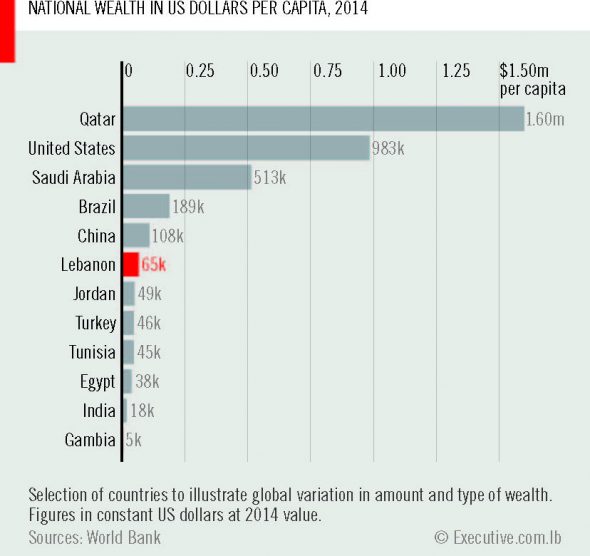
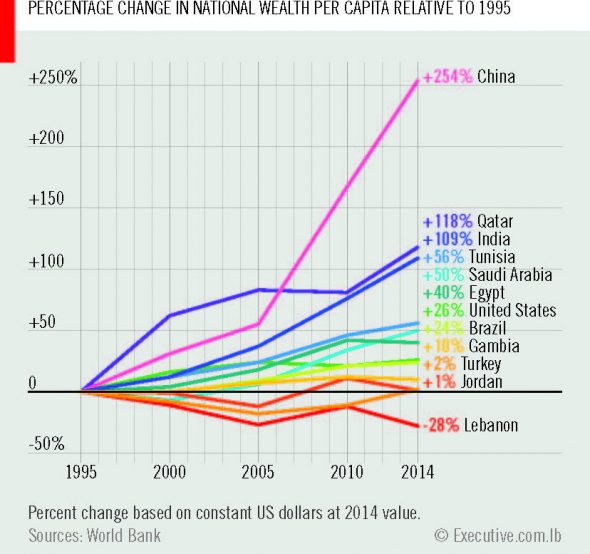
With the infographic charts in this overview, Executive can give our readers some impression of the contributions of human capital and other significant intangible assets that are made more accessible for the calculation of Lebanese per capita wealth under the multi-factor bottom-up methodology deployed by the World Bank in Changing Wealth of Nations. The report’s authors describe human capital as the largest component in global wealth; this approach is reflected in the numbers given, as the value for total global wealth is $1,143 trillion in 2014—much higher than estimates given by reports using other methodologies.

According to the World Bank, wealth increased by 66 percent from 1994 to 2014. The much higher estimate of global wealth under the World Bank’s approach might be considered an indication that wider consideration of wealth components—eventually even including attempts to somehow quantify social capital so that it can be better recognized and developed in national economic contexts—is an attractive avenue to explore.

In looking at wealth and inequality, one must acknowledge that labor compensation systems and many other ways in which societies today assess wealth require much fundamental work.

Add: Computable data and inclusion

One issue in this regard is understanding the size and concentration of national and household savings in Lebanon. Nassib Ghobril, the chief economist of Bank Byblos, points to the high deposits in the banking system. He says these are clear indicators for significant savings in Lebanon, but concedes that there is no official information on the savings rate and no information regarding its distribution by income group. No analyst or financial industry stakeholder could tell Executive to what degree savings are concentrated with the top wealth group.

All who confess adherence to the concept of existential human equality are best advised to cherish wealth and work for increasing the wealth of the nation writ large. To this end, the financial system can play a significant role on the microeconomic and technical level, if it is capable of getting more vertically aligned with the interests of client groups across the social spectrum.

Society needs the rich and the poor. Inclusion by banks cannot be limited to financial inclusion, and banks should focus on allowing access to services that most adequately reflect each client’s needs, rather than focusing only on private banking. Small steps in the right direction can be seen in financial industries, such as life insurance , and microfinance.

If economic mobility is taken at the level of the individual, a lifetime can see one move across the spectrum of poverty to wealth, with added complexity due to individual perceptions of each extreme. One can take lessons in this regard from Seneca, the stoic Roman billionaire who once influenced the young Emperor Nero before being forced into suicide by his one-time charge. A member of the one percent, he wrote of poverty: “Non qui parum habet, sed qui plus cupit, pauper est.” (Not he who has too little but he who craves more, is poor).    

Note: Countries represented in the infographics in this overview have been selected for illustrative purposes. The countries show the breadth of the wealth spread and their selection does not imply any shared category or grouping.
September 6, 2018 0 comments
0 FacebookTwitterPinterestEmail
EditorialOpinion

On your own

by Yasser Akkaoui September 6, 2018
written by Yasser Akkaoui

If you moved back to Lebanon after the civil war during your late 20s with the dream of rebuilding the nation—and of course, haven’t held any public office—we predict you’re going to be working until you drop dead. Yes, Lebanese are known to be successful entrepreneurs—it’s a reputation that a few outliers have given us—but the majority of Lebanese are ordinary people with no safety net nor a propensity toward saving.

Whoever worked hard during the heydays of the 1990s until 2005 were, most likely, able to buy a roof over their heads and maybe put some money aside to enjoy over champagne, or exhaust during wars and crises. If you graduated after 2010, however, you entered the workforce at a time of decreasing prosperity. That is, if you were able to find a job rather than migrating to brighter pastures.

Our wealth management patterns follow the same rules that apply worldwide. Real estate, like in any other country, remains the first saving instrument we use. Everything else is subject to the cyclical global economic situation and amplified by the specifics of Lebanon’s geopolitical position, and of course, the lack of intelligence of our politicians.

While our politicians remain oblivious to the World Bank’s recommendations on poverty alleviation, inclusiveness, and market dynamics, Lebanese are left to devise their own retirement plan, quite the challenge with an annual GDP growth of less than 2 percent.

You are on your own.

Disclaimer: The above does not apply to state officials. They belong in a different economic model where you do not exist.

September 6, 2018 0 comments
0 FacebookTwitterPinterestEmail
DesignEntrepreneurship

The journey of Lebanese makers

by Sara Assi August 25, 2018
written by Sara Assi

With daily electricity cuts and the lingering garbage crisis overwhelming us, it may be hard to keep our attention on the positive: There is a growing “maker movement” in Lebanon—also known as “Industry 4.0” (part of the fourth industrial revolution). This maker movement is made up of individuals who design, tinker, and create tech-based hardware products. The movement has been gathering traction—and definitions—worldwide, arriving in Lebanon as early as 2008. In Lebanon, however, these makers face a raft of challenges not seen by their global counterparts.

The maker movement has the potential to boost Lebanon’s economy in myriad ways: by increasing Lebanese productivity through the creation of hardware locally, providing job opportunities for engineers, business developers, marketers, and craftsmen, and producing locally-made products for export. Raed Khoury, caretaker minister of economy and trade, says that the maker movement is “a promising sector,” and that “investing in this sector could lead to several success stories” and contribute to economic growth. But before raising up the maker movement as a potent pillar of the Lebanese economy, there are several obstacles that must be addressed. In addition to the struggles that all startups must endure, makers witness additional burdens because hardware is expensive and difficult to make, and considered a risky investment.

Funding, bankruptcy and tax

One of the main obstacles to hardware startups is funding. In 2014, the money injected by Banque du Liban, Lebanon’s central bank, into the ecosystem through Circular 331 aimed to de-risk funding Lebanese startups, but while this has proven successful for software companies, many hardware companies still struggle to find investment.

Fares Samara, chief technical officer and program manager at Speed, a Lebanese accelerator, says that hardware startups are not appealing to local venture capital (VC) funds, and founders are often encouraged to shift to software: “there are limitations in the Lebanese market. Hardware is not [Lebanon’s] strength and it’s very hard for us to compete on a global level in terms of equipment, expertise, and funding. In software we have the capacity to be competitive on a global level as it only requires brainpower and a laptop, which is accessible to everyone and even a slow internet connection cannot obstruct your work.”

This view was echoed by Riyad Abou Jaoudeh, managing director at regional VC Middle East Venture Partners, who cited barriers such as imports, customs clearance, and lack of expertise when it came to hardware. Even those funds willing to invest in hardware, such as Berytech Fund II, look for ideas that find “solutions to big problems,” according to managing director Paul Chukrallah.

Hardware is usually expensive to develop and produce. Jad Berro, co-founder and CEO of the startup Innovo, a hardware prototyping service provider in Lebanon, says, “Many young entrepreneurs have interesting ideas, however, most of the time they cannot afford the cost to build a minimum viable product or a prototype, which could be the main killer of a project that could have become a success story.”

Fouad Fattal, co-founder and CEO of Krimston II, a dual SIM iPhone charging cover, explained that investor mentalities need to change as iteration is tough, long, and costly. He added that VC funds don’t invest in hardware startups because they believe that hardware is difficult, without having an understanding of the product development process: “To assess hardware startups, you need people with product development experience on the committee and that’s what’s missing.”

Investment gaps in Lebanon mean many ideas may not get off the ground at all. This scarcity discourages entrepreneurs, and even worse, makes them more vulnerable to so-called “shark angels” who take advantage and acquire large stakes in startups.

Fouad Fattal and his partner Nabil Nasr

Funding aside, startups are prone to failure—a commonly quoted but rarely sourced statistic is that nine out of 10 startups will fail—and with Lebanese bankruptcy laws as they are currently, this failure can cripple an entrepreneur. It takes two years on average for every bankruptcy case to be finalized and in that period entrepreneurs cannot register a new company. The potential for bankruptcy also deters investors who worry about safeguarding their money through the lengthy procedures, as well as attorney costs, and the reputational hit.

Governments are expected to supply the basic needs for startups—such as continuous electricity supply and fast internet—according to the International Monetary Fund. In Lebanon, however, it is not just these structural needs that are lacking; makers are treated by the government as though they are large enterprises rather than individuals, and suffer from the extra burden of income taxes, Value Added Tax, social security, and custom clearance tariffs. Expecting startups, especially makers, to pay the same taxes and custom tariffs as larger businesses is short-term thinking that could slow down the economic cycle by blocking access for emerging SMEs.

Customs clearance

Another major challenge Lebanon-based makers have to deal with is customs clearance. These businesses must import parts and electronic components from abroad, as they are not readily available in Lebanon. Once packages arrive they are often delayed and have high clearance costs, to the point that some makers find it faster and cheaper to travel and get the packages themselves.

A senior customs official, who spoke on the condition of anonymity, laid the blame for delays at customs on other institutions. He says that packages delayed at the airport are either held by shipping agencies or are being examined by the designated authorities while they are listed online as being held by customs. Customs also has no control over other institutions examining importing goods, such as the Industrial Research Institute or Lebanese Armed Forces, he adds. The customs tariffs for electronics is between 0-5 percent, so the high clearing costs that might exceed the shipments’ cost are defined by the clearing agents, who work independently from the customs institution and set their rates depending on their own expenses.

In the current customs system, the margin of mistakes, bribery, and delays is large. Major reform could spare makers from delays and financial loss. It is up to the Investment Development Authority of Lebanon (IDAL) to lead such reforms, as it is their duty to promote investment in Lebanon and decrease obstacles for entrepreneurs. On his end, Khoury says that the attempts by his ministry to reform customs policies were not successful.

Education: mentality and access

Those interviewed agreed that Lebanese students do not lack talent but are constrained by the lack of practical experience offered by educational institutions in the country. Guillaume Crédoz, a French architect and a maker who runs the “Bits to Atoms” fabrication laboratory (Fab Lab) in Lebanon, says, “Japanese schools send their students to visit pottery makers, for example, as they consider them life treasures, while in Lebanon, parents want their children to become doctors, lawyers, and engineers without getting their hands dirty, because manual work in not well regarded.”

Bassam Jalgha

Wael Khalil, the Berytech Fab Lab manager, points out that not many are taking advantage of the Fab Lab and those who do are either architects eager to learn, or engineers who don’t want to operate the machines themselves. This draws attention to the fact that Lebanese engineers do not lack the means to make, but the skills. How can we expect to have a strong industry sector and educated craftsmen if vocational and technical schools use old curricula, have weak practical training due to a lack of equipment, and no accreditation standards? There are no educational institutions providing technical studies on machinery and equipment manufacturing in Lebanon. This, in addition to the stigma of working with one’s hands, has limited innovation in this sector.

Berro, who started Innovo while still at university and subsequently dropped out in his third year, says “After my second year at university, I could not stand our education system anymore. It was too theoretical for me. Our instructors had never built anything before. I knew what I wanted and how to get there on my own.” Meanwhile, Bassam Jalgha started Roadie Automatic Guitar Tuner as a university project, but said that despite taking courses in entrepreneurship at university, he  realized he lacked the know-how to go about building his project after he had secured funding.

Reforming the education system will be tough, according to Ramy Boujawdeh, deputy general manager at Berytech, who says it is hard to change universities because they are often large and bureaucratic. “It mostly requires a national strategy and a vision,” Boujawdeh says. A 2017 World Bank report also cites the educational barriers to entrepreneurs, finding that local accelerator programs do not provide sufficient quality training, and mentors are scarce.

Further obstacles

Research and development (R&D) plays a critical role in the innovation process, and is an area of high investment in big companies. However, startups cannot afford R&D on the same scale. In Lebanon, R&D is lacking, and, according to Khoury, investing in R&D is the responsibility of the private sector. But spokesperson at the Ministry of Industry (MoI), noted that the ministry is putting more effort into research in response to world trends and the need to develop new industries here.  Infrastructure for hardware production is also an obstacle, as the laboratories specialized for certification are lacking and local patenting is not recognized abroad—which pushes makers to turn to the US or Europe and spend a lot on patenting, which they might regret later.

Securing visas for foreign employees is also a barrier in Lebanon, as Fattal notes: “Unfortunately our CTO is working remotely from India as he could not get a working permit unless it’s a domestic worker permit.” If the CTO were able to be based in Lebanon, he could have shared his knowledge with Lebanese engineers, Fattal adds.

Jad Berro

Light at the end of the tunnel

There are some positives, however. In terms of investment, the iSME program by Kafalat has tried to plug the funding gap by giving grants to early stage startups. Another obstacle has been removed with the  opening of Fab Labs—The Maker Lab, a collaboration between Innovo and Antwork, The Berytech Fab Lab, and Bits to Atoms—in Lebanon, which gives makers access to machinery so they can produce their own prototypes. Boujawdeh says that the aim behind opening a Fab Lab was to allow more hardware companies into Berytech’s programs by helping to reduce prototyping costs.

The MoI has been aiding makers through building industrial zones that include an incubator for high-tech manufacturers across Lebanon. In 2016, three industrial zones launched, and in 2017 five further locations were announced. An upcoming law is also set to provide Lebanese industrialists that export locally manufactured goods with a 50 percent tax cut on the profits generated from exports.

The MoI is also working to reduce another financial burden on entrepreneurs by amending the Income Tax Law to exempt research and development expenditure, and has prepared draft laws suggesting changes and exemptions in VAT.  The ministry has also signed an agreement with the Ministry of Education and Higher Education, and the Association of Lebanese Industrialists to design educational programs addressing industrial needs.

Meanwhile, the Ministry of Economy and Trade is currently working with the World Bank on providing funds for early stage startup, and, according to Khoury, the government is currently working on a draft law that would protect startups, investors, and debtors in the case of bankruptcy.

Moving forward

What if we treat the makers movement as the potential savior of this country, and pour our energy, expertise, and potential into it, instead of planting obstacles? What if the government, ministerial committees, central bank, and other institutions start working together and draw a plan for this movement to succeed? What if more technocrats start occupying public sector positions and start channeling the resources we have, the knowledge economy, in the right direction?

Lebanon should review its business models and consider instigating a free trade regime to become a hub for tech production in the MENA region, galvanized by an industrial free zone, startup visas, and e-services.

Lebanon’s education system, both technical and academic, needs to be geared toward industry, and celebrate makers and making. More funds need to be injected into the local startup ecosystem. The government should support those startups through a “Made in Lebanon” policy, and collaborate closely with them.

It is up to the government to  design a vision, and decide whether to let entrepreneurs like Jalgha, Berro, Fattal, and others be pillars of this movement, or just struggling passengers in the making of Lebanon.

August 25, 2018 0 comments
0 FacebookTwitterPinterestEmail
Design

The reality beneath the trend

by Reina Arakji Solh August 25, 2018
written by Reina Arakji Solh

Design thinking, as a strategic design and creative problem solving process, is still quite popular in design and business circles and has gained mainstream status, especially as an enabler of innovation. Yet evidence is emerging regarding the failures of the method, leading design and business professionals to become its harshest critics. Genuine practitioners of design thinking regard it as an exploratory method that is more focused on the process than the end result. They work on enhancing the outcomes of so-called “wicked problems,” the complex situations encountered in modern society. Design thinking practitioners also favor the incorporation of end-user perspectives early on in the design process, as well as working in interdisciplinary teams in order to generate a multitude of ideas for possible innovative solutions.

To that effect, the design thinking methodology, as popularized by design and consulting firm, IDEO, comprises five iterative stages: (1) Empathize, or make the design process human-centered by learning about the end-user circumstances and behaviors, and uncovering their unmet needs; (2) Define, or characterize end-user objectives and the scope of the situation to be addressed; (3) Ideate, or brainstorm to generate different ideas for possible design solutions or interventions; (4) Prototype, or build simple representations of select ideas; and (5) Test, or share the prototypes with end-users as well as business and technical experts for feedback, before moving back to the ideate and prototype stages as necessary. This process supposedly allows for the emergence of products and services that are more likely to be successful when launched, as they would have already been vetted for desirability, technical feasibility, and viability.

In theory, the design thinking process and its core elements are quite valuable as a catalyst for innovative ventures. In practice, however, design thinking suffers from major drawbacks that often render the process ineffectual and affect the quality of its outcomes.

First of all, design thinking creates the illusion that everyone is or can become a designer. This has led to the design thinking fad. Design thinking workshops and executive courses—with a duration that varies from a few days to a few months—are now offered internationally by leading educational institutions. These educational programs do not equip attendees with any tangible design or business capabilities besides familiarity with the process itself. Professional designers, on the other hand, undergo rigorous training in design skills and research.

Furthermore, by democratizing the design process and including end-users and experts from a variety of fields, design thinking effectively replaces the traditional lone genius model of creativity and innovation with a creative problem solving process and interdisciplinary project teams. But does democratizing design create better designs? Not necessarily. Only in very few instances is the crowd actually able to produce a truly brilliant idea, the proverbial needle in a haystack. This is in contrast to the work of genuine and talented designers, who can regularly and intuitively address complex design conditions by using a variety of holistic approaches to devise solutions.

Moreover, making end-user needs the focal point of the design process, and downplaying the role of scientific and technological advances, results in relatively minor solutions and not radical discoveries.

Organizations of various sizes have also been quick to adopt the design thinking trend, even creating chief design officer positions, in their effort to remain effective and relevant in a fast changing marketplace. However, design thinking is often adopted internally by organizations, both for-profit and nonprofit, in a way that ignores their current realities and innate social dynamics. Bureaucracy, departmental silos, fear of failure, and managerial interference often hinder design thinking’s inherently exploratory process. This becomes evident when an organization is more established, i.e. more conservative and inflexible. IDEO is known to have “fired” some of its consulting clients—prominent global conglomerates—claiming that these organizations were too slow in adapting to the design thinking process. Also, in the case of for-profit organizations specifically, design thinking’s essence, the exploratory process that aims to add value to end-users first, often conflicts with corporate profitability and the organizational schedule of deliverables.

International NGOs (such as the nonprofit IDEO.org, and numerous others) have likewise attempted to implement design thinking to tackle global challenges such as poverty, the environment, education, and migration. While design thinking has delivered noteworthy small-scale solutions at the group and community levels, addressing global crises is not as simple. What the design thinking process uncovers in terms of population needs and aspirations does not necessarily correspond with what those in positions of power covet. Large-scale design thinking projects have therefore been mostly failures, due to political interference in the outcomes and red tape in the implementation phases.

The most significant drawback of design thinking is its fan base: the design thinking evangelists who believe it can reliably provide innovative results in any field or setting. They apply it uncritically, without paying attention to contextual nuances disregarding other tools that scientists and designers have at their disposal.

Most design thinking enthusiasts have forgotten its origins in the consulting world and the fact that it is a process that is fundamentally about commercialization of products. Design thinking should be a complement, not a substitute, for other problem solving methodologies and traditional R&D as drivers of innovation. Design thinking, if applied on its own, can collapse under its many shortcomings, but combined with other tools and approaches, could constitute a powerful and holistic creative methodology.

REINA ARAKJI SOLH is a design and innovation strategist leading advisory projects that build innovation opportunities in situations of economic, social, and cultural transformation. She was previously assistant professor and director of the Strategic Design and Management program at Parsons School of Design NYC and assistant professor of Information Systems at the American University of Beirut.

August 25, 2018 0 comments
0 FacebookTwitterPinterestEmail
Design

How it looks vs. how it works

by Joe Ayoub August 21, 2018
written by Joe Ayoub

My first encounter with the term “design thinking” was five years ago, while researching a project for a client. At the time we were facing a “wicked problem,” a problem with multiple and inter-connected sources. The client’s team had tried all the traditional methods and tools and failed, so we were tasked with looking at how we could find unconventional ways of solving the issue.

What I discovered about design thinking was beyond my expectations, and it was one of those big “aha!” moments. What struck me was the realization that design is actually not how things look—as we have been accustomed to describe the design of, for instance,  flower vases—but it is about how things work; in the case of a vase, is it easy to handle, fill with water, put on a shelf? As the late Steve Jobs said, “Most people make the mistake of thinking design is what it looks like. People think it’s this veneer—that the designers are handed this box and told, ‘Make it look good!’ That’s not what we think design is. It’s not just what it looks like and feels like. Design is how it works.”

Since this epiphany, at Brandcell we took a deep dive into this discipline and now use design to solve key business challenges, designing growth strategies for major clients.

So what is design thinking? According to Tim Brown of global design company IDEO, “Design thinking can be described as a discipline that uses the designer’s sensibility and methods to match people’s needs with what is technologically feasible and what a viable business strategy can convert into customer value and market opportunity.”

Basically, design thinking is a methodology that we use to solve complex problems, and it is a way of using analytics with empathy, and using user-research to trigger and envision future innovations that lead to sustainable growth.

The design thinking process, or what is now called human-centered design, starts with understanding user needs and the job to be done. This is achieved by walking in the customer’s shoes with a large dose of empathy to discover the world through the lens of the customer’s declared and undeclared needs and aspirations. This leads to identifying key insights, which are translated into opportunities for innovation and problem solving, or what is called “framing the challenge.” This is followed by an ideation stage to design solutions that are: 1. desirable (for customers), 2. viable (for the company) and 3. technologically feasible (doable and differentiating). The third stage entails zooming in on a key solution and creating rapid prototypes for testing before roll-out. The last stage involves implementing and monitoring results.

It is worth noting that in a lot of situations we are surrounded by bad design. Bad design is easy to achieve as it does not require high skills, and people do it all the time without much effort. It does not need much concentration to think about the best way to integrate the form and function of the object. However, the most worrying and insidious effect of badly-designed products or services is its impact on our well-being. Some examples include: complicated public administration processes that cause people to suffer because of a poorly thought-out service design; a frustrating call-center where no answers are given; bad product displays; difficult to read packaging; a back-breaking chair; a website with 100 steps to process one request; a one hour queue at a hospital. These bad designs make people’s lives more difficult and stressful. Design is therefore about moving things toward more desirable outcomes and more enjoyable experiences.

Design thinking is today a core capability adopted by major companies around the world. Companies have embedded design labs and applied design thinking to solve issues, producing both incremental and radical innovations. Large management consulting firms have embedded or acquired design studios and designers to complement their traditional tools and provide more holistic solutions to problems that cannot be tackled by analytics alone. The fields in which one can apply design thinking are extremely wide, from designing business strategies, to organizational development, customer experience, new product development, social design, and more. One particular field of importance nowadays is “experience design.” As the world economy shifts toward customers spending more on experiences and less on goods, designing a good customer experience is key. If you’re a strategist or CEO, and you are thinking about how to differentiate your company and services without attempting to understand and improve how your customers experience your brand at every touch-point, you are probably missing out on a very, very important lever.

Another application of design is digital transformation. Too often we meet clients who want to integrate digital channels but start at the wrong end, building a lavish website and spending on social media to attract potential customers, with limited success. First you need to understand which part of the journey customers would like to see digitized and in which part they prefer to keep interacting with a human, which is more reassuring (insurance and banking works best with a mix, for example). This is what we call designing an omni-channel strategy. Design then permeates the back-end, to redesign more efficient functions and processes, removing silos to ensure best delivery of a customer experience that will delight and create loyalty. We have been helping local organizations adopt design as a core skill for innovation, rapid prototyping solutions, and new initiatives in situ, before committing heavy resources and spending on expensive launches that might fail in the real world.

While not everyone is a designer, to design is to liberate the creative confidence and advance with an open, curious mind. With this approach, we can achieve better solutions, amazing innovations, and aspire to the best there is, and even to heights that have not yet been scaled. Better designing what we need is also a good discriminator to limit what we produce to what is of real value in improving human lives, and dropping the clutter that pollutes our senses and affects the quality of the environment.

It is important to realize the greater sense of design that lies beyond the shape and look of things, and to understand and practice how human-centered design actually improves life.

Brilliant design is holistic beauty, and as they say, beauty is a promise of happiness—in Lebanon, we all need it badly.

Joe Ayoub is the founder of Brandcell Consulting.

August 21, 2018 0 comments
0 FacebookTwitterPinterestEmail
Design

Mapping the future

by Tania Anaissie August 20, 2018
written by Tania Anaissie

Design thinking” is a powerful agent for social innovation, and since its emergence in 2002, when David Kelley of IDEO coined the term, practitioners have been applying it to drive social innovation. Design thinking is being used to address healthcare, education, and environmental challenges across the world. However, as designers engage in this work, they are finding gaps in the process, and as true designers, they are adapting and iterating the design thinking process itself to meet these new challenges.

As a design practitioner and instructor, I feel there has never been a more exciting moment in the design field than now. It is a time of experimentation and growth. So what are social innovation designers doing to adapt the process? What are we changing and why?

When I left my post at the Hasso Plattner Institute of Design at Stanford (known as Stanford d.school) in 2016 and launched a social impact design studio, I found working on social challenges required adapting the design process. I started to question: Why are we only asking for community members’ input on a challenge at the beginning and end of the cycle? What if they were part of our design team and present for all decision making? Why are community members viewed as unaware of their own needs, when many of these communities are organized and actively asking for what they need? What are the ethics of starting a design project when there is not a clear implementation plan or budget? How am I challenging my own biases around how I view this challenge and how I collaborate? How can I create an intervention with confidence that it will create positive behavior change?

I quickly started building tools to help navigate these queries. I started practicing co-design “with” communities instead of “for” them. I met many designers who were asking the same questions and developing their own tools to address them. We spent a year learning from each other’s work and then founded the Equity Design Collaborative, a group formed to share this work and build a movement in the design sector.

“Equity design” is a design thinking process that acknowledges historical context and power dynamics. For example, when I did work in Cape Town, South Africa while a lecturer at the Stanford d.school, I had to understand how I was perceived as an international lecturer coming from an American university to a country that has a complex relationship with colonialism and a history of abuse from outside researchers. That was an important factor to understand before I did any design work there. Equity design also helps us manage our biases of people, ourselves, the challenge framing, and the outcomes. It involves a practice of building deep self-awareness, which is critical for being able to work effectively with communities on difficult social challenges.

I developed a form of equity design called “liberatory design” with colleagues from the Stanford d.school and the National Equity Project. We pooled our expertise from the design thinking, systems thinking, and equity change fields. Equity change helps us build deep relationships with communities, talk honestly about power dynamics, navigate difficult conversations, and practice co-design in a way that uplifts all. Systems thinking tools help us see the social challenge in a wider context—a context that includes multiple stakeholders who are intricately interconnected. For example, I am working with a government agency to help them reduce the rate of recidivism in their county. They want to help formerly incarcerated residents thrive in their city and stay out of jail. In this project, behavioral health, security, data, medical, and program teams across the county have to collaborate to address this social challenge. To do this work demands systems thinking tools. Systems thinking helps us design an intervention that works across departments and systems. Without systems thinking tools, we risk oversimplifying the challenge and either creating ineffective solutions or even harmful ones with unintended consequences.

Equity design has immense potential to drive impactful social change in Lebanon. Design thinking helps identify meaningful challenges to explore, develops creative solutions, and generates rapid learning through prototyping and testing. In addition, using systems thinking we can unpack the complexity and interrelatedness of these challenges. For example, if we are trying to address the trash crisis in Lebanon, we need to interview community members in different cities to understand how it is impacting them. We also need to use systems tools to map out everyone connected to this issue: manufacturers, trash collectors, restaurants, government officials, recycling plants, and more. We cannot address this challenge by focusing on changing human behavior in one group alone; we need to identify the interconnectedness of the groups and how that affects the outcome. We might decide that the way to address the crisis is to reduce the amount of plastic packaging that people purchase at the grocery store. Or we might find that the most powerful leverage point is to change a national policy. By mapping the complexity of the system and designing a solution with communities, we can identify ways to most powerfully intervene to drive social innovation.

Lebanon is rich in driven, compassion, and intelligent change-makers. By leveraging equity design practices, these actors can add a powerful resource to their toolkit in their mission to drive social innovation. I encourage you to start building your own equity design tools and join our movement. The need for social innovation will continue to adapt, and so must our design practices.


Tania Anaissie is the founder and CEO of Beytna Design Studio, and lecturer at the Hasso Plattner Institute of Design at Stanford University.

August 20, 2018 0 comments
0 FacebookTwitterPinterestEmail
Design

Capturing the digital

by Loubna Ibrahim August 18, 2018
written by Loubna Ibrahim

Businesses spent over $3.5 trillion worldwide on technology last year, according to research company Gartner. A large part of these investments is due to digital transformation strategies. Harvard Business Review defines “digital transformation” as an ongoing process of changing the way you do business. It requires foundational investments in skills, projects, infrastructure, and, often, in cleaning up IT systems. It requires mixing people, machines, and business processes, with all of the messiness that entails. The question is: How can a company initiate that digital transformation? The short answer is: design thinking.

In recent years the term “design thinking” has built up a lot of momentum across different fields. The world’s leading brands, agencies, and consulting firms have incorporated the design thinking process into their business. So, what is design thinking, anyway? And why is it so important for you to know about today?

Design thinking is a creative approach to problem solving, using five main action steps: empathize,  define, ideate, prototype, and test. The methodology goes back to the early 90s, when IDEO, an international design and consulting firm, was founded in California and started applying a human-centered design (HCD) process in various fields—from designing a computer mouse for Apple to solving complex challenges related to healthcare, government, education, and more. Today, bluechip companies and consultancies (such as IBM, Accenture, Microsoft, and Google) have adopted and adapted the methodology.  A March 2018 study by Forrester Research found that teams employing IBM’s design thinking practices doubled design and execution speed, shortening initial design time by 75 percent and development and testing time by 33 percent. Picture that on a multimillion-dollar investment.

People, not technology

There is a reason all of these successful companies are now using this methodology: Building a product that no one would use is a waste of time. HCD methodologies, which the design thinking process belongs to, are tailored in a way to solve people’s troubles first, by having designers metaphorically walk in the shoes of their end-clientele. In this formulation, people, not technology, are the key to digital business solutions. Back in 1997, Apple Computer Company (as it was then known) transformed its business from the bottom up, by putting the customer first, and designing its products accordingly. Steve Jobs famously said, “You‘ve got to start with the customer experience and work backwards to the technology.” Often there are many customers, not just one, ranging from external consumers and stakeholders to internal customers, otherwise known as employees. In the latter situation, internal departments and team members take on a larger role in finding and establishing intra-corporate, innovative solutions.

Co-designing: A multidisciplinary approach

It might seem slow or counterproductive to some, but a solution that focuses on people first requires that one listen and engage with a wide array of participants. Hiring only a pastry chef will not, after all, help a restaurateur create a complete menu. By the same token, companies need to involve several specialists with multidisciplinary backgrounds to develop the right solution, especially when it comes to technology solutions.

The design thinking process emphasizes collaboration, not only to make sure that the right product is being built for the right audience, but also to unleash creativity throughout the organization while solving complex challenges. In fact, the co-design process involves customers, business owners, designers, researchers, engineers, and all other stakeholders to ensure that the end result is practical and meets the existing needs. When Ideatolife answered the call to find a technology solution for an oil and gas firm, they made sure to involve all the stakeholders from the different departments, from IT to the sourcing department, and bottom-up, from the field and rig teams to the VP’s office.

Rinse and repeat: 

Test, learn, iterate

While some companies already adopt a lean and agile approach to finding solutions, most of them find themselves ending the process at the first iteration. Technically, this limits the opportunities for the corporation. In fact, the process should continue on for several iterations, which would be tested among the different teams, but mostly from the different points of view of the relevant audiences.

Iterations can become products, with every new model emerging after a design thinking process cycle is complete. Mark Zuckerberg reportedly said that he never knew the full potential of Facebook until after he and his team had tried several versions of the site, applying different ideas over the years.

Zuckerberg’s 2012 letter to potential investors that laid out “the hacker way” highlighted this critical culture: “The hacker way is an approach to building that involves continuous improvement and iteration. Hackers believe that something can always be better, and that nothing is ever complete.”

Parting words

Each person and organization faces challenges in their own way. The design thinking process aligns your efforts and helps you focus on what is truly the most important thing: people. We are all trying to find solutions for problems that people are facing, whether in their companies or in everyday life. Technology helps streamline those solutions for people, and not the other way around.

How are you using technology to solve your problems? Are you ready to use the power of design thinking to rocket into your next iteration?

Loubna Ibrahim is a product and innovation manager at Ideatolife, a creative software development company based in Beirut that adopts design thinking for digital innovation.

August 18, 2018 0 comments
0 FacebookTwitterPinterestEmail
Last wordOpinion

Talking saves lives

by Mia Atoui August 8, 2018
written by Mia Atoui

The conversation around mental health in Lebanon has been ignited. While some believe we are still at the beginning of this journey, it is safe to say that the past five years—and in particular the past six months—have witnessed a dramatic change in the state of mental health awareness and resources in Lebanon. This change has come off the back of years of academic research, lobbying, awareness campaigns, and a national mental health strategy launched by the Ministry of Public Health in 2014.

The concepts of mental illness and mental wellbeing are not new to Lebanon. The wars and turmoil the country has suffered have left a clear impact on the generations who lived through them, as well as those they raised. Lebanese have been using mental health services for many years, though these have been restricted to the affluent segment of the population, who can afford them and have the knowledge to recognize their need for them.

The cost of mental health care, lack of awareness of the symptoms of mental illness, and deeply entrenched societal stigma are the main barriers preventing Lebanese citizens from accessing mental health services. These barriers continue to create a gap in our system—one that disadvantages a large section of the population when it comes to seeking health care services that many consider a fundamental human need.

Good mental health and access to healthcare services in the event of a mental illness are as basic and fundamental as good physical health and access to a doctor when sick—a fact that remains difficult for far too many to comprehend. One reason for this is that in Lebanese society mental illness has long been stigmatized. The misconception that a person’s mental health is a reflection of their character or personality—something within their own control—is still rife in this country. Those who do suffer from a mental illness are then judged, off the back of these ill-informed opinions, as being weak, or lacking some kind of discipline or will power. Mental illness is not appreciated for what it is, an illness. The alternative is simply to “pull yourself together.”

The impact of stigma

These misconceptions mean that those who do suffer from a mental illness are especially cautious about raising the topic of mental health with even close friends or family, as it often leads to feelings of embarrassment, doubt, or shame, thanks to being exposed to these flawed ideas. The most commonly raised feelings behind the closed doors of a psychologist or psychiatrist’s clinic in Lebanon is a reflection of this guilt and shame: “My feelings are too silly, my problem is just too insignificant to be discussed in here. I should just keep them to myself and just pull it together.”

Here, I must assert that this attitude is dangerous, as it deprives its owner of the basic need to be seen as a normal human being, and to be validated for their own pain, struggles, and vulnerabilities.   

What is positive here in Lebanon is that these misconceptions around mental illness are slowly changing. Families and individuals are coming to terms with the scientific facts; although the exact cause of most mental illnesses is unknown, it is becoming clear through research that many of these conditions are caused by a combination of biological, psychological, and environmental factors. National campaigns, as well as social media, allow these messages to spread faster and more effectively than they used to. Mental health professionals, NGOs, and academic and governmental institutions in Lebanon, each in their own way, have been educating the public on mental health by opening up the conversation and pushing for more resources and increased access to treatment.

Talking is treatment

Talking saves lives: having an open and honest conversation about mental health can help those suffering and this open dialogue is gaining momentum. Forcing a nuanced and healthy dialogue about mental health into the public’s awareness is what Embrace has been doing these past five years. Through campaigns like “Fekko el-e’ede” (Untie the knot) and “Akid rah fee’” (Of course I will wake) alongside the annual commemorative “Into the Dawn” walks in support of suicide victims and their families, and culminating with Embrace Lifeline, the first suicide prevention helpline in Lebanon and the Middle East, we have unlocked the doors of stigma. As a society, we are ready to embrace mental illness and take on the responsibility of seeking change and improved quality of life.

August 8, 2018 0 comments
0 FacebookTwitterPinterestEmail
Economics & PolicyHuman rights

The Brussels II conference

by Francisca Ankrah August 8, 2018
written by Francisca Ankrah

Despite the government’s substantial commitments to improve the refugee situation in Lebanon, shortfalls such as continued gaps in funding and the lack of concrete commitments on resettlement, livelihood, and the accountability of funds still persist. These gaps were reflected in the outcomes of the Brussels II Conference on “Supporting the future of Syria and the region” held in April 2018. More specifically, the Lebanon Partnership Paper, issued after the conference, was disappointing in its lack of detailed focus on the aforementioned areas.

Lebanon hosts the highest number of refugees per capita worldwide, significantly straining its already weak, costly, and fragmented public sector. However, the international community has shown its preference for sharing the financial, rather than demographic, burden of the Syrian refugee crisis. According to the UNHCR, a total of $559.3 million is currently available to implement activities under the Lebanon Crisis Response Plan, despite an appeal for $2.68 billion. It is therefore apparent that financial assistance alone is insufficient to fix a crisis exacerbated by inadequate or otherwise non-existent national refugee policies, and further aggravated by an overstrained demographic reality.

Part of the responsibility for alleviating the demographic burden falls on the international community, but with limited and constantly decreasing resettlement options, other legal pathways for resettlement are necessary. If designed properly, these pathways may, for example, facilitate labor mobility and help ease labor shortages in the EU.

Even if Lebanon is provided with sufficient financial assistance, and more refugees are resettled elsewhere, the situation will continue to deteriorate unless the Lebanese government initiates adequate policies. However, politicians and policy makers in Lebanon have demonstrated a strict unwillingness to address the crisis, unless the response focuses specifically on the repatriation of Syrian refugees. Historically, refugee return has proven to be the most sustainable solution to refugee crises, but only if refugees are returned voluntarily, in safety, and in dignity. In reality, the humanitarian and security situation in Syria continues to deteriorate, especially in former key economic areas of the country such as Raqqa and Deir Ezzor. By promoting returns at this stage, and making it ever more difficult for Syrians to seek protection outside of their country, Lebanon is effectively pushing refugees back to Syria, where they may face a renewed risk of persecution, and potentially future displacement.

Instead of proposing plans for refugee return to Syria, diverting the discussion away from Lebanon’s responsibilities toward refugees, the government should focus on strengthening local policies—by for example, creating livelihood opportunities that may bring vulnerable populations, including refugees, out of poverty in the long term. However, the Lebanon Partnership Paper fails to put forward concrete commitments on whether and how access to livelihoods for Syrian refugees will be addressed. Instead, it focuses on achievements made at CEDRE, the international donor conference to support Lebanon’s economic development. What is more worrying is the absence of a protection-centric approach. For example, the paper fails to address access to decent working conditions, and proper safeguards against risks such as exploitation. For resettlement, return, and access to livelihoods to be possible, Syrians must also be able to obtain legal residency documents to access their rights, not only as refugees, but as individuals. The promises made in Brussels will not be beneficial unless Lebanon recognizes the weight of its commitments. This means engaging all perinent officials across all levels of government in a protection-centered approach designed to achieve real and recognizable change. Seeing the multiplicity of donor conferences and commitments without any attendant visible progress will increase frustration among the general population, especially among individuals living in poor conditions, and this may lessen faith in humanitarianism as well. There need to be stricter regulations monitoring commitments, as these are responsibilities that both Lebanon and the international community have taken on as duty-bearers toward host and refugee communities. Already halfway through the year, and with most of the country’s attention focused on changes in Parliament and the government, it is difficult to predict, at least for the foreseeable future, when and how commitments made at Brussels will translate into clear, forward-looking policies.

August 8, 2018 0 comments
0 FacebookTwitterPinterestEmail
LeadersOpinion

Healthcare sector in Lebanon carrying its own, but still in need of coordined development

by Executive Editors August 8, 2018
written by Executive Editors

If Lebanon were to visit a doctor for a head-to-toe physical, she might leave the appointment with a few prescriptions in hand. A check up on the overall robustness of the nation’s health infrastructure would show the vital signs of the country’s health sector as generally good, albeit with some lingering concerns, such as reports of malpractice and medical insurance fraud. This examination is in the context of Lebanon’s impromptu multi-year stress test—the unplanned influx of Syrian refugees that began accelerating in 2013, placing strain on its medical centers, hospitals, and primary health facilities—during which the country has not buckled.

The overall diagnosis is that the healthcare sector requires coordinated development between the public and the for-profit and non-profit private sectors (see overview story, page 16). The private sector needs to learn and develop on the basis of the experiences of public health institutions and the Ministry of Public Health (MoPH) in the last few years, adopting lessons learned and best practices.

Required remedies

On the public sector side, there are any number of improvements that still need to be made. This should begin with a restructuring of the MoPH, where manpower seems to be overstretched and has thus far not been reorganized due to political interference. Developing the issues that the ministry has not addressed—in terms of closing coverage gaps and eliminating structures that are producing inequalities in these areas—must also be prioritized. The ministry must also hone its ability to regulate and supervise, and it has made progress on that front. But more must still be done, especially in the provision capability of financial resources to cover real needs.

Both public and private health institutions need to create a better popular understanding amongst the population of the connections between their work and mutual collaboration, and the benefits to overall public health. The public relations in this regard seem to have not been coordinated between stakeholders, and private stakeholders are stuck in a sort of family business mentality when it comes to communication, or the lack thereof, with the media. Awareness building within the general population must become a greater priority, necessitating clear communication strategies and greater transparency from the private sector, the MoPH, and public health institutions.

Looking ahead toward the demands of the future, the health sector overall needs to upgrade and streamline its structures and mechanisms used to access financing (see story on healthcare financing). Whether that is best done through a compulsory scheme, or through accessing capital markets, or through institutionalizing more of the private sector providers, is still a question that must be answered. But the general impression is that what has been achieved so far was not on institutional terms in compliance with institutional planning, but more opportunistic and based on the strength of personal relationships. In the future, improvements in the Lebanese healthcare system need to be institutionalized, whether at the National Social Security Fund, or at the MoPH by granting it more autonomy from its role as regulator and the insurance payer of last resort.

August 8, 2018 0 comments
0 FacebookTwitterPinterestEmail
  • 1
  • …
  • 79
  • 80
  • 81
  • 82
  • 83
  • …
  • 691

Latest Cover

About us

Since its first edition emerged on the newsstands in 1999, Executive Magazine has been dedicated to providing its readers with the most up-to-date local and regional business news. Executive is a monthly business magazine that offers readers in-depth analyses on the Lebanese world of commerce, covering all the major sectors – from banking, finance, and insurance to technology, tourism, hospitality, media, and retail.

  • Donate
  • Our Purpose
  • Contact Us

Sign up for our newsletter

    • Facebook
    • Twitter
    • Instagram
    • Linkedin
    • Youtube
    Executive Magazine
    • ISSUES
      • Current Issue
      • Past issues
    • BUSINESS
    • ECONOMICS & POLICY
    • OPINION
    • SPECIAL REPORTS
    • EXECUTIVE TALKS
    • MOVEMENTS
      • Change the image
      • Cannes lions
      • Transparency & accountability
      • ECONOMIC ROADMAP
      • Say No to Corruption
      • The Lebanon media development initiative
      • LPSN Policy Asks
      • Advocating the preservation of deposits
    • JOIN US
      • Join our movement
      • Attend our events
      • Receive updates
      • Connect with us
    • DONATE