
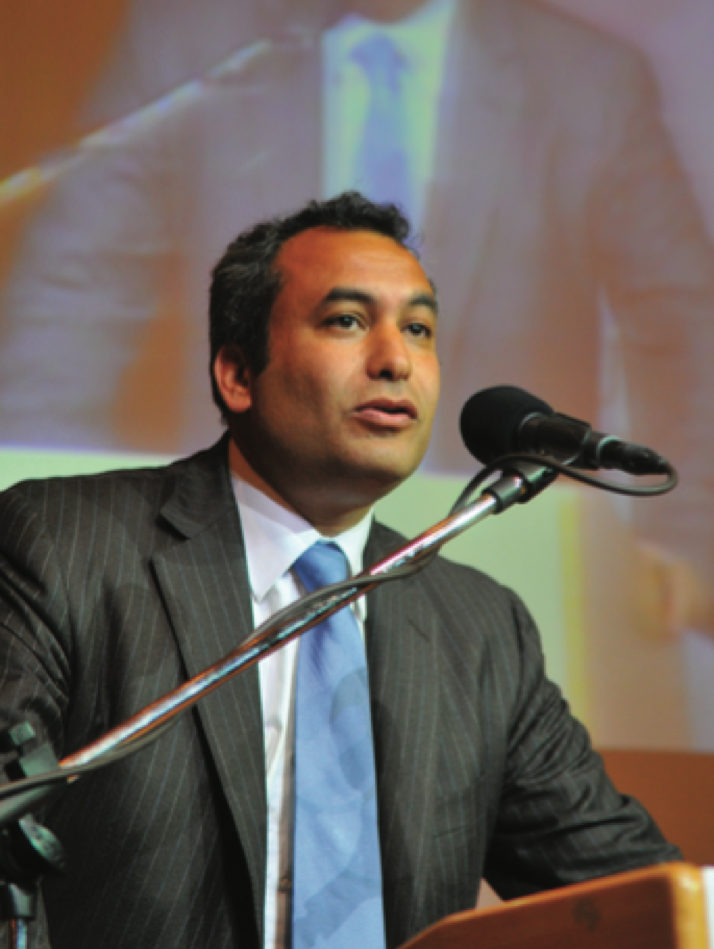
Executive sat down to talk with Elwy Taymour after a press conference announcing the opening of the YAL Egypt Branch, the appointment of Taymour as its chair, and the formal launch of a program called Learning for Life, which is “designed to help Arab students bridge the gap between universities’ academic output and the marketplace requirements.”
E So here we are, minute one.
Right. We just started, this is minute one.
E Egypt seems like a pretty big gap in coverage.
What happened was that Young Arab Leaders realized from the very beginning that Egypt was very important, but for two or three years nothing really happened.
E Why not?
I think it just didn’t materialize. But the Minister of Investment came in with SODIC [an Egyptian company that has been running a pilot program for the past year], and they tried to push the program and start the chapter. What’s good about Egypt is that the nucleus of the program was started before all this was organized, so there’s a structure that we can build around to hit the ground running.
E So tell me what’s been happening
We’re doing two main things. We have the Learning for Life program, and the grants associated with it, but then we also have donated money for labs, for actual labs at the universities and that’s going to be an ongoing thing. It’s always going to be there, it’s always going to be serving as place to offer training courses.
E It seems that students coming out of university without the necessary training for the workforce is a real problem in Egypt.
It’s always been a problem with this region. I think more and more there’s a gap between people coming out of university versus what’s out there waiting for them. Everyone wants to be an engineer and a doctor, and there’s a ton of other things out there that nobody knows how to do. So, I think one of the main things of YAL is that each chapter will try to reduce that gap. By introducing courses, by maybe getting a little bit more of a headway than what the government is doing, in terms of providing these guys with a little more of something to look forward to when they come out.
E Do you have any specific plans, now that you’re in charge?
To continue the initiatives that have already started, that’s one. Second, I really would like to start working in places other than Cairo, so the focus is also going to be, for me, like Alexandria, and some of the poorer places in upper Egypt. That’s a priority for us and to also encourage more people to dedicate some of their own time to participating in the programs.
E You mean adults, or kids?
Whichever. Whether they’re people who decide to join the chapter, or people who are older and would like to volunteer some of their time.
E Big plans, it sounds like.
Well, I think these programs are quite important, but I also think that what Egypt suffers from is a lot of little problems. I think fundamentally there are things that need to change in the country, but to begin with, there are smaller things. If you were to assume the quality of education is currently at 20 percent of its potential, for it to jump to 60 percent or 70 percent I think you need very small things to change. Getting kids exposure to the arts and things like that, I think, is something much more important that we can focus on that will create a much bigger impact. I think the most important thing right now are the small things that we can change.
