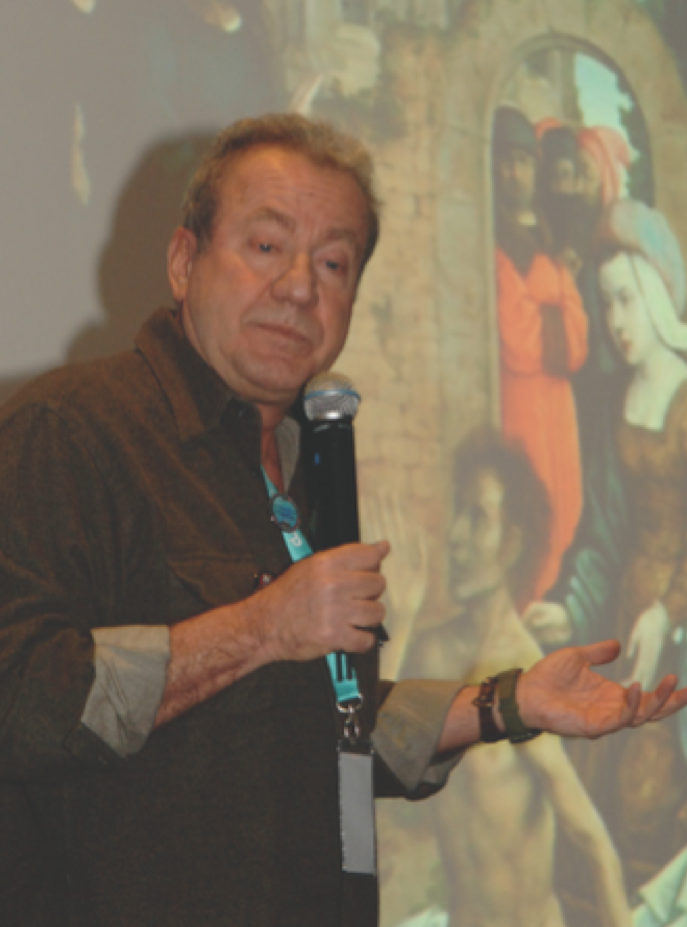
Executive sat down for an interview with Farid Chehab, the chief creative officer (CCO) and chairman of Leo Burnett CEEMA. Renowned in the advertising industry, Chehab began his career in 1970 at Young and Rubicam in Beirut, moving on to co-found H&C Advertising in 1974. Later in 1991, H&C formed a partnership with Leo Burnett and Chehab was appointed chairman and CCO of Leo Burnett ME. Today, he oversees the general orientation of the company and its creative output.
E Recently, there have been a substantial number of unsettled payments subsequent to the campaign completions. Have you witnessed any such occurrences in the industry?
Fortunately, no, we have good clients. Of course a lot of agencies have witnessed situations of non-payment. It’s a serious problem — whenever they don’t pay, it’s serious. The problem is especially in the media houses, because there is a mass amount of money that goes back and forth.
E How can this problem be solved?
You have to start from the beginning. For a long time agencies have not been able to elevate themselves to the rank of being partners and consultants to clients. It’s our fault that we have reached a point whereby we are mistreated by some clients for non-payments. Can you envisage non-payments when you talk to consultants? It never happens. Whenever it happens with agencies, it’s because the market — the industry — has been giving and giving and giving to the client and saying “don’t pay now, pay later.” So how do I cure that? We have to start doing it ourselves. We have to start getting ourselves to become more respected by the client so that this never happens. We have to recognize our role as idea agencies, idea companies — not just trading space in newspapers. Today, the economic situation is pushing clients to start looking at creativity because without creativity you don’t have any affect anymore. Whether you pay it or not, there is no more money now to be spent so you really need something that is more effective. Today with online communication you can measure the effectiveness of your idea in terms of upload clicks and the viral effect. So the client now knows whether his campaign is working or not. Hence, I think slowly we are going to go into a virtuous circle, not a vicious circle.
E New campaign deals in 2009 are reportedly down by more than 50 percent in the Gulf. How are you restructuring your strategic objectives and budget considering this downturn?
First, we don’t know how much we’re going to lose; we don’t know what the drop will be. We are waiting for the end of March. I think that from now till the end of March we will have a bigger and better picture of the situation. I do not consider the situation to be lethal. There are going to be corrections; clients now want to have value for their investments and this is going to translate into better communication. It’s going to be sharper and savvier. Agencies that cannot survive a crisis like this will die and this is good; it’s a correction. I’m not looking at it from a negative perspective — I don’t think it’s the end of the world. As long as people keep consuming, you’re going to keep on selling. The wheel of the world is not going to stop. It’s a crisis, we’re going to have corrections and we’ll start all over again. Leo Burnett, for example, was born in the middle of the Great Depression. Leo Burnett opened his agency during the 1930s in the midst of chaos!
E A lot of companies are cutting costs and downsizing, how will this affect the staffing situation in the MENA region?
There might be downsizing by necessity, but we’re not sure. There will be downsizing in the industry, definitely, but I don’t know how much. Relocating will not help a lot. We don’t have plans to relocate. This crisis is going to generate a new way to work because we are not in a situation where we can spend lavishly. Most probably we’re going to be forced to be much more online. In so many cases today we’re still spending lavishly. The whole crisis is going to create a vacuum. The job losses are going to be a plague on all fronts, so people must find a way now to re-adapt. There will be problems for some and opportunities for others. It’s the survival of the fittest.
E What challenges has Leo Burnett faced since the financial crisis began taking its toll on the region?
Lots of budget restrictions. Budgets are the biggest challenge. We have been preparing ourselves for some time now to adapt to the new givens of modern economy, i.e. using more online communication, understanding that it’s a people era and that if you do not talk to people, you are not doing your job properly. This crisis is going to bring up the people era more than ever because restrictions are going to push everybody online. Online is people, it is one-to-one. So we have been educating our people to face it. We don’t have any problem with this crisis [happening]. The only problem we’re going to face with others is the fact that budgets are going to shrink because of the situation.
E What sectors of your clients do you think will be most adversely or positively affected? Will it be the financial clients, real estate, etc.?
The consumer goods will not suffer a lot. Definitely real estate is going to suffer. We are blessed to have very solid financial clients like Bank Audi. But we have financial clients that will suffer albeit not significantly or as much as real estate [clients]. The only area that is very hurt is real estate and we don’t know how the sales are going to move. We’re in a situation where we review it every month, sometimes every two weeks.
E What do you see as the key element to give a competitive advantage to advertisers to weather the economic downturn?
Creativity, creativity and creativity. We are more than ever an idea culture. In order to have a competitive edge, knowing that clients do not have budgets to spend, what do we do? We tell the client, ‘I’m going to give you ideas that are so powerful, that when you put them in the face of people, they’re going to be the ambassadors for your brand.’ That means we now have a duty to produce creative advertising that delivers on this. Before, we didn’t have this necessity because with mass media you bombard consumers with ads and you didn’t know whether or not your campaign is good or not. Agencies are going to start asking clients, ‘Let me give you the opportunity to show you how viral you can become. Let me show you how many clicks we can make people deliver for you.’ Clients will take that because they, first, don’t have the money, and second, because they can benchmark. Then we as agencies will be paid as consultants, we’ll be paid for the power of the idea. We’ll become like actors who have their box office. That’s how we’re going to move on the requests of the client and I think this is very good.