
Are you prone to headaches or become agitated
quickly? Have you been forgetful lately or found
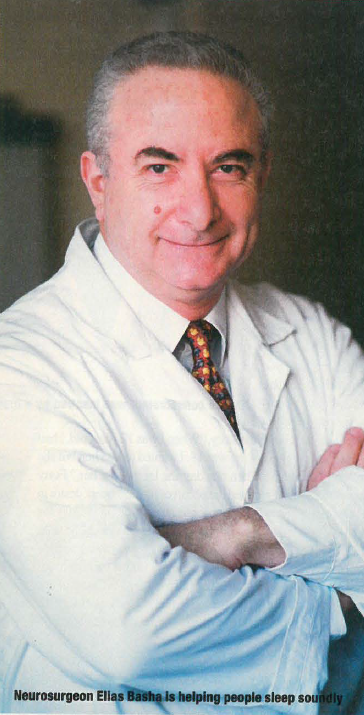
it hard to concentrate? According to neurosurgeon
Elias Basha, your problems may stem from a sleeping
disorder. “We sleep seven to eight hours a day – that’s
one-third of our life,” says Basha. “Therefore, sleep has an
important function.”
EEG recordings of the brain show five different types of
activity. When awake, brain activity is called alpha. When
asleep the brain registers four kinds of activity: slow waves
indicate drowsiness, spindles indicate light sleep, delta indicates
deep sleep and rapid eye movements (REM) occur when
we are dreaming.
This sleep cycle should occur five to seven times every night.
People who don’t experience these cycles have a sleeping
disorder, which can affect the quality
of their waking hours. “You can have a good state of wakefulness
or a diseased state of wakefulness,” says Basha.
Every stage of sleep has a function. For example, during
deep sleep hormones are secreted, such as growth, sex and
immunity hormones. Subsequently, light sleepers often
suffer from a deficiency of hormones. This can lead to
anything from stunted growth to frigidity, impotence and
a faulty immune system.
The most important stage of sleep is REM, because that
is when we dream. Dreams are directly related to memory,
problem-solving abilities, sexual health, intellectual faculties
and mood. A healthy amount of dreaming is 100 minutes
per night, over five to seven cycles.
“If you dream
enough, you’re fast-thinking, smart, alert, vigilant and creative,”
says Basha. “If you sleep badly, you wake up without
these faculties.” Basha even claims that proper sleep can
make a person more intelligent.
“Part of sleep is productive and part is wasteful,” says
Basha. Wasted time includes the hour it takes some people
to fall asleep, and the 15 to 30 minutes it takes others to fall
asleep after waking up in the middle of the night. According
to Basha, this can be harmful: “Dreaming is interrupted.”
Basha’s patients receive six 90-minute consultations,
each costing $50. They record their sleep patterns in a
diary. This enables Basha to determine the factors leading
to sleeping disorders. They are usually related to bad eating
habits, exercising before bedtime, smoking or drinking
coffee after 3:00 p.m. Tranquilizers are definite no-nos.
“They kill your dreams,” says Basha.
There are a number of other factors that can influence an
individual’s sleep cycle. These include whether the person
snores, talks in his or her sleep, or whether the individual suffers
from nasal obstructions. For this reason, patients spend
one night at the clinic in order to record their sleep patterns. The
cost is $750, but not all patients require a full night’s session.
“My sleep problem started when I was a kid,” says architect
Hani Choueiri, who consulted with Basha two years ago.
Recordings determined that Choueiri suffered from epilepsy
during his sleep. Choueiri used to depend on medication to fall
asleep and wake up. He gradually stopped taking the medicine
and began changing certain unhealthy habits.
“When the
quality of my sleep improved, the epilepsy went away,” he says.
“I have a better memory and in less time I am able to do more.”
Six months ago, Elie Chaaya was afflicted with a breathing
problem, which affected his sleep. He couldn’t get out of
bed easily, would wake up with a headache and his eyes
became irritated by strong odors. Recordings determined that
he had a snoring problem. Basha prescribed for Chaaya a
$1,600 breathing mask to wear when he went to bed.
“I’ll
have to use it between nine months and two years, depending
on my progress,” says Chaaya. So far,
the mask, which he has been using for a
month, has helped him sleep – and live
– better.
“I used to be irritable at work
and would get angry with clients,” says
Chaaya, who sells health equipment.
“Now I am able to deal with difficult situations
calmly.”
Basha also warns that a proper sleeping
ritual is of utmost importance. That
includes putting on pajamas just before
going to bed and using the bedroom
only for sleep and sex. That means no
phone, no television and no reading
material in the bedroom.
