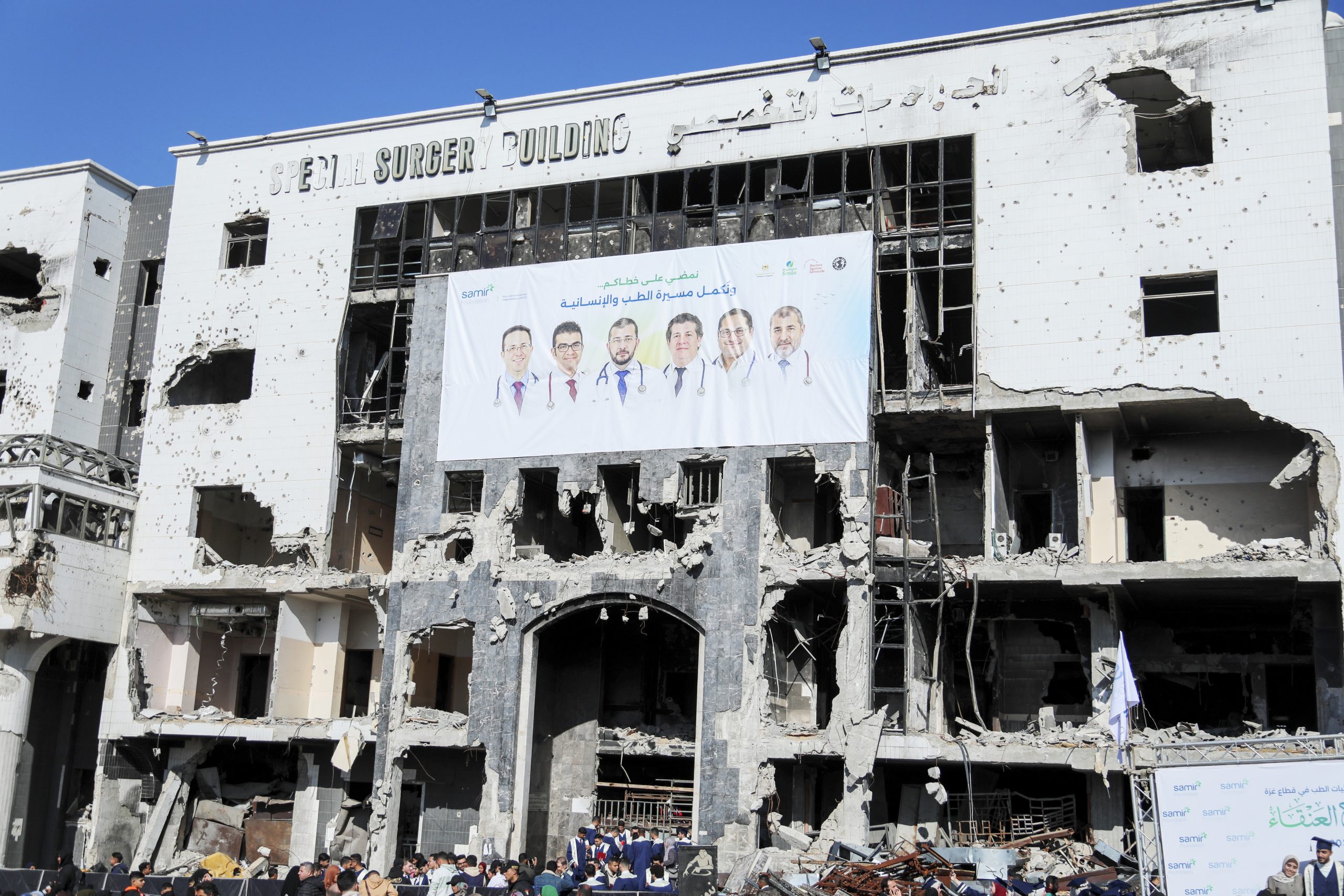
In Gaza’s hospitals, the daily struggle for life is inseparable from the fight to manage scarce resources and staff numbers, and to find innovative solutions within impossible constraints. Doctors, nurses, paramedics and support staff are compelled to act simultaneously as caregivers, administrators and problem-solvers in an environment where every decision is weighted by both clinical urgency and economic limitation.
A healthcare system tested to its limits
According to a situation report released in mid-October 2025 by The United Nations’ Office for the Coordination of Humanitarian Affairs, 14 out of Gaza’s 36 hospitals, 10 out of 16 field hospitals and 64 out of 181 primary healthcare centres are only partially functional. Private hospitals have closed and public hospitals operate at less than 30 percent of their capacity. By the end of September 2025, Gaza’s Ministry of Health reported that 55 percent of essential medicine, 66 percent of essential consumables and 68 percent of laboratory reagents were completely out of stock. Despite the latest ceasefire, restrictions on the amount of aid trucks crossing the border—Al Jazeera reported that only half of the necessary trucks were permitted entrance as of October 15th, and the ones entering did not carry many essential supplies—mean that medical supplies are still not reaching hospitals.
28-year-old Dr. Ali Mohammed Ziyad Al-Batta is a fourth-year urology doctor at Al Nasser Complex in South Gaza. As hundreds of thousands of Gazans were displaced from their homes in the north to the south of the Strip over the course of the two-year war, hospitals like Al Nasser Complex became a lifeline to more patients than they could accommodate. Operating the Khan Younis-based hospital became increasingly difficult amid overcrowding and a shortage of medical supplies. Doctors found themselves having to ration out pain relief medication.
Al-Batta says the announcement of a ceasefire has done little to change the disastrous circumstances he and his colleagues face every day at the hospital.
“It’s been two years of us trying to serve our people with the simplest of means,” he says. “The number of those with long-term injuries remains high; these patients require follow-up and restorative surgeries. Currently, they are waiting for the Rafah border to reopen in order to leave Gaza to receive medical treatment. For many of Gaza’s sick and injured, Rafah border has become a final glimmer of hope.”
Unpaid healthcare workers
Gaza’s economic collapse—UNCTAD, the UN’s trade and development agency, reported an 81 percent contraction in the last quarter of 2023 alone—compounds the challenges hospitals and healthcare facilities face. Dr Al-Batta is among those that have chosen to volunteer their services to preserve life and prevent the healthcare system from complete annihilation. “It has been two years since I was last paid a salary,” he says.
30-year-old nurse Khalid Abu Hasnain who works in the Emergency Department at Al Aqsa Martyrs’ Hospital in Deir El Balah, Central Gaza, is one of the luckier ones. He gets paid a small stipend of $300 a month, despite working shifts that exceed 12 hours. Responsible for both his own daughter and his orphaned nieces and nephews, Abu Hasnain says the money is barely enough to buy milk and does not cover his travel expenses, but he keeps going.
“The war has destroyed everything — homes, families, and futures — even our healthcare sector,” he says. “Doctors and nurses are working without equipment, without salaries and without rest. Yet, we are trying to prove that humanity does not die, even amid the rubble. We can’t abandon the patients.”
Making medical supplies stretch
With the limited availability and flow of cash, healthcare workers have created an informal health economy, sharing and bartering medical supplies, recycling disposables and sharing resources across hospital departments. In some instances, doctors report having to dilute medication to make supplies stretch. 38-year-old Dr. Nadia Hamdan works as a gynaecologist at Al-Shifa Medical Complex in North Gaza. Before the war, Al Shifa Medical Complex in the Rimal neighborhood of Gaza City was Gaza’s largest hospital. After suffering repeated bombing and a ground incursion which left it half-ruined, the hospital now runs limited services, including a makeshift outpatients department and emergency ward.
On top of treating her female patients, Dr Hamdan says she has the additional burden of finding new ways to be resourceful with the limited medical supplies and equipment on offer. Being able to just practice medicine is now a luxury.
“Oxygen runs out, sterile gauze is absent and essential medications are limited,” she says. “We disinfect and reuse instruments because electricity is unreliable and the generator cannot power all equipment. Every patient encounter is also a management exercise — we ration, prioritize and improvise constantly.”
Harbouring innovation and technology
Adapting through the use of innovation and technology is essential for the survival of Gaza’s fragile healthcare system. Solar panels, improvised incubators and remote training reduce costs and sustain operations. Medical students assist under supervision and NGOs provide healthcare workers with workshops on resilience, resource management and multi-role competencies. Doctors and healthcare workers utilise social media and digital platforms to carry out consultations or fundraising efforts.
“We cannot wait for suppliers,” says Ahmed Barakat, a bio medical technician at the European Hospital in South Gaza. “Spare parts are unavailable, so we improvise. Sometimes we use a 3D printer to print replacement parts, or we repurpose older equipment or repair machinery with locally sourced materials. Each solution saves money and prevents further strain on the health system.”
Hospitals struggling to operate in the absence of fuel and electricity
Before the war, 57-year-old Dr Naji Al-Qarshli used to work as an obstetrician and gynecologist at Kamal Adwan Hospital in Beit Lahia, North Gaza. He was displaced to the west of North Gaza after the area he lived in was completely destroyed, where he now works at the Patient Friend’s Benevolent Society Hospital.
Patient Friend’s Benevolent Society Hospital has now become the Gaza Strip’s main maternity and pediatric hospital according to an interview that Medical Aid for Palestinians conducted with its medical director in March of 2025. Dr Al-Qarshli and his colleagues work tirelessly to treat a neverending stream of women who go there to give birth. It is also one of only a few remaining hospitals in Gaza to have a NICU (neonatal intensive care unit). At the height of the war, Dr Al-Qarshli says maternity wards were being transformed into multi-use emergency rooms for the injured, alongside those who had come to give birth.
“When the electricity cut, we delivered babies by the light of our cell phones, searching for sterile gloves as if we were hunting for treasure,” he shares. “Our psychological state deteriorated, we lost a lot of weight and we were treating patients in a state of panic. Many of our pregnant patients arrived to the hospital after hours of walking, having been displaced from their homes. We were trying to preserve the lives of mothers and fetuses amidst an unforgiving reality.”
During a neonatal emergency, Barakat of European Hospital recalls being among staff that had to manually ventilate infants in order to keep them alive because the generator had stopped working.
“At 3am one morning, an incubator failed. We manually ventilated infants before the generator died. Hospitals rely on ten hours of full power daily; at night, many units become non-functional, impacting both health outcomes and operational budgets.”
From full-time gynecologist to volunteer medic: How Gaza’s war forced me to adapt
During the past six months, I personally lived and worked across North and South Gaza, experiencing both displacement and professional upheaval. My private gynaecology clinic was destroyed in the bombardment. I pivoted to volunteer work in public hospitals and field clinics, where demand exceeded available resources.
To reach women unable to travel to hospitals, I launched remote consultations via social media platforms, providing guidance and follow-up care. This digital approach functioned as both a clinical lifeline and an economic solution, extending limited resources without adding infrastructure costs.
Recognizing the ongoing material and financial scarcity, I established a free medical tent supported by online fundraising campaigns. Donations funded essential medications, medical supplies and operational logistics, creating a micro-healthcare economy sustained by community contributions and volunteer hours.
Maintaining services amid destroyed infrastructure, unpaid staff and scarce resources demanded strategic allocation, financial ingenuity and creative problem-solving. Through volunteer coordination, digital outreach and fundraising, I was able to continue delivering critical care to pregnant and nursing women, mitigating economic loss and sustaining the fragile healthcare ecosystem in Gaza.
Economic resilience at the heart of Gaza’s healthcare system
Gaza’s healthcare system today illustrates the inseparable link between economic resilience and medical care. Each ward, each procedure and each hour worked by a volunteer is not only a clinical intervention but also a strategic economic decision. Hospitals operate as micro-economies, where budgeting, resource allocation and improvisation determine survival both for patients and for the system itself.
Sustaining Gaza’s healthcare requires more than humanitarian aid. It demands structured economic planning, local manufacturing and coordinated community support. Investing in staff, creating emergency financial reserves and training multi-skilled personnel not only secures health outcomes but also strengthens the broader economy.
Ultimately, the story of Gaza’s healthcare system is a story of human ingenuity at the intersection of crisis, health and economy. The resilience demonstrated by healthcare workers, volunteers and communities proves in my experience of the past three years, that even amidst profound economic collapse, strategic innovation and human dedication can sustain life, preserve livelihoods and build a foundation for a more robust, self-reliant healthcare system.