This analysis was written as part of a Special Report on the repercussions of war across six polities from October 7th, 2023-December 2025
Since the Gaza war began in October 2023, Egypt has found itself between regional violence, economic fragility, and diplomatic tension. Its economy, shaped by strong state control, a powerful military and a struggling workforce, cannot be separated from the wider conflict. Yet despite its sensitive regional position and its multi-tiered diplomatic and strategic exposure, Egypt has not faced significant physical destruction or evident direct economic losses from the start of the war up to the first nine months of 2025, though the United Nations Development Programme (UNDP) released a May 2024 Rapid Assessment of potential socioeconomic impacts of the Gaza war on Egypt, basing their assessments on three scenarios ranging from contained to regional war. Estimated economic impacts on Egypt in these scenarios ranged from $5.6 billion to $19.8 billion. Although the third high intensity conflict scenario did not materialize in full, certain aspects of it, such as a direct confrontation between Israel and Iran, were realized. Still, the major impacts on oil, gas, tourism, and major long-term trade disruptions that warranted the $19.8 billion estimate have been largely avoided.
Economic indicators for Egypt do not reflect significant impact of the regional conflict scenario of the past year and nine months. According to International Monetary Fund (IMF) estimates from July 2025, debt-to-Gross Domestic Product (GDP) ratio narrowed by about 10 percentage point in the 12 months to June 2025, reaching 86 percent. Egypt’s ongoing debt burden and other economic weaknesses are not considered linked to the regional conflicts in Israel, Palestine, Lebanon, and Syria, and in fact the IMF projected a four percent real GDP growth in 2025. While conflict-related financial burdens affected each of those countries in specific ways, analysts link Egypt’s debt and other indicators of the country’s problems to escalation of homegrown crises of the 2010s, the 2000s, and even earlier.
The IMF instead highlights improvements in the Egyptian economy and social stability in the past 12 months. These positive signs include unemployment rates around 7 percent. While social safety nets also were bolstered over, significant drops were recorded in both headline and consumer price inflation rates.
Indirect conflict impacts
Rather than territorial battles and losses of military and civilian lives, the challenges faced by the Nile government unfolded on multiple economic and political fronts, a large amount of which are indirectly linked to what many consider the seventh Arab-Israeli armed conflict (October 2023-2025).
Sectors of the Egyptian economy and projects considered important for national development have been affected, including the long delayed full opening of the billion-dollar Grand Egyptian Museum (GEM), designed to attract five million annual visitors. However, the main source of revenue pressure in 2024 steamed from the Suez Canal passing, which manifested mainly in the first half of 2024.
Sectors from energy to weapons manufacture were also affected, alongside strains on socioeconomic peace and elevated costs for policing and opinion influencing. An as yet incalculable array of emerging risk factors related to dichotomous popular sentiments, political attitudes, populist agitation, refugee inflows, and future displacement dangers.
The primary political and humanitarian sensor of the conflict was the Rafah crossing, the only access to Gaza not fully under Israeli control and is operated by Egypt (in political and security accords with Tel Aviv). At time of this report, Egypt’s humanitarian burden along its Gaza border has kept growing, with tens of thousands of Palestinians seeking refuge. El-Sisi government played a key role in facilitating the Gaza agreements of October 2025, the country’s post-1978 role as a mediator and regional stabilizer had been complicated by domestic pressures, geopolitical maneuvering, and the shifting priorities of its traditional allies.
Rafah border: humanitarian lifeline and political minefield
Rafah is the only non-Israeli crossing point between Gaza and the outside world, and it is located near the southeast extremity of the Sinai Peninsula in Egypt. For Palestine’s private sector economy, the crossing serves as a vital trade corridor and for Egypt, it has provided marginal trade opportunities. The Cairo government has been using it as a strictly controlled pressure valve for decades, opening and closing it based on domestic politics, diplomatic situations, and security assessments.
Moreover, Rafah has become a pivotal challenge for Egypt’s regional responsibilities and its internal security concerns. Immediately after the beginning of Israeli military actions in 2023, the Egyptian government positioned Rafah as a humanitarian relief hub rather than a mass shelter. To this end, Cairo permitted a limited number of relief convoys to enter Gaza in cooperation with the UN, the Egyptian Red Crescent, and Gulf state donors like Qatar and the United Arab Emirates.
Between November 2023 and May 2024, more than 80 percent of humanitarian supplies that reached Gaza entered through Egypt, until May 2024, when Israeli forces undertook ground incursions of the Gazan side of the Rafah crossing.
Justified by Israel as a tactical necessity to destroy Hamas infrastructure, the takeover of the crossing was seen as an outright insult to Egypt’s logistical control. With its role as a key arbiter of humanitarian access undermined, Cairo accused Israel of breaking long-standing agreements and unilaterally changing the rules of humanitarian coordination. And within hours, it closed its side of the crossing.
UN agencies warned of catastrophic situation in Gaza, as medicine and fuel ran extremely low. Despite intense efforts of Western and Arab diplomats to find a workaround for opening, Egypt refused to reopen Rafah until it could do so without being seen as allied in Israel’s southern campaign. Furthermore, in order to block Palestinians from being displaced onto its territory, Egyptian officials instead called for the creation of an internationally monitored aid distribution system.
Emergency analysis has showed that Egypt lacks the resources to take in a sizable number of Gazan refugees. Even limited assistance for displaced people in Sinai might cost hundreds of millions of dollars, according to UNDP’s assessment in May 2024, funds that Cairo just does not have.
President Abdel Fattah el-Sisi confirmed that Egypt, of whose population refugees composed about 9 percent as of 2022 according to the International Organization for Migration, is not ready to provide the emergency housing, food distribution, healthcare, and educational infrastructure needed to host 100,000 displaced Palestinians. El-Sisiwarned in a number of public statements that resettling Palestinians in Sinai would “liquidate the Palestinian cause” and violate Egyptian sovereignty.
The security risks posed by a potential Hamas presence in Egypt, and its links to the Muslim Brotherhood, are perhaps the primary deterrent to opening the Egyptian border to Palestinians. Cairo’s opposition to having Gazan people mass-displaced onto Egyptian territory stems from a multi-layered and complex fear that permitting a massive influx of Gazans into Sinai might become a long-term attribute or sideshow of the Israeli-Palestinian conflict. Hence, the Egyptian government in 2024 focused on building a new large buffer zone along its border with Gaza. Located near the Rafah crossing and extends several kilometers into North Sinai. Satellite images analyzed by US-based tech company Ventor (formerly Maxar Technologies) and confirmed by Egyptian officials, showed cleared land and newly built infrastructure.
Refugees, social services, and the Sinai strain
Despite national efforts to curb refugee influxes, roughly 100,000 Palestinians entered Egypt between October 2023 and June 2025 according to the Palestinian Authority’s embassy in Cairo, either through unofficial routes or with special permissions for humanitarian needs, family reunions, or medical care. The majority settled in North Sinai, particularly around the cities of Rafah and Arish.
A combined UNDP and World Food Programme (WFP) rapid assessment in May 2024 found that the influx of displaced people contributed to a more than 40 percent increase in food insecurity in border governorates. Based on analysts’ preliminary assessments, providing basic services to a huge number of refugees would be very costly to Egypt, as well as concerning capital investment in infrastructure or long-term integration costs.
With a fiscal deficit exceeding five percent of GDP, and with debt servicing that account for a third of its national revenue, the country’s direct economic exposure to Israeli military measures of the past two years is not as large as the exposures of Palestine, Lebanon, and Syria.
While Egypt has received aid and logistical support from Gulf states and international agencies, including a $35 billion investment package from the United Arab Emirates in February 2024 and $8 billion in financial aid and investments from the European Union in March 2024, long-term funding mechanisms have not yet been established. Regarding proposals to relocation of Gazan residents, no amount of funding could disperse with the illegality of such measures or is seen as a solution by the country’s government. Egyptian Foreign Minister Badr Abdelatty reaffirmed in a 2025 interview with CNN that “the displacement of Palestinians from the Gaza Strip is a ‘red line,’ Cairo will not permit anyone to jeopardize Egypt’s national security or sovereignty.”
Suez Canal, inflation, and foreign exchange
For Egypt, the Suez Canal is a national asset and a vital component of economic sustenance. Generating over $9 billion in revenue annually, it has long been a significant source of foreign currency for the government. As a route for almost 12 percent of worldwide trade and a link between the Mediterranean and the Red Sea, the Suez Canal also highlights Egypt’s strategic position in maritime trade routes.
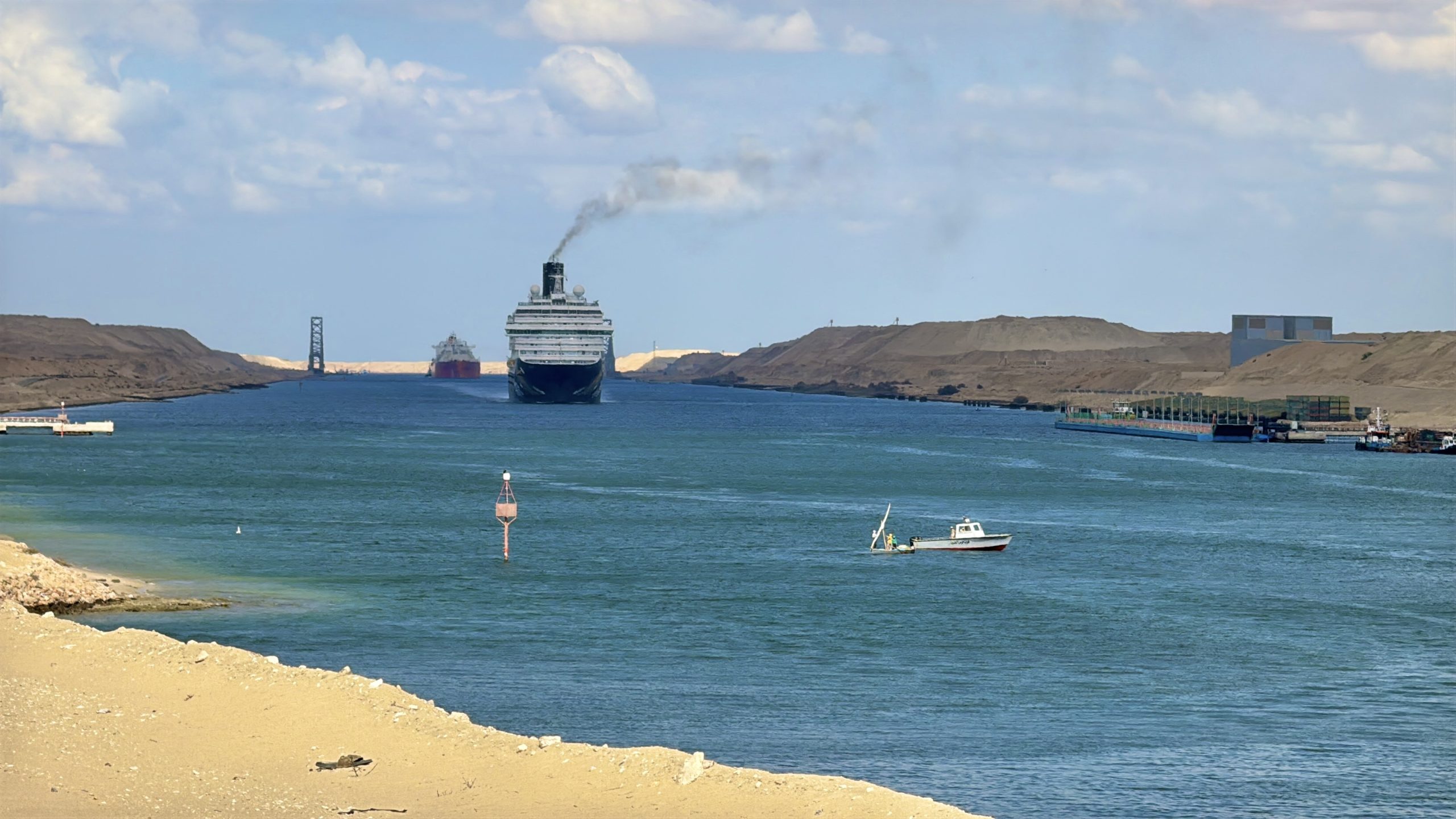
But the Gaza war weakened this strategic advantage. One of the most direct and expensive effects of the regional escalation for Egypt has been the disruption of Red Sea marine trade. Houthi attacks drove international shipping companies rerouted vessels away from the Red Sea and the Suez Canal. Revenue fell year-on-year by around 47 percent in January 2024, and maritime traffic fell 30 percent. These numbers represent the highest decline in canal revenue for more than ten years; big international shipping companies like Maersk and Hapag-Lloyd ceased transits in the Red Sea.
The consequences were immediate. Egypt found itself in a financial dilemma as it relied on consistent Suez traffic for jobs and foreign exchange along the canal corridor. Egypt had officially inaugurated a major expansion of the Suez Canal, known as the “New Suez Canal,” in August of 2015. This project involved digging a new 35-km (22-mile) lane and deepening/widening other sections to allow two-way traffic, significantly increasing the canal’s capacity. Subsequent, smaller expansion projects, such as widening 10 kilometers in the southern section, were initiated in 2022 and completed in 2023.
Based on expected earnings under normal circumstances, cumulative losses throughout the first half of 2024 were estimated to be above $6 billion. Egypt experienced a currency crisis in 2023-2024 fueled by the economic fallout from the war in Ukraine, which raised food and energy import costs, the Gaza conflict’s impact on Suez Canal revenues, and high external debt payments.
This adverse event came during a period of economic vulnerability for Egypt, with high levels of external debt, a widening trade deficit, and inflationary pressures. According to UNDP rapid assessment inflation of 23.5 percent in 2023 and projections of reaching 32 percent the following year. Additionally, in March 2024, the Central Bank let the Egyptian pound to freely fluctuate in accordance with the guidelines established by the International Monetary Fund (IMF), resulting in a nearly 60 percent devaluation, followed by a spike in the cost of fuel, imported commodities, and staple foods.
The IMF agreement and Egypt’s fiscal straitjacket
Egypt’s obligations to the IMF have further strained its economic independence. The country signed with the IMF a $3 billion Extended Fund Facility in December 2022 to stabilize its macroeconomic structure.
However, the initiative was significantly expanded as a result of adverse shocks, such as the conflict in Gaza, the Houthi attacks in the Red Sea, and associated revenue losses. Under the updated agreement, Egypt committed to a tighter fiscal consolidation route including lowering the budget deficit, permitting exchange rate flexibility, and eliminating untargeted subsidies.
However, returns have been severely constrained by geopolitical instability, currency devaluation, and global investor caution. Formerly willing to provide Egypt with financial support, nations like the United Arab Emirates and Saudi Arabia have taken a wait-and-see attitude, urging Cairo to increase transparency before making any commitments.
In July 2024 assessment, the IMF praised Cairo’s efforts but cautioned that growing external vulnerabilities and geopolitical uncertainty could derail the program. Egypt’s geopolitical strategy imposes an unspoken but constant restriction, because IMF agreements and Gulf investments would be threatened if it hosted Palestinian refugees that could be close to Hamas. In summary, the geopolitical fine print that comes with every dollar of foreign assistance, in addition to IMF spreadsheets, reinforces Egypt’s fiscal constraints.
Furthermore, reform also became more politically costly. Public outrage aroused by the removal of food and fuel subsidies as inflation squeezed households. Despite pressure from the IMF, the government postponed multiple rounds of subsidy cuts that were planned until mid-2024. The fiscal balance was further strained by the announcement of new social protection measures and wage increases for public sector employees.
Sectoral impacts: tourism, trade, and energy
Although Egypt is geographically remote from the conflict’s center, its border with Gaza, Red Sea attacks and extensive media coverage have affected the safe travel destination in the first months of the war. Regional unrest may severely impact tourism, which had been still rebounding from the COVID-19 pandemic. Nevertheless, the World Travel & Tourism Council, reported 2024 as Egypt’s highest tourism contribution to the economy with 2025 projected to reach a new peak. As of this writing, tourism remains a cornerstone of the national economy representing about 8.5 percent of its GDP.
The logistics and trade industries faced a series of challenges. As noted above, container traffic through the Suez Canal drastically decreased as Houthi drone and missile attacks made routes insecure. Outside of the area of transshipments, exporters experienced delays threatened supply agreements, and importers were disproportionately affected by higher freight costs. Logistics and shipping costs increased overall due to rising insurance premiums, with some experts estimating not only million-dollar added costs for each rerouted cargo vessel but also more negative climate balances.
In the energy field, Egypt has strengthened its ties with Israel, with whom its peace treaty of 1979 still stands, despite growing anti-Israel sentiment and public outrage following the Gaza War. Cairo and the Israeli firm NewMed signed a historic $35 billion deal in August 2025 to triple gas supplies from the Israel’s offshore Leviathan field. This arrangement comes as Egypt’s domestic gas production has dropped by over 40 percent since 2021, increasing dependence on imports at a time when its foreign reserves are running low.
Also, gasoline subsidy costs rose with global oil prices. Egypt remains a net energy importer. Currently, more than half of its imports and up to 20 percent of its overall consumption come from Israeli gas. In addition to providing a temporary economic lifeline by reducing energy shortages and stabilizing prices, the agreement represents Cairo’s long-term strategic investment on regional integration rather than symbolic political division, which is interpreted by observers as proof of the long-term significance of agreements in the spirit of the agreements signed since 2020 by other countries in the Gulf and North Africa (Bahrain, UAE, Morocco, Sudan) with Israel that known as the “Abraham Accords”.
Impromptu consumer behaviors and alleged labor impacts
In terms of Egyptian consumer responses, the Gaza conflict led to a widespread boycott of Western and companies thought to be Israeli-affiliated. The movement has had noticeable economic consequences despite being primarily a means of public opinion and political expression. Boycotts on international enterprises contributed to the growth of local Egyptian businesses, especially in the food and beverage industry, with reports indicating that certain domestic brands such as Egyptian soft drink labels have heavily benefitted from consumption surges.
This movement, while driven by opposition to Israeli interventions in Gaza, aligns with Egypt’s larger localization and industrialization objectives, which promote local production despite often-voiced doubts about the long-term scalability and global competitiveness. However, the economic impact is not entirely positive. Several boycotted enterprises are major employers, raising concerns that sudden decline in sales could result job losses or violation of workers’ rights. This highlights how consumer activism can affect economic stability and civil unrest, in a country already facing high unemployment and financial pressure.
The costs of Hamas intrusion into Israel in October 2023, the two years of domicide in the enclave, and the wider regional confrontations, measurably weighed on Egypt but less than the burdens created over the past 40 years under the country’s erratic economic policy making.
The theoretical post-conflict scenario of rebuilding Gaza under the regime of a transitional Palestinian government, supervised by an international “Board of Peace” and an “International Stabilization Force”, would have both burdens and benefits economic impact on Egypt. It could persist in areas from refugee care and Suez Canal receipts to tourism receipts and serving as gateway in humanitarian deliveries, trade and reconstruction. Egypt’s potential role in reconstruction was on display during the March 2025 Arab Summit for Palestine held in Cairo at the request of Palestine, where Arab leaders pushed for a permanent ceasefire and two-state solution, and approved an (as of yet unfulfilled) Egyptian-led plan to create a technocratic committee to temporarily govern and reconstruct Gaza.
Domestic cost factors will likely include keeping internal unrest under control. Domestic social unrest and negative international reputation have both been enhanced (albeit not caused primarily) by the blocking of the Gaza aid protests along with other nondemocratic actions of the Sisi administration over the past decade. Moreover, the domestic social and global reputational repercussions of operating a state apparatus that is regarded as repressive by international civil rights advocacy organizations, hinting at the strong possibility of Egyptian economic cost factors that are related to the Gaza conflict but have not yet been assessed.