• Donate
  • Our Purpose
  • Contact Us
Executive Magazine
  • ISSUES
    • Current Issue
    • Past issues
  • BUSINESS
  • ECONOMICS & POLICY
  • OPINION
  • SPECIAL REPORTS
  • EXECUTIVE TALKS
  • MOVEMENTS
    • Change the image
    • Cannes lions
    • Transparency & accountability
    • ECONOMIC ROADMAP
    • Say No to Corruption
    • The Lebanon media development initiative
    • LPSN Policy Asks
    • Advocating the preservation of deposits
  • JOIN US
    • Join our movement
    • Attend our events
    • Receive updates
    • Connect with us
  • DONATE
EditorialOpinion

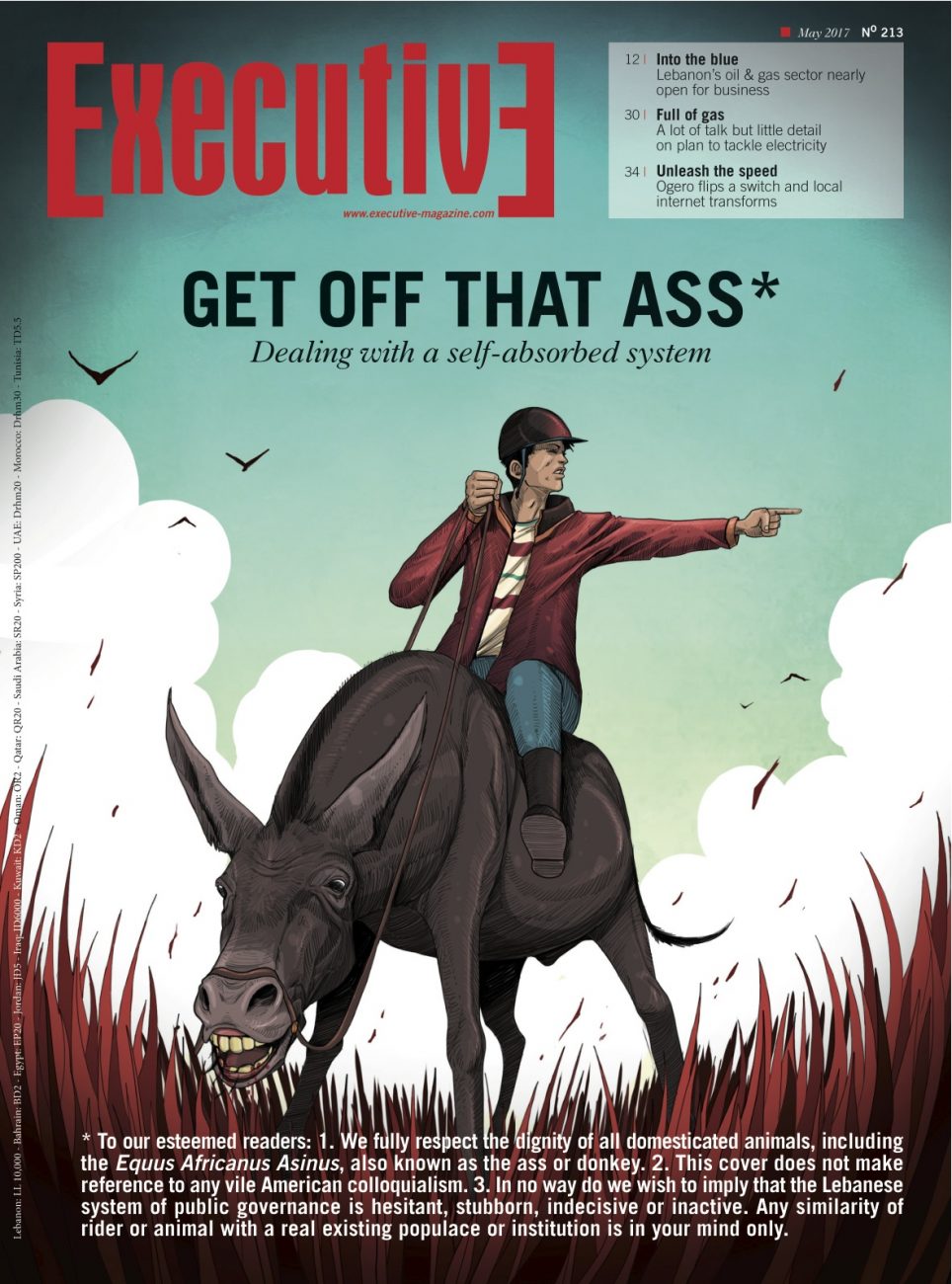
The donkey strategy

by Yasser Akkaoui May 9, 2017
written by Yasser Akkaoui

A scantily clad singer belts out another frivolous song, and not only does her video clip get banned, she has her travel privileges revoked. A university blogger dares to criticize the system only to find himself officially ostracized and harassed.

As this is taking place, a former head of Lebanon’s telecommunications company, himself under investigation for corruption, can be found in an expensive downtown restaurant publicly relishing his surroundings without a care in the world. Can this possibly be real? Is it acceptable by any standards?

For years, the Lebanese have been clamoring for faster internet services – their right. Practically immediately after the disgraced telecoms chief was fired, the company he was heading proved that fast download speeds were achievable with the flip of a switch. The word suspicious is too weak here. This could not have been a coincidence. The refusal to deliver optimum internet speed was obviously a deliberate choice by corrupt individuals to sabotage the delivery of fast internet service to the country to suit their twisted personal interests. All this at the expense of millions of resigned Lebanese who are guiltless bystanders.

In a democracy, the government is assumed to work for the people. Its purpose is to serve its citizens and facilitate their transition between stages of their personal and professional lives. This is what a horse does. A horse responds to its rider. A horse meets needs with speed and loyalty.

In our beloved Lebanon, does our system of governance remotely resemble the values embodied in a horse? The answer is a resounding NO! Instead, it is a donkey, moving at its own pace, stopping, drifting aimlessly through life, taking inane steps along the way, with only its own interests in mind, oblivious to the world around him.

Our donkey delayed oil and gas exploration for no justifiable reason – giving our neighbors a head start. Our donkey could neither manage waste management in the country nor pass a much-needed electoral law, even though it had ample time and no shortage of reasonable proposals for both. Our donkey simply waits. And eats. And waits. Our donkey does not care where we need to go. It is completely self-absorbed, self-centered, self-indulgent. Pure and simple.   

Don’t be fooled! Our donkey is not foolish. It knows exactly what it is doing. It is playing the waiting game and it knows that time is on its side. As for us, the riders, we sit defenseless, watching the race pass us by, despite being reconciled not to win. We have been denied participation, let alone victory. Wherever I look, I find that the Lebanese have abandoned their rightful aspirations and no longer attempt to even nudge the donkey. We all know that stubbornness is the donkey’s strength. Once again, the creature has outwitted us.

I, for one, refuse to be cowed. I no longer expect anything of the donkey. It is time to find a horse.

May 9, 2017 4 comments
0 FacebookTwitterPinterestEmail
Hospitality & TourismMinistry of Food

Of burgers and pizzas

by Nabila Rahhal April 28, 2017
written by Nabila Rahhal

It all started in 2010 with a small shop flipping burgers in a mainly residential area of Achrafieh facing Sodeco Square. Seven years later, Ministry of Food – the hospitality management company that owns the restaurant brands Classic Burger Joint (CBJ) and Tomatomatic – boasts a total of 30 CBJs and five Tomatomatics (with a sixth on its way in Hazmieh), and its growth and expansion targets don’t end there.

According to Angela Sawan, franchise manager at Ministry of Food, the company aims to have 100 outlets – including the two brands both locally and regionally – by 2020; an ambitious figure for a company that only began to aggressively franchise in 2016.

A solid foundation

From the start, CBJ resonated positively, particularly with young Lebanese, who were drawn to its trendy branding and modern vibes. Karl Ghorra, the company’s CFO, says that despite local instability, the numbers have been growing since day one, with a steady year-on-year increase. “Last year the increase was perhaps not as strong as before due to the economic situation in Lebanon and the region, but we managed to maintain profitability and even increase it despite a slower increase in sales,” explains Ghorra.

In terms of an increase in sales, store-to-store comparisons both locally and regionally have yielded very good results in the last few years, according to Ghorra. He adds that this is despite the heavy cannibalism in 2016 brought on by many CBJs and Tomatomatics opening in the same year. For full-fledged year round stores in solid locations, Ministry of Food aims to have an annual turnover of close to $1 million per year, per store – another ambitious estimate – with a profit margin of 25 to 30 percent.

The faces of the Ministry

Sawan attributes the success of Ministry of Food to its founders, whom she says are all active partners and come from diverse backgrounds that provide unique strengths to the company. Donald Battal, whom Sawan calls the “guru in F&B,” uses his expertise in the hospitality sector to drive innovation, research and development, and the vital expansion strategy.

Brothers Boudy and Walid Nasrallah are the founders of the design company Wonder Eight and are behind the branding and marketing strategy of both CBJ and Tomatomatic. Sawan says that although Wonder Eight is a separate company, and Ministry of Food has their own internal marketing department, there is a lot of synergy between the two.

Also among the partners is chef Ahmad el-Chami, who developed the menus, and Maroun Chammas, a financial entrepreneur who supported the formation of Berytech and the Beirut Digital District, he brings expertise in economic development and public relations.

[pullquote]

The company observed that sales from their pizza delivery far outweighed dine-in sales, and decided to reconceptualize Tomatomatic as quick service and delivery

[/pullquote]

Burger beginnings

While plenty of diners have been serving burgers in Lebanon since the 1990s (examples include Roadster Diner and Crepaway), Sawan argues that CBJ was the first to pioneer dedicated burger joints in Lebanon. The “burgers only” concept was already a big trend in the USA and Europe in 2009, when Ministry of Food decided to adapt it to the Lebanese market, attracted by the idea of a single-item operation. “Burgers were a trend outside of Lebanon, and so, we thought of being entrepreneurs, in a sense, and bringing the trend to Lebanon. It was in the vision of the founders of the company to create single-itemed stores where the focus is really on perfecting this item,” says Sawan, explaining that operating such a model is easier because one can control costs better and focus on innovating the main menu item.

CBJ expanded fast, and following their first outlet in Sodeco, they opened a branch in Jal el-Dib that Sawan describes as a strategic location, which allowed them to serve a larger consumer base. The Jal el-Dib store was followed by joints in Uruguay Street, Zaitunay Bay, Hamra, and Le Mall Dbayeh.

Time for pizza

A year after the launch of the first CBJ, and fueled by its success as a single-item F&B concept, Ministry of Food’s partners introduced Tomatomatic, which operates in the same model as CBJ, only here the focus is pizza. The first Tomatomatic was launched in 2011 as a casual dine-in concept located in the same Sodeco building that housed CBJ.

However, the company observed that sales from their pizza delivery far outweighed dine-in sales, and decided to reconceptualize Tomatomatic as quick service and delivery only. Sawan argues that the American-style pizza they bake is inherently better suited for delivery, and illustrates her point by giving the example of Pizza Hut rebranding itself from a dine-in concept to PHD, a delivery only model.

Tomatomatic relocated its operations to Geitawi, where Sawan says they have lower visibility than in Sodeco but are more central, and thus, able to deliver to a wider area. Other benefits from the change to the quick service model include lower rent and lower expenses when compared to a dine-in concept.

CBJ’s franchising presence

Sawan says that Ministry of Food’s main goal from the start was to grow their brands through franchising. “We wanted to expand the footprint of [CBJ], and we wanted to franchise the concept,” says Sawan.

Internationally, CBJ has franchise outlets in the UAE (Dubai), Kuwait and Cyprus, with plans for an expansion to Iraq also in the pipeline.

While at first the company was directly operating its stores in Lebanon, it began franchising domestically in 2016, the “year of the franchise” for CBJ. “The big leap for franchise was in 2016, when we started franchising locally, and therefore doubled our store number. We also had multiple franchisees abroad, and each one worked on a parallel development project. So, in Kuwait we opened four stores, in Dubai two … There was one opening every five weeks in the last 18 months,” says Ghorra.

The first three franchised branches of CBJ in Lebanon are fully operational year-round and are located in Mansourieh, ABC Achrafieh and Jounieh. They now include the franchise in North Lebanon, where the franchisee for the region has opened a shop in a food court in Zgharta, as well as seasonal kiosks in Balamand, Cedars, Ehden and Batroun.

According to Ghorra, each store opening takes between four to six weeks for logistics such as marketing, training and identity development, and utilizes all the company’s operations staff (16 to 20 people in the head office, plus the team of Wonder Eight who have implants in the company to support franchise expansion).

[pullquote]

The franchisee territory for Tomatomatic outlets is divided into zones – each of which has between 50,000 to 100,000 potential customers

[/pullquote]

More pizzas in the oven

Growth for Tomatomatic has been slower, and only two franchises were granted in 2016. “For Tomatomatic, we are now focusing on growing the brand locally like we did with CBJ. We tested the franchise model by operating the store ourselves, and then by franchising locally. So, we are ready to go regionally when the time is right,” says Sawan, explaining that they plan to have 10 Tomatomatics in Lebanon and one franchise in Iraq by the end of 2017.

Sawan enthusiastically explains that Ministry of Food’s aim is to grow Tomatomatic into multiple stores that act as a network. “It is a brand that lives and feeds on outdoor marketing campaigns, so what we do is take a chunk of the marketing money we make from each store and invest it into that campaign. The more branches we have for Tomatomatic, the more we can afford to spend on outdoor marketing, and the more clients we get,” she elaborates.

To ensure that oversaturation does not occur, says Sawan, the franchisee territory for Tomatomatic outlets is divided into zones – each of which has between 50,000 to 100,000 potential customers – and is delineated by a 15-minute drive by a motorcycle at a speed of 40 kilometers per hour.

All delivery calls are directed to a unified call center, which dispatches the order to the assigned territory. Sawan says they invested over $50,000 in the modern hardware and software for the call center, which is shared with CBJ. It was established a year and a half ago, and Ministry of Food sell its services to their franchisees. “This allows us to control and streamline the service, and at the same time reduce our overhead cost.”

Franchising the brand

Ministry of Food has a well-defined franchising model in place to ensure that everything runs smoothly. Domestically, Sawan says they mainly sell single-unit franchise licenses, but they have given multi-unit franchises in certain areas such as north Lebanon. “In multi-unit franchises, the franchisee takes over the territory and is in charge of expanding the brand there,” explains Sawan, adding that the opportunity exists in south Lebanon for a similar model.

According to Sawan, the profile of a local CBJ operator is an entrepreneur with a senior or management post in an F&B operation “who shares the same culture and values of the company and appreciates our brand.”

However, the profile differs regionally as franchises are given to very large territories, so seasoned F&B developers or corporations are required, explains Sawan. “To qualify, these operators should have had success in managing brands that are similar to CBJ in that they are casual. For example, our franchisee in Kuwait is the development agent of Subway, and in Dubai he is the franchisee of [Kahwet] Leila,” she says.

Meanwhile, Tomatomatic is described by Ghorra as having a “low barrier to entry” business model. “It is much easier to get a franchise for Tomatomatic, at least financially and training-wise. You can also be a non-F&B person and get it,” he says.

The money trail

As for franchising fees, Sawan explains that there are two main expenses: an area development fee and a unit franchise or license fee, which is related to a single location. Additionally, there are ongoing royalty fees and marketing contributions.

The area development fee differs from one country to another, according to Sawan, while the license fee is based on the number of branches. The more outlets the developer adopts, the cheaper this fee becomes.

Ghorra explains that the initial fee is related to the number of branches a franchisee will take on in a country or area, and the monthly fee is a fixed percentage of turnover. All in all, he estimates that it costs $120,000 to start your own Tomatomatic, while it would cost three times more for a CBJ.

Grilling for growth

As Ministry of Food grew its number of franchisees and developers, it had to become vertically integrated to be efficient and competitive. The company originally had a central kitchen in Lebanon, but when planning for franchising, they decided to close it in favor of having their suppliers produce the company’s proprietary ingredient using its recipes.

Although these suppliers have an exclusive contract with Ministry of Food in Lebanon, this is not the case regionally, as Sawan explains. “Outside of Lebanon we changed this because franchisees were asking for facilities closer to their territories to cut down on shipping expenses. So, we started to approve factories in the GCC region, and we added a factory in KSA to our portfolio. This factory will help our Kuwaiti and Dubai franchisees when they want to import and also help us when we expand to KSA,” explains Sawan.

When it comes to Tomatomatic, Ministry of Food is more lenient on ingredients, and while some items are integrated into the supply chain, the majority can be locally sourced according to certain specifications. “The only two ingredients which must be used like us are the Italian tomato sauce brand that we use and our secret spices recipe,” says Sawan.

[pullquote]

The profile of a local CBJ operator, according to Sawan, is an entrepreneur with a senior or management post in an F&B operation “who shares the same culture and values of the company and appreciates our brand”

[/pullquote]

A new marketing approach

Marketing and promotion was another area that Ministry of Food had to rethink in order to facilitate their brand expansion. Sawan explains that at the beginning, franchisees would come up with marketing ideas or promotional campaigns based on their outlets’ needs or performance, and Ministry of Food, through Wonder Eight, would do the production and send them the materials to use.

However, with the increasing store count, this strategy was no longer viable. “We decided to elect local marketing agencies wherever franchisees are to drive the brand. So, we asked regional agencies to pitch for the brand, and we selected the best agency to present our brand there,” says Sawan, insisting that they will still feed the agencies a brand level strategy to use, which will be “strictly followed up on and supported by the head office in Beirut.”

Facing the competition

In a landscape covered with international and Lebanese franchises, such as the Gulf, it is hard to stand out from the crowd. Sawan sees several areas where their brands have a competitive edge for their brands over American or European franchises. One of them is market adaptation and cultural literacy, whereby they adapt their marketing strategy based on each country.

Examples include the Kuwaiti burger (a best seller produced only for Kuwait, which includes flavors that nationals appreciate), the soup and dates served during the holy month of Ramadan, and the fish or mozzarella burgers they add to the menu during Lent. “Cultural literacy is high in our brand identity, and this is what the international brands might miss. For us, it’s easy to cater to such requests since we have less bureaucracy, are fast and supportive in that area, and are only a short plane ride away,” Sawan explains.

In countries where there is a large Lebanese presence, Sawan sees brand loyalty playing a role in sales. “Up to 30 percent of our clientele in Dubai are Lebanese, and in a market as competitive as Dubai, loyalty really makes a difference,” says Sawan.

Only time will tell

“Our vision and our aim is franchising,” repeats Sawan emphatically, and indeed, it is clear that all of the company’s energy has been poured into this goal.

Sawan sees the region becoming increasingly competitive, and with the struggling GCC economy, they are now shifting their franchise focus to emerging markets with  high population densities and improving economic situations, such as Egypt or Turkey.

It is still too soon to tell if Ministry of Food will hit the 100 store mark by 2020. Many Lebanese-grown concepts before them have tried to expand this way, only time will tell if Ministry of Food holds the keys to franchising success.

April 28, 2017 0 comments
0 FacebookTwitterPinterestEmail
EntrepreneurshipGaming

Bolstering Lebanon’s game development

by Executive Editors April 27, 2017
written by Executive Editors

With a touch of the screen, fat bunny bounces his way up the vibrantly colored mountain terrain, munching on the occasional carrot. Press too long or too little, however, and splat goes bunny into the mountainside – game over.

Like many mobile games, Fat Bunny’s concept is simple, yet its gameplay addictive. It was launched in its beta version on March 20, the first offering of Lebanese game studio Groovy Antoid, who, along with another Lebanese newcomer, Van Ahmar, were selected as part of a piloted partnership between the startup accelerator Speed@BDD and Arab Arcade, a self-described community initiative.

Game development is not new to Lebanon. Local game studios began appearing 2008-2012, boosted by investment from the likes of Middle East Venture Partners (MEVP), Berytech and Resource Group Holding. But this last year has seen a sudden surge in activity and a more concentrated effort to grow the game development community in Lebanon –  at the heart of which lies Arab Arcade.

Creating a community

The initiative has been operating since January 2016 with a stated mission “to grow and bolster the game development community in Lebanon and connect aspiring game creators across the region.”

The last six months have seen a flurry of activity. Arab Arcade organized the Beirut Games Festival back in January at the Beirut Digital District (BDD), alongside a range of other events such as Games Jams (48-hour-long marathons where teams compete to create a game) and Fuck-Up Nights (where enthusiasts gather to learn from each other’s mistakes) – all seeking to foster ties between those who are passionate about games and those who are experienced in game development.

It also launched an incubation program for game studio startups that provides everything from office space at BDD, to mentorship, help finding investment, and business and PR support. Groovy Antoid was the first team taken under their wing, and slots are open for the next to apply.

It seems as though the Lebanese game development scene has been touched by an angel; indeed the investors behind Arab Arcade have a particular love for the local industry. “Our angel investors see great potential for gaming in the Middle East,” explains Arab Arcade’s CEO and co-founder Raja Riachi, who declined to name the investors or the amounts they’ve invested. “And on a personal level, they are passionate gamers who want to see more and more games coming out of Lebanon.”

Passion aside, there is also money to be made. The game industry brought in close to $100 billion globally in 2016, and Arab Arcade takes either equity or revenue share from teams they incubate – they took equity from both teams in Speed’s accelerator. They also arrived on the scene at a particularly prescient moment, with Speed CEO Sami Abou Saab stating that the generalist accelerator has reached a point of maturity, and they are now keen to move into niche markets.

When Arab Arcade approached him about using Speed’s space at BDD for their events, a deeper partnership evolved. “Gaming is pretty interesting, since the teams draw technical co-founders on board, which is very important for Speed,” he says, explaining what made the case for focusing on gaming startups.

[pullquote]

We’ve got a huge pool of talent adjacent to what a game designer or developer would need

[/pullquote]

Arab Arcade and Speed officially launched their partnership on March 15, alongside Speed’s Cycle IV acceleration program. The two game studios will receive the usual support from Speed, in addition to in-kind gaming-specific mentoring from Arab Arcade.  If the pilot scheme proves successful, it could lead to an acceleration program aimed specifically at gaming startups, according to Abou Saab. “We are looking to get the feedback of the startups after the acceleration [program] and how this joint effort helped them build their studios. The traction and end-user engagement with their games is one of the criteria for success that we’re looking at,” he says.

Yet, there are still obstacles to be overcome before Lebanon can claim a place as a regional hub for game development, namely the lack of funding, resources, and specific talent.

Investment remains challenging for game developers in Lebanon, where there is no venture capital fund specialized in gaming. According to several game developers Executive spoke with, there is talk of, but no viable university level degree capable of producing graduates with the necessary skills to transition into the field.

Instead, there is passion and talent on the peripheries of game design. “I think we’ve got a huge pool of talent adjacent to what a game designer or developer would need,” explains Riachi.  “Translating that talent shouldn’t take too much; we are trying to set up the infrastructure that would make that transition easier.”

Encouraging investment

The majority of game studios in Lebanon are focused on mobile gaming, seen by some as a high risk/high reward venture. However, Abou Saab explains that investors are only willing to back gaming startups if they have a vision for more than one game. “If they have a plan about how they are going to do it – and also a conception of how they are going to monetize in the future – then the investors are interested.”

The numbers alone show why investment in Lebanese game development, financial and otherwise, could prove a smart move. Globally, the games industry rakes in billions of dollars annually and is on a path to eclipse other entertainment mediums. “In 2020 it’s going to overtake all other entertainment industries; I’m talking movies and music combined,” says co-founder of game developer Wixel Studios, Ziad Feghali. Such claims are not so hyperbolic when you consider that the global movie production and distribution market generated $95 billion last year, according to IBISWorld’s Global Movie Production & Distribution: Market Research Report, compared to the global games industry’s $99.6 billion in revenue – a year-on-year increase of 8.5 percent – according to Newzoo’s 2016 Global Games Market Report.

The future may well lie outside the big screen, as the smallest screen is the segment showing the greatest increase. Mobile gaming accounted for 27 percent of the global games market last year, generating $36.9 billion, up from $30.4 billion in 2015. This trend is showing no sign of abating, with the mobile games segment set to rise each year to a predicted 34 percent market share and revenues of $52.5 billion by 2019, according to Newzoo.

While MENA is by no means the largest market – Asia-Pacific accounts 47 percent of the global market, compared to MENA and Europe’s combined 24 percent – the potential for investors is still there. “The growth of smartphone adoption in MENA, paired with an increasingly younger population – 50 percent of current MENA population [is] below 24 years of age – support further growth of mobile games in the region,” explained MEVP’s Wajdi Ghoussoub via email. MENA was also the fastest growing gaming region last year, with a year-on-year growth rate of 26.2 percent from 2015 to 2016, and revenues of $3.2 billion.

When asked what criteria MEVP would look for when deciding to invest in a gaming startup, Ghoussoub identified three key areas: a team that is experienced, can execute their company’s strategy and adapt to an ever-changing environment (for example, the growth of mobile games and virtual reality); the business model of the company, whether they are a developer, publisher or both, and how they spend their resources; and return on investment, evaluating user economics and engagement to establish growth trajectory.

In agreement with Abou Saab, Ghoussoub says that while investors would love to come across the next Pokémon Go, sustainable growth is what attracts them. “In theory, we are always looking for a company with the next big game, but that does not mean that anything short of global dominance is a failure. Having a strong portfolio of games and a pipeline for new ones is critical, as it allows the company to diversify its risk and keep on bringing to the market new and engaging games after some might sunset,” he explains.

MEVP brought a gaming studio into its portfolio with an investment into Falafel Games back in 2011. Falafel Games runs on what Ghoussoub says, in MEVP’s experience, is the most common business model; free-to-play with monetization from ads and/or in-app purchases. “An overabundance of mobile gaming options has forced game publishers to resort to this model as consumers have grown accustomed to a vast availability of titles free of charge,” he says.

Games with a smaller reach can still generate significant revenue provided they are able to engage a loyal fanbase, such as Falafel Games’ clientele. CEO Vincent Ghoussoub (a distant relation) says that most of the studio’s games are MMOs (massively multiplayer online games), which make on average around 40-50 cents per day per active user, with active daily users close to 10,000. The company also closed a small –  by industry standards –  but significant round of investment last October that brought in $2.6 million from MEVP and iSME Holdings, among others.

Falafel, which counts localization among their business strategies –  50 percent of their market is Saudi Arabia, where language and cultural concerns are part of doing business –  recently relocated its headquarters to Lebanon and plans to launch projects that are Lebanon specific, though Ghossoub remained coy on details.

Game Cooks is another profitable Lebanese game studio, counting their daily active users at around 30-40,000, though they are focused on the American market. A year ago they also had an in-app purchases business model, but have recently changed their focus from mobile games to virtual reality (VR), a potentially risky move given the projected growth of mobile gaming and industry skepticism about the longevity of VR.

“VR is not a platform you do a lot of in-app purchases in, it’s particularly for premium users,” explains CEO Lebnan Nader. The company’s first VR game was launched on Samsung Gear at $2, and their latest will be at a higher price on the HTC Vive.

Nader acknowledges that there is no way of knowing yet if VR is a fad – the equipment itself is an expensive investment for the user, with good VR kit costing between $500-800 and requiring a top-of-the-line PC. Yet, he was convinced that it was the right direction after seeing both the interest of investors in VR at the Game Developer Conference in San Francisco and experiencing the “unbelievable immersion” of VR games first hand.

[pullquote]

Mobile gaming accounted for 27 percent of the global games market last year, generating $36.9 billion up from $30.4 billion in 2015

[/pullquote]

Building from the ground up

While established gaming studios have managed to find funding, monetize and expand, there are still barriers to creating a vibrant Lebanese game development community.

“One of the major problems we have is that, although we have a lot of gamers, we don’t have the suitable belief from universities that this can actually be a career,” says Feghali.

Feghali knows this firsthand, as he and Wixel co-founder Reine Abbas teach courses for a Masters degree in Game Design and Development at the Lebanese University, one of the few games-specific courses in the country. They argue that without the foundation of a BA program, this can never be fully fledged. “Developing games is a mindset,” Feghali explains,  a multifaceted discipline that needs a dedicated program.

With Lebanon and the region woefully behind in gaming education, he and his wife Abbas took matters into their own hands in 2014, launching the Spica Tech academy, which teaches children ages five and above about game development.

“We are shifting these kids from dumb digital consumers to smart digital producers,” explains Abbas. The courses, which are always free for girls – part of Abbas’ desire to see more women in gaming – run across Lebanon, with an online platform under construction to launch the academy globally.

Wixel Studios was founded back in 2008 by the couple and Karim Abi Saleh, and has always had a social tint to its games. Their latest, Antura and the Letters –  a partnership between Wixel, Cologne Game Lab and Video Games Without Borders –  was selected in March 2017 as one of the winners of the Education App for Syria competition.

Wixel is further evidence that game development is viable in Lebanon, staying profitable through creating advertisement games for clients and also receiving funding from Berytech back in 2013.

What they and other successful entrepreneurs agree on is the need to redirect talent into game development. “I think, if one or two big universities in Lebanon open up a game development course, that it would be a very good start,” says Nader.  “People can learn how to think about a game, how to take it from idea to development to execution – and obviously how to market it.”

For the Game Cooks CEO, the biggest challenges faced in Lebanon – other than the usual annoyances of infrastructure – are putting a team together, and finding funding in a landscape wary of games.

All also agree that Arab Arcade’s push to create a game development community that is business literate about the is a good first step. “There are finite cases of experienced people who don’t talk to each other. So the Game Festival and Arab Arcade in general foster a liquidity of experience,” says Falafel’s Ghoussoub.

There is still much work to be done if Lebanon is to become a regional hub for game development. It remains to be seen if Speed and Arab Arcade’s partnership will prove successful and, if so,  become the model of how to support a new generation of Lebanese game developers.

April 27, 2017 0 comments
0 FacebookTwitterPinterestEmail
Economics & Policy

Far off the target

by Gaelle Kibranian Zavzavadjian, Stephanie Nakhel & Gebran Azar April 26, 2017
written by Gaelle Kibranian Zavzavadjian, Stephanie Nakhel & Gebran Azar

In the first of a twelve-month series investigating Lebanon’s capacity to reach the UN’s Sustainable Development Goals (SDGs), Gaelle Kibranian Zavzavadjian, Stephanie Nakhel and Gebran Azar take a look at Goal 6: Clean Water and Sanitation.

The Lebanese are blessed with favorable amounts of precipitation, with the highest average rainfall of any country in the Middle East, according to the UN’s Food and Agriculture Organization (FAO). The government estimates that there is between 2,000-2,700 million cubic meters of total available water per year in Lebanon, exceeding the country’s projected water demand of 1,802 million  cubic meters in 2035. 

However, water supply shortages are still a major problem in the country. Most of the population faces severe water shortages, leading households to rely on unlicensed private wells, overpriced tanker trucks, and purchasing bottled drinking water to meet daily needs. Among an estimated 80,500 private wells in the country, only 20,529 are officially licensed, accordingly to a 2014 study conducted by the United Nations Developement Programme (UNDP) with the Ministry of Energy and Water (MoEW). This is execerbated by widespread pollution and substandard water infrastructure that restricts the government’s ability to meet the demand for water now and in the future. Among the major issues that need to be addressed are poor water storage, deficiency in water quantity, deficiency in the quality of water supply networks, an increase in demand, unsustainable water management practices and an increase in the salinity of groundwater.

To date, Lebanon is capable of storing only 6 percent of its total water resources, making it the country with the least storage capacity in the MENA region. As such, international organizations such as the World Bank expect Lebanon to face chronic water shortages as soon as 2020.

In the wastewater sector Lebanon faces major obstacles, such as insufficient sewerage networks and wastewater treatment plants. Furthermore, constructed plants are still not operational, leading to the unsanitary discharge of wastewater.

The influx of Syrian refugees since 2011 has intensified the problem, leading to additional stress on water resources and wastewater infrastructure. Across the country, particularly in regions playing host to large refugee populations, there has been an increase in demand for water and sanitation provisions.

To better address these challenges, in 2012 the MoEW launched the National Water Sector Strategy (NWSS), a detailed road map for improving water conditions and service delivery in the country. The strategy addressed infrastructural concerns relating to distribution and wastewater treatment, as well as management issues related to institutional, financial, legal and environmental concerns. It also presented a projection of how planned resource augmentation will meet future demand and identified $7.7 billion worth of capital investment opportunities for reshaping the water sector.

The NWSS provides a framework for Lebanon to achieve the sixth UN Sustainable Development Goal of ensuring the availability and sustainable management of water and sanitation for all. The national targets included maximizing the potential and improving the quality of surface water resources, improving the management and protection of groundwater resources, ensuring proper and continuous access to a high quality water supply, and increasing coverage of wastewater collection networks and treatment capacities.

The MoEW, in partnership with UN agencies, international donors and others, is working on several initiatives in line with the NWSS objectives and responding to water issues that were exacerbated by the Syrian crisis. 

However, to fully achieve the goal of providing clean and safe water to all, the Lebanese government needs to reform or repeal legislation that still impedes the full implementation of the water strategy, increase public awareness of the 2030 target for the SDGs, and seek funding from internal and external sources to implement the projects  in the water and wastewater sectors.

April 26, 2017 0 comments
0 FacebookTwitterPinterestEmail
Economics & PolicyRenewables

De-risking green power

by Vahakn Kabakian April 25, 2017
written by Vahakn Kabakian

Lebanon’s energy sector is characterized by a significant supply-demand imbalance, continuing growth in demand (5 percent per year), high generation costs (partly due to aging infrastructure), and a lack of financial sustainability. Electricité du Liban (EDL) cannot recover its operating costs and depends on the Lebanese government to subsidize operations. In 2013, EDL received transfers amounting to around $2 billion, corresponding to 4.5 percent of the GDP – creating a significant strain on the country’s budget and economy.

Lebanon’s baseline energy mix is dominated by oil, accounting for over 95 percent of generation. Renewable energy currently accounts for 4 percent of the electricity produced in Lebanon, predominantly hydropower, with less than 0.2 percent from solar photovoltaic (PV).

Renewable energy resources

The climate change case for investing in renewable energy is well known. A global and local shift to renewable energies, requiring both public and private resources, is essential to achieve the outcomes stipulated in the Paris Agreement.

Lebanon has significant wind and solar energy potential. The Ministry of Energy and Water (MoEW) started a wind energy procurement process in March 2013, requesting that wind farms be built and operated under a power purchase agreement (PPA). Three bids from local developers have been considered, and while the procurement process remains ongoing, there is optimism that agreements could be signed by mid-2017, which would bring with them a total of 180 megawatts (MW) worth of wind energy.

As for PV, most of the capacity installed to date is distributed on a small-scale (10 MW by the end of 2015), with an estimated 30 MW installed capacity by the end of 2016. Lebanon has two large-scale PV projects: the Beirut River Solar Snake (1.1 MW) and a second PV plant located within the Zahrani Oil Refinery Installation (1.1 MW), which are both connected to the EDL grid. The MoEW issued a call in January 2017 for parties interested in building solar PV farms in various regions of Lebanon, with the aim of installing an additional 120-180 MW of solar energy. The ministry received a total of 173 expressions of interest.

A risky matter still

A great deal of the recent advances in renewable energy can be attributed to increased political will and rapidly declining technology costs. However, financing costs for wind energy and solar PV in Lebanon today are estimated at 16 percent for the cost of equity (CoE), and 9 percent for the cost of debt (CoD).  These are substantially higher than in the best-in-class country, Germany, where they are estimated at 7 percent CoE, and 3 percent CoD. Given the longevity of energy assets and the capital intensity of renewable energy investments in particular, the impact of Lebanon’s higher financing costs on the competitiveness of wind energy and solar PV is significant compared to traditional fossil fuel powered technologies.

This means that high financing costs are a key factor hindering investment in renewable energy. Interviews with investors in Lebanon have shown that there is considerable interest today from domestic private sector actors, despite the slow pace of power sector reform and procurement activities to date. The high financing costs reflect a range of technical, regulatory, financial and institutional barriers, and their associated investment risks. The graph below shows how a range of investment risks currently contribute to higher financing costs in Lebanon. The risk categories with the largest impact on elevated financing costs are: 1) power market risk, which relates to accessing power markets and the price paid for renewable energy; 2) grid and transmission risk, which concerns the failure-free feed-in of the electricity produced; 3) counterparty risk, which concerns the credit-worthiness of the electricity off-taker (i.e., EDL); and 4) political risk, which concerns a country’s general intra and international stability.

By addressing these risks, Lebanon can create an environment conducive to investment and effectively address the concerns of private sector investors. This requires a targeted approach, which could include instruments such as: well-designed power market regulations, which reduce risk by removing the underlying barriers that create it; financial de-risking instruments, such as loan guarantees offered by development or central banks, which transfer risk from private to public sector; and financial incentives, such as direct subsidies for sustainable energy, which compensate investors for risk.

While challenging, these barriers are not insurmountable, especially if policymakers seeking to promote renewable energy assemble combinations of public measures to systematically address these underlying risks.

Public instrument selection

In order to specifically address the risk categories identified in the financing costs, a package of public instruments, containing both policy and financial de-risking instruments, needs to be developed and implemented (shown in Table 1). These measures would reduce the cost to the private sector, which in turn would be reflected in lower cost premiums quoted by the private sector when responding to government requests for wind and PV bids.

The ‘take or pay clause in PPA’ and ‘government guarantee for PPA’ are estimated to cost $55.1 million for wind and $25 million for PV. Taking a reserved approach, the ‘public loans’ and ‘political risk insurance’ are estimated to be $36.3 million for wind and $16 million for PV. This means that for financial de-risking of both wind and PV technologies, $91.4 million and $40.9 million are needed respectively. Policy de-risking instruments are estimated to cost $6.7 million for wind and $4.8 million for PV.

These represent costs (or expenditures) that would be incurred by the Lebanese government to de-risk (or uptake the risk) from the investors. This would allow for the further development of the sector and reduce the cost on future PPAs, as the investors would be bidding in a de-risked environment, and therefore, reduce the long-term cost on the government. This is obvious when the business-as-usual case (i.e., with the current risks) is compared to the post-de-risking environment (i.e., after implementing the policy and financial instruments mentioned above), where lower financing costs can be guaranteed.

In the business-as-usual scenario, wind energy and solar PV are more expensive than the baseline. The baseline technology mix consists primarily of combined cycle gas turbine (CCGT) plants, which Lebanon will likely use to increase its electricity generation capacity, and to a smaller extent the existing power generation fleet, which could be partly replaced by wind energy or solar PV. This approach results in baseline generation costs of $0.074 per kWh, assuming unsubsidized fuel cost for the CCGT technology. Therefore, the aim is to bring the cost of the wind and PV technologies closer to the CCGT technology.

To meet the 2030 National Renewable Energy Action Plan targets, the de-risking report estimates that $426 million and $140 million are required (in terms of price premium) for wind and PV technologies respectively.

However, the government could spend a total of $98 million and $46 million respectively to de-risk the wind and PV sectors. The de-risking would bring down the wind energy price premium to $205 million, thereby saving the government $221 million in generation costs over the next 20 years and resulting in a net savings of $123 million. The same holds true for PV energy, where the solar PV price premium is reduced to $43 million, thereby saving $97 million in generation costs over the next 20 years and achieving a net savings of $51 million. As such, following government interventions to de-risk the investment environment, and taking into account the resulting lower financing costs, the price premium for wind energy and solar PV would be reduced by roughly 50 percent and 70 percent respectively.

The above clearly demonstrates that investing in de-risking measures is good value for money when compared to paying a premium price for wind and solar PV energy. However, the majority of these measures could take time to implement. In the meantime, the government can offer subsidies to encourage immediate investments in the renewable energy sector. The ultimate risk, especially when generous subsidies are provided, is that the subsidy scheme itself might be vulnerable to a policy reversal. There are a great deal of complex trade-offs involved, and what seems to be of more importance is having continuous and consistent progress toward expanding the renewable energy portfolio. The thermal and renewable energy portfolios should  proceed in tandem by introducing renewable energy portfolio requirements for any future independent power producer (IPP) schemes in order to pursue the national 15 percent renewable energy target for 2030.

Click on image to view table
April 25, 2017 0 comments
0 FacebookTwitterPinterestEmail
BankingEconomics & Policy

Video: Natacha Tannous interviews Makram Azar about banking, US and European Macro Economics and the Middle East

by Magali Hardan April 23, 2017
written by Magali Hardan

Makram Azar is Chairman of Banking EMEA and Chairman of Barclays Bank PLC, MENA.
Makram also chairs the Senior Client Group globally.
Mr. Azar joined Barclays in September 2010 from Kohlberg Kravis Roberts & Co (KKR) where he was Managing Director and Head of Middle East and North Africa. Prior to joining KKR, Mr. Azar had spent 18 years at Lehman Brothers, latterly as Managing Director, Global Head of Sovereign Wealth Funds and Chairman of Media Investment Banking for Europe, the Middle East and Africa (EMEA).

April 23, 2017 0 comments
0 FacebookTwitterPinterestEmail
InsuranceQ&ASpecial Report

Going further

by Thomas Schellen April 21, 2017
written by Thomas Schellen

Allianz SNA is one of the most active insurance companies in Lebanon and the Middle East. Executive sat down with its Chairman and Regional Chief Executive Officer, Antoine Issa, to talk about the state of the insurance industry and the interconnections between consolidation, governance and institutional investments.

E   How do you view Lebanon from the perspective of a regionally active multinational insurance company?

I have worked in most of the countries in the ME region, in some directly and also as a board member of insurers working in these markets, so I have lot of experience in the [region’s] insurance sector. I can tell you that, despite everything, the level of technical know-how and the level of quality,  and pricing of the insurance market in Lebanon is probably the highest [in the region] still today.

E   Is that surprising, given that other, larger markets in the region have seen a great deal of insurance development?

I was asking myself: how can that be when you have 60 companies in a small country like [Lebanon] and very little regulation over the insurance sector as well as all other sectors in economy? [This is a country where] you don’t have good governance, and sometimes, you don’t have governance at all. So how can it be that you have a very good level of technical know-how, of pricing, of profitability, of innovation and so on? I think this is not contradictory because when you have 60 companies, you have 60 chief financial officers, 60 chief risk officers, insurance technicians, etc. I think [this situation] is promoting competition, innovation and self-discipline, and thus is making Lebanon what it is today.

E   But the insurance industry in Lebanon has seen relatively little growth or innovation as of late. So what is the problem?

The market is becoming too fragmented with too many small companies. The lack of strong regulation, strong capital and strong companies is not encouraging and is sometimes not allowing small well-managed companies to grow. But when you want to grow and institutionalize, you need good governance. Otherwise, it is impossible. So we now have some kind of bottleneck. We have some very good small companies that are very well managed, but they are not able to grow, merge or open their capital.

E   Currently, investment opportunities for Lebanese insurers appear restricted due to outdated regulation and other factors. Do you have proposals regarding how insurers can work as institutional investors in Lebanon?

It begins with the new law and new regulation, plus incentives for companies to move gradually into new environments. The regulation is not very restrictive. You have the possibility today, in this country, to invest 50 percent of your money abroad. When you allow companies to invest abroad, there is a larger horizon when compared with other jurisdictions, like KSA or Egypt, where you can only invest locally. However, we would welcome more local investment opportunities, such as funds that are tailored for the needs of insurers. But, it cannot be some small closed-ended fund; that doesn’t give me enough comfort. I need funds that are listed in a strong capital market. We need to have a change of mindset and need to start agreeing that we need a minimum [level] of infrastructure.

[pullquote]

The lack of strong regulation, strong capital and strong companies is not encouraging and is sometimes not allowing small, well-managed companies to grow

[/pullquote]

E   What would be the mentality shift to facilitate insurers to act as institutional investors?

To have listing, you need trust in the capital markets and the Capital Markets Authority. Today, people don’t [have that] trust. Why are people not buying? Because they have not seen transparency. We have good names [of listed banks on the stock market], but we don’t see the transparency that one would expect from listed companies. We need more companies to list, and we need to have strong governance, to show us that when we list a company, or tomorrow list a utility, Electricité du Liban or Eau du Liban or whatever, we can as consumers and as institutions start buying the stock because we have good control and good governance. To do this [for the private sector], however, you first need the public sector to accept [a high] level of governance and transparency.

E   How would you describe the relationship between Allianz Société Nationale d’Assurance (SNA) and the Middle East and the relationship between Allianz and SNA? Is what you are going through in the regional and Lebanese insurance markets comprehensible from the perspective of the corporate head office?

Allianz SNA is a company that is now 100 percent owned by Allianz Group. This was a gradual move by the founding shareholders. The name of the company – Société Nationale d’Assurance – was chosen to signify from day one of our history that this was a company with Lebanese management. The Lebanese shareholders always believed that we needed to have a strong foreign partner, not only to develop the insurance market in Lebanon, but also to develop [it in] the Middle East. [The acquisition of 100 percent of SNA] came at the end of a very long and successful gradual journey to team up with a top-notch foreign partner.

E   What is the role of the Lebanese operation for Allianz?

Allianz is using Lebanon as a platform to develop the rest of the Middle East. Out of Lebanon, we developed Allianz Egypt, and also started our journey into Saudi Arabia. Today Allianz is again using Lebanese talent to further develop these two markets, but also other [new] markets in the Middle East. We are using Lebanon as a hub with a talent pool and expertise in insurance. I think that with time, if we see better governance, regulation, more transparency in the law, in fiscal transparency and in the way we operate here, many multinationals will use Lebanon as a talent pool for the rest of the Middle East, as they did in the past. They went out [in part] due to the war but mainly due to lack of regulation and transparency. 

E   How many countries are under your leadership in the Middle East?

I have the whole Middle East, but the core markets that we are working in are Saudi Arabia, Egypt and Lebanon. We have joint ventures in Jordan and in Bahrain, but these two markets are not priorities for us because of their size. We have an operation in the United Arab Emirates, but it is in the DIFC [Dubai International Financial Centre], and thus we are not operating in the local market directly. We are operating in the local market by fronting with local companies. We are looking, as one of our next developments, to enter the UAE market.

E   Do you have a consolidated view on your market position in the Middle East region?

I think we are one of the larger multinational insurers in the Middle East region. We don’t have many multinationals in this region and this is perhaps because we don’t have many [multinational] competitors but also because we are in the largest markets. In the UAE, which is the largest market for insurance in the region, we are fronting locally and have a presence; the KSA is the second largest market and we have a strong presence there. The fourth largest [insurance market] is Egypt and we are there and the fifth is Lebanon and we have a presence [here too]. Out of the top five [markets in the Middle East] we are missing Qatar, but Qatar is closed to foreign players.

E   How is the split between life and non-life insurance in your portfolio?

In Lebanon we are split 50:50 between life and non-life; in Saudi Arabia we are 75 [percent] non-life and 25 life, because the market is very much into non-life and the size of business in non-life is very big. However, we are a dominant player in life with our small share. In Egypt, it is the reverse: 20 percent property and casualty and 80 percent life. The reason is that we identified opportunities in life when we entered the Egyptian market, which at that time was a virgin market for life insurance and also untapped by bancassurance, which we introduced to this market. We are scaling up this position now and we will continue development in life insurance.

[pullquote]

Why are people not buying? Because they have not seen transparency. We have good names [of listed banks on the stock market], but we don’t see the transparency that one would expect from listed companies

[/pullquote]

E   What is your target in terms of the relationship between life and non-life in Egypt?

Our ideal is to have a good balance between life and non-life like we have in Lebanon. Jordan is also an example of this balance as we have 50 percent life and 50 percent non-life. Allianz is a non-specialized company that is targeting all segments of corporate and retail insurance and all lines of business between life and non-life. Allianz is also known as a multi-access, multi-distribution company with our own sales force, with bancassurance, with brokers and with direct sales. That is why we will participate in the upcoming digitalization conference [of GAIF and ACAL in Beirut next month].

E   One of your high-end experts participated in the GAIF general conference last year as speaker.

That was Solmaz [Altin], our chief digital officer. This time, I’m bringing our head of market management and distribution officer [Jean-Marc Pailhol] because we want to talk about digitalization from the distribution perspective. Digital for Allianz is a priority and part of our strategy.

E   How many banks are you working with in product partnership in Lebanon?

We have [partnerships with] 11 banks.

[pullquote]

Digital for Allianz is a priority and part of our strategy

[/pullquote]

E   What is the rationale behind working with so many banks in Lebanon?

The strategy of Allianz is [to offer] multi-access. We need to look at the customer. If he wants to deal with us, we should accept to deal with him [through whatever channel]. We are an insurance risk carrier, not a distributor, and we don’t have any conflict of interest in this. In our opinion, it is the customer who should decide which distribution channel he or she uses and all of the distribution channels have a role and an added value.

E   Is it correct that the market position of Allianz SNA in Lebanon has improved in recent years?

Yes, on a composite level we are number one for life and non-life. We aren’t number one in life nor are we number one in non-life, but when you take both combined, we are number one. I think what is making us number one is having this multi-access and multi-segment strategy. Because we want to be multi-segment and offer a comprehensive range of solutions for institutions and for retail, we have been able to become number one on a consolidated base. The challenge for us now is to become number one in each line of business and in each distribution channel.

E   Are you looking to roll out services in new markets, like Iraq?

As I said, our priority, if the law and regulations allow us to do so, is [to establish a stronger local presence] in the UAE where we already have a local fronter. Another market that we are looking at is Iran. I visited Iran in 2015 and it is one of the largest markets in the Middle East. However, before having a local presence in Iran, we are still waiting until all sanctions are lifted. It is a process.

E   But presence in Iran would be through Allianz SNA, not from Germany, Turkey or France?

Yes. We are working on it out of Lebanon, but we won’t see a local presence before all the sanctions are lifted.

E What is your perspective on the Lebanese market in 2017/18, in terms of growth potential and intensity of competition?

Growth [of the Lebanese insurance market in recent years] has been limited to 3 to 4 percent [per year], and we became number one because we were growing faster than the market. In 2016, we had growth of 6 percent, which was above market. I can tell you that 2017 has started quite well. The market here is a retail market, and retail is very emotional. [To date the positive development in 2017] is linked to the new government, the reconciliation between the parties and the movement toward rebuilding the country. This was extremely well received; January was a great month for us and February also was a good month, particularly if we compare them to [the same months in] 2016. As far as we are concerned, we have confidence that we will have similar growth as in 2016, if not more. We also believe that the market will witness larger growth than in the past two years.

[pullquote]

Our priority, if the law and regulations allow us to do so, is [to establish a stronger local presence] in the UAE where we already have a local fronter

[/pullquote]

E   Some insurance CEOs have the perception that there are too many companies and too much competition on price in the Lebanese market and that this extreme competition is damaging the market.

I don’t have this perception. I think that the number of companies and the number of distributors in the country is creating more innovation, allowing the sector as a whole to increase the penetration rate. Although [insurance penetration] here is the largest in the region together with Morocco with 3 percent, we are still a virgin market in terms of percent [of GDP spent on insurance], and we still have a lot of people who are not insured. The number of insurance companies is definitely creating competition, but not to the extent of reducing the premium. The quality of the management of these companies, even the small ones, is [such that they are] competitive, but not crazy. We still maintain a sound level of technicity in Lebanon. 

E   Were there not, for example, large medical group contracts that were hotly contested and moving from one provider to the next due to price wars?

This is true, but the competition is still not crazy. We have much tougher competition in other markets, and sometimes we see crazy competition [there]. Also [in Lebanon], we are selling to people that were not insured in the past, and we are still seeing that the market is virgin. I’m quite optimistic for this [reason]. Having said that, I think we will gain by having better regulation and fewer companies, with a higher level of capital. This will definitely help, but I’m not sure that the problem is in the number of companies. I don’t have the same position as many of my peers who are saying that it’s bad to have a lot of insurance companies. On the contrary, we need to grow and I would be glad to have 60 very strong companies tomorrow. I’m saying they should regulate themselves and their capital should be stronger.

April 21, 2017 1 comment
0 FacebookTwitterPinterestEmail
InsuranceQ&ASpecial Report

Taking the long view

by Thomas Schellen April 20, 2017
written by Thomas Schellen

The task of improving the Lebanese insurance sector through regulatory instruments, financial supervision and increasing governance has been pursued by the Insurance Control Commission (ICC) at the Ministry of Economy and Trade (MoET) for the past 15 years, with growing vigor and ever-increasing activity. To obtain an update on the ICC’s views and projects, Executive conferred with Nadine Habbal, the acting ICC commissioner. (Due to special circumstances, this interview was conducted via email).

E   Can you update our readers on the rolling out of third-party liability coverage against material damages in motor insurance? Has a standard contract template for coverage of material damages and bodily injury under one policy been approved?

The ICC is launching a project [this month] to organize a framework for [Motor Third-Party Liability Insurance], including bodily injury and material damage coverage. The project will be conducted with the support of a team of experts from the World Bank who will commence their endeavours by meeting a number of key stakeholders in the market. Over the course of this project, the ICC will consider a number of options related to the possible organization of this [insurance]. Major considerations will be the analysis of definitions and limitations of various coverage, the exclusions, claims management and recovery processes, and the implementation of a centralized risk database to enhance the underwriting capabilities of insurance companies. In this initiative, the ICC will build on the experience it gained regarding market practices from its recent on-site visits with insurance companies and brokers.

E   How about the design of a standard policy for medical insurance, with mandated minimum prices and minimum benefits?

The ICC is continuing its investigation into market and international practices with regards to medical insurance, and will consider action in due course. In this respect, the ICC has dual objectives in mind; while it intends to shield policyholders from potentially harmful practices, it is also seriously considering ways to help insurance companies combat the unfair and illegal competition coming from cooperative funds who are not allowed to market medical insurance products to the public. A recent warning was sent to these funds, the impact of which is expected to unfold in the coming period.

E   Are there new developments from a regulatory perspective in relation to insurance pools for earthquake risk, oil and gas risks, or any other pools?

The ICC is in the process of updating its analysis on the risk of earthquakes in Lebanon. The analysis focuses primarily on how a major earthquake could impact the financial condition of insurance companies operating in the sector. Along the same lines, the risk management practices implemented to mitigate this risk are [being] scrutinized. The analysis has another tier covering uninsured households; this is an area where major losses can be incurred without any existing hedge.

[pullquote]

The analysis focuses primarily on how a major earthquake could impact the financial condition of the insurance companies operating in the sector

[/pullquote]

E   In their latest Financial Sector Assessment Program (FSAP, released this January), the World Bank and International Monetary Fund mentioned consolidation as a measure that could help create larger pools of resources in the Lebanese insurance sector and attract international groups. What is the ICC’s response to this assessment and to industry requests for central bank support for insurance M&As through soft loans and other incentives? Do you regard the recently approved acquisition of Lebanese insurer Al Ittihad al Watani by NASCO as a positive sign for the industry’s desire to consolidate?

In order to enhance the utilization of capital and the quality of the services rendered to policyholders, and to reduce the destructive competition on prices, the ICC is working on incentives to encourage companies to merge in a healthy context. Soft loans sponsored by the central bank would be an ideal scenario, provided the money is invested to build capacity in needed areas such as risk management, pricing, and governance. The acquisition of Al-Ittihad-Al-Watani by NASCO Holding is certainly a step in the right direction. A number of companies in the market may not be sustainable in the long run with the present setup; they must realize it, and seek alternatives to ensure they will remain in business in the coming years.

E   The FSAP opined that the insurance sector faces “structural challenges” to its development and voiced several recommendations. The assessment called modernization of the insurance law a “precondition for strengthening the ICC’s effectiveness.” The FSAP also proposed replacement of the National Insurance Board with a consultative process and effectively suggested legal changes to secure operational independence for the ICC and update the scope of its activities. Do you agree with these perspectives and proposals?

The facts speak for themselves. In the last 18 months, the ICC introduced the first controls and financial returns on brokers, conducted on-site inspections at car registration sites and financial services institutions across Lebanon, took action against unlicensed entities selling insurance products, started a process to review insurance products in the market, opened communication channels with the Association of Insurance Companies of Lebanon (ACAL) and Lebanese Insurance Brokers Syndicate (LIBS) and actively involved them in its process to design regulatory reforms, and much more.

Notwithstanding legal modernization, the regulator needs to assert its role with tangible and useful action; the fact is that the strongest legislation would remain useless if it were not translated into action that left a positive impact on the sector. On the other hand, no one would oppose a regulator determined to fulfill its mission and serve the best interests of policyholders and shareholders, even if its actions were not explicitly stipulated in the law. Replacing the National Insurance Board with a consultative process is a possible solution that mitigates the risk of political deadlock, but it is not the only one.

[pullquote]

Corporate governance remains a major concern for the ICC, and a challenging area to address given the historical context, as a large number of companies are family-owned

[/pullquote]

E   What are the ICC’s plans in relation to imposing corporate governance regulations on insurance providers, and what legal methodology do you envision for the implementation or enforcement of governance mandates on Lebanese insurance providers?

Corporate governance remains a major concern for the ICC, and a challenging area to address given the historical context, as a large number of companies are family-owned. The ICC is addressing this issue using a risk-based approach on a case-by-case basis,  and the sector is cooperating.

It should be stated that companies should not sit back and wait for the regulator to give them instructions on how they should best conduct their business. Corporate governance is not a matter of supervision but a fundamental requirement for the long-term sustainability of any business, let alone insurance. It should be stated that a number of players in the market have implemented advanced governance and extracted significant advantages from it in terms of performance and general business conduct.

E   You have revised the ICC’s logo and identity in 2016. What is your message with the new logo?

This is a step toward an ICC that will become an independent supervisory body with its own internal governance, in line with the international trend for insurance regulatory bodies. Lebanon has a long insurance history, and the potential to reach a stage where the sector plays a major role in the nation’s economy is large. The ICC’s aim is to be a primary actor in this transformation.

April 20, 2017 0 comments
0 FacebookTwitterPinterestEmail
InsuranceSpecial Report

More acquisition than merger

by Thomas Schellen April 18, 2017
written by Thomas Schellen

The sale of Al Ittihad al-Watani Insurance evolved over several years and was rumored in the Lebanese market to involve a number of valuation issues before culminating in an acquisition by NASCO Insurance Group. NASCO, whose founding purpose was brokerage activity and whose main focus is insurance broking, pursued the deal on the grounds that underwriting is becoming more and more heavily regulated and capital intensive.

Not all that much was publicly known about the negotiations for the sale of Al Ittihad before NASCO came to the table. According to a document issued in August 2015, Colina Holding, a Mauritius-based subsidiary of Morocco’s Saham Holding – which controlled 81 percent of Lebanon-based LIA Insurance in 2012 – was seeking a $30 million loan from Saham under the rules of the Mauritian stock exchange. The loan’s intended use was for the purchase of the 94 percent stake in Al Ittihad recently taken over by NASCO.

This fits with the fact that talk about the negotiations between NASCO and Al Ittihad was present in the Lebanese market for several years. According to Marc Abi Aad, the Beirut-based manager of group corporate development at NASCO Insurance Group, the process of due diligence was lengthy, but this was because of the complexity of the transaction rather than other factors. He said the duration of negotiations was not caused by diverging views on the purchase price, which he declared to have been fair to all parties, but the amount of which he was not authorized to disclose to Executive. “The due diligence was a complex process of analyzing the company; it was purely a technical challenge. The amount of data that we needed to process and the amount of preparatory work that needed to take place took a long time,” Abi Aad said.

The reason why the group stayed with the process is clear from the numbers related to Al Ittihad’s operations in Dubai and the United Arab Emirates. NASCO’s insurance broking operation made close to $500 million in transactions globally in 2016. In the UAE it acted as an agent for two local insurance companies, Abu Dhabi-based Al Wathba National Insurance Company (AWNIC) and Emirates Insurance Company (EIC). NASCO wrote about $45 million last year in business as agents of the two insurers.

Eyeing the Emirati market

In the UAE, NASCO has achieved good annual rates of growth over the past few years – as have NASCO units in most GCC countries and certain other markets – but it could not address the local market directly or obtain a new license due to restrictive licensing practices in the Emirates. Al Ittihad’s UAE operation showed impressive annual growth in its underwriting and, according to Abi Aad, grew from $33.7 million in premiums to $43.8 million in five years.

This has very positive implications for the group’s market position after the acquisition. “The immediate potential we have for Al Ittihad by injecting the NASCO portfolio would propel the insurer to rank between 15th and 16th position in the UAE market, by doubling its premium volume to $88 million. This process will start in 2017, and it will be expected to reach full integration in 2018,” said Abi Aad.

He further explained that besides a boost of about 10 places in its market position compared with listed UAE insurers, the acquisition will open the door to synergies, because NASCO has a regional platform as a broker and underwriter through Beirut-based Bankers Insurance. He confirmed that “having Al Ittihad on board will definitely open new opportunities for NASCO,” adding that the portfolio of Al Ittihad will benefit from access to NASCO’s regional platform for inter-company business referrals. “The volume of referrals within the group is high and picking up [further],” he noted.

In all this, NASCO does not harbor an expectation to lasso the moon above Dubai or Abu Dhabi. “We know our place as underwriters and will not compete even for a position in the top-ten insurance companies in the UAE market, but we want to exploit the consolidation potential between our portfolio and the Al Ittihad portfolio to the maximum,” he said, adding that the acquisition would probably translate into a sustained or accelerated growth rate for the resulting entity. “At this stage, it is hard to quantify [the growth going forward], but it is going to accelerate. Double-digit growth is achievable, and I would say more than 10 percent [growth per annum] is plausible,” he opined.

No favorites

However, the contrast between the upbeat expectations for NASCO’s newly consolidated UAE operation and the outlook for Al Ittihad in the Lebanese market could hardly be more pronounced. “For us, it does not make sense to have two insurance companies that are competing in the same market with redundant costs in both companies. We have already stopped production at Al Ittihad Lebanon and unfortunately we have had to dismiss most of the workforce,” Abi Aad admitted.

In recent years, the portfolio of Al Ittihad in Lebanon has weakened considerably – also because of inquietude in the market over the potential sale of the company – shrinking  to less than $6 million; a level, which Abi Aad said, did not justify keeping the operation running. However, he noted that of the remaining workforce of Al Ittihad – the company had already gone through two rounds of severances from employees he said – “some employees will be invited to fill positions within NASCO.”

As to the fate of the portfolio, he did not see it being automatically merged into the portfolio of Bankers Insurance. “It would be unfair and unjustified to give producers of Al Ittihad portfolios preferential treatment, and [take them] directly into Bankers. Of course, we are open to negotiations if any producer of Al Ittihad wants to roll over their portfolio to Bankers, but [this producer or broker] will have to abide by standards that Bankers has in place.”

Here the story appears to return to the UAE. “Bankers is the leading underwriter for NASCO Insurance Group and has developed a set of best practices over the years since 1972, which translated into Bankers being consistently ranked among the top three companies of [non-life insurance] in the Lebanese market. All these best practices are going to benefit Al Ittihad UAE, such as enterprise management and enterprise risk management frameworks, internal audit [skills] etc.,” Abi Aad said.

Despite the consolidation, a wholesale merger is not imminent. “For the coming two years, NASCO is planning to keep Bankers and Al Ittihad separate. During these two years, there is a long checklist that needs to be executed before the group can take any decision on how to eventually merge the two entities. Right now, a merger is not on the table, but in the future, anything can happen.”

April 18, 2017 0 comments
0 FacebookTwitterPinterestEmail
InsuranceSpecial Report

Lapping up management of health and diseases

by Thomas Schellen April 18, 2017
written by Thomas Schellen

As the tide of transformation in the insurance industry makes its way across geographies and business lines, it not only floods the field’s core players with uncertainty, but it also affects business models in auxiliary ventures affiliated with insurance. One important auxiliary area consists of enterprises that engage in the management of medical insurance claims. Called third-party administrators or TPAs, enterprises in this specialty services industry bundle the handling of medical claims for a variety of payers – insurers, mutual healthcare mutual schemes and self-insured organizations or corporations.

The TPA business model historically has added value to insurance by providing a layer of efficiency through managerial skills and bargaining power vis-à-vis healthcare providers due to the economies of scale involved. While many insurers locally and regionally might run their medical claims department under the title of TPA, the role of genuine “third-party” organization that is independently serving numerous payers has for more than two decades most strongly associated in Lebanon with the TPA GlobeMed (formerly MedNet).

However, what was a strident growth business in the 1990s and early 2000s (GlobeMed celebrated its 25th anniversary in Beirut in May 2016) currently faces pressures that require serious innovation, concedes Walid Hallassou, the general manager of GlobeMed Lebanon. “The medical insurance business is becoming less of an insurance story and more of a management one. We realized that opportunities in terms of healthy growth in the portfolio through new insurance companies or self-funded schemes were not very visible,” he tells Executive.

As he describes the situation, tidal pressures and crosswinds buffer the TPA business model from different directions. One factor is medical inflation through new medicines and improved treatment methods. Like inflation, which has become understood as a good thing for the economy when it occurs in moderation, the rate of innovation in medical treatments is on the whole regarded as beneficial to the patient. However, it is also associated with increases in costs for patients and their coverage providers. In any case, this rise in costs cannot be stopped and a TPA’s capability to mitigate impacts of medical innovation through control of treatments and hospital admission procedures is limited.

Also completely outside of the control of a TPA is the boost factor in medical treatment costs that is related to changing demographics. Populations in the Middle East are ageing, and the shift of countries characterized by high populations under 30 to societies with growing populations over 60 is, well, only a matter of time. Whether their needs are for treatments or long-term caregiving, older populations have higher medical requirements that are also associated with higher costs. With these two driving elements, medical inflation has become a fact of life for TPAs.   

On the other side of this equation, however, stand restraints on their ability to pass on higher costs to the insured population through increased premiums. As TPA clients, commercial insurers face a trade-off where higher medical insurance premiums translate into lower numbers of an insured clientele. Under either scenario of stable premiums and contracting margins, or of higher premiums and shrinking client numbers, the potential for organic business growth from managing medical claims appears to be much lower than in the past.

Talking and walking wellness

In response to these realities, GlobeMed has developed a strategy of encouraging and assisting people to stay healthy, Hallassou tells Executive. He explains that the TPA can only avert having to pay hospital bills for its insurance clients by promoting health and wellness among its healthy clients and by providing disease management to clients with known ailments or vulnerabilities tokeep them out of hospital as much as possible.

“We told ourselves that it is better if we can stop people from being admitted to hospital. [The idea is] to tell them them, ‘stay healthy, go see your doctor and do the tests, [and] prevent your diseases. Let us manage you outside the hospital.’ There are so many ways for health to be managed. This is where we try to push, and we have developed wellness programs, prevention programs and disease management programs,” Hallassou says.

A first practice under the new strategy was initiated in 2016 with a disease management program for diabetes sufferers. The program includes encouraging patients to take tests such as HbA1c, which shows long-term average blood sugar levels – and making insurance providers accept to pay for these tests. The economic rationale for offering the test to the insured is based on global evidence, which indicates that lowering HbA1c average blood sugar levels by one percentage point can exponentially lower the number of complications that require hospitalizations, or emergency room admissions.

According to Hallassou, patients in the pilot program for managing diabetes with assistance from GlobeMed have now received alerts for their health exams for almost a year. “We call them and send them an SMS that it is time for their test, we help them get the results, and we recommend action. All of this is going in the direction of improving the health of the population,” Hallassou says.

While it is still too early to assess the financial benefits of reducing treatment needs under the campaign, there has been a reduction of 10 and 12 percent in in-patient admissions and emergency room visits in a test population during 2016 under the GlobeMed diabetes disease management program, according to affiliated wellness partner GoodCare Clinics.

In further development of disease management programs, the TPA plans to roll out to assist in disease management of cardiovascular and pulmonary sufferers. Other measures under the health-focused strategy are to promote wellness and preventive activities to insured populations. As a digital tool for these measures, GlobeMed intends to release a mobile application in the near future, which Hallassou describes as “a wellness app” and “not an insurance app.”

Functionalities will include established ones like counting steps and calories burnt by walking, but the app will also contain country-specific databases of available foods, allowing users in Lebanon, Saudi Arabia or Egypt to enter information about the food they are about to consume and receive information on what eating this food means in terms of intake of calories, sugar, fat or the health-boosting mineral potassium. Hallassou says that the app will enable GlobeMed to alert people if they eat something they shouldn’t indulge in for the sake of their health. It can also give reminders on when to take medications, alerts of interactions between medicines, store medical records and test results and – having an insurance related function after all – support and track insurance applications and reimbursements.   

The new app also fits into an industry scenario, whereby digital technology and consolidation in insurance represent further crosswinds in the path of GlobeMed and the TPA model. On the digital front, the environment in which TPAs operate is changing because newfangled apps and digital gadgets lead to customer behavior modifications and changed expectations in the companies that take care of insured populations, with an overall increase in the importance of digital tools and country-specific systems that an insurer can operate online.

Consolidation challenges

As to the other crosswind, consolidation in the regional insurance industry is a necessity but also mixed blessing for the TPA business. Today, the Middle East houses a large number of insurance providers, over 100 of which have contracts with GlobeMed to use the TPA. These are all small companies by international comparison, and they are not capable of managing their claims in-house, hiring an actuary or having a digital transformation, explains Ziad Kharma, GlobeMed group’s vice-president for business development, actuarial and international health services.

Consolidation with a field of so many players is necessary and desirable, he tells Executive, but it also means that the needs of health insurance providers will change. “We recognize that these companies are going to get bigger, and a lot of them are already getting larger, to the point where they won’t need a TPA anymore. This is why our strategy is not just to have a TPA franchise, as we do, but to add a vendor line where we sell our system so that insurance companies, for example, can manage their own,” Kharma says.

While he acknowledges that software systems designed for the administration of health management processes and medical insurance claims handling are available from many large international software firms, he emphasizes that GlobeMed has developed its own systems over the past 25 years and that these systems are customized and localized for their markets. “We have developed our system from our experience as a TPA, and this is something that we are packaging and selling now as a solution on its own,” he says.

The logic behind this pivot from being a TPA into offering systems is to capture the potential for doing business with insurance companies, which grow to a scale where they have enough clout in price negotiations with health providers and can reap the profits of effective medical claims management through their own claims department. “When insurers are getting bigger, they are not in need of a TPA, they need a system, and this system will include digital platforms to manage healthcare,” Kharma explains. According to him, GlobeMed is venturing into the provision of systems with a multipronged approach. We have the option of on-premises setup and offer business process outsourcing; we are very flexible,” he says. 

Noteworthy in regards to the group’s corporate structure is that the GlobeMed brand is not operated by a monolithic company, but by a twin set or corporations consisting of GlobeMed Limited – a company registered in the British Virgin Islands – and of local entities in different countries. “GlobeMed Limited is the holding and the owner of the IT and the know-how and brand,” explains Hallassou. “Our model is a franchise model, so each of our operations is a franchise, and we transfer to them our know-how – how to manage a claim, how to do underwriting, how to set up a network,” adds Kharma, who notes that GlobeMed Ltd could engage in a country franchise without holding any equity.

In most countries, the two entities are akin to fraternal corporate twins that share a brand identity but have genetic (ownership) differences from each other. In some jurisdictions, GlobeMed Limited participates with as little as 5 percent in the equity in the local franchisee that operates the TPA, and in some, such as Syria, GlobeMed Ltd. holds all the equity. In Lebanon, the two companies are more like identical corporate twins under shareholding structures, where the same basic investors own GlobeMed Lebanon through a company called Murex Holding and the BVI company, GlobeMed Ltd.    

Rising competition

An adverse force in the company’s path, for GlobeMed unavoidable – and in business terms not unusual but rather expected – is rising competition. Whereas the Lebanese company once could claim undisputedly to be the largest TPA in the Middle East, it has in recent years been challenged in regional market leadership by Dubai-based NEXtCare. This TPA, whose corporate parent is the multinational insurance carrier Allianz of Germany, claimed last month on its website to have 3 million “managed lives,” meaning individuals with medical covers provided by commercial insurers, corporates, and public sector entities that are handled through the company. NEXtCare, moreover, said on its website that it had a provider network in 14 countries with a total of 11,000 practitioners, clinics and hospitals around the region.

Kharma claims that the regional presence of NEXtCare is not as wide as GlobeMed’s but admits that “NEXtCare is the primary competitor for us, and I think we both drive each other to stay ahead of the other.” Judging from other information available from the corporate website and sources in insurance companies, NEXtCare is strongest in Dubai. It is pursuing growth in regional expansion, which took it to establish offices in other GCC countries, the Levant, and recently Egypt. According to sources, the company will be a sponsor of an insurance conference in Lebanon next month, and it is reputed to employ competition on price in its growth strategy.

Unfortunately, however, NEXtCare declined to be interviewed on journalistic terms by Executive last month or respond to a list of questions after having requested this list from the magazine through its public relations company. After being contacted by Executive, the “key numbers” information on the NEXtCare corporate website was revised to say the company has over 4 million managed lives and a partner network of over 13,000 providers in 12 countries. Not having been able to interview a decision-maker in the company, Executive cannot confirm if these were 2016 NEXtCare numbers, report on the company’s current strategies or compare its corporate structure and position in GCC or Levant markets with that of GlobeMed.

According to Kharma, GlobeMed has more than 1,200 employees regionally, works with over 100 payers, has over 17,000 health providers under contract, and serves between 4 and 5 million people – when one includes those who obtain services through the Ministry of Public Health in Lebanon. In conclusion, it may be a moot question which TPA is currently the size leader in the Middle East in terms of managed lives and network. As only a small portion of the regional population is covered by any managed healthcare scheme, it seems clear that the need for evolving the administration of health and medical services to more inclusivity is greater than the potential for commercial providers to do so profitably.

April 18, 2017 0 comments
0 FacebookTwitterPinterestEmail
  • 1
  • …
  • 106
  • 107
  • 108
  • 109
  • 110
  • …
  • 691

Latest Cover

About us

Since its first edition emerged on the newsstands in 1999, Executive Magazine has been dedicated to providing its readers with the most up-to-date local and regional business news. Executive is a monthly business magazine that offers readers in-depth analyses on the Lebanese world of commerce, covering all the major sectors – from banking, finance, and insurance to technology, tourism, hospitality, media, and retail.

  • Donate
  • Our Purpose
  • Contact Us

Sign up for our newsletter

    • Facebook
    • Twitter
    • Instagram
    • Linkedin
    • Youtube
    Executive Magazine
    • ISSUES
      • Current Issue
      • Past issues
    • BUSINESS
    • ECONOMICS & POLICY
    • OPINION
    • SPECIAL REPORTS
    • EXECUTIVE TALKS
    • MOVEMENTS
      • Change the image
      • Cannes lions
      • Transparency & accountability
      • ECONOMIC ROADMAP
      • Say No to Corruption
      • The Lebanon media development initiative
      • LPSN Policy Asks
      • Advocating the preservation of deposits
    • JOIN US
      • Join our movement
      • Attend our events
      • Receive updates
      • Connect with us
    • DONATE