• Donate
  • Our Purpose
  • Contact Us
Executive Magazine
  • ISSUES
    • Current Issue
    • Past issues
  • BUSINESS
  • ECONOMICS & POLICY
  • OPINION
  • SPECIAL REPORTS
  • EXECUTIVE TALKS
  • MOVEMENTS
    • Change the image
    • Cannes lions
    • Transparency & accountability
    • ECONOMIC ROADMAP
    • Say No to Corruption
    • The Lebanon media development initiative
    • LPSN Policy Asks
    • Advocating the preservation of deposits
  • JOIN US
    • Join our movement
    • Attend our events
    • Receive updates
    • Connect with us
  • DONATE
IssuesMarch 2017

March 2017

by Executive Editors May 17, 2017
written by Executive Editors
space

[media-credit name=”Illustration by Ivan Debs” align=”alignright” width=”246″][/media-credit]
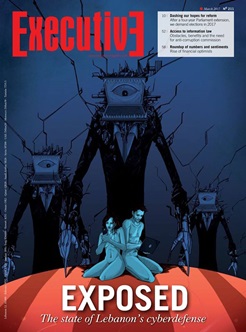
EDITORIAL

Recourse to reform

After a four-year Parliament extension, we demand elections in 2017

LEADERS

Dashing our hopes for reform

It’s time to break the silence on the CMA

Protect us from the modern plague

Lebanon remains overwhelmingly vulnerable to cyberwarfare

Rare opportunity

People now have the right to request information from government entities

COVER STORY

The battle between good and evil goes virtual

Online threats continue to proliferate 

Cyber(in)securities 

Fresh thinking needed to secure the banking system

Securing the entrepreneurship system 

Protecting the startups from the get-go 

The Lebanese cybersecurity landscape

Providers and markets

Propaganda goes viral

Communication continues to morph in the digital age

The public sector’s vulnerability to a cyberattack

A Q&A with OMSAR’s IT security expert, Ihab Chaaban

Cyberthreats in the GCC and the Middle East

Building legislative defense shields

How to protect your email from cyberattacks

A step by step guide

BANKING & FINANCE

Roundup of numbers and sentiments

Rise of financial optimists

HOSPITALITY AND TOURISM

A grand hotel plots a new course

Phonicia Beirut’s GM talks upcoming plan and her vision for 2017

LAST WORD

Lebanon’s national budget

A strategic instrument for adequate policymaking
May 17, 2017 0 comments
0 FacebookTwitterPinterestEmail
Economic ImpactOil & GasSpecial Report

Investment expectations

by Matt Nash May 17, 2017
written by Matt Nash

Walid Nasr’s eyes rolled so far back his head, Executive worried he was having an episode. The Lebanese Petroleum Administration (LPA)’s head of strategic planning was clearly disappointed. Only a few moments into an event organized by the Lebanese Forces, the emcee had wasted no time in estimating the value of Lebanon’s undiscovered offshore oil and gas. Whether she said it was hundreds of millions or billions USD, Executive forgets, as any such forecast is not worth remembering. As promising as Lebanon’s offshore may be, (with each new discovery in the east Mediterranean only adding to the hype), only actual drilling brings any certainty.

That said, revenues are no doubt the first thing to come to mind when one thinks about the oil and gas industry, followed closely by images of a country and economy transformed (think back to the billboards promising bullet trains built with resource money peppering Beirut in 2013). In an interview with Executive, however, Nasr explains, “To get an answer on all the [economic] impacts [the industry could have], you need four important factors: the volumes (discoveries and how large they are), the cost of production, the market price and your actual market. Those four variables are totally unknown.” The LPA, he says, has done scenario planning based on a variety of estimates, but “those series of results are not actual numbers that will be published because they are based on a lot of estimates and assumed values.” And this is only measuring the direct economic impact from the sector (i.e., revenues and employment). The LPA is also embarking on an exercise to estimate the multiplier effect the sector would have throughout the economy. “To have an actual number in ripple effect, you have to know all the variables I talked about [on] one side, plus you need data from the country itself, like the national accounts, economic indicators, facts and figures about other relevant sectors. This is what we are trying to collect, and you know the challenges regarding accurate data and the availability of data,” Nasr says. A sober and pragmatic economic approach to building an oil and gas industry is key, he argues, pointing to a problem already manifesting itself in the education sector.

[pullquote] A country can wait more than a decade between signing an oil and gas contract and the first revenue flows [/pullquote]

Lebanon’s first offshore licensing round opened in 2013, with an expectation for exploration and production sharing agreements to be signed in the first quarter of 2014. Many of the country’s universities took this deadline seriously – even if if its politicians did not – rolling out courses and majors in fields like petroleum engineering and the like. “This is a major problem,” Nasr says, “because the students that have already graduated can’t even find [local] training opportunities, since the industry doesn’t exist. We need to go step-by-step and be really gradual in thinking and moving forward.”

A slow start

Oil and gas is a long game. Contracts tend to last 30 years or more. For offshore acreage like Lebanon’s – which has never been drilled – this means that if contracts are actually signed as planned in November 2017, the country’s economy is still many years away from an oil and gas boost. An October 2014 guide from the United Kingdom’s Department for International Development estimates that – at the long end – a country can wait more than a decade between signing an oil and gas contract and the first revenue flows, as companies decide where to drill (exploration phase) and evaluate any discoveries made (appraisal phase). The guide states, “It is important to note that in the majority of instances, [oil and gas] activity is unsuccessful at the explore and appraisal phase – no potentially viable oil/gas sources are found, or when exploration wells are drilled no oil/gas is discovered or the reserves are not sufficient to justify the size of investment required to extract them. The majority of projects will therefore not reach stages three [development], four [production] or five [decommissioning] of [a typical project] life cycle.”

In Lebanon’s case, keeping its first offshore licensing round open for more than three years has given it a data advantage. It is not uncommon for a country to open a licensing round on acreage that has never been surveyed. Nearly all of Lebanon’s offshore, however, has been covered by 2D and 3D seismic surveys, with the data being interpreted and reinterpreted over the years. This means that the companies that win contracts will start with a pretty good idea of where they might want to drill. Some additional surveying may still be needed, but the bulk of the work that can make the exploration phase take up to five years has already been completed.

Lebanon’s exploration phase, by law, can last up to 10 years. However, the model contracts the state hopes to sign soon narrow that timeframe to five years, divided into two periods (the first a three-year period, and the second a two-year period extendable for another year with sufficient justification, according to the model contract). Companies are obliged to drill at least one well in each of the periods, though they can opt for more. An exact work program (drilling plans and other components) during the full exploration phase is one of the items (with multiple sub-components) companies bid on when submitting an offer. While this seems a strategy in part based on the aforementioned wealth of data and designed to get the sector moving relatively quickly, the actual impact on the economy in the first years after the contracts are signed is likely to be minimal.

Day 1

Zooming in a bit, as soon as contracts are signed, the winning companies will have to open branch offices in Lebanon. With a theoretical maximum of five contracts being signed, this translates into some very minor FDI flows into real estate (it applies to each company in a consortium, so if two contracts are signed – each with a three-company consortium – that is six branch offices). On employment, it’s impossible to guess at this point, but it seems clear that a few branch offices will only require limited staff. And while the model exploration and production sharing agreement includes a much-talked-about requirement for contractor staff to be comprised of 80 percent local citizens, Nasr stresses this a target and “a gradual thing.” “Knowing the situation and to be very pragmatic, we know that we cannot supply 80 percent of professional Lebanese experts from day one, it’s not something doable. However, we kept this target so that companies make every effort to recruit as many Lebanese as possible,” he explains. “Every year the companies will have to submit a recruitment plan – what they need in terms of human resources – and they also do public recruitment, so they would announce the professions needed and Lebanese can apply. If they have the qualifications and skills needed they receive preferential treatment, if they don’t, companies are not obliged to recruit any Lebanese who doesn’t fit the criteria.”

Additional surveys that companies may want to conduct will only have a limited economic impact. An offshore geological survey can cost millions of dollars, but most of that would not actually enter the local economy. However, Nasr notes that for past offshore surveys, “when those [survey] companies were working here, they used some Lebanese services like legal firms, logistics, whatever they needed to actually implement the survey, but of course this is a small percentage of the total investment.”

Feeding the beast

In an effort to pull maximum investment into Lebanon, the rules call not only for hiring locally when possible, but for sourcing goods and services locally as well. In fact, the model contracts give local companies an advantage, requiring oil and gas corporations to use a public procurement procedure when contracting and subcontracting for every good and service,  and demanding locals be given preference even if their prices are slightly higher (10 percent for services, 5 percent for goods) than an equivalent foreign supplier. In the earliest days this might not amount to much in terms of opportunity for the private sector, but if commercially viable discoveries are made, the opportunities (and revenues) will begin flowing. Again, Nasr will not put any numbers on what the future might hold, but notes, “I think with a few efforts from the Lebanese private sector, they can start getting involved.”

May 17, 2017 0 comments
0 FacebookTwitterPinterestEmail
CommentOil & GasSpecial Report

Russian expansionism

by Mona Sukkarieh May 16, 2017
written by Mona Sukkarieh

There’s no shortage of headlines about Russia’s grand design for the East Mediterranean gas resources. An unrealistic understanding of the strategic significance of these resources and the role they could play in weaning Europe away from Russian gas fuels these claims. In reality, we have yet to see a Russian breakthrough in the upstream oil sector of the countries surrounding the Levant Basin.

Cyprus has recently concluded a successful licensing round, awarding exploration licenses to Italy’s Eni, France’s Total and US-based ExxonMobil, alongside the latter’s partner Qatar Petroleum. No Russian company participated in this round. In the previous round, Russia’s Novatek and GPB Global Resources (part of state-owned Gasprombank Group) presented an offer together with Total but ultimately failed to win a license. In 2012-2013, at the height of Cyprus’ financial woes, it was reported that Cypriot officials were tempting the Russians with rights to gas exploration in the country’s Exclusive Economic Zone in return for a second loan from Moscow. It was even rumored Gazprom would offer Cyprus a private bailout plan, as reported in The New York Times, but the Russians were not tempted.

Russia’s interest in Israel’s gas sector has been more palpable. It has made several attempts to enter the Israeli gas market, with no success so far. In 2012, Gazprom bid for a 30 percent stake in the Leviathan gas field. The Russian company reportedly submitted the highest bid but lost to Australia’s Woodside Petroleum (whose bid was ultimately aborted). In 2013, Gazprom signed a letter of intent with the Tamar gas field partners to buy and export liquefied natural gas (LNG) through a floating facility. It never materialized. More recently, Russian President Vladimir Putin and Israeli Prime Minister Benjamin Netanyahu addressed the issue of Leviathan’s development in their latest meetings, with the rationale being that Russian involvement in the Israeli market would contribute to securing Israeli offshore drilling platforms and installations from cross-border threats, particularly those that of Hezbollah. But, here too, we have yet to see concrete results. It will be interesting to follow the results of the first Israeli offshore licensing round and see whether Russian companies place bids, and more importantly, if they will be awarded contracts.

[pullquote] Russian energy companies have yet to match Russia’s growing political influence in the region [/pullquote]

In December 2013, the Russian state-controlled Soyuzneftegaz was awarded an exploration and production license in Block 2, off the Syrian coast. In September 2015, its chairman decided not to proceed with the project because of the risks involved, and announced that the project would go to another Russian company. On April 21 this year, Syrian President Bashar Assad was quoted as saying that his government has started signing deals with Russian oil and gas companies. No details have yet been disclosed.

In Lebanon, three Russian companies prequalified in 2013 for the first licensing round in offshore oil and gas. All of them sought a non-operator role (and some of them partnered with western operators at the time), which came as a surprise for those expecting a more visible presence by Russian companies, and behind them, the Russian state. In the latest prequalification round, one of these companies, Lukoil, sought to modify its status and qualify as  an operator for the tender, but the attempt was unsuccessful. 

The picture is different in Egypt, where Russian companies are more active and are looking to expand their presence. Lukoil is involved in three upstream projects in Egypt, while Rosneft is negotiating a 30 percent stake in Zohr, Eni’s massive 2015 gas discovery.

Generally speaking, Russian energy companies have yet to match Russia’s growing political influence in the region.

There are two ongoing licensing rounds in the region: the Israeli bidding round will close on July 10, the Lebanese on September 15. By the end of the year, we will see if Russian corporations express interest, and – more importantly – if one or more is awarded a license. Where Russia will choose to set its foot, and who will award it a license, are both equally important questions.

May 16, 2017 0 comments
0 FacebookTwitterPinterestEmail
Oil & GasRegional DevelopmentsSpecial Report

Troubled waters

by Matt Nash May 15, 2017
written by Matt Nash

From a technical standpoint, the East Mediterranean is a challenge because the seabed is generally more than one thousand meters below the surface. Ultra-deep water, in industry parlance. From a geopolitical standpoint, the complexity is arguably even greater.

Many problems among a variety of neighbors

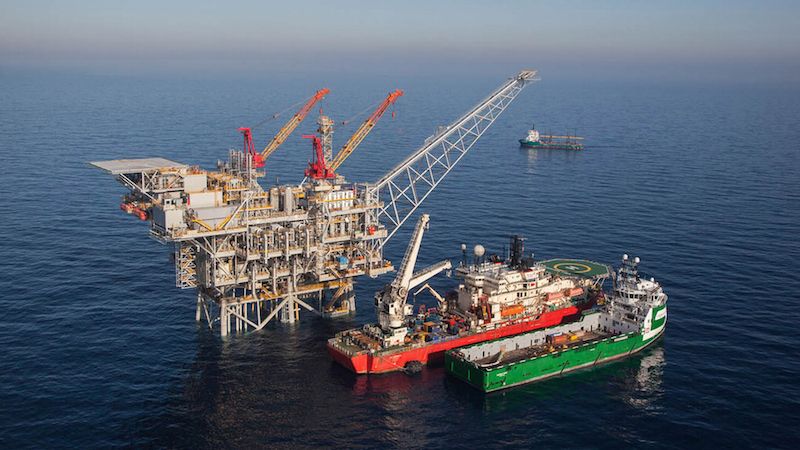
Production of East Med gas began in Egypt in the late 1960s. Activity remained localized for over thirty years until discoveries were made off Israel and the Gaza Strip in 1999 and 2000. For political reasons, the relatively small Gaza find remains undeveloped, while exploration continued apace offshore Israel, resulting in discoveries – namely Tamar in 2009 and Leviathan in 2010 (see map below) – that have helped spark intense interest in the so-called Levantine Basin, a subsea structure shared by Lebanon, Israel, the Palestinian Authority, Syria, Cyprus, and Turkey, at least from Turkey’s perspective. In 2012, Cyprus was elated by news of the Aphrodite discovery, but for all the gas Israel and Cyprus have found, not a molecule has yet been exported. In fact, most of the gas (including everything in Tamar, Leviathan and Aphrodite) remains buried for lack of a clear means to move it out of the region, among other reasons.

In essence, there are two ways to move gas: via pipeline or in liquid form. Shipping gas as a liquid requires liquefying it, which itself requires very costly infrastructure (think hundreds of millions of dollars) regardless of whether the facility is built onshore or offshore. Back in 2013, Cyprus was touting plans to build an onshore liquefaction plant, although the country’s lone discovery did not – and still does not – justify the cost, meaning without more gas (from Israel, for example), there would not be sufficient reason to build an onshore plant, and this plan is currently on hold apparently in favor of a pipeline to Greece. Egypt was also an export route option for East Med gas. As noted, Egypt has been in the natural gas business for decades. However, it has not been the best manager of its resources. Egypt has two onshore liquefaction plants, evidence of past export hopes. Domestic demand far exceeded expectations, however, and for years now the liquefaction plants have either not been used or were used far below capacity, opening an export opportunity for Israeli and/or Cypriot gas. The late 2015 discovery of the “supergiant” Zohr gas field in Egypt’s offshore near the maritime border with Cyprus may change just how much spare liquefaction capacity Egypt can actually offer. In that context, politics have re-entered the equation. The latest Israeli-Cypriot export plan involves a very long subsea pipeline to Greece, and then on to the rest of Europe. Pipeline plans come and go, but a Europe desperate to diversify its gas supplies (over 30 percent of European gas imports come from Russia), an Israel desperate for a political line to Europe, and currently stranded gas earning nothing for anyone could give life to a project that might have been dismissed in a different geopolitical context.

[pullquote] For all the gas Israel and Cyprus have found, not a molecule is yet being exported [/pullquote]

What this means for Lebanon

Even before the Zohr discovery, available evidence suggested Lebanon’s coastal waters were well worth exploring. Zohr changed the game and in the past year, companies prequalified to bid on Lebanon’s offshore blocks have successfully won acreage offshore both Cyprus and Egypt (see company table). While this is no guarantee companies prequalified in Lebanon and working in the neighborhood will bid here, it is a positive sign. In contrast, Israel is also holding a bidding round, but extended its closure from April until July, reportedly due to lack of interest from the major oil and gas companies currently working in Egypt and Cyprus. Receiving bids, of course, is only the first step on a long journey.

It is arguably too early to delve deep into potential export routes for Lebanese gas (remember, we have not found anything yet and have not even really begun searching), but it is worth noting that Lebanon is arguably in a better position than Cyprus or Israel, namely because of existing onshore infrastructure. The Arab Gas Pipeline (AGP) already connects Lebanon to potential buyers in Syria, Jordan and possibly even Egypt, depending how much domestic demand gas from Zohr will meet. How much damage the AGP has sustained during six years of conflict in Syria is unclear, but fixing stretches of a pipeline is clearly cheaper than building an entirely new one. On top of that, building a relatively short additional leg out of Syria can connect the AGP to Turkey, and Lebanese gas to Europe (although the hypothetical leg connecting Homs in Syria to Turkey is currently a war zone, meaning this is not a short-term option).It’s also important to remember the commercial aspects of the oil and gas business. Lebanon is not drilling for resources, profit-driven companies are. Barring a serious disruption in the energy industry, natural gas is expected to be an important part of the global energy mix even if the world keeps its climate change commitment to reducing the use of fossil fuels and stemming the global rise in temperatures. Floating gas liquefaction technology was born to bring stranded gas to market. If companies find quantities worth selling in Lebanon, history suggests they will manage to find a way to bring it to market.

Recent offshore gas activity in the East Mediterranean (Click to view full image)

May 15, 2017 0 comments
0 FacebookTwitterPinterestEmail
Oil & GasOverviewSpecial Report

Into the blue

by Matt Nash May 11, 2017
written by Matt Nash

Potential is the most important word to keep in mind when thinking about a future Lebanese oil and gas industry. In November (provided there’s a functioning government at the time), the country is scheduled to begin offshore exploration, which could provide a revenue stream flowing decades into the future and kickstart a local industry services sector. Fifty-one mostly foreign companies have pre-qualified to get in on the action (see list below), and despite  weaker prices per barrel than Big Oil would like, there is clearly appetite for investment in east Mediterranean acreage – industry slang meaning, in this case, drilling and production rights in blocks of a country’s Exclusive Economic Zone (EEZ). Evidence, from both drilling in the neighborhood and abundant subsea survey data covering nearly all of offshore Lebanon, suggests there could be good news in the country’s near future. That said, detailed predictions about what to expect (which companies will bid to win a contract, how much gas or oil will be found, how much it will be worth) remain as useless today as they have been previously. What is undeniable, however, is that Lebanon’s slice of the gas-rich East Med is on radars near and far.

Terms and conditions

Some four years behind schedule, in September Lebanon will accept bids from oil and gas companies keen to explore its offshore. The rules say each bid must come from a consortium of prequalified companies (one operator, the company actually overseeing the complicated work of drilling hundreds of meters into the seabed, and at least two non-operators). Bids will be based on a model exploration and production sharing contract with a potential lifespan stretching more than 30 years. Certain technical and financial provisions in these contracts have been left undefined, and filling in these blanks is the heart of the bidding process.

The financial offer is the more important of the two in terms of bid evaluation (i.e., on a 100-point scale, it is worth 70 points). Lebanon’s plan for an oil and gas fiscal system (i.e., how the state captures rent from potential resources) has been loudly maligned, but not very well understood. There are certain fixed revenue mechanisms in the contracts, the most talked-about being a 4 percent royalty on natural gas, and a sliding royalty on oil ranging from 5 to 12 percent, based on volumes. Were these royalties Lebanon’s only straw for syphoning revenues from the sector, they would be laughably low, and the critics of this one component of the overall fiscal system would be correct to complain. However, royalties are only part of the story. In addition to paying Lebanon’s corporate income tax (currently set at 15 percent but expected to rise to 20 should Parliament approve a long-promised new oil and gas tax law), companies will bid on the parameters of further revenue sharing with the state based on the volumes of resources (if any) found. The details are complicated (and covered by Executive in the past), but in essence, no matter what exact numbers companies put in their bids, if enough oil and/or gas is found to justify extracting it, the state will begin sharing profits from resource sales immediately, with the state’s share growing over time. Not every country uses the same model, but it is common and – as a system – perfectly capable of maximizing the state’s take from the sector. This is all to say that there’s no way to predict what revenues Lebanon can expect at this point, but the system in place has been proven in other markets and attacks against it are likely to be driven by alterior motives.

The technical bids are arguably more exciting. Evidence from both drilling in the neighborhood and abundant subsea survey data, which today covers nearly all of offshore Lebanon, suggests there could be good news in the country’s near future – and that is not hyperbole. The aforementioned delay, abundant data and regional evidence have pushed Lebanon to be more ambitious than one would expect of a country that has never drilled an offshore well (a frontier area, in industry parlance). If contracts are signed in November, winners will be committed to drilling at least one well (if not more) in the first three years (as opposed to after 7-10 years, which can be the case in other frontier areas). What many people fail to realize is the value drilling offers in terms of useful information that itself can be of greater value in the future. For all the large natural gas discoveries nearby and talk about Lebanon’s potential, we actually know nothing about Lebanon’s offshore. Absolutely nothing. Drilling will change that, even if no discoveries are made. One arguably learns as much from “failure” (a dry well) as from success. The truth is out there, and the first real answers on Lebanon’s potential will come relatively quickly after contracts are signed.

Slow and steady wins the race

Oil and gas is a long game. The contracts Lebanon hopes to sign soon will last more than 30 years, provided a discovery is made (if companies do not find anything in Lebanon’s offshore, the sector could well be very short-lived, although all available indications suggest this will not be the case). A big discovery will no doubt intensify interest in Lebanon’s offshore in the same way large gas fields in Israeli, Egyptian and (to a lesser extent) Cypriot waters make the whole East Med an exciting exploration area. With this in mind, the Lebanese Petroleum Administration (LPA), the sector’s not fully independent regulator, pushed long and hard for gradual licensing (i.e., offering chunks of offshore acreage over time instead of signing contracts covering the entire offshore all at once). From a strategic point of view, gradual licensing allows Lebanon to leverage knowledge gained from drilling to get better terms in the future and also potentially expand the timeframe over which revenues from the sector pour into state coffers. At one point in the past four years, some politicians were against gradual licensing. Ultimately, however, the LPA won. Of the 10 blocks into which Lebanon’s offshore is divided, five are on offer in the first round, with no obligation for how many contracts the government must sign.

Managing expectations

If the deadline is respected, Lebanon will be doing more than signing contracts in November; it will be establishing a potentially valuable new sector. However, even if all goes as well as possible, oil and gas will not transform Lebanon’s economy. In the first few years, most Lebanese likely will not notice a difference. Even 30 years from now, if Lebanon is a regional gas powerhouse, the oil and gas sector will not be an economic pillar the way banking and tourism are. While there will be direct job creation, exact numbers are hard to predict, but thousands and thousands of jobs is an unrealistic expectation. The industry will need services (from housing and transportation to catering and local legal advice), and many local companies may find new opportunities, but again, not in a volume to actually re-configure the economy. In fact, one risk the LPA is actively trying to avoid is known as Dutch Disease, or the rapid refocus of an economy on one sector to the detriment of all others.

The $1,000,000 Question

As noted, it is far too early to guess what revenues Lebanon can expect from potential oil and/or gas finds. It is also a bit too early to say for certain how those potential revenues will be managed. A 2010 law governing offshore exploration and production calls for all state earnings to be deposited in a sovereign wealth fund. The law gives the fund a dual, and potentially contradictory, mandate: save some, spend some. Writing a separate law fleshing out the sovereign wealth fund will function as the sector’s next political priority after contracts are signed. The success of drilling will determine just how quickly the sovereign wealth law needs to be written.

May 11, 2017 1 comment
0 FacebookTwitterPinterestEmail
Economics & PolicyEnergy

Full of gas

by Jeremy Arbid May 11, 2017
written by Jeremy Arbid

Lebanon will finally be rescued from the electricity cuts it has long suffered from, or so says the government as it trumpets its latest plan for the sector. Eight years ago, Electricité du Liban (EDL) supplied, on average, only 18 hours of electricity per day, and an ambitious plan from 2010 did not accomplish much in terms of reducing the country’s shortfall in generated electricity. It did employ short-term measures, like leasing electricity barges, refurbishing existing power plants, and constructing small-scale renewables, all of which slightly boosted the electricity supply. The latest proposal looks like it will, again, emphasize short-term measures, but the government has so far avoided detailing the plan to the public.

At the end of March, Cabinet heard the electricity plan. According to minutes from a meeting that took place, Lebanon’s Minister of Energy and Water Cesar Abi Khalil presented the plan to the cabinet, which agreed to it in principle, permitting him to publicly announce the plan the following week in early April.

But Melhem Riachy, the Minister of Information, told reporters after the March cabinet meeting that ministers had made many comments on the plan, which would  be kept secret, and that the plan would be implemented in a completely transparent way after it was ratified.

Executive requested an interview with the Ministry of Energy and Water (MoEW)  but did not receive a response. A source at the ministry, who did not want to be named, wrote to Executive in an email at the beginning of April that details of the plan could not be discussed because there were several issues yet to be resolved. The source would not explain what those issues were and  could not give a timeframe for the finalizing of the plan’s details.

The plan, in general, calls for measures to bridge the gap between the supply of electricity and consumption, according to a draft that a separate ministry source, who also did not want to be named, confirmed to Executive as authentic but outdated (it was dated March 24, 2017). In the short-term, the plan will call for new generation capacity by leasing new barges. Over the long-term, the focus will shift toward constructing new power plants, and a switch from fuel oil to natural gas for power generation.

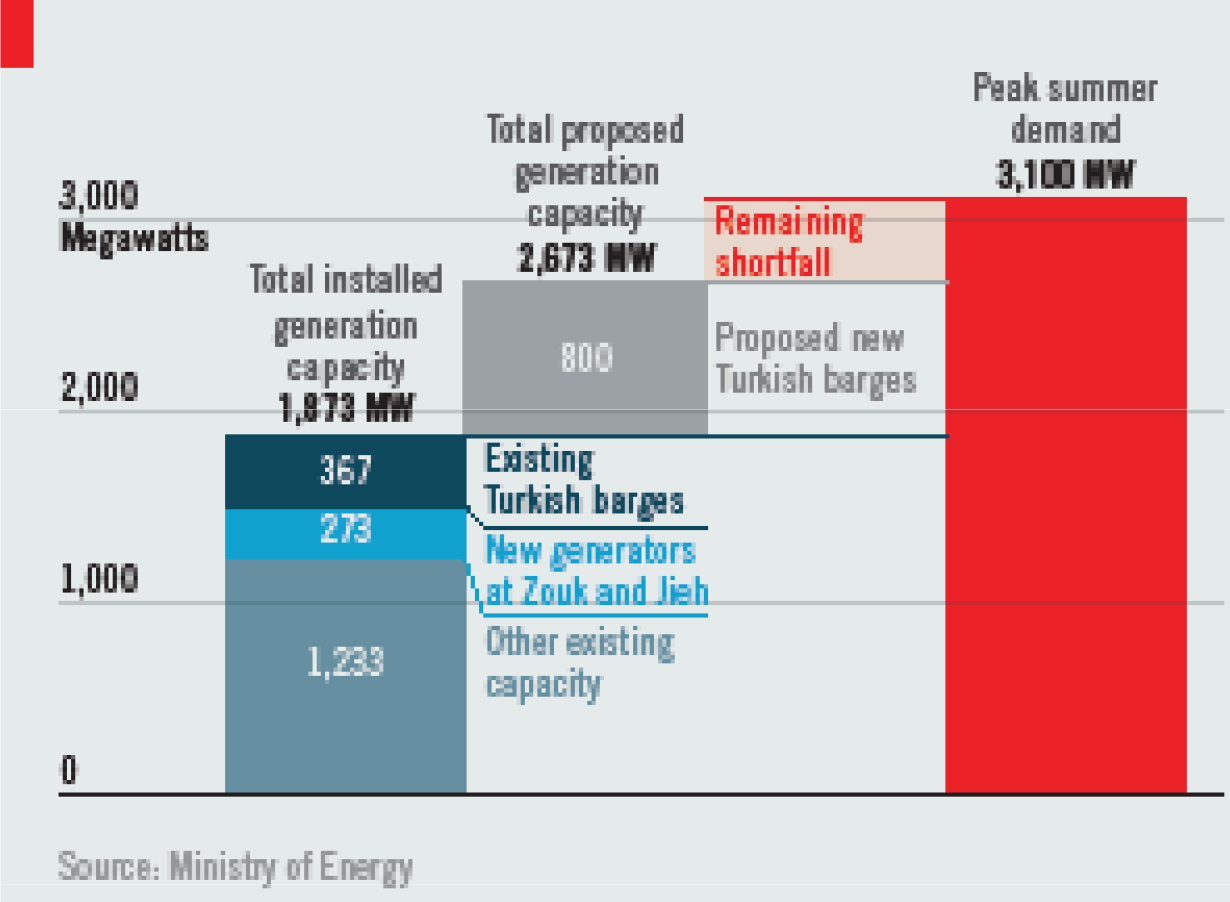
Electricity generation capacity VS demand, 2016

Short-term measures

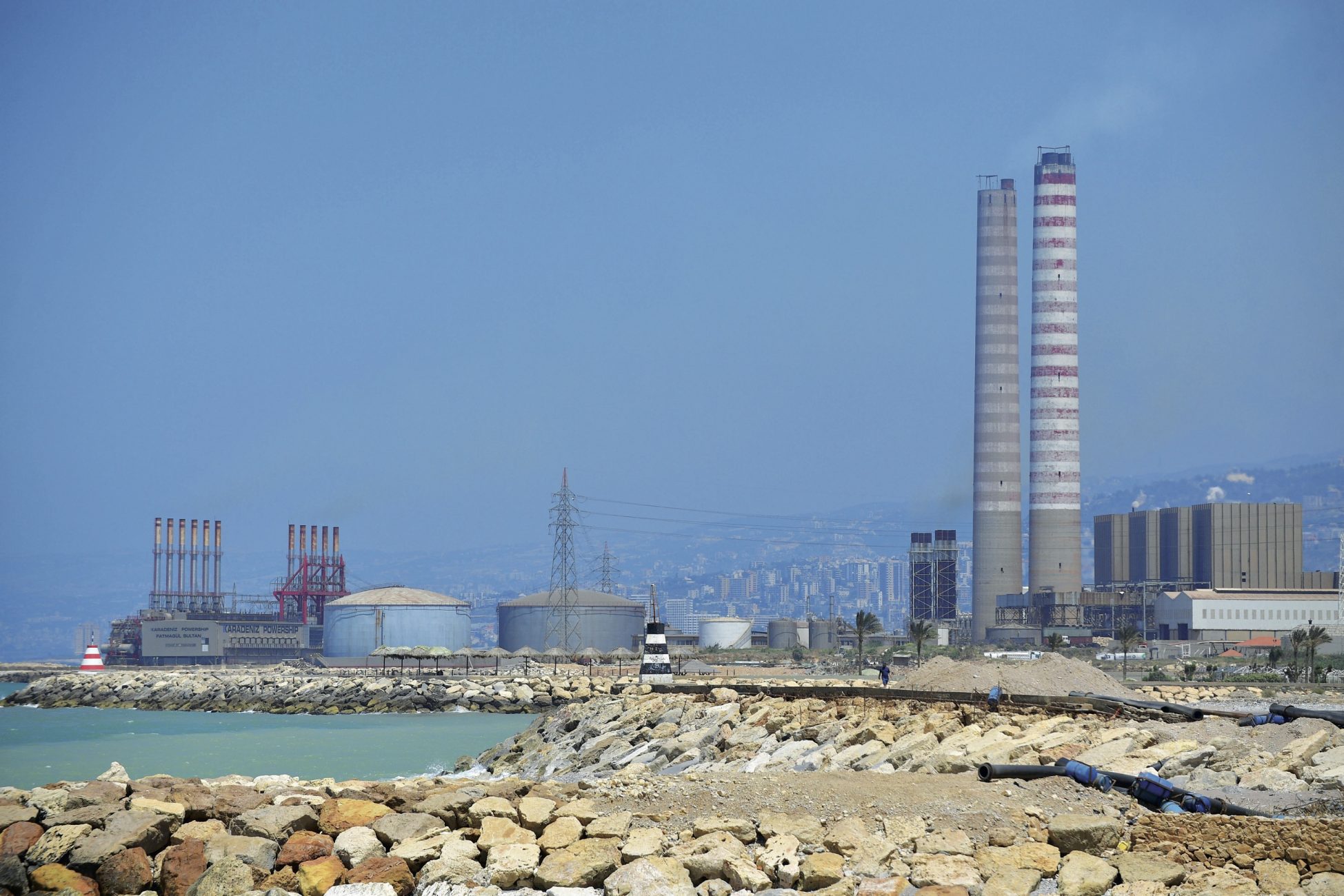
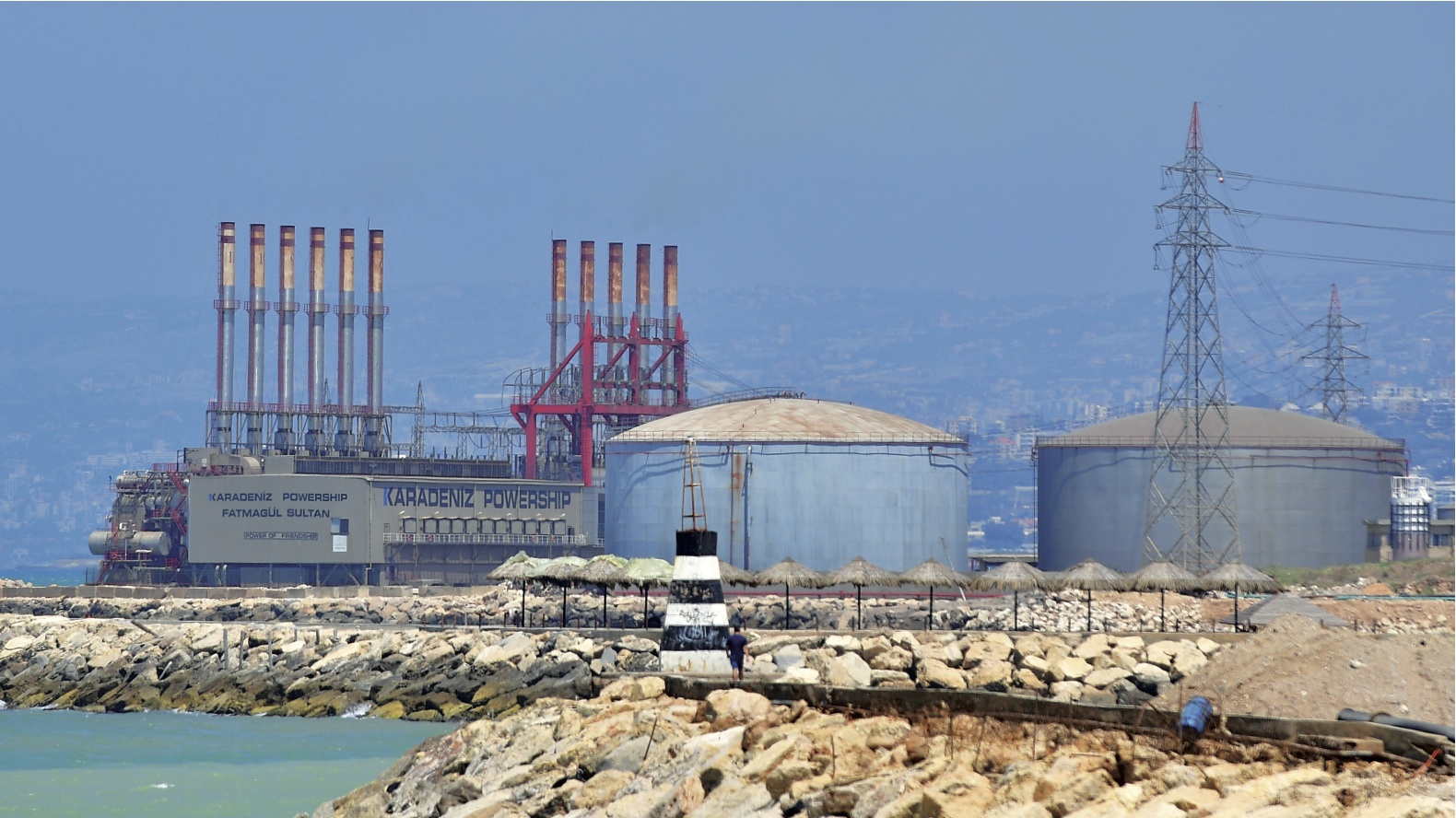
Lebanon, by the end of 2016, had a total generating capacity of 1,873 megawatts (MW). The figure includes megawatts from two Turkish barges that connected to Lebanon’s electricity grid in 2013, and from new reciprocating generators installed at the Jiyeh and Zouk power plants in 2016.

Last summer, peak demand reached 3,100 MW. The government wants to increase the supply of electricity by leasing new barges, according to the draft plan, as a short-term measure to meet this summer’s electricity needs.

In early April, the ministry did publish a tender for two new electricity barges that would generate between 800 to 1000 MW, but bidding was postponed, according to a report in Al Akhbar.

Long-term measures

The new electricity barges that the government might rent are meant as short-term measures that could turn into long-term. The government wants to lease those barges to meet Lebanon’s electricity demands, while it builds new power plants that it hopes to power with natural gas or renewables. 

According to the draft plan, the government wants to partner with the private sector to build new power plants through a modality known as Independent Power Producers (IPP), where companies would own the power plant and sell the generated electricity to the public or Lebanon’s utility, Electricité du Liban.

Worst ranking countries for power cuts and reliance on electricity generators

The government wants to set up solar power infrastructure that would generate 1,000 MW and is now readying to tender 120 MW of solar generated electricity after receiving 265 expressions of interest at the end of March, according to a list of applicants published on the website of the Lebanese Center for Energy Conservation (a government agency tied to the MoEW). The plan also calls on the private sector to build a 1000 MW plant at Solata to be powered by natural gas. Electricity Law 462, ratified in 2002, stipulated that a regulator would be the authority to license new power plants, but the government never got around to appointing that body. Parliament, instead, passed legislation in 2014 and 2015 to get around that roadblock by allowing cabinet, on the recommendations of the MoEW and the Ministry of Finance, to decide when the private sector can build power plants.

The government is again looking to shift from burning fuel oil to generate electricity at most of Lebanon’s power plants to using natural gas. The country’s newest power plants at Deir Ammar and Zahrani, built in the 1990s, were meant to use gas but were never supplied. Gas burns cleaner and would help Lebanon reach its climate change commitments, and gas imports would be cheaper and more predictable than fuel oil. It is also possible that Lebanon might find offshore gas fields as companies are now preparing to bid for exploration, with licensing expected in November this year. However, finding gas and extracting it is a possibility that is several years down the road at the earliest.

Rise in electricity generation capacity and demand

For now, if the government’s plan is to use gas to generate electricity, then Lebanon will have to import that gas. In 2009, the Lebanese government inked a deal to import gas from Egypt via Syria using the Arab Gas Pipeline (AGP). Media reports point to dozens of attacks damaging sections of the pipeline in the Sinai Peninsula since 2011, hampering gas supplies to Jordan and Israel, and it is not clear whether the sections of the pipe snaking through war-torn Syria are functional. Even if the AGP was fully operational, the problem has been that there was never enough gas to supply Lebanon. Egypt is currently a net importer of gas to meet its own consumption needs. Its 2015 discovery of the Zohr gas field offshore might change that, but the first gas is expected from Zohr in 2018, and it is not clear where that gas will be allocated, domestically in Egypt or for export.

[pullquote] The plan forecasts the construction of the pipeline at just under $200 million [/pullquote]

In any case, the AGP only connects Lebanon in the north, at Tripoli. Lebanon would have to import Liquified Natural Gas (LNG) from a supplier abroad to feed the country’s other power plants, and it would need to build a pipeline to connect them. The plan calls for a pipeline that would extend from Solata, the proposed 1000 MW power plant in the north, to Tyre in south Lebanon. The plan forecasts the construction of the pipeline at just under $200 million, but does not acknowledge that much of its proposed pathway cuts through urban areas. The government would have to clear land, including part of the Palestinian refugee camp Ain al-Hilweh, to construct the proposed pipeline, and its proposal does not mention the costs of doing so.

The plan suggests the alternative of contracting three floating storage regasification units (FSRUs) to import the needed gas. A FSRU takes LNG and converts the liquid gas back into its gaseous form for power plants to burn and generate electricity. FSRUs come in different capacities, but three FSRUs would be unnecessary if Lebanon’s power plants were connected by pipeline. If the government does end up with plans to tender three FSRUs, then it is tacitly acknowledging that a coastal pipeline connecting Lebanon’s power plants is not possible.

The MoEW did not want to discuss the proposed electricity plan with Executive and has kept its public comments on the plan to a minimum. One of the ministry officials that Executive spoke with on condition of anonymity described many of the items in the plan as too far-fetched and politically motivated. In the end, the government is proposing a plan in the same way it has operated the electricity sector, and we are all still living in the dark.

May 11, 2017 0 comments
0 FacebookTwitterPinterestEmail
Economics & PolicyTelecom

Unleash the speed

by Matt Nash May 11, 2017
written by Matt Nash

During five days in April, Lebanese internet users were given proof that their notoriously terrible connections have been kept that way on purpose. Lebanon had become a laughing stock. Back when Ookla – the US-based operator of the ubiquitous speedtest.net – offered public rankings of average internet download speeds by country, Lebanon was always near the very bottom of the list. With the rankings no longer public, it is hard to reliably say where we stand today, but we do not really need an official ranking to know typical Lebanese download speeds of 1 to 2 megabits per second (mbps) are pathetic.

Last month, the publicly owned gatekeeper of Lebanon’s internet – Ogero – conducted five days of speed tests in different parts of the country. The results were jaw-dropping. The company’s new director general (appointed by the cabinet in January) claimed on Twitter that some users reached download speeds of 27 mbps, a 1,250 percent increase from the 2 mbps standard of the past few years. The majority of speedtest.net results tweeted at Ogero showed speeds around 16 mbps. And this without any intensive infrastructure projects. It was programmable.

“We’ve been saying for years that a simple administrative decision would improve the internet by at least 30 percent in terms of bandwidth, in terms of speed,” explains Maroun Chammas, CEO of IDM, a local internet service provider (ISP).

The bad old days

The Ministry of Telecommunications (MoT) is the sector’s steward. In addition to devising and implementing policy, it owns nearly all the infrastructure (fiber, copper and mobile-phone base stations). On the MoT’s recommendation, the government decrees the price of every phone call (mobile and landline), and the ministry’s hand is heavy on the internet. Competition in this segment is permitted, though in recent years it arguably has not been encouraged. In 2007, the steward oversaw a transformation in the market. At long last, the dial-up connection (complete with screeching modem) was replaced with a digital subscriber line (DSL) service. The future. Lebanon was a last adopter of this technology. Local rollout was slow, and download speeds are, a decade later, still abysmal.

To make a long and technical story short, the MoT and Ogero, a state-owned enterprise working as a ministry contractor, have considerable power over the internet market. With control of most of the infrastructure that allows someone in Lebanon to check their email, competition in the market can be easily hobbled. Private companies are allowed to use some of their own equipment to serve customers, but Ogero is in charge of the links that move customer traffic from one piece of equipment to another, before actually moving that traffic on to the information superhighway (via cables Ogero manages all access to). In other words, Ogero is the one closing lanes on access roads and opening only two tollbooths onto the highway during rush hour. Except it is at all hours. Every day. Whenever an unhappy customer – or a curious reporter – would ask a private provider why the internet was so bad, there was always one answer, however diplomatically delivered: Ogero, specifically in the person of its former director general. This has been true for 10 full years. It almost seemed like a convenient excuse (“Abdel Moneim Youssef ate my homework”) until the internet magically got better. Much better. Just like that.

The grey market

There used to be informal advertisements all around Beirut (which, when Executive decided to photograph one in April, were surprisingly very hard to find). An A4 piece of paper adorned with a few words in black ink, slapped up on a wall: “Wireless Internet Free for one month [local mobile number].” Some included monthly prices, some did not. This is the grey market. You pay a guy. He brings a wire to your house, sells you a router, and you have internet as fast as the two lowest-priced DSL packages, which an estimated 90 percent of legal users opt for, according to interviews with private players and an Ogero official that Executive conducted in 2014. Until recently, these illegal providers would get international bandwidth (actual internet access) in one of two ways: 1) by redistributing several legal connections to multiple users (small fry, and as best Executive can ascertain, the smaller part of the grey market segment) or 2) by bringing it in from abroad. As noted, Ogero controls the cables connecting Lebanon to the actual internet, but international capacity (as that on-ramp to the highway is called) can be secured via satellite or microwave. Many grey market providers were avoiding Ogero (and associated costs) all together.

[pullquote]

Ogero used to view the private sector as the enemy

[/pullquote]

Anywhere in the world, an ISP is that link to the highway. They buy access to the internet (bandwidth) and sell it to users at a higher price. The price at which Ogero buys bandwidth and from which provider has not been made public, but market estimates of around $4 per E1 line (2 mbps of bandwidth) seem reasonable based on internet research into the topic. ISPs in Lebanon currently pay Ogero $250 per E1 line (reduced from over $1,000 in 2014). Grey market providers buying bandwidth abroad no doubt pay more than Ogero (having at least a satellite link provider between themselves and an actual internet seller), but almost certainly less than local ISPs pay Ogero. And the advantage is not only on international bandwidth. ISPs must deposit  a $1,000 letter of guarantee on every E1 line they get from Ogero, according to both IDM’s Chammas and an ISP owner who spoke on condition of anonymity. Also, ISPs can only offer DSL on an Ogero cable. The grey market providers just add another wire to the tapestry slowly being weaved from building to building across Lebanon and hook users up the next day.

Between 2014 and 2015, the grey market got a bit whiter. Chammas as well as one private-sector and one publice-sector source told Executive that around 120 grey market ISPs were semi-legalized during that time period. Details are unclear, but what Executive can confirm is that companies formerly buying international bandwidth from abroad were sold bandwidth by Ogero – at a time when previously licensed ISPs were asking for bandwidth and not receiving it – but continued to be exempt from providing letters of guarantee and respecting distribution rules. Shortly after this apparent attempt at better regulating the market – which disrupted a supply chain at least 10 years old – corruption charges against then-Ogero Director General Abdel Moneim Youssef began to fly.

A new era?

Ogero’s director general is one of three directors general at the MoT. As such, the company’s head is an integral part of devising the ministry’s strategy for developing the country’s telecom sector. Ogero implements whatever strategy it helps write. The three-seat power structure gives the MoT’s Director General of Maintenance and Operation power to oversee Ogero’s work, and act as a check and balance, as Imad Kreidieh, the new head of Ogero, explains it. Until January, Abdel Moneim Youssef was both Ogero’s DG and the DG of maintenance and operation, “judge and jury,” Kriedieh says. That situation has now been resolved. Youssef is currently being scrutinized by the judiciary and is out of, well, two jobs. Kreidieh replaced him at Ogero, and Bassil Ayoubi is now in Youssef’s other former leadership spot at the MoT.

Market reaction to the change – only around 12 weeks old when Executive made the rounds – was cautiously optimistic. Communication between the private sector and both Ogero and the MoT is significantly improved, and Kreidieh speaks to Executive like a penitent. He admits that, prior to assuming his post in January, for Ogero, “the private sector used to be seen as the enemy.” He insists, however, “my role is not to consolidate a monopolistic position, but to offer the infrastructure for anyone who has a license, the technology, and the content to deliver it.”

Offering the infrastructure he reportedly is. On April 11, 13, 15, 27 and 29, Ogero quite simply unleashed the speed, to borrow the company’s hashtag. The tests lasted only a few hours, and were conducted in a handful of areas on each day. However, according to Habib Torbey and Patrick Farajian, heads of the data service providers Globalcom Data Service and Sodetel, respectively, the private sector has been able to keep the speed unleashed in the spots Ogero tested, as the lines between privately owned equipment are no longer congested.

Kriedieh has repeatedly said in public (both in March at ArabNet and during April on Twitter) that a new internet pricing decree will be presented by the MoT to the cabinet sometime soon, never committing to a precise deadline. While in the mobile phone segment, such a decree sets the price of all phone calls in the country (and out of it, which is why voice over IP services, like Skype, are still technically banned). In the internet segment, such a decree only sets internet package prices for Ogero. Private sector ISPs can charge customers whatever they choose (although most stick close to the decree to remain competitive), but the price of internet access (an E1 line) they pay Ogero is set by the decree. In the past, the price of internet packages for end users has been based on two factors: the speed of the connection and the monthly cap on download capacity. The decree will remove speed as a factor, Kriedieh explained, meaning users will be given the fastest speed their connections can deliver. Word on the street is that Ogero’s speed test days will become market realities after the decree. Executive interviewed Kreidieh before the tests, and he was unavailable for comment after.

Remaining constraints and the road ahead

This is not to say it is internet Christmas eve for every last one of us. Congestion is only one part of a series of problems. Individual internet users in Lebanon connect to central offices (COs), which then connect them to the internet, with copper cables. This is an old technology, with speed transfer limits and a serious problem transferring data quickly over a distance more than one kilometer. Fiber optic cables are now industry standard, and Lebanon has fiber in many places where it is needed (the country has 6,000 kilometers deployed, Kriedieh says). With a new government taking office in January came a new policy for the sector, Kreidieh explains. He describes the new strategy as “not politicized, user-centric and time-bound,” adding that “by the end of 2018, things will be much, much better.” Four projects are currently in motion, he says, the centerpiece of which is a long-discussed fiber-to-the-cabinet project (a cabinet being a piece of telecom equipment placed between users and a central office, not to be confused with the Council of Ministers). The project involves connecting individual users via copper wires to nearby cabinets –  which would themselves be connected by fiber to COs, meaning only a few cabinets and fiber cables would need to be installed to provide a multitude of users fast connections instead of fiber from the CO to each individual home. The project should begin in September and take 18 months to complete, Kriedieh says. He promises download speeds of “over 100 mbps without fiber” to the home (a technological breakthrough circa 2010).  [Editor’s note: Fiber to the cabinet was phase two of the now-fully-abandoned MoT national strategy launched in 2015. It was supposed to be nearly completed by now.]

[pullquote]

Congestion is only one part of a series of problems

[/pullquote]

The elephants in the room

Kreidieh claims not to see himself at the helm of a purely profit-driven commercial enterprise. At one point during the interview, he describes Ogero as a regulator. What he promises to deliver is a nationwide telecom network capable of providing all users with voice, data and streaming video services on the same cable. Triple-play, as it is called in the industry. Yes, a better network will benefit Ogero and help expand its market share (which he pegs at 290,000 of 700,000 legal subscribers, or 41 percent, admitting, however, that there are “leakages” that make the true number of subscribers unknown). Kreidieh, however, insists strengthening Ogero’s market position is not his goal. With a network capable of modern offerings, he says that he wants the private sector to flourish. The private sector, meanwhile, seems to want the access it has long been denied and a level playing field (meaning either fully licensing the 120 or so providers semi-legalized two years ago or forcing them out of business). Many estimate these semi-licensed providers have a significant customer base, although the numbers are very fuzzy.

Lebanon’s reported total number of fixed-line broadband (DSL) connections stands at slightly over 1.2 million, according to MoT data supplied to the International Telecommunications Union. If both that number and Ogero’s figure of 700,000 fully legal connections are correct, the formerly grey market would service over 500,000 customers. Ignoring the fact that 1.2 million fixed connections would mean Lebanon’s estimated 900,000 households are all wired, with some households actually having two or more DSL lines, it is safe to assume that there are at least some potential market share gains for fully-licensed ISPs if some providers leave the market when the rules apply equally to everyone.

Kreidieh offers no detail on how to deal with the 120 or so semi-legalized ISPs aside from suggesting that when the service offered by Ogero and fully licensed private ISPs is significantly improved the market will correct itself. If these providers are allowed to continue buying bandwidth from Ogero while being allowed to ignore the rest of the rules, however, it is hard to see how they will be pushed out of the market completely. Fully licensed ISPs may have more services to offer in the not-too-distant future (i.e., streaming, high-definition video and TV over the internet), but the market overwhelmingly demands a cheap connection, and is conditioned to accept vastly inferior services.

May 11, 2017 2 comments
0 FacebookTwitterPinterestEmail
Hospitality & TourismQ&A

Le Gray Grows

by Executive Staff May 10, 2017
written by Executive Staff

Situated across from Martyr’s Square with a view of the mountains over the Mediterranean, Le Gray hotel has been a prominent structure in downtown Beirut’s landscape since it was founded in October 2009.

Operated by Campbell Gray Hotels and a member of the Leading Hotels of the World, Le Gray Beirut is a luxury five star property with 87 rooms, six F&B outlets and a spa. As such, Le Gray is positioned as a high end boutique hotel with an emphasis on accommodation and food and beverages.

This positioning has served the hotel well in its eight years of operation in Beirut but, since the property didn’t have a banquet hall or large meeting rooms, certain market segments were harder to access- namely the Meetings, Incentives, Conferences and Exhibitions (MICE) and the wedding segments.

While the presidential suites on the hotel’s top floor were often used for small meetings or receptions, this was not enough to usher through the large volume generated by MICE and wedding segments.

The expansion the hotel is undergoing is meant to rectify this and allow the property to tap into these markets.

Executive sat with the hotel’s General Manager George Ojeil to learn of the expansion’s details and its impact on Le Gray.

E What does the expansion entail?

We have finalized three floors in the building. The basement, ground floor and first floor.

The basement includes a ballroom which can accommodate up to 350 people for a seated meal.

E So you’re targeting the weddings market with that ballroom?

Yeah weddings, social events, conferences… It’s a beautiful ballroom with state of the art equipment and decoration.

And then we are going to have a screening room; the only one in Beirut within a hotel. It’s like an amphitheater or small auditorium with the latest technology in audiovisuals, Dolby surround system etc… it can accommodate 53 people.

E What do you see people using the screening room for?

It could be used for product launching such as car launching which needs special effects and advanced audiovisuals; it can be used for a movie presentation or an afternoon kids’ birthday party with animation.

We also added a multipurpose or news room that can be used as a conference room and can accommodate up to 60 people depending on the setup.

Finally we have a board room that can accommodate up to 26 people in a boardroom set up.

This boardroom will have a virtual screen and we will be the first venue in Beirut to have that.

E Are these spaces going to be rented per hour or how does it work?

If any conference is followed by a meal, the conference room will be granted on complimentary basis. However, if there won’t be any meal (and just a coffee break) there will be a rental fee depending on the length of stay per day and on the room. For example, booking the smaller boardroom has a different fee than the conference which is of bigger size and capacity. It also depends on the demand.

E How often do people attending conferences in Lebanon book a hotel room as well?

Demand for residential seminars is on the increase again with the lift of the travel ban and the safety and security we’ve been witnessing at the local level.

Before the lift of the ban, these seminars had been deviated to Jordan and the Gulf (mainly Dubai and Abu Dhabi) so we have been witnessing increasing demand and this should support occupancy in the hotel as well because previously we were perceived as a boutique luxury hotel which offers accommodation simply and I would say luxury or highly developed services in food and beverages. But now I can say that we will be in a position to host residential conferences.

We are also adding more rooms and will have 103 rooms. This usually supports those kinds of seminars because typically when they meet in Beirut they would need up to forty rooms and when we had only 87 rooms, we couldn’t allow ourselves to book half of the hotel for a seminar and anyhow we didn’t have any conference facilities to offer them.

E Is this a rule that you cannot book half the rooms in a hotel for one event?

We prefer to avoid such scenarios especially in boutique hotels. We are a hotel that is known for repeated business and so we cannot book half of the hotel for a single event because it will put us in a situation where we might have to turn down repeaters.

E How does Le Gray still fit into the boutique hotel feel with 103 rooms?

Usually the number of rooms is below 100 and guests are more than just a number.

You have more of anticipating guests’ needs, more of a personalized service, attention to details…

It’s different than a big box and more complicated. We accommodate high end frequent international travelers with sophisticated demands and that’s why they look for such type of hotels. We know their needs from their previous visit and accommodate for them.

E How many new people are you hiring with this expansion?

27 head counts.

We are going to have a new lobby lounge so we will have more wait colleagues for that, banquet sales, banquet operational people, additional colleagues for housekeeping and a few additional colleagues in areas of support (administrative, sales and marketing) and in the kitchen we will have three additional chefs for that.

E With all these new additions, it seems you want to compete in the MICE category knowing that this space is almost saturated with the existing banquet halls and conference rooms?

There will always be other banquet halls or conference rooms and that is why we have a solid differentiation strategy for positioning our product.

Our wish is to position ourselves as the unique destination in downtown Beirut in terms of conferences and events. We have the best location in Beirut -although in politicized area-but when things are calm the location is strategic in being central with easy access.

We are determined on delivering the same quality of service in our banquets that we do in our restaurants and rooms. It’s going to be very personalized: the choice of menu will be meticulously done, the way the food will be set and the displays is going to be different and innovative with elaborated food stations, carvings….

E You are emphasizing your F&B offerings in your reply. Do you consider F&B to be your strength as a hotel ?

We are an F&B hotel.

We have six outlets for F&B and the banqueting in a 103 rooms hotels with each outlet being unique. Our wish now is to take it the higher level and we recruited a new British chef few months ago.

E Why did you choose to undergo the facilities additions when you did considering the situation the country was in then?

I think they took the right decision investing in tough times back in October 2015. Now, we will be inaugurating the project in perfect timing for the summer season.

E How much did you invest into the expansion?

It could reach $13 million. The furniture, choice of fabric, the artwork… we’ve been meticulous about this and it will pay back.

E Who are you targeting with the additional facilities and the expansion?

The conference and events market is flourishing in Beirut regardless of the situation so this will support the hotel during tough times when Beirut is not a destination for international travelers. Lebanese will always spend like crazy on their weddings.

Now we will have an addition which will allow us to penetrate a new market which we did not benefit from at the time and which affected us.

Despite this we have to point out that we were number one in the market in terms of occupancy.

May 10, 2017 0 comments
0 FacebookTwitterPinterestEmail
LeadersOpinion

Don’t sweat the details

by Executive Editors May 10, 2017
written by Executive Editors

After a rocky start that saw a several-year delay of the sector’s development as a result of political squabbling, in late April the Lebanese Ministry of Energy and Water (MoEW) announced the oil and gas companies that will be eligible to bid for offshore exploration licenses in late. Executive lauds this milestone and hopes the government adheres to the ministry’s step-by-step plan to get contracts signed in November.

Parliament must immediately ratify a newly produced draft transparency law to oversee the country’s hoped-for oil and gas sector. The law codifies the publication of information, like payments from companies to the government, and criminalizes illicit behavior. Its ratification would send a positive signal to the companies and professionals looking to do business in the country on a level playing field. It would also show the public that the government’s management of the sector will be open.

Lebanon needs this law because, as experience shows, we cannot rely on the good faith that the MoEW, and the rest of the government, says it is bringing to the oil and gas sector. We need strong legislation to hold them to account as they manage an industry that is notoriously dirty the world over.

The ministry says it wants to manage oil and gas in an efficient and transparent manner, its track record in other industries, however, sometimes shows it doing the opposite. While it has articulated its near-term plan for oil and gas, and shown its willingness to engage the public, it has not done so for its other major portfolio – electricity. Lebanon was not able to complete the implementation of its 2010 electricity plan; and the ministry has never explained why it failed.

With regards to the the latest plan for electricity, dubbed the “plan to rescue the sector,” the government has given the ministry a carte blanche in filling out the particulars, and the ministry has avoided sharing the details with the public. The last cabinet meeting to discuss the electricity plan took place at the end of March, but what has happened since then, and how will Lebanon secure both its short and long-term electricity needs?

Do not worry about it, the Minister of Energy and Water wrote on Twitter, as Executive went to print. The message was, as long as there is an electricity boost in the summer, do not sweat the details and trust us. Trust a ruling class whose governments have successively failed since the 1990s to provide cheap and reliable electricity? That, in that same time, drained tens of billions of dollars from the public treasury to subsidize Electricité du Liban – a failing public institution that the 2010 electricity plan admits is vastly overstaffed with unqualified political appointees? No, thank you.

The electricity plan needs to be scrutinized, but first, it needs to be detailed. We have no idea, beyond some high level bullet points, of what its measures will cost or how they align with Lebanon’s climate change commitments. We do want 24-hour electricity, but are not willing to write a blank check to get it.

Lebanon’s potential gas resources might be used to generate electricity down the road, linking these two issues, and the ministry is at a crossroads regarding the intersection of these two portfolios. The path taken could lead us miles forward, or in the other direction. Unfortunately, any confidence that could be inspired in the transparent planning of oil and gas is immediately shaken by the opacity with which electricity is handled.

May 10, 2017 0 comments
0 FacebookTwitterPinterestEmail
LeadersOpinion

Self absorbed

by Executive Editors May 9, 2017
written by Executive Editors

Donkeys deserve more respect than they get. For some 5,000 years, humans have been using them as strong, reliable beasts of burden. We’ve made progress on the backs of these noble creatures, yet denounce them for a strength of will we praise in ourselves. Intransigence is in the eye of the taskmaster, it seems. Donkeys aren’t stubborn because they’re lazy. A donkey’s stubbornness actually belies its intelligence. While humans can poke and prod horses to do nearly anything, if a donkey senses it is being pushed to act against its self-interest, it won’t budge. Hardly ideal for a work animal, but a respectable trait nonetheless. That said, a donkey will never win the Triple Crown. For both strength and speed, the more malleable horse is a far better bet. Lebanon’s economy needs a horse. The donkey we’ve been riding is old, tired and clearly not up to meeting new challenges with anything that resembles swiftness.

Our system is our donkey. Not parliament, cabinet or the presidency as such, but the whole confessional, consensual system. The so-called 1 percent have a disproportionate amount of power the world over, but Lebanon’s elite have their status further protected because each is a guardian of a self-absorbed community worried about its own interests and protection rather than the creation of a strong and functioning state that could benefit all citizens. Our donkey is at once the people in power, but also, the unwritten compromise that keeps them there and paralyzes decision making in this country.

While the donkey has overseen some decent economic times in the past 25 years, recent times have proven just how useless our donkey has become. While the Great Recession did little damage to the Lebanese economy, fallout from the civil war in Syria has been devastating. As growth fell from 8 percent in 2010 to 2 percent in 2011, as per World Bank figures, the donkey didn’t budge. And it has only barely moved since. This stands in stark contrast to Banque du Liban, Lebanon’s central bank, which has proven to be a thoroughbred, albeit one still confined to the paddock. Boosting growth is not BDL’s job, yet the institution has been doing all it can in this regard as the donkey munches grass, neither inspired to follow suit, nor willing to lend a hoof. In the past five years, BDL used subsidies and circulars in an effort to prop up the so-called pillars of Lebanon’s economy, real estate, tourism and banking. The hardest hit – real estate – has received the most help, and BDL still claims responsibility for 50 percent of growth since 2012, which Executive is unable to verify. The donkey makes no such boasts.

[pullquote] Our system is our donkey. Not parliament, cabinet or the presidency as such, but the whole confessional, consensual system [/pullquote]

This is infuriating. In the pages that follow, the donkey’s dereliction of duty is well documented. Seven years after a plan for fixing the electricity sector won the donkey’s support, nothing has changed. In fact, the donkey is still munching on the same plan it approved but never implemented. Two electricity bills drain households of disposable income and restrict the regional competitiveness of local industry. Twenty-four hours of state-supplied electricity by 2015, as the donkey promised in 2010, would have had a cumulative impact by now.

For its handling of telecommunications – particularly the quality of internet service in the country – the donkey deserves a beating. Download speeds in Lebanon have been kept very slow on purpose in recent years. While blame for this is often laid at the feet of one man, the donkey kept that man in place. A World Bank study from 2009 found that a 10 percent increase in access to fast internet gives GDP growth a recurring 1.3 percent boost in developing countries. Again, widespread, faster internet was possible years ago and our economy would be stronger today had the donkey but moved.

The donkey also delayed the launch of Lebanon’s oil and gas sector, and could yet stand in the way once again. To explore the country’s offshore potential, wells must be drilled. That won’t happen without contracts between the government and companies qualified to do that drilling. Contracts were supposed to be signed back in 2013, but the donkey failed to pass two needed decrees. While the donkey passed the decrees in January, we need a donkey to sign contracts in November, but might not have one, as the donkey’s plans for long-overdue parliamentary elections are anything but clear. The donkey’s refusal to choose an electoral law adds an unnecessary and unwelcome element of uncertainty onto an already disastrous economic situation.

The donkey is a losing bet. We’ve done all we can to push it into action over the years, with little to show for our efforts. It’s time to ditch the donkey and start betting on a horse.

May 9, 2017 0 comments
0 FacebookTwitterPinterestEmail
  • 1
  • …
  • 105
  • 106
  • 107
  • 108
  • 109
  • …
  • 691

Latest Cover

About us

Since its first edition emerged on the newsstands in 1999, Executive Magazine has been dedicated to providing its readers with the most up-to-date local and regional business news. Executive is a monthly business magazine that offers readers in-depth analyses on the Lebanese world of commerce, covering all the major sectors – from banking, finance, and insurance to technology, tourism, hospitality, media, and retail.

  • Donate
  • Our Purpose
  • Contact Us

Sign up for our newsletter

    • Facebook
    • Twitter
    • Instagram
    • Linkedin
    • Youtube
    Executive Magazine
    • ISSUES
      • Current Issue
      • Past issues
    • BUSINESS
    • ECONOMICS & POLICY
    • OPINION
    • SPECIAL REPORTS
    • EXECUTIVE TALKS
    • MOVEMENTS
      • Change the image
      • Cannes lions
      • Transparency & accountability
      • ECONOMIC ROADMAP
      • Say No to Corruption
      • The Lebanon media development initiative
      • LPSN Policy Asks
      • Advocating the preservation of deposits
    • JOIN US
      • Join our movement
      • Attend our events
      • Receive updates
      • Connect with us
    • DONATE