• Donate
  • Our Purpose
  • Contact Us
Executive Magazine
  • ISSUES
    • Current Issue
    • Past issues
  • BUSINESS
  • ECONOMICS & POLICY
  • OPINION
  • SPECIAL REPORTS
  • EXECUTIVE TALKS
  • MOVEMENTS
    • Change the image
    • Cannes lions
    • Transparency & accountability
    • ECONOMIC ROADMAP
    • Say No to Corruption
    • The Lebanon media development initiative
    • LPSN Policy Asks
    • Advocating the preservation of deposits
  • JOIN US
    • Join our movement
    • Attend our events
    • Receive updates
    • Connect with us
  • DONATE
BankingSpecial Report

Banking on reason

by Thomas Schellen June 20, 2017
written by Thomas Schellen

Pushing loans onto consumers has become the fashion among financial service providers — a fashion hardly more concerned with reason and logic than proposing the existence of prefabricated tears and holes around the knees of a new pair of jeans. But, while the latter insanity is only a serious detriment if you want to use your jeans for actual work, like laying bricks on a patio, the former can be ruinous for consumers, as banks push products that carry added risk by catering to advertising-induced, exaggerated, or otherwise non-existential needs. These products are nonetheless well embedded in the profit-seeking culture of contemporary consumerism, in Lebanon as elsewhere. But one Lebanese bank ­— specifically one that can claim to be rooted most deeply in the territory’s history, even before the founding of the Republic — is pursuing a path less trodden.

BSL Bank, which in various earlier phases of its history carried names from Ottoman Imperial Bank to Banque de Syrie et du Liban, has made waves in the market since the beginning of this year. It began by offering the unthinkable: a housing loan with an annual interest burden of practically zero percent. In spring, it followed with a personal loan that proposes an annual percentage rate (APR) of 10.62 percent. APR — which reflects real interest charges and other costs of a loan and is mandated by the central bank to appear in loan advertisements — is not an intuitive concept that lends itself to back-of-the-napkin computation by consumers, but it is easy to compare APRs under the simple rule that lower is better.

By this comparison, most personal loans in Lebanon have, in recent years, been priced at four or more percentage points above BSL’s new offering. According to BSL General Manager Elias Alouf, customers are not eligible for the loan if they are a foreigner (as per every bank in the country) or have too few zeros on their monthly paycheck (the floor for loan qualification is a monthly income equivalent to $2000 or $2,500 for the self-employed). Neither will the loan be approved if the cash is to be blown on a cruise, lavish celebration, high-priced image-boosting car, or some other conspicuous consumption extravaganza. 

At first, this array of lending conditions brings to mind a quote by 20th century American comedian Bob Hope, who famously said that “a bank was a place that will lend you money if you can prove that you don’t need it.” But, Alouf describes the BSL’s approach as a matter of practical prudence — the risks of a low earner defaulting on a loan are exponential when compared with mid-income families, he says. He portrays BSL as balanced between “agile and disciplined,” claiming that this is the bank’s strength. “Being simultaneously agile and disciplined makes a bank flexible and enables it to promote its products and services rapidly, but at the same time we will never forget the basics of banking,” he elaborates. This identity matrix appears to be topped off by classical societal principles, and perhaps, a dose of some patronizing behavior. “We really are orientating the bank toward helping the Lebanese to stay in Lebanon, buy their houses, and create their own business,” he explains.

Next, he lowers his voice to a conspiratorial whisper and apologizes in advance for uttering the “e” word. “Excuse me, this is ethical,” he says when explaining how BSL will not push its customers into borrowing for purposes of conspicuous consumption, leisure, or even the financing of big family events such as weddings and christenings. “These are things that should not be financed by banks. Bank financing is for necessities. For us, everything that is leisure, travel, etc., is not a necessity,” he says.

In his view, people should save if they want to go on a vacation, rather than overburden themselves with debt that can turn a two-week holiday into a years long commitment to loan installments. According to BSL, self-financing such enjoyments is the correct path and it will therefore always inquire of loan applicants their objectives for borrowing before deciding whether to approve the loan.

To entertain such a strategy, a lender has to be selective as well as self-restrictive, and operate on principles that at times are likely to get in the way of maximizing profit. “We don’t want to only be a profit-oriented bank,” Alouf says. “We want to contribute and help people as much as we can. When you look at the basic needs of the population, they need to buy a home, they may need a personal loan to renovate their apartment, they need to educate [their] children, insure retirement and that’s it. I will not finance a lifestyle.”

He acknowledges that this can be viewed as an attempt to change the mentality of Lebanon’s loan-happy consumers, but emphasizes that BSL does not aspire to move behavioral mountains in an instant. “We are a mid-sized bank, not one of the top banks, and we are not going to tell you that we are going to change the mentality of consumers. [But] people will always make comparisons, and they will see a bank that is not [goading] them to take loans, but instead is advising them in certain cases not to take a loan. It will have impact on the consumers, trust me. But not to a very large extent. It is a snowball effect,” he says.

[pullquote] Bank financing is for necessities. For us, everything that is leisure, travel, etc., is not a necessity [/pullquote]

Besides seeking to distinguish their lending through new retail products, Alouf and Youmna el-Khoury, business manager and head of marketing at BSL, tell Executive that the bank is preparing to roll out new digital strategies and new card services by the end of this year. “Consumers are overloaded with products and promises from everywhere. At the end of the day, if you don’t want to fight [over customers] with other banks, you need to find an innovative product for it to be accepted. By year end, BSL wants to be on par with all major banks in its product offerings,” Alouf says.

Khoury, who has banking in her blood as a member of BSL’s main shareholding family, joined the bank’s management team, at the same time as Alouf in June 2016. According to her, BSL is devoting new efforts into building both customer and employee relationships, in a process she estimates will take around three years. “We are starting today, in 2017, to acquire new clients, and we are also building on our relationships with our existing clients. We are also doing a lot of internal work to communicate with our employees and create this relationship because the best advocates of our brand are our client base and our employees,” she says.

As part of the bank’s digitization strategy, last year BSL began to invest substantially in its e-banking systems and online presence, commissioning an international provider for the development of a website that is scheduled to go live soon. Khoury envisions BSL as an interactive bank where physical branches function as digital banking nodes in which electronic knowledge of the consumer is stored. “I see it as the future where people would go into the branch — I’m not talking about eliminating the branch — and it would be a smart branch, [though] not in the sense of an automated branch as you see it today in some banks in Lebanon. When a customer steps in, the employees at the smart branch would know exactly who this customer is, if they have a loan and a need for a new car,” she explains.

Alouf admits that customers will not migrate to BSL if the bank only provides the same offerings as its many competitors in the Lebanese market. Besides rolling out a digital banking strategy and preparing new products on both the lending and savings side, he therefore aims to emphasize BSL’s historical competitive advantage: it was the first banking provider to arrive in some regions of Lebanon 70 years ago. This rootedness shows in BSL’s emphasis on what Alouf calls, “basic banking.” This stands in contrast to the recent growth strategies of some other expansionary banking franchises in the Lebanese market, which have more of a background in wealth and asset management or investment banking. Alouf concedes that BSL might consider adding asset management to its offerings later on, but plans today are to grow into the retail area on the asset and liability side. Relying on his more than 20 years of experience working with strategy, compliance, and international expansion projects at two large groups, Byblos Bank and Bank of Beirut, Alouf says that BSL is planning to pursue its growth domestically and organically, at least for the time being.

[pullquote] When a customer steps in, the employees at the smart branch would know exactly who this customer is, if they have a loan and a need for a new car [/pullquote]

In its approach to the business segment, BSL is targeting the commercial middle market of established traders and manufacturers with financing needs of up to $1 million. It aims to serve these clients within its fundamental philosophy of prioritizing the client’s best interest as understood by the bank, even if this means advising a client engrossed with the good performance of his or her business against taking a loan for expansion. “In some cases, expansion carries a danger of reducing profit instead of increasing it, and a banker who notices that a commercial client is heading in such direction has to advise a customer against taking a loan to expand,” notes Alouf.

For the branch network, BSL applies a similar approach of deliberate moderation. Arguing that the current network of 18 branches is sufficient for a proximity banking approach in Lebanon, Alouf wants to expand the bank’s workforce from a current staff of 298 to about 325. He says he will make additional hires in the medium-term only if necessitated by employee departures or substantial increases in client numbers, but is not looking to increase the network by adding new branches in the next one to two years.

According to Alouf, the bank’s performance has advanced in terms of profitability, which before 2016 was below targets and trailed behind sector averages, but has seen notable growth beginning last year and a full-year profit growth of 7 percent in 2016. However, he adds that it was only at this level because exceptional gains had been recorded in 2015. “If you remove this exceptional component from profits and compare 2015 and 2016, we had more than 60 percent increase in operating income but on the bottom line it was a 7 percent increase,” he says.

The bank seeks to expand operational profitability and has had good responses to its new housing finance and personal loan offerings, he says, and expects growth this year to be “in the high double digits,” and to achieve core profitability ratios that are on par with Lebanese Alpha banks. While BSL has a high share of independents on its board (seven out of nine board members), the bank, according to Alouf, does not currently plan to go public.

June 20, 2017 0 comments
0 FacebookTwitterPinterestEmail
BankingSpecial Report

Better direction for Lebanese banks

by Thomas Schellen June 19, 2017
written by Thomas Schellen

Finding yourself immersed among a gaggle of high-profile Lebanese bankers at a conference or social get-together can be a mildly frightening experience. When almost everyone in your vision is a banker or economist, what do you say to soften this phalanx of professionals? Which is the best buzzword to break the ice? The answer, personally tested in a meeting last month, is “corporate governance.” 

Dropping the term on the sidelines of a non-governance-related event at the Institute for Finance and Governance at the Ecole Superieure des Affaires (ESA) sparked an immediate conversation with a local banking consultant, who shared his experiences working in the provision of corporate governance (CG).

In the words of the World Bank Group’s International Finance Corporation, CG is “the structures and processes by which companies are directed and controlled.” Good corporate governance is important because it helps companies to operate more efficiently, mitigate risk, improve access to capital, be more accountable, and have the tools to respond to stakeholder concerns.

“Exchanges get involved in good governance work via the listing requirements they specify in order for companies to issue shares on their markets. The general idea is to protect shareholders against the information disadvantage they suffer, to be sure that management is always mindful of their best interests,” said Thomas Krantz, an activist and former chief executive of the World Federation of Exchanges. He offered this perspective on the importance of corporate governance in the context of securities exchange during a speech in late April at the American University of Beirut. The event was sponsored by the Beirut-based specialized consulting firm Capital Concept — a company chaired by Yasser Akkaoui, who is also general manager of Newsmedia, the publisher of Executive.

At the same event, five Lebanese banks signed on to a document called the Investors for Governance and Integrity (IGI) declaration. Per the declaration, they acknowledged their duty to act in the best long-term interest of their beneficiaries, stating, “We believe that corporate governance issues can affect the performance of investment portfolios,” and declaring good CG to be an essential factor “in mitigating financial risks and protecting shareholders’ rights.” With the signatures of the five new banks, the number of IGI signatories has doubled to ten, comprising seven local banks, two investment funds/firms and one regional association that represents 27 private equity firms. 

Rising standards 

Discussion of corporate governance has been on the rise in Lebanon. For several years before the April event, improved CG was trail blazed by some of the few banks listed on the Beirut Stock Exchange, along with eager consultants and the central bank. Adding to the sense that this is a timely and important issue for Lebanese banks was the arrival of corporate governance training for bank board members instigated last year by the central bank and accolades for a Lebanese bank’s CG in a London-based magazine. 

Moreover, recent ratings of Beirut Stock Exchange-listed companies show marked improvement in CG scores. The Governance and Integrity Ratings (GIR), issued by Capital Concept, saw ratings for six of ten listed stocks improve compared with a ratings exercise done two years ago. Except for marginal improvement by cement manufacturer Holcim, all the listed companies with an improved rating were banks. Three advanced by leaps and bounds (though the prior scores of all three were in the insufficient or outright failed range) and two others improved within their grade or by one notch. Of the four listed companies which did not, or barely, improved in the ratings, one is a bank, one a real estate developer ,and two are categorized as manufacturers or traders. 

Banks BLC, BEMO, and Bank of Beirut (BoB) saw the strongest improvement. As the top gainers, BoB and BEMO each jumped 50 points. BoB moved from a grade of F to a B-, and BEMO from a D- to B+ on the grade scale, which entails a total of five grades and 12 sub-grades. The third best improvement belonged to BLC, which added 31 points to its score and moved from an F to a C grade. Small gains from higher bases were achieved by Byblos Bank (three points, unchanged C+ grade) and BLOM Bank, which had an 11 point improvement and rose from a B+ to an A- grade, the highest of all listed companies. Two other listed companies of importance, Solidere and Bank Audi, seem not to have sought any improvement in their GIR scores. Bank Audi, given a B- grade under Capital Concept’s GIR methodology in 2015, received a minimally improved score and unchaged grade in 2017, and Solidere’s ranking, a D+, was likewise unchanged.

While the short history of the GIR ratings exercise does not constitute sufficient material to talk about trends or confirm sustainable increases in the corporate governance of Lebanese banks, it is notable that the average scores of banks shot up from less than 40 to 63 points, an increase of over 60 percent, to qualify for a B- grade.

Committing to better CG

The IGI signatories include publicly traded as well as unlisted banks. In the latter group are, in order of their signing, First National Bank, Jammal Trust Bank, BBAC Bank, Al-Mawarid Bank and FFA Private Bank. The listed signatories are BLOM and BEMO, the former having been the first bank to sign the IGI declaration and the latter a signatory from April 2017.

BLOM Bank issued a written statement about its CG commitments to Executive last month, just prior to the announcement of the 2017 GIR ratings by Capital Concept’s Akkaoui. In it, the bank said that it “continues to build on its strong corporate governance foundations.” CG measures mentioned in its statement included an update of its Corporate Governance Code in 2016 and several independent board members attending a training session on “Board Level Corporate Governance in Banks,” conducted in fall 2016 at ESA by Nestor Associates, a London-based CG consultancy. The training was held at the initiative of Banque du Liban, Lebanon’s central bank. BLOM added that more executive and independent board members are scheduled to attend similar training in 2017.

In a further note of interest for Lebanese CG practices, a London-based online publication and magazine called Ethical Boardroom declared its 2017 corporate governance winners for the Middle East in eight industry categories last month. Besides seven companies based in the Gulf region — the likes of SABIC, ZAIN, DP World and ALBA were among the winners — the awards contest declared one Lebanese bank to be the regional corporate governance champ in the financial services category: Bank Audi.

Independent and partisan sources both tell Executive that the process of organizing CG training for the board members of Lebanese banks was, and possibly still is, not without its opaque moments. At the same time it seems undeniable that CG standards at Lebanese banks — and, hopefully at other privately held or listed companies — are moving forward.

As CG advocate Krantz emphasized at the close of his Beirut speech, even regulated public markets are human endeavors, and as such are vulnerable to poor or improper behavior. “We simple humans need guidance in the form of regulation,” he said — which in a moderately better world is exactly what corporate governance is all about.

June 19, 2017 0 comments
0 FacebookTwitterPinterestEmail
BankingSanctionsSpecial Report

Changes from abroad

by Jeremy Arbid June 17, 2017
written by Jeremy Arbid

“Part II of this legislation is coming”, US House of Representatives Foreign Affairs Committee Chairman Ed Royce said in his opening statement at a committee hearing entitled “Attacking Hezbollah’s Financial Network: Policy Options.” The United States alleges the Party of God is a global crime syndicate and has designated Hezbollah as a terrorist organization. The hearing, held June 8, comes on the heels of Lebanese media speculation that the United States was already drafting new legislation intended to strangle Hezbollah’s finances, rumors local government and banking officials downplayed Executive reported in the June print issue.

According to its annual report, Lebanon’s financial intelligence unit, the Special Investigation Commission (SIC) at the central bank, received 470 cases related to money laundering or terrorism financing in 2016. This was only a small uptick in referred cases from 2015, despite Lebanese banks’ compliance last year with the United States’ Hezbollah International Financing Prevention Act (HIFPA) and new local regulations.

Local media outlets have been reporting since mid-April that the United States was close to expanding its legislative efforts to target Hezbollah’s finances, a rumor that the Secretary General of the SIC, Abdul Hafiz Mansour, says has been blown out of proportion. But while new legislation or amendments to HIFPA remain at the draft stage, media speculation alone has caused a spike of uncertainty and forced a rush to Washington by Lebanese officials in an effort to water down any expansion of regulations.

In an interview with Executive, Mansour dispelled rumors of new legislation and discussed compliance with international anti-money laundering standards, correspondent relations between local banks and their American partners, and the possibility for consolidation in the Lebanese banking sector due to the ever-rising costs of compliance.

E   There is much speculation in the Lebanese press about new legislation in the United States targeting Hezbollah’s finances. Executive reached out to spokespeople at the Treasury Department, the House Committee on Foreign Affairs, and the US Embassy in Lebanon … silence. This appears to be news that came exclusively from Lebanese sources. What insight can you share — is the United States drafting a new law, or is this an issue that has been blown out of proportion?

There were two teams that went to the United States recently: the Association of Lebanese Banks and the parliamentarians. Both arrived at the same point — there was nothing new. [On May 23] MP Yassin Jaber told al-Joumhouria that there was no new legislation, neither final nor at a serious stage of drafting. Mainly, the media was [reporting] the news as if it were a fact that the United States was expanding the radius of its sanctions, or targeting individuals or parties, while actually there was nothing.

We’re of the opinion that this doesn’t need to be addressed, as there is still nothing concrete, and until there is, I don’t think we should encourage the rumors that are circulating.

E   In an interview last year, you told Executive that Lebanon’s banks met anti-money laundering and counter-terrorism financing requirements. This includes the international standards set by the Financial Action Task Force (FATF) and the United States’ HIFPA. Has anything changed on that legal front?

Nothing has changed. Actually no new regulations, neither nationally nor internationally, have come into the picture this year. We’re continuing with the same regulations in force and doing the normal procedures to make sure all financial institutions are implementing the Lebanese regulations that were issued and complying with international standards to protect the interests of all.

We’re always following up on any new developments and requirements, and we’re passing the necessary regulations and enforcing them as needed. We believe we’re doing all it takes to be in compliance to protect the Lebanese banking sector, Lebanese individuals, and [the] national interest at large. This has been the stated policy all along, and I think that nobody contests that  the country’s interests come first. All our efforts and compliance enforcement fall under this banner.

[pullquote] Mansour dispelled rumors of new US anti-Hezbollah legislation [/pullquote]

E   There is a central bank regulation requiring each branch of a commercial bank to have a compliance officer. Are banks fully in compliance by hiring specifically for that role or are they assigning those duties to another employee?

The regulation doesn’t go to that extent. The banks either appoint someone from within the branch to do the job or they assign a new person or staff member to perform the duties. But this is a very advanced kind of arrangement that we have imposed, and it’s a very important step to make sure that with the clients there is always someone watching and making sure the procedures are applied. Of course, there are other layers within the banks, such as the central compliance office and internal audit, as well as external audit and the SIC, that all have different procedures of ensuring compliance. I think our system is quite rigorous in this regard.

E   Last year, when the United States implemented its HIFPA legislation, there was a wave of de-risking, with local banks closing accounts. Is there a concern today, with rumors of new American legislation, that there might be more de-risking?

The central bank has a regulation that requires banks to notify the SIC before closing an account along with the justifying reasons. We want to make sure that an action taken by a bank is proper and ensures the rights of its customers. I’m not worried that this is happening because if so [we would’ve heard about it]. We didn’t receive an exceptionally large number of [notifications of] accounts to be closed for whatever reason. It’s just business as usual. There is conscientiousness from everybody because of the rumors, but it has not culminated in to something like de-risking actions.

[pullquote] We believe we’re doing all it takes to be in compliance to protect the Lebanese banking sector, Lebanese individuals, and the national interest at large [/pullquote]

E   Last fall, the International Monetary Fund (IMF) published a survey of banks in the region. With regards to the closure of correspondent relations with American or European banks, the primary reason given was that there was a lack of profitability.

Yes, this was the principal cause, not de-risking Lebanon because of HIFPA. But de-risking is taking place in many areas of the world because of low compliance practices, weak regulations [and] weak jurisdictions that don’t have the right rules, regulations, and enforcement in place. Correspondent banks don’t like to expose themselves, so they de-risk countries, clients or classes of clients. This isn’t something limited to Lebanon.

So, when the IMF is referring to this practice, yes it’s an observed practice in many countries, and some of the reasons could be economic. Other reasons could be for compliance purposes, [whereby] the correspondent banks are visiting their corresponding banks in the countries in which they operate, and they are doing their own due diligence, examination and assessment of the compliance with anti-money laundering and counter-terrorism financing regimes in a certain jurisdiction. And, if they are not satisfied, they might consider it as a source of trouble and would start pulling out, or de-risking such businesses from their portfolios.

E   Do you foresee this becoming an issue for the smaller banks in Lebanon?

For economic reasons maybe, but smaller banks that are keen on maintaining a relationship might ask their correspondent banks why they want to stop the relationship. However good the procedures in the country and at the bank, sometimes a relationship cannot be maintained because of low profitability. These smaller banks – -— because they are keen on having direct correspondence banking relationships — are negotiating with [correspondent] banks to determine the minimum fees they need to generate from an account in order to maintain the relationship. Some are negotiating and paying that minimum to maintain the relationship, this happened last year and in the years before. But, for those smaller banks that do not want to do that either, they’ll solve their transactions through the bigger banks.

E   So small local banks can work through larger ones?

Yes, they can always do that, but then the large banks will be required to perform the due diligence, otherwise it would amount to nesting of a noncompliant relationship — a small bank would open an account with a larger bank, and the latter would be processing the transaction. The correspondent bank wouldn’t know that the transactions are for a third-party bank. It’s the responsibility of the larger local bank to do the due diligence and make sure the transactions are complying as if they are its own transactions and perform enhanced diligence to make sure everything falls into place.

[pullquote] The smaller banks may find it advantageous sometimes to merge with one another [/pullquote]

E   Have the investments in IT solutions and Human Resources that were required in order to satisfy compliance requirements created pressure?

Banks need to have the necessary IT systems and procedures, and they need to have qualified staff to do the job. So yes, this definitely is an added cost that wasn’t part of the formula before.

E   Lower profitability in correspondent relations, combined with higher costs of compliance – do you think that might encourage consolidation?

There are merits to consolidation and that’s an added reason to consolidate. The smaller banks may find it advantageous sometimes to merge with one another, and the compliance requirements are an added reason. Because compliance is not a small cost of operation in any bank. You can see that the compliance function — the compliance staff and officers — at some of the larger banks, four or five years back, numbered less than 10, and now it has multiplied, perhaps many fold; that suggests to you the costs associated with compliance. The smaller banks, because there is a minimum of what needs to be done, may find the cost disadvantageous, but they can’t avoid it. So, that’s another reason that could push them to consolidate.

June 17, 2017 0 comments
0 FacebookTwitterPinterestEmail
BankingSanctionsSpecial Report

A balancing act

by Jeremy Arbid June 16, 2017
written by Jeremy Arbid

“Part II of this legislation is coming”, US House of Representatives Foreign Affairs Committee Chairman Ed Royce said in his opening statement at a committee hearing entitled “Attacking Hezbollah’s Financial Network: Policy Options.” The United States alleges the Party of God is a global crime syndicate and has designated Hezbollah as a terrorist organization. The hearing, held June 8, comes on the heels of Lebanese media speculation that the United States was already drafting new legislation intended to strangle Hezbollah’s finances, rumors local government and banking officials downplayed Executive reported in the June print issue.

After weeks of media speculation, in May Lebanese officials moved to downplay the possibility that new American legislation would expand the scope of sanctions targeting Hezbollah’s finances. Rumors circulating in the Lebanese press since mid-April alleged that the US Congress was quickly drafting a new law that would tighten the noose on Hezbollah and its affiliates’ ability to use banks.

According to multiple sources from the Lebanese banking community, and from statements and media reports following trips to Washington by MPs and the Association of Banks in Lebanon (ABL), at the moment any talk of legislation is just that — talk. American officials, however, remain mum.

True or not?

While media reports may have jumped the gun on the prospect of imminent new legislation, there is no denying that there is a draft bill circling through the corridors of Washington D.C.

A senior official at Lebanon’s central bank told Executive that there “is a draft bill, and we all have copies of this draft. That is serious. What is not true is names. There are parties: Hezbollah, Amal and associates yes, but no names. There is no bill yet, but there is a draft of the bill.”

Returning from their trip to the United States, the ABL confirmed the existence of a draft bill and their opposition to it. In meetings with US officials from Congress, the State Department, the Treasury and the National Security Council, the ABL “made observations on the text of the proposed law and on the negative effects that may ensue and join Lebanon and banking activities in it. The delegation insisted that the current legislation in force is sufficient, thus eliminating the need for any new provisions that may leave inappropriate interpretations,” according to a May 22  press release.

The ABL has lobbied US officials and its American banking counterparts for years. According to disclosure documents compiled by opensecrets.org, a research group tracking money in US politics, from 2013 through April 2017 the ABL spent just over $3 million lobbying US officials on Lebanese banking concerns, including $1.8 million attempting to water down last year’s Hezbollah International Financing Prevention Act (HIFPA).

Lebanon’s Parliament dispatched its own delegation to Washington in mid-May. “Everyone is speaking in Lebanon as if there is a new US sanctions law targeting Lebanon that has been issued, and this is a big fallacy because it has not happened yet,” MP Yassin Jaber told al Joumhouria on May 23. According to Jaber, there was a committee in Congress drafting a bill, the draft was leaked, and the result was an explosion of rumors that reverberated through the Lebanese press. (Jaber did not respond to multiple requests for comment).

Abdul Hafiz Mansour, secretary general of the Special Investigation Commission (SIC) at the central bank, downplayed the possibility that the Americans will introduce new legislation targeting Hezbollah’s finances. He says local media “was [reporting] the news as if it were a fact that the United States was expanding the radius of its sanctions, or targeting individuals or parties.” Mansour dispelled these reports as unsubstantiated, though he did acknowledge that US authorities were discussing new legislation (or amending HIFPA), with the addendum that these talks had not yet reached serious levels.

[pullquote] The mere talk of further sanctions has shaken faith in Lebanese banks [/pullquote]

Confidence in the toilet

The attempt by Lebanese officials to downplay the threat of new legislation is understandable. The mere talk of further sanctions has shaken faith in Lebanese banks, and local officials say any new legislation would crush confidence in the banking system, disrupting the country’s economy in the process.

Around 100 individuals and entities were sanctioned by the United States following the April 2016 implementation of HIFPA. The SIC, which acts as Lebanon’s financial intelligence unit (FIU), would not disclose the aggregate number of accounts that were closed, citing banking secrecy. But a senior international monetary official told Executive in December that the legislation probably had little effect on Hezbollah’s finances but had a large impact on confidence in the banking sector.

Regarding media reports about new American legislation, the head of compliance at one of Lebanon’s Alpha banks said that if the rumors of new sanctions  were true, the “impact would not be good, because we are talking about psychological effects.”

And the senior official at Lebanon’s central bank told Executive that a consequence of a new law could be de-risking, a unilateral severing of banking relations. “That’s the worst, the de-risking potential. And what really scares me is banks and central banks chickening out. When you’re hit with sanction after sanction they begin to ask, ‘Why should we do business with Lebanese banks?’”

Mansour told Executive a similar story, that following last year’s local implementation of HIFPA the number of accounts that local banks closed was not significant, but confidence was affected, adding that rumors of fresh legislation have reminded the banking community of this uncertainty. “There is conscientiousness from everybody because of the rumors, but it has not culminated into something like de-risking actions.”

AML framework fine, but…

Confidence in Lebanon’s banking system is a delicate thing. Mansour describes Lebanon’s anti-money laundering (AML) and counter-terrorism financing (CTF) framework as robust, and says that local banks are in full compliance with international standards, foreign legislation and national regulations.

However, to outside observers, it might be hard to recognize the integrity of Lebanon’s financial system and the rules that govern it. To them the core may be intact, but the rest of the apple looks rotten.

According to the 2016 Basel AML Index, compiled by the Basel Institute of Governance at the University of Basel, Lebanon is not doing so well when considering its AML/CTF rules in concert with its perceived corruption rating and the weakness of its judiciary. The Basel Index ranks Lebanon as second worst in the Middle East, behind only Iran, and 28th worst out of all 149 countries. The index measures “AML/CFT systems combined with structural and functional vulnerabilities, such as high rates of perceived corruption, weak judicial systems and inadequate financial sector standards.” Though it also states that, “it is important however to note that the fact that these countries are placed higher in the risk-rating category does not necessarily mean that they can automatically be considered as attractive destinations for money launderers. It only means that the country has a heightened vulnerability to money laundering due to shortcomings in their AML systems as assessed by international standards.”

To tackle these gaps, Lebanon created a ministerial portfolio to target corruption ­— but it is unclear what its objectives are or what, if anything, has been accomplished so far. The country is consistently perceived as corrupt, according to global watchdog Transparency International, and in early 2017 the International Commission of Jurists called on Lebanon to extensively reform its judiciary to ensure its full independence, concluding, “Measures must be taken to ensure that the judiciary is not subject to any form of undue influence by political actors and confessional communities, and that it is able to fulfill its responsibility to uphold the rule of law.”

[pullquote] There is not yet a clear strategy emanating from the White House with regards to Middle East policy [/pullquote]

What is US policy?

Stateside, talk of new legislation is seemingly less about money laundering concerns and more about politics. HIFPA is a continuation of the United States’ war on terrorism, an American policy that dates back to the Bush administration. Its passage was a consequence of the P5+1 nuclear agreement with Iran and the lifting of sanctions on the Islamic Republic. Those opposing the Iran deal feared the removal of sanctions would allow Iran to float more money and aid to Hezbollah and other proxies in the region.

The United States might be honing its pursuit of Hezbollah’s finances, after last year’s HIFPA law seemingly had little practical effect. According to SIC’s 2016 annual report, Lebanon’s FIU received 470 cases related to money laundering or terrorism financing, 107 of which were referred by foreign sources. This was only a small uptick in referred cases from 2015, despite Lebanese banks’ compliance last year with HIFPA and additional local regulations.

But Ibrahim Warde, an expert on terrorism financing at Tufts University, points out that there is not yet a clear strategy from the White House with regards to Middle East policy. “There’s a great deal of confusion within the administration, but one must also contend with Trump’s impulsive instincts,” Warde wrote to Executive in an email. The future of American policy may have been partially revealed during Trump’s visit to the region in mid-May. In a speech in Riyadh, the US president praised Gulf countries for “blocking funders from using their countries as a financial base for terror and for designating Hezbollah as a terrorist organization.”

In justifying the HIFPA legislation, the Americans alleged that Hezbollah is a key player in global narcotics trafficking and money laundering networks, charges that Hezbollah vehemently denied. According to the US State Department’s 2016 International Narcotics Control Strategy Report, Lebanon is among 65 nations considered a “jurisdiction of primary concern” for money laundering and financial crimes. In explaining this designation, the department noted, “Lebanon faces money laundering and terrorism financing challenges. Domestically, there is a black market for cigarettes, cars, counterfeit consumer goods, pirated software, CDs and DVDs.” However, the report notes that “the sale of these goods does not generate significant proceeds that are laundered through the formal banking system,” adding, “the domestic illicit narcotics trade is not a principal source of laundered proceeds.”

What the Americans might be attempting to do is influence Hezbollah by leveraging the banking sector. “This is the spirit of HIFPA and this is what [the Americans] want, but the outcome of this is very debatable. Regarding the effects of the sanctions imposed by the US on Hezbollah, some say they haven’t been affected, but that it’s affecting poor people of the [Shia] community. It may be putting pressure on some in the party to change their behavior,” says the commercial bank compliance chief.

Out on a wire

The recent reappointment of Riad Salameh as governor of the central bank might boost Lebanon’s ability to negotiate or head off proposed American legislation. But as the Trump administration’s Middle East policy evolves, particularly its effort to isolate Iran, Salameh alone cannot save Lebanon. Hezbollah has acted unilaterally in Syria’s civil war while the official stance of the Lebanese government continues to be one of disassociation. And along Lebanon’s southern border, Hezbollah continues to possess the means to threaten Israel.

There does seem to have been an acceptance on the Americans’ part that they should not disrupt the Lebanese economy by cutting off local banks from the global financial system. And the banking community’s message to US lawmakers, when related to Hezbollah, seems to be that if you cut off Lebanese banks, you give the country to Hezbollah and Iran. But there are different tactics at play. The United States is applying the bullying strategy: Do as we say, or else. Lebanon’s part is to roll over like a good little doggy: We know you don’t mean what you say, you’re nice and we’re nice so don’t confront us. But the notion that the Americans are not contemplating something serious is hard to buy, and the worry with Trump is that he seems willing to push the envelope further than previous administrations, and in unpredictable ways.

Where does that leave Lebanon? The banking system is the pillar of the economy, and so it begs the question of Lebanon’s political class: Is blowing up the country’s banking sector worth the price of resistance?

June 16, 2017 0 comments
0 FacebookTwitterPinterestEmail
BankingProductivitySpecial Report

Look to the numbers

by Thomas Schellen June 14, 2017
written by Thomas Schellen

In June 2017, there will be unprecedented room for emotion in banking. Lebanese financial markets could express a wide array of feelings — a mix of relief (at the stability of personnel), exasperation (at the inertia of political processes), doubt (in the ability of the body politic to ever deliver needed laws) and fear (over the impact of American hatred and global economic developments).

Reassurance comes from the numbers. According to a Bankdata review of top-tier bank performance issued at the end of May, banks with deposits of over $2 billion (Alpha group banks) saw “moderate activity growth” in the first quarter of 2017. Their consolidated assets increased 0.9 percent on the quarter and 7.5 percent on the year to $218.8 billion, with larger domestic than foreign activity growth.

Growth of consolidated deposits in Alpha banks likewise increased in quarterly and annual terms, at respective rates of 0.8 percent and 5.4 percent. Growth trajectories of domestic and foreign deposits diverged more than in the category of assets, Bankdata says, at a contraction of 1.3 percent in entities abroad versus a 1.2 percent expansion of domestic deposits (ironically attributed mainly to deposits in foreign currencies, which increased four times faster than deposits denominated in Lebanese Lira), resulting in increased dollarization. “Domestic FX deposit growth should be read in conjunction with double-digit growth in financial inflows, turning the deficit in the balance of payments to a net surplus,” Bankdata says.

[pullquote] Growth of consolidated deposits in Alpha banks likewise increased in quarterly and annual terms, at respective rates of 0.8 percent and 5.4 percent [/pullquote]

With the arrival of the IFRS 9 rules still over six months away, both this new internationally-rated accounting methodology and the Basel III standards have already been internalized and mentally incorporated by Lebanese banks, some bankers opined in conversations with Executive. This leaves time for Alpha banks to proceed with business as usual, nurturing high liquidity (the ratio of primary liquid assets to deposits was at 37.1 percent at end-March), albeit juxtaposed with less-than stellar developments in loan portfolios. According to Bankdata, loans to the private sector retreated by 0.7 percent in the first quarter, but doubtful loan ratios stayed cool. Collective provisions rose to a record 1.6 percent of the Alpha banks’ net loan portfolio, which the consultancy attributes to banks’ compliance with the central bank’s Intermediary Circular No 446.      

Profit announcements came from BLOM Bank, whose general manager claimed top of the class with first-quarter profits of $112 million, edging perennial rival Bank Audi’s reported $110 million. On the whole, the year-on-year net profit growth of Alpha banks in the first quarter was reported as a “modest 1.7 percent.” Return on average assets dropped to 0.95 percent at end-March 2017, from 1 percent a year earlier, and the return on average equity declined from 11.07 percent to 10.14 percent, according to Bankdata, which interpreted the return ratio developments as indications of “the persistently tough operating conditions of Lebanese banks in Lebanon and in various foreign markets of presence, pressurizing both their yields and their efficiency metrics within the context of persistently low spreads and interest margins at large.

(Click on image to view full table)

June 14, 2017 0 comments
0 FacebookTwitterPinterestEmail
BankingEmployee DevelopmentSpecial Report

Banking on training and education

by Thomas Schellen June 12, 2017
written by Thomas Schellen

Besides having to dispatch their staff to rigorous regular training programs required under central bank stipulations, banks provide employees with a variety of opportunities to participate in continuous education. Training extends from honing soft skills to mandated skill checks, acquisition of professional certifications and pursuit of academic degrees. Executive spoke to five banks about how they approach the issue.     

Each of these banks provided Executive with similar figures, stating that their training budgets represent 1 or 2 percent of their payroll and reporting between 20 and 30 average annual training hours per employee. But the breadth of approaches, offerings, and perspectives on the benefits of training show that both job seekers and banks would do well to give training and educational support as much attention as their remuneration packages. 

Bank AUDI

Bank Audi’s training portfolio represents one of the most advanced and diverse educational support programs in the country. The long-standing employee qualification policy with regard to MBA degrees gives employees a chance to pursue a master’s degree in Lebanon or even at a university abroad. It is part of the policy to sponsor attainment of a master’s degree without regardless of the need for such a degree in the employee’s current position at the bank.

“Everybody has [an] equal opportunity to apply for a masters. The bank fully covers [the tuition cost] of any employee who would like to do a masters. Whereas other institutions might look [to see] if the [employee’s] position needs a masters, we don’t. We say that the person needs the masters and will give more [to the bank] afterwards,” says Nayiri Manoukian, head of human resources at Bank Audi.

Manoukian says that training and continuous education involve all of the bank’s departments, even under a tightened budget. She claims that an employee request to pursue further education might be deferred for one year if the budget does not allow for it immediately, but the bank’s HR department never says no to an educational pursuit, while possessing a clear preference for quality universities.

Bank Audi’s broader training for staff includes a laboratory where new hires can go through a sandbox-style simulation of branch environments; an in-house academy for employees, with required courses for aspirants to specific career positions; a corporate academy; two-day manager training on an annual basis; and its latest addition, a year-long advanced management program carried out in collaboration with the American University of Beirut.    

According to Manoukian, the depth of Bank Audi’s commitment is captured by the following numbers: The yearly training budget represents 2 percent of total HR expenses and 1 percent of total operating expenses, with employees logging between 110,000 and 115,000 training hours per year.

BLOM

“We encourage our employees to pursue higher education, mainly in Lebanon,” says Pierre Abou Ezze, head of human resources at BLOM Bank. He tells Executive that some 125 staff members of the bank’s 2,500 workforce are currently pursuing master’s degrees, and explains that BLOM finances these studies to 50 percent, 75 percent, or even 100 percent, with the extent of the sponsorship determined by the university’s international academic ranking.

Sponsorship is tied to a commitment to stay with the bank for five years after graduation, otherwise, all or part of the tuition has to be paid back to the bank. Tuition investment is amortized to 20 percent each year, meaning an employee who leaves after one year would be obliged to pay back 80 percent of the tuition, and after five years, would be free of degree-related obligations. On a broader level, Abou Ezze says that the average number of training hours per employee in 2016 was 23. He says that BLOM staff are a frequent target of headhunting by other banks, due to the bank’s provision of strong continued education. On the other hand, training also serves as a tool for winning employees’ loyalty. “The way we are trying to retain our employees is that we train them well and offer them competitive packages,” Abou Ezze says.   

BYBLOS Bank

At Byblos Bank Group, the practice of MBA sponsorship also exists, but on slightly different terms. According to head of human resources Fadi Hayek, the bank selects high achievers to participate in an MBA program at several well-reputed universities in Lebanon, such as AUB, Lebanese American University (LAU), Université Saint-Joseph (USJ) and Ecole Supérieure des Affaires (ESA). Between five and eight employees every year can pursue an MBA, and the bank covers their tuition up to 80 percent, with funding tied to work retention commitments and an amortization period of five years after completion of the MBA.

According to Hayek, Byblos Bank also selectively sponsors employees for qualifications such as Certified Public Accountant (CPA) or Chartered Financial Analyst (CFA) if these skills contribute to their fulfilling a job requirement. For example, someone working in the finance department might be approved for a sponsored CPA qualification program, while someone working at a branch might not. However, the bank does allow time for branch employees to pursue additional qualifications. Hayek says that the average annual training time per employee is 2.8 to three days (equivalent to 22-25 training hours per year).

Credit Libanais

Credit Libanais Training and Development Manager Bassam Nammour explains that the bank operates with a regimented [training] budget. The budget is set at the beginning of every year and divided into sections, including external, in-house and overseas training. It also entails provisions for career management training, a resource library and extras related to training. “We have an e-learning system that we developed [further] this year to also facilitate mobile learning and introduce the gamification concept to the learning atmosphere in general,” Nammour says.

Training hours at Credit Libanais are subdivided into several categories, such as classroom, e-learning, overseas and executive training. According to Nammour, the average number of training hours per employee is 40 to 50 per year, when including e-learning. Without e-learning, he says that the average training commitment stands between 20 and 30 hours. “We try to focus courses as much as we can — having 30 hours of focused training is much better than having 100 hours without focusing,” he adds.

He explains that Credit Libanais’ approach to financing master’s programs is different from that of other banks, driven by the observation that elsewhere around 40 percent of the sponsorship recipients move on from their bank within two years of graduation. “The point at Credit Libanais is that we don’t sponsor the education of employees, but we encourage it with an emphasis on certifications. Upon success, we pay employees the fees for the certifications. Concerning MBAs, we provide employees with loans at zero interest so that they can further their education,” Nammour says.

Banque Misr Liban

Banque Misr Liban is engaged in an expansion strategy. According to human resources head Rabih Joumaa, the bank’s growth is reflected in the increase in the number of employees, from 248 in 2011, to 359 as of the end of April 2017. In this context, the bank has sought to lower HR turnover and, as part of its strategy to retain employees, has massively expanded its training budget, which has more than tripled in each of the last few years. The number of training hours per employee grew 50 percent between 2015 and 2016. Employee feedback is incorporated into the design of training   in each department. The range of offerings includes team building activities and courses on leadership, communication skills, and business etiquette.

“Any employee can, at any time, contact HR and register to attend a training [course] under an automated process,” Joumaa explains, adding that the benefits of the bank’s availability of training enhances cultural buy-in, so that all employees share the same vision and speak the same language. “It made our task easier to enhance the culture and communication among the employees, and although we are an institution — not a family owned bank — the culture in the bank is like that of a family, with an open-door policy implemented by the executive general manager so that employees can discuss any concerns they have.”

June 12, 2017 0 comments
0 FacebookTwitterPinterestEmail
F&B Goes Digital

When restaurants and tech meet

by Nabila Rahhal June 9, 2017
written by Nabila Rahhal

Digital transactions ­— via websites or mobile applications — have become commonplace in everyday life. From shopping to booking a vacation, most tasks can be accomplished with just a few steps through an app — at least in more developed countries.

In Lebanon, those wishing to outsource such interactions to apps have fewer options, though this is beginning to change. With more apps and (functioning) websites on the market, consumers are now able to settle their phone bills or manage their bank accounts on their smart phones.

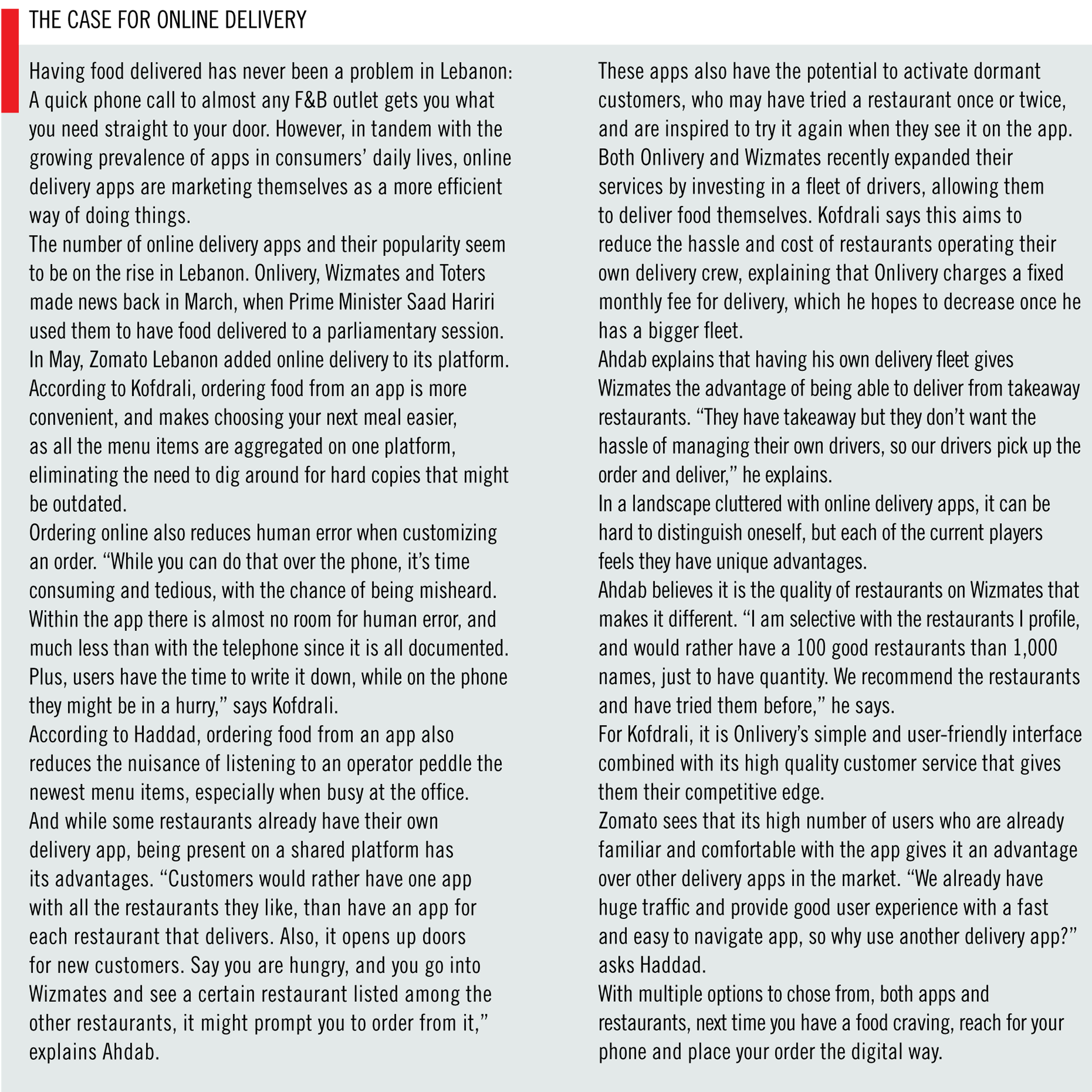
More recently, apps have begun to appear in the Lebanese food and beverage (F&B) industry. From booking a favorite restaurant online, to home delivery, to simply choosing which restaurant to dine out at, one can now easily satisfy a food craving with minimal human interaction.

From the world to Lebanon

As with many trends, online delivery and booking apps were common globally and regionally before penetrating the Lebanese market. For example, the online reservation platform Open Table was launched in the late 1990s in San Francisco. Talabat, an online delivery website and app, launched in Kuwait in 2005.

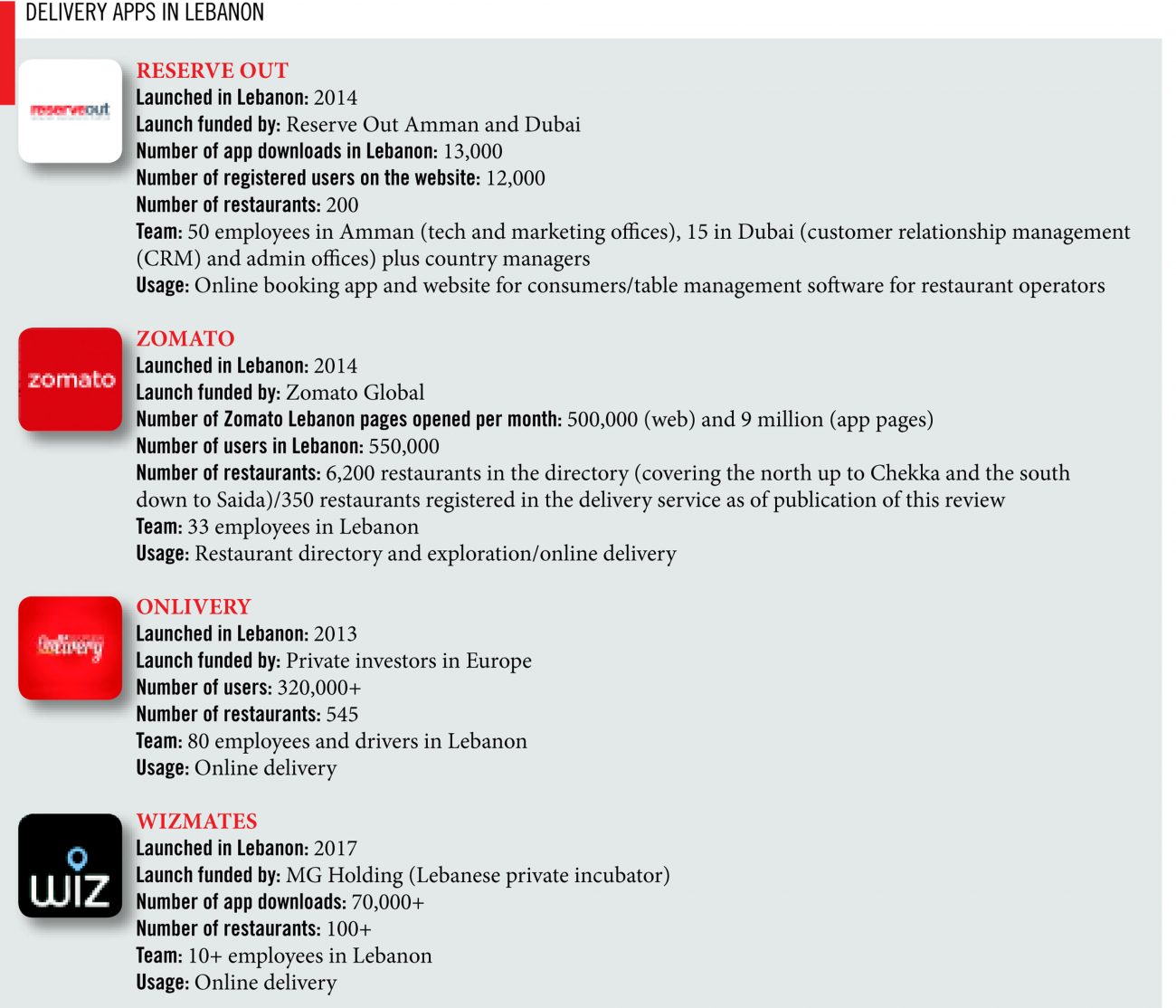
Despite Lebanon’s well-developed F&B industry, it took a little longer for these types of apps to make a mark here. Onlivery — an online delivery app — was one of the first F&B apps to be launched in the country in 2013, with others soon following suit.

By 2014, the market was more open to convenience apps, encouraging entrepreneurs to take the leap. “The first time I came back [to Lebanon] in 2011, I wanted to do it, but it was too early because no one had apps then. But now everyone has gone digital, even the banks have apps and everything, so I felt the appetite was there and it was the right time to launch,” says Aoni Ahdab, who launched Wizmates, another online delivery app, in 2017.   

Zomato, a restaurant search and discovery startup founded in India with a global reach of 23 countries, also saw potential for their app in Lebanon’s F&B industry. “It’s a small market compared to India and other markets, but it is [also] a very food-centric country, and eating is one of the main activities in Lebanon,” says Bechara Haddad, country manager of Zomato Lebanon, explaining that, for example, all of Portugal has around 12,000 F&B outlets while much smaller Lebanon has around 10,000. 

Homegrown versus international

Some of these apps, like Zomato, or Reserve Out, an online reservation platform launched in Amman by a Jordanian American, were active outside of Lebanon before entering the local market. Others, such as Wizmates or Onlivery, were developed in Lebanon, but inspired by successful international models.

In that sense, these app founders have not reinvented the wheel, they have simply tailored a global product to a Lebanese clientele. “We’re not innovative, but we proved the concept in a place where no one had before. We have a solid business model and growth plan because we know where we are going, and we know this is going to work because it’s been proven outside,” says Daniel Kofdrali, founder of Onlivery.

What’s in a buck?

Finding funding is challenging for tech entrepreneurs in Lebanon, so getting off the ground was not easy for these homegrown apps. “Funding in Lebanon is very hard [to get] and takes time, and this is why we are getting funded from Europe. In Lebanon, it can take six to nine months after your funding is approved [to get the money], and some startups can’t last that long,” says Kofdrali. He wishes that investors in Lebanon would be a bit more aggressive and a bit less traditional, and asks them to believe in the region, rather than wait for an international acquisition before they take interest.

Being part of a company with international reach has its perks. “Being part of a global startup is an advantage for us because we have faster access to funds. I know a lot of local startups who spent  their own money while waiting for the papers to be completed or for compliance issues in the banks to be sorted out and this affected their business and continuity. When we needed funds, we asked our HQ for them and it got done in a few days; our investor is basically Zomato HQ India,” says Haddad, explaining that Zomato Global was funded by Info Edge Limited, Sequoia Capital, VY Capital, and Temasek.

Starting at the very beginning

Even as banking and mobile top-up apps are being used more and more frequently by Lebanese consumers, there is still some reluctance to trust technology over good old-fashioned human contact.

In fact, most of the developers and founders Executive talked to mentioned changing consumer habits as a challenge they faced when they first entered the market. “In Lebanon, one of the issues we tackled is that some people don’t really trust technology and prefer to talk to a human. We tackled this issue through the push notifications that provide reassurance to customers that their order has been received and is being executed,” explains Wizmate’s Ahdab.

At first, Reserve Out also faced some difficulty in encouraging users to book tables online, but having a presence in the region helped. “In Lebanon, we have all kinds of customers. There are those that still prefer to call and reserve and those who prefer to book online. In Dubai, everybody is open to online booking and many prefer booking online, which is great because when they travel in the region, including Lebanon, they can use the app as well,” says Moussa Rida, country manager of Reserve Out Lebanon.

Kofdrali recalls struggling with restaurant operators when entering the Lebanese market. “It was very hard to convince the big players of its worth when we first started. They weren’t convinced that we were going to get them a large volume of orders, and they weren’t convinced that we would give them the kind of customer service that wouldn’t jeopardize their brand name, but we proved ourselves and paved the way for newcomers,” says Kofdrali proudly.

Warming up

Despite hesitance from older consumers, F&B apps in Lebanon found an almost immediate audience in the younger crowd. The app founders Executive spoke with say those between 18 and 35 years old readily welcomed their products.

For those who were still unsure, incentives have been used to pique their interest and convince them to at least try the app once. “Those who lived abroad, or who are tech savvy and familiar with this type of app, will use it without any prompting, and then you have those that are reluctant to use it. But what attracts those customers is the exclusive deals and offers that are only available through our app and the ability to order from restaurants that do not have delivery services,” explains Ahdab.

Other apps also use rewards to encourage engagement. Rida explains that users get a certain number of points once they download the app and gain points with each reservation. Once they reach a specific number of points, they can redeem them as money to pay for their meals.

Kofdrali says they invest heavily in marketing Onlivery, through campaigns and competitions to raise the app’s visibility among consumers. “It is a challenge to market this in Lebanon, and this is why we are happy there are other apps. Competition is good from a perspective of helping create awareness. Today we are reinvesting every dollar into marketing; if they [the other delivery apps] help me in marketing, this shortens the distance for [all of us],” he explains.

According to Kofdrali, once a user orders through Onlivery two or three times, they are hooked and become repeat users, Ahdab also says that 90 percent of Wizmates’ customers are repeat users. It seems that these little incentives have been key to creating new habits.

Making money

A few years into their operations, the F&B apps active in Lebanon all say they have profitable business models.

Reserve Out makes its money through a fixed fee it takes from participating restaurants on bookings, and from a table management software which it sells to restaurants. “Restaurants pay a monthly fee to utilize the Reserve Out reservations and table management system, which also includes all support, training and future software updates. We also charge a fee per reservation (depending on the number of people who reserved) if the reservation materializes: when the restaurant makes money, we make money,” says Rida explaining that both aspects of the business are profitable.

Zomato spent the first four months of operation in Lebanon getting restaurant menus, GPS coordinates, pictures, and phone numbers before going live, then the focus turned to increasing consumer engagement with reviews and photo uploads. Once they had enough users and traffic, they started to generate money. “We started as a restaurant directory, and once we gathered enough users and enough traffic, we were able to sell advertisement spots (on the platform) to restaurants to promote themselves. But the prices were proportional to the number of users we had back then. We review our prices and zones constantly, to adapt to market demand and zones’ web and app traffic,” explains Haddad.

Both Onlivery and Wizmates take a commission or percentage from each delivery made through their apps. Onlivery, which has started its own delivery fleet, takes an additional commission from restaurants that have subscribed to their service.

What the future holds

The size of the market in Lebanon could be limiting to app founders with big ambitions. “The market is small, so you can never make it big if you stay in Lebanon. But for us, we wanted to start from Lebanon because it is our home, and we believe in it and want this to be a Lebanese app. We have a plan to expand [outside of Lebanon] and are working on it very seriously,” says Wizmate’s Ahdab.

Regional player Reserve Out, which has reach across seven cities in the Middle East, also has further expansion in mind. Rida says that they have already signed an agreement with a big restaurant chain in Tokyo; Turkey and Egypt are also on their radar.

None of the F&B apps operating in Lebanon have completed their domestic expansion yet — all say they want to cover more areas across the country. “We want to expand in the Lebanese market as well, to areas which are beautiful but not as exposed online, such as in Sour or the north, where there are very good restaurants with little publicity. I would like to collect all these restaurants so they have coverage abroad and in Lebanon as well,” concludes Rida.

June 9, 2017 0 comments
0 FacebookTwitterPinterestEmail
EntrepreneurshipUnicamels

Unicorns with humps

by Matt Nash June 8, 2017
written by Matt Nash

When venture capitalist Aileen Lee first employed the term “unicorn” to refer to startups valued at or above $1 billion, she intended to stress just how uncommon a creature she was describing. In a November 2013 post that spawned a Forbes list, Lee identified and analyzed 39 “US-based tech companies started since January 2003 and most recently valued at $1 billion by private or public markets.” While her lens was US-focused, that was fewer than four unicorns born per year, on average, during the 10 years under study. Even if she missed some in the wider world, the beasts have undeniably been breeding like rabbits since she named them. The tech and entrepreneurship news website CrunchBase’s unicorn roll included 229 of the horned wonders as of May 23 (more than five times the number Lee found when she went hunting less than four years ago).

At the moment, taxi-hailing app Careem is the only Arab company on the CrunchBase list, having earned the title in December 2016 after a $350 million funding round. At ArabNet in March, Christian Eid, Careem’s head of marketing, joked that the company was a “unicamel,” later explaining to Executive that growth and keeping customers and drivers happy were more important than milestones and mythical monikers.

Gone from the list as of mid-March, however, is the MENA-founded Souq.com. The site began as part of a larger web portal (Maktoob) and followed an e-Bay auction model. In 2009, proof of concept for this type of MENA entrepreneurship came when Yahoo! bought Maktoob (but not its sister sites, including Souq). At the time, the deal had a rumored value near $100 million, although in a disclosure to the US Securities and Exchange Commission (SEC), Yahoo! later revealed that it spent $168 million on Maktoob. The acquisition was a confidence booster for the ecosystems around the region, and after switching to an Amazon-style business model, Souq.com kept growing. In fact, on the heels of a $275 million funding round in February 2016 (eight months before Careem), Souq became the first Arab unicorn, at a time when it was being courted for purchase by Amazon. In March, the global e-commerce platform announced it had acquired Souq, without disclosing a price. Amazon refused to comment on press reports that the deal is far below $1 billion. (The magic number will eventually be revealed, as Amazon cannot decline comment to the SEC.) Like the Maktoob deal, however, a significant added value of this transaction is the confidence boost it brings.

While Arabian Business might have gone too far with the May 26 headline “Gulf e-commerce market seen exploding after Amazon entry” (and inadvertently frightened readers), venture capitalists in Beirut tell Executive that, regardless of size, the psychological impact of the purchase makes it a big deal at a time when ecosystems around the region are teeming with growth.

No shortage of money

Detailed data is hard to come by, but Magnitt, a Dubai-based regional platform for startups and investors, offers something by way of numbers, which are looking better and better in terms of the maturity of ecosystems. Unfortunately, the company follows the modern trend of publishing “reports” as flashy infographics as opposed to text-heavy tomes with annexed raw data. For example, Magnitt’s 2016 State of MENA Funding reports that both the total value of investments and average ticket sizes have shown strong growth between 2014 and 2016, but fails to define clearly in the report (or anywhere Executive could find on their website) what countries are included in MENA. That said, there is plenty more money on the way, although not specifically earmarked for MENA spending.

In October last year, Saudi Arabia announced a partnership with Japan’s SoftBank aimed at creating a $100 billion (yes, that is billion with a b) VC fund, with the Kingdom’s coffers contributing the first $45 billion. On May 21, the SoftBank Vision Fund announced commitments of $93 billion and plans to hit its target within six months. Five days later, Saudi Telecom Company announced it would soon launch a self-funded $500 million VC fund.

Waiting for disruption

One critique still raised about MENA entrepreneurship, at least by those in the Lebanese ecosystem, is the tendency to clone. Yahoo! wanted Maktoob because of its Arabic-language email service (translation is arguably not innovation). Souq.com and Careem are similarly tailoring winning ideas to local markets. This is not to say there is no innovation in MENA, or that ecosystems are not adding value to their home countries even if they are not pumping out unicorns. What is undeniable is the increase in activity, in terms of new startups forming (even if exact numbers are elusive), new VC funds operating, and new support infrastructure (by Magnitt’s count, in the undefined MENA there are today 31 accelerators and 27 incubators).

For Fadi Bizri, an active member of Lebanon’s entrepreneurship ecosystem for nearly a decade and today working with the local VC B&Y Venture Partners, recent good news in the regional startup space — from unicorns to a high-profile acquisition and a Gulf billionaire’s foray into ecommerce (see box above) — is creating a buzz that’s drawing welcome attention, both from international investors and local high-net-worth individuals and governments. If success breeds success, this is arguably an exciting time for MENA entrepreneurs.

June 8, 2017 1 comment
0 FacebookTwitterPinterestEmail
BankingSpecial Report

On the job

by Thomas Schellen June 7, 2017
written by Thomas Schellen

Banking is such a constant in Lebanese existence that you can pretty much set your watch by its heartbeat. Of course this only looks effortless. In reality, there are a series of arduous and vital balancing acts in progress, primarily at the central bank and then one tier lower at the commercial banks. After all, the sector’s steady performance in the safe annual growth of assets and deposits is entwined with global realities of the most fragile political, monetary and economic sorts. This inconvenient and undeniable reality was underscored by the months-long hullabaloo over Banque du Liban (BDL) Governor Riad Salameh’s term extension, announced at the end of May. 

Another bone of contention is profitability and its implications. In 2015, there were questions over the banks’ taxation, in 2016 a moral legitimacy debate over the benefits that banks gained from the central bank’s financial engineering, and in 2017, again, the dispute over the proper role of banks in the financing of the national budget by way of the taxes they pay. This is not to mention earlier incarnations of the question over the banking sector’s role in the financing or exploitation of what can hardly be described as smart frugality in the Lebanese public administration.

For 25 years banks have fluctuated between rentier-economy style gains in the case of their profits from high-interest paying treasury bills in the 1990s, and their burdens, such as the zero-coupon bonds of 2002/2003 (issued in the wake of the Paris II donor conference), and the more recent debates mentioned above. Without going into any of these issues and regurgitating the many valid questions related to our peculiar financial market, one is inclined to conclude that the concentration of risks — both upside and downside ones — in the banking segment is a perennial feature of post-Taif Lebanon.

[pullquote] Of varied societal functions, banking sector employment is the weightiest one [/pullquote]

The industry’s hidden values

Besides its two main contributions to the national economy — the financing of our public and private sector deficits — there are additional facets to Lebanese banking and its role in society. These facets are varied as banks’ enhancement of consumer lifestyles, sponsorship of events, their charitable contributions, their sponsorship of Lebanese art and their role as job creators and employers. Of these societal functions, banking sector employment is the weightiest one, constituting an important structural pillar of national employee incomes and of the labor market.

The dimensions of the employment pillar are not very obvious, and indeed the labor market in its entirety is shrouded in a fog of data insecurity,  further obscured by partisan international lighthouses. Multilateral agencies and initiatives with their development agendas may illuminate the local labor market’s myriad problems and inefficiencies, but rarely offer any practical way forward. In recent years, internationally driven reports have highlighted high inequality in private sector income distribution, the statistically shrinking productivity of workers, rampant youth unemployment, the absence or inefficiency of social safety nets, and lower female participation in the national workforce.

Realistic hopes are hard to build from these reports, whether for regional job prospects or for Lebanon. For example, a 2015 report produced by the International Labour Organization’s (ILO) local office suggests (based on conclusions from somewhat questionable data on negative growth of productivity since 2000) that “types  of  employment  available  in  Lebanon  over the  past  two  decades  have  been,  on  average, of relatively low productivity, usually indicative of low-quality, low-paying jobs in informal activities.”

Two reports from 2017 are worth noting. First, the United Nations’ World Economic Situation and Prospects 2017 report, published in January and updated last month, stated that the recent weakening of Arab labor markets in the Gulf countries had negative impacts on employment prospects for regional job seekers. The report highlighted that, “armed conflicts have caused large-scale unemployment in Iraq, the Syrian Arab Republic and Yemen, and some negative spillover effects have been observed in the labor markets of Jordan, Lebanon and Turkey.” In conclusion, the UN claimed that “the labor market situation in the region is not expected to improve significantly in the next two years, with structural unemployment remaining high, particularly among youth, and a widespread lack of decent work.”

[pullquote] Data research by LinkedIn from the past five years showed top regional growth in numbers of entrepreneurs and only single-digit increases in finance and banking workforces [/pullquote]

The second report, issued last month by the World Economic Forum (WEF) in collaboration with the social network LinkedIn, struck the same alarm bell on insufficient job generation, but added a new tone, referring to the “creative disruption triggered by the Fourth Industrial Revolution.” The report — published under the title, The Future of Jobs and Skills in the Middle East and North Africa — raised the notion that the impact of the Fourth Industrial Revolution “will interact with a range of additional socio-economic and demographic factors affecting the region,” creating what was labeled as challenge and opportunity for the MENA region’s workforce.

According to the WEF, data research by LinkedIn from the past five years showed top regional growth in the numbers of entrepreneurs but only single-digit increases in the finance and banking workforces. While the report offers the usual abundance of wise words and recommendations, adorned with statistics from MENA countries, it lacks useful labor statistics on Lebanon.    

Against this weary background, it is quite a different microeconomic picture that emerges when one examines employment data from the Lebanese banking sector. Granted, the banks’ collective productivity is attributable to only about 26,000 banking sector employees. This is only a fraction of the economically active population of circa 2.1 million, as estimated in 2009 by the Central Administration for Statistics, with more than 1.4 million formally employed and another 0.6 million in the informal economy.

If we consider that every high-quality job in Lebanon is an asset to the national fabric, and every newly created job of this sort expands that fabric — then the contribution of banks to the sphere of labor is impressive. The direct and indirect employment bill that comprises the salaries, allowances and social contributions paid by Lebanese banks totals some LL 1.8 trillion ($1.2 billion), equivalent to 2.5 percent of the GDP (2015 figures). According to the Association of Banks in Lebanon (ABL), the salary portion of this total reached 62.5 percent and the total cost paid by banks per average employee is LL 72.87 million (over $48,300) in 2015.   

Similarly, net job creation in the banking sector, which has stood at about 800 new hires per year for the last few years, can rightly be regarded as insufficient when compared with the estimated need for supplying university graduates with quality work — but it can also be taken as a blessing, especially when one considers that the banks’ gross hiring activity of fresh graduates is likely not limited to this net increase, but closer to absorbing 2,000 job seekers with bachelor’s degrees.

Gross hiring figures are not captured in the ABL annual report, but three of the largest banks tell Executive about their gross to net hiring ratios. “As banks we are doing our share of creating [employment] opportunities in the market. If I look at the past three to four years, the gross hiring at Bank Audi is more than 1,150. This is not a small amount,” says Nayiri Manoukian, head of human resources at Bank Audi Group. According to her, the group’s workforce in Lebanon comprises about 3,400 individuals; Manoukian explains that in 2016 alone, new hiring reached around 360, against perhaps 150 out migrations, leaving a net of 210 in added human capital.

At BLOM Bank Group, Head of Human Resources Pierre Abou Ezze says, “In terms of employment we have been growing at about 125 to 150 employees per year for the last five or six years at least, and we are anticipating that this trend will continue.” He adds that the bank hires about 250 new employees per year, in part to balance attrition of the workforce, and in part to satisfy demand for business development. “Our strategy is to aim for stable growth in operations, in terms of opening branches as well as in terms of developing business through existing branches,” he explains.

While the headcount at Byblos Bank was kept relatively constant in the first three years of the decade, new hiring has grown since 2014. “We hired around 100 people in 2014, then 134 persons in 2015, and 189 in 2016. In 2017 to date, we have hired 87, and expect for the full year to reach up to 200 new hires. This is new hires, not net growth of the workforce,” says Fadi Hayek, head of human resources. He puts the bank’s total employee turnover at around 6 percent per year, indicating that about 100-110 of its total national workforce of nearly 2,000 leave the bank per year. This number mainly includes job migrations, people retiring and a very small number of dismissals. “The net effect of hiring in 2015, in terms of human capital, was an increase of 25; in 2016 it was 84; in 2017 [we are] also expecting around 80 to 100,” he states.

Between them, these three large banks have about 7,500 employees in Lebanon, or very close to 30 percent of the total banking sector workforce. Although this number is not large in comparison with the national needs for employment generation, the role of banks in job creation gains even more weight when seen in the dimensions of empowering continued education of employees, developing career and social plans, as well as providing potential model functions to other corporate and institutional stakeholders in the labor market.

The human dimension

Workforce expansion strategies vary substantially from bank to bank. Hiring is correlated firstly to the addition of new branches, but also linked to adding and strengthening departments with new focuses, such as digitization or growth into SME and retail banking. Departments and specializations that saw disproportionately large additions of human capital, in the years since 2012, are compliance and control.

HR managers at the largest banks, and at some smaller ones, tell Executive of areas under their purview where automation is subduing the need for workforce expansion, such as in back office, archival and basic administrative roles. Overall, however, they confirm that banking jobs are safe, and that the increasing headcounts and creation of new positions has progressed hand-in-hand with the consistent increases in the assets, deposits and loan portfolios of Lebanese banks.

While it is mainly anecdotal information that fresh Lebanese university graduates and job seekers regard banking as a top employment choice — a survey this spring claimed to have found that 36 percent of respondents see banking as the most attractive industry for fresh graduates and that 39 percent see it as having the highest job security, but gave no information on sample size and methodology. Rabih Joumaa, head of the HR division at Banque Misr Liban (BML) says that he  would not be surprised by such findings. This is because in this country, where a great hunger for stability exists, banking is “the only industry that has been stable for many years,” he says.

Job security is indeed closely related to the issue of stability. Although the hospitality industry may have demand for several thousand extra workers at the start of a promising summer season, and the construction industry may hunt after new staff when the economy is on the upswing, these industries are also notorious for seasonality and layoffs during difficult times. By contrast, the statistics at individual banks point to slower hiring during some years but not to the kind of employee volatility found in many sectors that have greater demand for labor.

Historic shifts in the profiles of work at Lebanese banks commenced in the 1990s and were spearheaded by the larger banks. Under the adverse conditions of the Lebanese Civil War, academic qualifications for work in banks became a lesser concern than street smarts in facing daily challenges, such as safely making it home from the office, remembers BLOM’s Abou Ezze. At banks like BLOM and Audi the post-conflict period was the time when senior management embarked on upgrading their staff by looking for skilled knowledgeable workers, with at least a bachelor’s

degree, or even by taking in small cohorts of MBA holders. “When I was hired as a consultant [in 1995], it was the aim to introduce academic elements to training programs at the bank. The nineties saw [the] start of [an] era of human resources in Lebanese banks. That is when banks started to take care of their human capital element,” Abou Ezze explains. Today of course, a bachelor’s degree is the minimum entry requirement that bank recruiters posit.

Merits rule

Meritocracy is not what is usually associated with pathways of social advancement in Lebanon, but the principles of quality hiring and merit-based pay are emphasized by the banks, as opposed to assumptions that only elusive personal connections or specific communal allegiances open doors in bank employment. In the experience of some HR experts, such latter assumptions have, in recent years, gained even more traction among young job seekers. This is a problem, because as self-perpetuating misperceptions they can easily turn into artificial inner barriers that discourage people from applying. “The process of recruitment in the top ten banks is very developed. Banks have specific means that they use to recruit the best in the market through job fairs, internships, etcetra. They are making efforts so that the recruitment process is as accurate and objective as possible,” says Bassam Nammour, training and development manager at Credit Libanais.     

Rather than expecting ulterior motives in how banks recruit and promote their people, career-minded graduates, according to BML’s Joumaa, should be patient. “People should accept the idea [that they must] work hard, prove themselves and make effort in order to grow. It is not enough if fresh graduates would just do the minimum that is required in their job but expect quick promotions to become managers and immediately get what others got after 10 or 15 years of hard work,” he explains. 

Enmeshed with the issue of merit based promotion is the ever-thorny question of gender biases and gender-based pay gaps. Here the tenor of human resource specialists in the banks is uniform — discrimination based purely on gender terms is not an issue.

Women rising

Byblos’ Hayek states it categorically: “You will not find gender-based pay gaps in Lebanon in banks. In comparable positions such as among assistant branch managers or personal bankers, you find women earning more than men and vice-versa. Salaries depend on position and performance.” When doing an analysis of gender splits in different branches of Byblos Bank, such as rural versus urban locations or branches in regions with presumably more traditional views on the role of females, he found the reality ran opposite to common assumptions. According to him, several branch manager positions in places that are religiously conservative were in fact filled by women, and the gender mix in urban and rural branches was the same. 

“We never look whether it is a male or female when we promote anyone,” confirms Audi’s Manoukian. She points out that the rise of female employees is more than a passing phenomenon and today extends, if not yet to the very top of hierarchies, certainly to high echelons in the largest Lebanese bank. “We have a good number of females as middle managers and heads of departments. When it comes to branch managers, we are looking for males, as most [branch managers] are females,” she says. 

BLOM’s Abou Ezze says that the bank has, of late, seen a largely stable ratio of 51 percent female and 49 percent male employees in the strata of professional banking jobs (excluding clerical workers and manual laborers). “The ratio has not changed much in last few years. Twenty years ago the male workforce was dominating, but today female education levels and participation in workforce in Lebanon are higher. Families in Lebanon have need for both parents to work,” he concludes.

“In BML today, you can see that most branch managers are ladies, and if you want to headhunt a qualified one, you have to pay her what she deserves. I don’t see that pay based on gender is the case at all in the Lebanese banking sector today. Pay is based on knowhow, qualification and the market, which in my opinion today does not differentiate between men and women,” chimes in BML’s Joumaa. He adds that the bank also takes a positive view on future moms in the workplace. “We don’t mind at all to hire a pregnant woman. We had three cases in 2016/17 [of hiring pregnant women] where we were convinced that those ladies are very qualified and will provide extreme added value to the bank,” he says.

Staying realistic

It would still be presumptuous to claim that there are no glass ceilings, unjust promotions, communal biases or any sort of wasta or family-driven distortions in the composition of the banking sector’s workforce. This starts at the recruitment phase. HR managers on the one hand describe ideal recruitment practices as regarding applicants as unique individuals, and anonymizing bias-prone information such as the name of the university where an applicant earned his degree, but from the conversations with Executive it appears that it is a dominant practice to discriminate in favor of applicants from “reputed universities,” which in Lebanon firstly includes American University of Beirut (AUB), Lebanese American University (LAU), Ecole Superieure des Affaires (ESA) and Université Saint-Joseph (USJ). Upon further questioning, most HR heads confirm that their preferred lists include a variety of additional universities — especially praising the technical skills of graduates from the Lebanese University — but also caution that the high number of officially licensed tertiary education institutions in Lebanon does entail a portion of universitary entities whose teaching ability and program quality they doubt. 

In terms of career equality and job stresses, equality of opportunity and merit-based pay do not exclude differences in willingness to get ahead, nor do they provide female employees with the means to compensate for periods in which they may

focus on childbirth or child rearing. Simply said, gender pay gaps are a reality in Lebanon and likely will be for the foreseeable future. But as far as banking is concerned they are not based on the undervaluation of women’s contributions in the workplace.

As far as work-life balance is concerned, working in a bank is no easy job, and stresses — such as pressures to meet targets and produce sales results that will boost their bonuses — come to bear on all employees. According to BLOM’s Abou Ezze, work-life balance is a nice concept but he agrees that it is not fully compatible with ambitious career-mindedness. He says average work time per employee is 40 to 42 hours per week and admits that changes in working hours several years ago caused some employees to resign or opt for a transfer to the head office, where time flexibility is greater than in branches.

Average employees will not be pressured to put in extra work, but others have to make choices. “If you want to advance in your career and one day be part of top management, you have to put in more than the rest,” Abou Ezze confirms. This also results in proportionally greater male participation in BLOM’s program for high achievers,  as  younger women might find themselves unable to meet the program’s extensive time requirement if they want to prioritize their family for a period. He says: “People in that program are totally dedicated to their career. To differentiate yourself and justify being in that particular program, you first have to be a cut above [the rest] in your capabilities and second be a cut above in terms of commitment.” 

Also in Credit Libanais training head Nammour’s view, “Work-life balance is not about the bank being flexible, it’s about you as a person and how you can adapt to the bank’s schedule and be flexible within it.” On the other hand, this puts the onus on the bank. Rather than expecting traditional attitudes of employee loyalty, it should focus on proactively engaging employees. “The bank needs to let the employee feel engaged by providing the right environment, economic incentives and rewards, trainings, etc. If an employee is engaged, he will be more productive,” he says.

In the totality of remuneration issues — where still modest entry-level salaries are regulated by a collective agreement that is circulated in three languages by ABL and where pay scales for branch managers potentially reach into six-figure territory — and numerous career-related issues from trainings and continued education options (see story page 30), to the provision of clear career paths and employee evaluation procedures that keep up with international developments, Lebanese banks appear as trailblazers of practices that one might otherwise encounter in teaching manuals at Lebanese universities, but see rarely in such organized and coherent form in the bulk of private-sector enterprises. 

[pullquote] Work-life balance is not about the bank being flexible, it’s about you as a person and how you can adapt to the bank’s schedule [/pullquote]

Thinking beyond retirement

Moreover, the banks’ engagement extends into another socially crucial dimension — adequate pension planning. “Bank Audi feels that it is part of its civil duty to help its employees after retirement,” says Manoukian. Although the current number of retiring Audi employees is still very low, planning for retirees is on top of her department’s to-do list. She explains that since the beginning of 2017, the bank has been working on a retirement and pension plan, in a collaboration between the HR department and the bank’s finance and organization divisions, and has also worked with an actuarial company for this project. “We have committed that by the middle of this year we should produce a proper proposal that can be presented to the bank’s executive [board] committee to see if it will be adopted.”

While she concedes that at some point in the future pension provisions might even become a legal obligation, she notes that it doesn’t help an employer to have no proper pension scheme or old-age insurance model enacted by the state. But besides the political aspects, she sees the problem in Lebanon as cultural, citing the fact that very few people ask insurers about pension plans or annuity products. “It is really a culture where people don’t plan for the future, and this is scary,” she says.

In order to avoid pitfalls such as eventual future liabilities, Bank Audi is seeking to develop a plan for its employees which — while preserving the bank’s existing benefits offered at retirement and not affecting end-of-service NSSF indemnities – makes sure that employees will have, at the very least, the comfort of health coverage after their retirement. She acknowledges that this project will demand a strong financial commitment from the bank but refuses to provide any projection on its estimated magnitude.   

“The bank has this culture of taking care of its employees, and it was with management acceptance that we went into the pension plan [project]. Otherwise [we] would not have done it. You cannot have such a big population and productive workforce, and their retirement is not properly secured. We especially want to have the basic need of medical care  covered at age 65 and above, when one needs it,” she assures.

There are provisions in the banking sector’s Collective Labor Agreement for 2016/17 that banks have to ensure for their employees “the right of continuity of hospitalization coverage insurance” after retirement, through a program called in bureaucratese Conversion Privilege Options (CPO). Seen in combination with the other benefits that working at a bank provides in Lebanon’s unstable labor and social security environment, it is noteworthy that such initiatives are actually being implemented (Credit Libanais’ Nammour claimed that the bank recently signed such a CPO agreement for all its 1,600 staff, and was ahead in the industry in this). It should indeed send a signal to other industries that expectations of increasing productivity from employees — vital for economic success — require much more than a CEO pep talk about the “happy work family.”

June 7, 2017 0 comments
0 FacebookTwitterPinterestEmail
LeadersOpinion

Endless

by Executive Editors June 7, 2017
written by Executive Editors

Executive confesses to nonsense fatigue. Our editors are tired of platitudes about the banking sector. If we hear one more locution implying that the Lebanese economy’s doom is inevitable, or another hackneyed phrase about a banking sector that is trying to resist bad economic tides to the best of its ability while continuing to develop new products and services, we will choke. Especially if such vain observations are tied to attempts to exploit journalists in marketing said products and services aggressively to consumers.

Trying to maintain integrity with respect to editorial independence and the separation of journalism from advertising interests looks more like a quixotic fight against windmills every year — but even if it is not a financially rewarding endeavor, it is a necessary fight if one hopes to be a genuine journalist. Thus, tired as we are of some parts of the Lebanese banking sector’s narrative, Executive is still fascinated by the sector’s unsung assets, and in this issue, attempts to explore how much the human capital in our banks is growing, how much intangible value banks create through employee training and continued education, and how through all this, banking contributes to alleviating the huge problem that fresh university graduates (and all Lebanese) face in finding quality jobs.

Also, we have to admit that our general nonsense fatigue is a mere nuisance when compared with our exasperation over hollow complaints by political types, who do nothing to move the national confidence dial higher but instead vainly berate people, including those very bankers who are trying to make the economy work. Can it be that there is a political class who have it in their hands to bring down corruption by relinquishing their privileges and fiefdoms, but prefer to sit idle?

Playing politics

Most of all, we are disgusted, turned off, and appalled at political tugs of war that are not only unworthy of democratic discourse, but harmful to national economic confidence. Such are the pointless and overlong battles over our electoral law, the budget, taxes on the ultrarich, and the dishonest attempts to derail the reappointment of central bank Governor Riad Salameh last month.

This reappointment battle is now over, and it is indeed Round Five of Salameh at the helm of Banque du Liban. However, that does not mean that the battles that are sure to come during his fifth term are already won. There are new attacks being formed in the shadows by prejudiced foreign friends, and there is an important area — corporate governance at banks  — where progress is notable but further challenges appear to loom for all stakeholders.

Lastly, whenever a hero is born in the public’s mind, there are concerns that one must not forget. Hero worship is dangerous and being a hero — we guess because we cannot lay claim to any heroic deeds — comes with its own sort of fatigue. And in this regard, Governor Salameh’s most recent appearance before a Lebanese Euromoney conference could be seen as putting the onus on others to call for some fresh ideas at the central bank. Shaped as an on-stage interview, Salameh’s 30-minute appearance did not provide the kind of attention grabbing remarks that the once revered  maestro of the Fed, Alan Greenspan, provided to financial markets with his speech on “irrational exuberance” just over 20 years ago.

Still fragile

One would wish for more than comments on global interest rates. What is needed now is not just the honest remark that the Lebanese central bank relies on the published analyses of international energy augurs for its oil price assessments and anticipations, not the evasive assertion that Lebanon’s central bank favors everything that boosts financial inclusion when the question was about the BDL position on Fintech, and also not the insight that oil and gas, the knowledge economy and the financial sector can be enablers of the Lebanese economy. 

Thus Executive, while very relieved over the commencement of the fifth round of Governor Salameh’s reign at the central bank, calls for succession planning to start as of now. Should we wait until the governor of the central bank has completed his seventh term as an octogenarian and is perhaps ailing before we deign to call a surprise board meeting and advance one of his deputies to the head of the table? Apart from the fact that a sudden board change with internal handover to another office holder is not feasible politically or legally, the idea of running for another 18 years with monetary policy still pegged to the dollar is, today, simply frightening. Lebanon’s political economy is still too fragile to be caught by surprise in any Minsky moment or creative destructiveness that, according to economic learning, the country needs to be prepared to encounter somewhere in the future, whether in the next six years or later.

As if any reminder about the importance of developing a good political economy in Lebanon was needed, the 2017 edition of the World Competitiveness Yearbook (WCY) by Swiss business school IMD made it to our desks just as we were putting the last touches to this issue. The WCY — published on May 31 — showed a number of telling changes in the competitiveness rankings of the 63 countries covered this year. Notably, while the United States lost further ground and now is only the WCY’s fourth most competitive country, the strongest gainers in terms of ranks were Asian countries such as Kazakhstan, which advanced 15 spots to 32nd place, and Mainland China, which improved by seven spots to reach 18th place. Nota bene, the most competitive country in the Middle East was the United Arab Emirates, which improved five positions to 10th place (Cyprus and Saudi Arabia were included for the first time, and could claim respectable positions in the lower middle ranks).

According to IMD World Competitiveness Center head Arturo Bris, upwardly mobile countries maintain business-friendly environments that encourage openness and productivity. He traced China’s improvement to the country’s dedication to international trade. If such examples show that improvements in competitiveness are perfectly achievable, the WCY also reveals what keeps countries stuck in the bottom: The WCY’s lowest ranks are largely occupied by countries experiencing political and economic upheaval. “You would expect to see countries such as Ukraine (60), Brazil (61) and Venezuela (63) here because you read about their political issues in the news. These issues are at the root of poor government efficiency, which diminishes their place in the rankings,” Bris was quoted as saying. Lebanon, sadly, is still not covered by the WCY, but the message fits perfectly.

June 7, 2017 0 comments
0 FacebookTwitterPinterestEmail
  • 1
  • …
  • 103
  • 104
  • 105
  • 106
  • 107
  • …
  • 691

Latest Cover

About us

Since its first edition emerged on the newsstands in 1999, Executive Magazine has been dedicated to providing its readers with the most up-to-date local and regional business news. Executive is a monthly business magazine that offers readers in-depth analyses on the Lebanese world of commerce, covering all the major sectors – from banking, finance, and insurance to technology, tourism, hospitality, media, and retail.

  • Donate
  • Our Purpose
  • Contact Us

Sign up for our newsletter

    • Facebook
    • Twitter
    • Instagram
    • Linkedin
    • Youtube
    Executive Magazine
    • ISSUES
      • Current Issue
      • Past issues
    • BUSINESS
    • ECONOMICS & POLICY
    • OPINION
    • SPECIAL REPORTS
    • EXECUTIVE TALKS
    • MOVEMENTS
      • Change the image
      • Cannes lions
      • Transparency & accountability
      • ECONOMIC ROADMAP
      • Say No to Corruption
      • The Lebanon media development initiative
      • LPSN Policy Asks
      • Advocating the preservation of deposits
    • JOIN US
      • Join our movement
      • Attend our events
      • Receive updates
      • Connect with us
    • DONATE