• Donate
  • Our Purpose
  • Contact Us
Executive Magazine
  • ISSUES
    • Current Issue
    • Past issues
  • BUSINESS
  • ECONOMICS & POLICY
  • OPINION
  • SPECIAL REPORTS
  • EXECUTIVE TALKS
  • MOVEMENTS
    • Change the image
    • Cannes lions
    • Transparency & accountability
    • ECONOMIC ROADMAP
    • Say No to Corruption
    • The Lebanon media development initiative
    • LPSN Policy Asks
    • Advocating the preservation of deposits
  • JOIN US
    • Join our movement
    • Attend our events
    • Receive updates
    • Connect with us
  • DONATE
BusinessCompanies & Strategies

Coming Sukleen

by Thomas Schellen & Thomas Schellen November 9, 2015
written by Thomas Schellen & Thomas Schellen

After protests outside their Lebanon plant and activist allegations of corruption, the CEO of Averda gives his first ever interview to a media organization. Little known by name in Lebanon, Averda is a waste management company founded in 1993 by Lebanese engineer Maysarah Sukkar. It is the parent company of Sukleen and Sukomi. Maysarah’s son, Malek, has been a top manager since the company’s inception, and today leads the company as it continues an expansion abroad that began a few years ago. Contracted by the government to collect, treat and dispose of Beirut’s waste in the early 1990s, Sukleen and Sukomi – which even Sukkar refers to collectively as Sukleen, a play on the family name – the companies quickly took on more municipalities in Lebanon and have been handling waste in the capital and all of the Mount Lebanon governorate (except Jbail) for around 20 years. Previously media shy, Malek Sukkar sits with Executive to talk about the waste crisis and his reaction to Sukleen’s many critics.    

E   How do you respond to accusations that have been leveled recently in Lebanon against Sukleen and your family in context of the escalating garbage crisis?

The nicest way I can describe this is that we understand the need to find someone who can be held responsible. We are not responsible, but we are the easiest people who they can try to [blame]. We understand the frustration but [what Sukleen is being accused of] is unfair and unfounded.

E   Have any of the organizations or parties with interests in this controversy reached out to you asking for your response or comments on this matter?

No. It is shocking, but no.

E   Were you surprised that the emergency plan which was announced on September 9 has not seen the beginning of implementation within the seven weeks that have passed until the first literal garbage flood on October 25?

Honestly, I am surprised because I thought that the change of which minister handled the file would be based on some sort of agreement that had been reached in the Council of Ministers. I am not privy to what happened [with regards to] the actual execution but I am surprised by the delay because this is a critical service. It is not a nice-to-have service like superfast WiFi versus regular WiFi. Taking care of our garbage is a bare necessity and this has always been my worry as a human being, not as someone who is involved in this file.

E   Can you be more specific about why the situation worries you personally?

I remember a story from Harvard Business Review from some years ago. It said that there is always a danger that your strength becomes your weakness. The Lebanese government relies on the resilience of the people. Every Lebanese has three different power sources and several different water sources. The resilience that this has built up is what I am afraid people will develop [because of] the waste issue. The scene that we [saw on October 25] of the floating garbage may become something that we are used to, and that would be the absolute worst outcome. We got used to mobile telephones where calls cut after about 20 seconds or so; we got used to not having electricity. People still get angry but there is a used-to-it-ness and it is my worry that the longer this thing takes to get sorted out, the more this resilience gene might come out where people would say we can also survive without waste management. That, to me, is the worst possible outcome.

E   Do you think that the emergency plan has the potential for dealing with the issue at least for a year or two?

The emergency plan is fairly straightforward. What it [calls for] is a devolvement of the waste services [to municipalities] and for doing that over 18 months. That is a wise process because you can’t go from zero to 100 all at once. From a high-level view I think this makes sense. What I think worries people is the question if there is something that will happen within these 18 months, or will this be a period that will require another 18 months and then another 18 months [of emergency management]. This is probably the tougher question. Only the municipalities know because they will have to pick up the baton and run with it.

E   You have not participated in the tender bids that were preceding the announcement of the emergency plan. How large a role did the Lebanese operation play in the overall activities of Averda up until the summer and the closure of the Naameh landfill?

Everyone in our organization is so proud of the work that has been done in different countries, but Sukleen and Sukomi are the mama. All that is good in the whole company has come from these two entities, all the genes and the DNA, the will, the pride and the resilience, talking in a positive sense. When we started this process in Lebanon in 1993, we came to a country that had been decimated and a population that had not been in a corporate setting for about 20 years. When you asked for someone who could use a word processor or for a specialized accountant, you couldn’t find them. From when we started, the gene was built one brick at a time. We created a school for training almost every skill set and we took the view that we were a meritocracy. It was a very small family [involvement], there was my father and myself and not a lot of Sukkars in the organization. We believe that you are as good as your performance, not as good as your last name. We put a lot of training performance-based management systems in creating the gene of the organization and this gene self-propagates.

E   You have recently been much more responsive to questions about Sukleen when compared with a lack of answers that we observed over many years previously. Why the long-standing reluctance to talk?

We have no political aspirations, neither my father nor me. We always thought that if you speak to the press in Lebanon, you are making a bid for parliament or becoming a minister. Also, a lot of times when we answered in the past, we answered with 17 pages of documents and numbers and no one ever read them. And because we are highly technical people, we always assumed that whatever response we give, it will be twisted in the media, so let’s not say anything. In hindsight this was a humongous mistake.

E   What has changed in this regard?

The attacks in recent weeks have been so personal, so wrong, that your blood boils and not answering has become impossible. Our doctrine now is that we answer, not by being rude or aggressive but by being factual and our facts speak for themselves. We believe in everything that we have done and we say that.

E   From your perspective now, what is your strategy in going forward not just in responding to crises but in representing to larger audiences what Averda is?

I think for the first time in the history of the company we have a marketing budget and within that budget a very specific media marketing strategy that we are now applying.

E   Which is to do what and why?

We do a lot of great things; we do life-changing things and to many people it is a shock when they see this. It shouldn’t be a shock and, to be honest, the people whom we hurt [with our silence when we were accused] probably more than our own family are the people who work in this great company. If you work for Sukleen today in Lebanon, you are not proud. They have made you feel small. The attacks we have received are not something that will make you feel that you can walk into a bar and wear a Sukleen t-shirt. So one of the reasons why we have taken what is for us a bold step is that these people who have been doing this work for decades deserve a response they can take to their friends and their neighbors and tell them, ‘what you are saying is not right. This is the truth.’ Working for this company should be a moment of pride, not a moment of shame. Having learned from the Lebanese condition, we will go forward with a positive view of media relations.

November 9, 2015 2 comments
0 FacebookTwitterPinterestEmail
Banking 2015BusinessFinance

No time to cry wolf

by Thomas Schellen November 9, 2015
written by Thomas Schellen

In the Lebanese banking sector’s cherished game of claiming the deposit throne, month-on-month drops of private sector deposits are usually reserved for the January statistics, in what has become known as the annual correction of window dressing at the end of the business year. That is why, when the relevant central bank data is pulled up as a line graph, January 2011, January 2014, and January 2015 look like little potholes on a long, ever ascending highway to a heaven of private sector deposits.

Besides the January corrections, deposit dips in the past five years have been few and far between, such as February 2011, July 2012 and April 2013. None of downward moves lasted more than a month and none amounted to more than a few decimals in the sector’s deposit tally of billions of dollars. This fact alone was enough to make alarm signals sound in the news, that July was another of those months with a minute contraction in private sector deposits appears unseemly; namely a 0.2 percent fall from $148.58 billion in June to $148.39 billion in July according to Banque du Liban data released in mid-September.

In numbers based on central bank reporting, total private and public deposits at all commercial banks rose by $4.26 billion from $143.4 billion at the end of June 2014 to $147.6 billion at the end of last year and by another $4.15 billion to $151.8 billion at the end of June before receding to $151.5 billion in July. Total deposits are generally a few billion dollars higher than total private sector deposits. But looking at either data stream, the growth rate in H1 2015 has clearly slowed percentage wise when compared with six-month periods in recent years. However, this observation itself cannot be a precursor of the sky being about to crash down.

The picture of our banking activity also remains within bounds of normality when reviewing the performance of top banks in the first half of 2015. Market leader Bank Audi recorded very minor growth of assets and deposits. Both its domestic and foreign assets expanded by less than 1 percent in the first half of 2015. Domestic assets denominated in USD saw the largest increase, at 2 percent year to date. Loans in the bank’s foreign operations contracted when expressed in USD, domestic loans in the Lebanese Pound expanded by over 5.6 percent in the year to date but this increase could not keep the consolidated lending growth in the black; the overall loan portfolio shrank by 0.8 percent.

Growth and profit

At BLOM Bank, the growth rates looked stronger but not decidedly stronger. Assets edged up by 2.3 percent, deposits by 3.1 percent and loans by 1.6 percent. Domestic growth surpassed growth of BLOM’s foreign entities in all three categories, by about one percentage point in loans, two percentage points in assets and almost three percentage points in deposits. While Audi and BLOM’s combined market share of total deposits dropped by about 30 basis points when compared with mid-2014, combined, their position remained dominant with a 37 percent control of alpha group deposits.

Revenue stream components at the two largest banks showed an up-shifting of net interest income while trading and investment income and non-interest income declined. According to FFA Equity Research the year-on-year improvements in net interest income for H1 2015 were 8 percent at BLOM and 16.5 percent at Audi. Both banks improved their fees and commissions income; however, these gains were juxtaposed with year-on-year drops in trading and investment income of 43.1 percent at BLOM and 18.3 percent at Audi that contributed to the two banks’ contraction of non-interest incomes by 16.5 percent (BLOM) and 4.4 percent (Audi).

The first-half net profits of the two top banks amounted to $202.1 million for Audi and $190.4 for BLOM, followed by $70.1 million at Byblos Bank, the third largest Lebanese bank by assets and deposits. Year on year, Audi achieved a 6.5 percent profit increase, BLOM 6.2 percent. For Byblos Bank, the increase was 1.1 percent. The latter bank’s first-half performance, which was a mix of net interest income versus non-interest income, underwent a rather different development to that of Audi and BLOM. Byblos Bank’s fees and commissions income dropped 10.4 percent year on year, its trading and investment income, however, jumped 24.7 percent higher. Byblos Bank achieved improvements of 8.8 percent in net interest income and 8.7 percent in non-interest income.

Alpha banks

Growth of deposits in different pockets, lending activity subdued across the ranks

The report card on profits is also coherent for the entire stratum of the 14 largest Lebanese lenders. Banking intelligence company BankData reported in early September that the combined net profits of banks in the alpha group, comprising banks with deposits above $2 billion, increased by 9 percent for the first half in 2015 when compared with end June 2014. Total alpha group profits for H1 2015 tallied at $993 million according to BankData, with the top five banks by profits – Audi, Blom, Bank of Beirut, Fransabank and SGBL – accounting for $648 million, or 65 percent of the total.

The three banks with the strongest first-half deposit growth rates were Lebanon and Gulf Bank (LGB) with 7 percent, followed at some distance by Credit Libanais and BBAC, each showing growth in the mid four percent range. The three banks together represent about 9.5 percent of alpha group deposits. While Credit Libanais and BBAC each reported growth of domestic deposits that was above 5 percent in conjunction with drops in deposits in entities abroad, LGB derived its growth more from units abroad than from domestic operations, showing year-to-date deposit growth rates of 22.5 percent from entities outside of Lebanon and 6.9 percent within the country. Of the two banks that experienced negative year-to-date growth of deposits, First National Bank (-1.7 percent) and Banque Libano-Francaise (-0.4 percent), FNB saw outflows from foreign currency accounts in the domestic market while BLF achieved a small gain in domestic deposits and reported lower deposits in foreign entities. FNB’s and BLF’s combined market share in alpha group deposits is 7.7 percent.

The strongest loan growth was represented by CreditBank at 7.7 percent, followed by BBAC at 5 percent. On the balance, however, the overall evolution of the alpha group’s loan portfolio was unsettlingly flat for the first half in 2015, at 0.1 percent growth. Six of the 14 alpha group banks showed year-to-date drops in the loan portfolios, with contractions going up to 5 percent. The lending growth that occurred was, with a few exceptions such as CreditBank, concentrated on Lebanese Lira-denominated loans while the alpha group’s portfolio of foreign currency-denominated loans regressed mildly.

In short, developments of assets, deposits, and loans since the start of 2015 have varied in the customary fashion from bank to bank and often differed notably between H1 2015 and H2 2014, and also within individual institutions.

The most striking commonality in the sector’s performance numbers is related to deposit growth when comparing year-to-date growth in the first six months in 2015 with the year-on-year growth between end June 2014 and end June 2015. With the single exception of BLF, whose small contraction of deposits was wider year on year than in the year to date, all banks in the alpha group by end of June 2015 had seen significantly stronger deposit growth rates in the past twelve months than in the past six months. More specifically, for the bottom half of the alpha group banks, the growth percentage of the 12-month period was three times or more what they had achieved in the first half of 2015. On average across the alpha group, the year-to-date deposits growth rate was 2.2 percent as opposed to 6.9 percent year on year.

Deposit doubt

This slowing in the ability to attract deposits is the hidden, or not so hidden, worry that lurks beneath the floorboards of the Lebanese economy. Consistent and significant growth in deposits is needed to sustain the financing of the public sector deficit and of the private sector. This growth necessity does not chime all that well with the information in the BankData report for H1 2015 that “deposits rose by 2.2 percent over the first half of 2015, with domestic deposits growing by 3.0 percent while foreign deposits decreased by 1.4 percent over the period. Out of domestic deposits, [LBP] deposits grew by 4.6 percent while foreign currency deposits increased by 2.1 percent.”    

While it is certainly worth keeping in mind that deposit growth in such low percentage ranges could cause the Lebanese economy serious pains after few short years, the detailed numbers for the first half of 2015 and the headline numbers for July present a nuanced picture of banking sector performance, showing a reality that does not lend itself to broad-brush predictions of doom.

Expectations voiced by BDL Governor Riad Salameh in the September monthly meeting between the central bank and the Association of Banks in Lebanon are that banks will achieve 6 percent growth in deposits and 5 percent growth in lending this year according to a brief report in Byblos Bank’s Lebanon This Week (LTW) publication for the third week of September. According to LTW, Salameh also affirmed the stability of the currency regime and the sufficiency of market liquidity in Lebanon and told bankers that BDL will continue to issue its financial stimulus package in a 2016 edition. (Minutes of the meeting or even a summary were not offered online by ABL or BDL as neither organization appears to have yet put on the mantle of transparency when it comes to keeping the business community in the loop about these important conversations).

For the moment, the analysis of year-to-date sector data and the presence of central bank assurances suggest that now is not the time to cry wolf over any new, vicious imbalance in our banking sector. Lebanese bankers will also act at their own peril if they ignore recent warning flashes of downward adjustments in 2015’s GDP and the change in the ratings outlook from stable to negative. It is indubitable that the banking business, along with the entire country, is in for new challenges and one cannot shout loud enough to alert all “concerned parties” that the political paralysis of the state must be overcome constructively.

A Federal winter is coming

Finally, it is an inescapable insight that, today, global scenarios are just as obscure as the domestic outlook. The past weeks of Federal Reserve soul-searching over interest rate decisions have affirmed the understanding that hiking of the federal funds rate in the United States has certain implications of uncertain direction and magnitude outside the US. This was reflected clearly in references to “developments abroad” and “international developments” in the Federal Open Market Committee’s September 17 statement on the decision to maintain the current rate a little while longer. The potential for a growing dichotomy between US and global interests was immediately highlighted by divergent responses from market participants after the recent Fed announcement and the need to calm moods with a speech by Fed Chair Janet Yellen on September 24 to reassure her compatriots that the return to “normal” levels of the federal funds rate is likely to be initiated before the end of this year.

If anything is more certain than that the Fed’s decisions will impact markets and economies all over the world, it is that these impacts will bring many surprises and give analysts years of work opportunities to formulate hindsight explanations why such events were logical. A safe assumption for any Lebanese observer is therefore that our bankers will have to be at their nimblest, smartest, and most responsible in order to preserve health and growth of their institutions in this emerging global financial environment.

November 9, 2015 0 comments
0 FacebookTwitterPinterestEmail
LeadersOpinion

Rivers of corruption

by Executive Editors November 9, 2015
written by Executive Editors

In late October the streets of Beirut filled with water. A torrential downpour, common for this time of the year, washed the garbage accumulations on various empty lots and roadside spots onto the city’s streets, turning what was solid waste into a disgusting viscous soup. After six weeks of disagreement over the emergency plan, the garbage crisis is now even more in our streets than ever. This shows how the garbage crisis in its essence always was a political battle between self-interested parties and was impaired by a huge presence of corruption.

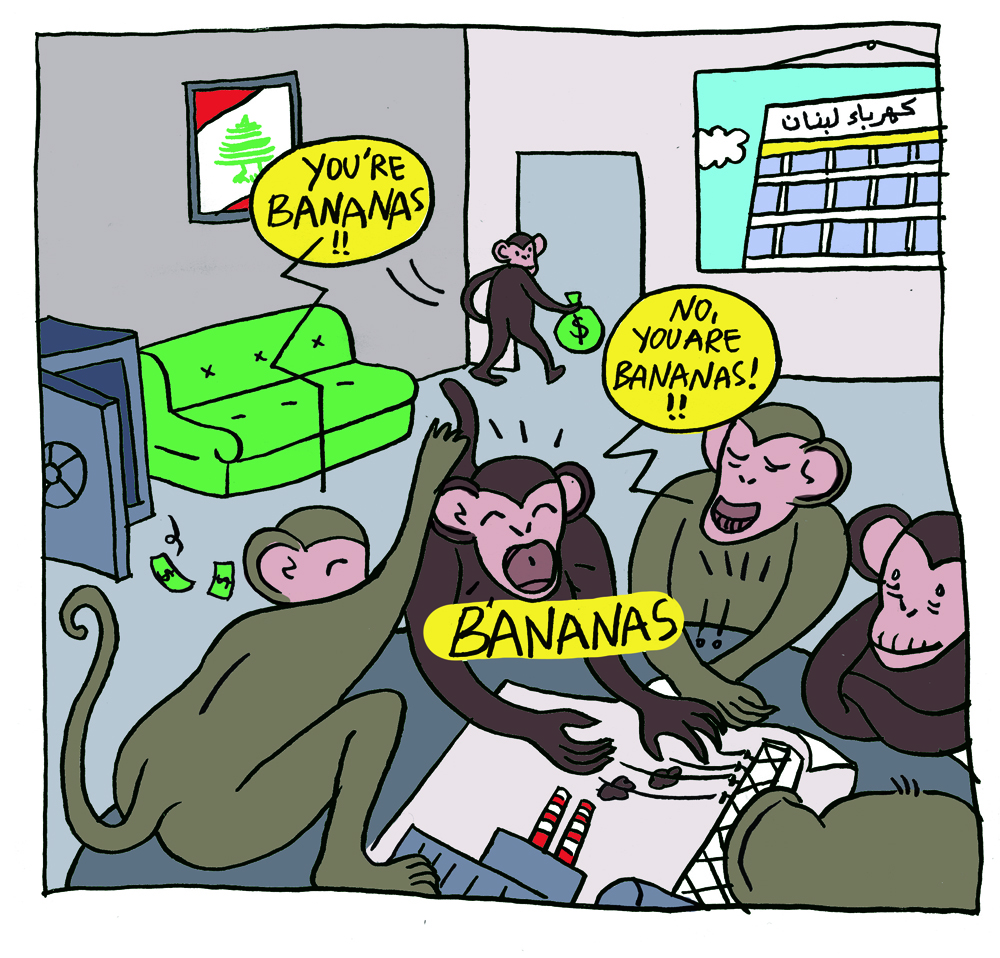
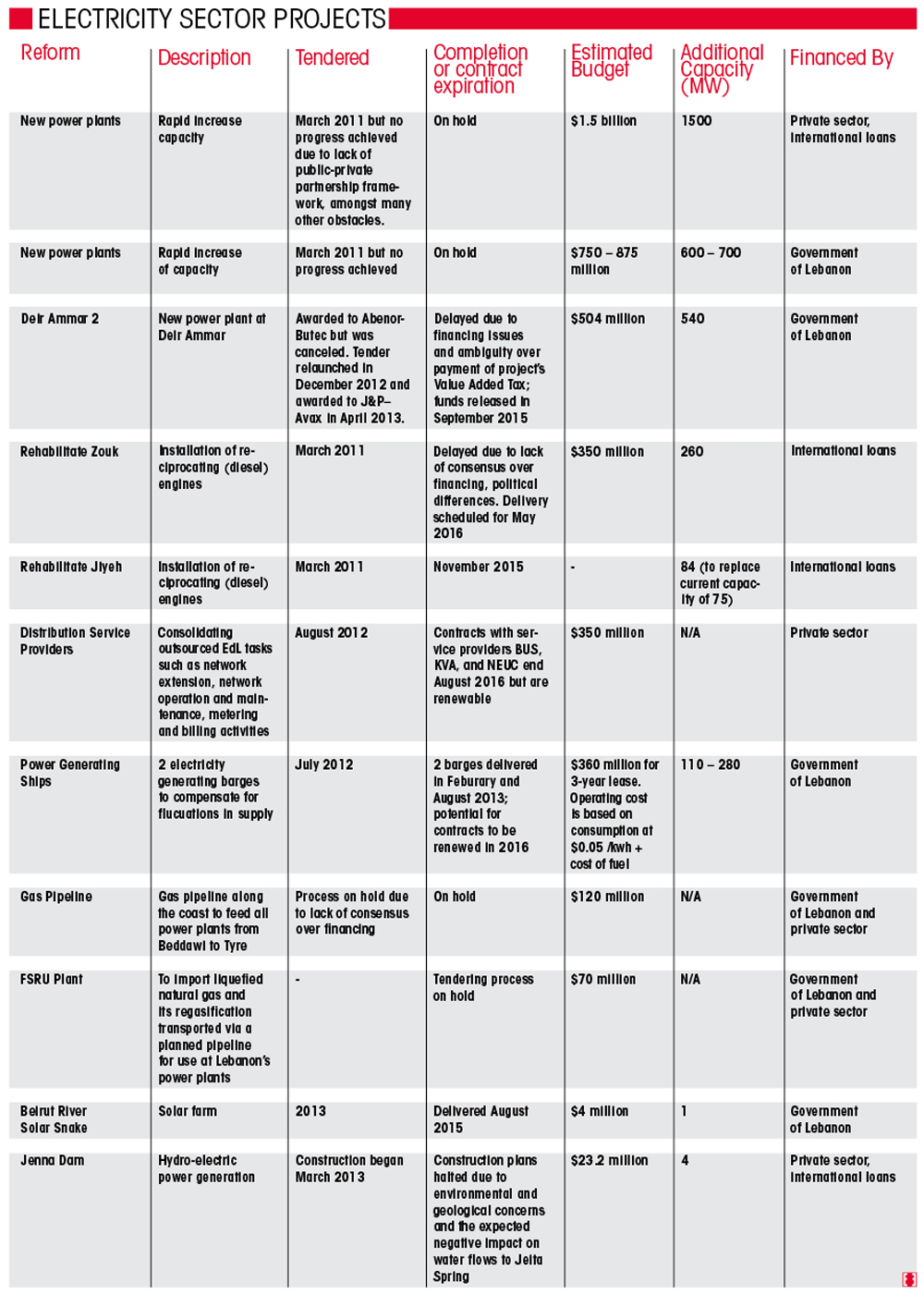
The same actually is true for the electricity crisis where accusations and counter-accusations of corruption were exchanged between Speaker of Parliament Nabih Berri’s Amal Movement and former Prime Minister Saad Hariri’s Future Movement against the Free Patriotic Movement (FPM)’s Gebran Bassil. In short, Amal and Future officials charge Bassil and the FPM of incompetence in the tendering and implementation of contracts for projects from Bassil’s 2010 electricity plan (see table below) and the misspending of some $1.2 billion. For their part, Cesar Abou Khalil – an advisor to the Ministry of Energy and Water and a FPM candidate for parliament in the 2009 elections – said on talk show Kalam el Nas in late October that the Ministry of Finance did not release the needed funds for the projects because special interests wanted to see the electricity sector sink so low so as to force privatization, with plans to manage it with a company similar to Sukleen in the garbage sector.

The accusations come after a statement war between the Ministry of Energy and the Ministry of Finance in early September, followed by a squabble and pissing contest over which politician was less corrupt in an October energy committee meeting in parliament. The entire debacle is not a comedy, and it is not a tragedy in the classic Greek sense of avoiding bad fortune – which politicians are yet to try. It is, instead, downright insanity. The call for action is once again only to cry and say pack up and leave – to the politicians, not our youth.

Civil society vs politicians

The YouStink movement continues its campaign despite a momentum busting month that saw many of its activists facing criminal charges by military tribunal. Non-governmental organizations – like the Lebanese Transparency Association and Sakker el Dekkane – have helped shed light on illicit activity, but their lobbying efforts to pass legislation – access to information and whistleblower protection laws – to mitigate corruption have so far not borne fruit. Politically-backed organizations, such as Kataeb’s newly established MALAF, may not support non-partisan headway toward anti-corruption.

Unfortunately, civil society’s efforts to cleanse Lebanon have not achieved much in the way of systemic reform. But will the coalescence of corruption driven crises actually create real change? As Lebanon’s leading political leaders gather in national dialogue, the calls to root out corruption in delivery of basic public services – including waste management, water, electricity – by civil society and opportunistic politicians seemingly fall on deaf ears. Business will carry on as usual in the parliament as committees re-elected its members in October, despite the legislative body’s inability to elect a president or pass laws to address any one of the numerous economic or social challenges facing the country. At the executive level, the council of ministers remains paralyzed because decision-making stipulates a consensus vote – an impossible requirement given the political polarization.

What Lebanon has been facing is a lack of transparency in political supervision and a lack of accountability to the electorate. The world over, basic public services are delivered through two models, state-owned enterprises or privatization, neither being particularly more efficient than the other and both proven as failed models for Lebanon. What model is the appropriate vehicle to deliver a given service is an important debate that should ensue a overhaul of the system of accountability at three levels: political, institutional and economic.

Political accountability means citizens must have access to elected officials, who need to be able to answer questions with proof, and all ministry-related institutional accountability must be transparent. There are various instruments that can be employed – like public hearings and open committee meetings, or at least the full publication of the minutes of those forums – to make the process more accessible so that the constituency can hold politicians and government officials more accountable.

Economic accountability refers to those who have the authority for economic decision-making. That many of Lebanon’s economic drivers – institutions and business leaders and investors – are co-opted, married to the destiny of the political class, is concerning. This co-option has gone on far too long, so irrespective of any crony capitalism in banking or other sectors of the economy, the economic decision-makers have to accept responsibility for having contributed to the disaster we are in and draw the consequences. Moving forward, the economy still needs to be an active partner of the state and having a public-private partnership law can help further productive collaboration.

Not to mention this magazine’s warnings and calls for reforms, global institutions have pointed out time and again that transparency and accountability are key criterion for efficient functioning of economies, for their growth, and for social well-being. The enduring challenge in Lebanon, however, is that, even with legislation enacted and coupled with ministerial decrees for implementation, laws do remain unenforced.

electricity table

November 9, 2015 0 comments
0 FacebookTwitterPinterestEmail
CommentOpinion

Lebanon’s failing grade

by Nadim Houry November 5, 2015
written by Nadim Houry

Lebanon’s seasonal rains brought with them more than the usual road chaos this year. Trash that had been left on sidewalks as a result of the government’s self-inflicted garbage crisis floated down the streets, sending a stark reminder of the impending health disaster.

Despite the multiple emergencies, Lebanon’s problems – like its garbage – are mounting while the government and the country’s political leaders while away the time. Lebanon’s political class seems to have turned procrastination into a governance strategy. Parliament can’t agree on an electoral law? No problem; its members have extended their own terms twice. No president? Let’s wait until the regional conflicts sort themselves out. Garbage piling up? Maybe the rain will just wash it away to the sea.

The lack of progress in the country will be clear in the outcome after Lebanon appears on November 2 for its second Universal Periodic Review (UPR) at the UN Human Rights Council in Geneva. Think of the UPR as a rather friendly exam session where a country’s human rights record is reviewed by other states that are members of the Human Rights Council. At Lebanon’s first UPR, five years ago, it made a commitment to carry out various reforms, and it will need to show this time around the progress it has made since then. Unfortunately, there won’t be much to show for.

In its 2010 UPR, Lebanon agreed to establish a National Commission on Human Rights and to improve the fight against torture by criminalizing all forms of torture and ill-treatment. Five years later, the draft law for such a commission is still stuck in Parliament, alongside many other initiatives to improve the country. As for torture, security forces continue to ill-treat and abuse detainees amid a general climate of impunity. At best, when videos of abuse by security forces surface and create a scandal – such as the videos that emerged this summer showing several Internal Security Forces officers beating inmates in Roumieh prison – officials promise accountability and announce investigations that seem to fade away as soon as the media attention shifts to other scandals.

When confronted with their failure, many local officials will politely agree about the need for reform but disagree on the timing, arguing that no progress can be made due to a never-ending series of local or regional crises.  Lebanon is facing a number of challenges, but these excuses ring hollow and the countries reviewing Lebanon’s record in Geneva should recognize them as such.

The failure to prosecute human rights abusers, like the failure to find a solution to the garbage crisis, is not due to external crisis but rather is deeply rooted in the country’s culture of impunity. It is a culture that received an official seal of approval at the end of the civil war, when the warlords agreed on a general amnesty. This approach has since metastasized to all parts of the administration, making the struggle to end impunity a difficult one.

The challenges ahead were evident in the recent effort to hold security officers accountable for excessive violence against protesters demanding an end to the garbage crisis. Despite the opening of a judicial investigation into excessive use of force, two months later there is no indication that any judicial measure have been taken. For now, the only action seems to be light disciplinary measures against six security officials for acting without checking with their superiors.

Ending impunity should dominate Lebanon’s review at the UPR in Geneva. If Lebanon’s political class dismisses the demands for more transparency by local protesters, perhaps they will feel the need to respond to questions from peer states in Geneva. In the meantime, get ready for more garbage floating along a street near you.

November 5, 2015 0 comments
0 FacebookTwitterPinterestEmail
Entrepreneurship

Time to talk it up a notch

by Executive Editors November 1, 2015
written by Executive Editors

Lebanon is at a crossroads. It has been two years since the announcement of Circular 331, and the
murmurings of a revitalised golden age brought about by our startup and entrepreneurial system. Whilst it might be too early to speak of the clear tangible benefits to the Lebanese economy, there is obvious traction within the sector which in 2015 witnessed a growth in the number
of acceleration programs and non-financial initiatives that complemented the large input from Lebanese venture capital powerhouses. Executive’s special report on the entrepreneurship profiles several of these accelerators, and discusses the current impact circular 331 is having
on the ecosystem. Though money is needed and has been well received, deployment has been slow and the central bank should create a centralized database of 331-related
investments to keep spending as transparent as possible.
How long will entrepreneurs have to wait in line to get the investments and tickets they need, before they gain access to ‘Club 331’? We stand on the edge of the investment cliff, because the
viability and survival of our startup and entrepreneur system in the long run is in question. Though every initiative within the ecosystem need not survive, an overarching sustainability
is key, which will see investments feed back into our country to develop a strong and robust asset class which is attractive to the private sector. Whilst the future is bright, and opportunities
present themselves with the current financial enthusiasm, it will only remain so if Lebanon as a country chooses to tread the right path, and ensure opportunities are not squandered.
This in turn must be coupled with a strong adherence to clear governance that regulates without restricting growth.
PART OF THE SOLUTION
There are many positive initiatives at present to encourage the growth of the Lebanese entrepreneurial ecosystem. The Banque du Liban Accelerate conference is one
such example of a positive step encouraging collaboration for a more harmonious sector. Lebanon For Entrepreneurs (LFE), an initiative which works both to inform the diaspora on the current status of the Lebanese startup system and to promote sharing of global expertise, is another.
However, in order to make this ecosystem successful all players within the sector must contribute and commit themselves to the fullest, which means that whilst competition between funds is beneficial, effective communication across the board is essential to ensure a cohesive
ecosystem. More can be done to ensure that all within the ecosystem are in sync with one another, especially here in Lebanon. This is extended to institutions, banks and universities bodies which are on the periphery and which feed individuals into the Lebanese economy. At time of press there was no unique central portal for the exchange of knowledge, and LFE’s database of private and academic entrepreneurship support organisations was last updated over a year ago. Whilst individual programs are trying to target the gaps within the system, an independently
regulated umbrella platform with up-to-date information would undoubtedly facilitate understanding, cooperation and ultimately growth, and potentially promote healthy competition. Though initiatives such as the Global Entrepreneurship Week encourage relations between players,
more can be done to improve and centralise collaboration.
This includes prioritising the development of an electronic stock market, a central ‘location’ to provide much needed liquidity to companies, and identifying areas in the infrastructure
which could be improved and leveraged to attract young talent, such as relaxing required capital for
registering companies.
A great deal of money has been poured into, and is earmarked for, the entrepreneurship ecosystem. But if Lebanon wishes Circular 331 to be a success, and ensure the money is not wasted, improvements must be made at the macro and micro level. There is an inherent amount
of volatility that cannot be avoided; risks which cannot be mitigated; as our special report will outline, venture capitalists and private equity firms must overcome the steady security of being risk-averse and spend the money raised through Circular 331 without exercising undue caution.
We must accept that there is no mathematical financial instrument that can price a startup akin to the way the Black-Scholes equation prices European options; there is no accurate prediction instrument for the future value of a Lebanese startup system. All eyes should be focussed
on trying to make the space we have as accessible as possible for the next generation of innovators, improving inter-player communication, and pressurising the government for better infrastructure, internet and entrepreneur- friendly policies is key. Many would argue that this is a fruitless task, seeing as our streets are now swimming with garbage thanks to the rain and the political puppet
show playing out in the Grand Serail. However, the beauty of the entrepreneurship sector is its ability to develop solutions which are innovative and effective, which defy imagination even in the face of overwhelming odds, and there is no reason that this cannot extend to macro issues.
To ensure our system doesn’t dwindle and fall by the wayside in seven years time, we need to realise that Circular 331 is only part of the framework needed to hold up our ecosystem. The time to act is now, so we ensure foresight, rather than hindsight, is our ally.

November 1, 2015 0 comments
0 FacebookTwitterPinterestEmail
Editorial

EASTERN PROMISES

by Executive Editors November 1, 2015
written by Executive Editors

That our politicians got us into an absolutely avoidable waste crisis they have been unable to extricate us from for over three months is simply embarrassing. It’s not about garbage
any more. It’s about turning Lebanon into a distressed asset.
It has become obvious that our institutions, which have been running on an ad hoc basis for 25 years now, are headed for a complete meltdown. The state is not successfully providing
even one basic service. Our politicians have made this country a joke, and today
it looks like things will only get worse.
Legislative paralysis is putting us at risk of losing much-needed loans for development projects from the World Bank. If we allow this to happen, we’re taking a potentially devastating risk. Other international institutions and past partners could very well reconsider financial facilities armarked for Lebanon, triggering an isolation of our financial system. Once our uncooperativeness unplugs us from the international system, expect scavengers to impose their rule under the pretext of assistance. Sound familiar? We can either remember how those who promised Lebanon help in the 1980s only bled us dry, and learn from that experience or keep living in denial, insisting our ever slowing economic pulse is still proof of life until we return to being simply a market for the East, deprived of any ambition or ability to produce. If history does repeat itself, we will have only ourselves to blame. We’ve invested nearly nothing to make this country more productive and are watching the traditional engines of our economy run out of gas while insisting we can
make it just a few more kilometers before taking action.
Meanwhile, we have a guerilla army of well educated, creative and innovative individuals able to generate wealth and value in unconventional ways, making markets around the globe a click away. This small, dedicated and focused group has been working hard with few resources for too long. Two years ago, the central bank has stepped in with support, and a more vibrant entrepreneurship ecosystem is emerging. Happily, they’re our last link to the productive global economy.

November 1, 2015 0 comments
0 FacebookTwitterPinterestEmail
Banking 2015Business

Quilvest loves BlomInvest

by Thomas Schellen October 28, 2015
written by Thomas Schellen

It is a regular romance. Quilvest, a global wealth manager, and Lebanon’s BlomInvest Bank have tied the knot with a new product partnership, allowing the Lebanese bank’s wealth management clientele to buy into Quilvest deals via a special purpose vehicle called the Blom-Quilvest European Real Estate Fund. The two are teaming up for the second time in three years to market investment opportunities. The difference from their first collaboration, which was a l’Americaine, is that the current arrangement is focused on European property investments.

“What is most important in our relationship is that the very spirit of [both] Quilvest and the bank are very much alike,” says Marc Manasterski, partner and global head of the real estate unit at Quilvest. “BLOM has a family approach to business and we have the same,” he adds and iterates a line from the Quilvest Group’s corporate narrative to explain how the group is distinguished from the hoi polloi of fund management by always committing its own important equity stakes into projects. According to Manasterski, Quilvest does not prioritize fund management fees as its revenue source. “We are investors before we are fund managers,” he enthuses.

For Fadi Osseiran, the general manager of BlomInvest, it was enlightening to see how the investment opinions on both sides moved in sync. “We said, [this is] great, we see eye to eye,” Osseiran explains, referring to how he saw that Quilvest was targeting the United States at the same time when the BlomInvest team thought the US was the ticket three years ago. They also talked about Europe just as BlomInvest was looking to invest there, given the weakening Euro and central bank efforts to stimulate an economic turnaround.

Another enticing element of convergence was the all-important perspective on risk, Osseiran says. “People are greedy,” he elaborates. “Whenever they are approached with promised returns, they don’t look at risk. We have always a lot of opportunities when funds come to us but when we pick a fund, we don’t just look at the performance, which shows only the growth but not the risk. Looking at Quilvest we saw a family fund that has a track record of 70 years of investing its own money directly. Our cultures are very similar in terms of risk mitigation.” 

Looking to Europe

The Blom-Quilvest European Real Estate Fund is seeking to accumulate $20 to $30 million in investor money and deploy interesting amounts into select projects in European capitals and gateway cities. Projects will generally not be new developments but consist of property acquisitions targeted for refurbishing and repositioning, aiming for annual returns of 12 to 13 percent. According to Manasterski, the monies will be deployed over two years and the holding period of the investments will be about four years, aiming for liquidation by 2020 or 21, with interim income delivered in the meantime. He emphasizes that the investments will be in the low-risk European environment, but will offer premiums of 900 to 1000 basis points (bips) when compared with returns achievable from high-quality sovereign bonds that yield less than three percent.

“The strategy in the current partnership is not to invest in funds but only in direct deals with pre-identified investments; another characteristic is that investments are in deals that secure value creation upfront so that the exits are not so exposed to market swings. Therefore, if we do not secure the 12 to 13 percent, we serve eight percent at worst, comparing to the treasury bond at 2.5 or 3 percent, [representing] a 500 bips riskless type of investment return,” Manasterski says.

He outlines his rationale for targeting the European property market over other investable real estate markets around the world. While property values in the US still have room to increase, one has to be cautious and very selective in the coming three to five years to avoid being caught in market adjustments. Markets in Singapore and Hong Kong are very active, but these East Asian property environments are, value wise, under the influence of China. The country, in Manasterski’s view, is in a phase of no development which he specifically attributes to the Chinese government’s anti-corruption drive that has hit decision making in state-owned enterprises. Latin-American property markets in turn are sluggish because of the dependency on Chinese demand by most of the continent’s economies.   

For BLOM clients, the Blom-Quilvest European Real Estate Fund is accessible on a retail level, Osseiran says. But that is retail in a manner of speaking, to the value of a $250,000 minimum ticket size compared to the multimillion dollar participation requirements that Quilvest usually imposes as an entry barrier. “We use the word retail as opposed to the minimum ticket of $5 million or $10 million,” Osseiran clarifies.

Given the Blom-Quilvest fund’s minimum ticket size of $250,000, the audience for buying into the fund seems destined to range in the dozens and not in the hundreds of clients. Osseiran says he expects that respondents to the fund offering will comprise perhaps sixty percent of clients who already use BlomInvest. This would give the bank important opportunities to appeal to wealth clients that have ties with the parent, BLOM Bank, and to approach potential new clients in the market place where the BlomInvest Private Banking unit competes in Lebanon with the likes of Audi Private Bank, the Saradar Group, and FFA Private Bank.

October 28, 2015 0 comments
0 FacebookTwitterPinterestEmail
Tourism and Hospitality

Burning the fat

by Nabila Rahhal October 26, 2015
written by Nabila Rahhal

The commercial fitness industry in Lebanon is witnessing a growth both in the number of gyms and in the variety of fitness options inspired by global trends. Executive profiled four different gyms to learn more about their unique business strategies and their take on the Lebanese market.

180 Degrees fitness and spa

Spread over 4,000 meter squares is Ashour Holding’s first venture into the health and fitness industry, following his other hospitality projects such as the Lancaster hotels and the restaurants in Verdun.

180 Degrees, which opened almost a year ago, is located on Unesco Street towards the beginning of the Jnah highway and is housed in the three floor underground warehouse of Ashour Holding’s Park Tower Building. According to Samar Hamdan, the project’s director, a fitness and spa center was one of the few concepts that would be successful in a such large underground space.

In addition to the gym itself, which has 18 cardiovascular machines, around 34 strength training ones, an indoor pool and two squash courts, the outlet also includes a health food cafeteria, a clothing store and a beauty and massage spa. “We want people to come to our center and be able to spend the day,” explains Hamdan.

[pullquote]“Clients still sign up for personal training because they see better and faster results, sometimes in only three months.”[/pullquote]

Hamdan explains that they use 180 Degrees Fitness and Spa’s large space to its full advantage and have five studios for classes with plans to open a new studio in their garage that would have a capacity of 80 clients per class. Because of the number of studios, 180 Degrees is able to offer a variety of classes at the same time, often having four classes running simultaneously. “We offer Les Mills, Radical Fitness, Freestyle and yoga classes so everyone can find a class that suits them,” explains Hamadan.

180 degrees

Hamdan does not feel that having a large number of members in one class would deter from the experience and says that it is up to the trainer to make sure all members are doing the moves correctly. Because of the high energy classes offered and the vibrant decor, Hamdan says the gym attracts a lot of students from the neighbouring universities such as LAU and AUB. Membership fees vary between corporate, students, annual cash payment and semi annual payment but the average is $125 per month paid over a full year.

Hamdan says a lot of their members sign up for personal training although the instructors on the floor monitor all clients regardless of whether they took PT sessions or not, and change their programs on a bimonthly basis as they develop strength. “Clients still sign up for personal training because they see better and faster results, sometimes in only three months,” says Hamadan.

When they first opened the gym, Hamdan says the main challenge was promoting their name amidst the competition in the area. “We were able to distinguish ourselves with our consistent high quality service,” explains Hamadan.

Today, 180 Degrees has around a 1,000 members with plans to continue growing.

Evolve

Just off the Rabieh highway is a physiotherapy and sports boutique center called Evolve which opened in 2012.

Its owner, Elias Azar, is a physiotherapist. After earning a Bachelor’s in Biology, Azar had hoped to become a chiropractor but was forced to change plans when the July 2006 war prevented him from continuing his education abroad.

Instead, Azar chose to major in physiotherapy at Lebanon’s Antonine University which had just launched the course in English. Alongside his studies, Azar, who had always practiced a wide variety of sports, was working part time as a trainer at one of the neighborhood gyms. “I was applying what I was learning at university; the late stage of physiotherapy is the strengthening and proprioceptive phase, or the early stage of sports,” explains Azar.

As Azar learnt more about the relationship between physiotherapy and working out, he began to relate his knowledge to his clients. Word of mouth from satisfied clients helped Azar expand his list of gym clients who were recovering from injury. “I started using the gym to strengthen and heal my patients and not just to get in shape and be fit,” enthuses Azar.

Following the completion of his physiotherapy degree and after a stint helping launch a 24-hour fitness center in Qatar, Azar chose to return to Beirut and launch his own business. “Like with any other business, one has to be a pioneer and develop a concept that is new to the market for it to be successful. Because there already exist a fair number of gyms in my area [Rabieh], my businesses wouldn’t have been competitive and physiotherapy alone would not have been enough. So instead, I opened a boutique gym inside the physiotherapy department, effectively combining the two concepts together. Those who were doing physio would continue in sports and regain their strength to the fullest and those who were doing sports alone would trust that they were doing so in a safe and well studied environment,” says Azar.

evolve

Evolve does not have monthly membership fees and is a sessions only gym whereby one books an in-house personal trainer (PT) session ($50) or a physiotherapy session ($40) depending on the person’s needs.

At any given time there are a maximum of four clients at the premises, and Azar is always personally present to monitor and train, along with a few trainers and physiotherapists who assist him. Azar also sets up personalized programs according to the clients’ specific needs, including taking into consideration which type of sport they practice the most, the frequency with which they train and the results it has on their particular body composition. As such, he says his biggest challenge is the long hours he puts into providing this kind of attention. This is in addition to the fact that the gym physiotherapy combination is a relatively new concept in Lebanon, leaving him with no precedent to model after or learn from.

Among the services that Azar offers, both at the physio and gym sections, are corrective training for physical imbalance when overworking a group of muscles, posture exercises, functional and corrective training (such as when one hand is stronger than the other in the case of tennis players) and preventive training such as the prevention of osteoporosis in menopausal women.

Azar says his clients’ ages range between 12 and 90 years old and explains that he has many geriatric clients who are aware of the importance that sports has on maintaining joint flexibility and good circulation.

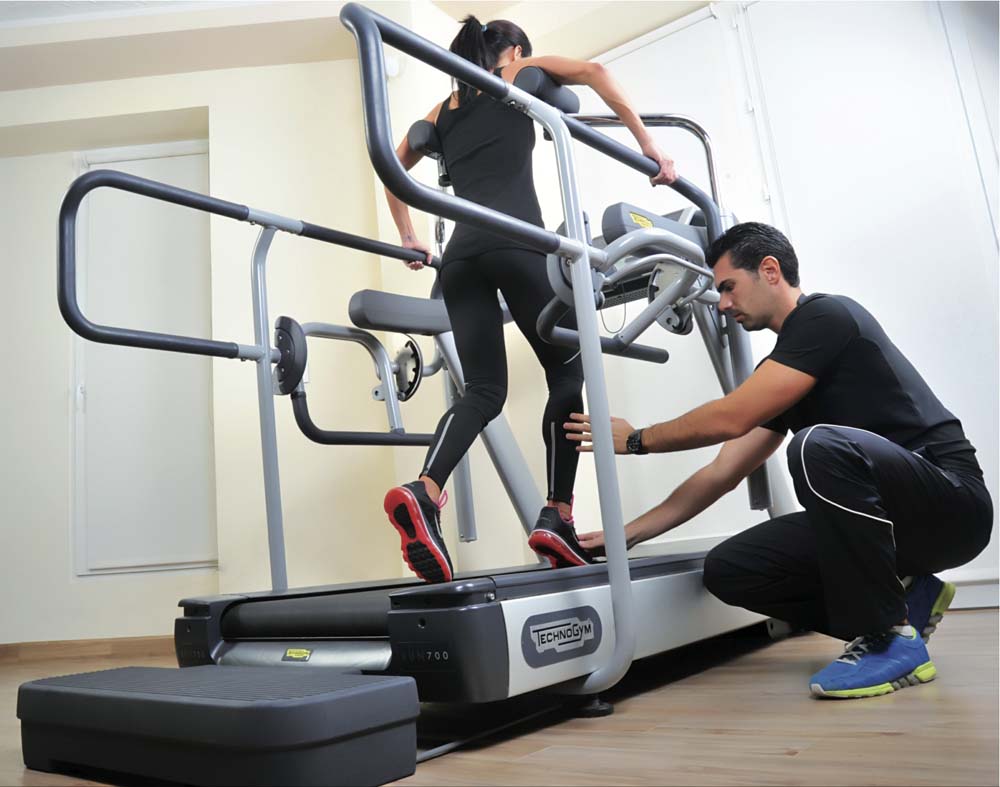
Because of the physiotherapy element of the gym, each machine in the outlet has been handpicked to be the safest possible with specifications made for those with injuries, such as inbuilt crutches on the sides of treadmills.

Azar is happy with the feedback he has received from clients and says he is keeping a busy schedule with physiotherapy clients staying on to continue sports and vice versa. Speaking of the fitness scene in Lebanon, Azar says, “People are becoming more aware of fitness and it has become part of their lifestyle. Even physiotherapy is becoming more of a need after an injury to help relieve the pain. People are beginning to understand that in order to prevent the injury from reoccurring or even occurring in the first place, they have to keep themselves fit by doing sports. It’s a cycle.”

Exhale

Exhale, a classes and personal training fitness studio, opened in 2004 on the first floor of an apartment building towards the end of Bliss Street. Hania Bissat, Exhale’s owner, says that she and her then partner started Exhale upon their return to Beirut after having lived abroad because they felt the fitness scene in Beirut was lacking in certified trainers and general awareness of the importance of sports for a healthy life was missing.

From the start, recounts Bissat, she was interested in indoor cycling or spinning and introduced that to her studio. She started by becoming certified abroad as a spinning instructor and brought indoor cycling workshops to Beirut in order to certify Exhale’s instructors as well.

Bissat still hosts international workshops at Exhale and invites other gyms to certify their instructors as well. “Our main motto was to make everybody more aware about fitness in general and to make sure that everybody who works in Exhale as a trainer is certified in everything they do. Still, the more certified instructors there are, the better for the industry,” says Bissat.

Bissat believes certification is important because clients who come to Exhale are not paying a small amount. A single class costs $22, with discounts available if classes are bought in bulk over a predetermined time frame. Clients therefore expect professional service. “The whole environment and experience has to be professional and that is what I personally work on. Hopefully enough people will appreciate it to make it worthwhile,” explains Bissat.

Over time, Exhale’s client list grew considerably, with people coming from across the city for classes at the Bliss Street studio. When the Saudi Embassy relocated to the end of Bliss Street, it purchased the parking lot where Bissat’s clients used to park and created increased traffic issues in an already congested street. This made reaching Exhale difficult if one was not on foot or with a driver.

ex

These factors, combined with Bissat’s long term desire to have a studio at street level instead of in a building, encouraged her to open a second Exhale in Saifi Village in May 2015. “I wanted to be in a central location where people coming from both Hamra and Downtown could reach easily, so I was limited with my choice. Since I know Saifi Village well and have a soft spot for it, I chose it. It’s more expensive than Bliss Street but the most expensive investment for me remains the equipment,” says Bissat.

Having already developed a reputation for her indoor cycling classes at Bliss, Bissat decided to go all out in Saifi, doubling the number of bikes to 30 and offering twenty one weekly classes instead of just three. Bissat even worked with an American consultant who had designed the interior of around 80 indoor cycling studios to get everything from the backdrop details and positioning of the bikes to the lighting and the music just right. “It’s a new concept in Lebanon to be so specialized but I wanted to try something new and I love being specialized because specializing in one trend means you stay on top of the industry and provide the best service,” explains Bissat.

Bissat has been pleasantly surprised by the response the new Saifi studio has had so far, especially considering the summer months are usually slow when it comes to sports. But Exhale was kept busy with expats who had previously done indoor cycling in similar studios abroad and were happy to see it take root in Lebanon. “We were able to achieve results but my real test will be from September to December,” says Bissat adding that four of Exhale Saifi’s classes have waiting lists because of their good timing or the instructor’s popularity.

Exhale has a wide range of clients of all ages and genders. “Most of them have traveled abroad and know what a big deal cycling is. There is something about indoor cycling, in the energy and the music, which is addictive,” enthuses Bissat.

Exhale also offers personal training sessions at the studio, with prices ranging from $55 to $65. Bissat claims they are doing well as clients today enjoy the one-on-one attention, particularly when it comes to fitness.

Maya Nassar’s Start Living Right App

By now, the story of Maya Nassar, Lebanon’s first fitness bodybuilding and bikini competition champion, is relatively well known. As she recounts it, Nassar used to be overweight and felt insecure so she decided to take matters into her own hands and embark on a fitness journey based on her own extensive research on clean diets and weight loss programs. So she set out a personalised program which included both nutritional changes and working out six times a week under the supervision of a personal trainer. “I am proud that I did it myself and no one helped me. I was fascinated with the subject and addicted to the results of feeling good, having energy and confidence and losing weight on a weekly basis,” enthuses Nassar.

In three short months, Nassar had lost more weight than she’d originally planned to. Without wanting to stop there, Nassar challenged herself further by signing up to take part in a female body building competition. “I thought of trying it for the challenge and for the preparation training it would involve, not necessarily to win. Just being on the stage with the other girls would be like winning for me,” says Nassar, explaining that since female bodybuilders are rare in Lebanon, she had to train alone and had no one to share her experiences with.

While training for the competition and even on her initial fitness journey, Nassar, who was always passionate about writing, recorded her experiences on her personal Facebook page. Towards the end of July 2013, she realized the positive feedback and fitness questions she had been getting from her friends online and decided to launch a fitness website called Start Living Right which would motivate and inspire those thinking of launching their own health and fitness programs. “There are a lot of scams regarding diet and fitness so I wanted to be very honest and provide simple, unbiased information for people. I don’t have advertising and I am not trying to sell anything so I am not impartial,” explains Nassar.

Nassar says the website did really well because a lot of users were writing to her saying that she had inspired them in their fitness journeys. The website now has 8,000 unique visitors. Because of the website’s positive performance, Nassar decided to launch a mobile application with the same features of the website, including the calorie counter and the motivational articles but with a few additions such as the animated workouts divided into the body’s muscle groups.

The application has 15,000 downloads so far and Nassar says she and her developers are working on a few more additions. 70 percent of Nassar’s online clients are women, mainly from Lebanon and the Middle East, but she says she also has users from England, Russia, India and Turkey. The website and applications are slightly geared towards the Middle East in that the calorie counter includes food items which are common to this part of the world and not usually found in international calorie counter applications.

Nassar has no structured marketing but says that what has helped her gain exposure was being officially endorsed by the Lebanese Ministry of Sports to represent Lebanon in female bodybuilding competitions, garnering her a lot of media attention. “I wanted to do this to counter the stereotype of female bodybuilders as being very muscular and unfeminine which is not necessarily true,” explains Nassar.

Nassar’s journey in fitness does not stop here; the young health and fitness leader has plans to open her own gym soon. “My advantage is that I have a lot of followers, on both my website and application. Many of them contact me wanting to work with me but I don’t have a physical location to help them. I plan to drive traffic from my website and application to my gym when it finally opens and use this as a physical location where I’ll be able to help the people I’ve been thus far helping online.”

It is clear that Nassar’s heart really is in it. “For me, it’s more about passion than work. It’s something I enjoy doing,” she concludes.

U Energy

When Alex Nazarian, CEO of U Energy gym, first moved to Dubai, UAE, he was disappointed by all the large franchise gyms available there which cater to the masses and lack personalized attention, as opposed to smaller gyms which tend to have a more unique feel.

Seeing this prompted Nazarian to launch U Energy gym in Dubai in 2012. Although he says he had no previous experience with the fitness business, working instead in his family’s textile manufacturing business, his passion for sports and his lifelong ambition of setting up his own business encouraged him to take this decision.

In August 2013, Nazarian brought U Energy to Beirut. He chose Downtown as the location since it is primarily a business area and he felt at home in such an environment after his experience with U Energy Dubai at the Dubai International Financial Center. The second U Energy opened in Bliss Street around early May 2015, attracting a lot of professors and doctors as clients in addition to university students from AUB and LAU. Nazarian plans to open a U-Energy gym in Hazmieh and another in Antelias as he believes there is still room for growth of the fitness industry in Lebanon.

Nazarian describes his clientele as trendy, fit and young, between the ages of 21 and 50. These are all factors he keeps in mind when choosing locations for his gyms.

Membership fees in U Energy vary between corporate, student and regular memberships but fall within a rough average of $140 per month if the client commits to an annual package. Personal trainers cost $45 to $50 per session. While the fee is not as low compared to other gyms, Nazarian sees his gym as “boutique”, catering to a small number with classes of up to 16 students as opposed to others which pack theirs with around 50 students, allowing for more personalized attention. “I consider myself a boutique health club. Our price range is at the medium end so we are not looking for the masses. I aim for an average of 600 members at the gyms that I open and we are pretty close to reaching that number in Downtown,” explains Nazarian.

The personalization concept extends to developing classes unique to U Energy gym instead of importing workouts from abroad. “Most gyms in Lebanon follow the Les Mills approach of body pumping and body combat where the Les Mills Company sends standardized choreography, steps and music which the trainers here have to apply to the dot. We, instead, much prefer to cater and develop our workouts based on our clients’ needs,” explains Nazarian.

Among the biggest challenges Nazarian faced was finding qualified trainers. He explains that although both the Antonine University and the Lebanese University offer a Physical Education degree, he believes that it’s not enough to simply qualify to be a trainer, preferring to train his staff in-house. “We give research workshops twice a week for all our trainers to better themselves because ultimately, personal trainers are like doctors in that they deal with your body and therefore must be sure not to hurt you and make a problem worse,” says Nazarian.

In parallel to U Energy, Nazarian has also developed a new concept called Go by U Energy. This is strictly personal training, where the customer books sessions with a PT, with one small studio where one class called Go is given. Nazarian describes Go as “the ultimate high intensity class: a combination of everything you need to get toned and fit.”

The first Go by U Energy has already opened in Gemmayzeh and Nazarian plans to open a few more if the concept takes off. “It’s much smaller so you can find smaller locations with good rent prices and actually open more of these. People want this because they want personal trainers or smaller classes as I can tell from my clients at U Energy,” explains Nazarian.

Nazarian acknowledges that Lebanon has a long way to go before reaching global fitness trends and blames this on a lack of education. “Lebanese have the backdated idea of fitness being mainly about bodybuilding, but abroad it’s completely changed and is more about functional training. Today more and more people want to be fit and healthy, and this is a good thing because it will get people more educated about fitness,” says Nazarian adding that the recent surge in gyms in Lebanon is a positive sign and that he welcomes the competition as it pushes him to better himself and ultimately better serve the clients and the industry.

October 26, 2015 0 comments
0 FacebookTwitterPinterestEmail
Tourism and Hospitality

Fitness on an incline

by Nabila Rahhal October 26, 2015
written by Nabila Rahhal

Over a decade ago, gyms or fitness centers in Lebanon evoked images of steroid pumped men grunting loudly while lifting heavy weights, or leotard clad women enjoying aerobics classes led by smiley and energetic trainers with questionable training abilities. The Lebanese fitness industry has since grown significantly, inspired by global trends of wellness and healthy living. This growth stretches across the industry and manifests itself in the increased number of fitness centers, the variety of sports activities available and the rising awareness of the importance of hiring certified trainers.

Growth in fitness

Emile Baroody, Vice President of Baroody Group sal, a sports company established in 1912 which represents Technogym, a commercial fitness equipment brand, places the industry’s annual growth at about 15 to 20 percent over the last five years, based on his own estimates.

Naji Saliba, managing director of Young Trading Co, established in 1997, which represents Life Fitness, an American brand of commercial use fitness equipment, also cites significant growth over the past three years, naming at least four gyms which have opened in Beirut and Mount Lebanon in the last three years.

Components of the industry

The fitness industry is divided into two main categories. One is the purchasing of equipment for residential, personal use. The second is commercial use and is itself divided into various subcategories including hotel gyms, corporate gyms, fitness facilities in residential compounds and health clubs.

The use of fitness facilities in residential compounds is the one that has seen the most growth since 2009, according to Saliba. Both Saliba and Baroody list more than ten residential developments which have bought fitness equipment for the residents’ gym and Saliba places the budget for these gyms at $100,000 each.

[pullquote]The latest trend in commercial fitness equipment is for it to be technologically connected overseas[/pullquote]

Speaking of hotel gyms, Saliba says this particular sub market has not witnessed a significant growth because no major hotels have opened in Lebanon in recent years. Baroody says that, with the exception of the five star or international names, hotels in Lebanon do not view their fitness room as an important revenue source for their outlet and as such do not invest in good quality fitness equipment, preferring instead to buy cheaper Chinese brands or second hand machines. “It is a short term vision because in the long run, clients will appreciate hotels with a professional quality gym,” admits Baroody, adding that some five star hotels in Lebanon make money out of their hotel gym by opening it up to non-guests for an annual membership fee.

Increased interest in fitness centers

Fitness centers remain the biggest category of commercial fitness in Lebanon, with Saliba placing 90 percent of the country’s gyms in Beirut, Mount Lebanon and the North up to Tripoli.

Patrick Bejjani, founder of 4 Actions Academy which educates and certifies fitness and personal trainers, has a long history in the health club industry, starting out as a trainer before establishing 4 Actions in 2011. Bejjani finds that, in general, the Lebanese show a greater interest in attending health clubs and training sessions today than they did in past years. “There is definitely more interest in working out. You see it in the increased number of gym memberships, in the social media posts of people using the gyms and in the general vibe of wanting to be healthy,” says Bejjani. Saliba believes this growth in the fitness club business is led by women who are working out more now, especially with personal trainers.

Investing in fitness

Because fitness equipment for commercial use is built to last at least ten years, it is not cheap, with both Saliba and Baroody placing the cost of machines between $5,000 and $25,000, depending on the specifications and how technologically advanced the equipment is.

Baroody explains that, while five years ago the most important criteria for gym operators in selecting machines was the cost and length of the warranty, today they prefer instead to base their selections on their gym’s needs, such as safety of the machine, its durability and its entertainment options.

The latest trend in commercial fitness equipment is for it to be technologically connected overseas, with Saliba explaining that Life Fitness machines are now networked to the main office in the USA so that whenever a malfunction occurs, Headquarters informs the local representative first. Technology and entertainment are also central components of gym equipment selection, with many of today’s cardiovascular machines equipped with smart screens which create virtual scenes for runners (such as running on the streets of Paris) or allowing cyclers to connect with and race each other within the gym.

Despite the high costs of the machines themselves, the biggest expenses for a gym operator is rent. “The gym equipment and decor may be expensive, but it is an investment which is made once and lasts ten years. Rent, on the other hand, is an annual expense,” says Saliba, adding that some gym operators own the facility’s property and as such are able to generate profit much faster than those who have to pay rent.

The costs of operating a gym do not end with the rent and equipment. They include other overhead costs such as electricity, water and maintenance, with the bigger gyms that have pools or sports fields incurring even more charges, explains Saliba.

According to Bejjani, monthly membership fees and the cost of personal training (PT) sessions have not significantly increased over the past five years and still range between $130 to $200 at the good quality gyms and $40 to $60 for most PTs. He explains that, while prices have remained stable because they cannot afford to be raised considering the limited income of most Lebanese, the expenses for gym operators have nonetheless increased.

The rise of the small gym

Elevated expenses have caused gym operators to migrate towards establishing smaller gyms rather than the traditional big gyms which boasted membership of 1,000 members or more. The concept of the smaller gym focuses on the new trends of Crossfit (Olympic style exercises) and functional training (exercising the way the body moves), thereby saving on rent and fitness equipment. Saliba adds that popularity for this type of gym is growing in Lebanon, naming four which have opened in the last year alone.

Bejjani and Baroody have noticed that small studios or boutique gyms are also on the rise, pointing out six personal training studios which only offer sessions with a personal trainer and do not provide membership. According to Bejjani, the reason for this shift is that private trainers who develop a big clientele list are tempted to set up their own practices, making more money that way than when they have to give a percentage of their earnings to the gyms that employ them.

Personal trainers

Trainers are arguably the heart of any gym, capable of bringing in increased revenue when they garner a loyal customer base who come specifically to train with them.

Fitness instructors, however, are not yet represented in the ministries and don’t have a syndicate or an order to represent them. This is despite the fact that they, like physiotherapists who do have syndicate representation, work in the healthcare industry and are liable to causing serious injuries to clients if not well educated in their business, laments Bejjani.

Although certification programs for fitness trainers have always been available in Lebanon, they have only recently become a proper industry, adopting international standards and increased awareness about the professional significance of having certified trainers.

[pullquote]The concept of the smaller gym focuses on the new trends of crossfit and functional training, thereby saving on rent and fitness equipment[/pullquote]

Realizing the new potential in this burgeoning business, and looking to bring international standards to the fitness industry in Lebanon, Bejjani quit his job as a personal trainer at Fitness First and established 4 Actions in 2011, becoming the sole agent of the double accredited International Fitness Professionals Association (IFPA) in the Middle East and North Africa.

Bejjani started by offering IFPA courses at the Panacea gym in exchange for educating the gym’s trainers for free, but quickly moved from giving the course in several other gyms to finally renting his own premises in Abraj Center, Furn El Chebak, in 2014. “With my growing list of students, I felt I needed a home base where students could interact with each other, relax and read up on fitness,” explains Bejjani who has graduated over a 1000 students up until today. The course costs $800 and Bejjani admits that in Lebanon he is only able to break even, whereas he is able to make real profit when he teaches the courses in Saudi Arabia or the UAE.

Personal training is a growing business in Lebanon, attests Bejjani, with the trend moving towards group personalized fitness where a maximum of five clients train with a PT at lower cost than solo PT sessions. “The last five years saw a big growth in personal training because people want to gain the most out of their workout session. There is more profit for gym operators in this as well, since trainers can charge between $50 and $100 per hour, of which the gym gets a cut. So naturally they encourage it,” explains Baroody.

The future of Lebanon’s fitness industry

While the Lebanese fitness industry has been steadily on the rise, there is of course always room for further growth. Saliba says the penetration of active gym users in Lebanon is low, placing it at 3 percent, in comparison to the USA which has 14 percent market penetration. “There is still room for the market to grow because in Lebanon we have a comparatively lower use of fitness equipment per capita when compared to other countries in the region such as Dubai,” says Baroody.

Whether this growth in the fitness industry manifests itself in the creation of more gyms or into other forms of sports training remains to be seen. Either way, it is a positive sign that more and more people are getting out and moving their bodies in the hope of achieving a healthier lifestyle.

October 26, 2015 1 comment
0 FacebookTwitterPinterestEmail
Tourism and Hospitality

50 shades of hotel Le Gray

by Thomas Schellen & Thomas Schellen October 22, 2015
written by Thomas Schellen & Thomas Schellen

When you sit down at a sidewalk table of Gordon’s Café in downtown Beirut on a balmy late September afternoon, you can sip your espresso or pot of Sencha (green tea) in the middle of the city, nestled between the restored historic Beirut Municipality building, and the nation’s symbol-laden Martyr’s Square, with a view of the port basin and the coastal mountains behind it. As such, Gordon Campbell Gray, CEO of the company that operates Le Gray Hotel, does not hold back from declaring that he feels, “Le Gray has the best location in Beirut.”

However, this is a doubled edged sword since, says Campbell Gray, “when there is trouble, it is the worst [location] because it all happens outside our front door.” This summer, since civil society and political protest movements have regularly converged in downtown Beirut from August 22, “it all” meant roadblocks and cordons of riot police, tense standoffs between demonstrators and security forces, and, one September Sunday, even the sight of political thugs assaulting protesters who dared call certain politicians “corrupt”.

Campbell Gray had a bird’s eye view of the attacks by thugs, from the balcony of the suite he was staying at for one of his frequent business visits to Le Gray, and it shook him. “I have always loved Lebanon but my love affair has been cracked for the first time. Although I am quite an optimist, it’s really depressing at the moment,” he tells Executive the day after the disturbing event.

According to him, the hotel staff dealt professionally with guest needs during several tense hours that day, but no effort could shield Le Gray from losing business this summer, including last-minute event cancellations. And the troubles in front of their door were not the first in the hotel’s six-year history of operations. From construction delays forced by the unstable Lebanese situation in the mid 2000s to travel warnings amid regional unrest in more recent years, it seems safe to assume that Le Gray experienced more unpredictability and tough business cycles than periods where management could comfortably anticipate the results of the coming quarter.

Campbell Gray refuses categorically to disclose any operational results of Le Gray just as he will not say how much CampbellGray Hotels, the company which operates Le Gray under his leadership, invested into making the hotel the group’s flagship property and how much or little these investments had been paying out.

But here is where the story takes another surprising turn. Despite everything that happened to curb business this summer, the group is planning to invest in refurbishing previously unused areas located behind the hotel’s current atrium, adding 16 new guest rooms, a ballroom, a lobby lounge, a private screening room and a chocolate shop to Le Gray. Scotsman Campbell Gray declines to provide an investment amount for the expansion that will be carried out starting this month [October] but does tell Executive that it will be “millions, upward of $10 million.”

The investment is not a singular endeavor for Campbell Gray Hotels but rather a part of an expansion project focused on the Middle East. In the following conversation with Executive, Campbell Gray provides more about that growth.

E    Can you tell us more about the new property in Abdali, Amman?

Basically everything is under the umbrella of Campbell Gray Hotels, but this new concept being built in Abdali is Le Gray Living which consists of offices, a hotel and apartments. We’re curating all the retail so we are in charge of the whole thing. All of this will be going into Le Gray Living which will be brought to Dubai as well.

E   So are you starting to compete in the field of large complexes with things like serviced apartments and retail spaces which, in this region, one normally associates with a multi-level operator such as Emaar Properties?

I think the scale is smaller since we are private. We are not trying to compete at this level [of a mega operator such as Emaar] because I’ve never thought that big is beautiful.

E   The CampbellGray website says that you are refurbishing the Phoenicia Hotel in Malta, and that it is a Grand Hotel. Your first globally noted property, the One Aldwych in London, was often described as a boutique hotel. How do you align such divergent identities?

I never thought of One Aldwych as a boutique hotel; I wanted it to be a modern classic and do all the things that a five-star hotel offers, [but] in a slightly more modern and relaxed way. I also wanted to create an inclusive atmosphere. What we did was eliminate the possibility of a two tier approach [in dealing with guests]. This relates all the way round – when anyone joins the company I personally do the induction and say that we are all the same and merely have different responsibilities.

E    Looking at the style of properties that are operating or are under development, it seems you lean toward extremes. You have Beirut, with Amman and Dubai coming up, plus Malta, and then there is a resort in Scotland that you are working on. Can one present them in the manner of similar properties in a branded group?

We want them all to be little masterpieces in their own right. I’m excited about Malta because it’s completely original. I think you can stay in this [Le Gray Beirut] and [also] enjoy the Malta property. It’s going to feel comfortable and a little old fashioned but not a vestige of the past. The idea is to make it comfortable and sex it up a bit but without turning it into something silly. The brief that I have to make this really interesting is to put Malta on the agenda for people who have never been there; I first promote the country and then the hotel. It also was how I promoted this [place]. It was about Beirut. I said you must come to Beirut and by the way, you must stay with us.

E   How about factors in hotel operations that are often said to be crucial, such as achieving economies of scales through large brands and having the advantage of a big group’s booking networks?

We have a wonderful relationship with Leading Hotels of The World [a network of independent luxury hotels]. For us, that works beautifully. The great advantage today, with internet accessibility, is that people can do so much online. So many of my favorite hotels in the world are privately owned one offs and statistically they nearly all have a higher RevPar (revenue per available room) and occupancy [than the hotels under big brands] because there is a desire for individuality.

[pullquote]We want [all our properties] to be little masterpieces in their own right[/pullquote]

E   Do you have investors in Le Gray?

Yes, I have local investors; we always try to partner with local investors which I think is very good. I want the product to be beautiful and I believe with the right finance directors and people around me, the bottom line can’t miss.

E   Are you more of a proprietor or an operator in your way of working?

We have been both and we can be both. I have recently merged my company Campbell Gray with the Audeh Group and that has given quite a bit of firepower to invest. The Audeh family owns the [Le Gray Living project] in Abdali and so there are no [other] investors in that project.

E   How busy does this partnership make you and do you have anything else up your sleeve?

At the moment we have three hotels being designed at the same time and this is really tiring because everything has to be detailed and the food has to be thought out properly, the chefs hired, the teams trained… I couldn’t do any more.

What I am very aware of is that there is a huge desire for individuality everywhere, and if you want to roll out twenty hotels in one year, how can they be fabulous? I know what it takes to create a hotel and I am doing it with a new brand, a more affordable one which is codenamed Baby Gray. It is huge work to create this brand. I am thinking through every detail to make it affordable, attractive, sexy, and young. The big thing now is developing the Baby Gray. I think you could put a Baby Gray in Dubai, [or] in Barcelona, and it could travel anywhere. It is less expensive to create and has less staff, with a very good business model. We could roll that out more because they can be replicated quite easily.

E   Do you see it growing regionally or globally?

The word global is a little pretentious, but we are being asked by investors to [develop it] in quite interesting places and if somebody said we would love to do a Baby Gray in Buenos Aires or Iran, I would say, “I’ll meet you there tomorrow.” My only main criterion [for selecting a location] is that it has to be a city where I would like to wake up in the morning.

E   What is your primary passion?

I am passionate about everything I do – I am a creator. My passion is to curate things that are successful. So when I say that I am not a money person, I do not personally need to make money. But I am very keen on making a business that has to be successful and I am meticulous about it being a good business model.

E   Do you think Le Gray became a gateway to the region for CampbellGray Hotels as it was so successful despite the challenges which you encountered in Beirut?

Definitely. It was unintentional because I had never considered the region before, ever. I saw this place as an outpost and kind of an adventure but it got bigger than I ever expected it to be, so it exposed us to the region. The reason why they wanted us in Dubai or Amman is because they had stayed here [in Beirut] and thought ‘I would like that [too]’. So the answer is a big yes, unexpectedly.

October 22, 2015 0 comments
0 FacebookTwitterPinterestEmail
  • 1
  • …
  • 142
  • 143
  • 144
  • 145
  • 146
  • …
  • 695

Latest Cover

About us

Since its first edition emerged on the newsstands in 1999, Executive Magazine has been dedicated to providing its readers with the most up-to-date local and regional business news. Executive is a monthly business magazine that offers readers in-depth analyses on the Lebanese world of commerce, covering all the major sectors – from banking, finance, and insurance to technology, tourism, hospitality, media, and retail.

  • Donate
  • Our Purpose
  • Contact Us

Sign up for our newsletter

    • Facebook
    • Twitter
    • Instagram
    • Linkedin
    • Youtube
    Executive Magazine
    • ISSUES
      • Current Issue
      • Past issues
    • BUSINESS
    • ECONOMICS & POLICY
    • OPINION
    • SPECIAL REPORTS
    • EXECUTIVE TALKS
    • MOVEMENTS
      • Change the image
      • Cannes lions
      • Transparency & accountability
      • ECONOMIC ROADMAP
      • Say No to Corruption
      • The Lebanon media development initiative
      • LPSN Policy Asks
      • Advocating the preservation of deposits
    • JOIN US
      • Join our movement
      • Attend our events
      • Receive updates
      • Connect with us
    • DONATE