• Donate
  • Our Purpose
  • Contact Us
Executive Magazine
  • ISSUES
    • Current Issue
    • Past issues
  • BUSINESS
  • ECONOMICS & POLICY
  • OPINION
  • SPECIAL REPORTS
  • EXECUTIVE TALKS
  • MOVEMENTS
    • Change the image
    • Cannes lions
    • Transparency & accountability
    • ECONOMIC ROADMAP
    • Say No to Corruption
    • The Lebanon media development initiative
    • LPSN Policy Asks
    • Advocating the preservation of deposits
  • JOIN US
    • Join our movement
    • Attend our events
    • Receive updates
    • Connect with us
  • DONATE
Banking 2015BusinessFinance

Working with and against financial sanctions

by Thomas Schellen August 17, 2015
written by Thomas Schellen

It has never been easier to be branded a financial pariah. You wake up one morning and when you check your correspondence you find that you have been given the ominous title of “specially designated national” (SDN) by the Office of Foreign Assets Control (OFAC) at the United States Department of the Treasury.

This designation means that, according to “evidence” which can range from classified information of US intelligence services to reports in your local newspaper, you have been found to be a perpetrator of terror, narcotics, weapons of mass destruction or other threats to the national security, foreign policy or economy of the United States. As of this moment, you are a financial outcast with whom no US citizen or corporation with American interests will do any business. If you have assets in the US, these will be frozen.

International criminals, but also people with ties to organizations such as Hezbollah and persons doing business with sanctioned countries such as Iran and previously Cuba, are frequently added to the SDN list without much public attention, except for rare cases when big names in business are concerned. In one such recent case, Lebanese magnate Kassem Hejeij (Middle East and Africa Bank) was listed by OFAC on the grounds of “direct ties to Hezbollah organizational elements”. His alleged misdeeds also included investing “in infrastructure that Hezbollah uses in both Lebanon and Iraq.”

The worst thing for economically active people hit by the SDN hammer is that their businesses are just as ostracized as they themselves are. This was the implication for Hejeij when he was placed on the SDN list in early June. His business interests, most importantly the Middle East and Africa Bank (MEAB) under his chairmanship and majority ownership were in acute danger of being crippled. Hejeij, despite protesting and declaring his determination to fight the SDN label foisted upon him, eventually stepped down from his position, sold his shareholdings in MEAB, and overnight became a thoroughly private individual as far as business is concerned. Within one month, MEAB had presented a new management team, gotten busy on new business plans and started communicating its intended future.

Is there a defense?

The good news about the case of Kassem Hejeij and MEAB is that it cannot be compared to the notorious dismantling of the Lebanese Canadian Bank on the basis of money laundering allegations by the US treasury more than four years ago, says Paul Morcos, a Beirut-based lawyer and consultant specialized in banking. “It is not realistic to compare the two cases of LCB and Kassem Hejeij since the [Middle East and Africa] bank was not listed on OFAC but rather the name of the chairman,” he explains.

In the LCB case, the bank was sold and its identity dissolved to control the damage. According to Morcos if MEAB itself had been accused, it would also in the Hejeij case have led to “catastrophic results” beginning with a total shutdown of all correspondent banking relationships. “This distinction is to differentiate between listing the juristic person of the bank, which was not the case, versus listing the natural person. This is why I think that there was a chance to handle the situation differently than other cases when banks are listed,” he says.

table3finsan

Being based, as Beirut observers are, far outside the Beltway, it would be idle speculation to wonder why the treasury department’s officials chose this particular time to target Hejeij, or why the department’s top man in the Office for Terrorism and Financial Intelligence, acting (and according to President Obama to be fully appointed) under-secretary Adam Szubin, would last month issue a fiery press release specifically attacking Hezbollah and declaring that his office would “pursue all of Hezbollah’s revenue sources, whether charitable fundraising, criminal proceeds, or state sponsorship.”

Hopeful news from the de-risking front

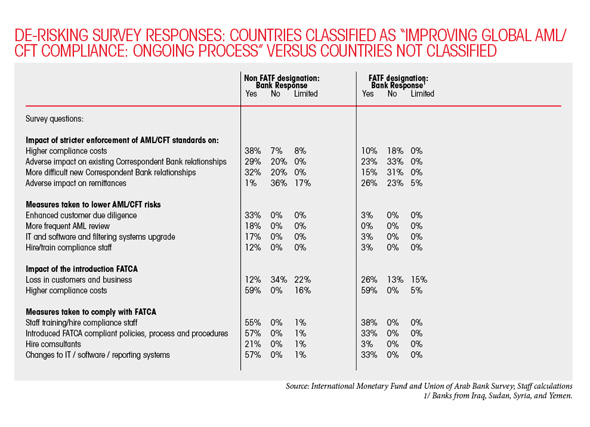
The good news is that de-risking and other impacts of greater compliance pressures are perceived as manageable by banks across the Arab world. A recently released joint study by the Union of Arab Banks and the International Monetary Fund shows that the region’s bankers noted increased costs related to correspondent banking due to stricter AML/CFT enforcement. However, “wholesale de-risking by global banks does not appear to have taken place so far,” the report said. On the other hand, regional banks did not indicate that they had taken several measures to improve their immunity to ML/FT risks.

The study was conducted in spring 2015 via a survey sent to 471 banks in 20 MENA countries. The response rate of about 25 percent was not very high and further research is warranted according to the study’s authors, but the exercise provided useful indications on the business impacts of AML/CFT measures, Foreign Account Tax Compliance Act (FATCA) and Basel 3.

The highest impact was perceived in the area of correspondent banking where 40 percent of responding banks indicated that these relationships were becoming “more demanding, more time-consuming, more complex, and expensive to maintain.” Impacts on remittance flows were seen as minor, and so were business impediments related to FATCA and Basel 3.

Impacts were more pronounced for banks in countries classified by the Financial Action Task Force (FATF) as having strategic deficiencies in AML/CFT regimes that are however in the process of being addressed under “high-level political commitment”. In the four MENA countries in this category – Iraq, Sudan, Syria and Yemen – banks’ responses indicated higher negative impacts on business due to the introduction of FATCA and significantly higher impediments of remittances but lower cost impacts due to the stricter AML/CFT regimes.

When compared with banks in the non FATF designated countries, banks in the four designated countries showed significantly less eagerness to take measures that would reduce ML/FT risks or to enhance their FATCA compliance. The study pointed to a possible reason for this underwhelming implementation of new compliance measures – a paltry 3 percent of banks in sanctioned countries enhanced their customer due diligence to lower ML/FT risks versus 33 percent in the other countries – in the fact that their nation’s inclusion on the sanction list nullified any individual efforts for achieving greater compliance. Over one third of the banks that responded to the survey – 41 out of 117 – were based in sanctioned countries.

Also a counter-intuitive result of the study was the situation of regional de-risking. Whilst the study did not directly identify the countries whose banks undertook regional de-risking, it said that about 10 percent of the survey respondents had closed some correspondent banking relationships with banks in sanctioned countries and/or weak AML/CFT policies – meaning that “de-risking of regional correspondent banking relations by MENA banks”, as the study termed it, is a subject which warrants attention.

Statements of this sort are well-worn in the American repertoire, as was the name of Hezbollah’s Mustafa Badreddine who was highlighted in the July 21 dispatch. In past scenarios, such sanctions messages were interpreted to be warnings, or threats, demanding good behavior from Lebanon.

Whatever the hidden sticks-and-carrots in the current American strategy may be, it remains possible that the last word has not yet been spoken on whether the potential threat to MEAB has been solved with the intra-familial transfer of chairmanship at the bank. In more general terms, however, all signals suggest that Lebanese and Arab banks cannot relax their attention when it comes to compliance with the US agenda.

One problem, Morcos says, is the American insistence on publicly confronting alleged financial facilitators of terrorism without giving these entities a chance to cooperate. He recalls how Arab participants in a 2006 workshop with officials from the Federal Reserve Bank of New York were asking the US entities not to expose Arab banks in public statements immediately after having discovered a concern, but first to employ information channels such as the financial intelligence units that exist in all countries of the region.

As Morcos remembers, this request was brushed aside by the official in question, with a reference to the victims of the 9/11 Twin Towers attack who had been murdered without any consideration. The single-minded US desire to fight terrorism finance in the sharpest way possible has kept relationships problematic since that time, Morcos says, and argues, “Now is another occasion to reemphasize that any subpoena and any suspicion should be channeled through official channels, i.e. the financial investigative units and through the central bank of Lebanon, especially since it works efficiently. Why not adhere to this channel instead of spreading the word as news, which has a dramatic impact on depositors’ interests and even on the sector here?”

No alternative to compliance

Financial institutions need to abide by anti money-laundering (AML) and combating the finance of terrorism (CFT) rules, and have had to learn their lessons in this regard as even top international banks changed their processes only after being hit with multi-billion dollar fines for having facilitated financial transactions with sanctioned countries such as Sudan, Iran, and Cuba, says the secretary general of the Union of Arab Banks (UAB), Wissam Fattouh.

“In my opinion, penalties for non-compliance with AML and CFT or also with [Foreign Account Tax Compliance Act] regulations are very good. Banks need to behave and this is not only about issues related to AML and CFT but also about corporate governance and violations of rules such as exchange rate manipulations,” he says.

While the strengthening of international regulations and enforcement of penalties against rule-breaking banks comes with general questions about the proportionality and effectiveness of such penalties, Arab banks in Fattouh’s view struggle with a different set of challenges that are grounded in the presence of economically powerful terror organizations, namely ISIS.

In order to deny these organizations an increase in power because of their ability to provide jobs, populations in ISIS-affected countries need to be offered economic opportunities and better jobs. In this context, Arab banks have a major role in developing employment structures through the financing of small and micro businesses.

[pullquote]“Advancing financial inclusion and job creation are priorities…in the war against the sources of terrorism.”[/pullquote]

“Advancing financial inclusion and job creation are priorities where banks play a role in the war against the sources of terrorism, [namely] the economic distresses that enable terror groups. It is my opinion that banks have to play a large role in economic growth through SME finance, housing and real estate finance, infrastructure lending, etc,” Fattouh tells Executive.

However, this is exactly where the emphasis on AML and CFT compliance clashes with the banks’ responsibility to expand their national economies. As Fattouh points out, micro entrepreneurs and small business owners more often than not run ventures where compliance checks on their customers are nearly impossible to enforce and financing of SMEs with a dedicated lending program may turn out to be too risky for banks purely from a compliance perspective.

Risks of fixation on AML-CFT

Extreme AML-CFT compliance pressure is counterproductive to the overall global targets of achieving greater financial inclusion and universal access to finance, which have been highlighted most recently in the United Nations’ Addis Ababa Action Agenda, which was globally adopted by UN member states last month at the Third International Conference on Financing for Development in the Ethiopian capital. The agenda noted [in article 38] without being more specific that “some risk-mitigating measures” in finance could create barriers against access to formal financial services by micro, small and medium enterprises.

Risk mitigation, or rather risk deflection, is another AML-CFT induced challenge for the relationships between Arab banks and international banks, as well as among Arab banks themselves. This is because of a temptation for banks to sever correspondent banking ties when compliance requirements make these relationships too cumbersome. Called de-risking, the practice potentially impedes international finance for smaller partners and according to Fattouh is generally ill-advised and not the intention of US stakeholders. “From the point of view of the regulator and the treasury, banks have to continue to understand risk and manage it, not talk about de-risking, and I agree with them. But we are witnessing some international banks cutting their relationships with Arab banks,” Fattouh explains.

De-risking is an economy 101 decision; banks compare the rewards of doing business with individuals and institutions with the cost of compliance attached to having those relationships. This positively implies that decisions on correspondent banking are non-ideological for the vast majority of commercial banks and financial institutions, supporting the assumption that current occurrences of de-risking are a temporary phenomena and will not impede global financial structures in the longer term.

tablefinsan2

However, Fattouh is concerned that the region’s bankers could lose something much more precious than correspondent banking relations or even licenses: their risk cultures. “My impression is that law enforcement is changing the hearts and minds of bankers, which is very dangerous,” he says. “Banks are by themselves conservative. When they feel the pressure of law enforcement upon them, it changes the spirit and this is my worry, as it could impact the role of banking negatively.”

Practical tools for making the burdens of AML-CFT compliance less costly for Arab banks could include an authoritative regional entity empowered to carry out compliance checking as intermediary for all banks in the region, Fattouh suggests, noting that such an initiative is not currently feasible for the UAB and could be initiated perhaps by the Arab Monetary Fund acting as the secretariat of Arab central banks. However, to facilitate dialog between Arab and international bankers the UAB will expand its private sector dialog program on combating the financing of terrorism from a US-MENA dialog to a EU-MENA dialog, which will be inaugurated on September 3 in Brussels.

[pullquote]“My impression is that law enforcement is changing the hearts and minds of bankers, which is very dangerous.”[/pullquote]

To help Arab banks with the cost and behavior challenges of the many sanctioned waters they have to operate in, UAB is currently working on compiling a code of ethics which, according to Fattouh, will guide banks in their approach to four central points, namely a) rules and regulations, b) corporate governance, c) financial inclusion and universal financial access and d) financing of the economy. The parameters for the project have been assembled and he hopes for publication of the Code of Ethics as guidebook for Arab banks by November, Fattouh says.

In the meanwhile, the American crusade against the financing of terrorism will continue and implicated persons will have to struggle if they want to contest their pariah status. Comments shared by US law firms suggest that even proving one’s innocence has not been the most successful approach for removal from the SDN list – delisting was more often achieved by offenders for admissions of guilt rather than protestations of innocence.

Another option of interest to the region and of great potential business value for Lebanese banks, although not in any way likely to benefit people accused of Hezbollah affiliations, is the change of US political views. As Cuba was finally allowed to hoist its flag over its recently reopened embassy in Washington D.C., it was no surprise that a single OFAC update had already announced the deletion of more than 50 Cuba-related names from the SDN list. What the US calls “sanctions relief” vis-à-vis Iran will take at least several more months to gain momentum, but the prospects for new opportunities from the Iran deal are infinitely more promising than making any attempt to change minds across the Atlantic about the status of people who act as open bank accounts for alleged Hezbollah operatives or invest in mysterious infrastructures that can be used by the organization.

August 17, 2015 0 comments
0 FacebookTwitterPinterestEmail
DesignSpecial Report

Saving money one sunbeam at a time

by Matt Nash August 17, 2015
written by Matt Nash

The problem could not have been more standard: how can ABC’s department store in Ashrafieh reduce overhead to maximize profits? In 2012, the company began doing some research on electricity consumption with an energy audit. A solution soon followed: use that glowing orb which gives us life. In June, the department store went solar – partly.

Mohammad Abou Rich, the mall’s technical director, told Executive that a system consisting of 4,000 square meters of photovoltaic panels on the mall’s roof will supply 21 percent of the department store’s yearly energy needs, saving ABC $100,000 per year in dual energy bills. While the amount paid to design and build the system is “confidential,” Abou Rich explains that because of the way the panel layout was designed – with the sun-suckers oriented east-west instead of north-south, as many of the other contractors who bid for the project proposed – the investment will be recouped in only five years because of the extra power supplied. Panel orientation east-west (in line with the path of the moving sun, for the astrophysically challenged) means the system produces “10 to 15 percent” more electricity than a north-south orientation, he says.

August 17, 2015 1 comment
0 FacebookTwitterPinterestEmail
DesignSpecial Report

The evolving role of ‘design’ in the world of today

by Executive Editors August 17, 2015
written by Executive Editors

For many years, the term ‘design’ in the world of business referred mainly to the aesthetics of a product. Today, ‘design’ has become a concept which represents much more than just a drawing; it has come to reflect the outline of the brand identity, which understands every aspect of a company and its interaction with its customers.

A brand worth remembering is a brand with a unique personality. This is why design has evolved into a holistic blueprint transcending the product itself to encompass all other elements revolving around it.

Executive interviewed several designers to understand the role that this evolved concept of ‘design’ plays in their companies and products, and the resulting effect of employing design on their brand.

Nabil Kettaneh – Chairman & CEO of Kettaneh Group 

Untitled

“German car manufacturer Audi AG considers itself a global design patron and a responsible employer. At Audi, conventional ways of seeing and thinking are continually challenged in order to advance the company and play an active role in shaping the mobility of the future. An Audi cannot, and should not, be purely fashionable, particularly since trends are not set in stone. Rather, it must be timelessly modern. Audi is a company which considers commitment to design as part of its DNA.

As a progressive car manufacturer, Audi is constantly developing its design philosophy with each new generation of models. Audi’s refined language and philosophy of design focuses on a strong link between technology and design. The Audi models of today are intended to be tomorrow’s icons. Every Audi has the same genetic code: distinctiveness with the aim of striking an exciting compromise between emotion and reason, aesthetics and efficiency, as well as sportiness, progressiveness and sophistication.

Audi designs seek inspiration globally. Ideas might arise from observing an innovative house, a classic piece of furniture or a sensational dress. The Audi designers have to have their fingers on the pulse of the times and are guided by a variety of influences – be it from nature, architecture, art or film. The overriding goal is to give the product the characteristics of the brand with the four rings.”


George Bou Jaoude – Marketing Manager of Infiniti at RYMCO

1

“Being automotive agents, designing the actual models is not in our scope of work. We work on designing ambiances and campaigns that fit the brand and the target audience. The design of the car is a major source of attraction and one of the most important factors for customers, as one first needs to like a car before proceeding to the next stages of the purchasing behavior.

However, ‘design’ extends beyond just the aesthetic or features of the car, as a good design in general also includes a suitable price tag. This delicate balance between quality and price is a considerable part of what constitutes good ‘design’. Our brands are attentive to that balance and are always seeking innovative designs that cater to customers’ needs and expectations across the different areas that they examine.”

Michel Trad – Chairman of Saad & Trad SAL

2

“Today, design has become increasingly important. It is the main factor that reflects the image of the brand identity. When it comes to design, people tend to notice what they can relate to, and it is key to cutting through the clutter. This is why companies are investing in design more than ever, putting in place design centers that meticulously shape the personality of the brand, its corporate identity. Anything relating in any way to the brand is closely examined so as to echo the same message.

Whether the brand stands for modernity, performance, luxury, creativity or any other value, it is supposed to be reflected in the showroom, interior design, staff appearance and attitude, pre-and-post sale services, as well as in marketing activities such as ad campaigns and partnerships with other brands. Almost everything is taken into consideration since ‘design’ serves a purpose beyond simply the product’s visual appeal.”

Reem Acra – Fashion designer

reem

“The design is not just a product that is for sale, it is a way of thinking – a message. The Reem Acra label is represented by that design and how it is presented and packaged.

[pullquote]“DESIGN IS NOT JUST A PRODUCT…IT IS A WAY OF THINKING.”[/pullquote]

It is very important that there is one message in the design that evokes an emotion as well as the experience. The Reem Acra brand has depth with an emotional message-it is a brand that started with wedding dresses and brought a new kind of luxury to the table. The company as a whole represents the brand, all of our employees speak the same language so as to represent the same message that translates to the experience of a lifetime for the customer.”

Sabine Mazloum – Pearl Specialist, Jewelry Designer, Creator & Owner of the Sabine Mazloum brand

sab

“Design is who you are, your fingerprint, and the creativity which pours from your soul to make something unique. And this is your identity which makes you stand out from the crowd. However, the relationship between the design and the product itself is complementary.

Since I am a pearl specialist, the main material I work with is pearls. Each gem is unique by nature, and, depending on the characteristics of each pearl, I harmonise the design of my pieces. It is so important to keep the value of the pearl and at the same time to add my own touch of creativity. To start creating a design you have to have a foundation and you have to know where to start from.

[pullquote]“DESIGN IS WHO YOU ARE, YOUR FINGERPRINT”[/pullquote]

Each individual picks a design that is close to their taste, which often represents their inner personality or what they want people to think of them. If the customer is comfortable with the piece they choose, it will fulfill the required desire and the right image they are trying to project to others. It will also give them the confidence to express themselves more.”

Mia Karam – Brand Manager at Luxury Clothing Company sal

mia

“Design defines a product. Without it, it simply wouldn’t exist.

In fashion, the creation of a product starts with an inspiration, a mood board, a story. This turns into a sketch, which explodes into an infinite choice of fabrics, weights, colors, and volumes. It finally turns into a sample that is later perfected to become a sellable item.

This item will then be placed in the right environment and will attract a customer who will most likely fall in love with it and want to make it their own. After purchasing it, the item is given a new purpose and function each time it’s worn or carried.

Design greatly impacts a customer’s experience. Brands worldwide are investing first and foremost in innovative shop concepts in order to convey the brands’ identity, and have the customers immersed in the brands’ universe. It’s not just a matter of having an attractive and relaxing store environment or a clear display anymore. Brands are competing on a whole other level with the design of their flagships, going to leading architects to create state-of-the-art concepts for their targeted clientele. Design and fashion are inseparable today, and form a winning team.

The same goes for a working environment. Designing an office with specific codes that resemble the company’s identity will help the employees understand and thus convey better what the company’s values and missions are.”

August 17, 2015 0 comments
0 FacebookTwitterPinterestEmail
Banking 2015BusinessFinance

MEAB injects a bit of youth to its boardroom

by Thomas Schellen August 14, 2015
written by Thomas Schellen

Their corporate narrative is what Wikipedia might call “a stub”, or an article in need of expansion. But when Middle East and Africa Bank (MEAB) implement an interactive timeline in the history section of its online identity, the months of June and July 2015 will carry pivotal content.

Within the space of 10 days starting June 15, the mid-sized bank, which holds $1.5 billion in deposits and ranks 15th in the Lebanese banking sector in that category (2014 figures), welcomed a young new chairman who is also the bank’s new majority shareholder and a seasoned Lebanese banker with 30 years of experience as a general manager.  The new leadership duo, Chairman Ali Hejeij and GM Nabih Haddad, lost no time embarking on a review of the bank’s business plan and strategy that was in full swing by end of June. While doing so, MEAB management lit the boosters on a new image building effort and proactive communications approach with a July 15 dinner for Lebanese media bigwigs. In between, the bank’s new leaders even found time to open a new retail branch, MEAB’s 21st, on Beirut’s Corniche Mazra.

The intense frenzy of the period was to a very significant (but not fully quantifiable) degree involuntary. It had been triggered in early June by a measure originating in the United States’ treasury’s Office of Foreign Assets Control, or OFAC, under which Lebanese citizen Kassem Hejeij – Ali Hejeij’s father and then chairman of MEAB – was put on a list of persons alleged to be involved in financing of terrorism. In Kassem’s case, the accusation was consorting with Hezbollah.       

MEAB and other companies under Hejeij family ownership were excluded from American action and thus it was prudent to protect the economic assets from being sanctioned by association. Advised by legal experts and central bankers, Kassem Hejeij immediately decided to step down and fully divest his shares in the bank he had founded in the early 1990s.

MEAB growth spurt

Ergo, the transfer of ownership to Ali Hejeij who, according to an MEAB statement, was already a board member and shareholder with a non-specified stake in the bank. With the rapid transaction in an ownership sphere valued above $100 million, his majority expanded to “about 85 percent”, Hejeij told Executive. 

Including himself, MEAB has five board members, Hejeij said, and none of the other board members owns more than five percent in the bank. Not yet 35 years of age, the new chairman had been working in the management of construction companies in Gabon and Equatorial Guinea for most of the past ten years, after he had acquired a degree in banking and finance from a university in Lebanon. The construction companies are affiliated with the Hejeij family, which built a fortune in Africa from the 1970s onward.

Growth of MEAB in recent years had been quiet but brisk. “Growth from 2012 to 2013 and from 2013 to 2014 was about six percent [year on year] in terms of both assets and deposits and our net profit of 2013 was approximately $18 million,” Hejeij said in the interview with Executive. According to figures cited by him, the bank’s increase in deposits between 2013 and 2014 amounted to about $100 million. His declared growth target for the bank is to surpass $2 billion in deposits, from the current $1.6 billion implied by the cited growth in 2014. 

According to the Liban Banque’s yearbooks for 2010 and 2014, MEAB climbed from a 0.4 percent market share in banking sector deposits in 2009 to 1.1 percent in 2013, which was reflected in an 11-spot gain in its sector position in that category over the four-year period. Another growth marker was branch expansion where MEAB almost doubled its network between 2010 and July 2015, consisting of the additions of seven domestic branches and two branches in the Iraqi cities of Baghdad and Basra.   

Future strategy

The bank’s growth in recent years is being analyzed under the business assessment and plan that Hejeij and MEAB management are currently carrying out, Haddad explained. “The bank grew very fast in a very short period of time. To assure this growth we should go back to the roots and make sure that everything else will follow,” he said.

The process will include strategic decisions on how to further develop the electronic banking services at MEAB, training of the young workforce in the branch network, and investments in corporate governance structures, Haddad added.

For Hejeij, fast aggressive moves and efforts to disrupt the complacent Lebanese banking sector are not on the MEAB agenda in the near future. “My first priority is to concentrate on my institution, which needs time for the new team and to make my recommendations. We are walking forward now, but slowly. Five to six months later, we can move faster. My next target, after finishing the interior [process] is to reach the alpha group [size of banks with over $2 billion in deposits],” he said.

Not much more can be said about the bank’s plans and strategy at this point. Haddad declined to comment as yet on MEAB’s views and intentions in corporate banking and services for businesses. Africa is not currently a specific focus or expansion target for the bank according to Hejeij.

As MEAB is generally seeking to grow its exposure outside of Lebanon, management, according to Haddad, is looking at the situation in Iraq and assessing the bank’s exposure there from angles such as human resources and security. “If we decide to continue in Iraq, we will expand,” Hejeij said.    

In the first weeks after the change at the top, which saw Ali Hejeij becoming both the youngest current chairman of any bank in Lebanon and the youngest person to ascend to the role in decades, his message in interviews and media statements followed the same line. He repeatedly emphasised  MEAB’s compliance with Lebanese and international financial rules and the bank’s firm alignment with standards on anti-money laundering and combating of financing of terrorism. In measures which sought  to make international markets more comfortable with MEAB, Hejeij says he wants to achieve diversification in the bank’s ownership by bringing in either institutions or individual investors with high reputation. But this, he says, “is in the long term and [should] not be expected to happen within the next few years.”

August 14, 2015 0 comments
0 FacebookTwitterPinterestEmail
CommentOpinion

Building socially responsible corporate cultures

by Daan Elffers August 14, 2015
written by Daan Elffers

Corporate social responsibility (CSR) largely refers to the responsibility of an organization — whether it be a corporation, a governmental body or a nonprofit organization — to its stakeholder, the wider society and environment. The mainstream view is that organizations, as ‘corporate citizens,’ ought to be accountable to and responsible for the consequences of their activities which directly and/or indirectly affect society and the environment.

Legislation is a driving force in the uptake of CSR, and with penalties for poor implementation particularly for FTSE 100 companies, there is a tendency to view it as having a ‘check-list’ quality. This approach may generate only incremental changes, with limited innovation as organizations are cautious to go above and beyond such legislation in light of potential risks and unknown rates of return on investments.

Despite this, there are a cluster of organizations which are shaking up the traditional business models in favor of new, alternative models. The concept of the circular economy — an alternative to the existing linear economy of ‘take, make and dispose’ as one that sees products re-enter the economy continuously — is inspiring a number of organizations to reject the traditional business model in favor of something quite innovative. For example, Method, a pioneer in homecare and personal care products, manufactures products using materials that can be infinitely recycled in technological and biological cycles through a process that uses only renewable sources of energy. It generates clean water as a by-product and the business culture is one that practices social fairness.

Alternative models have the capacity to not only exist, but to also thrive in an economy that is, by and large, quite conventional. This should offer confidence to organizations in moving away from the traditional business model, which is typically profit driven, to one that holistically embraces CSR and delivers value systemically, across the triple bottom line: people, planet and profit.

There is a strong business case to be made for CSR, evidenced by the current shifts in the finance and investment markets whereby the adoption of CSR policies, and perhaps most importantly, the availability of published CSR reports, is of growing interest to investors. The establishment of the Social Stock Exchange (SSX) in London is evidence of this shift, becoming the first platform of its kind in the world to serve as a marketplace for publicly listed social impact businesses. Currently, the SSX has a market capitalization of $1.91 billion and the market for social impact business is anticipated to grow between $200 billion and $650 billion in the next decade.

To ensure that the investments are realized, it is important to identify and minimize the risks associated with CSR implementation. Most risks are associated with poor strategic integration — this is where a CSR strategy has not been integrated at the core of the business and manifests in a strategy that is not in line with stakeholder interests with poor communication of strategy and impact. Such challenges can be overcome by ensuring a material assessment is conducted prior to strategy development, to ensure that it meets the needs of stakeholders.

Having achieved this, it is then crucial to communicate this narrative to stakeholders to ensure long-term engagement. This need to report and communicate is partly driven by an increasing culture of transparency. It is estimated that 90 percent of consumers would actively recommend an organization who had excellent CSR credentials, with a report in place through which they can locate this information. Aside from the advantages an organization may receive through this increased transparency, it is the process of reporting that yields the most benefits. The process provides a window of opportunity to analyze and evaluate an organization’s internal systems and processes, and enables risk to be fairly assigned across all departments, stakeholders and partners by integrating them into an organization-wide process. As Alberto Andreu, then Head of CSR & Reputation for Telefónica, said in an interview with EMG, “if risk has no owner, you have a problem.” Risk can only be managed when identified, understood and communicated.

CSR is not a static concept and it is important that an organization doesn’t get caught up with the terminology. Instead, they need to understand the common goal; a concerted effort by organizations of all types to identify and take responsibility of the risk that it generates as part of its day-to-day running. The success of a CSR strategy, measured by its impact and return on investment, will depend largely on its applicability and relevance to the organization itself. As such, it is crucial that organizations remain focused on the aspects important and unique to them.

August 14, 2015 0 comments
0 FacebookTwitterPinterestEmail
DesignSpecial Report

Design of the times

by Thomas Schellen August 13, 2015
written by Thomas Schellen

When you walk into a communications agency in Beirut, you know it. Dark wood paneling and bookshelves lined up with tomes in historic succession, a vault with a time lock on every floor, picture after picture of lovely high rises, or a garage-door-sized executive desk in mahogany. Think law office, bank headquarters, property developer, or (self-) important manufacturer. For an advertising or communications outfit, think open floor space, unconventional accessories (from basketball hoop to marketing murals), roughly hewn looks of concrete and glass or sometimes limestone on interior walls, communicative courtyards, and lots of alliterative post-its sticking to every conceivable (and inconceivable) vertical surface.

In short, if it trumpets creativity with notes of purple berries and minty hints of chaos, you are standing in the office of a Beirut advertising firm. This is the Lebanese industry that has been leading – and indeed supplying – the entire region with communications talent, creative talent, and design talent for at least five decades. It is an industry whose self-perception of being creative means that it is pregnant with new designs in every campaign, every pitch, and every presentation down to its office walls. The only design related questions of relevance here are: is design everything, is everything design, or both?

With so much design competency it has become clear that the advertising and marketing communication minds of Beirut don’t have a single answer about the nature and importance of design. Ask them and they spawn a whole library.

Firstly, design is nigh on impossible to define as a concept and the industry has a grip on this fact. “Design is a broad concept under which you can align life itself,” says Omar Nasreddine, vice president for Central and Eastern Europe, the Middle East and Africa for global advertising agency Grey Group, a unit of world-leading marketing communications conglomerate WPP.

Life, thankfully, is beyond commerce. Adding measurability in form of marginal utility or market value then is key for getting design to work for the benefit of its author or intellectual owner. “In a business context, design is twofold: first it is design that we do, aesthetics, from packaging to artwork to ideas, and [secondly] there is the strategic bit which is all about how you design your own company, your own business strategy, your expansion,” Nasreddine differentiates.

While cautioning that he is not comfortable with restricting the design discussion to strategic design, he continues, “But for the sake of making the discussion easier, one common denominator that defines all the ways in which you strategically design things, be it products, services, concepts, or structures, is optimization. The only reason why strategic design exists is to optimize anything – from a person to a product to a structure to an ideology, and if you do not apply the law of evolution to that design, it might as well have not been there.”

Keeping the mind profitable

What must never be amiss in using strategic design according to Nasreddine is profitability. This certainly reverberates with the business of media planning as another existential pillar of the marketing and communications industry. Standing besides the advertising agencies, specialized entities in advertising conglomerates that have often been referred to in industry lingo as media buying units (MBUs) are focused on designing and negotiating the avenues that will deliver return on investments (ROI) for the marketing dollars of their advertising clients.

[pullquote] Design is a broad concept under which you can align life itself [/pullquote]

From his perspective, as expert on media planning and buying, “design is creativity for us. We always focus on creativity in media buying – how can we be creative in our media approaches?” says Wissam Najjar, managing director for the Levant region at OMD, a worldwide media planning company and unit of Omnicom Group, a New York-based global marketing communications powerhouse.

“We know that the future is content so we focus a lot around content. For us creativity is about being creative through content, and for us being creative means that it has to make business sense to the client,” Najjar elaborates.

Explaining that things like getting gleaming awards for a campaign’s design will “not do anything for the client who wants volumes, to achieve targets, defend market share or gain it,” Najjar says the media planners speak a language with the client that is based on the fact “that he wants exposure and at the end of the day wants business and it all has to relate to ROI.”

This means that in his experience creativity and design aren’t quite everything for a media planner, because some creative ideas emerge as too complicated for deploying them in sales and the creative angle alone does not have “the scientific approach that we do,” Najjar says. “Our role is to sit together and craft a strategy which is doing well creatively and also as a business strategy.”

“Our design part comes in where we do something creative within the media itself. We think about how we can approach any media with a non-traditional manner,” he continues and references approaches such as the growing practice where adverts mimic the style of content providers such as news media publishers.

These so-called native adverts seamlessly blend into the platform formats of digital environments and provide advertisers with increased rates of engagement by media users, although Najjar notes that “some people feel frustrated [by native advertising] because they believe that they are being cheated.” But the cardinal question for media planners cannot be the displeasure of some, it appears, or a debate over the need for an impenetrable wall between marketing and content.

Where just a few years ago advertising groups in the Middle East were lamenting how the region was still lagging in its embrace of online advertising, the new ubiquity of tools such as native advertising testify to the fact that the digitization of communications is perhaps slower here but no less of a challenge to advertising and media stakeholders to develop sustainable standards of governance, and at the same time achieve the economic aims that will allow both marketing communications and content publishers to grow.

For a media planner, this means being clear about priority one, Najjar says: “Our biggest topic is how to engage the customer, so anything we come up with has to be engaging.”

ADVERTISING2

And of course the need to survive is right at the center of all changes in the communications sector, including the role and importance of design. With the advertising industry’s own exposure and adherence to the laws of evolution, design has always been present but in recent years it has risen higher and been given what Areej Mahmoud perceives as “its right place, the place where it should be.”

An evolution in intelligent design

“Design is for sure taking a more serious place in advertising and has been doing that for a few years,” says Mahmoud, who is head of creative at Leo Burnett Beirut, an international agency that is part of France-based advertising conglomerate Publicis.

He links the greater role of design to the industry’s departure from what he calls “the tyranny of the media,” the era when advertising industry minds were focused on which medium a message was to be placed in. “For a very long time the advertising industry was hijacked by media, where the thinking process of anyone in advertising was, ‘what are we putting on television, what are we putting on radio, what in the magazine, what’s outdoors?’”, he says.

The old approach according to him would seek to find a common ground between disjointed information strands on consumer, product, brand message and sales purposes associated with an advertising campaign and implement this in media according to placement priorities. For Mahmoud, this traditional way of thinking in advertising was overly formulaic. “I don’t think of design as a practice, because I am a designer. For me, thinking as a designer is looking at a problem and all its angles,” he sums up his definition of design and enthuses, “Since today we are free from the tyranny of media companies, you go back to solving a problem as a human being, not as a marketer, planner or salesman.”

As an example for how design thinking at an agency can solve problems when it is not bound to media, he cites approaches like that of New York-based agency R/GA whose Hammerhead navigation solution for bikers earned top awards at the 2015 Cannes Lions.

Approaches proving the validity of the design method in solving business problems are accumulating all over the advertising industry and it’s not only global agencies with pedigree that can deliver them. When Beirut-based agency Interesting Times was offered a stab at a shampoo launch, their first thought was “boring”, says Ashraf Mansour, a managing partner and co-founder of Interesting Times.

But when they took the possibility seriously and decided to tackle it, what came out was a virtual concert with an interactive online audience of over 50,000 – and since the campaign’s focus was on Saudi Arabia and Egypt, this included an audience of over 20,000 in Saudi Arabia, most of whom, as Mansour emphasizes, likely never had a chance to attend a live concert. From the agencies’ perspective, its contribution not only helped sell a new soapy product but also allowed women in the kingdom to set their minds a little freer.

[pullquote]For me, thinking as a designer is looking at a problem and all its angles[/pullquote]

It was not necessarily a strategic design concept that was the basis of their startup a few years ago, after Mansour and several colleagues departed from multinational agency JWT to establish their own firm. Stepping out of their comfort zones as corporate executives created a specific spirit for the agency founders, he explains. “There was something in the narrative that became truth for us: it was like we want to be people living in interesting times, meaning the time of ongoing change. That was crucial for us and is something that we try hard to remain true to. We have eight different logos for Interesting Times [which express that] the name is the same, the spirit is the same but the interpretation doesn’t stop. From a design perspective this reflects the spirit. Is the design consistent? No, because the thought is not consistent, it is always changing.”

For Mansour, the starting point of every project is strategy which precedes design. “The way we see things is that everything is converging. Advertising, PR, design, everything is one. How does this lead to strategy? I think there needs to be a strategy and there needs to be an interpretation of this strategy in terms of PR, in terms of social, in terms of design.”

He agrees with the other advertising professionals interviewed by Executive that there is considerable hype to the narrative depicting strategic design as a new discipline for practically everything. All the experts concur that these attitudes are due to everyone’s desire to own a profitable business, leading everyone to describe their own approach as the most innovative one, playing the eternal game of competition. In this game, “even naming has a strategy now,” chuckles Mansour.

An ever-crowded field

Overlaps exist for example between strategic design consulting propositions and the methods of conventional financial consulting, says Nasreddine, but adds that the short-term orientation of many financial consultancies is surpassed, in his view, by the longer-term focus of strategic design. Plus, immersion into strategic design is today indispensable for anyone in advertising leadership, he says. “If I want to talk to a top notch client, I need to speak with top notch knowledge and no way can top notch knowledge exist without strategic design as a part of it.”

Where questions and some doubts may loom over the presence and strength of a design ecosystem in Lebanon [see overview on page 28], the experiences of professionals such as Nasreddine and Mahmoud speak with a historic depth on the design mentality in the country, as they cite the positive influences that mentors and models such as regional industry greats Philippe Skaff at Grey and Farid Chehab at Leo Burnett had on their own development.

While the professionals conversing with Executive shared the concern that too many talented designers have been and are migrating away from Lebanon, this seems to support rather than disprove the evidence of a, however informal and tender, design ecosystem. Design talents keep sprouting in the country, or as Mansour says cheerily, “In Lebanon, from a design view, we have the talent, [and] we have the taste.” Mahmoud observes that some “mediocrity will be found everywhere” but he emphasizes, “I am proud of the design ecosystem. There are terrible designs but also good designs in the region and in Lebanon specifically we have some good schools that are run by really enlightened people.”

For OMD’s Najjar, the issue is less the state of the national design ecosystem but more the state of the nation and how to use the power of design and communications to upgrade perceptions of Lebanon. “Our role in communications is to spread more news about the positive things in Lebanon,” he says and proclaims, “let’s push positive news in Lebanon – in a fucked up system like Lebanon you have to take a first step and that’s changing the perceptions. How do you change it? By [employing the] media.”

August 13, 2015 0 comments
0 FacebookTwitterPinterestEmail
CommentOpinion

Lebanon’s doppelgänger

by Samer Karam August 13, 2015
written by Samer Karam

Imagine a country with a mix of ancient and modern cultures and religions, and 6000 years of history. Imagine a country where women and men are equally educated, and where technology and innovation combine.

Imagine a country with some of the highest Human Development Indicators (HDI) in the region but with a labor potential that remains untapped, and a stifling brain drain.

Imagine a country where the diaspora is a vast, successful, powerful pillar of its economy and its fledgling startup ecosystem struggled for years until a critical event resulted in overnight capital abundance.

To every Lebanese, in Lebanon and its diaspora, this country is Lebanon.

To me, this is also Iran, Lebanon’s doppelgänger – not in all things for sure, but in entrepreneurship.

Lebanon’s startup ecosystem was born around 2010, with 2 Venture Capital (VC) funds, an accelerator, a tech conference, a startup weekend, and an angel network. For 4 years, the country struggled to attract direct foreign investment for its startup ecosystem, as the sovereign risk was considered far too high for venture capital. Then in 2013, Lebanon’s central bank intervened to stimulate the knowledge economy with BDL Circular 331. Overnight, over $400 million were made available to startups, VCs, and accelerators. Today, Lebanon’s startup ecosystem has transformed into the leading ecosystem in the Arab World, with a few international exits, over $250 million in 7 VC funds, 3 accelerators, 3 angel networks, 2 tech conferences, 1 international startup conference, well-funded support institutions, and hundreds of entrepreneurs.

Meanwhile, Iran’s fledgling startup scene has grown, despite sanctions, and been incrementally shaped by a few key stakeholders, including Avatech and Sarava, Iran’s first accelerator and VC fund respectively. Support institutions have been driving the entrepreneurial culture, particularly through local versions of international events such as Startup Weekend and FailCon. Avatech runs a six-month extended acceleration cycle, with 10 startups completing in each cycle. With just over 100 startups operating in the country, the community has tentatively come together despite the global circumstances. So far, it has operated without access to international markets and foreign investment. If these barriers were removed, the startup system could blossom in a country which has more than enough potential. Half of Iran’s population of over 80 million is under 30, with a high regional literacy rate. More than two thirds of Iranian homes have broadband access and mobile penetration is enormous, with a rate of 1.3 mobile connections per citizen. With these levels of connectivity, education and aptitude, Iran is an incredibly viable consumer market, particularly for startups.

The startup scene in both countries has evolved despite challenges. Government initiatives in Iran and Lebanon have been put in place to stimulate digital sectors. Iran set aside $1 billion for an innovation fund for entrepreneurs, and is upgrading its infrastructure to accommodate the wave of growth. The Lebanese Ministry of Telecommunications has pledged to deliver Fiber-to-the-Home within the next couple of years. The two countries therefore not only share similar socio-economic and geopolitical challenges, but also the determination to overcome such problems in an innovative way.

After years of negotiations, world powers reached a deal with Iran on limiting nuclear activity in return for the lifting of sanctions. The future relief and, hopefully, removal of these presents a golden opportunity for Lebanon. Beirut is the bridge between Iran and the world, and in turn Iran is the untapped market that Lebanon can reach. Entering the GCC and European markets incurs large travel and legal costs for Lebanese companies, but a lack of visa restrictions between Iran and Lebanon facilitate easy working conditions with potentially fewer expenses. Although Eastern Europe has come to be a significant talent resource for Lebanon, it is culturally too different to be a natural extension. Turkey also has proven to be a good destination, but due to its strong homegrown economy, doing business there is highly competitive and there are clear signs of a slowing economy. Iran, on the other hand, has both the cultural and geographical proximity which would benefit Lebanon.

Today, a shared common language isn’t a key requirement for economies to achieve top growth in their interaction. The primary driver of mutual economic benefits is knowledge industries, which require limited upfront capital investment.  Code and design are the new common ‘languages’ found in those industries, and they transcend borders and cultures seamlessly. With both coders and designers abundant in Iran and Lebanon, it seems that a common language has been found between the two countries.

Lebanon can provide the knowledge industry investment Iran needs, and together the countries can produce ventures which are no copycats of powerhouses, but instead are globally competitive based solely on their own merits. In terms of entrepreneurship, Lebanon’s future lies with its doppelgänger.

August 13, 2015 0 comments
0 FacebookTwitterPinterestEmail
Brand Voice

THE FUTURE OF THE WORKSPACE

by Executive Editors August 12, 2015
written by Executive Editors

Have you ever wondered what the secret to employee productivity is? This is the question Waterfront City asked itself before creating its Business Park. For months, the company has observed the best working environments in the world, seeking to identify the future trends in workspace design that increase productivity.

Here is what they found…

Research has shown that the design of an office is extremely important when it comes to getting things done efficiently and quickly. A good work environment has a huge impact on individual productivity, in particular affecting an employee’s ability to concentrate. It also enhances creativity, and thus innovation, in the services industries, which is critical in competitive economies.

In the last fifteen years, well-known Silicon Valley companies such as Google, Facebook and Apple have been leading the way in terms of innovative work spaces, using fun, fresh and creative designs. Their goal was to create a work environment where employees actually look forward to spending a day at the office. The office complexes aim to stimulate creativity and inspire employees to give their best.

 Companies like Apple, for example, have put tremendous effort into creating the perfect work environment by mixing business with pleasure in a setting where employees can relax and enjoy themselves, allowing their creative juices to flow and innovation levels to rise. Integrated business spaces that foster transparency, offer multiple options as to how and where to work and an environment that imitates life outside the office, with beautiful landscapes and natural lighting, are the best at improving employees’ productivity and happiness. Waterfront City’s Business Park offers just that: an elaborate campus made up of twelve office blocks, amphitheaters, abundant parking, green areas and retail spaces packed with the necessary services for offices, all nestled within a comprehensive urban space.

1. Flexible work

Being able to work when, where and how they want is one of the first concerns of today’s employees. In addition to working from their offices and homes, more and more employees are now working from airplanes, hotels and other remote locations. They need to be supported by technology in order to work efficiently no matter where they are. According to Makram Kaki, lead architect at Leftish, the company that designed the Business Park, Waterfront City will offer the kind of flexibility which tomorrow’s workers are looking for. “In The Business Park, we wanted to make sure to offer as many options and opportunities as possible,” he says. For example, the benefits of having 1600 parking spaces, surrounded by green open areas, a supportive retail network of stores, restaurants and other leisure facilities, are all distinctive elements for an advanced and productive environment. The entire Business Park is also covered with Wi-Fi in order to allow employees to be constantly connected.”

2. Open Spaces vs Closed Spaces

Silicon Valley has been the leader in terms of open work spaces. Leading companies such as Google, Yahoo and eBay have all adopted the trend. However, the latest surveys show that although open spaces may stimulate collaboration and creativity and make employees feel like they are part of a relaxed and modern company, they also bring problems, the main one being a lack of privacy. Many employees working in open spaces have reported being frustrated by distractions, which hindered their ability to concentrate and to think creatively, and led to poorer work performance.

 One solution to the lack of privacy complaint is the inclusion of nook-areas where people can go and isolate themselves. Efficient working spaces should also provide a variety of purpose-built areas for specific activities such as formal meeting spaces, project rooms and individual work spaces that can be used by all employees.

The offices at the Business Park are of a Grade A standard, the highest for commercial office space. That grade includes open floor plans, abundant sunlight and building layouts structured to facilitate the adoption of the most advanced digital technologies and connectivity services. This infrastructure allows for customization of the office space between open floors and nook-areas that adapts easily to the requirements of any business.

3. Green Areas, Lighting and Acoustics

Having enough natural light and windows as well as passive or active contact with nature is a very efficient way to improve employee productivity and overall job satisfaction. If your office doesn’t have windows, a simple potted-plant or a picture of the outside world can help. Good acoustics are also vital for creating a peaceful and stress-free environment that will allow employees to stay on task. Creating some privacy for workers at their desks and isolated rooms for private discussions, as well as using sound-absorbing material in the ceilings and floors, will help manage the level of noise.

 “Quality of life is our primary concern at Waterfront City. This is why we decided to build a Business Park that will put the workers in a state of mind that brings out their potential for creativity, productivity and innovation. The Business Park offers efficient floor plans, fully open spaces and offices from 100m² up to full floors of 800m², along with a unique campus layout with abundant green spaces and open areas. Landmarks include the great square in the middle of the park as well as the amphitheatre available for all companies at the Business Park to use,” says Samer Bissat, Senior Development Director at Waterfront City.

 According to him, Waterfront City is working on infrastructures that will not only improve employees’ productivity, but also their overall happiness and well-being.

“Having green spaces complements the project’s aim to be LEED (Leadership in Energy & Environmental Design) certified, that has led the Business Park to design abundant green spaces, as well as garden rooftops,” he adds. “Employees at the park can also go outside and take walks, enjoy the sea view or sit in our parks during their breaks.”

 It may be some time before Google, Apple or Facebook open regional offices in Beirut, but if one day they do, it seems the only major office space that can cater to their preferences and demands is the Waterfront City Business Park.

August 12, 2015 0 comments
0 FacebookTwitterPinterestEmail
CommentDesignSpecial ReportUncategorized

How scanners became storybooks

by Tania Anaissie August 12, 2015
written by Tania Anaissie

Doug Dietz is a legend. He is the man that transformed the once miserable experience of receiving a MRI scan into a magical adventure. Doug is a design thinker.

He is an alumnus of our Stanford Hasso Plattner Institute of Design (d.school) Executive Education program. Doug was on the General Electric (GE) team that designed nuclear scanners (used to conduct MRIs). When they were first installed, he excitedly visited a hospital to observe them in use. What he saw was a small, 7-year old girl hiding behind her mother’s legs, terrified of the upcoming scan. The loud sounds, flashing lights, and deadly-looking stretcher brought her to tears. She was so upset, the family had to go home and reschedule the scan for another day. Hundreds of other children that year had to be sedated to undergo the MRI tests. As Doug describes it, “I went for kudos, but what I got was a kick in the ass.” He found it an incredibly heartbreaking and humbling experience.

Motivated to make a change after this encounter, he came to the Stanford University d.school to learn Design Thinking. He learned that by focusing on his users, he could make the largest impact. When his superiors at GE dismissed his request to conduct this work, he used his personal time after work and on weekends to move forward. He created an advisory board of children in Chicago, consulted experts at children’s museums, and spoke to a number of families in hospitals. As he progressed, his focus shifted many times until he reached a truly magical solution. He turned the MRI rooms into adventures that make children feel they are in forests, oceans, or cities. The machines and walls are painted with scenes, the technicians wear costumes and act, and children receive storybooks the night before preparing them for their upcoming “adventure.”

The results are incredible. When Doug visited after the change, he observed a small girl with her family. After the scan, she tugged on her mother’s skirt and asked, “Mommy, can we come back tomorrow?” The number of children needing sedation has dropped to almost zero.

Aside from the heart-warming change for families and children, Doug and his team have greatly improved the way teams design healthcare services. When talking to hospitals looking to buy either GE’s machines or a competitor’s, GE has secured multi-million dollar deals because the hospitals wanted Doug’s magical designs installed. And now within GE, engineering and marketing teams are asking Doug to join early discussions as they make changes to the machines. Engineers motivated by his story began to think, “How can we make the machines quieter and less scary?” As a result, GE will soon be releasing this new quiet MRI machine – an amazing advancement.

Doug’s story is a prime example that shows if you focus on your users and their deeper needs, you can transform people’s lives. This is so powerful that, naturally, more people will want your product/service. This can also transform how other groups in your organization work, scaling the desire for innovation.

Though you may not work in healthcare or work with children, we all have the ability to bring delight and novelty into our work. I truly believe that all people are inherently creative, but our school and work environments often stifle us. Design Thinking helps us re-engage our creativity. It is a problem-solving process that can be applied to any field. It consists of five process steps and a set of mindsets that radically shift how we work. The key element of design thinking is a focus on the user. Humans are the key to building successful solutions, and only by deeply understanding our end users can we truly innovate.

 Design thinking as we know it came to life in Silicon Valley. Startups in the Valley are eagerly applying it to their work, and it has become a key element of many Startup ecosystems around the world. Now, large companies are doing the same. Organizations like Fidelity, Jet Blue, Procter & Gamble, Capitol One, and more have opened internal Design Thinking innovation labs. They are attracting top young talent, developing innovative new offerings, and transforming their industries.

Aside from focusing on your users, what does being a design thinker mean? It means you believe in a bias towards action (do instead of talk), you build on your teammates’ work and make them look good, you seek answers from others who have different life experiences than you (and you really listen), and you work with teammates who come from a diversity of backgrounds and value their perspective. You also believe in iterating quickly and often at low resolution to learn as fast as possible.

Wherever you are today, you can creatively solve problems in this human-centric way. You can start small, by interviewing one customer. Get to know them – what’s their story and how does your product or service fit into their lives? There are free resources on the d.school website. You can run a beginning crash course in design thinking for your colleagues or you can go through the Online Crash Course. The books “Creative Confidence” by Tom and David Kelley and “The Achievement Habit” by Bernie Roth are good reads on the topic. Also look for opportunities to access design thinking here in Lebanon. Every time I am here, I meet more people practicing it.

Design thinking is radically shifting how we work and disrupting industries across the world. And, maybe, with a little listening and prototyping, you’ll find yourself in an imaginative storybook of your own.

August 12, 2015 0 comments
0 FacebookTwitterPinterestEmail
DesignSpecial Report

Taking a step back is actually the way forward

by Reina Y. Arakji August 11, 2015
written by Reina Y. Arakji

When I first moved to New York City, I did what everyone else does upon arrival; I looked up. I took in the instantly recognizable skyline, but I still could not understand what made the city so extraordinary. It was only when I began discovering the underground scenes that I finally recognized its sources of vitality and creativity. More literally, traveling on the city’s subway system, I was quite intrigued by one signpost in particular. It was prominently displayed on platforms and trains and emphatically stated: “Sometimes to Move Forward, You Have to Ride Backwards First”.

As counterintuitive as it sounds, this approach works. New York City’s subway system is old, complex, and has many renovations taking place throughout the year. It is often more effective, therefore, to take a train that is moving a few stops opposite to your intended direction, and change later down the line to an express train which heads back in the right direction. It might sound long winded, but passengers often end up at their destinations sooner than had they taken the obvious choice of train pulling into the station.

I recall this signpost every time I read yet another article touting Beirut as the “next Silicon Valley”. Lebanon’s policy makers have decided to jump on the knowledge economy bandwagon by replicating other tech startup ecosystems, assuming that it’s the expressway to economic growth and prosperity. The city is building technology parks and accelerators such as Beirut’s Digital District, inviting prominent international speakers to our tech conferences and sending our entrepreneurs on road trips to Silicon Valley and New York City. We are also attempting to ease regulatory hurdles by offering incentives to form tech venture investment funds through Banque Du Liban’s Circular 331.

This attitude towards technology and innovation, however, will hardly move us any closer to our desired long-term economic growth or increase our national living standards. To begin with, the majority of today’s technology, including web-based and mobile products are built to capitalize upon network effects, where a slight initial advantage in the number of subscribers snowballs into exponential growth. We are building and unavoidably participating in a global winner-takes-all marketplace, where less than 10 percent of startups thrive or achieve superstar status, while the remaining 90 percent stall and fade away. What’s more, nearly all of our booming tech startups, especially those with truly global reach, will end up relocating to Silicon Valley anyway, where markets are bigger and regulations more favorable. What we are actually doing is investing in a tech startup ecosystem the returns of which do not enliven the whole economy and only accrue to the individual successful startup founders, their handful of employees, and of course their bankers and VCs.

Why are we building an ecosystem that is irrelevant to the majority of the Lebanese population and that will only grow to feed itself? What we truly need is to invest in Strategic Design, the application of design principles to realize a specific purpose. This will ensure that our actions are in fact creating the positive change we are looking for. And right on point, its methodology always starts by taking a step back, to reconsider our assumptions and reformulate our questions, before deciding on a course of action. Here are a few questions that we can start with: what would we gain by becoming the next Silicon Valley, and more importantly, what would we lose? Why are our creative minds working on competing globally when we have pressing local and regional challenges that desperately require innovative interventions? Why does our national innovation strategy involve the mere copying of another country’s best practices, instead of truly carving a niche of our own?

Ultimately, Strategic Design is an instrument of choice. On the national level, it can guide our policy makers in determining where and how to intervene, what incentives to offer and what impact to seek. On the industry and individual business level, it can facilitate the uncovering of opportunities, which, incidentally, may or not may involve technology.

It is essential that we situate our economic activity in our genuine cultural identity and creative impulses, and that we build economic clusters around what makes us unique and distinctive. Our comparative advantage, on a global level, is obvious. Look no further than the fashion at the Oscars’ red carpet or the winning creative communication campaigns at the Cannes Lions awards show. But we need not focus exclusively on making international headlines. Addressing any of our economic, social and ecological challenges through innovative interventions will invariably boost our employment levels and increase our standard of living. Why attempt to be the next Silicon Valley when we can be an original Lebanon?

August 11, 2015 0 comments
0 FacebookTwitterPinterestEmail
  • 1
  • …
  • 149
  • 150
  • 151
  • 152
  • 153
  • …
  • 705

Latest Cover

About us

Since its first edition emerged on the newsstands in 1999, Executive Magazine has been dedicated to providing its readers with the most up-to-date local and regional business news. Executive is a monthly business magazine that offers readers in-depth analyses on the Lebanese world of commerce, covering all the major sectors – from banking, finance, and insurance to technology, tourism, hospitality, media, and retail.

  • Donate
  • Our Purpose
  • Contact Us

Sign up for our newsletter

    • Facebook
    • Twitter
    • Instagram
    • Linkedin
    • Youtube
    Executive Magazine
    • ISSUES
      • Current Issue
      • Past issues
    • BUSINESS
    • ECONOMICS & POLICY
    • OPINION
    • SPECIAL REPORTS
    • EXECUTIVE TALKS
    • MOVEMENTS
      • Change the image
      • Cannes lions
      • Transparency & accountability
      • ECONOMIC ROADMAP
      • Say No to Corruption
      • The Lebanon media development initiative
      • LPSN Policy Asks
      • Advocating the preservation of deposits
    • JOIN US
      • Join our movement
      • Attend our events
      • Receive updates
      • Connect with us
    • DONATE