• Donate
  • Our Purpose
  • Contact Us
Executive Magazine
  • ISSUES
    • Current Issue
    • Past issues
  • BUSINESS
  • ECONOMICS & POLICY
  • OPINION
  • SPECIAL REPORTS
  • EXECUTIVE TALKS
  • MOVEMENTS
    • Change the image
    • Cannes lions
    • Transparency & accountability
    • ECONOMIC ROADMAP
    • Say No to Corruption
    • The Lebanon media development initiative
    • LPSN Policy Asks
    • Advocating the preservation of deposits
  • JOIN US
    • Join our movement
    • Attend our events
    • Receive updates
    • Connect with us
  • DONATE
Business

Strategy & war — Part II

by Thomas Schellen February 4, 2015
written by Thomas Schellen

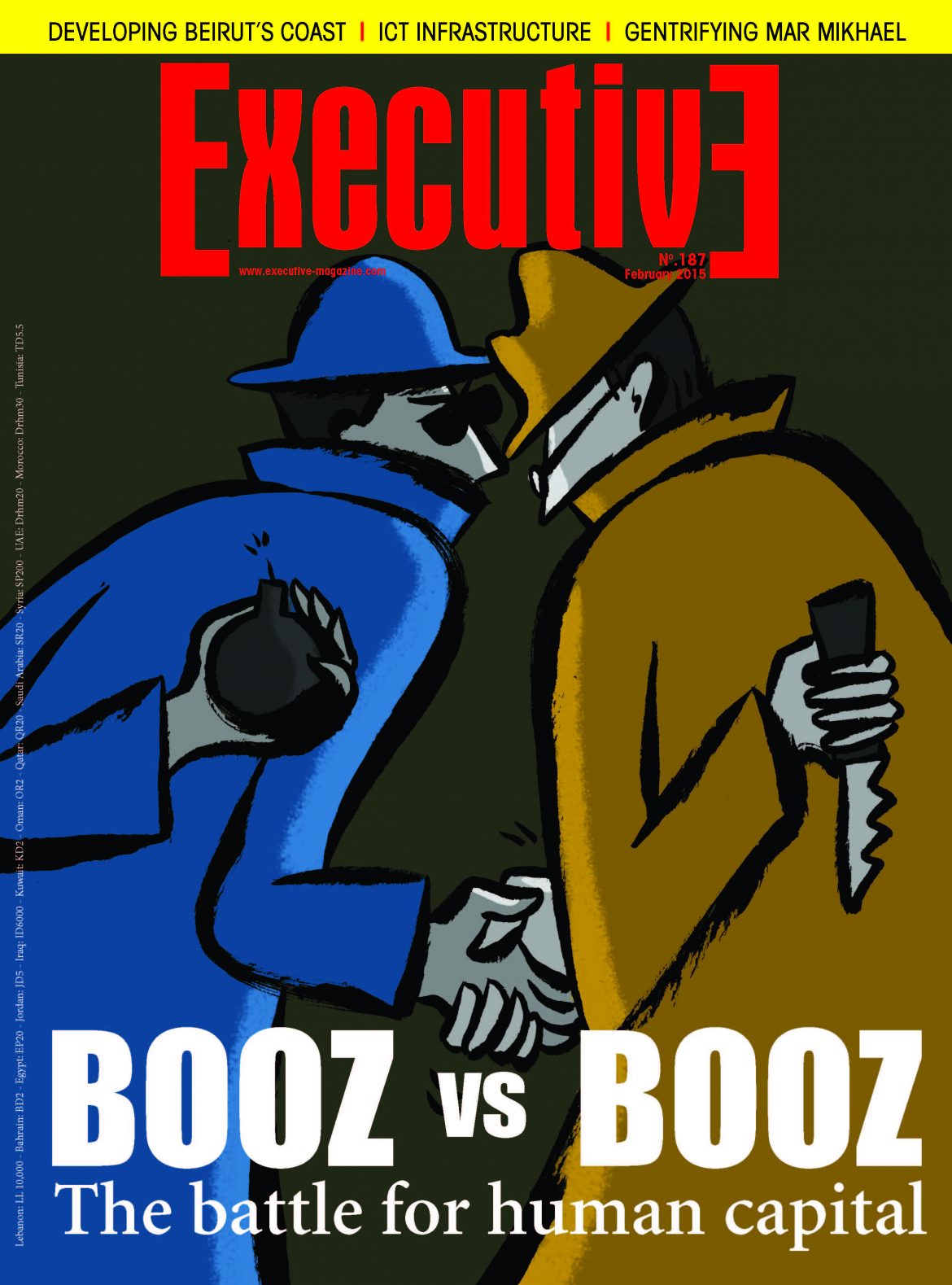
In consulting, human capital is everything. Real experts are rare and have long been fought over, especially in a growth region like the Middle East where cultural compatibility is a key need. Now it looks as if the region’s scarcity of qualified consultants is taking the war for local talent to a whole new level. This is the second installment in a three part investigation into recent developments at Strategy& since it combined forces with global services organization PwC. Read part I here.

[pullquote]What happened was “a meeting of the minds” between PwC and Booz, says Saddi[/pullquote]

From the C-suite narrative, there was a straightforward logic behind the decision to combine Booz & Company with PwC, a move that Booz’s global layer of top stakeholders approved in December 2013 and that was formally sealed in April 2014. What happened was “a meeting of the minds” between PwC and Booz, says Joe Saddi, senior partner and chair of Strategy&’s Middle East business.

For Booz, the process started with introspection into the consulting industry and its future challenges. “It dawned on us that the industry was going through an inflection point in that clients were no longer asking only for strategic advice but also wanted you to [implement] and deliver tangible impacts. To deliver tangible impacts nowadays requires having much more capabilities,” says Saddi. To gain those needed capabilities, the company’s only choices were to either build them internally over time or find a partner that already had such capabilities, he adds. 

Having opened the mental doors to the possibility of joining forces with a partner, the leadership of Booz responded to overtures which according to Saddi originated from PwC. The caveat was to engineer the partnership in a way that would have a greater chance of success than other such moves that had accompanied the turbulent growth of the accounting and consulting industries since the days of the Enron scandal. “We spent a lot of time understanding what would make such a partnering succeed,” says Saddi. 

Both of the two firms, PwC and Booz, had already lived through complicated exercises in searching for winning corporate formulas of the sort that they expect from their new alliance. PwC’s experience in this regard was shaped by the divestment of its Management Consulting Services unit in 2002. The path of Booz had included the split in 2008 that created Booz & Company as an entity focused on international business and Booz Allen Hamilton as a consultancy initially working on US government contracts, many with military and security flavors. And in 2010 Booz & Company said it had aborted discussions with consultancy peer A.T. Kearney over a possible merger. 

In going with PwC, the deal was shaped in a very different way from any other in the consulting industry, “where the smaller company was merged and integrated into the operation of the bigger one,” says Saddi. “This is not the case here. Both sides agreed that in a first step what was Booz & Company would remain intact as a structure. Legacy Booz is going to remain as an entity and have its own identity within the PwC family.”

[pullquote]“I prefer the term ‘combination’ rather than the word ‘merger’ because it is more of a combination than a merger”[/pullquote]

‘Legacy Booz’ is the term by which members of Strategy& frequently refer to their company since joining PwC. Not even the term ‘merger’ appears to express the way in which partners in the consultancy perceive their new identity. “I prefer the term ‘combination’ rather than the word ‘merger’ because it is more of a combination than a merger,” explains George Sarraf, a partner and veteran of Strategy&’s Middle East business. 

In addition to the client demand for implementation of strategy that Saddi had discussed, Sarraf mentions three other key benefits to legacy Booz, all related to the much larger scale of the PwC operation when compared with the old Booz & Company.

“In the consulting business you need to invest, and the combination has allowed us access to a much larger pool of investments because of the sheer size and financial strength of a global firm like PwC,” Sarraf says, going on to cite access to new capabilities “that we didn’t have and which we needed access to” and enhanced geographic reach as the second and third new advantage. “Although Booz surely was a global firm and had in excess of 50 offices around the world, there were many countries where we were not present. If you today want to serve in areas like Africa, as an example, the wide geographic presence of a firm like PwC is a big plus,” he explains.

The ‘bigger is better’ argument is well supported by numbers. According to its annual figures for its fiscal year ending June 2014, PwC achieved $33.95 billion in global revenues of which just under 3.5 percent were generated in the Middle East and Africa (MEA). In terms of total revenues, PwC was the world’s number two in the advisory–accounting–consulting multiverse, just behind Deloitte, which reported $34.2 billion in revenues for the 12 months ending May 31, 2014. 

PwC’s revenues growth rate for MEA was shown at 9 percent versus 5.8 percent globally. Unpleasantly, as with other global corporate reports, the growth rates shown in the annual overview don’t give details on the performance of MENA markets by themselves. However, the report says that the growth rate for MEA was 15.9 percent at stable exchange rates — which makes it unlikely that growth in the dollar pegged markets of the region, such as the GCC, was as strong as growth in markets against whose currencies the dollar appreciated over that period.

[pullquote]Booz had “hundreds of partners and thousands of employees” worldwide before joining forces with PwC[/pullquote]

A world in need … of consultants

Unlike PwC, Booz as a private partnership organization did not report global or regional revenues but the size differential is shown in the human capital accounts. According to Saddi, Booz had “hundreds of partners and thousands of employees” worldwide before joining forces with PwC; PwC, according to its online data sheet, accounted for 10,000 partners and over 195,000 total staff by the end of June 2014. On a global level, then, Strategy& will rely on PwC’s strength to tap into the lucrative and growing market for consulting services.

Big consulting is at home in the United States and Europe, where top players achieve varying but generally dominant portions of their turnovers. Data from the US market, still the mother lode of consulting activities, say that revenues of management consulting firms grew from $120 billion in 2009 to $138 billion in 2013 and $143 billion in 2014. These figures were compiled by information portal statista.com from US Census data on industry.

In another statistical view on the international consulting industry, a company called Source Information Services found in the autumn of last year that big consulting groups, meaning firms employing more than 50 consultants, achieved revenues surpassing $41 billion from the US market in 2013. The same company, which acts as an analyst and consultant on the consulting business, said on several recent occasions that Southeast Asia and the Middle East and North Africa region — or more exactly the Gulf Cooperation Council bit of it — offer the best growth prospects for big consulting firms.

The Southeast Asia region benefited from political stability and the ASEAN economic area was projected to achieve 5 percent annual growth for the next five years, it said but acknowledged that among the two consultancy growth regions, the GCC market generates higher revenue per consultant and also has a higher propensity to buy consulting services.

[pullquote]The Saudi and Emirati consulting markets have been leading the world in growth rates[/pullquote]

While Source Information Services described the GCC consulting clienteles in unflattering terms as fidgety by comparing typical GCC client behavior to that of a “petulant teenager” and also named MENA markets with $2.2 billion in 2013 in consulting turnover as rather small revenue generators for big firms, it highlighted that the Saudi and Emirati consulting markets have been leading the world in growth rates, respectively registering 26 and 16 percent expansion in 2013.

With such growth rates, it is no wonder that the GCC market is an arena for the ambitions of global consulting firms such as Boston Consulting Group, Booz Allen Hamilton, Bain & Company, McKinsey and Accenture, as well as the consulting units of the globally leading ‘Big Four’ audit firms: Deloitte, KPMG, Ernst & Young and PwC.


Continue on to Part III

“Booz vs. Booz: An agressive challenger”


February 4, 2015 1 comment
0 FacebookTwitterPinterestEmail
Business

Strategy & war — Part I

by Thomas Schellen February 3, 2015
written by Thomas Schellen

In consulting, human capital is everything. Real experts are rare and have long been fought over, especially in a growth region like the Middle East where cultural compatibility is a key need. Now it looks as if the region’s scarcity of qualified consultants is taking the war for local talent to a whole new level. This is the first installment in a three part investigation into recent developments at Strategy& since it combined forces with global services organization PwC. Read part II here.

Their offices are located on what feels like the central corner of downtown Beirut. From their conference rooms and executive offices the view sweeps across the headquarters of Lebanon’s largest bank and the premises of the nation’s top couturier to the city’s flashiest high end office addresses.

But what makes the presence of consulting firm Strategy&, formerly Booz & Company, at the physical core of the Lebanese business landscape truly noteworthy is not the location’s air of money and corporate importance. It is the company’s history of stay. It has been here since this part of downtown was rebuilt — which means operating a top tier Beirut office for more than a decade, even though the Lebanese consulting market is strictly little league.

A tale of two Edwins

Strategy& is an uneasy name for a consulting firm. Many will tell you — and opine — that the old name, Booz & Company, was so much more memorable as it carried the storied image of a full century of consulting dating back to one Edwin Booz who hung out his shingle as presumably the world’s first commercial consultant in Chicago back in 1914.

However, in 2013 the global partners — and hence owners — of Booz & Company had no choice but to give up that brand in order to join forces with another storied name (and much bigger company): professional services corporation PricewaterhouseCoopers, today branded as PwC. The merger meant that a clause in an older deal between Booz & Company and sister consultancy Booz Allen Hamilton had to be obeyed — a stipulation of the demerger of the company that was operating globally as Booz Allen Hamilton until 2008. This demerger had established BAH as a US focused firm whose revenue stream originated more than 90 percent from defense, intelligence and other government work and provided Booz & Company with a hold over international markets. The newly segregated siblings were not to penetrate into each other’s territory for three years, until late 2011, and if Booz & Company were ever to merge with another player, it would have to discontinue using the Booz brand.

Yet the new deal with PwC did not deprive Booz & Company of association with a time honored name. PwC’s roots date back to the mid 19th century and to prominent London based accountants, including one Edwin Waterhouse.

When compared with the Gulf region, “we don’t have many clients in Lebanon,” acknowledges Joe Saddi, senior partner and chairman of Strategy&’s Middle East business. “In business focus, the firm follows GDP, from the biggest down,” he says, and names the region’s primary markets for consulting services as Saudi Arabia, followed by the United Arab Emirates and then Qatar and Kuwait. 

Ask the top person at the Lebanese lair of this globally active consulting firm why they maintain an expensive presence in Beirut, and Saddi will tell you that they are here because of Lebanon’s most valuable resource: “We are in Lebanon mostly because of the talent.”

And while the name Strategy& may not yet ring a bell with people who look up a consulting firm only when they need to restructure or reinvent their company, this company has been plugged into the industry’s spinal cord since its beginnings in the industrial environs of Chicago 101 years ago. Then, the company’s name appears to have been “Business Research System”, but it became known through a succession of later monikers which all included the term Booz, after its founder. Last year, however, Booz & Company made a big move by combining forces with another global services organization, PricewaterhouseCoopers (PwC), and had to drop anything ‘Booz’ from its official identity because of a contractual obligation (see box).

Making it on the local stage

While other consulting firms with global repute — the likes of Boston Consulting Group (BCG), Bain & Company, McKinsey and so forth — have bypassed Beirut in recent decades and put all their regional offices into the GCC basket or perhaps into Egypt, the Strategy& organization’s Beirut office has given the company an edge in recruitment and boosted its human capital. 

George Sarraf, a Strategy& energy partner and veteran of its Middle East consulting activity reminisces on how the company has been accessing Lebanese talent ever since he joined its then regional base in Abu Dhabi in 1996. “Lebanon is an important source of talent for us and it always has been since we first opened an office in the region,” he muses. 

[pullquote]12 of 27 Middle East based partners left the company between December 2013 and January 2015[/pullquote]

According to both Saddi and Sarraf, talent — and competition for talent — are defining issues in what they call the premium consulting industry, whose management and strategic advisors regularly have to interact with senior leaders in large corporate and public sector organizations. “The biggest challenge you have is access to talent and to maintain talent. This is the element that constrains growth the most and that is why there is a lot of fighting around talent within this industry,” Sarraf explains.

In Saddi’s words, Strategy& was able to draw in local talent more effectively than other premium consultancies over many years, but as he concedes, outbound talent migration at the top tier of partners in the company was part of the company’s transition from a standalone firm to alignment with global giant PwC. While the majority of regional partners, according to him, voted in favor of the tie up with PwC in the fourth quarter of 2013, “around 10” partners left the firm between the vote and mid 2014. According to comments by Sarraf in September 2014, the issue was under control at that time, because the majority of partners remained with the organization, only a minority of departees from various ranks went to the competition and new hires came aboard. “[When looking at] the net — net of how many people have left and how many have joined during this period of time — I would not say it is a wash but it is a near wash,” he enthused.

A small wrinkle

But when wrapping up and rechecking its research into the regional human capital of partners and consultants in January 2015, Executive found signs suggesting that Strategy& has been recently embroiled in a veritable talent battle.

Where they went

As of December 10, 2013 — a mere fortnight before Booz & Company partners took the final vote to join PwC — the company’s website listed 27 partners in the Middle East. As of mid January 2015, here’s where each of them were.

Strategy&
Olaf Acker
Samer Bohsali
Alessandro Borgogna
Gabriel Chahine
Georges Chehade
Bahjat El-Darwiche
Chucrallah Haddad
Hilal Halaoui
Andrew Horncastle
Fadi Majdalani
Joe Saddi
George Sarraf
Richard Shediac
Chady Smayra
David Tusa

Boston Consulting Group
Jad Bitar
Leila Hoteit
Christian Reber
Peter Vayanos

Booz Allen Hamilton
Walid Fayad
Raymond Khoury
Ramez Shehadi

McKinsey
George Haimari
Mazen Ramsay Najjar

Ernst & Young
George Atalla

A.T. Kearny
Sean Wheeler

No affiliation
Tarek Elsayed

Source: The Internet Archive, firms, individuals’ LinkedIn profiles

Comparing the lists of partners on Strategy&’s website and other sources from last month with a version of Booz’s cached by nonprofit outfit The Internet Archive, one finds that 12 of 27 Middle East based partners left the company between December 2013 and January 2015.

While this sounds grave enough in a business where partners are crucial players for reputation, expertise and also for bringing in clients and contracts, the defections of partners over a slightly longer period from March 2013 until January 2015 seemed counter indicative to Sarraf’s suggestion that “only” a minority hitched with regional competitors.

Of partners who vanished from Booz in that period to reappear elsewhere in the consulting industry, one moved to Ernst & Young in a global role; two others became partners at McKinsey in the UAE; and a fourth claimed on their LinkedIn profile that they moved from Booz to join A.T. Kearney in Dubai in January 2015 (however, their name had not appeared on the A.T. Kearney website as Executive went to press).

Taking the total count to eight, three partners jumped to BCG in the Middle East and one to BCG in Europe. Lastly, as the hammer in this game of rotation, consulting firm Booz Allen Hamilton (BAH), which started pushing into the Middle East after a noncompete agreement with former sibling Booz & Company expired in Q3 2011, in October 2014 presented three recently departed Booz seniors plus another Booz alumnus as new BAH partners and part of their new MENA leadership team — led by yet another Booz outbound migrant as the MENA team’s new “executive vice president and managing director”, according to the press release (see box).

Moreover, the migratory pressure has not been limited to the top tier of partners, vice presidents and so forth. For an informative, albeit not statistically representative assessment of migrations in the rank and file of the Strategy& and BAH organizations, and in an effort to find direct crossings from the former to the latter, Executive reviewed some 42 LinkedIn profiles of analysts, associates, senior associates and principals who indicated employment by either of the two companies in their online profiles.

According to their profiles, most of which were posted by persons with last names that indicate a possible Lebanese nationality, 20 individuals — almost half of the interconnected profiles which we accessed — left Booz–Strategy& between mid 2013 and end 2014. And all but a few of these individuals indicated that they moved without any intermediary employment to BAH.

That, one assumes, cannot be a boon for an organization whose defining capital is human. 

Correction: When counting partner departures from Booz–Strategy&, a previous version of this article inadvertently put the time period under consideration as March 2013 to January 2014, instead of to January 2015. Apologies.


Continue on to Part II

“Booz and PwC: It made sense on paper”


February 3, 2015 0 comments
0 FacebookTwitterPinterestEmail
Beirut's private coastReal Estate

Achour-ed success

by Matt Nash February 2, 2015
written by Matt Nash

[pullquote]“The land, I think, [is worth] less than this amount, but the amount was [acceptable] like this because we’re not paying immediately”[/pullquote]

Even with the smell of untreated wastewater wafting into the air and urban waste effluents annoying bathers in the sea, the property shown on the Beirut cadastral map only as land parcel 3689 was clearly valuable. Real estate developer Wissam Achour must have seen these 5,188 square meters of sandy beach at the southern edge of the upscale Ramlet al-Baida district as a veritable treasure — judging from the fact that his Achour Development in 2011 agreed to pay $175 million for parcel 3689 and the larger plot behind it. The price reflected the undeveloped land’s terrific location and potential for a tourism project, Bahij Abou Mjahed, a lawyer for Achour Development, tells Executive. He admits, however, “The land, I think, [is worth] less than this amount, but the amount was [acceptable] like this because we’re not paying immediately.”

As is standard in the industry, Achour Development created two special purpose vehicles, Beirut Marina Gate and Achour Marine Development, to manage and build, respectively, what is planned to be the Eden Rock Resort, a seaside project with an estimated investment value of $500 million, Abou Mjahed explains. As per a special purchase contract between Beirut Marina Gate and Eden Rock Real Estate and Tourism — the company that owns parcels 3689 and 3687, the 17,107 square meter plot that abuts 3689 on the land side — the developer handed over around “12 to 13 percent” of the amount upfront, he says.

This computes to an initial payment of around $21 to $23 million for the land, with the balance to be paid as the project — where prices for a low rise apartment start at $15,000 per square meter — begins drawing in revenue, Abou Mjahed says. Once the price is paid, ownership will transfer to Beirut Marina Gate as project owner and operating company, he adds. 

All indications — such as the telltale merging of smaller parcels into 3687 and 3689 — are that Eden Rock Real Estate and Tourism, which is selling the land to Achour, clearly wanted to turn the property into a profit making asset. It entered the process of acquiring the permits needed for building beyond the scope of what zoning laws in the area allow and, after receiving a green light for a ‘grand project’ from the Directorate General of Urban Planning (DGUP), the Council of Ministers signed off on Decree 14814. Published in the Official Gazette in July 2005, it cleared the way for structures with a height of more than 5.5 meters above road level to be erected on the land.

It is unknown why Eden Rock Real Estate and Tourism abandoned its project and further details on its approved 2005 plans were not available, but Abou Mjahed confirms that Achour Development has submitted its drafts for the project with modifications and says that these blueprints have been making their way through the approval process without any real obstacles. Approval of the updated plans from the DGUP was required and granted. He insists, however, that no new approval from the Council of Ministers is required — a point some dispute.

[pullquote]Another lingering question concerns when construction can legally start[/pullquote]

Lingering doubts

In January, a DGUP official directly contradicted Abou Mjahed’s claim that no further action is needed by the Council of Ministers. The official, who spoke on condition of anonymity, said that the DGUP had approved the new plan and sent it on to the Council for consideration. Abou Mjahed denies the need for further Council action, claiming that the existing Decree 14814 is sufficient and applies to the resort. The decree itself is vague, and Executive was unable to reach Tourism Minister Michel Pharaon — who said at a launch event for the resort in October that the file was still with the DGUP — for clarification.

Another lingering question concerns when construction can legally start. An official with the engineering office at the Municipality of Beirut, again insisting on not being named, tells Executive that the permit for 3689 is “on hold,” but he did not know why. The official explains that the hold means a developer can begin excavation but not construction. Manar Jaber, head of sales at Achour Development, acknowledges the inability to begin construction at the moment, but insists the permits will come and blames the delay on extra red tape related to a recent change in leadership in the Beirut governor’s office.

In addition to the delay, there remains an outstanding legal case related to plot 3689 between Walid Rassi, an engineering consultant, and Eden Rock Real Estate and Tourism. A Lebanese court, according to the land ownership paper from the Directorate of Land Registration and Cadastre, put a hold on developing the land until the matter is settled. Andre Bouchaaya, a lawyer who specializes in real estate, confirms that the legal action against the landowners will prevent development. “The court put a hold on; only the court can lift it,” Bouchaaya says as he looks over the land ownership papers.

Jaber says Achour Development is working to settle the issue with Rassi, who does not deny that he’s been in touch with the company, but says “no serious efforts” to resolve the case have been made recently. Either way, according to Abou Mjahed, if the case with Rassi is not resolved before the final payment is made to Eden Rock Real Estate and Tourism, a clause in the transfer contract stipulates that Achour’s Beirut Marina Gate will be legally allowed to settle the case for any amount of money, but Eden Rock Real Estate and Tourism will have to pay.

Works underway

The current hold on construction does not mean a full stoppage of work — excavation began in January, according to a company spokesperson.

This isn’t the first work to be done. Prior to beginning any work on the resort, Achour had a sewage problem. As is the case in several spots along Beirut’s coast, raw sewage used to meet the sea near plot 3689, contaminating the waters off Ramlet al-Baida. The Council for Reconstruction and Development (CDR), which is tasked with building the country’s wastewater collection network, has “for years” been meaning to stop the outflow of excrement into the Mediterranean, but work is slow and costly, Assem Fedawi of the CDR told Executive in September.

Interestingly, in 2013 South for Construction won a contract to build a pumping station to transport the wastewater pouring on to the Ramlet al-Baida beach to a treatment plant further south, according to the company’s website. Abou Mjahed explains that Achour personally stepped in to help speed up the tendering process. “He provided what they needed to make this pumping station happen. I don’t want to say he paid, he provided … You know the bureaucracy of the regulation, the Ministry of Health, the Ministry of Environment, the CDR — which is a state in itself — so to [effect] accord between all the parties, Mr. Achour did this job. He’s investing. He believes in Lebanon,” Abou Mjahed explains.

[pullquote]Prices for units range from $15,000 to $20,000 per square meter[/pullquote]

The vision

According to the current designs, the Eden Rock Resort will comprise a residential tower, a hotel tower, low rise apartments and a hospitality and recreational complex that includes almost 130 chalets. Cabins and a ‘summer marina’ round off the project. In an artist’s rendering of the project, the hotel is depicted at about the same height as the 22 story residential tower.

Prices for units range from $15,000 to $20,000 per square meter, implying yet another surge in what Lebanese developers regard as achievable in marketing to the one percent.

This is the vision Achour is staking out. While he declined to comment for this article, he appears relentlessly undeterred by dysfunctional bureaucracies or lengthy litigation. Yet still, Abou Mjahed — as one would expect from a lawyer — says the letter of Lebanon’s various laws regarding development will be followed religiously. “We cannot afford any violations of the law. We’re taking the risk, putting up the big investment and, most important, our reputation,” he promises.

Correction: A previous version of this article claimed that excavation began late last year. While preparations began late last year, actual excavation began in January according to a spokesperson for Achour Development. Excavation on the site had also been conducted previously.

February 2, 2015 2 comments
2 FacebookTwitterPinterestEmail
Real Estate

The house of culture

by Nabila Rahhal January 30, 2015
written by Nabila Rahhal
(Greg Demarque | Executive)

As in all historic cities across the globe, there are certain architectural structures in Beirut, such as the Egg in downtown or the old Manara in Ain El Mraisseh, that have become landmarks and a major part of the Lebanese collective memory. Even as the city progresses and develops, these buildings should be preserved, in one form or another, as part of our national heritage.

Exhibition in the Pink House

One such landmark, at least according to nearby residents, is the Pink House, situated on a green hill just off Bliss Street and overlooking the Riyadi Club in Manara. This house has long been fascinating for tourists and Lebanese alike who often pose for photos in front of it on their walks along the Corniche.

Recently, the Pink House has been the subject of documentaries and articles discussing its rich history. It was thrust into the media spotlight again in early November with an exhibition that British artist Tom Young organized in it, which ran until the end of December. 

Young had done a similar project in 2013, in “Villa Paradiso” a heritage home in Mar Mikhael. The house was being renovated by the Feghali family, who had recently bought it and was wondering what to use it for, when Young met them and suggested it become a cultural space, beginning with his exhibition. Ever since, a number of artistic events have been held in the villa. 

The Rose House Exhibition, as Young dubbed his show in the Pink House, was one of the few times in the last decade that this private residence was open to the general public. Hundreds flocked to see the house that had piqued their curiosity. During an interview with Executive in late November, Young estimated that more than 2,000 people visited the exhibition, with about 200 guests on the opening night alone. 

Tom Young, host of the Rose House Exhibition

[/media-credit] Tom Young, host of the Rose House Exhibition

A brief background  

The Pink House, or La Maison Rose as it’s known among the francophone community, is no stranger to cultural activities and events. The ground floor of the house was built by Mohamad el Ardati as his hunting lodge and he added the first and second floors in 1882. The house is actually a three story building, and each level is a separate apartment with no interior connection between them.

Young has researched the house’s history and had dedicated an entire room of his exhibition to this subject. He recounts that half the Ardati family lived in the Pink House until 1959, after which it was rented to notable figures including the American cultural attaché and his family, the Indian ambassador to Lebanon and his family, and the American artist John Ferren who lived in the house until 1964.

The Khazens move in 

But it was Selim Khazen’s family who lived there the longest, starting in 1964, and hence had the greatest effect on its development. The Khazen family is one of Lebanon’s aristocratic families and Selim, its patriarch, was a lawyer credited with initiating the development of the Faraya Mzaar ski resort on the land he owned in the area. 

[pullquote]Although Fayza kept the first floor of the house in relatively decent condition for her to live in, the ground and second floors were left to decay and the house began to show its age[/pullquote]

It was Sami, Selim’s son and a well known architect and artist in the 1960s, who came across the Pink House and fell in love with it, renting it from the Ardatis. He moved his parents onto the first floor, where the exhibition took place last month, and redesigned the ground floor as his living space and studio, doing such a good job with the design that it was featured in Architectural Digest according to Young. The Khazens lived in the house, which became known as a cultural and artistic hub, and the parties the Khazens held drew the crème de la crème of Lebanese society.

With the onset of the Civil War, the Khazens left the country, save for Margo, Selim’s wife, who stayed — leaving only for a year in 1982 when the Israelis invaded Beirut and the house was badly damaged — and kept the doors open for guests from all over the world, says Young.

After the Civil War, in 1994, Margo became paralyzed so Fayza, her only living offspring (Sami and Hoda, the two other children of Margo and Selim, had passed away) returned from Paris to be with her. Aside from taking care of her mother, Fayza continued promoting the family tradition of cultural activities through establishing her own publishing house, Terres du Liban, which released coffee table books on the Levant and life in Lebanon.

Although Fayza kept the first floor of the house in relatively decent condition for her to live in, the ground and second floors were left to decay and the house began to show its age.

New owners take over 

Shortly before Margo passed away in 2011 at the age of 94, the last remaining son of the branch of the Ardati family who owned the house, Adel Ardati, passed away in Germany where he had lived almost all his life. With no one left to inherit the house, the family lawyer sold it to Hisham El Jaroudi, the current president of the Riyadi Club and a prominent architect with many projects across the city.

[pullquote]Fayza was asked to vacate the house by November 2014 in preparation for its new owners[/pullquote]

Fayza was asked to vacate the house by November 2014 in preparation for its new owners and it was during her last months there that she met the artist. Young says that he had been always fascinated by the house and curious about who lived in it. Recalling the day he met Fayza, Young says, “It was after the Villa Paradiso exhibition and I was looking for a similar project as I was sad at leaving that Villa, and missing it, after having invested so much of my heart in it but in the end it’s not mine; maybe I sort of wanted to replace it and I was a bit lost in my direction. Early in April 2014, I was walking down the Corniche with my wife Nour and we looked up and saw some [clothes] hanging on the balcony, so Nour suggested we try and find an entrance and we found the back door and knocked.”

Young paints the Pink House 

So began a fateful encounter that led Fayza to invite Young to live in the Pink House and work on paintings depicting the final days of the house, with the idea of preserving its memories and showing its haunting loneliness as its final Khazen tenant prepared to move on. Young’s paintings are of the house itself and surrounding scenes, such as the Ferris wheel and the lighthouse, which are considered part of Manara’s heritage. 

Upon learning that the house was bought by the president of the Riyadi Club, which is in close vicinity to the house, Young says he went down and talked to him, asking his permission to open the Pink House to the public for a two month exhibition after Fayza leaves, as well as creative and educational activities, from teaching children art to hosting AUB architecture students for discussions.

Through these two months and such events, Young says he was hoping to show Jaroudi that the house should be preserved as a cultural center. “This is what art can do and this is my concept: that art can reach the highest level of powerful individuals and entice conversation among them and work with them on saving and preserving these heritage places to make sure they stay for the whole city. It should be open for everybody as public spaces are being eradicated at an alarming rate in Beirut and in a divided society, we need cultural spaces where people of all kinds can mix.”

[pullquote]It seems that the Lebanese will not lose their landmark view during their strolls by the sea[/pullquote]

The house remains 

Jaroudi says he is intending to renovate and preserve the house. “The house, which is a significant part of our city’s history, is currently in a bad condition. I want to preserve it and restore it to its former glory as a Beirut landmark and part of its heritage. It is my duty towards my city,” says Jaroudi, adding that his initial plan, after the restoration, is to live in it with his family, but that he is also considering having a floor dedicated to cultural activities.

Meanwhile, Young is trying to prepare a team who could help Jaroudi create a cultural center, if he decides to do so. Young himself, who had sold most of the Rose House Exhibition paintings halfway through the exhibition (with prices ranging between $500 and $15,000), plans to take a break before attempting to embark on yet another project in a “key building which everyone knows and is in the city center.”

At a time when heritage homes are being destroyed at a breakneck speed to make room for the more lucrative high rises, it is heartening to know that the Pink House will be spared such a fate. Whether Young gets his wish for the house to be permanently open to the public remains to be seen, but it seems that the Lebanese will not lose their landmark view during their strolls by the sea.

Correction: A previous version of this article erroneously claimed that Young’s work sells for as much as $1,500. The correct figure, according to the artist, is $15,000. Apologies.

January 30, 2015 2 comments
0 FacebookTwitterPinterestEmail
Economics & Policy

No rest for the weary

by Maya Gebeily January 29, 2015
written by Maya Gebeily

After decades of a relatively open border policy with its eastern neighbor, the beginning of 2015 saw Lebanon take unprecedented steps to monitor the entry and residency of Syrian nationals. Spearheaded by the ministries of interior and social affairs, the policies are an attempt to regulate the nearly 1.2 million Syrians already in Lebanon — as well as others seeking entry in the future.

The first of these measures came in the form of new visa requirements for Syrians and went into effect on January 5, 2015. Despite political pushback and concerns by human rights groups, Lebanese authorities insist this new policy is only the beginning.

Neighborly relations

Prior to the conflict, entry for Syrians into Lebanon was easier than for any other foreign nationality. According to the Treaty of Brotherhood and Cooperation, signed in 1991, Lebanon and Syria share “distinctive fraternal ties” and did not require travel visas from each others’ citizens. The lax requirements meant that borders remained relatively open, allowing hundreds of thousands of Syrian laborers to enter Lebanon seasonally for work.

Syrians could enter Lebanon at any border checkpoint using a valid government ID and would be issued a onetime-renewable six month residency for free. At the end of their year in Lebanon, Syrians would have to return to Syria. Palestinian refugees from Syria had to have pre-approval from Lebanon’s government to enter.

Children in refugee communities are particularly vulnerable to the harsh winter weather

[/media-credit] Children in refugee communities are particularly vulnerable to the harsh winter weather

With the onset of the Syrian uprising in 2011, the policy changed. Instead of returning to Syria at the end of their one year stay in Lebanon, Syrians could renew their residency for another six months through General Security, paying $200 per family member over 15 years old. For Palestinians from Syria, the pre-authorization was lifted, and the transit visa they received at the border could be exchanged for a three month residency, also renewable for free until the $200 yearly fee.

Now, Lebanon’s policy has changed once more. On December 31, General Security announced that Syrians entering Lebanon would be issued entry documents based on the proven purpose of their visit. Their stays now fall under eight categories: tourism, study, work, medical treatment, transit to another country, checking on property, visiting an embassy, or being “sponsored” by a Lebanese citizen. Instead of the one-size-fits-all, six month residency they had previously received, the length of stay for each of these categories now varies, and strict documentation is required. 

The change was pegged as part of a new, three point policy statement that the Council of Ministers approved in October. To manage the refugee influx, the October statement said, the government would seek to decrease the number of Syrians registered with UNHCR (the refugee agency in Lebanon coordinating relief efforts for Syrians), tighten up security within Lebanese territories and lift the socioeconomic burden on Lebanon.

General Security’s new residency requirements are the first step of this statement’s implementation. “We’re trying to find out who is trying to come in and why — and this is something we have the right to know,” explains General Security press officer General Joseph Obeid.

But the decision has already sparked controversy — some of it based on semantics. Syrian Ambassador to Lebanon Ali Abdul Karim Ali said requiring visas from Syrians violated the bilateral agreements that had kept borders between the two countries open for decades. Speaker of Parliament Nabih Berri and a number of ministers from Hezbollah and the Amal Movement similarly criticized the move.

Timeline of events

General Security, however, insists that the documents it is issuing to Syrians upon entry are not “visas” and therefore do not violate these treaties. “It’s entry documentation — it’s not a visa. It’s not like an Egyptian coming into Lebanon,” Obeid insists. Although procedures for Syrians entering Lebanon do remain distinct from those for other foreigners, the strict categories, required documentation and limited stay are exactly what constitute visas in other countries. 

And despite claims in the Lebanese daily Al-Akhbar that the visa policy will soon be retracted, Obeid says the measure will continue to steamroll forward. “There will be no change in this policy. We’re moving ahead with it as planned,” he assures.

Beyond this disagreement, Syrians and human rights organizations are worried about what General Security’s new border policy might mean for those trying to flee Lebanon’s war torn neighbor. Noticeably absent from the eight category statement is a provision for refugees — Syrians trying to enter Lebanon after being displaced by violence. According to General Security and to Khalil Gebara, advisor to Minister of Interior Nouhad Machnouk, these “humanitarian entries” will be granted on a case by case basis.

Both Amnesty International and Human Rights Watch expressed concern that the measures would limit access to safety for thousands of Syrians fleeing conflict at home. At the time of writing, UNHCR had yet to issue a statement. “We’re still studying it. We’ll let you know more when we get it,” says spokesperson Ron Redmond.

[pullquote]Even prior to General Security’s new measures, the refugee influx into Lebanon had slowed dramatically[/pullquote]

Border policy 

Even prior to General Security’s new measures, the refugee influx into Lebanon had slowed dramatically. The number of refugees registering with UNHCR saw a drastic drop in the last months of 2014 — in October and November combined, only 29,477 Syrians registered with the agency, compared with 31,158 in September alone. Even that month produced relatively low numbers compared to the rest of the year — until August, at least 42,000 refugees were registering every month.

Part of this drop is likely due to the fact that the active battlefronts in Syria’s war have shifted to the country’s north and east. Indeed, months of clashes in Syria’s western Qalamoun region in early 2014 saw the most concentrated refugee flows into Lebanon to date. As battles shift away from Syria’s west and south into the north, refugee flows into Turkey continue to increase, while those into Lebanon and Jordan have markedly dropped. 

But even many of those Syrians who made it to the Syrian–Lebanese border at the end of 2014 were having difficulty entering the country. Aid organizations including Human Rights Watch and the Norwegian Refugee Council say that toughening border controls saw “most” Syrians being denied entry. For Palestinian refugees from Syria, entry was nearly impossible — very few exceptional cases were allowed access.

Although the new policy specifies entry requirements for non-refugee Syrians, the criteria for those entering Lebanon as refugees are still being developed. “How do we know who’s really a refugee? They could be lying to us,” says General Security’s Obeid. He adds that UNHCR would determine refugee status on a case by case basis, but dodges questions on the specific criteria that would be used to make such a determination.

Gebara has worked closely on the government’s new policy. He says the Ministry of Social Affairs might have an active presence at Lebanon’s border crossings and would be giving approval for extreme humanitarian cases in line with the Council of Ministers’ October decision. When asked what kind of criteria this would entail, Gebara hinted at two potential standards: place of residence in Syria and number of people. “If one man comes from the center of Damascus and says he’s a refugee, it won’t work,” he tells Executive. “When there’s fighting in an area, the whole village shows up. The last thing that would happen would be that there would be a mass influx along the border that would get denied entry.”

Unfortunately, human rights agencies say General Security doesn’t have a great record of identifying vulnerable cases. “Even after the [Council of Ministers’] October decision, General Security officers were not inquiring about humanitarian need,” insists Lama Fakih, researcher at Human Rights Watch’s Beirut office. “The process of entry was arbitrary and discriminatory.”

Most Syrians live in dwellings ill equipped to deal with Lebanon’s harsh winter

[/media-credit] Most Syrians live in dwellings ill equipped to deal with Lebanon’s harsh winter

According to Human Rights Watch and Lebanese rights NGO LIFE, instead of taking humanitarian factors into consideration, General Security was allowing entry based on perceived affluence, religion, and origin in Syria. Nabil Halabi, director of LIFE, says that “social discrimination” saw those who appeared to be from a higher social class — traveling in private cars, well dressed, often from the capital — waved through Lebanon’s checkpoints. Nadim Houry, deputy director of HRW’s Middle East and North Africa division, says Syrians with traditionally Christian names received the same treatment. Meanwhile, those coming from Raqqa or Deir Ezzor — eastern provinces in Syria which are now Islamic State strongholds — were facing significant difficulty.

Houry adds that this practice is contrary to Lebanon’s international obligation towards those seeking safety. “If a Syrian businessman from Damascus wants to come spend a weekend in Beirut, and the Lebanese government says no, then we’re not going to complain,” says Houry. “They’ve actually done the opposite — they’re happy with those with money to come spend the weekend, but they don’t want the others to come in.” 

General Security’s Obeid emphatically rejected these claims. “Nothing about this is true. Everyone is on the same level with us,” he tells Executive. “If the government says let people in, we do.”

[pullquote]Holding legal status in Lebanon isn’t just a matter of convenience; it’s central to almost all aspects of refugee life[/pullquote]

“It’s impacting everything else” 

Holding legal status in Lebanon isn’t just a matter of convenience; it’s central to almost all aspects of refugee life. Unfortunately, rapidly changing policies, inconsistent implementation, and inadequate dissemination of information mean that many refugees in Lebanon are living here illegally. In September, Lebanon’s government gave refugees who had limited legal status as of August 21, 2014 the opportunity to regularize their stay with General Security for free. Thousands who had either entered illegally or whose legal stay had expired were able to become legal residents without paying the LBP 950,000 ($630) regularization fee. 

Still, hundreds of thousands of Syrian refugees are not living in Lebanon legally. UNHCR declined to provide Executive with numbers on how many of the 1.2 million registered refugees in Lebanon fall within this category. However, the agency’s planning figures in early 2014 anticipated that over 800,000 Syrian refugees — two thirds of those registered with UNHCR — would be living with limited legal status by the end of that year. With the government’s stricter policies on entry and residency, this number may now be even higher.

Lack of legal stay severely restricts refugees’ ability to move around Lebanon. In a detailed March report on the topic, the Norwegian Refugee Council interviewed 1,256 Syrians, over half of whom were in Lebanon illegally. NRC noted that over 73 percent of respondents reported curtailed freedom of movement as the biggest consequence of their illegal stay in Lebanon. Fear of harassment by security forces at checkpoints, local municipality police, and even regular Lebanese citizens has kept many Syrians sedentary. Refugees with limited legal status who are arrested by security forces are usually given an order for departure back to Syria, but are rarely forcibly deported.

Nonetheless, this lack of mobility has a major effect on refugees’ access to resources. For some, their limited legal status has prevented them from registering with UNHCR. Several refugees who had crossed over illegally from Syria’s Qalamoun region told Executive they felt “trapped.” Too afraid to cross Lebanese Army checkpoints, they could not register at the UNHCR center in Zahle.

According to the NRC report, illegal stay has also pushed families towards increased child labor. Male heads of households without legal stay are often too afraid to leave their homes to seek work for fear of arrest. Since children are less likely to be stopped by security forces and asked for paperwork, fathers often send their children to work or beg for money instead of going to school. NRC says this practice exposes children to potential abuse and exploitation. Furthermore, Syrians without legal stay cannot access Lebanon’s healthcare system, and crucially cannot register the birth of their children with the Lebanese authorities. 

“It creates anxiety, uncertainty. It prevents them from organizing their lives … It’s impacting everything else,” says HRW’s Houry.

Follow the money? 

At the time of writing, the Lebanese government and relevant security agencies had yet to issue decisions on the renewal process for the new visas that Syrians will hold. In their reaction to the decision, Amnesty International announced that refugees who had legal status prior to January 5, 2015, would continue paying the $200 per adult renewal fee as usual, but this has not been confirmed by the Ministry of Interior or General Security. 

For many refugees, the renewal process presented a significant financial burden. NRC’s report notes that refugee families typically pay $100 per month to rent out a small bedroom in an unfinished building. Securing food costs more than $200 per month, and fuel comes at a cost of $100 per month. Given that the average Syrian refugee family earns $250 per month, according to NRC, the renewal fee is one of the first expenses that families forego when money gets tight.

Indeed, the NRC’s March report notes that almost one third of those interviewed stated they could not renew their stay, with 85 percent of these cases saying the cost had prevented them from being able to do so. Others reported that poor treatment and a fear of General Security offices had caused them to skip renewals. 

Birth rates among Syrian refugees are significantly higher than neighboring Lebanese populations

[/media-credit] Birth rates among Syrian refugees are significantly higher than neighboring Lebanese populations

Despite the pervasive negative effect that limited legal status has had on Lebanon’s refugees, international aid groups have declined to cover the cost of visa renewal. In 2012, when refugees were nearing their first one year stay in Lebanon and would have to pay the $200 for the first time, aid agencies agreed that they would not cover the yearly fee as part of their support. Now, only one or two NGOs provide the $200 for very extreme cases. “It would be a huge fee. It would potentially contradict our advocacy towards waiving that fee,” says Dalia Aranki, advisor to the NRC’s Information, Counseling, and Legal Assistance Program. A mere 100,000 renewals — less than 20 percent of the refugee population over 15 — would cost $20 million. 

Keeping refugees, and those helping them, informed 

Refugee and aid agencies alike have said it is difficult to keep up with the government’s changing policies. Some organizations, like NRC, have two tiers of information-gathering: the official government statements about its policies, and the observed and reported practices of security forces. They aren’t always consistent.

“If you go to General Security offices, they’ll tell you your kids don’t need to be registered. But then you take them to the border and they tell you you’re violating Lebanese law,” complains Leila, a Syrian refugee living in the Burj al-Barajneh camp in southwest Beirut.

NRC’s Aranki says she’s seen the same inconsistency. “You can see how complicated this is. There have been so many changes, and how this is implemented is not written down somewhere in one place,” she explains. Practices differ in areas with different local administrations, and NRC has even had to step in to retrain local authorities who were incorrectly registering Syrian refugee births.

[pullquote]Making sure refugees are aware of the legal procedures is no easy task[/pullquote]

Making sure refugees are aware of the legal procedures is no easy task, either. In countries like Jordan or Turkey, where large numbers of the refugee population are concentrated in government controlled camps, dissemination of information can be done much more easily. In Lebanon, refugees live in informal tented settlements, rented apartments, and unfinished buildings — and they don’t always want to be accounted for. “Over the last year, where there has been more tension between the Lebanese and refugees, people have not wanted to make themselves known very much,” Aranki added.

A developing policy

Week by week, more details are coming to light about the Ministries of Interior and Social Affairs’ revamped refugee policy. Social Affairs Minister Rachid Derbas has explained that refugees already in Lebanon and registered with UNHCR would not be forced to regularize their stay as part of the new eight category visa. “However, if the refugee decides to go back to Syria and then return to Lebanon, they will have to comply with the new measures and justify the reason behind their return,” Derbas told Lebanon’s As-Safir. 

Simultaneously, however, Lebanon’s government has been working with UNHCR to deregister Syrians from the refugee list. From June 2014 until October, 68,000 Syrians were removed from UNHCR’s list for crossing back into Syria frequently or failing to pick up aid packages. The Ministry of Interior’s Gebara says that these deregistrations go hand in hand with tighter border control.  

“Until we can audit every single refugee that’s in Lebanon, let the number of new, registering refugees be lower than the number of those being deregistered,” he tells Executive. “So negative growth.”

Both Gebara and General Security’s Obeid promised additional measures in the coming weeks. But several challenges remain, not least the growing political opposition to the new regulations and the lack of clear criteria for “extreme humanitarian” entry cases. 

For refugees and the aid organizations facing the renewed test of understanding and accurately relaying this policy, the period of tumult isn’t over. “Expect the policy to keep changing based on the security and political situation in Syria,” Gebara says.

January 29, 2015 0 comments
0 FacebookTwitterPinterestEmail
The Buzz

Cleisthenes, meet Ares

by Executive Staff January 28, 2015
written by Executive Staff

February marks the 10th anniversary of the Second Intifada’s conclusion. Since then, Israel has held three elections for its parliament, the Knesset, and been involved in at least four major military offenses — facts that some suggest are related. With today’s escalation along Lebanon’s southern border and Israeli elections due in March, we decided to see if the two might be related. Of course, with so few data points, we can’t meaningfully measure correlation, but we can look at sequencing. Indeed, Israel conducted major operations 1–3 months before two of its three post-Intifada elections, but it also launched offensives that don’t quite fit the bill: both the July 2006 war with Lebanon and last year’s devastating war on Gaza didn’t directly precede parliamentary elections.

So the result? It likely depends on your point of view. Decide for yourself using our interactive timeline:


January 28, 2015 0 comments
1 FacebookTwitterPinterestEmail
Leaders

Take the lead

by Executive Editors January 27, 2015
written by Executive Editors

It’s too soon to say whether Lebanon’s potential oil and gas resources are truly a game changer or not. But if the resources might significantly alter the trajectory of the country — its economy, its businesses, its people and their way of life — then Lebanese civil society must vigorously impress values of transparency and accountability upon the management of this sector. One important component of this is the Extractive Industries Transparency Initiative (EITI, see “Not just a pipe dream“); civil society must demand that the government commit to implementing its standards.

While instilling values of transparency and accountability can be realized in part through the EITI, differing opinions — for example, the timing of its application and the flexibility of its requirements — found within Lebanon’s civil society must first be calibrated. While some believe the EITI can be useful now, even before petroleum contracts are signed, others argue this could be dangerous: if EITI standards were implemented now but then stalled, citizens might further lose confidence in the government. There is also a suggestion that EITI requirements might be too radical to apply in the Lebanese context. These differences must be ironed out if civil society is ever to make a concerted push for EITI implementation specifically, and greater transparency generally. To be a true — that is, influential — partner with the government on the EITI, civil society must first articulate a common stance.

The EITI embraces transparency by building trust among stakeholders: government, companies and civil society. Fostering this trust is key to the good governance of Lebanon’s potential resources, and the EITI encourages this spirit by helping shed light on the farthest and darkest corners of this notoriously shady industry. The initiative does this by reinforcing access to information, wherein dialogue among stakeholders determines the pertinent information to include in an EITI report — informing public debate and enabling citizens to better grasp how the sector is managed.

Ideally, a government would already collect much of the information that the EITI requires, even if it is spread across several databases; the report compiles hard to find information into one easy to read publication. In certain instances, Lebanon’s government is already collecting information that would satisfy EITI specifications, but in many cases it may not be collecting any relevant information — as of today, we can’t be sure. Civil society should work with the government so that when EITI standards are implemented, the compiling of information can be a smooth and painless transition. Furthermore, it should put in place a culture for the straightforward compilation of information for public dissemination through the EITI report, so that unnecessary, parallel disclosure systems are not constructed.

Making information easily accessible through EITI reporting holds value for all stakeholders. It improves the investment climate environment by indicating government commitment to transparency; it helps mitigate reputational risk for companies operating under opaque governance; and it enables access to public information, increasing government accountability to citizens.

Even though Lebanon’s first licensing round for oil and gas exploration has stalled, peripheral avenues can be traversed in moving this sector forward. Civil society must begin agreeing on EITI standards and articulating the merits the initiative holds for everyone, thereby coercing the government to declare its intention to implement.

What the government needs from civil society is a suitable partner in the governance of this sector — both contributing to sound governance, but also pinpointing areas of deficiency. The government should announce its intention to implement EITI standards, but it is up to civil society to push them toward the microphone.

January 27, 2015 0 comments
0 FacebookTwitterPinterestEmail
Real estate

A walk in the park

by Executive Editors January 27, 2015
written by Executive Editors

Beirut Municipality is upgrading several of the city’s aging and often trash strewn parks. Last year, René Moawad Garden — more commonly known as Sanayeh Garden after the area in which it is located — opened after being closed for two years during its renovation. The $2.5 million project was paid for by the Azadea Foundation, an arm of the fashion and retail focused group of the same name. Part of the city’s plan for renovating parks is bringing in private sector investment to both save the city money and avoid a tendering process that would see the lowest bidder win. Late last year, Beirut Mayor Bilal Hamad explained that choosing the lowest bid does not ensure the highest quality for the park’s redesign.

The only other renovated park to open is the Hawd el Wileyeh park, more commonly known as Karm al-Arees or the Burj Abi Haidar park. Among the other parks with facelifts scheduled are Sioufi Garden, Mufti Hassan Khaled Garden, St Nicolas Garden and Horsh Beirut. The first three, according to a book the city printed in 2012, were slated to have design plans finished in 2013. Hamad told Executive in December 2014 that Horsh Beirut has a new master plan and will hopefully be open in 2015. Executive visited each, and saw no signs of imminent redevelopment work.

January 27, 2015 0 comments
0 FacebookTwitterPinterestEmail
Economics & Policy

Not just a pipe dream

by Jeremy Arbid January 22, 2015
written by Jeremy Arbid

Even though Lebanon’s first offshore licensing round is on hold indefinitely, each passing month highlights the necessity for transparency and accountability in managing the country’s potential oil and gas resources. When Executive asked questions about the Lebanese firms prequalified to bid for petroleum contracts in its October 2014 issue, it found evidence that Apex Gas Limited exploited loopholes to conceal its corporate identity and that Petroleb blatantly expected government connections would result in it winning a bid.

[pullquote]Executive found that civil society, with some exceptions, is failing to hold the country’s oil and gas decisionmakers to account[/pullquote]

In conducting this investigation, Executive encountered tremendous resistance from both the government entities organizing the sector and the companies in question. Likewise, Executive found that civil society, with some exceptions, is failing to hold the country’s oil and gas decisionmakers to account, with many NGOs largely uninformed and unaware of the information relevant to transparency and, ultimately, still relatively clueless as to their role in the governance of this sector. 

On one end, the problem was, and still is, a lack of communication of information by the government to the public, breeding mistrust and discouraging confidence in the government’s ability to transparently manage this sector — all at a time when political squabbling is further complicating matters. And on the other end, another roadblock is civil society’s incompetence and general lack of interest in the subject. If civil society can overcome these obstacles, however, it may be able integrate itself into the governance of this sector — and the international Extractive Industries Transparency Initiative (EITI) is one useful tool to this end.

EITI allusions

In October, what should have been a commercial conference on Lebanon’s potential oil and gas resources was instead downgraded to a day focused on civil society’s role in governance of the nascent sector. It was, according to a post-event recap on the Lebanese Petroleum Administration’s (LPA) website, a display of “support, faith, commitment and constructive inputs provided by our decision makers, local partners, civil society and academic institutions, as well as our media.”

Though the Lebanese government has not formally announced its intention to implement EITI standards, it has alluded to this intent on several occasions. Most recently, Lebanon’s minister of energy, Arthur Nazarian, welcomed the conference audience by stating that Lebanon will “explore what implementing the EITI will mean” for the country in embarking “on such a cooperation without having discovered any oil or gas yet.”

[pullquote]The LPA had also commissioned a study on the feasibility of implementing EITI standards[/pullquote]

The LPA had also commissioned a study on the feasibility of implementing EITI standards, carried out by the Beirut office of international NGO Natural Resource Governance Institute (NRGI), but has not released comments on the findings of the study. With intent signaled by both the LPA and the Ministry of Energy, the Council of Ministers could also formalize its intentions — announcing intent is the necessary first step towards EITI implementation. 

These positive indications of implementation, and through the spirit of invitation subtlely extended during the conference, thrust civil society into a role of articulating the merits of the EITI, its applicability to the Lebanese context, and its benefits to the interest of the country at large — inclusive to government and company stakeholders.

Trust through cooperation

What the EITI provides — which has been articulated recently in contributions by Lebanese civil society leaders (here, here and here) to Executive on the subject — is not a parallel reporting mechanism but rather an outlet for disseminating information already collected, ideally, by a government. In many countries, explains Pablo Valverde, country manager for the Middle East and North Africa at the EITI Secretariat, this information doesn’t exist, so the EITI can also serve as an assessment tool for governments to see what kind of information they should be making available as well as helping make the information they already collect accessible. “As with everything else in the EITI Standard, the ideal is that you wouldn’t need a parallel reporting system like the EITI because all of this would already be available through the government,” adds Valverde.


Read also: Beyond EITI — Lebanon needs better institutions, not just greater transparency


If a government is already collecting EITI-relevant information it is therefore, by definition, not a radical concept. Likewise, those who fear the government might begin the implementation of the EITI only to stall assume that civil society or companies are not active partners in the process — though the tripartite cooperation is an absolute requirement of EITI candidacy and implementation. These notions are exactly the opposite of the governance environment the EITI fosters — transparency by building trust through cooperation.

[pullquote]The act of providing access to information is a key step towards improving transparency[/pullquote]

The act of providing access to information is a key step towards improving transparency in the governance system, says Valverde, adding that “sunlight is the best disinfectant; having the information available is the best way to limit corruption. The government can say ‘Look, this is not the way it is in this case,’ but how do you prove it? Well this is a way of proving it.”

Trust in the government is essential to the management of this industry. “It’s important because of our past experience in Lebanon and the very intimate relationship between the political and the economic elite — many times they are one and the same — whereby government contracts are actually awarded to those who are in power or close to power,” says Sami Atallah, executive director of the Lebanese Center for Policy Studies.

Much of what currently qualifies as EITI requirements includes information on the overview of payments made by companies to the government and overview of payments received by government from companies, allocation of exploration and production rights, well production data, and the social impact of the industry — to broadly name a few. Yet EITI standards form a live organism, constantly adapting to developments around the world — one such development is that of beneficial ownership.

On the horizon

The disclosure of beneficial ownership is a relatively new concept and the value of its application is not yet fully appreciated — pilot projects in EITI implementing countries are navigating the unknown path with project evaluations commencing in 2015, and plans to make beneficial ownership a reporting requirement shortly thereafter. “There’s a really good argument here in that, ‘This is coming, this will most likely be a part of the EITI Standard in the future’ — so countries that start doing it now will have a head start,” says Valverde.

Simply put, beneficial ownership refers to those controlling benefactors of a company — the individuals behind the scenes. There can be many entities with stakes in a company, so a precise definition of beneficial ownership is the prerogative of the national multistakeholder group (MSG) — a collection of representatives from local government, companies and civil society overseeing the EITI implementation process. “What the MSG would need to figure out is how far it would be logical for them to go. Is it necessary to identify each and every owner? Maybe only those that own more than a certain percentage are of any consequence?” explains Valverde.

“The international companies usually have this information in the open,” says Diana Kaissy, MENA coordinator for Publish What You Pay, and EITI standards acknowledge this. Norway’s Statoil sets an example for disclosing beneficial ownership. The company keeps track of beneficial ownership to a threshold of 5 percent, reporting on its website that only the Norwegian state surpasses this threshold — owning roughly 70 percent of the company.


Read Diana Kaissy’s article “Extracting transparency — Lebanon’s oil industry must not be shrouded in secrecy” published in this year’s January issue


“For the government of a resource rich host country it can be important to know to whom exclusive exploration and production rights to national resources are awarded. It can be considered a matter of resource management,” explains Tonje P. Gormley, a lawyer at Norwegian law firm Arntzen de Besche who specializes in international petroleum law and is a frequent speaker at Lebanese conferences. The LPA ensured just that when it required the details of partners or shareholders with an interest of more than 20 percent, as part of its prequalification application process in the country’s first offshore licensing round last year. The Lebanese government is already collecting beneficial ownership information.

[pullquote]“We want to know that company won the contract because it had a competitive bid, not because it had the connections”[/pullquote]

Close ties

In many cases throughout the global oil and gas industry those companies bidding for — and sometimes winning — petroleum contracts have close ties to the government through connections that influence the award. These companies can mask the identity of their ownership: “They’re hiding behind companies and law firms, behind shell companies or even entities that do not exist,” explains Laury Haytayan of NRGI.

It is the right of the individual, in Lebanon and elsewhere, to invest freely in the country — in its resources, its businesses and its people. But what raises concerns for civil society is when individuals leverage their connections to win contracts while hiding their complicity in doing so. As Atallah puts it, “We want to know that company won the contract because it had a competitive bid, not because it had the connections.”

“It’s especially important for state owned enterprises entering joint ventures that might not be 100 percent owned by the government … or companies that are local service providers. These are the companies — their names and owners — to be listed,” Kaissy explains. Valverde expressed a similar notion saying, “In some countries you can look at the smaller company in a joint venture and think ‘Okay, why is this company even here, what do they bring to the table?”

When Executive surveyed the companies bidding in Lebanon’s licensing round late last year, it uncovered evidence of both scenarios — the ownership identity of Apex was obscure, while Petroleb’s leadership outright proclaimed their competitive advantage to be government connections.

Preventing suspicions

Determining the application of beneficial ownership towards improving transparency is ongoing. Haytayan explains that “this is another way of building trust, rather than ownership remaining a mystery and frustrating citizens into believing that people from the government are stealing their resources.”

Yet, as a point of strength, beneficial ownership is a useful tool for all stakeholders. Where the primary goal in utilizing such a tool is in mitigating corruption, it also carries corollary value. “Some host countries prohibit certain persons — such as government officials of a certain seniority, parliamentarians or judges — to hold petroleum contracts. In such cases disclosure of beneficial ownership can ease monitoring of compliance,” Gormley explains, adding that, “Even without such prohibitions, disclosure of beneficial ownership may reveal that one or more owners of a company [are] very closely linked to the government — and this may give reason to question whether such [a] company is treated in a more preferential manner than other companies. At the same time, disclosure of beneficial ownership in combination with transparent awards of exploration and production rights may also prevent unjustified suspicions of corrupt behavior and thus contribute to building trust.”

Gormley points out that tax evasion can also be an issue. In fact, in 2013 OpenOil, an organization advocating transparency in the oil industry, evaluated the utility of disclosure of beneficial ownership using a Norway EITI country report from 2011, an ideal scenario. Data from the report broke down tax transactions to determine jurisdiction of parent companies, often the first step in uncovering the ultimate beneficial owner hidden layers below the apparent surface. The study also concluded that this information was useful for governments to determine “how much revenue fell outside double taxation treaties.”

The means to scrutinize

Accountability is only possible when actors make use of information made available through standards such as the EITI. Nongovernmental organizations will need support, including financial and technical assistance, if they are to champion transparency for this sector, not limited to the EITI requirements — but this highlights a need to further calibrate civil society’s interorganizational knowledge and capacity.

One such proposal to kick off this capacity building process could entail a roundtable or workshop for media in interpreting the information found in EITI reports. In fact, strengthening accountability and transparency will be core components of capacity building support which the Norwegian government will provide to Lebanon in 2015, targeting “the main transparency actors, such as decisionmakers, civil society organizations, the media, as well as public control institutions, including parliament,” the Norwegian Ambassador to Lebanon Svein Aass wrote in a recent contribution to Executive.

January 22, 2015 0 comments
0 FacebookTwitterPinterestEmail
Business

Positive shock

by Livia Murray January 21, 2015
written by Livia Murray

Likely due to some well publicized successes, the concept of startup acceleration has spread like wildfire over the past decade. This idea — nurturing nascent innovators for a small slice of the pie — has developed worldwide. Every cluster of startups that considers itself an ecosystem needs at least one accelerator to take itself seriously. The first Middle Eastern accelerator, Jordan’s Oasis500, saw the light of day in 2010. Lebanon’s first accelerator, Seeqnce, launched its first batch of startups in 2012 but then disbanded soon after the group graduated. Since Seeqnce was established, many calls have been made for a new accelerator as something badly needed for the entrepreneurial ecosystem. Finally, a well meaning and perhaps a little exasperated group of individuals from Bader, Berytech, Lebanon for Entrepreneurs and Middle East Venture Partners came together to create Lebanon’s second accelerator, Speed@BDD, which will launch its first round of acceleration in early 2015, according to Fadi Bizri, Speed’s CEO.

Adapting to local specificities

But the region’s relatively new accelerators couldn’t simply copy their peers elsewhere. Accelerators in the Middle East have some basic elements in common with accelerators in Europe and the United States: a business development program lasting several months, where the accelerator’s fund takes an equity stake for a cash and in-kind investment. However, accelerating in the Middle East is a different beast from operating anywhere else, and accelerators have to adapt even further to take local specificities into consideration.

Making a carbon copy of a foreign accelerator in the Middle East is perhaps among the worst ideas if one wants to be successful. “If we just tried to copy and paste [US based accelerator] Techstars’ model in Bahrain it wouldn’t have worked,” says Hasan Haider, CEO of Bahraini accelerator Tenmou. “We looked at [their] program, looked at curriculum [and] it just didn’t sit with [the] characteristics of the market. We did a lot of niche things to change the way it’s delivered. We also decided we’re not going to focus on tech, we’re not going to be a Silicon Valley, we’re going to invest in any good team,” adds Haider.

Those behind the accelerators confess that they had to adapt their programs to local specificities. Ramez Mohamed, CEO of Egyptian accelerator Flat6Labs, acknowledges that their programs have to provide more basic training, since they were seeing entrepreneurs in emerging or developing markets with little experience in business. “The format of the program kept developing cycle by cycle until we develop[ed] something fit for Egypt and the region,” he says.

MEASURING ACCELERATOR EFFECTIVENESS

In physics, when charged particles go through a cyclic accelerator, they are propelled through a circular vacuum tube by electromagnetic fields until they reach an intense energy level, at which point the beam of accelerated particles is then directed at a certain target. The radiation — fundamental particles and combinations thereof — emanating from the collision with the target are captured and recorded by sensors to draw conclusions on the nature of the universe.

In business, a startup accelerator propels startup founders through a rigorous cycle of coaching, exposes them to mentors and markets, and provides them with seed capital for a small slice of equity. The anticipated result is to accelerate the process of customer acquisition and have the business mature faster than it would outside of the acceleration process.

But measuring the success of the companies, and therefore the effectiveness of the accelerator, follows a slightly less scientific process than that of measuring radiation, despite the various metrics that have been identified to ballpark the success of the process. Some accelerator rankings have focused on the valuation of the companies that came out of different accelerators after a certain period of time, while other measurement factors taken into consideration include how much funding the companies have been able to raise post-acceleration, what percentage of the companies have been acquired and what percentage of the companies have gone out of business.

While some accelerators are highly successful, the overall performance of the industry is by no means uniformly stellar. According to a 2014 report by US academics Susan Cohen and Yael V. Hochberg, while on average each accelerator examined saw 4 percent of its own startups successfully exit via sale or initial public offering, this percentage varied between 0 and 13 percent, depending on the accelerator in question. Among different accelerators, the percentage of companies receiving financing of over $350,000 within a year after graduation ranged from 5 to 78 percent. The very wide discrepancy between the range of results is one indicator pointing to the fact that not every accelerator adds the same value, and some perhaps add close to none. It is important to remember that better known accelerators attract the best deal flow, often by virtue of having been around for the longest time — as well as having older graduates that had more time to build and sell their companies. But ultimately, the programs and resources offered by different accelerators also account for their different levels of effectiveness in advancing startups.

Those familiar with the lean startup model know that you have to keep changing, iterating and adapting your product until it fits the market. The work of those guiding an accelerator is not dissimilar to this. Over the course of several cycles, a successful accelerator adapts to the market and figures out the best way to help the startups it is supporting meet their business goals. This, perhaps more than longevity, can account for some accelerators’ successes. “Our accelerator has been developing to the needs of the market since we began in September 2010. So we’ve been very fluid [in order] to identify the most appropriate way of what works and doesn’t,” says Oasis500’s CEO, Yousef Hamidaddin.

The lineup

In this context, Executive took a look at three regional accelerators to examine the models and the value that they add to their incubated companies. While measuring the performance of accelerators is an imperfect science (see box), one ballpark metric is how well these companies are doing.

The accelerators identified were established before 2012, as it is difficult to assess the performance of companies established much later than this. We looked at Oasis500 in Jordan, Flat6Labs, which was established in May 2011, and Tenmou in Bahrain, launched in November 2010.

The first on the list and by far the most successful is Oasis500. Out of 75 startups that have graduated from it since the first quarter of 2011 when its first batch was launched, 55 are still active and nearly half have raised follow on funding with a combined total of $18 million as of Q3, according to the Oasis500 team. It is the only regional accelerator that has witnessed an exit for one of its startups. In 2013, their graduate, Run to Sport, was acquired by Jabbar Internet Group, an investment group made up of former employees of Maktoob, a Jordanian internet company acquired by Yahoo in 2009. The deal brought the Oasis500 shareholders a return of three times the original investment of $30,000 for 10 percent equity, according to Hamidaddin, meaning the company was acquired at a valuation of little under $1 million. Hamidaddin sees exits, rather than reaping dividends, as the only strategy by which the accelerator can become financially viable. Their strategy thus is to hold equity for five years and then divest in the next five.

The team states that now for a 10 percent equity slice, Oasis500 gives between $53,000 and $80,000 direct cash investment per startup, in addition to $12,000 worth of in-kind services, such as office space and internet connection. For making these investments, Oasis500 currently taps into a $6 million fund. They are also launching two more funds according to Hamidaddin, though they still have to deploy 20 percent of the first. According to Hamiddadin, the anchor investor is the King Abdullah II Fund, a non profit initiative by Jordan’s king.

 In terms of their acceleration model, Hamidaddin stresses that it is the accelerator team that adds the most value to the program. “It’s the group of people who spend hours with the startup [working] on how to develop value. We work a lot on bringing things back to the fundamentals. And the fundamentals are importance of delivering a business.” Everything else is “dressing on the salad,” he says. Even mentorship takes second stage next to the core team. “Mentors, if they are given too much high ground, distract the business,” explains Hamidaddin, cautioning against too heavy a focus on mentorship. “Mentors, because we position them as a thought leader and a reference, sometimes, or in other cases many times, cause the business to lose focus. And they do become a crutch and a handicap for some startups.”

Hamidaddin also frowns on practices that focus too much on pitch events, and claims that he only lets some of their entrepreneurs do them. “There is a buzz around startups. You push them into competitions, you push them into PR [public relations] driven activities,” says Hamidaddin.

But not all PR activities are bad PR activities, especially when it comes to attracting deal flow to the accelerator. To spread their name, Oasis500 organizes ‘bootcamps’ across the Middle East — training programs lasting several days with the chance of being accepted into the accelerator — to attract companies to their program in a region that lacks deal flow. According to Hamidaddin, they have received applications from companies from as far away as Russia, Kenya, Brazil and the US.

Flat6Labs, the Cairo based accelerator, has had comparable success having graduated 57 startups, 70 percent of which are still active, according to CEO Ramez Mohamed. Over 50 percent raised follow on funding totalling $2 million as of Q3, according to Mohamed. The accelerator takes a 10–15 percent equity slice for $15,000–$20,000 in cash investment and $15,000–$20,000 of in-kind services.

Mohamed explains that Flat6Labs has a heavy focus on mentorship. “It’s more like Techstars than Y Combinator [another US based accelerator] because we are more mentorship driven. Techstars has a huge network of mentors and support,” he says. “I think it stands for every accelerator in the world; [it’s] not just about pipeline, [but] all about [the] quality you provide, the quality of the mentors, what mentors you are engaging with,” says Mohamed.

[pullquote]In terms of a success formula, “There is no magic wand … Just put the structure for them in the environment, and it’s always up to them to drive”[/pullquote]

In terms of a success formula, “There is no magic wand,” says Mohamed. “Just put the structure for them in the environment, and it’s always up to them to drive. We buy them the car, show the road, but never drive for them. We always push the entrepreneurs in any country to have confidence to drive the team [and] talk to investors. This is one of the very basic steps that we tell them at the beginning of the cycle. It’s your business,” he explains.

Bahraini accelerator Tenmou has a different approach to supporting startups. CEO Haider says, “We try to give the startups enough money to make the cash flow break even. We try not to rely on raising money to survive.” This has proved successful thus far; of the 18 startups Tenmou has graduated, 10 are still active, according to Haider. They invest between $53,000–$80,000 for equity stakes of 20–30 percent. As of Q3, seven companies have raised follow on funding, for a total of $500,000 according to the CEO.

Haider describes Tenmou as a hybrid between an accelerator and an angel network. About $2.7 million has been invested to build the accelerator, while its shareholders consist of 14 private sector family groups and two semi-governmental entities. Tenmou’s program comprises a three month acceleration period in which the accelerator’s ‘strategic partners’ come in to provide advice on marketing, finance and PR, at the end of which they have a session with investors. Haider explains that they also organize one on one mentorship. “I think having a structured program to take the entrepreneurs from the idea stage is useful. There is a major difference in companies who have gone through accelerators.”

[pullquote]The secret to success is perhaps not just in the content of the program itself, but also in the resources at their disposal[/pullquote]

Deep pockets

But the secret to success is perhaps not just in the content of the program itself, but also in the resources at their disposal. Accelerator programs require an important upfront capital investment, since the companies do not start making returns for the shareholders in the first few years after they are created. The accelerators then need funding until they become sustainable from the returns of shares they take from their graduated companies, a situation in which no MENA accelerator is yet finding itself.

Even management fees derived from the seed investment fund would not necessarily cover any given accelerator. According to Hamidaddin, Oasis500’s functions run on a budget derived from a 3 percent management fee per year, providing them a total of $180,000 per year. While he would not specify the exact amount, Hamidaddin concedes that operating costs are more than $500,000 per year; however, considering they have a staff of around 22, these costs are likely to be much heftier.

With no immediate returns, acceleration is certainly a project for the long haul. No Middle Eastern market is alike, and accelerators will face varying degrees of success not only based on their programs and resources but also on their local business atmosphere. Accelerators in the Middle East are still quite young and it is impossible to compare them to the big players in the US and elsewhere, yet a glimpse at their performance is worthwhile to make sure they deliver tangible business goals to the companies they host, and not just glorified office space.

January 21, 2015 0 comments
0 FacebookTwitterPinterestEmail
  • 1
  • …
  • 166
  • 167
  • 168
  • 169
  • 170
  • …
  • 696

Latest Cover

About us

Since its first edition emerged on the newsstands in 1999, Executive Magazine has been dedicated to providing its readers with the most up-to-date local and regional business news. Executive is a monthly business magazine that offers readers in-depth analyses on the Lebanese world of commerce, covering all the major sectors – from banking, finance, and insurance to technology, tourism, hospitality, media, and retail.

  • Donate
  • Our Purpose
  • Contact Us

Sign up for our newsletter

    • Facebook
    • Twitter
    • Instagram
    • Linkedin
    • Youtube
    Executive Magazine
    • ISSUES
      • Current Issue
      • Past issues
    • BUSINESS
    • ECONOMICS & POLICY
    • OPINION
    • SPECIAL REPORTS
    • EXECUTIVE TALKS
    • MOVEMENTS
      • Change the image
      • Cannes lions
      • Transparency & accountability
      • ECONOMIC ROADMAP
      • Say No to Corruption
      • The Lebanon media development initiative
      • LPSN Policy Asks
      • Advocating the preservation of deposits
    • JOIN US
      • Join our movement
      • Attend our events
      • Receive updates
      • Connect with us
    • DONATE