• Donate
  • Our Purpose
  • Contact Us
Executive Magazine
  • ISSUES
    • Current Issue
    • Past issues
  • BUSINESS
  • ECONOMICS & POLICY
  • OPINION
  • SPECIAL REPORTS
  • EXECUTIVE TALKS
  • MOVEMENTS
    • Change the image
    • Cannes lions
    • Transparency & accountability
    • ECONOMIC ROADMAP
    • Say No to Corruption
    • The Lebanon media development initiative
    • LPSN Policy Asks
    • Advocating the preservation of deposits
  • JOIN US
    • Join our movement
    • Attend our events
    • Receive updates
    • Connect with us
  • DONATE
Comment

Beijing’s Saudi gamble

by Paul Cochrane February 7, 2013
written by Paul Cochrane

It is one of those economic oddities that Saudi Arabia, regularly the world’s top oil producer, does not set the price for the oil it sells. While potentially wielding great influence over global supplies of oil through ramping up or decreasing production, the kingdom limits itself to operating within the Organization of Petroleum Exporting Countries’ (OPEC) quota system; Saudi Arabia is a price taker, not maker, using OPEC’s Secretariat Crude Oil Basket Daily Price — a reference basket weighing crude from all 12 OPEC member countries — and a market-related base price to sell its oil.

So when a delegation from the Shanghai Futures Exchange (SFE) showed up in Riyadh over the new year to petition the Saudis to sell their crude via the Chinese marketplace, it came as a bit of a surprise. The kingdom has long indicated it is in no mood to directly market its oil, let alone through one single market. 

What the SFE’s initiative showed, and here is where there is no surprise, is China’s increasing importance on the global oil markets. Indeed, it is the number two consumer of crude at 11.4 percent of global consumption, according to British Petroleum figures. But just as Riyadh has little direct say on market prices, neither does Beijing, which is frustrating the rising superpower as it is forced to make purchases through the dominant futures markets — Brent in London and West Texas Intermediate (WTI) in New York ­— to offset spikes in domestic demand not covered by long-term contracts with producer countries. 

The Shanghai benchmark, which is slated to start this year, could give the Chinese pricing influence in the oil futures markets. However, Saudi Arabia would be key to making the SFE a success, not only because of its contribution to China’s imports, but as the dominant member of OPEC. 

If Riyadh were on board, other Middle East and North African (MENA) oil producers would presumably follow, and with the International Energy Agency (IEA) forecasting that within a decade 90 percent of the region’s oil will be destined for Asia, the SFE could dislodge the global prominence of Brent and WTI.  

With China being Saudi Arabia’s third largest petrochemicals customer after the United States and Japan, forward-thinking policy makers in Riyadh were undoubtedly weighing the merits of the Shanghai option. The two countries’ state-owned oil companies are also in a $10 billion joint venture to build a 400,000 barrels-per-day refinery on the kingdom’s Red Sea coast. 

The gambit was certainly a clever move by Beijing to try and tie-up the Saudis, but given Riyadh’s past tumultuous experiences with oil pricing policies, Saudi Arabia is not likely to be easily shanghaied. 

Options that are worth considering by Riyadh would be exposure to multiple futures markets, or directly selling Saudi oil, like a government bond, through auction. Deciding on either of these options may prove inevitable as non-OPEC production ramps up — and at cheaper prices — while OPEC output has already dropped to 40 percent of global production. 

Riyadh, though, has not even opted to sell on the Middle East’s sole pricing benchmark, the Dubai Mercantile Exchange (DME), which in 2007 set up the Oman Crude Oil Futures Contract to market Dubai and Omani oil. An estimated 40 percent of the DME’s contracts are bound for China. 

With China and other Asian economies demanding increasing amounts of oil, and demand dropping elsewhere, the Saudis will be keen to keep Beijing happy, but will almost certainly carefully sidestep the Shanghai proposal, at least for the time being. 

Currently neither the kingdom nor anywhere else in the Middle East and North Africa is in the mood for any further radical changes, be it oil pricing or the socio-political status quo. Messing with oil prices that could affect revenues is not on the table — even if going directly to the markets could be a boon in the long run. 

For now it is business as usual and stability is the name of the game. Chinese brokers, however, will be banking on the rising global clout of Asian consumers for the SFE to secure a spot in the futures markets. 


Paul Cochrane is the Middle East correspondent for International News Services

February 7, 2013 0 comments
0 FacebookTwitterPinterestEmail
Economics & Policy

The UAE’s top places to work 2013

by Thomas Schellen February 7, 2013
written by Thomas Schellen

The ranks have swelled. The list of great places to work (GPTW) in the United Arab Emirates (UAE) has grown by 50 percent this year, but the familiar faces are still all there. Now 15 strong, the companies most successful in building high-trust cultures with their employees in the UAE are once again led by information technology colossus Microsoft, with runner-up Marriott International, the global hospitality industry’s family business.

All of 2012’s 10 best companies are still recognized as great places and five new entrants have boosted the ranks, comprising the first appearance by a government agency and four local debuts by well-known multinationals. By spread of activity, information and communications technology is the strongest category, chased by logistics providers and fast moving consumer goods manufacturers.

For the full interactive list of the best places to work click here or on the table below

“It is consistency of the value proposition that we have for people to work here,” says Microsoft Gulf General Manager Samer Abu Ltaif, when Executive asks him about the secret behind the persistent showing of the company in the top of the UAE list. He is quick to add, however, that there is a “whole mix of things” that went into the source code for Microsoft’s employee engagement.

Making the grade

It could hardly be otherwise, given that the methodology employed by the Great Places To Work Institute is complex. It entails a survey of employee inputs on five clusters of issues and an evaluation of the corresponding management culture in the organization.

Measuring employees’ perceptions of the organization’s credibility, respect, fairness, pride and camaraderie, the survey goes by the name of Trust Index and contributes two thirds to an organization’s evaluation by GPTW. The score is then completed in the “culture audit” discussion with management. But as David Robert, the chief executive of GPTW Middle East tells Executive, he and his team will not even review the culture audit information if the Trust Index score of an organization is below 70.

The good grades start at 80, Robert says. “The organizations that are below 80 on their trust survey and get on the list do so primarily because their culture audit is very strong.”  

What that means is that a company will not be likely to reach the coveted status of great place to work if it scores less than 80 percent of affirmative employee responses to questions/statements such as “people care about each other here” (camaraderie category), “people here are treated fairly regardless of their nationality” (fairness) and “management is competent at running the business” (credibility).

A question of questions

There are 58 questions in all that comprise the survey used in the GPTW evaluations wherever the Institute is active around the world. According to the scores in the 2013 Trust Index, the averages for all five categories have been diluted to some degree by the expansion of the GPTW list from 10 to 15 organizations. However, when viewing only the top 10, scores are very stable and fluctuations within categories are quite balanced with an upward tendency for the overall average.

On the somewhat touchy point of whether the methodology, which originates from a journalistic research endeavor in the United States in the mid 1980s, is universally valid and fully in step with current realities, Robert counters, “Our methodology is based on three core relationships in the workplace, and although these relationships may look different and manifest themselves differently in different countries, it is still the same relationship when you pull away some of that cultural stuff.  Our methodology has worked for us for many years and has stood up in 45-plus countries.”

The view gets support from Noor Shawwa, a Dubai and Beirut-based business blogger with experience of managing research teams and a background in teaching management and entrepreneurship in Canada. “There are basics in managing people that I believe have applied for hundreds of years and will never change. Also, things like the importance of a transparent environment will never change,” he says.

Adding a caveat that ranking methodologies are generally afflicted by a tendency to undervalue or over-stress what companies do well — similar to some widely used educational scoring systems — Shawwa affirms that he sees lists such as GPTW as “applicable in the Middle East and applicable for showing gaps that exist in the Middle East.”

Mohammed Khalifa al-Hadari, Deputy CEO for Organizational & Supporting Services at the UAE Securities and Commodities Authority (SCA) — the public sector organization that acceded to the GPTW list this year — said “credibility” was the trust category he considers most meaningful to invest in and that the GPTW process allowed SCA management to gain insights into “numerous important things to focus on in the future to enhance our working environment and employee incentive and capacity building policies.”

In the case of Microsoft, the multiple factors that Abu Ltaif referred to as influences in their performance as an uber-great workplace in the UAE were the economic role that the company plays, the familial corporate environment, the employees’ freedom to realize their potentials, the company never being complacent with its achievements and the social responsibility that it assumes. And if the complexity of this ecosystem might obscure what the role of a decision maker in the UAE’s current top workplace is all about, Abu Ltaif sums it up in saying, “as general manager of Microsoft Gulf I am chartered to be, like, the chief people officer.”


February 7, 2013 0 comments
0 FacebookTwitterPinterestEmail
The Buzz

Morning briefing: 7 Feb 2013

by Executive Staff February 7, 2013
written by Executive Staff

Economics

The European Union will consider adding Lebanon's Hezbollah movement to its list of terrorist organisations after it was implicated in a bombing in Bulgaria last year, an EU foreign affairs spokeswoman has said.

More from Reuters


Morocco continues to meet the criteria for a precautionary credit line, approved last year under a two year agreement for US$6.2bn, the International Monetary Fund (IMF) said. 

More from Arabian Business


A European Union court has ruled that the EU should lift sanctions it imposed on one of Iran's largest banks, the second such judgment that could complicate Western efforts to increase pressure on the Islamic Republic.

More from Arabian Business


As Lebanon’s teachers and civil servants prepare for an open-ended strike starting February 19, several sides have called on the government to implement a controversial law that bans public sector strikes.

More from The Daily Star


Egypt’s central bank sold fewer dollars to banks on Wednesday than in a previous auction and the pound gained for the second time in three days as authorities battle to halt a slide of its currency into crisis.

More from Reuters


Companies

UAE executives can expect to see a 5 percent rise in starting salaries this year, with those in the financial services sector forecast to enjoy the biggest boost in their pay packets, according to a survey by recruitment specialist Robert Half.

More from Arabian Business


Kuwait’s Jazeera Airways Group reported net profit for 4Q2012 soared 93 percent, compared to the same period in 2011, and the company is planning to capitalise on this growth by adding two new aircraft to its fleet this year.

More from Arabian Business


Abu Dhabi National Energy Co, better known as Taqa, posted its second-successive drop in full-year net profit on Wednesday as charges against its business in the North Sea and lower gas prices in North America affected its earnings.

More from Khaleej Times


February 7, 2013 0 comments
0 FacebookTwitterPinterestEmail
Real Estate

A new way to finance luxury real estate

by Thomas Schellen February 7, 2013
written by Thomas Schellen

When times are challenging and it is not enough to call a development “unique” or “best ever” to see apartments, duplexes and villas “fly off the shelves like hot cakes” in the speak of silly marketing metaphors, one needs innovative ideas in order to sell out a development with the speed that makes competitors green with envy. 

FFA Real Estate, the property development arm of Beirut-based FFA Private Bank, has recently achieved just that; it found takers for four villas and 15 other residential units in a $42 million, small luxury project in the coastal town of Amcheet north of Byblos. Nineteen out of 25 total units in the project were sold within just six weeks in the fourth quarter of last year, according to Mireille Korab, head of sales and marketing at FFA Real Estate. 

This performance was a feat in a time of indecision among property buyers, she says, noting that when the project idea came up in discussions people were incredulous and asked who these days would pay serious money for a luxurious villa on the beach. The skeptics were proven otherwise by the project because, “it all depends on how you offer it,” Korab enthuses. “If you offer it asking, ‘do you want a house by the beach for $3.5 million?’, people will say ‘no, why the hell would I want [to do] that?’ But if you offer it the other way around, like we have done, and created the hype around it, it was pretty interesting.”

In technical terms, “the other way round” meant that FFA Real Estate solicited clients with an offer to buy a property in Amcheet and invest in the project company at the same time. Buying a house, they were also issued shares in the Amcheet Bay Company, which owns the project. The approach thus was circular instead of the usual bi-directional mode where a developer on the financing side approaches investors with an opportunity to invest and achieve a financial return, and on the marketing side offers housing units to buyers under off-plan or buy-what-you-see sales models.  

According to Korab, shares in Amcheet Bay Company could not be bought except through association with a home purchase. As she describes it, the buyer-investors participate in the risk of this company and its theoretical losses or likely gains from selling the remaining units. 

Mood or money?

The idea was so appealing to Korab that she herself has become one of the buyer-investors in the project and so she is a shareholder in the project that she markets in her role at FFA Real Estate. When asked by Executive about the structure of the Amcheet Bay Company, she declines to reveal its capital or the name of the chairman of the board. 

“The mean success feature is not the numbers,” Korab claims, but the achievement of devising an innovative way to sell this project. She considers this an existential art for the property development business in Lebanon instead of copy-and-paste marketing solutions that she distances herself from. Korab emphasizes, “real estate is a very emotional industry. If you deal with it in any other way, I don’t think you will be very successful.” In this sense, FFA Real Estate sold the Amcheet Bay project as “mood, experience and added value — the experience is what we really sold.”

Whether mood and experience or expectation of rising home values drove the buyer-investors in Amcheet Bay, the take-up on the project appears fast when seen against a new development brand owned by Beirut-based property company BREI.  

Proximus, a brand of BREI, is focused on coastal properties and has broken ground on its first project in Fidar, a community about as far south of Byblos as Amcheet is north of the ancient port city.  

According to BREI sales manager Layal Chahine, the development will comprise three residential buildings with units of 50 to 125 square meters (sqm) that are positioned in the $100,000 to $250,000 price range. During a pre-launch phase that started in June 2011 and ended last December, 40 percent of these units were sold, Chahine tells Executive, but says she does not have information on the mechanism that was used in financing the project.    

As a business narrative, the method and success of Amcheet Bay’s marketing effort and return on investment for its owners deserves to be noted as a corporate success. In the larger story on the cultural landscape of Lebanon, one has to cast the question on its success wider because seafront real estate is a particularly divisive element of the national property annals. 

A cursed coast

Coastal developments are a consistent and profitable line of property business in Lebanon, much to the chagrin of environmental conservationists and people aching for a walk along what is by law a public domain, not to be restricted by private interests. With more than one third of Lebanon’s coastline consumed by urban, industrial and non-touristic commercial usage, less than 140 kilometers of seafront see agricultural, recreational and touristic usage or are, in the rarest of cases, simply free from intense human exploitation. 

Lebanon’s coastal urbanization began in ancient times, yet the 20th century was especially unkind to the country’s beaches. The civil war between 1975 and 1990 saw a wholesale destruction of coastal spaces with the recorded erection of some 1,269 illegal structures. The past 20 years have seen the Lebanese state lift barely a finger to address the situation. 

Even the post-war years did not alleviate the defacement of the coast. In the late 1990s this Executive journalist was sitting dumbfounded on a tiny, rocky stretch of beach in Maameltein, just after interviewing a beaming engineer who wanted to stamp a resort on this piece of coast, which he cheerfully described as the last stretch of nature along all Jounieh Bay. 

More recently, the exploitation of the coast for commercial gain has had many twists and turns, from the ramming of the first boardwalk into the ground on the Damour seafront to the warped saga of the Dbayeh mixed-use project that today has the name Waterfront City.  In the sum of my exposures, only very few coastal developments of the past 15 years appear to have fulfilled their eager promises of sustainability and wider benefit to the communities.  

Today’s developers building near the coast but on private plots and in compliance with the zoning and construction “rules” that are currently in force on municipal and national levels, are presumably more sensitive to the need for keeping alive what remains of nature. 

Korab, describing the seashore abutted by the Amcheet Bay development as “virgin beach with small pebbles and clear sea”, emphasizes that public access to the beach cannot be restricted and that the buyer-investors in Amcheet Bay ­­— who are all friends of one another — and their neighbors are prone to the sort of communal identity that wants to maintain the pristine aspects of their surroundings.

With the little that is still there and with the dreadful mix of under-funding, incompetence and corruption fatally marring prospects of any public-sector-driven restoration of the coast, one can at least hope private, small-scale residential projects (Amcheet Bay comprises about 7,500 sqm of built-up area) with a vested interest in preserving something of nature may yet represent the least-reproachable development use of private land near the seafront.    

In its essentials, the innovation behind the Amcheet Bay buyer-investor modality was actually a return to a very traditional partnership concept, Korab confirms. “It was the old idea of having a piece of land and bringing in partners who bring in money and build their apartments. You always have to go back to the roots.” The development still has two villas and four other units that will be marketed under a commercial off-plan scheme.

February 7, 2013 0 comments
0 FacebookTwitterPinterestEmail
Comment

A realistic goal for progress

by Sami Halabi February 6, 2013
written by Sami Halabi


In 2005 an exiled former general of the Lebanese Army stepped off a plane in Beirut to meet the throngs of supporters coming to welcome him after 15 years abroad. Once amid his loyal followers on the tarmac and with the obligatory kisses complete, the general made his way to a podium where he spoke his first words to the cacophony of enthusiasts and press gathered before him; he told them to “shut up”. 

You can say what you want about Michel Aoun and his party, but you can’t deny that the general speaks his mind. But when last month the Free Patriotic Movement (FPM) decided to run an electoral ad supporting the Orthodox Gathering Law (OGL) many of his previous supporters were taken aback, given that for decades the FPM has prided itself on being a ‘secular’ party, even if Aoun himself based his credibility on the ‘majority’ of the Christian vote. 

For those unfamiliar with the proposal, the OGL basically mandates that each member of each sect votes for the seats in Parliament allocated to their religious confession on a proportional basis. All the major Christian parties in Lebanon, who are just as sectarian as the FPM, if not more so, have agreed to the law. Yet the FPM’s ad stands out. It parades several Lebanese Christians who state their names, their confessions and voicing their support for the OGL because it “represents” them and their interests while previous laws did not. In essence, what the FPM and other Christian parties are now saying to their supporters, and the Lebanese at large, is the most honest electoral appeal to date. They have done away with the façade of ‘Change and Reform’ and other empty policy-based promises. Instead, they are telling the Lebanese that they are nothing more than a collection of sects who have no common interests beyond their narrow sectarian identities, who must acknowledge this as their fate and vote accordingly. 

It should, however, be abhorrent to anyone who believes in democracy to elect their representatives purely on the basis of sect, and hopefully this proposal will expose how sectarian our political parties really are and lead more people into the secular camp. However, we also have to be honest about the nature of the country and not expect everyone to become anti-sectarian overnight. A balance must be found between appeasement of the established status quo and progress toward a better electoral system.

Realistically, it is too late this year, and there is not enough political investment in true electoral reform for proportional representation and a single district for all of Lebanon to be implemented in full before the election — not to mention the laundry list of other reforms such as pre-printed ballots to prevent vote buying. And yet, many countries with complex circumstances such as ours have found new and inventive ways to run elections for seats in their parliament, and there is no reason Lebanon should be any different. 

Ultimately, the aim of electoral reform is to provide a more representative government. But the old party leaders will not accept election reforms unless they are assured their power bases will be maintained. Thus, the dilemma is how to appease these sectarian parties and those who support them, while both holding the elections on time and implementing electoral reforms. The answer might just be the use of mixed-member proportional representation with countrywide proportional representation for a half of the parliament — ideally on a non-sectarian basis — while allowing sectarian parties to squabble over a way to elect the other half; this is probably the most progressives can realistically hope for at this juncture. Similar voting systems have been used in Germany, New Zealand and the United Kingdom, albeit in different forms adapted to the circumstances of each nation. 

This would allow small constituencies and sectarian interests to elect their own people — which is all they care about anyway — while also opening the door to proportional representation in Lebanon as a single constituency, as well as push for other electoral reforms. Even if such a system were implemented on a sectarian basis it would incentivize issue-based politics, given that candidates would have to appeal to voters across the country, rather than being able to concentrate their vote-buying and patronage networks on a particular fiefdom. In the longer term, this might even nudge members of the electorate to consider casting their ballot for leaders that represent their issues, rather than those that don’t but happen to be from the same sect. 


Sami Halabi is a master of public policy candidate at the University of Edinburgh and former managing editor of Executive

February 6, 2013 0 comments
0 FacebookTwitterPinterestEmail
Comment

America’s killing machines

by Farea al-Muslimi February 6, 2013
written by Farea al-Muslimi

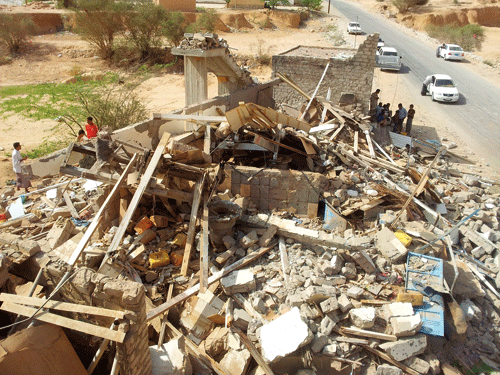
Yemen is not just a land of many problems — its sky has problems too. The receding annual rainfall from the clouds above has made way for another precipitant: missiles from remote-controlled American aircraft. The United States has been flying armed drones over Yemen since 2002, targeting Al Qaeda in the Arabian Peninsula (AQAP) and recently these strikes have increased dramatically. The Obama administration has authorized more airstrikes and drone attacks in the past two years than Bush did during his eight years in office. Far too often civilians are paying the price. In 2012 alone, US missiles killed at least 185 Yemenis in as many as 90 strikes.

Among the tactical changes of the Obama administration has been its “signature drones” policy, by which drone operators can engage targets based solely on “suspicious behavior” observed through telescopic cameras far above, rather than on hard intelligence gathered on the ground. In a country where, in remote areas, people carry guns like people in the West carry iPhones, this policy makes almost everyone a “legitimate target”. Consequently, the tragedies have increased.

US drones have killed hundreds of Yemeni men, women and children with no connection to AQAP, aid workers and even prominent leaders working at the behest of the US government in rural Yemen. American embassy cables released by Wikileaks revealed how former President Ali Abdullah Saleh had secretly offered the US political cover for the drone program, telling former Central Command General David Petraeus, “We’ll continue saying the bombs are ours, not yours.”

His successor, the current president, Abdu Rabu Mansour Hadi, has been far less discrete, publicly endorsing drone operations in late September on a visit to Washington praising their accuracy and technological advancement. Former opposition leaders, who once lambasted Saleh for allowing US drones to violate Yemen’s sovereign skies, have remained silent. Facing growing public outrage over the drone strikes, these leaders, especially from the Islah Muslim brotherhood in Yemen, are also pressuring their supporters to remain quiet as well.

President Hadi’s support for the drones has made him a darling of the US — the American ambassador said in a press conference that the US’ relationship with Hadi was even stronger than it was with Saleh and that America would be happy if he ran in the presidential elections again in 2014 — but to the average Yemeni, it makes their first freely elected president in decades look like an American puppet. Remember, a main catalyst for the uprising that overthrew Saleh was that he was accountable to Washington rather than his own people. Local opponents to Hadi are thus amassing a political, legal and moral war chest against the president.

Importantly, neither the Yemeni nor the American government has paid any type of compensation to the innocent victims of drone strikes, while AQAP has an extensive record of compensating the families of civilians inadvertently harmed during its operations. Indeed, AQAP has become an outlet for Yemenis bent on revenge after losing relatives to American missiles, making the drone program a crucial tool of AQAP’s recent recruitment drive, contrary to the loud denials of American security experts. It must be said that these “experts” rarely have a clue what is happening in Yemen given that they almost never travel beyond the perimeter of their five-star hotels in the capital, Sanaa. Were they to, they would see how many Yemenis recoil at even the words “American military” and how strong a patriarchal position Al Qaeda has built out of the drone program. It has learned that its war with America is a war of mistakes — the fewer you make, the more you win and drones are simply far more prone to mistakes than AQAP.  

In America, drones are a fascinating technology in a videogame war where US soldiers neither put themselves at risk nor feel the blood on their hands of those they kill. This has made American policy makers arrogant and overbearing when it comes to even discussing drones, an attitude that history will not treat kindly. Like the McNamara policy in Vietnam of counting enemy corpses as a metric of success, the US drone policy in Yemen will embody America’s moral erosion in our times.
 

Farea al-Muslimi is Executive’s Yemen correspondent
 

February 6, 2013 0 comments
0 FacebookTwitterPinterestEmail
The Buzz

Morning briefing: 6 Feb 2013

by Executive Staff February 6, 2013
written by Executive Staff

Economics

Lebanon needs to rethink its economic model after decades of setbacks that have affected its socio-economic stability, an International Labor Organization official said Tuesday.

More from The Daily Star


New signs of distress in Egypt's economy emerged Tuesday with the disclosure that foreign currency reserves – already at critically low levels – fell nearly 10 percent in just the last month as political turmoil flared anew on the streets.

More from Associated Press


The long frosty relations between Egypt and Iran entered a slow thaw yesterday after Mahmoud Ahmadinejad became the first Iranian president to visit Egypt since the 1979 revolution.

More from The National


Projects worth a combined $6.8bn (AED25bn) will boost solar power in the Middle East, claims the chairman of the inaugural Solar Middle East Conference, which opens in Dubai on 17 February.

More from Arabian Business


Saudi Arabia’s economy will more than treble to US$3 trillion by 2050, making it the 18th largest economy in the world, according to analyst PricewaterhouseCoopers.

More from Arabian Business


Companies

Microsoft, Marriott hotels and FedEx Express have again been rated the best companies to work for in the United Arab Emirates.

More from Executive Magazine


SANAD, a German fund for small and medium enterprises in the MENA region signed Tuesday a $20 million loan facility with Bank Audi aimed at expanding lending to small businesses in Lebanon.

More from The Daily Star


Banks in the United Arab Emirates will this year aim to repay capital placed with them at the height of the global financial crisis, with some turning to the bond market to avoid servicing expensive debt and risking a sudden “capital cliff” later on.

More from Reuters


Siemens has been awarded a $38 million contract by Qatar Steel to build a high-voltage substation at Qatar’s industrial city of Mesaieed, the German engineering conglomerate said on Tuesday.

More from Gulf Business


February 6, 2013 0 comments
0 FacebookTwitterPinterestEmail
Economics & PolicyGreat places to work 2013

The United Nationalities of Work

by Thomas Schellen February 5, 2013
written by Thomas Schellen

Hearing the rank and file in the companies on the Great Places to Work (GPTW) list talk about their approaches to life at work is a humbling and exciting experience. And contagious. 


From a numerical angle, the cumulative headcount of the 15 great workplaces in the United Arab Emirates does not seem humongous at all. According to the data provided by companies via their culture audits and passed on by GPTW, the total number of employees among the 15 organizations in the UAE comes to 12,644 souls. 


See also: Full, interactive 2013 Great Places to Work in the UAE list


That is a miniscule bunch, whether gaged against the estimated 7 million or so working-age expatriates who reside in the UAE, or measured against the close to 1.9 million strong cumulative global workforce of the 15, mostly multinational, companies that made the list. 


Constituting a little over 0.6 percent of the global workforces of the 15 companies, and less than 0.2 percent of the UAE population on basis of the available figures, being an employee in a great workplace in the UAE qualifies as an exceedingly rare privilege. 


Such dabbling in numbers and ratios, however, makes it even more shocking that every single individual in the 12,644 is a story and a message that is too vast to capture. I met about 40 of them and it is ridiculous to think that this could be enough to begin tracing the human reality of it all. 


But in a slight bit of redemption there are some saving threads that keep the entire story collection a little more manageable.


There is the human commonality. Within the face-to-face interviews Executive conducted, some self-interests were put into proportion. Money was never cited as the prime factor for making a workplace great. This is not implying that there was some bacterium of unhealthy self-denial or a virus of pretense going around. The women and men, young and old, verbose and less so, in the great workplaces saw remuneration as important but not as key. As one group of three interviewees agreed among each other, “If you are not paid well, you get depressed. But if you get paid very well and you don’t love the job, you will also get depressed. It has to fit together.”  


Qualifiers for what makes a great workplace in several cases were stated to be “the team”, with a strong common feel of valuing the “appreciation, support, and understanding” that characterizes a real community. Belonging was definitely a highly valued category, but rather than representing those on the lower rungs of companies, responses that emphasized belonging came from people at many different and often advanced levels of presumed social standing.  


Diversity, more diversity


Then there is the dimension of diversity of identities and aspirations. To name but a few examples, I have conversed with a young Syrian lady who has her family in Aleppo to think of and says her dream job will be one where she can “evolve, use my talents or skills whatever they may be and be happy”; a middle aged Hawaiian who aims to build schools and an Egyptian go-getter who likes challenges and wants to be his country’s second secretary general of the United Nations. 


Diversity of nationalities and cultures in the UAE workplace seeks its equal in any city. At General Electric Middle East, more than 50 nationalities are represented in the workforce. Ratios of internationalism are high among managers, mid-level employees and job starters. Many interviewees praised the multi-culturalism of their work environment, although it also emerged in the conversations that diversification can become a need in the generally multi-national workplace if a certain layer of a workforce is tilted toward one nationality to the point of creating barriers against outsiders. On the emotional issue of emiratization, which is so politically charged that GPTW is not likely to develop a list of best workplaces for Emiratis in the next few years, there can be not only the known difficulties of attracting nationals into the private sector but that Emirati citizens inversely can feel mono-culturally fenced in when working in the usual reservations of employment for nationals.


The diversity of the UAE workforce can indeed be a double-edged sword, commented Ehhsan Abdallah, senior practice consultant at the Gallup organization: “If you are able to harness the diversity that you have — and good managers are able to — and are able to hire people from an array of different [cultural and ethnic] backgrounds, the rewards are massive.


“However, if you are not able to harness it, you create a culture of disengaged teams and associates and what can happen is that the culture becomes very cliquey — you can be almost making ghettos in your workplace. In this scenario, the negative impact can be double for a company because instead of having one poor performer, the disengagement spreads and becomes toxic,” said Abdallah, an expert on behavioral economics. 


A kingdom for equality


GPTW awarded recognition for being top workplaces for women to four companies — THE One, DHL, Marriott and Paramount (the latter is not in the Top 15). There were advancements of workplace gender equality visible at these and other companies in the Top 15. Some were outright surprising, such as the sponsorship of a “Women in Logistics Middle East” organization that is breaking new ground for female participation in this industry which is far from a ‘conventional domain’ of career women. Female and male employees at THE One shared their experiences of equality at all levels of the company. Microsoft has a new top-level female executive in the region, and others, such as media company OMG, are continuing to press toward gender parity in their ranks.  


On the other hand, counter narrations of disadvantages for women and slow-going in implementing more equality and fairness also came up quite regularly in conversations with employees at great workplaces. Most of these experiences originated in the wider society of the UAE and not in the workplace, but there were also comments such as one by a young joiner in the UAE operation of a multinational who said, “If I look at our company here, we have no single woman in top management. There is definitely space for improvement. Europe is fighting to empower women, the US is fighting with the same dilemma, and here is even a step behind those.” 


C.S.R.’US 


The social engagement of GPTW companies is noticeably high and as such a common factor in the corporate identities of the high-trust employers. This prevalence of corporate responsibility is much more than a bonus for society or a sideline perk. 


As Monique Ritacca-Herena, senior vice president, human resources & chief human resources officer- Asia, Middle East & Africa at PepsiCo, told Executive, people increasingly want to work for companies who share their values: “The foundation of our business is built upon performance with purpose, which is the idea that the short and long-term, sustainable success of the company can be aligned to what is good for society. It is the strategy in which performance is driven by purpose and purpose enhances performance,” she explained. 


The beauty of it is that social investment is also contagious. Sitting around a table at THE One, store manager Clare Abad gave an example of how the engagement works for her: “I know that when we sell one more sofa, we earn one more brick for the school [in India].” 


Rear Spoiler 


Engaging in conversations with the people in the great places to work is an intense exercise of communication with far too many peaks. It is something like an interplanetary view of a mountain range — far too much information to facilitate a microscopic approach. 


In this sense, it is necessary to question the importance of ranking differences between the great places to work. From the non-statistical plane of human communication there are 15 best places to listen, learn, and find interesting people that are captured on the GPTW list; in an uncharted territory of many more great workplaces that are waiting to be discovered.  And all can be developed. 

February 5, 2013 0 comments
0 FacebookTwitterPinterestEmail
Economics & PolicyGreat places to work 2013

Dreaming on the job

by Thomas Schellen February 5, 2013
written by Thomas Schellen

Dreaming at work must be a universal trait. Whatever culture, whatever age, there are tales and traces left behind by people who dream of something while they are at work.  

See also: Full, interactive 2013 Great Places to Work in the UAE list


Some dreaming at work is catastrophic — inattention causing damage and destruction is a peril for every company and the society that it is embedded in. Other dreaming at work is perilous more on the personal level. Management is not always understanding of those who appear to goof off. 


The crux of all that dreaming, however, is what we can read from it, not in the sense of shamanic or Freudian interpretations but as signs telling us of engagement and disengagement. 


About one third of all employees are highly engaged, suggest surveys and workplace studies such as the 2012 Global Workforce Study by international consulting group Towers Watson. Another quarter of employees are actively disengaged people, making the two categories the largest employee groups in work cultures stretching from Scandinavia to the Gulf.  Research also says that companies with highly and sustainably engaged employees are far more productive than average companies. The question for an organization then is how to move from a mediocre fabric with few strands of high engagement, to a high collective level of engagement. 


The possibility of reaching this state seems to me dependent on the veracity of cultural evolutionism, whereby human ideas and characteristic behaviors undergo long-term and durable changes into new ideas and behaviors. 


As corporate evolutionism, this would make companies see their human capitals as their preeminent asset and the purpose of the enterprise as wellbeing instead of wealth, as another business brain trust, the Boston Consulting Group formulated last November. If impulses of cultural evolutionism shape corporate DNA, then this means that companies actually can abandon the predatory behaviors that ruled the past and adopt the upright walk of inspired and inspiring beings. If this whole idea holds water, then the great places to work of today are the pacesetters of future corporate behavior. To my mind, three points support this assumption: 1) The great places to work tend to maintain their status for some time; 2) Employees in great work environments represent a sample of humanity but align themselves extremely well with their work cultures; 3) Companies that stray from their corporate DNA can falter but can also recover. 


Not to be confused with quantitative verification, here are my current perceptions why I consider these three points to be at least workable as indicators for a viable hypothesis, if not more. 


The companies on the GPTW list in the United Arab Emirates are a diverse bunch by their fields of activity, their leadership and management patterns, and the economic and competitive environments in which they move. All exhibited a high degree of stability in their ability to be ranked as great places to work.


The employees of the great workplaces that I had a chance to meet in reviewing the GPTW process in 2012 and 2013 were highly diverse and yet all highly engaged. In both senior management and junior ranks, I had a chance to witness human behaviors that were in unity with the expectations that one has for a great workplace. 


A first-rate case for the third point, the importance of a company not betraying its DNA, presented itself when I read last month how Toyota Corporation in 2012 regained its place for the world’s top car deliveries. The critics were amazed. Among keys to the recovery were a return to two virtues that made Toyota great — total quality focus and listening more to the employees.


When reviewing great places to work, one can either see the distance between one’s own house of labor and the environment of a great workplace — or one can see the potentials for copying some morsels of successful corporate DNA and embark on splicing them into the own self or organization. 


The employees who I met at the GPTW list places in January 2013 without exception responded to one of my questions by sharing their exciting dreams of things they wanted to do. They were dreaming economic dreams, in the widest sense of contributing to the great scheme.   


What did this tell me? Great job stories can show us how we can make our workplaces great. It starts with dreaming of what we want to achieve and then making it happen. Never stop dreaming of improving thy work, and keep at it until ye all get there.


Thomas Schellen is Executive's MENA business editor

February 5, 2013 0 comments
0 FacebookTwitterPinterestEmail
Economics & PolicyGreat places to work 2013

Symbiosis at work

by David Robert February 5, 2013
written by David Robert

If anything can be said with accuracy and certainty about the corporation in this relatively young year, it is that the job of leading a company in 2013 is more demanding than it was in 2012. Decision makers every year are faced with an ever growing flow of information and increasing complexities in their markets but also within their organizations. 

See also: Full, interactive 2013 Great Places to Work in the UAE list

Technology has been the great enabler in creating the global village. Its speed of advancement and innovation has corporate leaders and managers aching and we all know how vital it is to keep up with tech. The financial bottom line is our quarterly and annual checkpoint to see how well companies respond to market needs. But when thinking about a company’s assets and liabilities, how much value is created by its people – and how much importance do decision makers place on their people? 

If we pause to think about this for a minute, we realize that companies all over the world are pressed for talent. As we see skill levels of employees expanding relentlessly, competition for the best and most promising young graduates drives more and more employers into intensive hiring campaigns. Is it then prudent for corporate leaders to view employees as a source of expense (payroll, benefits, etc.) or as a revenue-generating profit center? This is an important question for every company because the answer will ultimately define the organization’s corporate culture. 

Our 30 years of workplace research across the globe by the Great Place to Work (GPTW) Institute shows that investing in workplace culture and engaging employees as valuable profit centers yields definitive and tangible benefits. The geographic location, regional culture, size, or industry of the company does not matter. To be a great workplace requires a deep commitment to employees, a desire for continuous improvement and practice. In return for this investment, great workplaces experience lower voluntary staff turnover, higher-caliber job candidates and higher revenues and profit margins. GPTW case studies of top companies demonstrate further benefits such as lower inventory loss and an ability to move through periods of change more efficiently.

To answer the question of why great workplaces yield these types of benefits, a business leader needs only look at his or her personal relationships. Hopefully, most of us have at least one personal relationship or friendship that is based on a high degree of trust. These relationships stand out from others because there is a history of consistent behavior, a deep understanding of the other person and a willingness to support and protect the relationship. These types of relationships tend to be mutually beneficial, balanced and a source of comfort and confidence. 

In great workplaces, these types of relationships are quite common. The relationship between employees and the organization is built on a high degree of trust from day one. A great workplace seeks to understand its employees, to provide an environment of support, to accept employees for who they are, to consistently inspire employees and to genuinely appreciate the value they bring. In turn, employees seek to understand the company and its mission, engage in activities that emotionally bond them to their contribution, are more likely to give the organization the benefit of the doubt, are fierce advocates for the organization and universally perform at a higher level. Simply put, in organizations in which employees are inspired, encouraged to be themselves, given permission to be creative and are supported when taking risks, those employees dream bigger, work smarter and consistently deliver at a higher level. 

The essence of a great workplace can be summed up by the words of an employee at one of the UAE’s top companies. At a recent visit to the location where she works, I had a chance to sit down with her to talk about her workplace experience. “This is my family. I can be myself here and I see advancement opportunities for me. They (the company) believe in me so that makes me confident. I’m excited about my future.”


David Robert is Chief Executive of the Great Place to Work Institute Middle East

February 5, 2013 0 comments
0 FacebookTwitterPinterestEmail
  • 1
  • …
  • 282
  • 283
  • 284
  • 285
  • 286
  • …
  • 683

Latest Cover

About us

Since its first edition emerged on the newsstands in 1999, Executive Magazine has been dedicated to providing its readers with the most up-to-date local and regional business news. Executive is a monthly business magazine that offers readers in-depth analyses on the Lebanese world of commerce, covering all the major sectors – from banking, finance, and insurance to technology, tourism, hospitality, media, and retail.

  • Donate
  • Our Purpose
  • Contact Us

Sign up for our newsletter

    • Facebook
    • Twitter
    • Instagram
    • Linkedin
    • Youtube
    Executive Magazine
    • ISSUES
      • Current Issue
      • Past issues
    • BUSINESS
    • ECONOMICS & POLICY
    • OPINION
    • SPECIAL REPORTS
    • EXECUTIVE TALKS
    • MOVEMENTS
      • Change the image
      • Cannes lions
      • Transparency & accountability
      • ECONOMIC ROADMAP
      • Say No to Corruption
      • The Lebanon media development initiative
      • LPSN Policy Asks
      • Advocating the preservation of deposits
    • JOIN US
      • Join our movement
      • Attend our events
      • Receive updates
      • Connect with us
    • DONATE