• Donate
  • Our Purpose
  • Contact Us
Executive Magazine
  • ISSUES
    • Current Issue
    • Past issues
  • BUSINESS
  • ECONOMICS & POLICY
  • OPINION
  • SPECIAL REPORTS
  • EXECUTIVE TALKS
  • MOVEMENTS
    • Change the image
    • Cannes lions
    • Transparency & accountability
    • ECONOMIC ROADMAP
    • Say No to Corruption
    • The Lebanon media development initiative
    • LPSN Policy Asks
    • Advocating the preservation of deposits
  • JOIN US
    • Join our movement
    • Attend our events
    • Receive updates
    • Connect with us
  • DONATE
The Buzz

The mineral miracle

by Robert Biddle February 5, 2013
written by Robert Biddle


Nuclear power has garnered a bad reputation, particularly after the Fukushima disaster in 2011 devastated Japan. Meltdowns at the Three Mile Island power plant in the United States in 1979, and at Chernobyl, Ukraine in 1986, among others, helped tinge talk of uranium-based power generation with the hint of impending catastrophe.    

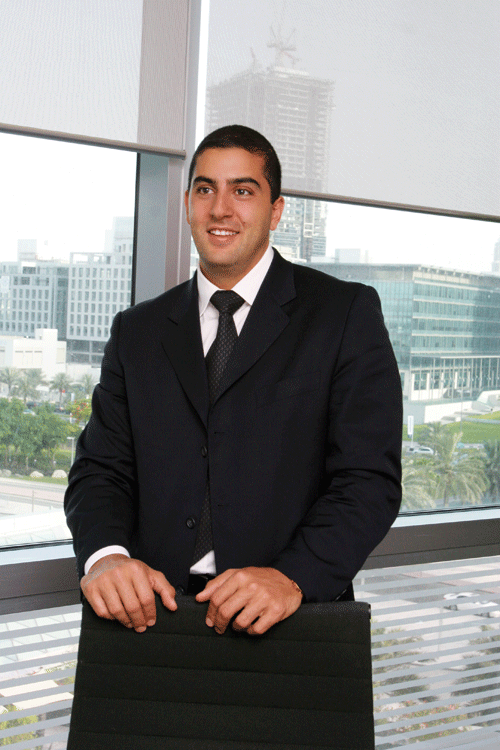
But what if there was a safer, more efficient alternative? At the TEDxBeirut conference in November, which consisted of a series of innovative and thought-provoking presentations, Salim Zwein argued that there is and its name is thorium. 

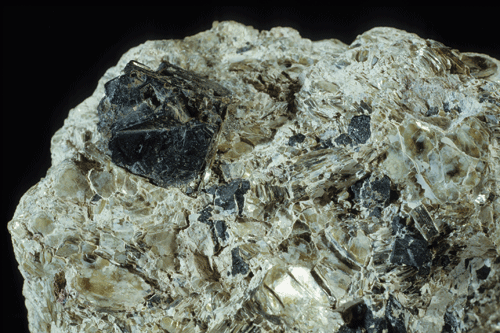
“Thorium is an element that you find virtually everywhere. In every cubic meter of soil you have one gram of thorium,” said the Lebanese quality-control consultant and engineer in his presentation. He added that the metal is so energy-concentrated that it would only take 6,600 tons to meet global energy needs annually. The World Nuclear Association estimates that there are roughly 4.4 million tons of thorium globally, about three times more abundant than uranium.

What makes this metal so attractive is that it could potentially solve the conventional problems associated with nuclear power — waste management, cost efficiency and safety — while offering a high-quality energy source.

Many like Zwein have argued that thorium is more efficient than uranium. “To produce one gigawatt of electricity, you need one ton of thorium, but 35 tons of uranium.” Plus, he adds, 83 percent of the waste that thorium generates will stabilize in 10 years, and the other 17 percent will stabilize in a few hundred years. Uranium, on the other hand, produces more radioactive waste — less than one percent of the uranium is used in the reactor to create energy — and it  takes 10,000 years to stabilize.

No bang for your buck

Of course, there is no discussion of nuclear energy without bringing up proliferation, or using nuclear power to make weapons. One of the benefits of thorium is that, while it is “not proliferation-proof”, it is significantly more difficult to produce bombs using a thorium-based fuel cycle, according to Zwein.

Thorium is not fissile, meaning that it cannot be used directly as an energy source. Rather, it is fertile and can be transmuted into what is essentially uranium-233, which is considered more efficient than the conventional uranium-235, using a fissile material. But a small uranium “driver” is required to start the thorium fuel cycle, and either the driver or the resulting uranium-233 can be used to make a bomb.

However, the transmutation of thorium also creates other isotopes of uranium, namely uranium-232. These particular isotopes “produce very high quantities of gamma rays,” says Zwein, explaining that this makes it prohibitively difficult to handle compared to traditional enriched uranium-235.

 Moreover, he adds, even if one were to extract the uranium from the reactor while avoiding the uranium-232, the high levels of radiation can still be detected by satellite. The International Atomic Energy Agency keeps a close watch on all nuclear reactors so proliferation at a thorium reactor would not go unnoticed. 

Another advantage thorium has is that its higher melting point of about 500 degrees Celsius means there is less of a chance of meltdown or nuclear disaster than with uranium. 

Why hasn’t it been used?

If thorium is such a wonder, one might ask, then why is it not already a household name in electricity generation? Thorium’s properties were discovered in the 1940s and tested in the 1960s, but it lost the nuclear race to uranium. 

“Scientists were more familiar with plutonium [and uranium] than thorium,” Zwein says. The molten salt reactor, another type of nuclear reactor that arguably would best utilize thorium in generating energy, was like “the strange kid in the room”. Instead, the light water reactor became the dominant choice — the same type of reactor that exploded at Chernobyl and Fukushima. After these catastrophes, Zwein remarks, there was a phobia attached to nuclear power and nobody wanted to finance it further. 

But today, thorium is enjoying something of a revival. In 2008, Kirk Sorenson, a former National Aeronautics and Space Association engineer, rediscovered the experiment from the 1960s plant in Oak Ridge, Wisconsin, and began advocating for the idea around the world. The project to rebuild the molten salt reactor ultimately needs funding for research and development.

Arguably, such a power source seems too good to be true and with such claims come skeptics. The National Nuclear Laboratory at the United Kingdom’s Department of Energy & Climate Change released a report in September that stated: “thorium has theoretical advantages regarding sustainability, reducing radio-toxicity and reducing proliferation risk. While there is some justification for these benefits, they are often overstated.” 

Yet the report still recommended that the UK invest in a small amount of research on thorium, given its rising global popularity. 

Indeed, China has been extremely interested in developing thorium reactors and at the beginning of January, allocated $350 million into the research and development process on thorium.

Prospects for Lebanon?

“I’m dreaming, but I want every single country in the world to participate in investing in this kind of energy,” Zwein says, and Lebanon is no exception. When asked about the likelihood of such a project being tackled in Lebanon, especially in light of the recent hype around the country’s potential billion-dollar offshore oil and gas reserves, he said: “Why not? With oil you have one golden ticket, with thorium you have another. Why not go with both?” 

Lebanon currently needs around 2.5 gigawatts of power to provide countrywide 24-hour electricity. A ton of thorium is thought to be capable of producing a gigawatt of power and depending on market fluctuation, costs between $50,000 to $80,000. The country’s annual fuel costs could be met for a fee of $125,000 to $200,000: significantly less than the $1.45 billion spent on oil by Électricité du Liban from January to August in 2012.

It will be difficult to uproot the stigmas attached to nuclear power in order to cultivate popularity for thorium-based energy. For that, more questions need to be answered, meaning considerable investments of time and money into thorium’s research and development. It may be years before the world sees the first thorium reactor, but it could be the answer to the growing energy crisis.

February 5, 2013 0 comments
0 FacebookTwitterPinterestEmail
Comment

Lebanon’s frigid, deadly Russian bride

by Moe Ali Nayel February 5, 2013
written by Moe Ali Nayel

It was a Saturday night when the temperature dropped. Beirut’s skies condensed with the thick gray clouds of January. Talk of wild weather started to snowball off the tongues of Beirutis. Bridges, buildings, highways and walls collapsed, floods reached peoples’ beds, blackouts affecting the whole country occurred and water disappeared from taps. Schools and universities closed their doors, grocery stores were left with empty shelves. At least five people died and the Minister of Interior advised citizens not to leave their houses.
No, this was not a tsunami, an earthquake, or the apocalypse; it was just another winter storm that hit with a bit more force this year. The storm, dubbed arous (bride) by the Lebanese, did not take Lebanon by surprise. This storm, which descended from Russia, was well forecasted; however, in the season of fabricating election laws Lebanese politicians paid little heed to the bride’s wedding march.

As usual it was the poor who paid the steepest price of the state’s ineptitude. 

See also: Why does Lebanon flood so badly?

Syrian refugees scattered across the northern slopes sank in pools and shivered in their tents. Refugees in Palestinian camps started burning their shoes for heating while Lebanese from Akkar to Hermel were stranded, besieged in their homes by a thick layer of snow. On the outskirts of Beirut, residents of the impoverished suburb Hay Al Sellom found a forgotten river, Al Ghadir, invading their living rooms; a result of negligence on the part of the Ministry of Energy and Water, which had failed to conduct adequate maintenance of river courses across the country.

The bride laid bare the inadequacies of a state that cannot offer the bare minimum of services to its citizens. But faster than the emergency services struggling to respond were the ministers, ducking accountability and accusing each other of a dereliction of duty. Some leaders blamed Mother Nature, while others, such as Transportation Minister Ghazi Aridi, simply denied reality: “I am content that the transportation ministry has done all rehabilitation work during the summer in anticipation of rainfall,” he told reporters on his way to a cabinet meeting. Energy and Water Minister Gebran Bassil, who let a dispute over salaries and pensions with workers at the state-run Électricité du Liban power company drag on for almost a year, tried to blame those workers, telling Agence France Presse: “There is a storm, and there is a problem in the grid. The electricity workers are on strike, and they’re not letting anyone fix the problem.”

Yet even while the bride was huffing and puffing, spreading her white dress over Lebanon, the debate amongst Lebanon’s politicians continued to be about the upcoming parliamentary elections in sunny June; the cumulative response to the storm by the Council of Ministers, Lebanon’s cabinet, was to eventually agree to allocate a paltry $2 million for relief.

Abu Mohammad, a 67-year-old taxi driver, said he resented the whole Lebanese political class and vowed that he would not vote in the coming elections. “In 2005, after Hariri died, I urged my wife and said we should vote, it’s an important time. In 2009 I told my wife: ‘Let’s go vote, they will pay us after we cast our votes.’ But this year no matter how many promises [politicians] make, or how much they pay per vote, we are not voting.”

Elie Hana, a 73-year-old taxi driver, who spoke to me from behind the wheel of his 1968 blue Mercedes, came to Beirut from Aley looking for passengers the day the sun finally shone and the storm receded. “I have been driving this taxi for more than 40 years and through that time I have witnessed stronger and colder storms than this Bride, but this was the first time I saw the country paralyzed. This has nothing to do with the storm, it has to do with a state that doesn’t respect or care about its own people. What happened to those $52 billion [the politicians borrowed] to build Lebanon? Our infrastructure is worse than ever — did they spend it all on building luxury apartments in the city center?”

With global climate change, weather patterns are quickly becoming harsher in Lebanon, with colder winters and hotter, dryer, summers, and yet Lebanon lacks the disaster management capacities to cope. Indeed, this Russian bride made clear that the state ministries and institutions are having an affair with negligence and corruption, leaving us out in the cold. In abusive relationships such as this, at some point we will have to ask for a divorce.
 

Moe Ali Nayel is a freelance journalist based in Beirut

February 5, 2013 0 comments
0 FacebookTwitterPinterestEmail
Economics & Policy

Where is the private sector?

by Zak Brophy February 5, 2013
written by Zak Brophy

The Higher Council for Privatization (HCP) was created nine years ago; since then there have been no successful privatization programs, and after six years the public-private partnership (PPP) law is still gathering dust in Parliament. Executive challenged the Secretary General, Ziad Hayek, to find out why his office still exists.  


Has the HCP failed in its mission?

We have not made any privatizations so in some way you could say we have failed. However, I would like to say that the HCP is not a corporate entity that has a legal identity of its own. It is a permanent ministerial committee, so it is not an entity that can succeed or not succeed in what it is doing. We are an arm of the Council of Ministers [Lebanon’s cabinet] that assists in carrying out their decisions regarding privatization. Some council ministers have been pro-privatization while others have been against.


Has the failure to develop independent and empowered regulatory bodies for the telecoms and energy sectors precluded previous or current privatization policies?

Yes. Having a regulatory authority is an important ingredient of the privatization process because as you privatize and move activities out of the purview of a particular ministry and pass those activities onto the private sector, an independent group of professionals needs to regulate that private sector involvement. 


Why haven’t these bodies been created and given the powers stipulated under Laws 431 and 462 that govern the telecommunications and energy sectors respectively?

Under Law 431 for telecommunications a regulator for the sector was created, the TRA [Telecommunication Regulatory Authority], yet no regulator was created for the energy sector or civil aviation. The reason this has not been done in the last two cases and has been done poorly in the first is that a conflict of interest exists between having an independent body and the person of the minister in each one of these ministries. 


The new plan from the telecoms ministry is to de-layer the sector, with a state-owned infrastructure and greater private sector involvement in the service operator and retail domains. Was your office involved at all in the adoption of this strategy?

No. I think it is unfortunate that ministers tend to devise strategies for the ministries that are not consistent with laws that have been passed by Parliament. 


Why is this plan not in accordance with the law?

Law 431 is very clear that you need to establish the TRA and afford it certain powers.  It also gives a clear path as to what should be done with regards to the development of a corporate entity called Liban Telecom that will own and operate the fixed line infrastructure and have a mobile license. This entity, Liban Telecom, is yet to be created and other policies about how to organize the sector are not consistent with 431 unless you create Liban Telecom.      


How would you describe the current status of the TRA?

It is a diminished version of what it should be. We don’t have a true regulator at this time. 


If the laws pertaining to the telecoms, electricity and aviation sectors are not being implemented, should they not just be consigned to the dustbin and new ones drawn up?

Those laws are not sacrosanct. They can be amended and likely should be amended.  But in essence they are good laws. Ministers have tried to avoid implementing them. The laws have caused the ministers plenty of headaches. I have lobbied ministers and will continue to do so, to stop them circumventing legislation. If they don’t like it they need to work with Parliament to amend the laws, but if they are not amended [the ministers] need to implement the legislation.


Is the PPP law going to pass?

We have been working on this for the past six years and a fourth version is now being discussed in Parliament. Meanwhile, the finance and budget committee has taken it up on its agenda and it is favored by the president, the prime minister and the speaker of the parliament.


Yet there is still much opposition. Is that primarily ideological or political?

It is for the same reason that privatization has been delayed, and that is that the ministers perceive the passing of any project that hands the delivery of any public service onto the private sector as a reduction of their own authority. They pay lip service to it but in reality they don’t want to have an actual partnership with the private sector. They want to give the private sector some kind of modified version of a management contract or an outsourcing contract upon which the minister has the ultimate say. 


Would PPP projects attract mainly native investors and funds from Lebanese bank deposits, or foreign investors?

I think it will in the first instance be Lebanese funds. The banks have around $140 billion in deposits and they are very interested in finding investment opportunities.  We have Lebanese entrepreneurs running PPP projects worldwide. So we have the entrepreneurs and the money but we don’t have the enabling framework to make that happen in a professional and transparent way in Lebanon.


In 2010 you said that within the power sector the transfer of the national utility from being a government to corporate entity was a cornerstone of your efforts. Are you closer to achieving this goal?

No. We don’t set the policy for the sector. It is the same problem of the minister not wanting to transfer authority or employing people and granting contracts. 


There are plenty of cases of PPPs failing to deliver better services, cheaper prices or more efficiency. With Lebanon’s record of poor transparency and corruption, shouldn’t widespread administrative reform come first?

PPP legislation has as one of its main objectives increased transparency and limits to the corruption you are talking about. Today in Lebanon you can do PPP projects, in fact we already have many. The problem is that they are all problematic. They are controversial and lack transparency. What we are trying to do is to remedy those problems.


The energy sector is in such a mess, can it really be considered a viable and attractive investment opportunity for the private sector?

I don’t think anyone is interested in a privatization of the power sector, not foreign or local investors. PPP is a different animal. Many people are interested in PPPs in the power sector. 


Everyone is talking about offshore oil and gas. Is the Petroleum Administration vulnerable to the same resistance and inertia as we have seen in the other sectors we have discussed?

I believe so because of the way in which it is set up. It is dependent on the minister, so as long as these decision makers are not independent we will have the same problems.  This is not a fully independent board. The government does not have the ability or the wherewithal to fully exploit this sector so there will be a huge involvement of the private sector and this is where my concern lies.

February 5, 2013 0 comments
0 FacebookTwitterPinterestEmail
The Buzz

Morning briefing: 5 Feb 2013

by Executive Staff February 5, 2013
written by Executive Staff

Kuwait granted Lebanon an $85 million loan on Monday to finance the upgrading and rehabilitation of the Zouk and Jiyyeh power plants as part of efforts to overhaul the ailing electricity sector.

More from The Daily Star


Egypt's finance minister has said the government will complete the revision of its economic reform plan this week and invite the International Monetary Fund to visit Egypt soon, the finance ministry said in a statement released on its website on Monday.

More from Reuters


Companies

Etihad Airways is close to taking a stake in India’s Jet Airways, the Abu Dhabi airline said on Monday after reporting a tripling in profits for last year.

More from Reuters


Emirates airline, which has multi-million dollar sponsorship deals with FIFA and Arsenal football club, inked a five-year partnership with Formula One motor racing on Tuesday, beginning this year.

More from The Daily Star


Qantas Airways, Australia's largest carrier, will fly seven Asian routes earlier in the day as a partnership with Emirates Airline gives it more scope to run flights at times that appeal to business-class passengers.

More from The National


Ahli United Bank is seeking regional acquisition targets after making a total profit of $212.9 million on the sale of a 29.4 percent stake in Qatar's Ahli Bank, Bahrain's largest lender said on Monday.

More from Reuters


Aramex plans to target more acquisitions in Asia and Africa, the logistics firm said on Monday, and reported a 15-per cent rise in quarterly profits.

More from Reuters


British commodity trading and finance investment firm DVK Group is currently in talks with a Qatari royal to launch a Shariah-compliant investment fund targeted at women and with a capital target of up to US$500m.

More from Arabian Business

February 5, 2013 0 comments
0 FacebookTwitterPinterestEmail
Society

Playing profits

by Nabila Rahhal February 4, 2013
written by Nabila Rahhal

Like most things in Lebanon, it all began with sectarianism. Or, more accurately, with one basketball team’s efforts to break free from the yoke of patronage. 

The year was 2001 — the Syrians were rounding up opposition activists in unprecedented numbers, the South was basking in its freedom and basketball was booming in Lebanon. Riding the crest of the B-ball wave was Hoops Club, an academy and sports center in Downtown Beirut, which took the opportunity to turn the sport’s new popularity into hard cash.

“To have our competitive team be self-sufficient, and not reliant on any political party, our academy had to be money making,” says Yassem sKanso, founder and president of Hoops Club and previously a player with the Sporting team. “It took time for Lebanon to adopt the idea of the business of sports because sports games were usually subsidized by political entities, and this discouraged the public to actively embrace it for fear of being labeled. Hoops was the first academy to challenge this political dominance and be apolitical,” explains Kanso.  Fast forward to 2013 and Hoops’ combination of public court-rental fees, corporate sponsorship, youth academy programs and gym membership fees has allowed them to expand to three locations. And they’re not alone.

With the apparent success of Hoops Club, sports centers caught the interest of athletic investors looking to capitalize on the growing demand for non-politically affiliated sports clubs in the country. One such center is SportsVille, owned by the Tahseen Khayat Group, located in the densely populated area of Sakiet El Janzeer where, for $90 per hour, a group of friends can rent a mini basketball or football field and work up a sweat. SportsVille’s courts are regularly full and clients usually have to book at least a week in advance.  

“There is clearly a [demand] for these facilities, but they have to be combined with academies, as profits from court rental alone are not that high,” says Martin Mugharbil, a former professional basketball player and the founder of Never Too Late basketball training academy, which has a partnership agreement with SportsVille. 

Youth academy programs take sports centers’ earning capacities to the next level. Monthly and potentially longer programs guarantee income and training schemes, and travel opportunities add value and build loyalty, an important factor given that courses are offered from ages four to 21. 

Advanced Soccer Academy (ASA), an example of such a successful academy, was founded by Raed Saddik and Rani Ghaziri. Both were coaches at the American Community School in Beirut but left when what started as a side business developed into one of the few dedicated football academies in the country with 500 members.

 ASA grew from an academy into court management at their Ansar branch. Like Hoops, their revenues essentially come from monthly membership fees, of approximately $160, training camps and sponsors. ASA also acts as an agent for its top players, sometimes letting them train free of charge, developing their talents and seeks to secure them contracts with European clubs. If such a contract is secured, ASA takes a 10 percent finder’s fee. “It is a profitable business and we easily returned our investments in a year and a half,” says Saddik. 

Hitting the big time

Now, plans for “the biggest sports complex in the Middle East” are being laid in Hazmieh. Champs, owned by famed basketball player Fadi el-Khatib and Nader al-Jaber, is set to open by early 2014 and will include seemingly every sports facility imaginable stretched over 20,000 square meters. 

An ambitious project, Khatib says Champs’ “state of the art professional facilities” will include an international spa franchise, a hotel for academies hosting teams from abroad, training camps during school vacations and a diner. Aishti’s Michel Salameh will have an outlet for his sports brands and will sponsor all outfits from the academy members’ uniforms to the trainers’ and other staff’s uniforms. 

The project will cost an estimated $8 million and both partners are confident of its success, despite the competition from existing facilities in Hazmieh. 

“We are at a better location and have more facilities under one roof, plus some entertainment in the form of the eatery outlets and bowling alleys. We’ve combined everything so that if you want to do anything sports-related, you will want to come to our place. Parents can come with their children; the child trains in football and the mother can be on the treadmill watching from above. It is for all ages and activities,” says Jaber. 

Khatib says membership fees will be reasonable. “We are going to compete and it will be affordable, without sacrificing the project and our investment,” says Khatib.  “You are going to get a better experience for the same price, so why not?” adds Jaber.

Why not indeed? For a country where the lack of available and convenient public sports spaces forces enthusiasts of all ages into paying gym memberships and court rental fees — or more commonly, giving up physical activity altogether — the increasing number of such facilities can only be a good sign of a healthier culture. 

As Hoops’ Kanso summarizes: “I always encourage such businesses because, at the end, we are promoting the culture of sports. I’m even happy with my competition as it ends up being a matter of who offers the best service; it creates a healthy competition and so sports become a culture and a habit in our country.” 


February 4, 2013 0 comments
0 FacebookTwitterPinterestEmail
Comment

Paving a new silk road

by Jihad Yazigi February 4, 2013
written by Jihad Yazigi

The signing of several economic agreements on January 16 between Iran and Syria confirmed the persistently strong strategic relations between the two countries. However, contrary to a widely held belief, and to the claims of the two governments, bilateral trade ties have historically been very limited. Hence, in 2010, according to Syrian government statistics, bilateral trade between Syria and Iran reached $312 million — this was lower than trade between America and Syria, despite various economic sanctions imposed by successive United States administrations on Damascus since at least the late 1970s. 

The trade balance was largely to the benefit of Iran, which exported $297 million in goods to its long-term ally and imported only $15 million from Syria. 

Bilateral investments are also paltry and do not exceed a handful of projects by Iranian investors in the Syrian manufacturing sector — mainly a petrochemical venture located south of Damascus and two car assembly plants based near Damascus and Homs. And while Syria joined the Greater Arab Free Trade Area in 2005 and signed a free trade agreement with Turkey as early as 2007, it signed a preferential trade agreement (PTA) with Iran only in 2011. 

It is difficult to comprehend why the two countries failed for so long to expand their ties but a number of objective factors can explain this. 

The two economies do not complement each other — the main export item for both countries is crude oil, while their main import items are oil derivatives, manufactured products and industrial equipment that are not produced in significant volumes; they do not have a contiguous border, as Iraq — which has had an extended period of poor relations with both countries — stands between them; there are no historical trade links comparable to the relations existing between Syria and Turkey from the Ottoman period or between Damascus and the Hejaz; since the Iranian revolution in 1979 the governments of the two countries have systematically prioritized their political and military ties at the expense of most other types of relations. 

In recent years, a number of events helped change this dynamic, including the fact that economic issues started to take on increasing importance in the decision-making process in Damascus.

Several large tenders by the Syrian government were awarded to Iranian contractors in the energy, manufacturing and water sectors. These have included the construction of several power plants by Iranian companies, including a 470 megawatt (MW) combined-cycle plant awarded last year to Mapna; a water sewage project in the region of Latakia awarded in 2009 to Mirab, an engineering firm, for an amount of $64 million; segments of a water irrigation scheme worth $31 million in the area of Aleppo awarded to contractor Sabir and; the construction of 10 grain silos awarded to Tosee Siloha, a civil engineering house.

Another important turning point has been a change in relations between the two countries and Iraq, which has stabilized to some extent and whose government is now close to the Iranian authorities. 

The improvement in ties with Baghdad helped both Syria and Iran envisage the PTA between them, and also to look at other ventures that use Iraqi territory. This has included, for instance, a quadripartite deal inked in early 2012 involving the sale of some 1,300 MW of electricity from Iran to Iraq, Syria and Lebanon. While Baghdad will receive 1,000 MW, Damascus and Beirut will share the balance.

More significant is the scheme to build a gas pipeline dubbed the “Islamic Pipeline”, a route that will carry gas from Iran’s South Pars Gas Field through Iraq and Syria. The 56-inch pipeline will be some 2,000 kilometers long and will have a daily capacity of 110 million cubic meters. The construction costs are estimated at between $2 billion and $2.5 billion. The long-term ambition of Tehran is to expand the pipeline in order to reach the crucial European market.

While the Syrian uprising brought back to the fore the security aspects in the relation between the two governments, it is likely that the potential “loss” of Syria, will not only be a major strategic setback for Iran but also mark a rapid end of promising economic opportunities that had just begun to unfold.


Jihad Yazigi is editor-in-chief of The Syria Report

February 4, 2013 0 comments
0 FacebookTwitterPinterestEmail
Business

Standing tall amid the fallen

by Maya Sioufi February 4, 2013
written by Maya Sioufi

Long gone are the days when the Middle East was the hot spot to set up shop, raise funds and invest in private companies with the promise of phenomenal returns. Before the global financial crisis struck in 2008, the region’s nascent private equity (PE) industry saw a boom in the number of firms while listings on Arab stock markets were oversubscribed to near insanity. Yet today, the PE industry’s easy pickings have all but vanished with the socio-political turmoil engulfing the Middle East. But even while the amount of capital raised in the region in recent years has fallen, one PE firm is still holding on to its bets: Saudi-based Amwal AlKhaleej.   

Through two funds totaling some $650 million, Amwal acquired stakes between 20 and 40 percent in Middle East companies across different sectors, with an average ticket size of $30 million. Fully deployed, its current portfolio includes stakes in 14 companies after completing 10 exits since its establishment in 2004, making it one of the oldest PE firms in the region. For the first fund, which started deploying capital in 2005 and with 85 percent of its exits completed, the rate of return on investment averages 30 percent. The second fund, which started deploying capital in 2008 — just before the global financial crisis — has completed three exits, out of a total of 11 investments, and still managed double-digit returns. 

Amwal AlKhaleej’s survival during the recent turbulent years boils down to two things, according to Chief Executive Fadi Arbid: no use of leverage to fund their investments and a very aggressive pricing strategy. “We’ve got a stingy reputation which in many ways I don’t mind,” he says. “I am protecting the money given to me; today if we are making money on our exits it’s because we bought cheap,” he adds. Multiples on investments in companies in the region have been decreasing in recent years as investors have been less keen on deploying capital in a rocky Middle East, meaning fund managers who paid generous sums for their initial investments are now hard pressed to find buyers for an exit, thus squeezing them to sell at a loss. 


The end of easy money

The business of Middle Eastern PE funds was booming prior to the global financial crisis. According to a report conducted by business school INSEAD and consulting firm Booz, the amount of money raised by PE funds went from $1 billion in 2004 to $10 billion in 2008, with around 100 funds ready to deploy capital in the Middle East. With fund terms averaging five years, the outlook for lucrative exit strategies at that point seemed whopping. And then the pain began. As the global financial crisis came closer to home, the completed PE transactions in the region fell from 73 in 2008 to 49 in 2009 — a year during which “committed funds in the region had declined to levels not seen since the end of the 1990s”, according to the report. Another blow came with the Arab uprisings, which left no industry unscathed. “Before [the financial crisis], when you sold to the public, [initial public offerings] used to be 20 to 30 times and sometimes even 100 times oversubscribed,” says Arbid. “Now if you get two to three times you are a champion.” A stark example of the hype for Middle Eastern IPOs prior to the financial crisis was the $435 million listing of the shares of the Dubai Financial Market, which was 300 times oversubscribed. 

Of Amwal AlKhaleej’s 10 exits, only two were completed on the public market; listing on an exchange is far more challenging than selling to a strategic buyer, since it hinges on abiding by strict regulatory requirements, on being scrutinized by the public market and on being subject to the volatility of both global and regional markets, but Arbid says that his investments are groomed for a public listing. He added that his firm turns investments into IPO candidates through the implementation of solid growth strategies that adhere to international corporate governance standards. 

With 30 percent of Amwal’s portfolio exposed to Egypt, if pressured to sell now, Arbid “would be uneasy and uncomfortable to find buyers at the right price for all the assets”, but with his fund spanning across 2016, he has the luxury to be able to wait. Another 40 percent of the portfolio is exposed to Saudi Arabia, 20 percent to the United Arab Emirates and the rest mostly to the Levant area.  The first fund had some exposure to Lebanon through investments in Bank Audi and Lebanese Canadian Bank, exiting in 2006 and 2007, respectively. Arbid says investment in these did very well, but Lebanon was avoided by the second fund due to its political uncertainty.

Third is a charm

As the second fund starts shaping up for exits, Arbid says he is assessing his options but he is optimistic, having completed three exits from the two funds in 2012, of which one was the highly publicized IPO of Saudi-based Al Tayyar Travel Group. After a failed attempt to list in 2009, Amwal’s team was “stubborn, rolled [its] sleeves up and eventually as a key shareholder strongly got involved in the listing process with the company and its advisors,” says Arbid. Six times oversubscribed, Al Tayyar’s listing raised $2.2 billion on the Saudi Stock Exchange in June 2012. “Tayyar makes us proud, not just because it was completed at an extremely high multiple but also because it is an investment that embodies a lot of our values. We took a sizable minority stake, we were on the board of the company, it embodies the value added we bring in, we undertook a lot of corporate finance actions and we worked a lot and hard to take it public,” adds Arbid. 

The form of a third fund is shaping up to look different than the previous two, and Arbid estimates that there is enough appetite to raise up to $350 million. With investors less keen on deploying capital into a blind pool of funds, whereby investors deploy capital and fund managers decide where it goes, the PE industry, as well as Arbid’s Amwal AlKhaleej, is shifting more to a deal-by-deal model, whereby investors deploy capital into a specific transaction.  

Another direction the Saudi PE firm is also shifting to is raising capital from Western institutional clients, not just regional investors, with a target to have 60 percent of the third fund’s capital from these institutions that provide “sticky money that is unemotional”, says Arbid. As their business is to invest, they could eventually become long-term partners of the PE firm if the investments do well. ‘Family money’ on the other hand “could decide to stop investing if their operating businesses are not doing well”, says Arbid. He adds that the remaining 40 percent will be raised from 10 to 15 regional investors, who are capable of bringing in deals  and “intelligence”. 

Funds and fundamentals

Going forward, the Middle East PE industry is slowly adapting to the new socio-political and economic realities taking shape across the region. In addition to Arbid’s expectation of seeing a move to a deal-to-deal model from a blind-pooled funds model, he anticipates that the region will have fewer PE firms of smaller sizes in the next five years, but with a larger mandate moving beyond PE into alternative space such as opportunistic investments.   When political stability returns to the region — and fingers are crossed that will occur in the near-term — the Middle East’s solid fundamentals should help the region’s private equity industry regain some of its pre-financial crisis momentum, according to Arbid. The strong growth potential, good demographics and upcoming structural reforms are motivation, he says, to continue on deploying capital as “private equity should mirror the fundamentals of the region”.  

February 4, 2013 0 comments
0 FacebookTwitterPinterestEmail
The Buzz

Morning briefing: 4 Feb 2013

by Executive Staff February 4, 2013
written by Executive Staff

Economics

Lebanon’s five listed banks posted an aggregate 2.4 percent growth in profits in 2012 standing at $1.01 billion, compared to $986 million a year earlier.

More from The Daily Star


Iran's foreign minister has welcomed the willingness of the United States to hold direct talks with Tehran in the standoff over its nuclear program.

More from The National


A Kuwaiti court sentenced a man to five years in prison on Sunday for insulting the emir on Twitter, a rights lawyer and news websites said.

More from Arabian Business


Lebanon's Union Coordination Committee, which groups public and private school teachers, has announced an open-ended strike will begin on February 19 should the government fail to implement the new salary scale.

More from The Daily Star


Companies

A $1.35 billion sale of shares in Iraqi mobile telephone firm Asiacell, the country's first major public offer of equity since the US-led invasion in 2003, was fully subscribed.

More from Reuters


Mercedes Benz recorded a 16.7 percent rise in sales in the Middle East and Levant in 2012 compared to 2011 and closed the year with 15 consecutive months of double digit growth, smashing a previous record set in 2008.

More from The National


Dana Gas, the Abu Dhabi-listed energy firm which defaulted on an Islamic bond, has said its full-year net profit for 2012 rose 20 percent on the back of higher oil prices and lower costs.

More from Arabian Business


British authorities are looking into an allegation Barclays lent Qatar money to invest in it as part of a rescue fundraising at the height of the 2008 financial crisis.

More from The National


Mashreq, one of the UAE's leading financial institutions, has reported a net profit of Dhs1.3bn for the year ended 31st December 2012, constituting a 60 percent increase on the previous year.

More from AME Info


February 4, 2013 0 comments
0 FacebookTwitterPinterestEmail
Editorial

The Lebanon we want in 2030

by Yasser Akkaoui February 1, 2013
written by Yasser Akkaoui

Despite the headline on this month’s cover, Lebanon could actually be a country powered by natural gas — a fuel that is more efficient and environmentally friendly than the heavy fuel oil and diesel currently used to generate our electricity, and, most importantly, gas would save our country the billions of dollars per year now spent on subsiding the state-owned power company. Lebanon could also be a country with a functioning public transportation network, with interconnected bus and railway lines that speed passengers to and from work daily, easing commuting times and the traffic gridlock throttling our streets.

Development of these, and other basic types of infrastructure such as proper telecommunications services, would unleash benefits we can hardly fathom at this moment — from increased productivity, to an increased quality of life, to a generally healthier society. And its not like these ideas haven’t been thought of before; serious consideration of converting the nation to gas power first came up in the early 1990s.

The roadblock to progress, time and again, has been political intransigence, the sectarian fractionalization and the endemic systems of patronage and corruption that our political leaders use to enrich themselves, divide the population and control each of their little fiefdoms of influence. Even when a minister does put forward progressive policy, it is inevitably scrapped by his successor who insists on reworking the scheme to benefit his own interests, thus killing any long-term continuity. Changing even this, however, is not beyond the realm of the possible — the only reason inept leaders are in power is because we voted for them, remember?

To begin to change, however, we first have to have an idea of where we are going. To this end, Executive is launching the Lebanon 2030 initiative. Throughout 2013 we will be looking to the future, examining how the pillars of a properly functioning state would take shape in this country, and how, within the realistic time frame of the next decade and a half, we could build them here.

While some may wallow in their cynicism and say Lebanon will always be the same, it is precisely that defeatism that becomes a self-fulfilling reality. If there is to be any chance for positive change, we must set the goals of what we want this country to look like — so let’s move forward.

February 1, 2013 0 comments
0 FacebookTwitterPinterestEmail
The Buzz

Morning briefing: 1 Feb 2013

by Executive Staff February 1, 2013
written by Executive Staff

Economics

Lebanon’s Energy and Water Minister has announced that the first electricity barge is expected to reach Lebanon by the end of February and promised to supply the country with 24 hours of electricity every day in 2015 if his plan is implemented on schedule.

More from The Daily Star


Leaders in Erbil and Baghdad are approaching what could be a decisive confrontation in their long-standing dispute over oil policy and autonomy: a legal battle over the Kurdistan Regional Government's (KRG) independent crude exports.

More from Iraq Oil Report


Saudi Arabia's tourism market was one of the world's fastest growing in 2012 despite a slump in the number of visitors to the Middle East, latest figures reveal.

More from Arabian Business


A leading private sector group called for key steps to shore up Lebanon’s economy, including building a second civilian airport, creating more free trade zones and clamping down on strikes by teachers and public workers.

More from The Daily Star


The recall of 1.2 million Toyota cars internationally will not affect Lebanese customers, the local distributor of the Japanese vehicle has said.

More from The Daily Star


Iran’s crude oil exports in December leapt to their highest level since European Union sanctions took effect last July, analysts and shipping sources said, as strong Chinese demand and tanker fleet expansion helped the OPEC member dodge sanctions.

More from Reuters


Companies

Emirates Airline, Dubai's flagship carrier, has launched a $750m 12-year amortising bond, arranging banks said.

More from Reuters


Qatar Holding has unveiled plans for a one billion euro ($1.35bn) investment in Sardinia's tourism sector, it has been reported.

More from Arabian Business


Global giant GE has signed a strategic agreement with the developers behind plans to build a $1bn medical city in Oman.

More from Arabian Business


Property prices in Dubai’s prime locations jumped by up to 30 per cent last year on the Emirate’s sound economic fundamentals, according to a latest report by Hamptons Mena.

More from Khaleej Times

February 1, 2013 0 comments
0 FacebookTwitterPinterestEmail
  • 1
  • …
  • 283
  • 284
  • 285
  • 286
  • 287
  • …
  • 683

Latest Cover

About us

Since its first edition emerged on the newsstands in 1999, Executive Magazine has been dedicated to providing its readers with the most up-to-date local and regional business news. Executive is a monthly business magazine that offers readers in-depth analyses on the Lebanese world of commerce, covering all the major sectors – from banking, finance, and insurance to technology, tourism, hospitality, media, and retail.

  • Donate
  • Our Purpose
  • Contact Us

Sign up for our newsletter

    • Facebook
    • Twitter
    • Instagram
    • Linkedin
    • Youtube
    Executive Magazine
    • ISSUES
      • Current Issue
      • Past issues
    • BUSINESS
    • ECONOMICS & POLICY
    • OPINION
    • SPECIAL REPORTS
    • EXECUTIVE TALKS
    • MOVEMENTS
      • Change the image
      • Cannes lions
      • Transparency & accountability
      • ECONOMIC ROADMAP
      • Say No to Corruption
      • The Lebanon media development initiative
      • LPSN Policy Asks
      • Advocating the preservation of deposits
    • JOIN US
      • Join our movement
      • Attend our events
      • Receive updates
      • Connect with us
    • DONATE