• Donate
  • Our Purpose
  • Contact Us
Executive Magazine
  • ISSUES
    • Current Issue
    • Past issues
  • BUSINESS
  • ECONOMICS & POLICY
  • OPINION
  • SPECIAL REPORTS
  • EXECUTIVE TALKS
  • MOVEMENTS
    • Change the image
    • Cannes lions
    • Transparency & accountability
    • ECONOMIC ROADMAP
    • Say No to Corruption
    • The Lebanon media development initiative
    • LPSN Policy Asks
    • Advocating the preservation of deposits
  • JOIN US
    • Join our movement
    • Attend our events
    • Receive updates
    • Connect with us
  • DONATE
Economics & Policy

Government’s failing grade

by Nabila Rahhal January 2, 2013
written by Nabila Rahhal

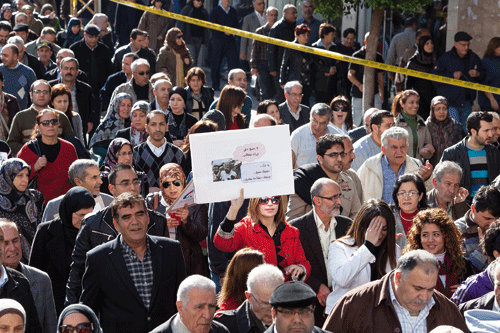
Since the beginning of the academic year, public school teachers, and many from private schools too, have abandoned their classes on an almost weekly basis and taken to the streets. The reason? They are demanding that the Council of Ministers, Lebanon’s cabinet, stop stalling and honor its promise to refer the new salary scale draft law to the parliament. At first glance this dispute may seem straightforward — in reality, the wide array of interests and possible impacts at play make for a class in politics and economic algebra all on their own.  

Principles of protest

Teachers striking for better wages has become a near annual occurrence in Lebanon, and, mainly due to their unified and organized front, their protests have met with some limited success. However, with the relentlessly rising cost of living eroding away these gains, it is never too long before the teachers head back to the streets. 

“Do you know that a teacher working full time for 20 years ends up, by law, with a basic salary of only $1,333 [per month]?!” said May Hamadeh, a private school teacher at a protest in October. “Many schools of course do pay you more than that, but when the law itself does not respect the teaching profession, it makes us teachers feel angry and reflects on our teaching and students.”

In September, with public school teachers threatening to leave students’ official examinations uncorrected, the cabinet agreed to a draft law approving a new and improved salary scale for all public sector employees, including public school teachers; private school teachers are also affected as their salaries are built on a similar pay scale. Since then, however, the cabinet has delayed referring the draft law to the parliament. The teachers have continued to take their anger to the streets and it is the students who have been caught in the middle — though teacher’s unions have promised they will make up for time lost striking. “I like it when we don’t have school because I get to sleep in but I don’t want to start coming on Saturdays or during vacations to make up for the lessons lost while our teachers were off,” says Rabih, a fourth grader at one of Ras Beirut’s public schools. “It’s not my fault… so why should I pay the price?"

See also: Lebanon's latest strike misses the point

A class in ineptitude

The cabinet’s reason to delay implementing the salary hike is that they simply don’t have the money to pay for the estimated $1.5 billion annual increase in wages for the 180,000 public sector employees affected by the law. “We cannot pay the salary increases all at once and we cannot approve the salary scale draft and send it to Parliament without revenues,” said Prime Minister Najib Mikati in a recent press conference at the Grand Serail. “The teacher unions are demanding that the draft be sent to Parliament without ensuring revenues and new taxes which is not realistic.”  

Government proposals for raising funds include increasing taxes on luxury items and customer deposits at banks, and to perhaps pay the wage increases in increments of four to five years; the government insists it will not raise taxes in a manner that will affect limited income families. 

The teachers’ unions have rejected the installments proposal, as it was not part of the agreement they had reached during meetings with the ministerial committees. The union insists that the government can pay the increases if they just cut down on excess spending, fought corruption and improved tax collection, especially from the Beirut Port. However, the central bank and private-sector economic associations have warned the government of the negative impact adopting this law would have on Lebanon’s already struggling economy. By adopting such a costly and contentious law without having thought through how it would be funded, the cabinet has caught itself between a rock and a hard place, with no escape in sight. 

Private vs public school impacts

Many private school directors have been watching this battle apprehensively, fearing the impact such a law would have on their schools’ budgets. “There are around 15 big private schools in the country that will not be affected by this law because they already have a high number of students, and because they cater to a caliber of parents who will not notice if their child’s tuition goes up a little bit more than usual,” notes Maurice Dabaghi, principal of Marjeyoun National college, explaining that even though the law will not impact all private schools equally, the government is acting as if it would. “Consideration should be given to the community the school is serving, as salaries and conditions in Beirut differ from those in remote areas of the country,” continues Dabaghi. 

Those big schools aside, the majority of privately owned schools in the country do indeed cater to students of middle income families who might be tempted to change schools should tuitions spike up significantly. “This year, I removed my eldest child from a private school here [in Marjeyoun] and enrolled him in the public school because we can’t afford the tuition for all three of my children — if tuitions increase again next year, I will have to put all my children in the public school,” complained Maha, one of the many indignant parents wondering what they might have to do with their children if the law passes. Knowing that tuition is a major consideration for many parents when picking a school for their child, this law has the potential to create an unhealthy situation where schools lower their tuition fees to compete with other schools, at the expense of quality education.      

How children will suffer

“The impact on schools can be measured by the ratio of students to teachers in each class,” explains Paul Owiess, principal of the National Evangelical School in Kfershima. “If a school has more than 40 students in each class, which some schools do, then the teacher’s salary can easily be paid from these students’ tuition. However, if you are a school that cares about the quality of education you are providing, [by having] no more than 20 students in each class, then this law will negatively impact you.”  

Those schools that don’t want to increase tuition might consider other ways of cutting costs, such as firing their longest serving — and therefore most highly paid — staff, but this might leave them vulnerable to lawsuits by those teachers. Instead, Owiess says that between a choice of two candidates, schools might start choosing the one with less years of service due to her lower salary rights, though the other might be better qualified. An equally undesirable way of cutting costs to help fund the increased salaries is halting all extracurricular activities, and only teaching core topics. 

As the fate of the law is kicked around from pillar to post it creates a pervading sense of insecurity for both school administrations and the teachers. It is of course the education of the students that suffers the most. The cabinet has made a mess of the whole process by trying to bungle through an ill-considered law. That cannot be changed, but it means they must now work with all the involved parties to find a solution so teachers and management can get on with the business of educating Lebanon’s youth. 

January 2, 2013 0 comments
0 FacebookTwitterPinterestEmail
Editorial

A better Lebanon

by Yasser Akkaoui January 1, 2013
written by Yasser Akkaoui

With many bitter moments from 2012 still lingering in our minds, it is time for sober reflection and realistic objectives to guide us in making resolutions for the New Year. While we want ‘realistic’ targets for 2013, it is hard not to feel that we are stumbling out of the starting gate.

For many of us, while we still love our country, it simply doesn’t seem to make sense any more. Since 2006 there has been a steady erosion in the belief that things can or will get better. When people believe that the quality of life in the place they live will only get worse — that their country will not offer them the opportunity to fulfill their goals any time soon — they inevitably leave in search of greener pastures.

It will not be easy, but what we really need to see in 2013 is some form of progress in Lebanon. It would be folly to demand the entirety of our politics and society to be reordered in the next 12 months, but give us something. Electricity all day long, water in our tanks throughout the year, Internet we can stream whole videos over, streams, beaches and nature areas unlittered with garbage — just give us something in Lebanon we can point to and say “this is better today than it was yesterday.”

Even if it is a long-term plan — such as a railway along the coast to alleviate rush-hour traffic, or a blueprint to remove the mountains of garbage blowing stench throughout our streets and into our living rooms — as long as there is implementation of a sensible, rational and achievable plan, then we have something to look forward to.

One good thing about the state of this country is there is no lack of opportunity for our policy makers to improve the situation — just do something. Perhaps there might even be politicians that step forward in the elections this year that offer us a choice of policy platforms, rather than the option of choosing our representatives based on their allegiance to Saudi Arabia, Iran or otherwise.

To extend the trends of 2012 into 2013 and maintain the status quo is to regress further. A message to our government for the New Year: give us reason to believe a better Lebanon is possible.

January 1, 2013 0 comments
0 FacebookTwitterPinterestEmail
Real Estate

Constructing the high life

by Sam Tarling January 1, 2013
written by Sam Tarling
In the shadow of Beirut's most famous building - the Rafik Hariri Mosque - the foundations for the high-rise, high-cost Plus Towers are being laid [Photo: Executive/Sam Tarling]
Executive was given exclusive access to explore the huge building site that will eventually become some of the country's most sought-after real estate [Photo: Executive/Sam Tarling]
A foreman and a laborer discuss the work. The site will eventually host two towers, both with a mixture of commercial and residential properties [Photo: Executive/Sam Tarling]
[Photo: Executive/Sam Tarling]
[Photo: Executive/Sam Tarling]
[Photo: Executive/Sam Tarling]
[Photo: Executive/Sam Tarling]
[Photo: Executive/Sam Tarling]
[Photo: Executive/Sam Tarling]
It is due to be completed in 2014, though the company would not say at what time during the year. Photo: Executive/Sam Tarling]

In the shadow of Beirut’s most famous building – the Rafik Hariri Mosque – the foundations for the high-rise, high-cost Plus Towers are being laid


January 1, 2013 0 comments
0 FacebookTwitterPinterestEmail
Comment

Adapting to democracy

by Eileen Byrne December 31, 2012
written by Eileen Byrne

Tunisia’s coalition government, its first to emerge from free and fair elections, has been on a steep learning curve through its first year in office. In the October 2011 vote for a constituent assembly, the Islamists of the Nahda (‘Renaissance’) party reaped the gains of their unflinching opposition to the deposed regime of Zine al-Abidine Ben Ali, but the credit this brought them is wearing thin as economic recovery lags. In the parliamentary and presidential elections planned for 2013, Nahda will struggle to repeat its resounding success of last year.

The party has had to adapt rapidly to operating in a democracy, and the Tunisian media, much of which remains in the same hands as before the revolution, has been eager to jump on its mistakes. One such mistake was Nahda leader Rachid Ghannouchi’s failure to put enough clear blue sky between his party and the extreme conservatism of certain radical Salafist preachers. 

Salafists have emerged as key drivers in a change in the climate for freedom of expression that troubles many non-religious Tunisians. On three occasions, starting with marches against a screening of the film Persepolis just before the 2011 election, Salafist activists were able to swing a surprisingly broad swathe of public opinion behind their stance that Islam was under attack and needed to be defended. Salafist preacher Abou Iyadh, leader of Tunisia’s own Ansar Ash-Sharia group, has attempted to exercise leverage outside party politics. Other Salafists have formed parties to present candidates in next year’s elections. Nahda hopes the elections will reveal that their true level of support is less than some media coverage has suggested. 

A turning point came in September, when a demonstration headed by Salafists degenerated into chaos and arson at the United States embassy, with four demonstrators killed. The damage inflicted on relations with the US was considerable but not irreparable. Washington is a leading backer of the project for a democratic and prosperous Tunisia; the Obama administration is betting that Tunisia can prove a success story to inspire other Arab countries. With Europe — Tunisia’s main export market and source of job-generating investment — wracked by crisis, outside financial aid will continue to be key to underpinning stability through 2013.

Nahda politicians have pledged a tightening of security, emphasizing that this will not be at the expense of fair trials and civil liberties for all Tunisians, including Salafists. Guaranteeing those rights will not be easy, with the country’s security services and judicial system still in upheaval, having been the main instruments of repression under Ben Ali. Two young men, who were detained after September’s demonstration at the US embassy, died in November after a two-month hungerstrike protesting their innocence and demanding to be set free.

Constituent assembly members have honed their political skills in the same parliamentary chamber once occupied by Ben Ali’s yes-men. The Islamist party has shown a willingness to compromise over the draft constitution, accepting a system in which a directly elected president will have certain executive powers. Nahda would have preferred executive powers concentrated in the office of prime minister.

The mooted June 30 date for the 2013 election may slip toward the autumn, as a new electoral commission is put in place to supervise a closely-fought vote. Nahda will seek to hold together its fragile alliance with the center-left Congress for the Republic and the Ettakatol party, which reassures both domestic and international audiences. Its main challenger will be a new party, Nida Tounes (‘Tunisian Call’), headed by last year’s interim prime minister, the 86-year-old Beji Caid Sebsi. Claiming to have “technocratic” expertise, Nida Tounes will seek to build an anti-Islamist bloc that includes figures who worked with Ben Ali but who are regarded as having avoided major corruption scandals. Chronic unemployment in the western and southern regions will, through next year, weigh heavily on the hopes and dreams of the younger generation. The grumble that “nothing has changed” will still be heard. 

Whatever government is in power will struggle to keep a lid on tensions, especially when these are stoked by political opponents. Both old and new political elites have, however, repeatedly deployed the language of “consensus-building” to bring the country back from the brink. The much-heralded process of transitional justice, addressing rights abuses of past decades, will proceed cautiously, and there may still be a certain lack of clarity on prosecutions for corruption.

Eileen Byrne reports from Tunis for the London-based Guardian and The Sunday Times


December 31, 2012 0 comments
0 FacebookTwitterPinterestEmail
Insurance

Walid Genadry

by Thomas Schellen December 25, 2012
written by Thomas Schellen

The task of insurance sector supervision in Lebanon is the domain of the Insurance Control Commission, a body attached to the Ministry of Economy and Trade. The ICC team is headed by Walid Genadry. In a chat with Executive, he spoke about some of his experiences and ambitions for the sector.

  • Has Lebanon seen major developments in insurance supervision in 2012?

If something has moved, it is subtle. It is background work and 2012 was a year that was rather dull for the insurance sector in Lebanon. We are a small team in insurance supervision and what I see is that the rate of controls has increased markedly. There have been competence developments and people are in high gear on a number of issues despite the impediments on the legal side.

  • How do you measure the performance and development of the ICC team?

It is the understanding and the speed at which they do things. I have signed between 200 and 250 letters back to the sector since we received the annual reports from companies in May/June. These letters were based on the findings of the team and constituted an unprecedented number of messages where we either asked companies to correct an inadequate financial situation, to correct statements in their financial reporting or, because from our analysis we could not be sure of the viability of their information, asked them to send us the proper information.

  • Can you specify issues that rank high on your agenda for 2013?

We are trying to nail down the issue of compulsory car insurance. It is about time that something gets done. The solution is partly technical and partly related to regulating market conduct. This part needs the help of the politicians.

  • Does your plan pertain to compulsory insurance of material damages?

No, to the present compulsory [insurance], which covers bodily injury. To my mind we must not introduce the material damages compulsory car insurance if the existing problems on the level of liability for bodily injuries are not solved.

  • What problems are we talking about? Issues related to the amounts of indemnities that were awarded?

You had several problems. Policies were not sold at the official price which led to cash underwriting and a monopoly of some [providers] and there were and are problems with lack of payment of claims. At some point there was cheating on the official vignettes with people escaping from taxation and reserving.

  • Doesn’t the new traffic safety law imply that mandatory coverage of motorists for material damages will be introduced?

Hopefully the new traffic safety law will help move things forward. It has a measure on compulsory insurance for material damages. This will not be automatic because the introduction of this compulsory line remains under the authority of the Ministry of Economy and Trade. But the new law will increase the pressure for this to be applied. So if we make sure that the problems with the present compulsory car insurance are solved, it will be easier to expand it to coverage of material damages.

You mentioned the data provided by insurance companies to the ICC. Has the quality of their financial reporting improved over the years?

It has been improving if I look at the last 10 years but we still spend a non-negligible amount of time and energy correcting what we receive. It is sad that companies still make mistakes on information they should be masters in.

  • But isn’t it true that it can be to their own detriment if companies do not know their financial data perfectly?

That is right, because a number of those errors are not intentional. In principle the data we need is the same data that the general manager of the company needs. We detect problems in their financials and that is not supposed to happen. Our objective is not to correct data. It is just to see if a company is healthy or not. If it is healthy, we leave it alone. But the general manager needs to know whether the company is healthy or not in order to steer it. So it is surprising that we still have a level of data quality that can be improved.

  • Last year the Arab Forum of Insurance Regulatory Commissions (AFIRC) met in Beirut to discuss greater collaboration. Has much happened since the 2011 meet?

AFIRC is a gathering of supervisors. We are working seriously but at the pace that we are capable of taking. We have a strategy that was developed in collaboration with [consulting firm] Booz & Co and it proposed about 18 initiatives. We had a quite intensive discussion for a year and a half and finally decided that we could not go as quickly as the strategy wanted. We have selected about one third of those initiatives for the next five years.

  • That means six initiatives? What are they focused on?

We are working on three long-term ones and three short-term ones. The direction that we are taking includes things like training of supervisors and self-assessment of supervisory authorities.  We also have a metrics project with the assistance of [professional services and accounting firm] PricewaterhouseCoopers where we are trying to put regional statistics together. We have had a training certificate developed by the Bahrain Institute of Banking and Finance.

  • How much demand from countries in the Middle East and North Africa region is there for competency building in insurance supervision?

We need a lot of competency building of supervisors in the MENA region. What I see is that you have a catch-22 problem in the sense that the more you need, the less you can absorb. Development takes time. Anything related to education and competence development is a slow process at best.

When you train a supervisor, you may not be in the optimal context. You may not be independent or have an independent budget. You don’t have mentors and you have difficulty  absorbing knowledge because you have to do your work on top of it. For a smart person it takes a lot of time to start mastering [supervision]: understanding, sniffing and catching mistakes. That is our role. If the referee doesn’t catch mistakes, he has a problem. So yes, we need a lot of training, and no, we are not advancing as quickly as we want but this is partly structural, and probably the lot of most developing jurisdictions.

  • Would your work be easier if the ICC was a standalone entity and not attached to a ministry?

Ideally, yes, and I insist on ideally because who gives you the independence? In order for independence, which is desirable, to be effective, it is first necessary that the politicians accept the idea sincerely. If they don’t, it is a worse solution than being attached to a ministry. When the minister respects you, he is in a position of defending you so that you can do your work.

  • Where do you position yourself as a person in carrying out your role as supervisor of the sector and leader of the ICC; are you an eternal optimist, a worrier, a motivator or a detached analyst?

I would say I am pragmatically passionate. Concretely, I believe in what I am doing.

  • So you don’t worry every night about the future of Lebanese insurance?

There is a cause to worry every night, but I do accept that reality has its place.

You said that perhaps the greatest compliment people gave you was in saying that you have done a lot with what legal tools you have at your disposal as supervisor. What is your message in that?

That people agree to the need for a new law. Some of the work you do goes by power of common sense and a certain moral authority. But moral authority has its limits and you need the power of the law. Let me put it in a very concrete way: I cannot in any way influence the implementation of governance. There is 0.000 percent possibility to introduce anything related to corporate governance with the present law, not even in an indirect way. I can do some improvements to market conduct because I am supposed to protect policy holders and even then it is not enough, but I can in no way establish a modern solvency system.

December 25, 2012 0 comments
0 FacebookTwitterPinterestEmail
Editorial

Hope, despite ourselves

by Yasser Akkaoui December 25, 2012
written by Yasser Akkaoui

The Lebanese were not shy to give voice to their discontent in 2012.

The grievances underlying these manifestations of public discontent were clear: declining purchasing power, the decrepit state of the country’s infrastructure and public institutions, and the seemingly inherent instability and criminality in the country.

Teachers and public sector workers chanted in the streets demanding a proper living wage, taxi and bus drivers blocked roads and major intersections decrying the cost of fuel, while protests struck both ends of the electricity network with customers outraged at the frequent blackouts and workers storming Électricité du Liban offices demanding fair pay and labor rights. Then there were the burning tires, the kidnappings, the protests against kidnappings, retaliatory kidnappings, and farmers and their families blocking the security services from eradicating cannabis crops.    

And that’s all aside from recurring armed clashes in Tripoli, along the borders and elsewhere; a brutal assassination; a sinking economy and soaring inflation; refugees flooding in from a civil war next door; a decimated  tourism season with its wide impact across business sectors, and increased international pressure on Lebanese banks from the United States, among a litany of other crises. In tandem, our entire political class — both government and opposition — utterly lost whatever moral authority to lead they had left, showing themselves corrupt to the core and inelastic to change.

Had we a crystal ball in January and known all this was in the pipe for the 12 months that were to come, we might have thrown up our hands and booked tickets abroad while writing Lebanon’s last will and testament.

And yet, here we still are. Lebanon persists. Lebanon survives. Because that is what the Lebanese do. And how? Because despite ourselves, despite the pain and the complaints, hope lives in our DNA. Even while businesses were closing this year, others were opening; the entrepreneurial space grew like at no other time in recent memory; developers continued to build around the country, not to sell tomorrow, but the day after — the better day they all say they see coming.

Next year will obviously have its challenges, but avenues are opening for potential progress — the new Capital Markets Authority, the public-private partnership law, maybe even a railroad up the coast.

And then there are the elections. Will the Lebanese finally give voice to their discontent at the ballot box? I’d like to be optimistic.  

December 25, 2012 0 comments
0 FacebookTwitterPinterestEmail
Business

The app that knows your number

by Joe Dyke December 20, 2012
written by Joe Dyke

Looking at the Lebanese Google trends data for 2012, one company’s growth shone above any other. In 2012 the number of people searching for Truecaller in Lebanon increased by 4,150 percent – the biggest rise of any term in the search engine, with the next highest growing by just 250 percent. Truecaller’s app has been the most downloaded on both iPhones and Android phones for much of the second half of the year.

The service Truecaller offers is remarkably simple. It allows people to log on and enter a number to find out the name of a caller. In effect it is a backwards phone book – rather than looking for the name and getting the number, you enter the number and find out the name. This service is incredibly useful in Lebanon, where the curse of the missed call from an unknown number is particularly common due to exorbitantly high calling costs.

The app’s huge success in the country has taken its inventors by surprise. Swede Alan Mamedi, who came up with the idea along with a friend after working for a company where he got a lot of missed calls from international numbers, says he had no idea it would take off in the Middle East.

“Our total marketing budget for the app last year for 3000 euros ($4,000). None of that went to the Middle East!” he jokes. “For some reason people started to use our application in Lebanon and now we have become popular in the whole region. Being a market leader in Lebanon is a big success.”

The app is hugely popular globally, with over 1 million global downloads a month, and aside from the Middle East is particularly popular in India and Scandinavia. “We try to remove the land borders and in most parts of the world there are no yellow pages, so our goal has been to be global,” Mamedi added.

Taking liberties?

Truecaller has, perhaps unsurprisingly given the nature of its business, been accused of an invasion of privacy. Show the app to someone for the first time by entering their number and watching their name appear and they often feel outraged.

The numbers are actually collected not through purchasing the data from service providers but in fact from crowdsourcing. When you download the application you are asked if you are willing to share your data, and if so it is uploaded onto the company’s servers.

Elie Fares, a Lebanese student and prominent blogger, has begun a campaign to encourage people to stop using the service. “The problem is not with the site, it’s with you giving them unlimited access to your contact list. Do you want a random company to have unlimited access to it? What if some random Lebanese company uses it to send spam messages?”

“When you are giving a random company access to your contacts – it is the same as saying ‘read my texts’,” he added.

Yet Mamedi believes such concerns are misplaced, pointing out that those opposed to their data being in the public domain can opt out. “When people find out that their number is available it is very important to make sure that our users understand that the information can only be retrieved by entering the phone number.”

“We made it possible for anyone to opt in with their names and phone numbers in their phonebook….If you opt in to share, when you opt out your data gets deleted. If you have friends that don’t want their number there they can delete it. If you want you can untag your whole family.” He adds that the company is taking security concerns into account and plans to introduce new features to protect data.

While there are also concerns about the safety of the company’s data in an era of increasingly powerful hackers, Mamedi said it would be all but impossible for someone to access their servers to get the information. “When it comes to security I cannot give you an example or explain it in technical terms but we have a very talented engineering team that have been working with this,” he added.

Carry on growing

No matter what, 2013 is likely to bring further growth for Truecaller. In September, the Venture Capitalist fund Open Ocean invested $1.3 million in the app, with Open’s Ralf Wahlsten explaining that they believed “Truecaller is positioned to be the leading service in the global mobile white pages industry.”

Mamedi said that whilst hoping to maintain their dominance in the Middle East and other markets, they are targeting Western Europe and the United States in 2013. Truecaller was previously banned in the United Kingdom due to privacy laws, but is now expanding rapidly.

The app is currently free and Mamedi says he intends to keep it that way, instead planning to make money from other revenue streams. “We will be introducing new features to monetize where users can buy extra services,” he said, refusing to be drawn further on the details.

He added that the company was investigating the possibility of adverts and “testing the ad market in one specific country to see if it works… [but] I don’t think it is the right way to go as we don’t want to ruin our application.”

December 20, 2012 1 comment
0 FacebookTwitterPinterestEmail
The Buzz

Morning briefing: 19 Dec 2012

by Executive Staff December 19, 2012
written by Executive Staff

Economics

Gold regained strength on Wednesday as a weaker US dollar spurred buying from jewellers, but prices were still within sight of an almost four-month low given signs of progress in US fiscal talks that dented bullion's safe-haven appeal.

More from Reuters


Brent futures edged up near $109 a barrel on Wednesday, tracking a rally in most other risk assets on expectations that a budget crisis in the United States will be resolved, saving the world's top oil consumer from slipping into recession.

More from Reuters


The World Bank has pledged $900 million to Iraq over the next four years to help it create jobs, build stronger institutions and improve social inclusion, the global development lender said.

More from Arabian Business


More than US$400bn of illicit cash flowed out of the six GCC countries between 2001 and 2010, according to a report by a global financial watchdog.

More from Arabian Business


Gasoline prices in Lebanon continued to increase slowly for the third week Wednesday, the weekly price update shows.

More from The Daily Star


Companies

Abu Dhabi-based hotelier Rotana is on track to open eight properties in the Middle East in 2013, according to pipeline data obtained by Hotelier Middle East.

More from Arabian Business


Zain Saudi extended the maturity of a 9 billion riyals ($2.40 billion) Islamic loan for another six weeks on Wednesday, the sixth time the loss-making telecom operator has deferred payment.

More from Arabian Business


Saudi Arabian Mining Co (Maaden), which has an aluminium joint venture with Alcoa, raised 9 billion riyals ($2.4 billion) through an Islamic loan facility to help fund its future projects, it has said.

More from Gulf Business

December 19, 2012 0 comments
0 FacebookTwitterPinterestEmail
The Buzz

What did the Lebanese Google in 2012?

by Joe Dyke December 19, 2012
written by Joe Dyke

In the past week Google released its Trends data for 2012, providing insights into what the world looked up over the course of a year. Unfortunately Google Trends in Lebanon is not as sophisticated as it is for larger markets such as the United States, so doing searches in categories is not possible. Nevertheless we have sought to dig out what the Lebanese searched for in 2012.


Politics

While Future Movement leader Saad Hariri may not have been in Lebanon much in 2012, this doesn’t appear to have stopped him dominating political discussion online. The head of the opposition, who left the country in early 2011, has been active on Twitter in the past year and his name was Googled more than any other politician's inside Lebanon. However this number must be qualified by the fact that many people Googling Hariri were in fact looking for the airport that bears the name of his late father and former Prime Minister Rafik Hariri.

Note: The graphs are relative comparisons, whereby 100 represents the peak search period and the rest are relative to that number. If you hover over the graphs, you can see the data more clearly.


However worldwide Hezbollah leader Hassan Nasrallah was a more popular search online, with spikes including when he was interviewed on Julian Assange’s Russian TV chat show in April.


Companies

Top 10

1. Facebook

2. Google

3. Youtube

4. Whatsapp

5. Hotmail

6. Samsung

7. Nokia

8. Blackberry

9. Yahoo

10. MTC


No surprises at the top of this list as Internet behemoth Facebook is again the most Googled search term in Lebanon in 2012, followed in the same order as in 2011 by Google and Youtube (which is owned by Google). The big riser, however, was Whatsapp – the free messaging service for smartphones – coming in fourth having been only the 11th most searched company in 2011.


Fastest increases

1. Truecaller (4,150%)

2. Viber (250%)

3. Whatsapp (170%)

4. Samsung (120%)

5. HTC (110%)

The rise of Truecaller in Lebanon has been incredibly steep and the inventor of the mobile and online app, which allows you to find out who called from an unknown number, has been discussing its success with Executive.


Banks

Lebanon's five largest banks in terms of assets are, in order, Bank Audi, Blom Bank, Byblos Bank, Fransabank and Bank Med and that order is replicated in Google searches with Audi far more searched for online than its rivals.

Countries

The Syria crisis posed the most immediate threat to Lebanon in 2012 but does not appear to have preoccupied people’s minds. France was in fact the most Googled country, followed by the USA and Syria.


Euro 2012

If Google is an indication of who the Lebanese were supporting at the European Football Championships, held in Ukraine and Poland in June, then it seems they were not rooting for the eventual winners Spain. Runners-up Italy were in fact the most Googled country during the final week of the tournament, followed by Germany and then Spain.


Celebrities

2012 was the year of Wael Kfoury, as the singer releashed his first album since 2007 and topped the charts with hits such as "Ya Dalli Ya Rouhi." His name was Googled more than other stars such as Elissa, Nancy Ajram and Haifa Wehbe – all of whom had successful years.


15 minutes of fame award

There can only be one winner for this: Myriam Klink. The "3ANTER" singer's hit about her pet pussy cat provoked one of the biggest temporary spikes of the year in Lebanese Google searches.

The first chart, without Klink, shows Haifa Wehbe, Nancy Ajram and Elissa as the top three Googled female artists overall, with the legendary Fairuz trailing a long way behind.  


 But the second graph, with Klink, shows that for a brief period in June she was all the Lebanese were looking up. This spike coincided with a satirical comedy show hosted by Nemr Abou Nassar in which he turned his wrath onto the blond singer's 'talents'.


December 19, 2012 0 comments
0 FacebookTwitterPinterestEmail
The Buzz

Morning briefing: 18 Dec 2012

by Executive Staff December 18, 2012
written by Executive Staff

Economics

Brent crude rose above US$108 a barrel on Tuesday as the outlook for oil demand improved on signs of progress in US talks to resolve a budget crisis that threatens to dip the world's top oil consumer into recession again.

More from Reuters


Saudi Arabia will review fuel prices and give its civil aviation body powers to allow fare increases as it struggles to move towards an open-skies policy, the country's information minister has said.

More from Arabian Business


Port of Beirut revenues increased 8.8 percent to reach $158.5 million in the first 11 months of 2012 from $145.7 million recorded a year earlier.

More from The Daily Star


Global oil supplies are plentiful and demand is good, while buyers and sellers are happy with current prices, top exporter Saudi Arabia's oil minister Ali Al-Naimi said on Tuesday.

More from The Daily Star


Companies

Saudi food and drink manufacturer Savola Group is to build a $106m distribution center in the Gulf kingdom.

More from Arabian Business


Banque Saudi Fransi, which is part-owned by Credit Agricole, will close a 1.9 billion riyals ($506.6 million) Lower Tier 2 Islamic bond issue on Tuesday, a source familiar with the matter said.

More from Gulf Business


Saudi Arabian Mining Co (Maaden), which has an aluminium joint venture with Alcoa, raised 9 billion riyals ($2.4 billion) through an Islamic loan facility to help fund its future projects, it said on Tuesday.

More from Reuters


Following a year marked by a sharp decline in tourism and an acute economic slowdown, Beirut’s Central District, known for its high-end stores and numerous restaurants, looks set to shed more of its outlets as businesses prepare to close their doors.

More from The Daily Star


Investcorp, a Bahrain-based alternative asset manager, said on Tuesday it acquired five real estate assets in the United States for around US$100m.

More from Arabian Business

December 18, 2012 0 comments
0 FacebookTwitterPinterestEmail
  • 1
  • …
  • 292
  • 293
  • 294
  • 295
  • 296
  • …
  • 696

Latest Cover

About us

Since its first edition emerged on the newsstands in 1999, Executive Magazine has been dedicated to providing its readers with the most up-to-date local and regional business news. Executive is a monthly business magazine that offers readers in-depth analyses on the Lebanese world of commerce, covering all the major sectors – from banking, finance, and insurance to technology, tourism, hospitality, media, and retail.

  • Donate
  • Our Purpose
  • Contact Us

Sign up for our newsletter

    • Facebook
    • Twitter
    • Instagram
    • Linkedin
    • Youtube
    Executive Magazine
    • ISSUES
      • Current Issue
      • Past issues
    • BUSINESS
    • ECONOMICS & POLICY
    • OPINION
    • SPECIAL REPORTS
    • EXECUTIVE TALKS
    • MOVEMENTS
      • Change the image
      • Cannes lions
      • Transparency & accountability
      • ECONOMIC ROADMAP
      • Say No to Corruption
      • The Lebanon media development initiative
      • LPSN Policy Asks
      • Advocating the preservation of deposits
    • JOIN US
      • Join our movement
      • Attend our events
      • Receive updates
      • Connect with us
    • DONATE