• Donate
  • Our Purpose
  • Contact Us
Executive Magazine
  • ISSUES
    • Current Issue
    • Past issues
  • BUSINESS
  • ECONOMICS & POLICY
  • OPINION
  • SPECIAL REPORTS
  • EXECUTIVE TALKS
  • MOVEMENTS
    • Change the image
    • Cannes lions
    • Transparency & accountability
    • ECONOMIC ROADMAP
    • Say No to Corruption
    • The Lebanon media development initiative
    • LPSN Policy Asks
    • Advocating the preservation of deposits
  • JOIN US
    • Join our movement
    • Attend our events
    • Receive updates
    • Connect with us
  • DONATE
Economics & PolicyUAE's Best Places to Work

Employers par Excellence

by Thomas Schellen February 3, 2012
written by Thomas Schellen

Everyone deserves a good job. Thus, a challenge is afoot in corporate Arabia and it mandates companies to improve from within: to become a great workplace. For the second time ever, ten companies in the United Arab Emirates are being recognized as the Top Companies to Work For in the UAE. 

The list of these exemplary workplaces has been researched and produced by the UAE arm of the global research and training firm the Great Place to Work Institute (GPTWI) in partnership with Executive.  The ten companies that emerged on top passed the scrutiny of a thorough employee satisfaction survey, called a Trust Index in GPTWI terminology, and a culture audit, or assessment of their corporate behavior. The trust index score, which is based on employee responses to a confidential survey, accounts for two thirds in the ranking of a company.   The 2012 list is led by big business names: FedEx Express followed by Microsoft Gulf, the hospitality group Marriott International in third.  Three homegrown companies also made the list, furniture retailer Total Home Experience (THE) One (5th), online employment market Bayt.com (8th), and the human resources firm Dulsco (9th).

As an annual benchmarking study, the GPTW list is only in its secondary function a ranking exercise and celebration of the best companies in achieving workplace excellence. The list’s primary function is to induce a process of continuous improvement in the value that workplaces provide to their employees and teams, to their owners and shareholders, and ultimately to their communities and societies on national and regional levels. 

“We want every company in the UAE and the GCC [Gulf Cooperation Council] to be a great place to work. Whether we will be able to achieve that in 20 years or 25 years or 100 years, I don’t know. But we are very aggressively going at it,” said Farrukh Kidwai, the chief executive officer of the GPTWI in the UAE. According to Kidwai, the institute has surveyed over 6000 companies and more than three million employees globally and lays claim to being “the world’s largest databank of information when it comes to great places to work.” 

This portfolio of information and insights was originally the work of an American journalist and has grown over the past 27 years to cover 45 countries today. The selection of companies for participation in the GPTWI survey and audit process is based on an approach akin to that of a ratings agency, whereby companies have to agree and actively register to be part of the process. This methodology may not necessarily be representative of the whole landscape of eligible employers, but the track record of the GPTW rankings in the US indicates that firms which enroll in the process early on after GPTWI’s entry into a market have a distinct edge in developing their workplace quality and enhancing their employee satisfaction, thus improving their human capital base with substantial benefits to profitability and bottom lines.  In the UAE the process is still in its infancy; the skew toward Dubai-based ventures suggests that awareness has yet to spread more toward Abu Dhabi and the other emirates. 

Besides recognizing the top 10 places to work in the UAE, the GPTWI published its first specialized list featuring three top companies to work for women and Emiratis just after Executive had completed interviews. The research into best companies for women and Emiratis is to be developed into full lists by GPTWI UAE. The organization is also working on geographic expansion of its presence and coverage to Saudi Arabia, Qatar, and other GCC countries. 

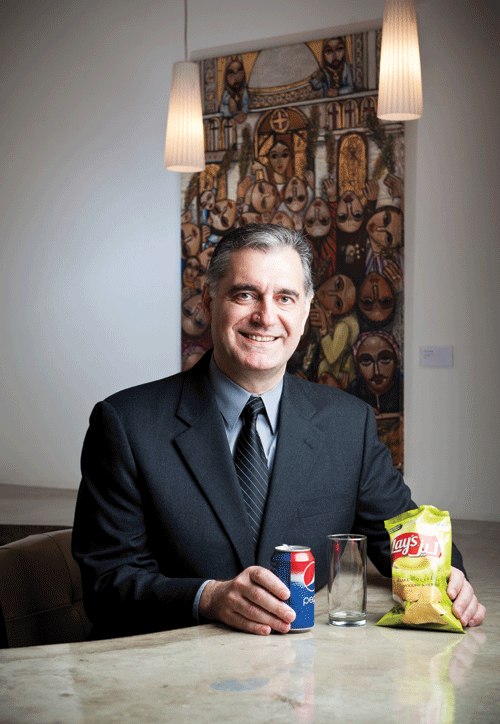
The top companies for women to work in the UAE are General Electric Middle East and North Africa, THE One, and Omnicom Media Group. GE and PepsiCo are the two companies highlighted for their appeal to Emiratis. 

Very notably in the 2012 results, employees have given their organizations substantially improved marks when compared with the average scores which the top ten companies reached in the trust index surveys a year earlier.

Congratulations are in order.

February 3, 2012 0 comments
0 FacebookTwitterPinterestEmail
Economics & PolicyUAE's Best Places to Work

EMC Corporation – Best workplace in the Cloud

by Thomas Schellen February 3, 2012
written by Thomas Schellen

Being cryptic and brief was quite common when naming startup companies in the United States 30 or 40 years ago. When two American engineers created a venture for production of computer memory boards in 1979, they combined their initials and a third letter into EMC Corporation, garnished it with a visual reference to Einstein’s relativity formula and grew it into a specialist information technology (IT) company under a cloak of mild obscurity, known best among true nerds and corporate IT managers.   

Today, the company boasts $20 billion in consolidated revenue with double-digit growth in 2011 driven by demand for its data storage, information management and security and cloud computing products. It has 48,500 employees worldwide and spent 11 percent of last year’s consolidated revenue on research and development, according to results announced last month.    

In 1999, EMC set up its first office in the Middle East in the United Arab Emirates with a tiny team and has grown to about 550 employees in 17 offices around the region, plus 250 to 300 engineers based in Cairo, says Wael el-Nadi, the EMC technology solutions director for Turkey, Emerging Africa and the Middle East. 

Aspects that impressed the Great Place to Work Institute in the EMC culture audit were the company’s initiatives and readiness to exceed legal requirements in developing a caring culture, granting time off for paternity and marriage as well as compassionate leave and extended holiday leaves. 

As Nadi describes it to Executive, the spirit motivating EMC’s care of its employees is one of mutuality. The firm is responsive to people’s requests for time off whenever that is needed and goes beyond the mandates of the UAE labor law in providing extra vacation during the Eid periods and in special situations, because “on the other side of the coin we expect our employees to work harder than the standard.”

The reason why EMC’s Dubai-based organization participated in the 2012 GPTW list process was a sense of obligation to staff.  “We believe we owe this to the employees, because we are a great place to work and we believe it is good to share the success,” Nadi explains. 

Success is perhaps the biggest driver in making the UAE and regional teams proud of what they do and binding them to the company — according to Nadi, the operation is the highest-growth EMC office in percentage terms worldwide. “This by itself makes the office attractive because people join a successful team.”

He cites EMC’s very low employee turnover as indicative of pride and loyalty: “It is part of the ego of a normal individual to be proud of it if you work for a good company.” In corporation-wide internal employee feedback, the regional organization usually gets strong marks on vision and leadership, he adds. “Management is accessible and easy to approach and one can raise any concern and so on; thus we score very high when it comes to leadership and vision. When it comes to rewards, here in this region we know that we are not the highest but also not the lowest.”

In pursuit of its human capital growth plans, EMC has recently set up an undergraduate curriculum with universities in the UAE which the company expects will unleash much potential for local recruitment. This program ties in with an “associate program” that grooms graduates with degrees in disciplines such as computer engineering and business administration for management roles. Leadership training for high-potential employees in a joint program with EMC’s European division is another part of the formula. 

EMC engages in a variety of corporate citizenship activities and has implemented corporate social responsibility programs in Pakistan, Egypt, and the UAE. 

Nadi tells Executive of strong territorial expansion that has been managed from the regional office in Dubai and he is highly confident that the organization based here will increasingly contribute to global results. At present, the regional organization keeps some 4,000 people, including employees and their dependents, in bread and roses. He says, “We consider this our big family and this is a big responsibility. That is why we always say that we have to maintain our success.”

February 3, 2012 0 comments
0 FacebookTwitterPinterestEmail
Economics & PolicyUAE's Best Places to Work

Dulsco – It started on the docks

by Thomas Schellen February 3, 2012
written by Thomas Schellen

Dulsco, the Dubai-based provider of human resources and waste management services, is the largest and oldest local company in the Top Companies to Work for in the United Arab Emirates, and it has succeeded not only to make the Great Places To Work (GPTW) list for the second year running but also improved its standing in the list from 2011. 

Acting behind the scenes as a quasi-invisible human resources back office to a wide range of enterprises, the company provides manpower support to industries that are essential for the UAE’s economic performance, such as transport and logistics and also in sectors that are core to the international attractiveness of the Emirates, such as event organizers and hospitality operators. Its staff profiles range from drivers and machinery operators to clerical workers and recruitment consultants. In the area of waste management, the company provides general and specialized cleaning, collection and related services as well as low-tech and high-tech equipment. 

As a privately held company, it does not publish results and the primary testimonies to its business acumen are its record of 77 years of continuous operations and its staff size of more than 5,300, approximately two thirds of which are part of the Human Resources division. The company has a joint-venture operation for manpower and waste management services in Qatar and dispatches roving staff to safety-tested locations and sites on specific projects and vessels beyond the borders of the Gulf Cooperation Council. Homegrown and without the human capital development processes and resources that a multinational firm or foreign corporate parents can deliver to their UAE units, Dulsco invested itself in the GPTW process from its internal resources.

At the core of any business is the human being. Due to the nature of the company’s activity with many physically demanding work roles and occupations, caring for its employees means for Dulsco to care for the safety and wellbeing of a mainly expatriate, male workforce.  

Incentive to care

“If you don’t invest in your employee, the employee will not care about his work. When, however, you plan a career for him and take care of safety and provide him with help and all that comes with it, you are transparent to him. When everything is clear in this way, he will be motivated to work for such a company,” Dulsco Chairman Abdul Aziz Mohammad Khan Abdulla tells Executive. 

As he conveys the Dulsco story, it becomes evident that the tradition of caring goes back to the company’s formation with stevedoring services. It was years before port facilities were created, and so ships would load and unload at an anchorage. It was also a long time until insurance companies would start offering their services. From those early days on, the company made it a policy that a worker who was injured or unable to work will get paid until he is healthy and able to work again.  

“So when the ports were built and insurance was introduced, we were way ahead of the other companies in providing safety and benefits as part of the corporate work policies,” Abdul Aziz says. 

People before profits

The practice was applied throughout the company’s growth. During the war in Iraq, there were inquiries to send crews to work at an oil loading terminal outside of the war zone with the promise of substantial premiums added to the normal wages, but Dulsco insisted firstly on the security of its employees and did not outsource the workforce. According to Abdul Aziz, “It is not just about money. It is safety first; this is what we believe in and we value human life more than money.” 

In its appraisal, the GPTWI 2012 Culture Audit commends Dulsco for its commitment to communications and active listening to employees. The report highlights the company’s facilities for two-way and down-up communication between employees and management, which include an open-door and ‘open office’ model, plus suggestion boxes in every location and department. 

Other Dulsco assets in being a great place to work for its employees include quality housing, sports facilities and a clinic as well as soft assets like celebratory and entertainment events that are tailored to the hearts of the employee base. “Don’t forget that these people are deprived of being with their families for two years and so you need to create the ‘home-style’ atmosphere, have functions and entertainment,” Abdul Aziz explains and sums the Dulsco culture up in saying, “We run this business as a family business.”

February 3, 2012 0 comments
0 FacebookTwitterPinterestEmail
Economics & PolicyUAE's Best Places to Work

Bayt.com – From the website to the workplace

by Thomas Schellen February 3, 2012
written by Thomas Schellen

Rooted with one leg in technology and with one leg in services, Bayt.com stands with a well-established reputation as a leading authority in the region on all questions related to jobs. The company’s core activity is the provision of an internet-based marketplace connecting global job seekers and Middle East-based employers. The company has also leveraged its wealth in interaction with job seekers into an auxiliary career services business and into research activities.

Revenue generation at Bayt.com is based on fees that employers pay for posting job offers. But as the company does not collect fees for employment agreements emanating from usage of their site, Bayt.com cannot provide information on the number of contracts reached on the marketplace each year. However, the number of registered users is reported to be above 7 million and growing and the number of organizations that post employment offers is cited as 40,000.

There is money in the employment marketplace for Bayt.com and the firm has reached profitability within a relatively short time from its creation in 1998, according to chief executive Rabea Ataya. Yet it nurtures an approach to profits that differs from most companies. 

Every year Bayt.com sets a profitability target which is kept at a ‘low-level’; any profit exceeding the targeted margin will be reinvested into the team, Ataya tells Executive. “The company is willing to trade off profitability to achieve gains in how recognized, respected, and admired it is. We are far more focused on touching people’s lives than we are on profitability,” he says.

The organization’s employee-centric culture is cited by the Great Place to Work Institute (GPTWI) as an outstanding feature in the culture audit evaluation for the 2012 Best Companies to work for in the UAE list. As an example, GPTWI mentions daily training sessions prepared by team members and shared across the company’s locations. 

Based on the trust-index survey responses of Bayt.com employees and GPTWI’s culture audit, Bayt.com retained the same position in the 2012 and 2011 best companies lists. For Ataya, the repeated success in the GPTW process is “one of those feathers in our cap that we value with the greatest amount of pride,” he beams. 

Every person joining the Bayt.com team is tuned in to the company’s vision, which Ataya says is “about trying to build a Middle Eastern institution that is globally recognized and respected; and the way we hope to build that is by empowering people to lead better lives.”

The participation in the first GPTW process helped the company in understanding areas in which Bayt.com could further develop its strengths in 2011 and remedy weaknesses that it was not previously aware of. 

Gaps between responses by managers and junior employees to some trust index questions showed that while managers were well aware of the organization’s values and focus on maximizing Bayt.com’s role in improving people’s lives while maintaining profitability, employees were not made equally aware of these values and approaches. As one of the results of the GPTW participation, Bayt.com management increased efforts to enhance internal communications and explain these approaches more deeply.  

In other aspects of its employee focus, Bayt.com supports wellness-orientated lifestyles among its team members through initiatives such as providing baskets of fresh fruit in all pantries. Other sponsored activities throughout the year include team sports and lunch sessions in which the company invites speakers to address “topics that relate to improving people’s general lifestyle and quality of living,” Ataya says.

Ataya considers very steep hierarchical structures to be a hinderance to forming creative environments. Based on the realization of how important his sense of freedom while at work is for his own wellbeing, he made it a priority to give people in the organization the chance to replicate the same experience in their own working lives, saying: “The single most important thing that I can impart on the organization is letting people have that freedom.”

Alignment with the culture is a high priority in selecting employees and Ataya is confident that most Bayt.com workers are “seeking to live toward realizing our values. In all relationships with clients and employees and job seekers, we try to leave a positive impact on their lives.”

February 3, 2012 0 comments
0 FacebookTwitterPinterestEmail
Business

Healthy returns in an ailing society

by Rayya Salem February 3, 2012
written by Rayya Salem

Despite billions of petrodollars spent on healthcare in Saudi Arabia, the kingdom’s targets for healthcare service have not been met in recent years. With the government’s push to include more private investment in the field, and Saudi Arabia’s burgeoning demand for medical services in a country that has high rates of diabetes and other ‘lifestyle’ diseases, the kingdom may have the potential to offer the highest returns in the Gulf Cooperation Council to those who can build and operate cost-effective hospitals and medical networks. Thus, models are now emerging in this market — traditionally seen as almost impenetrable — that many are suggesting will offer substantial returns for investors without skimping on quality healthcare.

“Any successful [private healthcare] project which is looking to expand across the GCC should consider a joint venture approach with an experienced partner on the ground,” wrote Mohammed al-Qahtany, chief executive officer, Al Aman Investment of Kuwait, in a 2009 report by Ithmar Capital titled ‘Meeting the GCC Healthcare Challenge 2050’. “This ensures both local support and at the same time enables the project to benefit from the accumulated experience of the organization as a whole. Joint ventures have a successful track record, and this is the way to move forward.” It seems some major investors took notice. 

The doctor strikes a deal

Dr. Sultan Bahabri founded and served as CEO of the 894-bed King Faisal Specialist Hospital in Riyadh; now as chairman of the Riyadh-based Ebram Investments, he has formed a joint venture with the new Beirut-based Rizk Red House Healthcare (RRHH) to develop a chain of 10 specialty hospitals throughout different cities in Saudi Arabia over the next eight to 10 years. The $1.35 billion project was announced in December 2011 after Red House chairman Mazen Beaini, and Bahabri, decided on a strategic vision that would require exceptional medical operating experience. Beaini then looked to Sami Rizk, the former general manager of Ashrafieh’s Rizk Hospital, as the man for the job, and RRHH was formed as a partnership. It is not hard to see why the trio has come together. 

The Saudi government has long planned to transition healthcare from the public to private sector. However, it has been slow to do so and continues to buoy the majority of the industry, as most estimates put government expenditure at more than two-thirds of total healthcare spending. As part of a plan to increase the profile of healthcare in the country, the government announced that an extra-budgetary spending of $18 billion will be allocated to healthcare and social services under a five year plan, begun last May. As part of the initiative, 120 healthcare centers and hospitals will be built and four expanded. 

To reach the target of 3.5 hospital beds per 1000 people by 2014, the kingdom will need to add more than 41,600 beds to its total of 55,000, as of last year. But so far the private sector has been hesitant to make bold moves, as the nature of the capital-intensive industry requires many years before significant returns are seen. 

Bahabri points out that returns for healthcare providers are around 6 to 8 percent worldwide, “but in our region it is about 10 to 12 percent.” In the last three years, he says, some private groups have seen returns of 22 to 25 percent, mainly because governments started to buy those services, a trend that will likely continue. Globally, revenue streams are differentiated according to each medical specialty. For example, diagnostic centers tend to provide exceptionally high returns compared to other domains. “Some specialties make [profit] after three years of operation; [for] some it takes eight years to make money back,” says Rizk.

Saudi Arabia’s health ministry still owns and operates more than 60 percent of hospital beds in the kingdom, but even so, a recent report by management consultants Booz & Co noted that: “many private companies are either majority owned by the government or have government officials on their board in the GCC — private investors will be wary of going head-to-head with such companies.” 

Another reason private sector investment has not surged is because regulation is nascent, with the government announcing in 2010 that it would set up an authority to track private facilities.

Lifting the lid

In March of 2011, King Abdullah issued a number of royal decrees to encourage foreign private investment in healthcare, in which the cap on loans to private hospitals rose from SR50 million ($13.3 million) to SR200 million ($53.3 million).

In fact, though both Ebram and Red House had been doing their own independent research on the Saudi healthcare market, it was not until King Abdullah’s initiatives were announced that the two got in touch. “As a Lebanese company headquartered in Beirut, we were motivated because of the foreign investment incentive,” said Beaini. “Now we have access to government authorities and groups like [Saudi] social security which has billions to invest.”

Mandatory healthcare insurance, which has been an obligation for the private sector since 2009, “will ultimately apply to all Saudi national employees as well,” according to a report on the Saudi healthcare industry by the National Commercial Bank, one of the country’s largest lenders. As of today, an estimated 20 to 30 percent of Saudis have voluntary health insurance according to Bahabri.

As such, the joint venture plans to construct hospitals in cities like Riyadh, Jeddah, Khobar and other areas outside major population centers. “Al Kharj, close to Riyadh, doesn’t even have one [civilian] hospital. All these areas already have infrastructure so we don’t need to build,” says Beaini, who insists that people should not have to come to Riyadh and Jeddah for quality care. Already, real estate consultants Colliers International have completed a feasibility study for the first hospital in Riyadh in November 2011 and will decide with Ebram what the specialty will be in each area where hospitals are planned.

Getting the money

The joint venture between Ebram and RRHH has adopted a fund-like procedure modeled on private equity but with the option to use other structures to raise 70 percent of the $1.35 billion cost not covered by government loans. Thirty percent of the $1.35 billion cost will be covered by soft loans that can be paid back with interest over 20 years, with a plan to go public down the line.

Till now, the joint venture has raised the seed capital, which covers 55 percent of required equity, and will officially launch a road show in the second quarter of this year to raise the rest of the money, mostly from international healthcare funds and operators. “We prefer institutional investors since we have worked with them before in our other projects,” says Bahabri, adding that they may approach investment banks as well. Funds will start to be deployed by the first half of this year.

So far, international healthcare operators have shown eagerness to invest, and cover the remaining equity in exchange for long-term (20 to 30 year) contracts as facility operators. “We have European, Canadian, Indian, all the big players in the healthcare sector,” says Beaini. “We have [even] been approached by Spanish contractors trying to get into partnership. If they have a proven track record in healthcare, this could be an added value for us.” 

Since most Saudis who seek care abroad end up in Germany, Britain, Thailand and India, it would make sense that potential operators will be found there, according to Booz & Co. Treatment in oncology, neurology, orthopedics and cardiology centers are most sought by Saudi patients abroad, the firm adds. 

Costs and returns

The time is ripe for such a healthcare venture in the KSA market, according to Bahabri, given the supply shortfall and the interest that will be drawn from the financial sector due to the innate financial setup. He says, “In KSA, we have a very healthy market for Initial Public Offerings (IPOs). We have [around] 20 health insurance companies listed and only one listed healthcare company on stock exchange [Al Mouwasat Medical Services], which is the opposite of the global reality,” where listed healthcare providers outnumber insurance companies. The planned IPO could pave the way for a more mature healthcare market. “The authorities are… encouraging us and other healthcare companies to go public because it’s low-risk and it suits pension funds and other funds that would like long-term sustainable income,” says Bahabri. The potential already exists due to rising rates of diseases like diabetes and the onset of an ageing population, as well as the penetration of supportive industries like health insurance. 

While $300 million has been marked for land acquisition (locations of the first hospital will be chosen in the coming few months), about $1 billion will be spent on design and construction (each hospital may have up to four surrounding speciality centers); equipment will most likely be leased.

Since medical equipment and technology must be imported, traditionally it has been a tricky piece of the pie for new private players who seek to provide healthcare in the GCC. But Bahabri says he has a plan to bypass those expenses: “We are going to change the rules of the game in a very conservative industry. If we are not going to be innovative, we will not be in it. You don’t have to own your CT-scan anymore. You don’t even have to lease it. You can share revenue with the provider and that would improve your margins.”

By comparison, each 300-bed hospital will cost around SR500 million ($133.3 million) as compared to the $70 million cost of the 300-bed Jeddah East Hospital under construction, a project of the Saudi Ministry of Health. “In the United States $450,000 to $500,000 is the standard cost per bed when developing a hospital, including construction, equipment and land,” says Rizk. “We are spending $450,000 per bed [including construction, equipment and land] but we are financing it differently.” 

Operations strategies

Unlike other development schemes, when building hospitals it is crucial that the operator and contractor are in sync from the design phase so as to coordinate patient flow based on what kind of specialty the hospital will serve, according to Rizk. 

Ebram Medical, which is legally designed as a public company, will have a board and audit committee, and will operate the hospitals but will form strategic alliances with international operators, hinting that Asian models from Thailand, Malaysia and India are preferred over Western operators due to cost-efficiency. “The challenge is not to build, it is how to operate… the investment part is easy, it is the operations and services that are hard,” says Bahabri.

Using a more sophisticated version of a cost-effective model already in place in the region, the group plans to bring in American doctors for 15 days every 3 months and schedule operations during the strategic interval. But costs will have to be kept close to the standards of the kingdom. “Today, open heart surgery in KSA is around 40,000 Saudi Riyals ($10,600) as opposed to $40,000 in [the] US,” cited Bahabri.

In 2010, KSA was already exhibiting higher prices in private hospitals as both the inpatient and outpatient visits are estimated to have increased by 5 percent and 8 percent that year, respectively, according to the National Commercial Bank’s report on Saudi Health Care published in July 2011. 

Issues and concerns

“Our strategy is ‘what not to do,’” says Bahabri. Certainly, it is not to imitate models of medical pinnacles like the Mayo Clinic in Minnesota, but instead to focus on delivery of a specific area of medicine and only provide post-hospital care in later phases after secondary care is established. Hospitals would be run like a network with “specific disease-based centers” surrounding them, according to Bahabri, which will collaborate with other research centers.

“For each disease you need a hospital, which has been the trend in last 10 years, and each facility will have a different strategy,” he says.

In addition to high expectations from demanding healthcare recipients and the cost of importing medical equipment, Saudi Arabia faces a shortage of local talent in terms of medical staff and will need to attract foreigners to fill the gap.

Though more than 100 nationalities work as physicians in KSA, Saudi doctors are preferred, according to Bahabri, who also points out that Philipino nurses are on their radar, as they have a well-established and respected history in the kingdom. To integrate the pool of medical experts, the hospitals will have their own training programs. In parallel, the government is trying to increase the number of Saudi physicians. In December 2010, Saudi Arabia‘s Education Minister announced plans to build medical colleges and hospitals at all 24 government universities in the country.

There is competition from other well-established players that have expanded in recent years, like Magrabi Hospitals and Centers, and Saudi German Hospitals Group, though no new major players have emerged in last 10 years and Bahabri says the joint venture’s focus on disease-based centers will differentiate its market.

Gulfward bound

RRHH — a Lebanese company based in Beirut — aspires to distribute their know-how in management, operations, design and construction, with a focus on the GCC across the Middle East and North Africa.

 Though there were 68 hospitals in the United Arab Emirates in January 2011, bed demand will more than double to about 165,000 and treatment demand will rise by 240 percent by 2015, according to a January 2011 report by the Italian Trade Commission. Healthcare costs in the Emirates could multiply by a factor of five to $60 billion. So far, however, billions of healthcare dollars are being spent outside the country, a major loss of revenue. The most recent figures from the Abu Dhabi Chamber of Commerce notes that UAE residents spent $2 billion on treatment abroad in 2009, though the government has a stated policy of encouraging private investment in order to supply its domestic medical needs. 

Centers for diabetes are particularly in short supply, with the International Diabetes Foundation noting that the GCC spends $5.5 billion a year on prevention and treatment of diabetes, accounting for 14 percent of its total health expenditure.

Lebanese companies may reap great benefits due to their long history of accredited medical institutions relative to the GCC, says Rizk: “The GCC respects Lebanese know-how in healthcare, we are renowned for it.”

Citing the potential of healthcare tourism in Jordan and Tunisia, Rizk stresses that the strategy must be patient-centered in the new healthcare era, where the type of design prioritizes cost-efficiency. As for markets in short supply of modern medical services, RRHH aims to expand beyond the conservative model of sticking to construction, design, and equipment placement, with plans to develop a strong network of services, management, healthcare tourism, maintenance, facilities management, biomedical engineering and talent management. 

“Our quality is because of the culture and this is what we will export,” says Rizk.

February 3, 2012 0 comments
0 FacebookTwitterPinterestEmail
Real Estate

Big is getting bigger

by Rayya Salem February 3, 2012
written by Rayya Salem

Increased competition in the retail sector has ushered in a new era, whereby malls have become the major players, as exhibited by the increased demand for space and rising rental prices. But there is little doubt that upcoming malls will irrevocably change the rules of the game in terms of operations, services, rents and fees. The price of doing business is definitely on the up. 

“The cost of construction [has] reached peak levels, leading shop rents to the highest point ever and newcomers [malls] are modifying their prices,” said Michel Abchee, chief executive officer and chairman of ADMIC, the builder of City Mall in Dora and parent company of retailers BHV and Monoprix. 

Already, Beirut is home to the third most expensive retail rents among 13 cities in the Middle East, according to a September 2011 survey by property consultants Cushman & Wakefield. Beirut’s retail stood out as the only city in the region where retail rents in general increased, while the report zoned in on ABC Ashrafieh’s retail rents, which increased by 33.3 percent over the year ending June 2011. But it was a report released in the second quarter of 2011 by Ramco Real Estate Advisors (RREA) that exposed the trend of steady rises in mall rents, while pointing out that surrounding retail areas outside of the mall had stabilized. 

Considering the added pressure of new supply and the impact of a seemingly impending wage hike, local retailers will have to play it smart if they are to compete with large retail groups and international stores.

In with the new

Despite several established retail areas, some believe that supply is still limited. According to RREA, 95 percent of retail space in Hamra, Verdun, Ashrafieh and Gemmayze was occupied, as of July 2011. New mall operators will likely look to fill much-needed supply in areas outside the capital. Hazmieh will be home to Lebanon’s largest mall as Dubai-based mall developer, Majid Al Futtaim Properties, will deliver 60,000 square meters (sqm) of Gross Leasable Area (GLA) when the Beirut City Center opens this year, which will include more than 200 shops. 

Acres Development, a subsidiary of the retail group Azadea, will deliver its third installation of the Le Mall brand with a new mall in Dbayeh, which they intend to open in August. Although the Dbayeh building offers 25,000 sqm of GLA, more than double that of the existing Sin El Fil location, it is already sold out of retail space “even for a stand,” according to a representative at Acres. The mall is aiming for high foot traffic by the inclusion of attractions such as an eight-screen movie complex, along with two floors of food and beverage outlets. It has also been successful in luring new entrants to the Lebanese market. Several European and American brands have taken up the largest swaths of retail space; international apparel giants Decathalon and The Gap have both booked sizable space at 3,000 sqm and 900 sqm respectively. 

Go big or go home

Although tourism fell 23.6 percent last year compared to record numbers in 2010, according to the tourism ministry, tax-free purchases by tourists actually grew by 10 percent for the year, according to Global Blue, the reimbursement firm, although that was lower than the 21 percent growth recorded in 2010. However, if tourism numbers continue to fall and the retail market is flooded with more malls, it will likely force retailers to improve their services, and offer better prices. More than ever, increasing competition will push out low performers to make room for newer or international brands. “At renewal time, some [tenants] are asked to leave because there’s a waiting list… and malls want to improve their tenant mix,” said Abchee. 

According to the owners and managers of the Verdun 730 and 732 retail buildings, Aliamad Group, ground floor retail space always has a waiting list of around 10 companies with rents starting at around $700 per square meter. While each mall caters to a different category of shopper in various geographical areas, whether retail rents will stabilize across the board as new supply enters the market is something that only time can tell. But according to Abchee one thing is certain: “Those who are not client-oriented will fade out and lose their market share.”

February 3, 2012 0 comments
0 FacebookTwitterPinterestEmail
Society

Foam and fortune

by Ellen Hardy February 3, 2012
written by Ellen Hardy

If you fancy an evening of Lebanese food, implores Karim Haïdar, do not book a table at his newly opened restaurant, Zabad. 

“Please,” he says, “go to Karam [Al Bahr, a close neighbor at the Zaitunay Bay restaurant complex], because if you come here you’ll be disappointed.” Given Zabad’s tagline “Lebanese Cuisine by Karim Haïdar”, this might seem counterintuitive. But it is a serious attempt to prepare his audience for what many will see as an unorthodox dining experience. 

A traditional Lebanese table invariably calls for blizzards of mezze, steaming mountains of main dishes, pagodas of fresh fruit and platters of sweetmeats — even if half of it gets thrown away. But at Zabad, you will consume a finely-orchestrated procession of seven small savoury dishes and two sweet, from a set tasting menu that changes every few days and name-checks a raft of well-known Lebanese ingredients — tahini, moghrabiyyé, kafta — while presenting them in unheard of forms and flavors.


Food as art

A dollop of chickpea “espuma”, a scoop of moghrabiyyé with cheese foam, a single square-cut chip with a slick of basil coulis — this is Haïdar’s interpretation of Lebanese cuisine in the modernist tradition. Sometimes known (and maligned) as “molecular gastronomy”, this precise, experimental and technical style of cookery has been obsessing the greatest chefs around the world for the past decade, and has influenced a whole generation of restaurateurs. 

Names like Ferran Adrià, Thomas Keller, Heston Blumenthal and Grant Achatz have dominated the scene, with Adrià’s three Michelin starred restaurant elBulli, situated on the northern coast of Spain, and its mythical 35-course dinners making it to the number one spot of Restaurant Magazine’s annual “Best Restaurant” rankings a record five times. But despite the two million requests it received for tables every year, elBulli closed in summer 2011 due to massive financial loss, and is due to reopen in 2014 as a culinary research and education center.

Modernist kitchens have often been compared to laboratories — they rely on sophisticated cooking methods, intricate equipment and a lot of highly-trained manpower to achieve dishes that bear little relation to anyone’s idea of a square meal. Adrià and his ilk’s repertoire of foamed, frozen, deconstructed and reconstituted ingredients have become bywords for a scientific complexity that has nevertheless become popularized to the extent that Adrià created Texturas, his line of products for home kitchens. 

Alginate for spherification (“the controlled gelification of a liquid which, submerged in a bath, forms spheres”), lyophilized (freeze dried) fruits and anti-humidity tablets are all on the menu — at a cost. A “mini-spherification kit” will set you back around £85 ($130) from Harvey Nichols in London, and if you want to purchase a cookbook, ‘Modernist Cuisine’, created by former Microsoft chief technology officer Nathan Myhrvold with a team of 20 staff over five years, it comes in at six volumes, 2,400 pages, 1,500 recipes and a $625 list price. This is fine dining taking itself extremely seriously.


Shy tongues for modernism

Beirut is still in the early stages of acquaintance with modernist wizardry, but there are a number of the famous sous-vide machines (long, slow cooking in a plastic vacuum) in operation in kitchens around the capital, and some restaurateurs are taking the idea further. Badeeh Abla is the founder of beirutrestaurants.com, creative director of Nobrand agency and a self-confessed “gourmet and gourmand” who has created a private kitchen in his Gemmayzeh mansion dedicated to hosting top international chefs and “putting Beirut on the culinary map.” 

In September last year, he hosted a team of chefs from elBulli for three nights, investing $85,000 in equipping his kitchen with everything from obscure herbs to a $4,000 Pacojet machine, which purees frozen ingredients. The event, at $350 a head, was booked out, but Abla barely broke even. He says wryly “I really understand why elBulli [did] not make money… It’s a lab, it’s a show.” 

One of Nobrand’s former clients, chef Dory Masri, has ample reason to agree with Abla’s assessment. After rising through the ranks in London to work with celebrity chefs like Gordon Ramsay and Angela Hartnett, he returned to Lebanon in 2011 to invest $400,000 with two friends in opening La Manche on Pasteur Street, offering exclusively modernist dishes. 

With a menu listing sea bass with pink grapefruit foam, carbonated mashed potato, deconstructed peanut butter sandwiches and liquid nitrogen frozen kiwi lollipops, Masri’s influences and ambitions were clear. The project lasted eight months. 

“The only interest I had was from chefs, to be honest, and restaurant owners,” says Masri, who regrets his assessment of the market and location (being located in Downtown, he suspects, would have helped). Importing pigeon breasts and bringing in alginate and other substances by DHL courier pushed the price of a single dish up to as much as $65, earning La Manche a reputation as unfeasibly expensive. He was also frustrated by the reception of his ideas by his audience, characterized by suspicion of the unknown. 

“Lebanon is a very hard market to deal with. You go for a soft poached egg and people tell you: ‘It’s nayyeh [uncooked], you can’t serve that…’” says Masri. 

His passion for the modernist approach suffered an early casualty in regards to marketing with the PR company Grey, who “didn’t have a clue about it. Their presentation was like another McDonald’s.” 

As an unknown chef in Beirut and with no knowledge of the market, he now says ruefully that his advice to other chefs contemplating a similar move would be to “be very careful. Market it big time.” Given the chance again, he would “start with what the market needs, establish my name and then do it [with] a menu of 60-70 percent molecular and 30 percent other stuff.”

Is there a genuine market for modernist cuisine in Beirut? “Yeah, like 12 people,” says Abla. At his elBulli event, “I’m sure 40 percent of those people didn’t know what they were eating.” And he is cautious about the potential for growth, pointing to the high cost and small portions associated with this approach. “[Beirut] will never be ready for such a cuisine,” he says. “It [modernist cooking] came late to Beirut.”

 If a chef is really passionate about his art, perhaps he should look to Burgundy restaurant, whose more traditional à la carte menu and focus on a quality wine list give their Canadian chef freedom to experiment with acidulated cucumbers and foie gras with curry. Restaurants that do not succeed will lose in the region of $50,000 a month in running costs, Abla estimates. Even popular restaurants rely on franchising to grow their business. For modernist restaurants in Beirut, he says “it is a risk and I don’t know how they can pull it [off].”


Culinary for love

Haïdar will be hoping he can prove the naysayers wrong. A Lebanese restaurateur based in Paris since 1985, with successful operations Point Bulles, L’Enclume des Bulles and La Branche d’Olivier to his name, he opened Zabad at Zaitunay Bay in late December, his first venture in his home town. “I don’t want to change Lebanese cuisine,” he insists, citing the variety found within French cookery. “I want to add to it… it’s for people who are interested in this new dining experience.” Moghrabiyyé, for example, “in Lebanon is made only one way… with cinnamon and caraway, with chickpeas and with red onions. We are serving it with saffron as a spice, totally changed, and a foam of cheese.” Instead of Arak in a glass, you’ll find it in a palate-cleansing granita between the savoury and sweet courses.

Haïdar has invested, he estimates, 50 percent more in his kitchen than he would otherwise have done to acquire the requisite Pacojet, siphons for injecting liquid fillings, a sous-vide machine and a thermoplongeur for achieving exact temperatures. But although he’s “very scared” about the prospect of failure, he says he makes significant savings on wastage and labor. And he is prepared to listen to his customers. He has already had “good” and “horrible” feedback, but “of course I’m not coming to make the restaurant that they love to eat in, because Lebanon is full of that,” says Haïdar. “I’m not coming just to make money and fill my restaurant and make whatever people want. So I’m making what I want them to eat, but I want to listen to them, to understand what they really feel about it.”

February 3, 2012 0 comments
0 FacebookTwitterPinterestEmail
Comment

A man of change?

by Peter Speetjens February 3, 2012
written by Peter Speetjens

King Abdullah of Jordan continues to rule in all shapes and sizes. The country is filled with images of Abdullah as a pilot, student, family man and Bedouin. In Amman, there is even one poster of him cheering in a football jersey next to the smiling face of Ronaldo. The message is clear. King Abdullah is like a father to all his subjects. He also remains a trusted friend of the West that continues to portray him as a man of change. Surprisingly, Abdullah’s talk of reform since his ascendency to the throne in 1999 has actually manifested very little. 

Politically, the constitutional reforms suggested last summer were disappointingly meager, as they hardly limit the king’s powers and still await parliamentary approval this spring. The same is true for the new election law — no one expects a fundamental change. Abdullah’s support base in the sparsely populated tribal and rural areas is likely to continue to dominate over the densely populated and predominantly Palestinian urban areas. Economically, Jordan under Abdullah’s reign has increasingly adopted a free market ideology. Yet, while the country has shown a healthy gross domestic product growth rate in recent years, most observers agree that the increase in wealth has not been evenly distributed, while corruption has been gradually on the rise. On the 2011 Corruption Perceptions Index issued by Transparency International, Jordan ranked 56th out of a total 183 countries. In 2004, the kingdom ranked 37th.

As Jordan’s reputation was fading, something needed to be done. Consequently, the Anti-Corruption Law (ACL) was passed in 2006, which shortly after gave birth to the Anti-Corruption Commission (ACC). Admittedly, the ACC has since uncovered a series of major scandals: in 2010 four suspects were sentenced to three years behind bars for paying $18 million in bribes with the aim to obtain a multi-billion dollar contract to expand the country’s one and only oil refinery. They included an ex-minister, a former adviser to the prime minister and a billionaire with, reportedly, good contacts at the royal court.

The ACC is currently investigating the wrongdoings in a major affordable homes building scheme that allegedly involves a former Minister of Housing. Mawared, a property development firm with close ties to the military, is also under investigation.

Still, it remains to be seen if Jordan is serious about fighting corruption, especially since King Abdullah last year replaced Prime Minister Sami Rifai with Maroun Bakhit. It was a decision that raised quite some eyebrows, as Bakhit in a previous stint at the helm supervised the most tainted elections in Jordan’s history in addition to the “Casinogate” scandal.

In 2007, former Tourism Minister Osama Dabbas signed a contract with an Iraqi investor to build a casino on the Dead Sea coast. Within a week however, the Bakhit government changed its mind, even though the investor in that case was contractually entitled to damages worth some $2 billion. The case was eventually settled out of court.

As soon as his second coming was a reality, Bakhit referred Casinogate to the ACC. He had little choice, as he had vowed “to open all corruption files with transparency and with no exceptions” and “there will be no immunity for an official, no closed files and no protection for the corrupt.” In reality, the former general set out to do the exact opposite. Based on recommendations by the ACC, Jordan's parliament managed to obtain the required two-third majority to prosecute Dabbas, but not Bakhit. The latter went on to amend the ACL by adding Article 23, which penalizes an accusation of corruption “on false grounds” with a fine of up to $86,000, which seems to have but one goal: to stop the media from meddling in potentially embarrassing affairs and keep the decision to investigate corruption cases firmly in the hands of the establishment. Shortly after, Bakhit was replaced by Awn Shawkat al-Khasawneh, King Abdullah’s 9th premier in 12 years. Looking back at those 12 years, one cannot but conclude that very little of the promised reform has actually materialized.

There is one exception: the streets of Amman are increasingly adorned with the images of Abdullah’s son Hussein — there is little Hussein serious in a suit, little Hussein smiling in a shirt and little Hussein complete with Bedouin scarf watering an olive tree. Thanks to this most salient successful policy change of his father, one can only imagine the day young Hussein himself ascends to the throne, heralded by the horns of reform and bearing the mantle of a better tomorrow that looks surprisingly similar to yesterday.

February 3, 2012 0 comments
0 FacebookTwitterPinterestEmail
Comment

After the brinkmanship

by Gareth Smith February 3, 2012
written by Gareth Smith

The failure of Iran and the United States to negotiate risks all out conflict. Western advocates of sanctions against Tehran argue they will pressure the Iranian people to lean on their government to abandon its nuclear program. “Intelligence sources” are claiming that covert operations can do the same.

Many Iranians question this belief. Farideh Farhi of the University of Hawaii noted that the latest murder of an Iranian nuclear scientist, Mostafa Ahmadi-Roshan, was followed by the plastering of his picture throughout the Iranian media “with his adorable young son, both sweetly gazing at the camera.” She continued: “The picture went viral and, with it, a rather explicit message: America, Britain, and Israel… have killed a father and orphaned a son. It must have been pure fortuity for Tehran that, on the same day, a video of American marines urinating on dead Afghan bodies also took the internet by storm.” The notion that sanctions and covert operations will turn Iran’s leaders rests on some analysis of their psychology and political thinking. But is it right?

Iranian politics is factional. When I lived in Tehran from 2003 to 2007, there was a leadership group of around six to eight people, reflecting the balance of factions within the political class that weighed up important decisions. Within the group, Ayatollah Ali Khamenei was pre-eminent as the rahbar (‘leader’) but he was no simple autocrat. 

When he succeeded Ayatollah Ruhollah Khomeini in 1989, he lacked his predecessor’s religious pre-eminence and stature as leader of the 1979 revolution. Partly as a consequence, Khamenei rarely led from the front, preferring to wait for consensus or balance to emerge within the leadership. 

True, Khamenei often sided with Iran’s conservatives. In the 1997 presidential poll, he barely hid his support for Ali Akbar Nateq-Nouri and when reformist Mohammad Khatami won, Khamenei allowed conservatives to undermine him, especially through the judiciary.  But in 2005, he instructed the Guardian Council, a constitutional watchdog, to reinstate two reformists in the presidential election. And in March 2006, he publicly backed talks with the US regarding Iraq, despite strong objections from fundamentalists aired in the media, including by Hussein Shariatmadari, editor of Kayhan newspaper, who wrote two stinging editorials describing talks with the US as a “trap”. Mahmoud Ahmadinejad’s election in 2005 capped a rightward shift in Iranian politics and the new president, endorsed by a landslide, elevated the nuclear program from a state policy to a popular campaign. Slowly, the balance in the leadership had moved in favor of a more assertive — or, as Washington would see it, defiant — foreign policy, and Ayatollah Khamenei moved with it. 

When the reformists took to the streets after Ahmadinejad’s disputed re-election in 2009, it was clear that Washington’s political class was wary of the “engagement” promised by Barack Obama when elected the year before. 

And like Khamenei, Obama has shown little inclination to lead from the front. Whilst it is true that by recently postponing joint military maneuvers scheduled for April he signaled to Israel not to take for granted US support for a military attack, he has seized on tighter sanctions as a ‘cost free’ alternative to force, as a way to buy time and assuage domestic and international critics. Khamenei knows sanctions are cutting deeper as they have focused on Iran’s central bank and oil imports. Tehran enjoys some leeway due to high oil prices, but this could diminish as China, South Korea and India scale back purchases, or perhaps, in the case of Beijing, use the situation to drive down prices.

Diplomacy barely exists. The P5+1, the permanent members of the United Nations Security Council plus Germany, is an unwieldy negotiator led by Catherine Ashton, whose main diplomatic experience appears to have been negotiating the Lisbon treaty through the British upper chamber, the House of Lords. On the Iranian side, Saaed Jalili, secretary of the Supreme National Security Council, lacks the worldliness of predecessors like Hassan Rouhani or Ali Larijani.

If Obama and Khamenei really wanted to talk, they could dispatch serious and trusted people to meet, ideally in secret, in Norway or a South Sea island. But that is where domestic calculations come into play. For all their bluster, neither Obama nor Khamenei are ready for the risks. The outcome is a dangerous drift. And looming US presidential elections this year and parliamentary elections in Iran next year will give plenty of room for advocates of confrontation to make the running.

February 3, 2012 0 comments
0 FacebookTwitterPinterestEmail
Comment

Dilapidation and deficit

by Paul Cochrane February 3, 2012
written by Paul Cochrane

My fiancé and I recently decided that we’d had enough — the grinding traffic gridlocks, the high-and-rising rent, the ever present noise of construction and the near complete lack of public green space in Beirut were daily agitations we could no longer bear. Our move — to a house with a large garden and mountain views 10 kilometers above Jbeil — was possible, we reasoned, given that we are both able to work remotely, via the Internet.     

That was the theory anyway. In reality the infrastructure in our area provided for no functioning Internet network, and so we had to purchase an illegal, snail-speed connection. The other shock was regarding electricity, with power cuts vastly more pervasive than in Beirut, meaning we had to shell out for a UPS system for uninterrupted power — a viable solution but with obvious annoyances. All this made us tangibly aware that while the current government has spoken a great deal about reform — and indeed some progress has been made in the telecommunications sector — Lebanon still has a long way to go. Phone costs here are still among the highest in the world, and while Internet connectivity and pricing has improved — albeit not nearly as much as was promised by the telecommunications minister in October — for much of the country Internet speeds have gone from a snail’s pace to the velocity of a snail after a few energy drinks. Cheap telecommunications and fast Internet are economic essentials in this so-called ‘global village’ we live; when dealings with the rest of the world are fast and efficient, business is invariably stimulated. Jobs are already being created in call centers and related services that tap Lebanon’s skilled and multi-lingual labor force. Better telecommunications would also relieve some of the strain on Beirut as, in principle, more people would be able to work from home or at businesses outside the capital. As it stands, my own move to the countryside will have to be part-time — today’s journalists require high-speed Internet, and for that I will be forced to keep my office in the city and become another commuter clogging Beirut’s traffic arteries. 

Successive governments have pledged to promote more equitable development throughout Lebanon, which would require investment in public infrastructure such as telecommunications, electricity, roads and so forth. This investment has not materialized, with the consequence for the northern regions being unemployment by far the highest in the nation, while constituting 46 percent of the poor in the country according to the United Nations. The lack of viable growth areas outside the capital has also concentrated the country’s economic expansion in and around the capital, with 400,000-odd vehicles entering the capital everyday according to air quality researchers, gardens being paved over for car parks, and open spaces disappearing under new tower blocks, among other stressors that have reached such a pitch in recent years that the city is becoming unlivable. Aside from killing productivity and fraying nerves, the increased traffic is also destroying people’s health: recent studies have shown that Beirutis are at high risk of almost constantly inhaling hazardous particulates, mostly from cars. Further statistics highlight the rampant urbanization: some 80 percent of Lebanese live in urban areas and there are an estimated 18,000 people per square kilometer in some areas of Beirut such as Nabaa and Dahyeh— an urban density higher than that of Shanghai or Beijing. 

It is apparent that our policy makers are quickly losing the luxury of inaction on public service reforms — the infrastructure that is meant to prop up the country is teetering under dilapidation and deficit, placing pressure on Beirut that has become unsustainable. 

Despite the inconveniences my fiancé and I have faced since leaving the city, the move could not have been more timely. The five-story building that collapsed in Beirut’s Fassouh district last month, killing 27 people, was the building my fiancé had lived in until just two weeks prior to the tragedy. If we had not moved when we had… well, I would rather not contemplate that possibility. Preliminary investigations indicate the building’s decrepit structure gave way after sustained heavy rains — a grim reminder of how, when neglected, eroding foundations eventually crumble.

February 3, 2012 0 comments
0 FacebookTwitterPinterestEmail
  • 1
  • …
  • 345
  • 346
  • 347
  • 348
  • 349
  • …
  • 686

Latest Cover

About us

Since its first edition emerged on the newsstands in 1999, Executive Magazine has been dedicated to providing its readers with the most up-to-date local and regional business news. Executive is a monthly business magazine that offers readers in-depth analyses on the Lebanese world of commerce, covering all the major sectors – from banking, finance, and insurance to technology, tourism, hospitality, media, and retail.

  • Donate
  • Our Purpose
  • Contact Us

Sign up for our newsletter

    • Facebook
    • Twitter
    • Instagram
    • Linkedin
    • Youtube
    Executive Magazine
    • ISSUES
      • Current Issue
      • Past issues
    • BUSINESS
    • ECONOMICS & POLICY
    • OPINION
    • SPECIAL REPORTS
    • EXECUTIVE TALKS
    • MOVEMENTS
      • Change the image
      • Cannes lions
      • Transparency & accountability
      • ECONOMIC ROADMAP
      • Say No to Corruption
      • The Lebanon media development initiative
      • LPSN Policy Asks
      • Advocating the preservation of deposits
    • JOIN US
      • Join our movement
      • Attend our events
      • Receive updates
      • Connect with us
    • DONATE