• Donate
  • Our Purpose
  • Contact Us
Executive Magazine
  • ISSUES
    • Current Issue
    • Past issues
  • BUSINESS
  • ECONOMICS & POLICY
  • OPINION
  • SPECIAL REPORTS
  • EXECUTIVE TALKS
  • MOVEMENTS
    • Change the image
    • Cannes lions
    • Transparency & accountability
    • ECONOMIC ROADMAP
    • Say No to Corruption
    • The Lebanon media development initiative
    • LPSN Policy Asks
    • Advocating the preservation of deposits
  • JOIN US
    • Join our movement
    • Attend our events
    • Receive updates
    • Connect with us
  • DONATE
Finance

Q&A – Simon Cooper

by Vanessa Khalil May 3, 2011
written by Vanessa Khalil

Simon Cooper is deputy chairman at HSBC Bank Middle East and North Africa (MENA). Herecently sat down with Executive to discuss the effect of the regional unreston business and investment in the MENA region, as well as growth opportunities for the future.

With all the capital outflows, the foreign investments that have been stopped, the people who have been laid off, the expectation that unemployment will rise rather than fall, the lost tourism and the fact that the government is not spending yet, it seems it will take a lot for Egypt to not to fall into a very vicious circle. Banks in general and HSBC are exposed to a lot of risks there. There’s a risk of default from corporate clients and absolutely from individuals for the retail banking division. How are you going to manage this crisis?

I think you’ve got to step back here. First there was the physical crisis that hopefully has passed. We were able to manage that through being part of a regional network so we were able to immediately support what was taking place onshore in Egypt with our infrastructure offshore. We were the first bank to re-open in Egypt.

In terms of the credit risk, we saw a short-term blip in delinquency in February when people on the retail side were not paid because businesses weren’t open to issue payrolls. But we’ve seen that reversing in March.

We as a bank are at the higher end of the economic spectrum in our client base so we have a natural advantage in terms of segmentation of our customer base. When you look at the corporate side, the central bank of Egypt was very disciplined for many years in terms of making sure that foreign currency borrowing was mirrored by foreign currency earnings. So again the impact of foreign exchange has been largely self-hedged by the regulations over many years.

There’s certainly going to be a short term impact on tourism. Hotel occupancy is definitely lower this time this year than it would have been this time last year. I understand that people are starting to book again for October-November, which will be the next peak season for Egypt’s tourism industry. It’s too early to say whether that will be successful or not. It will be a very important barometer to see how many people do come back in.

There’s definitely a bump in the road; exactly how long that bump will last is too early to say. To my mind, it’s probably a year or two to get back on its historic trajectory but I don’t think it will take 10 years, after a sort of downward spiral from where we sit today. We now need the constitutional reform to be moved forward; we need the government to come into place and hopefully it will be a sustainable one.

You were one of the first to be in Iraq along with Standard Chartered, but in the end it wasn’t really operational. What’s your prospect for Iraq and why there?

I can’t take credit or blame; it was done before I was in the region. But talking to Lebanese customers, there’s a huge amount of interest in business opportunities in Iraq. A number of people distribute their products into Iraq – all told me that their only constraint was in getting enough product into the market, whose potential they believe is significant. I think if you look at foreign investment coming into Iraq we’ve done a lot in terms of some of our multinational clients looking to establish or grow their business [there]. It’s not going to suddenly take over the United States as a top-five economy in the world, but in terms of growth potential it’s significant. Physical security remains a high operating cost of having a branch network in Iraq. But the business potential I think is significant. We used to manage the business predominantly from Jordan, and we increasingly put more and more people into Iraq as security becomes much more stable.

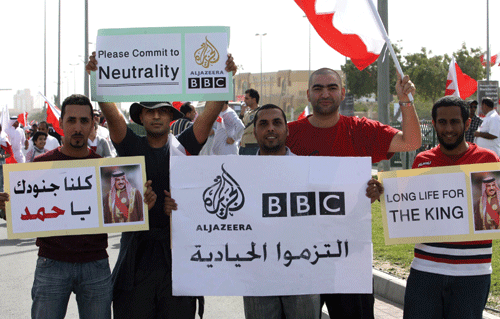
Bahrain’s image as a financial hub has been tarnished recently. Is doing business there at the moment such a good idea?

There are clearly a number of companies that ran regional businesses from Bahrain that had to move their operations very quickly elsewhere. So clearly that is a memory that people will retain for some time and it will cause people to think twice when they are looking to really invest. So yes, there has been some damage to its brand. But we’re absolutely staying there. We’ve been through a number of wars in the region and turmoil — we’ve seen it all before. So we’re very much here to stay and to continue to invest more.

How would you assess potential for Syria and Libya?

In Syria we have a representative office. We applied for a branch license last year, which we didn’t get. In terms of Libya, there’s a tremendous opportunity in terms of the economy and to be part of the economic growth. But I don’t know what’s going to happen in terms of the current conflict; that has to resolve itself one way or another before you can form a view as to where the economy is going and how long it’s going to take to get there. But the potential is absolutely huge. In Syria, I’m sure the economics are strong; but from a banking perspective, as an international bank doing business in Syria, given the US sanctions and everything else, it is too difficult. 

Will the‘Arab Spring’ provide new opportunities for the region?

Look at what’s been the reaction for a number of governments. There’s been an increase in infrastructure spending. There’s a renewed or heightened oil price. Both of those things are economic stimulants for much of this region, and that gives tremendous opportunities for employment, gives opportunities for bankers, for project financing. So, yes, I think there will definitely be some benefits coming from it.

Many of the countries’ infrastructure is not at as high levels as you would expect given these countries’ wealth. So as infrastructure investment comes in, it is a real sustainable investment and a real sustainable benefit to the economy. It’s not just the initial sort of cash injection; it’s what it does to enable businesses going forward.

Who benefited from the capital outflows within the MENA region?

There’s definitely a flow of capital around the region. While there’s been an FDI [foreign direct investment] outflow, some of it has come back into some of the other countries. The UAE [United Arab Emirates] has definitely benefited from some of the unrest that’s taken place around the region. It’s become a safe haven for some direct investors.

It’s also become a safe haven for tourists. Tourism numbers in the UAE have risen dramatically in the last few years…because perhaps people are more concerned than they were about holidaying in some of the other destinations they would have otherwise gone to.

May 3, 2011 0 comments
0 FacebookTwitterPinterestEmail
Real Estate

Venus towering over Phoenician past

by Karah Byrns May 3, 2011
written by Karah Byrns

The threat that cultural heritage faces in Beirut as a result of rising land prices and the scarcity of empty plots is a familiar theme. There seems to be no shortage of fresh cases to highlight and local and international media, as well as local NGOs devoted to preserving national heritage, are doing their part to raise the issue.

Over the last several weeks, Venus Real Estate has been in the spotlight over the discovery of what local news media has claimed is an ancient Phoenician port on “lot 1398”, an approximately 7,000-square-meter sitewhere the company is preparing to construct a luxurious three-tower high rise complex called Venus Towers. 

“I haven’t seen the site; it is closed to the public and even to archaeologists — this is what happens every time there is an important discovery in the Beirut town center,” said Leila Badre, museum director of the Archeological Museum of the American University of Beirut. The Directorate General of Antiquities (DGA) has been carrying out work on the site since the discovery of the ruins by the Ministry of Culture nearly two months ago. At present, the ministry is consulting with local and international experts to determine the value of the site, and as of April 27 five reports had been submitted, signifying that a final decision is coming soon. “We found slopes going down toward the sea that can be interpreted in many ways,” said caretaker Minister of Culture Salim Warde. “It might be a port, a shipyard, or even a quay, but it is surely something very interesting, and we are seeing how we can work with the owners of the land to save this site,” he said.

Over the month of April, An-Nahar criticized Venus Real Estate in two reports that cited numerous experts on the potential archeological value of the site. On April 27, Venus Towers issued an official statement to “clarify” the situation to the general public, threatening media outlets with legal action for making damaging accusations. The statement contends that the plot is too far from the sea to have been used as a port, and too far above sea level, but did not address any historic changes in sea level since the period when the ruins are thought to have originated from.

“The coast of Beirut today is not as it was over 2,000 years ago,” said Warde. “We know for a fact that over the last century this area was covered by stones at least four times. Before then, we don’t know how many times this occurred.” The last time land reclamation like this occurred was by Solidere, whose damage of historic sites was notorious during the post-civil war reconstruction boom. Disturbed by the situation and what he referred to as yet another challenge between the national interest and the private sector, member of Parliament Walid Joumblatt expressed his concern to Executive following the issuance of the Venus Real Estate statement. “I don’t believe a word they say; it’s all rubbish. They will find any excuse for the sake of a few square meters,” he said.

Prior to the publication of the statement from Venus Real Estate, Venus Towers spokesperson Wajih al-Bazri told Executive on April 25 that there was a great difference of professional opinion from archeological experts about the importance of the site. Bazri claimed that while local experts believe the site is important, the international expert brought by Solidere ruled the site unimportant. “The Ministry of Culture and Solidere are working together to get more opinions,” said Bazri. “There is no final opinion yet, but they are working to finalize as soon as possible to be able to go ahead with the project.”  He added that the real estate company will abide by the ruling of the Ministry of Culture, whatever it may be. In the worst case scenario, “we will build around it,” said Bazri, explaining that the ruins only cover about 1,000 square meters of land, then adding: “The newspapers are making a bigger fuss out of this than it really is.”

May 3, 2011 0 comments
0 FacebookTwitterPinterestEmail
Real Estate

Funding’s new frontier

by Rayya Salem May 3, 2011
written by Rayya Salem

Lebanon has all it takes to be a haven for real estate investors; no crash in property prices is known to have ever driven desperate developers to leap off their office balconies.

Even when real estate financing bubbles were bursting in neighboring countries and across the Atlantic, the case for Lebanese real estate remained strong, with compelling fundamentals and more specifically, guaranteed tightness in land supply.

Traditional real estate funding — with cash, help of family, bank loans and some government-subsidized schemes — is as deeply entrenched in Lebanon as is the national preference for real estate as an investment. So far, what remains scarce within Lebanese borders is private equity (PE) real estate funds. But some entrepreneurial minds have placed their bets on fund-type private equity investing in the local real estate scene, arguing that Lebanon’s property boom (most of the $14 billion in FDI inflow since 2008 was funneled into real estate) and ongoing maturation of the sector are signaling opportune times for professional real estate private equity investments, also called REPEs.

Lebanon’s maturing market may have created the need for REPE services, as they also serve as an alternative to (tightening) debt financing. “The 50 million square meters of construction permits obtained since 2008 will drop their final products onto the market within the next three years,” says Ralph Chahine, the head of private equity for MENA Capital, a Beirut-based financial firm. “If we estimate that 70 percent of that number is sold, and that a small portion will remain non-built, the remaining number is large enough to pressure banks to make more calculated decisions.”

Currently managing three real estate private equity (REPE) funds in Lebanon (though registered in the island of Guernsey in the English Channel) and one Lebanese offshore dedicated to investment in Iraq, collectively worth over $225million, MENA Capital is one of Lebanon’s largest managers of REPE investments.

New kids on the block

Recently a new REPE player came to the table and is raising cash for its first project, a 23-story residential tower, Trabaud 1804, in Ashrafieh. The firm’s name is Capstone Investment Group, and its chief executive officer, Ziad Maalouf, states the company’s case in similar terms as MENA Capital’s Chahine. 

Now is the time for REPE in Lebanon, Maalouf says, “Money at the bank has been losing value; there are fears of inflation around the world, so people are looking for solid investments that they can also exit after a definite period of time, especially in a market that has good fundamentals and where real estate prices have not dropped.”

Private equity plays in real estate have emerged as institutional acquisitions of income-generating assets in developed markets, but their relatively aggressive, opportunistic model (which requires high capital investments to be locked in for a period of time) have higher risk-return profiles. Differences between investing in a REPE venture and partnering with a traditional real estate developer include the REPE’s systemic approach with a time-phased payout structure to the investor and a strong profit incentive for the REPE manager.   

 “We have the structure of the fund, without having to call it as a fund… because of the lack of proper fund regulations in Lebanon,” says Capstone’s Maalouf. “There are no ‘Lebanese domiciled’ funds investing in real estate, the ones in Lebanon [regulated by the central bank] are mostly money market funds. The laws, rules, regulations, support, back office and administration necessary to create and manage real estate funds in Lebanon leave much to be desired… so we opt to register outside [of the country].”

Capstone’s development management agreement (with the holding company which owns the land) works the same way as a fund, taking a management fee of 8 percent of construction costs. Carried interest is applied at 20 percent of the profits above a rate of return of 10 percent, meaning the fund manager will be eligible for a substantial share in profits that exceed a baseline return under the agreement with the investors.

The $45 million cost of Capstone’s first project (for land and construction) is financed by an equity-debt combination and the structure projects an internal rate of return of 25 percent or more for investors.

An investor committing a dollar in the fundraising phase (year 0 of a project) will get “back at least two dollars in year three or four; investors would double their investments in a period of three to four years,” claims Maalouf. So far, as half of the apartments (ranging from 290 to 445 square meters) have been pre-sold, revenues exceed $65 million.

PE investments in Lebanese real estate carry little risk as opposed to PE investment in other asset classes, according to Maalouf, because one can foresee an exit after a certain period of time — usually three years. “If I invest with an entrepreneur, I cannot get my money out of this company unless he takes his company public, or he sells his share to another company or liquidates his investments. In real estate’s worst case scenario, if you don’t sell the apartments, you can rent them out, and turn that investment into an income producing asset.”

Maalouf told Executive that Capstone applies “a transparent bidding process for all the tenders, and the decision is taken by [the board of directors] who are the representatives of the major investors in the project and meet monthly or as needed.”

Uphill battle

But there are nonetheless reasons why REPE and comparable schemes may face difficult market entry in Lebanon. As Lebanon does not have mutual funds, insurance companies, or other large players actively investing in PE, around 70 percent of investors in established funds like MENA Capital’s real estate funds are high net worth individuals (HNWI), “unlike developed markets where this percentage is more around 13 percent, or even the region where around 30 to 35 percent are HNWIs,” says Chahine.

Transparency of PE funds, which has been described as underdeveloped across MENA, is not exactly the Lebanese forte. Comparing promised returns or even comparing exit timings of two different funds is difficult anywhere, especially in Lebanon, even if the funds are registered outside.

The main other issue for REPE funds in Lebanon would be the limited exit options. Chahine said REPE may garner a slow and skeptical reception in Lebanon, especially if investors are asked to put their money into a family-owned and managed private equity company.

As Capstone settles into a nascent PE market, the firm is eyeing the central district for future projects. It has set a nearly $50 million budget to acquire land and construct a modern office tower in the vicinity of Solidere, “because we believe there is lack of modern office space in Beirut today,” says Maalouf.

Meanwhile, the changes in real estate demand in Lebanon are weighing on MENA Capital’s pending and future plans; “Certainly, we cannot afford to turn a blind eye on the changes in the market… in some of our projects, we did split some apartments to answer requests for smaller units. We are now working on a couple of projects in Lebanon with apartments ranging from 100 square meters to 250 square meters,” says Chahine.

May 3, 2011 0 comments
0 FacebookTwitterPinterestEmail
Real Estate

Q&A – Joseph Mouawad

by Rayya Salem May 3, 2011
written by Rayya Salem

Joseph Mouawad, chairman of Mouawad Investment Group (MIG), has gradually earned his place among Lebanon’s top developers of residential properties, country clubs and mixed-use offices since the start of Lebanon’s post-civil war reconstruction effort. Two of his major ongoing projects, covering almost 90,000 square meters  in Faqra, will soon put his footprint on the famous Lebanese resort town. Executive chatted to the developer about his latest resort operations and his sway toward hospitality projects in Beirut.

After the success of Park Tower Suites in Ashrafieh, you seem to be gravitating towards more hospitality projects in Gemmayze, Saifi and Monot…

In our new residential project Monot 38 on Monot Street on land we acquired about a year ago, we will also have a boutique hotel, Monot Suites, of about 25 rooms, along with the residential tower of about 20 floors, which will consist of small to medium-sized residential units of 100 to 300 square meters, of which 35 percent is sold.

And in October of this year, Saifi Suites will function as a boutique hotel, offering 70 suites. From our previous experience at Park Towers, we were able to put up a good [internal] management team to manage the new hotels that are coming up.

Why hotels? Is the profit margin higher? Is there a gap in supply?

We believe there is shortage in hotel supply in Beirut. Even before the [civil] war, we had more rooms. We believe that building a hotel will be an added value for a long-term investment, especially when you have a prime location.

You have signed with Rotana to manage an upcoming Gemmayze hotel project, correct?

We are developing a new hotel project with Rotana’s new brand Centro, as the manager, on Rue Pasteur in Gemmayze. It will have a view to the port, and it’s a nice area that allows visitors to walk to trendy shops, bars and pubs. The restaurant in the hotel will cater to both hotel clientele and the Gemmayze crowd.

And why did you choose Rotana to run operations?

I found an opportunity in the new brand they’re putting up: the Centro brand. It is a  trendy budget business hotel that will cater mainly to business people and tourists, and Beirut has few three and four-star hotels so this will garner much demand, and their reservation system will help fill the 170 rooms. [In March, Rotana Hotels became the first Middle East hotel operator to sign an agreement with Google to display Rotana rates and availabilities on Google platforms.]

In Beirut,since [MIG’s]  The Palladium building [near Starco center] was finished three months ago, are there any new tenants?

Bank Audi rented around 7,000 square meters of office space, which will accommodate around 400 employees of the bank. But in terms of retail space, just recently, Santiago [womans clothing boutique] opened [in addition to Lanvin, Balmain, and Isabel Marant, which belong to the same owners, as well as Manasseh, the renowned Silverware store]. In terms of restaurants, in addition to Kampai [Asian restaurant] already open, we will also have Le Cocteau that is expected to open in June 2011. ..We are partners in both of them. We are now in the process of closing some other retail shops.

How much do you want to grow the hospitality wing of your activities?

We want, eventually, 50 percent of our activities to be under the umbrella of hotels and restaurants.

Since the banks are tightening their fists, how has your financing strategy changed overthe last few years?

Our debt-to-equity-ratio will start changing from now on because banks are demanding higher equity in the projects, as they believe the market is saturated. They are requiring 50 percent equity compared to 20 to 25 percent previously. Now we cannot count on presales as much, so we have to put in more equity.

The Oakridge residential resort is probably your largest residential project to date, sitting on about 46,000 square meters of land, 100 meters from Faqra Club. Is this kind of resort setup new to Faqra?

To me, there is nothing similar in the area to what we are delivering. [Oakridge] is different. We saw an opportunity to create a resort, not [just] chalets. The resort will consist of residences, town houses, villas, and it will have about 12,000 square meters of touristic facilities. That includes a spa, club, hotel, furnished apartments, indoor and outdoor pools, a restaurant, bar and children’s playground. We started construction about two years ago after buying the land in August 2008  and plan to deliver at the end of 2012. Today, around 60 percent of the project is already sold.

In a resort project like Oakridge, how do you anticipate how much demand there will be for the different residential facilities — villas, townhomes, chalets?

We try to anticipate demand from the existing market, so we look at the existing demand in the area of Faqra, and we try to meet this demand. But at the same time we bear in mind that we need to cater to all budgets; we don’t want to limit ourselves. In Faqra club, 10 years ago, the demand was only for big chalets and villas, but now the young generation is showing more interest and looking for smaller chalets so we try to cater to both budgets. In Faqra, most people buy a piece of land and then build for their own use. Very few are building commercial projects, the only project that was built in Faqra club is Clouds.

What does the price range look like for units in Oakridge?

We have an increase average price of $3600 per square meter now. There are some villas and townhouses, which we priced by unit not by square meter, so $2.2 million for the townhouse and around $3.2 million for the villas. These are sold on core and shell.

What is the plan for the Silver Rocks plot in Faqra?

Silver Rocks is a land development project, on a plot of about 40,000 square meters that we bought at the same time [as the Oakridge plot], in summer of 2008. It consists of 39 plots for sale and we already sold 60 percent. We decided to have a closed gated community and build a small clubhouse and swimming pool to be used by the residents. We are mainly selling plots to people who will build their own chalets, but of course, the design has to be approved by our company.

What’s the incentive to develop land and sell off plots, instead of building residences and selling them?

Many people prefer to buy a plot instead of a chalet. They consider a land purchase a safer investment for the long term.

What are these two large projects costing?

The total project cost for Oakridge is $45 million including land and construction. Silver Rocks costs around $10 million.

How would you characterize the swelling of supply in Faqra now as around nine residential and hotel projects are underway?

There are still plots of land in Faqra, but there are too many projects being built, so project development will definitely slow down and many projects under planning will be put on hold. The demand will pick up again once the political situation gets better.

Do you think prices will dim?

Cost of construction in Faqra area is high due to the weather conditions that allow only seven months of work per year and also due to higher cost in labor and transportation. The cost is at least 20 percent higher than [the cost of building in] Beirut. Prime lands are limited, which also led to a high land cost, so prices will not decline since the profit margin is not significant.

May 3, 2011 0 comments
0 FacebookTwitterPinterestEmail
Economics & Policy

Executive Insight – Welcoming Chinese inflation

by Fabio Scacciavillani May 3, 2011
written by Fabio Scacciavillani

The spectacular rebound of emerging markets after the recent recession was driven in no small part by China’s emergency stimulus package in late 2008, arguably the timeliest and the largest in the world (relative to gross domestic product). The pull of Chinese demand was powerful enough to revitalize international trade — severely curtailed by the crunch in trade finance — and to drag out of the hole many of the economies well integrated in the Chinese supply chain, from Malaysia to Korea, and Australia to Germany.

The flip side of this stimulus has been a worrisome boom in real estate prices (which has led many to scream “Bubble!”) and persistent inflationary pressures which have extended across Asia (excluding Japan),complicating the macro picture at the national and global level. Asian central banks (and also Latin American ones) until late last year were reluctant to aggressively raise interest rates, lest they clip the green shoots of recovery. But with the upturn in emerging markets, food and commodities prices world wideresumed their surge; since the beginning of this year this surge has been exacerbated by oil price reaction to the turmoil in North Africa. Amplifying this effect is the premature end, after Japan’s Fukushima disaster, of the much touted “nuclear renaissance” that was supposed to substantially curtail hydrocarbons in the world energy mix.

China remains to-date the epicenter of inflationary pressures, despite the fact that authorities were the first to react decisively by increasing reserve requirements up to 20 percent for top lenders, restricting credit to the real estate sector and hiking interest rates four times since October. Nevertheless, in March, Chinese inflation hit a three-year record of 5.4 percent per annum, while in India, which is also experiencing a generalized price surge, it reached almost 9 percent; across the emerging markets generally, from Korea to Brazil, price levels are overheated.

Conventional wisdom and mainstream policy advice suggests that the Chinese authorities should act even more aggressively to counter further price hikes, and indeed solemn pledges to this effect figure prominently in public statements by senior politicians. But China generally defies conventions and an alternative course of action appears to be gathering consensus within policy circles. The new five-year economic plan sets a 4 percent inflation target for this year, and Chinese authorities have signaled that in the medium term they would be comfortable with inflation between 4 percent and 5 percent, which represents a substantial increase compared to previous years.

Furthermore, national and local governments have enacted a spate of hefty salary increases: since the beginning of the year, 12 Chinese provinces and provincial-level municipal cities have raised their minimum wages. The average adjustment over the 12 provinces was 21 percent with the highest hike, 28 percent, being decreed in Chongqing, in central western China (outside the coastal belt where manufacturing is concentrated). Incidentally, thanks to a 20 percent rise, Shenzhen replaced Shanghai to become the city with the highest minimum monthly wage in China (approximately $203). If we consider a longer horizon, since last year 30 provinces raised the minimum wage, often by double digits.

These measures were justified by the need to attract labor from the inner regions and to improve living standards, an issue that had taken center stage in domestic politics after strikes and workers unrest spread across the country, threatening to become a widespread phenomenon.

Whether by happenstance or by design, it seems that an unorthodox policy recipe is emerging. One of the foremost issues confronting the Group of 20 countries is the rebalancing of the current-account surplus by China and Germany and other mercantilist oriented countries. The most vocal critique of China’s export-led strategy has been the United States, which (stirred by Congress) has used such criticism to push for a revaluation of the yuan.

The Chinese government and central bank are aware that an ever-increasing current-account surplus is not sustainable (the foreign exchange reserves have reached a walloping $3 trillion), but might be contemplating an alternative route; instead of revaluing the nominal exchange rate (as demanded by the US and others) they are increasing the real exchange rate.

By raising domestic wages they boost domestic inflation, thereby losing competitiveness, but Chinese workers feel the benefits more than foreign competitors. In essence, the Chinese government seems to be pursuing a redistributive policy in favor of the domestic population with the aim of boosting internal demand and reducing the current account surplus.

It is hard to say how this policy will turn out; it certainly carries risks, as once a price/wage spiral is triggered it becomes hard to control, but a few implications for the global economy and the Middle East are clear.


Over the pastthree decades China has become the world manufacturer and has been the mostpowerful force behind a relentless deflation in traded goods — reveled in bythe rest of the world — thanks to an almost inexhaustible supply of cheaplabor. This process is reverting, and with China’s inflation on the rise it isonly a matter of time before a global reverberation is felt.

If one adds the effects of money printing in the US and the need to monetize at least in part public debts in mature countries, foremost in the Eurozone, the next few years will present serious challenges for monetary policy; the word ‘stagflation’ is likely to make a comeback in everyday parlance. 

This change will not be a temporary adjustment, but will represent a structural shift in the global economic environment, affecting greatly the smaller economies in the Middle East and elsewhere. In particular, the Gulf Cooperation Council countries will find themselves again ensnared, like in 2006-2008, in a monetary policy determined by the US Federal Reserve to serve its domestic goals, but utterly inadequate for the conditions of GCC economies.

Furthermore, the central banks and the sovereign wealth funds that manage the accumulated export revenues are typically exposed to fixed income securities denominated in US dollars. At present, the safe haven status and the anemic credit conditions have held bond prices remarkably stable (excluding of course troubled countries such as Greece or Portugal). But when markets realize that higher inflation is not a blip, the adjustment could be traumatic for fixed income securities. There are no simple solutions to this kind of tectonic shift, but a revamping of the GCC’s common currency project could not be more timely. A degree of flexibility in monetary policy and a new strong international currency would be in the best interests of the oil exporters and also indirectly, those of other countries in the region.

The surge in Chinese wages will also lead domestic consumption to replace exports as an engine of growth. This swing has a long course to run as private consumption represents a remarkably low percentage of China’s GDP. The effects of the Chinese boom have thus far benefited countries and companies embedded in China’s supply chain, but from now on the effects of the stimulus could reach those countries and companies that cater to Chinese consumers, in particular in the provision of durable goods for the expanding middle class — washers, cars, furniture and high end services, such as tourism, healthcare and financials.

A benevolent interpretation posits that, far from being a serious worry, inflation spurred by the loose wage policy tolerated — and often encouraged — by the Chinese authorities could be another step in the long march toward better quality of life within China and the harbinger of a great leap forward for the world economy.


Fabio Scacciabillani is chief economist at the Oman Investment Fund

May 3, 2011 0 comments
0 FacebookTwitterPinterestEmail
Society

Book review: America’s Kingdom

by Paul Cochrane May 3, 2011
written by Paul Cochrane

Saudi Aramco, valued anywhere from $2 trillion to $7 trillion and employing more than 55,000 people, is the world’s largest unlisted company. How it got there is a story that has been told before — from the first discovery of oil to the entrance of the American oil majors, to the development of the so-called “special relationship” between Saudi Arabia and the United States.

But Robert Vitalis’s newly updated book, the product of a decade of research and writing, charts the history from a different perspective, viewing Aramco as a microcosm of the colonial order. It describes an ‘oil-garchy’, the partnership that began decades ago with some of the largest oil companies in the world —Socal, later renamed Chevron, Standard Oil of New Jersey, later Exxon, and Socony-Vacuum Oil, later Mobil — and the relations between Washington DC and Riyadh until Aramco was fully nationalized in 1980, becoming known in 1988 as the Saudi Arabian Oil Company or Saudi Aramco.

It is not a telling of history financed by Aramco or seeking to enter the good books of the Saudis or the oil industry — an independence that aids its veracity. As Vitalis notes: “Companies are like authoritarian countries. They keep records hidden…They open their archives only to those they hire [and] insist on the right to approve what is written… There are no sunshine laws and no Freedom of Information Acts against corporate privilege.”

Indeed, like other tomes exposing the costs of oil development, America’s Kingdom is blacklisted in Saudi Arabia.

Vitalis blasts commercially successful accounts of Aramco and Saudi Arabia that conveniently gloss over the company’s less than exemplary past and uncritically repeat Aramco’s creed that it acted differently from other oil companies; the company claims to have helped Saudi Arabia modernize through what Aramco President Frank Jungers called its “far sighted policies” and a “55-year record of cooperation and mutual respect.”

Vitalis exposes the situation of Saudi and non-American workers, their decades-long struggles for better accommodation, wages and rights, how protests were squashed, and the eventual ending of a system that divided labor based on race, imported from the US and similar to the ‘Jim Crow’ laws used in America to pay white workers more than African Americans and Hispanics.

He also exposed as myths many claims that Aramco still expounds; the company’s website states that, “Since 1940, Saudi Aramco schools have provided educational services to dependents of Saudi Aramco employees.” Infact, Aramco’s management worked to prevent Saudis and their dependents from being educated, arguing “the company should not engage in a general educationprogram,” despite a 1942 Labor Law that required Aramco to do so. It was not until 1955 that the labor movement and the Saudi government forced Aramco to “pay for a system of schools, training institutes, and, ultimately, an engineering college.”

The book debunks the notion of Saudi “exceptionalism” — the doctrine that its leadership steered the fledgling kingdom through the miasma of empire and imperialism without external influence; while Saudi Arabia became a state in 1932, what “everyone seems to forget is that (the Saudi Emir, later king) Ibn Saud signed a treaty in 1915 with Great Britain that conceded sovereignty rights for protection,” writes Vitalis. The kingdom has been keen to downplay such reliance on outsiders for its survival ever since, whether on Britain or later on Aramco and the US.

America’s Kingdom is an important contribution to the often-neglected field of oil history, and a powerful critique of the US-Saudi relationship and of Aramco, a company with monumental sway over the world’s energy markets.


May 3, 2011 0 comments
0 FacebookTwitterPinterestEmail
Society

Executive Insight – Post-revolution communication

by Mark Helou, Zeina Loutfi & Ramsay G. Najjar May 3, 2011
written by Mark Helou, Zeina Loutfi & Ramsay G. Najjar

The sweeping social changes and revolutions rocking the Middle East and North Africa in recent months have indeed taken the world by surprise. Although many analysts and experts agree that these movements will result in a lasting change that will drastically modify the region’s geo-political landscape, no one knows yet in which direction this change might head. As the French philosopher and political scientist Raymond Aron said, “Men make history without knowing the history that they are making.”

Will these revolts give rise to true democracies or give birth to new authoritarian societies? History provides numerous examples of revolutions that “devour their own children” and culminate in large-scale oppressions and exactions, starting from the most famous – namely the French revolution — and ending with the Soviet, Chinese, Iranian and Latin American revolutions of the 20th century.

Lighting the path

With this in mind, what role can communication firms play in helping to direct the winds of change in a positive direction? The question is all the more pertinent as these revolts have shown the extent to which communication has become a driving force in society through its multitude of channels, from global media outlets to online social networks. It is onlylogical to assume that this same force that helped to spawn these movements can ultimately steer their course in the right direction, toward a beneficial and lasting change for the people of the region.

The first crucial role to be played by communication outlets is to fill the void created after decades of despotism and an effective absence of meaningful political participation. As the revolutionary movements in Egyp tand Tunisia unfolded, one of the themes that recurrently surfaced was that they lacked  powerful and effectiveleadership to guide and federate them. However romantic the image of a spontaneous and unplanned revolution might be, political reality dictates that in order to ensure its sustainability and to reach its objectives such a movement eventually must be channeled through a visible and empowered leadership. This has not yet occurred, delayed by the fact that these countries have been living for decades in a state of autocracy deprived of substantial opposition leadership. Proper communication can ultimately lay the groundwork for the natural emergence of an enlightened leadership by advocating the values that the society wishes to adopt and identify within the post-revolution era.

Contrary to the paradigm within the many surviving totalitarian societies, it is not the leader’s role to impose a system of values on his or her people. Ideally, it is the set of values determined by the people that ultimately gives rise to a leadership that embodies and defends them. In the case of the newly born Arab democracies still in search of leadership, the media and civil society should seek to communicate with all stakeholders to create a consensus toward a common system of values, which may include, for example, the protection of individual freedoms, secularism or social justice. It is then, by upholding these values and being held accountable by their standards, that citizens would raise political players to leadership status, offering them the blessings of the populace.

By entrenching a truly national set of values emanating from the people’s will, communication outlets could ensure that future leadership would be attuned to citizens’ aspirations. They would also set in place a unified and consistent vision for the country that ensures that citizens and leaders work toward the same national objectives; even if opinions diverge, they would still be grounded in the principles set forth by the people. Only then would the revolutions have transcended their original social demands to forge a national identity and set the tone for the full-fledged rebuilding of the national political system.

Closing the cycle

For all of this to happen, communication outlets must develop the political maturity of the people and entrench a sense of democratic responsibility. Decades of authoritarianism have suppressed awareness of the rights and the duties that a mature democracy offers and demands from its citizens. In this respect, the role of communication would be to effect a shift in mentality from the previous reactionary state of mind to a positive and constructive mindset in which citizens are ready to make sacrifices and build a system reflecting their aspirations.

Though the revolutionary spirit was necessary to break the people’s shackles, the post-revolutionary role of communication would be to ensure that this fervor does not give rise to a state of “permanent revolution” that would flare up every time a sacrifice — such as an increase in taxes or the removal of subsidies — is necessary.

Well-crafted communication would therefore be essential to make citizens fully aware of their responsibility in holding the new leadership accountable by empowering them and sharpening their political sense. By acting as the guardian of government transparency, communication mediums have the potential to ensure that the people and the government work as a team rather than as adversaries. Most importantly it will set the background for political stability by protecting against repeat revolutionary earthquakes which could arise from an inadequate resolution of the original issues.

By playing a largely informative role during the period of unrest, communication channels and social media networks contributed greatly to the development of the revolutionary movements and acted as the logistical backbone of popular action. As this phase has successfully come to an end, communication should take on a whole new level by moving from a reactive informative trend to a proactive constructive one by which it pursues the noble cause of shaping the post-revolution society at its best. To reach this end, media outlets and civil society players will have to work hand in hand to encourage dialogue with the various stakeholders and spark the emergence of a consensus concerning national values and constants, while raising the level of political awareness.

As media and communication outlets begin to reach their objective of establishing national values, they can begin to move toward effectively becoming the “Fourth Estate” by ensuring scrutiny and accountability with respect to the national principles that they would have helped establish and consolidate. Communication outlets would thus have successfully “closed the cycle” by helping to spark the revolution, accompanying it, establishing the social and political contract of the post-revolution era and, finally, acting as the guardian of this contract and the values that its stands for.

Leaders and governments are mere transitory players in the lives of nations, whereas the true cornerstones are the values on which these nations are built. Today, nascent Arab democracies should reflect back on the lessons of the French revolution and understand that once they establish a common set of national values, they will be setting the platform on which modern, just and perennial states can be built to prosper.

May 3, 2011 0 comments
0 FacebookTwitterPinterestEmail
Society

Executive Insight – Lebanese brands weak on the home front

by Joe Ayoub May 3, 2011
written by Joe Ayoub

As a general rule, it’s difficult to trust someone that you don’t know. Extending this rule to the commercial level, how can consumers be expected to choose Lebanese brands when so little is known about them?

A recent advertising campaign asked consumers to do just that. “You love your country, love its products”, read the campaign slogan — a suggestion that attempts to inspire consumers to purchase something based on its manufacturing origin alone. Certainly consumers would have had every right to respond to the recent campaign by providing a challenge of their own: “You want me to buy Lebanese brands? Then tell me more about them.” In truth, we would be hard pressed to know much about any of our local manufacturers. What is lacking is public knowledge of financial indicators (which can provide telling signals for consumer confidence), the people behind the brand, how the products are manufactured, what quality standards are enforced, how employees are treated, and so on. Why is this important? Because the more information a brand communicates about itself, the more familiar it becomes to consumers, thus empowering it to enjoy greater consumer preference.

Consumer power

The advent of the digital age has made the need even stronger for brands to open up, reach out and engage with consumers. In today’s world, brands can be crippled in a matter of seconds by virtually anything and anyone. For example, it only takes one anonymous ‘tweet’ on a company’s mishandling of employee affairs or revelation of malpractice to wipe value off a million dollar enterprise. This is why brands can no longer afford to stick their heads in the sand. Instead it is imperative that they place themselves in the hands of consumers and open up a two-way dialogue that takes in feedback. Importantly, being open with customers is key to reinforcing trust and can empower local industries to compete not just at home but abroad.

The only way is up

There are three levels on which industry branding in Lebanon could, and should, be improved. The first is on the industry level itself. The point here is to focus on industries that have strengths — in Germany one would think of the auto industry, for example — and to promote these industries collectively. In Lebanon, it could be jewelry or olive oil that are targeted for promotion.

Next there is the level of the corporate image, where companies need to communicate their values. Are they an exemplary employer, for example?  

Lastly, there is the level of the brand image itself. Many brands don’t communicate their own story: the description that sums up the essence of where the brand comes from as well as what it delivers. And the brand story is just the beginning; beyond this there are many touchpoints which have to be aligned with the brand values and communicated with consistency.

One touchpoint, and a crucial area in which local industries fall short, is product packaging. Go to any supermarket and compare similar products from Europe and those from local manufacturers and you will see an immediate difference. Local manufacturers assume that customers want cheaper packaging to give them an affordable price, failing to realize this shows disrespect to the consumer. Beyond packaging, often the second big disappointment is the product itself, with low or inconsistent quality.

The way to go

We know that Lebanese services have the ability to reflect a positive image of the country and to compete on a regional and international level. The hospitality industry and banking are two prime examples of this. Yet, for manufacturing, we only have to look at the level of imports versus exports to realize that there is a still a long way to go before Lebanese manufactured goods become the strong competitors they could be, either here or abroad. To get consumers to believe in their products, local manufacturers need to wake up to the power of branding and take the first steps to unlock their full potential.


Joe Ayoub is the CEO of Brandcell

May 3, 2011 0 comments
0 FacebookTwitterPinterestEmail
Economics & Policy

Renewable energy and climate change in the region

by Rend Stephan May 1, 2011
written by Rend Stephan

BCG


Rend Stephan is a partner and managing director of the Boston Consulting Group in Dubai. BCG’s Eduardo Neto, a project leader, and ChristianSchwaerzler, a consultant, contributed to this report

The Middle East is home to one of the world’s largestreserves of fossil fuel, primarily used for what is considered “conventionalenergy.” It also has strong natural advantages in renewable sources of energysuch as solar power. The region may also be well positioned in the climatechange debate through its potential ability to inject carbon gas emissions intooil fields. But the road ahead is not easy — far from it. Both public andprivate sector players need to choose their positioning and investmentstrategies wisely, for the region to play a leading role in this space.

Renewable energy – a global view

The unprecedented interest in alternative energy during thelast decade was driven by two major factors: the increased reliance onfossil-fuel-generated energy with its related political concern over energysecurity, and the drive to curb carbon emissions to combat climate change.Looking ahead, we expect an even more rapid adoption in the next decade thanhas been widely foreseen thus far, especially for solar and to some extent, forwind. But at the same time, we acknowledge that many economic and structuralhurdles stand in the way of a truly smooth growth story.

Over the next decade, few renewable technologies will beable to match traditional energy sources on the cost side, known as “reachinggrid parity.” Photovoltaic (PV) will continue its cost improvement trend, sothat it will reach grid parity in high-priced markets such as California andSpain. New pilot technologies in Concentrated Solar Power (CSP) may also havesome potential. On-shore wind is largely mature and very close to grid parityon the best sites, but growth can be limited by the availability of prime sites(with regular strong winds). Offshore wind is nascent, with high investment andmaintenance costs due to remote locations, and is unlikely to exit thesubsidy-driven phase by 2020.

In addition, the expected improvement in storagetechnologies (such as thermal storage, batteries), and the development of moreflexible grid systems do not seem groundbreaking enough to alleviate theintermittent nature of solar and wind. On the structural side, slow regulatoryframework changes, “subsidy fatigue” and hesitant global climate policies alsopose hindrances to their development. But all in all, the combined share ofsolar and wind energy may reach 20 to 25 percent of the total power generationmix globally in 2020.

A leading role for the Middle East?

Against this backdrop, it is important to explore what rolethe Middle East could play. While wind has some potential here, it is really insolar — where the region has large areas of cheap and available land with highirradiation — that a potential global competitive advantage could be built. Butthree very careful choices have to be made.

The first choice relates to local solar energy productionfor local consumption. Such energy sources will find it more difficult to reachgrid parity, given the direct and cheap availability of fossil fuels in theregion, as well as the existence of substantial power generation subsidies.However, this is an incomplete, simplistic and misleading view, since theopportunity cost of making fossil fuel available for exports needs dramaticallychanges the picture.

Countries in the region with fossil fuel reserves understandthis position and some are starting to investigate and invest in local solarenergy production (plus some nuclear) for local consumption and to preservefossil fuels. This trend has to be articulated, encouraged and sustained.

The second choice relates to solar energy exports. Therecent developments in long distance electricity transmission and the relativeproximity of large solar prime sites to high energy demand areas make solarenergy exports a worthwhile option to investigate. Projects such as theDesertec initiative (North Africa solar energy production for consumptionprimarily in Europe) illustrate this point well. From the “Western”perspective, these projects face many hurdles related to political stabilityand investment risks, as well as governance. Yet they constitute a tremendousopportunity for many of the Middle East countries to position themselves assolar energy exporters, substituting for the inevitable decline in fossil fuelavailability and, hence exports, in the long run.

A well-articulated strategy to position the region in thisspace and to make such solar energy exports a reality has to be defined andinitiated.

The third choice involves local investments in solartechnology or manufacturing — namely, the undertaking of related, value-chaininvestments — has to be generally discouraged, at least initially. Suchinvestments are typically not yet attractive in the broad economic sense, andwould have to compete with research and development (R&D) technology centersin the developed world on the one hand, and production facilities in low-costcountries, on the other.

It is true that while building local solar energyproduction, some related value-chain investments could prove attractive;however, these need to be considered very cautiously and selectively and not asa “grand-scheme” plan. This position may change in the long run if/when theregion can create a sustainable solar energy export market — one that hasenough scale to allow further attractive positioning in the adjacent parts ofthe value chain.

Beyond solar, the Middle East’s strategic pre-occupationwith fossil fuels could promote an emerging alternative energy topic: carboncapture and storage for enhanced oil recovery (CCS–EOR). This complex namerefers to capturing carbon gas emissions from power plants and injecting theminto oil fields. This enhances the recovery of oil reserves while at the sametime reducing carbon emissions and hence climate change impact — a doubleadvantage not to be overlooked. Our research has shown that the proximity ofcarbon emitting plants to suitable and large oil fields in parts of the regioncan make such investments economically viable.

This unique advantage of the region could position it as anincubator of CCS-EOR technology development and use. We estimate the region tobe able to quickly capture more than 20 percent of global market share, plus a‘first-mover’ advantage position.

What next?

The future for alternative energy is closer than commonlyassumed and stakeholders in the Middle East should move sooner rather thanlater. The recommendation is simple: get back to basics, and relentlessly focuson the region’s competitive advantages in this space.

In essence that means: Invest in local solar energy productionfor local consumption where it increases the longevity of current fossil fuelreserves and/or fossil fuel exports, but shy away from making grand-schemeplans to play in technology or manufacturing in the short-to-medium term.Actively position the region for solar energy exports, a critical long-termsubstitute for fossil fuel exports, and align other policy decisionsaccordingly. If done well, and on a large enough scale, this could well openthe option of technology and even manufacturing leadership in themedium-to-long term.

A ‘first mover’ advantage in CCS-EOR should be pursued andefforts should be made to ensure that the potentially conflicting interests ofmultiple players do not distract the region from such a unique leadershipposition.

This strategy is urgent but selective, and needs rapiddetailed articulation of each country’s choices, and a relentless alignment ofleadership, policies, regulations and incentives in energy and other sectorsaccordingly. The private sector and incumbent utilities, as well as nationaloil companies (NOCs), will need to understand and align themselves to thesepriorities while being careful, if not dismissive, about risky ventures thatare not aligned with the overarching strategy.

A lot can be done at a country level in the short-to-mediumterm (such as local solar investments and CCS–EOR), but the maximum potentialfor the region (solar energy exports, leadership in technology andmanufacturing) can only be attained in the medium-to-long term with strong cooperationand alignment between countries .

There is work to do today and tomorrow and no excuse forprocrastination. In the end, it is not a question of if alternative energieswill disrupt our ways of life and doing business, but when, and how can the MiddleEast capture the leadership opportunities available to it.


May 1, 2011 0 comments
0 FacebookTwitterPinterestEmail
Society

Smiles from the starting line

by Thomas Schellen May 1, 2011
written by Thomas Schellen

Car distributors in the Gulf and Middle East region have seensales bloom in the first quarter of 2011. Whether they are unrestrainedly regalchariots or utterly practical wheels, vehicles made by automotive brandmanufacturers of the Far East, Europe and the United States have enjoyedbroadly improved demand in the Arabian Peninsula and the Levant, as comparedwith the first quarter of 2010.

Rolls Royce, the British luxury brand and proper matrimonialmotorcar maker, reported that regional sales were up 90 percent this springwhen compared with the same quarter in 2010. According to a statement by theRolls Royce dealer for Dubai and the Northern Emirates, AGMC, Dubai was at thefore of Rolls Royce’s regional sales increase with 178 percent first quarter growth.This put Rolls Royce at the top of regional percentage growth among carmanufacturers who provided Executive with first-quarter performance figures forthe Middle East.

A spokesperson for Rolls Royce Middle East told Executivethat the car maker had not only a record first quarter in the Middle East, butalso expects in 2011 to globally outsell the 2,711 motorcars it shipped in2010. That would include another record year in Middle East sales.

Kia, Korea’s easiest-to-pronounce auto brand, said it recordedyear-on-year growth of 19 percent to nearly 45,000 sold vehicles for the MiddleEast region in the first quarter of 2011, including a single-month gain of 29percent March-on-March. In first-quarter statistics for the Gulf CooperationCouncil, the make advanced 6.3 percent year-on-year to 14,444 units.

Kia’s increases notably came from a base of already highunit sales a year ago, as the manufacturer claimed three consecutive years ofgrowth in the Middle East from 2008 to 2010.

Last year, Kia sold 175,369 units in the Middle East for ayear-on-year increase of 48 percent, according to figures provided by thefirm’s head office in Seoul.

United States-based General Motors and Ford also sawimproved demand in the GCC last quarter. In GM’s stable of brands — comprisedof Cadillac, Chevrolet and GMC — just shy of 30,000 vehicles rolled out of theregion’s showrooms, representing 16 percent better unit sales than the yearbefore. 

Without releasing actual sales numbers, Ford Motor Companysaid it achieved a 52 percent increase in GCC sales compared to the same periodlast year. According to Ford Middle East, Saudi Arabia recorded the highestregional growth for the brand, at 75 percent, followed by Kuwait with a 50percent increase. The United Arab Emirates, meanwhile, saw an increase of 32percent.

National trends

‘Full blossom’ was also the assessment for the Germanbrands, which regionally enjoy a strong position among European imports andhave the reputation of doing particularly well in the premium segment. BMW, theBavarian auto smithy whose motto hails driving as enjoyment, sold more than4,600 new BMW and Mini cars in 14 Gulf and Levant markets in the first quarterof 2011, for a 19 percent year-on-year increase, though more than 4,200 ofthese cars were BMWs. Abu Dhabi and Dubai registered year-on-year increases of42 and 38 percent, respectively. 

BMW Middle East confirmed to Executive that the firstquarter of 2011 was the group’s best ever in the region in terms of sales forboth BMW and Mini brand vehicles. This marks a further increase from a 2010performance where group sales of 17,119 vehicles across the region had been thehighest in BMW history. According to BMW, its 2010 sales in the Middle Eastexceeded regional sales of any other European premium manufacturer.

Audi, the German car maker in perennial praise ofengineering, whose hometown is just a 38-minute train ride from BMW’s Munichbase, proved a close competitor in percentage gains, reporting 19 percentgrowth in first quarter unit sales in the Middle East. In the UAE, Audiadvanced 23 percent in the first quarter. The manufacturer’s spokesperson saidgrowth was driven by the marque’s flagship sedan and by its sports utilityvehicles.

The communications head office of Stuttgart-based Mercedestold Executive that first-quarter sales growth in “Arabian markets, includingDubai, Kuwait and Saudi Arabia” amounted to 5.6 percent for total first quartersales of 4,000 Mercedes-Benz vehicles.

UAE distributors of Japanese auto brands, whose marketshares in the Middle East are proportionally higher than Japanese car makers’global market share, continue to appear the least eager to disclose unit saleswhen compared with their Korean, European and American competition. But NissanMiddle East, marking a trend toward transparency, did provide Executive withexact numbers for the first quarter and the company’s fiscal year 2010, whichended March 31. Jebel Ali-based Nissan Middle East Free Zone (NMEF) said thetotal first quarter 2011 sales of Nissan and Infinity vehicles amounted to45,137 units. For the 2010 financial year, the regional total was 166,448units. While both NMEF figures represent drops on a year ago, full-year numberswere down less than one half of 1 percent. First-quarter sales, however, weredown more than 14 percent from 52,938 units in first quarter 2010.

The contraction in unit sales for Nissan vehicles in theMiddle East runs counter to the overall growth trend in sales of cars made bybig name manufacturers. The news is not all bad for NMEF, however, whichinformed Executive that the group’s up-market Infinity brand realized 28.6percent growth in sales during the first quarter of 2011 when compared to thesame period in 2010. 

According to estimates by General Motors, total motorvehicle sales of 1.148 million across the Middle East in 2010 were up 8 percentfrom 2009. Of these, 48 percent were Japanese, 14 percent Korean, 15 percentAmerican and 23 percent European makes, with emerging markets’ automotivebrands — from India, Iran and China — “not on the radar” of local buyers.

Yet, given the lack of confirmed governmental data on exactvehicle numbers for the GCC and for individual member states, all industryfigures include a larger portion of assumptions and estimates than isdesirable. This means for the manufacturers and distributors that market shareassessments are in part guessing games and brand manufacturers have onlythemselves, their own previous performances and their own targets to reliablybenchmark against.

The global picture

In announcing their good performances during recent weeks,the global car makers’ Middle East representatives have broadly attributedtheir sales growth across the region to a mix of economic recovery, notablyincluding easier access to bank loans for prospective buyers, plus increasedefforts by car dealerships, and, more than anything, their new model lineups.

At the same time, the Middle East numbers have to be seen inlonger-term regional and global contexts to provide a fuller picture. While theperiod from January through March 2011 produced absolute unit sales records forseveral manufacturers, the comparison with 2010 is somewhat flattering forothers whose sales results in 2007 or 2008 were substantially higher than 2009and 2010 numbers. When measured against peak sales in 2007 and 2008, firstquarter 2011 numbers are good on an industry level but not as impressive as ayear-on-year comparison with 2010.   

In both the downturn of 2009 and in the upswing now,regional results were moreover co-cyclical with global results announced by bigEast Asian, European and American car manufacturers. Kia, for example, said itsglobal unit sales in first quarter 2011 were 20 percent higher when comparedwith a year ago. Under the same comparison, Germany’s Volkswagen sold 14percent more cars and BMW recorded a global increase of 21 percent.

On the global profits side, big manufacturers have alsodisplayed demonstrative smiles. Daimler AG, maker of Mercedes, posted a firstquarter net interim of $1.75 billion [AED 6.42 billion] — a greater than 90percent improvement on the first quarter of 2010. Ford reported a group-widefirst quarter net gain of $2.55 billion [AED 9.36 billion], its highest in the21st century to date, and even Chrysler spread its feathers in pride at the endof April with a net interim of $116 million [AED 426.08 million].

Chrysler, whose twice-tarnished record in recent yearsentailed a 2007 breakup after a failed marriage with Daimler and then a descentinto Chapter 11 bankruptcy protection in the second quarter of 2009, presentedits first quarterly profit in five years or more.

From Japan, ahead of announcements of 2010 results by Toyotaand Nissan expected in mid-May and covering the 12 months to the end of March2011, analysts published expectations that the leading Japanese car makerscould announce 2010 net profits far above 2009 results.

Profits generated in the Middle East region, which are notdetailed in the interim or full-year financial reports of the manufacturinggroups, will only in the rarest cases translate into very visible improvementsto the overall results profile of the automotive groups.

Caught in traffic

Going forward, the remaining months in 2011 could spell theslowing of automotive business on several fronts globally and, to a lesserextent, regionally.

Balance sheets of Japanese car manufacturers are expected toshow the impact of the Great Tohoku Earthquake and Tsunami, which devastatednortheastern Honshu on March 11, in their results for the first six months oftheir 2011 financial year, which began April 1. According to an average ofanalyst estimates compiled by Bloomberg, Toyota’s six-month losses up toSeptember 30 could reach $4.9 billion [400 billion yen]. While progress reportsfrom the car makers Toyota, Nissan and Honda show gradual restoration ofcapacities to pre-catastrophe levels, production of parts and vehicles in Japanwill still be impacted in various forms throughout much of the remainder of2011.

Statements by Japanese manufacturer Nissan as regards theimpact on the Middle East acknowledged the likelihood of vehicle supplybottlenecks choking the market, but without specific projections. Othermanufacturers said they were observing the markets but by the end of April hadnot been revising sales targets for the region. 

In their estimate of overall sales outlook for the MiddleEast, GM expects 2011 to see industry results of 7 percent growth on 2010.Manufacturers contacted by Executive said that unrest in the region hadtemporarily subdued buying moods in some areas of Saudi Arabia and had a directimpact on showroom visits by prospective buyers in Bahrain and Syria, but thesetwo markets do not contribute large shares to regional volume.

However, as Ford Middle East General Manager Larry Preinsaid, events such as the unrest in North Africa (which is not part of theMiddle East region by the auto industry’s classification) had “an impact oneverybody from a customer confidence point of view. This has a ripple effectthrough the [Arab] countries. We will just have to play it out and manage therisks the best we can.”

On the upside, government measures in the important Saudimarket, such as job creation and the infusion of cash into households, couldhave positive impacts on car sales.


May 1, 2011 0 comments
0 FacebookTwitterPinterestEmail
  • 1
  • …
  • 380
  • 381
  • 382
  • 383
  • 384
  • …
  • 686

Latest Cover

About us

Since its first edition emerged on the newsstands in 1999, Executive Magazine has been dedicated to providing its readers with the most up-to-date local and regional business news. Executive is a monthly business magazine that offers readers in-depth analyses on the Lebanese world of commerce, covering all the major sectors – from banking, finance, and insurance to technology, tourism, hospitality, media, and retail.

  • Donate
  • Our Purpose
  • Contact Us

Sign up for our newsletter

[contact-form-7 id=”27812″ title=”FooterSubscription”]

  • Facebook
  • Twitter
  • Instagram
  • Linkedin
  • Youtube
Executive Magazine
  • ISSUES
    • Current Issue
    • Past issues
  • BUSINESS
  • ECONOMICS & POLICY
  • OPINION
  • SPECIAL REPORTS
  • EXECUTIVE TALKS
  • MOVEMENTS
    • Change the image
    • Cannes lions
    • Transparency & accountability
    • ECONOMIC ROADMAP
    • Say No to Corruption
    • The Lebanon media development initiative
    • LPSN Policy Asks
    • Advocating the preservation of deposits
  • JOIN US
    • Join our movement
    • Attend our events
    • Receive updates
    • Connect with us
  • DONATE