• Donate
  • Our Purpose
  • Contact Us
Executive Magazine
  • ISSUES
    • Current Issue
    • Past issues
  • BUSINESS
  • ECONOMICS & POLICY
  • OPINION
  • SPECIAL REPORTS
  • EXECUTIVE TALKS
  • MOVEMENTS
    • Change the image
    • Cannes lions
    • Transparency & accountability
    • ECONOMIC ROADMAP
    • Say No to Corruption
    • The Lebanon media development initiative
    • LPSN Policy Asks
    • Advocating the preservation of deposits
  • JOIN US
    • Join our movement
    • Attend our events
    • Receive updates
    • Connect with us
  • DONATE
Economics & Policy

Currency board for Lebanon

by Nabil Makari March 2, 2021
written by Nabil Makari

The Lebanese are currently subjected to depreciation, with the ever-rising prices of goods and services, self-imposed limits on withdrawals by banks at a rate of LBP 3,900 to the dollar, and a local currency estimated at LBP 9,600 to the dollar as at March 1st 2021. Rampant inflation was estimated at 84.8 percent for the full year 2020 according to the Central Statistics Department, with end-of-year inflation from December 2019 to December 2020 estimated at 14.8 percent. Additionally, any release of controls for withdrawals in LBP would result in added inflation due to an expansion of the monetary mass and a rush to buy USD currency at black market rates. The depreciation of the currency reflects, in part, a loss of confidence in the national currency, and a flight to safer cash currencies on the black market. In light of this situation, some financial experts have recommended the establishment of a currency board (CB) in Lebanon to help tackle inflation.

Broadly defined, a currency board is an authority in charge of managing the money supply and the exchange rate of a country’s currency, in lieu of the central bank. Its tasks are set by law, and no printing of the currency can occur without it being 100 percent backed by another foreign currency, in most cases the US dollar as the worldwide preferred medium of exchange. Unlike a typical central bank, it is not a last-resort lender and is not legally allowed to print currency and lend to the government under any circumstance.

Under a CB management, the exchange rate and the monetary level are determined independently by the board, who is ruled by law and, due to its direct task, is less likely to be under political pressure. CBs often have a 100 percent reserve requirement, therefore a specific unit of foreign currency must back every unit of currency printed. For someone to obtain a fixed amount of LBP, they must ask their bank to convert dollars at the CB. Thanks to a stable foreign-currency-backed fixed exchange rate, CBs allow fighting inflation more effectively.

Overall, more than 70 countries have adopted currency boards, most notably Hong Kong, Estonia, Bulgaria, and Denmark amongst others. In the case of Estonia, the institution of a currency board in 1992 helped end hyperinflation, with monthly inflation falling from 80 percent in early 1992 to only 3.3 percent in December of the same year.

Determining a fixed exchange rate

The question is: How would this be implemented? In an exclusive interview for executive Magazine, Professor Steve Hanke, the main proponent of the CB for Lebanon, recommended freezing all printing of Lebanese currency for a month, in order to lower the supply of LBP, which would drive down the price of the USD in the black market, a recommendation echoed by Dr. Patrick Mardini, head of the Lebanese Institute for Market Studies. In this situation, market forces would determine the rate.

This new fixed rate, unlike a currency peg, would not rely on the trust and credibility of a central bank in managing the money supply, as it would be 100 percent backed by reserves. “Developing countries don’t have the proper institutional framework to protect the Central Bank from government interference,” says Dr. Mardini. According to him, in a CB system, the currency in circulation grows in the presence of capital inflows, and if a person wishes to send their money abroad they would have to give their LBP to the CB, which would take them out of circulation, in exchange for providing an amount of USD in reserves. Such a CB would only require a law to be implemented to modify the Lebanese Code of Money and Credit, noting that such model-laws do exist, including one that has been drafted by Professor Hanke.

This is in contrast to the opinion of Jean Riachi, Chairman and Chief Executive Officer at FFA Private Bank. In his opinion, the problem with the peg is its inability to adjust to external conditions, deeming the fixed rate of the CB as similar to that of the dollar peg at LBP 1,500. “It’s just another peg, which has cost the Lebanese economy a lot,” he says. Indeed, fluctuations of currencies permit adjustments to changing economic conditions: for example, deficits in trade balances result in devaluations in order to limit imports and favor exports of goods and services. Riachi believes that “we were pegged when we needed more flexibility to export and produce,” as the LBP peg to the dollar was deemed to be overvalued and therefore made Lebanon expensive, causing it to lose any competitive edge.

Impact on inflation

The implementation of CBs has been deemed by many economists a success in fighting inflation. Imposing a 100 percent foreign reserves guarantee for local currencies succeeded in ending hyperinflation entirely in some countries: in 1997, Bulgaria’s CB ended hyperinflation in just one month.

Nevertheless, this requires effective governance and trust in institutions. “You need very strong governance to sustain it; you need fiscal discipline,” says Riachi. On the other hand, the opinion of economists supporting such an implementation is that the framework, which is backed by law, is enough to support trust in such a system, as the CB would not be allowed to print any amount of local currency if it doesn’t have the equivalent amount in USD in its reserves.The CB would be free from political interference and, for example, would not be allowed to lend the government to finance its budget deficits (this would be done either through taxes or through issuing debt on the financial markets).

In principle, implementing a CB would result in added foreign investments and therefore reserves: currently, the Central Bank of Lebanon (BDL) holds around USD 17.5 million in reserves, while it has around LBP 55 trillion in bank deposits and LBP 30 trillion in currency in circulation. At this level, the foreign currency reserves would serve as an anchor in order to cover such amounts in LBP. Any additional surplus from abroad in USD would allow for an expansion of the monetary base without any inflation, as it would be backed by USD reserves.  It is worth noting that implementing a CB in Bulgaria quadrupled foreign reserves in a matter of 12 months between 1997 and 1998 thanks to an influx of foreign investments (wishing to take advantage of arbitrage possibilities, which will be addressed below).

As a consequence, inflation levels would drop dramatically. It should be noted though, that in the case of Bulgaria, Estonia, and others in the former Soviet bloc, the CB has been adopted in the aftermath of Soviet management. In the case of Lebanon, this would occur after a long tradition of laissez-faire economics that had been aggravated by corruption and infective governance: while for the former soviet republic countries, the adoption of a CB was perceived internationally as a sign of willingness to engage in reforms, in the case of Lebanon it could appear as one last attempt to stall the necessary reforms by solving one issue only, which is inflation; it is therefore less certain that this would result in additional trust in Lebanon’s economic governance.

Impact on public finances

A CB is forbidden by law to loan the central government and/or to cover its deficits by printing money. Nevertheless, outflows of USD dollars would result in a lesser amount of LBP and therefore might impact the public sector: the government would have to revise its budget, which would result in a contraction of the economy. According to Riachi, the timing is wrong, “I don’t think we can have a balanced budget on the short to medium term”. Indeed, the current state of the economic crisis in Lebanon, with GDP projected to contract heavily, makes it difficult for the Lebanese government to balance its budget. On the other hand, should an inflow of foreign capital occur, the money supply in Lebanon would expend and therefore allow for the government to meet its expenditures as government revenue from taxes will increase due to inflows allowing for more bank lending and would therefore stimulate the economy. The questions remain nevertheless: why would this currency stability result in massive inflows of foreign capital?

Impact on foreign investments: arbitrage solution

The idea of arbitrage entails that a fixed rate in Lebanon would result in lower interest rates, in principle, as the currency would be interchangeable at the CB with US dollars. Nevertheless, the LBP interest rate would still be higher than its USD counterpart as interest rates incorporate political risk, sovereign debt risk, and others, which are higher than those of the United States. Therefore, due to low interest rates offered on the USD in international markets, holders of dollars would want to deposit money in LBP to take advantage of higher interest rates. Unlike the practices of the last years in Lebanon, the LBP would be fully backed by the dollar.

According to Mardini, USD interest rates would be lower than in past years but higher than overseas ones, therefore investors would be interested in taking advantage of this by depositing their dollars in Lebanon and exchanging them for LBPs.

Because of this, banks would be able to lend money in LBP and this would jumpstart the private sector thanks to lower rates and more liquidity in the Lebanese economy. Still, political factors in Lebanon, including geopolitical risk and lack of reforms, and limited trust in political institutions, could dissuade some from investing their money. According to Riachi, “reality bites when it comes to confidence,” as confidence remains the main motor to attract long-term investments, and the main issue with the peg remains its lack of flexibility in adjusting to shocks, “being solid is an illusion, you need flexibility,” he says. In the case of Lebanon, a floating currency would adjust to economic shocks, whereas a peg would not).

Indeed, though the fixed rate thanks to a CB would be lower than the current official LBP 1,500 to the dollar rate, and could therefore stimulate exports, it would still remain fixed and therefore would not change according to laws of supply and demand. In addition, lack of trust in the Lebanese economic sector, especially after a year of inaction on the part of the political class, could result in outflows, which would impact the interest rates and result in higher rates, therefore there could be little impact on resuming lending. Indeed, were the CB able to attract capital at a lower rate than typical Lebanese rates, the private sector would profit from a boost thanks to lower lending rates. If interest rates were to remain the same, additional inflows would have little impact on re-boosting the private sector.

Impact on the private sector

Should a CB be successfully implemented, lower rates than the typical rates of 8 to 9 percent on USD lending would be lowered, and this would in principle serve as a boost to the private sector. Business executives in Lebanon have long complained that high interest rates have had a negative impact on economic lending as it has discouraged investments due to the inability of businesses to make returns that would be high enough for them to service their debt. Lower interest would then permit more private sector lending.

In addition, this would result in banks getting back to diversifying their lending portfolio more in favor of private enterprise and allow for returns. The trade deficit would therefore be reduced as a fixed rate would be lower than the current peg and therefore favor exports. On the other hand, should this result in outflows from Lebanese willing to exchange their LBP notes to dollars, a consequence would be more pressure on the governmental budget due to difficulties in levying taxes: less activity would result in less profit and therefore less tax revenue for the state.

A limited solution?

Overall, the implementation of a CB would, in theory, help end the threat of hyperinflation in Lebanon, and attract foreign capital that would allow banks to lend to the productive economy. This would be accompanied by larger investments, and with a rate lower than LBP 1,500 to the dollar, promote Lebanese exports.

International investors would, again in theory, also be interested in acquisitions due to a productive and now cheaper (due to the devaluation) workforce. But this solution would seem in principle limited to the extent that it would solve hyperinflation alone, and reforms would still need to be implemented to help restructure the sovereign debt and the banking sector, and also help improve transparency and limit corruption. After years of eroding the confidence of the populace in their government and political class, Lebanon, indeed, does not suffer only from enormous inflation, but also from public deficits, an ever-growing public sector resulting in more currency printing and inflation, budget deficits, perception of extreme corruption, and a dearth of trust in the state.

With regards to the banking sector losses, an inflow of foreign capital would allow banks, in the long run, to lend again in LBP and therefore to stimulate the economy and make profits again. This would in theory help reduce the losses of the banking sector, though Mardini believes that it is only a stepping-stone that would provide stability, not excluding other necessary reforms. “Bankers can become bankers again,” says Mardini, “that’s how the CB solved the banking crisis in Bulgaria.” In the case of Bulgaria, banks were deemed insolvent but were able to repay their losses once they started making money.

Though controversial, the issue of instituting a CB in Lebanon is gaining ground. For example, Member of Parliament Paula Yacoubian has submitted, in June of 2020, a draft-law in parliament that would allow for the establishment of a CB.

Still, it is not deemed to be a miracle solution that would rid Lebanon of its economic difficulties. Even if it were successfully implemented and hyperinflation thus avoided, and with investment inflows pouring in, Lebanon’s government will still have to institute the necessary reforms that have been a key demand of civil society groups, non-governmental organizations, and international financial institutions. Lebanon still suffers from a lack of trust in institutions, lack of transparency in governance, and massive corruption.

The implementation of a CB in Lebanon could occur, but overall, there is doubt as to its attractiveness due to the lack of effective and transparent governance in Lebanese institutions, which may deter foreign investments even if the CB’s institutional framework could in principle be effective and transparent. Another risk is the implementation of a CB in name only as was the case in Argentina from 1991 to 2002: though called a CB, it had the authority to use its reserves in a discretionary manner and to lend the state, which resulted in an economic crisis and the suspension of the convertibility of Pesos to USD.

Overall, Lebanon appears short on viable alternatives, given that already much time has been wasted where the exchange rate problem and inflation pressures have been allowed to fester. A floating peg, whereby the Central Bank or the treasury reassesses the value of the peg periodically and then changes the peg rate accordingly, has also been on the table, though it remains difficult to assess whether this will require a hike in interest rates in order to stabilize it . Digitization of the dollars held in banks has been discussed but has been deemed a limited option, as it would not be a freely transferable currency. Reforms would take time and there is a sense of urgency with regards to tackling Lebanon’s woes, which call for solutions that would be implemented quickly. The final lacking element is simple: trust, and whether or not a CB would help restore trust from a monetary perspective is still subject to debate.

March 2, 2021 0 comments
0 FacebookTwitterPinterestEmail
Photo Essay

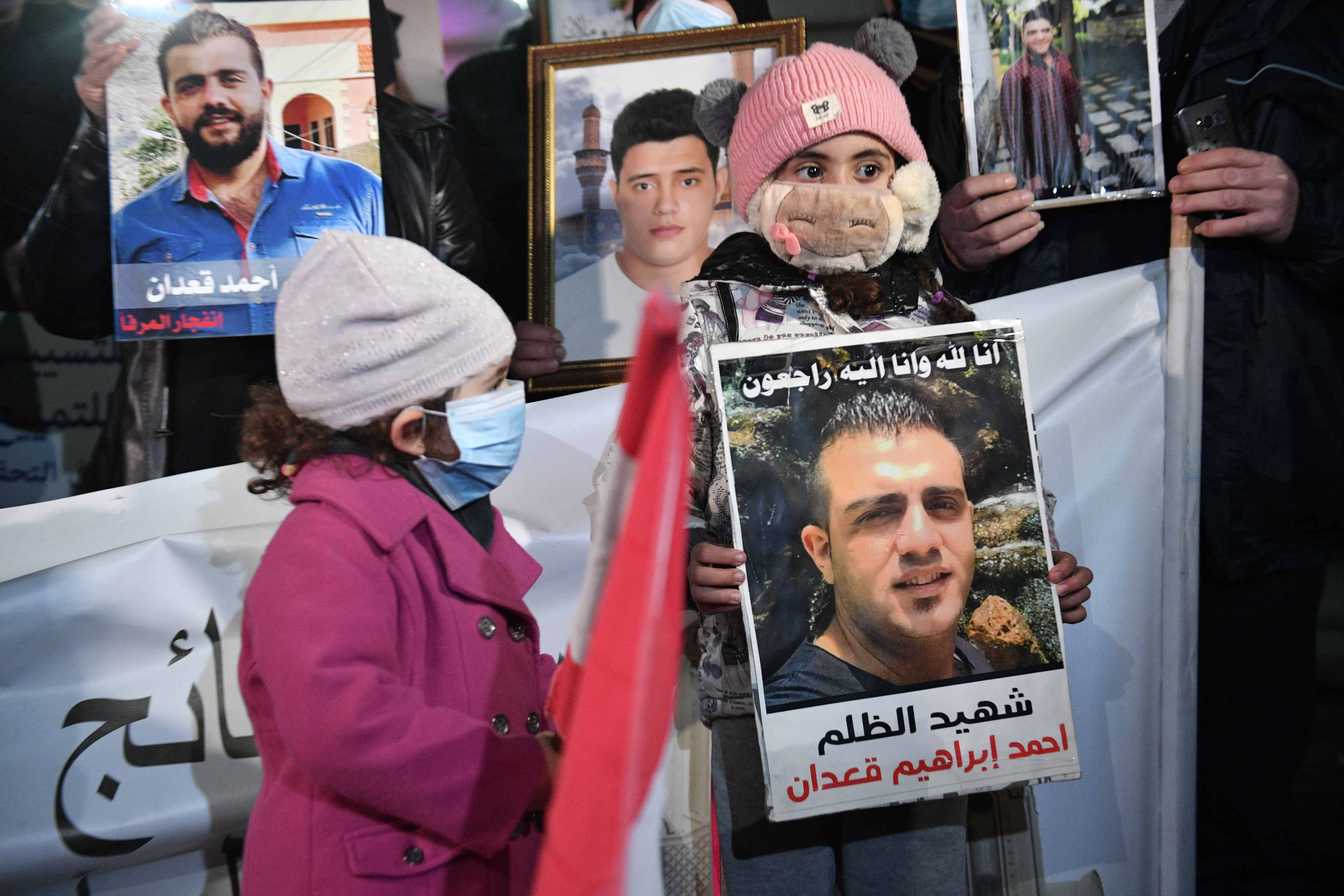
Protests against recusal of Beirut port blast judge

by Greg Demarque February 19, 2021
written by Greg Demarque

Parents and relatives of the victims of the Beirut port blast staged a spontaneous protest near the Courts of Justice in Adlieh in the evening of February 18th 2020 to express their anger and frustration at the recusal of Judge Fadi Sawan from the investigation earlier in the day, a decision condemned by both human rights activists who denounced perceived political interference in the judiciary process and the parents of the victims who still cry out for justice more than 6 months after the blast.
The recusal of Judge Sawan is expected to further delay the investigation to uncover the parties responsible for the presence of the ammonium nitrate inside the port and the explosion that left more than 200 dead, 6,000 wounded and thousands homeless.

[rl_gallery id=”27263″]
February 19, 2021 0 comments
0 FacebookTwitterPinterestEmail
Photo Essay

Vaccination campaign finally launched

by Greg Demarque February 14, 2021
written by Greg Demarque

On Sunday, February 14th 2021, began the pre-vaccination campaign organized by the Lebanese Ministry of Health for Lebanese medical personnel at the Rafic Hariri University Hospital, Saint Georges Hospital University Medical Center, and the American University of Beirut Medical Center (AUBMC), to be followed on Monday 15th by a general vaccination campaign for Lebanese citizens aged 65 years and more that have registered for the vaccine on the website of the Ministry of Health.

[rl_gallery id=”27236″]
February 14, 2021 0 comments
0 FacebookTwitterPinterestEmail
Photo Essay

The Funeral of Lokman Slim

by Greg Demarque February 11, 2021
written by Greg Demarque

In the midst of Beirut’s beleaguered southern suburbs, statements for logic and reason, as well as empathis condemnations of terror and weapons, were solidified on this February 11, as clerics and dignitaries from Lebanon’s religious communities along with several foreign ambassadors joined with activists and family in the funeral of slain Lebanese filmmaker and fearless journalist Lokman Slim

[rl_gallery id=”27228″]
February 11, 2021 0 comments
0 FacebookTwitterPinterestEmail
Photo Essay

Civil unrest in Tripoli

by Greg Demarque February 1, 2021
written by Greg Demarque

Tripoli protests continued to be intense, on January 31, 2021, in Al Nour square. It started with the arrival of demonstrators from Beirut, and ended up with armored vehicles and the Lebanese army soldiers’ pursuit of a group of young demonstrators in the streets of Tripoli.

[rl_gallery id=”27231″]
February 1, 2021 0 comments
1 FacebookTwitterPinterestEmail
Entrepreneurship

Entrepreneurship

by Executive Editors February 1, 2021
written by Executive Editors

Executive’s faith in the Lebanese spirit of entrepreneurship remains strong. Despite compounded crises that have blocked foreign transactions, raised operational costs, and accelerated the migration of a skilled workforce, entrepreneurship in Lebanon continues to demonstrate its resilience, creative problem-solving, and untapped potential.

To reaffirm its support to entrepreneurship, Executive produced this video in collaboration with Konrad-Adenauer-Stiftung (KAS).

February 1, 2021 0 comments
0 FacebookTwitterPinterestEmail
Photo Essay

Civil unrest turns violent

by Greg Demarque January 29, 2021
written by Greg Demarque

Tripoli protests January 28, 2021, in Al Nour square.

7:30 p.m.

Protesters have already set fire to one of the doors of Al Tell police station, Bechara El Khoury street. Tear gas grenades rain down from the roof of the building and the air is unbreathable.

 Gas floods the adjacent streets for more than 2.5 hours, which did not prevent protesters from throwing Molotov cocktails at the police station.

10 p.m.

The army on the outskirts of the square decides to dislodge protesters by storming the square.

Driven from their place of protest, the demonstrators headed for the town hall of Tripoli, left unprotected, and ransacked and burned it.

11:00 p.m. The army arrives in front of the burning serial.

11:15 p.m. A fire truck arrives on the scene, but does not have sufficient water, so there is confusion and disorder before another fire truck arrives 20 minutes later.

[rl_gallery id=”27234″]
January 29, 2021 0 comments
0 FacebookTwitterPinterestEmail
BankingBeirut Port explosionBusinessBusinessCultureFinanceOverview

Pivotal events of 2020

by Nabil Makari December 31, 2020
written by Nabil Makari

DECEMBER 19
Parliamentary consultations take place. Mr. Hassan Diab is nominated to form a government, backed by the Amal movement, Hezbollah, the Free Patriotic Movement, the Marada and others.

DECEMBER 20-31
Heavy protests take place, protesting the nomination of Hassan Diab as Prime Minister.

JANUARY 14
Lebanese Protests resume after weeks of calm. Banks are heavily targeted as the focus of popular anger centers around the Lebanese banking sector. Roads are closed by protestors all around Lebanon.

JANUARY 16
Contrary to cabinet leaks circulating in the news, the formation of the government does not take place, without any explanation.

JANUARY 18
Clashes occur between protestors and the police, resulting in 400 wounded and 34 arrested. Protestors were dispersed by the police, the latter using teargas, water cannons, batons and rubber bullets, in violation of international conventions.

JANUARY 21
A new cabinet is formed. The government, essentially backed by the March 8 coalition and its allies, is heavily rejected and protestors go to the streets in a clear sign of rejection.

JANUARY 22
Clashes occur between the police and protestors outside the Lebanese parliament.

JANUARY 25
Crowds gather around Beirut to celebrate the 100th day of the Thawra, protestors demand for a complete overhaul of the Lebanese political system.

FEBRUARY 1
Protesters gather outside the US Embassy in rejection of US President Donald Trump’s Middle East Peace Plan.

FEBRUARY 5
Protests ongoing in refusal to recognize the new government.

FEBRUARY 6
In light of the financial crisis, the new government presents its plan to fight tax evasion and publishes a detailed policy paper in this regard.

FEBRUARY 11
Protests occur in light of the new government’s confidence vote. Protests become violent in front of parliament due to the police’s heavy use of batons, teargas and rubber bullets.

FEBRUARY 21
The 1st case of COVID-19 is confirmed in Beirut.

FEBRUARY 28
Lebanon bars all travel by non-residents by air, sea or land from countries worst hit by COVID-19. The Public Works Ministry named China, South Korea, Iran, and Italy as affected countries.

MARCH 8
Lebanon announces default on $1.2 billion Eurobond payment.

MARCH 10
The first COVID-19 related death is recorded.

APRIL 21
Ten people are killed in a shooting in the village of Baakline.

APRIL 22
Mazen Harfoush, the gunman in the Baakline shooting, is apprehended and confesses to his crimes.

MAY 31
Lebanon reaches 1,220 cases of Covid-19 infections

JULY 27
Exchange of fire between Israeli soldiers and four Hezbollah members, no escalation occurs.

AUGUST 4
An explosion in the port of Beirut kills 203 people, wounds thousands and results in 300,000 people losing their home

AUGUST 5
The government declares a two-week state of emergency following the explosions, effectively allowing the military a free hand in tackling the security situation.

AUGUST 6
French president Emmanuel Macron arrives in Beirut and visits the scene of the explosion and tours the damaged quarters in Beirut. He engages in discussions with residents of Beirut and calls for government reforms and anti-corruption measures. Macron declares that he would help gather international aid through an international summit with the European Union, Arabic countries and the USA, with such aid being conditional on the government implementing reforms. Protests break out as a popular anger is at an all-time high due to the blast. 16 port employees, accused of being connected to the explosion, are arrested according to the military court spokesman.

AUGUST 7
Lebanese officials declare that the victims of the explosion are numbered to 157 deaths and 5,000 wounded. The European Union releases emergency funds for aid amounting to $38 million. According to Boris Prokoshev, former captain of the ship that brought 2,750 tons of ammonium nitrate to Beirut, Lebanese authorities were “very well” aware of the risks of stocking the said amount in the Beirut port.

SENSITIVE MATERIAL. THIS IMAGE MAY OFFEND OR DISTURB An injured man is transported on a stretcher following an explosion in Beirut’s port area, Lebanon August 4, 2020. Picture taken August 4, 2020. REUTERS/Mohamed Azakir – RC2K8I9K1KYA

AUGUST 8
Protests occur all over Lebanon, with over 700 reportedly wounded and one policeman killed. Protestors storm through various official buildings, including the foreign ministry, as the crowds of protestors face police violence. Prime Minister Hassan Diab calls for new elections, while the 3 MPs of the Kataeb party resign.

AUGUST 9
Ministers Manal Abdel Samad and Demianos Kattar submit their resignations. International leaders join a donor conference by videoconference with the United Nations. France pledges nearly $300 million of direct assistance to the Lebanese population.

AUGUST 10
Prime Minister Hassan Diab announces that he and his cabinet’s resignation.

AUGUST 27
Clashes between Hezbollah and tribal members in the town of Khalde resulted in two deaths and ten wounded.

AUGUST 31
Lebanon reaches 17,308 cases of Covid-19 infections.

SEPTEMBER 8
Ali Hassan Khalil and Youssef Fenianos, two former ministers, are sanctioned by the US Treasury’ Office of Foreign Assets Control (OFAC).

OCTOBER 9
A fuel tanker explodes in Beirut, leaving at least four people dead and thirty injured. The blast occurred after the tank caught fire in the Tariq-al-Jdide district.

OCTOBER 14
A delegation led by Brigadier General Bassam Yassine launched talks facilitated by the United Nations and the United States with Israel over the disputed maritime border.

OCTOBER 22
Saad Hariri is charged with the formation of a new government.

NOVEMBER 6
Free Patriotic Movement leader Gebran Bassil is sanctioned under the Global Magnitsky Human Rights Accountability Act by the United States.

DECEMBER 21
Parliament passes a law to lift banking secrecy for the duration of one year

DECEMBER 28
Lebanon reaches 171,226 cases of Covid-19 infections, with the death toll at 1394

December 31, 2020 0 comments
0 FacebookTwitterPinterestEmail
AnalysisBusinessCommentRetailSpecial Report

Executive Magazine’s December issue

by Executive Contributor December 31, 2020
written by Executive Contributor

Dear Executive readers,

It is our honor to present to you our end-of-year issue. The year behind us has been tumultuous worldwide, and especially for Lebanon – a small country that has many times carried its weight throughout international and regional crises. The tri-tragedy of the pandemic, the port explosion, and the collapse of the economic system has revealed our brightest and strongest asset: ourselves. As a people, we have risen with grace and generosity in facing 2020. A spirit we feel confident will carry into 2021.

In this issue we take a bird’s eye view of 2020. It includes in-depth overviews of banking, energy, trade, and retail. The magazine also includes two special reports produced in partnership with the Konrad Adenauer Foundation: the first focuses on health care, and the impacts of Covid-19 and the port explosion; while the second focuses on entrepreneurship, covering the grim reality of the sector, but its potential to grow into a regional knowledge economy hub.

As a highlight, the issue features an updated version of the Economic Roadmap. It outlines urgent emergency measures for the near future as well as longer term needs in detailed strokes; measures Lebanon must take to place itself on solid economic, social, and political grounds for recovery.

With this, we wish you a very happy new year. May your year be blessed and full of wonder.

Executive Editors,

December 31, 2020 0 comments
0 FacebookTwitterPinterestEmail
EntrepreneurshipSpecial Report

Lebanese start-up funding threatened

by Nabil Makari December 31, 2020
written by Nabil Makari

Eager to capitalize on the tech-savvy population,high education rate and entrepreneurial spirit, Banque du Liban’s (BDL) Circular 331, released in 2013, paved the way for the creation of dozens of startups in Lebanon, in addition to accelerators and incubators. Despite this support, events of the past few years have put a stop to the generous investments in startups.

Circular 331 was meant to incentivize local banks to invest in the local tech scene to turn Lebanon into a start-up nation. The circular encouraged banks to allocate up to 3 percent of their capital in startups, incubators, accelerators and venture capital funds by a mechanism that would guarantee reimbursement in case of failure of the said venture up to 75 percent of direct startup equity investment or indirect support entities. Local banks would be authorized to obtain a seven-year loan from BDL with zero interest, in exchange for investing it in Lebanese Treasury Bills with an interest rate of 7 percent, in return for the banks committing to invest in the knowledge economy with BDL guaranteeing the investment up to 75 percent and sharing the profits with the banks at 50 percent.

The structure of the initiative allowed for more guarantees. In 2014, this allowed for an injection of $400 million in the Lebanese knowledge economy. According to Bassel Aoun, program manager at Kafalat for the Innovation in Small and Medium Enterprises (ISME) program, a project supported by the World Bank, the major source of startup funding has come through Circular 331 subsidies. Banks are the main suppliers of funds through Circular 331, so the current banking crisis has resulted in this money drying up overnight.

“Most of the funds came from the banks’’, says Fadi Bizri, a partner at B&Y Venture partners. Indeed, in the absence of well-developed capital markets in Lebanon, the attempts to reach international investors have been lukewarm, and the ecosystem has been resting mostly on BDL’s shoulders.

Nevertheless, in light of Lebanon’s financial woes, and due to regulatory hurdles and other shortcomings of the Lebanese economy, the support mechanism established through Circular 331 have stalled.

Due to the current financial crisis, and to capital controls, it has been difficult to get investments from abroad to local startups, and trying to attract such investors is, according to Aoun, “counter intuitive”. “Capital controls are affecting the performance of our companies,” Aoun continues.

Indeed, startups in Lebanon are being barred from wiring money abroad to pay for marketing, software, ads, and foreign talent, which is having an adverse effect on their financial standing. “It’s a nightmare” says Fadi Bizri, taking into account that the value of a startup is heavily related to the value of its software (hosted on servers such as Amazon Web Services), data and cloud management, all of which require international payments to be maintained.

To add, startups are no longer able to hire talent from abroad, and are even losing talent to emigration. “Between the thawra, capital controls and Covid-19, there is a lack of trust from abroad in the local economy and therefore very little to no investment,” says Nicolas Rouhana, general man-
In collaboration with 43 ager at IM Capital, an initiative funded by USAID
which provides capital and support to companies through early-stage investors like angel investors, venture capital funds, accelerators and incubators .

Efforts to mobilize international investors have had little to no tangible result, most finance experts say. Consequently, many startups are considering moving abroad to re-incorporate in a different jurisdiction. Start-ups are also being pushed to relocate by investors, who are nervous about the current situation and Lebanese judicial regulations, as Lebanese commercial laws are deemed too rigid for the corporate structures needed in venture capital. Also, the relocation of these start-ups abroad would allow them to raise capital from different pools of investors, in jurisdictions where money would be more easily accessible.

Nevertheless, initiatives to channel foreign money into Lebanese startups have not fully dried up. IM Capital, for example, to help provide relief for affected SMEs in light of the August 4 Beirut port explosion, recently launched the “heartfelt support to Beirut” – initiative supported by USAID
to help channel 2 billion LBP through its companies across four sectors: education, housing, food and water, securities and business platforms. The
money will be used to provide relief packages to clients and beneficiaries who have been affected by the port explosion.

HAVE START-UPS TRIED TO CHANNEL SOME OF THE LOCAL EPOSITOR MONEY?

Startups would, in principle, be seen as attractive investments to local depositors worried about capital controls and talks of haircuts on deposits. “We have witnessed this trend”, says Aoun, mentioning investments in local dollars – “lollars” – in startups, “though it has been minor for early stage startups”.

Nevertheless, for startups less dependent on foreign money, Rouhana believes that this could result in a mix of “fresh” dollars and local dollars
as an investment tool in the near future. Such a mix of local and international dollars, according to Fadi Bizri, would not depend so much on the startup’s industry, but more on how mature the company is. Mature companies wishing to pay higher salaries, for example, or needing to transfer money abroad, would be less interested in the use of local dollars.

Other ways to circumvent the difficulty of accessing capital and sending money abroad is the use of crypto-currency and crowdfunding. The use of crypto in Lebanon is not obvious as such tokens would have to be converted to hard cash – and buying them would prove difficult due to capital controls. Regarding crowdfunding, there have been minor initiatives but they have been made on a small level. According to Bizri, “You have small initiatives from people abroad who want to help”, but those happen mainly for companies with exportable (or potentially exportable) products who are in need to import things like raw materials or machinery, and that can repay investments with ‘fresh’ dollars, which is not the case for most startups in Lebanon who are engaged in the local production and distribution of services.

“The last 14 months have been challenging in abnormal ways for any entity across Lebanon” says Mouhamed Rabah, Chief Executive Officer of the Beirut Digital District (BDD), a privately-funded community space that
hosts startups, incubators, accelerators and funds. According to him, startups are looking for international funding, but this comes with a requirement to reincorporate abroad. He argues that two elements are driving these companies to reincorporate: the drying up of funds for startup investments in Lebanon, and a loss of trust in the government and institutions due to the August 4 explosion. Indeed, the latter seems to have been the breaking point for many talents, who do not see the need to risk their lives or their childrens’.

“We are seeing an increase in demand from companies wanting to set-up their back office in Lebanon due to a more competitive financial cost and this could help Lebanon transform into an added value outsourcing hub, building on the yearly graduating talents” says Rabah. For example, a Saudi company is opening up their engineering office in Lebanon at BDD to profit from these now more affordable talents. More of these examples can be found at BDD, according to Rabah.

As local funds dry up, startups can turn to their networks in the diaspora, as incorporating outside of Lebanon doesn’t necessarily mean to pack bags and leave. Indeed, reincorporating abroad can mean setting up another legal structure and bank account for cash management outside of Lebanon, but does not imply leaving the Lebanese market as a whole or moving out completely.

December 31, 2020 0 comments
0 FacebookTwitterPinterestEmail
  • 1
  • …
  • 37
  • 38
  • 39
  • 40
  • 41
  • …
  • 689

Latest Cover

About us

Since its first edition emerged on the newsstands in 1999, Executive Magazine has been dedicated to providing its readers with the most up-to-date local and regional business news. Executive is a monthly business magazine that offers readers in-depth analyses on the Lebanese world of commerce, covering all the major sectors – from banking, finance, and insurance to technology, tourism, hospitality, media, and retail.

  • Donate
  • Our Purpose
  • Contact Us

Sign up for our newsletter

    • Facebook
    • Twitter
    • Instagram
    • Linkedin
    • Youtube
    Executive Magazine
    • ISSUES
      • Current Issue
      • Past issues
    • BUSINESS
    • ECONOMICS & POLICY
    • OPINION
    • SPECIAL REPORTS
    • EXECUTIVE TALKS
    • MOVEMENTS
      • Change the image
      • Cannes lions
      • Transparency & accountability
      • ECONOMIC ROADMAP
      • Say No to Corruption
      • The Lebanon media development initiative
      • LPSN Policy Asks
      • Advocating the preservation of deposits
    • JOIN US
      • Join our movement
      • Attend our events
      • Receive updates
      • Connect with us
    • DONATE