• Donate
  • Our Purpose
  • Contact Us
Executive Magazine
  • ISSUES
    • Current Issue
    • Past issues
  • BUSINESS
  • ECONOMICS & POLICY
  • OPINION
  • SPECIAL REPORTS
  • EXECUTIVE TALKS
  • MOVEMENTS
    • Change the image
    • Cannes lions
    • Transparency & accountability
    • ECONOMIC ROADMAP
    • Say No to Corruption
    • The Lebanon media development initiative
    • LPSN Policy Asks
    • Advocating the preservation of deposits
  • JOIN US
    • Join our movement
    • Attend our events
    • Receive updates
    • Connect with us
  • DONATE
Comment

The region’s rising risk

by Paul Cochrane April 1, 2010
written by Paul Cochrane

Getting labeled as a high risk country for firms to operate in, or receiving a low financial rating by an agency, is like a movie getting slapped with a XXX rating instead of the General Release investors had hoped for — meaning the mainstream conservatives are going to stay well away.  Recently, ratings agency Moody`s downgraded seven state-linked firms in Abu Dhabi by a notch or more due to “no explicit formal” government guarantee to support the companies, and is considering downgrading four United Arab Emirates banks.

This comes as predominantly Western financial analysts are mulling not only higher risk ratings for Middle Eastern and North African (MENA) countries, but the region at large. The recent situation in Yemen, ongoing insurgency in Iraq and Israel’s sabre-ratting on Lebanon’s border are all causes for concern, as is as the potential for widespread conflict if the situation between Iran and the United States/Israel deteriorates into actual war.

On top of this, US regulatory watchdog, the Treasury Department’s Financial Crimes Enforcement Network (FinCen), is widening its offensive on the global financial system, from the now well-established anti-money laundering and counter terrorist financing regulations all banks operating with the US have to comply with, to a heightened focus on corruption – the Foreign Corrupt Practices Act (FCPA). This onslaught by Washington and US-based ratings agencies is making life hard for Middle Eastern financial institutions and foreign firms that work in the region, and in particular for raising capital in an already tight lending environment. But while the UAE is being a touch sensitive about the downgrades — after all, British and American banks received lower ratings following the financial crisis and resultant government bailouts — the regulatory side is decidedly political.

Since the creation of the US Patriot Act in 2001, doing business with the “wrong sort” has been taken increasingly seriously. Early last year, British bank Lloyds TSB was slapped with a $400 million fine by a New York court for illegally transferring funds on behalf of clients in Iran and Sudan, both of which are under US sanctions.

The lesson to be learned is clear: if you do business with the likes of Iran, don’t get caught, and if you do get caught, make sure you are making enough profit to pay the fines. Lloyds TSB was slapped on the wrist financially — eventually agreeing to pay $350 million — but the bank was not blacklisted by the US. It is hard to imagine a Middle Eastern bank, caught playing the same game, would be let off as easily. 

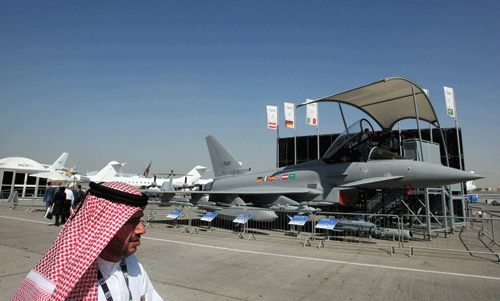
As for the FCPA, FinCen going after firms using bribes to get deals in the MENA region would open a Pandora’s Box given the rampant and endemic nature of corruption here, as a cursory glance at Transparency International’s Corruption Index shows.  British aerospace firm BAE felt this when it was investigated in London for greasing palms in Saudi Arabia to secure multi-billion dollar contracts. While cracking down on corruption is laudable, the case of BAE, like Lloyds, is a relative exception to the rule; corruption is blatantly practiced by Western firms, domestically and internationally.

 In any case, a greater focus on corruption and a higher collective risk level for the MENA would not necessarily dampen business or financial confidence; if that was the case, many firms and multinationals would have given the region the cold shoulder long ago. There is, after all, the maxim that big risks equal big rewards. Then there is the classic of “getting around” the rules and the regulations. On the regulatory level, institutions use tactics such as acquiring stakes — silently or not — in local banks and firms to operate in riskier markets. What such international firms need to watch out for is how far down the money trail US regulators may want to go. But unlike in the movies, financial institutions cannot edit or re-write the script where politics is involved; risks have to be faced head on, and it will no doubt come down to who you know.

 PAUL COCHRANE is the Middle East  correspondent for International News Services and writes for Money Laundering Bulletin

April 1, 2010 0 comments
0 FacebookTwitterPinterestEmail
Finance

Sprinting from the storm

by Natacha Tannous April 1, 2010
written by Natacha Tannous

Sprinting from the storm - First quarter results mask challenges around the bend

Once a hurricane passes, those left in its wake assess the damage, pick up the pieces and look ahead to how best to get on with life. The first quarter of 2010 was akin to such a moment for the six biggest United Arab Emirate banks, unbattening their hatches as the financial storms of 2009 slowly abated in the distance.

Ostensibly, exposure to poorly performing sectors and bad loans generally did not prevent Emirati banks from posting attractive numbers on first quarter financial statements.

But one must sift through the statistics to be sure whether faults in the findings have not been masked by opaque disclosures of asset quality and a recent UAE central bank circular to reduce provisioning.

The headline of the first quarter

Most UAE banks posted better-than-expected results, leading to improvements in ratings and paving the way for an upward trend in 2010 estimates.

According to profit and loss (P&L) statements, quarter-over-quarter (QoQ) improvements in first quarter net income stemmed from higher operating profits coupled with lower credit costs, which had peaked in the fourth quarter of 2009.

Net Income and balance sheet size of Dubai
</p>
									            </div>
        </div>

		            <div class=

April 1, 2010 0 comments
0 FacebookTwitterPinterestEmail
Business

Going your own way

by Carla Haibi April 1, 2010
written by Carla Haibi

After 18 years of partnership, the agency formally known as Saatchi & Saatchi Levant has split from the Saatchi & Saatchi worldwide network to become M&C Saatchi Middle East and North Africa, under Eli Khoury’s strategic leadership. Through this new partnership with M&C Saatchi, Khoury, chief executive officer of Quantum Group, is adopting a business model that may be a harbinger of a new way to conquer the market: one client at a time, one ad at a time.

Khoury says his drive for growth and continuous learning force him to challenge his status quo with every coming decade. After launching Quantum Group and its components in consultancy, content and communications in 2000, the advent of 2010 was a catalyst for Khoury to reassess his company’s standing and the way it provides services.

Companies need to design strategies in line with new trends in tools and technology if they want to stay on top of the communications game. The inability of big networks to keep pace with the shifting momentum of the industry fueled Khoury’s decision to split from Saatchi & Saatchi. “If you want to offer a client  something in communications, you have to walk in knowing what is happening online, offline and everywhere else,” he said. In a transforming industry, Khoury advocated a thorough mastery of the new trends in communication and how to apply them to any agency or network’s core strategies.

“It’s not only about bringing the cyber age into communication,” he said. “You have to really understand it. It has to be part of your first thinking.”

When Khoury first partnered with Saatchi & Saatchi network, as Saatchi & Saatchi Levant, it was still with the brothers Maurice and Charles, who founded the firm in 1970. The brothers later split from the network to start M&C Saatchi in 1995. In the mean time, Saatchi & Saatchi turned into a global network owned by Publicis Group. But then the network’s advertising spirit lost its essence, said Khoury.

Splitting from the pack

With half of the region managed by Saatchi & Saatchi and the Levant area managed by Eli Khoury, under the Quantum Group, the network was much less concerned with the small Middle East market than it was with the larger and more lucrative emerging markets of Brazil, Russia, India and China. After careful examination, Khoury could no longer see the relevance of being bound to a global network.

“Their agenda for the Middle East was something that we could not find our way through,” he said, noting that the agenda was not just about the future plans and strategies, but also about the clients they cater to, as well as allocation of their competencies and talents.

Diverging agendas with the Saatchi & Saatchi network was not the only problem though. The impact of the economic downturn on the mega group trickled down to the regional agencies and then to the clients, due to budget restrictions and lack of investment opportunities. The disagreement was also rooted in the disparity between how the Saatchi & Saatchi network wanted to do business, how it could adapt to the change in the industry, and Khoury’s vision and aspirations. Saatchi & Saatchi worldwide, a network operating in many countries, had an inefficient formula that, according to Khoury, was outdated in today’s changing industry.

While he agreed that larger networks provide a presence worldwide, this presence does not always deliver as it should.

“That big network name doesn’t give you added value,” said Khoury. “The myth of a network agency doing better because it belongs to an enormous machine doesn’t exist.”

In reality, the network’s operating costs were high, its resources, core competencies and talents diluted, and the investment opportunities were limited as a result of the economic downturn. Consequently, agencies in the Middle East were penalized by budget restrictions and their relationships with clients were jeopardized.

“If you look at networks that are owned by mega groups, [they] cannot invest as we speak, [even] if they have an important client they need to cater to,” Khoury explained. “Somebody who lives in a far off land is taking decisions on behalf of the region, whereby [that] region might have its own specific needs, its own specific hunger and investment requirements.” 

Another issue was that business coming from the network was limited.

“Some 95 percent of our revenue and of our work is from our agency’s clients, which did not come from the network,” said Khoury.

The network was also squeezing the already limited resources to maximize services for minimum fees, while the revenues and operating costs remained the same. As a result, the network was not accommodating clients properly, and neither could Saatchi & Saatchi Levant, given the nature of the agreement with Saatchi & Saatchi worldwide network.

Additionally, having a fully operating agency in almost every market is no longer optimal, as it erodes both revenues and talents.

“The thickness of your talents working together is nuclear,” said Khoury. “It is like any good paste, you dilute it too much [and] it becomes watery.”

On the other hand, through the strategic partnership with M&C Saatchi, an agency that also has a multinational presence, Khoury claims he is acquiring more flexibility in terms of his core strategies, resource and competency allocation and, more importantly, decreasing operating costs.

A fresh start

Along with a new name and partnership, comes a new business model. With M&C Saatchi, Khoury sees it as more efficient and effective to behave like a consulting group, with a back office — which he calls the “lighthouse” — being the main hub of competencies in Lebanon, and a front office of consultants and talents, acquired as necessary.

Such a centralized business model with an expansion strategy helps his company make use of economies of scale to provide a better service for the client, at a lower cost. It also offers flexibility to service choice clients and concentrate on lucrative markets, while still having the freedom of getting in and out.

The focus will not be on increasing market share or on going after market advertising expenditure, but rather on following target clients.

“We will be driven by the client not the market,” said Khoury.

Similar to supply-chain management, the new business model relies on building a competitive and competent infrastructure and leveraging the logistics, all in synchrony with demand. Hence, new acquisitions, if any, will be to diversify the services, and supply new competencies to the clients.

Completing the Saatchi circle

Quantum Group’s communication services are now referred to as M&C Saatchi MENA, with a minority stake going to M&C Saatchi. The MENA agency also features Brand Central, Fusion Digital and Vertical Media, regional brands that offer expertise for offline and online communications and brand building tasks, servicing clients with a wider range of interests.

Geographically, there will be no more limitations as to which clients Quantum with M&C Saatchi can access, in the Near East, Middle East, North Africa, and beyond if need be. Without the restrictions set by alliances with mega-networks, Khoury can also cater to any client anywhere without worrying about having an office in that specific location, with the specific competencies that will deliver a quality service.

“If our client is a multinational and wants us to be in five different countries, we will be in five different countries at the same time,” he said.

Having established a firm regional standing in media and communications, Khoury endeavors to thrive on continuous growth and push industry standards higher every decade. The value of his group has been its propensity to push the red lines, acting unconventionally while addressing the effects of new media on the industry, and incorporating new tools into core strategies that better serve the client.

In spite of the current industry changes, Khoury believes that when delivering a message, the principles will always be the same. The template, through which that message is delivered, however, is in flux.

In the process of globalization and the extension of the worldwide network, Khoury felt advertising work lost its zest.

“It’s becoming so mechanical that it is not even interesting anymore,” he said.

With little added value from the global network, the split was a natural progression, with the criteria for choosing the best new partner for Quantum tied to increasing their coverage and the thirst for learning new skills. 

“We are aiming at a competency relationship rather than just a network membership,” he said. Nostalgic for the 1980s and 1990s, and the era of “true-spirited advertising”, Khoury saw in M&C Saatchi a shared passion. Just like in most industries, enthusiasm and dedication were most likely to be found in smaller agencies where creative people still thrive on making ads, rather than expanding.

“M&C Saatchi is an independent network, but it’s not a machine. It’s about Soho, it’s about Charlotte Street. We did our lengthy turn to go back to Saatchi, from Saatchi & Saatchi to M&C Saatchi. Basically, you can call us Saatchi. This is where it all started, and, it seems, where it had to end, or to start again.”

April 1, 2010 0 comments
0 FacebookTwitterPinterestEmail
Real Estate

Hilton on ice

by Rayya Salem April 1, 2010
written by Rayya Salem

Lucas William, tapped to be the director of operations at the Hilton Beirut, is not talking about the elephant in the room. Indeed, most of the affiliated parties are keeping mum about the eight-storey, 158-room hotel in Minet a-Hosn that stands ready but is suspiciously closed. The hotel’s awkward silence in the midst of a buzzing touristic hotspot has lead many a curious mind to speculate what went wrong.

Davis Langdon Lebanon (DLL), the hotel owner’s representative during the construction phase, which ended in January of 2007, abruptly left the Hilton party when its contract was up. A spokesperson from the group declined to comment, instead referring queries to the “sole owner,” Nadhmi Auchi, chairman of General Mediterranean Holdings (GMH) — an expansive holding conglomerate made up of 120 companies in 28 countries, with more than 11,000 employees and assets worth over $4 billion. However, the Iraqi-born businessman — most well known in Lebanon for his Dbayeh landmark, Le Royal Hotel, and its Watergate theme park – also shied away from an interview with Executive after originally accepting the proposal in early July. However, Nizar Younes — the original owner of the central district land behind Beirut Souks and president and founder of Butec engineering firm, which constructed the Hilton — and the commissioned architect, Younes’ daughter, Hala Younes of Atelier d’Etudes techniques et d’Architecture Beyrouth (AETA), responded to interview requests regarding the five-star hotel’s nearly three-year delay and the tangle of legal disputes.

In 2005, Nizar says Auchi was brought in as a partner in a holding company Nizar had started, called Sharikat Al Ikarat Wal Abniat (SIWA), which owned the Hilton property in full. As construction of the $70 million hotel project neared the halfway point, Nizar says he needed extra capital. He and his brother Issam retained a 49 percent share of SIWA (29 percent and 20 percent respectively), and sold 51 percent to Auchi, making him the majority stakeholder.

Auchi heralded his new stake in SIWA in GMH’s 2005 chairman’s statement, which read: “Through subsidiaries we own controlling interest in the Beirut Hilton, located in the center of the city, which is in the final stages of construction and is expected to be ready by the end of 2006.”

Nizar claims that Auchi has the master key and is leaving the Hilton locked up until he can purge the Hilton’s management, obtain full ownership and have his Le Royal team manage the hotel instead.

On July 12, the International Court of Arbitration in Paris, under the International Chamber of Commerce, ruled that Auchi must pay compensatory damages for delaying the hotel’s opening, “which was estimated by the court for the whole period to be… around $40 million dollars,” said Nizar.

In 2007 Nizar says he sold Auchi his 29 percent share, but has yet to be paid in full, with this dispute now the subject of a pending legal battle in Lebanon in the Jdeideh Court of Arbitration.

Issam Younes has held on to his 20 percent share, despite several takeover attempts by Auchi.  AETA’s Hala Younes says that her firm’s role in the project has dragged on for roughly 10 years, starting from the original contract signed with Hilton in 2000, to court arbitration in Lebanon with Auchi over lack of payment. AETA finally received full payment in 2009. 

Hala claims that the GMH chairman was in agreement with the original layout for interior design, but later didn’t pay in full, claiming that the result deviated too much from the original agreement. 

Refuting the rumors

Among the more persistent rumors regarding why the Hilton has remained closed is that it failed to meet Hilton’s construction standards. However, on Feb 21, 2007, Hilton International headquarters sent a letter of approval to the architect’s Verdun office, confirming that the hotel’s physical structure, surfaced in acid-etched glass to protect it from the sea climate and featuring custom-made interior design, was up to par. According to Hala Younes, Solidere signed the occupation permit in January 2008, verifying that the building meets legal standards. The hotel still doesn’t have a legal permit to operate, however, as SIWA has not signed it.

If, or when, the new Hilton Beirut does open, the Lebanese can be thankful that its delay was down to simple, old fashioned business wrangling, rather than an omen of imminent war like its ill-fated predecessor; the original Hilton was due to open one day before the start of the Lebanese Civil War in 1975.  

April 1, 2010 0 comments
0 FacebookTwitterPinterestEmail
Comment

Freedom in flames

by Michael Young April 1, 2010
written by Michael Young

Recently, I happened to be involved in a public debate about the possibility of Lebanon soon introducing a smoking ban, along the lines of similar interdictions in Syria and Turkey. What most irritated anti-smoking activists was my proposal to allow for choice in certain types of facilities, with the market determining behavior. The outrage said a great deal about the mood driving a smoking ban law in Lebanon, and outside.

 The proposal was fairly benign. A ban could be made complete in most places, including ministries and private offices, but remain optional in restaurants, cafés, and bars. The reality of a ban, however, would allow owners of leisure establishments to declare them smoke-free environments, even brand them as such, without clients being able to dispute this. In turn, other establishments could allow smoking. The market would arrive at some equilibrium, with both sides satisfied.   

Rejection of these kinds of proposals generally revolves around three arguments. First, that the freedom of choice, as the National Tobacco Control Program put it in a letter sent in retort to my argument, “ends where my nose begins.” Tobacco kills, the writer reminded us, and exposing people to second-hand smoke endangers them: “Tobacco remains the leading cause of preventable deaths in the world, as well as in Lebanon, and hence should always be considered a public health priority.”

 A second common argument is that if restaurant, bar, and café owners were offered a choice, they would opt to allow smoking and, therefore, everything would remain the same. The third argument is more philosophical, though it is closely related to the first. Smokers and non-smokers don’t have the same freedom to choose. Because smokers harm others, their freedom to smoke is immoral. Consequently, anti-smoking activists are justified in imposing a total ban on smoking, except for outdoor facilities where the risk is less.

In many respects these arguments miss the point, when they are not contradictory. Preventing individuals from absorbing second-hand tobacco smoke is defensible. But in what way does labeling establishments as smoking or non-smoking prevent this? If I hate cigarette smoke, I can go to a non-smoking restaurant or bar; if I want to smoke, I can go to a place that allows smoking. Restaurant and bar owners who don’t want people to smoke will be armed with an official ban allowing them to convert their facilities. Given the number of people who reacted with vehemence to my proposal, their clientele will be large.

 Which leads us to the second argument. Giving establishments a choice to be smoking or non-smoking might not preserve the status quo at all. As the author of the National Tobacco Control Program admitted, in glaring contradiction with his or her defense of the status quo argument: “The idea that businesses will suffer with a 100 percent ban is a myth. While not a single independent study has proved a smoking ban produced negative results for the economy, numerous studies in countries such as Italy, Ireland and Canada have shown that business on average remains the same or even increases with such smoking bans.”

 Precisely, and the same argument can be made for a partial ban. The reason is that there is high demand for non-smoking facilities, and owners of restaurants and bars will cater for this. With time, I predict the number of non-smoking facilities will rise. Why? Because non-smokers will gradually impose their will on smokers by refusing to go out with them to smoking establishments. After all, it’s easier to forego a cigarette than to forsake a friendship. The market will respond accordingly, but choice also means that smokers will still be able to find places to light up.   

 At the heart of the discussion is the purported moralism of the anti-smoking crusaders. The matter of choice disturbs them because, ultimately, there should be no choice on immoral action. You have no freedom to kill me, they insist, and they are right. But many things kill. Alcohol kills a tremendous number of people per year, as does coronary heart disease due to eating certain types of foods. Do you legislate all behavior that poses health risks? By creating spaces for those on both sides of the smoking divide, the market imposes a more sensible outcome.  

April 1, 2010 0 comments
0 FacebookTwitterPinterestEmail
Society

Diageo – An industry cheers

by Emma Cosgrove April 1, 2010
written by Emma Cosgrove

Despite a global decline in alcohol sales, the Middle East is still supporting a healthy appetite for Scotch whiskey, according to the 2009 preliminary sales results of Diageo, the global alcoholic drinks provider. Diageo, which owns and produces Smirnoff, Guinness, Johnnie Walker, Captain Morgan and Jose Cuervo, managed to turn a profit in this year of economic turmoil, according to their figures released on August 31. As Western markets continue to suffer from the effects of the downturn, the Middle East and other emerging markets are taking the lead in terms of growth in the industry. 

“Johnnie Walker is the biggest Scotch whiskey in this part of the world,” said Gilbert Ghostine, Diageo’s Asia Pacific president. Ghostine also stated that the Middle East is just one of the emerging markets that Diageo will be concentrating on in the future.

Gilbert Ghostine is Diageo
</p>
									            </div>
        </div>

		            <div class=

April 1, 2010 0 comments
0 FacebookTwitterPinterestEmail
Comment

Resistance remembered

by Nicholas Blanford April 1, 2010
written by Nicholas Blanford

The story of the Lebanese resistance has long followed the Hezbollah narrative — unsurprising, given the party’s martial exploits of the early 1990s, when it came to dominate the effort to force Israeli troops from the country.

But last month, there was a poignant ceremony held in South Lebanon that briefly recalled another facet of military resistance against Israel’s occupation of the south, in the early 1980s, led by the remarkable, yet largely forgotten, Mohammed Saad. Born in 1956, the son of a poor grocer in Marakeh, Saad was a disciple of Imam Musa Sadr, the charismatic Iranian-born cleric who helped mobilize Lebanon’s Shia community in the 1960s and 1970s.

In the wake of Israel’s invasion of Lebanon in 1982, a resistance movement began in the villages around Tyre, an area that became known as the “arc of resistance.” Although Saad was the leader of the Amal resistance, he little looked the part of an influential military commander. He had narrow shoulders, a skinny physique and was described by one contemporary as “child-like” in stature. With his thick mane of wavy black hair, thin moustache and a scraggly tuft of beard on his chin, his appearance more resembled an American beat poet from the 1960s than a charismatic guerrilla commander. As hit-and-run attacks began to extract a mounting toll on the Israeli occupiers, they lashed back with punitive raids against the villages of the area. Resistance became a community effort. When Israeli columns were seen approaching a village, the warning was broadcast from the mosque, allowing resistance fighters to escape to their hideouts while women blocked the roads with burning tires and hurled stones and saucepans of boiling oil at the Israeli soldiers.

On one occasion, the Israelis learned that Saad was in Kfar Sir and surrounded the village with troops. Saad ran into a house and without saying a word to the startled family climbed into a pair of pajamas he saw lying on a bed. When Israeli soldiers banged at the front door, Saad himself opened it, dressed in the pajamas. The soldiers said they were looking for Mohammed Saad. The wily Saad turned to the family inside and said “Mother, they’re looking for someone called Mohammed Saad?”

“Never heard of him,” the mother replied, and the soldiers left. At the beginning of 1985, the Israelis began a phased retreat to a strip of territory along the border. Their withdrawal was marked by a brutal “iron fist” campaign against the villages of the south, marked by random executions, bulldozing of houses and mass arrests.

On March 2, 1985, Israel staged one of their biggest raids against Marakeh, but Saad and Khalil Jerardi, a top lieutenant, had already escaped. Two days later, Saad and Jerardi were holding a meeting on the first floor office of the Husseiniyah religious center in Marakeh when a bomb — planted by the Israelis during the earlier raid — ripped through the building, killing both men and 10 others.

Three months later, the Israelis had pulled back from the villages around Tyre to the border strip they would occupy for another 15 years. By then, Amal was embroiled in a savage war against the Palestinians. The “war of the camps” would sputter on for three years, sapping Amal of a number of its best military commanders and fighters. With Amal having lost some of its resistance impetus after Saad’s death, and sidetracked by the camps war, Hezbollah was able to expand its influence in the deep south, slowly transplanting its rival as the dominant Shia voice in the area.

To commemorate the 25th anniversary of Saad’s assassination, hundreds of people from Marakeh and the surrounding villages gathered on March 7 at Marakeh’s sports ground. Tough-looking men with stubbly haircuts, thick beards and rough calloused hands, and women clad in colorful headscarves, others in full-length black shadors, gathered beneath walls adorned with giant pictures of Saad and other deceased Amal resistance men whose names today are familiar only to the southerners.

A sheikh delivered a eulogy, calling Saad and his comrades “symbols of justice against murderers and killers.”

But this was very much a local affair; there was no representation from the senior ranks of Amal. Instead, the remarkable exploits of the resourceful Saad live on only in the memories of aging southerners, and in the few blurred and faded photographs of Amal “martyrs” tacked to street lights and walls in the villages of the former arc of resistance.

NICHOLAS BLANFORD is the Beirut-based correspondent for The Christian Science Monitor and The Times of London

April 1, 2010 0 comments
0 FacebookTwitterPinterestEmail
Comment

Competing for the long haul

by Peter Grimsditch April 1, 2010
written by Peter Grimsditch

The decision by Emirates Airlines to postpone moving its operations to the new Al Maktoum International Airport near Jebel Ali risks letting regional rivals steal a slice of Dubai’s hard-won and lucrative transit business on routes into Asia. According to Tim Clark, the president of Emirates, a “rethink” convinced the airline it was better to stay where it was for another decade. The moving timeframe has been put off from 2018 to 2020 to between 2022 and 2030.

“With a certain amount of investment,” said Clark, “you can get a lot more out of Dubai airport.” It would have been reasonable to add that it is much cheaper to stay put these days than it is to shift house. That “certain amount of investment” will boost passenger handling facilities at Dubai International Airport to 90 million passengers a year. That is still a long way from the staggering Al Maktoum target of an annual 160 million — or the equivalent of a little more than half the entire population of the United States.

Dubai is also an equally long way ahead of the airports at Istanbul and Doha, both of which would like to make further inroads into the growing Asia-bound traffic. Ataturk International Airport, in Istanbul, is the largest airport between Frankfurt and Dubai, and can handle 30 million people. A third airport in Istanbul would cost a minimum of $8 billion to $10 billion and the Turks are as ill-inclined these days as Dubai to splash money around unnecessarily. Istanbul has a second airport, Sabiha Gökçen but without a rapid transit access it is much too far away from the main body of the city to entertain thoughts of a grandiose future. The alternative and cheaper ideas include demolishing some high-rise apartment blocks to allow the addition of a parallel new runway at Ataturk, and a mega upgrade of the air traffic control system to allow planes to land with a gap smaller than the current minimum five miles. This could double the airport’s capacity. Hopefully the speed with which arriving passengers are processed through passport control would also be included in the plans. Qatar, too, is getting a new airport, which will be able to handle 50 million people when it is finished in 2015.

According to the International Air Transport Association (IATA), Middle East carriers are expected to carry just more than 15 percent more passengers in 2010, although few are managing to translate that into profits.  Etihad Airways expects to break even next year, Qatar’s national carrier is too busy adding aircraft to be overly concerned about the bottom line and loss-making enterprises in Dubai is too painful a topic to broach.

Even so, the expansion continues. Qatar Airways will soon launch services to Brazil and Argentina, Etihad will increase its links with Australia and Emirates is stepping up the number of flights to London. That leaves Turkish Airways (THY) in an enviable location. The number of passengers carried rose 25 percent in the first two months of this year and its fleet will be increased by 94 aircraft over the next four years; some 1,600 new air and cabin crew will be hired this year. Ten airlines, including the Polish national carrier LOT and three from the Balkans, are seeking suitable terms to be taken over by THY. It is even increasing the number of football teams with whom it has travel deals. THY signed a contract with English super-club Manchester United to ferry the team for three-and-a-half years and has a similar agreement with FC Barcelona.

In total, THY hopes to carry 31 million passengers in 2010, or more than the entire capacity of Ataturk Airport. This mathematical conundrum is easily solved by including the rest of the country’s airports. Its routes are increasing to both west and east, encouraged by the increasing numbers of countries and cities, such as Japan, the Philippines, South Korea, Hong Kong, Indonesia, Thailand and Malaysia, which no longer require pre-acquired visas from Turkish citizens. All this means more planes, passengers, routes, staff and even profits for THY — in 2009 it made just over $220 million.

Perhaps Emirates thinks it is so far ahead of Turkey and Qatar, the 10-year delay on moving its base holds no hazards. That’s what the hare thought when it left the tortoise looking at the bottom of its paws.

Peter Grimsditch is Executive’s Istanbul correspondent

April 1, 2010 0 comments
0 FacebookTwitterPinterestEmail
Comment

Mashreq enmeshed

by Riad Al-Khouri April 1, 2010
written by Riad Al-Khouri


The economy of the eastern Mediterranean went from being a unified whole under the Ottomans 100 years ago to increasing fragmentation in the Twentieth Century. This trend was especially apparent in 1950 when Lebanon and Syria broke off their customs union, and the latter proceeded to erect higher tariff barriers, eventually being emulated in this respect by Jordan, which also wanted to protect “infant” industries.

This issue was highlighted — and remedies for it sought — in a workshop held last month in Beirut by the United Nations Economic and Social Commission for Western Asia and the World Bank on “Regional Cross-Border Trade Facilitation and Infrastructure for Mashreq Countries.” Addressing the event, Hedi Larbi, director of the World Bank’s Middle East department, noted that “trade exchange within the Arab world is very weak in comparison with other regions of the world,” amounting to only 13 percent, compared to 21 percent in Latin America and almost 35 percent in East Asia.

Trade within sub-regions of the Mashreq is higher than that of the Arab countries taken as a whole, with Lebanon and Jordan in particular being states that do a lot of their trade with each other, and with others in the region. That point was underlined during Jordanian Prime Minister Samir Rifai’s visit to Beirut in March. During the trip, Rifai signed a number of bilateral agreements with Lebanon covering cooperation in industry, agriculture, higher education and scientific research, among others. He also stressed the need to speed up implementing the 2002 accord establishing free trade between the two countries. All this should further boost merchandise trade between the two countries, which stood at $288 million last year, an 18 percent increase over 2008. The two sides also underlined the need to promote the booming Mashreq tourist industry by conducting joint tourism fairs to sell Lebanon and Jordan as one destination.

Yet this spirit of co-operation was not always there; just as economic arguments restricted trade in goods among the countries of the Mashreq in the past 60 years, other considerations also played a role in stifling services industries. A case in point of such restrictions was the imposition of visa requirements on Lebanese travel to Jordan in the late 1970s, a step promptly followed by a quid pro quo retaliation from Beirut mandating visas for Jordanians wishing to enter Lebanon. This led to a drop in tourists heading from Amman to Beirut and vice versa, as well as diminished transport between the two countries. One result of such measures was that during the 1980s and 1990s there was a decline to only a few flights per week between the two countries, which was logical in view of falling tourist traffic. In 2005 that changed with abolition of visa restrictions for Lebanese and Jordanians in each other’s countries.

Royal Jordanian today thus has no fewer than 28 flights per week between Amman and Beirut, with Middle East Airlines also running more than one daily flight between the two capitals. Likely a result of the cancellation of visa requirements, the number of Jordanian visitors to Lebanon in 2009 was a huge 225,000, a big increase over the figures five years earlier and an example of how removing restrictions can enhance business across borders. These and similar points were made by the Jordanian premier during his latest visit to Lebanon.

At the Beirut Chamber of Commerce and Industry, Rifai outlined trade and investment prospects in the kingdom in preparation for a visit by members of the Lebanese private sector to Jordan in April. He also reviewed Jordan’s vision to build strategic relationships in the region through joint projects in the field of transport, especially railroads. That, of course, would also involve Syria, but Damascus is on board in efforts to remove obstacles to the smooth flow of goods, individuals and investments between the Mashreq countries to gradually lead toward their integration.


RIAD AL-KHOURI is a senior economist at the William Davidson Institute at the University of Michigan in Ann Arbor, and dean of the business school at the Lebanese French University in Erbil, Iraq

April 1, 2010 0 comments
0 FacebookTwitterPinterestEmail
Comment

Subsidy showdown

by Gareth Smith April 1, 2010
written by Gareth Smith

Iranian strategists have long wondered about an Islamic version of the Chinese model, which has achieved a 7 to 8 percent annual growth rate over 20 years, through easing state economic control under the Communist party’s political monopoly.

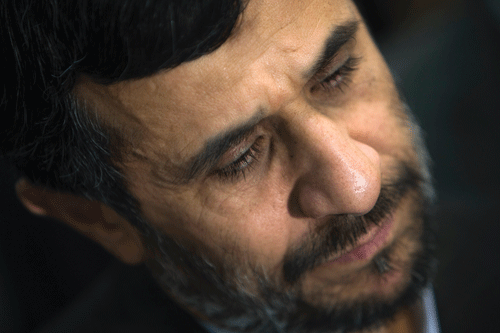
The crackdown on the reformist opposition since last year’s disputed presidential election — in which Mahmoud Ahmadinejad won a 63 percent landslide — will increase the attraction of China’s example. Iran may now be better placed for serious economic reform, with the aim of reaching the 8 percent growth envisaged by Tehran’s 2010-15 economic plan, rather than the paltry 2.2 percent forecast for 2010 by the World Bank.

Oil revenue in Iran has long pitted short-term consumption against the investment needed to finance growth. Hence, the problem with elections is that Iranians believe their country is much richer than it is and will vote for those who offer them their cut.

A friend in Tehran, now in prison, used to ask people how much they thought was their “share” of the oil wealth. The usual reply was in thousands of dollars, and he delighted in pricking the bubble by saying it was about $500 per year per adult.

Economist Djavad Salehi-Isfahani put the point differently last year, when he calculated the hypothetical per-person income of Iran’s oil and gas reserves of around 300 billion barrels, and oil-equivalent barrels, could be invested in a long-term trust fund offering 3 percent. This was at the top of the market, and yet the annual yield was $430 per person, declining over time as the population rose.

Such figures bear scant relation to the growing popular belief in Iran that oil wealth should improve people’s short-term lot. Ahmadinejad stormed to power in the 2005 presidential election promising not just a return to the egalitarianism of the 1979 Islamic Revolution, but to “put the oil money on the people’s sofreh” — the carpet or cloth on which poorer Iranians sit to eat lunch.

Yet in one of the most remarkable turnarounds in recent Iranian politics, Ahmadinejad subsequently came up with the first serious government plan to tackle the most damaging consequence of Iranians’ belief in their own wealth — the state’s annual commitment of between $50 billion and $100 billion to subsidize gasoline, electricity, bread and medicines.

Ahmadinejad’s scheme to phase out subsidies over five years and replace them with benefits targeted at the poor has put him at loggerheads with parliamentary deputies, conservative and reformist, who are loath to allow the president any discretionary spending. As much as half of the savings would be allocated to the “needy,” a difficult term to define even in economies far more developed and transparent than Iran. But after wrangling between the president and parliament, the Guardian Council, Iran’s constitutional watchdog, ruled in January there should be a new government body to receive and spend the saved money — putting it at least a step away from the president’s direct control.

In truth, many of Ahmadinejad’s opponents, inside and outside the country, are less interested in the reform plan’s potential success than in its potential to make the president unpopular. Removing subsidies could well stoke inflation and make millions of Iranians worse off in the short term. Without a broad political consensus, it is hard to see how such shock therapy could be initiated without the government falling prey to the kind of opportunistic political opposition that has stymied attempts to reform subsidies since the 1990s.

Conservatives around Ahmadinejad, supported by the supreme leader Ayatollah Ali Khamenei, now seek change. And why not? Shortly after Ahmadinejad’s 2005 election win, the reformist commentator Saeed Leylaz cited the dictum that China should adopt effective policies, whether “capitalist” or not. “The cat is finally catching mice,” Leylaz wrote, “and its color no longer matters.”

True, Ahmadinejad has shown little capacity to emulate the more subtle aspects of Chinese capitalism; privatizations have merely transferred assets to quasi-state-owned bodies. But if savings from universal subsidies can fund productive investment, then the longer-term benefits for the economy could include job creation and higher living standards. And those who had carry through the change might then benefit politically, and perhaps even be ready for more competitive elections.

GARETH SMYTH is the former Tehran correspondent for The Financial Times

April 1, 2010 0 comments
0 FacebookTwitterPinterestEmail
  • 1
  • …
  • 425
  • 426
  • 427
  • 428
  • 429
  • …
  • 696

Latest Cover

About us

Since its first edition emerged on the newsstands in 1999, Executive Magazine has been dedicated to providing its readers with the most up-to-date local and regional business news. Executive is a monthly business magazine that offers readers in-depth analyses on the Lebanese world of commerce, covering all the major sectors – from banking, finance, and insurance to technology, tourism, hospitality, media, and retail.

  • Donate
  • Our Purpose
  • Contact Us

Sign up for our newsletter

    • Facebook
    • Twitter
    • Instagram
    • Linkedin
    • Youtube
    Executive Magazine
    • ISSUES
      • Current Issue
      • Past issues
    • BUSINESS
    • ECONOMICS & POLICY
    • OPINION
    • SPECIAL REPORTS
    • EXECUTIVE TALKS
    • MOVEMENTS
      • Change the image
      • Cannes lions
      • Transparency & accountability
      • ECONOMIC ROADMAP
      • Say No to Corruption
      • The Lebanon media development initiative
      • LPSN Policy Asks
      • Advocating the preservation of deposits
    • JOIN US
      • Join our movement
      • Attend our events
      • Receive updates
      • Connect with us
    • DONATE