• Donate
  • Our Purpose
  • Contact Us
Executive Magazine
  • ISSUES
    • Current Issue
    • Past issues
  • BUSINESS
  • ECONOMICS & POLICY
  • OPINION
  • SPECIAL REPORTS
  • EXECUTIVE TALKS
  • MOVEMENTS
    • Change the image
    • Cannes lions
    • Transparency & accountability
    • ECONOMIC ROADMAP
    • Say No to Corruption
    • The Lebanon media development initiative
    • LPSN Policy Asks
    • Advocating the preservation of deposits
  • JOIN US
    • Join our movement
    • Attend our events
    • Receive updates
    • Connect with us
  • DONATE
Middle East Arms RaceSpecial Report

The Middle East Arms race

by Executive Staff November 26, 2009
written by Executive Staff

The global picture

This month the world will mark 20 years since the fall of the Berlin Wall — on November 9, 1989 — and the end of the Cold War. With the doomsday scenario of (nuclear) World War III less likely, people around the globe had high hopes for an era of peace and prosperity, including a decrease in military spending.

Following decades of military build-up in the United States, the former Soviet Union and both of their allies, military budgets did indeed decrease, albeit not for long. Over the past decade, military spending has gradually regained lost ground, reaching record levels last year.

According to the Stockholm International Peace Research Institute (SIPRI), global military expenditure in 2008 amounted to $1.46 trillion, which represented an estimated 2.4 percent of global GDP in 2008, and a 45 percent increase since 1999. Why?

The US leads the pack

“The idea of the ‘war on terror’ has encouraged many countries to see their problems through a highly militarized lens, using this to justify increased military spending, while the wars in Iraq and Afghanistan have cost $903 billion in additional military spending by the US alone,” said Sam Perlo-Freeman, head of the Military Expenditure Project at SIPRI. The US remains the world’s largest military spender.

The 2008 national defense budget amounted to $516 billion, or 42 percent of the world total, not including the $194 billion spent that year on the wars in Iraq and Afghanistan. Over the past decade, US spending increased by $219 billion, which represents 58 percent of the global increase. US Defense Secretary Robert Gates proposed a 2010 military budget of $534 billion and a reduced $117 billion budget for Iraq and Afghanistan.

The US is followed at some distance by China (8.2 percent of global military spending), Russia (4.75 percent), the United Kingdom (3.75 percent) and France (3.67 percent). China and Russia increased military spending  over the past decade by $42 billion and $24 billion, respectively. Other major budget increases also occurred in India, South Korea, Brazil and a number of Middle Eastern countries, including Israel, Iran, Kingdom of Saudi Arabia (KSA), the United Arab Emirates, Algeria and Oman.

Untransparent military budgets

KSA remains the region’s top spender, increasing its 1998 military budget by 61 percent to $33 billion in 2008. The kingdom is followed by Israel ($13 billion), Iran ($6.1 billion), Oman ($4 billion), Kuwait ($3.6 billion), Egypt ($2.6 billion) and the UAE ($2.5 billion). Considering that most countries in the Middle East have no arms industry to speak of, their share of the global arms trade is relatively high.

Military spending includes everything from soldiers’ pay and building maintenance to the actual acquisition of arms. The media often tend to confuse overall military spending with arms acquisitions.

“Many countries with lower levels of transparency do not even include arms imports in their military expenditure figures,” said Perlo-Freeman. “This may well include many Middle Eastern countries. In most cases the only data available for the military budget is a single figure, so it can be hard to relate military budgets to arms import trends. Also, official budgets often leave out quite a lot, not only arms imports. Iran, for example, does not include the Revolutionary Guard’s budget and the UAE budget does not include spending by individual Emirates, which is believed to be quite significant.”

One thing is certain: regional military spending will not decrease any time soon. In August, American research firm Sullivan & Frost concluded that the region’s military budgets are likely to break the $100 billion mark by 2014, amounting to 11 percent of global spending, compared to 7 percent today.

While most Middle Eastern countries are not among the world’s top spenders in absolute figures, they are top of the bill when military spending is defined as a percentage of GDP. The regional average is twice as high as the global average of 2.4 percent. The Middle East also scores high in terms of military spending per capita. Israel tops the global list with some $2,300 per inhabitant, followed by the US ($1,950), Oman ($1,650), Singapore ($1,625), Kuwait ($1,600) and KSA ($1,500).

It may come as a surprise to see Oman among the top spenders. The sultanate significantly increased its military budget from $1.7 billion in 1999 to $4 billion in 2008. The reasons are the same as elsewhere in the region: strategically located on the Strait of Hormuz, Oman fears Iran’s alleged nuclear and regional ambitions, as well as the fall-out from a potential US-led attack on Iran. It remains to be seen if the Iranian threat justifies the region-wide splurge in military spending. 

Top 15 countries by military spending per capita

Source: SIPRI

The regional arms race

British Typhoon combat jets to KSA, German Dolphin submarines to Israel, American Patriot defense missiles to Israel and the UAE, American F-16 fighter jets to Turkey, KSA and the UAE, and state-of-the-art American F-35 fighter jets to Israel: these are just a few examples of the military hardware coming the region’s way as part of a multi-billion dollar arms race. The Middle East has long been a lucrative market for international arms manufacturers, and will arguably remain so for many years to come.

“Predictions about the future volume of arms transfers are difficult to make, as good information is hard to get,” said Pieter Wezeman, a SIPRI senior researcher on international arms trade. “Still, known information about existing orders, and orders being negotiated, indicate that several countries will maintain their level of arms imports in the coming years.”

One major growth market will be Iraq, which is expected to increase its military spending, including arms imports, as the US army is set to increasingly take a back seat. Yet, it will take some years before Iraq will come anywhere near the region’s traditional big spenders on arms: KSA, Israel, Iran and, to a lesser extent, the UAE and Egypt.

“KSA buys everything from new German rifles to British combat aircraft, and possibly more aircraft from the US,” said Wezeman. “Some weapons are getting old and are ready to be replaced. In other cases weapons are procured, which arguably add to existing military capabilities. For example, the procurement of new and upgraded combat aircraft armed with cruise missiles will give KSA, at least in theory, the capacity to strike targets at a long range, in some ways creating a counter deterrence to Iran’s ballistic missiles.”

KSA and its allies, as well as Israel, view Iran as the main threat to regional stability, which, as such, functions as the main catalyst in the current Middle East arms race. Naturally, their concerns were not exactly reduced when the Islamic Republic in recent months test-fired a series of long-range Sijil and Shahab III missiles, whose range extends as far as Tel Aviv.

Partly with the aim to counter Iran’s ballistic threat, KSA in 2007 bought 72 Eurofighter Typhoon jets from the world’s second largest arms manufacturer, Britain’s BAE for an estimated $9 billion. The British Ministry of Defense hailed “Project Salam” as a “new chapter” in Saudi-British relations, which arguably referred to the cloud of corruption that accompanied the massive 1980s Yamamah arms deal. It speaks for itself that the $9 billion “peace project” will be spread over the kingdom’s annual military budgets for many years.

One major growth market will be Iraq, which is expected to increase military spending, including arms imports, as the U.S. army takes a back seat

Riyadh’s arms bazaar

The Financial Times in September reported another major Saudi deal, with Riyadh planning to buy at least $2 billion worth of Russian arms. According to the British daily, the contract could be signed before year’s end, yet Wezeman warned that Russian arms manufacturers tend to announce things early, and recommended adopting a “wait and see” attitude.

It is nevertheless an interesting development. KSA has significantly improved its ties with Russia in recent years. Following former Russian President Vladimir Putin’s 2007 visit to the kingdom, the first ever by a Russian head of state, Moscow and Riyadh last year signed a military cooperation agreement. The Financial Times reported the value of the deal was at least $2 billion, and possibly as high as $7 billion, including hundreds of Mi-35 attack helicopters, Mi-17 transport helicopters, T-90S tanks, BMP-3 infantry vehicles, and, most importantly, the S-400 Triumf, Russia’s most advanced anti-aircraft missile defense system.

The S-400 is an upgraded version of the S-300 long-range surface-to-air missile system, and is capable of detecting and engaging six targets from a range of 400 kilometers. Despite the arrival of the Russians in a region that is traditionally a customer of Western arms manufacturers, not a word of protest has been heard in Washington or European capitals.

“Saudi Arabia buys weapons as a ‘bribe’ to the world’s great powers in exchange for support”

Serenading Moscow

Most analysts believe that the deal is some sort of sweetener, aimed at convincing Russia to accept economic sanctions on Iran and dissuading Moscow from selling its missile defense systems to the Islamic Republic. In a widely publicized 2007 deal, Russia agreed to sell Iran its S-300 missile defense system — a contract reportedly worth between $750 million and $1 billion — yet so far no delivery has been made.

“The pressure from the US is a stick, and the huge weapons deal prepared by the Saudis is a carrot,” Ruslan Pukhov, director of the Centre for Analysis of Strategies and Technologies, told the Russian news agency Interfax. “We all know Saudi Arabia buys weapons as a ‘bribe’ to the world’s great powers in exchange for support.”

“The exact motivations and rationale for arms procurement by most governments in the Middle East often remain obscure,” said SIPRI’s Wezeman. “Only in Israel there exists some sort of public debate. It is plausible that KSA wants to buy arms from Russia, in particular air defense missiles, on the condition that Russia does not sell the same weapons to Iran. That would be a very good bargain indeed, as it would not only increase its defense capacity, but also keep Iran vulnerable. Considering the major military market in KSA, this scenario may also be appealing to the Russians.”

“But other motivations may play a role as well,” he continued. “KSA may want to diversify its sources to avoid ending up in a situation where its current suppliers will restrain their exports. KSA may want to improve its relations with a broader group of global players. Last year, for example, it bought Chinese artillery, which may have been aimed at pleasing Beijing. Finally, there may be a relation with the division between power centers in KSA, where the National Guard has often bought weapons completely independently from the armed forces.”

A qualitative edge would make up for a quantitative manpower shortage when facing a bigger adversary

Emirates bristle with US missiles

KSA is not the only country splashing out on arms. The UAE has invested considerably in missile defense systems, fighter jets and marine vessels. Unfortunately, there are few reliable figures available regarding the UAE’s overall military budget, if only because military spending by individual emirates is not included. Consequently, SIPRI has not published UAE figures since 2005. Still, from the reported arms deals it becomes clear that the UAE has optimized its defense capabilities. 

According to the Dubai-based Institute for Near East & Gulf Military Analysis (INEGMA), the noticeable hike in defense expenditure in a few Gulf countries, and specifically in the UAE, is very much related to a possible regional war between Iran, on the one side, and the United States and Israel on the other, which might swirl out of control and drag in the Arab countries.

According to INEGMA, it is of strategic importance for the UAE to keep the Strait of Hormuz open for import and export.

“Lacking geographical depth and sizable manpower, the need to protect strategic assets requires the country to seek high-tech and top quality defense systems to make up for the existing disadvantages, and to extend an effective defense umbrella to all of the state’s assets and its infrastructure,” said Riad Kahwaji, INEGMA’s founder and general manager.

“So it is a qualitative edge that would make up for quantitative shortages in manpower, especially when facing a bigger adversary.”

Fortress Arabia

According to Kahwaji, the UAE and other Gulf states could also become the target of terrorist attacks by extremists entering the country illegally by land or sea. That’s why in 2008 the UAE embarked on a multi-million-dollar high-tech project to consolidate the security of its borders with cameras and sensors, as well as reconnaissance airplanes and coastal patrol boats. The country also recently asked the Pentagon for approval to purchase more than 360 Hellfire missiles and all accompanying hardware.

Earlier this year, the UAE became the first foreign country to purchase the Theater High Altitude Air Defense (THAAD) system with advanced Patriot PAC-3 missiles for low-to-medium altitude interceptions and advanced radars, both airborne and land-based, for early warning.

The country furthermore completed taking delivery of 80 US F-16 fighter jets, which are to operate alongside its 60 French Mirages, and it has ordered a series of Hercules and Boeing transport planes from Lockheed Martin, reportedly worth some $3 billion.

Finally, the UAE Navy ordered a $117 million anti-sub frigate from Italy and asked the Abu Dhabi Ship Building Company to build 12 new Fast Fighting Vessels and upgrade 12 existing ones.

How real is the Iranian threat?

To justify the billions of dollars spent on the military in general and arms procurements in particular, the region’s politicians and media almost routinely point at Iran, which allegedly aims to build an A-bomb and is said to have regional ambitions in Iraq, Afghanistan and beyond. Or, as Egyptian President Hosni Mubarak cried in 2008: “The Persians are trying to devour the Arab states.”

Thus Iran has effectively taken over Israel’s role as the region’s main bully and bad boy. The fact is that Iran has increased its military spending, from $3.2 billion in 1999 to a touch more than $6 billion in 2008 and, as stated previously, this amount is arguably much higher as it does not include the country’s budget for the elite Revolutionary Guards.

Inflated threat

Even so, most experts agree that Iran’s military threat is greatly exaggerated. The London-based International Institute for Strategic Studies (IISS), for example, estimates that Iran, with a population of 66.5 million, spends up to 25 times less per capita on its military than Israel and most of its Arab neighbors.

According to Travis Sharp, military policy analyst at the Center for Arms Control and Non-Proliferation, the Arab states are wary of Iran’s military threat, yet that hasn’t stopped them from maintaining close political and economic relations with Tehran. Billions of dollars in goods destined for Iran pass through Dubai annually.

“Is the UAE willing to participate in strengthened sanctions against Iran if doing so would mean the loss of trade revenue?” Sharp posited. “Probably not, especially if the UAE and other Arab states believe that Europe, Israel and the US are going to deal with Iran…the Arab states want a free ride on the West’s commitment to prevent an Iranian nuclear bomb.”

“Iranian arms procurement has been discussed widely in recent years, but a lot was based on rumors…which have not proven to be true,” said SIPRI’s Pieter Wezeman. “Two years ago Iran was first said to buy 250 advanced combat aircraft from Russia, yet nothing happened. Russia has sold Iran some short-range missile air defense systems, but (apparently) has put delivery of long range air defense missiles on hold.”

“Whatever the intentions of the Iranian government are, its military capabilities are limited and easily exaggerated,” Wezeman continued. “In terms of conventional weapons Iran’s capability to threaten anyone is very limited. Iran has not been able to buy large numbers of advanced weapons, such as combat aircraft and long-range missile air defense systems, while most, if not all, of its adversaries have comparatively large, or very large, arsenals of such weapons. Iran also does not have the financial means to go on a major arms procurement spree.”

As a result, the Iranian armed forces are largely equipped with outdated weapons. Just look at Iran’s air force, which will have to win the battle for the skies with a few dozen 1991 French Mirages, Russian Migs and Chinese jets, as well as a handful of American 1968 F-4 Phantoms.

 Ironically, despite the boycott, much of Iran’s arms are American-made and stem from the days when the Shah was a major American ally. Meanwhile, the US is replacing its fleet of F-16s with the more advanced F-35s and F-22s, and has sold hundreds of F-15s and F-16s to countries such as Turkey, Egypt, UAE and KSA. Israel has the largest fleet of F-16s outside the US, and is to receive F-35s to maintain “its qualitative edge” over its Arab neighbors.

Iran’s capability to use force lies mainly in its arsenal of ballistic missiles and its influence over (militant) groups in countries such as Iraq and Lebanon. However, Iran’s missiles are limited in number and lack accuracy. Armed with conventional warheads, they have a limited military impact. Of course, if Iran would acquire nuclear warheads, the story would be quite different.

Yet, as Wezeman pointed out, it remains to be seen in such a scenario how current Arab arms procurements will actually help to face any real or perceived Iranian threat.

“It can even be argued that Iran perceives itself as being encircled by unfriendly states with considerable, partly offensive and increasing military capability, which may be an added motivation for Iran to pursue some sort of nuclear weapons capability,” Wezeman concluded.

Israel’s might made in America

Israel remains the region’s top spender after KSA, with a military budget of $13 billion in 2008, which represents some 8 percent of GDP, and an increase of 31.5 percent since 1999. Despite Washington’s arms sales to Arab countries, Israel remains without a doubt its leading ally in the region.

In 2007, the Bush administration increased military aid to Israel by more than 25 percent to an average $3 billion per year for the next decade.

“We consider this $30 billion in assistance to Israel to be an investment in peace — in long-term peace,” Nicholas Burns, then Under Secretary of State for Political Affairs explained. “Peace will not be made without strength. Peace will not be made without Israel being strong in the future.”

The Bush administration also announced the sale of additional sophisticated weaponry to Saudi Arabia and other Gulf countries, yet US officials have since repeatedly stressed that US policy in the region is based on maintaining Israel’s “qualitative military edge” over its neighbors.

Nearly half of the US annual military aid budget goes to Israel, which is the only recipient not obliged to spend all of it in the US. This has not only helped the Israeli armed forces become one of the most advanced and feared in the world, but also helped the country build a domestic defense industry, which today ranks among the leading exporters worldwide. On average, Israel uses some 75 percent of American military aid to purchase US defense equipment.

While Israel already has the largest fleet of F-16s outside the US, in addition to F-15s, as well as all the latest attack helicopters, Washington has agreed to sell 25 more advanced F-35s to Israel, with an option of another 50. The F-35 will not be sold to Arab countries. Last but not least, Israel has an estimated 150 to 200 nuclear warheads, which can be delivered by a ballistic missile.

The 10 largest arms producing companies, 2007

Source: SIPRI
*Note: Companies are US-based, unless indicated otherwise. The profit (not the sales) figures are from all company activities, which include non-military sales.
November 26, 2009 0 comments
0 FacebookTwitterPinterestEmail
Feature

Hummus slinging

by Executive Staff November 26, 2009
written by Executive Staff

A white tent, as large as a circus big-top and just as crowded, shakes and rustles to the boom of a loudspeaker.

“Hummus!” a voice bellows through a microphone. “Hummus Lubnani!”

The crowd cheers, claps, presses forward, and there, through the milling bodies, rises the ceramic contours of a giant bowl, as wide as a truck is long, its edge as high as a man’s shoulder. Around it throng an army in tall chef’s caps, stirring the bowl’s contents with giant wooden paddles. Every few minutes a chef pushes through to the bowl’s edge and empties an enormous basin of cream-like liquid into it.

Below, the digits of a huge electronic scale climb through the hundreds. The scale clicks: 2,080 kilograms weight. The crowd cheers.

“Two tons!” the loudspeaker roars. “Lebanon has just set the Guinness world record for most hummus ever assembled in one place!”

Hummus — the unassuming hors d’oeuvre that ties any Lebanese meal together — may seem an unlikely battleground for global conflict. Yet the mighty vat under the big-top sits at the center of what has become an all-out tug-of war between Lebanon — which claims to be hummus’ birthplace — and a bevy of foreign industry players marketing the dish as Greek, Turkish or Israeli cuisine.

“We first noticed our food’s piracy during international agro exhibitions, where many Lebanese products were marketed under other appellations,” said Fady Abboud, president of the Association of Lebanese Industrialists (ALI). “This results in colossal losses [for Lebanon’s economy].”

The hummus market is worth more than $1 billion globaly, with 500,000 tubs eaten every day in the United Kingdom alone, said Abboud. The international community seems to have forgotten that hummus is to the Levant what Cornish Pasty is to Cornwall, and the Lebanese want it back.

Hummus nationalists have been particularly outraged by restaurants serving hummus bi tahini, falafel and baba ghannouj as “traditional Israeli cuisine,” and are currently preparing an international lawsuit against Israel over the dishes’ ownership. 

In addition, the ALI, the Syndicate of Lebanese Food Industries, the Ministry of Industry and the Chamber of Commerce are petitioning the European Union to accord hummus, along with 24 other Lebanese national dishes, a place under its Protected Designation of Origins Act. The status assures a product can only be sold in European markets if it is produced in its country of origin.

Industry representatives stress that they are not trying to monopolize the market for chickpea dip.

“Hummus, in various forms and under various titles, is served across the Mediterranean and Middle East,” said Edward Aoun, deputy chairman of International Fairs & Promotions (IFP), the group organizing the event. “However, the name, as well as the dish in its most conventional form, are strictly Lebanese.” The first use of the term — originally hummus bi tahini — occurred in Lebanon in the 1950’s, advocates say. The first canned hummus was manufactured by the Lebanese brand Cortas.

However, thanks to rampant misappropriation by other nations, the average global consumer is more likely to associate hummus with Israel, Turkey or the Mediterranean in general, giving scant consideration to the country that first furnished the dish.

Besides potential economic gains, the fight to bring hummus back to Lebanon is a nationalistic struggle, advocates say. “This is a patriotic event on a national scale,” said Fady Jreissati, vice president of the IFP.

Whether a spot in the Guinness Book of World Records — or the  spectacle of a two-ton bowl of hummus — will be enough to gain international recognition remains to be seen. If the events of the day are any evidence, there is little doubt that the battle will go on.

November 26, 2009 0 comments
0 FacebookTwitterPinterestEmail
Feature

Running dry

by Executive Staff November 26, 2009
written by Executive Staff

At face value, the city of Hasakah in Syria’s northeast doesn’t suggest a four-year drought is underway. On the outskirts, cotton pickers work away in fields and dozens of trucks line the roads piled high with sacks bursting with raw cotton, while in the local market watermelons and vegetables are on sale, and the hotels have running bath water.

The Khabur River that runs through the city is not dry, yet hardly a river at just over ankle deep — exactly what one might expect following a hot and rainless summer, but far less than normal for early autumn.

The Hasakah area only received 100 millimeters (mm) of rain this year, well below the annual average of 200 to 250mm. As a result, an estimated 36,000 families from the Hasakah governorate have been driven off the land. In neighboring Deir e-Zour, dust storms caused by desertification were so bad this summer that, on certain days, people couldn’t see more than two meters in front of them, business ground to a halt and roads were closed off after being covered in sand.

From farming to urban poverty

Indeed, according to a United Nations report, an estimated 1.3 million people in eastern Syria have been affected by climate change and drought, while 803,000 people have lost their livelihoods. The displaced are finding their way to larger cities, living in tents and makeshift shacks, and forced to work as day laborers or even scavenge from the rubbish dumps on the edges of Damascus.

“Those that are really dependent, herders and small farmers, their livelihoods are being destroyed. If they are not already dependent on food aid, they will be,” said Jean-Marie Frentz, program manager of the economic cooperation section at the European Commission to Syria.

The paradox of places like Hasakah, deep in drought but yet still farming away, is that Syria has still not adapted its agricultural and farming policies in line with hydrological conditions. While crops fed by rainfall have failed, irrigation and the usage of dwindling groundwater reserves present the illusion, a veritable mirage, of an oasis of productive farming land.

For a country that has prided itself on agricultural self-sufficiency and its use of water resources — the back of the 500 Syrian pound note depicts the Assad Dam and fields being tilled — the drought is clearly bad news. Unlike past challenges the country has faced, however, the Syrian government is admitting they have a problem.

“For the first time the government is really speaking about the issue, and realizes it is an emergency situation. In the past, there was a tendency to deny or say it is Syrian business and [there is] no need for international assistance,” said Frentz.

A cry for help

The UN, along with seven non-governmental organizations and the Syrian government, have established the Syrian Drought Response Team, requesting $53.9 million from international donors. The bulk of the money — $29 million — is for food aid, while $20 million is earmarked for supporting agriculture and livelihoods. This is significantly more than Damascus asked for in 2008, some $20 million, which Syria failed to raise from donors until early this year.

The scale of the drought has put Damascus in a tough spot, as it was “bad public relations for Syria to have to feel like Ethiopia, presenting an image of people starving and sick children,” said Jihad Yazigi, editor of business publication Syria Report. “And it was quite a strange situation, as the same week the appeal was made [UAE real estate developer] Majid Al Futtaim announced the launch of a $1 billion project [just outside Damascus] in Yaafour. It says something about the new Syria.”

The government is even attributing the economic slowdown in the country to the drought, with agriculture accounting for an estimated 20 percent of gross domestic product and 10 percent of total exports.

Last year, as Executive reported, Syria experienced its worst wheat and barley harvest in recent history, producing just 2 million tons of wheat and 90 percent less barley than in 2007. The target for wheat production in 2009 was back to former levels of 4.5 million tons, but year-end projections estimate only 3.4 million tons.

Severely drought-affected population, 2009

Source:  Syrian Ministry of Agriculture and Agrarian Reform

Importing food staples

The up-tick is due to average rainfall in certain areas of the country, particularly along the coastline, and from better irrigation usage. However, in areas reliant on rainfall in the northeast and east, there was almost zero production, said Abdullah Droubi, director of Water Resources at the Arab League’s Center for the Studies of Arid Zones and Dry Lands in Damascus.

As a result, the Syrian government has increased its imports of wheat by 300,000 tons to 1.5 million tons this year to boost its reserves, crucial for keeping the populace placated via flour subsidies. Such a shortfall in agricultural output is forcing the government to rethink how water is allocated, with agriculture accounting for 90 percent of water usage.

“The government is looking over the next decade to reduce this figure by 30 percent through new irrigation techniques,” said Droubi, while the agriculture ministry is studying a plan to reduce cotton cultivation by 20 to 30 percent from the current one million tons per year.

A shift from heavy usage of groundwater reserves is also needed, said Frentz.

Rainfall in different regions of Syria

Source: World Food Programme

No master water plan

“The general trend is that groundwater levels are falling considerably [in recent years]. In rural [areas around] Damascus there has been a six meter per year drop, while in the Homs area the drop in groundwater levels ranges from 12 to 35 meters a year, so this is very worrying indeed and clearly not a sustainable model,” Frentz explained.

But with no master water plan and a lack of coordination between government bodies, coming up with viable solutions is problematic.

“Water is a very fragmented sector with many actors,” said Frentz. “For instance, the ministries of construction, agriculture, environment and local administration all cover different aspects of water. There needs to be an integrated water management policy, not a piecemeal approach.”

Then there is the scale of the drought and climatic changes. As Droubi pointed out droughts are often cyclical, but without scientific data it is difficult to plan ahead. And for a country of 20 million people with 2.1 percent growth per annum, such data is essential to address the needs of a rapidly growing, rapidly urbanizing population.

“We have to have a plan to combat desertification and study climate change, but there has been no research about the frequency of the drought,” said Droubi.

The shortfall in agricultural output is forcing the government to rethink how water is allocated, with agriculture accounting for 90 percent of usage

November 26, 2009 0 comments
0 FacebookTwitterPinterestEmail
Feature

Labor laments

by Executive Staff November 26, 2009
written by Executive Staff

How to solve the global financial crisis is naturally a hot topic, sparking innumerable talks, conferences and forums. The Middle East is no exception. But while certain countries in the region like to boast that the crisis has largely passed them by, delegates at the International Labor Organization’s (ILO) Arab Employment Forum (AEF) in Beirut last month pointed out that the Middle East already had a chronic employment problem well before the financial crisis struck.

Growth without jobs

The forum therefore had a degree of urgency about it, given the challenges the region faces and the world’s highest unemployment rates set to rise further, from an average of 9.4 percent  to as high as 11 percent this year, according to the ILO. Meanwhile, aggregate growth in the region is projected to drop 2 percent this year, rising to 4 percent in 2010.

Yet growth, as Ahmad Majdalani, the Palestinian Authority’s labor minister suggested, doesn’t always mean jobs, citing statistics of 5.4 percent growth regionally over the past three years but only 1.5 percent growth in job opportunities. Indeed, as the ILO’s Director General Juan Somavia said in his opening address, “the unemployment rate is only the tip of the iceberg.”

Somavia went on to blast the neo-liberal model of development as a “dysfunctional financial economy” that “privileged the short-term profit objectives of financial operators. The end result was globalization without a moral compass.”

The ILO has set itself the task of rectifying the structural weaknesses of the capitalist system, by being that seemingly mislaid moral compass for the workers of the world. The forum was also a platform for the ILO to plug the policy paper that came out of the International Labor Conference in Geneva in June: “Recovering from the crisis: A Global Jobs Pact.” The paper, which calls for, among other things, investment in the real economy, received “recognition” at the G20 summit in Pittsburgh in September, and it looks like the outcome of the AEF will also receive such coveted “recognition” by Arab governments. For while the forum had the majority of the Arab League’s labor ministries in attendance, and plenty of hand-wringing in speeches, the AEF was essentially all talk.

Ministries without clout

The comments of Jordan’s Labor Minister, Ghazi Shbeikat, suggested  why. In discussing the financial crisis, he said part of the problem stemmed from the region’s labor ministries not being brought into governmental discussions about the economy, and that employment was seen solely as a labor ministry issue.

“The crisis is an opportunity for a change in relations,” he said, “for labor ministries to make economic policies.”

Shbeikat made an important point in that not enough resources are allocated to labor ministries as opposed to the ministries of economy and finance. But if the other ministries were not letting labor ministries through the door before, would they now? Perhaps the region’s economy and finance ministries should have attended the forum, as well as high-level representatives of the private sector, the very people that have influence on economic policy.

Expatriate workers

Arab trade unions were also there in force, but they have witnessed a prolonged erosion of their strength, their ability to rally workers and their voice to advocate for labor rights. For the constructive change that the ILO wants, strong labor ministries and trade unions are essential.

Therein lies the crux of the problem: Will governments that are heavily influenced by the financial sector remove the leash that has held back labor ministries and unions? Realpolitik would suggest not, especially given union involvement in politics and the resulting strikes and demonstrations, which invariably send shivers down the spines of the more authoritarian regimes in the Middle East and North Africa.

Indeed, some of the policies that governments have implemented in response to the crisis suggest that the needed change is not afoot. For instance, Shbeikat said the Jordanian government has adopted an initiative to help workers at the Aqaba Special Economic Zone (SEZ) and Qualifying Industrial Zone (QIZ) buy apartments. While this could boost the real estate sector, what Shbeikat did not mention is that the majority of workers at the SEZ and QIZ are expatriates, and low paid ones at that. According to a 2009 US Defense Resources Management Institute paper, the number of jobs the QIZ created from 2001 to 2004 rose by 46 percent for local workers, while the ranks of expatriate workers rose 360 percent. So instead of boosting the number of local workers, which would curb unemployment, the government is advocating real estate purchases.

Measuring the crisis

Other suggestions at the forum were not so nonsensical, particularly from Talal Abu-Ghazaleh, chair of the United Nations Global Alliance for ICT and Development. He said the Arab world “doesn’t need intellectuals, businessmen or politicians, but experts in vocational work.” Ghazaleh added that to understand the scale of the region’s economic problems an Arab Statistics Agency is needed.  “We cannot measure the crisis if there are no measurements,” he said. A lot of benefit could come out of implementing these two ideas alone. As for the outcome of the forum, this will depend on whether labor ministries can punch above their weight to get policies the ILO is advocating in place.

November 26, 2009 0 comments
0 FacebookTwitterPinterestEmail
Feature

Naturally high

by Executive Staff November 26, 2009
written by Executive Staff

On October 12, the first commercial flight powered by fuel from natural gas took place. From London’s Gatwick airport, it took the Qatar Airways Airbus A340-600 some six hours flying time before landing at Doha International Airport.

Developed by Shell, the company building the world’s largest gas-to-liquids (GTL) plant in Qatar in conjunction with Qatar Petroleum, the fuel used to power the jet engines was a mix blend of GTL kerosene and conventional oil-based kerosene fuel, known as GTL Jet Fuel. The flight is a promising sign for the airline given that Qatar, which holds the third largest reserves of gas in the world, is set to become the world leader in GTL kerosene if production begins on schedule in 2012. Besides the commercial advantages of using the GTL blend, the fuel also emits less sulfur dioxide than its conventional cousin making it more eco-friendly.

Many analysts however doubt that the fuel will become an effective alternative to conventional jet fuel due to the high costs involved in its production process. According to JBC Energy, a Vienna-based energy consulting firm, GTL kerosene’s  potential by 2015 is some 40,000 barrels per day, equal to approximately 0.8 percent of global demand for jet fuel. Speaking to The Wall Street Journal, David Wech, head of research at JBC Energy, said that when the full life cycle emissions are taken into account, more CO2 is emitted than when conventional jet fuel is used. “GTL economics do simply not work out,” he noted.

Publicity stunt or not, with around 1 million tons of GTL kerosene planned to be pumped out of Qatari territory — enough to fly a commercial aircraft 500 million kilometers, according to Qatar Airways — the carrier looks like it still has a long way to go and more than enough fuel to get it there.

November 26, 2009 0 comments
0 FacebookTwitterPinterestEmail
Feature

A no-fly zone

by Executive Staff November 26, 2009
written by Executive Staff

It must rank as one of the quietest air shows in history. Despite event posters featuring a red-devil bi-wing stunt plane flying upside down, the blue sky above was clear — no helicopters, no planes and no screaming jet fighters performing the aerial acrobatics typically seen at international air shows. There weren’t even grounded aircraft at the exhibition, near though it was to the Damascus International Airport. The attraction that closest resembled aviation technology was an Iranian-made flight simulator tucked away in a corner.

Still, the first Syria Air Show International Aviation Technology Exhibition was a premiere event for the country. It signified that the Syrian aviation industry has made small but significant progress over the past few years, including the launch of two private airlines that broke the state-owned Syrian Arab Airlines’ (SAA) monopoly. United States President Barack Obama even extended an olive branch to Damascus, suggesting America may end sanctions against Syria’s aviation sector.

Nonetheless, the air show raised many a curious eyebrow. “I’m wondering: why have a show?” said Nabil Sukkar, managing director of the Syrian Consulting Bureau for Development and Investment. “Who is going to exhibit, as Syria is not buying planes?”

The post-sanctions horizon

Indeed, with American companies dominating the aviation sector worldwide, Syria is unable to purchase planes due to the sanctions and instead relies on leases and Russian- made aircraft. On the other hand, several company representatives said it was the potential of tapping into an essentially virgin market once sanctions are removed that prompted them to attend the air show.

“Syria’s not very commercial yet. We are here to feel out the market,” a spokeswoman for Moscow-based Sukhoi Civil Aircraft said. “We can’t sell in Syria as we have 10 percent American parts in our planes; it’s politics, and we don’t want to jeopardize sales elsewhere. But when the sanctions are lifted, [aviation companies] will flood in,” she added.

Sukhoi, however, was the only major international aviation player at the exhibit. Dominating half of the stands were Iranian aircraft, helicopter and aviation service companies, while the rest were made up of Syrian aviation companies, the Jordanian Royal Air Force, Jordanian pilot training academies and airport handling services from Bahrain and Egypt. Iran was over-represented, as it is in the same position as Syria when it comes to US aviation sanctions, with Syria one of the few countries Iran can viably market to.

State-owned Iranian Aviation Industries Organization (IAIO) manufactures cargo planes, small wing aircraft and civilian planes, developed in partnership with Ukrainian engineers to get around the ban on buying parts from Boeing and Airbus. Asked why the company was at the air show, Amin Salari, a member of IAIO’s board of directors, said: “It’s the first event in Syria so we had to be here.”

Other companies were of a similar mind. “We don’t provide services here yet, but we hope to and are looking to sell to private companies and individuals,” said Mohamad Khosravi, managing director of Tehran-based Navid Helicopter Services.

The presence of so many Iranian companies was perhaps indicative of the sentiment that US aviation sanctions will not end anytime soon. The Obama administration may have eased the embargo, with American companies now able to get a license for export to Syria, but so far none have. According to a well-placed source, Washington rejected an SAA request for Airbus planes.

“The US is basically saying they are easing exports, but the fact that SAA is going to [Russia’s] Tupolev [for two new aircraft] means Syria doesn’t believe this,” said Jihad Yazigi, editor of Syria Report. This was further evidenced when the US pressured Germany in late October to ground the engines of two SAA planes that were under repair, reducing the fleet to just three aircraft.

For Syria’s private airlines, Pearl Air (which has a 25 percent stake held by SAA) and Cham Wings, one of the air show’s sponsors, getting around the sanctions means leasing aircraft until they can “buy American,” said one executive off the record.  “It’s a double-edged sword, it affects us and the owner of the sanctions,” he said. “If sanctions were lifted, we’d buy more planes, technical training services, and have deals with maintenance companies. We would buy from America. Millions of dollars in deals could be made.”

The potential is certainly there, with Syria attracting a record 4 million plus tourists this year and more international carriers flying into the country.

“Services are really growing in tourism, investment and business travel, [like] private jets and VIP lounges,” said Marwan Hijazi of Sky Aviation Services. “Business is up for us in Syria.”

November 26, 2009 0 comments
0 FacebookTwitterPinterestEmail
Feature

An economy vexed

by Executive Staff November 26, 2009
written by Executive Staff

As recent international attention on Iran has focused on domestic unrest and talks over the nuclear program, the government now faces a major economic challenge.

Change is in the air. Inflation is at its lowest in many years, the Tehran stock exchange has handled its biggest ever privatization and parliament is discussing the phasing out of universal subsidies on everyday items like electricity, bread as well as medicines.

In a highly politicized country like Iran, commentators will assess such changes in terms of the country’s vulnerability to further international sanctions and whether they bolster or undermine the government of Mahmoud Ahmadinejad.

But the deeper issue, according to Djavad Salehi-Isfahani, economics professor at Virginia Tech University and an expert in development economics, is whether the government can channel resources away from consumption, including costly subsidies, towards the investment needed for economic growth.

To benefit more fully from having the world’s second highest combined reserves of oil and gas, Iran must resist popular pressure for “redistribution.”

Promises of a revolution

But this is far from easy. A “lack of transparency in government activity and the public’s naïve view of how the economic system works” means “the politics of redistribution trump those of growth,” Salehi-Isfahani wrote earlier this year.

Ahmadinejad famously promised in his 2005 election win to put oil money on the people’s sofreh [dining table]. But pressure to distribute oil wealth has long been fostered by the 1979 Revolution’s commitment to the mostazafin (the dispossessed) and has led successive governments to keep everyday items priced as low as possible.

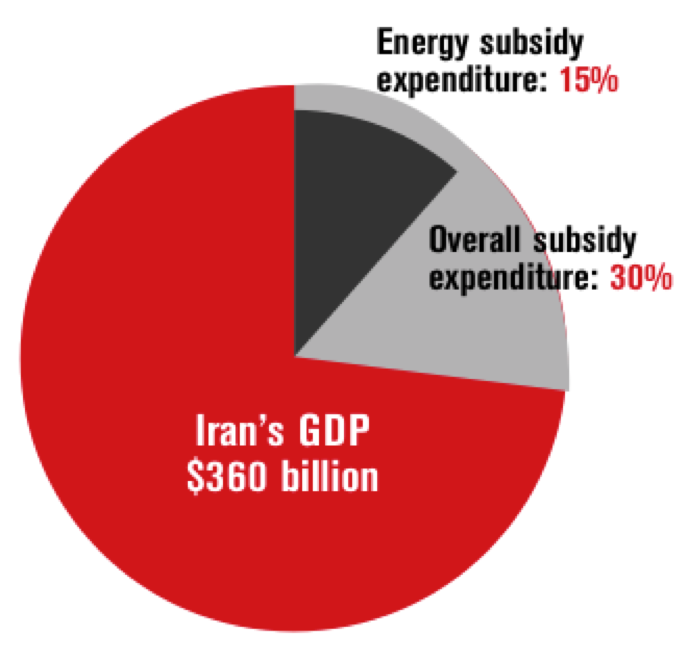
As a result, subsidies of gasoline and other forms of energy amount annually to $50 billion, or 15 percent of GDP. Overall subsidies are as high as $100 billion, or 30 percent of GDP.

The effects on growth are clear. While the Iranian economy has grown faster than most developing countries, it has not met the ambitious 8 percent target set by the country’s five-year plans.

Growth averaged 5.4 percent from 1996 to 2006, reached 7.8 percent in 2007 and then fell back with the world recession and weaker oil prices to 2.5 percent in 2008. The International Monetary Fund last month projected 1.5 percent growth this year and 2.2 percent in 2010.

This is not enough to provide jobs for all the baby-boomers, born in the Revolution’s early years, coming into the employment market. Officially unemployment is 12.5 percent, but many analysts say the real figure is much higher.

Salehi-Isfahani told Executive he was disappointed this year’s presidential election did not confront the challenge of increasing investment.

“I feel that redistribution has a greater hold on large sections of Iranian voters than I realized,” he said. “I had expected that after his [Ahmadinejad’s] failure to deliver [in his first term as president] that more people would turn away from populism. Instead, I heard many people say that he would have delivered on his promises [to redistribute wealth] had he been allowed to by the powers that be.”

For some years, there has been a consensus among Iran’s political class in favor of greater investment of oil revenues and the development of the private sector, especially through privatization. But in practice, politicians’ support has been lukewarm.

The previous government of Mohammad Khatami established a ringfenced Oil Stabilization Fund to collect windfall revenue, but both Khatami’s government and the parliament soon dipped into the fund to finance pet spending projects, often with an eye to elections. Under Ahmadinejad, the fund’s coffers have diminished further, to the point where its level is kept confidential.

Reducing subsidies

Progress has been slow on a privatization program launched under Khatami and given impetus by two rulings, in 2005 and 2006, from Ayatollah Ali Khamenei, the supreme leader, that 80 percent of the state sector be privatized.

Last month parliament began discussing the phasing out of subsidies. The move would be inflationary and will need careful management even though inflation fell to 9.3 percent in September this year — down from the 30 percent range topped in October 2008.

The discussion marks a shift from last year, when parliament threw out a similar plan from the Ahmadinejad government. Salehi-Isfahani feels the “political emergency” of unrest after June’s election has given the president more leeway. “The conservatives in the parliament are less likely to oppose him while he is under pressure from the reformists,” he said.

But liberalization and privatization are never straightforward in a country weaned on oil income with a powerful state and quasi-state sector.

The introduction of petrol rationing in 2007 was a state-led approach. Faced with escalating import bills — at the time, gasoline imports were 40 percent of consumption — Ahmadinejad avoided a market solution and chose to allocate motorists a set amount, through a smartcard, at a subsidized price equivalent to 10 cents a liter.

The move has been a relative success. “It has not reduced consumption in my judgment, but it has at least stopped a rise in consumption,” said Heydar Pourian, editor of the Tehran-based monthly, Iran Business.

Imports have fallen from 200,000 barrels per day (bpd) in 2007 to around 130,000 barrels bpd  — making the economy less vulnerable to the gasoline sanctions touted in the United States and Europe.

But reducing the costs of subsidies on electricity, bread and other items cannot be done through rationing, at least not without a costly expansion in bureaucracy. Hence, the government plans to replace subsidies with targeted benefits for the poor.

Middle class discontent

Whatever the longer term benefits for the economy, it will be a huge challenge for Ahmadinejad to manage the political fallout as everyone other than the poor faces the resulting price hikes.

Another problem with liberal economic reform is that it strengthens a middle class whose numbers are already swollen by the expansion of higher education under the Islamic Republic. Iran’s middle class is largely disenchanted with the government and was the backbone of the protests against June’s presidential election results.

“In the last 10 years the middle class has doubled in size while the ranks of the poor have shrunk by two thirds,” said Salehi-Isfahani. “Now the government finds itself in an adversarial position vis-a-vis the middle class, it may adopt policies inimical to their growth and transformation into a productive class. I can see the government move more in the direction of greater control of the economy with more policies aimed at redistribution, which generally hurt growth.”

Privatization is a massive test. Iran’s capital markets are weak, while foreign capital is restricted both by domestic law and US banking sanctions. And yet quasi-state bodies, buoyed with oil revenue, are relatively liquid.

The sale in late September of a 50 percent plus one share in the state-owned Telecommunications Corporation of Iran (TCI) was the largest in the history of the Tehran Stock Exchange (TSE) and raised eyebrows given the economic slowdown.

Iranian subsidies as a portion of 2009 GDP

Source: The Economist Intelligence Unit

Islamic revolutionary shareholders

The winning buyer, Etemad-e Mobin, is a consortium of three Iranian firms with varying degrees of experience in the sector. But government critics attacked the sale as an extension of control by the Islamic Revolutionary Guard Corps (IRGC).

After the IRGC’s role was raised in the Iranian parliament, it emerged from parliamentary speaker, Ali Larijani, and Finance Minister Shamseddin Hosseini, that some shares of the three companies were held by IRGC retirement funds.

The TCI sale illustrates how politics make economic reform harder. Iranian telecoms are a potentially lucrative market — cellular penetration is relatively low, for example, at 70 percent — but foreign investors are wary, because of sanctions and the suspicion of foreigners in Iran.

At the same time, IRGC pension funds hardly relish investing abroad, given the corps is targeted by sanctions and was designated a “terrorist” organization by the US Treasury in 2007.

The privatization program has tended to transfer assets from state ownership to quasi-state ownership or to powerful interests with links within the state sector, including social security funds. The IRGC is part of the mix, with its engineering arm already expanding in construction and energy.

“It’s hard to establish whether the growing economic role of the IRGC reflects a central plan or is the result of disparate groups, many with links to the IRGC, jockeying for position,” said David Butter, senior Middle East analyst at the London-based Economist Intelligence Unit.

A sign of how things might develop will come in November as Iran launches a $1.4 billion bond offer to meet a funding shortfall for the South Pars gas field. Despite the rich potential takings on offer in South Pars, international energy majors and western banks are shunning it because of US and UN sanctions.

The Iranian media has reported the bond will offer a 9 percent interest rate. If the bond finds takers domestically, or from Asia, then Iran will have cleared, or at least not fallen at, one of the many hurdles it faces.

November 26, 2009 0 comments
0 FacebookTwitterPinterestEmail
Banking

Money matters BLOMINVEST Bank

by Executive Staff November 26, 2009
written by Executive Staff

Regional stock market indices

Regional currency rates

GCC hydrocarbon projects at $690 billion

Despite the suspension or cancellation of 30 percent of the Gulf’s hydrocarbon projects, the Gulf Cooperation Council’s (GCC) oil, gas and petrochemicals construction market remains the most active in the world, with $690 billion of budgeted projects. Among 578 hydrocarbon projects in the GCC, 30 percent by value have been placed on hold or cancelled, with another 30 percent under construction and a further 40 percent in the pipeline. Earnings from the GCC oil, gas and petrochemicals sectors remain the largest among other sectors, constituting about 85 percent of the region’s export revenues. In addition, the demand for hydrocarbons and refined products is expected to pick up as the global economy pulls out of recession. Proleads Insight, a hydrocarbon consultancy firm, is projecting that by 2010, the cash flows in the GCC hydrocarbon markets will stabilize. But this is bound to deteriorate quickly if projects scheduled to start are not executed as planned by the start of next year.

GCC railway projects will reach $60 billion by 2010

As GCC countries witness substantial growth and develop rapidly, member countries have agreed to build railroad networks with a total estimated cost of more than $60 billion. These railroads will help boost cross border trade, cut freight costs and result in faster movement of cargo and passengers. Construction of a rail network that will link the six members of the GCC is expected to start in 2010, while expenses will be shared by the states. Moreover, the Union Railway Company in the UAE has an estimated $8.2 billion railway project that will connect all major cities in the Emirates with a track length of 1,400km. In Saudi Arabia, the Saudi Railway Organisation already provides freight services on three main lines totalling 1,018km, while there are plans to extend the network to the Red Sea port of Jeddah and eventually to the borders of Jordan, Yemen and Egypt.

Yemen seeks $2 billion bailout

The Arab world’s poorest country, Yemen, is seeking a $2 billion bailout from the region’s richest state, Saudi Arabia, to avert a cash crisis. The Yemeni government desperately needs money to pay for food and fuel imports after revenues from oil exports plummeted 75 percent in the first half of 2009. This drop in oil revenue comes after a decline of 26 percent in the country’s oil production and a large decrease in oil prices compared with the same period last year. In 2008, oil revenues paid for 75 percent of government expenditures and oil accounted for 96 percent of Yemen’s exports. In the first quarter of 2009, and in the wake of falling oil prices, the government’s oil revenues fell to $255 million, down 74 percent from $998 million in the same period the previous year. In May, the Central Bank of Yemen said it held $7.3 billion in foreign currency reserves, which would only be enough to cover the bill for food and fuel imports for the first nine months of 2009. By contrast, in 2004, Yemen’s foreign reserves of $5.7 billion were enough to pay for nearly 16 months of imports.

November 26, 2009 0 comments
0 FacebookTwitterPinterestEmail
Banking

Upping the stake

by Executive Staff November 26, 2009
written by Executive Staff

In mid-September, Arab media reported that the Gulf Cooperation Council countries were in talks with the World Bank about raising their capital contributions. This was confirmed by Senior Vice President and World Bank Group General Counsel Anne-Marie Leroy, who said the talks were meant to secure additional capital and would therefore increase the voting rights of the GCC, and that an announcement to this effect would be made in October.

But no announcement came. The World Bank may be in dire financial straits, according to statements made at the October World Bank Group and the International Monetary Fund meetings in Istanbul, but there is disagreement between developing countries and the bank’s biggest donors as to how soon more capital is needed, and where it should come from.

Representatives from both France and Great Britain, two of the bank’s largest contributors, said that they believe lending increases can go forward without additional capital. But World Bank President Robert Zoellick and representatives from many developing nations sounded the opposite note, predicting that without expedited gains in capital, the World Bank would have difficulty maintaining its current lending by the middle of 2010.

“The distribution of quotas should reflect the weights of its members in the world economy, which have changed substantially in view of the strong growth in dynamic emerging markets and developing countries,” said the G-20 leaders in a joint concluding statement after their Pittsburgh meetings in September.

Accordingly, capital increases would have to come from middle-income countries and not the now dominant West. In fact, the G-20 countries recommended that funding for the World Bank should shift by a measure of three percent toward credit-worthy developing countries and away from developed ones.

As it stands, the GCC voting block holds 3.88 percent of the total votes in the International Bank for Reconstruction and Development (IBRD), the oldest and largest lending arm of the World Bank Group, which provides relatively low interest loans to developing countries. It is these countries that were the most vocal in their call for more donor-money at the Istanbul meetings and it is this fund, the IBRD, that World Bank officials say needs new capital, and quickly.

A question of motivation

Both expert opinion and rhetoric from October’s World Bank Group-IMF meetings may point to the reasons why the GCC’s role in the World Bank will remain fixed while others’ will increase. Ibrahim Saif, secretary general of the Jordanian Economic and Social Council and expert in political economy, believes that GCC capital in the bank is holding steady, in part, because the countries themselves are not interested in playing a larger role in the global political scene.

“They are quite happy to just work while it’s happening and not get engaged with the rest of the world,” he said. “The BRIC [Brazil, Russia, India and China] were quite aggressive. I think they were very clear that they really wanted to increase their shares.”

Saif said that no such desire came from the GCC and thus no increase was made.

In November 2008 British Prime Minister Gordon Brown saw a “lukewarm reception” when he visited the Gulf and suggested that the GCC contribute “hundreds of millions” to IMF bailouts, said Gulf Research Center Chairman Abdulaziz Sager in an analysis piece. He said that any humanitarian or geo-political aspirations that the GCC may have held evaporated with the credit crisis.

Total World Bank lending by region: fiscal 2009

Share of $46.9 billion total

Source: World Bank

Total World Bank lending by theme: fiscal 2009

Share of $46.9 billion total

Source: World Bank

Total World Bank lending by sector: fiscal 2009

Share of $46.9 billion total

Source: World Bank

Singular ambition

On this issue of international contributions however, the GCC is not completely in agreement as Saudi Arabia’s role in both the World Bank and the IMF far exceeds its Gulf neighbors. GCC capital in the IBRD totals approximately $7.5 billion, and $5.4 billion of this, or 72 percent, comes from Saudi Arabia.

“Saudi Arabia wanted to play a role but Saudi Arabia is like a single player,” said Saif. “The other GCC countries are small and they don’t see the benefit of having more stake in the World Bank. It seems that they are quite satisfied with their current role.”

Saudi Arabia has been negotiating a sizeable additional contribution to the IMF, rumored at $10 billion.

“If you look at the track record of Saudi since the 70s you’ll see the willingness to support the IMF when others were unwilling or unable,” Muhammed al-Jasser, governor of the Saudi Arabian Monetary Authority, told The Wall Street Journal last month.

Al-Jasser also argued that contributions to the two international lenders should not necessarily be determined by GDP, as global financial prominence is a better gauge, which is particularly relevant to Saudi Arabia, as it is the most over-represented country in terms of the ratio of international donations to GDP.

Cool wind from the West

In addition to the speculated lack of desire for greater geo-political influence on the part of the GCC, large Western donors have also hinted their objections to a capital increase originating from the Gulf.

At a meeting of the World Bank’s development committee, United States Treasury Secretary Timothy Geithner said, “We will be seeking critical institutional reforms in any consideration of additional resources.”

Saif believes this statement would definitely apply to the GCC.

“It’s not new that the GCC countries over the last few years came under huge pressure to become more transparent about their budgeting and about their oil revenues and how they distribute them,” he said. “Secondly, they also came under pressure as far as their investments. They are not really willing to open their books.”

In fact, a lack of transparency in the Gulf’s financial sector has been blamed for the falsely high credit ratings given to the countries’ financial institutions, leading up to and even after the start of the global financial crisis.

More green in the spring

At the suggestion of the World Bank’s biggest donors, a formal review of the bank’s financial needs will take place in the spring of 2010 in order to address the World Bank’s proposal of an overall capital hike of $3 billion to $5 billion for the IBRD.

Saif, however, has doubts that this will change the role of the GCC.

“I think it will remain the same. I think that the GCC countries are not very eager and not very aggressive about increasing their weight in the World Bank,” he said.

World Bank officials declined to comment for this article.

November 26, 2009 0 comments
0 FacebookTwitterPinterestEmail
Banking

Lira overload

by Executive Staff November 26, 2009
written by Executive Staff

With deposits flowing in unabated, banks in Lebanon find themselves in an almost singular global position — they have an overabundance of liquidity.

“We definitely have an excess,” said Marwan Barakat, head of research at Bank Audi. “But this liquidity pays in difficult times, such as [those] we are passing through nowadays. Excessive liquidity has been paying for Lebanon.”

The Central Bank of Lebanon reported $14 billion in capital inflows for the first eight months of 2009, though some analysts contest this number. Bank Audi estimated that $5 billion of this amount were converted into Lebanese lira (LL) during the first half of 2009, gaining on the $8 billion worth of conversions for the whole of 2008.

Though total liquidity is not at its record high, it is the massive conversions into LL that have created an excess of liquidity in local currency, which could, eventually, become a burden if not properly handled.

“This is what I call an enviable problem for Lebanese banks,” said Nassib Ghobril, head of economic research and analysis at Byblos Bank. “Since the crisis started, banks around the world have tried to attract liquidity and they haven’t all succeeded. They’ve had to use government intervention and bailouts. [In Lebanon], the banks are the ones who have supported the government for a long time.”

Deposits have been converted into LL at unprecedented rates in recent years, with dollarization of deposits dropping from 77.3 percent in 2007 to 69.6 percent in 2008. That number is down to 65.5 percent today, according to Ghobril.

The sharp increase in LL deposits led to an overall increase in LL money supply of 8.8 percent for the first half of 2009, with the majority of this increase coming from LL savings deposits, which increased 18.5 percent during the same period.

Lebanon’s primary liquidity ratio at the end of 2008 was 51.5 percent of total deposits, which — compared to an average of 28 percent in the Middle East and North Africa region, 34 percent for emerging markets and 30 percent globally — puts Lebanon in a unique fiscal position.

“More than the number of inflows, the important thing is the balance of payments surplus — the difference between what is coming in and what is going out of the country,” said Barakat. According to the central bank, the balance of payments surplus was $4.8 billion over the first nine months of 2009, which is a record high for Lebanon.

Confidence into cash

These figures are the product of famously conservative practices on the part of Lebanese banks and prudent regulations by the central bank banning high-risk investments such as structured products and derivatives, which have kept the Lebanese banking sector relatively unaffected by the global credit crisis and spurred confidence in the local currency.

Increased confidence in the local currency has also been aided by an attractive interest rate spread. Interest rates on deposits in LL have hovered around 7 percent for the past two years, dropping from 7.23 percent in August of 2008 to 7 percent for the same month in 2009, while US dollar rates have dropped from the already low 3.55 percent in August 2008 to 3.18 percent in August 2009. In order to keep the spread from growing any further and to slow the rush of local currency conversions, the Association of Banks in Lebanon has recommended that banks cap their LL deposit rates at 7 percent.

“The trend was liquidity over profits, liquidity over expanding the balance sheet, liquidity to be on the safe side,” said Ghobril of the banks’ practices during the financial crisis.  

And Lebanon’s top banks have managed to turn a profit this year, a relative anomaly in today’s financial landscape. BLOM Bank has reported $138 million in profits, a 5.8 percent year-on-year increase. Bank Audi’s profits increased 1.9 percent from last year, totaling $133 million, and Byblos Bank saw 2 percent growth from last year with $64 million in profits.

But despite praise coming from international organizations and the media, this growth has slowed, and is predicted to continue on that declining trajectory without profitable outlets for capital.

Banking sector deposit rates

Source: Bank Audi

Banking sector dollarization ratios

Source: Bank Audi

Too much of a good thing

Though most bankers and economists would argue over the syntax of the situation — “It’s a challenge not a problem,” said Ghobril — the fact remains that Lebanese banks need to find a way to turn the staggering amount of liquidity into profit in order to afford the expense of such abundant deposits, given the high interest rates offered on them.

“Because so much of it is converted into Lebanese [lira] and there are no outlets, now the banks are rushing to buy treasury bills,” said Ghobril.

But treasury bills are becoming a less attractive outlet as yields steadily decrease. In fact, despite the stacks of capital stored at the banks and the few opportunities to capitalize on them, the treasury bills portfolio of Lebanon’s commercial banks decreased in the first half of 2009 by the equivalent of $1.09 billion.

The simple solution is for banks to lend more in LL. However, due to Lebanon’s unique financial nexus, increasing local currency lending is easier said than done.

“Interest rates cannot decline on their own because we have a high fiscal deficit, a high public debt and we have not done anything to reduce the public debt or the fiscal deficit,” said Ghobril. “As long as we have these structural deficits in addition to the lack of long term political stability, there is no way to reduce interest rates much further.”

Short-term fix

The Central Bank of Lebanon has made several efforts to provide the banks with outlets for their excess liquidity, but none have yet proved a lasting remedy.

Until early July, the central bank was issuing LL certificates of deposits (CDs), with banks particularly taking advantage of the high-yielding five-year variety. The return rate on the CDs dropped from 10.9 percent at the end of 2008 to 9.25 percent at the end of June 2009. After issuing the equivalent of $6 billion in CDs, issuance of the popular five-year category was suspended, possibly because the program became too expensive, with demand in 2008 doubling in only the first half of 2009.

The central bank then shifted its efforts and is now attempting to spur lending in local currency. With 57.8 percent of the public debt held by domestic commercial banks as of August this year, lending in local currency continues to be expensive and banks have struggled to lower interest rates in order to spur LL lending.

As of August, the LL lending rate was down 69 basis points from the same time last year, at 9.27 percent. US dollar lending rates stood at 7.05 percent in August, which is 12 basis points lower than August 2008.

Furthermore, banks are working against usual practice. As of June 2009, lending continued to see a dollarization rate of 85.4 percent, which has been the case since the beginning of the decade.

In addition to the unattractive LL lending rates, some argue that the worldwide tightening of purse strings has affected loan requests.

“It’s a demand problem. We have enough liquidity for sure. But, you need two people to dance,” said Makram Sader, secretary general of the Association of Banks in Lebanon.

In order to encourage banks to lower LL lending rates, the central bank lifted reserve requirements on certain loan categories beginning in late June. The reserve requirement exemptions mostly affect housing and education loans and represent what Bank Audi said is the central bank’s only remaining option to spur lending.

“Within this environment, the policy of subsidizing debtor interest rates in LL rises as the only plausible exit for the current distortions within the context of massive capital inflows and currency conversions,” said Bank Audi in a recent report.

“The initiative is to exempt Lebanese [lira] lending from reserve requirements to the extent of 60 percent,” said Barakat.

And the banks have responded with housing, personal, car and education loans in LL with interest rates around 5 percent for the first year.

Treasury bills yields

Source: Bank Audi

Looking to the long-term

In September, an International Monetary Fund working paper on the “Determinants of Bank Deposits” said that Lebanon’s “domestic commercial banks which, given their large existing exposure to government, are de facto captive in this system, in the sense that the viability of government finances and that of the banks’ balance sheets are mutually dependent.”

Analysts expressed confidence in the forecasted success of the central bank circulars to increase LL lending, but the limited categories for which reserve requirements have been lifted don’t allow for private sector development.

“It is yet increasingly wished that the central bank expands the relatively limited scopes of the circulars, said Bank Audi. As the aggregation of all such categories does not constitute the bulk of lending growth requirement in the coming couple of years,” said the report.

November 26, 2009 0 comments
0 FacebookTwitterPinterestEmail
  • 1
  • …
  • 440
  • 441
  • 442
  • 443
  • 444
  • …
  • 683

Latest Cover

About us

Since its first edition emerged on the newsstands in 1999, Executive Magazine has been dedicated to providing its readers with the most up-to-date local and regional business news. Executive is a monthly business magazine that offers readers in-depth analyses on the Lebanese world of commerce, covering all the major sectors – from banking, finance, and insurance to technology, tourism, hospitality, media, and retail.

  • Donate
  • Our Purpose
  • Contact Us

Sign up for our newsletter

    • Facebook
    • Twitter
    • Instagram
    • Linkedin
    • Youtube
    Executive Magazine
    • ISSUES
      • Current Issue
      • Past issues
    • BUSINESS
    • ECONOMICS & POLICY
    • OPINION
    • SPECIAL REPORTS
    • EXECUTIVE TALKS
    • MOVEMENTS
      • Change the image
      • Cannes lions
      • Transparency & accountability
      • ECONOMIC ROADMAP
      • Say No to Corruption
      • The Lebanon media development initiative
      • LPSN Policy Asks
      • Advocating the preservation of deposits
    • JOIN US
      • Join our movement
      • Attend our events
      • Receive updates
      • Connect with us
    • DONATE