• Donate
  • Our Purpose
  • Contact Us
Executive Magazine
  • ISSUES
    • Current Issue
    • Past issues
  • BUSINESS
  • ECONOMICS & POLICY
  • OPINION
  • SPECIAL REPORTS
  • EXECUTIVE TALKS
  • MOVEMENTS
    • Change the image
    • Cannes lions
    • Transparency & accountability
    • ECONOMIC ROADMAP
    • Say No to Corruption
    • The Lebanon media development initiative
    • LPSN Policy Asks
    • Advocating the preservation of deposits
  • JOIN US
    • Join our movement
    • Attend our events
    • Receive updates
    • Connect with us
  • DONATE
Comment

Obama’s healthcare woes

by Claude Salhani September 3, 2009
written by Claude Salhani

When it comes to politics, Americans, much like everyone else, are terrible ingrates. People tend to forget how bad things were under the old regime and remember only the positive, sweeping the negative aspects into the forgotten corners of their memory.

Indeed, it was just a matter of time before the honeymoon President Barack Obama enjoyed started coming to an end. If the president’s ratings in the rest of the world are still somewhat solid, his star is no longer shining as brightly in the US as it was when he entered the White House last January.

Just eight months into his presidency, the man who turned out to be one of the most popular presidents ever in the United States upon his election is now starting to see his ratings fall.

One must add that this is really through no fault of his own. When Obama entered the White House last January, replacing one of the most unpopular presidents in US history, people expected the impossible, and they expected it right away. But that’s not how politics work.

The expectations people had of this young president were astronomical, bordering on miraculous. They expected him to fix the economy, which was in a global recession and sliding faster than Bush’s popularity. Obama inherited a country with probably the worst financial crisis since the Great Depression rocked the nation following the stock market crash of 1929.

People expected Obama to end two highly unpopular wars –– one in Iraq and one in Afghanistan. Then of course there is the invisible war, the one still being fought in the shadows, the ‘War on Terror’, as President Bush liked to call it. An indication of how disinterested the American public is in the wars in Iraq and Afghanistan can be gauged through the lack of front-page articles on those two conflicts in the American press. Days can go by without either country making it onto page one.

Obama inherited the housing crunch brought about by the subprime mortgage crisis, triggered by a dramatic rise in mortgage delinquencies and foreclosures in the United States; that, in turn, had a negative impact on the world’s economy.

There was the climbing price of gas, which passed $3.70 per gallon for the American consumer before Bush left the White House (it was $1.45 when Bush took over from Clinton). But what perhaps contributed to Obama’s rapidly decreasing popularity, at least in the US, was his decision to take on the poisoned arrow of health care reform.

The reform of the American health care system has traditionally been the kiss of political death for anyone who dared touch it and its praetorian guard, the legions of lobbyists who protect their turf on Capitol Hill with the same zest with which Roman legions defended ancient Rome.

It was health care reform that brought the ire of the conservative movement in the US against current Secretary of State Hillary Clinton when she was the first lady, and when her husband President Bill Clinton gave her the impossible task of setting up universal health coverage for Americans, which remains the only industrialized country in the world without universal coverage for all its citizens.

As if that were not enough, there is another kiss of death for American politicians who dare to venture there: Middle East politics. Here again, there exists an uncanny expectation that Obama will wave his magic wand and the sea of animosity dividing the Middle East protagonists will suddenly allow a passage towards a peaceful solution to the six-decade conflict.

As of July, for the first time since his election, Obama’s popularity fell below the 50 percent mark, according to an ABC NEWS-Washington Post poll. The health care industry in the US is a huge business and the drug manufacturers spend millions of dollars every year lobbying Congress so that senators and congressmen and women will vote like they are supposed to vote; meaning, to maintain the complex and archaic system of healthcare currently in effect.

The trouble with the current system is that it does not make sense. The US spends more than any other nation on healthcare, yet 47 million people have no health coverage (from a population of 300 million). And all that money doesn’t buy American citizens much bang for their buck: the World Health Organization ranks the US healthcare system at 37 out of 191 countries surveyed.

America does have some of the best hospitals, doctors, and yes, healthcare in the world. Unfortunately, not everyone can see those great doctors and go to those great hospitals. And the system’s biggest problem is that healthcare is usually arranged through one’s employer, and so an employee (and his or her family) loses health care coverage if he or she loses his or her job.

But Obama could not begin solving the above-mentioned problems without the participation of all parties concerned. After all, he is President Obama, not Saint Obama. He accomplished the impossible soon after assuming the presidency: gas is down to around $2.35 a gallon and the economy has stopped sliding and is actually pick up.
Miracles however, take a little longer.

Claude Salhani is editor of the Middle East Times and a political analyst in Washington
September 3, 2009 0 comments
0 FacebookTwitterPinterestEmail
Comment

An embargo that shouldn’t fly

by Executive Staff September 3, 2009
written by Executive Staff

Sanctions are one of those political issues that can make amiable dinner conversation turn unpleasant, as the battle lines are drawn down the table between those for and against.

 Sanctions have certainly had mixed success, starting with the first recorded case of a trade embargo some 2,400 years ago between Athens and neighboring Megara. The embargo failed, sparking war.

Sanctions have never worked since then, argue some. “That is too reductionist,” may come the reply, while others prefer to pick-and-mix examples from embargoes through the ages to argue their case. The more pragmatic approach would be to not ask whether sanctions “work,” but to consider when and under what circumstances.

Sanctions that are meant to oust a dictator but result in the deaths of thousands of innocent civilians — Iraq for instance — can be considered counter-productive. Sanctions preventing a particularly nasty regime from getting hold of, say, chemical weapons, on the other hand, would appear desirable and effective.

In a report on the effectiveness of sanctions by the Washington-based Institute for International Economics, out of 211 cases from World War I until the year 2000, only 38 percent were successful.

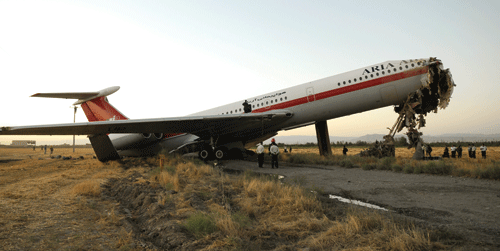
Applying sanctions on the aviation sector can fall under the questionable effectiveness category. Impeding a country’s access to military aviation parts is understandable, but for commercial aircraft it ranks as dangerous. In the Middle East, this applies to Iran and until July, Syria, when the United States ended sanctions on the export of goods to the Syrian aviation industry. Sanctions were first imposed against Syria in 1979 and tightened in 2004 under the Bush administration.

Aviation sanctions have long been considered a risk to air safety, with airlines that own American and European manufactured aircraft (Boeing and Airbus) unable to purchase spare parts and navigation equipment, or to upgrade technology in line with international safety standards. A report prepared for the United Nations’ International Civil Aviation Organization has made this clear.

The danger sanctions pose to aircraft and passengers was underscored in July when two Iranian commercial planes crashed within 10 days of each other, killing 184 people. Iran claims the sanctions were to blame, and foreign ministry spokesman Hassan Qashqavi said the Western aviation sanctions in place since 1979 “signify a violation of human rights.”

While no Western lives were lost in the two crashes, it may only be a matter of time before citizens of the primary imposer of sanctions, the US, also become collateral damage, whether onboard a doomed aircraft, or while picnicking below when a badly serviced plane drops out of the sky.

As Flight Commander General Hazim al-Khadra, director general of the Syrian Civil Aviation Authority, told me in Damascus a few years ago: “Sanctions are a big problem because US aviation interferes with the aviation industry, the spare parts for commercial airlines in particular, which maintain the safety of passengers. And these passengers aren’t only Syrians, but also Europeans, Americans and Asians.”

Perhaps there would have to be the rather ironic situation of a plane that lacked the spare parts or proper guidance systems accidentally crashing into a US embassy or military facility, for Washington to truly wake up to the hazards of unsafe aircraft.

After all, it is curious that the Air France jet that crashed en route from Rio de Janeiro to Paris and the US Airways plane that ditched into the Hudson River in New York earlier this year garnered extensive media reports about aircraft safety, yet the aviation sanctions against Syria and Iran have not. Unsafe aircraft flying around the world are not safe for anyone, whether on the ground or in the air.

The US decision to end the sanctions against the Syrian aviation sector — which has rapidly opened up in recent years to include a handful of private airlines — is a step in the right direction. But the sanctions against Iran, and its aviation sector, continue. It even looks like the sanctions are going to be tightened further, with America proposing to ban Iranian airplanes from landing in Western airports, along with banning insurance on trade deals with Iran and the imposition of sanctions on any company that trades with the Islamic Republic.

While the heightened sanctions are meant to put further pressure on the Islamic Republic to change it ways, the policy should be scrutinized. The sanctions related to the curbing of Iran’s nuclear aspirations and funding to groups like Hamas and Hezbollah are a political minefield, with strong arguments from both sides of the political spectrum as to whether such a policy is working. Civil aviation however should be in a special category. It should be a human right for people — civilians — to be able to fly safely.

PAUL COCHRANE is the Middle East correspondent for the International News Services
 

September 3, 2009 0 comments
0 FacebookTwitterPinterestEmail
Comment

The Arab trading bloc

by Riad Al-Khouri September 3, 2009
written by Riad Al-Khouri

Based on recently released figures, Arab investors have been paying more attention to business in neighboring countries, while looking less at “traditional” Western markets. The size of inter-Arab direct investment inflows grew 64 percent in 2008, with Saudi Arabia receiving the largest share of investments and the United Arab Emirates being the top investor in other Arab states, according to the Investment Climate in Arab Countries 2008 report.

The report, released by the Kuwait-based public Arab Investment and Export Credit Guarantee Corporation (better known as Dhaman), notes that the total volume of inter-Arab investments reached $34 billion in 2008, up 64 percent from 2007. This is a remarkable jump, and may have a lot to do with the sorry state of Western economies last year, which put off Arab investors and made them look to less risky business closer to home.

Saudi Arabia received the largest share with 38 percent of Arab investments in 2008, reaching $13 billion, according to Dhaman. The kingdom was followed by Algeria which attracted 17 percent of total Arab investments or $5.7 billion last year, then Sudan, accounting for 14 percent or $4.8 billion of the total. Lebanon was fourth in terms of attracting Arab inflows, receiving 8 percent or $2.7 billion worth of investments, much of them in the tourism sector, which is currently booming with the influx of Gulf visitors.

Of the dozen Arab economies covered by the survey, most saw an increase in investment inflows; only a handful of countries, including Lebanon and Jordan, received a smaller share of investments in 2008 compared to the previous year. The shortfall of money flowing into Beirut was the result of the drawn-out government crisis there that culminated in street battles during May of last year, but the trend in 2009 seems to be up. Jordan, on the other hand, is a different story: the latest figures show that foreign direct investment from all sources — Arab or otherwise — fell sharply to less than $220 million during the first quarter of this year, compared to $920 million in the same period of 2008.

The UAE was the top regional investor in Arab countries in 2008, with its direct investment outflows reaching $10.7 billion or 32 percent of the inter-Arab total. UAE investments went primarily to the Saudi market, which received $5.8 billion of the Emirates’ outflow. UAE and other inter-Arab investments were concentrated in the services sector, which made up 62 percent of total investments, including to tourism, transport, telecommunications and finance, among others.

Yet, in many other areas, investment from the UAE and other Arab states continues to flow to the West, which remains attractive for certain types of business, particularly high tech. An interesting example of this came in July, when Aabar, an Abu Dhabi investment fund, paid around $280 million to buy nearly a third of commercial space-travel startup Virgin Galactic. In exchange, the state-controlled fund will acquire exclusive regional rights to eventually launch Virgin Galactic tourism and scientific research spaceflights from the UAE capital. Aabar’s buy-in boosts Virgin’s space tourism venture at a time when many Western funding sources have dried up. (Read more about this transaction on page 112.) This also gives Abu Dhabi a chance to broaden its economy beyond oil, in line with the emirate’s plans to embed technology, research, and science in the economy. It also complements the aim of being an international tourism magnet.

Whether in outer space or back down on Earth, Aabar has emerged as an active investment fund. Among other recent deals, it bought 9 percent of Mercedes-Benz maker Daimler in March, and in August signed a vehicle production deal with the Algerian government to develop a network of vehicle and engine manufacturing plants in conjunction with five German companies (including Daimler). Up to 10,000 cars and trucks will be assembled each year with operations expected to start in 2010, following the modernization or development of plants; products identified for potential manufacturing include four-wheel drive vehicles and engines.

With automotive manufacturing taking off in neighboring Morocco and elsewhere in the region, I predict that cars and trucks will be the latest sunset industries to move out of the developed world and into Arab economies (among other developing ones), just as lower-end clothing production made an exodus from Western Europe and America in the late 20th century.

Now that the Dubai bubble has burst, and with economies slowing down in most of the region, the short-run continuation of this Arab-to-Arab investment trend might seem in doubt; but in the long-term, investments by regional players inside the region are probably going to accelerate, no matter what happens to the West’s faltering investment climate.

RIAD EL-KHOURI is senior associate consultant at the William Davidson Institute of the University of Michigan in Ann Arbor, and dean of the Business School at the Lebanese French University in Erbil

September 3, 2009 0 comments
0 FacebookTwitterPinterestEmail
Society

Crepaway – Claude Thoumy (Q&A)

by Nada Nohra September 3, 2009
written by Nada Nohra

Crepaway was founded in 1984 by two brothers, Charles and Claude Thoumy, as a limited liability company and was incorporated in 2003. Today, Crepaway Corporation operates eight outlets in Lebanon with two seasonal restaurants, and four franchises in Egypt, Saudi Arabia and Qatar. Charles Thoumy has been the chairman and general manager of Crepaway since its founding as a small kiosk serving crepes. He spoke with Executive about he and his brother’s successful chain of “casual dining” restaurants.

E How is the casual dining industry performing, and what are the major problems in the industry?
The major problem is basically inconsistency. In a country like Lebanon, even if you go by strategic planning, you have to have a tactical approach in dealing with circumstantial ups and downs. Sometimes you go for a five or six year plan, and something happens, like a war or a crisis, and then you have to [halt] your plans and go for tactical little things to make your thing work. Again you are not working on a road map to achieve your goals. It is a temporary deviation.

E So you always have to have a plan B? 
And C and D sometimes.

E Other than the inconsistency, are there any problems that you are facing with government regulations?
No, but you are working in a country that is not really structured. Sometimes you have to deal with different departments, sometimes they overlap, sometimes they do their job and sometimes they don’t. There is no system that you can abide by. You do not feel that there is someone to help you. When the government structures its departments again, we will be able to deal easier with their rules and regulations. Even though we know that rules and regulations, like everything else, need to be updated.

E What corporate strategy do you use to deal with competition?
We have fierce competition. The fiercest competitor we have is ourselves. We compete with ourselves to do better every day. I think competition is a source of richness. Competitors learn from you and you learn from them; that is  basic. You do better in something, they do better in something else. Then you upgrade, they update and that is the nice game of competition. On the other hand, since we have been leading since 1984, we have had a lot of people coming and copying… well not copying, but it is a normal thing in business when people look at businesses that are working well and try to do something similar. That is another confirmation that we are doing well and where we feel we have the responsibility to do better than we did before. That is the main scope of our competition.

Talking about strategies, there are different strategies to deal with competition. First, when you talk about competitive strategy, [it] is when you see what the competitor is doing and try to do better. We are not into war with our competitors — we try to complete each other, so there is not really an approach where we look closely at what they are doing and then try to block the way for competition. It is a nice game everybody is playing, and people who win have to be complemented.

E In the last couple of months, many restaurants have increased their prices. Do you know the reason?
We also have extra running costs concerning electricity and generators… we are living that today. The increase in prices happened in the last couple of years. And again the cost of real estate has increased a lot. Which means that the rent went up a lot. At all levels, you have an increase in your costs. In the end you are in a business that requires high running cost. We haven’t increased our prices in the last two or three months. Beginning in spring, we have added sometimes 500 or 1,000 Lebanese lira because of the fluctuation of the Euro. So, we had to.

E How has the financial crisis affected Lebanon and your business?
The economic downturn of course has an adverse impact, not only on Lebanon but on the global level. It leads to a decrease in purchasing power. We have witnessed a decline in the purchasing power, especially from the people and expats who used to come from Dubai and Qatar. They were loaded with money, so they used to come and spend their money with more freedom. These were affected. But we cannot say people are refraining… but there is for sure a drop in average spending.

E Do you have an idea how severe the drop has been?
I cannot tell you really, but I can say that it doesn’t show a lot because we tried to increase the volume (the number of people) and the flow of tourists was high. But we can say that the average check that was $15 could go down to $13. But you can tell that in big restaurants that serve champagne and wine, because some people that used to spend $300 for a bottle of wine are now spending $70, for example. It is an attitude. Instead of ordering three platters and appetizers and a dish and a desert, people would share. It goes back to the average check.

E If we want to talk about tourism this summer, what do you think is the difference?
[With] the stability of the political situation we have seen a very high flow of tourism. Even in our branch in Egypt, where Arabs used to go, our management there said they were affected by the flow of tourism that hasn’t been very substantial there, and they say that all the tourists went to Lebanon. They sensed it in the Egypt branch because usually Egypt is a destination for Arabs in summer. You can also tell by the hotel reservations. I can tell that definitely there is a 35 percent increase in our sales.

E What about other branches in the Gulf. Are you sensing a negative effect?
The casual dining industry is able to face the financial crisis, even in the regional markets, because the average check is affordable. There is no doubt that they were affected because there was less tourism and these countries also rely on tourism. But the affect was not on a large scale, because it is not a luxury product. For an expat working in Saudi or Qatar, he would definitely [rather] go spend $15 or $20 for a meal than $50. But in Dubai, the yield changed drastically.

E What are your plans? Are you planning to expand in the future to other countries?
Strategically, growth is a constant objective; it is the main motivation, we cannot stop. We have one opening in Hamra [district in Beirut] probably in a month’s time, and there is a new mall in Saida — we are opening there. There is also a plan to grow into micro markets but the idea is not consolidated yet. We have plans for several locations in the KSA, Qatar, Syria, and Dubai. We are planning for all that. We were planning to open in Dubai the beginning of this summer, and we postponed that until next year.

E Do you expect to do better than last year in terms of profits?
Yes I expect it to be better because when the volume goes up, you have better opportunity to make a profit. We work on a volume basis. In our industry, we are not defined by what 50 people would [spend in one] night, with an average of $200 per person… if we have three bursts per year like we have this summer, I think our industry would be fine. We invested a lot in organization last year, so our profits were slower last year because we were in an investment mode. But this year we amortized that and we know we have around a 40 percent increase in profits.


September 3, 2009 0 comments
0 FacebookTwitterPinterestEmail
Society

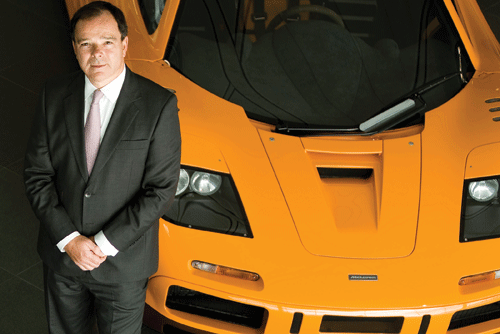
McLaren – Ian Gorsuch (Q&A)

by Paul Cochrane September 3, 2009
written by Paul Cochrane

Since 1963, McLaren has been renowned for its race cars and is the only racing team to have won Formula 1, Indianapolis 500, Can-Am and Le Mans championships. McLaren Automotive was established in 1989 and eventually manufactured the iconic McLaren F1 which, when it launched in 1992, was the world’s fastest production road car with a top speed of 386 kilometers per hour. Only 100 were built. Executive spoke with Ian Gorsuch, McLaren’s regional director for the Middle East and Africa, in Beirut after his company announced McLaren Automotive’s launch as a new, high performance car company.


E You said in your presentation that a McLaren F1 sold for $4.1 million some eight months ago. That is quite remarkable in a recession, no?
People were surprised as it was at the height of the recession. But it shows there is an interest and understanding of what we did in the world [at the time], the first luxury super car that was way above $150,000 — at $1 million, but now there are many [brands] at that price. It was great to see such confidence in McLaren… [F1 driver] Lewis Hamilton has been promised one if he wins three F1 championships with McLaren.

E How is the Gulf market for super cars compared to the rest of the globe?
The US and Europe are the major markets. Here is perhaps 10 percent of demand because, although there are a lot of wealthy people, [the population is smaller], and there are more millionaires in the US than here, although here [they] may be retaining their wealth better.


 E What super cars does McLaren compete with, in the Middle East and globally?

People will benchmark us against Ferrari and Lamborghini — favorably.

E The world is going through a financial crisis. Why are you marketing now for the 2011 launch?

I think it was good planning but also good luck; develop in the recession and hopefully by 2011 — what everyone is saying — the recession will be over, and we’ll launch the McLaren P11. We have also been very conservative with our figures, not looking at the 2007-2008 market — a record year with sales up — but at 2003-2004, when sales were lower. And we’re lucky, when we sell in 2001, we will have demand and not a stock situation, but a clean sheet.

 E How has the slowdown affected McLaren?
Our competitive benchmark has suffered a slowdown in sales, but Lamborghini, Ferrari and Aston Martin are still selling, in less amounts, and that is why we have a conservative model from several years ago, not last year.

E And how have sales of McLaren been in the Gulf?

While McLaren builds the SLR, it is Mercedes-Benz that actually sells them and possesses all the information relating to sales in the region. Globally, the SLR has been the most successful supercar ever in its price bracket. What we are doing at McLaren Automotive now is to create a completely new car company — not only will we build our own cars, but we will market them through our very own distribution network.

E When was the first McLaren bought in the Gulf?
It was the McLaren F1 in the early 1990s.

E McLaren will have distributors in Kuwait, Abu Dhabi, Dubai, Doha, Manama, and three in Saudi Arabia. What’s the plan until they open?
Our current focus is on building an understanding and awareness in the region of what McLaren, and in particular McLaren Automotive, is about. Currently some people know the brand from Formula 1, some from the McLaren F1 supercar and others from the success of the Mercedes-Benz SLR McLaren. We are also in the process of appointing a retail network and building a prospect and depositor base.

E A prospect and depositor base?
This is particular to the luxury car markets, the brand and the dealer. Customers order in advance to assure early delivery.

E There will be dealerships in the Gulf, but why not in Beirut?
When the car is launched, we will build 1,000 for the world. There will be large demand and we will not be able to open everywhere. We need a dealership to be profitable as they look after customers better. We want our customers to be comfortable when in Beirut. So in the initial stages cars will only be looked after here in Beirut, at a service center.

E Have you found a center yet?
We are still looking for a service operator. I think we have identified one, and it will be the same one that deals with top end customers with super cars.

E But given the road conditions in Lebanon — driving aside — there are potholes, speed bumps and other obstacles, is Beirut the right place to drive a McLaren?
If a guy comes here for his summer holidays and brings one to two cars, he might decide to bring say a Lamborghini and a Aston Martin because there is a service center, but not bring his McLaren — even though he loves driving it — so we want him to be comfortable and have the confidence to bring it here.

E There is a Formula 1 track in Bahrain, and over the past few years there has been talk of F1 tracks opening in Qatar and Dubai. That must be good news.
The whole region is car mad, and aware of cars, and loves racing cars… often on the streets. For F1 to be in Bahrain, it is good for us to be a major player at the cutting edge of technology, and for us to be there in the region.

E McLaren is known for its gold covered engines. Excessive?
It is not actually the engine that has a gold cover, but the engine bay of the original McLaren F1 supercar. This was for purely practical reasons, as gold was found to be the best material for heat insulation. Indeed, at McLaren we have a saying that everything we do is done for a purpose.

E You mentioned many brands that McLaren has worked with in the presentation. Is this still the case?
We developed the engine of the F1 car with BMW. During the 1980s, the Formula 1 cars’ engines were from Honda. Nowadays, we have Mercedes-Benz engines in our F1 cars, and of course we have been working with Mercedes-Benz on the SLR. What working with other brands has shown is that one plus one equals three. We learned a lot from our partnership with Mercedes on the SLR. With the new car, we will be building on all this experience yet producing a car that will be totally McLaren.

E Over the next few months you are going to be doing hot weather testing in the Gulf. Why there, not say in the deserts of Nevada?
The Gulf temperatures are hot and humid, and in the deserts [there is] low humidity and high temperatures, so a good environment for testing. A major concern of our Gulf customers is whether the car will be able to handle the conditions of the Gulf.

E You are to have a shareholding of $407 million. Will there be an initial public offering (IPO), or are you looking at an investor, or investors?
It’s all in equity, there is no debt, so we are looking for an investor.

September 3, 2009 0 comments
0 FacebookTwitterPinterestEmail
Executive Insights

Those who lead and those who follow

by Rany Kassab & Ramsay G. Najjar September 3, 2009
written by Rany Kassab & Ramsay G. Najjar

During these times of unending political squabbles, we often hear people sitting in cafes basking in Beirut’s sun arguing and vigorously calling for the emergence of a new leadership that can help replace some of the “old guard” and resurrect the country from its quasi-lethargic political quagmire.

Elsewhere in the Arab region, the “identity confusion” that has characterized certain societies, in terms of a lack of unified values and divergent aspirations, has also triggered a quest for a leadership capable of fulfilling people’s expectations.

Meanwhile, on the other side of the world, on Manhattan island, and in the midst of one of the worst financial crises seen since 1929, what used to be the “golden boys” of finance and young executives are desperately hoping for a new corporate leadership that can help shield their gloried financial institutions from bankruptcy, and bring back the good old days of mouth-watering bonuses and lavish lifestyles.

In all cases, however, certain questions come to mind: What exactly makes a leader? Is political leadership, in essence, any different from leadership in the corporate world?And possibly the more fundamental and age-old question remains, is leadership an innate or a nurtured quality?

What’s certain is that while leadership is most often associated with political figureheads and CEOs, it nonetheless is evident all around us, whether in the way a team captain leads his team to victory, a school teacher pushes her pupils to explore their full potential, or a general leads his men into battle. Leadership is also certainly not restricted to humans, as it also extends to the animal kingdom where “alfa” males try to impose their authority and dominance over the pack.

Leadership, thus, is that ability to influence others, to rally and galvanize people around an agenda. It is the capacity to communicate a certain vision in a way that allows it to get across to its intended recipients and very often change perceptions and entrench principles and convictions. Whether these convictions are considered “good” or “bad” is a matter of personal opinion.

In fact, while we might find Hitler, Mussolini, Genghis Khan, Pol Pot, or even Rupert Murdoch’s views and actions appalling, no one can argue their ability to influence people into believing them and in them, which is a quintessential leadership trait.

All such leaders have in common certain sets of skills and attributes that reinforce the perception of leadership that others have of them, most notably charisma, linguistic skills, physical aura, confidence and determination.

While some of these characteristics are arguably innate, most are acquired and developed through the years, and communication plays a central role in this. The way a person communicates, both verbally and physically, can go a long way in establishing his leadership, granted that the physical “package” is coupled with a core “product,” or message that matches, if not surpasses it.

Eye contact, facial expressions, hand gestures, tone of voice, posture and clothing are all bits and pieces of a larger puzzle that when rightfully pieced together can help accentuate and showcase a person’s leadership.

This is especially true when considering that 70 to 90 percent of communication is non-verbal, relayed through body language. Both consciously and sub-consciously, your body tells observers what is really going on with you. As the old adage goes, you can lie with your words but never with your eyes.

Likewise, although subtle, even the smallest of hand gestures can, according to some schools of thought, be associated with a specific image in people’s minds, be it positive or negative.
On the other hand, a person’s posture, stride and gestures, can either convey the image of a strong, forceful and dynamic person, or that of an unassertive and nervous individual who is lacking self confidence and assurance.

But while physical demeanor is key to nurturing one’s leadership skills, it is only one side of the equation, with the second being the content of the person’s message and his ability to engage his audience and to deliver his message in an impressive and resonating manner.

Having the right ideas is a main ingredient for leadership, but being able to convey them through the media to stakeholders in a catchy and simple way that makes them understood by the masses is equally as important, particularly at a time of increased media awareness.

Media skills, both in terms of physical language and message delivery, can nowadays make or break a leader. Case in point, Democratic hopeful Howard Dean killed his chances early in the United State’s 2004 Democratic primaries due to an emotional holler (the “Dean Scream”) during one rally that gave bloggers and late night show hosts in the US ample material for comedy that ruined his “presidential” allure.

Less than a month ago, Hilary Clinton’s inability to control her emotions at a public meeting in the Congo became an online sensation that some political pundits argued undermined her aura and revealed her Achilles heel.

It is because of such examples that established and aspiring leaders alike, both those in the political arena and in the corporate world, have recognized the importance of media training, which has become a skill sought by many across the world. Media training can provide the dos and don’ts of communication that are pivotal to would-be or seasoned leaders, as they can help to enhance the power of their rhetoric while increasing their ability to influence and impact others.

In the Middle East, many corporate heads and politicians are also starting to realize the pivotal role of communication in cementing their leadership. But much is still needed in terms of mastering such skills in a way that does not dilute their image or over-expose them. Their goal should be to ultimately reach the level of “media maturity” that allows their discourse to move from simple propaganda to a truly content-rich and engaging discourse.

In the end, a person’s aptitude to properly communicate and express himself, effectively reaching his audiences and speaking a language that strikes a chord with them, both through his physical demeanor and messages, can determine whether he truly is a leader.

Rudyard Kipling surely said it best when he said:
“If you can talk with crowds and keep your virtue,
Or walk with Kings — nor lose the common touch;
If neither foes nor loving friends can hurt you,
If all men count with you, but none too much…
Yours is the Earth and everything that’s in it,
And — which is more — you’ll be a Man [and almost certainly a leader] my son!”

Rany Kassab & Ramsay G. Najjar S2C

September 3, 2009 0 comments
0 FacebookTwitterPinterestEmail
Economics & Policy

The single currency conundrum

by Chitro Majumdar September 1, 2009
written by Chitro Majumdar

The mountain of bad debt still on the books of the United States banking system and now emerging in the European banking system, as well as the furious monetization of dubious assets undertaken by the Federal Reserve and European Central Banks, is coming back to haunt us.


The Greek crisis is a direct result of an insane policy of artificially low interest rates which allowed the reckless fiscal extravagance of an entire nation to continue unchecked. Such profligacy left Greece’s terms of trade stagnating since the advent of the euro and perpetuated tax evasion — estimated at more than 30 percent of tax revenues — taking gross government debt to 115 percent of the country’s $352 billion economy.

Exacerbating this were debatable accounting practices and Goldman Sachs-engineered financial tricks that led the credit default swaps (CDS) spreads to 450 basis points.

To mitigate the impact of the Greek crisis on other European nations, the European Monetary Union (EMU) took the seemingly paradoxical step of issuing a gigantic package of almost 1 trillion euro in further debt.  This being debt, rather than the bank equity offered in the United States’ TARP program, it does not provide the benefit of the money multiplier, due to the fractional banking system. This has had the net effect of weakening the euro and spreading the contagion throughout Europe, thanks to the immediate widening of CDS spreads for some “Club Med” countries, which then extended outright to France and Germany.

As the Greek fiasco spreads, we should not forget the Gulf Cooperation Council nations, which have in recent years entered serious talks on establishing a single currency. This new currency, with its proposed US dollar peg, will now be subject to a thorough, critical revision.

Through the introduction of a single currency the GCC would provide a broader platform for economic integration and promote the non-oil sector, which could supply a more balanced mix of revenues and more distributed job opportunities to grow the region’s economy. Also, a single currency would decrease the transactional cost involved in bilateral exchange between the region’s countries. As the degree of economic integration increased, the non-oil sector would help offset foreign exchange costs, reduce accounting expenditure and other costs firms incur when operating in more than one GCC country.

However, the first lesson we can draw from the euro crisis is that a monetary union without fiscal and inevitably political unification may fail under the stress of crisis. A common currency fosters an artificial convergence of interest rates to the lowest denominator, and allows countries to defer addressing productivity disparities and fiscal imbalances, until a crisis forces a painful realignment of the fiscally weaker. A common currency imposes currency rigidity that precludes the possibility of engineering fast International Monetary Fund-type interventions, such as a dramatic devaluation to jump start growth.

So how would a single GCC currency impact the region should a crisis threaten macroeconomic stability?

Most GCC countries currently maintain considerable surpluses — collectively 26 percent of GDP in 2008 — and therefore need not issue debt. Until oil revenues constitute less than 50 percent of GDP, however, the proposed new currency will inevitably be linked to oil prices. After 2008, which saw oil peak at above $100 a barrel then plunge briefly to $30, possible volatility could be uncomfortable to say the least.       

As an April 2010 Jadwa Investment report rightly noted, Greece’s high budget deficit had been largely based on its ability to draw on Eurozone membership to borrow cheaply abroad. However, the bank said a comparable scenario was unlikely in the GCC due to the similarity of the Gulf nations’ oil-based economies, meaning imbalances between nations were less likely.

As we can see from the ongoing euro crisis, a regional common currency can be a double-edged sword. As such, the architects of a GCC monetary union will have to evaluate and incorporate lessons from the euro’s woes, and carefully consider if the next logical step — a fiscal and political union — is a wise choice for the future.


September 1, 2009 0 comments
0 FacebookTwitterPinterestEmail
Money Matters

Money Matters by BLOMINVEST Bank

by Executive Staff August 28, 2009
written by Executive Staff

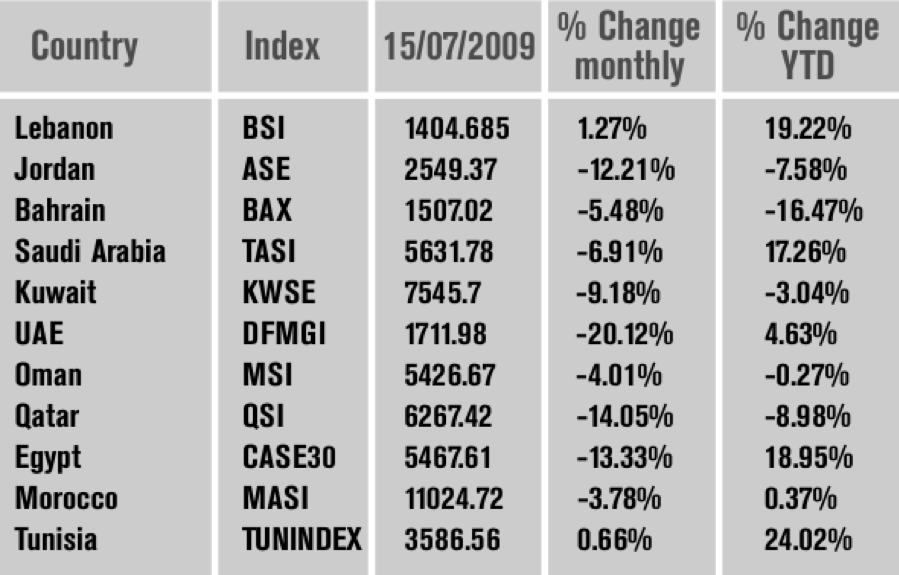
Regional stock market indices

Regional currency rates

Trade Bank of Iraq to issue $10 billon in credit

The Trade Bank of Iraq (TBI) aims to issue $10 billion in letters of credit in 2009. This represents an increase of 11.11 percent on 2008, amid increased private sector activity. Most of the bank’s business will remain in the public sector, with the addition of issuing around $1.8 billion in letters of credit to the private sector. In 2008, TBI’s net profit rose 41 percent to reach $359.3 million with a net operating income that rose 51 percent to reach $447.1 million. However, this profit will most likely remain flat this year as a result of the global economic crisis. The bank plans to enhance its domestic retail activities by opening five more branches in Iraq and three more branches abroad, in the United Kingdom, Turkey and Lebanon. It will also seek help from international investment banks in order to structure an Iraqi investment fund to finance tourism, infrastructure and industrial projects in the country.

ADNOC and Conoco Phillips deal

ADNOC (Abu Dhabi National Oil Company) and Conoco Phillips (US) signed a final agreement to invest in a $10 billion project known as the SGD (Shah Gas Development). The two companies signed the joint venture and field-entry agreement to create a new company with an ownership that will be split 60:40 between ADNOC and Conoco Phillips, respectively. This new venture aims to develop ‘sour’ or sulphur-rich gas reserves at the Shah gas field in the south of the emirate, and build processing and transportation infrastructure for 540 million cubic feet of gas alongside liquid sulphur pipelines and an export terminal at Ruwais. US company Fluor completed the front-end engineering and design for the scheme in March and documents for the construction phase of the project in June have been released. The Shah Gas Development project is one of the largest energy infrastructure developments to be approved in the Middle East in 2009.

Algerian expansionary policy

As oil and gas prices remain below their 2008 highs, Algeria expects its government revenue to fall sharply in 2009. Nevertheless, the Algerian government will still maintain an expansionary fiscal policy in order to boost economic activity in the country. The 2009 budget has been set at $72 billion, up from $68.5 billion in the supplementary 2008 budget, and revenue is projected at $39.19 billion, of which $16.7 billion is in tax receipts. As oil prices recover further along with the global economy, Algeria’s central budget deficit is forecasted at 2.4 percent of GDP in 2009 (compared to an estimated surplus of 9 percent of GDP in 2008). Real GDP growth is expected at 3.3 percent for 2009 and economic growth is anticipated to accelerate in 2010 thanks to a slight recovery in export markets. Average inflation is expected to fall sharply to 4.3 percent in 2009. As for the currency, Banque d’Algérie (BdA) will still maintain a managed float of the Algerian dinar in order to strengthen it. Additionally, rising oil prices are likely to continue to fuel the economy and trade surplus is expected to grow to $20.6 billion for the year.

August 28, 2009 0 comments
0 FacebookTwitterPinterestEmail
Executive EducationSpecial Report

Learning for the corporate world

by Executive Staff August 28, 2009
written by Executive Staff

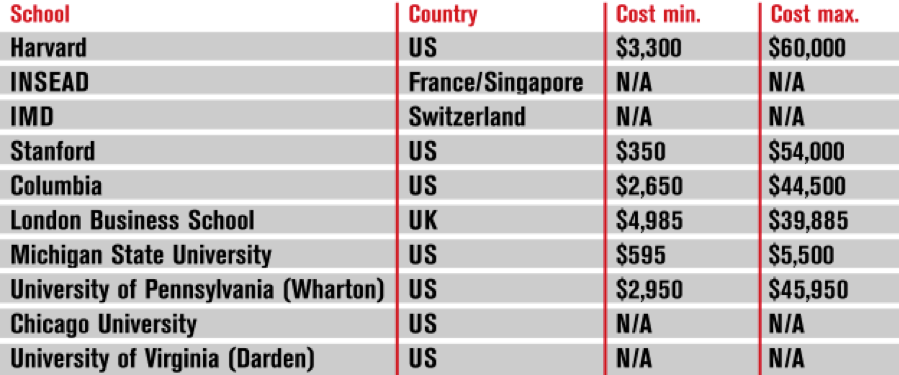
Top 10 international executive education programs

Source: BusinessWeek

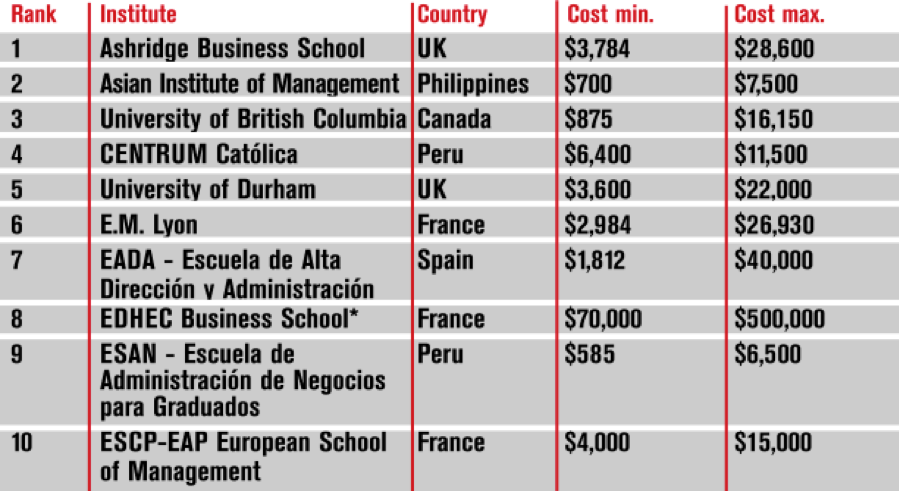
Top 10 non-US executive education programs

*Custom program
Source: BusinessWeek

At an executive managerial level, it isn’t easy to make long-term commitments unrelated to work. Executive education programs are tailored to those who want to continue their education but are unable to spare a year or two obtaining an Executive Master’s Business Administration (EMBA), or executive master’s degree in business administration. While no degrees are issued upon completion of executive training courses, participants receive accredited certificates. With shorter, smaller classes, executive education courses come in two forms: open enrollment and customized courses.

Business schools around the world have created tailor-made executive education courses for companies aiming to enhance their employees’ skills. Harvard Business School, the world’s top executive education provider, works with companies to develop specially designed courses to fit the organization’s needs. Training courses benefit the individual employee as well as the entire company, according to Harvard.

Open enrollment courses are also valuable, as employees acquire skills on a personal need basis and then apply the knowledge in their working environment. For example, ‘Achieving Outstanding Performance’ is a five-day course offered by INSEAD. This course is for senior managers in companies focusing on initiatives to enhance its staff’s performance.

Another course offered by INSEAD is the “Family Enterprise Challenge.” This four-day course is “an overview of the latest thinking and best practices on a wide range of family enterprise topics, using real family business cases.” With many small to medium-sized enterprises and family-owned businesses in the Middle East, this class is ideal for regional executives. Other institutions offer numerous topics ranging from “advanced strategic management” at International Institute for Management Development in Switzerland to classes on “interpersonal dynamics for high-performance executives” at Stanford and “wealth management” at Wharton.

Lighter on the pocket and softer on time away from the office, executive education is an alternative to a long-term EMBA in today’s competitive and rigorous global business circumstances.

August 28, 2009 0 comments
0 FacebookTwitterPinterestEmail
Executive EducationSpecial Report

How the successful push further ahead

by Executive Staff August 28, 2009
written by Executive Staff

Fine-tuning your professional skills may be your best bet to retain a position or get a promotion. If you are a middle to senior manager with 10 to 15 years of managerial experience, the executive masters of business administration (EMBA) is for you.

Unlike the specific MBA, where students choose a particular specialization in business administration, the EMBA covers a wider range of skills, and does not explicitly focus on one issue. Instead, the EMBA provides executives with the breadth and depth of business management skills they need to boost their career. MBA programs are full-time programs, whereas EMBA degrees offer more flexible scheduling. Once an individual has reached a senior management position, they have the ability to take a few working days off to travel and focus on their studies every month, especially since companies are aware of the benefits its employees are gaining. Completing an EMBA gives executives significant leverage over their peers and competitors. Candidates for the EMBA are fast-paced, hard-working individuals, who are unquestionably devoted to their careers.           

Outside of the United States, the EMBA is quite a new concept; it has only appeared in the rest of the world within the last decade. The American University of Beirut (AUB) introduced its EMBA program in February 2004, and has since graduated 90 executive students. International programs, such as the London Business School and INSEAD — both of which opened campuses in Dubai — have larger clusters of students, as these programs have been around slightly longer. The limited awareness of EMBA programs is starting to change, as more globally renowned institutions are transplanting their programs into the Middle East while regional universities are starting to pick up the pace.

Top 20 international EMBA schools

Source: BusinessWeek

Do you fit the profile?

EMBA students in the region and around the world are largely mid-level executives who are ready to climb the next rung on the ladder, and senior executives wanting to sharpen their skills.

Edward Buckingham, director of EMBA programs at INSEAD, outlines the different kinds of individuals who frequently participate in an EMBA. First, there are the specialists. This group includes doctors, lawyers, engineers, accountants, architects and the like, who have already matured in their specific careers. At some point, these specialists become so good at their job that they are asked to lead a department.

“Very often, [specialists] haven’t had the chance to do an MBA earlier, so they need the training to take on more responsibilities,” say Buckingham.

Riad Dimechkie, director of the EMBA program at AUB’s Olayan School of Business, says experts are those seeking to widen the scope of their business knowledge.

“[These students] are often functional experts, so they have expertise in sales, accounting, information technology and they want more breadth, they want to know something about the more functional areas so that they can deal with them at a strategic level,” he says. “Or, they are getting ready to be promoted and want to learn about the functions they don’t know about firsthand.”

Dimechkie notes the specialists joining an EMBA program bring a lot of industry knowledge with them, whether it be in banking, law, finance or other major industries.

“They already have another career but they want to understand more about businesses with which they have some kind of relationship,” he says. “[For example,] if a lawyer deals with business people, they will want to have a better sense of business strategy and business accounting. Medical doctors may want to start up their own practice, or have shares in a business they want to oversee.”

The second group of EMBA students, according to Buckingham, are entrepreneurs. Such individuals have built-up their own company within the last five to 10 years and did not have the time to do a full-time MBA program.

“They shoulder an enormous amount of responsibility for their organization and community,” he says. This group also includes owners of small and medium-sized enterprises and family-owned businesses.

Dimechkie and Buckingham similarly highlight a final group of executive students, known as ‘the generalists.’ According to Dimechkie, this group is usually made up of general managers (GMs).

“These could be people who inherited a business or who were promoted to being a GM. All of a sudden they’re going from a GM to dealing with lawyers, bankers, insurance, hiring people, etc…  so they too need the breadth,” he says. “They also need more depth, because many of them come from non-business backgrounds and they are tired of managing by trial and error and want some fundamental analytical tools, conceptual frameworks, and more to better make decisions and most importantly, to be more confident in the decisions they make.”

Buckingham says generalists are often managers in multinational corporations or large companies.

“They have a lot of social capital within their company, around five to 10 years of experience within the same company. They are committed to a path and want to develop themselves,” he says. 

Many specialists need E.M.B.A. training to take on more responsibility in their careers

The learning curve

EMBA programs around the region allow participants to engage with one another in safe surroundings. Executive students are given the opportunity to test business ideas, concepts, frameworks, proposals and strategies with their classmates who come from a variety of cultural and career backgrounds. The classroom enables executives to interact with one another and experiment with different ideas without feeling insecure, says Dimechkie.

“Executives get to really enjoy the opportunity to share and bounce their ideas off of other people with similar or different backgrounds, because it’s a safe environment,” he says. “They don’t get the chance to do that in their own company, as they’re afraid to take chances because they want to be consistent with past behavior patterns or because they don’t want to be judged.”

Kevin Dunseath, director of the EMBA program at London Business School in Dubai, believes that executive students learn an unparalleled amount of information during the course.

“Our students will learn at least as much from one another as they will from the professors,” he says. “The professors have around 20 years of teaching experience, but in the class you’re going to have 800 years of combined work experience, from a huge variety of professional backgrounds.”

The dynamics of an EMBA classroom provides an edge for students. Dimechkie says that teachers are the facilitators of learning, as they manage the class without directly lecturing its students.

“The really clever professors are the ones that use the invisible hand; they’re intervening at the right time to push the discussion in a certain direction or to emphasize a point,” he says, adding that EMBA participants acquire knowledge in a different way than young students do.

“Executives learn in a much different way than [undergraduate] students do,” says Dimechkie. “They don’t learn by sitting and listening to lectures. They learn by doing, [just as they’ve been] learning while they’re on the job for the last 20 years. They learn by reflecting on what they’ve done and seeing if it was the right way to do it or not.”

Because students must be employed full-time during the program, what is learned in the classroom can be immediately applied in the workplace.

E.M.B.A. Programs build an extremely powerful, influential and well-connected network of people

Added value

Most EMBA programs meet every three to four weeks, for two to three day block sessions. No matter what program one chooses, classes are extremely diverse as executives fly from all around the world to participate in the top-notch courses. With so much diversity around, executives get to network with each other during and after the program.

“By the end of the program, [participants] would have built up an extremely powerful, influential, very well-connected network of people,” says Dunseath.

Dimechkie also highlights the networking opportunity that EMBA programs create.

“It’s very important for people to [get the chance to network] in the region, because they are the people they’re going to be working and connecting with for the rest of their lives,” he says. “[Executive students] tend to develop very close and strong relationships with each other, and very often go into business ventures together.”

Executives around the world gain a tremendous amount of leverage over their peers in their company, as each month they return to the office from the program with new ideas. Alumni of EMBA programs gain the ability to quickly analyze complex business issues, and quickly make decisions about them. Dimechkie explains the mixture of rigor and relevance common in an EMBA program.

“[The executive students] need the relevance to apply what they’re learning, quickly. The idea is to quickly take those concepts [from class] and struggle and wrestle with them and try to apply them in the real world,” he says.

It is key to note that EMBA programs are not tailor-made to regional issues or economies. The point of such an executive degree is for students to learn and apply knowledge at a global level, thus providing alumni with the most universal and cutting edge business tools around.

Executive students are taught comprehension of overall business functions, from human resources to balancing the organization’s books. EMBA programs also teach leadership skills, demonstrating how to manage large groups from the most senior level.

Corporate sponsorship

Many companies in the world sponsor senior employees seeking an EMBA. Corporations view sponsoring higher education as a retention strategy, with some asking their employees to promise to remain with the company for a certain amount of time upon completion of the corporate sponsored degree.

“Companies use the EMBA as a risk management tool for people to get the training they need and to get feedback on how to progress further,” says INSEAD’s Buckingham.

Since the global financial crisis took hold, many companies simply do not have the means to fund such pricey programs.

“Companies that send people tend to send them less during times of crisis, as one of the first things they want to save is expenses on training,” says Dimechkie. “If a company is laying people off, to turn around and spend $50,000 on one person doesn’t look that great within the company.”

The flipside of the financial turmoil is that it lures eligible candidates to ameliorate their knowledge and skills, and think about returning to education. Since last year, London Business School has witnessed a 20 percent increase in its applications. Still, corporate funding is not always available. Many students pay from their own pockets, if need be.

“One difference that we’ve noticed in the last 12 months is that fewer companies are willing or able to provide corporate sponsorship,” says Dunseath. “But, we are confident that as business confidence builds up in the coming months, we’ll attract more corporate sponsorship again.” 

Obstacles for women

Around the MENA region, and the world generally, few women are enrolling in EMBA programs.

“There are fewer women in upper-middle and top management in the Arab world than there are men,” Dimechkie says. “Also, the average age group of participants [in the AUB EMBA] is around 40 years old. At that age, women usually have young families so it’s hard for them to constantly leave and participate in such a rigorous program.”

He wishes there were more women in the program, and like his peers in the region, makes continuous efforts to encourage top female executives to enroll.

“Once, we had 15 percent, which is still way too low… but the program is very expensive for people in [the region], so we’re trying to make a scholarship for women specifically,” he says.

International universities also face this obstacle. Dunseath estimates that only 10 to 20 percent of participants at the London Business School in Dubai are female. Buckingham says the INSEAD program in Beijing has around 27 percent women enrolled, while the Fontainebleau program has a class  composition which is approximately 17 percent female.

“We recognize that this is part of a larger problem,” says Buckingham. “It’s difficult for women to balance career and home life. There’s another problem o­­f companies who are not so open minded about hiring women with children, as they’re worried that their loyalties will lie with the family and not the company.”

EMBA programs in the Middle East

* Tentative: expected to be launched in fall 2010
Source: Executive Magazine

Movin’ on up

Career advancement is one of the possible rewards upon completion of one’s EMBA. Graduates may receive salary increases, promotions, or may have the pleasure of being headhunted for higher positions in another company. It’s a two-way street though; Dimechkie says just because a EMBA candidate has been “in a pressure cooker for 20 months” doesn’t mean they will automatically receive the related perks.

Conversely, companies must make an effort toward recognizing their hard-working employees.

“Companies need to recognize that people are making huge investments in themselves — while also sacrificing their family time and social life — and if you don’t watch them or give them opportunities to grow, you might lose them,” says Dimechkie. “It’s the executives’ responsibility to make an impact, but also the companies’ responsibility to give them opportunities to expand.”

Of the AUB EMBA graduates, around 70 percent are either promoted within their company or are recruited by other companies at more senior levels. Alumni of the London Business School’s Dubai program double their salary within three years of completing the program. But Buckingham say what’s most interesting is how EMBA alumni’s careers are reoriented and redeveloped after the program.

Ultimately, no matter how much money one spends or how prestigious the institution, the onus lies in the hands of the EMBA participant.

“Just because you’re working hard and getting an education, if you don’t make an impact in the organization you’re in, they are not going to promote you or give you a higher salary,” says Dimechkie. “Somehow, you have to figure out a way to make an impact. Once they get noticed, they get promoted.”

August 28, 2009 0 comments
0 FacebookTwitterPinterestEmail
  • 1
  • …
  • 453
  • 454
  • 455
  • 456
  • 457
  • …
  • 696

Latest Cover

About us

Since its first edition emerged on the newsstands in 1999, Executive Magazine has been dedicated to providing its readers with the most up-to-date local and regional business news. Executive is a monthly business magazine that offers readers in-depth analyses on the Lebanese world of commerce, covering all the major sectors – from banking, finance, and insurance to technology, tourism, hospitality, media, and retail.

  • Donate
  • Our Purpose
  • Contact Us

Sign up for our newsletter

    • Facebook
    • Twitter
    • Instagram
    • Linkedin
    • Youtube
    Executive Magazine
    • ISSUES
      • Current Issue
      • Past issues
    • BUSINESS
    • ECONOMICS & POLICY
    • OPINION
    • SPECIAL REPORTS
    • EXECUTIVE TALKS
    • MOVEMENTS
      • Change the image
      • Cannes lions
      • Transparency & accountability
      • ECONOMIC ROADMAP
      • Say No to Corruption
      • The Lebanon media development initiative
      • LPSN Policy Asks
      • Advocating the preservation of deposits
    • JOIN US
      • Join our movement
      • Attend our events
      • Receive updates
      • Connect with us
    • DONATE