• Donate
  • Our Purpose
  • Contact Us
Executive Magazine
  • ISSUES
    • Current Issue
    • Past issues
  • BUSINESS
  • ECONOMICS & POLICY
  • OPINION
  • SPECIAL REPORTS
  • EXECUTIVE TALKS
  • MOVEMENTS
    • Change the image
    • Cannes lions
    • Transparency & accountability
    • ECONOMIC ROADMAP
    • Say No to Corruption
    • The Lebanon media development initiative
    • LPSN Policy Asks
    • Advocating the preservation of deposits
  • JOIN US
    • Join our movement
    • Attend our events
    • Receive updates
    • Connect with us
  • DONATE
Insurance

MENA – The underwriting tow

by Executive Staff December 3, 2008
written by Executive Staff

The underwriting division of the regional insurance industry is expected to expand substantially over the next year, as companies reeling from the effects of the global financial crisis concentrate more on their core business of writing risks rather than on the increasingly dismal investment side of the industry, which has already given the industry quite a beating. “In 2008 the poor results are due to [losses in] investment income,” said Farid Chedid, managing director at Chedid Re. “What we are expecting is that because of poor investment income and the negative investment environment in general, insurers and reinsurers will to look to increase their underwriting profits to sustain all the damage that was created by the global financial crisis. Hence, we are expecting more profits on the insurance [underwriting] side.”

Changing direction
But even if regional companies are intent on a paradigm shift in priorities from investment to underwriting, the transition will take time and, as the saying goes, time is money. “I think the trend will be that we will go back to technical profitability and not concentrate too much on the financial income aspect of the insurance business,” averred Elie Nasnas, director general of AXA Middle East. “It’s a medium-term trend and it will not happen overnight.”
Governments in the region have been keen to push mandatory insurance requirements but are viewed by many in the industry as lacking the foresight to encourage voluntary insurance, such as life insurance, through regulatory reform and by raising individual awareness levels of their populations by offering incentives to first-time insurance buyers. But in terms of incentives, “[governments] want to do it and they are afraid to do it. We need tax incentives to enhance the potential of the life insurance sector,” said Nasnas. This job has now been left to the companies themselves who, while keen to increase awareness, can only do so much in an environment that is not yet conducive to increasing insurance awareness across the region. The notion that the long-term benefits of insurance growth and awareness will outweigh the short-term costs of providing incentives to local populations seems to evade regional governments. Thomas Schellen, publishing editor and researcher at Zawya Dow Jones, said “Understanding that providing incentives to increase insurance penetration, even though it costs money now, will be more beneficial to both the state and the individual is a major problem.”

On the business side
Traditional regional coverage areas associated with the energy sector will remain strong. “The many challenges facing the energy sector in the Middle East also constitute great opportunities for long-term, diversified and innovative (re)insurance players,” wrote Loredana Mazzoleni Neglén, director of Europe, Middle East and Africa at Swiss Re IRI’s Energy & Power Industry Practice, in Middle East Insurance Review. “The region’s massive oil and gas projects will fuel the engine of its growth, particularly in the Gulf states, and (re)insurance will be an important catalyst to support this undeniable potential and boost the Middle East’s economies in the upcoming years,” she continued. However, the recent fall in oil price is seen as a real impediment to insurance growth because of the effect that decreasing prices will have on disposable income in the region. According to Chedid, “If you have a drop in oil prices, there is a slowdown in the regional economy […] Therefore, with less disposable income there will be less demand for insurance.”
Areas such as real-estate development have also seen promising growth rates in 2008 and look to continue into 2009. “Products related to urban development, where the Middle East is now establishing itself as a world leader — from the drawing board to final implementation, city building and the Middle Eastern drive to develop new urban identity modules — come with specific insurance needs that will have a stronger role,” Schellen said. Nevertheless, this growth should be taken with a grain of salt as these areas are expected to see a contraction in 2009 due to the high leveraging of the regional real estate sector coupled with the global financial crisis, in particular in places like Dubai where the real estate industry has been one of the cornerstones of economic development in recent years.
“Prices have gone down [in the real estate sector] and projects are delayed due to the fact that the economy in Dubai is based on real estate,” said Michael Bitzer, CEO of Daman. “There will be an impact on the GDP and then indirectly on the insurance sector.” Moreover, a looming real estate crisis brought on by the global financial crisis could have dire consequences for the insurance industry as well as the regional economy.
“I think the worst thing that can happen in the region is to have a real estate crisis,” said Chedid. “For insurance companies it immediately has a negative impact. If the real estate industry is in trouble, they will be looking to save on risk management.”
Overall, the business segment of the regional insurance industry is set to decrease in line with the contraction of regional and global economies. The focus for the next few years will have to be on retail underwriting and companies will look to improve their product offerings and cut costs in order to stay competitive in the regional market.
“Companies will start to think in terms of the bottom line and concentrate on technical underwriting as well as practice further cost cutting,” Nasnas said. This is good news for retail consumers who can expect better products and services from their insurance providers in 2009 and beyond, even though companies will increasingly feel the crunch. “Clients will expect the same level of service if not more and companies will have to cut their costs accordingly,” Nasnas concluded.

December 3, 2008 0 comments
0 FacebookTwitterPinterestEmail
Comment

The Arab brand

by Paul Cochrane December 3, 2008
written by Paul Cochrane

The Middle East as a region has a ‘brand image’ problem. War, terrorism and — in the words of a soon-to-be- departing US president — evil, are terms that still abound in the generalized view of the region. Although the Gulf countries are getting double digit marks for growth, tell people in Europe or the Americas that you’ve just been in Lebanon/Syria/Iran/Jordan etc. and the response is invariably, “Oh, isn’t it dangerous there?”

There is always a short or long answer to this. But based on the past year, outside of Iraq and the Palestinian Territories, there has been remarkably little to brand the Middle East as any more of a hot spot for war, terrorism or evil than most other parts of the world.
The region has arguably been the victim of its own craven desire for publicity — at once complaining of skewered coverage, yet getting proportionally more coverage than other places. The region’s geostrategic importance, energy and the role of Israel all play their part in this, but this over exposure of the ‘dangerous’ images of the Middle East has taken its toll on brand perception.
Compare this image to that of say Brazil, where people associate the country with samba, football and sunshine, yet in terms of street crime and robbery Brazil is far more dangerous than the majority of Arab streets, whether in the day or after dark. Equally Europe, the strongest of regional brands, has had its share of terrorism, and the chances of being mugged in Barcelona or pick-pocketed in London are exponentially higher than in Beirut or Aleppo.
Or take India, riding high on a brand image of an ascendant power in the region and the world, destined to take on China. While this may happen with India expanding its nuclear capabilities, a still-strong economy despite the global financial turbulence, and a gigantic domestic market, what has hardly dented brand India over the past year, at least internationally, is the spate of bomb blasts and attacks that have rocked the country.
This includes last month’s battles in Mumbai and the 63 bomb blasts in seven states over the previous eight months. As Executive went to print there were more than 100 dead in Mumbai, with security forces still skirmishing with pockets of armed extremists in the city. Between 2004 and 2008, there have been at least 25 major bomb attacks and hundreds of smaller incidents. Such violence has been carried out by Islamist groups, separatists and, in what has recently come to light, also by right-wing Hindu groups.
India ranks in the top three globally outside of war zones for terrorist attacks, yet if you tell people you’ve been to India, they respond with a type of concern typical of India’s brand, “Oh, isn’t it so dirty and poor?” — a far cry from the concern voiced when people hear you’ve been to the Middle East.
This is India’s challenge, as many recognize, yet it has not overly affected its global image. And while many countries in the Middle East face the same issues, there is also the impression of the petrodollars and glitz of the Gulf. The Middle East clearly has a mixed brand image, given the economic discrepancies between the GCC and the Levant.
Although tourism, a major part of a country or region’s brand image, is relatively strong, the association or a one-off terror attack alone is enough to make non-Arab tourists cancel their trips. When I visited Luxor in Egypt a year after the attacks on tourists in 1997, there was hardly a visitor; good for me but not the local economy. Egypt and Jordan saw a massive drop in tourists following September 11, 2001. Lebanon has also been quiet following the July War. And while Syria’s numbers have surged in recent years, the tourists are 75% Gulf Arabs.
But although India might not be doing that well in the foreign tourism stakes, only getting 3.5 million visitors a year — paltry in relation to its population and the 6 million Dubai gets, the 11 million that visit Egypt or Syria’s 4 million – people don’t call off their vacation because of a bomb blast.
It is time for the Middle East to start putting another image of itself across to the world to disassociate itself from the terrorism that does happen and portray all the positives that make the region such a wonderful place to visit and live in. There is no easy solution to this in the face of media portrayals, but that can also be used to the region’s advantage too, for there is a great deal of interest in the Middle East. There is also the talent and brains to achieve this. Above all it will take belief in the region, at the micro, country level as well as at the macro for this to happen. Brand India appears to have a strong belief in its future, and so should the Middle East.

PAUL COCHRANE is a freelance journalist. He is currently in the Indian subcontinent.

December 3, 2008 0 comments
0 FacebookTwitterPinterestEmail
Banking

Charles P.S. Hall – Q&A

by Executive Staff December 3, 2008
written by Executive Staff

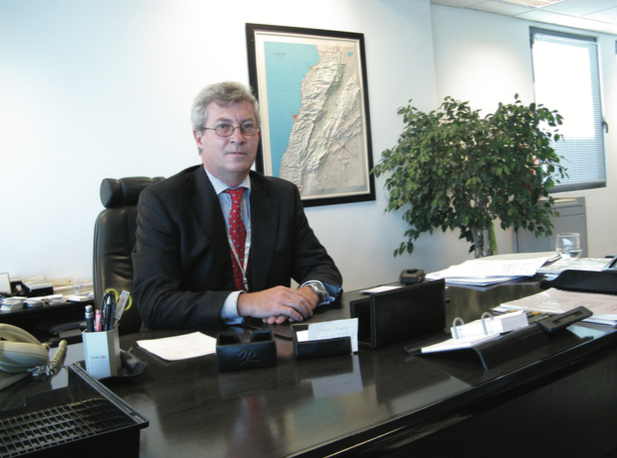
Executive sat down for an exclusive interview with Charles P.S. Hall, CEO of HSBC Lebanon, to discuss the current prosperity of the Lebanese banking sector, the regional sector’s performance in 2008 and prospects for 2009.

E Looking back at 2008, how did the Lebanese banking sector perform?
The Lebanese banking sector has actually been very resilient. I think the central bank can take a huge amount of comfort from that.
The most drastic accounts are what has happened recently, with the global credit market drying up and the fact that Lebanese banks have been very prudent in managing to escape the worst of it. As you know, they benefit substantially from inflows of money. I think there is the perception that the Lebanese banking system has weathered the storm and is therefore continuing to attract deposits, which have been flowing in. I understand in many cases that some of the private bankers have switched into Lebanese pounds, which yield a much higher rate than US- dollars. So as long as that premium exists in terms of the Lebanese pound, you’re probably going to see continued inflows of money, which benefits the economy and that benefits the government when it comes to capital raising exercises such as issuing more Eurobonds that have financed the country’s economic side of things.

E Why do you think the Lebanese banking sector is doing so well even after the global financial crisis?
Well, in fact the Lebanese banking sector is doing nothing new. It’s just continuing the prudent approach it has taken in the past. It’s just that the model has worked and nothing has really changed. The Lebanese banks have not had the same problems that the foreign banks have had, the business models are very, very different. You look at some of the UK banks; for every $100 they were taking in, they were lending out $1,200 — something’s going to have to give. The Lebanese banks are very well capitalized and they don’t have that type of liquidity problem.

E Would you say that the Lebanese banks have benefited from the global financial crisis, or is to too early to tell?
Oh, they have clearly benefited, especially in terms of the inflow of funds.

E Do you think the Lebanese banking sector’s current prosperity will continue into 2009?
I see no indication why it shouldn’t. I suppose there are a couple of issues that might arise. If you look at a number of other countries that are in real difficulty, they’ve actually had to price their sovereign debt, their government debt, well above 9%. You look at somewhere like Iceland, they’ve had to actually price their debt at over 20% to attract inflows of funds. There is no indication at the moment that the government here is going to have to compete with those markets and they’ve got a large enough Lebanese diaspora that feels that Lebanon is very much a part of their own and will continue to support it. So, I don’t see any problems in the short-term. In the longer term, the government is going to have to address the debt level… but at the moment I don’t see any problems with that, as there are such large inflows of funds to support it. As long as the political stability remains here — or some sort of political status quo — then I think Lebanon is probably as well placed, or better placed, then many countries.

E Credit Suisse predicts Lebanon’s GDP to rise a mere 3% this year and 4% in 2009 – whereas the IMF forecasts a 6% GDP rise for 2009. Which forecast do you think is more accurate, and why?
Well, I think all bets are off at the moment, because we just don’t know what’s going to happen. Lebanon is part of the global economy anyway, whether we like it or not, and is not going to be immune from the flow of trade in either direction. Lebanese are descendants of the Phoenicians, the world’s greatest traders, so without actually knowing how the trade flows are going to evolve, we can get some sort of idea at the moment from our trade finance business… we’re finding, actually, still that the flows of trade are very healthy, but at some point it is bound to be affected. So I just don’t have a feel as to how the GDP will look, but I would err on probably the more conservative side now. When the Credit Suisse report was written, things were very different.

E Do you think Lebanese banks will continue expanding regionally to help them grow?
Audi, BLOM, all the major banks have. I think the [recently broken deal between EFG-Hermes and Bank Audi] was a sensible move, because they couldn’t agree on a price and in the current markets you just don’t know what’s happening. Audi is a very well run bank and I think it was very prudent, because you just don’t know what the exposure of the other bank was going to be. They’ve probably done their due diligence and I can’t really comment on that. But, I know the central bank has actively encouraged the major Lebanese banks to diversify outside Lebanon to make sure their eggs were not all in one basket. You’ve seen Audi expand dramatically into Egypt and into a number of other countries too. Syria has been a major one for them. I think it’s been very prudent for them to do that.

E What role would you say regulation plays in protecting banks? Do you think Lebanese banks are less affected by the current crisis than GCC banks due to tighter regulations set by the Lebanese central bank?
Yes, I think that is absolutely right. Lebanon has actually exported bankers for many, many years within the levels of HSBC — the person that runs HSBC in the Middle East is Lebanese, the head of global banking markets in the whole of HSBC Group, is Lebanese… So I think the Lebanese are probably some of the smartest people when it comes to running banks, and the central bank here, well, as you know Riad Salameh was voted Governor of the Year in 2006. Some people have said to me that some of the regulations have been draconian, but that has actually paid off. The exposure by banks to these credit default swaps is negligible. Now that’s not to say that these instruments are not useful, they have their use, but they’ve been abused. I was talking to one Lebanese banker and he said that the treasury department of this major bank didn’t understand these particular instruments… and because they didn’t understand it, they didn’t actually buy them. That says something of the management of those banks. So yes, the central bank has a very clear role with regard to regulation and has been central towards making sure that the economy has benefited because the government and the banks are essential and they need each other and they have been a success for Lebanon.

E How would you explain the $7.7 billion — up from $6.6 billion in 2007 — inflow of bank deposits into Lebanese banks in just the first nine months of 2008?
Well, a lot of it has to do with the booming property market as people are actually shifting money into Lebanon. We’ve seen it, we’ve had a 250% increase in our home lending. If you take that across the whole banking sector, and I know it wouldn’t have been as much in terms of percentage increase, but if you take that kind of thing into account then you can see fairly quickly that the lending side for property has attracted a lot of funds, mainly from the Gulf and the Lebanese diaspora. I’d say that is the main factor, certainly for the first nine months. But also, people are repatriating money. A lot of people have emigrated out of Lebanon into the Gulf and are bringing their money back.

E Was the Lebanese banking sector affected by the May events?
It was interesting actually, I was here at the time and I met a few customers. In fact, as the problems were happening I was down in our trade finance area and there was a customer bringing in a letter of credit. When I was talking to him about it he said, “These things happen, life goes on!” We detected, obviously, a slowing down for a couple of days, but then there was a pent-up demand and business was back to normal. In fact, actually, there was a sort of sense of euphoria after the events and people went into a sort of a holiday mode thinking all their troubles had been sorted out — it was really quite bizarre.


December 3, 2008 0 comments
0 FacebookTwitterPinterestEmail
Real estate

Kuwait – Fuel to build

by Executive Staff December 3, 2008
written by Executive Staff

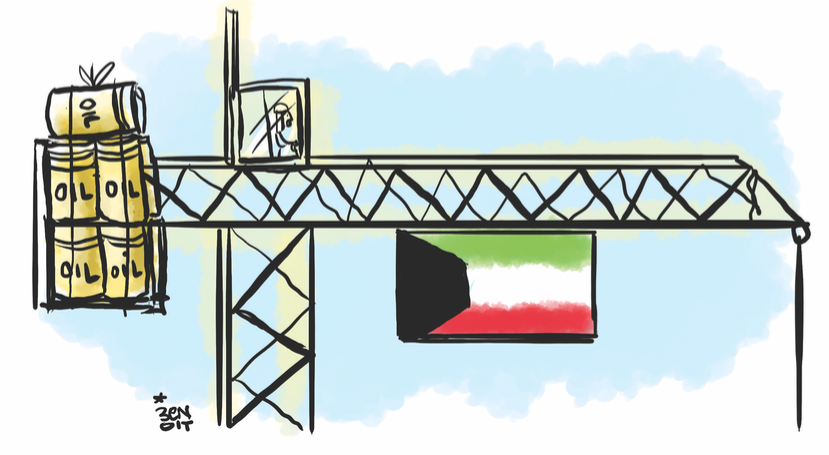
Kuwait accounts for about 10% of the world’s oil reserves and has benefitted from recent high oil prices, as well as political stability and economic growth. Yet the country plans to diversify its economy away from the oil sector to include infrastructure, tourism and construction. Still, the construction sector contributes only 6% to the nation’s economy, while the oil sector accounts for 55% of GDP, 95% of expatriate revenues and 80% of government income, according to the Oxford Business Group (OBG). The country is far behind its neighboring economies in terms of growth in the property market, mainly due to the lack of transparency on real estate information, lack of trading savy among investors, lack of regulations, restriction of foreign ownership and scarcity of lending facilities.

According to the National Bank of Kuwait (NBK), 2008 has not been very prosperous as the first nine months of the year witnessed a 28% drop in real estate sales compared to the same period in 2007. The number of transactions also fell by 32%. The decline in sales occurred mostly in residential property — which accounts for around 80% of market activity — with value and unit sales declining by 36% and 38%, respectively.
Poor government regulations and a massive bureaucracy have caused local investors to focus on foreign investment rather than expanding domestic supply. Moreover, according to the Kuwaiti Financial Center (Markaz), high land prices are restraining growth in the real estate sector by decreasing demand and making new developments less affordable.
Expatriates, who account for 68% of the total population, are still not allowed to own real estate, thus holding back the flow of investment and inducing expatriates to search for better opportunities in other Gulf countries. In October, the cabinet announced it plans to allow GCC nationals to own land and property in an effort to open up the sector and encourage foreign investment.
According to OBG, in the next five years around $8 billion of private investment and $3 billion of government investment is expected to come into the sector. Some of the major projects include Gailakha Island, Bubiyan Island, Project Kuwait, Khairan and Arifijian residential projects. Overall, new construction is expected to reach $129 billion in 2010.


December 3, 2008 0 comments
0 FacebookTwitterPinterestEmail
Insurance

Overview – Paltry protection

by Executive Staff December 3, 2008
written by Executive Staff

One might think that the region that invented insurance would lead the world in mitigating risk and act as a model for others to follow. But almost 4,000 years after Mediterranean merchants first insured their cargo from the risk of piracy, the region suffers from a lack of insurance awareness and coverage across the board. Although information for all of 2008 and even for the third quarter has yet to be released by many insurers, what is available for analysis points to low penetration rates coupled with an increasingly caliginous financial sector. For example, the UAE registers a meager 1.7% penetration rate as a percent of GDP, trailed by Egypt (0.9%) and Saudi Arabia (0.6%), according to Business Monitor International’s (BMI) Q3 reports for the industry. That said, low penetration rates also constitute ample room for growth. With the industry expecting double digit growth (estimates vary between 12% and 15% annually) and a CAGR of up to 25% in some countries in the region over the next five years, the industry looks set to make its mark on the regional economic framework.

In a perfect world, such figures would have been heralded as early signs of the next regional industry boom. Assumptions of this nature, however, do not hold much water when the world is drowning in a global recession ushered in by a colossal financial crisis. Despite the anticipated fallout from the global financial crisis, the prognosis for the region in general remains more promising than that of many advanced economies expected to grow at an average of just 2%, according to adjusted IMF figures. Nevertheless, a widespread slowdown as a result of lower oil prices will undoubtedly have a sobering effect on the insurance industry as a whole. According to Michael Bitzer, CEO of Daman, “In general, on a regional level the global financial crisis, and now the global recession, as well as the decrease in oil prices will have a negative impact on the overall growth rate of economies and insurance in particular.”
The phenomenon of low penetration rates prevalent across the region is, however, regarded as more of an opportunity than a sign of a general unwillingness to embrace the concept of insurance. Yet the idea that double digit growth and the room for expansion provided by low penetration rates can compensate for many of the industry pitfalls in 2009 and beyond is rather simplistic. “There are great opportunities, but to say that everything is golden because we have double digit growth is just not the right picture,” said Thomas Schellen, publishing editor at Zawya Dow Jones. This sentiment is echoed by many in the industry who enjoyed the recent boom but will now have to weather the storm of the regional slowdown, even in territories like the UAE that are at the forefront of the regional insurance industry. This year “was characterized by extremely high growth for the whole of the UAE, but for next year I am expecting that growth rates will go more or less to 0%,” Bitzer averred.
The main reason for most analysts skepticism is that the industry is heavily dependent on the global and regional financial environment, which is currently in a state of disarray. “In 2008, the poor results are due to [losses in] investment income,” said Farid Chedid, managing director at Chedid Re. Moreover, the institutional framework and regulatory environment that operates on a regional scale has yet to be put in place as of 2008. “Standards that customers and insurers can rely on are not yet uniformly developed,” Schellen pointed out. However, there is a sense that regional governments have acknowledged that the region is relatively underinsured and have started to take some of the necessary steps required to begin to support the regional insurance environment in 2008 and into 2009. “Governments should continue what most of them have started [in 2008] and improve regulations as well strengthen the regulators”, said Bitzer.

December 3, 2008 0 comments
0 FacebookTwitterPinterestEmail
Comment

Region cues for Obama’s list

by Claude Salhani December 3, 2008
written by Claude Salhani

For a change, the news from Washington was positive and well received around the world, including the Middle East. Upon his victory on November 4, Barack Obama received messages of congratulations from a number of leaders in the region, among them Iranian president Mahmoud Ahmadinejad. Obama’s election raised hopes in the Middle East that under his administration, America would resume her role of peacemaker in the region.

Obama’s election was a reminder that democracy, despite its many imperfections, works. It was, unquestionably, the best example America could offer and should encourage the spread of democracy around the world far more so than the menace of any military threat.
Realistically, however, what does Barack Obama’s election mean for the Middle East? Are too much hope and too high expectations being placed on the new president? The answer to both questions is an unequivocal “yes”.
While Obama will take the US in a very different direction than his predecessor, all his good intentions to try and resolve the Middle East’s crises will be hampered by the president’s biggest hurdle: time. There is only so much any president can handle in the space of 24 hours and Obama will have every hour of his days filled, working to untangle the mess caused after eight years of disastrous policies adopted by the neoconservatives who have managed to take a vibrant economy and drive it into the ground, start two wars in the Middle East and alienate the US from much of the world.
Obama inherits a long list of urgent domestic dossiers from the Bush administration: an economy in shambles; the housing market in disarray; unemployment hitting a 14-year high at 6.5%; the American car industry on the brink of bankruptcy with Ford, Chrysler and General Motors laying off workers by the thousands and plants in the Detroit area risking closure.
In foreign affairs, the Obama administration will have to deal with the war in Iraq, which appears to be winding down, but where the US is now engaged in a political battle with the Iraqi government over the SOFA (Status of Forces Agreement).
If the violence is abating in Iraq, it is gaining momentum in Afghanistan. Obama will have to decide what to do there and see if he can convince NATO and other allies to commit more troops in a concentrated effort to finally defeat the Taliban. Additionally, Obama will have to make a landmark decision about whether US forces should pursue Taliban and al-Qaeda fighters into neighboring Pakistan, seeing that as long as Pakistan continues to provide shelter — either willingly or unwillingly — to insurgents fighting the international force in Afghanistan, the problem is unlikely to end.
One of the topics likely to require urgent attention by the president will be Iran’s pursuit of nuclear technology. Just days after his nomination President-elect Obama reiterated that Iran should not be allowed to develop nuclear weapons.
In view of the priorities that will be granted to other more pressing issues, the Israeli-Palestinian conflict is likely to take a backseat — once again — until the president can find time to devote to getting the peace process moving. The good news here is that the Washington rumor mill reports that Obama will appoint a high profile envoy to represent him in the Middle East and push ahead for a comprehensive peace deal.
Obama will have to mend soured relations with Syria, which continues to hold the keys to any lasting peace treaty in the region. As long as Israel occupies the Golan Heights, Syria will remain opposed to the peace process, whereas a peace treaty with Damascus will pave the way for a comprehensive peace in the region. There is one important caveat, however: Lebanon.
Any peace treaty between Israel and Syria that does not include Lebanon will not be worth the paper it is written on. Why? Because a continued state of belligerency between Israel and Lebanon (read: Hizbullah), leaves a dangerous escape clause in the Syrian-Israeli peace process. Lebanon on its own would never sit down with Israel to discuss peace, but Lebanon as part of a joint delegation with Syria would place those parties opposed to a peace treaty with Israel in front of a fait accompli.
Finalizing the peace between Syria and Lebanon on one side and Israel on the other would resolve the issue of the Shebaa Farms and — in principle — remove Hizbullah’s reasons to maintain an armed militia.
Obama would then need to mend fences with much of the Arab and Muslim world with whom relations have been strained by the Bush neoconservative policy.
Of course, all this will take a backseat to the most urgent problem facing the US today, the financial crisis. Yet, Obama’s victory on November 4 over his rival, Republican contender John McCain, is a clear indication of the American people’s want for the change which Obama has promised.
As pollster John Zogby wrote in an editorial just days before the election, “change is coming.” And on November 4, change came.

Claude Salhani is editor of the Middle East Times and a political analyst in Washington.

December 3, 2008 0 comments
0 FacebookTwitterPinterestEmail
Banking

Lebanon’s banks invested in rebuilding the country‘s economy

by Fadlo Choueiri December 3, 2008
written by Fadlo Choueiri

The Lebanese banking sector has shown strong resilience to economic and political shocks and has demonstrated a commitment to continuously support the Lebanese government in its arduous rehabilitation journey.

With a rating equivalent to that of the Lebanese government (“B-” and a stable outlook), total assets in excess of $91.7 billion as of end of September 2008, customer deposits nearing $76 billion for the same period and a branch network exceeding 825 branches, the Lebanese banking sector has responded rapidly and efficiently to the financing needs of the domestic economy and continues to provide a wide range of conventional as well as high quality modern financial services for resident and non- resident clients.
The Lebanese banking sector continues to be the backbone of the economy, characterized by an efficient banking secrecy law, a free exchange system and free movement and repatriation of capital. In the past couple of years, the banking sector witnessed a significant improvement in investing in human capital, the latest information and communication technologies, internal auditing, risk management and control systems, and money laundering compliance units.
It has and will continue to play a pivotal role in smoothing government public finances and alleviating internal public debt service through its sustained investments in Republic of Lebanon Eurobonds and other government instruments instigated during the many reform phases engineered by the Lebanese Ministry of
Finance. This includes, among other things, the banking sector’s full support to roll over maturing government securities at lower yields and its participation in the exchange (swap) transactions of Republic of Lebanon Eurobonds that emerged in 2005.
One cannot forget the role of the Lebanese banking sector in fueling Banque du Liban’s (BdL) foreign currency reserves to record highs, thanks to the banks’ historical investments in BdL’s financial instruments that helped mitigate the risk of any imminent currency devaluation and added an influx of foreign capital from Lebanese expatriates, who continue to prosper on the back of a more relaxed political and investment environment. It is also worth highlighting the role of foreign donors’ support for Lebanon during the Paris II and Paris III meetings, raising some $4.4 billion and $7.6 billion, respectively, in foreign currency denominated funds. In this perspective, gross foreign currency reserves soared to an astounding $18.96 billion in the first half of November 2008, registering an unprecedented 51.33% annual appreciation.
Concurrently, in 2008 the Lebanese banking sector has witnessed a unique inflow of foreign remittances from Lebanese expatriates, especially those living in the Gulf, with some 43.1% reported annual expansion in foreign inflows to $5.65 billion through July 2008, up from $3.95 billion in the same period in 2007. In the second half of 2008, notwithstanding the global financial turmoil that struck financial institutions worldwide, the Lebanese banking sector preserved its solid standing with a reported $500 million influx during the one-week period that followed the bankruptcy filing of Lehman Brothers.
Renowned international credit rating agencies continue to praise the role of the banking sector in stabilizing the economy, to a certain extent, by being the primary source of public financing in both foreign and domestic currencies. In addition, recent reports by international rating agencies (e.g. Moody’s Credit Opinion report November 2008) hailed the resilience of the Lebanese banking sector to the prevailing global financial chaos and went further to indicate that the Lebanese banking sector actually benefited from the crisis. The immunity to the global economic and financial crisis can be attributed to the sound regulatory framework set forth by the BdL coupled with close supervision by the Banking Control Commission
Nevertheless, today the Lebanese banking sector is unquestionably experiencing a transitional stage into a new era characterized by a reduced exposure to government securities, narrowing interest spreads, harsh cut-throat competition, political tensions and economic instability.
I am confident the Lebanese banking sector has and will always be a major contributor to Lebanon’s economic resurrection. This owes to the banking sector’s eagerness to provide continuous financial support to the government if and when needed, its proven ability to create job opportunities both domestically and regionally as banks expand abroad, its credibility in the eyes of international donors and rating agencies that increase foreign and domestic investors’ level of confidence in the economy, that attract foreign direct investment and that add to its thrust to provide continuous financing to the various economic sectors upon which economic growth depends.

Fadlo I. Choueiri, CFA, is the head of corporate finance & economic research at Credit Libanais Investment Bank

December 3, 2008 0 comments
0 FacebookTwitterPinterestEmail
Insurance

GCC & Levant – The fog of financial crisis

by Executive Staff December 2, 2008
written by Executive Staff

The long-term effects of the global financial crisis have already begun to take hold of the industry as lower demand for oil, resulting from the effects of a global financial crisis, has pulled the rug from under the inflated oil revenues the region was lavishing in only a few months ago — albeit with double-digit inflation. Oil-rich governments do have a certain amount of financial cushion hoarded in their sovereign wealth funds, but individual disposable income will suffer as a result of lower cash flow in the region. Oil-poor nations will also be directly affected by less disposable income in places like the GCC, as their residents will be less able to send remittances to countries such as Lebanon, where remittances constitute around 25% of GDP. The decrease in regional disposable income will prove another substantial hurdle for a regional insurance industry already dealing with low demand and penetration.

For an industry that depends heavily on investment revenues, it comes as no surprise that Return on Investments (ROIs) have suffered greatly as a direct result of the global financial crisis. “Some of the largest players’ 2008 Q3 year-on-year income came down by 70% or more,” said Thomas Schellen, publishing editor at Zawya Dow Jones. Previous statements touting the region’s relative immunity to the effects of the financial crisis have proved to be nothing more than wishful thinking, as the Middle East’s equity markets have tumbled subsequent to the collapse of Lehman Brothers, exacerbating an already unstable market environment. As Executive went to press, the Tadawul, the largest Arab bourse by capitalization ($296 billion), had lost half its value in 2008. Other regional equity markets have followed suit creating a situation where the regional insurance industry will be hard pressed to find lucrative investment opportunities to prop up their recent profit losses in 2009. “The whole investment philosophy is changing […] what we see now is that whatever diversification you do or assets you acquire, everything is going down,” explained Farid Chedid, managing director at Chedid Re.

The bottom line dropping out
The perilous financial environment prevailing today has undoubtedly prompted regional insurers to shift their focus from investment income to technical underwriting, but they will be unable to completely retrench from the investment side of the industry, as “there will be no escape from their [insurer’s] financial dependency [and] this will affect the bottom line of insurers very directly,” Schellen said. Thus, all regional insurance companies can do to shield themselves somewhat from the effects of the global financial crisis is to change their bullish investment strategy to one that mitigates risk and, where possible, pulls out completely. “The average rate of investment income will drop heavily and become very conservative,” said Elie Nasnas, director general of AXA Middle East. According to Michael Bitzer, CEO of Daman, “People will start to reevaluate how they invest for retirement. In the past they were investing in real estate and stock markets here and in their own countries, and now I think that they will be looking for a more stable form of investment and return so this might spur more demand for such products.” Bitzer explained that risky investment products will also make up much less of a proportion of insurers portfolios as customers are less willing to embrace risks under the current financial circumstances.
Furthermore, the exposure of the American Insurance Group (AIG) to subprime losses has tarnished the image of insurance agencies in the public consciousness in the West but has yet to significantly affect the regional insurance environment. “People do not realize that this might affect their local insurer,” Bitzer said. “I think that the majority of our clients are not educated enough to understand that even AIG has a problem and maybe they should check with their own insurer.” Moreover, there is a perceived notion that the losses at AIG have aided many of their competitors in the region. “The troubles at AIG have helped their competitors; there is no doubt about that,” said Chedid. However, if the financial crisis continues to affect AIG the outlook for many regional insurance markets does not look promising, as “there are territories where if, God forbid, AIG falls you will have a crisis, like Lebanon, where their market share is huge and this would become a social problem,” Chedid concluded.
Both AIG and Alico Lebanon (a subsidiary of AIG) declined to be interviewed for this article. However, Osama Abdeen, executive vice president of AIG MEMSA released a statement to Executive saying, “AIG’s insurance companies remain financially healthy and are meeting all policyholder obligations. Insurance is a regulated business. Regulators ensure that each AIG member insurance company has adequate assets to back each policy and meet all policyholder obligations. Policyholders are protected and their policies are safe.”

Losses? What losses?
The unwillingness to divulge information to the public and press about profits and losses during a global financial meltdown is suspicious, as well as indicative, of a general industry slowdown and a loss of profit growth. “Numerous companies in the GCC have put off their announcements of their 3rd quarter results as far back as they can, to as much as 45 days, rather than 10 or 20 days” said Schellen. “This is an indicator that they are not really happy about what they will have to say.”
The lack of transparency in an industry that operates using reserves from their clients to attain ROIs seems contradictory to the interests of the industry as a whole. “The success of the insurance industry is linked to its transparency,” Chedid said. “There is definitely a need for better regulation and automatically more access to information.”
Countries like Qatar, Jordan and the UAE increased their transparency rating in 2008 according to Transparency International (TI), the global organization that monitors transparency and corruption. This, however, is not indicative of wider regional reform and the effects of the sector’s opaqueness are being felt in the regional insurance industry.
“One indicator is that there are laggards currently in announcing quarterly results,” said Schellen. “It took a lot of convincing in order for companies to tell us their breakdown figures in terms of the real benchmarks, like how much revenue comes from underwriting and how much comes from investment. In some countries, like the UAE, they won’t do it by line of business; they will give us technical results but will not announce them for each line of business,” he explained. In Lebanon this trend is proving to be a huge impediment to the growth of the local market, as current legislation is deemed inadequate and government is uncooperative in providing information to local insurers.
“Legislation only goes so far as to require companies to publish their financial statements,” said Nasnas. “We used to compile a report for the Lebanese market, but this year we still have not gotten the consolidated figures from the Ministry of Economics for us to carry on in making the report. Many reinsurers and insurers, both regional and international, as well as many international groups are asking for the figures from Lebanon for 2007 and we don’t have them.”
With the need for growth potential as high as ever, one can only hope that governments increase their efforts to increase transparency in the region for the good of the insurance industry and us all.

Propping up the industry
In times of crisis, the need to stay ahead of the competition is even more pertinent to a company’s operations and the insurance industry is no different. “Modernization is a necessity for local companies to be able to survive if we have an economic downturn in the region,” said Chedid.
To stay ahead, many regional organizations are making blanket investments in the modernization of business sectors and processes. One of the main areas in which the regional insurance industry is undergoing an overhaul is in the IT sector.
“Any company that wants to be significant has to beef up their IT and bring it up to global standards — this started in 2008 and will definitely continue in 2009,” Bitzer asserted. “Companies are focusing more on this, especially regional companies, because when you are of a certain size you cannot operate without a very efficient IT system,” added Nasnas.
Another area of the industry where companies are suffering is in the lack of adequate human resources for regional markets to accommodate the needs of the regional insurance industry, which is “an issue weighing heavily on the back of insurance companies in the region,” according to Schellen. Today, except for Lebanon, Egypt and Jordan, most of the insurance staffing is imported from outside the region. Furthermore, within the region itself local talent is being uprooted from countries in the region where insurance penetration and expertise is concentrated to the more lucrative areas in the region, inevitably causing a brain drain on many local markets. “In Lebanon we had a huge HR problem in 2008 because all the people we train get great offers from the Gulf and leave,” Nasnas said. Also, within the Gulf states many traditional staffers from the Indian subcontinent are moving back to their home countries, now that the opportunity cost of returning has decreased as a result of the emerging nature of these economies. The void created further exacerbates the human resource shortage in countries like Lebanon. “There is a need to replace [the workers from South Asia] and they are doing it with highly qualified human resources that mostly come from Lebanon,” Nasnas said.
At the end of the day, however, it is growth which will accommodate for any pitfalls in the insurance industry. The implications of lower oil prices will have their ramifications on growth capabilities across the region in 2009. However, the nature of the regional insurance environment has the ‘wiggle-room’, as well as the willpower to endure the effects of a global financial crisis and come out on the other end looking better off than when this whole mess began.


December 2, 2008 0 comments
0 FacebookTwitterPinterestEmail
The Buzz

Surviving the downturn with intelligent branding

by Joe Ayoub December 1, 2008
written by Joe Ayoub

With the global financial downturn impacting on all markets, everyday business challenges have become compounded by reduced customer spending power, budget constraints and more cautious investor confidence. Companies may be turning to downsizing, or outsourcing to meet these challenges yet their biggest asset — their brand — cannot be approached in the same way. True, they can choose to stop spending on their brand, but in a time of crisis, there is actually no better time to leverage their brand assets to produce greater value.

Not just a name

First, it is important to understand what exactly is a brand. With branding still a fledgling topic in terms of awareness among local businesses, many mistakenly believe it means having a strong name in the market. Companies in Lebanon often think, “I have a famous name and it is selling well so this is a brand.” But often it’s selling because there is no real competition, or the product or service is cheap. When a serious competitor appears, they lose market share. In fact, a brand is a total experience: it’s the name plus the logo plus the brand promise and the delivery of that promise — brand equals trust.

Winners and losers

Competition can quickly sort the winning brands from the losers, but a crisis is another force to reckon with. In an economic downturn, consumer spending falls and purchasing shifts away from those brands which lack a strong bond with their customers. Many Gulf real estate developers have already learned this lesson, having spent lavishly on logos and communications but overlooking the need to bond with consumers. Thus, at the first sign of economic pressure, they began to suffer as investors sold their shares.

The new market reality is that consumers are not only spending less, they are  re-examining every single purchasing decision. One global trend also emerging in Lebanon is for strong brands to reach out to consumers in a way that takes advantage of the economic climate but avoids diluting the brand value. These brands are opening new stores, often referred to as outlets, where customers have access to discounted luxury goods. This drives sales for the known brand but by using an alternative name for the outlet, it avoids diminishing the perception of the brand.

This trend is a prime example of well-positioned brands creating value by driving demand. What all successful brands require is a deep understanding of brand mechanics, how their brands influence customer behavior and choice. Understanding the process of brand value creation is vital not only to drive demand but also to improve decision-making and budget spending.

Digging for value

A successful brand strategy consists of determining the brand essence — which is what the brand stands for — and the brand promise, which is what the customer expects to be delivered when they buy the product or service. The branding process starts with an internal brand audit. Working with the company’s management, the audit sets out to discover the core strengths and fundamentals of the brand, what makes it unique and how it reached its current status. Once this is identified, strategies are devised around the brand foundations.

The corporate strategy starts with a vision, a mission, a set of beliefs and the corporate attitude or personality of the company. Once these are set they should first be shared and believed by all employees working in the company so they can deliver in their daily work.

But branding doesn’t stop there; brand management is essential for it to be effective. If you have a car, you change the oil, maintain and clean it so that it always performs. A brand is the same; you manage its image, its performance, and you keep on improving the service or product formula, so that it consistently delivers on its promise.

Sending the right message

All of these are essential before a company should think about advertising. Companies suffering from ineffective advertising shouldn’t blame the ad agency but look internally and see if they have a clear message, brand promise, employee and customer satisfaction. Only once these are really well covered should they consider advertising.

So, in times of crisis, instead of focusing purely on where and how to cut costs, companies should use the period of uncertainty to look at their brand value and strategy, look internally and question everything they have been doing: At the brand level, are your customer touch points well structured? Are your employees motivated and happy? Do they believe in your brand and your company? Then look outward at the customer: are they having a positive experience with your brand? What should you improve?

With companies increasingly focused on the bottom line, the good news is that branding drives up the brand value; the more positive a connection with customers, the more customers will remain attached to the brand and be prepared to spend money on it. Many companies may be looking to outside investors to inject funds into their business, and with a good brand strategy, they can sell at a premium. Even for companies not looking for outside investment, branding done correctly is one way to ensure that once the crisis eases, not only will they still be standing but they will also be among the first to reap the rewards. 

JOE AYOUB is CEO of BrandCell

December 1, 2008 0 comments
0 FacebookTwitterPinterestEmail
Society

Lebanon – Aging potential

by Brooke Anderson December 1, 2008
written by Brooke Anderson

A mid a global recession and a decline in wine consumption worldwide, Lebanese are raising their glasses as the country’s $25 million wine sector continues to grow at a steady pace. But experts say that despite Lebanon’s ideal climate for viticulture and a high level of expertise, the sector is still not living up to its potential.


World wine consumption dropped by 0.8 percent last year, according to the International Organization of Vine and Wine. But New World wine consumption has increased, and so has Lebanon’s, rising by 1.5 percent during the same period. 

“I think people are searching for a new taste. The wine consumer is always looking for a new product, and Lebanon is benefiting,” says Lebanese restaurant consultant Nagi Morkos. “Worldwide, there is a trend toward ethnic wine and food.”

With domestic consumption still relatively low, the country has relied on exports for most of its profits. Between 2002 and 2003, Lebanese wine exports doubled, and today they continue to increase. According to figures from the Lebanese customs, official wine exports totaled $13.1 million, up from $9.8 million in 2006. The United Kingdom, the biggest importer, bought $4.6 million worth of wine in 2008, compared with $2.6 million in 2006.

Even with the ongoing global recession, some vineyards are opening up to new markets, compensating for a drop in sales to their established buyers.

“We can’t say we’re not affected by the crisis,” says Emile Majdalani, marketing director at Kefraya, one of the country’s top producers. “But our brand is well established and we’re always working on long-term business plans. We’ve never opened so many markets as we have this year — a total of six new countries.”

Kefraya is now exporting to Australia, Benin, Cyprus, Nigeria, Mexico, Poland and Togo.

“We felt the crisis in certain countries, mainly the United States, Russia and Western Europe,” says Majdalani. “But our main markets are more or less compensated. We’ll close the year with no decrease in exports.”

As for wine sales in Lebanon, which has been relatively unscathed by the global financial crisis, he says business is booming, up 15 percent from last year.

From one resilient war-torn country to another

Last year saw a major increase in exports to Iraq, after five years of decline following the US-led invasion in 2003. In 2008, Iraq imported $158,000 worth of Lebanese wine, up from $88,000 in 2006.

“The Iraqi market fluctuates,” says Ramzi Ghosn, winemaker and co-owner of Massaya winery in the Bekaa Valley. “It could be an index of stability in Iraq, according to wine sales.”

Like Kefraya, Massaya is always looking at new markets and trying not to rely too heavily on its established ones.

Lebanese wine is a $25 million industry, large by Middle East standards but small compared with major wine-producing countries such as France, Italy and the US. Since 2005, the number of vineyards in Lebanon has doubled — from 15 to 30. Still, that’s small compared to neighboring Cyprus, whose vineyards number 60, and which attracts an international crowd to its annual wine festival in August.

Observers have pointed to Lebanon’s shift over the past several years from a whisky and arak society to a wine culture, and attribute this to the country’s relative stability over the past couple of years. An example of this is the opening of the first commercial winery in South Lebanon in 2003.

At Karam Winery in Jezzine, founder Habib Karam is basking in the relatively newfound popularity of Lebanese wine.

“Today, if you are a wine importer in America or the UK, it’s your responsibility to have Lebanese wine. Otherwise your list won’t be complete,” says Karam, who exports 50 percent of the 55,000 bottles he produces annually. “We are becoming like Chile and South Africa. Lebanese wines are in demand.”

At Nabise, a boutique winery in Mount Lebanon near Aley, which opened in 1999, the husband and wife co-owners Nazih and Mai Metni proudly note that their vineyard is in an area slowly recovering from sectarian conflict. Since they started a decade ago demand has steadily increased, although this year they admit they have been affected by the recession, as 70 percent of their exports go to the US. But Mai Metni is confident wine is a sustainable export, particularly as there has been a steady increase in foreign demand for their wine ever since they opened. “I’d like to see a hundred wineries open in Lebanon. We need exports for our economy to grow. What else are we going to export? Oil?”

New grapes for an expanding palate

But as demand grows, vineyards continue to open. In April, the Saade Group, a Beirut-based family business that primarily works in real estate and tourism, unveiled their new wine, Marsyas. In November, they will introduce their new Syrian wine Bargylus in the coastal province of Latakkia. Both wineries use their own grapes and are being bottled according to international standards. This is the first time that a company opens a winery in both Lebanon and Syria, another sign of Lebanon’s increased stability.

“Wine is good for Lebanon’s reputation,” says Sandro Saade of Saade Group. “The downside is that there needs to be more regulations that ensure quality.”

For now, most of Lebanon’s commercial wineries buy the majority of their grapes from farmers instead of using those grown at their vineyards.

“Lebanon’s wineries should start investing more in their own vineyards,” says Saade. “All of the wineries have done a good job so far. But we can take the wine-making sector to the next level.”

Despite the competition between Lebanon’s various wineries, Saade hopes to see more cooperation between them.

“What is a pity is that nobody is coordinating,” he says. “In Lebanon, we have everything on our side, and we’re not exploiting it. We need a common vision for the country.”

Unfortunately, right now, he says, “There’s a lack of strategic thinking in Lebanon for everything, including wine. There’s no Lebanese flag on Lebanese wine.”

But this lack of national unity might not be entirely the fault of Lebanon’s wineries.

In the summer of 2006, a National Institute of Wine was slated for opening but has been put on hold ever since the July 2006 war. The purpose of the institute, which would be a partnership between the ministry of agriculture and the private sector’s Union Viticole du Liban (UVL) would be to study wine and enforce regulations to protect the quality of Lebanese wine.

But as the project continues to get delayed, so wanes the momentum to get it started.

The UVL, which is supposed to represent all of Lebanon’s wine producers has only managed to attract 11 wineries, at least two of which have left the union over the past two years. They cite the group’s lack of vision and unity.

 Growing the fruits of success

However, despite the challenges facing Lebanon’s wine industry the ministry of agriculture sees it as a success story. “The wine industry is better than others in Lebanon. There’s competition,” says Mariam Eid, head of the agro-industry department at the ministry of agriculture. “You can’t compare it with olive oil, where they still use out-of-date technology. Wine has an important future in Lebanon. I hope the institute will open soon.”

Other people see the future of Lebanon’s wine industry in “enotourism.” Over the past year, Lebanon’s producers have stepped up their efforts to attract tourists to their vineyards, although it appears to be without coordination. The Saade Group is planning a hotel and wine museum in the Bekaa Valley, both slated to open in 2011. Kefraya says it is also opening a wine museum, which it expects to open next year. Carlos Adem, owner and founder of Chateau Faqra, a boutique winery in Kfardebian, is building a small hotel near his vineyard, which he plans to open next year.

This appears to fit well with a recent initiative by the Ministry of Tourism to promote rural Lebanon.

“Wine tourism is a part of agro-tourism in Lebanon,” says Nada Sardouk Ghandour, general director of the Ministry of Tourism. “When people see the wine label, they also see the name of the village.”

The home front first, then the world

But with all of the recent international recognition of Lebanese wine, it’s the Lebanese themselves who might be the ones preventing their local wines from receiving the domestic praise it deserves.

“In Lebanon there’s a snobbish attitude that everything imported is better,” says Ghosn of Massaya. “For them, it’s not always about pleasure. It’s about having French wine at the table so they can say, ‘I drink French wine.’”

Carlos Khachan, a Lebanese wine expert who leads tours of Lebanon’s vineyards with his group Club Grappe, agrees. He believes that if the Lebanese themselves have confidence in their own country’s products, non-Lebanese will follow suit.

“[The late industry minister] Pierre Gemayal told people to buy national products. If you love your country, you should consume its products,” Khachan says. “Why not apply that to wine?”

If Lebanon is to succeed in attracting more domestic consumption it will have to do so soon as tariffs on foreign wine have been decreasing, making the domestic market even more competitive. Several years ago, tax on foreign wine in Lebanon was 70 percent, but it is now only 40 percent.

“They keep on reducing taxation. In two years, there will be no duties [on foreign wine coming into Lebanon],” predicts Adem. “Lebanon will face more international competition. But this will make us produce more high-quality wine. With taxes getting lower on imported wine, we’ll have no choice.”

Still, to really get Lebanese wine on the map, it will take more than good quality, but also good name recognition. Michael Karam, author of the book “The Wines of Lebanon” agrees that “Lebanon will never make a genuine impact on the international wine market unless it embarks upon a proper generic campaign. By that I mean selling Lebanon — not Musar or Kefraya or Ksara or Massaya — as a wine producer.”

If Lebanon does not address this soon, he believes Lebanese wine “will remain nothing more than an ethnic curiosity, living on the reputation of Chateau Musar, which only appeals to a few devotees and does not represent the new generation of Lebanese wine. We are being left behind.”

He notes that even Brazil, which is not known as a wine-producing country, has a national wine campaign.

“We need to take on the world with our six million bottles, but if we don’t act soon we will have missed the boat,” says Karam.

December 1, 2008 0 comments
0 FacebookTwitterPinterestEmail
  • 1
  • …
  • 497
  • 498
  • 499
  • 500
  • 501
  • …
  • 707

Latest Cover

About us

Since its first edition emerged on the newsstands in 1999, Executive Magazine has been dedicated to providing its readers with the most up-to-date local and regional business news. Executive is a monthly business magazine that offers readers in-depth analyses on the Lebanese world of commerce, covering all the major sectors – from banking, finance, and insurance to technology, tourism, hospitality, media, and retail.

  • Donate
  • Our Purpose
  • Contact Us

Sign up for our newsletter

    • Facebook
    • Twitter
    • Instagram
    • Linkedin
    • Youtube
    Executive Magazine
    • ISSUES
      • Current Issue
      • Past issues
    • BUSINESS
    • ECONOMICS & POLICY
    • OPINION
    • SPECIAL REPORTS
    • EXECUTIVE TALKS
    • MOVEMENTS
      • Change the image
      • Cannes lions
      • Transparency & accountability
      • ECONOMIC ROADMAP
      • Say No to Corruption
      • The Lebanon media development initiative
      • LPSN Policy Asks
      • Advocating the preservation of deposits
    • JOIN US
      • Join our movement
      • Attend our events
      • Receive updates
      • Connect with us
    • DONATE